Understanding and Supporting Demand Avoidance in Autistic Young People childrenandfamilyhealthdevon.nhs.uk What is demand avoidance? Anxiety-driven response to everyday demands The core characteristics most commonly cited are: resisting and
"Understanding and Supporting Demand Avoidance in" is the property of its rightful owner. Permission is granted to
download and print the materials on this website for personal, non-commercial use only, and to display it
on your personal computer provided you do not modify the materials and that you retain all copyright
notices contained in the materials. By downloading content from our website, you accept the terms of this
agreement.
Presentation Transcript
01
Understanding and Supporting Demand Avoidance in Autistic Young People childrenandfamilyhealthdevon.nhs.uk<br>
02
What is demand avoidance? Anxiety-driven response to everyday demands The core characteristics most commonly cited are:
resisting and avoiding the ‘ordinary demands of life’
using social strategies as forms of resistance – for example, distraction, giving excuses
Can look like refusal, distraction, negotiation, withdrawal
Not deliberate defiance, but a coping strategy
Can also include avoidance of own (internal) demands, sometimes to a significant degree.
Can seem confusing or illogical e.g. avoidance of favourite activities
Sometimes described as a Pathological Demand Avoidance (PDA) profile<br>
03
Features of demand avoidance resisting and avoiding the ‘ordinary’ demands of life
using social strategies as part of the avoidance
appearing ‘socially able’
experiencing intense emotions and mood swings
appearing comfortable in role play, pretence and fantasy
intense focus, often on other people (real or fictional)
a need for autonomy, often driven by anxiety or an automatic ‘threat’ response
the conventional approaches used in support, parenting or teaching, e.g. reward charts, stickers, house points, are ineffective<br>
04
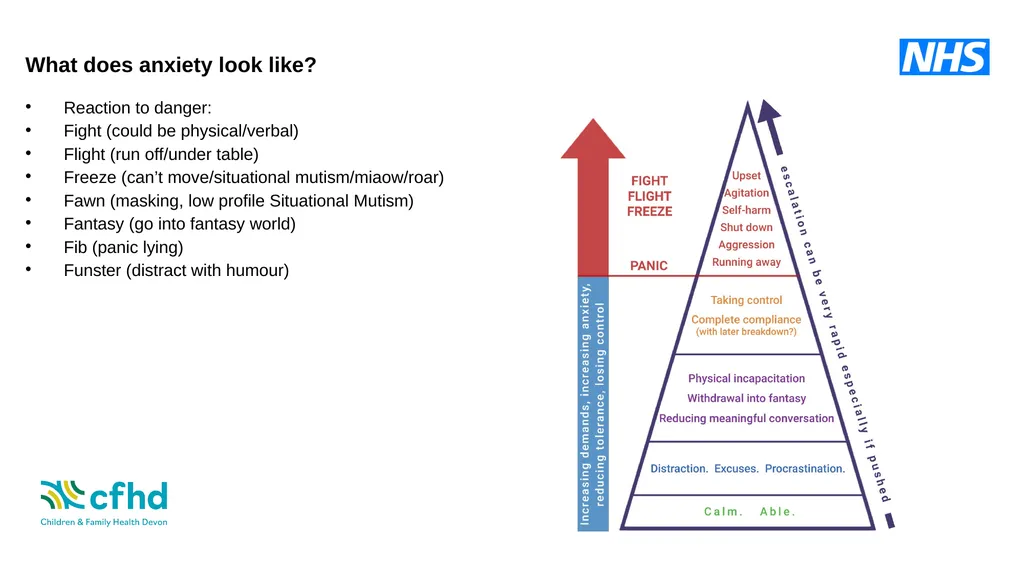
What does anxiety look like?
Reaction to danger:
Fight (could be physical/verbal)
Flight (run off/under table)
Freeze (can’t move/situational mutism/miaow/roar)
Fawn (masking, low profile Situational Mutism)
Fantasy (go into fantasy world)
Fib (panic lying)
Funster (distract with humour)<br>
05
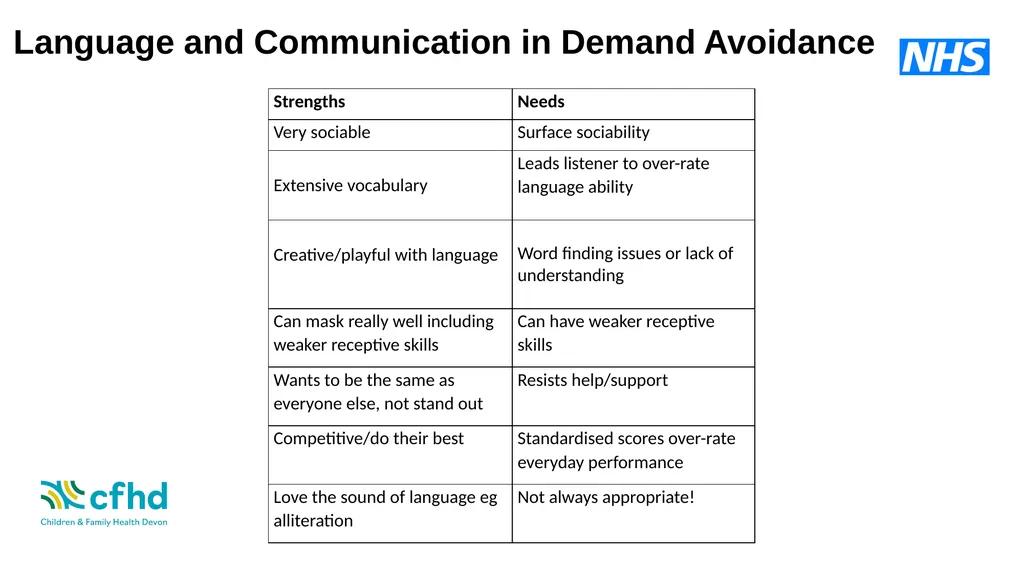
Language and Communication in Demand Avoidance<br>
06
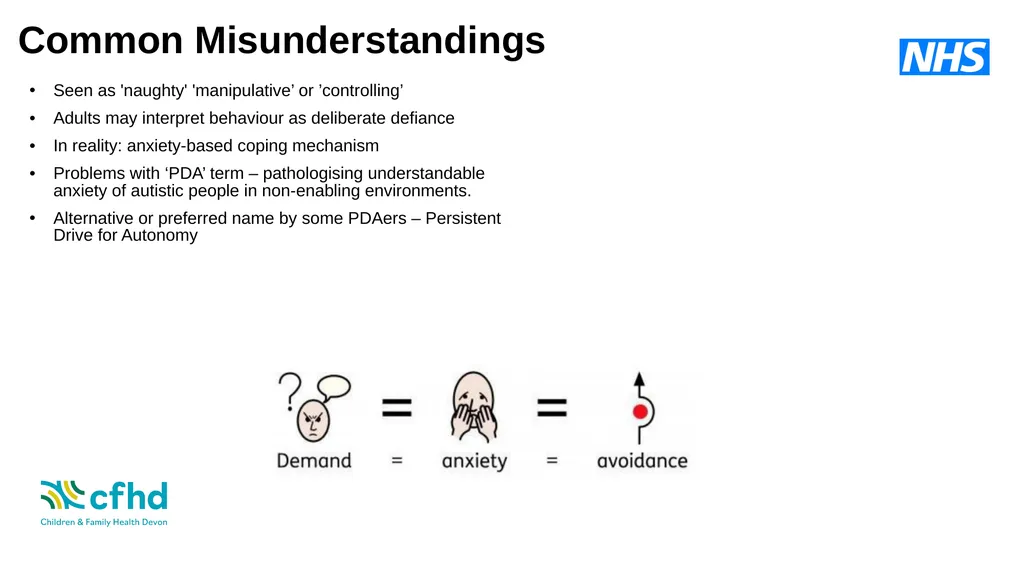
Common Misunderstandings Seen as 'naughty' 'manipulative’ or ’controlling’
Adults may interpret behaviour as deliberate defiance
In reality: anxiety-based coping mechanism
Problems with ‘PDA’ term – pathologising understandable anxiety of autistic people in non-enabling environments.
Alternative or preferred name by some PDAers – Persistent Drive for Autonomy<br>
07
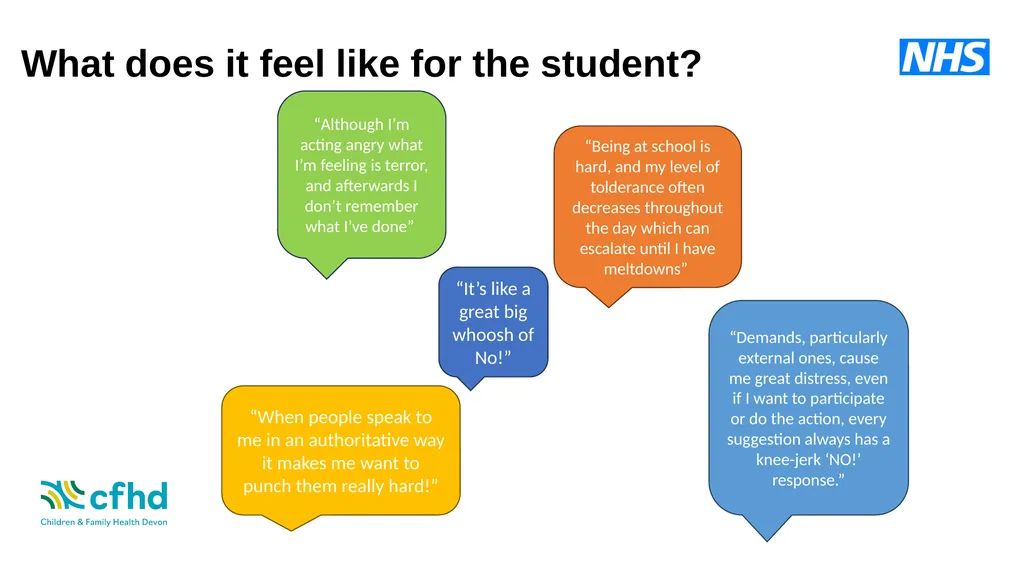
What does it feel like for the student? “Although I’m acting angry what I’m feeling is terror, and afterwards I don’t remember what I’ve done” “Being at school is hard, and my level of tolderance often decreases throughout the day which can escalate until I have meltdowns” “It’s like a great big whoosh of No!” “When people speak to me in an authoritative way it makes me want to punch them really hard!” “Demands, particularly external ones, cause me great distress, even if I want to participate or do the action, every suggestion always has a knee-jerk ‘NO!’ response.”<br>
08
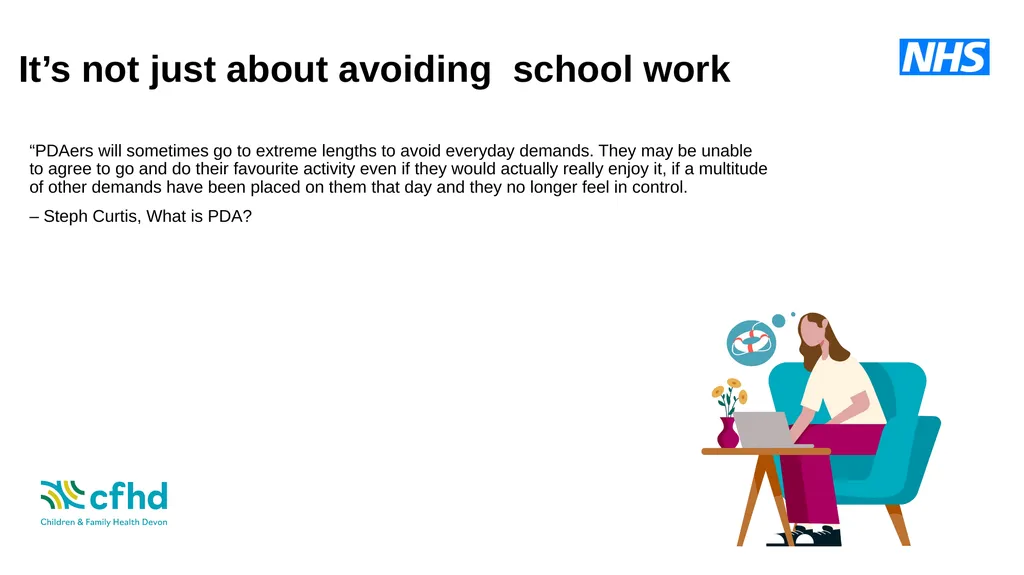
It’s not just about avoiding school work “PDAers will sometimes go to extreme lengths to avoid everyday demands. They may be unable to agree to go and do their favourite activity even if they would actually really enjoy it, if a multitude of other demands have been placed on them that day and they no longer feel in control.
– Steph Curtis, What is PDA?<br>
09
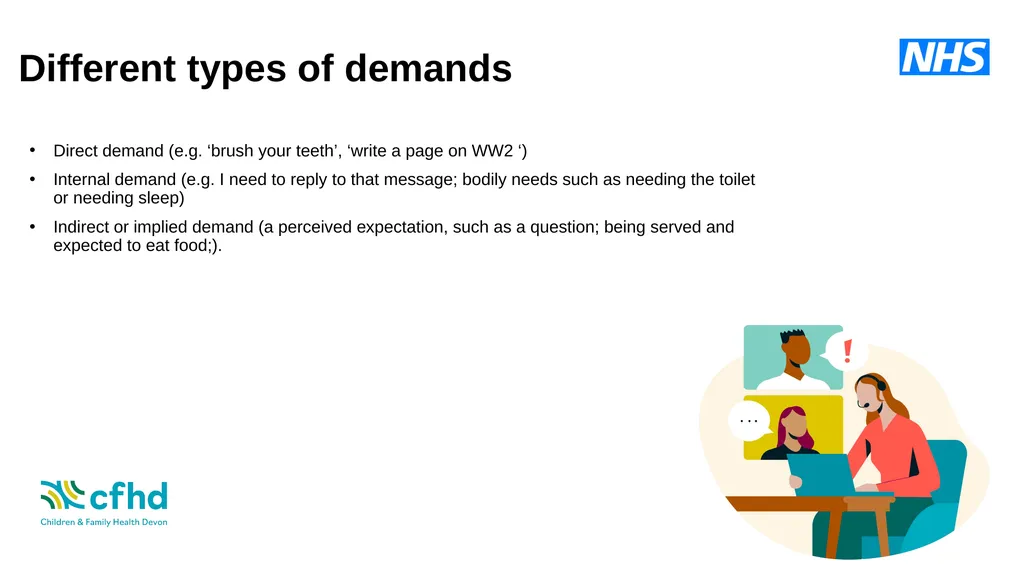
Different types of demands Direct demand (e.g. ‘brush your teeth’, ‘write a page on WW2 ‘)
Internal demand (e.g. I need to reply to that message; bodily needs such as needing the toilet or needing sleep)
Indirect or implied demand (a perceived expectation, such as a question; being served and expected to eat food;).<br>
10
Debate over PDA First described by psychologist Elizabeth Newson in 1980s, ‘PDA’ first published use in 2003 research.
PDA is not a clinical diagnostic category
No formally recognised assessment process
Demand avoidance is widely acknowledged as a characteristic reported by and observed in some people…
…but no research has found strong evidence for the group of traits proposed for PDA.
Differing views of autistic people about validity and usefulness of PDA as a label.
Some view label as problematic as it locates the issues within the autistic person rather in pressures created by the environment.
Demand Avoidance may be a more useful and less stigmatising descriptor.
NB: NHS does not offer assessment for/diagnose PDA<br>
11
How to Support – Key Principles Reduce pressure where possible
Offer choices and sense of autonomy
Work collaboratively to ease sense of hierarchy
Be honest
Build trust and emotional safety
Adjust your language
Use creativity, humour and novelty
Offer indirect praise
Be prepared to be flexible and think on your feet – find what works and follow it
Expect to change and evolve approach<br>
12
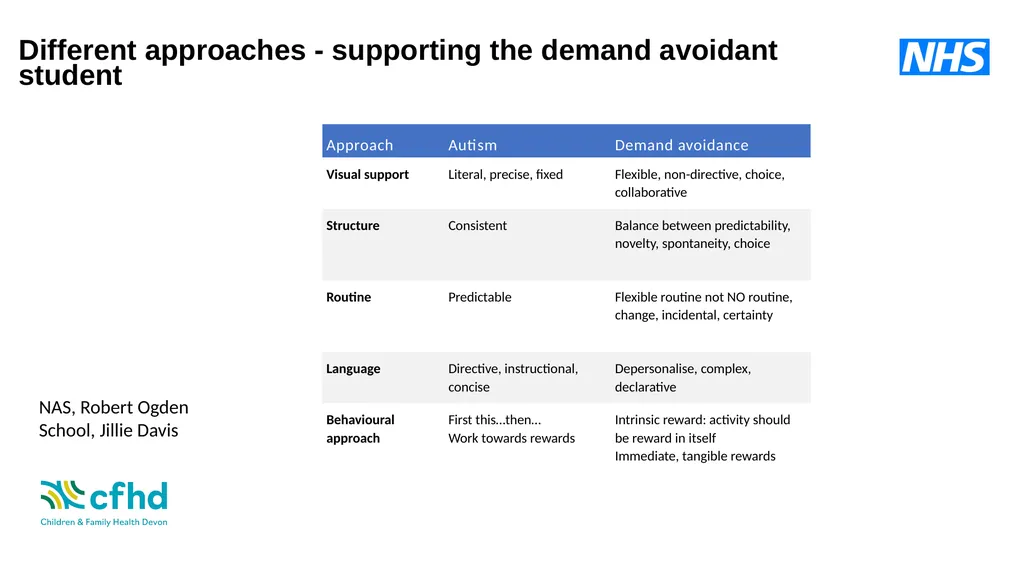
Different approaches - supporting the demand avoidant student NAS, Robert Ogden School, Jillie Davis<br>
13
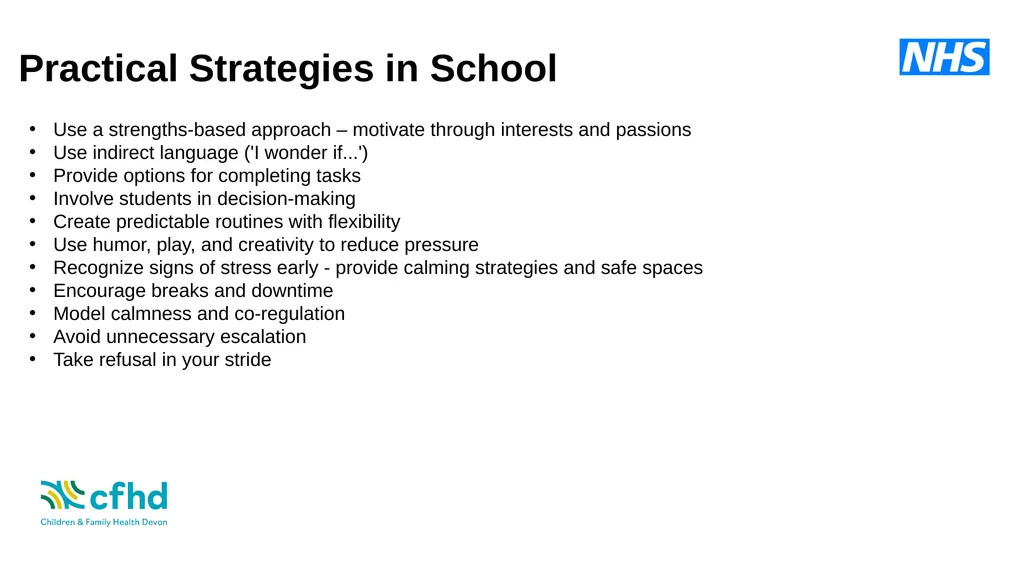
Practical Strategies in School Use a strengths-based approach – motivate through interests and passions
Use indirect language ('I wonder if...')
Provide options for completing tasks
Involve students in decision-making
Create predictable routines with flexibility
Use humor, play, and creativity to reduce pressure
Recognize signs of stress early - provide calming strategies and safe spaces
Encourage breaks and downtime
Model calmness and co-regulation
Avoid unnecessary escalation
Take refusal in your stride<br>
14
Remember PANDA as a way in… The PDA Society recommend using the PANDA mnemonic as a gentle guide……’the real work happens through connection, curiosity and trial and error’ https://www.pdasociety.org.uk/what-helps-guides/pda-approaches/panda-as-a-way-in/<br>
15
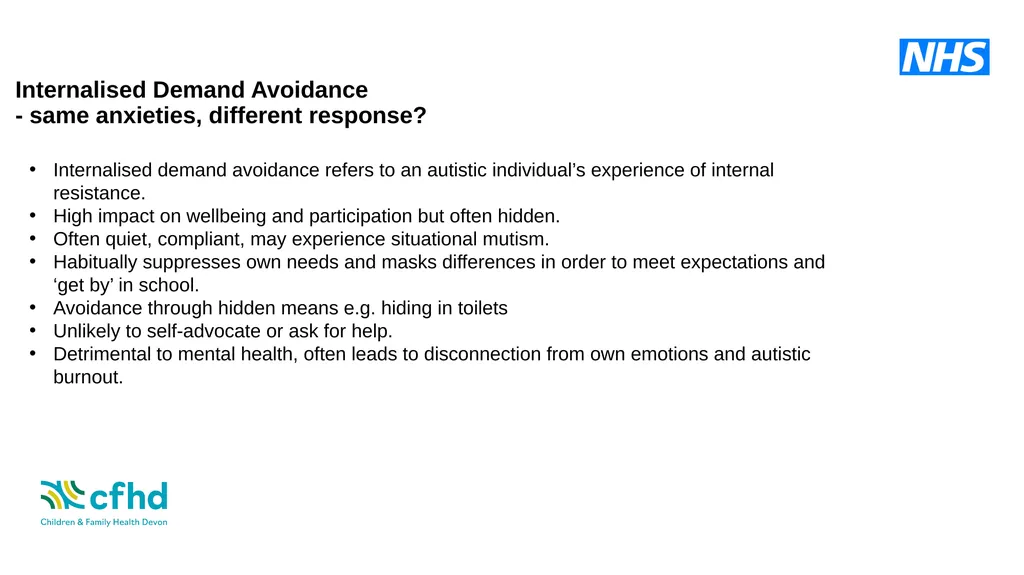
Internalised Demand Avoidance - same anxieties, different response? Internalised demand avoidance refers to an autistic individual’s experience of internal resistance.
High impact on wellbeing and participation but often hidden.
Often quiet, compliant, may experience situational mutism.
Habitually suppresses own needs and masks differences in order to meet expectations and ‘get by’ in school.
Avoidance through hidden means e.g. hiding in toilets
Unlikely to self-advocate or ask for help.
Detrimental to mental health, often leads to disconnection from own emotions and autistic burnout.<br>
16
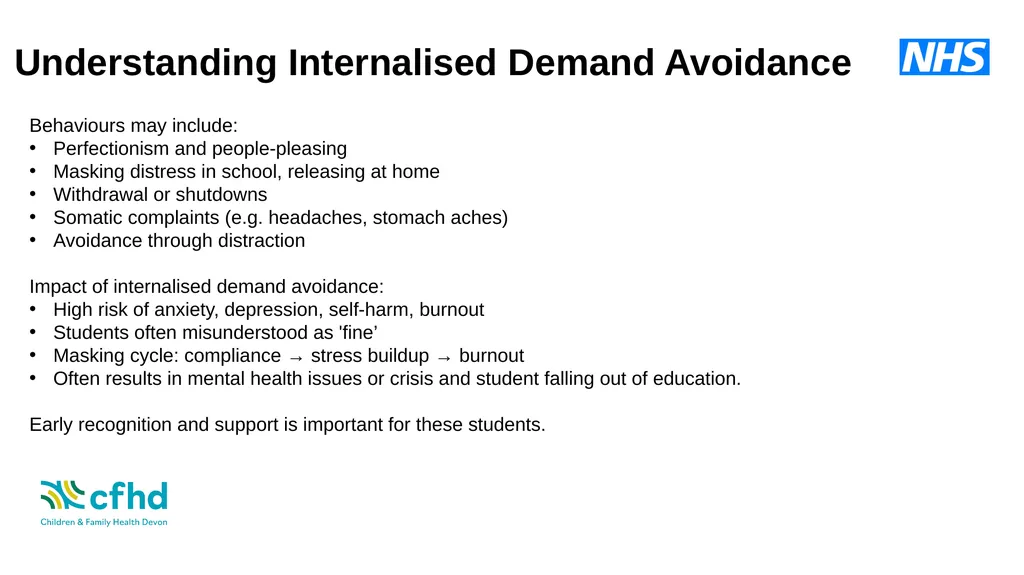
Understanding Internalised Demand Avoidance Behaviours may include:
Perfectionism and people-pleasing
Masking distress in school, releasing at home
Withdrawal or shutdowns
Somatic complaints (e.g. headaches, stomach aches)
Avoidance through distraction
Impact of internalised demand avoidance:
High risk of anxiety, depression, self-harm, burnout
Students often misunderstood as 'fine’
Masking cycle: compliance → stress buildup → burnout
Often results in mental health issues or crisis and student falling out of education.
Early recognition and support is important for these students.<br>
17
Spotting the Signs Always 'well-behaved' in school, exhausted at home
Frequent illnesses or requests to leave class
High achievers who avoid starting tasks
Sudden school refusal after long periods of coping
'Quiet' students overlooked until crisis point<br>
18
How does it feel inside? CONTENT<br>
19
Strategies for Support Use low-demand, indirect communication
Reduce performance pressure (avoid spotlighting)
Provide private alternatives to public tasks
Allow extra processing time
Create safe spaces for regulation
Use strengths and special interests to motivate
Offer choices and shared control
Encourage participation, but don’t force
Build trust through consistency
Focus on wellbeing, not just compliance<br>
20
Working with Families Parents often see the 'fallout' at home
Listen to family insights: they know their child best
Share strategies for consistency across home and school
Recognise hidden struggles even when behaviour looks 'fine'<br>