
UNDERSTANDING DISABILITY: Disability Inclusion













Description: UNDERSTANDING DISABILITY: Disability Inclusion Training Toolkit for Disability Inclusion in Care Reform By the end of this workshop you will be able to define disability describe the relationship between poverty and disability identify
Related Topics
Download Presentation
"UNDERSTANDING DISABILITY: Disability Inclusion" is the property of its rightful owner. Permission is granted to download and print the materials on this website for personal, non-commercial use only, and to display it on your personal computer provided you do not modify the materials and that you retain all copyright notices contained in the materials. By downloading content from our website, you accept the terms of this agreement.
Presentation Transcript
slide1. UNDERSTANDING DISABILITY:
Disability Inclusion Training Toolkit for Disability Inclusion in Care Reform<br>
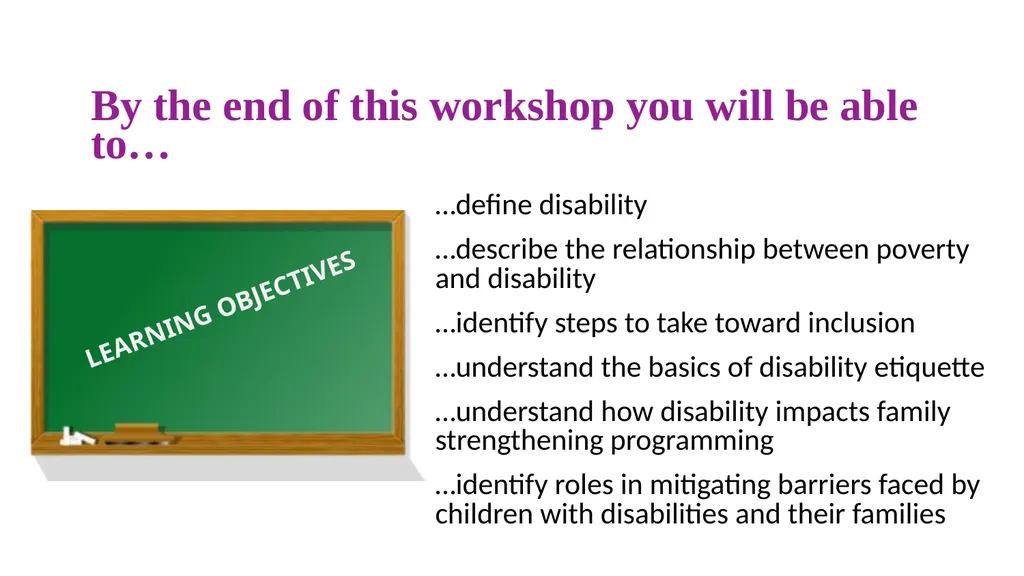
slide2. By the end of this workshop you will be able to… …define disability
…describe the relationship between poverty and disability
…identify steps to take toward inclusion
…understand the basics of disability etiquette
…understand how disability impacts family strengthening programming
…identify roles in mitigating barriers faced by children with disabilities and their families LEARNING OBJECTIVES<br>
slide3. Reflection What does the word disability mean to you?
What is your reaction when you see a person with a disability?
What personal experience do you have with disability, either with your own lived experience, within your family, or in your community?<br>
slide4. Defining Disability Persons with disabilities have long-term physical, mental, intellectual or sensory impairments which in interaction with various barriers may hinder their full and effective participation in society on an equal basis with others
Limited Activity- difficulty encountered by an individual in executing a task or action
Restricted participation- problem experienced by an individual in involvement in life situations
Impairment- problem in body function or structure, with varying severity<br>
slide5. Disability Models<br>
slide6. Global disability statistics 80% of people with disabilities live in developing nations 15% of global population 20% of people who live on < $1.25 per day in the world have a disability 6<br>
slide7. Disability and Poverty video<br>
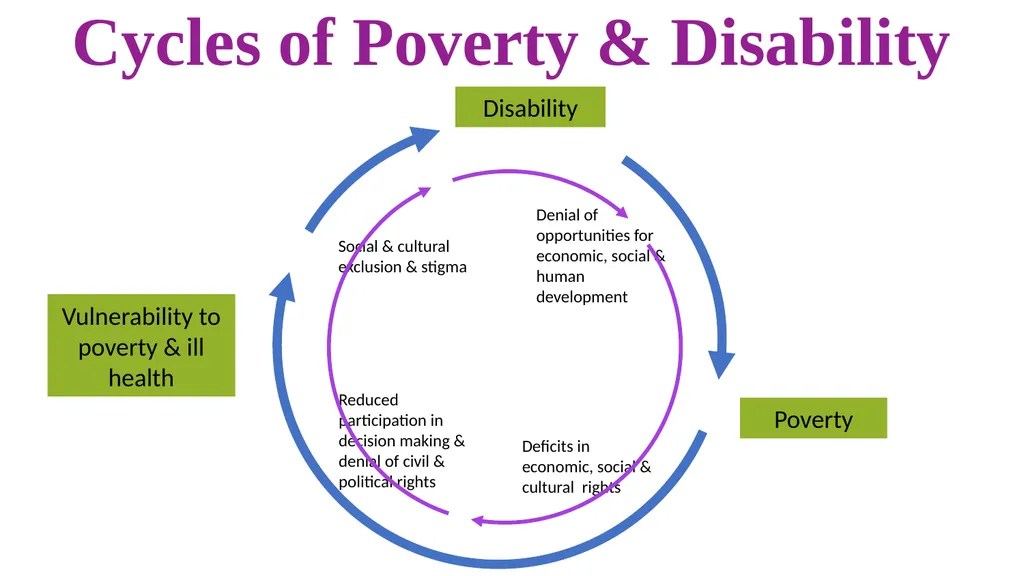
slide8. Cycles of Poverty & Disability Disability Poverty Vulnerability to poverty & ill health Social & cultural exclusion & stigma Reduced participation in decision making & denial of civil & political rights Deficits in economic, social & cultural rights Denial of opportunities for economic, social & human development<br>
slide9. Why should we care? “This is not just the right thing to do for common humanity – but it is the smart thing to do in ending extreme poverty. If we get things right for people with disabilities, we get things right for all people.”
Penny Mourdant, Secretary of State for International Development, UK. Global Disability Summit, July 2018<br>
slide10. Inclusion involves…<br>
slide11. Inclusion in Action Invite persons with disabilities to be part of the solution
Include the voices and interests of people with disabilities in project design, implementation, and evaluation
Collect disability-disaggregated data
Identify and address barriers to participation
Use accessible information and communication
Set aside a disability inclusion budget of 3-5%
Hire staff with disabilities<br>
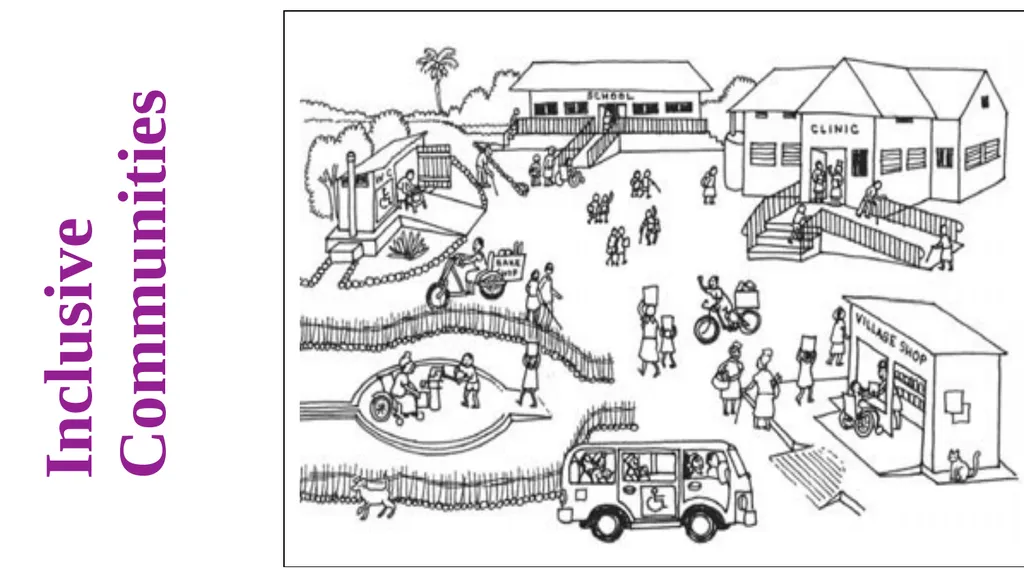
slide12. Inclusive Communities Inclusive Communities look like this<br>
slide13. Disability Terminology<br>
slide14. Etiquette Don’t touch personal equipment
Don’t victimize
Don’t assume
Adjust posture to eye-level
Make eye contact
Ask before providing assistance
Don’t underestimate abilities
Speak to the person before his/her caregiver<br>
slide15. Reflection What questions do you have?<br>
slide16. Rights Perspective UN Convention on the Rights of the Child
UN Convention on the Rights of People with Disabilities Views persons with disabilities with rights, capable of claiming rights & making decisions based on free / informed consent
Active members of society
Human rights instrument with social development dimension
Broad categorization of persons with disabilities<br>
slide17. Reflection How do these rights play out in your country or community?
How are they upheld?
What are the challenges to children with disabilities (and their caregivers) claiming those rights?<br>
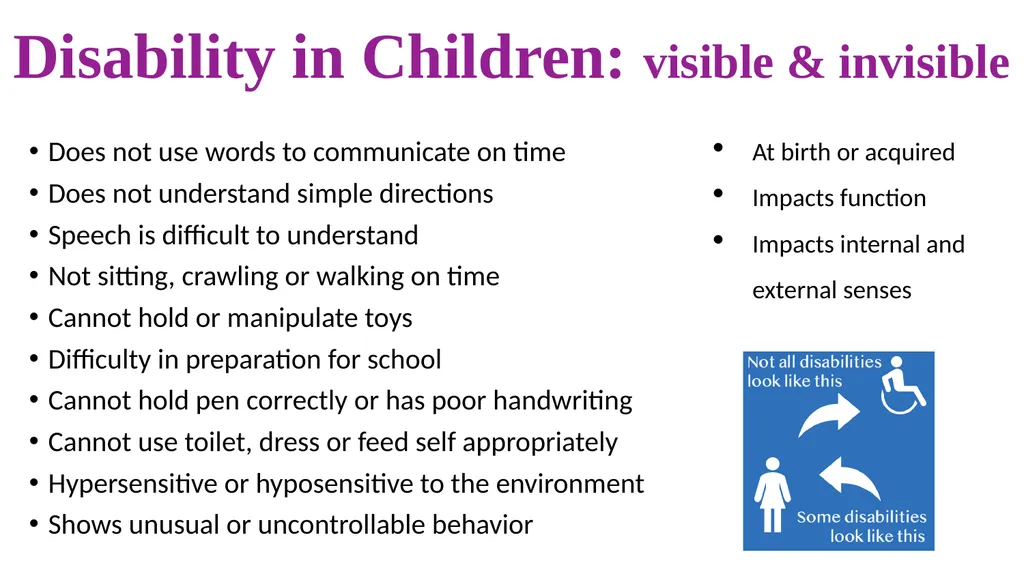
slide18. Disability in Children: visible & invisible Does not use words to communicate on time
Does not understand simple directions
Speech is difficult to understand
Not sitting, crawling or walking on time
Cannot hold or manipulate toys
Difficulty in preparation for school
Cannot hold pen correctly or has poor handwriting
Cannot use toilet, dress or feed self appropriately
Hypersensitive or hyposensitive to the environment
Shows unusual or uncontrollable behavior At birth or acquired
Impacts function
Impacts internal and external senses<br>
slide19. Reflection Not all disabilities are visible. What does this mean for our work?
How does institutionalization or family separation further impact a child with disability?
What are parents told by the community or doctors about their child with disability? How does that impact separation?
What community services could help parents keep their children with disabilities with them?
What’s your role in addressing those service gaps?<br>
slide20. Impact of Disability The child, in the present and future
Siblings
Parents
Family
Services
Society<br>
slide21. Why inclusion? Example of Kenya Disability is a key driver of child-family separation in Kenya
Children with disabilities are disproportionately represented in institutional care and more at risk of separation
Due to their complex needs and social barriers to inclusion, children with disabilities are often the first to be placed in institutional care and the last to leave
They can also be the hardest children to find in your community, because they face stigma and discrimination and thus can be kept hidden<br>
slide22. Inclusion Strategies: Example of Kenya<br>
slide23. Reflection Why is inclusion important in our context?
How can we respond to the impact of disability our programming?
What’s holding us back right now?<br>
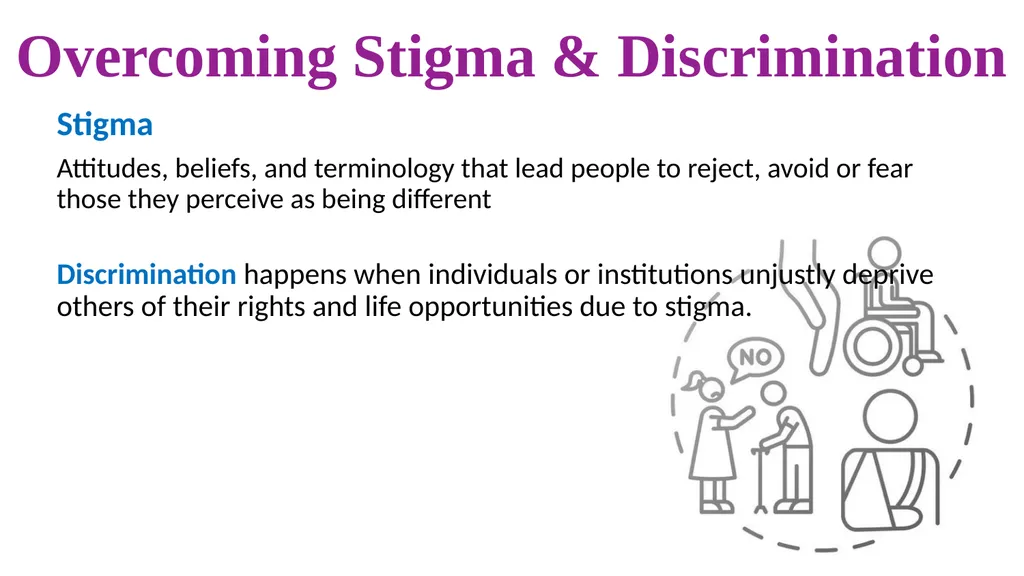
slide24. Overcoming Stigma & Discrimination Stigma
Attitudes, beliefs, and terminology that lead people to reject, avoid or fear those they perceive as being different
Discrimination happens when individuals or institutions unjustly deprive others of their rights and life opportunities due to stigma.<br>
slide25. Importance of Community Engagement Faith communities
Schools
Health centers
Parent Networks
Community Based Rehabilitation
Organizations of Persons with Disabilities<br>
slide26. Reflection What are the resources, services, and capacities available in your country context?
How can you engage these to build strong community actions that support family-based care?<br>
slide27. Data Global gaps in quality data on disability, especially for children. Even bigger gaps at country level.
Useful for informing program design, adaptations mid-cycle, and advocacy
Consider what we collect, how we collect it, and how it’s used
Disaggregation can help us see gaps<br>
slide28. Reflection What kinds of data are we collecting on children with disabilities and their families?
What more should we be collecting? How would we use it to inform program design and adaptations?<br>
slide29. Key Take Away<br>
slide30. Closing slide Need to know more?
info@ctwwc.org or visit changingthewaywecare.org
©2021 Maestral International LLC. All Rights Reserved. This material may not be reproduced, displayed, modified or distributed without the express prior written permission of copyright holder. For permission, write to info@ctwwc.org. The photographs in this publication are used for illustrative purposes only; they do not imply any particular health, orphanhood, or residential care status on the part of any person who appears in the photographs.<br>
slide2. By the end of this workshop you will be able to… …define disability
…describe the relationship between poverty and disability
…identify steps to take toward inclusion
…understand the basics of disability etiquette
…understand how disability impacts family strengthening programming
…identify roles in mitigating barriers faced by children with disabilities and their families LEARNING OBJECTIVES<br>
slide3. Reflection What does the word disability mean to you?
What is your reaction when you see a person with a disability?
What personal experience do you have with disability, either with your own lived experience, within your family, or in your community?<br>
slide4. Defining Disability Persons with disabilities have long-term physical, mental, intellectual or sensory impairments which in interaction with various barriers may hinder their full and effective participation in society on an equal basis with others
Limited Activity- difficulty encountered by an individual in executing a task or action
Restricted participation- problem experienced by an individual in involvement in life situations
Impairment- problem in body function or structure, with varying severity<br>
slide5. Disability Models<br>
slide6. Global disability statistics 80% of people with disabilities live in developing nations 15% of global population 20% of people who live on < $1.25 per day in the world have a disability 6<br>
slide7. Disability and Poverty video<br>
slide8. Cycles of Poverty & Disability Disability Poverty Vulnerability to poverty & ill health Social & cultural exclusion & stigma Reduced participation in decision making & denial of civil & political rights Deficits in economic, social & cultural rights Denial of opportunities for economic, social & human development<br>
slide9. Why should we care? “This is not just the right thing to do for common humanity – but it is the smart thing to do in ending extreme poverty. If we get things right for people with disabilities, we get things right for all people.”
Penny Mourdant, Secretary of State for International Development, UK. Global Disability Summit, July 2018<br>
slide10. Inclusion involves…<br>
slide11. Inclusion in Action Invite persons with disabilities to be part of the solution
Include the voices and interests of people with disabilities in project design, implementation, and evaluation
Collect disability-disaggregated data
Identify and address barriers to participation
Use accessible information and communication
Set aside a disability inclusion budget of 3-5%
Hire staff with disabilities<br>
slide12. Inclusive Communities Inclusive Communities look like this<br>
slide13. Disability Terminology<br>
slide14. Etiquette Don’t touch personal equipment
Don’t victimize
Don’t assume
Adjust posture to eye-level
Make eye contact
Ask before providing assistance
Don’t underestimate abilities
Speak to the person before his/her caregiver<br>
slide15. Reflection What questions do you have?<br>
slide16. Rights Perspective UN Convention on the Rights of the Child
UN Convention on the Rights of People with Disabilities Views persons with disabilities with rights, capable of claiming rights & making decisions based on free / informed consent
Active members of society
Human rights instrument with social development dimension
Broad categorization of persons with disabilities<br>
slide17. Reflection How do these rights play out in your country or community?
How are they upheld?
What are the challenges to children with disabilities (and their caregivers) claiming those rights?<br>
slide18. Disability in Children: visible & invisible Does not use words to communicate on time
Does not understand simple directions
Speech is difficult to understand
Not sitting, crawling or walking on time
Cannot hold or manipulate toys
Difficulty in preparation for school
Cannot hold pen correctly or has poor handwriting
Cannot use toilet, dress or feed self appropriately
Hypersensitive or hyposensitive to the environment
Shows unusual or uncontrollable behavior At birth or acquired
Impacts function
Impacts internal and external senses<br>
slide19. Reflection Not all disabilities are visible. What does this mean for our work?
How does institutionalization or family separation further impact a child with disability?
What are parents told by the community or doctors about their child with disability? How does that impact separation?
What community services could help parents keep their children with disabilities with them?
What’s your role in addressing those service gaps?<br>
slide20. Impact of Disability The child, in the present and future
Siblings
Parents
Family
Services
Society<br>
slide21. Why inclusion? Example of Kenya Disability is a key driver of child-family separation in Kenya
Children with disabilities are disproportionately represented in institutional care and more at risk of separation
Due to their complex needs and social barriers to inclusion, children with disabilities are often the first to be placed in institutional care and the last to leave
They can also be the hardest children to find in your community, because they face stigma and discrimination and thus can be kept hidden<br>
slide22. Inclusion Strategies: Example of Kenya<br>
slide23. Reflection Why is inclusion important in our context?
How can we respond to the impact of disability our programming?
What’s holding us back right now?<br>
slide24. Overcoming Stigma & Discrimination Stigma
Attitudes, beliefs, and terminology that lead people to reject, avoid or fear those they perceive as being different
Discrimination happens when individuals or institutions unjustly deprive others of their rights and life opportunities due to stigma.<br>
slide25. Importance of Community Engagement Faith communities
Schools
Health centers
Parent Networks
Community Based Rehabilitation
Organizations of Persons with Disabilities<br>
slide26. Reflection What are the resources, services, and capacities available in your country context?
How can you engage these to build strong community actions that support family-based care?<br>
slide27. Data Global gaps in quality data on disability, especially for children. Even bigger gaps at country level.
Useful for informing program design, adaptations mid-cycle, and advocacy
Consider what we collect, how we collect it, and how it’s used
Disaggregation can help us see gaps<br>
slide28. Reflection What kinds of data are we collecting on children with disabilities and their families?
What more should we be collecting? How would we use it to inform program design and adaptations?<br>
slide29. Key Take Away<br>
slide30. Closing slide Need to know more?
info@ctwwc.org or visit changingthewaywecare.org
©2021 Maestral International LLC. All Rights Reserved. This material may not be reproduced, displayed, modified or distributed without the express prior written permission of copyright holder. For permission, write to info@ctwwc.org. The photographs in this publication are used for illustrative purposes only; they do not imply any particular health, orphanhood, or residential care status on the part of any person who appears in the photographs.<br>