
Unit 3 Biological Bases of Behavior Module 14
CB
Published · 32 slides · 0 views

1 / 1
Description
Unit 3 Biological Bases of Behavior Module 14 Behavior Genetics: Predicting Individual Differences Learning Targets 14-1 Define chromosomes, DNA, genes, and the human genome, and describe how behavior geneticists explain our individual
Related Topics
Share
Embed code
Download this presentation From Below
"Unit 3 Biological Bases of Behavior Module 14" is the property of its rightful owner. Permission is granted to download and print the materials on this website for personal, non-commercial use only, and to display it on your personal computer provided you do not modify the materials and that you retain all copyright notices contained in the materials. By downloading content from our website, you accept the terms of this agreement.
Presentation Transcript
01
Unit 3
Biological Bases of Behavior<br>
02
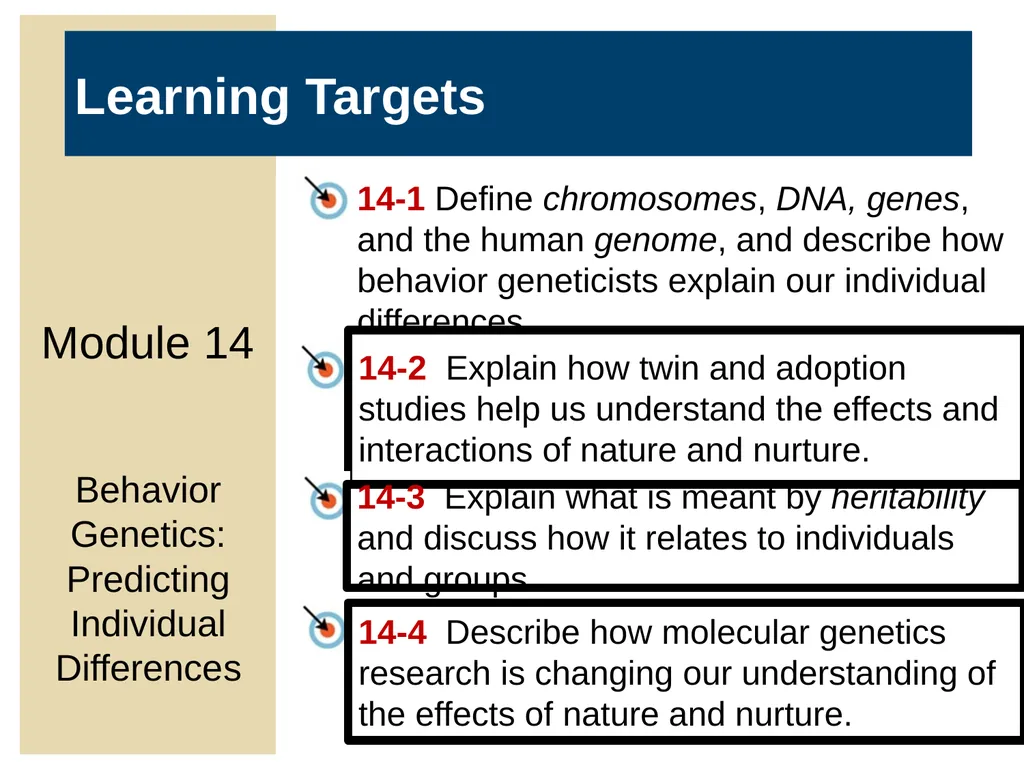
Module 14 Behavior Genetics: Predicting Individual Differences Learning Targets 14-1 Define chromosomes, DNA, genes, and the human genome, and describe how behavior geneticists explain our individual differences. 14-2 Explain how twin and adoption studies help us understand the effects and interactions of nature and nurture. 14-3 Explain what is meant by heritability and discuss how it relates to individuals and groups. 14-4 Describe how molecular genetics research is changing our understanding of the effects of nature and nurture.<br>
03
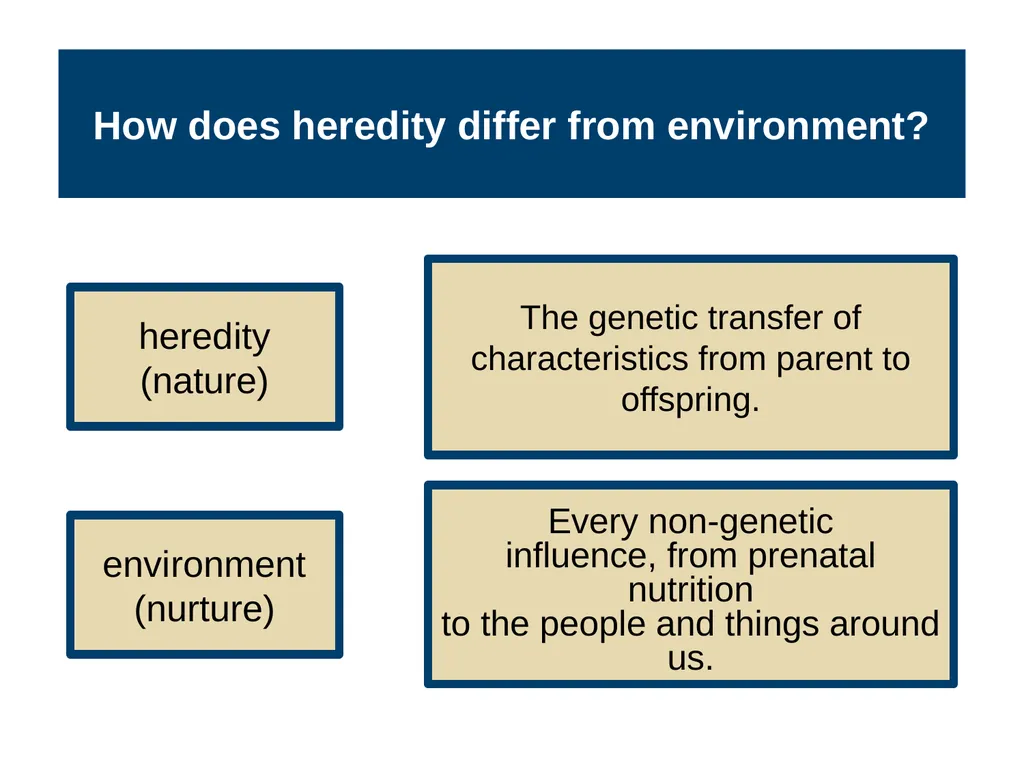
How does heredity differ from environment? heredity
(nature) The genetic transfer of characteristics from parent to offspring. environment
(nurture) Every non-genetic
influence, from prenatal nutrition
to the people and things around us.<br>
(nature) The genetic transfer of characteristics from parent to offspring. environment
(nurture) Every non-genetic
influence, from prenatal nutrition
to the people and things around us.<br>
04
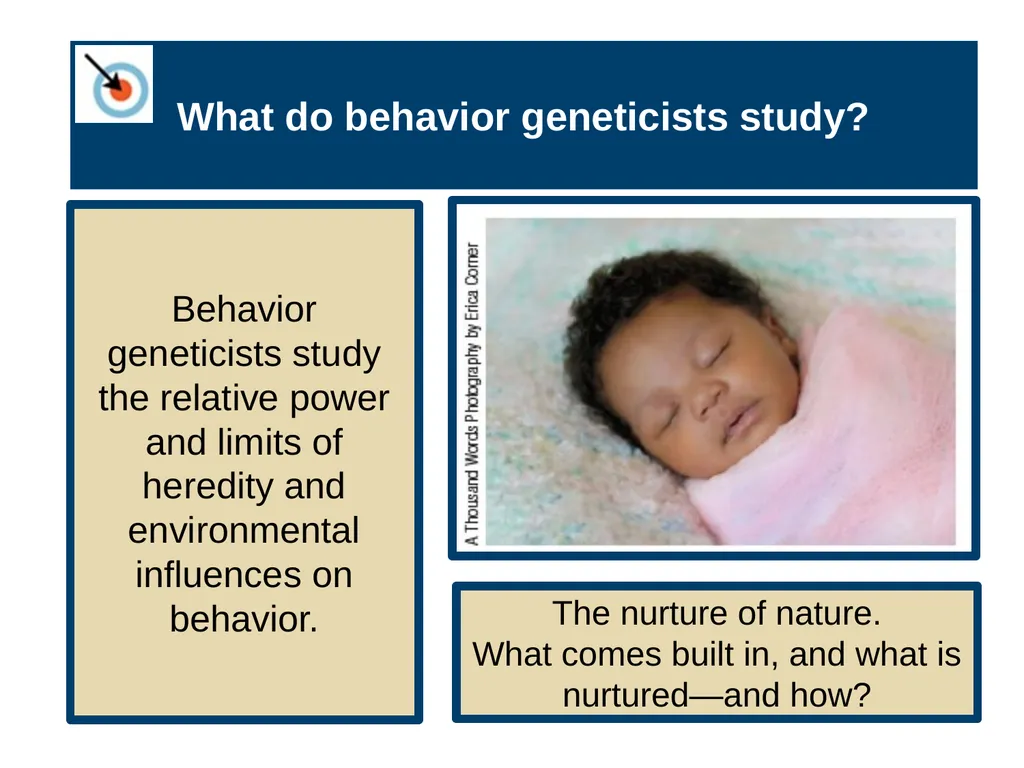
What do behavior geneticists study? Behavior geneticists study
the relative power and limits of heredity and environmental
influences on behavior. The nurture of nature.
What comes built in, and what is nurtured—and how?<br>
the relative power and limits of heredity and environmental
influences on behavior. The nurture of nature.
What comes built in, and what is nurtured—and how?<br>
05
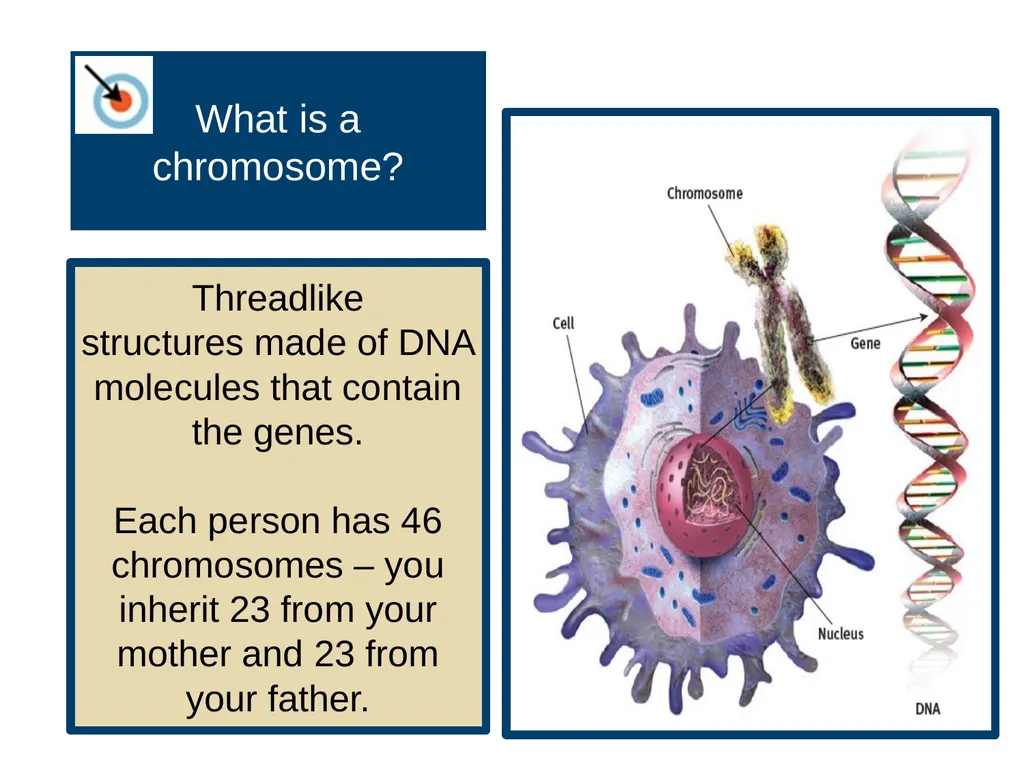
What is a chromosome? Threadlike
structures made of DNA molecules that contain the genes.
Each person has 46 chromosomes – you inherit 23 from your mother and 23 from your father.<br>
structures made of DNA molecules that contain the genes.
Each person has 46 chromosomes – you inherit 23 from your mother and 23 from your father.<br>
06
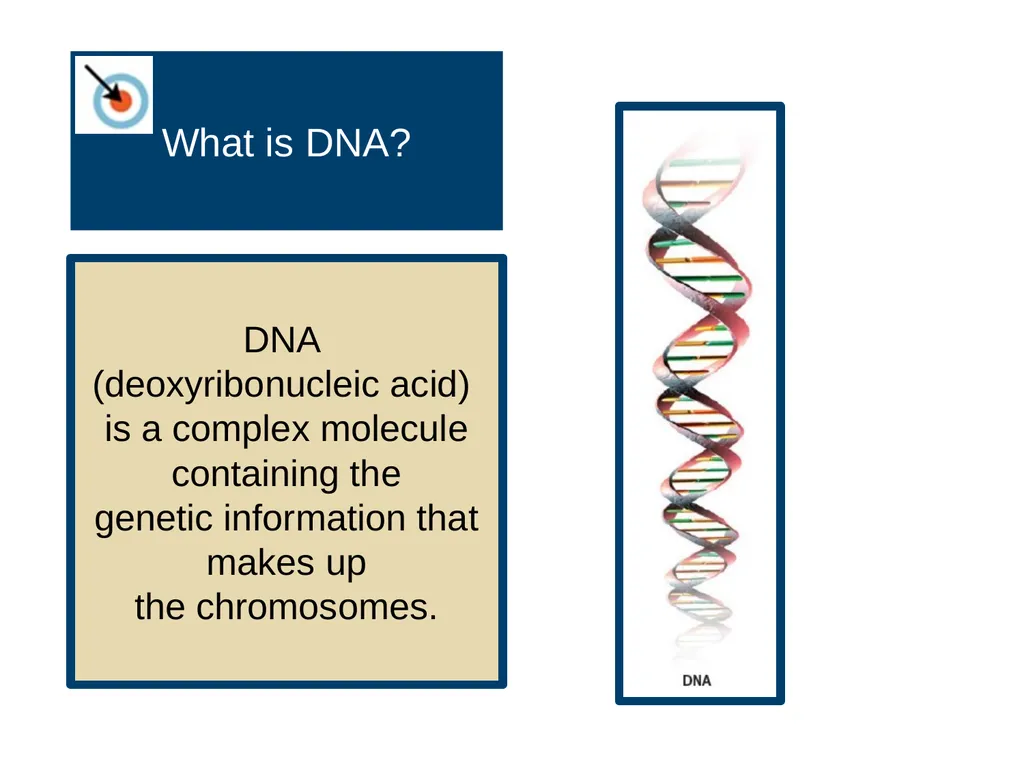
What is DNA? DNA
(deoxyribonucleic acid)
is a complex molecule containing the
genetic information that makes up
the chromosomes.<br>
(deoxyribonucleic acid)
is a complex molecule containing the
genetic information that makes up
the chromosomes.<br>
07
What are
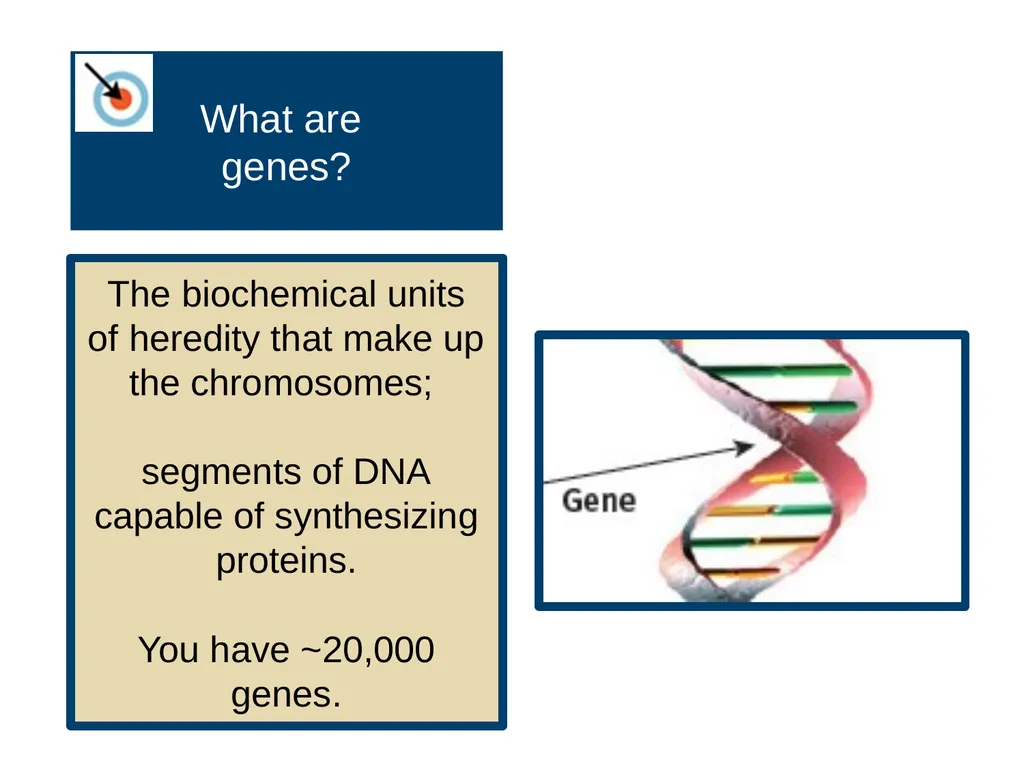
genes? The biochemical units
of heredity that make up the chromosomes;
segments of DNA
capable of synthesizing proteins.
You have ~20,000 genes.<br>
of heredity that make up the chromosomes;
segments of DNA
capable of synthesizing proteins.
You have ~20,000 genes.<br>
08
What is the human genome? The complete instructions for making a human organism, consisting of all the genetic material in that human’s chromosomes.
Researchers have discovered a common sequence within human DNA.
This shared genetic profile is what makes us humans, rather than tulips, bananas, or chimpanzees.<br>
Researchers have discovered a common sequence within human DNA.
This shared genetic profile is what makes us humans, rather than tulips, bananas, or chimpanzees.<br>
09
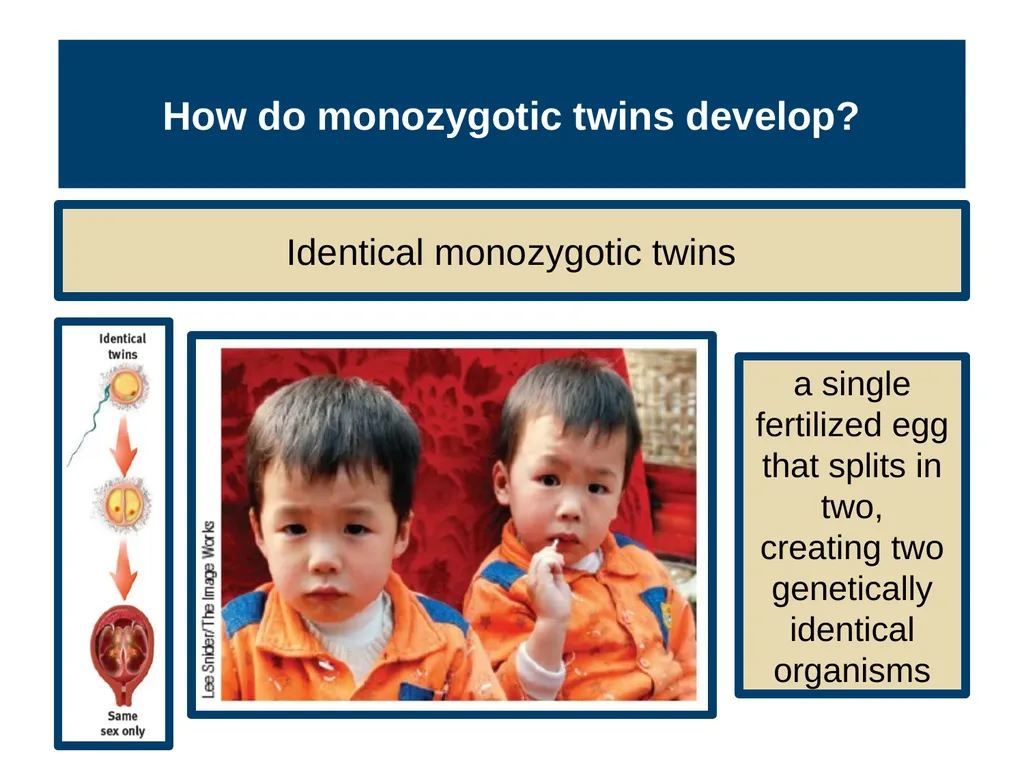
How do monozygotic twins develop? Identical monozygotic twins a single
fertilized egg that splits in two,
creating two genetically identical
organisms<br>
fertilized egg that splits in two,
creating two genetically identical
organisms<br>
10
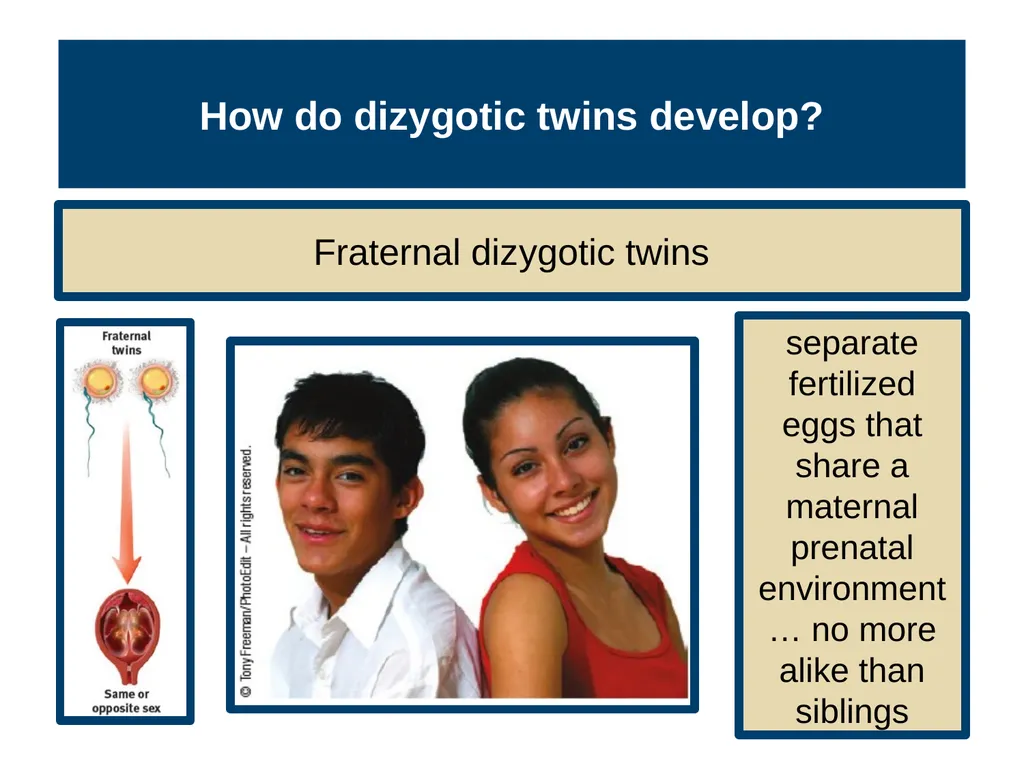
How do dizygotic twins develop? Fraternal dizygotic twins separate fertilized eggs that share a maternal prenatal environment… no more alike than siblings<br>
11
How do MZ and DZ twin studies help
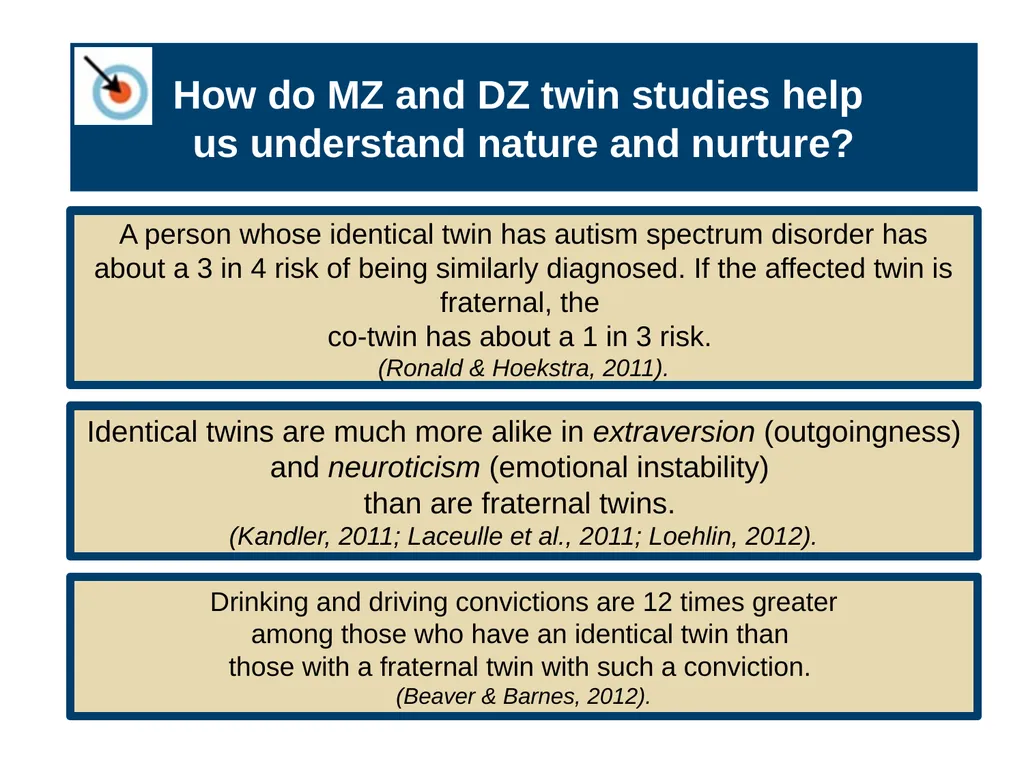
us understand nature and nurture? A person whose identical twin has autism spectrum disorder has about a 3 in 4 risk of being similarly diagnosed. If the affected twin is fraternal, the
co-twin has about a 1 in 3 risk.
(Ronald & Hoekstra, 2011). Identical twins are much more alike in extraversion (outgoingness) and neuroticism (emotional instability)
than are fraternal twins.
(Kandler, 2011; Laceulle et al., 2011; Loehlin, 2012). Drinking and driving convictions are 12 times greater
among those who have an identical twin than
those with a fraternal twin with such a conviction.
(Beaver & Barnes, 2012).<br>
co-twin has about a 1 in 3 risk.
(Ronald & Hoekstra, 2011). Identical twins are much more alike in extraversion (outgoingness) and neuroticism (emotional instability)
than are fraternal twins.
(Kandler, 2011; Laceulle et al., 2011; Loehlin, 2012). Drinking and driving convictions are 12 times greater
among those who have an identical twin than
those with a fraternal twin with such a conviction.
(Beaver & Barnes, 2012).<br>
12
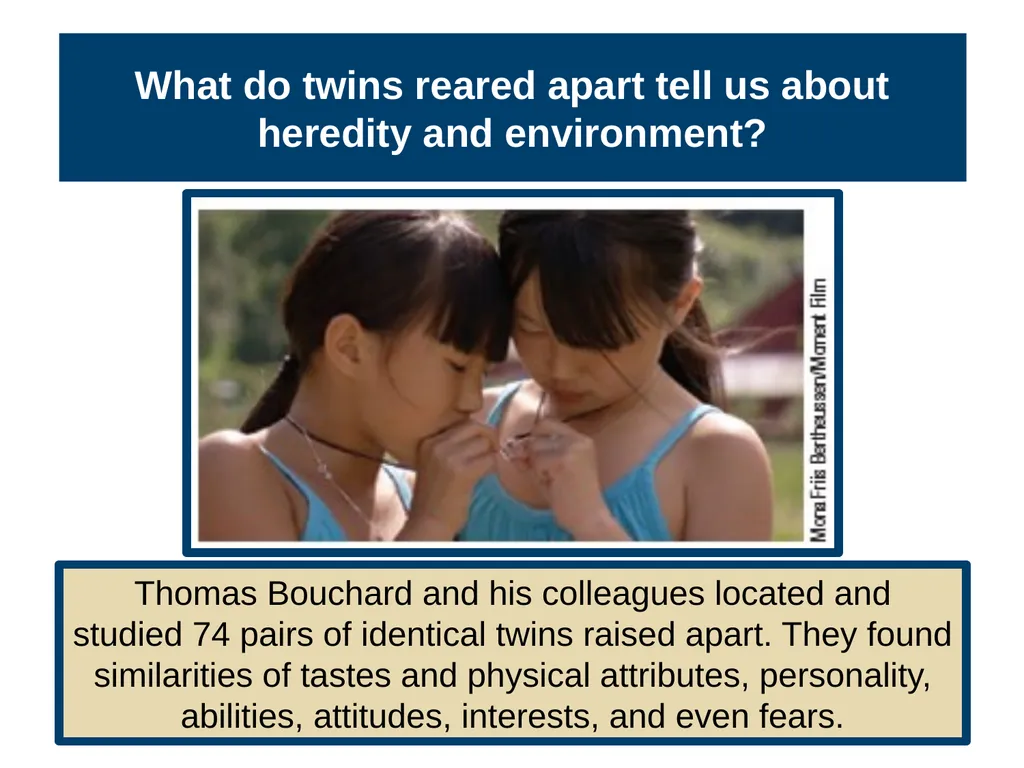
What do twins reared apart tell us about heredity and environment? Thomas Bouchard and his colleagues located and
studied 74 pairs of identical twins raised apart. They found similarities of tastes and physical attributes, personality, abilities, attitudes, interests, and even fears.<br>
studied 74 pairs of identical twins raised apart. They found similarities of tastes and physical attributes, personality, abilities, attitudes, interests, and even fears.<br>
13
How do adoption studies help us
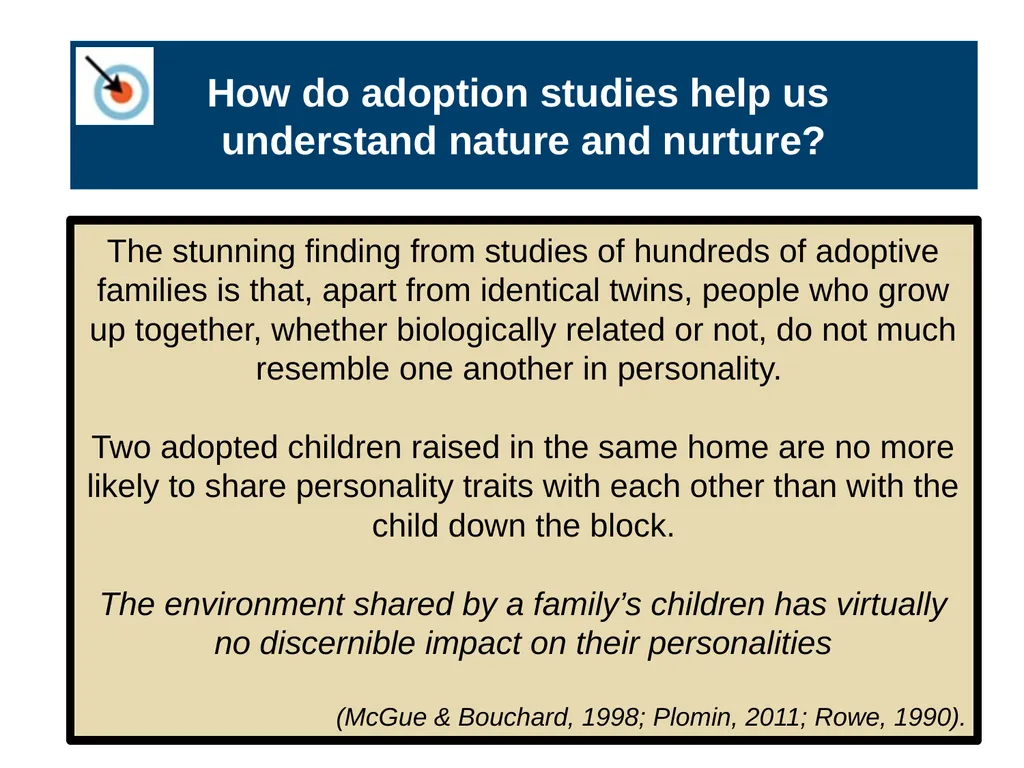
understand nature and nurture? The stunning finding from studies of hundreds of adoptive families is that, apart from identical twins, people who grow up together, whether biologically related or not, do not much resemble one another in personality.
Two adopted children raised in the same home are no more likely to share personality traits with each other than with the child down the block.
The environment shared by a family’s children has virtually no discernible impact on their personalities
(McGue & Bouchard, 1998; Plomin, 2011; Rowe, 1990).<br>
Two adopted children raised in the same home are no more likely to share personality traits with each other than with the child down the block.
The environment shared by a family’s children has virtually no discernible impact on their personalities
(McGue & Bouchard, 1998; Plomin, 2011; Rowe, 1990).<br>
14
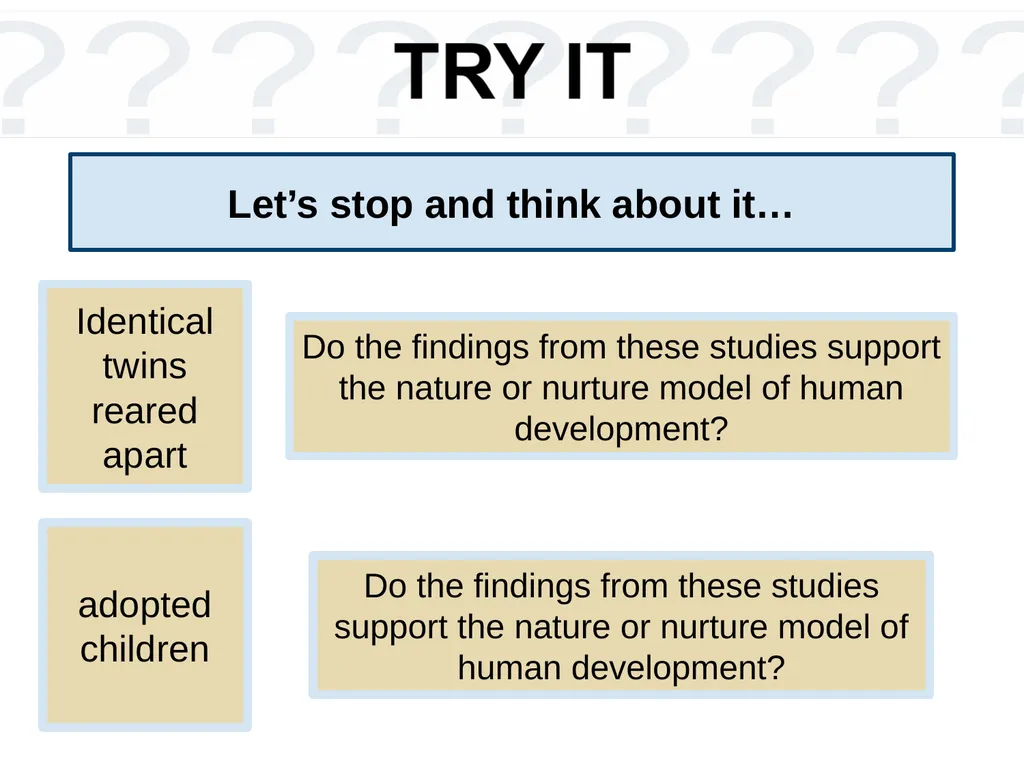
Let’s stop and think about it… Identical twins reared apart Do the findings from these studies support the nature or nurture model of human development? adopted children Do the findings from these studies support the nature or nurture model of human development?<br>
15
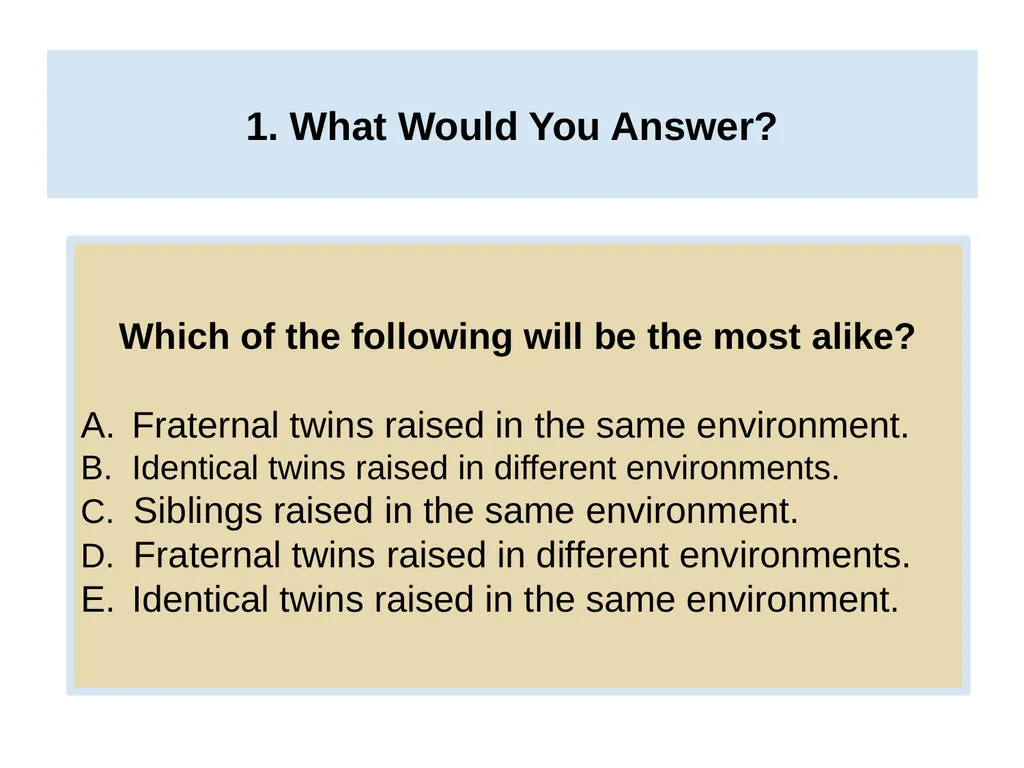
1. What Would You Answer? Which of the following will be the most alike?
Fraternal twins raised in the same environment.
B. Identical twins raised in different environments.
C. Siblings raised in the same environment.
D. Fraternal twins raised in different environments.
Identical twins raised in the same environment.<br>
Fraternal twins raised in the same environment.
B. Identical twins raised in different environments.
C. Siblings raised in the same environment.
D. Fraternal twins raised in different environments.
Identical twins raised in the same environment.<br>
16
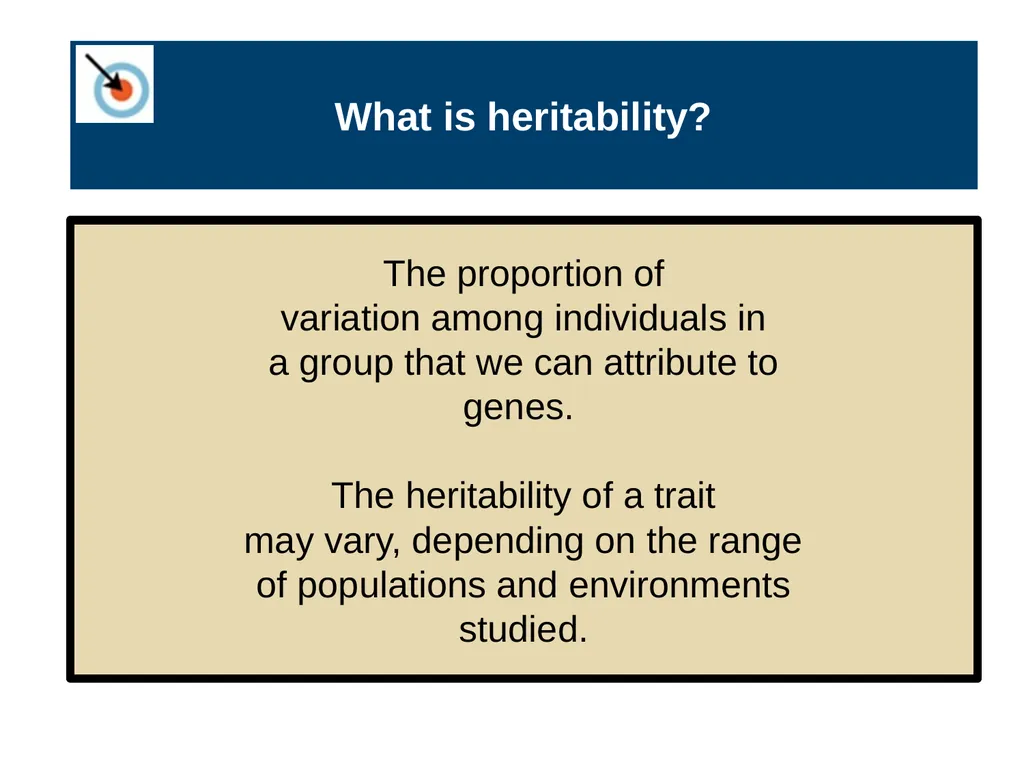
What is heritability? The proportion of
variation among individuals in
a group that we can attribute to
genes.
The heritability of a trait
may vary, depending on the range
of populations and environments
studied.<br>
variation among individuals in
a group that we can attribute to
genes.
The heritability of a trait
may vary, depending on the range
of populations and environments
studied.<br>
17
How do behavior geneticists
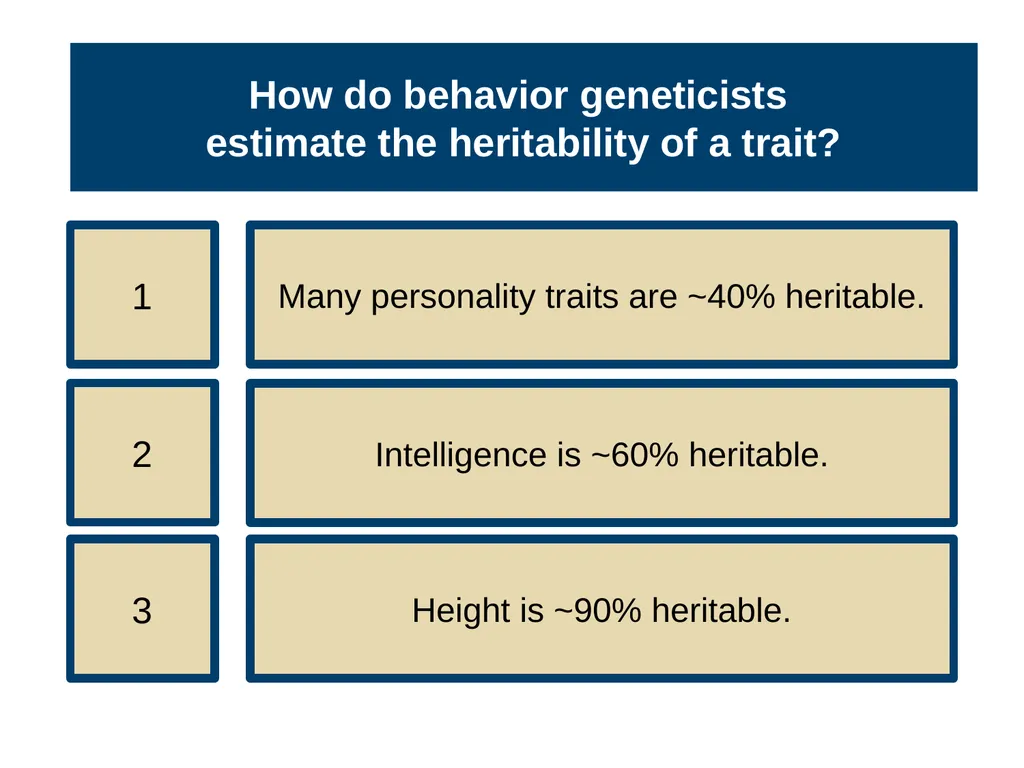
estimate the heritability of a trait? 1 Many personality traits are ~40% heritable. 2 Intelligence is ~60% heritable. 3 Height is ~90% heritable.<br>
18
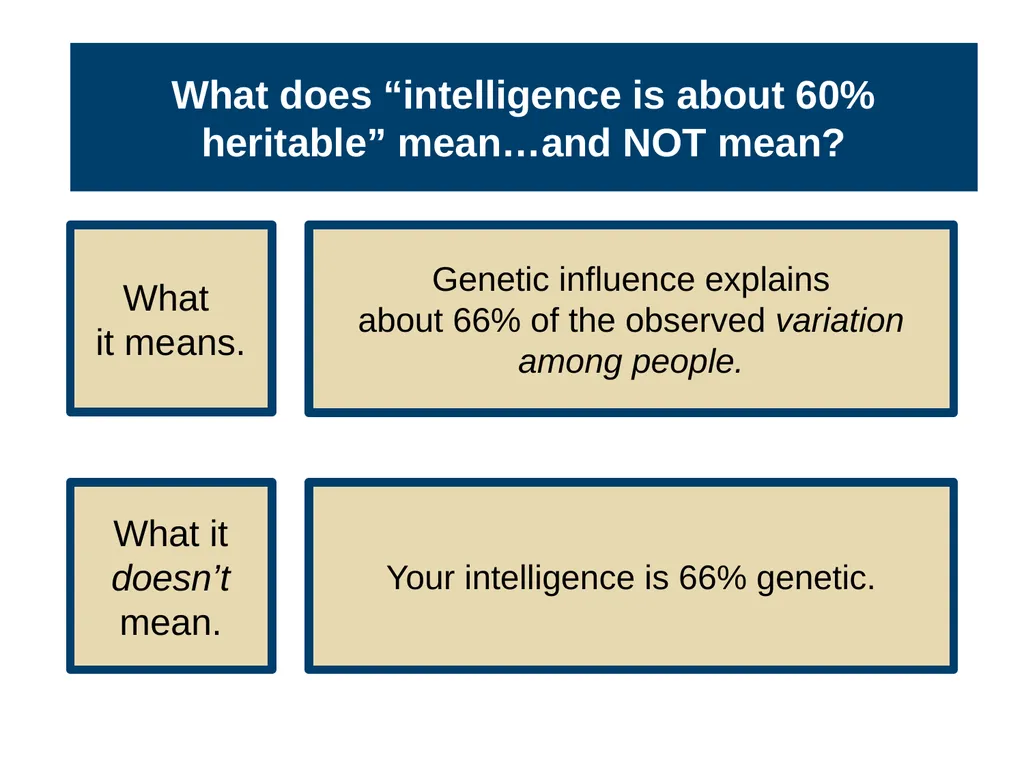
What does “intelligence is about 60% heritable” mean…and NOT mean? What
it means. Genetic influence explains
about 66% of the observed variation among people. What it doesn’t mean. Your intelligence is 66% genetic.<br>
it means. Genetic influence explains
about 66% of the observed variation among people. What it doesn’t mean. Your intelligence is 66% genetic.<br>
19
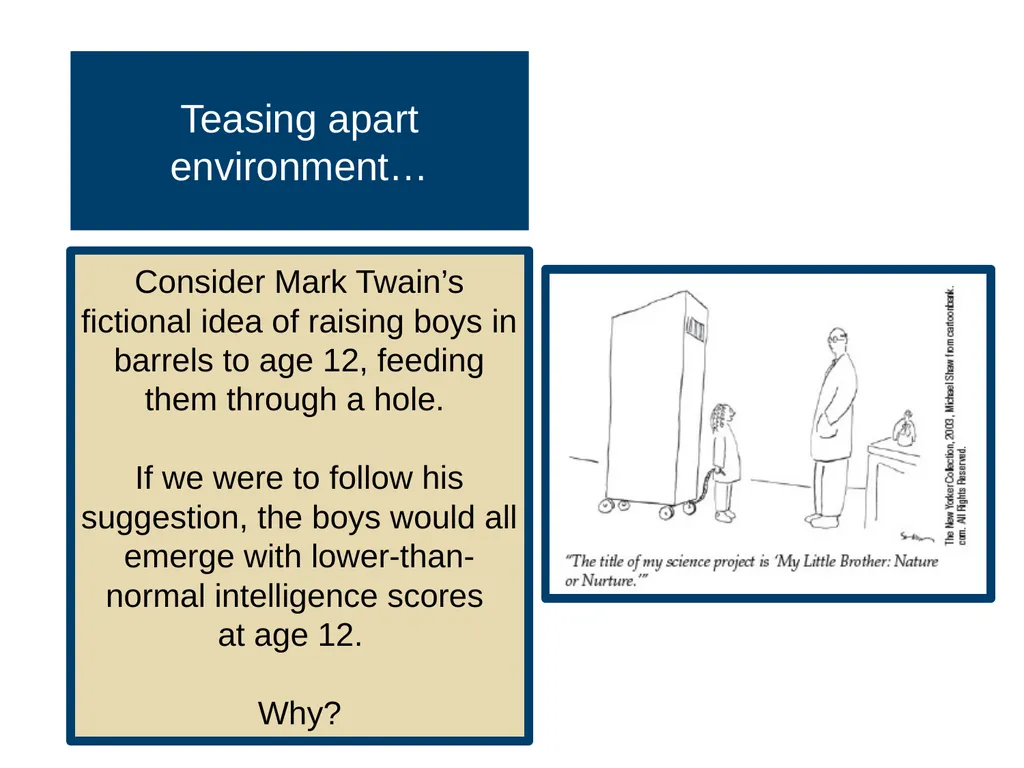
Teasing apart environment… Consider Mark Twain’s fictional idea of raising boys in barrels to age 12, feeding them through a hole.
If we were to follow his suggestion, the boys would all emerge with lower-than-normal intelligence scores
at age 12.
Why?<br>
If we were to follow his suggestion, the boys would all emerge with lower-than-normal intelligence scores
at age 12.
Why?<br>
20
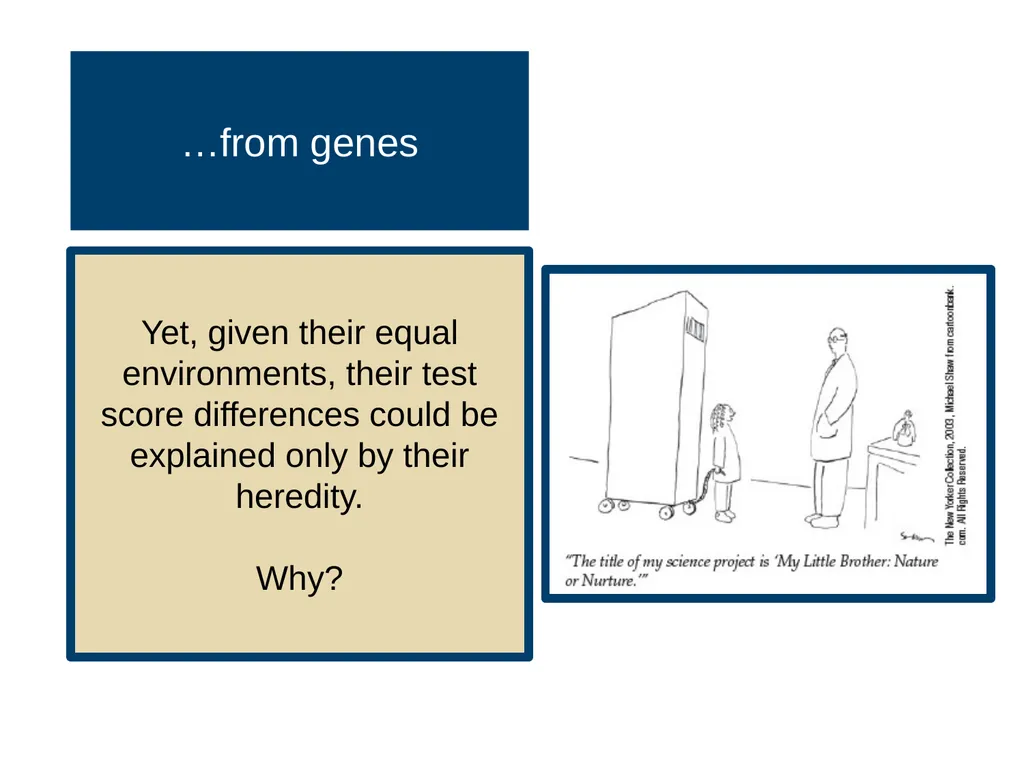
…from genes Yet, given their equal environments, their test score differences could be explained only by their heredity.
Why?<br>
Why?<br>
21
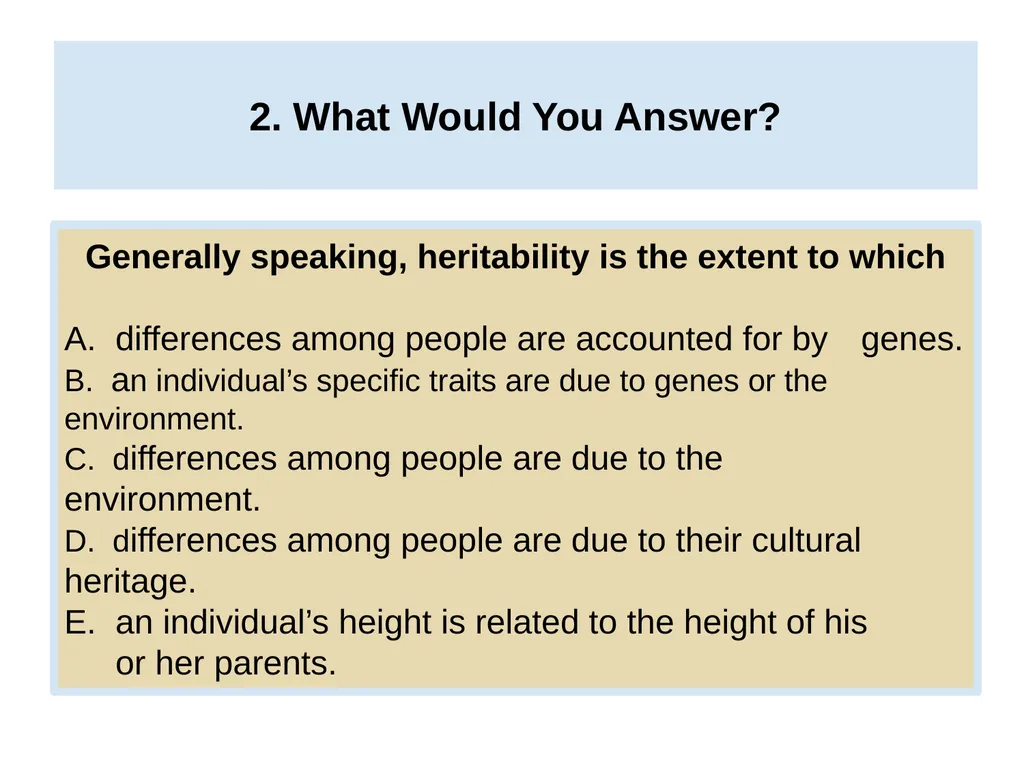
2. What Would You Answer? Generally speaking, heritability is the extent to which
differences among people are accounted for by genes.
B. an individual’s specific traits are due to genes or the environment.
C. differences among people are due to the environment.
D. differences among people are due to their cultural heritage.
an individual’s height is related to the height of his or her parents.<br>
differences among people are accounted for by genes.
B. an individual’s specific traits are due to genes or the environment.
C. differences among people are due to the environment.
D. differences among people are due to their cultural heritage.
an individual’s height is related to the height of his or her parents.<br>
22
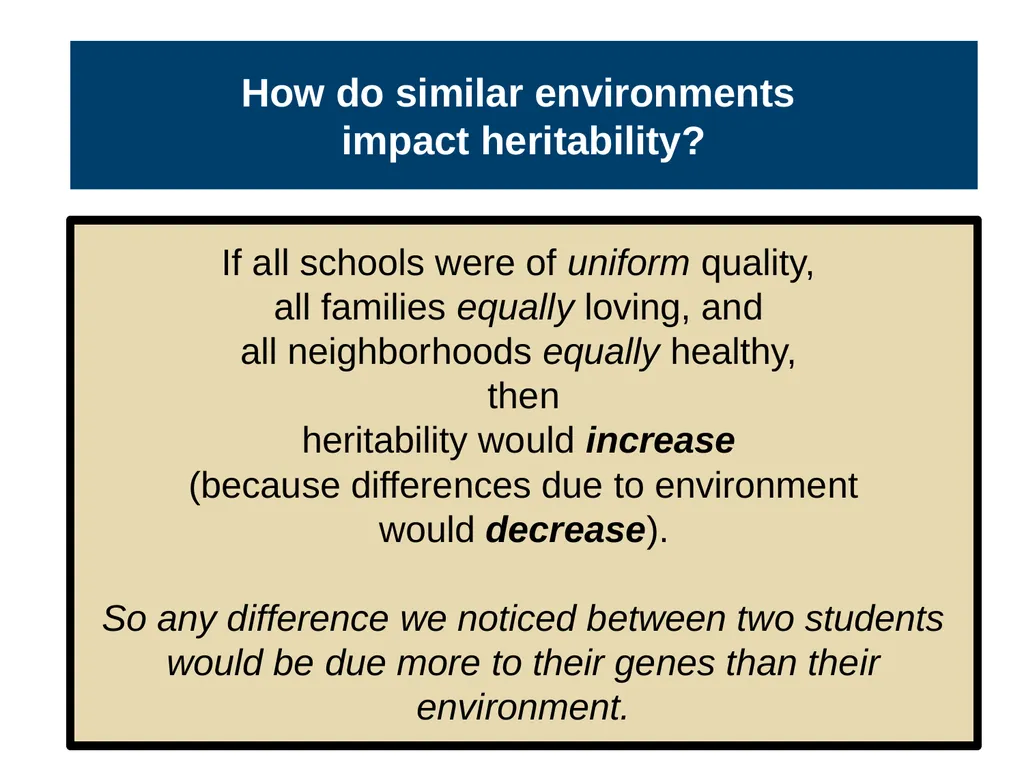
How do similar environments
impact heritability? If all schools were of uniform quality,
all families equally loving, and
all neighborhoods equally healthy,
then
heritability would increase
(because differences due to environment
would decrease).
So any difference we noticed between two students would be due more to their genes than their environment.<br>
all families equally loving, and
all neighborhoods equally healthy,
then
heritability would increase
(because differences due to environment
would decrease).
So any difference we noticed between two students would be due more to their genes than their environment.<br>
23
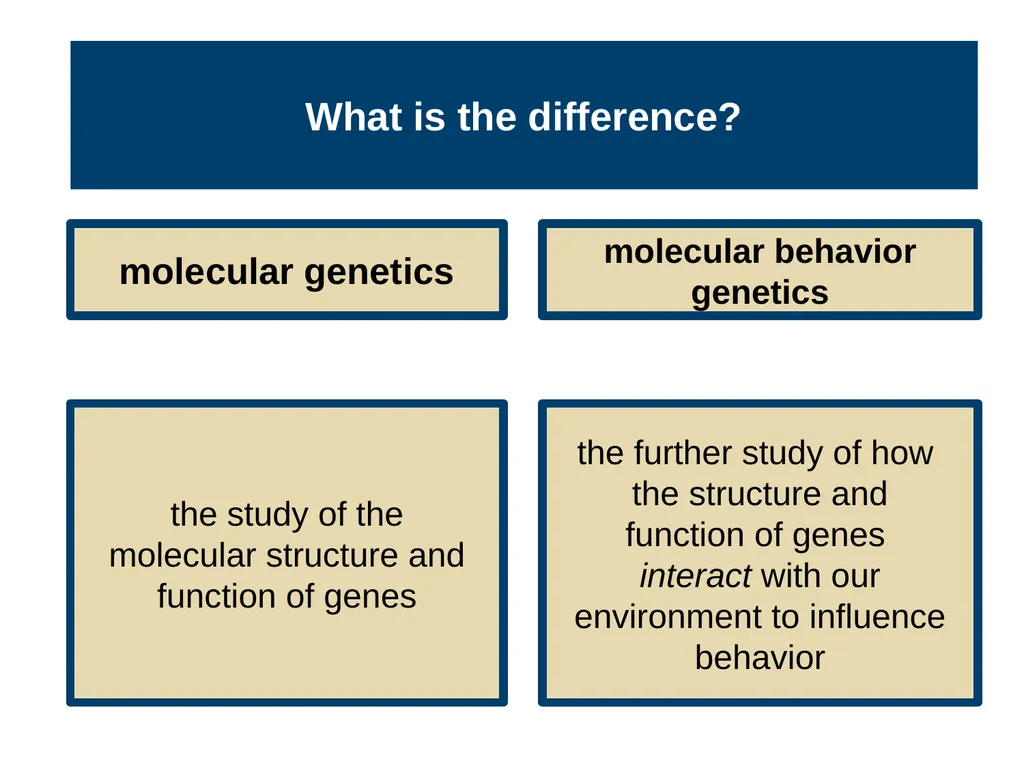
What is the difference? molecular genetics the study of the
molecular structure and function of genes molecular behavior genetics the further study of how
the structure and
function of genes
interact with our
environment to influence behavior<br>
molecular structure and function of genes molecular behavior genetics the further study of how
the structure and
function of genes
interact with our
environment to influence behavior<br>
24
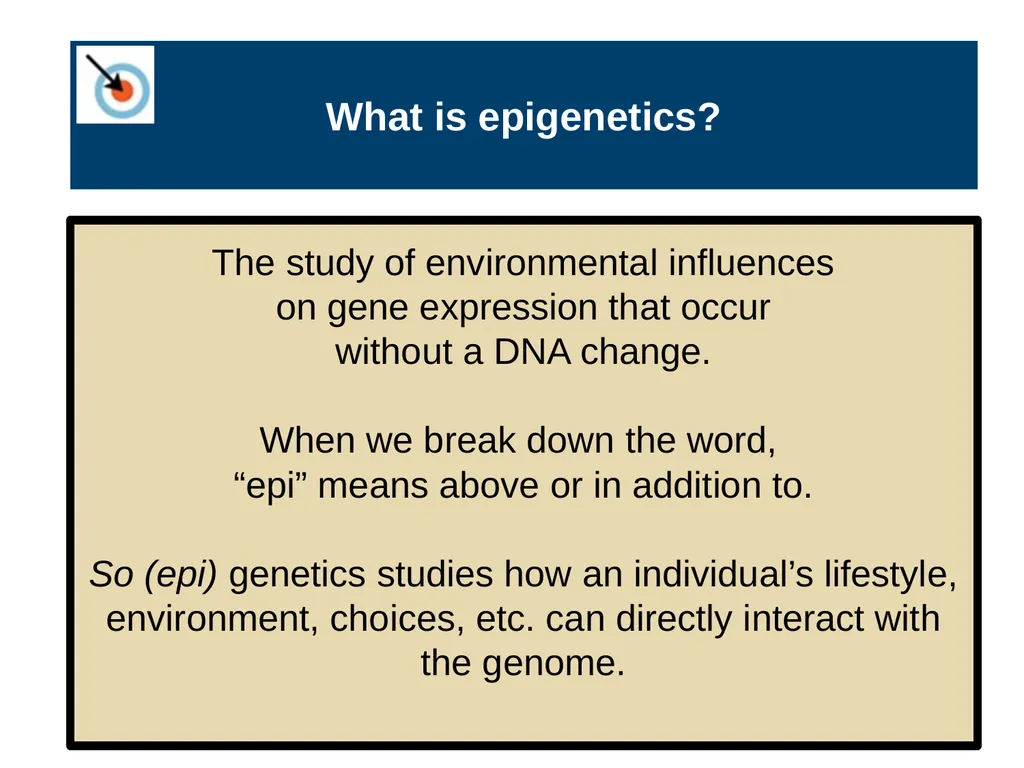
What is epigenetics? The study of environmental influences
on gene expression that occur
without a DNA change.
When we break down the word,
“epi” means above or in addition to.
So (epi) genetics studies how an individual’s lifestyle, environment, choices, etc. can directly interact with the genome.<br>
on gene expression that occur
without a DNA change.
When we break down the word,
“epi” means above or in addition to.
So (epi) genetics studies how an individual’s lifestyle, environment, choices, etc. can directly interact with the genome.<br>
25
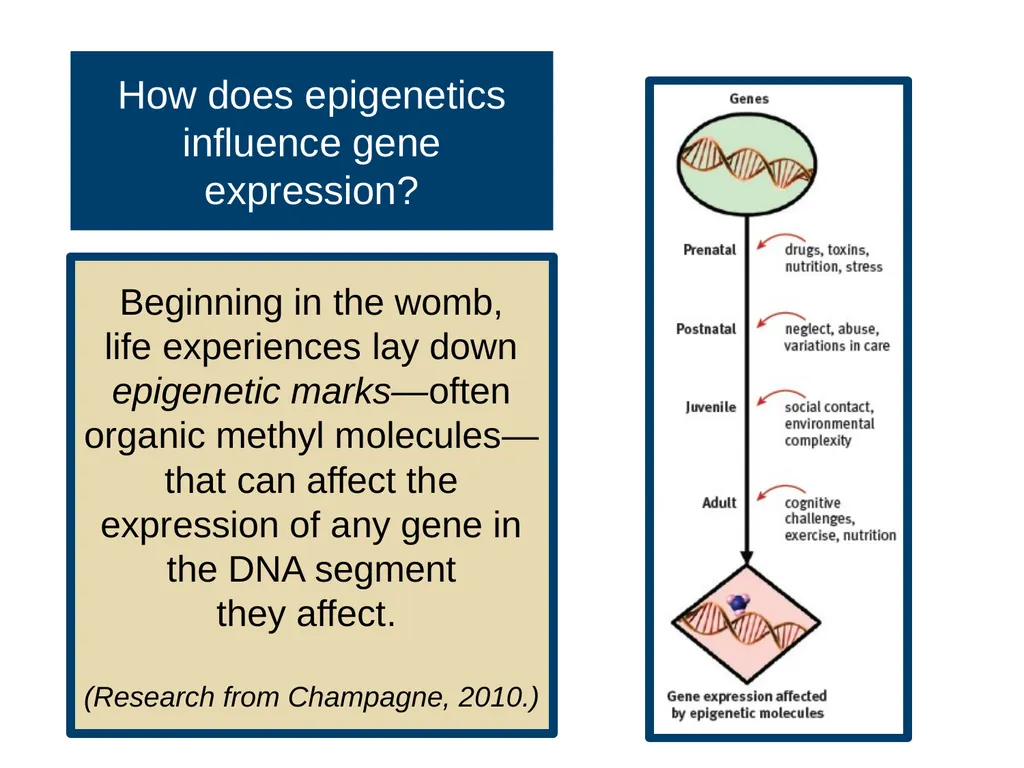
How does epigenetics influence gene expression? Beginning in the womb,
life experiences lay down
epigenetic marks—often
organic methyl molecules—that can affect the expression of any gene in the DNA segment
they affect.
(Research from Champagne, 2010.)<br>
life experiences lay down
epigenetic marks—often
organic methyl molecules—that can affect the expression of any gene in the DNA segment
they affect.
(Research from Champagne, 2010.)<br>
26
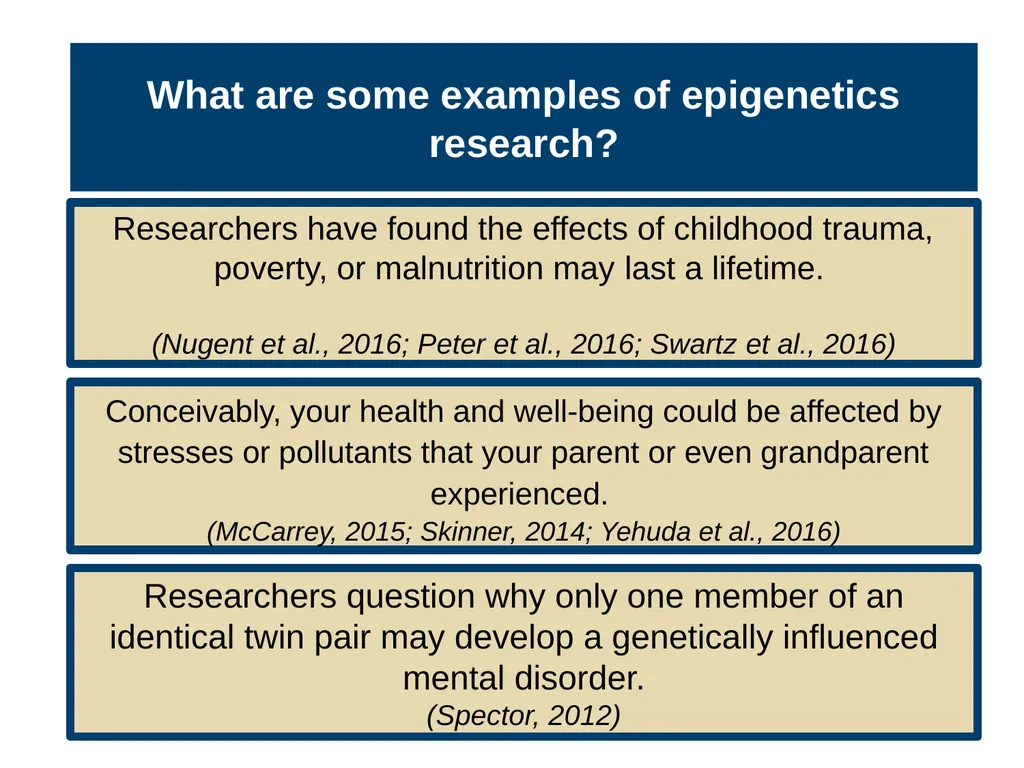
What are some examples of epigenetics research? Researchers have found the effects of childhood trauma, poverty, or malnutrition may last a lifetime.
(Nugent et al., 2016; Peter et al., 2016; Swartz et al., 2016) Conceivably, your health and well-being could be affected by stresses or pollutants that your parent or even grandparent experienced.
(McCarrey, 2015; Skinner, 2014; Yehuda et al., 2016) Researchers question why only one member of an identical twin pair may develop a genetically influenced mental disorder.
(Spector, 2012)<br>
(Nugent et al., 2016; Peter et al., 2016; Swartz et al., 2016) Conceivably, your health and well-being could be affected by stresses or pollutants that your parent or even grandparent experienced.
(McCarrey, 2015; Skinner, 2014; Yehuda et al., 2016) Researchers question why only one member of an identical twin pair may develop a genetically influenced mental disorder.
(Spector, 2012)<br>
27
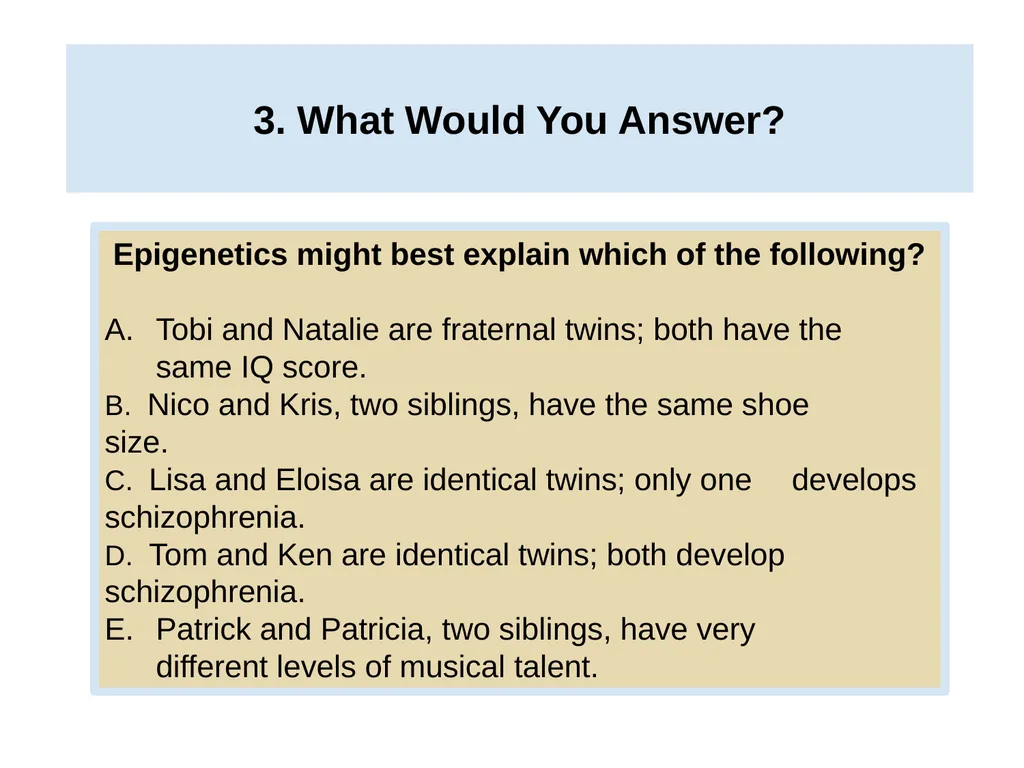
3. What Would You Answer? Epigenetics might best explain which of the following?
Tobi and Natalie are fraternal twins; both have the same IQ score.
B. Nico and Kris, two siblings, have the same shoe size.
C. Lisa and Eloisa are identical twins; only one develops schizophrenia.
D. Tom and Ken are identical twins; both develop schizophrenia.
Patrick and Patricia, two siblings, have very different levels of musical talent.<br>
Tobi and Natalie are fraternal twins; both have the same IQ score.
B. Nico and Kris, two siblings, have the same shoe size.
C. Lisa and Eloisa are identical twins; only one develops schizophrenia.
D. Tom and Ken are identical twins; both develop schizophrenia.
Patrick and Patricia, two siblings, have very different levels of musical talent.<br>
28
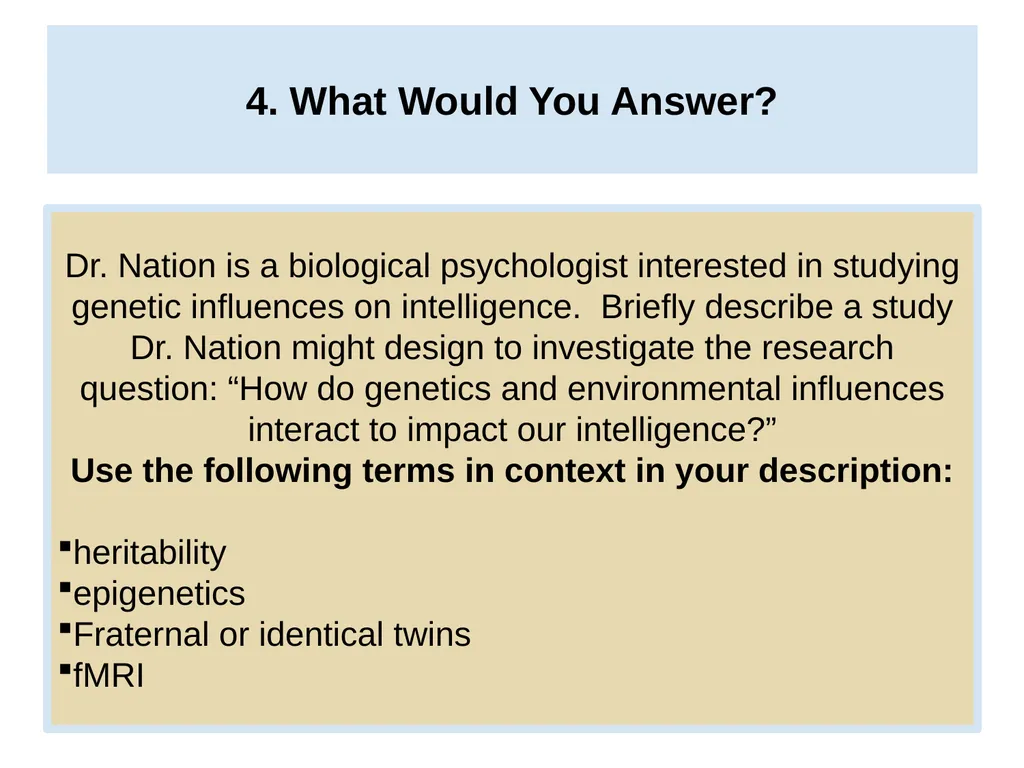
4. What Would You Answer? Dr. Nation is a biological psychologist interested in studying genetic influences on intelligence. Briefly describe a study Dr. Nation might design to investigate the research question: “How do genetics and environmental influences interact to impact our intelligence?”
Use the following terms in context in your description:
heritability
epigenetics
Fraternal or identical twins
fMRI<br>
Use the following terms in context in your description:
heritability
epigenetics
Fraternal or identical twins
fMRI<br>
29
Learning Target 14-1 Review Define chromosomes, DNA, genes, and
the human genome, and describe how
behavior geneticists explain our individual differences. Genes are the biochemical units of heredity that make up
chromosomes, the threadlike coils of DNA.
Behavior geneticists seek to quantify genetic and environmental influences on our traits.
Most of our differing traits are influenced by not one gene, but many, and by the interaction of our individual environments with these genetic predispositions.<br>
the human genome, and describe how
behavior geneticists explain our individual differences. Genes are the biochemical units of heredity that make up
chromosomes, the threadlike coils of DNA.
Behavior geneticists seek to quantify genetic and environmental influences on our traits.
Most of our differing traits are influenced by not one gene, but many, and by the interaction of our individual environments with these genetic predispositions.<br>
30
Learning Target 14-2 Review Explain how twin and adoption studies
help us understand the effects and
interactions of nature and nurture. Studies of identical (monozygotic) twins, fraternal (dizygotic) twins, and adoptive families allow researchers to consider the effects of shared environment and shared genes, which sheds light on how nature and nurture influence our traits.
Shared family environments have little effect on personality, and the stability of personality suggests a genetic predisposition.<br>
help us understand the effects and
interactions of nature and nurture. Studies of identical (monozygotic) twins, fraternal (dizygotic) twins, and adoptive families allow researchers to consider the effects of shared environment and shared genes, which sheds light on how nature and nurture influence our traits.
Shared family environments have little effect on personality, and the stability of personality suggests a genetic predisposition.<br>
31
Learning Target 14-3 Review Explain what is meant by heritability
and discuss how it relates to individuals and groups Heritability describes the extent to which variation among
members of a group can be attributed to genes.
Heritable individual differences (in traits such as height
or intelligence) do not necessarily imply heritable group
differences. Genes mostly explain why some people are
taller than others, but not why people are taller today
than they were a century ago.<br>
and discuss how it relates to individuals and groups Heritability describes the extent to which variation among
members of a group can be attributed to genes.
Heritable individual differences (in traits such as height
or intelligence) do not necessarily imply heritable group
differences. Genes mostly explain why some people are
taller than others, but not why people are taller today
than they were a century ago.<br>
32
Learning Target 14-4 Review Describe how molecular genetics research is
changing our understanding of the
effects of nature and nurture. Our genetic predispositions and our surrounding environments interact. Environments can trigger gene activity, and genetically influenced traits can evoke responses from others.
Molecular geneticists study the molecular structure and
function of genes, including those that affect behavior.
The field of epigenetics studies the influences on gene
expression that occur without changes in DNA.<br>
changing our understanding of the
effects of nature and nurture. Our genetic predispositions and our surrounding environments interact. Environments can trigger gene activity, and genetically influenced traits can evoke responses from others.
Molecular geneticists study the molecular structure and
function of genes, including those that affect behavior.
The field of epigenetics studies the influences on gene
expression that occur without changes in DNA.<br>