
Using material from Item A and elsewhere, asses


Description: Using material from Item A and elsewhere, asses the view that religion no longer acts as a shared universe of meaning for people today By Trevor Wright Lordwin Anim Its already in the L drive :D So what is this question asking us to
Related Topics
Download Presentation
"Using material from Item A and elsewhere, asses" is the property of its rightful owner. Permission is granted to download and print the materials on this website for personal, non-commercial use only, and to display it on your personal computer provided you do not modify the materials and that you retain all copyright notices contained in the materials. By downloading content from our website, you accept the terms of this agreement.
Presentation Transcript
slide1. Using material from Item A and elsewhere, asses the view that religion no longer acts as a ‘shared universe of meaning’ for people today By Trevor Wright & Lordwin Anim It’s already in the L drive :D<br>
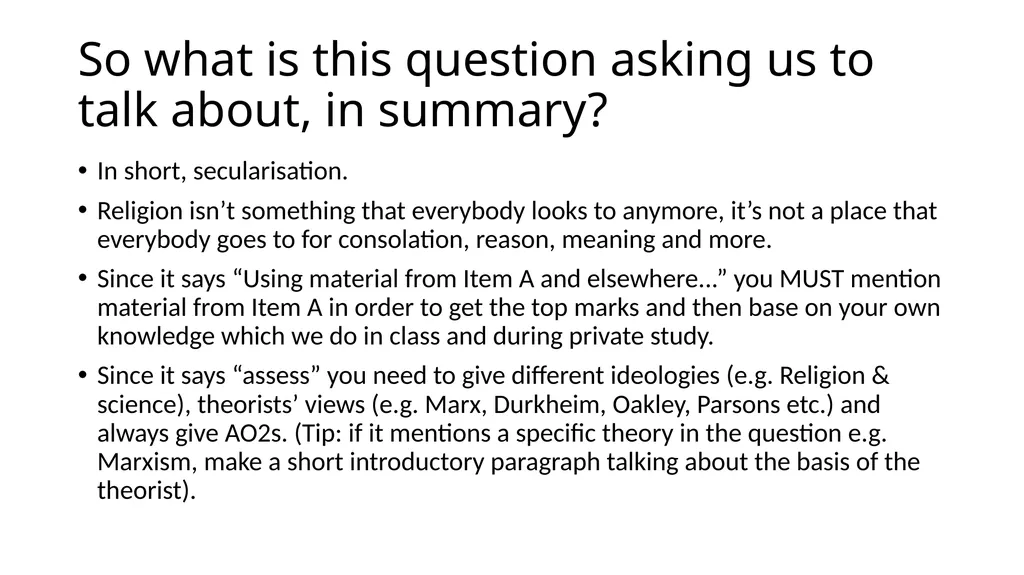
slide2. So what is this question asking us to talk about, in summary? In short, secularisation.
Religion isn’t something that everybody looks to anymore, it’s not a place that everybody goes to for consolation, reason, meaning and more.
Since it says “Using material from Item A and elsewhere...” you MUST mention material from Item A in order to get the top marks and then base on your own knowledge which we do in class and during private study.
Since it says “assess” you need to give different ideologies (e.g. Religion & science), theorists’ views (e.g. Marx, Durkheim, Oakley, Parsons etc.) and always give AO2s. (Tip: if it mentions a specific theory in the question e.g. Marxism, make a short introductory paragraph talking about the basis of the theorist).<br>
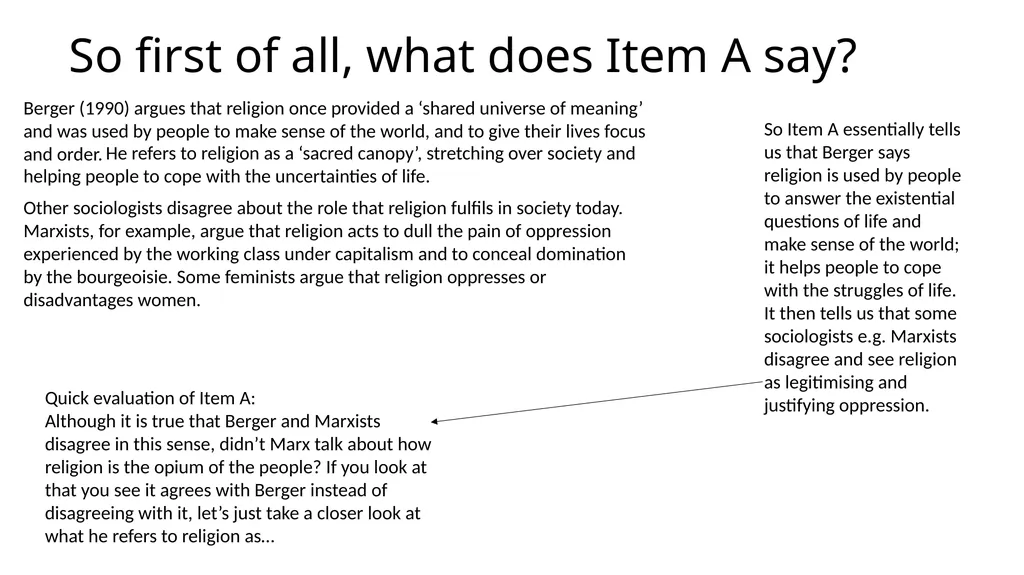
slide3. So first of all, what does Item A say? So Item A essentially tells us that Berger says religion is used by people to answer the existential questions of life and make sense of the world; it helps people to cope with the struggles of life. It then tells us that some sociologists e.g. Marxists disagree and see religion as legitimising and justifying oppression. Quick evaluation of Item A:
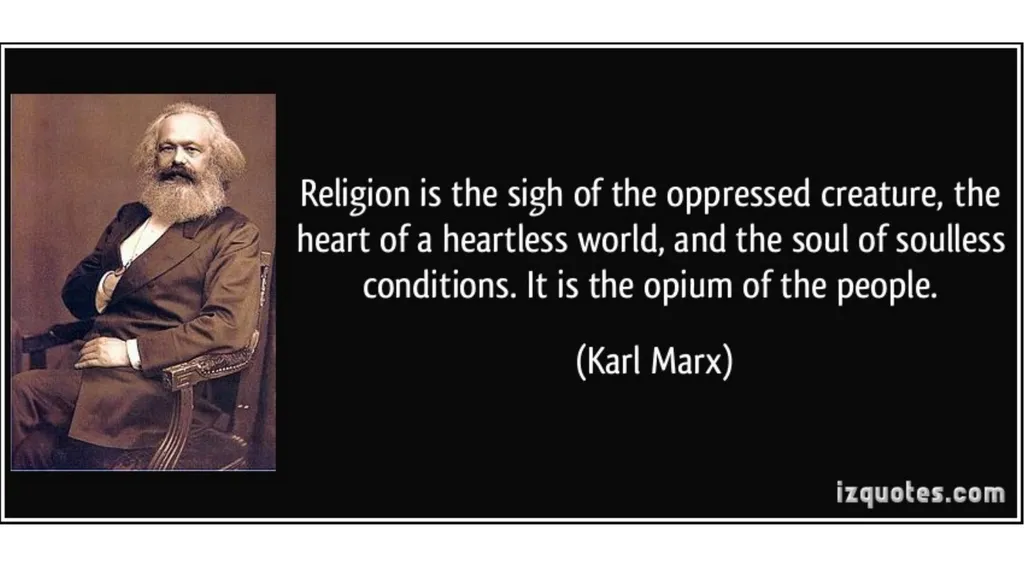
Although it is true that Berger and Marxists disagree in this sense, didn’t Marx talk about how religion is the opium of the people? If you look at that you see it agrees with Berger instead of disagreeing with it, let’s just take a closer look at what he refers to religion as… Berger (1990) argues that religion once provided a ‘shared universe of meaning’ and was used by people to make sense of the world, and to give their lives focus and order. He refers to religion as a ‘sacred canopy’, stretching over society and helping people to cope with the uncertainties of life. Other sociologists disagree about the role that religion fulfils in society today. Marxists, for example, argue that religion acts to dull the pain of oppression experienced by the working class under capitalism and to conceal domination by the bourgeoisie. Some feminists argue that religion oppresses or disadvantages women.<br>
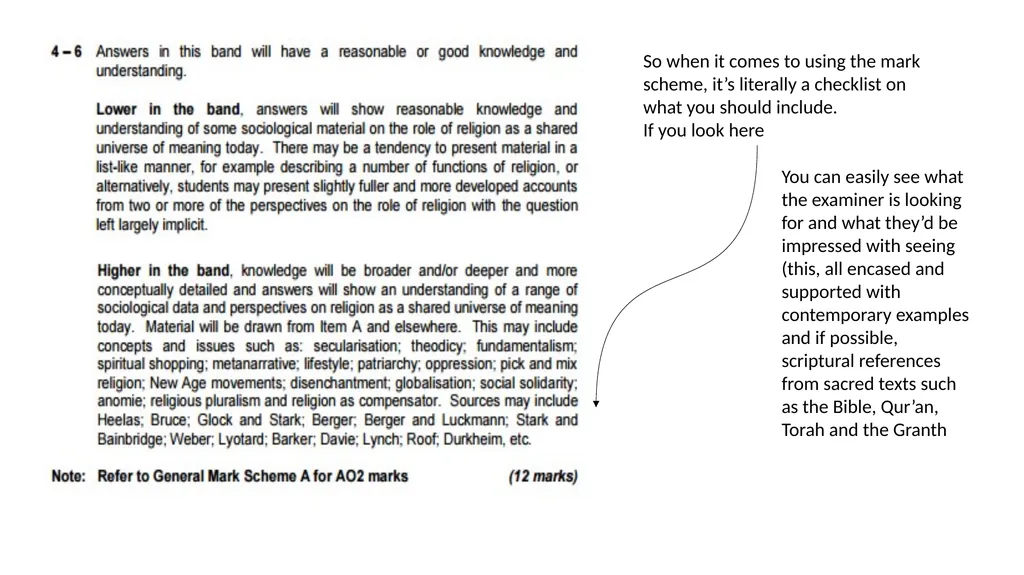
slide4. So when it comes to using the mark scheme, it’s literally a checklist on what you should include.
If you look here You can easily see what the examiner is looking for and what they’d be impressed with seeing (this, all encased and supported with contemporary examples and if possible, scriptural references from sacred texts such as the Bible, Qur’an, Torah and the Granth<br>
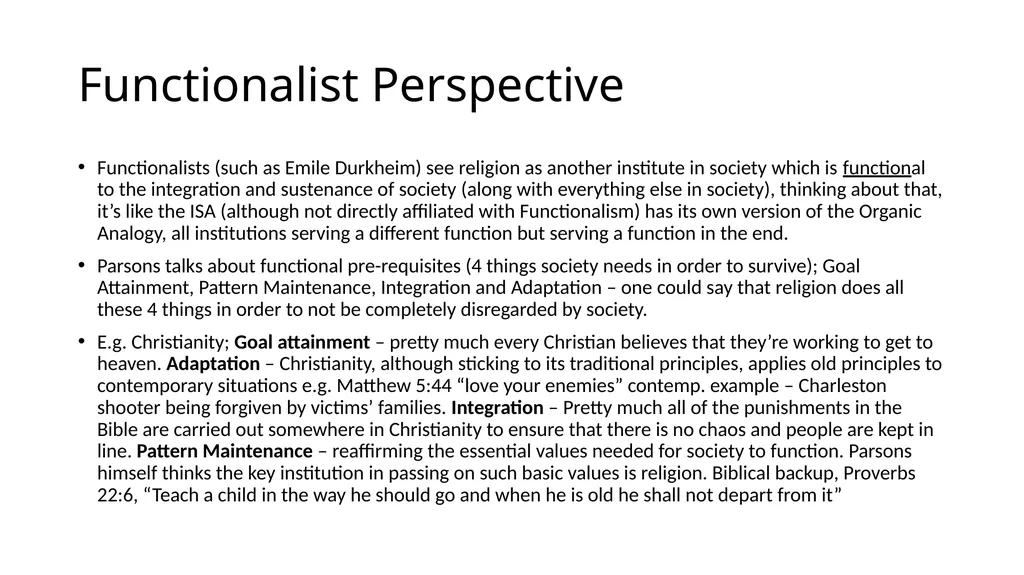
slide5. Functionalist Perspective Functionalists (such as Emile Durkheim) see religion as another institute in society which is functional to the integration and sustenance of society (along with everything else in society), thinking about that, it’s like the ISA (although not directly affiliated with Functionalism) has its own version of the Organic Analogy, all institutions serving a different function but serving a function in the end.
Parsons talks about functional pre-requisites (4 things society needs in order to survive); Goal Attainment, Pattern Maintenance, Integration and Adaptation – one could say that religion does all these 4 things in order to not be completely disregarded by society.
E.g. Christianity; Goal attainment – pretty much every Christian believes that they’re working to get to heaven. Adaptation – Christianity, although sticking to its traditional principles, applies old principles to contemporary situations e.g. Matthew 5:44 “love your enemies” contemp. example – Charleston shooter being forgiven by victims’ families. Integration – Pretty much all of the punishments in the Bible are carried out somewhere in Christianity to ensure that there is no chaos and people are kept in line. Pattern Maintenance – reaffirming the essential values needed for society to function. Parsons himself thinks the key institution in passing on such basic values is religion. Biblical backup, Proverbs 22:6, “Teach a child in the way he should go and when he is old he shall not depart from it”<br>
slide6. Interlude: Globalisation Globalisation may be one reason that religion isn’t a ‘shared universe of meaning’ anymore. With the Disnification and McDonaldization of the world, millions have adopted new ideologies and beliefs during their spiritual shopping spree, with things like Star Wars – people have created the religion of Jedi (supporting how religion may be a social construct), also with the new trilogy of Star Wars episodes releasing soon, many fans are due to religiously dedicate their time and money to the movies and merchandise produced by George Lucas’ famous movie series.
You could even say that this spiritual shopping and freedom of choice is just a way of making people think they have autonomy over their life and they aren’t just a product of societal institutions (relates to a theory that you can’t actually get out of the Matrix, you just go to another layer of the Matrix; if you’d like to watch it click here)<br>
slide7. Woodhead & Heelas – AO1 and AO2 Woodhead & Heelas identified two versions of the disappearance thesis which states that religion that modernity is bringing about the death of religion, the significance of religion is declining for both society and the individual.
Secondly the differentiation thesis states religion is declining in social significance however is still significant in some people’s private lives and always will be. However in the House of Lords there are still bishops and archbishops, so a lot of political influence, as they pass and accept laws that potentially change our world, go through people with a religious-based mind-set.<br>
slide8. Steve Bruce (2002) Bruce states that the social significance of religion is declining and that it no longer acts as a shared universe of meaning for people (Quick tip: at least once or twice in your essay, formulate one sentence in your paragraphs to rephrase the question so you make sure the examiner always knows you’re answering what they want answered) because it is being replaced with science and other ideologies. Bruce backs his work up by looking at the power and prestige of religious institutions and how what was once the most important building, the church, can now be seen in ruins and being put to secular use, for example, one church in Bournemouth has been turned into a nightclub named ‘Halo’ (where people allow hedonism and debauchery to run wild) whilst another has been turned into a Tesco Express.<br>
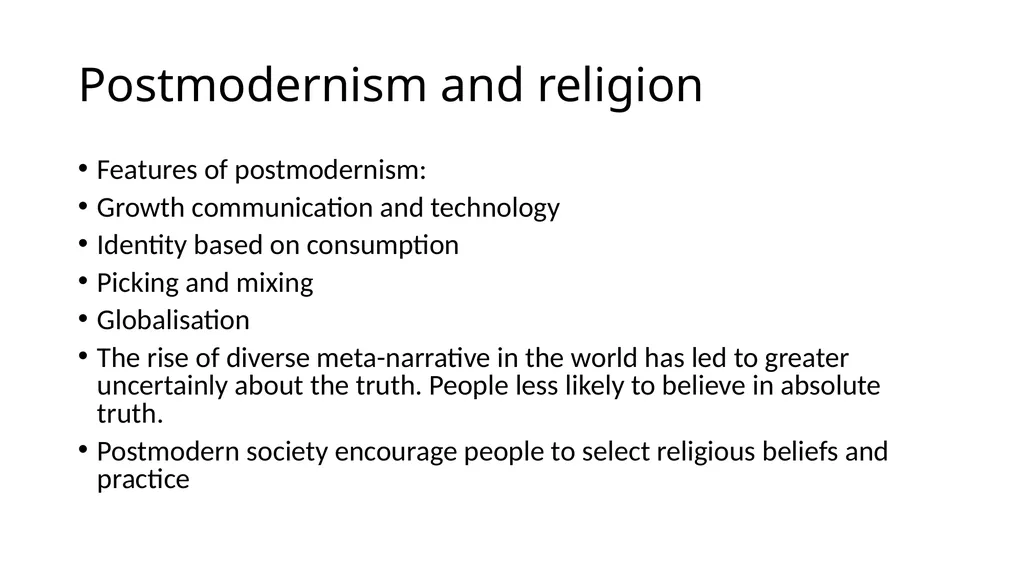
slide9. Postmodernism and religion Features of postmodernism:
Growth communication and technology
Identity based on consumption
Picking and mixing
Globalisation
The rise of diverse meta-narrative in the world has led to greater uncertainly about the truth. People less likely to believe in absolute truth.
Postmodern society encourage people to select religious beliefs and practice<br>
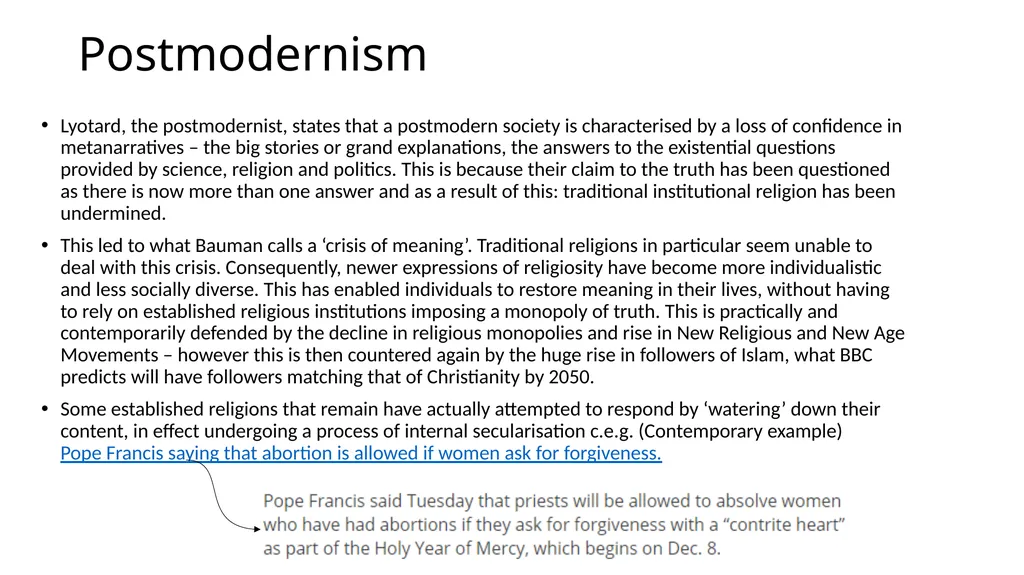
slide10. Postmodernism Lyotard, the postmodernist, states that a postmodern society is characterised by a loss of confidence in metanarratives – the big stories or grand explanations, the answers to the existential questions provided by science, religion and politics. This is because their claim to the truth has been questioned as there is now more than one answer and as a result of this: traditional institutional religion has been undermined.
This led to what Bauman calls a ‘crisis of meaning’. Traditional religions in particular seem unable to deal with this crisis. Consequently, newer expressions of religiosity have become more individualistic and less socially diverse. This has enabled individuals to restore meaning in their lives, without having to rely on established religious institutions imposing a monopoly of truth. This is practically and contemporarily defended by the decline in religious monopolies and rise in New Religious and New Age Movements – however this is then countered again by the huge rise in followers of Islam, what BBC predicts will have followers matching that of Christianity by 2050.
Some established religions that remain have actually attempted to respond by ‘watering’ down their content, in effect undergoing a process of internal secularisation c.e.g. (Contemporary example) Pope Francis saying that abortion is allowed if women ask for forgiveness.<br>
slide11. Max Weber Around the 16th century the western world started to move towards rationalisation- the process of thought that requires ideas to be justified and thought out. This way of thinking replaced religious thought for many people. For the most part Europe was dominated by the Medieval catholic view that the world is magical and mystical.
The magic and mystery of the world have been unveiled and the natural order of the world has been revealed through science.<br>
slide12. Bryan Wilson Highlighted how historically, religion were monolithic (i.e. there existed one dominant faith). The wide range of religion in modern society mean that religion has lost its power and religious influence has become weather. For example, Church of England co-exists with other religions in the same societies. Therefore, religious beliefs have been diluted as a result of the sheer number of religions offering competing views. Their influence has declined and this is evident when we consider church attendance figure.<br>
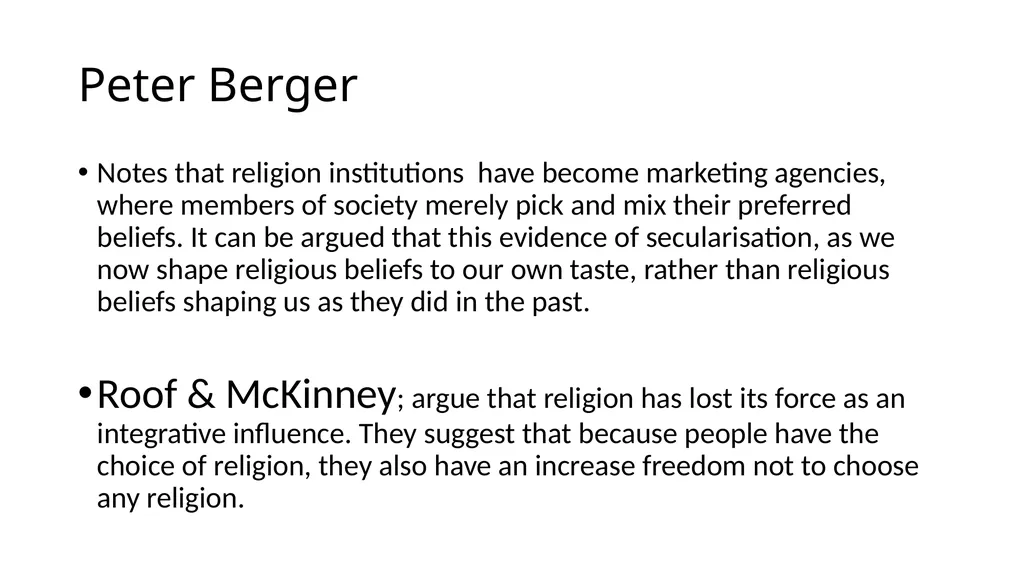
slide13. Peter Berger Notes that religion institutions have become marketing agencies, where members of society merely pick and mix their preferred beliefs. It can be argued that this evidence of secularisation, as we now shape religious beliefs to our own taste, rather than religious beliefs shaping us as they did in the past.
Roof & McKinney; argue that religion has lost its force as an integrative influence. They suggest that because people have the choice of religion, they also have an increase freedom not to choose any religion.<br>
slide14. So what’s the Postmodernist view saying then? The Postmodern view, therefore, highlights that religion, in one way or another, influences people – whether that means making people more secular or making them bow their knees and speak to a supreme being they have faith exists. Religion has just become more consumerist. Individuals are choosing their beliefs and shaping them into their own philosophies instead of shaping their philosophies into their beliefs (you can’t be a Christian only when it’s convenient for you, get it?) Hence, if people are choosing hybrid religions then religion still exists. This suggests that using pluralism as a measure of secularisation only offers a partial view of religion in the UK and an almost unrepresentative one.<br>
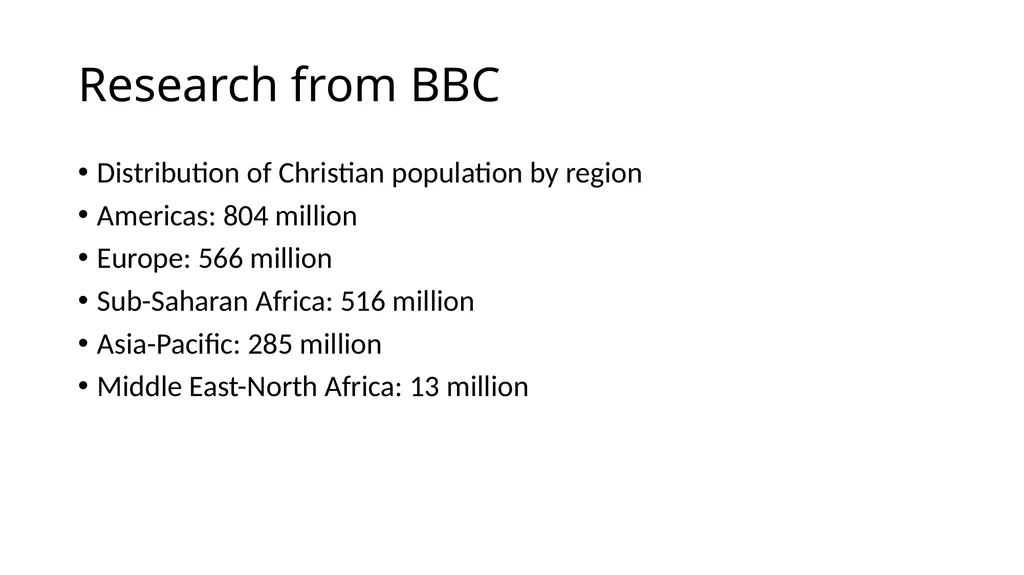
slide15. Research from BBC Distribution of Christian population by region
Americas: 804 million
Europe: 566 million
Sub-Saharan Africa: 516 million
Asia-Pacific: 285 million
Middle East-North Africa: 13 million<br>
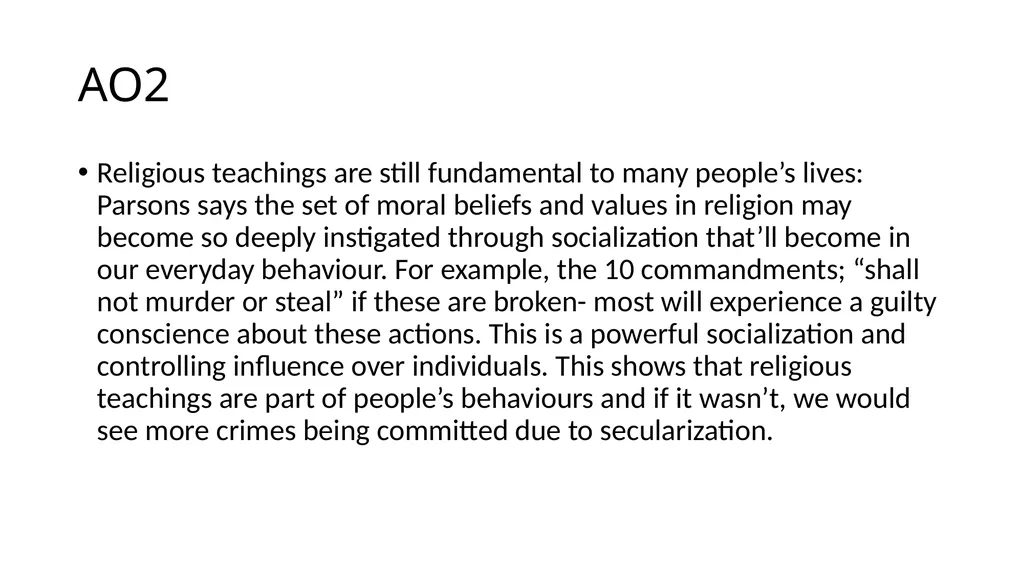
slide16. AO2 Religious teachings are still fundamental to many people’s lives: Parsons says the set of moral beliefs and values in religion may become so deeply instigated through socialization that’ll become in our everyday behaviour. For example, the 10 commandments; “shall not murder or steal” if these are broken- most will experience a guilty conscience about these actions. This is a powerful socialization and controlling influence over individuals. This shows that religious teachings are part of people’s behaviours and if it wasn’t, we would see more crimes being committed due to secularization.<br>
slide18. Any Questions? Any Contributions? Rate Our Performance!<br>
slide19. Contributions Slide<br>
slide2. So what is this question asking us to talk about, in summary? In short, secularisation.
Religion isn’t something that everybody looks to anymore, it’s not a place that everybody goes to for consolation, reason, meaning and more.
Since it says “Using material from Item A and elsewhere...” you MUST mention material from Item A in order to get the top marks and then base on your own knowledge which we do in class and during private study.
Since it says “assess” you need to give different ideologies (e.g. Religion & science), theorists’ views (e.g. Marx, Durkheim, Oakley, Parsons etc.) and always give AO2s. (Tip: if it mentions a specific theory in the question e.g. Marxism, make a short introductory paragraph talking about the basis of the theorist).<br>
slide3. So first of all, what does Item A say? So Item A essentially tells us that Berger says religion is used by people to answer the existential questions of life and make sense of the world; it helps people to cope with the struggles of life. It then tells us that some sociologists e.g. Marxists disagree and see religion as legitimising and justifying oppression. Quick evaluation of Item A:
Although it is true that Berger and Marxists disagree in this sense, didn’t Marx talk about how religion is the opium of the people? If you look at that you see it agrees with Berger instead of disagreeing with it, let’s just take a closer look at what he refers to religion as… Berger (1990) argues that religion once provided a ‘shared universe of meaning’ and was used by people to make sense of the world, and to give their lives focus and order. He refers to religion as a ‘sacred canopy’, stretching over society and helping people to cope with the uncertainties of life. Other sociologists disagree about the role that religion fulfils in society today. Marxists, for example, argue that religion acts to dull the pain of oppression experienced by the working class under capitalism and to conceal domination by the bourgeoisie. Some feminists argue that religion oppresses or disadvantages women.<br>
slide4. So when it comes to using the mark scheme, it’s literally a checklist on what you should include.
If you look here You can easily see what the examiner is looking for and what they’d be impressed with seeing (this, all encased and supported with contemporary examples and if possible, scriptural references from sacred texts such as the Bible, Qur’an, Torah and the Granth<br>
slide5. Functionalist Perspective Functionalists (such as Emile Durkheim) see religion as another institute in society which is functional to the integration and sustenance of society (along with everything else in society), thinking about that, it’s like the ISA (although not directly affiliated with Functionalism) has its own version of the Organic Analogy, all institutions serving a different function but serving a function in the end.
Parsons talks about functional pre-requisites (4 things society needs in order to survive); Goal Attainment, Pattern Maintenance, Integration and Adaptation – one could say that religion does all these 4 things in order to not be completely disregarded by society.
E.g. Christianity; Goal attainment – pretty much every Christian believes that they’re working to get to heaven. Adaptation – Christianity, although sticking to its traditional principles, applies old principles to contemporary situations e.g. Matthew 5:44 “love your enemies” contemp. example – Charleston shooter being forgiven by victims’ families. Integration – Pretty much all of the punishments in the Bible are carried out somewhere in Christianity to ensure that there is no chaos and people are kept in line. Pattern Maintenance – reaffirming the essential values needed for society to function. Parsons himself thinks the key institution in passing on such basic values is religion. Biblical backup, Proverbs 22:6, “Teach a child in the way he should go and when he is old he shall not depart from it”<br>
slide6. Interlude: Globalisation Globalisation may be one reason that religion isn’t a ‘shared universe of meaning’ anymore. With the Disnification and McDonaldization of the world, millions have adopted new ideologies and beliefs during their spiritual shopping spree, with things like Star Wars – people have created the religion of Jedi (supporting how religion may be a social construct), also with the new trilogy of Star Wars episodes releasing soon, many fans are due to religiously dedicate their time and money to the movies and merchandise produced by George Lucas’ famous movie series.
You could even say that this spiritual shopping and freedom of choice is just a way of making people think they have autonomy over their life and they aren’t just a product of societal institutions (relates to a theory that you can’t actually get out of the Matrix, you just go to another layer of the Matrix; if you’d like to watch it click here)<br>
slide7. Woodhead & Heelas – AO1 and AO2 Woodhead & Heelas identified two versions of the disappearance thesis which states that religion that modernity is bringing about the death of religion, the significance of religion is declining for both society and the individual.
Secondly the differentiation thesis states religion is declining in social significance however is still significant in some people’s private lives and always will be. However in the House of Lords there are still bishops and archbishops, so a lot of political influence, as they pass and accept laws that potentially change our world, go through people with a religious-based mind-set.<br>
slide8. Steve Bruce (2002) Bruce states that the social significance of religion is declining and that it no longer acts as a shared universe of meaning for people (Quick tip: at least once or twice in your essay, formulate one sentence in your paragraphs to rephrase the question so you make sure the examiner always knows you’re answering what they want answered) because it is being replaced with science and other ideologies. Bruce backs his work up by looking at the power and prestige of religious institutions and how what was once the most important building, the church, can now be seen in ruins and being put to secular use, for example, one church in Bournemouth has been turned into a nightclub named ‘Halo’ (where people allow hedonism and debauchery to run wild) whilst another has been turned into a Tesco Express.<br>
slide9. Postmodernism and religion Features of postmodernism:
Growth communication and technology
Identity based on consumption
Picking and mixing
Globalisation
The rise of diverse meta-narrative in the world has led to greater uncertainly about the truth. People less likely to believe in absolute truth.
Postmodern society encourage people to select religious beliefs and practice<br>
slide10. Postmodernism Lyotard, the postmodernist, states that a postmodern society is characterised by a loss of confidence in metanarratives – the big stories or grand explanations, the answers to the existential questions provided by science, religion and politics. This is because their claim to the truth has been questioned as there is now more than one answer and as a result of this: traditional institutional religion has been undermined.
This led to what Bauman calls a ‘crisis of meaning’. Traditional religions in particular seem unable to deal with this crisis. Consequently, newer expressions of religiosity have become more individualistic and less socially diverse. This has enabled individuals to restore meaning in their lives, without having to rely on established religious institutions imposing a monopoly of truth. This is practically and contemporarily defended by the decline in religious monopolies and rise in New Religious and New Age Movements – however this is then countered again by the huge rise in followers of Islam, what BBC predicts will have followers matching that of Christianity by 2050.
Some established religions that remain have actually attempted to respond by ‘watering’ down their content, in effect undergoing a process of internal secularisation c.e.g. (Contemporary example) Pope Francis saying that abortion is allowed if women ask for forgiveness.<br>
slide11. Max Weber Around the 16th century the western world started to move towards rationalisation- the process of thought that requires ideas to be justified and thought out. This way of thinking replaced religious thought for many people. For the most part Europe was dominated by the Medieval catholic view that the world is magical and mystical.
The magic and mystery of the world have been unveiled and the natural order of the world has been revealed through science.<br>
slide12. Bryan Wilson Highlighted how historically, religion were monolithic (i.e. there existed one dominant faith). The wide range of religion in modern society mean that religion has lost its power and religious influence has become weather. For example, Church of England co-exists with other religions in the same societies. Therefore, religious beliefs have been diluted as a result of the sheer number of religions offering competing views. Their influence has declined and this is evident when we consider church attendance figure.<br>
slide13. Peter Berger Notes that religion institutions have become marketing agencies, where members of society merely pick and mix their preferred beliefs. It can be argued that this evidence of secularisation, as we now shape religious beliefs to our own taste, rather than religious beliefs shaping us as they did in the past.
Roof & McKinney; argue that religion has lost its force as an integrative influence. They suggest that because people have the choice of religion, they also have an increase freedom not to choose any religion.<br>
slide14. So what’s the Postmodernist view saying then? The Postmodern view, therefore, highlights that religion, in one way or another, influences people – whether that means making people more secular or making them bow their knees and speak to a supreme being they have faith exists. Religion has just become more consumerist. Individuals are choosing their beliefs and shaping them into their own philosophies instead of shaping their philosophies into their beliefs (you can’t be a Christian only when it’s convenient for you, get it?) Hence, if people are choosing hybrid religions then religion still exists. This suggests that using pluralism as a measure of secularisation only offers a partial view of religion in the UK and an almost unrepresentative one.<br>
slide15. Research from BBC Distribution of Christian population by region
Americas: 804 million
Europe: 566 million
Sub-Saharan Africa: 516 million
Asia-Pacific: 285 million
Middle East-North Africa: 13 million<br>
slide16. AO2 Religious teachings are still fundamental to many people’s lives: Parsons says the set of moral beliefs and values in religion may become so deeply instigated through socialization that’ll become in our everyday behaviour. For example, the 10 commandments; “shall not murder or steal” if these are broken- most will experience a guilty conscience about these actions. This is a powerful socialization and controlling influence over individuals. This shows that religious teachings are part of people’s behaviours and if it wasn’t, we would see more crimes being committed due to secularization.<br>
slide18. Any Questions? Any Contributions? Rate Our Performance!<br>
slide19. Contributions Slide<br>