
Using VALUE Rubrics to Assess Almost Any Program
SN
Published · 24 slides · 0 views
1 / 1
Description
Using VALUE Rubrics to Assess Almost Any Program Outcome Lets Get it Started! Workshop Outcomes As a result of this workshop you will be able to: Describe how VALUE rubrics can be used for program assessment Create a signature or key
Related Topics
Share
Embed code
Download this presentation From Below
"Using VALUE Rubrics to Assess Almost Any Program" is the property of its rightful owner. Permission is granted to download and print the materials on this website for personal, non-commercial use only, and to display it on your personal computer provided you do not modify the materials and that you retain all copyright notices contained in the materials. By downloading content from our website, you accept the terms of this agreement.
Presentation Transcript
01
Using VALUE Rubrics to Assess Almost Any Program Outcome Let’s Get it Started!<br>
02
Workshop Outcomes As a result of this workshop you will be able to:
Describe how VALUE rubrics can be used for program assessment
Create a signature or key assignment that is aligned with program learning outcomes
Collect student work from multiple course sections and/or instructors
Use results to help students improve their skills and content knowledge<br>
Describe how VALUE rubrics can be used for program assessment
Create a signature or key assignment that is aligned with program learning outcomes
Collect student work from multiple course sections and/or instructors
Use results to help students improve their skills and content knowledge<br>
03
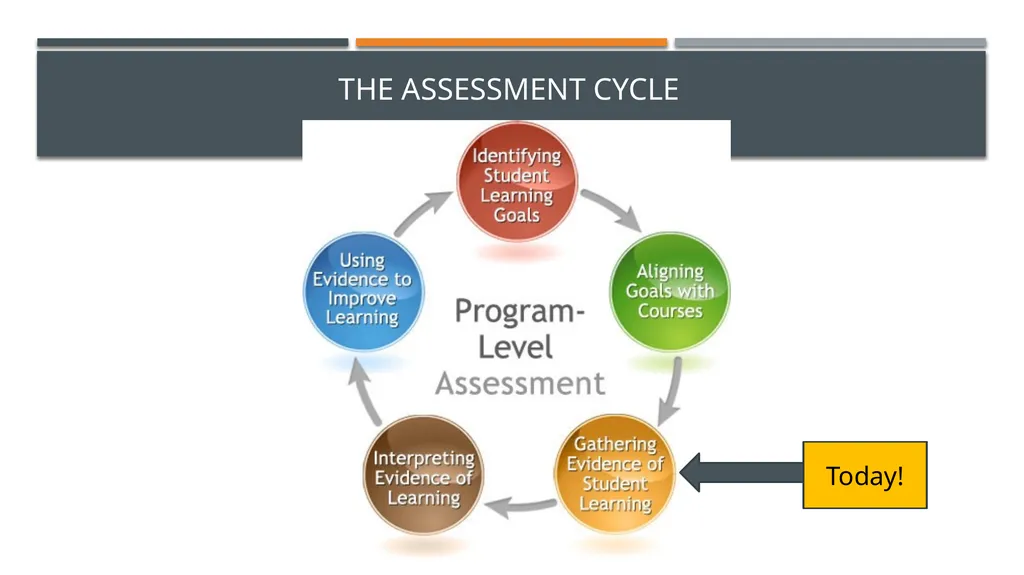
The Assessment Cycle Today!<br>
04
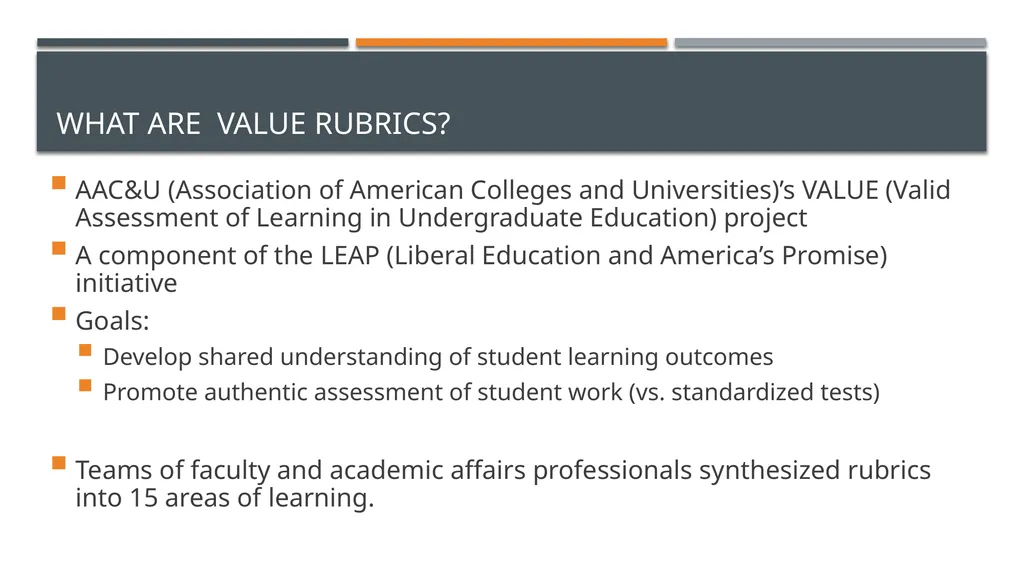
What Are value rubrics? AAC&U (Association of American Colleges and Universities)’s VALUE (Valid Assessment of Learning in Undergraduate Education) project
A component of the LEAP (Liberal Education and America’s Promise) initiative
Goals:
Develop shared understanding of student learning outcomes
Promote authentic assessment of student work (vs. standardized tests)
Teams of faculty and academic affairs professionals synthesized rubrics into 15 areas of learning.<br>
A component of the LEAP (Liberal Education and America’s Promise) initiative
Goals:
Develop shared understanding of student learning outcomes
Promote authentic assessment of student work (vs. standardized tests)
Teams of faculty and academic affairs professionals synthesized rubrics into 15 areas of learning.<br>
05
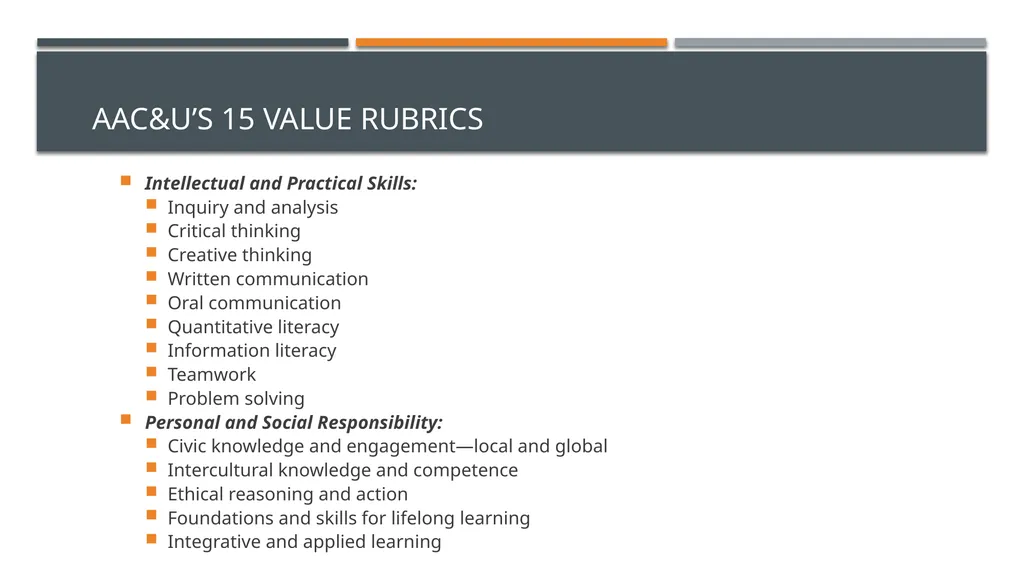
Intellectual and Practical Skills:
Inquiry and analysis
Critical thinking
Creative thinking
Written communication
Oral communication
Quantitative literacy
Information literacy
Teamwork
Problem solving
Personal and Social Responsibility:
Civic knowledge and engagement—local and global
Intercultural knowledge and competence
Ethical reasoning and action
Foundations and skills for lifelong learning
Integrative and applied learning AAC&U’s 15 VALUE rubrics<br>
Inquiry and analysis
Critical thinking
Creative thinking
Written communication
Oral communication
Quantitative literacy
Information literacy
Teamwork
Problem solving
Personal and Social Responsibility:
Civic knowledge and engagement—local and global
Intercultural knowledge and competence
Ethical reasoning and action
Foundations and skills for lifelong learning
Integrative and applied learning AAC&U’s 15 VALUE rubrics<br>
06
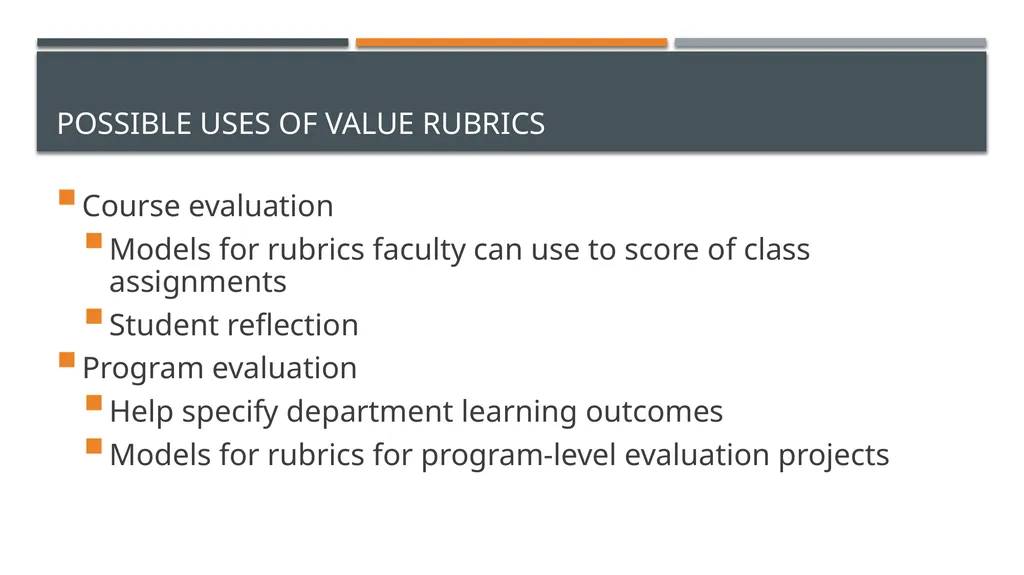
Possible Uses of VALUE rubrics Course evaluation
Models for rubrics faculty can use to score of class assignments
Student reflection
Program evaluation
Help specify department learning outcomes
Models for rubrics for program-level evaluation projects<br>
Models for rubrics faculty can use to score of class assignments
Student reflection
Program evaluation
Help specify department learning outcomes
Models for rubrics for program-level evaluation projects<br>
07
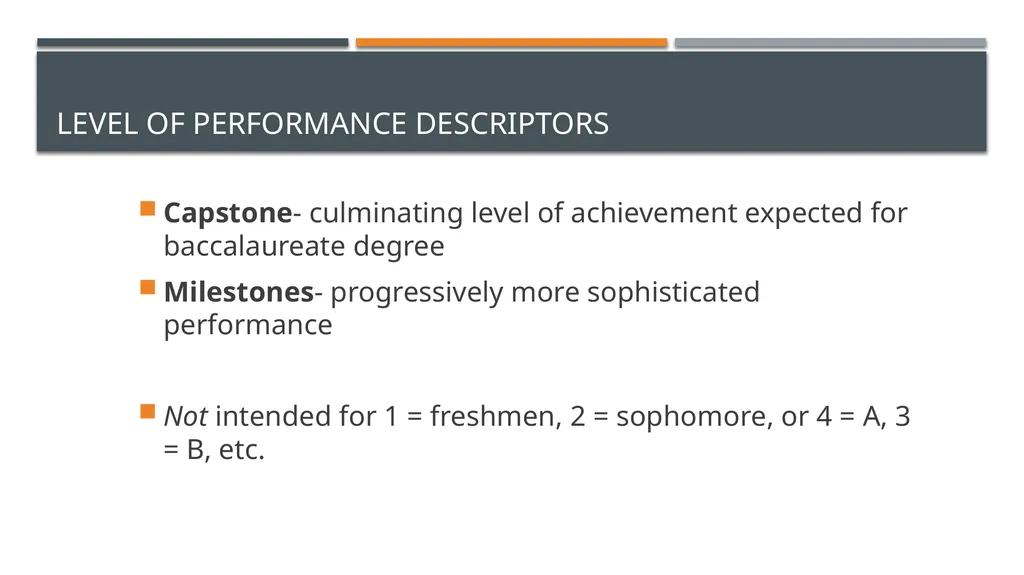
Level of Performance Descriptors Capstone- culminating level of achievement expected for baccalaureate degree
Milestones- progressively more sophisticated performance
Not intended for 1 = freshmen, 2 = sophomore, or 4 = A, 3 = B, etc.<br>
Milestones- progressively more sophisticated performance
Not intended for 1 = freshmen, 2 = sophomore, or 4 = A, 3 = B, etc.<br>
08
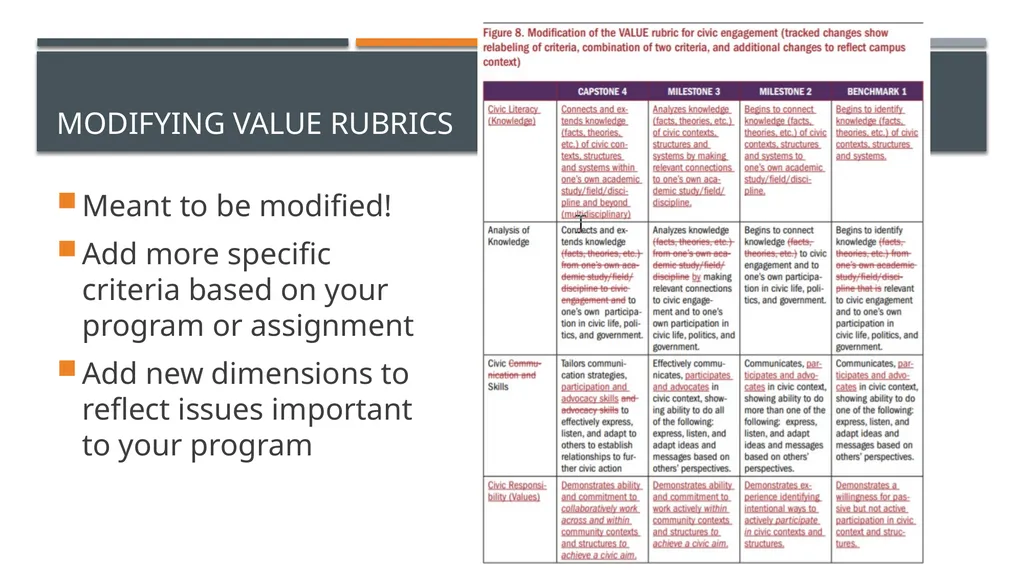
Modifying Value Rubrics Meant to be modified!
Add more specific criteria based on your program or assignment
Add new dimensions to reflect issues important to your program<br>
Add more specific criteria based on your program or assignment
Add new dimensions to reflect issues important to your program<br>
09
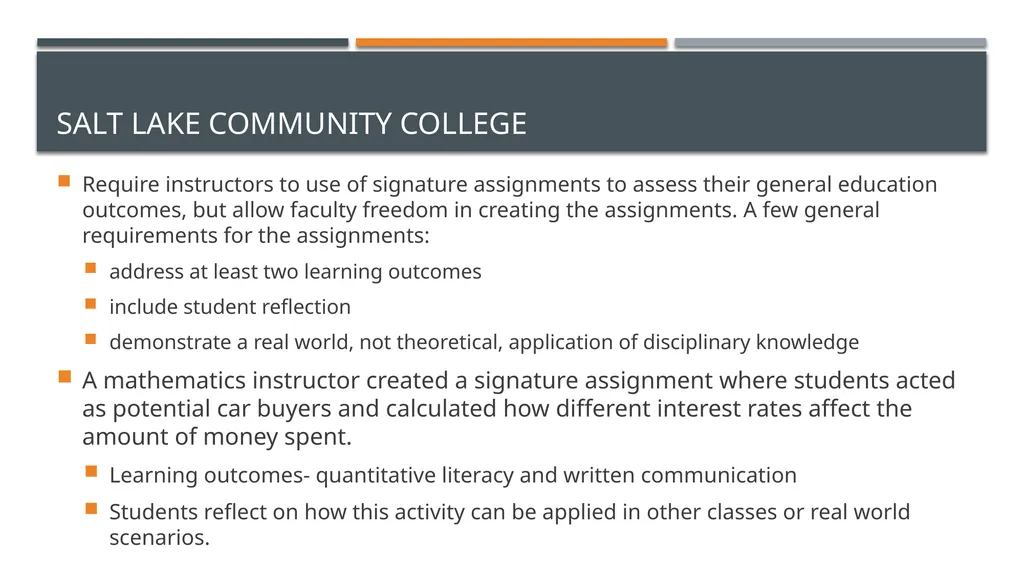
Salt Lake Community College Require instructors to use of signature assignments to assess their general education outcomes, but allow faculty freedom in creating the assignments. A few general requirements for the assignments:
address at least two learning outcomes
include student reflection
demonstrate a real world, not theoretical, application of disciplinary knowledge
A mathematics instructor created a signature assignment where students acted as potential car buyers and calculated how different interest rates affect the amount of money spent.
Learning outcomes- quantitative literacy and written communication
Students reflect on how this activity can be applied in other classes or real world scenarios.<br>
address at least two learning outcomes
include student reflection
demonstrate a real world, not theoretical, application of disciplinary knowledge
A mathematics instructor created a signature assignment where students acted as potential car buyers and calculated how different interest rates affect the amount of money spent.
Learning outcomes- quantitative literacy and written communication
Students reflect on how this activity can be applied in other classes or real world scenarios.<br>
10
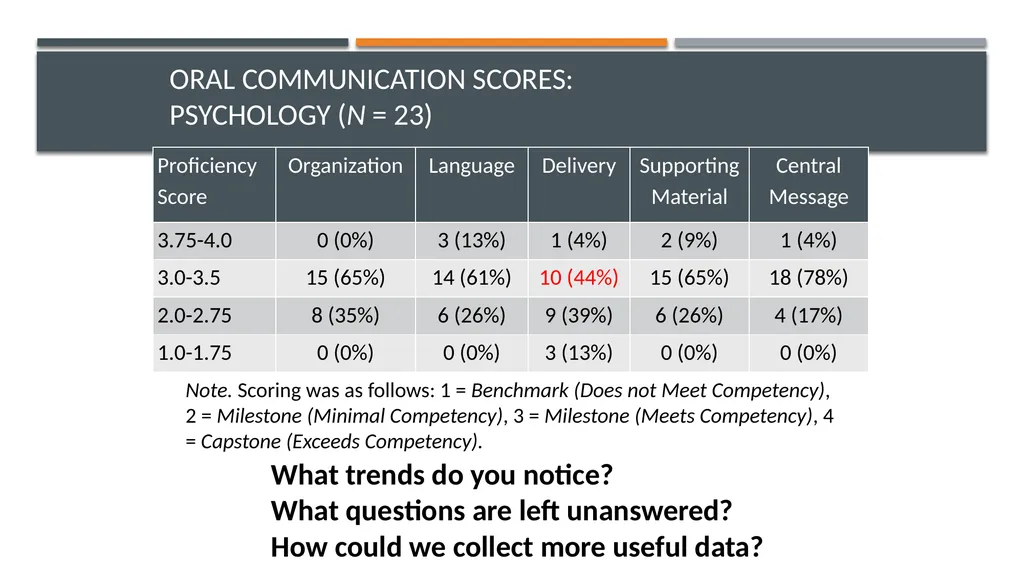
Oral Communication Scores:
Psychology (n = 23) Note. Scoring was as follows: 1 = Benchmark (Does not Meet Competency), 2 = Milestone (Minimal Competency), 3 = Milestone (Meets Competency), 4 = Capstone (Exceeds Competency). What trends do you notice?
What questions are left unanswered?
How could we collect more useful data?<br>
What questions are left unanswered?
How could we collect more useful data?<br>
11
Activity #1: Choosing an Outcome How do these align with your Program Learning Outcomes? Which learning outcomes are emphasized by your program?
What are your strengths and weaknesses?
Which seems like a priority for assessment?<br>
What are your strengths and weaknesses?
Which seems like a priority for assessment?<br>
12
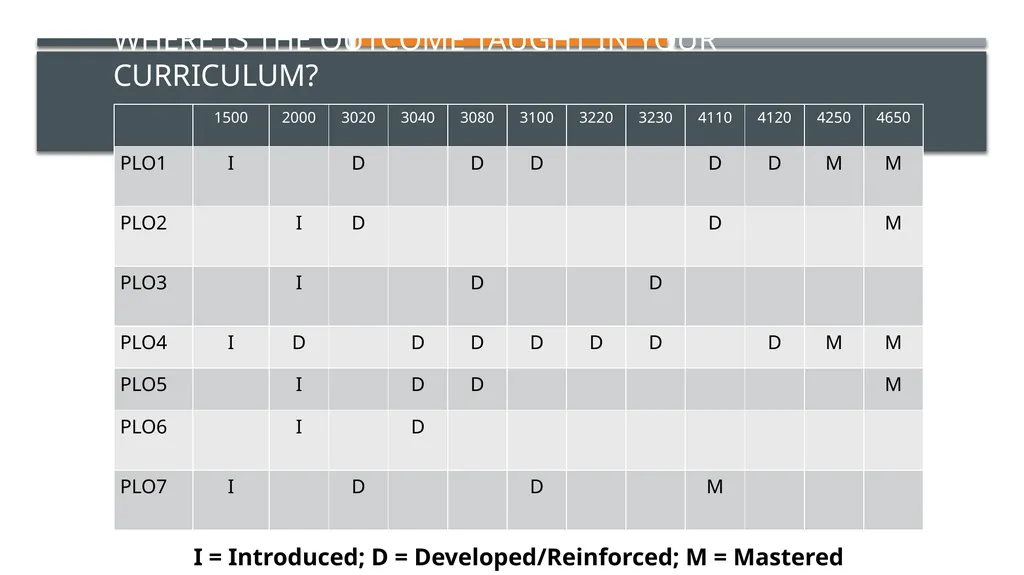
Where is the Outcome taught in your curriculum? I = Introduced; D = Developed/Reinforced; M = Mastered<br>
13
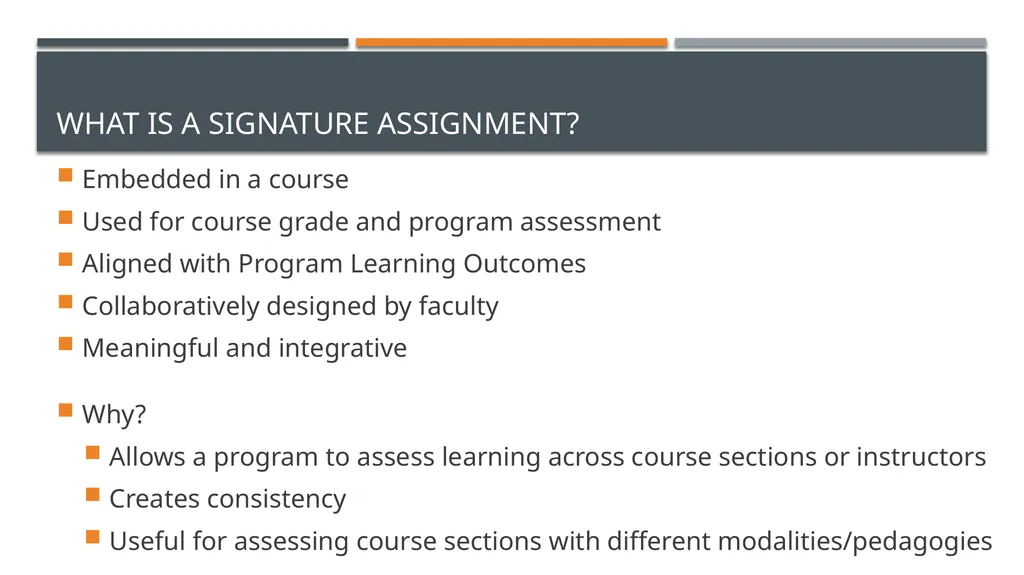
What is a Signature assignment? Embedded in a course
Used for course grade and program assessment
Aligned with Program Learning Outcomes
Collaboratively designed by faculty
Meaningful and integrative
Why?
Allows a program to assess learning across course sections or instructors
Creates consistency
Useful for assessing course sections with different modalities/pedagogies<br>
Used for course grade and program assessment
Aligned with Program Learning Outcomes
Collaboratively designed by faculty
Meaningful and integrative
Why?
Allows a program to assess learning across course sections or instructors
Creates consistency
Useful for assessing course sections with different modalities/pedagogies<br>
14
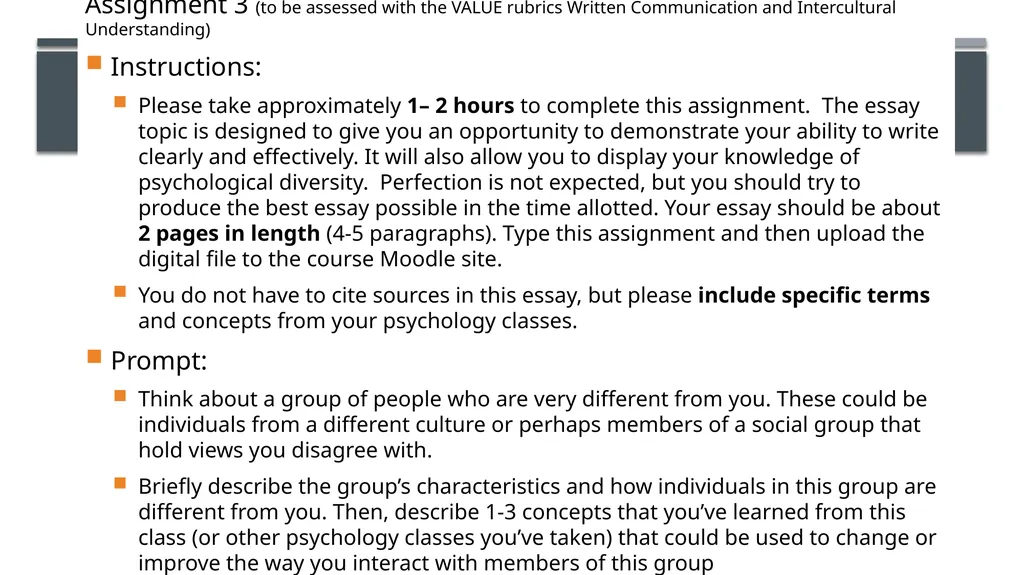
Assignment 3 (to be assessed with the VALUE rubrics Written Communication and Intercultural Understanding)
Instructions:
Please take approximately 1– 2 hours to complete this assignment. The essay topic is designed to give you an opportunity to demonstrate your ability to write clearly and effectively. It will also allow you to display your knowledge of psychological diversity. Perfection is not expected, but you should try to produce the best essay possible in the time allotted. Your essay should be about 2 pages in length (4-5 paragraphs). Type this assignment and then upload the digital file to the course Moodle site.
You do not have to cite sources in this essay, but please include specific terms and concepts from your psychology classes.
Prompt:
Think about a group of people who are very different from you. These could be individuals from a different culture or perhaps members of a social group that hold views you disagree with.
Briefly describe the group’s characteristics and how individuals in this group are different from you. Then, describe 1-3 concepts that you’ve learned from this class (or other psychology classes you’ve taken) that could be used to change or improve the way you interact with members of this group<br>
Instructions:
Please take approximately 1– 2 hours to complete this assignment. The essay topic is designed to give you an opportunity to demonstrate your ability to write clearly and effectively. It will also allow you to display your knowledge of psychological diversity. Perfection is not expected, but you should try to produce the best essay possible in the time allotted. Your essay should be about 2 pages in length (4-5 paragraphs). Type this assignment and then upload the digital file to the course Moodle site.
You do not have to cite sources in this essay, but please include specific terms and concepts from your psychology classes.
Prompt:
Think about a group of people who are very different from you. These could be individuals from a different culture or perhaps members of a social group that hold views you disagree with.
Briefly describe the group’s characteristics and how individuals in this group are different from you. Then, describe 1-3 concepts that you’ve learned from this class (or other psychology classes you’ve taken) that could be used to change or improve the way you interact with members of this group<br>
15
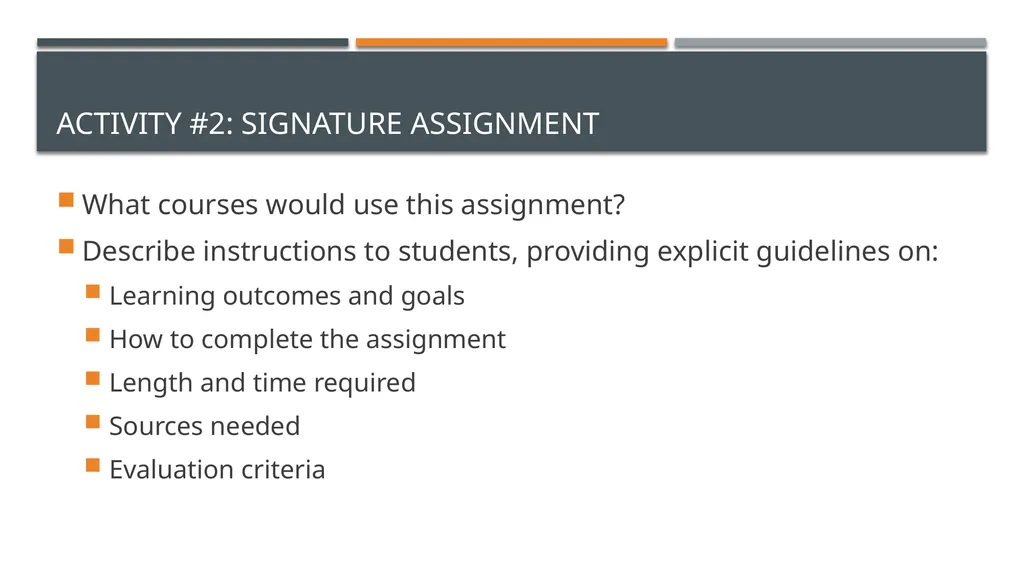
Activity #2: Signature Assignment What courses would use this assignment?
Describe instructions to students, providing explicit guidelines on:
Learning outcomes and goals
How to complete the assignment
Length and time required
Sources needed
Evaluation criteria<br>
Describe instructions to students, providing explicit guidelines on:
Learning outcomes and goals
How to complete the assignment
Length and time required
Sources needed
Evaluation criteria<br>
16
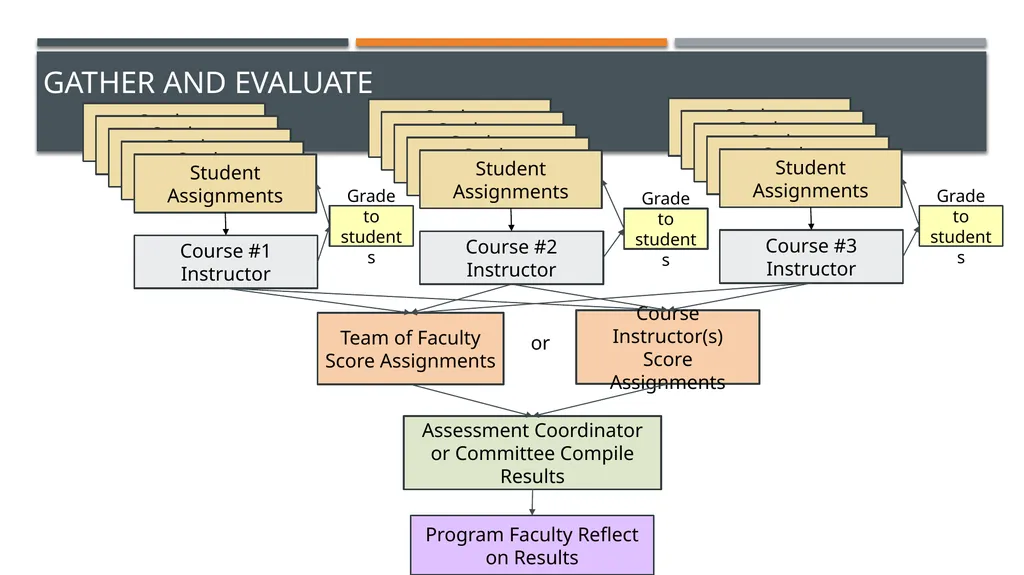
Gather and Evaluate Student Assignments Course #1 Instructor Course Instructor(s)
Score Assignments Team of Faculty Score Assignments Assessment Coordinator or Committee Compile Results Program Faculty Reflect on Results Student Assignments Student Assignments Student Assignments Student Assignments Student Assignments Course #2 Instructor Student Assignments Student Assignments Student Assignments Student Assignments Student Assignments Course #3 Instructor Student Assignments Student Assignments Student Assignments Student Assignments or Grade to students Grade to students Grade to students<br>
Score Assignments Team of Faculty Score Assignments Assessment Coordinator or Committee Compile Results Program Faculty Reflect on Results Student Assignments Student Assignments Student Assignments Student Assignments Student Assignments Course #2 Instructor Student Assignments Student Assignments Student Assignments Student Assignments Student Assignments Course #3 Instructor Student Assignments Student Assignments Student Assignments Student Assignments or Grade to students Grade to students Grade to students<br>
17
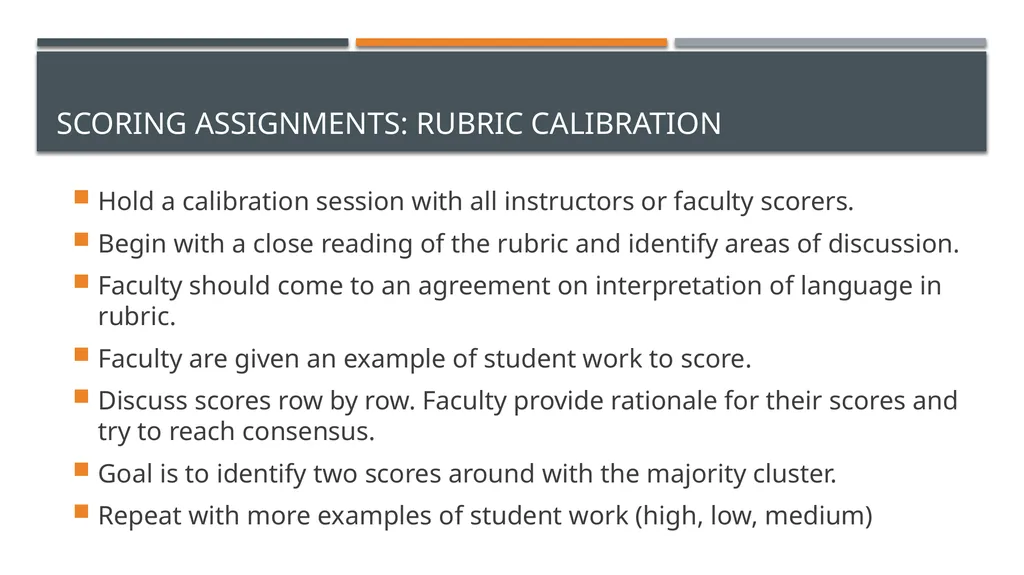
Scoring assignments: Rubric Calibration Hold a calibration session with all instructors or faculty scorers.
Begin with a close reading of the rubric and identify areas of discussion.
Faculty should come to an agreement on interpretation of language in rubric.
Faculty are given an example of student work to score.
Discuss scores row by row. Faculty provide rationale for their scores and try to reach consensus.
Goal is to identify two scores around with the majority cluster.
Repeat with more examples of student work (high, low, medium)<br>
Begin with a close reading of the rubric and identify areas of discussion.
Faculty should come to an agreement on interpretation of language in rubric.
Faculty are given an example of student work to score.
Discuss scores row by row. Faculty provide rationale for their scores and try to reach consensus.
Goal is to identify two scores around with the majority cluster.
Repeat with more examples of student work (high, low, medium)<br>
18
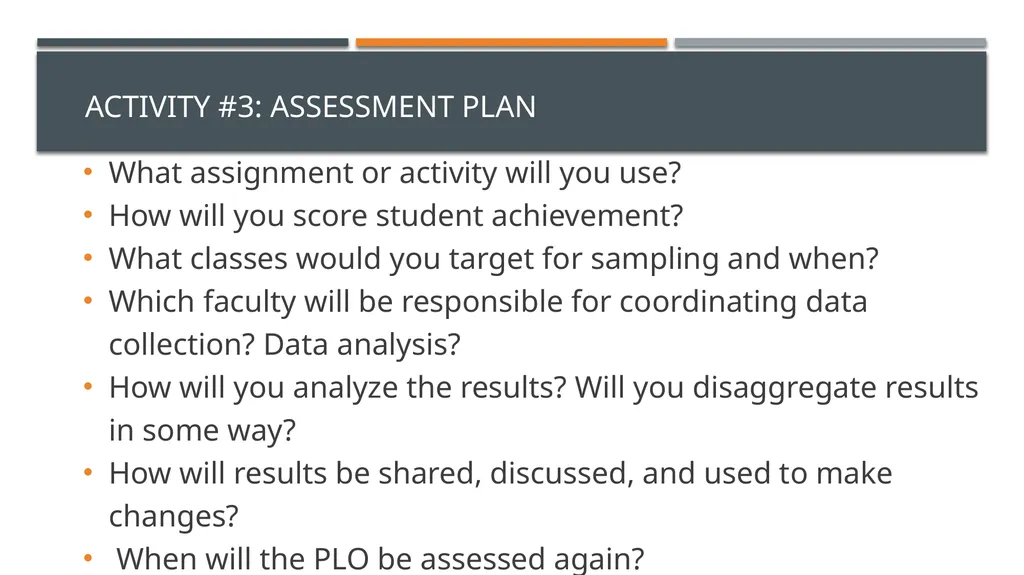
Activity #3: Assessment Plan What assignment or activity will you use?
How will you score student achievement?
What classes would you target for sampling and when?
Which faculty will be responsible for coordinating data collection? Data analysis?
How will you analyze the results? Will you disaggregate results in some way?
How will results be shared, discussed, and used to make changes?
When will the PLO be assessed again?<br>
How will you score student achievement?
What classes would you target for sampling and when?
Which faculty will be responsible for coordinating data collection? Data analysis?
How will you analyze the results? Will you disaggregate results in some way?
How will results be shared, discussed, and used to make changes?
When will the PLO be assessed again?<br>
19
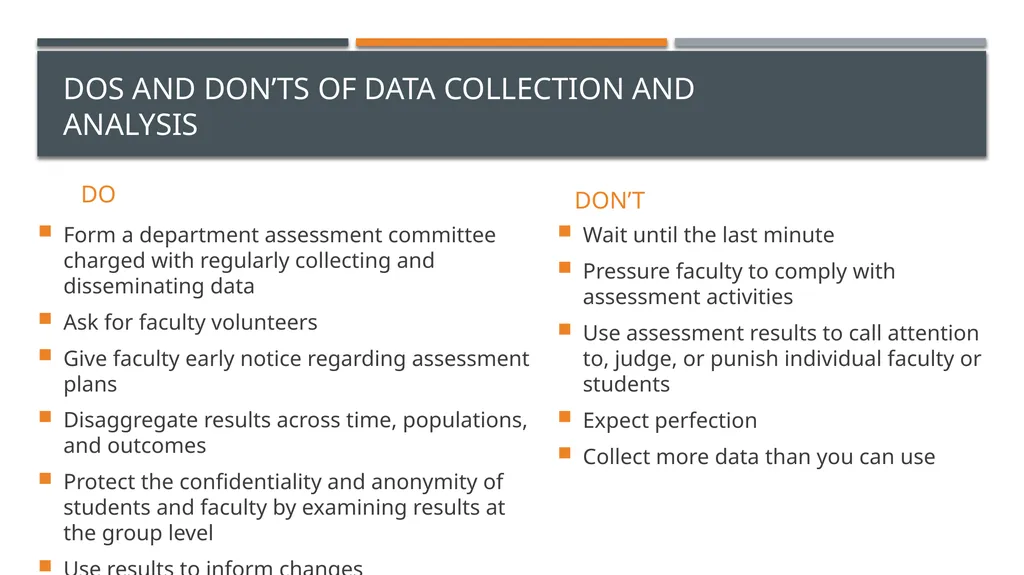
Dos and Don’ts of Data Collection and Analysis DO Form a department assessment committee charged with regularly collecting and disseminating data
Ask for faculty volunteers
Give faculty early notice regarding assessment plans
Disaggregate results across time, populations, and outcomes
Protect the confidentiality and anonymity of students and faculty by examining results at the group level
Use results to inform changes DON’T Wait until the last minute
Pressure faculty to comply with assessment activities
Use assessment results to call attention to, judge, or punish individual faculty or students
Expect perfection
Collect more data than you can use<br>
Ask for faculty volunteers
Give faculty early notice regarding assessment plans
Disaggregate results across time, populations, and outcomes
Protect the confidentiality and anonymity of students and faculty by examining results at the group level
Use results to inform changes DON’T Wait until the last minute
Pressure faculty to comply with assessment activities
Use assessment results to call attention to, judge, or punish individual faculty or students
Expect perfection
Collect more data than you can use<br>
20
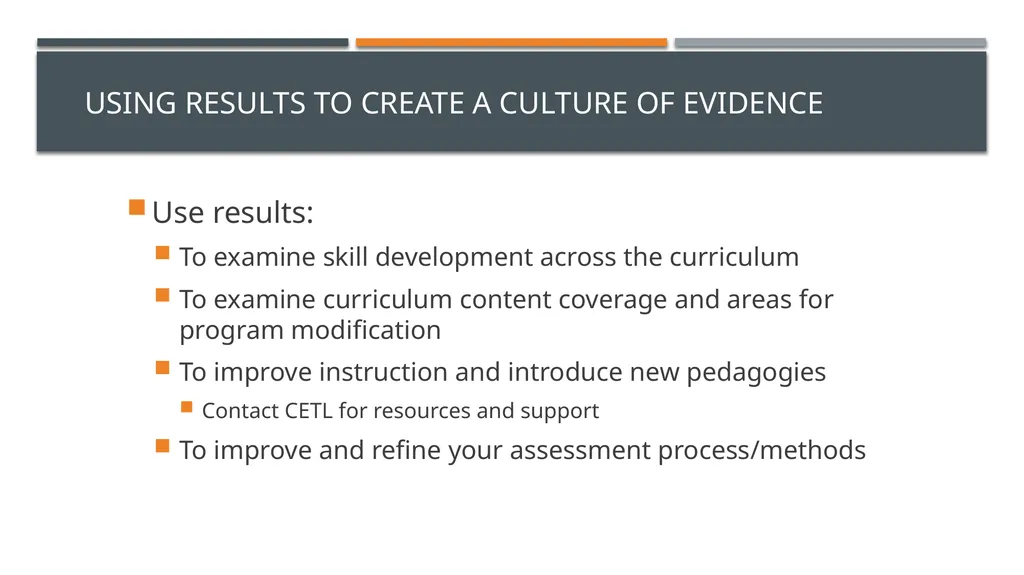
Using Results to Create A Culture of Evidence Use results:
To examine skill development across the curriculum
To examine curriculum content coverage and areas for program modification
To improve instruction and introduce new pedagogies
Contact CETL for resources and support
To improve and refine your assessment process/methods<br>
To examine skill development across the curriculum
To examine curriculum content coverage and areas for program modification
To improve instruction and introduce new pedagogies
Contact CETL for resources and support
To improve and refine your assessment process/methods<br>
21
Next Steps What have you learned today that you want to share with others in your department?
Write down 1-3 you can do this semester to keep your assessment momentum going?<br>
Write down 1-3 you can do this semester to keep your assessment momentum going?<br>
22
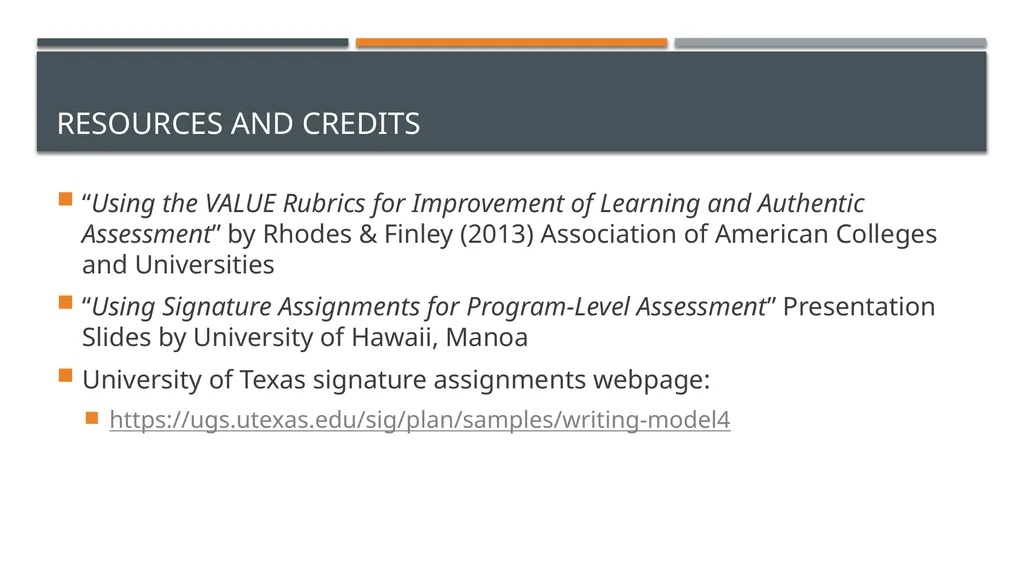
Resources and credits “Using the VALUE Rubrics for Improvement of Learning and Authentic Assessment” by Rhodes & Finley (2013) Association of American Colleges and Universities
“Using Signature Assignments for Program-Level Assessment” Presentation Slides by University of Hawaii, Manoa
University of Texas signature assignments webpage:
https://ugs.utexas.edu/sig/plan/samples/writing-model4<br>
“Using Signature Assignments for Program-Level Assessment” Presentation Slides by University of Hawaii, Manoa
University of Texas signature assignments webpage:
https://ugs.utexas.edu/sig/plan/samples/writing-model4<br>