
WG/UNICEF Child functioning module: Preliminary
Description: WGUNICEF Child functioning module: Preliminary results from Samoa Supporting documentation Mitchell Loeb National Center for Health Statistics Washington Group on Disability Statistics 1 In 2014 the Samoan Bureau of Statistics undertook
Related Topics
Download Presentation
"WG/UNICEF Child functioning module: Preliminary" is the property of its rightful owner. Permission is granted to download and print the materials on this website for personal, non-commercial use only, and to display it on your personal computer provided you do not modify the materials and that you retain all copyright notices contained in the materials. By downloading content from our website, you accept the terms of this agreement.
Presentation Transcript
slide1. WG/UNICEF Child functioning module: Preliminary results from Samoa &
Supporting documentation Mitchell Loeb
National Center for Health Statistics/
Washington Group on Disability Statistics 1<br>
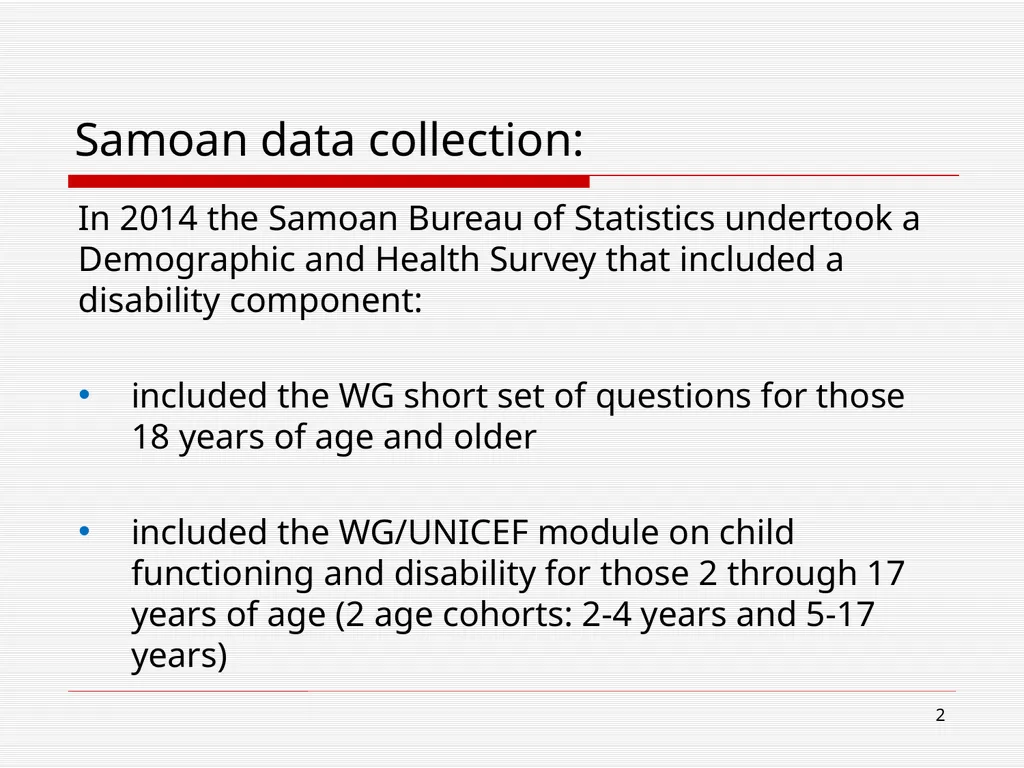
slide2. In 2014 the Samoan Bureau of Statistics undertook a Demographic and Health Survey that included a disability component:
included the WG short set of questions for those 18 years of age and older
included the WG/UNICEF module on child functioning and disability for those 2 through 17 years of age (2 age cohorts: 2-4 years and 5-17 years) Samoan data collection: 2<br>
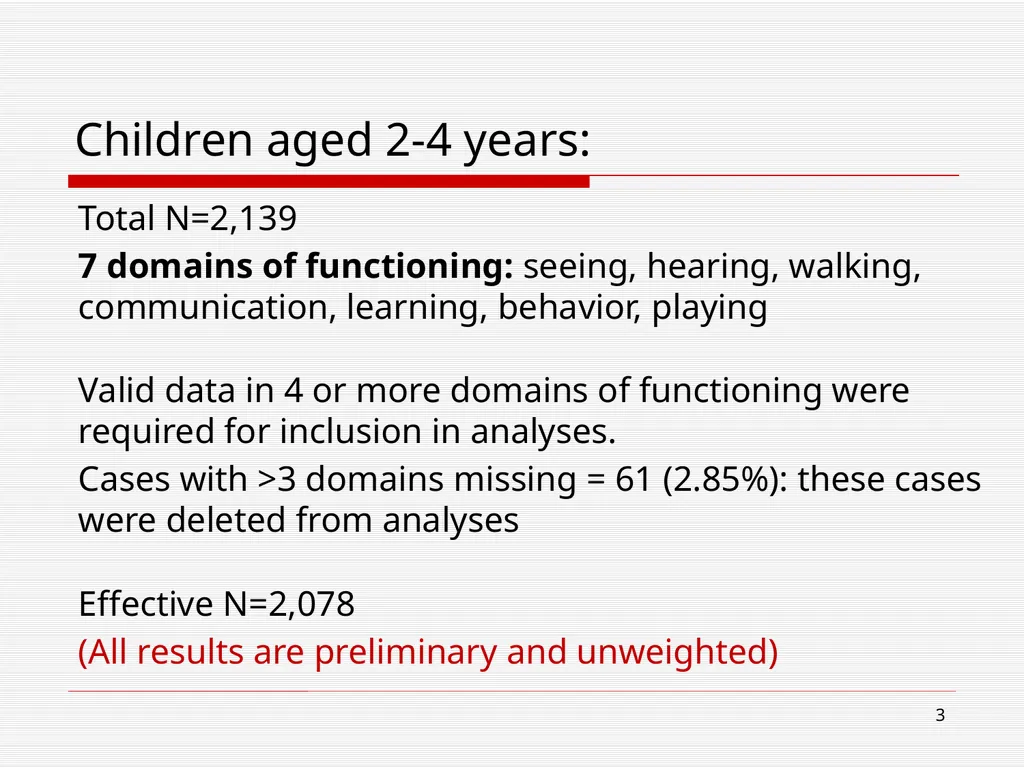
slide3. Total N=2,139
7 domains of functioning: seeing, hearing, walking, communication, learning, behavior, playing
Valid data in 4 or more domains of functioning were required for inclusion in analyses.
Cases with >3 domains missing = 61 (2.85%): these cases were deleted from analyses
Effective N=2,078
(All results are preliminary and unweighted) Children aged 2-4 years: 3<br>
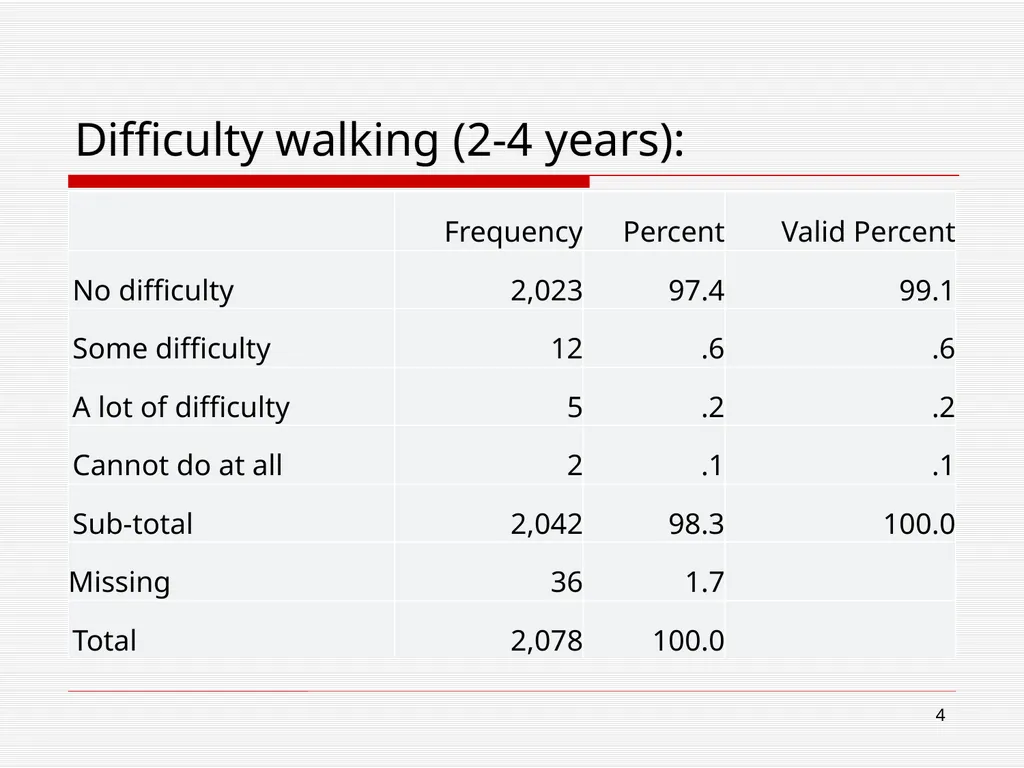
slide4. Difficulty walking (2-4 years): 4<br>
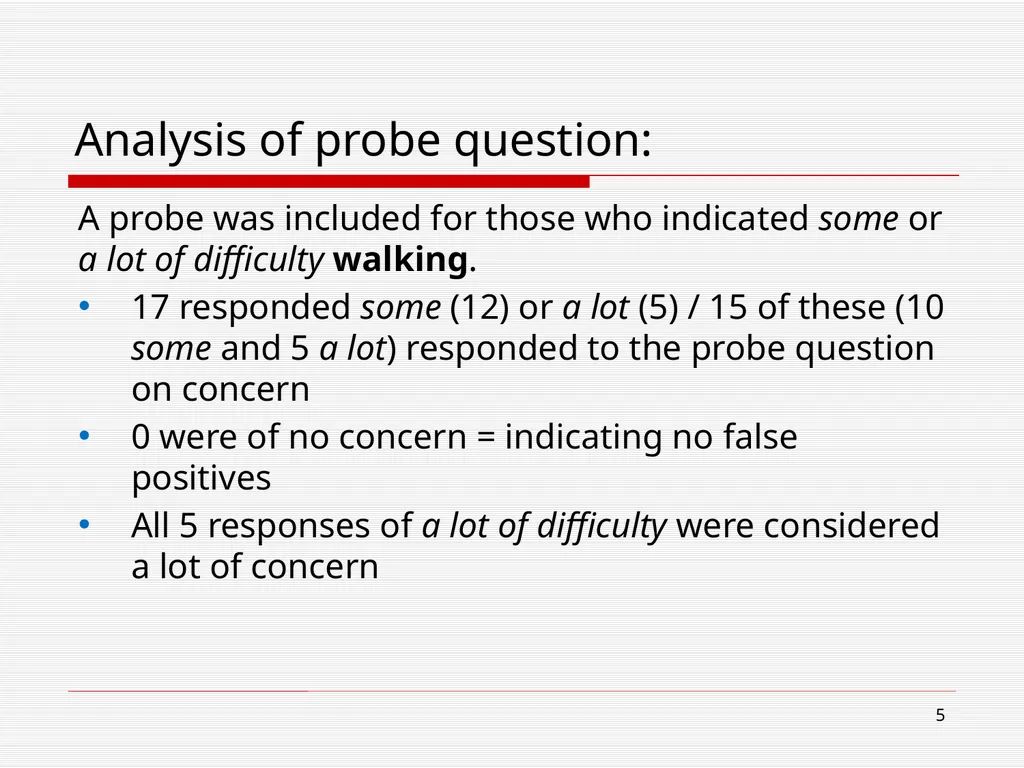
slide5. A probe was included for those who indicated some or a lot of difficulty walking.
17 responded some (12) or a lot (5) / 15 of these (10 some and 5 a lot) responded to the probe question on concern
0 were of no concern = indicating no false positives
All 5 responses of a lot of difficulty were considered a lot of concern Analysis of probe question: 5<br>
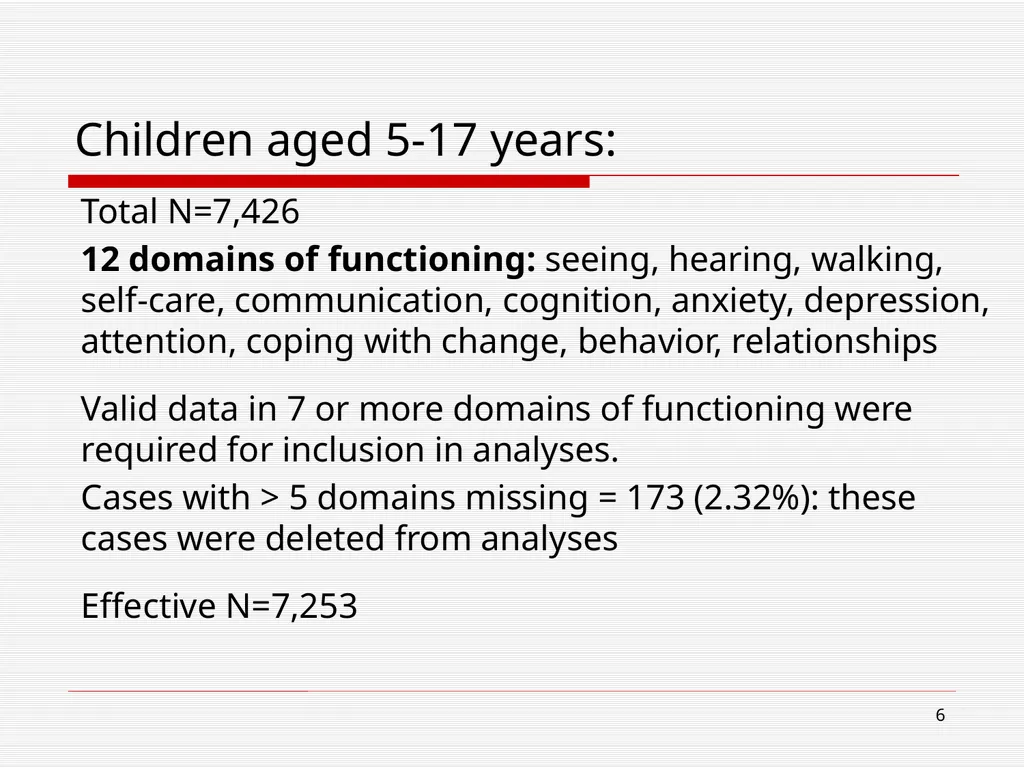
slide6. Total N=7,426
12 domains of functioning: seeing, hearing, walking, self-care, communication, cognition, anxiety, depression, attention, coping with change, behavior, relationships
Valid data in 7 or more domains of functioning were required for inclusion in analyses.
Cases with > 5 domains missing = 173 (2.32%): these cases were deleted from analyses
Effective N=7,253 Children aged 5-17 years: 6<br>
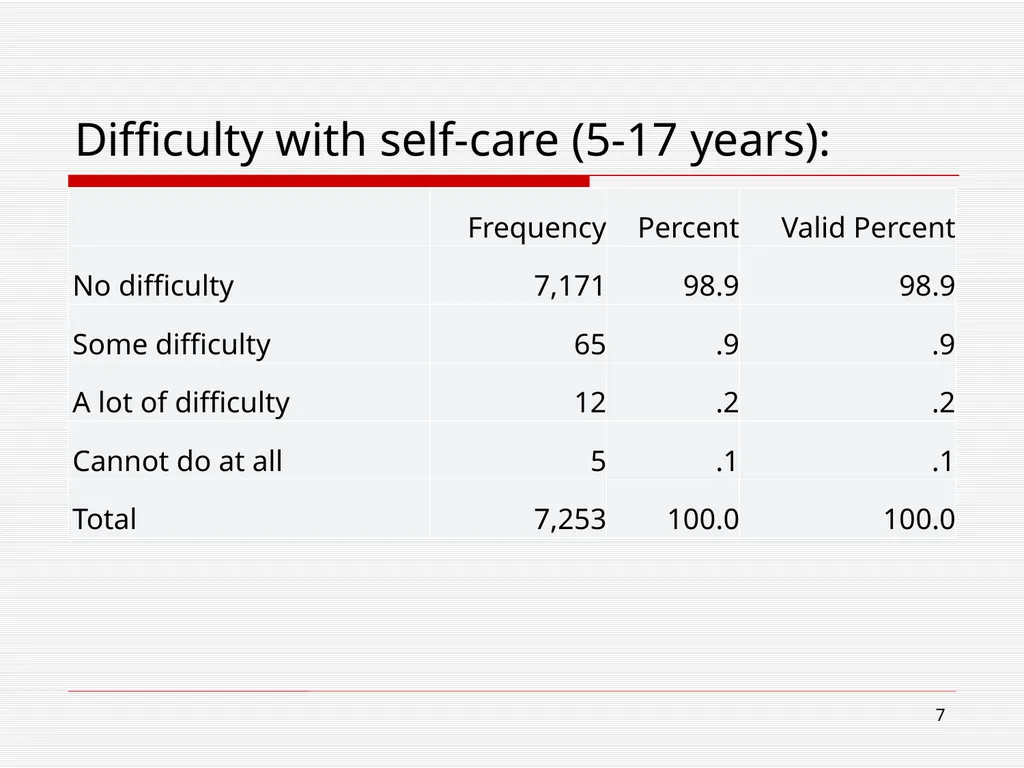
slide7. Difficulty with self-care (5-17 years): 7<br>
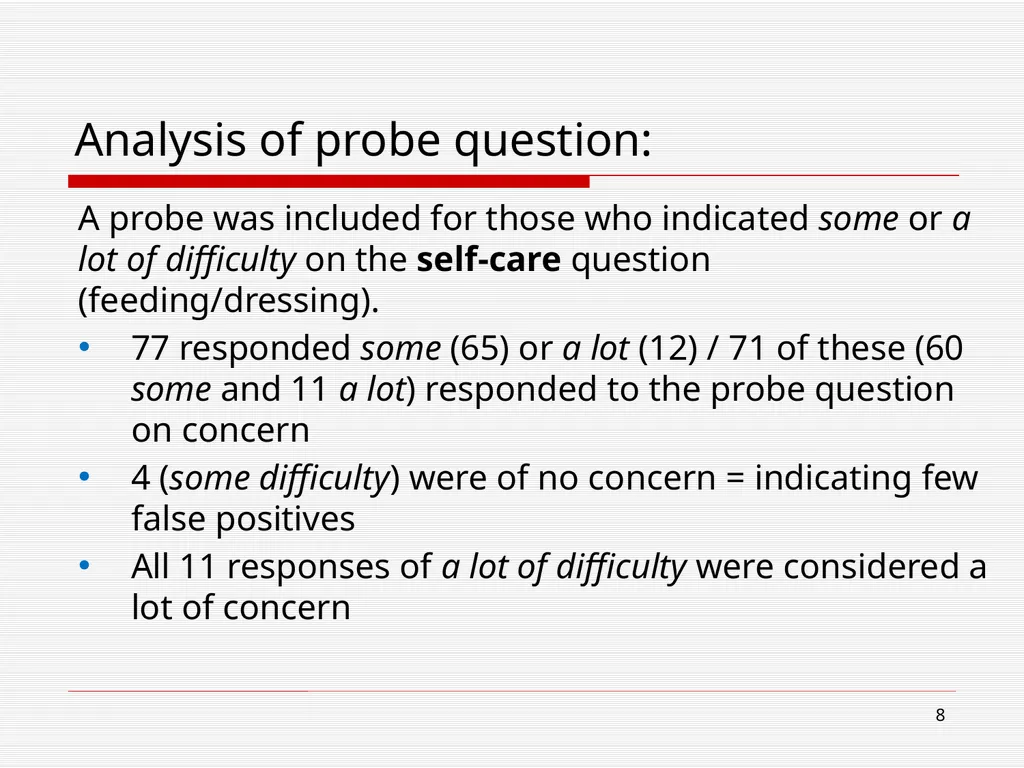
slide8. A probe was included for those who indicated some or a lot of difficulty on the self-care question (feeding/dressing).
77 responded some (65) or a lot (12) / 71 of these (60 some and 11 a lot) responded to the probe question on concern
4 (some difficulty) were of no concern = indicating few false positives
All 11 responses of a lot of difficulty were considered a lot of concern Analysis of probe question: 8<br>
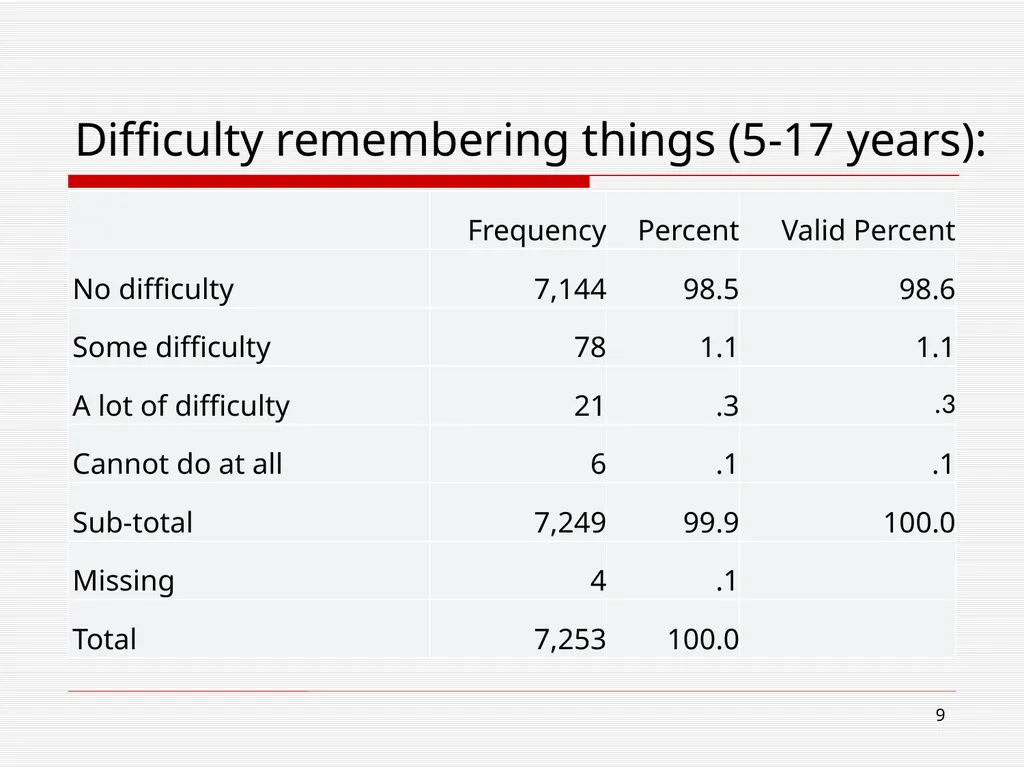
slide9. Difficulty remembering things (5-17 years): 9<br>
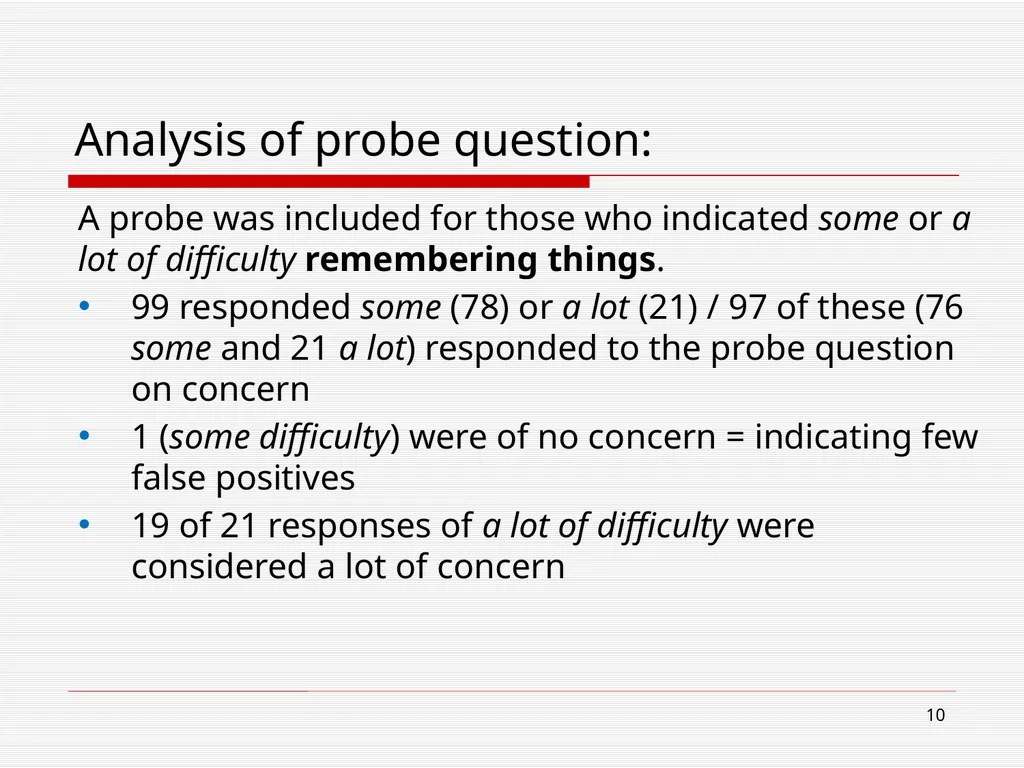
slide10. A probe was included for those who indicated some or a lot of difficulty remembering things.
99 responded some (78) or a lot (21) / 97 of these (76 some and 21 a lot) responded to the probe question on concern
1 (some difficulty) were of no concern = indicating few false positives
19 of 21 responses of a lot of difficulty were considered a lot of concern Analysis of probe question: 10<br>
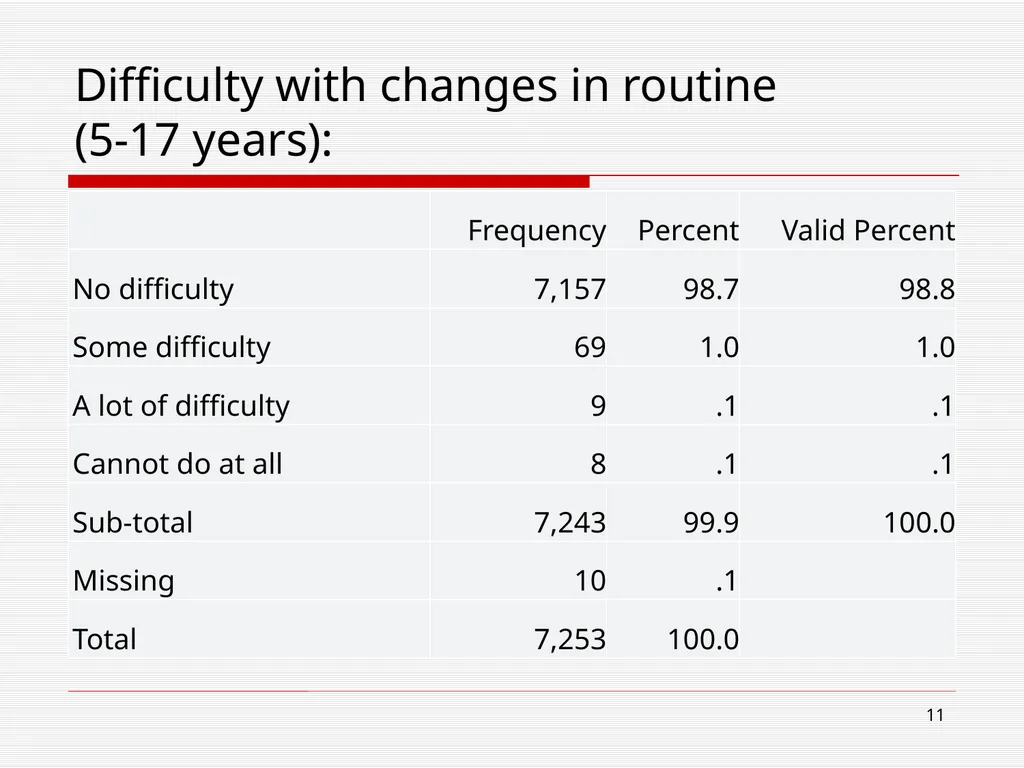
slide11. Difficulty with changes in routine (5-17 years): 11<br>
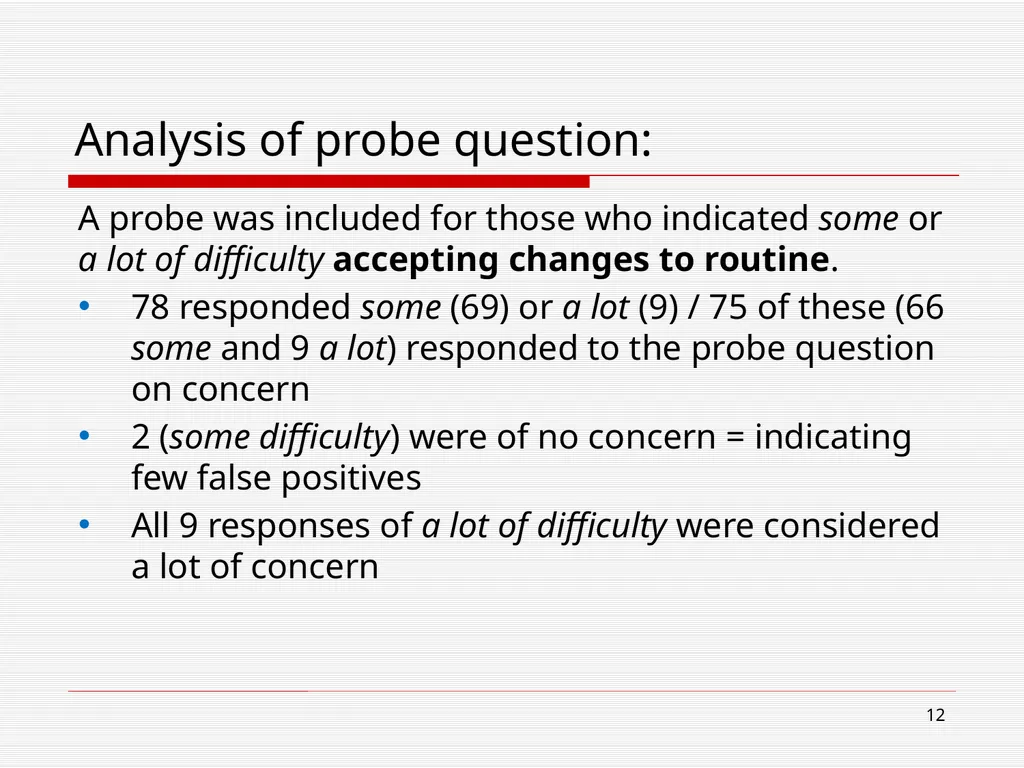
slide12. A probe was included for those who indicated some or a lot of difficulty accepting changes to routine.
78 responded some (69) or a lot (9) / 75 of these (66 some and 9 a lot) responded to the probe question on concern
2 (some difficulty) were of no concern = indicating few false positives
All 9 responses of a lot of difficulty were considered a lot of concern Analysis of probe question: 12<br>
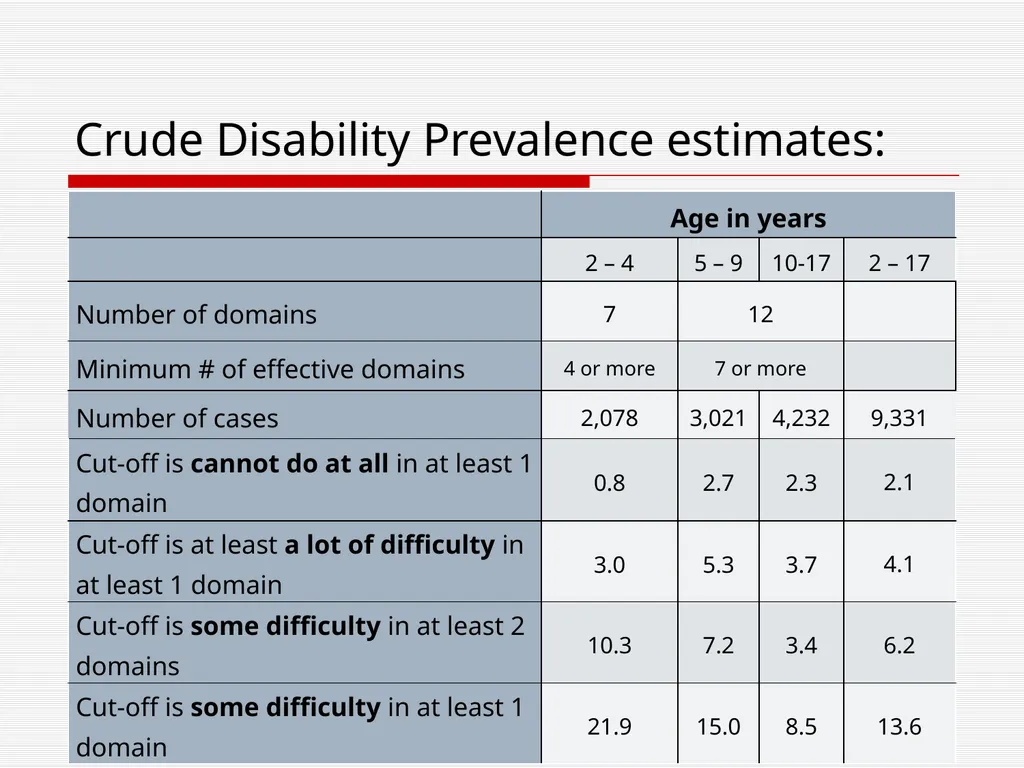
slide13. Crude Disability Prevalence estimates: 13<br>
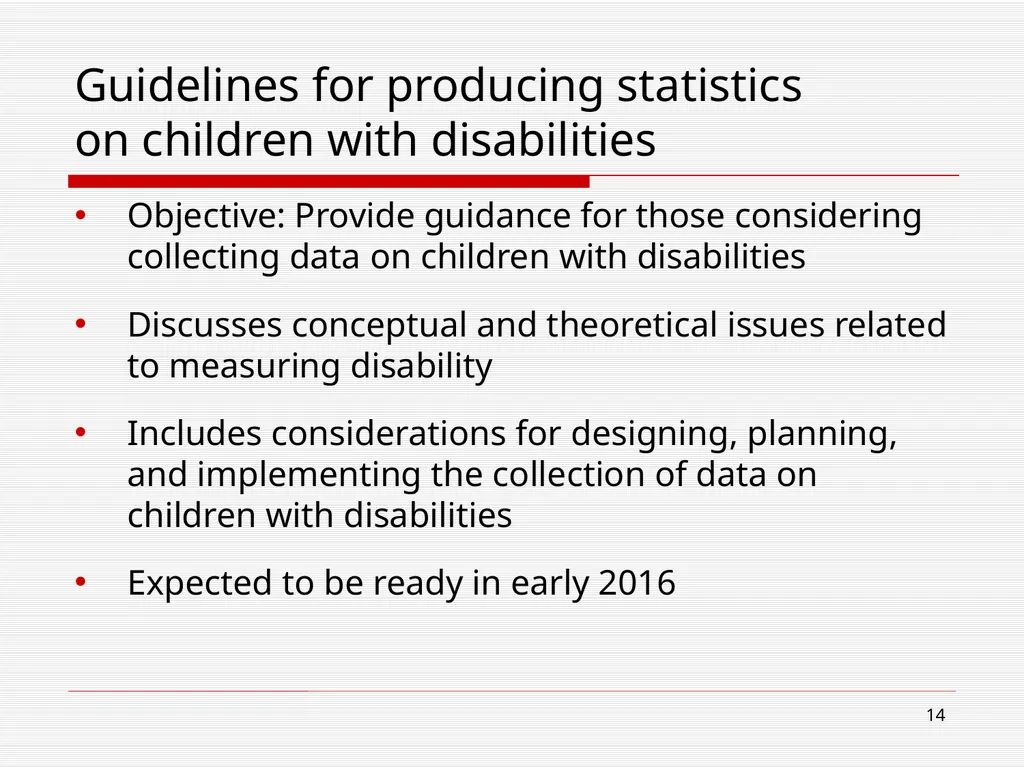
slide14. Guidelines for producing statistics on children with disabilities Objective: Provide guidance for those considering collecting data on children with disabilities
Discusses conceptual and theoretical issues related to measuring disability
Includes considerations for designing, planning, and implementing the collection of data on children with disabilities
Expected to be ready in early 2016 14<br>
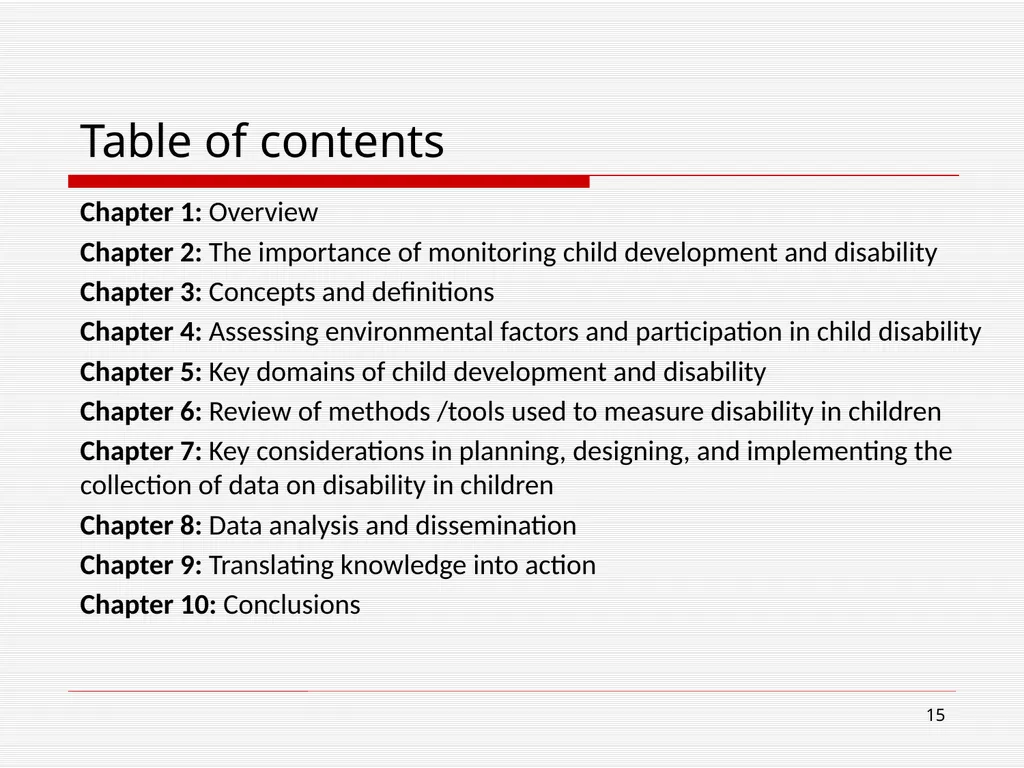
slide15. Table of contents Chapter 1: Overview
Chapter 2: The importance of monitoring child development and disability
Chapter 3: Concepts and definitions
Chapter 4: Assessing environmental factors and participation in child disability
Chapter 5: Key domains of child development and disability
Chapter 6: Review of methods /tools used to measure disability in children
Chapter 7: Key considerations in planning, designing, and implementing the collection of data on disability in children
Chapter 8: Data analysis and dissemination
Chapter 9: Translating knowledge into action
Chapter 10: Conclusions 15<br>
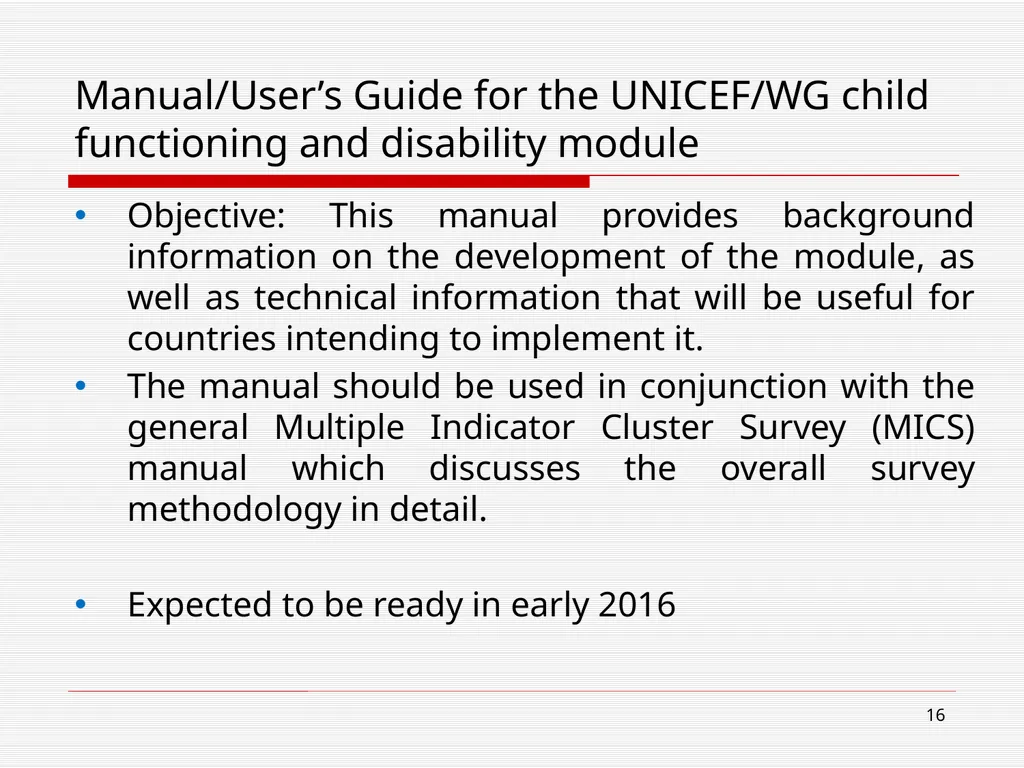
slide16. Manual/User’s Guide for the UNICEF/WG child functioning and disability module Objective: This manual provides background information on the development of the module, as well as technical information that will be useful for countries intending to implement it.
The manual should be used in conjunction with the general Multiple Indicator Cluster Survey (MICS) manual which discusses the overall survey methodology in detail.
Expected to be ready in early 2016 16<br>
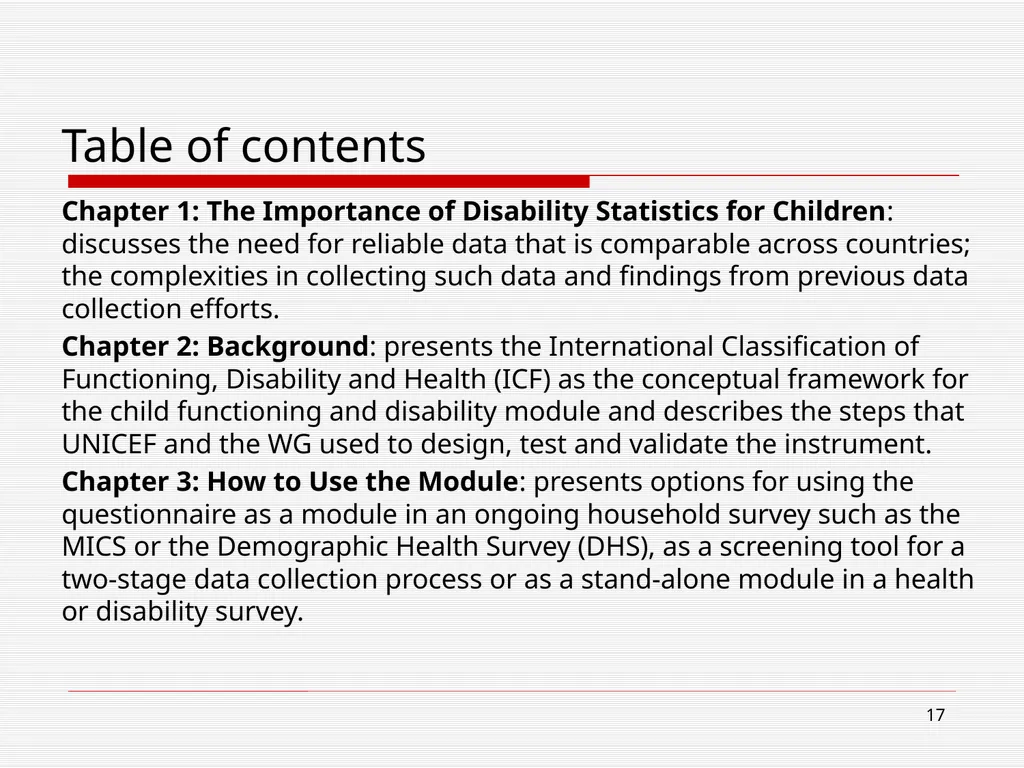
slide17. Table of contents Chapter 1: The Importance of Disability Statistics for Children: discusses the need for reliable data that is comparable across countries; the complexities in collecting such data and findings from previous data collection efforts.
Chapter 2: Background: presents the International Classification of Functioning, Disability and Health (ICF) as the conceptual framework for the child functioning and disability module and describes the steps that UNICEF and the WG used to design, test and validate the instrument.
Chapter 3: How to Use the Module: presents options for using the questionnaire as a module in an ongoing household survey such as the MICS or the Demographic Health Survey (DHS), as a screening tool for a two-stage data collection process or as a stand-alone module in a health or disability survey. 17<br>
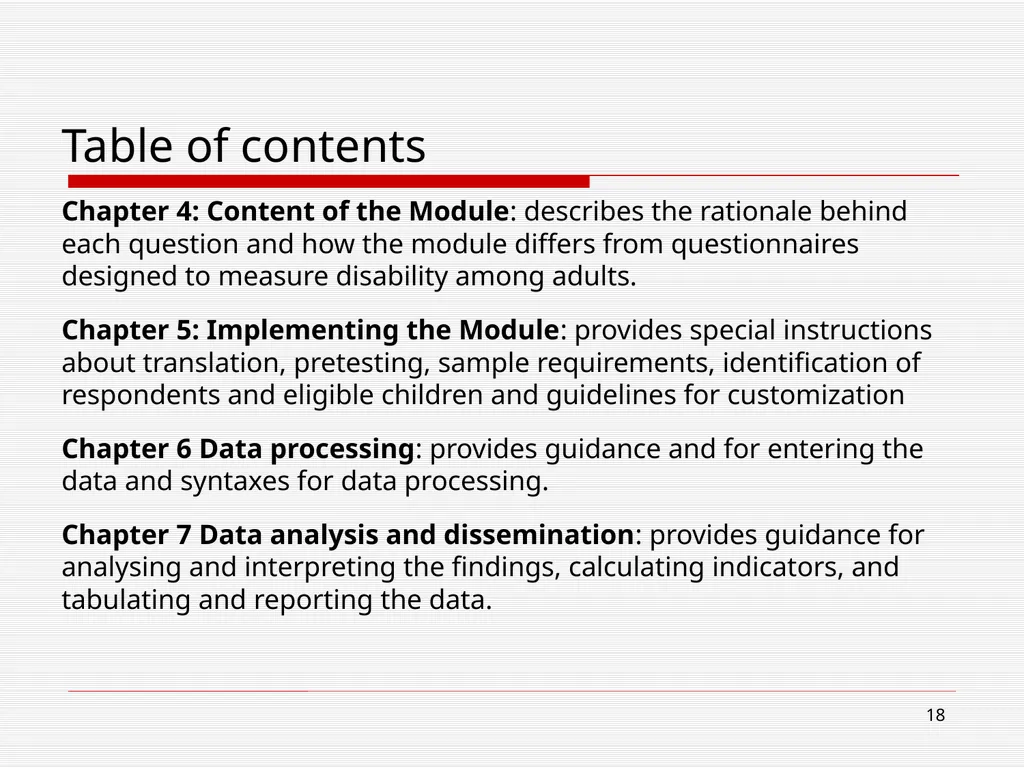
slide18. Table of contents Chapter 4: Content of the Module: describes the rationale behind each question and how the module differs from questionnaires designed to measure disability among adults.
Chapter 5: Implementing the Module: provides special instructions about translation, pretesting, sample requirements, identification of respondents and eligible children and guidelines for customization
Chapter 6 Data processing: provides guidance and for entering the data and syntaxes for data processing.
Chapter 7 Data analysis and dissemination: provides guidance for analysing and interpreting the findings, calculating indicators, and tabulating and reporting the data. 18<br>
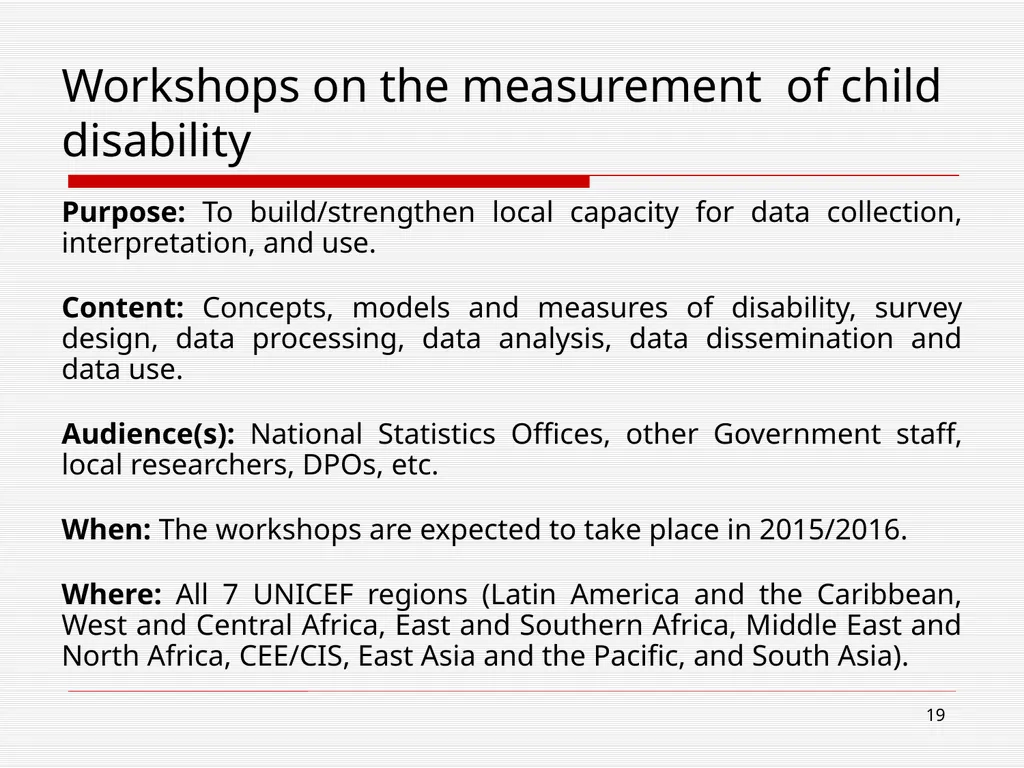
slide19. Workshops on the measurement of child disability Purpose: To build/strengthen local capacity for data collection, interpretation, and use.
Content: Concepts, models and measures of disability, survey design, data processing, data analysis, data dissemination and data use.
Audience(s): National Statistics Offices, other Government staff, local researchers, DPOs, etc.
When: The workshops are expected to take place in 2015/2016.
Where: All 7 UNICEF regions (Latin America and the Caribbean, West and Central Africa, East and Southern Africa, Middle East and North Africa, CEE/CIS, East Asia and the Pacific, and South Asia). 19<br>
National Center for Health Statistics/
Washington Group on Disability Statistics 1<br>
slide2. In 2014 the Samoan Bureau of Statistics undertook a Demographic and Health Survey that included a disability component:
included the WG short set of questions for those 18 years of age and older
included the WG/UNICEF module on child functioning and disability for those 2 through 17 years of age (2 age cohorts: 2-4 years and 5-17 years) Samoan data collection: 2<br>
slide3. Total N=2,139
7 domains of functioning: seeing, hearing, walking, communication, learning, behavior, playing
Valid data in 4 or more domains of functioning were required for inclusion in analyses.
Cases with >3 domains missing = 61 (2.85%): these cases were deleted from analyses
Effective N=2,078
(All results are preliminary and unweighted) Children aged 2-4 years: 3<br>
slide4. Difficulty walking (2-4 years): 4<br>
slide5. A probe was included for those who indicated some or a lot of difficulty walking.
17 responded some (12) or a lot (5) / 15 of these (10 some and 5 a lot) responded to the probe question on concern
0 were of no concern = indicating no false positives
All 5 responses of a lot of difficulty were considered a lot of concern Analysis of probe question: 5<br>
slide6. Total N=7,426
12 domains of functioning: seeing, hearing, walking, self-care, communication, cognition, anxiety, depression, attention, coping with change, behavior, relationships
Valid data in 7 or more domains of functioning were required for inclusion in analyses.
Cases with > 5 domains missing = 173 (2.32%): these cases were deleted from analyses
Effective N=7,253 Children aged 5-17 years: 6<br>
slide7. Difficulty with self-care (5-17 years): 7<br>
slide8. A probe was included for those who indicated some or a lot of difficulty on the self-care question (feeding/dressing).
77 responded some (65) or a lot (12) / 71 of these (60 some and 11 a lot) responded to the probe question on concern
4 (some difficulty) were of no concern = indicating few false positives
All 11 responses of a lot of difficulty were considered a lot of concern Analysis of probe question: 8<br>
slide9. Difficulty remembering things (5-17 years): 9<br>
slide10. A probe was included for those who indicated some or a lot of difficulty remembering things.
99 responded some (78) or a lot (21) / 97 of these (76 some and 21 a lot) responded to the probe question on concern
1 (some difficulty) were of no concern = indicating few false positives
19 of 21 responses of a lot of difficulty were considered a lot of concern Analysis of probe question: 10<br>
slide11. Difficulty with changes in routine (5-17 years): 11<br>
slide12. A probe was included for those who indicated some or a lot of difficulty accepting changes to routine.
78 responded some (69) or a lot (9) / 75 of these (66 some and 9 a lot) responded to the probe question on concern
2 (some difficulty) were of no concern = indicating few false positives
All 9 responses of a lot of difficulty were considered a lot of concern Analysis of probe question: 12<br>
slide13. Crude Disability Prevalence estimates: 13<br>
slide14. Guidelines for producing statistics on children with disabilities Objective: Provide guidance for those considering collecting data on children with disabilities
Discusses conceptual and theoretical issues related to measuring disability
Includes considerations for designing, planning, and implementing the collection of data on children with disabilities
Expected to be ready in early 2016 14<br>
slide15. Table of contents Chapter 1: Overview
Chapter 2: The importance of monitoring child development and disability
Chapter 3: Concepts and definitions
Chapter 4: Assessing environmental factors and participation in child disability
Chapter 5: Key domains of child development and disability
Chapter 6: Review of methods /tools used to measure disability in children
Chapter 7: Key considerations in planning, designing, and implementing the collection of data on disability in children
Chapter 8: Data analysis and dissemination
Chapter 9: Translating knowledge into action
Chapter 10: Conclusions 15<br>
slide16. Manual/User’s Guide for the UNICEF/WG child functioning and disability module Objective: This manual provides background information on the development of the module, as well as technical information that will be useful for countries intending to implement it.
The manual should be used in conjunction with the general Multiple Indicator Cluster Survey (MICS) manual which discusses the overall survey methodology in detail.
Expected to be ready in early 2016 16<br>
slide17. Table of contents Chapter 1: The Importance of Disability Statistics for Children: discusses the need for reliable data that is comparable across countries; the complexities in collecting such data and findings from previous data collection efforts.
Chapter 2: Background: presents the International Classification of Functioning, Disability and Health (ICF) as the conceptual framework for the child functioning and disability module and describes the steps that UNICEF and the WG used to design, test and validate the instrument.
Chapter 3: How to Use the Module: presents options for using the questionnaire as a module in an ongoing household survey such as the MICS or the Demographic Health Survey (DHS), as a screening tool for a two-stage data collection process or as a stand-alone module in a health or disability survey. 17<br>
slide18. Table of contents Chapter 4: Content of the Module: describes the rationale behind each question and how the module differs from questionnaires designed to measure disability among adults.
Chapter 5: Implementing the Module: provides special instructions about translation, pretesting, sample requirements, identification of respondents and eligible children and guidelines for customization
Chapter 6 Data processing: provides guidance and for entering the data and syntaxes for data processing.
Chapter 7 Data analysis and dissemination: provides guidance for analysing and interpreting the findings, calculating indicators, and tabulating and reporting the data. 18<br>
slide19. Workshops on the measurement of child disability Purpose: To build/strengthen local capacity for data collection, interpretation, and use.
Content: Concepts, models and measures of disability, survey design, data processing, data analysis, data dissemination and data use.
Audience(s): National Statistics Offices, other Government staff, local researchers, DPOs, etc.
When: The workshops are expected to take place in 2015/2016.
Where: All 7 UNICEF regions (Latin America and the Caribbean, West and Central Africa, East and Southern Africa, Middle East and North Africa, CEE/CIS, East Asia and the Pacific, and South Asia). 19<br>