
Which type of difficult conversation are you most






Description: Which type of difficult conversation are you most likely to avoid or delay? Talking about poor performance Addressing conflict between team members Disagreeing with an executive director or chief executive Managing resistance to change
Related Topics
Download Presentation
"Which type of difficult conversation are you most" is the property of its rightful owner. Permission is granted to download and print the materials on this website for personal, non-commercial use only, and to display it on your personal computer provided you do not modify the materials and that you retain all copyright notices contained in the materials. By downloading content from our website, you accept the terms of this agreement.
Presentation Transcript
slide1. Which type of difficult conversation are you most likely to avoid or delay?
Talking about poor performance
Addressing conflict between team members
Disagreeing with an executive director or chief executive
Managing resistance to change
Other (specify in the chat) Welcome to Difficult Conversations. We will start momentarily. In the meantime:
ANSWER IN
THE CHAT<br>
slide2. Difficult Conversations To get the most out of today please
Turn on your camera
Focus on the session
Use the reactions in the toolbar
Use the chat panel or raise your hand to speak
Mute yourself when not talking
Take part in the discussions June Morrow
Learning & Development Consultant<br>
slide3. Give a👍if you've ever delayed
a conversation because you hoped
the issue would resolve itself.<br>
slide4. Give a👍if you had a difficult conversation in the past three months or have one coming up.<br>
slide5. Learn how to approach difficult conversations with more confidence. OBJECTIVES How to prepare for the conversation
Behaviours that can create barriers in difficult conversations
A practical four-step model to navigate difficult conversations more effectively<br>
slide6. Which type of difficult conversation are you most likely to avoid or delay?
Talking about poor performance
Addressing conflict between team members
Disagreeing with an executive director or chief executive
Managing resistance to change
Other (specify in the chat)<br>
slide7. It’s human nature to want to avoid difficult conversation. They might get emotional. They might even cry! The conversation could ruin my relationship with that person. I have no idea how to approach this conversation! Maybe someone else will handle it.<br>
slide8. Give a👍 if you've had a difficult conversation that strengthened a relationship afterward.<br>
slide9. Give a ❤️ if you've ever experienced someone reacting much better than expected during a difficult conversation.<br>
slide10. When handled well, difficult conversations build trust and safety.<br>
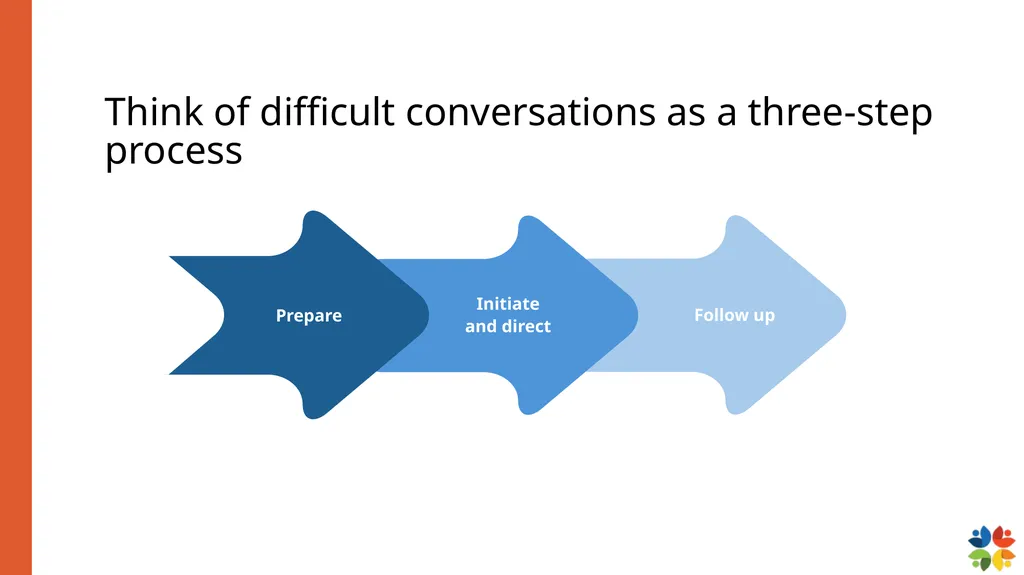
slide11. Think of difficult conversations as a three-step process Prepare Initiate and direct Follow up<br>
slide12. What are some things to consider when preparing for a difficult conversation? RAISE YOUR HAND OR ANSWER IN THE CHAT<br>
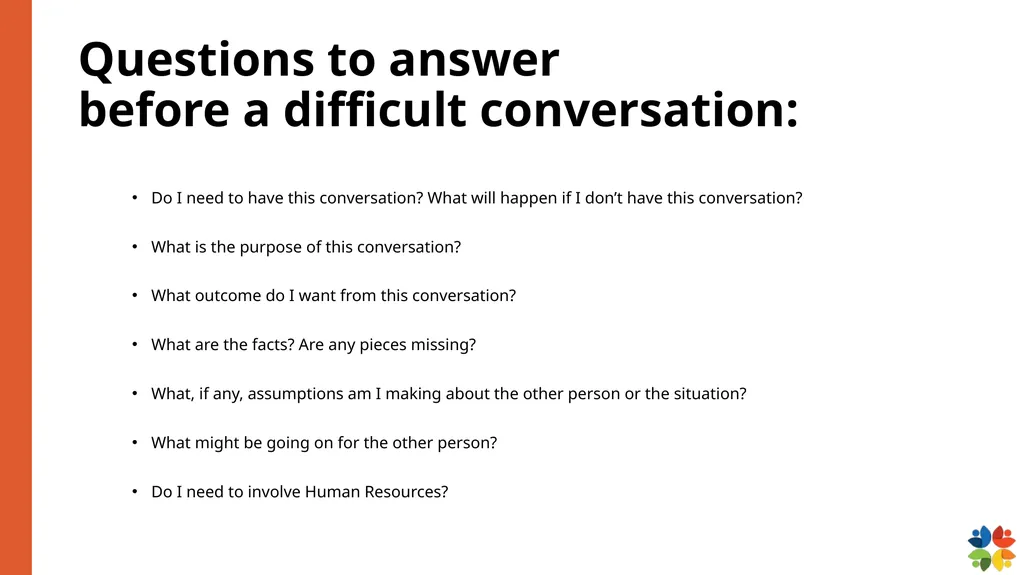
slide13. Questions to answer before a difficult conversation: Do I need to have this conversation? What will happen if I don’t have this conversation?
What is the purpose of this conversation?
What outcome do I want from this conversation?
What are the facts? Are any pieces missing?
What, if any, assumptions am I making about the other person or the situation?
What might be going on for the other person?
Do I need to involve Human Resources?<br>
slide14. Involve your HR Manager for Have HR present when… Any performance management, or event that requires investigation, that may lead to any level of discipline.
Managing requests or situations related to family status, religious, or other non-illness/injury related workplace
Addressing employee relations or conflict issues
Handling harassment, discrimination, or respectful workplace concerns
Responding to attendance or leave concerns
Interpreting collective agreements, employment contracts, or HR policies
Addressing organizational restructuring, layoffs, or position changes<br>
slide15. workplace accommodations
return to work issues
workplace violence
Injury prevention
safety-related employee concerns Involve Occupational Health Safety and Wellness<br>
slide16. Spending time clarifying your goal is just another way of putting off the conversation.
Answer: False TRUE OR FALSE?<br>
slide17. If I'm feeling emotional, I should wait until I feel no emotion at all before having a difficult conversation.
Answer: False-ish TRUE OR FALSE?<br>
slide18. I should create a script before a difficult conversation.
Answer: False-ish TRUE OR FALSE?<br>
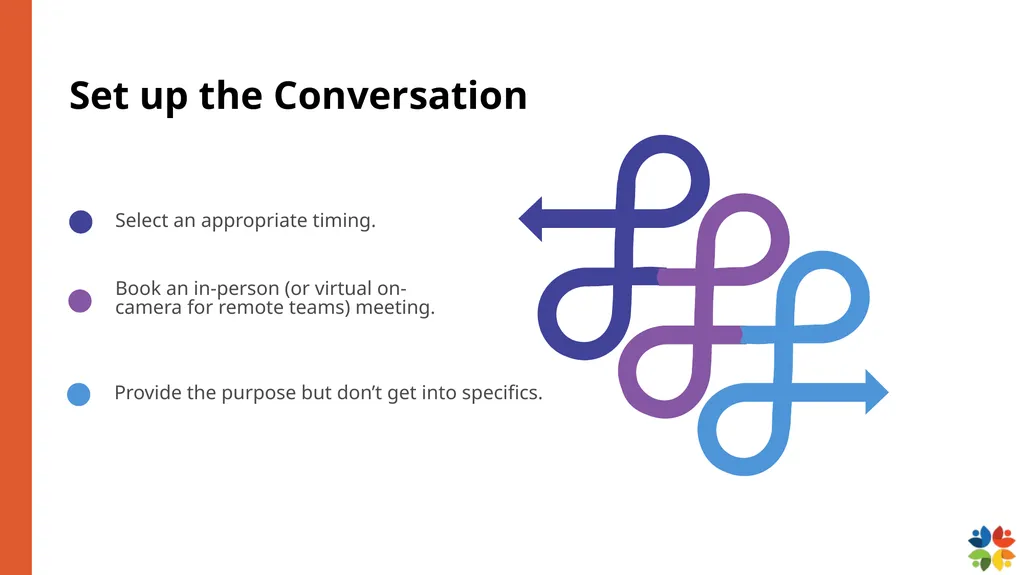
slide19. Set up the Conversation Select an appropriate timing. Book an in-person (or virtual on-camera for remote teams) meeting. Provide the purpose but don’t get into specifics.<br>
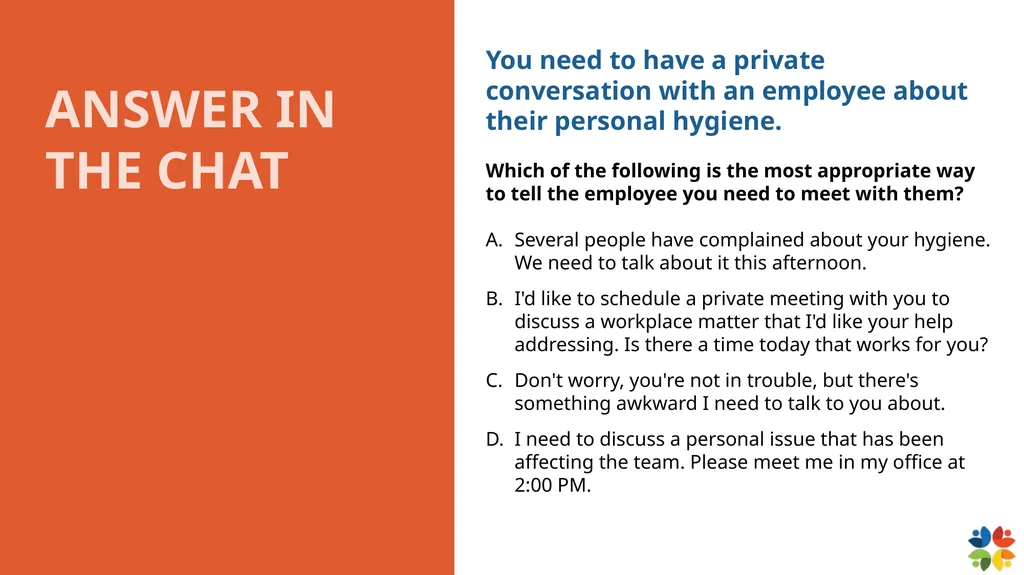
slide20. You need to have a private conversation with an employee about their personal hygiene.
Which of the following is the most appropriate way to tell the employee you need to meet with them?
Several people have complained about your hygiene. We need to talk about it this afternoon.
I'd like to schedule a private meeting with you to discuss a workplace matter that I'd like your help addressing. Is there a time today that works for you?
Don't worry, you're not in trouble, but there's something awkward I need to talk to you about.
I need to discuss a personal issue that has been affecting the team. Please meet me in my office at 2:00 PM. ANSWER IN THE CHAT<br>
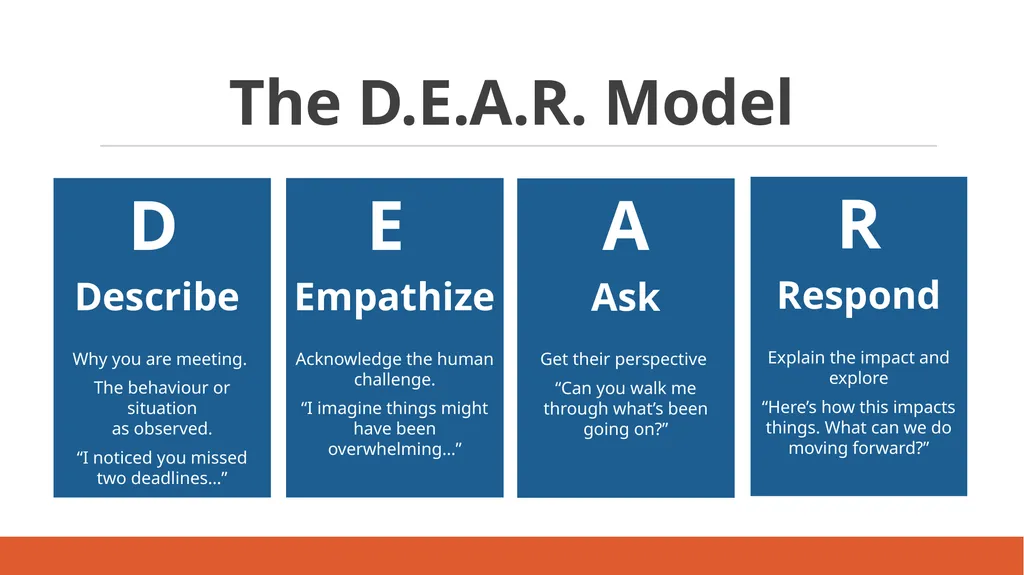
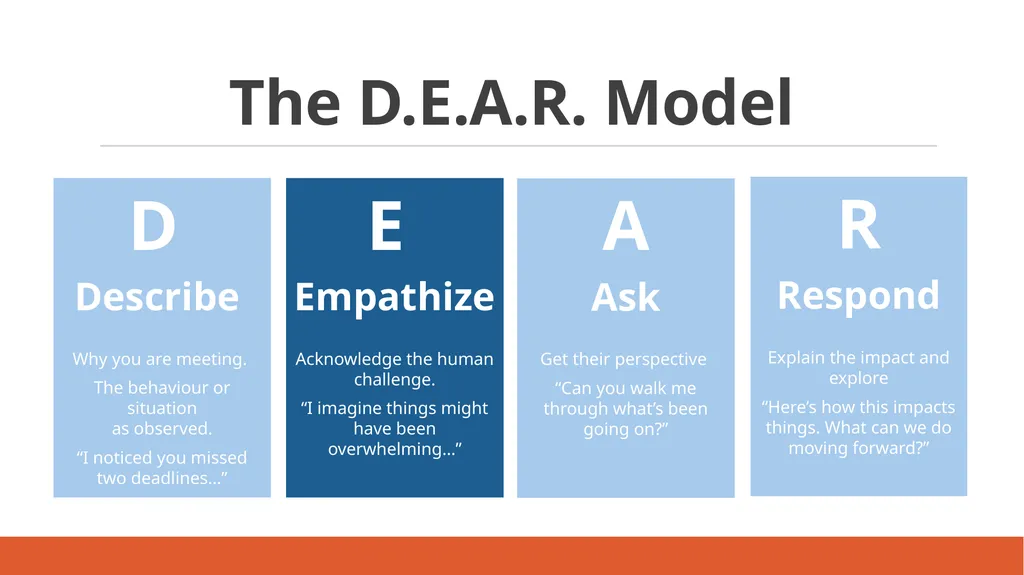
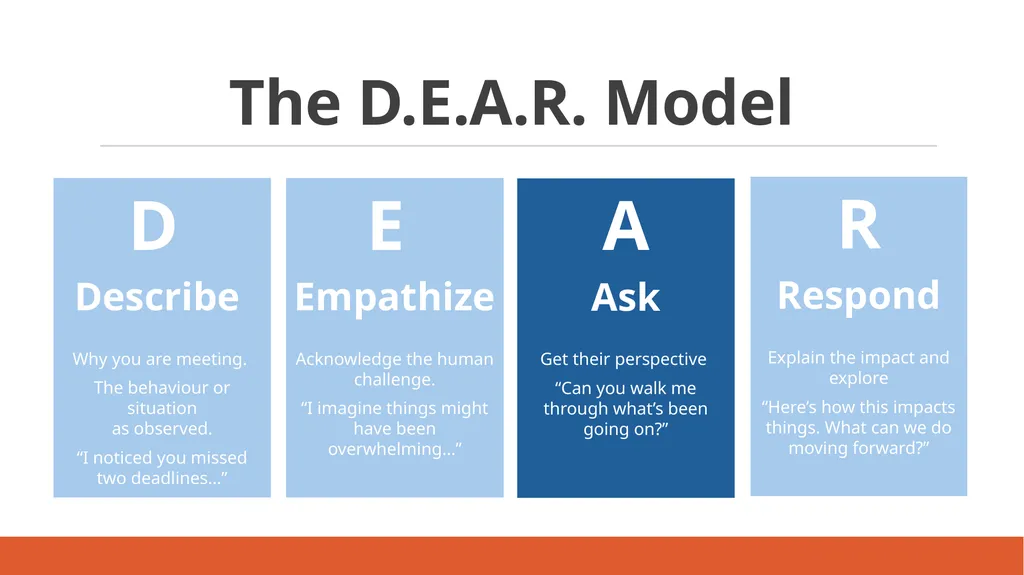
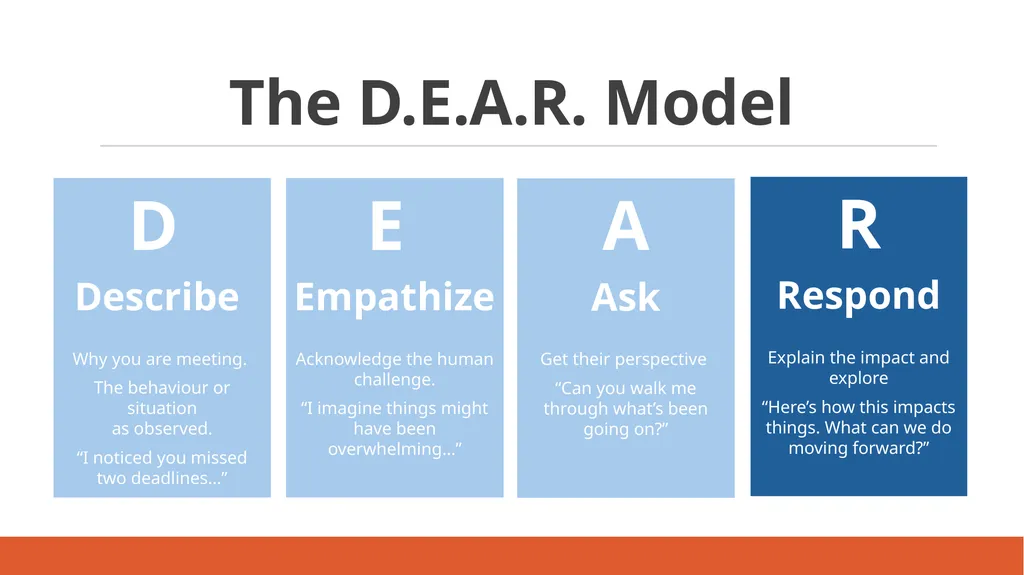
slide21. The D.E.A.R. Model E
Empathize
Acknowledge the human challenge.
“I imagine things might have been overwhelming…” A
Ask
Get their perspective
“Can you walk me through what’s been going on?” R
Respond
Explain the impact and explore
“Here’s how this impacts things. What can we do moving forward?” D
Describe
Why you are meeting.
The behaviour or situation as observed.
“I noticed you missed two deadlines…”<br>
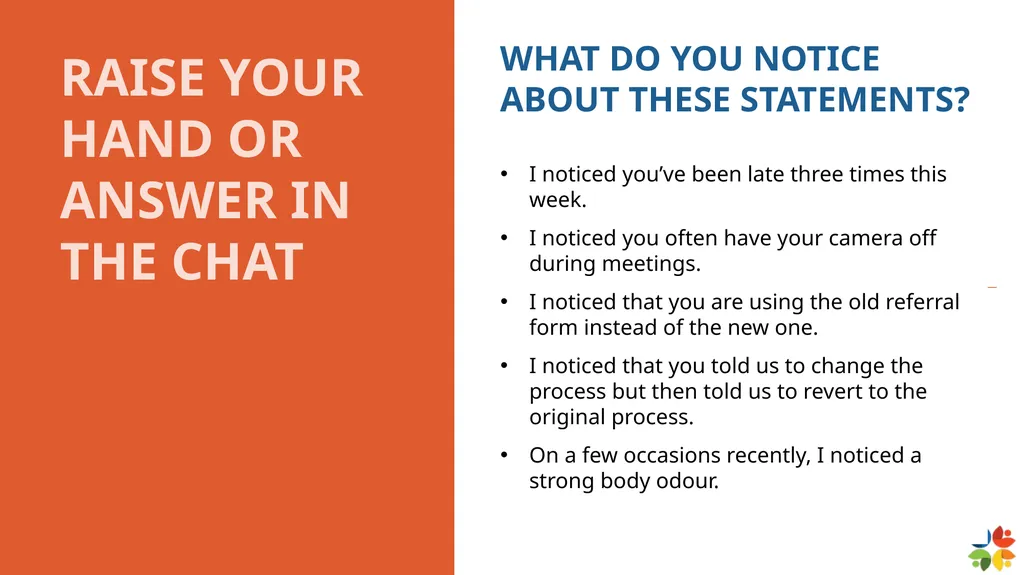
slide22. WHAT DO YOU NOTICE ABOUT THESE STATEMENTS? RAISE YOUR HAND OR ANSWER IN THE CHAT I noticed you’ve been late three times this week.
I noticed you often have your camera off during meetings.
I noticed that you are using the old referral form instead of the new one.
I noticed that you told us to change the process but then told us to revert to the original process.
On a few occasions recently, I noticed a strong body odour.<br>
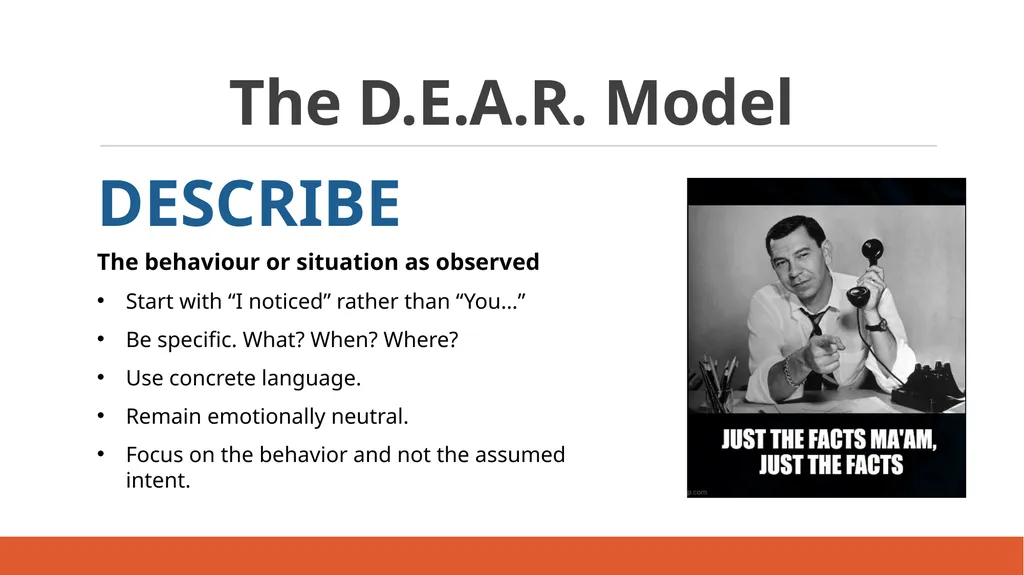
slide23. The D.E.A.R. Model The behaviour or situation as observed
Start with “I noticed” rather than “You…”
Be specific. What? When? Where?
Use concrete language.
Remain emotionally neutral.
Focus on the behavior and not the assumed intent. DESCRIBE<br>
slide24. As you are giving an update on a controversial policy change, one of your staff rolls his eyes. What is the staff doing?
Rolling his eyes
Disagreeing with what you are saying.
Being disrespectful.
Trying to get others on the team to agree with him.
All of the above.
Answer: A ANSWER IN THE CHAT<br>
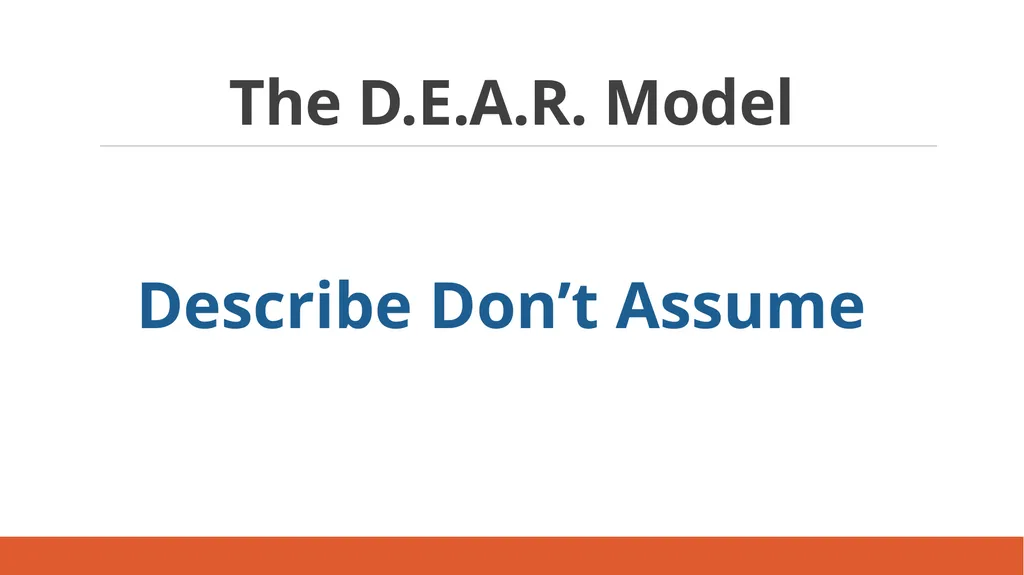
slide25. The D.E.A.R. Model Describe Don’t Assume<br>
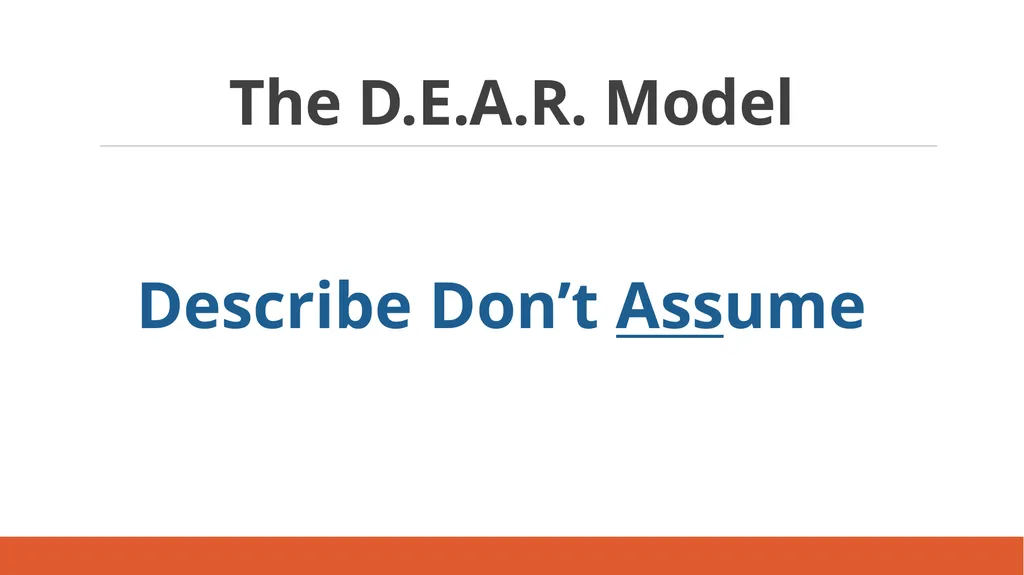
slide26. The D.E.A.R. Model Describe Don’t Assume<br>
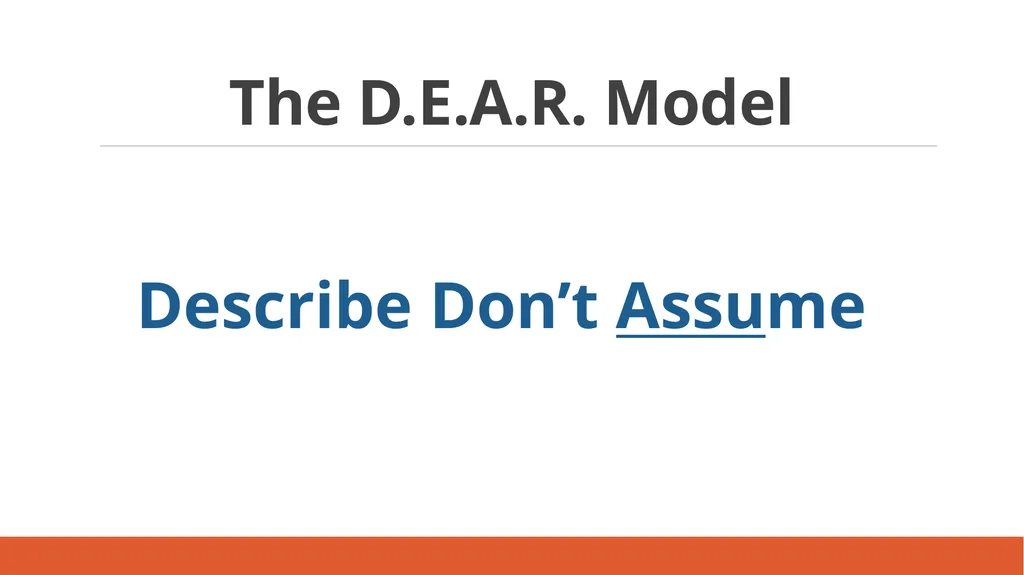
slide27. The D.E.A.R. Model Describe Don’t Assume<br>
slide28. The D.E.A.R. Model Describe Don’t Assume<br>
slide29. The D.E.A.R. Model E
Empathize
Acknowledge the human challenge.
“I imagine things might have been overwhelming…” A
Ask
Get their perspective
“Can you walk me through what’s been going on?” R
Respond
Explain the impact and explore
“Here’s how this impacts things. What can we do moving forward?” D
Describe
Why you are meeting.
The behaviour or situation as observed.
“I noticed you missed two deadlines…”<br>
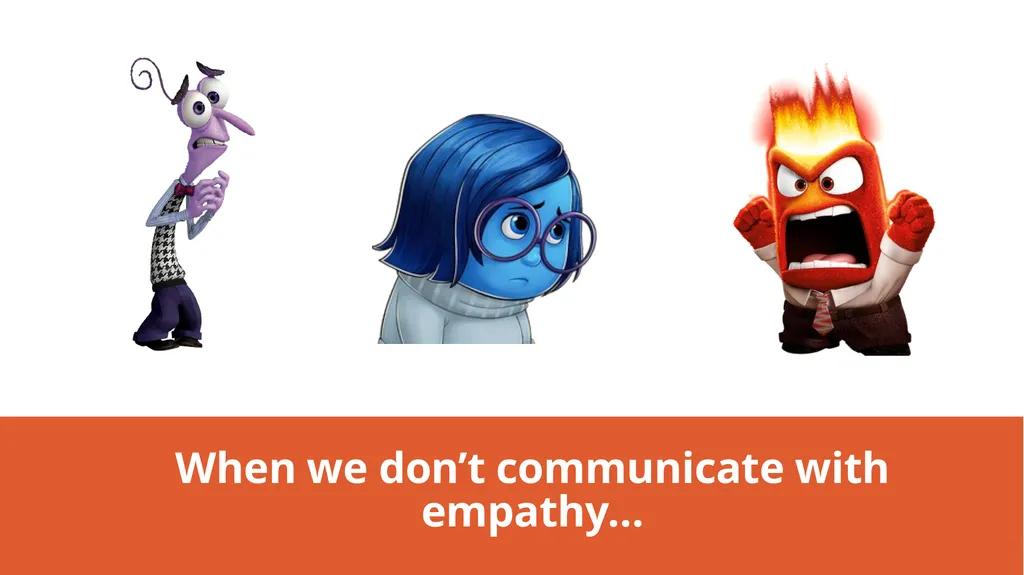
slide30. When we don’t communicate with empathy…<br>
slide31. EMPATHY BLOCKERS
What behaviours send the message “I don’t care.” ANSWER IN THE CHAT<br>
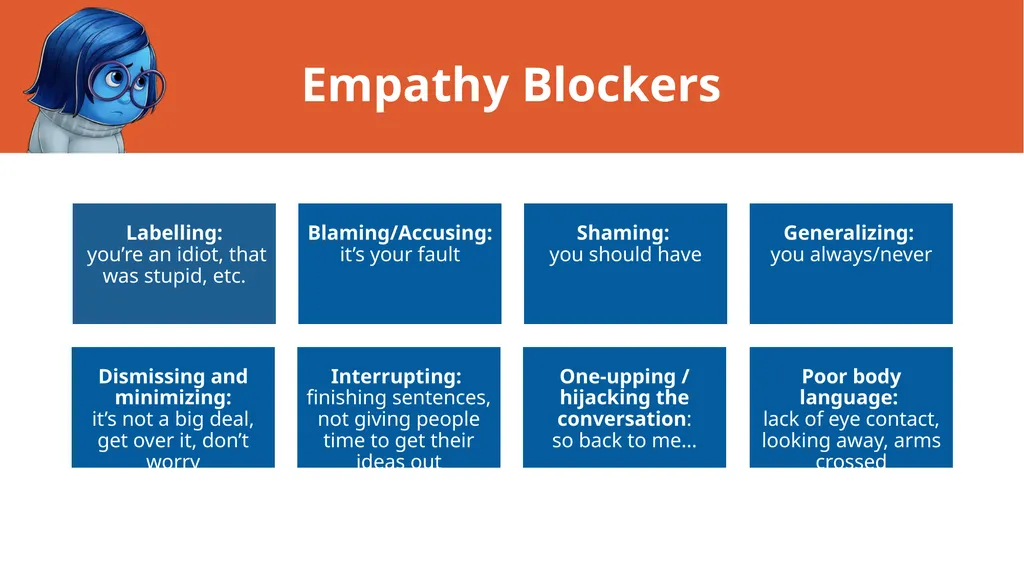
slide32. Empathy Blockers Labelling: you’re an idiot, that was stupid, etc. Blaming/Accusing: it’s your fault Shaming: you should have Generalizing: you always/never Dismissing and minimizing: it’s not a big deal, get over it, don’t worry Interrupting: finishing sentences, not giving people time to get their ideas out One-upping / hijacking the conversation: so back to me… Poor body language: lack of eye contact, looking away, arms crossed<br>
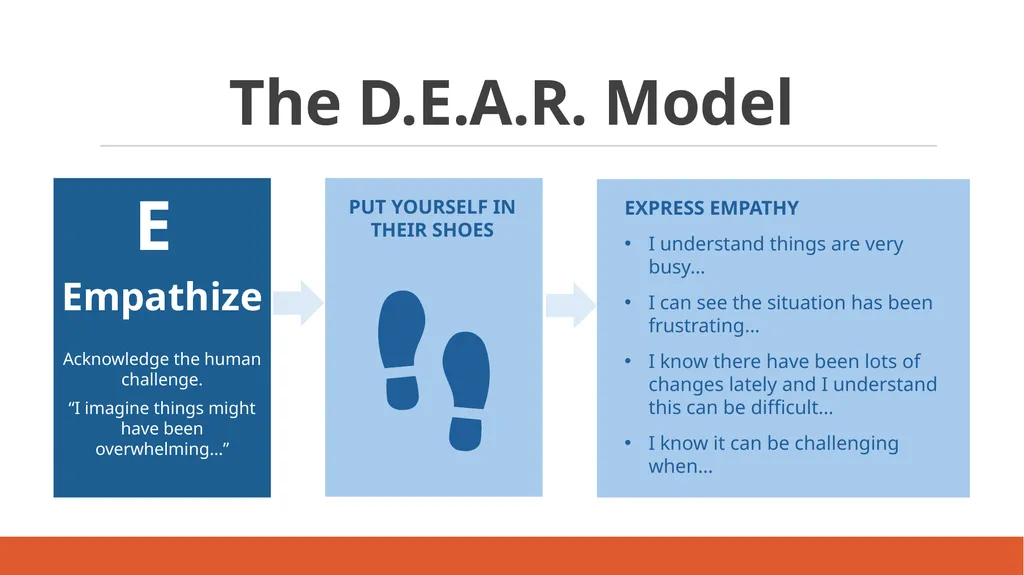
slide33. The D.E.A.R. Model E
Empathize
Acknowledge the human challenge.
“I imagine things might have been overwhelming…” EXPRESS EMPATHY
I understand things are very busy…
I can see the situation has been frustrating…
I know there have been lots of changes lately and I understand this can be difficult…
I know it can be challenging when… PUT YOURSELF IN THEIR SHOES<br>
slide34. The D.E.A.R. Model E
Empathize
Acknowledge the human challenge.
“I imagine things might have been overwhelming…” A
Ask
Get their perspective
“Can you walk me through what’s been going on?” R
Respond
Explain the impact and explore
“Here’s how this impacts things. What can we do moving forward?” D
Describe
Why you are meeting.
The behaviour or situation as observed.
“I noticed you missed two deadlines…”<br>
slide35. Most people act the way they do because: They don’t know any better.
They don’t realize their behaviour is impacting others to the extent it is.
They are responding from a place of fear, hurt or unmet needs.<br>
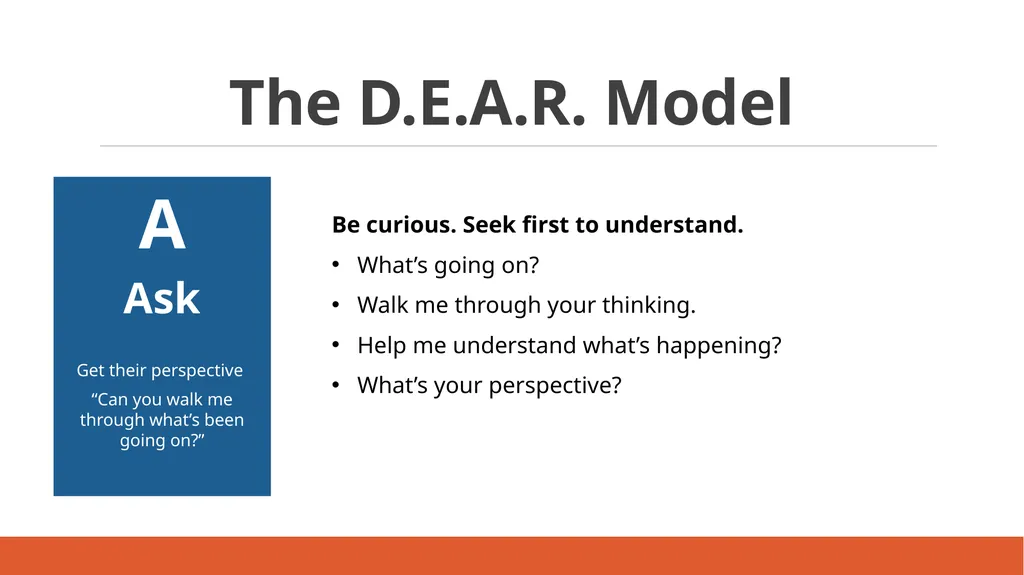
slide36. The D.E.A.R. Model A
Ask
Get their perspective
“Can you walk me through what’s been going on?” Be curious. Seek first to understand.
What’s going on?
Walk me through your thinking.
Help me understand what’s happening?
What’s your perspective?<br>
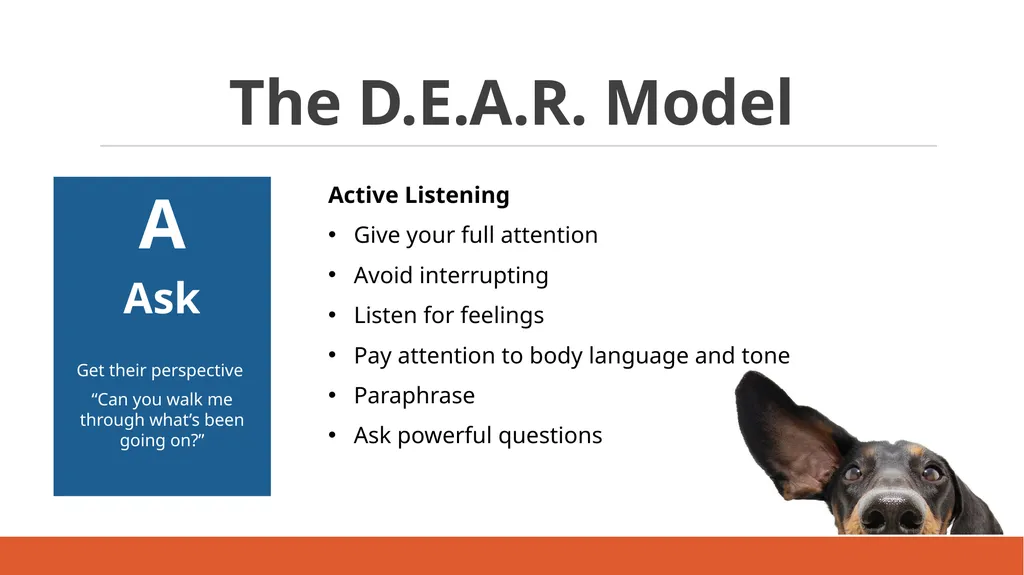
slide37. The D.E.A.R. Model A
Ask
Get their perspective
“Can you walk me through what’s been going on?” Active Listening
Give your full attention
Avoid interrupting
Listen for feelings
Pay attention to body language and tone
Paraphrase
Ask powerful questions<br>
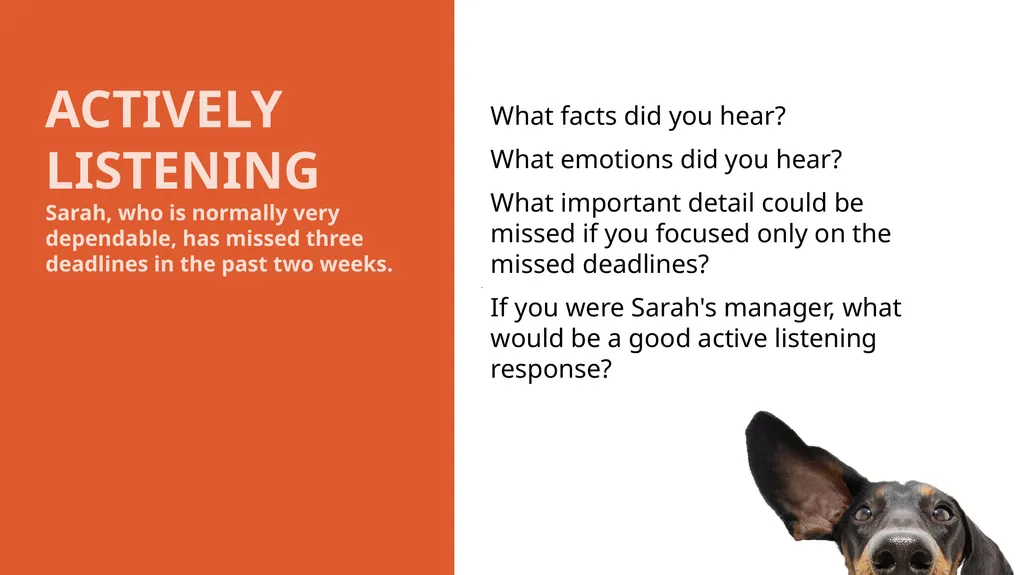
slide38. What facts did you hear?
What emotions did you hear?
What important detail could be missed if you focused only on the missed deadlines?
If you were Sarah's manager, what would be a good active listening response? ACTIVELY LISTENING
Sarah, who is normally very dependable, has missed three deadlines in the past two weeks.<br>
slide39. If the person goes silent, I should talk more to reduce the awkwardness.
False TRUE OR FALSE?<br>
slide40. If the person starts crying, I should compliment them to try to make them feel better.
False TRUE OR FALSE?<br>
slide41. If the person gets angry, I should match their tone to bridge our emotions.
False TRUE OR FALSE?<br>
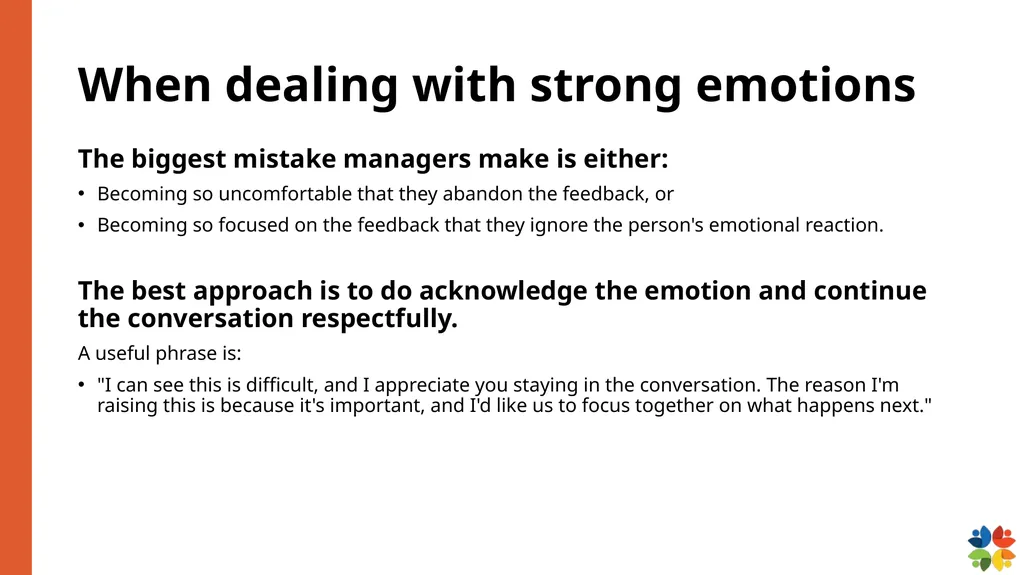
slide42. When dealing with strong emotions The biggest mistake managers make is either:
Becoming so uncomfortable that they abandon the feedback, or
Becoming so focused on the feedback that they ignore the person's emotional reaction.
The best approach is to do acknowledge the emotion and continue the conversation respectfully.
A useful phrase is:
"I can see this is difficult, and I appreciate you staying in the conversation. The reason I'm raising this is because it's important, and I'd like us to focus together on what happens next."<br>
slide43. The D.E.A.R. Model E
Empathize
Acknowledge the human challenge.
“I imagine things might have been overwhelming…” A
Ask
Get their perspective
“Can you walk me through what’s been going on?” R
Respond
Explain the impact and explore
“Here’s how this impacts things. What can we do moving forward?” D
Describe
Why you are meeting.
The behaviour or situation as observed.
“I noticed you missed two deadlines…”<br>
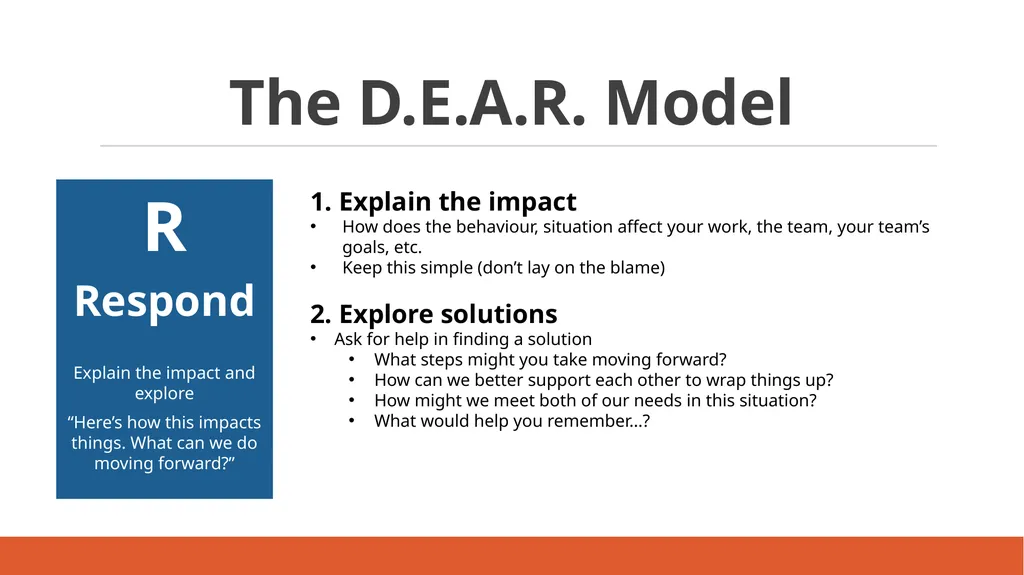
slide44. The D.E.A.R. Model R
Respond
Explain the impact and explore
“Here’s how this impacts things. What can we do moving forward?” 1. Explain the impact
How does the behaviour, situation affect your work, the team, your team’s goals, etc.
Keep this simple (don’t lay on the blame)
2. Explore solutions
Ask for help in finding a solution
What steps might you take moving forward?
How can we better support each other to wrap things up?
How might we meet both of our needs in this situation?
What would help you remember…?<br>
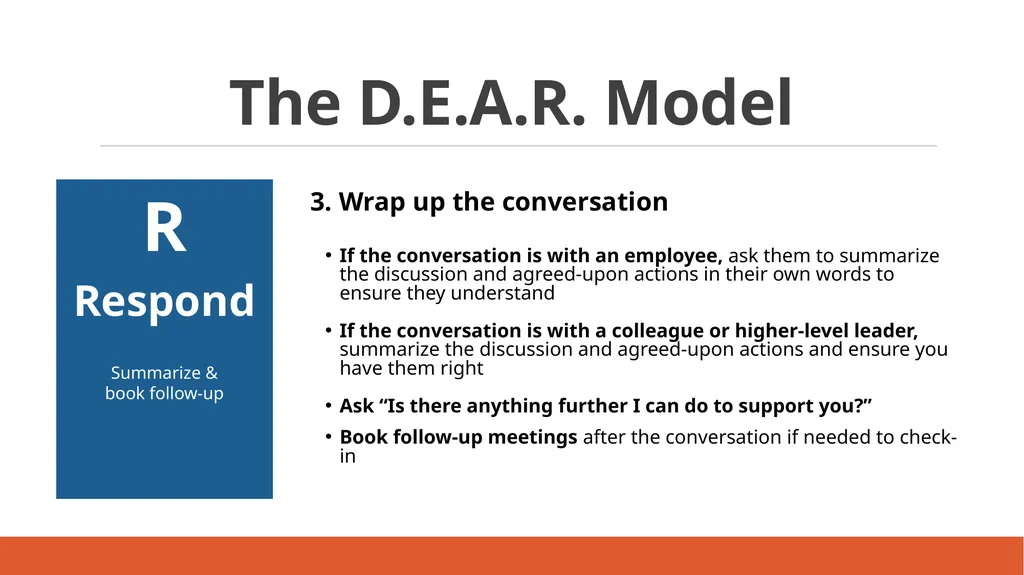
slide45. The D.E.A.R. Model R
Respond
Summarize & book follow-up 3. Wrap up the conversation If the conversation is with an employee, ask them to summarize the discussion and agreed-upon actions in their own words to ensure they understand
If the conversation is with a colleague or higher-level leader, summarize the discussion and agreed-upon actions and ensure you have them right
Ask “Is there anything further I can do to support you?”
Book follow-up meetings after the conversation if needed to check-in<br>
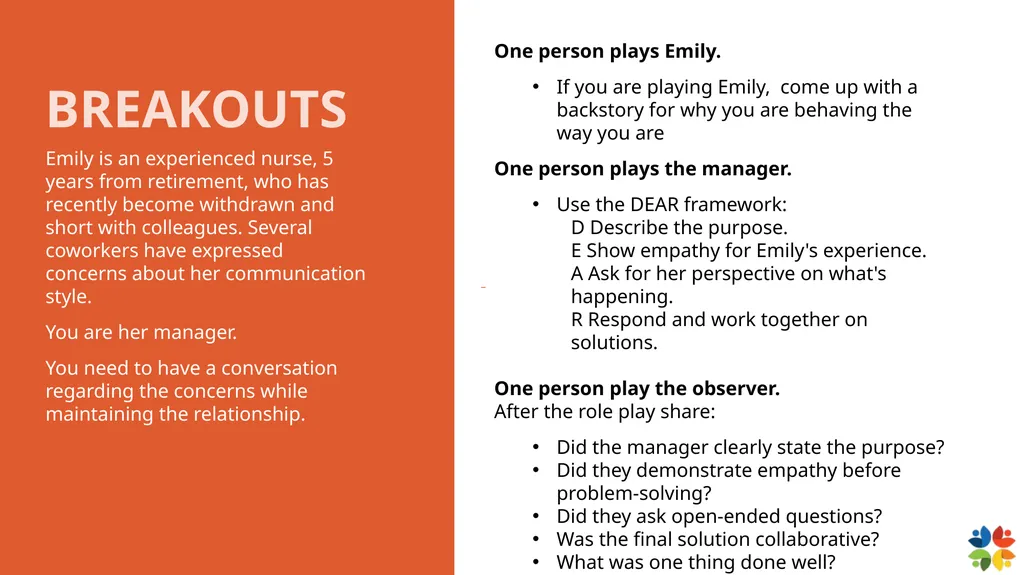
slide46. One person plays:
One person plays Emily.
If you are playing Emily, come up with a backstory for why you are behaving the way you are
One person plays the manager.
Use the DEAR framework:
D Describe the purpose.
E Show empathy for Emily's experience.
A Ask for her perspective on what's happening.
R Respond and work together on solutions.
One person play the observer. After the role play share:
Did the manager clearly state the purpose?
Did they demonstrate empathy before problem-solving?
Did they ask open-ended questions?
Was the final solution collaborative?
What was one thing done well?
What was one improvement opportunity?
One person plays:
Emily
One person acts as:
Observer BREAKOUTS Emily is an experienced nurse, 5 years from retirement, who has recently become withdrawn and short with colleagues. Several coworkers have expressed concerns about her communication style.
You are her manager.
You need to have a conversation regarding the concerns while maintaining the relationship.<br>
slide47. Learn how to approach difficult conversations with more confidence. OBJECTIVES How to prepare for the conversation
Behaviours that can create barriers in difficult conversations
The DEAR model: a practical four-step model to navigate difficult conversations more effectively<br>
slide48. Give us your feedback Fill out the evaluation form online on your phone using the QR code or the link in the chat<br>
slide49. The quality of our relationships is often determined by the quality of the conversations we're willing to have. Identify one conversation you've been putting off and commit to taking the next step this week.<br>
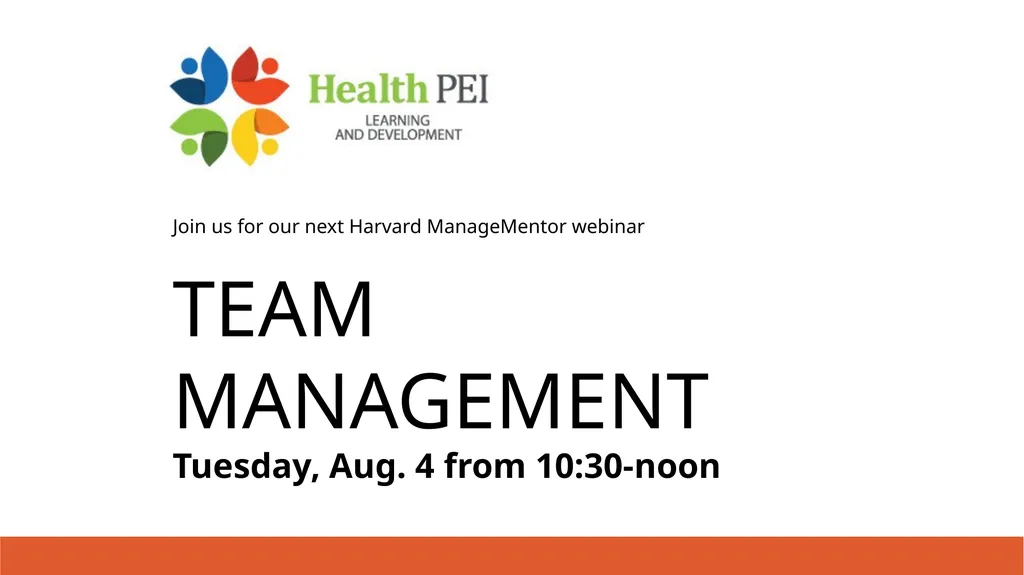
slide50. Join us for our next Harvard ManageMentor webinar
TEAM MANAGEMENT
Tuesday, Aug. 4 from 10:30-noon<br>
Talking about poor performance
Addressing conflict between team members
Disagreeing with an executive director or chief executive
Managing resistance to change
Other (specify in the chat) Welcome to Difficult Conversations. We will start momentarily. In the meantime:
ANSWER IN
THE CHAT<br>
slide2. Difficult Conversations To get the most out of today please
Turn on your camera
Focus on the session
Use the reactions in the toolbar
Use the chat panel or raise your hand to speak
Mute yourself when not talking
Take part in the discussions June Morrow
Learning & Development Consultant<br>
slide3. Give a👍if you've ever delayed
a conversation because you hoped
the issue would resolve itself.<br>
slide4. Give a👍if you had a difficult conversation in the past three months or have one coming up.<br>
slide5. Learn how to approach difficult conversations with more confidence. OBJECTIVES How to prepare for the conversation
Behaviours that can create barriers in difficult conversations
A practical four-step model to navigate difficult conversations more effectively<br>
slide6. Which type of difficult conversation are you most likely to avoid or delay?
Talking about poor performance
Addressing conflict between team members
Disagreeing with an executive director or chief executive
Managing resistance to change
Other (specify in the chat)<br>
slide7. It’s human nature to want to avoid difficult conversation. They might get emotional. They might even cry! The conversation could ruin my relationship with that person. I have no idea how to approach this conversation! Maybe someone else will handle it.<br>
slide8. Give a👍 if you've had a difficult conversation that strengthened a relationship afterward.<br>
slide9. Give a ❤️ if you've ever experienced someone reacting much better than expected during a difficult conversation.<br>
slide10. When handled well, difficult conversations build trust and safety.<br>
slide11. Think of difficult conversations as a three-step process Prepare Initiate and direct Follow up<br>
slide12. What are some things to consider when preparing for a difficult conversation? RAISE YOUR HAND OR ANSWER IN THE CHAT<br>
slide13. Questions to answer before a difficult conversation: Do I need to have this conversation? What will happen if I don’t have this conversation?
What is the purpose of this conversation?
What outcome do I want from this conversation?
What are the facts? Are any pieces missing?
What, if any, assumptions am I making about the other person or the situation?
What might be going on for the other person?
Do I need to involve Human Resources?<br>
slide14. Involve your HR Manager for Have HR present when… Any performance management, or event that requires investigation, that may lead to any level of discipline.
Managing requests or situations related to family status, religious, or other non-illness/injury related workplace
Addressing employee relations or conflict issues
Handling harassment, discrimination, or respectful workplace concerns
Responding to attendance or leave concerns
Interpreting collective agreements, employment contracts, or HR policies
Addressing organizational restructuring, layoffs, or position changes<br>
slide15. workplace accommodations
return to work issues
workplace violence
Injury prevention
safety-related employee concerns Involve Occupational Health Safety and Wellness<br>
slide16. Spending time clarifying your goal is just another way of putting off the conversation.
Answer: False TRUE OR FALSE?<br>
slide17. If I'm feeling emotional, I should wait until I feel no emotion at all before having a difficult conversation.
Answer: False-ish TRUE OR FALSE?<br>
slide18. I should create a script before a difficult conversation.
Answer: False-ish TRUE OR FALSE?<br>
slide19. Set up the Conversation Select an appropriate timing. Book an in-person (or virtual on-camera for remote teams) meeting. Provide the purpose but don’t get into specifics.<br>
slide20. You need to have a private conversation with an employee about their personal hygiene.
Which of the following is the most appropriate way to tell the employee you need to meet with them?
Several people have complained about your hygiene. We need to talk about it this afternoon.
I'd like to schedule a private meeting with you to discuss a workplace matter that I'd like your help addressing. Is there a time today that works for you?
Don't worry, you're not in trouble, but there's something awkward I need to talk to you about.
I need to discuss a personal issue that has been affecting the team. Please meet me in my office at 2:00 PM. ANSWER IN THE CHAT<br>
slide21. The D.E.A.R. Model E
Empathize
Acknowledge the human challenge.
“I imagine things might have been overwhelming…” A
Ask
Get their perspective
“Can you walk me through what’s been going on?” R
Respond
Explain the impact and explore
“Here’s how this impacts things. What can we do moving forward?” D
Describe
Why you are meeting.
The behaviour or situation as observed.
“I noticed you missed two deadlines…”<br>
slide22. WHAT DO YOU NOTICE ABOUT THESE STATEMENTS? RAISE YOUR HAND OR ANSWER IN THE CHAT I noticed you’ve been late three times this week.
I noticed you often have your camera off during meetings.
I noticed that you are using the old referral form instead of the new one.
I noticed that you told us to change the process but then told us to revert to the original process.
On a few occasions recently, I noticed a strong body odour.<br>
slide23. The D.E.A.R. Model The behaviour or situation as observed
Start with “I noticed” rather than “You…”
Be specific. What? When? Where?
Use concrete language.
Remain emotionally neutral.
Focus on the behavior and not the assumed intent. DESCRIBE<br>
slide24. As you are giving an update on a controversial policy change, one of your staff rolls his eyes. What is the staff doing?
Rolling his eyes
Disagreeing with what you are saying.
Being disrespectful.
Trying to get others on the team to agree with him.
All of the above.
Answer: A ANSWER IN THE CHAT<br>
slide25. The D.E.A.R. Model Describe Don’t Assume<br>
slide26. The D.E.A.R. Model Describe Don’t Assume<br>
slide27. The D.E.A.R. Model Describe Don’t Assume<br>
slide28. The D.E.A.R. Model Describe Don’t Assume<br>
slide29. The D.E.A.R. Model E
Empathize
Acknowledge the human challenge.
“I imagine things might have been overwhelming…” A
Ask
Get their perspective
“Can you walk me through what’s been going on?” R
Respond
Explain the impact and explore
“Here’s how this impacts things. What can we do moving forward?” D
Describe
Why you are meeting.
The behaviour or situation as observed.
“I noticed you missed two deadlines…”<br>
slide30. When we don’t communicate with empathy…<br>
slide31. EMPATHY BLOCKERS
What behaviours send the message “I don’t care.” ANSWER IN THE CHAT<br>
slide32. Empathy Blockers Labelling: you’re an idiot, that was stupid, etc. Blaming/Accusing: it’s your fault Shaming: you should have Generalizing: you always/never Dismissing and minimizing: it’s not a big deal, get over it, don’t worry Interrupting: finishing sentences, not giving people time to get their ideas out One-upping / hijacking the conversation: so back to me… Poor body language: lack of eye contact, looking away, arms crossed<br>
slide33. The D.E.A.R. Model E
Empathize
Acknowledge the human challenge.
“I imagine things might have been overwhelming…” EXPRESS EMPATHY
I understand things are very busy…
I can see the situation has been frustrating…
I know there have been lots of changes lately and I understand this can be difficult…
I know it can be challenging when… PUT YOURSELF IN THEIR SHOES<br>
slide34. The D.E.A.R. Model E
Empathize
Acknowledge the human challenge.
“I imagine things might have been overwhelming…” A
Ask
Get their perspective
“Can you walk me through what’s been going on?” R
Respond
Explain the impact and explore
“Here’s how this impacts things. What can we do moving forward?” D
Describe
Why you are meeting.
The behaviour or situation as observed.
“I noticed you missed two deadlines…”<br>
slide35. Most people act the way they do because: They don’t know any better.
They don’t realize their behaviour is impacting others to the extent it is.
They are responding from a place of fear, hurt or unmet needs.<br>
slide36. The D.E.A.R. Model A
Ask
Get their perspective
“Can you walk me through what’s been going on?” Be curious. Seek first to understand.
What’s going on?
Walk me through your thinking.
Help me understand what’s happening?
What’s your perspective?<br>
slide37. The D.E.A.R. Model A
Ask
Get their perspective
“Can you walk me through what’s been going on?” Active Listening
Give your full attention
Avoid interrupting
Listen for feelings
Pay attention to body language and tone
Paraphrase
Ask powerful questions<br>
slide38. What facts did you hear?
What emotions did you hear?
What important detail could be missed if you focused only on the missed deadlines?
If you were Sarah's manager, what would be a good active listening response? ACTIVELY LISTENING
Sarah, who is normally very dependable, has missed three deadlines in the past two weeks.<br>
slide39. If the person goes silent, I should talk more to reduce the awkwardness.
False TRUE OR FALSE?<br>
slide40. If the person starts crying, I should compliment them to try to make them feel better.
False TRUE OR FALSE?<br>
slide41. If the person gets angry, I should match their tone to bridge our emotions.
False TRUE OR FALSE?<br>
slide42. When dealing with strong emotions The biggest mistake managers make is either:
Becoming so uncomfortable that they abandon the feedback, or
Becoming so focused on the feedback that they ignore the person's emotional reaction.
The best approach is to do acknowledge the emotion and continue the conversation respectfully.
A useful phrase is:
"I can see this is difficult, and I appreciate you staying in the conversation. The reason I'm raising this is because it's important, and I'd like us to focus together on what happens next."<br>
slide43. The D.E.A.R. Model E
Empathize
Acknowledge the human challenge.
“I imagine things might have been overwhelming…” A
Ask
Get their perspective
“Can you walk me through what’s been going on?” R
Respond
Explain the impact and explore
“Here’s how this impacts things. What can we do moving forward?” D
Describe
Why you are meeting.
The behaviour or situation as observed.
“I noticed you missed two deadlines…”<br>
slide44. The D.E.A.R. Model R
Respond
Explain the impact and explore
“Here’s how this impacts things. What can we do moving forward?” 1. Explain the impact
How does the behaviour, situation affect your work, the team, your team’s goals, etc.
Keep this simple (don’t lay on the blame)
2. Explore solutions
Ask for help in finding a solution
What steps might you take moving forward?
How can we better support each other to wrap things up?
How might we meet both of our needs in this situation?
What would help you remember…?<br>
slide45. The D.E.A.R. Model R
Respond
Summarize & book follow-up 3. Wrap up the conversation If the conversation is with an employee, ask them to summarize the discussion and agreed-upon actions in their own words to ensure they understand
If the conversation is with a colleague or higher-level leader, summarize the discussion and agreed-upon actions and ensure you have them right
Ask “Is there anything further I can do to support you?”
Book follow-up meetings after the conversation if needed to check-in<br>
slide46. One person plays:
One person plays Emily.
If you are playing Emily, come up with a backstory for why you are behaving the way you are
One person plays the manager.
Use the DEAR framework:
D Describe the purpose.
E Show empathy for Emily's experience.
A Ask for her perspective on what's happening.
R Respond and work together on solutions.
One person play the observer. After the role play share:
Did the manager clearly state the purpose?
Did they demonstrate empathy before problem-solving?
Did they ask open-ended questions?
Was the final solution collaborative?
What was one thing done well?
What was one improvement opportunity?
One person plays:
Emily
One person acts as:
Observer BREAKOUTS Emily is an experienced nurse, 5 years from retirement, who has recently become withdrawn and short with colleagues. Several coworkers have expressed concerns about her communication style.
You are her manager.
You need to have a conversation regarding the concerns while maintaining the relationship.<br>
slide47. Learn how to approach difficult conversations with more confidence. OBJECTIVES How to prepare for the conversation
Behaviours that can create barriers in difficult conversations
The DEAR model: a practical four-step model to navigate difficult conversations more effectively<br>
slide48. Give us your feedback Fill out the evaluation form online on your phone using the QR code or the link in the chat<br>
slide49. The quality of our relationships is often determined by the quality of the conversations we're willing to have. Identify one conversation you've been putting off and commit to taking the next step this week.<br>
slide50. Join us for our next Harvard ManageMentor webinar
TEAM MANAGEMENT
Tuesday, Aug. 4 from 10:30-noon<br>