
Wildlife Management and Vector Control for an FAD
MT
Published · 31 slides · 0 views

1 / 1




Description
Wildlife Management and Vector Control for an FAD Response in Domestic Livestock Overview Adapted from the FAD PRePNAHEMS Guidelines: Wildlife Management and Vector Control for an FAD Response in Domestic Livestock (2014) Definitions of
Related Topics
Share
Embed code
Download this presentation From Below
"Wildlife Management and Vector Control for an FAD" is the property of its rightful owner. Permission is granted to download and print the materials on this website for personal, non-commercial use only, and to display it on your personal computer provided you do not modify the materials and that you retain all copyright notices contained in the materials. By downloading content from our website, you accept the terms of this agreement.
Presentation Transcript
01
Wildlife Management and Vector Control for an FAD Response in Domestic Livestock Overview Adapted from the FAD PReP/NAHEMS
Guidelines: Wildlife Management and Vector Control for an FAD Response in Domestic Livestock (2014)<br>
02
Definitions of relevant terms
APHIS Authorities
Significance of wildlife in an FAD
Roles and responsibilities
Wildlife management methods and plans This Presentation USDA APHIS and CFSPH FAD-PReP/NAHEMS Guidelines: Wildlife, Vector Control – Overview 2<br>
APHIS Authorities
Significance of wildlife in an FAD
Roles and responsibilities
Wildlife management methods and plans This Presentation USDA APHIS and CFSPH FAD-PReP/NAHEMS Guidelines: Wildlife, Vector Control – Overview 2<br>
03
Wild animal: “an animal that has a phenotype unaffected by human selection and lives independent of direct human supervision or control”
Wildlife: “all free-ranging animals, including native and exotic wildlife species, as well as feral domestic animals” USDA APHIS and CFSPH FAD-PReP/NAHEMS Guidelines: Wildlife, Vector Control – Overview 3 Definitions - OIE<br>
Wildlife: “all free-ranging animals, including native and exotic wildlife species, as well as feral domestic animals” USDA APHIS and CFSPH FAD-PReP/NAHEMS Guidelines: Wildlife, Vector Control – Overview 3 Definitions - OIE<br>
04
Feral: domestic animals not confined
Wildlife reservoir: free-ranging species as a potential source of infection/infestation
Vector: any living organism that can carry disease agents
Biological transmission: disease agent transfer from host to susceptible animal
Mechanical transmission: disease agent transfer from host to susceptible animal via external body parts USDA APHIS and CFSPH FAD-PReP/NAHEMS Guidelines: Wildlife, Vector Control – Overview 4 Definitions cont’d<br>
Wildlife reservoir: free-ranging species as a potential source of infection/infestation
Vector: any living organism that can carry disease agents
Biological transmission: disease agent transfer from host to susceptible animal
Mechanical transmission: disease agent transfer from host to susceptible animal via external body parts USDA APHIS and CFSPH FAD-PReP/NAHEMS Guidelines: Wildlife, Vector Control – Overview 4 Definitions cont’d<br>
05
FAD: animal disease or pest not known to exist in US or territories
Emerging disease: change or mutation in pathogenicity, communicability or zoonotic potential to become a threat
When livestock outbreak involves wildlife - USDA APHIS and authorities with jurisdiction over wildlife collaborate USDA APHIS and CFSPH FAD-PReP/NAHEMS Guidelines: Wildlife, Vector Control – Overview 5 Definitions cont’d<br>
Emerging disease: change or mutation in pathogenicity, communicability or zoonotic potential to become a threat
When livestock outbreak involves wildlife - USDA APHIS and authorities with jurisdiction over wildlife collaborate USDA APHIS and CFSPH FAD-PReP/NAHEMS Guidelines: Wildlife, Vector Control – Overview 5 Definitions cont’d<br>
06
USDA APHIS Authorities for Responding to an FAD Outbreak in Domestic Livestock<br>
07
Animal Health Protection Act (AHPA)
Authorizes Secretary of Agriculture
Prevent, detect, control, eradicate
Title 9 of the CFR
Regulations for disease control
VS Memo 573.1
“Animal Health Policy in Relation to Wildlife”
Requires collaborative relationships between agencies of authority APHIS Authority USDA APHIS and CFSPH FAD-PReP/NAHEMS Guidelines: Wildlife, Vector Control – Overview 7<br>
Authorizes Secretary of Agriculture
Prevent, detect, control, eradicate
Title 9 of the CFR
Regulations for disease control
VS Memo 573.1
“Animal Health Policy in Relation to Wildlife”
Requires collaborative relationships between agencies of authority APHIS Authority USDA APHIS and CFSPH FAD-PReP/NAHEMS Guidelines: Wildlife, Vector Control – Overview 7<br>
08
Relevance of Wildlife in an FAD Outbreak in Domestic Livestock
or Poultry<br>
09
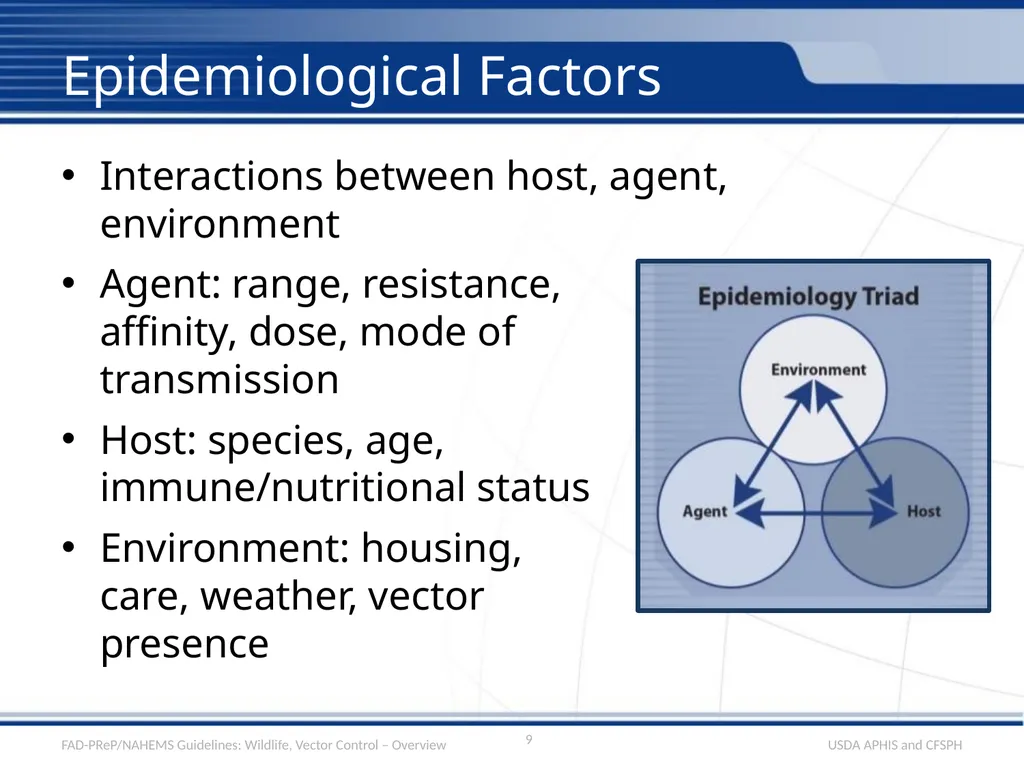
Interactions between host, agent, environment
Agent: range, resistance, affinity, dose, mode of transmission
Host: species, age, immune/nutritional status
Environment: housing, care, weather, vector presence Epidemiological Factors USDA APHIS and CFSPH FAD-PReP/NAHEMS Guidelines: Wildlife, Vector Control – Overview 9<br>
Agent: range, resistance, affinity, dose, mode of transmission
Host: species, age, immune/nutritional status
Environment: housing, care, weather, vector presence Epidemiological Factors USDA APHIS and CFSPH FAD-PReP/NAHEMS Guidelines: Wildlife, Vector Control – Overview 9<br>
10
Immediately assess wildlife during an FAD
Detect cases
Understand disease characteristics
Identify disease risks
Provide information for control
Evaluate effectiveness of control and adjust
Ecological factors USDA APHIS and CFSPH FAD-PReP/NAHEMS Guidelines: Wildlife, Vector Control – Overview 10 Epidemiological Factors cont’d<br>
Detect cases
Understand disease characteristics
Identify disease risks
Provide information for control
Evaluate effectiveness of control and adjust
Ecological factors USDA APHIS and CFSPH FAD-PReP/NAHEMS Guidelines: Wildlife, Vector Control – Overview 10 Epidemiological Factors cont’d<br>
11
OIE distinguishes between wildlife infection and domestic infection for some diseases
wildlife role in transmission, maintenance of agent
Not all countries will follow OIE guidelines for trade USDA APHIS and CFSPH FAD-PReP/NAHEMS Guidelines: Wildlife, Vector Control – Overview 11 International Trade Implications<br>
wildlife role in transmission, maintenance of agent
Not all countries will follow OIE guidelines for trade USDA APHIS and CFSPH FAD-PReP/NAHEMS Guidelines: Wildlife, Vector Control – Overview 11 International Trade Implications<br>
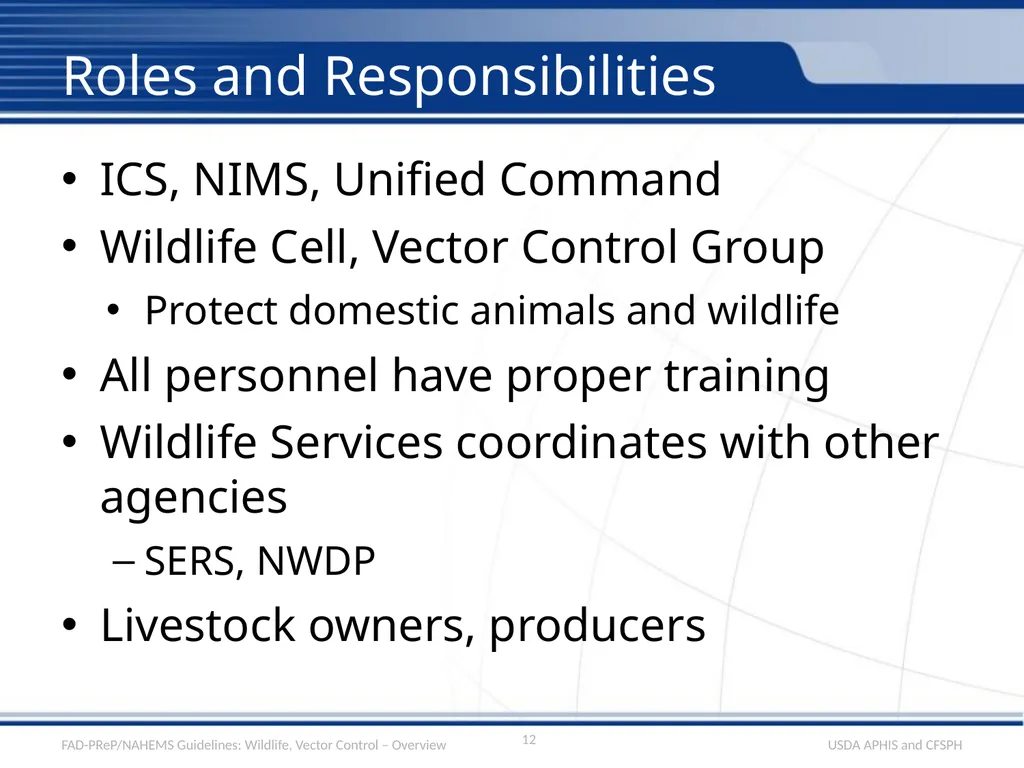
12
ICS, NIMS, Unified Command
Wildlife Cell, Vector Control Group
Protect domestic animals and wildlife
All personnel have proper training
Wildlife Services coordinates with other agencies
SERS, NWDP
Livestock owners, producers Roles and Responsibilities USDA APHIS and CFSPH FAD-PReP/NAHEMS Guidelines: Wildlife, Vector Control – Overview 12<br>
Wildlife Cell, Vector Control Group
Protect domestic animals and wildlife
All personnel have proper training
Wildlife Services coordinates with other agencies
SERS, NWDP
Livestock owners, producers Roles and Responsibilities USDA APHIS and CFSPH FAD-PReP/NAHEMS Guidelines: Wildlife, Vector Control – Overview 12<br>
13
Wildlife Management Methods and Plans in an FAD Outbreak in Domestic Livestock<br>
14
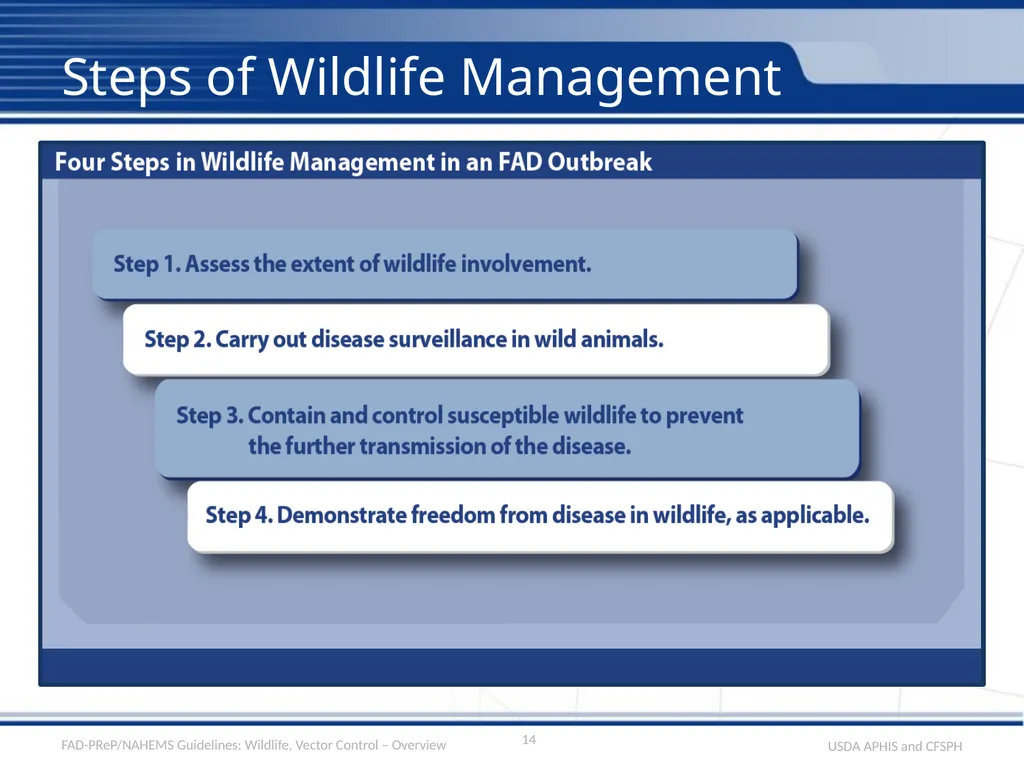
USDA APHIS and CFSPH FAD-PReP/NAHEMS Guidelines: Wildlife, Vector Control – Overview 14 Steps of Wildlife Management<br>
15
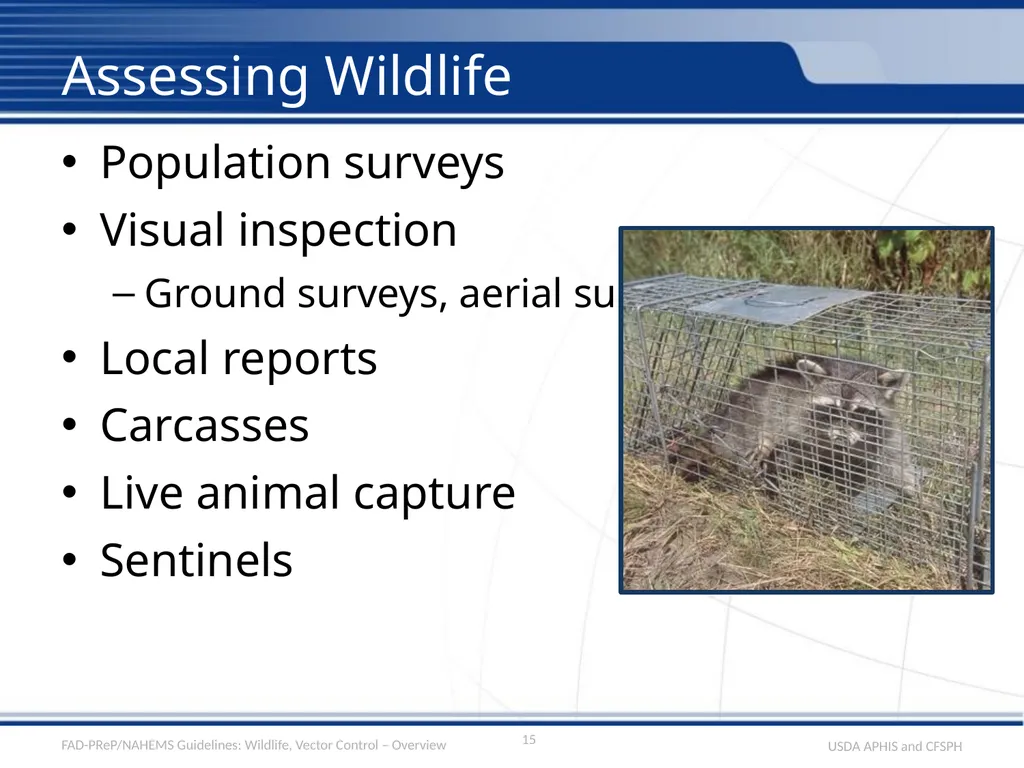
Population surveys
Visual inspection
Ground surveys, aerial surveys
Local reports
Carcasses
Live animal capture
Sentinels USDA APHIS and CFSPH FAD-PReP/NAHEMS Guidelines: Wildlife, Vector Control – Overview 15 Assessing Wildlife<br>
Visual inspection
Ground surveys, aerial surveys
Local reports
Carcasses
Live animal capture
Sentinels USDA APHIS and CFSPH FAD-PReP/NAHEMS Guidelines: Wildlife, Vector Control – Overview 15 Assessing Wildlife<br>
16
Presence, spread, and/or prevalence
Consider animal movement into and out of Control Area
Diagnostic sampling may be necessary
Live capture, observation, carcass collection
Parameters should be outlined in surveillance plan USDA APHIS and CFSPH FAD-PReP/NAHEMS Guidelines: Wildlife, Vector Control – Overview 16 Disease Surveillance<br>
Consider animal movement into and out of Control Area
Diagnostic sampling may be necessary
Live capture, observation, carcass collection
Parameters should be outlined in surveillance plan USDA APHIS and CFSPH FAD-PReP/NAHEMS Guidelines: Wildlife, Vector Control – Overview 16 Disease Surveillance<br>
17
Manipulate populations, habitat, or other factors
Removal, relocation, dispersal, containment
Buffer zones
Monitor, surveillance for effectiveness
Impacts evaluated USDA APHIS and CFSPH FAD-PReP/NAHEMS Guidelines: Wildlife, Vector Control – Overview Contain and Control Wildlife 17<br>
Removal, relocation, dispersal, containment
Buffer zones
Monitor, surveillance for effectiveness
Impacts evaluated USDA APHIS and CFSPH FAD-PReP/NAHEMS Guidelines: Wildlife, Vector Control – Overview Contain and Control Wildlife 17<br>
18
Safety is a priority
Trained and experienced personnel
Animal safety
Minimize stress on animals
Personnel safety
Chain of command with assigned duties
Determine all animal procedures, equipment, safety plans ahead of time USDA APHIS and CFSPH FAD-PReP/NAHEMS Guidelines: Wildlife, Vector Control – Overview 18 Animal and Personnel Safety<br>
Trained and experienced personnel
Animal safety
Minimize stress on animals
Personnel safety
Chain of command with assigned duties
Determine all animal procedures, equipment, safety plans ahead of time USDA APHIS and CFSPH FAD-PReP/NAHEMS Guidelines: Wildlife, Vector Control – Overview 18 Animal and Personnel Safety<br>
19
Reestablishing international trade
Wildlife-specific surveillance plan may need to be developed
Not always feasible, practical for wildlife
FAD PReP/NAHEMS Guidelines: Surveillance, Epidemiology, and Tracing USDA APHIS and CFSPH FAD-PReP/NAHEMS Guidelines: Wildlife, Vector Control – Overview 19 Demonstrating Disease Freedom<br>
Wildlife-specific surveillance plan may need to be developed
Not always feasible, practical for wildlife
FAD PReP/NAHEMS Guidelines: Surveillance, Epidemiology, and Tracing USDA APHIS and CFSPH FAD-PReP/NAHEMS Guidelines: Wildlife, Vector Control – Overview 19 Demonstrating Disease Freedom<br>
20
Developing a Wildlife Management Plan<br>
21
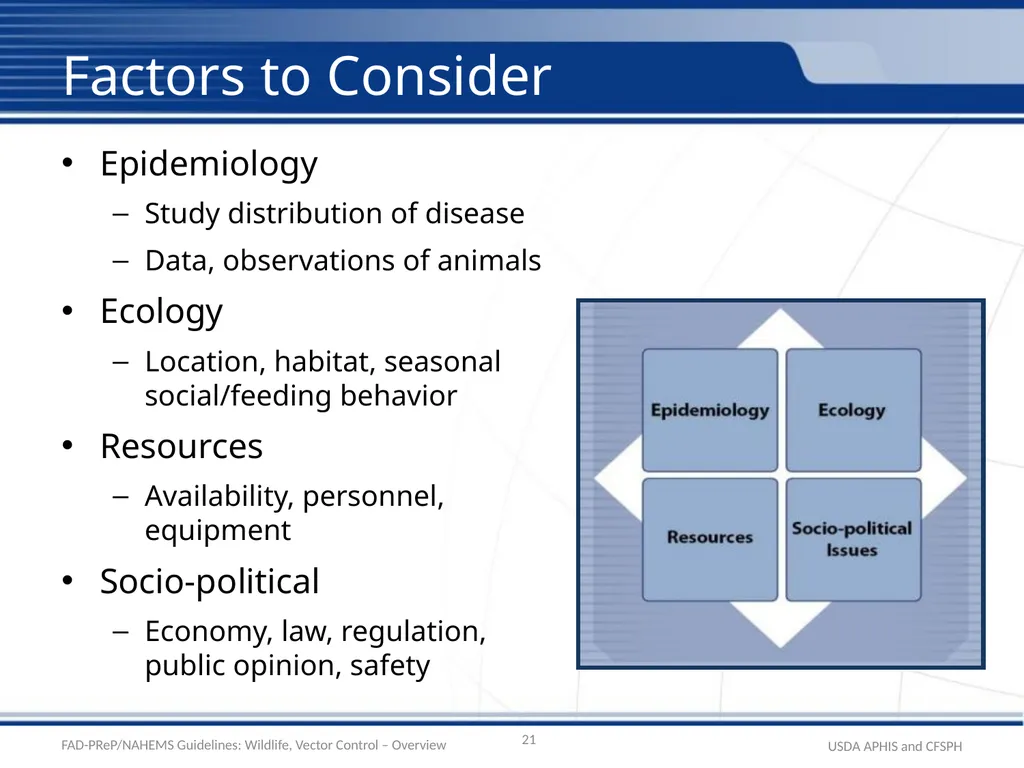
Epidemiology
Study distribution of disease
Data, observations of animals
Ecology
Location, habitat, seasonal social/feeding behavior
Resources
Availability, personnel, equipment
Socio-political
Economy, law, regulation, public opinion, safety USDA APHIS and CFSPH FAD-PReP/NAHEMS Guidelines: Wildlife, Vector Control – Overview Factors to Consider 21<br>
Study distribution of disease
Data, observations of animals
Ecology
Location, habitat, seasonal social/feeding behavior
Resources
Availability, personnel, equipment
Socio-political
Economy, law, regulation, public opinion, safety USDA APHIS and CFSPH FAD-PReP/NAHEMS Guidelines: Wildlife, Vector Control – Overview Factors to Consider 21<br>
22
Personnel
Understand biosecurity, safety protocols
Hazard exposure may include zoonosis
PPE, vaccination
Safety Officer – safe work procedures
Equipment, cleaning and disinfection
Information collected, reported
Manage, store, analyze, disseminate USDA APHIS and CFSPH FAD-PReP/NAHEMS Guidelines: Wildlife, Vector Control – Overview 22 Personnel, Equipment, Reporting<br>
Understand biosecurity, safety protocols
Hazard exposure may include zoonosis
PPE, vaccination
Safety Officer – safe work procedures
Equipment, cleaning and disinfection
Information collected, reported
Manage, store, analyze, disseminate USDA APHIS and CFSPH FAD-PReP/NAHEMS Guidelines: Wildlife, Vector Control – Overview 22 Personnel, Equipment, Reporting<br>
23
Vector Control in an FAD Outbreak in Domestic Livestock<br>
24
Transmission of disease pathogen
Mechanical
Biological
Methods of vector control
Understand life cycle and relationship to host and pathogen
Focus on habitat reduction, minimizing contact, chemical/biological control USDA APHIS and CFSPH FAD-PReP/NAHEMS Guidelines: Wildlife, Vector Control – Overview Vector-borne FADs 24<br>
Mechanical
Biological
Methods of vector control
Understand life cycle and relationship to host and pathogen
Focus on habitat reduction, minimizing contact, chemical/biological control USDA APHIS and CFSPH FAD-PReP/NAHEMS Guidelines: Wildlife, Vector Control – Overview Vector-borne FADs 24<br>
25
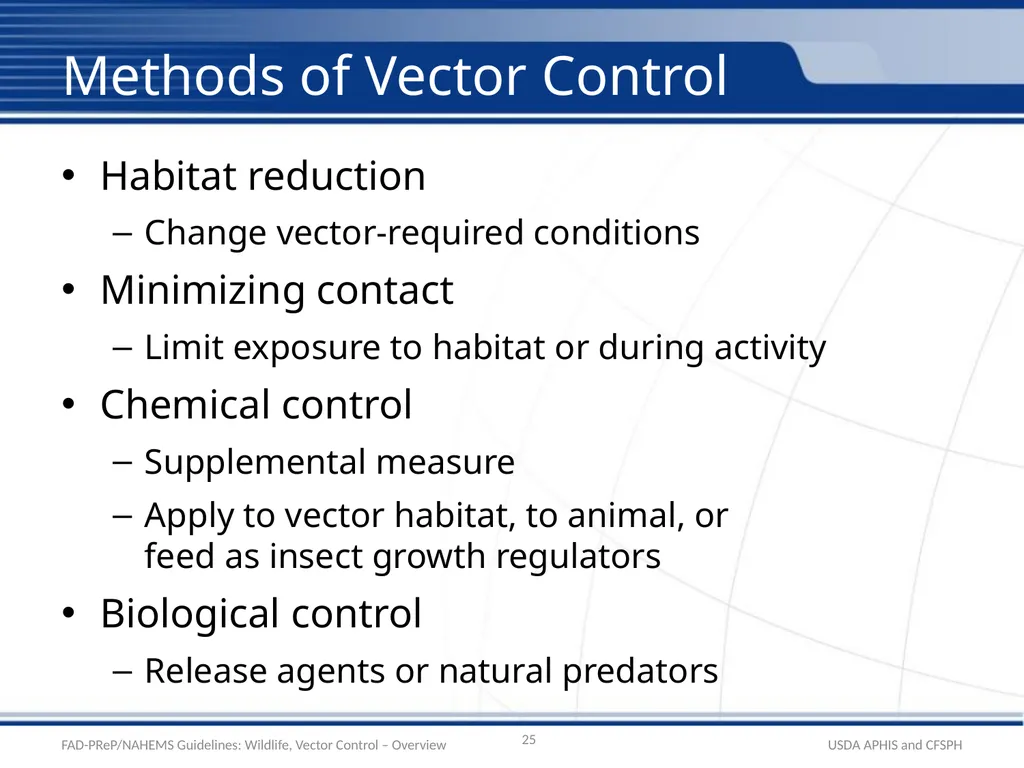
Habitat reduction
Change vector-required conditions
Minimizing contact
Limit exposure to habitat or during activity
Chemical control
Supplemental measure
Apply to vector habitat, to animal, or feed as insect growth regulators
Biological control
Release agents or natural predators USDA APHIS and CFSPH FAD-PReP/NAHEMS Guidelines: Wildlife, Vector Control – Overview Methods of Vector Control 25<br>
Change vector-required conditions
Minimizing contact
Limit exposure to habitat or during activity
Chemical control
Supplemental measure
Apply to vector habitat, to animal, or feed as insect growth regulators
Biological control
Release agents or natural predators USDA APHIS and CFSPH FAD-PReP/NAHEMS Guidelines: Wildlife, Vector Control – Overview Methods of Vector Control 25<br>
26
Other Response Activities<br>
27
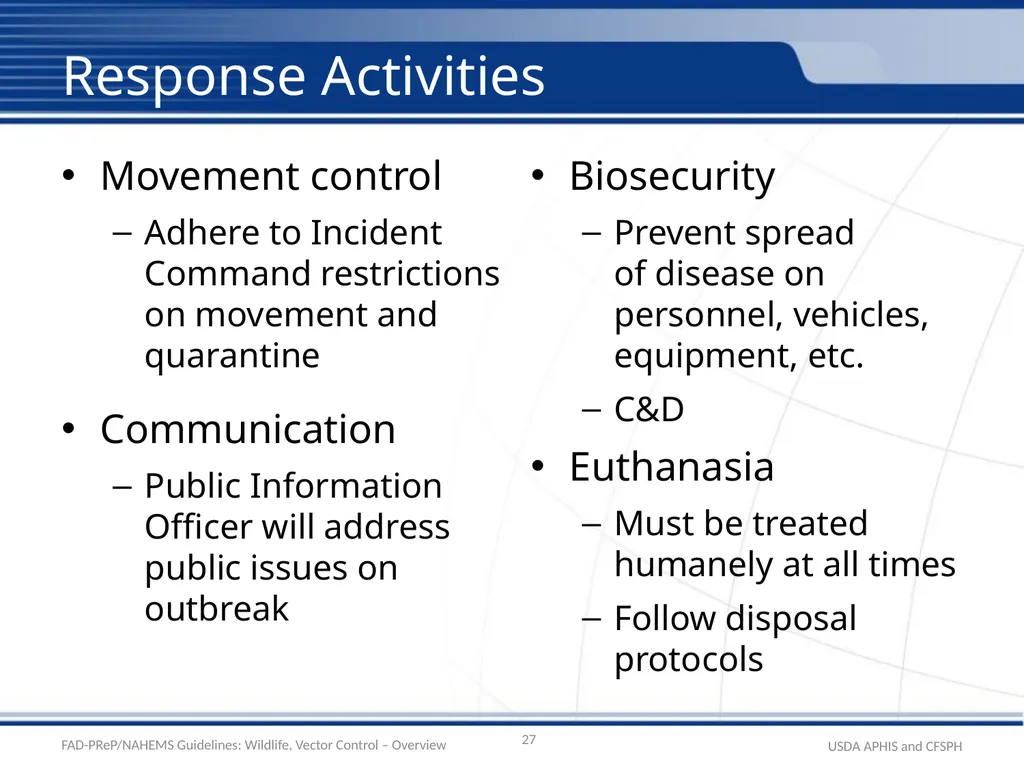
Response Activities Movement control
Adhere to Incident Command restrictions on movement and quarantine
Communication
Public Information Officer will address public issues on outbreak Biosecurity
Prevent spread of disease on personnel, vehicles, equipment, etc.
C&D
Euthanasia
Must be treated humanely at all times
Follow disposal protocols USDA APHIS and CFSPH FAD-PReP/NAHEMS Guidelines: Wildlife, Vector Control – Overview 27<br>
Adhere to Incident Command restrictions on movement and quarantine
Communication
Public Information Officer will address public issues on outbreak Biosecurity
Prevent spread of disease on personnel, vehicles, equipment, etc.
C&D
Euthanasia
Must be treated humanely at all times
Follow disposal protocols USDA APHIS and CFSPH FAD-PReP/NAHEMS Guidelines: Wildlife, Vector Control – Overview 27<br>
28
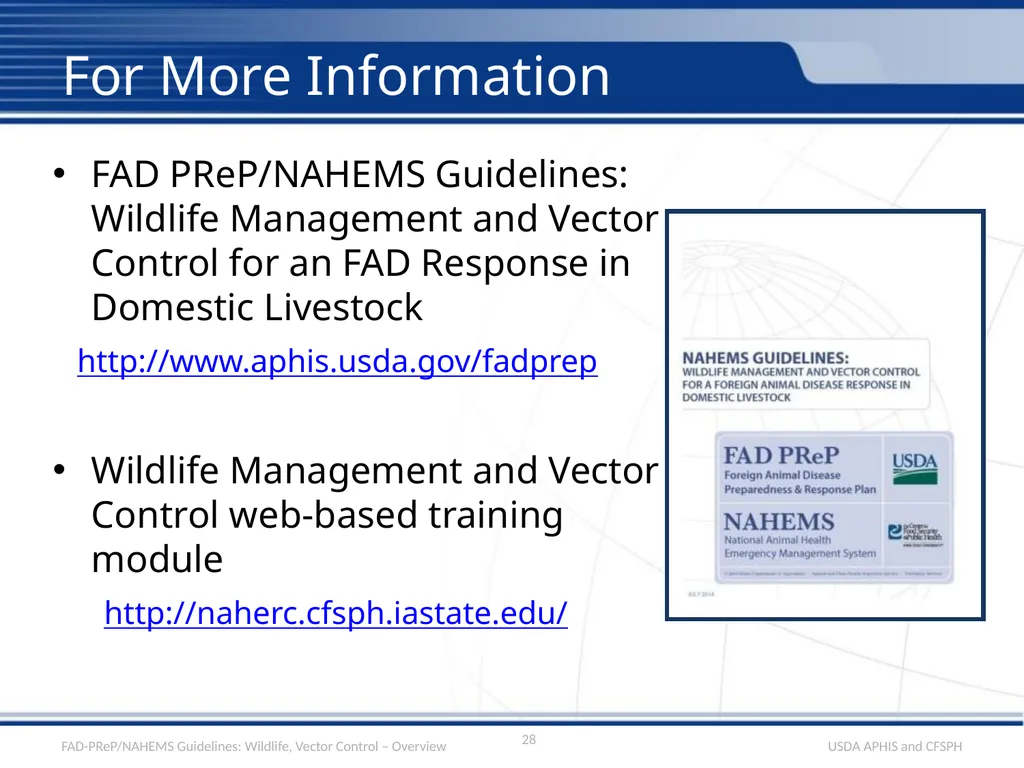
FAD PReP/NAHEMS Guidelines: Wildlife Management and Vector Control for an FAD Response in Domestic Livestock
http://www.aphis.usda.gov/fadprep
Wildlife Management and Vector Control web-based training module
http://naherc.cfsph.iastate.edu/ USDA APHIS and CFSPH FAD-PReP/NAHEMS Guidelines: Wildlife, Vector Control – Overview 28 For More Information<br>
http://www.aphis.usda.gov/fadprep
Wildlife Management and Vector Control web-based training module
http://naherc.cfsph.iastate.edu/ USDA APHIS and CFSPH FAD-PReP/NAHEMS Guidelines: Wildlife, Vector Control – Overview 28 For More Information<br>
29
Authors (CFSPH)
Glenda Dvorak, DVM, MS, MPH, DACVPM
Nicole Seda, BS
Meghan Blankenship, BS
Heather Allen, PhD, MPA
Contributor (USDA)
Jonathan Zack, DVM USDA APHIS and CFSPH FAD-PReP/NAHEMS Guidelines: Wildlife, Vector Control – Overview 29 Guidelines Content<br>
Glenda Dvorak, DVM, MS, MPH, DACVPM
Nicole Seda, BS
Meghan Blankenship, BS
Heather Allen, PhD, MPA
Contributor (USDA)
Jonathan Zack, DVM USDA APHIS and CFSPH FAD-PReP/NAHEMS Guidelines: Wildlife, Vector Control – Overview 29 Guidelines Content<br>
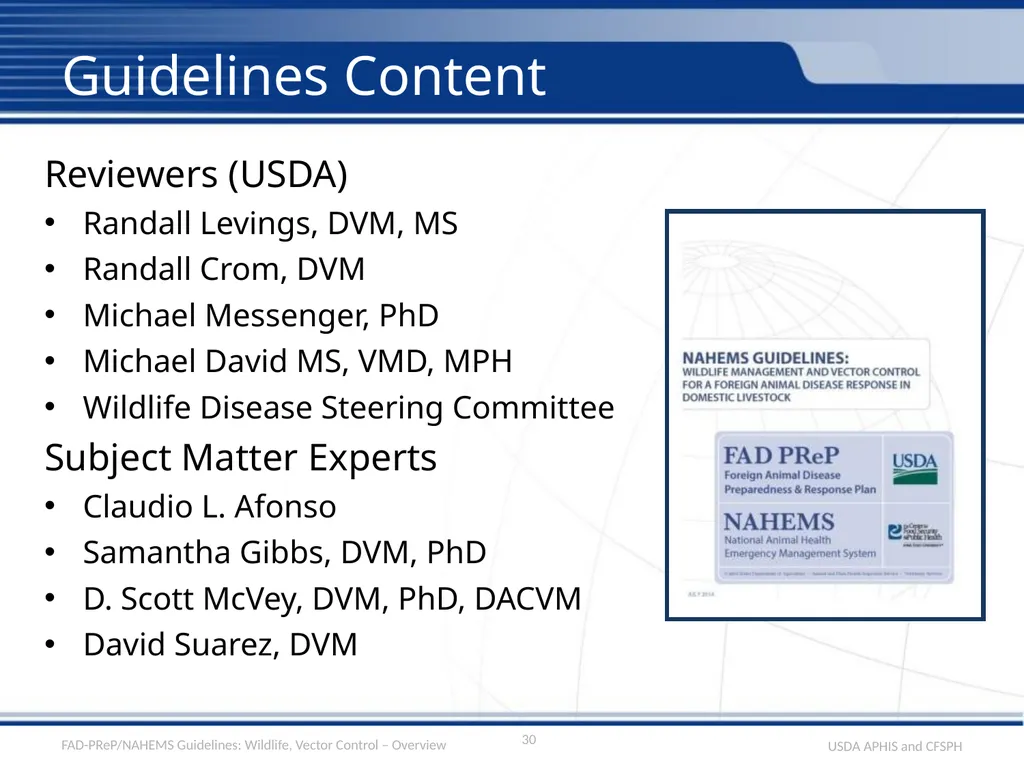
30
Reviewers (USDA)
Randall Levings, DVM, MS
Randall Crom, DVM
Michael Messenger, PhD
Michael David MS, VMD, MPH
Wildlife Disease Steering Committee
Subject Matter Experts
Claudio L. Afonso
Samantha Gibbs, DVM, PhD
D. Scott McVey, DVM, PhD, DACVM
David Suarez, DVM USDA APHIS and CFSPH FAD-PReP/NAHEMS Guidelines: Wildlife, Vector Control – Overview 30 Guidelines Content<br>
Randall Levings, DVM, MS
Randall Crom, DVM
Michael Messenger, PhD
Michael David MS, VMD, MPH
Wildlife Disease Steering Committee
Subject Matter Experts
Claudio L. Afonso
Samantha Gibbs, DVM, PhD
D. Scott McVey, DVM, PhD, DACVM
David Suarez, DVM USDA APHIS and CFSPH FAD-PReP/NAHEMS Guidelines: Wildlife, Vector Control – Overview 30 Guidelines Content<br>
31
Acknowledgments Development of this presentation was by the Center for Food Security and Public Health at Iowa State University through funding from the USDA APHIS Veterinary Services PPT Authors: Abbey Smith, Student Intern; Janice Mogan, DVM
Reviewers: Glenda Dvorak, DVM, MPH, DACVPM; Heather Allen, PhD, MPA<br>
Reviewers: Glenda Dvorak, DVM, MPH, DACVPM; Heather Allen, PhD, MPA<br>