
Year 11 An Inspector Calls Revision Booklet
DJ
Published · 30 slides · 0 views

1 / 1

















Description
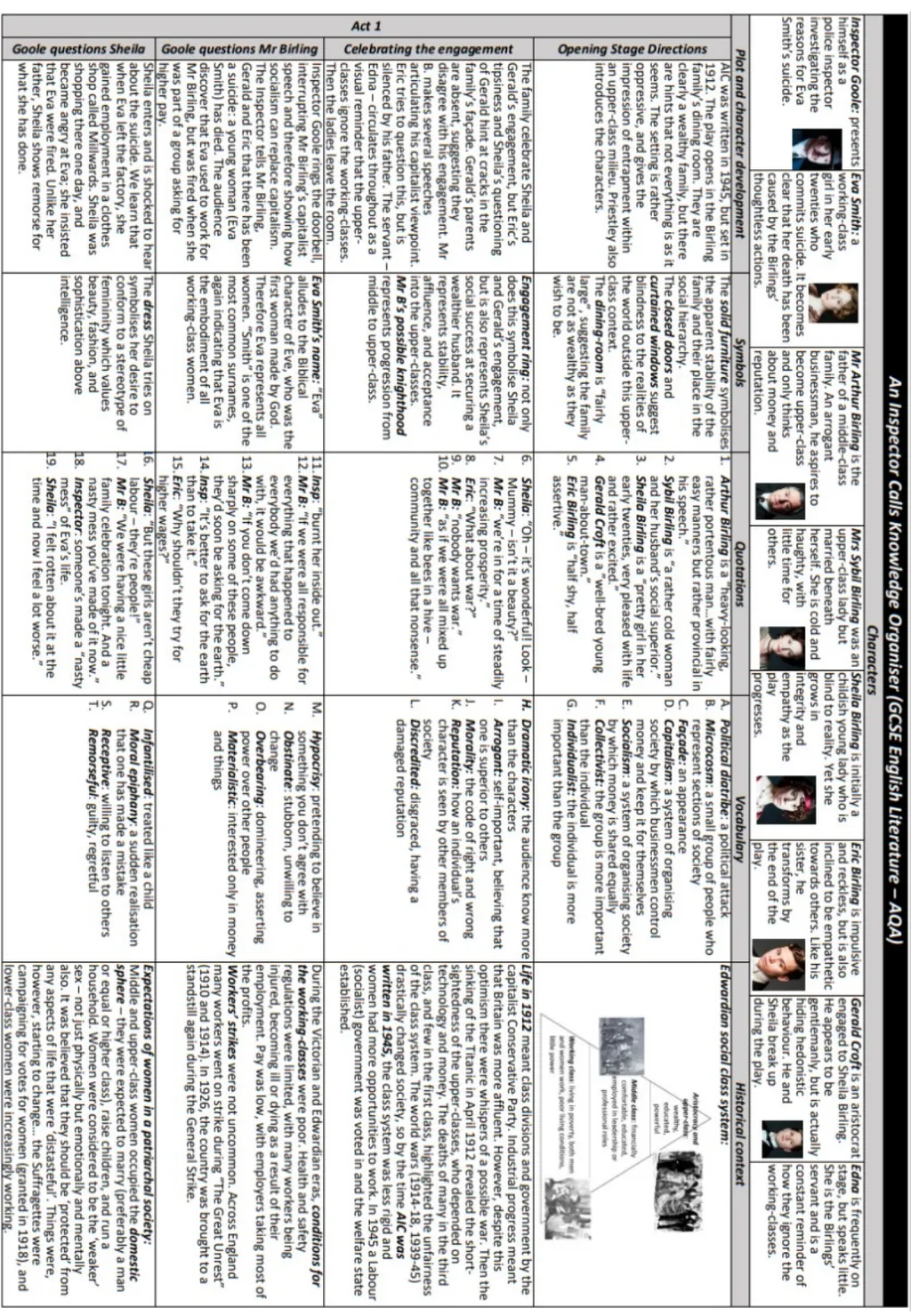
Year 11 An Inspector Calls Revision Booklet 2023-24 Name: Teachers Name: 1 2 3 Historical Context Use the information on this page to complete the grid on the next page. 4 JB Priestleys Life Priestley was born in 1894, and died in 1984.
Related Topics
Share
Embed code
Download this presentation From Below
"Year 11 An Inspector Calls Revision Booklet" is the property of its rightful owner. Permission is granted to download and print the materials on this website for personal, non-commercial use only, and to display it on your personal computer provided you do not modify the materials and that you retain all copyright notices contained in the materials. By downloading content from our website, you accept the terms of this agreement.
Presentation Transcript
01
Year 11
An Inspector Calls Revision Booklet
2023-24 Name: Teacher’s Name: 1<br>
02
2<br>
03
3<br>
04
Historical Context
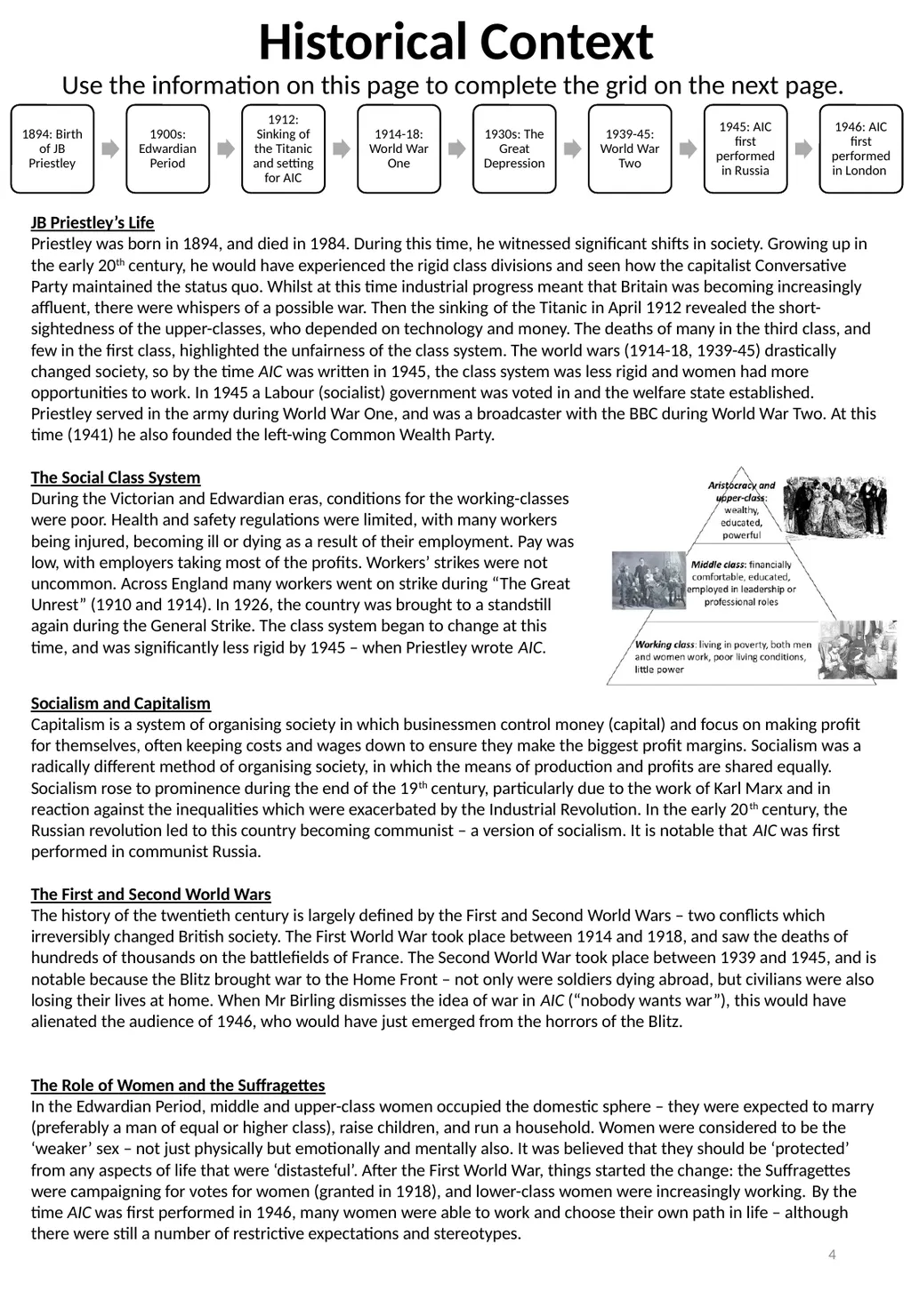
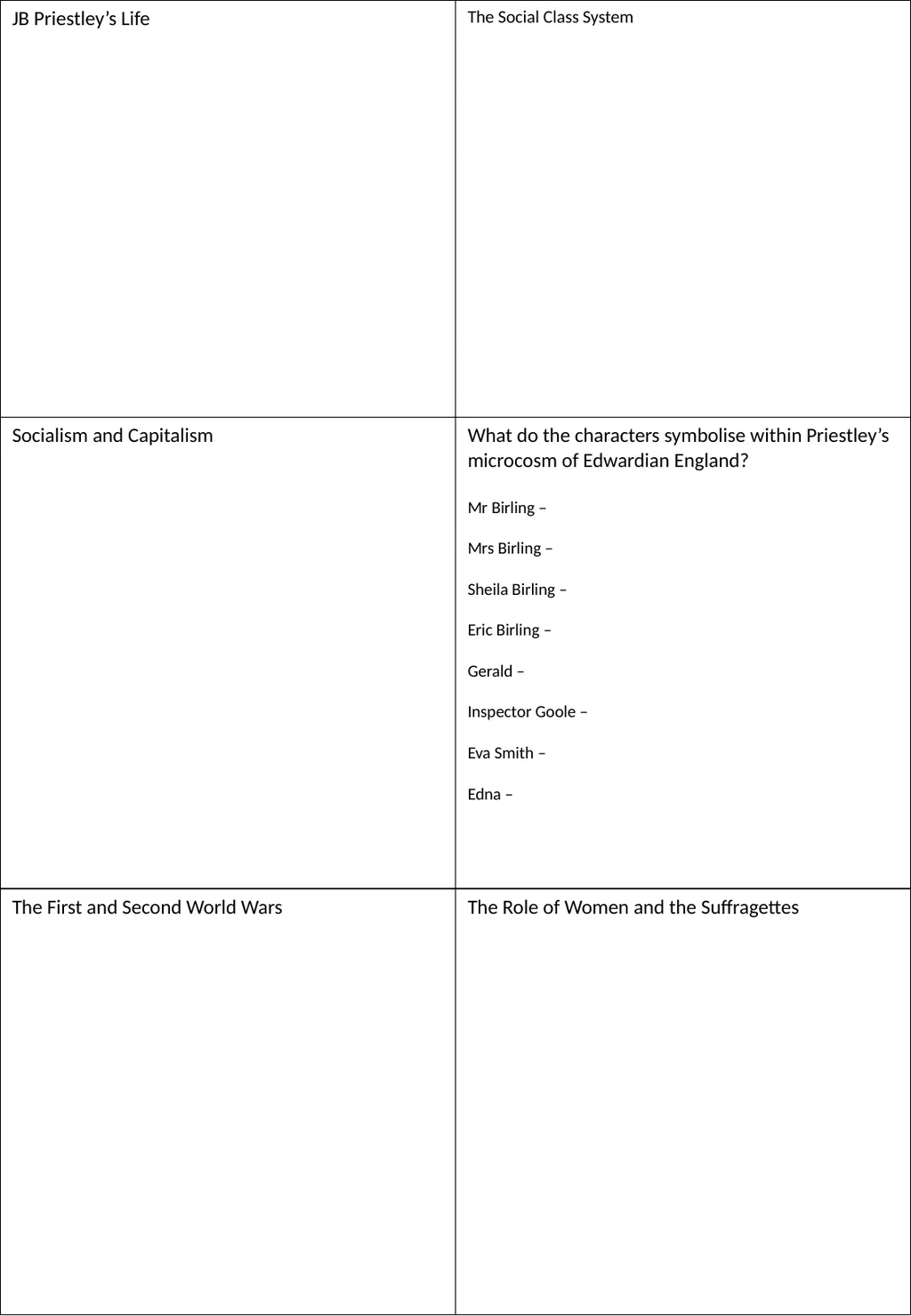
Use the information on this page to complete the grid on the next page. 4 JB Priestley’s Life
Priestley was born in 1894, and died in 1984. During this time, he witnessed significant shifts in society. Growing up in the early 20th century, he would have experienced the rigid class divisions and seen how the capitalist Conversative Party maintained the status quo. Whilst at this time industrial progress meant that Britain was becoming increasingly affluent, there were whispers of a possible war. Then the sinking of the Titanic in April 1912 revealed the short-sightedness of the upper-classes, who depended on technology and money. The deaths of many in the third class, and few in the first class, highlighted the unfairness of the class system. The world wars (1914-18, 1939-45) drastically changed society, so by the time AIC was written in 1945, the class system was less rigid and women had more opportunities to work. In 1945 a Labour (socialist) government was voted in and the welfare state established. Priestley served in the army during World War One, and was a broadcaster with the BBC during World War Two. At this time (1941) he also founded the left-wing Common Wealth Party.
The Social Class System
During the Victorian and Edwardian eras, conditions for the working-classes were poor. Health and safety regulations were limited, with many workers being injured, becoming ill or dying as a result of their employment. Pay was low, with employers taking most of the profits. Workers’ strikes were not uncommon. Across England many workers went on strike during “The Great Unrest” (1910 and 1914). In 1926, the country was brought to a standstill again during the General Strike. The class system began to change at this time, and was significantly less rigid by 1945 – when Priestley wrote AIC.
Socialism and Capitalism
Capitalism is a system of organising society in which businessmen control money (capital) and focus on making profit for themselves, often keeping costs and wages down to ensure they make the biggest profit margins. Socialism was a radically different method of organising society, in which the means of production and profits are shared equally. Socialism rose to prominence during the end of the 19th century, particularly due to the work of Karl Marx and in reaction against the inequalities which were exacerbated by the Industrial Revolution. In the early 20th century, the Russian revolution led to this country becoming communist – a version of socialism. It is notable that AIC was first performed in communist Russia.
The First and Second World Wars
The history of the twentieth century is largely defined by the First and Second World Wars – two conflicts which irreversibly changed British society. The First World War took place between 1914 and 1918, and saw the deaths of hundreds of thousands on the battlefields of France. The Second World War took place between 1939 and 1945, and is notable because the Blitz brought war to the Home Front – not only were soldiers dying abroad, but civilians were also losing their lives at home. When Mr Birling dismisses the idea of war in AIC (“nobody wants war”), this would have alienated the audience of 1946, who would have just emerged from the horrors of the Blitz.
The Role of Women and the Suffragettes
In the Edwardian Period, middle and upper-class women occupied the domestic sphere – they were expected to marry (preferably a man of equal or higher class), raise children, and run a household. Women were considered to be the ‘weaker’ sex – not just physically but emotionally and mentally also. It was believed that they should be ‘protected’ from any aspects of life that were ‘distasteful’. After the First World War, things started the change: the Suffragettes were campaigning for votes for women (granted in 1918), and lower-class women were increasingly working. By the time AIC was first performed in 1946, many women were able to work and choose their own path in life – although there were still a number of restrictive expectations and stereotypes.<br>
Priestley was born in 1894, and died in 1984. During this time, he witnessed significant shifts in society. Growing up in the early 20th century, he would have experienced the rigid class divisions and seen how the capitalist Conversative Party maintained the status quo. Whilst at this time industrial progress meant that Britain was becoming increasingly affluent, there were whispers of a possible war. Then the sinking of the Titanic in April 1912 revealed the short-sightedness of the upper-classes, who depended on technology and money. The deaths of many in the third class, and few in the first class, highlighted the unfairness of the class system. The world wars (1914-18, 1939-45) drastically changed society, so by the time AIC was written in 1945, the class system was less rigid and women had more opportunities to work. In 1945 a Labour (socialist) government was voted in and the welfare state established. Priestley served in the army during World War One, and was a broadcaster with the BBC during World War Two. At this time (1941) he also founded the left-wing Common Wealth Party.
The Social Class System
During the Victorian and Edwardian eras, conditions for the working-classes were poor. Health and safety regulations were limited, with many workers being injured, becoming ill or dying as a result of their employment. Pay was low, with employers taking most of the profits. Workers’ strikes were not uncommon. Across England many workers went on strike during “The Great Unrest” (1910 and 1914). In 1926, the country was brought to a standstill again during the General Strike. The class system began to change at this time, and was significantly less rigid by 1945 – when Priestley wrote AIC.
Socialism and Capitalism
Capitalism is a system of organising society in which businessmen control money (capital) and focus on making profit for themselves, often keeping costs and wages down to ensure they make the biggest profit margins. Socialism was a radically different method of organising society, in which the means of production and profits are shared equally. Socialism rose to prominence during the end of the 19th century, particularly due to the work of Karl Marx and in reaction against the inequalities which were exacerbated by the Industrial Revolution. In the early 20th century, the Russian revolution led to this country becoming communist – a version of socialism. It is notable that AIC was first performed in communist Russia.
The First and Second World Wars
The history of the twentieth century is largely defined by the First and Second World Wars – two conflicts which irreversibly changed British society. The First World War took place between 1914 and 1918, and saw the deaths of hundreds of thousands on the battlefields of France. The Second World War took place between 1939 and 1945, and is notable because the Blitz brought war to the Home Front – not only were soldiers dying abroad, but civilians were also losing their lives at home. When Mr Birling dismisses the idea of war in AIC (“nobody wants war”), this would have alienated the audience of 1946, who would have just emerged from the horrors of the Blitz.
The Role of Women and the Suffragettes
In the Edwardian Period, middle and upper-class women occupied the domestic sphere – they were expected to marry (preferably a man of equal or higher class), raise children, and run a household. Women were considered to be the ‘weaker’ sex – not just physically but emotionally and mentally also. It was believed that they should be ‘protected’ from any aspects of life that were ‘distasteful’. After the First World War, things started the change: the Suffragettes were campaigning for votes for women (granted in 1918), and lower-class women were increasingly working. By the time AIC was first performed in 1946, many women were able to work and choose their own path in life – although there were still a number of restrictive expectations and stereotypes.<br>
05
5<br>
06
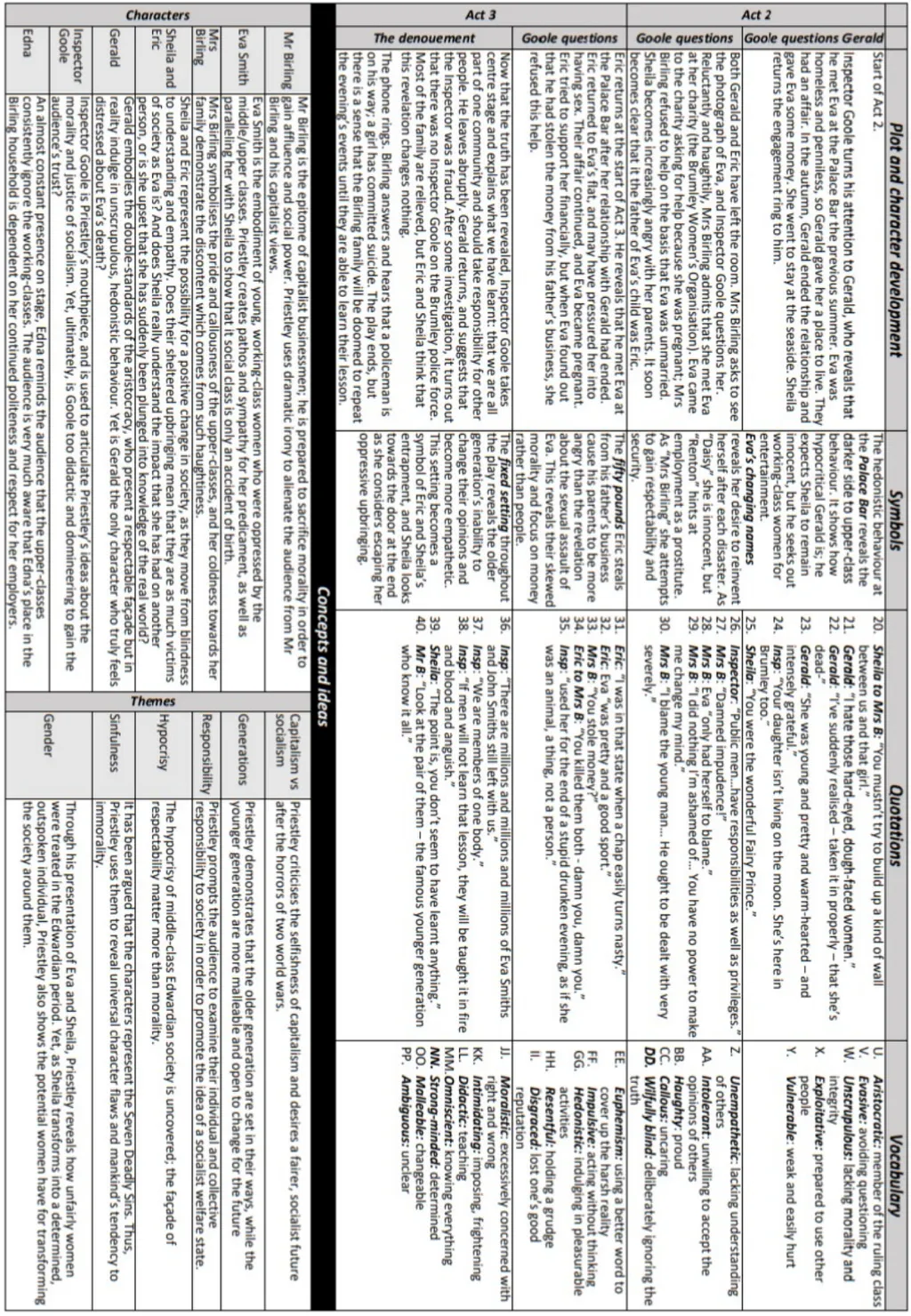
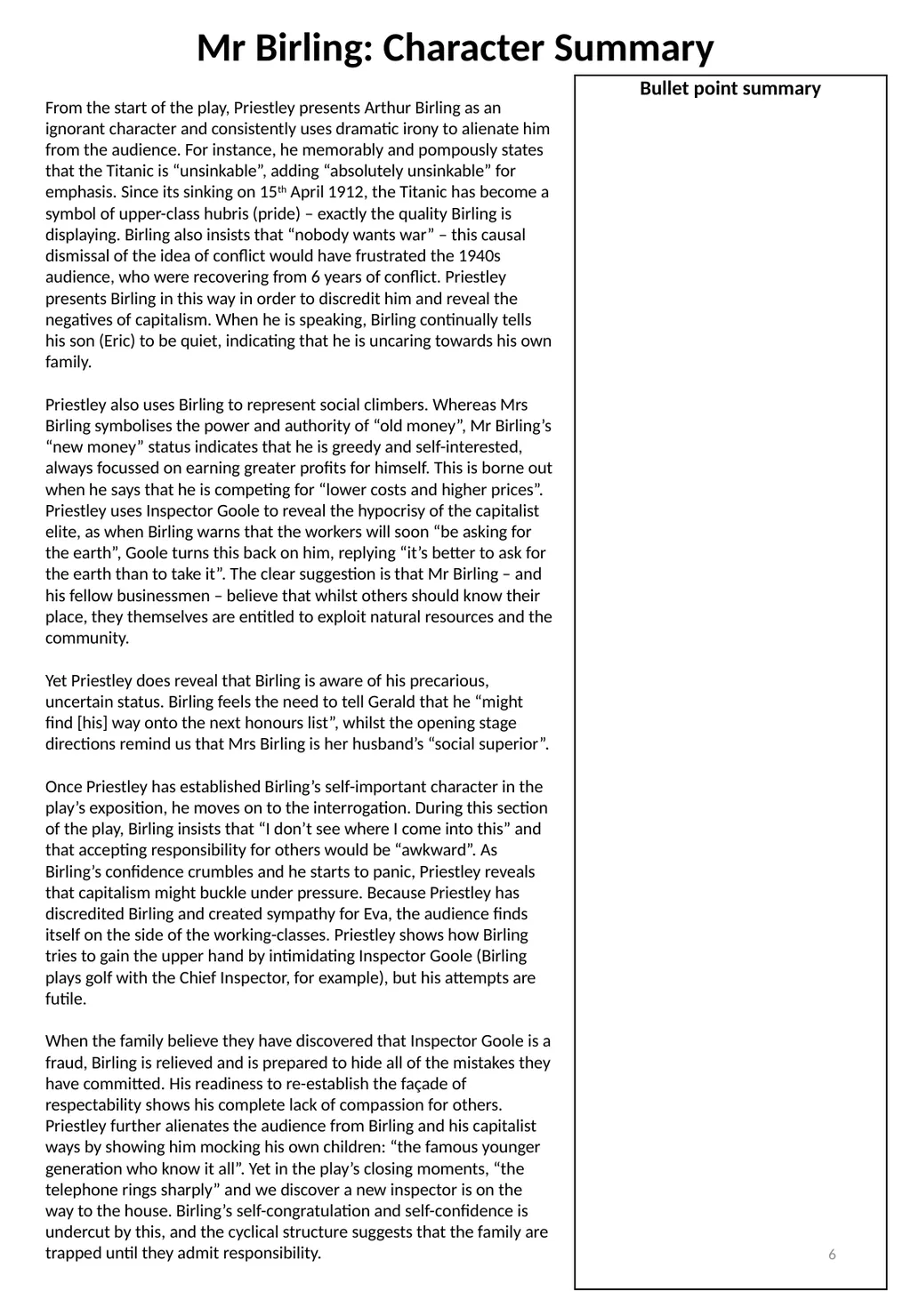
6 Mr Birling: Character Summary Bullet point summary From the start of the play, Priestley presents Arthur Birling as an ignorant character and consistently uses dramatic irony to alienate him from the audience. For instance, he memorably and pompously states that the Titanic is “unsinkable”, adding “absolutely unsinkable” for emphasis. Since its sinking on 15th April 1912, the Titanic has become a symbol of upper-class hubris (pride) – exactly the quality Birling is displaying. Birling also insists that “nobody wants war” – this causal dismissal of the idea of conflict would have frustrated the 1940s audience, who were recovering from 6 years of conflict. Priestley presents Birling in this way in order to discredit him and reveal the negatives of capitalism. When he is speaking, Birling continually tells his son (Eric) to be quiet, indicating that he is uncaring towards his own family.
Priestley also uses Birling to represent social climbers. Whereas Mrs Birling symbolises the power and authority of “old money”, Mr Birling’s “new money” status indicates that he is greedy and self-interested, always focussed on earning greater profits for himself. This is borne out when he says that he is competing for “lower costs and higher prices”. Priestley uses Inspector Goole to reveal the hypocrisy of the capitalist elite, as when Birling warns that the workers will soon “be asking for the earth”, Goole turns this back on him, replying “it’s better to ask for the earth than to take it”. The clear suggestion is that Mr Birling – and his fellow businessmen – believe that whilst others should know their place, they themselves are entitled to exploit natural resources and the community.
Yet Priestley does reveal that Birling is aware of his precarious, uncertain status. Birling feels the need to tell Gerald that he “might find [his] way onto the next honours list”, whilst the opening stage directions remind us that Mrs Birling is her husband’s “social superior”.
Once Priestley has established Birling’s self-important character in the play’s exposition, he moves on to the interrogation. During this section of the play, Birling insists that “I don’t see where I come into this” and that accepting responsibility for others would be “awkward”. As Birling’s confidence crumbles and he starts to panic, Priestley reveals that capitalism might buckle under pressure. Because Priestley has discredited Birling and created sympathy for Eva, the audience finds itself on the side of the working-classes. Priestley shows how Birling tries to gain the upper hand by intimidating Inspector Goole (Birling plays golf with the Chief Inspector, for example), but his attempts are futile.
When the family believe they have discovered that Inspector Goole is a fraud, Birling is relieved and is prepared to hide all of the mistakes they have committed. His readiness to re-establish the façade of respectability shows his complete lack of compassion for others. Priestley further alienates the audience from Birling and his capitalist ways by showing him mocking his own children: “the famous younger generation who know it all”. Yet in the play’s closing moments, “the telephone rings sharply” and we discover a new inspector is on the way to the house. Birling’s self-congratulation and self-confidence is undercut by this, and the cyclical structure suggests that the family are trapped until they admit responsibility.<br>
Priestley also uses Birling to represent social climbers. Whereas Mrs Birling symbolises the power and authority of “old money”, Mr Birling’s “new money” status indicates that he is greedy and self-interested, always focussed on earning greater profits for himself. This is borne out when he says that he is competing for “lower costs and higher prices”. Priestley uses Inspector Goole to reveal the hypocrisy of the capitalist elite, as when Birling warns that the workers will soon “be asking for the earth”, Goole turns this back on him, replying “it’s better to ask for the earth than to take it”. The clear suggestion is that Mr Birling – and his fellow businessmen – believe that whilst others should know their place, they themselves are entitled to exploit natural resources and the community.
Yet Priestley does reveal that Birling is aware of his precarious, uncertain status. Birling feels the need to tell Gerald that he “might find [his] way onto the next honours list”, whilst the opening stage directions remind us that Mrs Birling is her husband’s “social superior”.
Once Priestley has established Birling’s self-important character in the play’s exposition, he moves on to the interrogation. During this section of the play, Birling insists that “I don’t see where I come into this” and that accepting responsibility for others would be “awkward”. As Birling’s confidence crumbles and he starts to panic, Priestley reveals that capitalism might buckle under pressure. Because Priestley has discredited Birling and created sympathy for Eva, the audience finds itself on the side of the working-classes. Priestley shows how Birling tries to gain the upper hand by intimidating Inspector Goole (Birling plays golf with the Chief Inspector, for example), but his attempts are futile.
When the family believe they have discovered that Inspector Goole is a fraud, Birling is relieved and is prepared to hide all of the mistakes they have committed. His readiness to re-establish the façade of respectability shows his complete lack of compassion for others. Priestley further alienates the audience from Birling and his capitalist ways by showing him mocking his own children: “the famous younger generation who know it all”. Yet in the play’s closing moments, “the telephone rings sharply” and we discover a new inspector is on the way to the house. Birling’s self-congratulation and self-confidence is undercut by this, and the cyclical structure suggests that the family are trapped until they admit responsibility.<br>
07
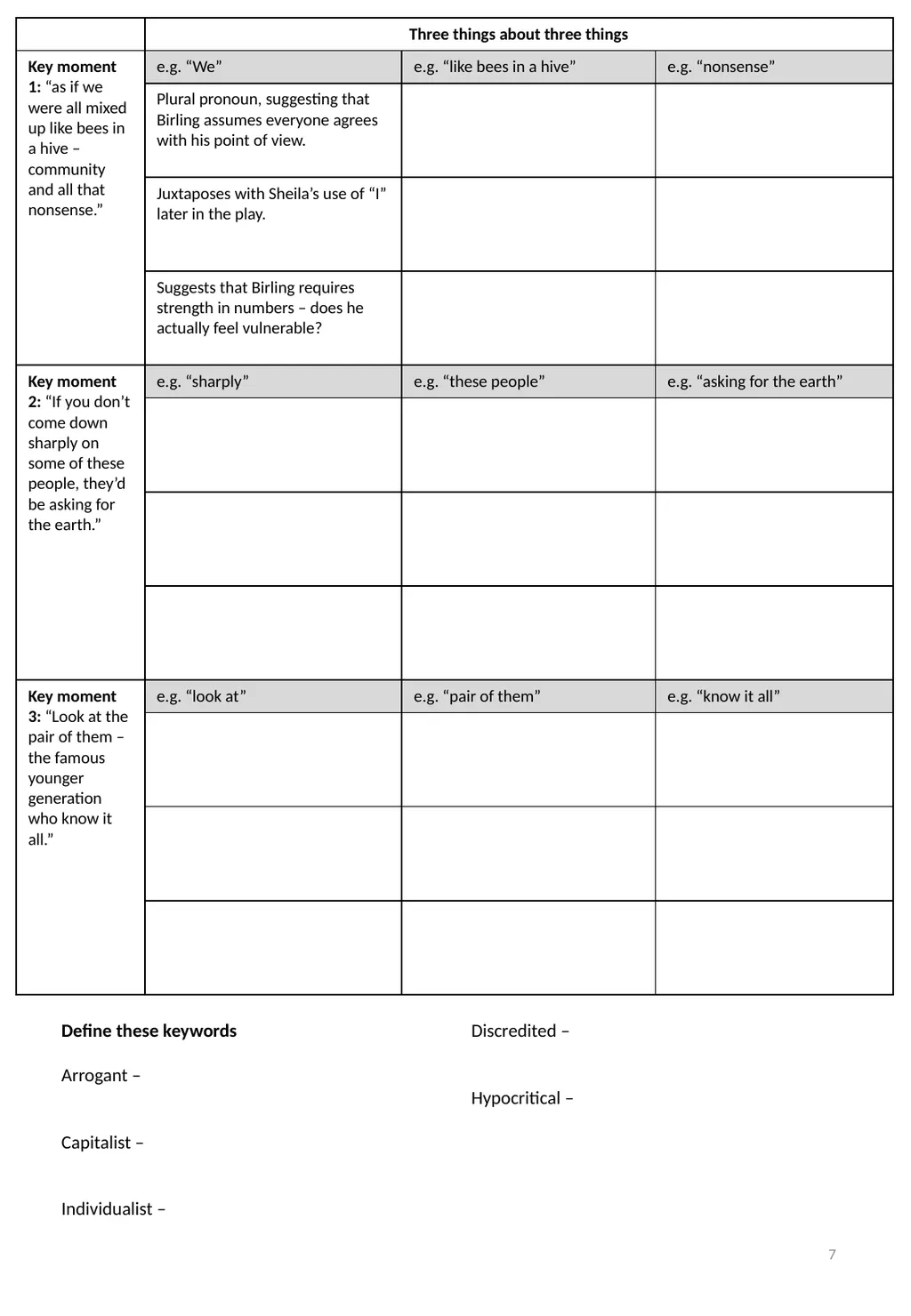
7 Define these keywords
Arrogant –
Capitalist –
Individualist –
Discredited –
Hypocritical –<br>
Arrogant –
Capitalist –
Individualist –
Discredited –
Hypocritical –<br>
08
Mr Birling: 5 minute plans 1. To what extent does Priestley present Mr Birling as an unlikeable character?
5 minute plan:
2. How does Priestley present Mr Birling as a symbol of capitalist greed?
5 minute plan:
3. To what extent does Priestley present Mr Birling as arrogant and callous?
5 minute plan: 8<br>
5 minute plan:
2. How does Priestley present Mr Birling as a symbol of capitalist greed?
5 minute plan:
3. To what extent does Priestley present Mr Birling as arrogant and callous?
5 minute plan: 8<br>
09
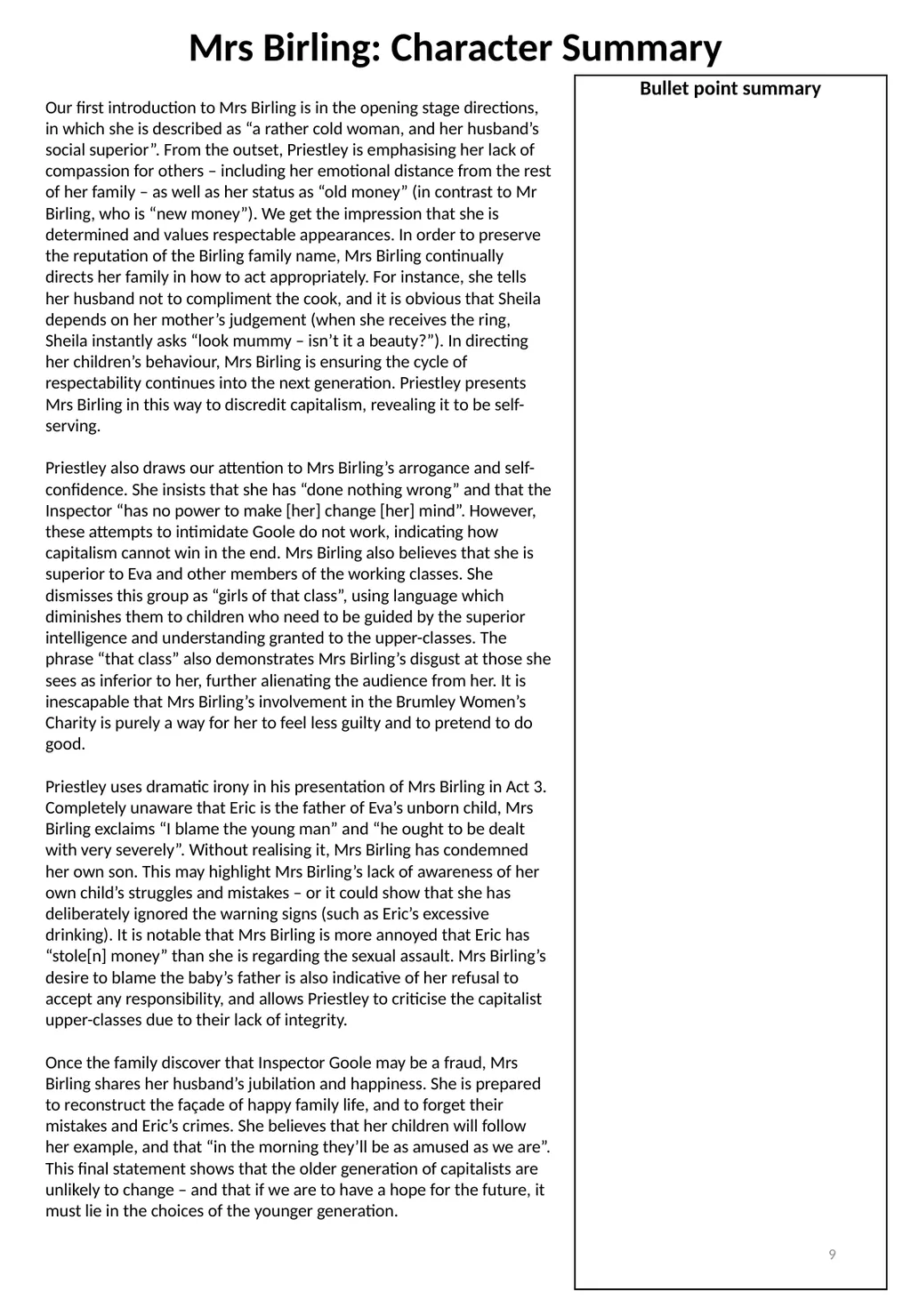
9 Mrs Birling: Character Summary Bullet point summary Our first introduction to Mrs Birling is in the opening stage directions, in which she is described as “a rather cold woman, and her husband’s social superior”. From the outset, Priestley is emphasising her lack of compassion for others – including her emotional distance from the rest of her family – as well as her status as “old money” (in contrast to Mr Birling, who is “new money”). We get the impression that she is determined and values respectable appearances. In order to preserve the reputation of the Birling family name, Mrs Birling continually directs her family in how to act appropriately. For instance, she tells her husband not to compliment the cook, and it is obvious that Sheila depends on her mother’s judgement (when she receives the ring, Sheila instantly asks “look mummy – isn’t it a beauty?”). In directing her children’s behaviour, Mrs Birling is ensuring the cycle of respectability continues into the next generation. Priestley presents Mrs Birling in this way to discredit capitalism, revealing it to be self-serving.
Priestley also draws our attention to Mrs Birling’s arrogance and self-confidence. She insists that she has “done nothing wrong” and that the Inspector “has no power to make [her] change [her] mind”. However, these attempts to intimidate Goole do not work, indicating how capitalism cannot win in the end. Mrs Birling also believes that she is superior to Eva and other members of the working classes. She dismisses this group as “girls of that class”, using language which diminishes them to children who need to be guided by the superior intelligence and understanding granted to the upper-classes. The phrase “that class” also demonstrates Mrs Birling’s disgust at those she sees as inferior to her, further alienating the audience from her. It is inescapable that Mrs Birling’s involvement in the Brumley Women’s Charity is purely a way for her to feel less guilty and to pretend to do good.
Priestley uses dramatic irony in his presentation of Mrs Birling in Act 3. Completely unaware that Eric is the father of Eva’s unborn child, Mrs Birling exclaims “I blame the young man” and “he ought to be dealt with very severely”. Without realising it, Mrs Birling has condemned her own son. This may highlight Mrs Birling’s lack of awareness of her own child’s struggles and mistakes – or it could show that she has deliberately ignored the warning signs (such as Eric’s excessive drinking). It is notable that Mrs Birling is more annoyed that Eric has “stole[n] money” than she is regarding the sexual assault. Mrs Birling’s desire to blame the baby’s father is also indicative of her refusal to accept any responsibility, and allows Priestley to criticise the capitalist upper-classes due to their lack of integrity.
Once the family discover that Inspector Goole may be a fraud, Mrs Birling shares her husband’s jubilation and happiness. She is prepared to reconstruct the façade of happy family life, and to forget their mistakes and Eric’s crimes. She believes that her children will follow her example, and that “in the morning they’ll be as amused as we are”. This final statement shows that the older generation of capitalists are unlikely to change – and that if we are to have a hope for the future, it must lie in the choices of the younger generation.<br>
Priestley also draws our attention to Mrs Birling’s arrogance and self-confidence. She insists that she has “done nothing wrong” and that the Inspector “has no power to make [her] change [her] mind”. However, these attempts to intimidate Goole do not work, indicating how capitalism cannot win in the end. Mrs Birling also believes that she is superior to Eva and other members of the working classes. She dismisses this group as “girls of that class”, using language which diminishes them to children who need to be guided by the superior intelligence and understanding granted to the upper-classes. The phrase “that class” also demonstrates Mrs Birling’s disgust at those she sees as inferior to her, further alienating the audience from her. It is inescapable that Mrs Birling’s involvement in the Brumley Women’s Charity is purely a way for her to feel less guilty and to pretend to do good.
Priestley uses dramatic irony in his presentation of Mrs Birling in Act 3. Completely unaware that Eric is the father of Eva’s unborn child, Mrs Birling exclaims “I blame the young man” and “he ought to be dealt with very severely”. Without realising it, Mrs Birling has condemned her own son. This may highlight Mrs Birling’s lack of awareness of her own child’s struggles and mistakes – or it could show that she has deliberately ignored the warning signs (such as Eric’s excessive drinking). It is notable that Mrs Birling is more annoyed that Eric has “stole[n] money” than she is regarding the sexual assault. Mrs Birling’s desire to blame the baby’s father is also indicative of her refusal to accept any responsibility, and allows Priestley to criticise the capitalist upper-classes due to their lack of integrity.
Once the family discover that Inspector Goole may be a fraud, Mrs Birling shares her husband’s jubilation and happiness. She is prepared to reconstruct the façade of happy family life, and to forget their mistakes and Eric’s crimes. She believes that her children will follow her example, and that “in the morning they’ll be as amused as we are”. This final statement shows that the older generation of capitalists are unlikely to change – and that if we are to have a hope for the future, it must lie in the choices of the younger generation.<br>
10
10 Define these keywords
Obstinate –
Overbearing –
Unscrupulous –
Haughty –
Callous –<br>
Obstinate –
Overbearing –
Unscrupulous –
Haughty –
Callous –<br>
11
Mrs Birling: 5 minute plans 1. To what extent does Priestley present Mrs Birling as a character we cannot sympathise with?
5 minute plan:
2. How does Priestley present Mrs Birling as a symbol of capitalist greed?
5 minute plan:
3. To what extent does Priestley present Mr Birling as unchanging?
5 minute plan: 11<br>
5 minute plan:
2. How does Priestley present Mrs Birling as a symbol of capitalist greed?
5 minute plan:
3. To what extent does Priestley present Mr Birling as unchanging?
5 minute plan: 11<br>
12
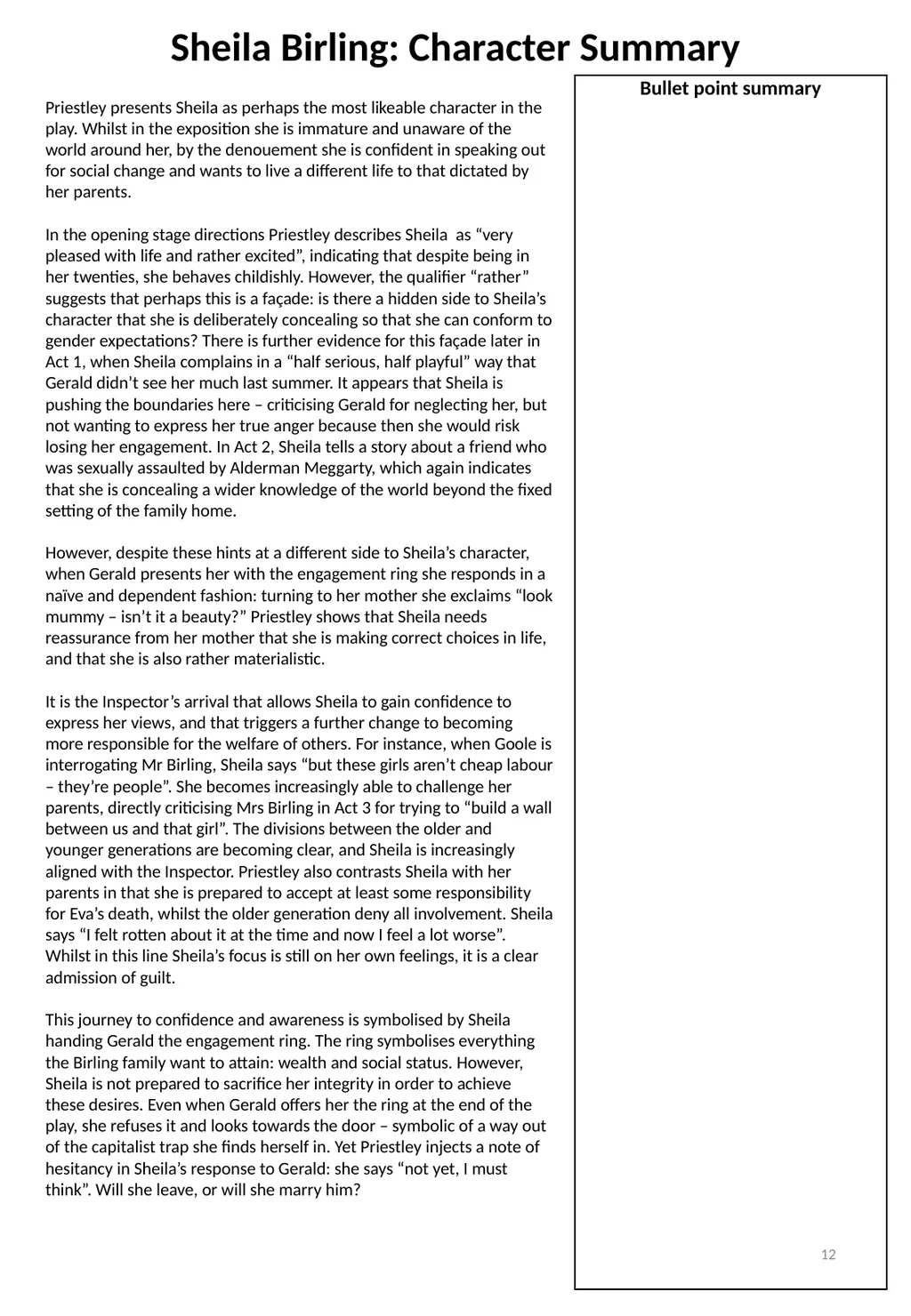
12 Sheila Birling: Character Summary Bullet point summary Priestley presents Sheila as perhaps the most likeable character in the play. Whilst in the exposition she is immature and unaware of the world around her, by the denouement she is confident in speaking out for social change and wants to live a different life to that dictated by her parents.
In the opening stage directions Priestley describes Sheila as “very pleased with life and rather excited”, indicating that despite being in her twenties, she behaves childishly. However, the qualifier “rather” suggests that perhaps this is a façade: is there a hidden side to Sheila’s character that she is deliberately concealing so that she can conform to gender expectations? There is further evidence for this façade later in Act 1, when Sheila complains in a “half serious, half playful” way that Gerald didn’t see her much last summer. It appears that Sheila is pushing the boundaries here – criticising Gerald for neglecting her, but not wanting to express her true anger because then she would risk losing her engagement. In Act 2, Sheila tells a story about a friend who was sexually assaulted by Alderman Meggarty, which again indicates that she is concealing a wider knowledge of the world beyond the fixed setting of the family home.
However, despite these hints at a different side to Sheila’s character, when Gerald presents her with the engagement ring she responds in a naïve and dependent fashion: turning to her mother she exclaims “look mummy – isn’t it a beauty?” Priestley shows that Sheila needs reassurance from her mother that she is making correct choices in life, and that she is also rather materialistic.
It is the Inspector’s arrival that allows Sheila to gain confidence to express her views, and that triggers a further change to becoming more responsible for the welfare of others. For instance, when Goole is interrogating Mr Birling, Sheila says “but these girls aren’t cheap labour – they’re people”. She becomes increasingly able to challenge her parents, directly criticising Mrs Birling in Act 3 for trying to “build a wall between us and that girl”. The divisions between the older and younger generations are becoming clear, and Sheila is increasingly aligned with the Inspector. Priestley also contrasts Sheila with her parents in that she is prepared to accept at least some responsibility for Eva’s death, whilst the older generation deny all involvement. Sheila says “I felt rotten about it at the time and now I feel a lot worse”. Whilst in this line Sheila’s focus is still on her own feelings, it is a clear admission of guilt.
This journey to confidence and awareness is symbolised by Sheila handing Gerald the engagement ring. The ring symbolises everything the Birling family want to attain: wealth and social status. However, Sheila is not prepared to sacrifice her integrity in order to achieve these desires. Even when Gerald offers her the ring at the end of the play, she refuses it and looks towards the door – symbolic of a way out of the capitalist trap she finds herself in. Yet Priestley injects a note of hesitancy in Sheila’s response to Gerald: she says “not yet, I must think”. Will she leave, or will she marry him?<br>
In the opening stage directions Priestley describes Sheila as “very pleased with life and rather excited”, indicating that despite being in her twenties, she behaves childishly. However, the qualifier “rather” suggests that perhaps this is a façade: is there a hidden side to Sheila’s character that she is deliberately concealing so that she can conform to gender expectations? There is further evidence for this façade later in Act 1, when Sheila complains in a “half serious, half playful” way that Gerald didn’t see her much last summer. It appears that Sheila is pushing the boundaries here – criticising Gerald for neglecting her, but not wanting to express her true anger because then she would risk losing her engagement. In Act 2, Sheila tells a story about a friend who was sexually assaulted by Alderman Meggarty, which again indicates that she is concealing a wider knowledge of the world beyond the fixed setting of the family home.
However, despite these hints at a different side to Sheila’s character, when Gerald presents her with the engagement ring she responds in a naïve and dependent fashion: turning to her mother she exclaims “look mummy – isn’t it a beauty?” Priestley shows that Sheila needs reassurance from her mother that she is making correct choices in life, and that she is also rather materialistic.
It is the Inspector’s arrival that allows Sheila to gain confidence to express her views, and that triggers a further change to becoming more responsible for the welfare of others. For instance, when Goole is interrogating Mr Birling, Sheila says “but these girls aren’t cheap labour – they’re people”. She becomes increasingly able to challenge her parents, directly criticising Mrs Birling in Act 3 for trying to “build a wall between us and that girl”. The divisions between the older and younger generations are becoming clear, and Sheila is increasingly aligned with the Inspector. Priestley also contrasts Sheila with her parents in that she is prepared to accept at least some responsibility for Eva’s death, whilst the older generation deny all involvement. Sheila says “I felt rotten about it at the time and now I feel a lot worse”. Whilst in this line Sheila’s focus is still on her own feelings, it is a clear admission of guilt.
This journey to confidence and awareness is symbolised by Sheila handing Gerald the engagement ring. The ring symbolises everything the Birling family want to attain: wealth and social status. However, Sheila is not prepared to sacrifice her integrity in order to achieve these desires. Even when Gerald offers her the ring at the end of the play, she refuses it and looks towards the door – symbolic of a way out of the capitalist trap she finds herself in. Yet Priestley injects a note of hesitancy in Sheila’s response to Gerald: she says “not yet, I must think”. Will she leave, or will she marry him?<br>
13
13 Define these keywords
Infantilised –
Materialistic –
Receptive –
Moral epiphany –
Malleable –<br>
Infantilised –
Materialistic –
Receptive –
Moral epiphany –
Malleable –<br>
14
Sheila Birling: 5 minute plans 1. To what extent does Priestley present Sheila as a hope for the future?
5 minute plan:
2. How does Priestley present Sheila as a changing character?
5 minute plan:
3. To what extent does Priestley create sympathy for Sheila?
5 minute plan: 14<br>
5 minute plan:
2. How does Priestley present Sheila as a changing character?
5 minute plan:
3. To what extent does Priestley create sympathy for Sheila?
5 minute plan: 14<br>
15
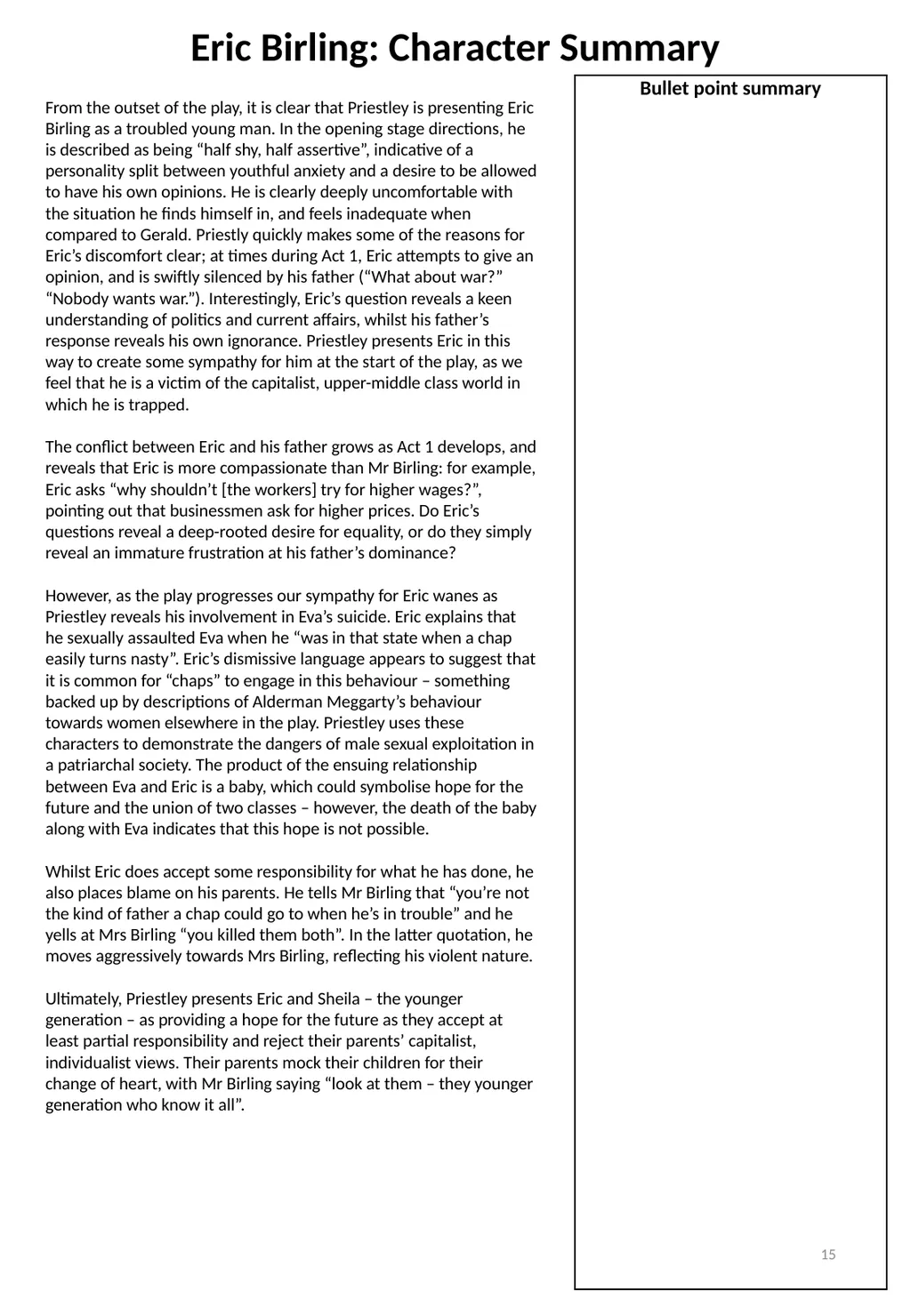
15 Eric Birling: Character Summary Bullet point summary From the outset of the play, it is clear that Priestley is presenting Eric Birling as a troubled young man. In the opening stage directions, he is described as being “half shy, half assertive”, indicative of a personality split between youthful anxiety and a desire to be allowed to have his own opinions. He is clearly deeply uncomfortable with the situation he finds himself in, and feels inadequate when compared to Gerald. Priestly quickly makes some of the reasons for Eric’s discomfort clear; at times during Act 1, Eric attempts to give an opinion, and is swiftly silenced by his father (“What about war?” “Nobody wants war.”). Interestingly, Eric’s question reveals a keen understanding of politics and current affairs, whilst his father’s response reveals his own ignorance. Priestley presents Eric in this way to create some sympathy for him at the start of the play, as we feel that he is a victim of the capitalist, upper-middle class world in which he is trapped.
The conflict between Eric and his father grows as Act 1 develops, and reveals that Eric is more compassionate than Mr Birling: for example, Eric asks “why shouldn’t [the workers] try for higher wages?”, pointing out that businessmen ask for higher prices. Do Eric’s questions reveal a deep-rooted desire for equality, or do they simply reveal an immature frustration at his father’s dominance?
However, as the play progresses our sympathy for Eric wanes as Priestley reveals his involvement in Eva’s suicide. Eric explains that he sexually assaulted Eva when he “was in that state when a chap easily turns nasty”. Eric’s dismissive language appears to suggest that it is common for “chaps” to engage in this behaviour – something backed up by descriptions of Alderman Meggarty’s behaviour towards women elsewhere in the play. Priestley uses these characters to demonstrate the dangers of male sexual exploitation in a patriarchal society. The product of the ensuing relationship between Eva and Eric is a baby, which could symbolise hope for the future and the union of two classes – however, the death of the baby along with Eva indicates that this hope is not possible.
Whilst Eric does accept some responsibility for what he has done, he also places blame on his parents. He tells Mr Birling that “you’re not the kind of father a chap could go to when he’s in trouble” and he yells at Mrs Birling “you killed them both”. In the latter quotation, he moves aggressively towards Mrs Birling, reflecting his violent nature.
Ultimately, Priestley presents Eric and Sheila – the younger generation – as providing a hope for the future as they accept at least partial responsibility and reject their parents’ capitalist, individualist views. Their parents mock their children for their change of heart, with Mr Birling saying “look at them – they younger generation who know it all”.<br>
The conflict between Eric and his father grows as Act 1 develops, and reveals that Eric is more compassionate than Mr Birling: for example, Eric asks “why shouldn’t [the workers] try for higher wages?”, pointing out that businessmen ask for higher prices. Do Eric’s questions reveal a deep-rooted desire for equality, or do they simply reveal an immature frustration at his father’s dominance?
However, as the play progresses our sympathy for Eric wanes as Priestley reveals his involvement in Eva’s suicide. Eric explains that he sexually assaulted Eva when he “was in that state when a chap easily turns nasty”. Eric’s dismissive language appears to suggest that it is common for “chaps” to engage in this behaviour – something backed up by descriptions of Alderman Meggarty’s behaviour towards women elsewhere in the play. Priestley uses these characters to demonstrate the dangers of male sexual exploitation in a patriarchal society. The product of the ensuing relationship between Eva and Eric is a baby, which could symbolise hope for the future and the union of two classes – however, the death of the baby along with Eva indicates that this hope is not possible.
Whilst Eric does accept some responsibility for what he has done, he also places blame on his parents. He tells Mr Birling that “you’re not the kind of father a chap could go to when he’s in trouble” and he yells at Mrs Birling “you killed them both”. In the latter quotation, he moves aggressively towards Mrs Birling, reflecting his violent nature.
Ultimately, Priestley presents Eric and Sheila – the younger generation – as providing a hope for the future as they accept at least partial responsibility and reject their parents’ capitalist, individualist views. Their parents mock their children for their change of heart, with Mr Birling saying “look at them – they younger generation who know it all”.<br>
16
16 Define these keywords
Façade –
Reputation –
Remorseful –
Hedonistic –
Impulsive –<br>
Façade –
Reputation –
Remorseful –
Hedonistic –
Impulsive –<br>
17
Eric Birling: 5 minute plans 1. To what extent does Priestley present Eric as a hope for the future?
5 minute plan:
2. How does Priestley present Eric as a changing character?
5 minute plan:
3. To what extent does Priestley create sympathy for Eric?
5 minute plan: 17<br>
5 minute plan:
2. How does Priestley present Eric as a changing character?
5 minute plan:
3. To what extent does Priestley create sympathy for Eric?
5 minute plan: 17<br>
18
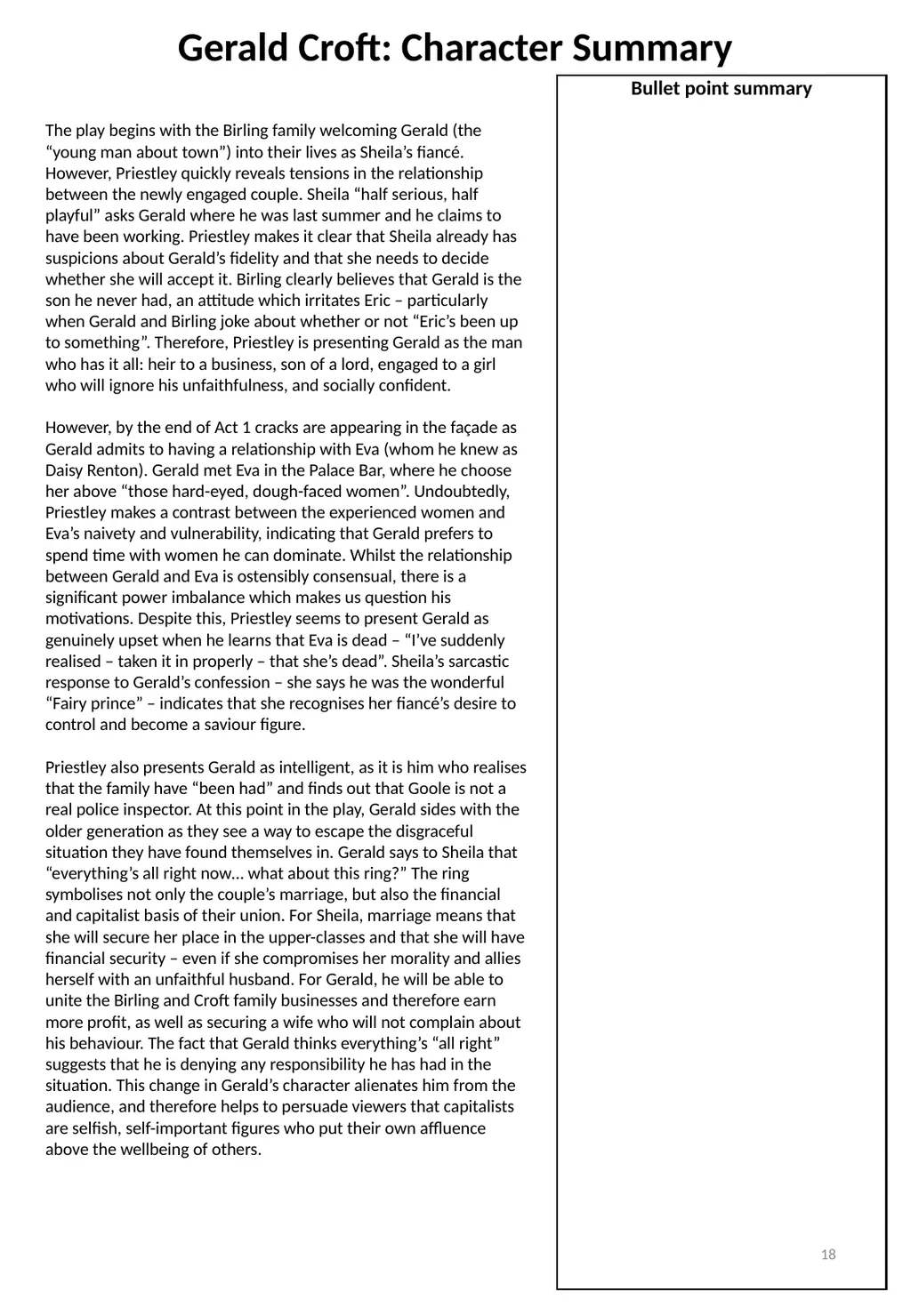
18 Gerald Croft: Character Summary Bullet point summary The play begins with the Birling family welcoming Gerald (the “young man about town”) into their lives as Sheila’s fiancé. However, Priestley quickly reveals tensions in the relationship between the newly engaged couple. Sheila “half serious, half playful” asks Gerald where he was last summer and he claims to have been working. Priestley makes it clear that Sheila already has suspicions about Gerald’s fidelity and that she needs to decide whether she will accept it. Birling clearly believes that Gerald is the son he never had, an attitude which irritates Eric – particularly when Gerald and Birling joke about whether or not “Eric’s been up to something”. Therefore, Priestley is presenting Gerald as the man who has it all: heir to a business, son of a lord, engaged to a girl who will ignore his unfaithfulness, and socially confident.
However, by the end of Act 1 cracks are appearing in the façade as Gerald admits to having a relationship with Eva (whom he knew as Daisy Renton). Gerald met Eva in the Palace Bar, where he choose her above “those hard-eyed, dough-faced women”. Undoubtedly, Priestley makes a contrast between the experienced women and Eva’s naivety and vulnerability, indicating that Gerald prefers to spend time with women he can dominate. Whilst the relationship between Gerald and Eva is ostensibly consensual, there is a significant power imbalance which makes us question his motivations. Despite this, Priestley seems to present Gerald as genuinely upset when he learns that Eva is dead – “I’ve suddenly realised – taken it in properly – that she’s dead”. Sheila’s sarcastic response to Gerald’s confession – she says he was the wonderful “Fairy prince” – indicates that she recognises her fiancé’s desire to control and become a saviour figure.
Priestley also presents Gerald as intelligent, as it is him who realises that the family have “been had” and finds out that Goole is not a real police inspector. At this point in the play, Gerald sides with the older generation as they see a way to escape the disgraceful situation they have found themselves in. Gerald says to Sheila that “everything’s all right now… what about this ring?” The ring symbolises not only the couple’s marriage, but also the financial and capitalist basis of their union. For Sheila, marriage means that she will secure her place in the upper-classes and that she will have financial security – even if she compromises her morality and allies herself with an unfaithful husband. For Gerald, he will be able to unite the Birling and Croft family businesses and therefore earn more profit, as well as securing a wife who will not complain about his behaviour. The fact that Gerald thinks everything’s “all right” suggests that he is denying any responsibility he has had in the situation. This change in Gerald’s character alienates him from the audience, and therefore helps to persuade viewers that capitalists are selfish, self-important figures who put their own affluence above the wellbeing of others.<br>
However, by the end of Act 1 cracks are appearing in the façade as Gerald admits to having a relationship with Eva (whom he knew as Daisy Renton). Gerald met Eva in the Palace Bar, where he choose her above “those hard-eyed, dough-faced women”. Undoubtedly, Priestley makes a contrast between the experienced women and Eva’s naivety and vulnerability, indicating that Gerald prefers to spend time with women he can dominate. Whilst the relationship between Gerald and Eva is ostensibly consensual, there is a significant power imbalance which makes us question his motivations. Despite this, Priestley seems to present Gerald as genuinely upset when he learns that Eva is dead – “I’ve suddenly realised – taken it in properly – that she’s dead”. Sheila’s sarcastic response to Gerald’s confession – she says he was the wonderful “Fairy prince” – indicates that she recognises her fiancé’s desire to control and become a saviour figure.
Priestley also presents Gerald as intelligent, as it is him who realises that the family have “been had” and finds out that Goole is not a real police inspector. At this point in the play, Gerald sides with the older generation as they see a way to escape the disgraceful situation they have found themselves in. Gerald says to Sheila that “everything’s all right now… what about this ring?” The ring symbolises not only the couple’s marriage, but also the financial and capitalist basis of their union. For Sheila, marriage means that she will secure her place in the upper-classes and that she will have financial security – even if she compromises her morality and allies herself with an unfaithful husband. For Gerald, he will be able to unite the Birling and Croft family businesses and therefore earn more profit, as well as securing a wife who will not complain about his behaviour. The fact that Gerald thinks everything’s “all right” suggests that he is denying any responsibility he has had in the situation. This change in Gerald’s character alienates him from the audience, and therefore helps to persuade viewers that capitalists are selfish, self-important figures who put their own affluence above the wellbeing of others.<br>
19
19 Define these keywords
Distraught –
Aristocratic –
Exploitative –
Unempathetic –
Ambiguous –<br>
Distraught –
Aristocratic –
Exploitative –
Unempathetic –
Ambiguous –<br>
20
Gerald Croft: 5 minute plans 1. To what extent does Priestley present Gerald as a changing character?
5 minute plan:
2. How does Priestley present Gerald as a symbol of capitalism?
5 minute plan:
3. To what extent does Priestley create sympathy for Gerald?
5 minute plan: 20<br>
5 minute plan:
2. How does Priestley present Gerald as a symbol of capitalism?
5 minute plan:
3. To what extent does Priestley create sympathy for Gerald?
5 minute plan: 20<br>
21
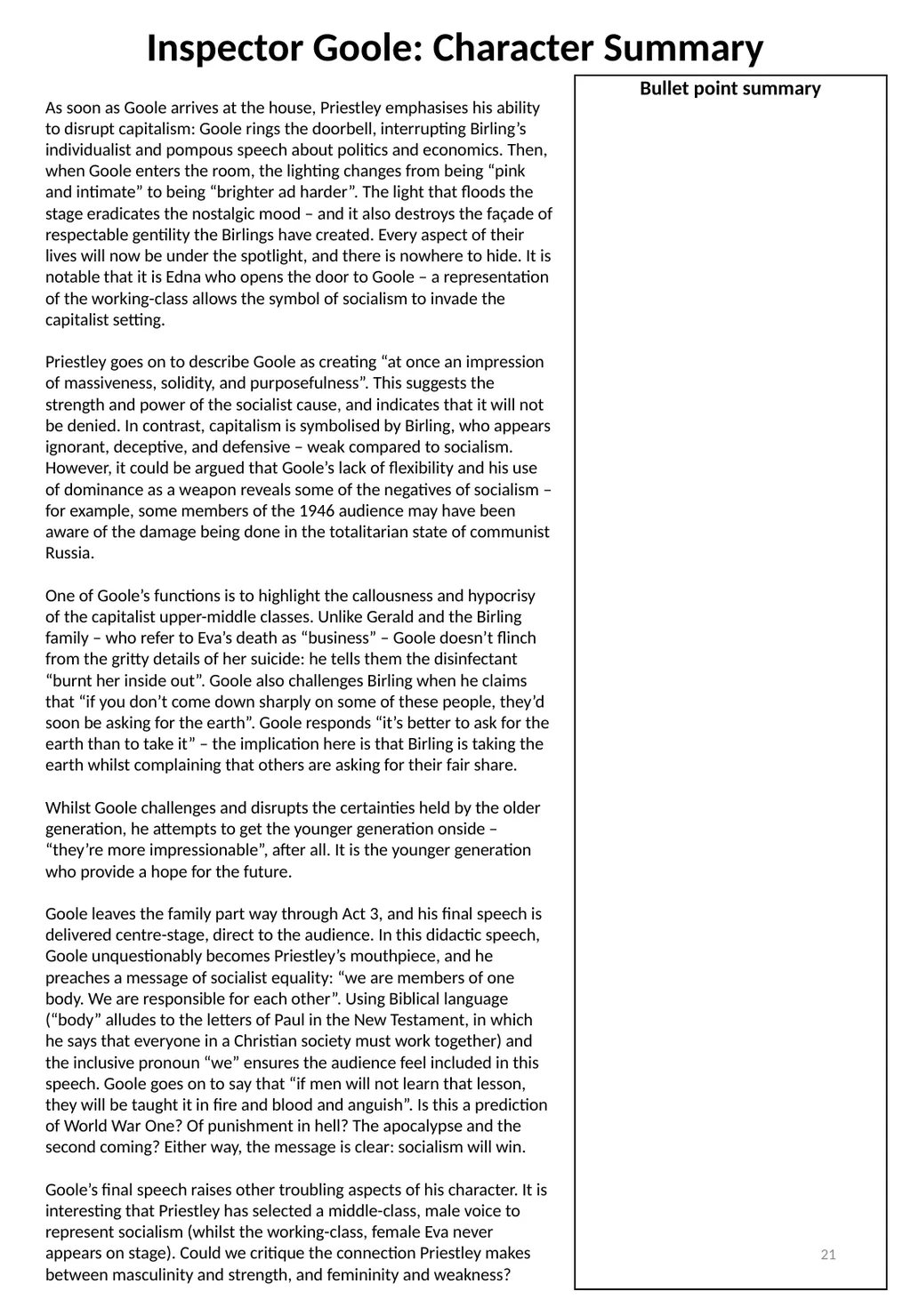
21 Inspector Goole: Character Summary Bullet point summary As soon as Goole arrives at the house, Priestley emphasises his ability to disrupt capitalism: Goole rings the doorbell, interrupting Birling’s individualist and pompous speech about politics and economics. Then, when Goole enters the room, the lighting changes from being “pink and intimate” to being “brighter ad harder”. The light that floods the stage eradicates the nostalgic mood – and it also destroys the façade of respectable gentility the Birlings have created. Every aspect of their lives will now be under the spotlight, and there is nowhere to hide. It is notable that it is Edna who opens the door to Goole – a representation of the working-class allows the symbol of socialism to invade the capitalist setting.
Priestley goes on to describe Goole as creating “at once an impression of massiveness, solidity, and purposefulness”. This suggests the strength and power of the socialist cause, and indicates that it will not be denied. In contrast, capitalism is symbolised by Birling, who appears ignorant, deceptive, and defensive – weak compared to socialism. However, it could be argued that Goole’s lack of flexibility and his use of dominance as a weapon reveals some of the negatives of socialism – for example, some members of the 1946 audience may have been aware of the damage being done in the totalitarian state of communist Russia.
One of Goole’s functions is to highlight the callousness and hypocrisy of the capitalist upper-middle classes. Unlike Gerald and the Birling family – who refer to Eva’s death as “business” – Goole doesn’t flinch from the gritty details of her suicide: he tells them the disinfectant “burnt her inside out”. Goole also challenges Birling when he claims that “if you don’t come down sharply on some of these people, they’d soon be asking for the earth”. Goole responds “it’s better to ask for the earth than to take it” – the implication here is that Birling is taking the earth whilst complaining that others are asking for their fair share.
Whilst Goole challenges and disrupts the certainties held by the older generation, he attempts to get the younger generation onside – “they’re more impressionable”, after all. It is the younger generation who provide a hope for the future.
Goole leaves the family part way through Act 3, and his final speech is delivered centre-stage, direct to the audience. In this didactic speech, Goole unquestionably becomes Priestley’s mouthpiece, and he preaches a message of socialist equality: “we are members of one body. We are responsible for each other”. Using Biblical language (“body” alludes to the letters of Paul in the New Testament, in which he says that everyone in a Christian society must work together) and the inclusive pronoun “we” ensures the audience feel included in this speech. Goole goes on to say that “if men will not learn that lesson, they will be taught it in fire and blood and anguish”. Is this a prediction of World War One? Of punishment in hell? The apocalypse and the second coming? Either way, the message is clear: socialism will win.
Goole’s final speech raises other troubling aspects of his character. It is interesting that Priestley has selected a middle-class, male voice to represent socialism (whilst the working-class, female Eva never appears on stage). Could we critique the connection Priestley makes between masculinity and strength, and femininity and weakness?<br>
Priestley goes on to describe Goole as creating “at once an impression of massiveness, solidity, and purposefulness”. This suggests the strength and power of the socialist cause, and indicates that it will not be denied. In contrast, capitalism is symbolised by Birling, who appears ignorant, deceptive, and defensive – weak compared to socialism. However, it could be argued that Goole’s lack of flexibility and his use of dominance as a weapon reveals some of the negatives of socialism – for example, some members of the 1946 audience may have been aware of the damage being done in the totalitarian state of communist Russia.
One of Goole’s functions is to highlight the callousness and hypocrisy of the capitalist upper-middle classes. Unlike Gerald and the Birling family – who refer to Eva’s death as “business” – Goole doesn’t flinch from the gritty details of her suicide: he tells them the disinfectant “burnt her inside out”. Goole also challenges Birling when he claims that “if you don’t come down sharply on some of these people, they’d soon be asking for the earth”. Goole responds “it’s better to ask for the earth than to take it” – the implication here is that Birling is taking the earth whilst complaining that others are asking for their fair share.
Whilst Goole challenges and disrupts the certainties held by the older generation, he attempts to get the younger generation onside – “they’re more impressionable”, after all. It is the younger generation who provide a hope for the future.
Goole leaves the family part way through Act 3, and his final speech is delivered centre-stage, direct to the audience. In this didactic speech, Goole unquestionably becomes Priestley’s mouthpiece, and he preaches a message of socialist equality: “we are members of one body. We are responsible for each other”. Using Biblical language (“body” alludes to the letters of Paul in the New Testament, in which he says that everyone in a Christian society must work together) and the inclusive pronoun “we” ensures the audience feel included in this speech. Goole goes on to say that “if men will not learn that lesson, they will be taught it in fire and blood and anguish”. Is this a prediction of World War One? Of punishment in hell? The apocalypse and the second coming? Either way, the message is clear: socialism will win.
Goole’s final speech raises other troubling aspects of his character. It is interesting that Priestley has selected a middle-class, male voice to represent socialism (whilst the working-class, female Eva never appears on stage). Could we critique the connection Priestley makes between masculinity and strength, and femininity and weakness?<br>
22
22 Define these keywords
Socialist –
Collectivist –
Moralistic –
Didactic –
Omniscient –<br>
Socialist –
Collectivist –
Moralistic –
Didactic –
Omniscient –<br>
23
Inspector Goole: 5 minute plans 1. To what extent does Priestley present Inspector Goole as a force for good?
5 minute plan:
2. How does Priestley present Inspector Goole as the voice of socialism?
5 minute plan:
3. How does Priestley use Inspector Goole to inspire social change?
5 minute plan: 23<br>
5 minute plan:
2. How does Priestley present Inspector Goole as the voice of socialism?
5 minute plan:
3. How does Priestley use Inspector Goole to inspire social change?
5 minute plan: 23<br>
24
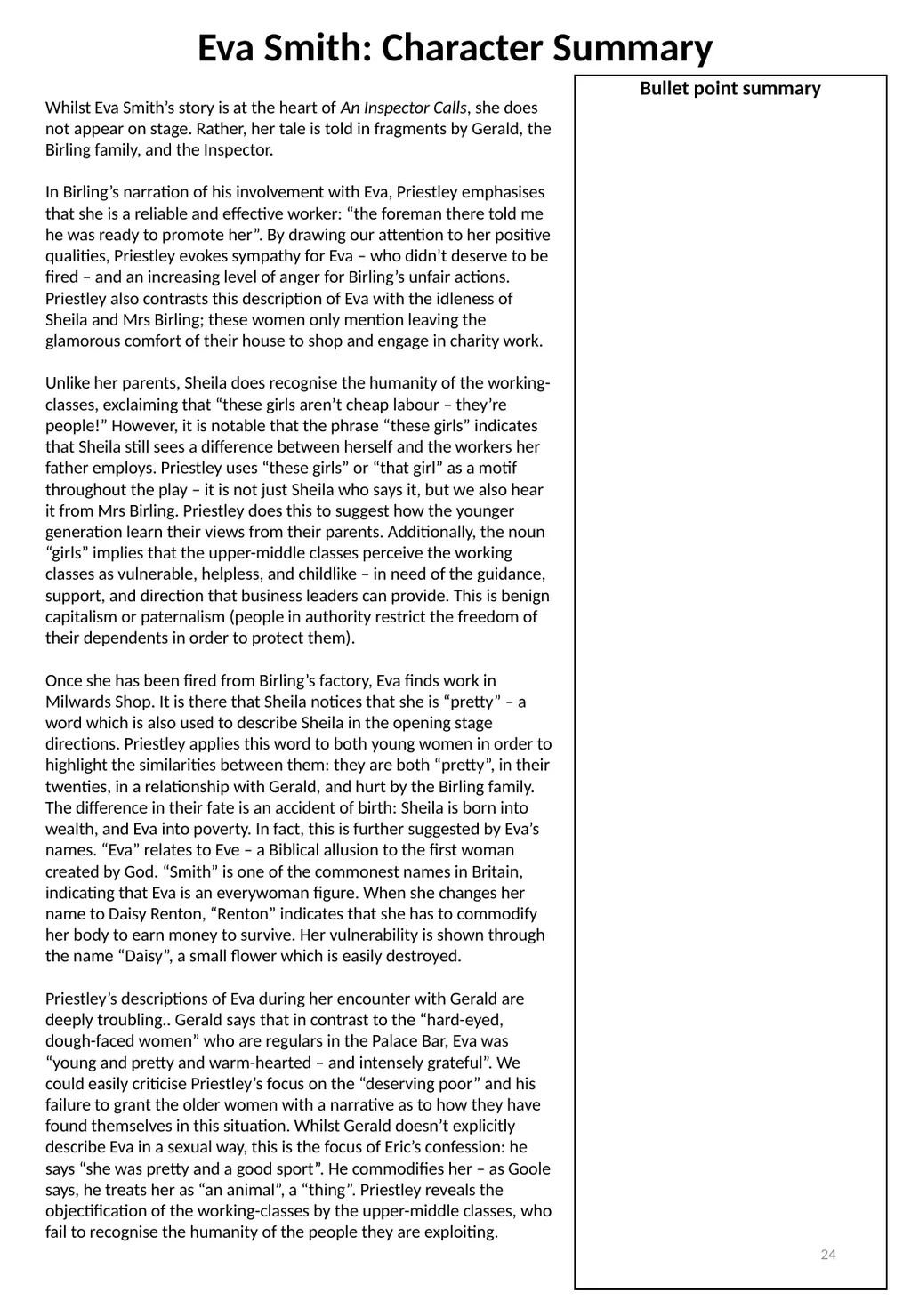
24 Eva Smith: Character Summary Bullet point summary Whilst Eva Smith’s story is at the heart of An Inspector Calls, she does not appear on stage. Rather, her tale is told in fragments by Gerald, the Birling family, and the Inspector.
In Birling’s narration of his involvement with Eva, Priestley emphasises that she is a reliable and effective worker: “the foreman there told me he was ready to promote her”. By drawing our attention to her positive qualities, Priestley evokes sympathy for Eva – who didn’t deserve to be fired – and an increasing level of anger for Birling’s unfair actions. Priestley also contrasts this description of Eva with the idleness of Sheila and Mrs Birling; these women only mention leaving the glamorous comfort of their house to shop and engage in charity work.
Unlike her parents, Sheila does recognise the humanity of the working-classes, exclaiming that “these girls aren’t cheap labour – they’re people!” However, it is notable that the phrase “these girls” indicates that Sheila still sees a difference between herself and the workers her father employs. Priestley uses “these girls” or “that girl” as a motif throughout the play – it is not just Sheila who says it, but we also hear it from Mrs Birling. Priestley does this to suggest how the younger generation learn their views from their parents. Additionally, the noun “girls” implies that the upper-middle classes perceive the working classes as vulnerable, helpless, and childlike – in need of the guidance, support, and direction that business leaders can provide. This is benign capitalism or paternalism (people in authority restrict the freedom of their dependents in order to protect them).
Once she has been fired from Birling’s factory, Eva finds work in Milwards Shop. It is there that Sheila notices that she is “pretty” – a word which is also used to describe Sheila in the opening stage directions. Priestley applies this word to both young women in order to highlight the similarities between them: they are both “pretty”, in their twenties, in a relationship with Gerald, and hurt by the Birling family. The difference in their fate is an accident of birth: Sheila is born into wealth, and Eva into poverty. In fact, this is further suggested by Eva’s names. “Eva” relates to Eve – a Biblical allusion to the first woman created by God. “Smith” is one of the commonest names in Britain, indicating that Eva is an everywoman figure. When she changes her name to Daisy Renton, “Renton” indicates that she has to commodify her body to earn money to survive. Her vulnerability is shown through the name “Daisy”, a small flower which is easily destroyed.
Priestley’s descriptions of Eva during her encounter with Gerald are deeply troubling.. Gerald says that in contrast to the “hard-eyed, dough-faced women” who are regulars in the Palace Bar, Eva was “young and pretty and warm-hearted – and intensely grateful”. We could easily criticise Priestley’s focus on the “deserving poor” and his failure to grant the older women with a narrative as to how they have found themselves in this situation. Whilst Gerald doesn’t explicitly describe Eva in a sexual way, this is the focus of Eric’s confession: he says “she was pretty and a good sport”. He commodifies her – as Goole says, he treats her as “an animal”, a “thing”. Priestley reveals the objectification of the working-classes by the upper-middle classes, who fail to recognise the humanity of the people they are exploiting.<br>
In Birling’s narration of his involvement with Eva, Priestley emphasises that she is a reliable and effective worker: “the foreman there told me he was ready to promote her”. By drawing our attention to her positive qualities, Priestley evokes sympathy for Eva – who didn’t deserve to be fired – and an increasing level of anger for Birling’s unfair actions. Priestley also contrasts this description of Eva with the idleness of Sheila and Mrs Birling; these women only mention leaving the glamorous comfort of their house to shop and engage in charity work.
Unlike her parents, Sheila does recognise the humanity of the working-classes, exclaiming that “these girls aren’t cheap labour – they’re people!” However, it is notable that the phrase “these girls” indicates that Sheila still sees a difference between herself and the workers her father employs. Priestley uses “these girls” or “that girl” as a motif throughout the play – it is not just Sheila who says it, but we also hear it from Mrs Birling. Priestley does this to suggest how the younger generation learn their views from their parents. Additionally, the noun “girls” implies that the upper-middle classes perceive the working classes as vulnerable, helpless, and childlike – in need of the guidance, support, and direction that business leaders can provide. This is benign capitalism or paternalism (people in authority restrict the freedom of their dependents in order to protect them).
Once she has been fired from Birling’s factory, Eva finds work in Milwards Shop. It is there that Sheila notices that she is “pretty” – a word which is also used to describe Sheila in the opening stage directions. Priestley applies this word to both young women in order to highlight the similarities between them: they are both “pretty”, in their twenties, in a relationship with Gerald, and hurt by the Birling family. The difference in their fate is an accident of birth: Sheila is born into wealth, and Eva into poverty. In fact, this is further suggested by Eva’s names. “Eva” relates to Eve – a Biblical allusion to the first woman created by God. “Smith” is one of the commonest names in Britain, indicating that Eva is an everywoman figure. When she changes her name to Daisy Renton, “Renton” indicates that she has to commodify her body to earn money to survive. Her vulnerability is shown through the name “Daisy”, a small flower which is easily destroyed.
Priestley’s descriptions of Eva during her encounter with Gerald are deeply troubling.. Gerald says that in contrast to the “hard-eyed, dough-faced women” who are regulars in the Palace Bar, Eva was “young and pretty and warm-hearted – and intensely grateful”. We could easily criticise Priestley’s focus on the “deserving poor” and his failure to grant the older women with a narrative as to how they have found themselves in this situation. Whilst Gerald doesn’t explicitly describe Eva in a sexual way, this is the focus of Eric’s confession: he says “she was pretty and a good sport”. He commodifies her – as Goole says, he treats her as “an animal”, a “thing”. Priestley reveals the objectification of the working-classes by the upper-middle classes, who fail to recognise the humanity of the people they are exploiting.<br>
25
25 Define these keywords
Vulnerable –
Exploited –
Marginalised –
Voiceless –
Deprived –<br>
Vulnerable –
Exploited –
Marginalised –
Voiceless –
Deprived –<br>
26
Eva Smith: 5 minute plans 1. How does Priestley create sympathy for Eva Smith?
5 minute plan:
2. How does Priestley use Eva Smith to inspire social change?
5 minute plan:
3. How does Priestley present female characters?
5 minute plan: 26<br>
5 minute plan:
2. How does Priestley use Eva Smith to inspire social change?
5 minute plan:
3. How does Priestley present female characters?
5 minute plan: 26<br>
27
Social Class: 5 minute plans 1. How does Priestley present the theme of social class?
5 minute plan:
2. How does Priestley present the flaws in the social class system?
5 minute plan: 27<br>
5 minute plan:
2. How does Priestley present the flaws in the social class system?
5 minute plan: 27<br>
28
Older and Younger Generation: 5 minute plans 1. How does Priestley show the differences between the older and younger generations?
5 minute plan:
2. To what extent does Priestley criticise the older generation?
5 minute plan: 28<br>
5 minute plan:
2. To what extent does Priestley criticise the older generation?
5 minute plan: 28<br>
29
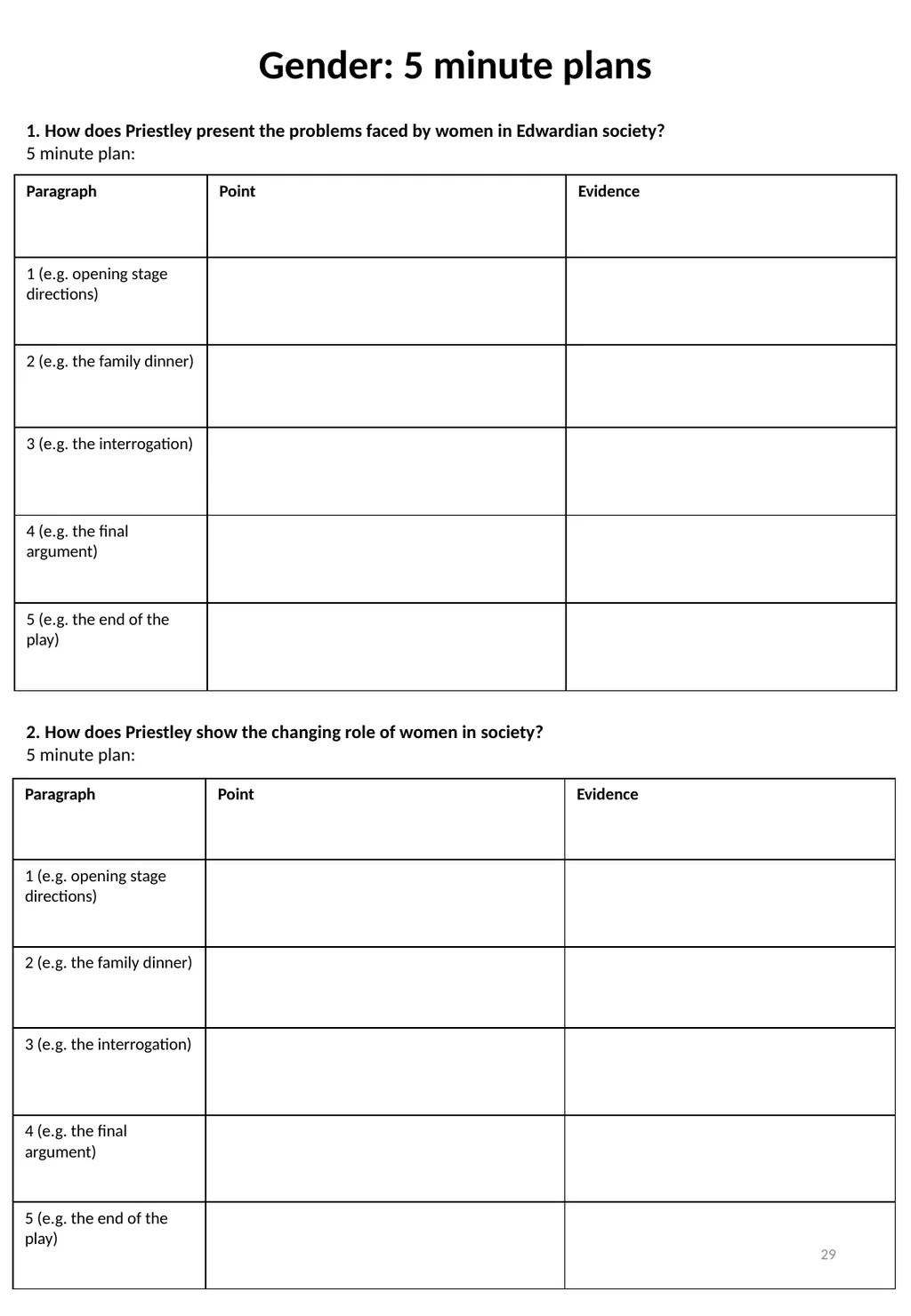
Gender: 5 minute plans 1. How does Priestley present the problems faced by women in Edwardian society?
5 minute plan:
2. How does Priestley show the changing role of women in society?
5 minute plan: 29<br>
5 minute plan:
2. How does Priestley show the changing role of women in society?
5 minute plan: 29<br>
30
Responsibility: 5 minute plans 1. How does Priestley inspire his audience to accept their responsibility for others in society?
5 minute plan:
2. How does Priestley present the idea of guilt in the play?
5 minute plan: 30<br>
5 minute plan:
2. How does Priestley present the idea of guilt in the play?
5 minute plan: 30<br>