
Year 2, Unit 13 Multiplication and division –
BR
Published · 68 slides · 0 views
1 / 1
Description
Year 2, Unit 13 Multiplication and division doubling, halving, quotitive and partitive division Curriculum Prioritisation for Primary Maths These materials heavily reflect the prioritisation approach of the ready-to-progress criteria in
Related Topics
Share
Embed code
Download this presentation From Below
"Year 2, Unit 13 Multiplication and division –" is the property of its rightful owner. Permission is granted to download and print the materials on this website for personal, non-commercial use only, and to display it on your personal computer provided you do not modify the materials and that you retain all copyright notices contained in the materials. By downloading content from our website, you accept the terms of this agreement.
Presentation Transcript
01
Year 2, Unit 13 Multiplication and division – doubling, halving, quotitive and partitive division<br>
02
Curriculum Prioritisation for Primary Maths These materials heavily reflect the prioritisation approach of the ready-to-progress criteria in the DfE Primary Mathematics Guidance 2020 and on the PPTs that exemplify them on the NCETM website. They also include other relevant National Curriculum content. Related sections of the NCETM Primary Mastery Professional Development Materials provide small-step teaching guidance.
Ready-to-progress criteria addressed by this unit
Teaching of this unit does not support any criteria from the ‘DfE Mathematics Guidance: key stages 1 & 2’ (the 335-page document available as a download)
Prior learning
There are no specific ready-to-progress criteria supporting the prior learning for this unit. Year 2, Unit 13<br>
Ready-to-progress criteria addressed by this unit
Teaching of this unit does not support any criteria from the ‘DfE Mathematics Guidance: key stages 1 & 2’ (the 335-page document available as a download)
Prior learning
There are no specific ready-to-progress criteria supporting the prior learning for this unit. Year 2, Unit 13<br>
03
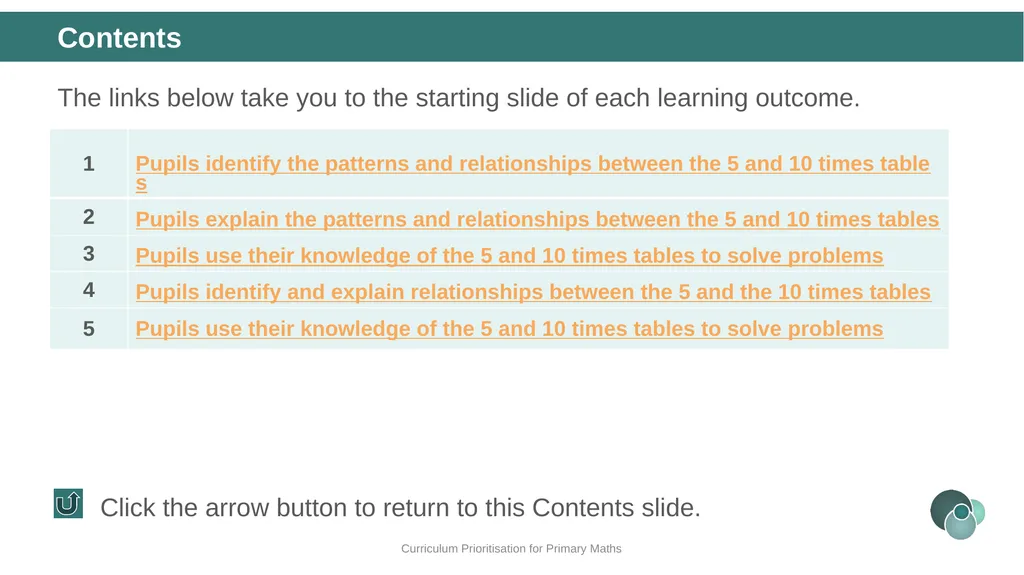
Curriculum Prioritisation for Primary Maths The links below take you to the starting slide of each learning outcome. Click the arrow button to return to this Contents slide. Contents<br>
04
Curriculum Prioritisation for Primary Maths The links below take you to the starting slide of each learning outcome. Click the arrow button to return to this Contents slide. Contents<br>
05
Curriculum Prioritisation for Primary Maths The links below take you to the starting slide of each learning outcome. Click the arrow button to return to this Contents slide. Contents<br>
06
Curriculum Prioritisation for Primary Maths The following slides have been collated to support the teaching of this learning outcome. Year 2, Unit 13, Learning Outcome 1<br>
07
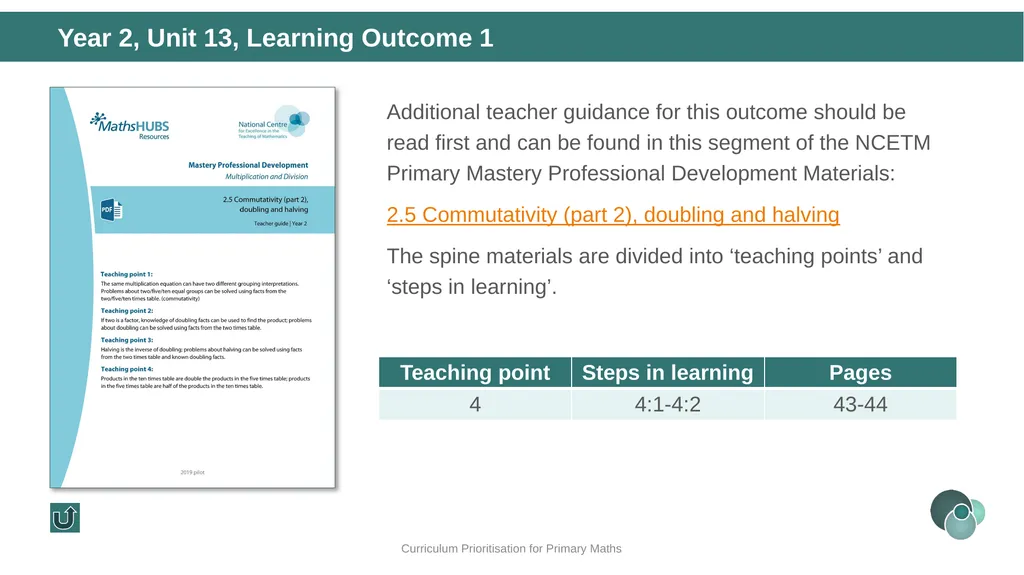
Year 2, Unit 13, Learning Outcome 1 Curriculum Prioritisation for Primary Maths Additional teacher guidance for this outcome should be read first and can be found in this segment of the NCETM Primary Mastery Professional Development Materials:
2.5 Commutativity (part 2), doubling and halving
The spine materials are divided into ‘teaching points’ and ‘steps in learning’.<br>
2.5 Commutativity (part 2), doubling and halving
The spine materials are divided into ‘teaching points’ and ‘steps in learning’.<br>
08
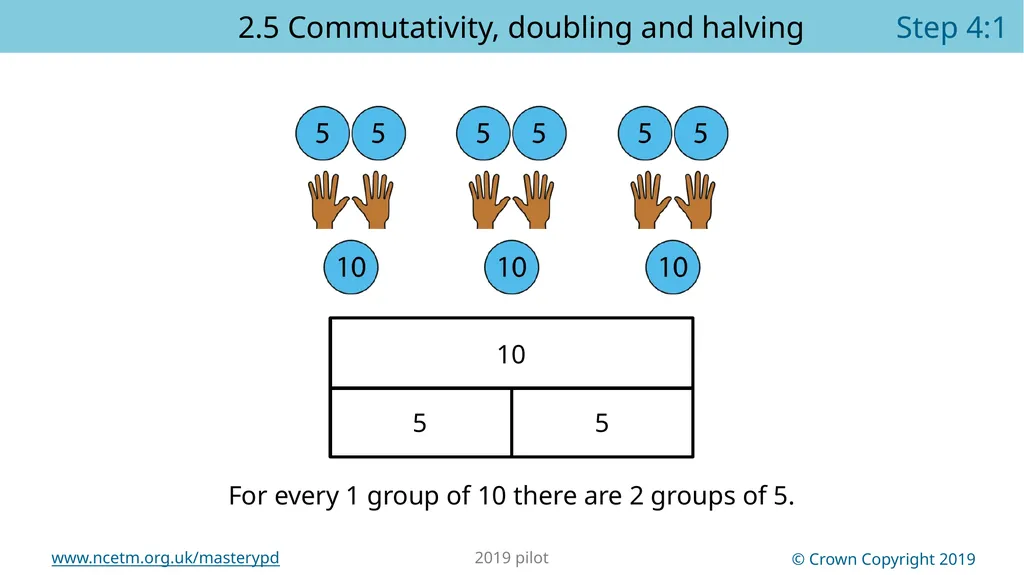
2.5 Commutativity, doubling and halving Step 4:1 For every 1 group of 10 there are 2 groups of 5.<br>
09
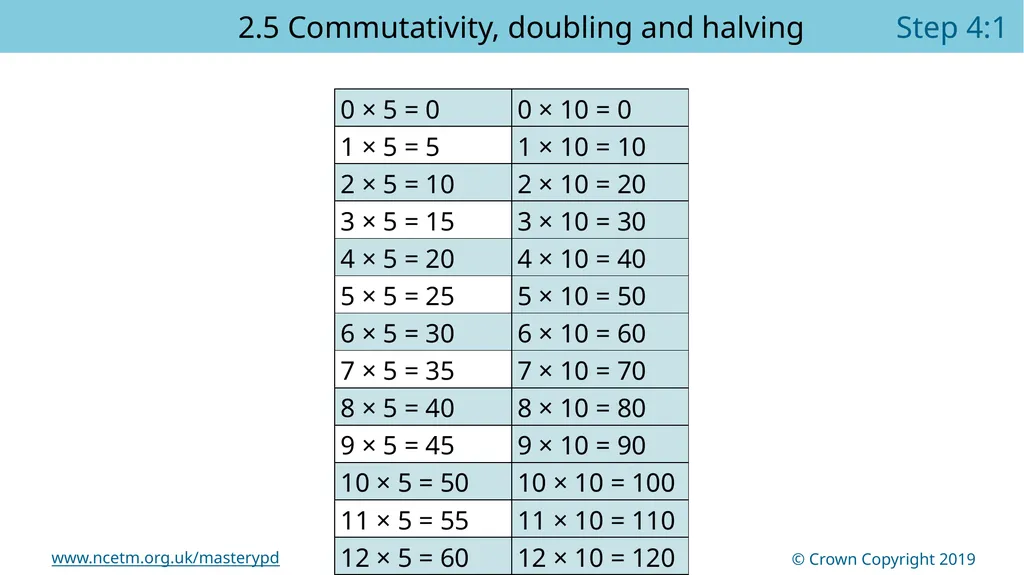
2.5 Commutativity, doubling and halving Step 4:1<br>
10
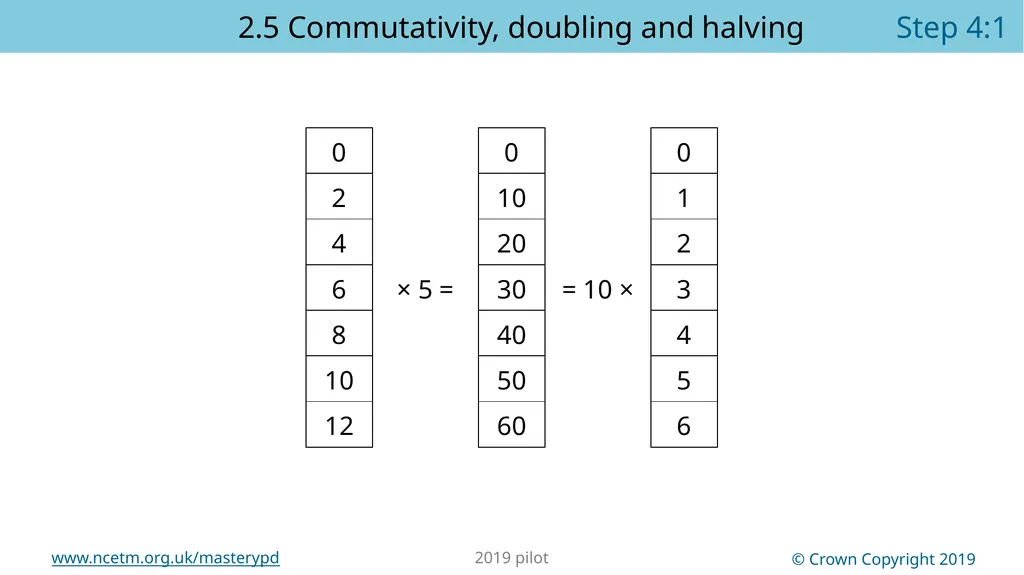
2.5 Commutativity, doubling and halving Step 4:1<br>
11
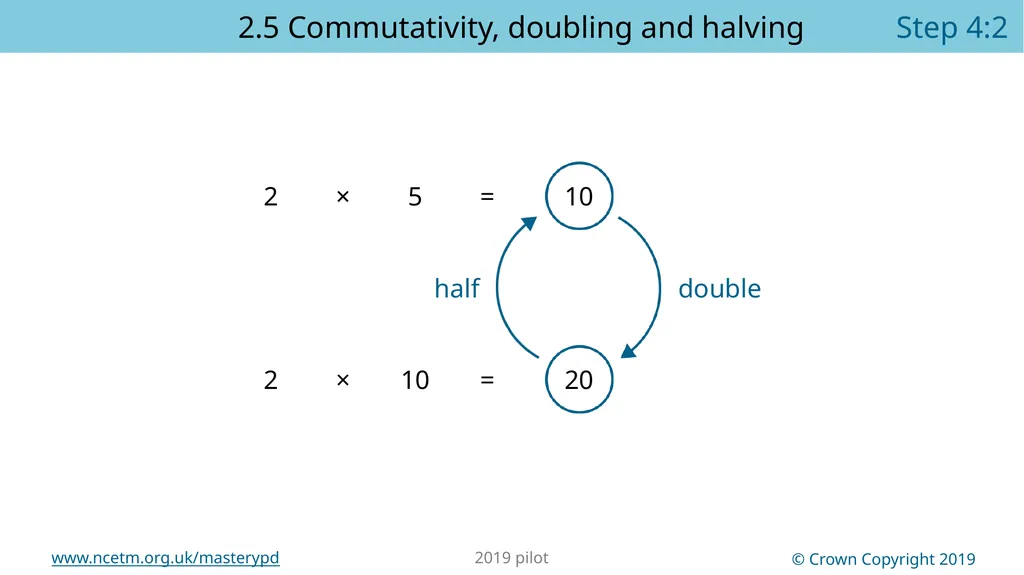
2.5 Commutativity, doubling and halving Step 4:2 half double<br>
12
Curriculum Prioritisation for Primary Maths The following slides have been collated to support the teaching of this learning outcome. Year 2, Unit 13, Learning Outcome 2<br>
13
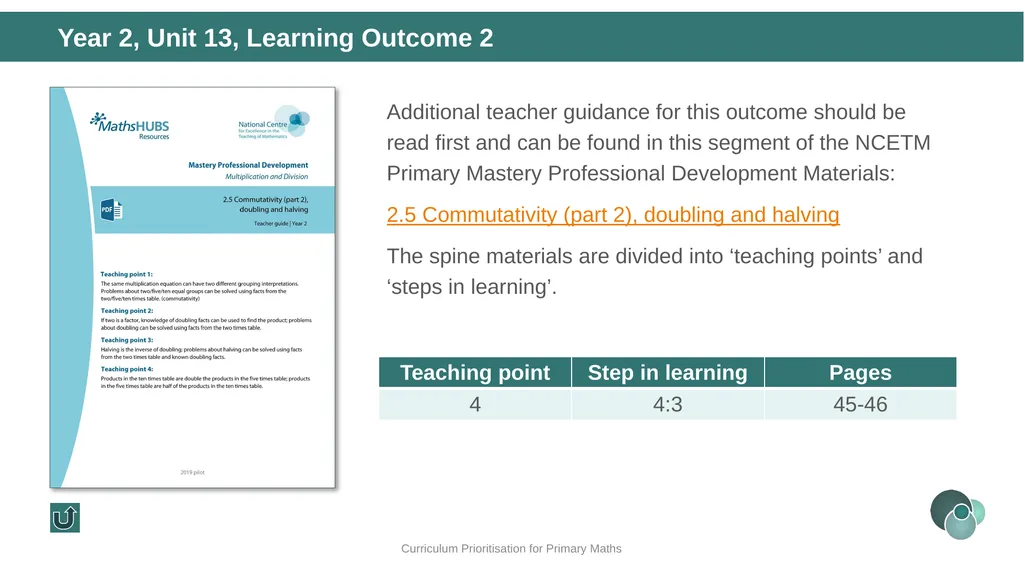
Year 2, Unit 13, Learning Outcome 2 Curriculum Prioritisation for Primary Maths Additional teacher guidance for this outcome should be read first and can be found in this segment of the NCETM Primary Mastery Professional Development Materials:
2.5 Commutativity (part 2), doubling and halving
The spine materials are divided into ‘teaching points’ and ‘steps in learning’.<br>
2.5 Commutativity (part 2), doubling and halving
The spine materials are divided into ‘teaching points’ and ‘steps in learning’.<br>
14
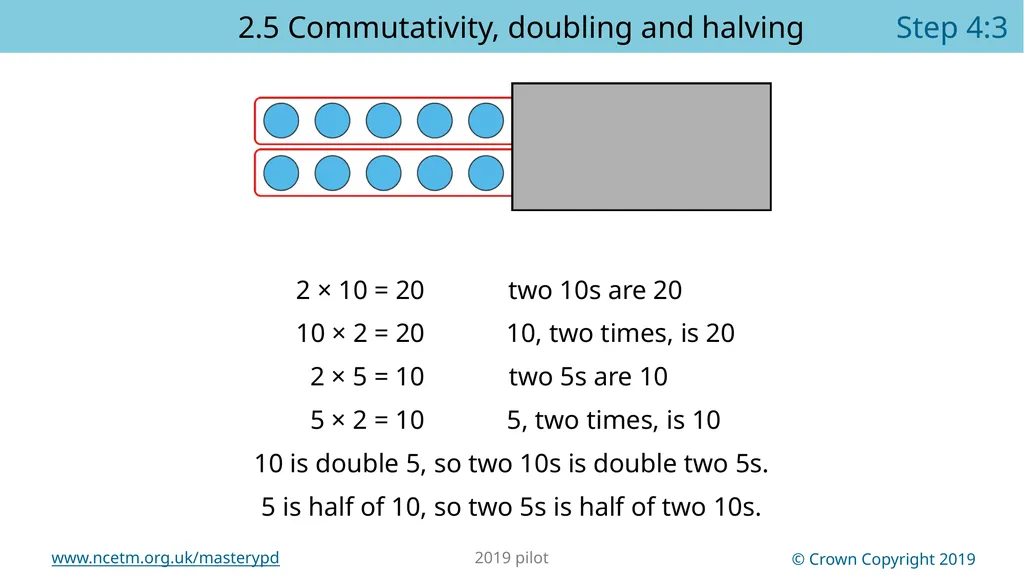
2.5 Commutativity, doubling and halving Step 4:3 5 is half of 10, so two 5s is half of two 10s. 10 is double 5, so two 10s is double two 5s. 5 × 2 = 10 2 × 5 = 10 10 × 2 = 20 2 × 10 = 20 5, two times, is 10 two 5s are 10 10, two times, is 20 two 10s are 20<br>
15
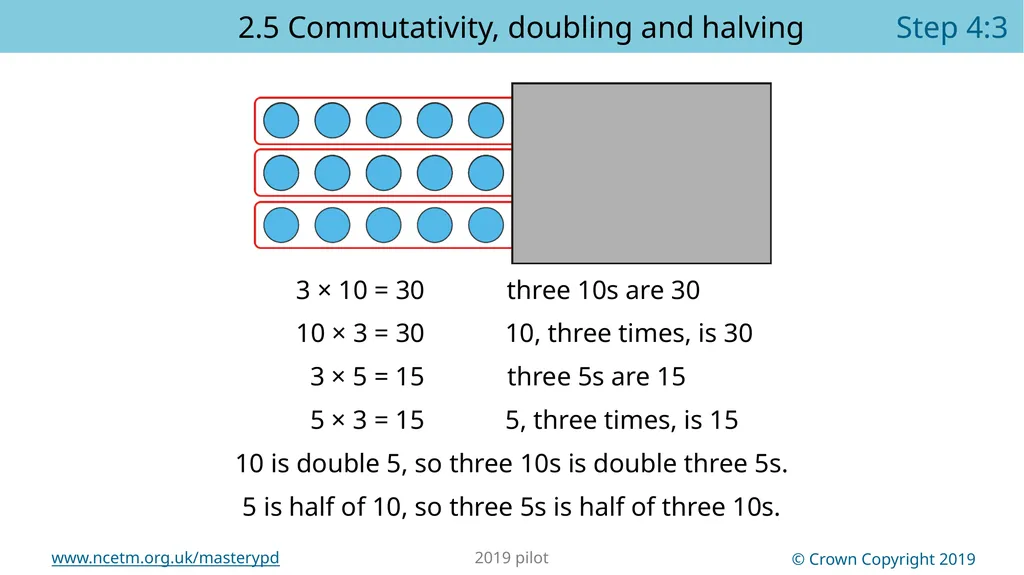
2.5 Commutativity, doubling and halving Step 4:3 5 is half of 10, so three 5s is half of three 10s. 10 is double 5, so three 10s is double three 5s. 5 × 3 = 15 3 × 5 = 15 10 × 3 = 30 3 × 10 = 30 5, three times, is 15 three 5s are 15 10, three times, is 30 three 10s are 30<br>
16
Curriculum Prioritisation for Primary Maths The following slides have been collated to support the teaching of this learning outcome. Year 2, Unit 13, Learning Outcome 3<br>
17
Year 2, Unit 13, Learning Outcome 3 Curriculum Prioritisation for Primary Maths Additional teacher guidance for this outcome should be read first and can be found in this segment of the NCETM Primary Mastery Professional Development Materials:
2.5 Commutativity (part 2), doubling and halving
The spine materials are divided into ‘teaching points’ and ‘steps in learning’.<br>
2.5 Commutativity (part 2), doubling and halving
The spine materials are divided into ‘teaching points’ and ‘steps in learning’.<br>
18
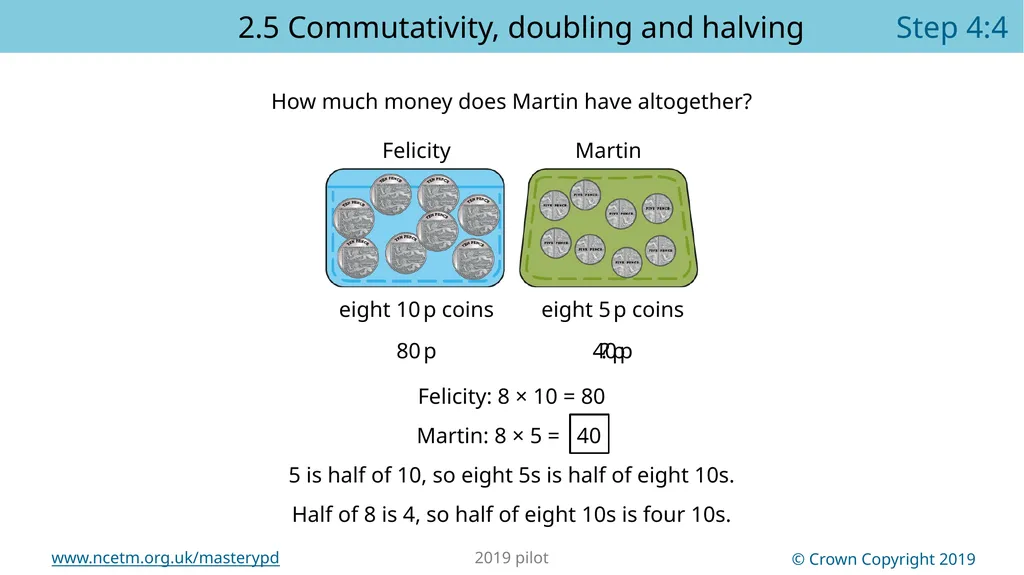
2.5 Commutativity, doubling and halving Step 4:4 How much money does Martin have altogether? Half of 8 is 4, so half of eight 10s is four 10s. 5 is half of 10, so eight 5s is half of eight 10s. Martin: 8 × 5 = Felicity: 8 × 10 = 80 eight 10 p coins eight 5 p coins 40 80 p ? p 40 p<br>
19
Curriculum Prioritisation for Primary Maths The following slides have been collated to support the teaching of this learning outcome. Year 2, Unit 13, Learning Outcome 4<br>
20
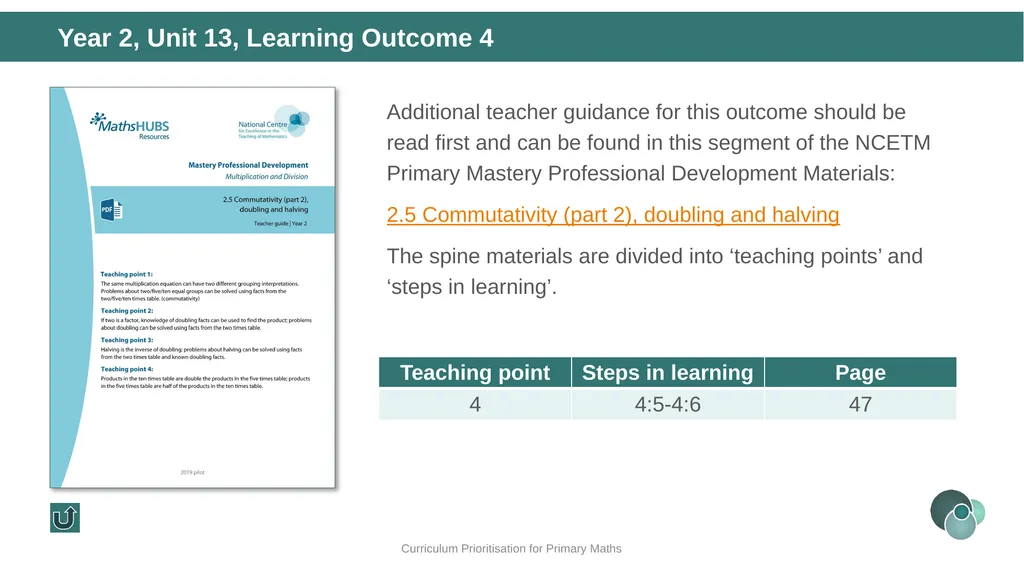
Year 2, Unit 13, Learning Outcome 4 Curriculum Prioritisation for Primary Maths Additional teacher guidance for this outcome should be read first and can be found in this segment of the NCETM Primary Mastery Professional Development Materials:
2.5 Commutativity (part 2), doubling and halving
The spine materials are divided into ‘teaching points’ and ‘steps in learning’.<br>
2.5 Commutativity (part 2), doubling and halving
The spine materials are divided into ‘teaching points’ and ‘steps in learning’.<br>
21
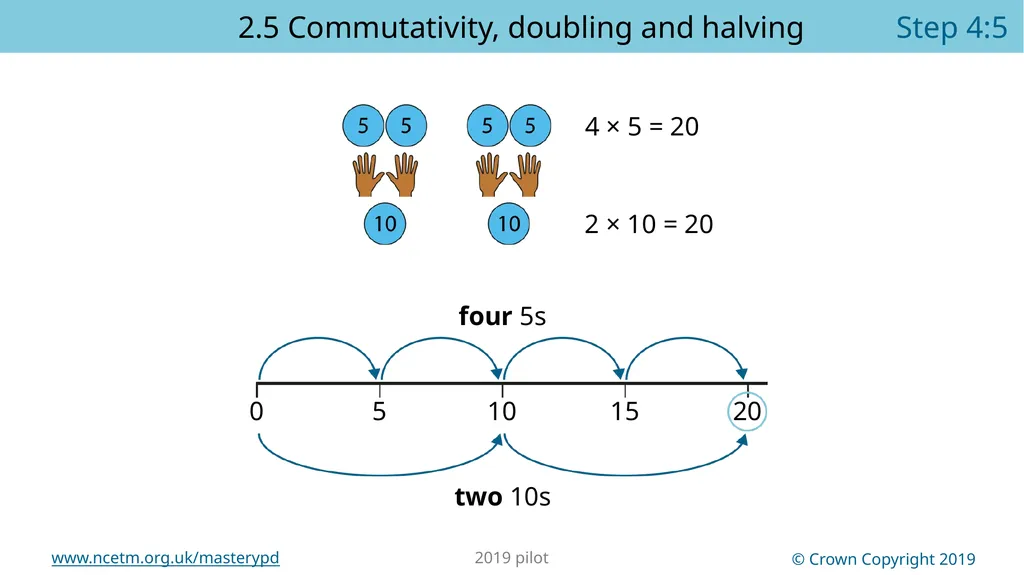
2.5 Commutativity, doubling and halving Step 4:5 4 × 5 = 20 2 × 10 = 20 four 5s two 10s<br>
22
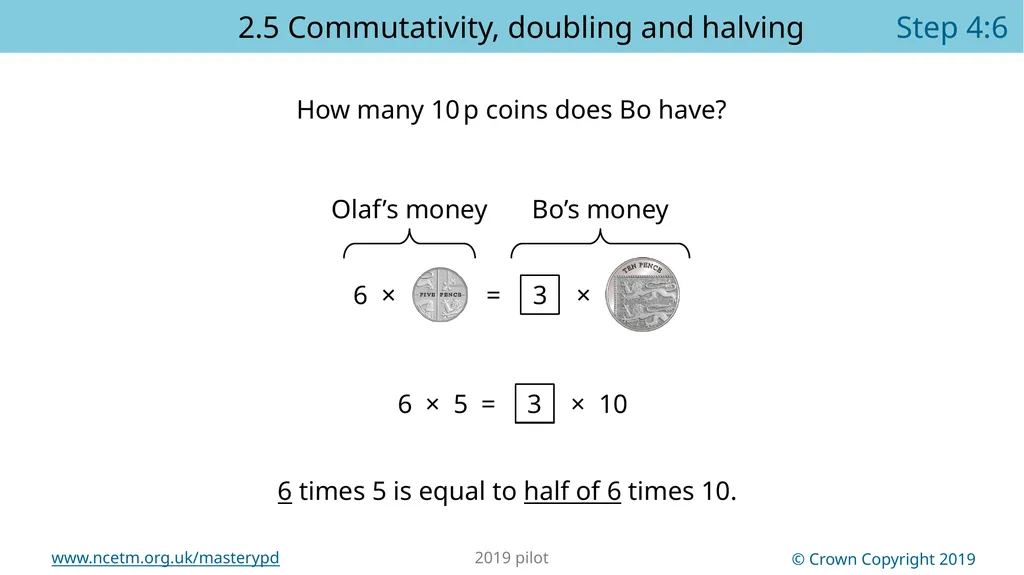
2.5 Commutativity, doubling and halving Step 4:6 How many 10 p coins does Bo have? 3 3 6 times 5 is equal to half of 6 times 10.<br>
23
Curriculum Prioritisation for Primary Maths The following slide supports the teaching of this learning outcome. Year 2, Unit 13, Learning Outcome 5<br>
24
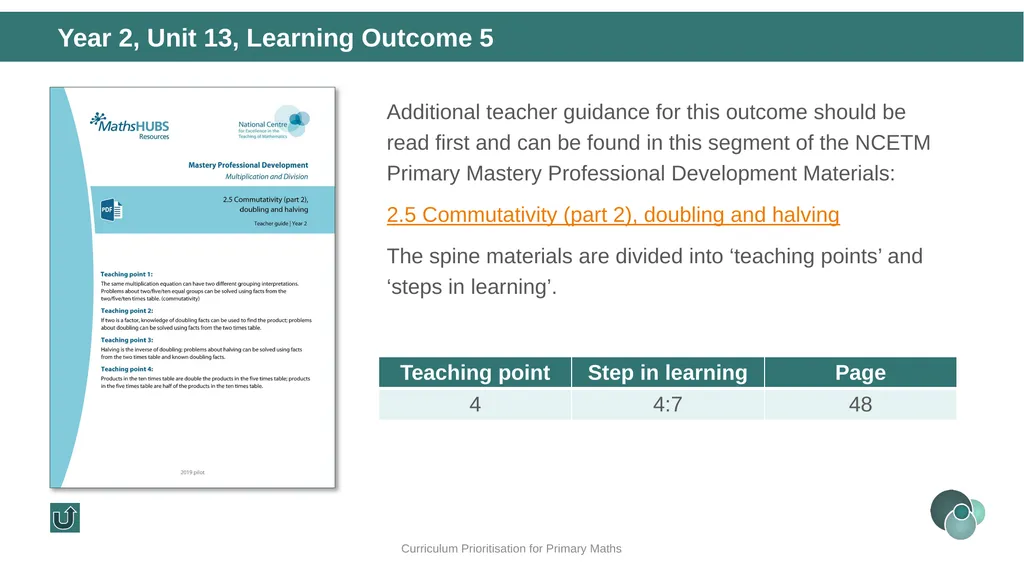
Year 2, Unit 13, Learning Outcome 5 Curriculum Prioritisation for Primary Maths Additional teacher guidance for this outcome should be read first and can be found in this segment of the NCETM Primary Mastery Professional Development Materials:
2.5 Commutativity (part 2), doubling and halving
The spine materials are divided into ‘teaching points’ and ‘steps in learning’.<br>
2.5 Commutativity (part 2), doubling and halving
The spine materials are divided into ‘teaching points’ and ‘steps in learning’.<br>
25
Curriculum Prioritisation for Primary Maths The following slides have been collated to support the teaching of this learning outcome. Year 2, Unit 13, Learning Outcome 6<br>
26
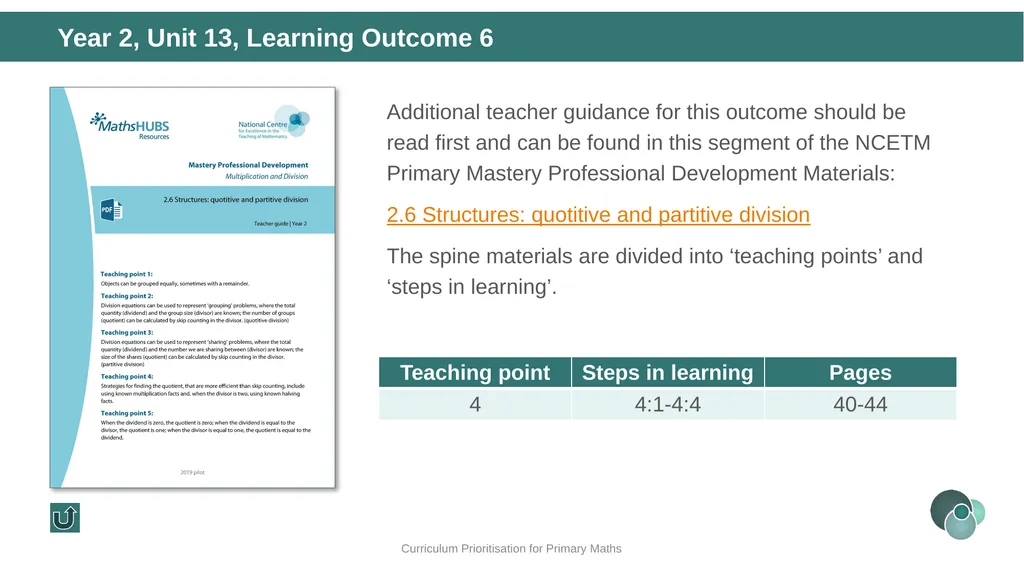
Year 2, Unit 13, Learning Outcome 6 Curriculum Prioritisation for Primary Maths Additional teacher guidance for this outcome should be read first and can be found in this segment of the NCETM Primary Mastery Professional Development Materials:
2.6 Structures: quotitive and partitive division
The spine materials are divided into ‘teaching points’ and ‘steps in learning’.<br>
2.6 Structures: quotitive and partitive division
The spine materials are divided into ‘teaching points’ and ‘steps in learning’.<br>
27
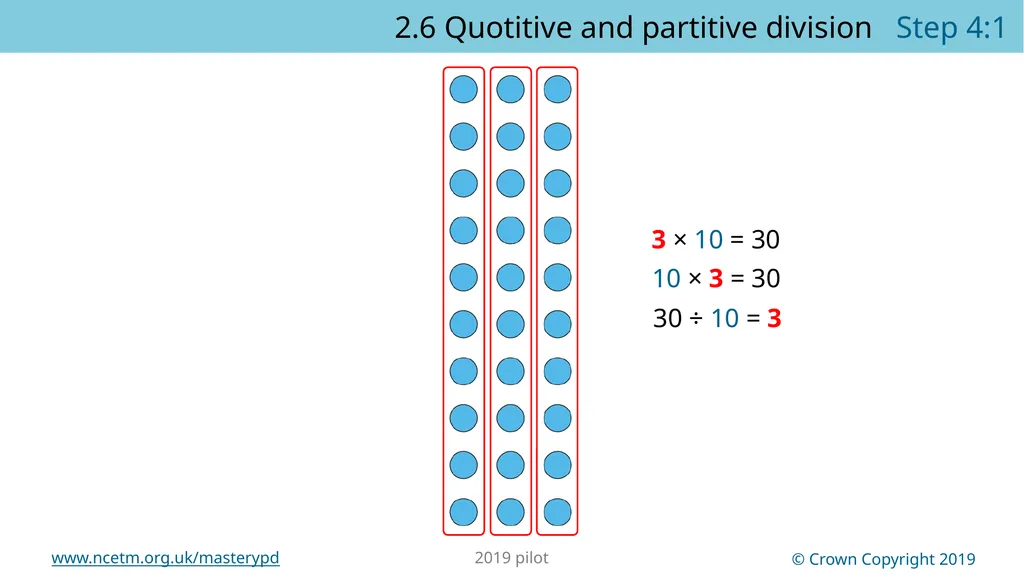
2.6 Quotitive and partitive division Step 4:1 3 × 10 = 30 30 ÷ 10 = 3 10 × 3 = 30<br>
28
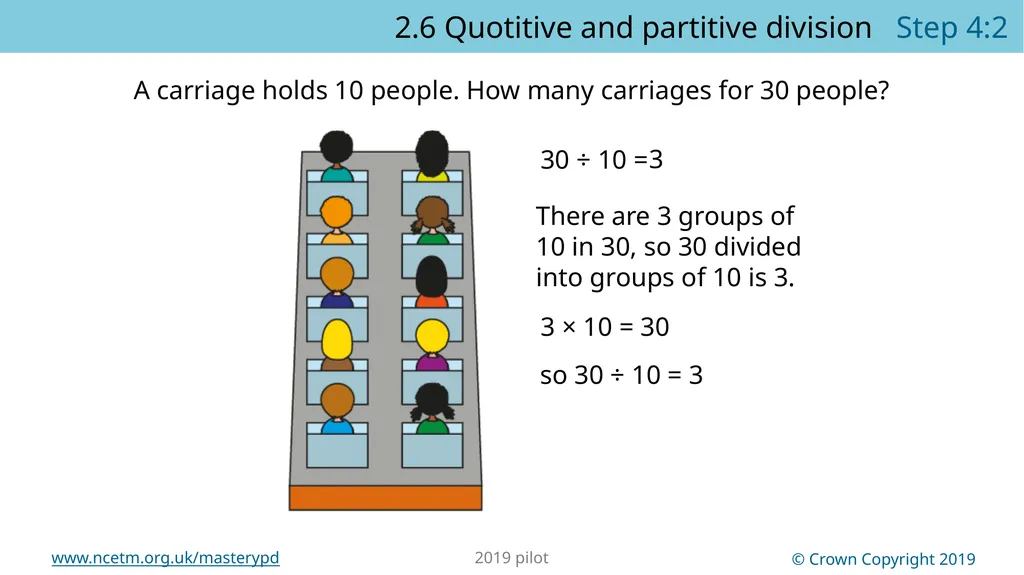
2.6 Quotitive and partitive division Step 4:2 A carriage holds 10 people. How many carriages for 30 people? 30 ÷ 10 = There are 3 groups of
10 in 30, so 30 divided
into groups of 10 is 3. 3 × 10 = 30 so 30 ÷ 10 = 3 3<br>
29
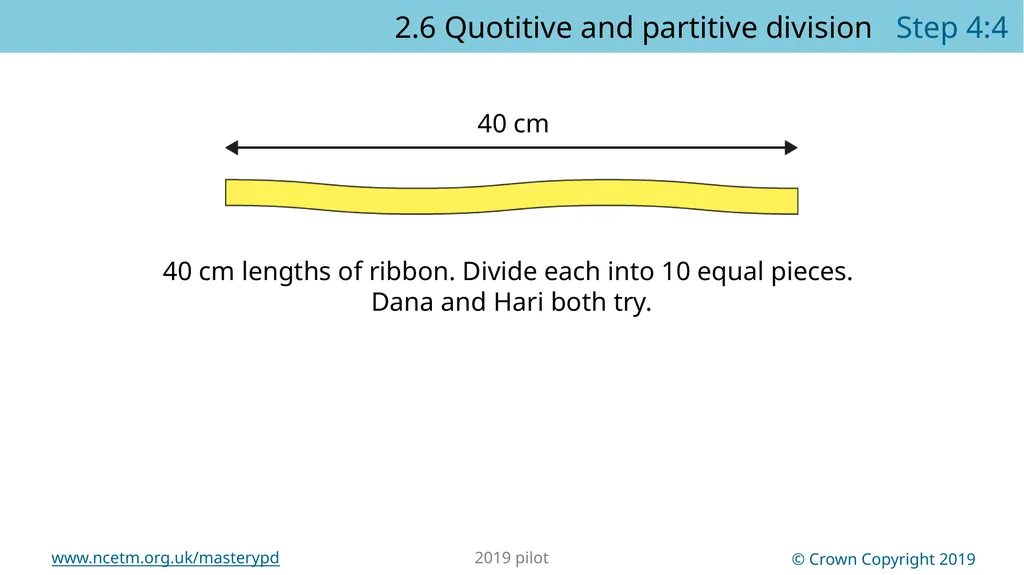
2.6 Quotitive and partitive division Step 4:4 40 cm 40 cm lengths of ribbon. Divide each into 10 equal pieces.
Dana and Hari both try.<br>
30
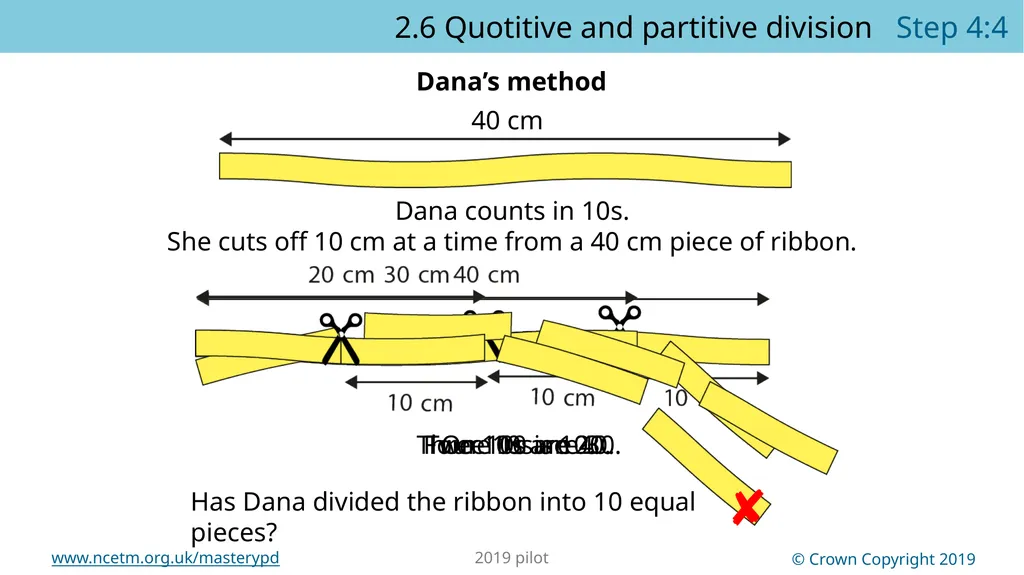
2.6 Quotitive and partitive division Step 4:4 Dana’s method Dana counts in 10s.
She cuts off 10 cm at a time from a 40 cm piece of ribbon. One 10 is 10. Two 10s are 20. Three 10s are 30. Four 10s are 40. Has Dana divided the ribbon into 10 equal pieces? 40 cm<br>
She cuts off 10 cm at a time from a 40 cm piece of ribbon. One 10 is 10. Two 10s are 20. Three 10s are 30. Four 10s are 40. Has Dana divided the ribbon into 10 equal pieces? 40 cm<br>
31
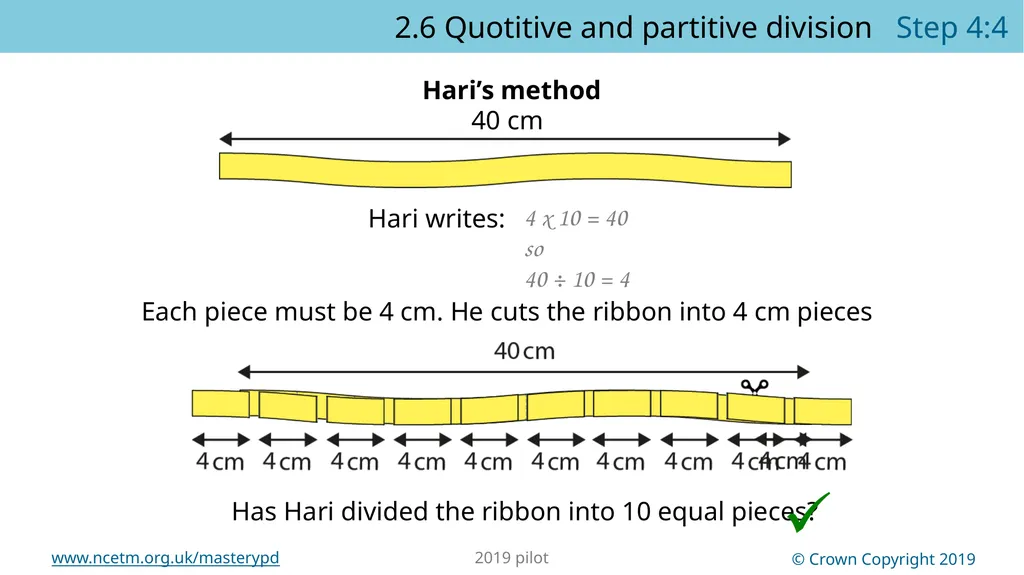
2.6 Quotitive and partitive division Step 4:4 Hari’s method Hari writes: 4 x 10 = 40
so
40 ÷ 10 = 4 Each piece must be 4 cm. He cuts the ribbon into 4 cm pieces Has Hari divided the ribbon into 10 equal pieces? 40 cm<br>
so
40 ÷ 10 = 4 Each piece must be 4 cm. He cuts the ribbon into 4 cm pieces Has Hari divided the ribbon into 10 equal pieces? 40 cm<br>
32
Curriculum Prioritisation for Primary Maths The following slides have been collated to support the teaching of this learning outcome. Year 2, Unit 13, Learning Outcome 7<br>
33
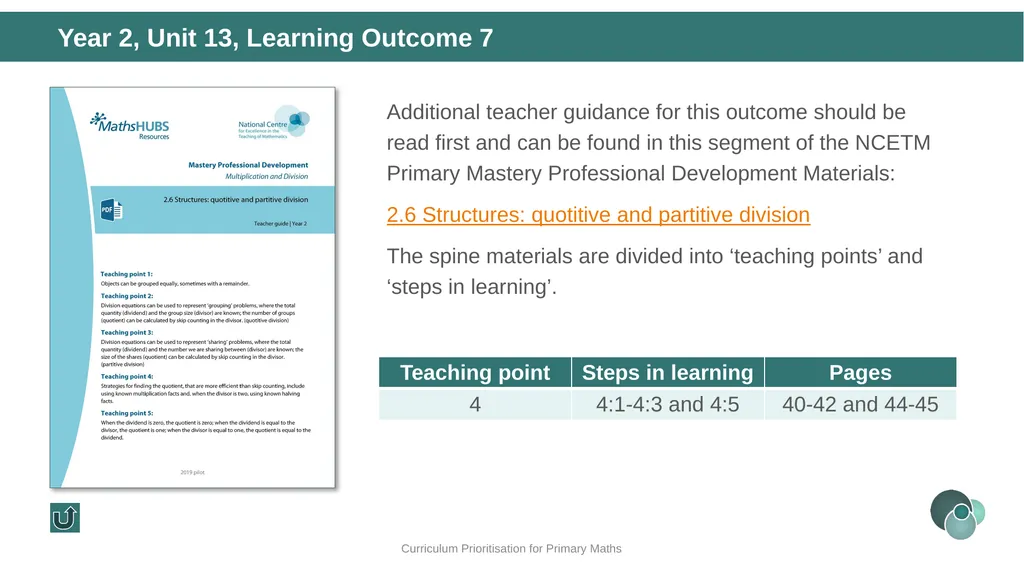
Year 2, Unit 13, Learning Outcome 7 Curriculum Prioritisation for Primary Maths Additional teacher guidance for this outcome should be read first and can be found in this segment of the NCETM Primary Mastery Professional Development Materials:
2.6 Structures: quotitive and partitive division
The spine materials are divided into ‘teaching points’ and ‘steps in learning’.<br>
2.6 Structures: quotitive and partitive division
The spine materials are divided into ‘teaching points’ and ‘steps in learning’.<br>
34
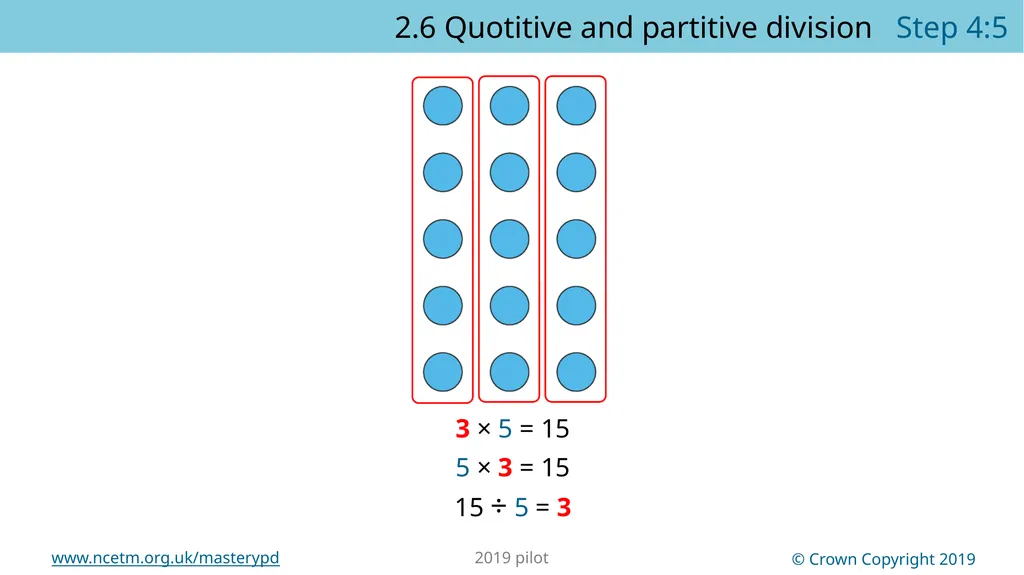
2.6 Quotitive and partitive division Step 4:5 3 × 5 = 15 5 × 3 = 15 15 ÷ 5 = 3<br>
35
Curriculum Prioritisation for Primary Maths The following slides have been collated to support the teaching of this learning outcome. Year 2, Unit 13, Learning Outcome 8<br>
36
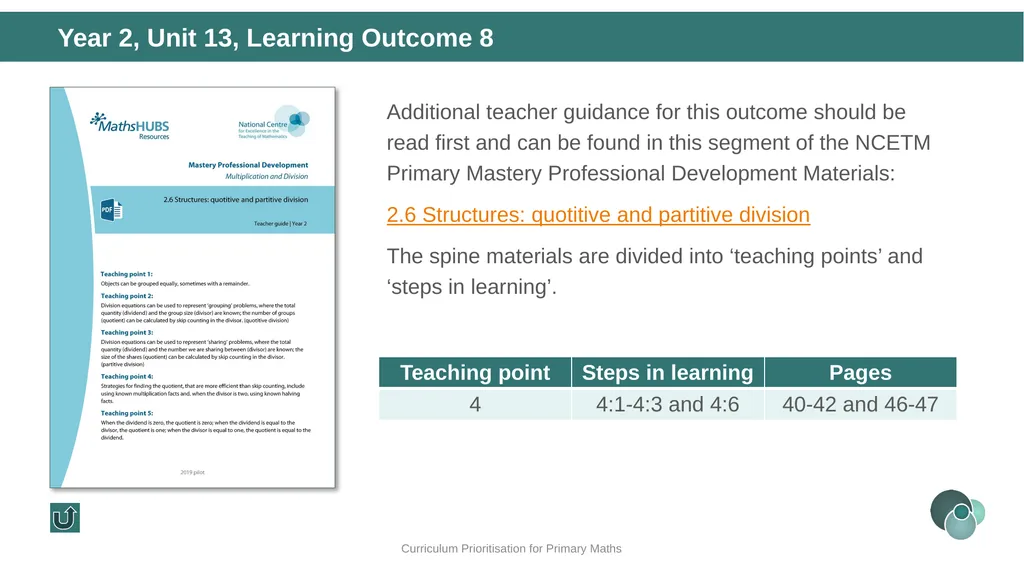
Year 2, Unit 13, Learning Outcome 8 Curriculum Prioritisation for Primary Maths Additional teacher guidance for this outcome should be read first and can be found in this segment of the NCETM Primary Mastery Professional Development Materials:
2.6 Structures: quotitive and partitive division
The spine materials are divided into ‘teaching points’ and ‘steps in learning’.<br>
2.6 Structures: quotitive and partitive division
The spine materials are divided into ‘teaching points’ and ‘steps in learning’.<br>
37
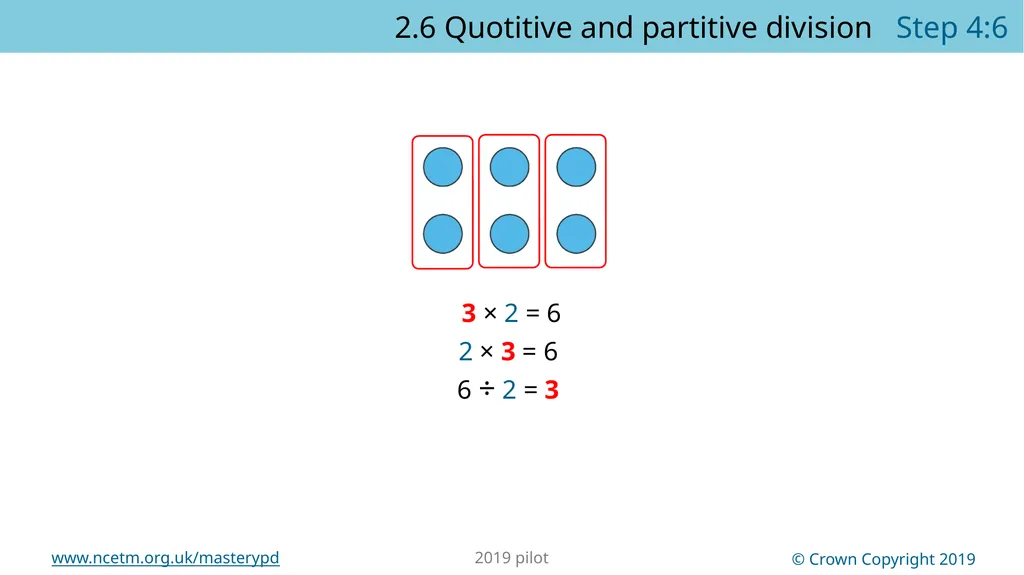
2.6 Quotitive and partitive division Step 4:6 3 × 2 = 6 2 × 3 = 6 6 ÷ 2 = 3<br>
38
Curriculum Prioritisation for Primary Maths The following slides have been collated to support the teaching of this learning outcome. Year 2, Unit 13, Learning Outcome 9<br>
39
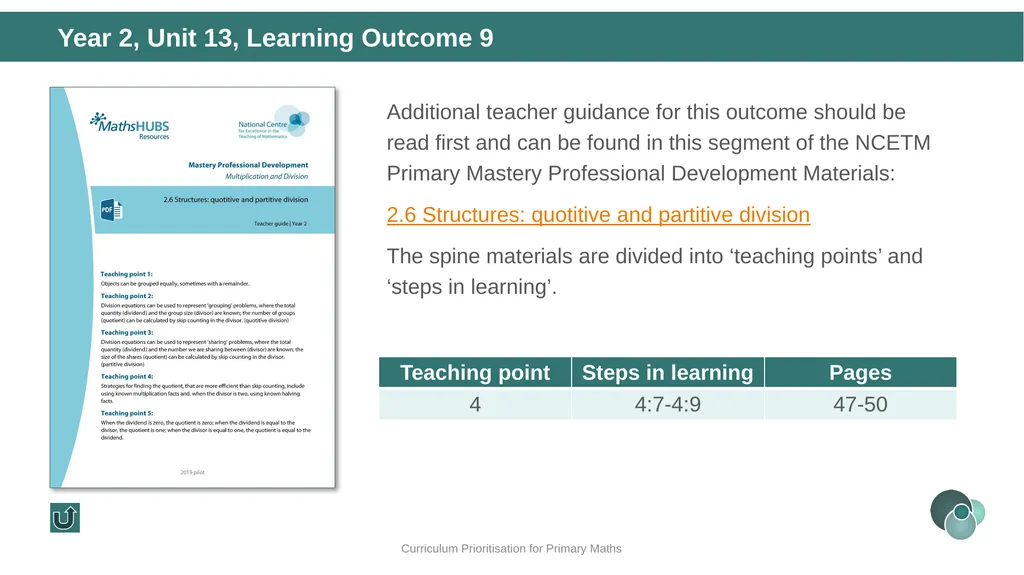
Year 2, Unit 13, Learning Outcome 9 Curriculum Prioritisation for Primary Maths Additional teacher guidance for this outcome should be read first and can be found in this segment of the NCETM Primary Mastery Professional Development Materials:
2.6 Structures: quotitive and partitive division
The spine materials are divided into ‘teaching points’ and ‘steps in learning’.<br>
2.6 Structures: quotitive and partitive division
The spine materials are divided into ‘teaching points’ and ‘steps in learning’.<br>
40
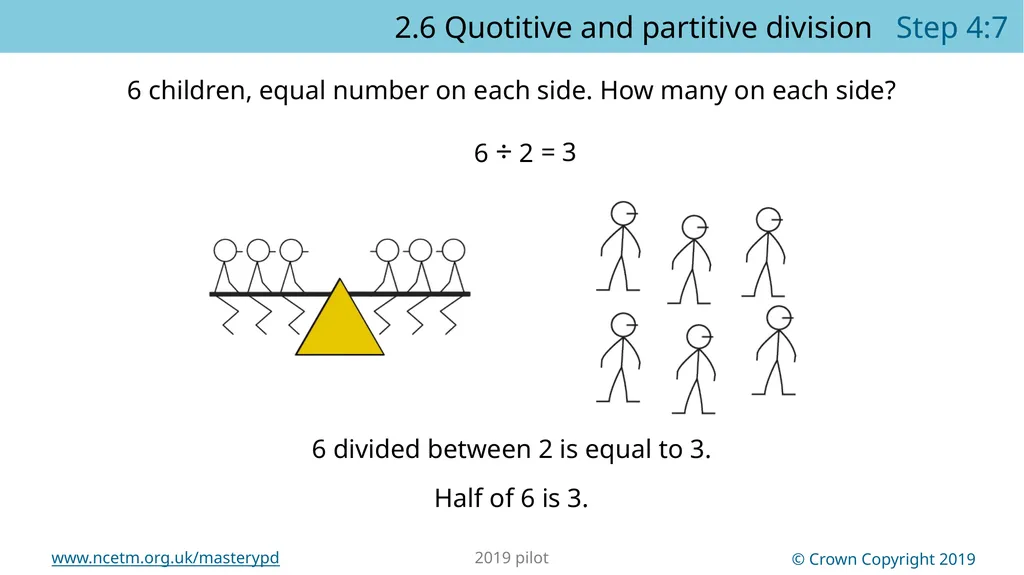
2.6 Quotitive and partitive division Step 4:7 6 children, equal number on each side. How many on each side? 6 ÷ 2 = 3 6 divided between 2 is equal to 3. Half of 6 is 3.<br>
41
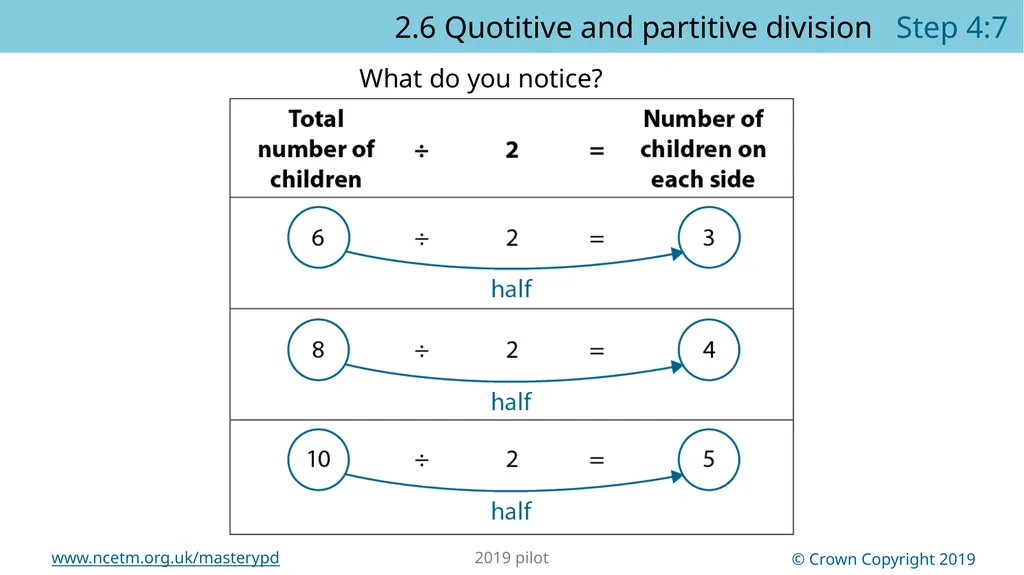
2.6 Quotitive and partitive division Step 4:7 What do you notice?<br>
42
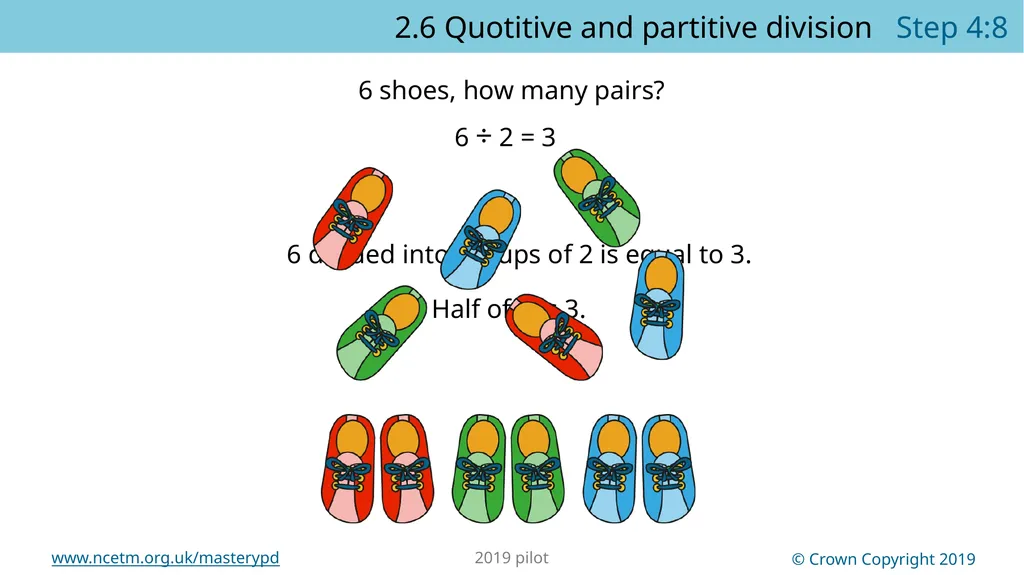
2.6 Quotitive and partitive division Step 4:8 6 shoes, how many pairs? 6 divided into groups of 2 is equal to 3. Half of 6 is 3. 6 ÷ 2 = 3<br>
43
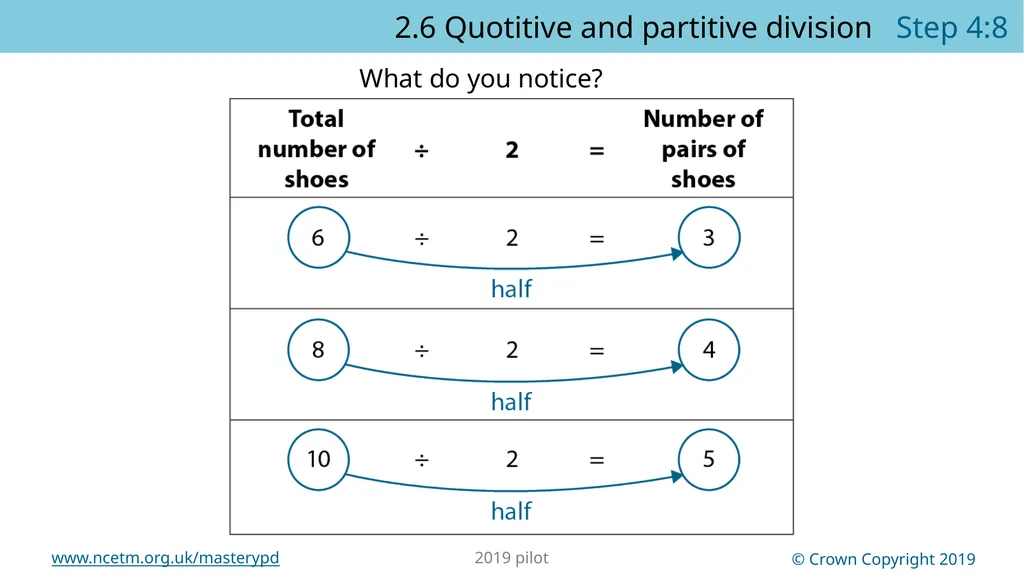
2.6 Quotitive and partitive division Step 4:8 What do you notice?<br>
44
Curriculum Prioritisation for Primary Maths The following slide supports the teaching of this learning outcome. Year 2, Unit 13, Learning Outcome 10<br>
45
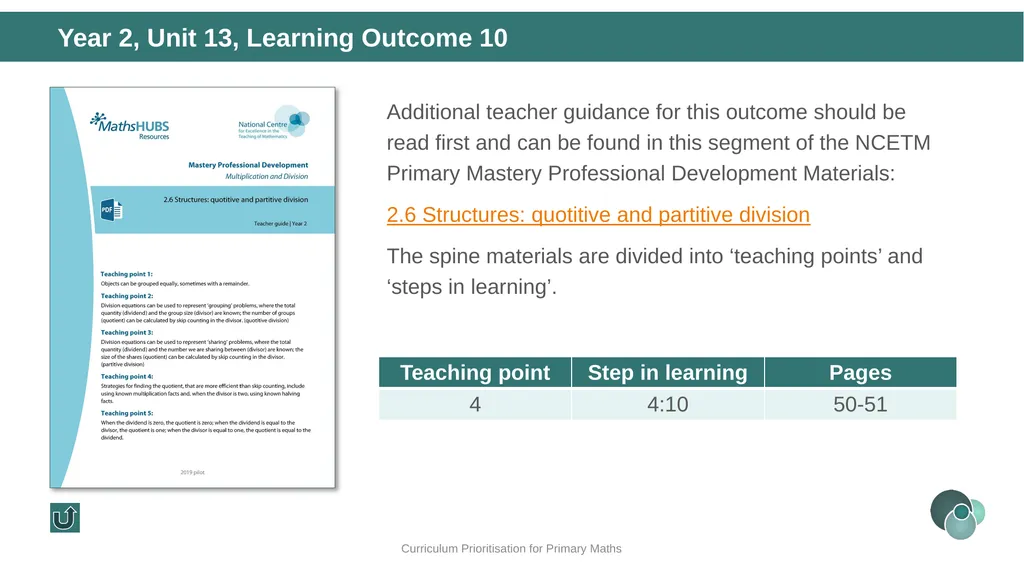
Year 2, Unit 13, Learning Outcome 10 Curriculum Prioritisation for Primary Maths Additional teacher guidance for this outcome should be read first and can be found in this segment of the NCETM Primary Mastery Professional Development Materials:
2.6 Structures: quotitive and partitive division
The spine materials are divided into ‘teaching points’ and ‘steps in learning’.<br>
2.6 Structures: quotitive and partitive division
The spine materials are divided into ‘teaching points’ and ‘steps in learning’.<br>
46
Curriculum Prioritisation for Primary Maths The following slides have been collated to support the teaching of this learning outcome. Year 2, Unit 13, Learning Outcome 11<br>
47
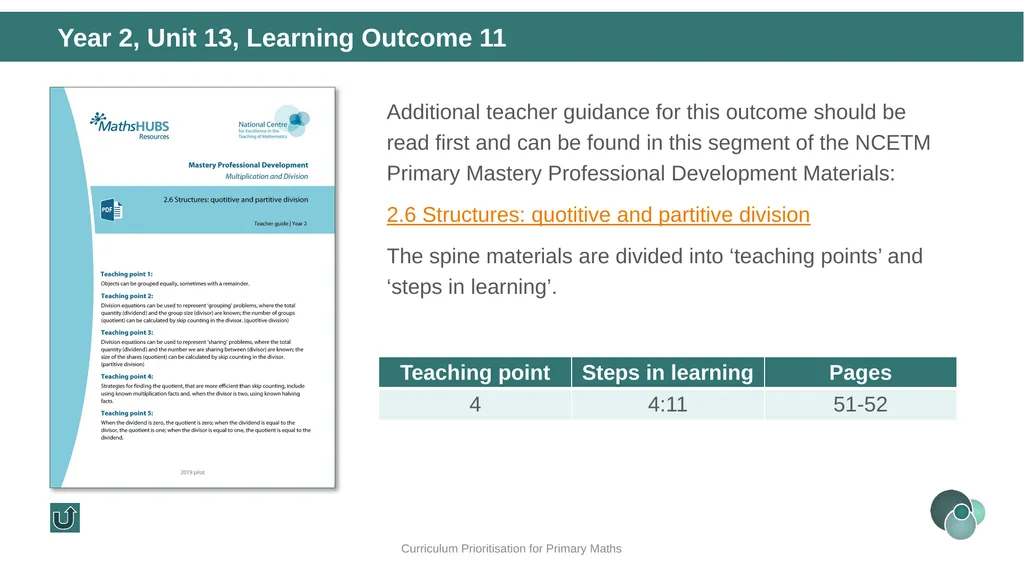
Year 2, Unit 13, Learning Outcome 11 Curriculum Prioritisation for Primary Maths Additional teacher guidance for this outcome should be read first and can be found in this segment of the NCETM Primary Mastery Professional Development Materials:
2.6 Structures: quotitive and partitive division
The spine materials are divided into ‘teaching points’ and ‘steps in learning’.<br>
2.6 Structures: quotitive and partitive division
The spine materials are divided into ‘teaching points’ and ‘steps in learning’.<br>
48
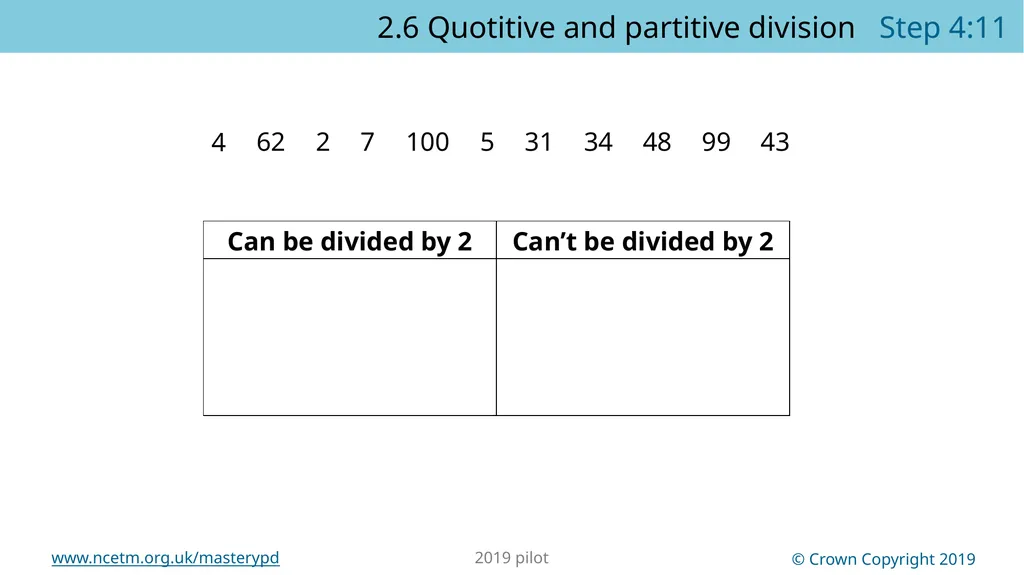
2.6 Quotitive and partitive division Step 4:11 4 62 2 7 43 34 48 31 99 5 100<br>
49
Curriculum Prioritisation for Primary Maths The following slide supports the teaching of this learning outcome. Year 2, Unit 13, Learning Outcome 12<br>
50
Year 2, Unit 13, Learning Outcome 12 Curriculum Prioritisation for Primary Maths Additional teacher guidance for this outcome should be read first and can be found in this segment of the NCETM Primary Mastery Professional Development Materials:
2.6 Structures: quotitive and partitive division
The spine materials are divided into ‘teaching points’ and ‘steps in learning’.<br>
2.6 Structures: quotitive and partitive division
The spine materials are divided into ‘teaching points’ and ‘steps in learning’.<br>
51
Curriculum Prioritisation for Primary Maths The following slide supports the teaching of this learning outcome. Year 2, Unit 13, Learning Outcome 13<br>
52
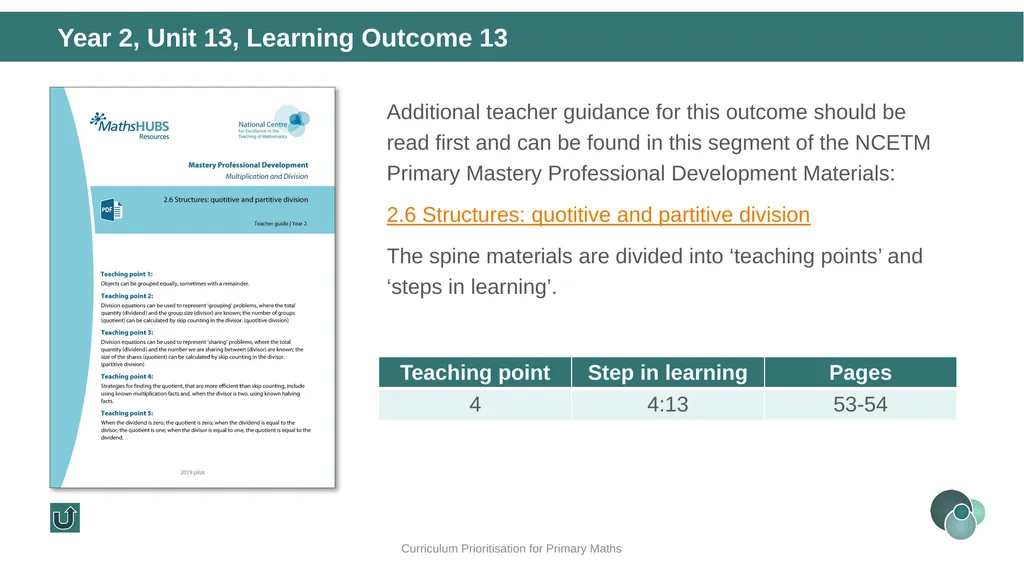
Year 2, Unit 13, Learning Outcome 13 Curriculum Prioritisation for Primary Maths Additional teacher guidance for this outcome should be read first and can be found in this segment of the NCETM Primary Mastery Professional Development Materials:
2.6 Structures: quotitive and partitive division
The spine materials are divided into ‘teaching points’ and ‘steps in learning’.<br>
2.6 Structures: quotitive and partitive division
The spine materials are divided into ‘teaching points’ and ‘steps in learning’.<br>
53
Curriculum Prioritisation for Primary Maths The following slides have been collated to support the teaching of this learning outcome. Year 2, Unit 13, Learning Outcome 14<br>
54
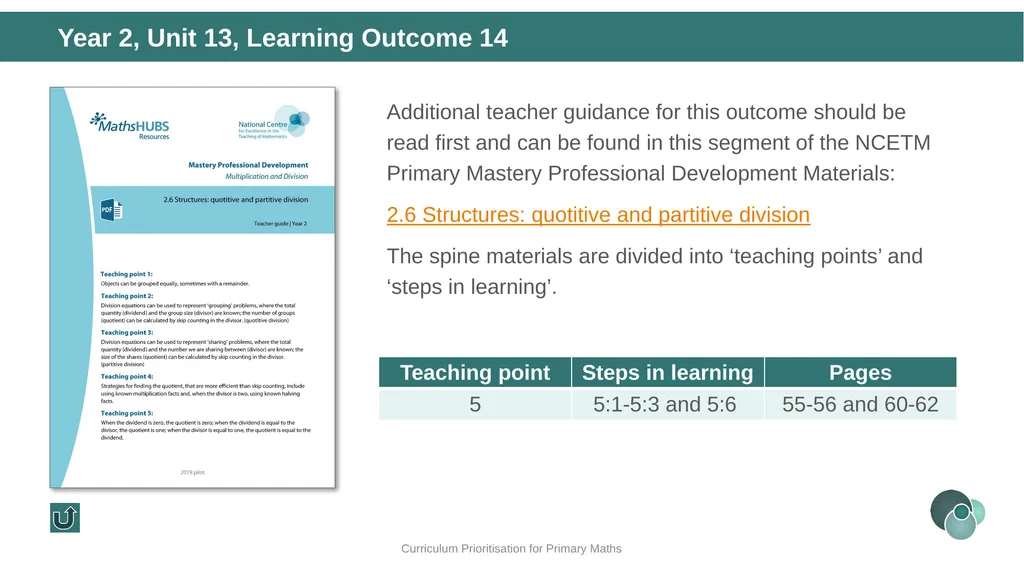
Year 2, Unit 13, Learning Outcome 14 Curriculum Prioritisation for Primary Maths Additional teacher guidance for this outcome should be read first and can be found in this segment of the NCETM Primary Mastery Professional Development Materials:
2.6 Structures: quotitive and partitive division
The spine materials are divided into ‘teaching points’ and ‘steps in learning’.<br>
2.6 Structures: quotitive and partitive division
The spine materials are divided into ‘teaching points’ and ‘steps in learning’.<br>
55
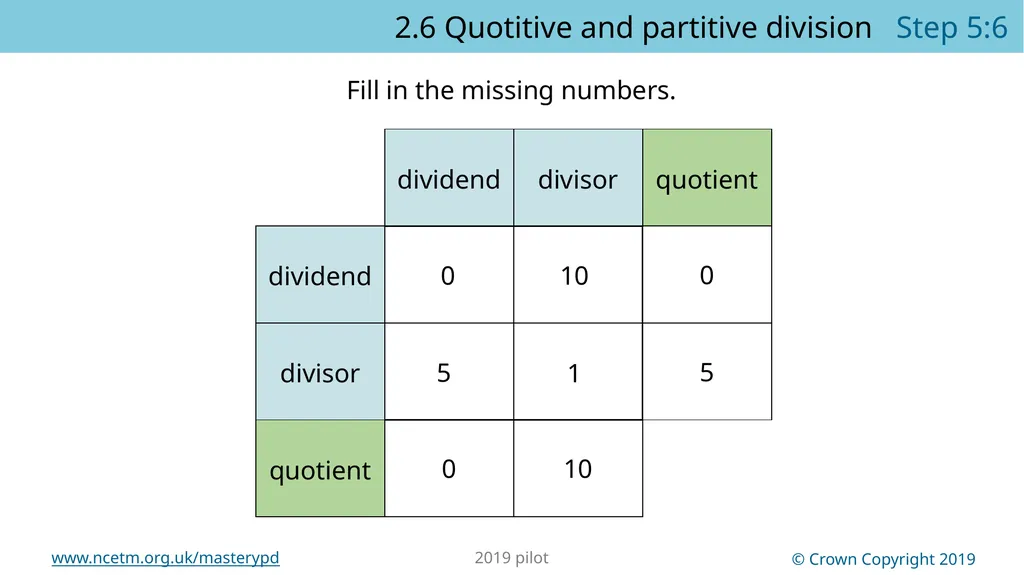
2.6 Quotitive and partitive division Step 5:6 Fill in the missing numbers. 0 10 5 1<br>
56
Curriculum Prioritisation for Primary Maths The following slides have been collated to support the teaching of this learning outcome. Year 2, Unit 13, Learning Outcome 15<br>
57
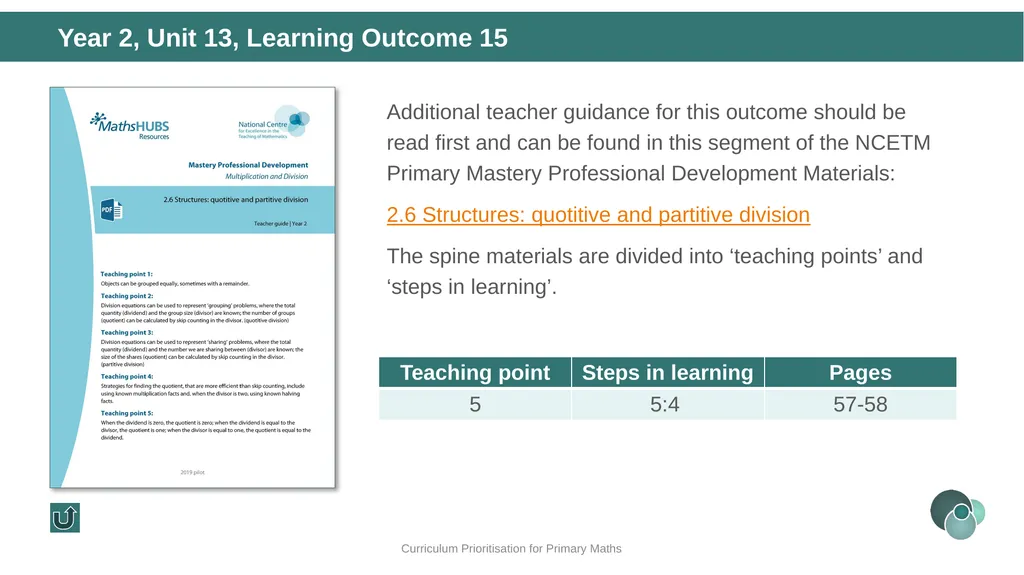
Year 2, Unit 13, Learning Outcome 15 Curriculum Prioritisation for Primary Maths Additional teacher guidance for this outcome should be read first and can be found in this segment of the NCETM Primary Mastery Professional Development Materials:
2.6 Structures: quotitive and partitive division
The spine materials are divided into ‘teaching points’ and ‘steps in learning’.<br>
2.6 Structures: quotitive and partitive division
The spine materials are divided into ‘teaching points’ and ‘steps in learning’.<br>
58
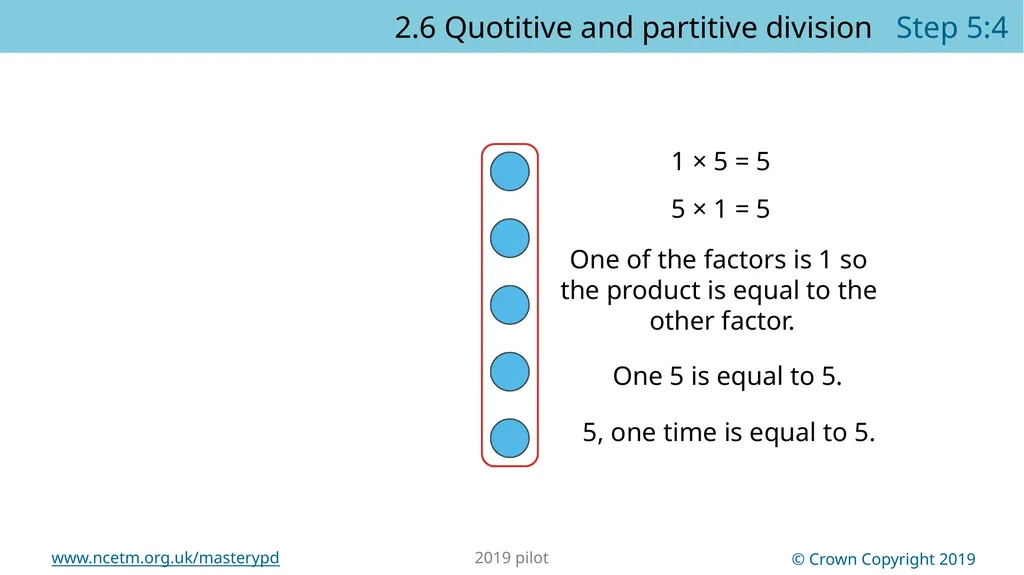
2.6 Quotitive and partitive division Step 5:4 1 × 5 = 5 5 × 1 = 5 One of the factors is 1 so
the product is equal to the
other factor. One 5 is equal to 5. 5, one time is equal to 5.<br>
59
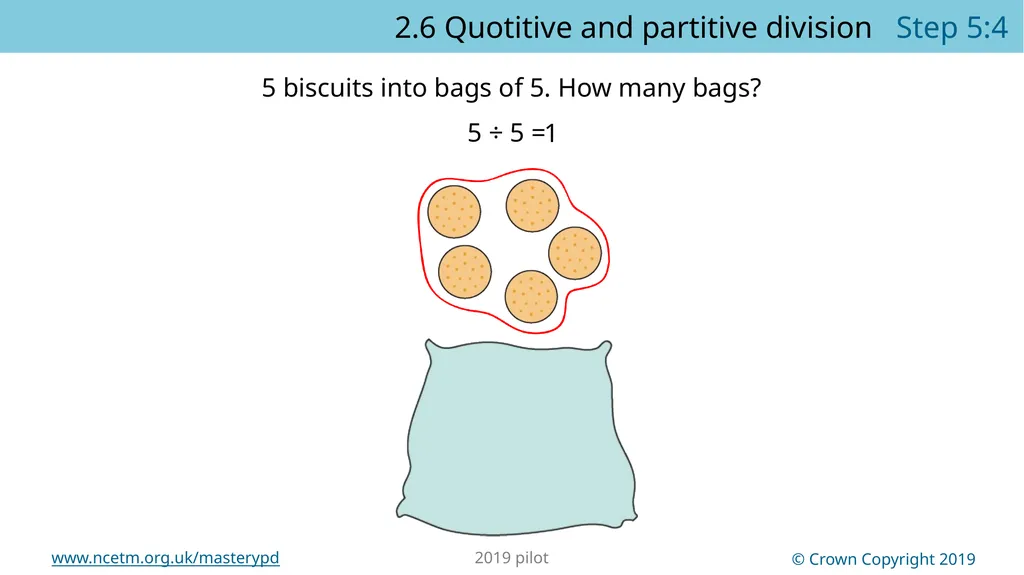
2.6 Quotitive and partitive division Step 5:4 5 biscuits into bags of 5. How many bags? 5 ÷ 5 = 1<br>
60
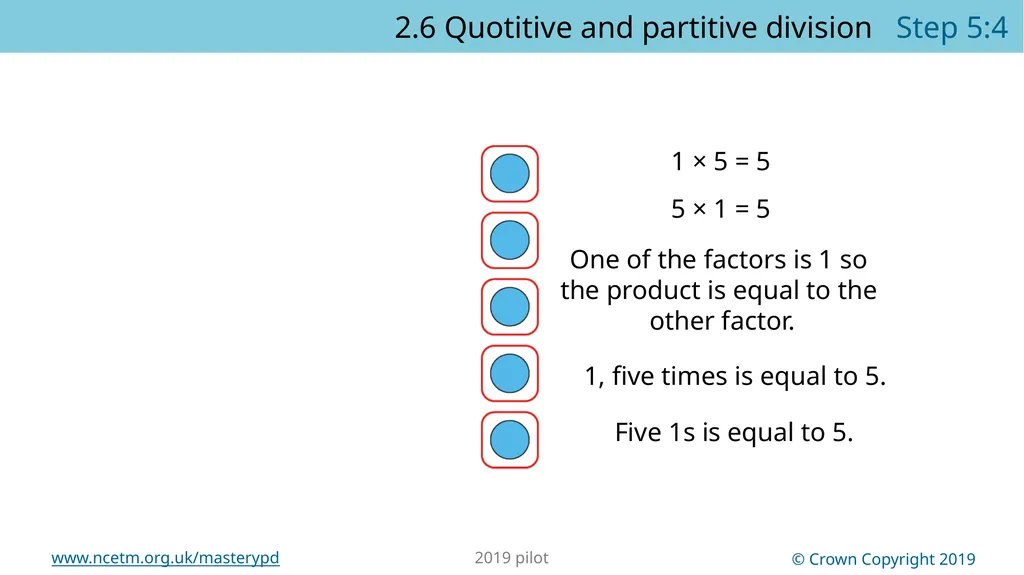
2.6 Quotitive and partitive division Step 5:4 1 × 5 = 5 5 × 1 = 5 One of the factors is 1 so
the product is equal to the
other factor. 1, five times is equal to 5. Five 1s is equal to 5.<br>
61
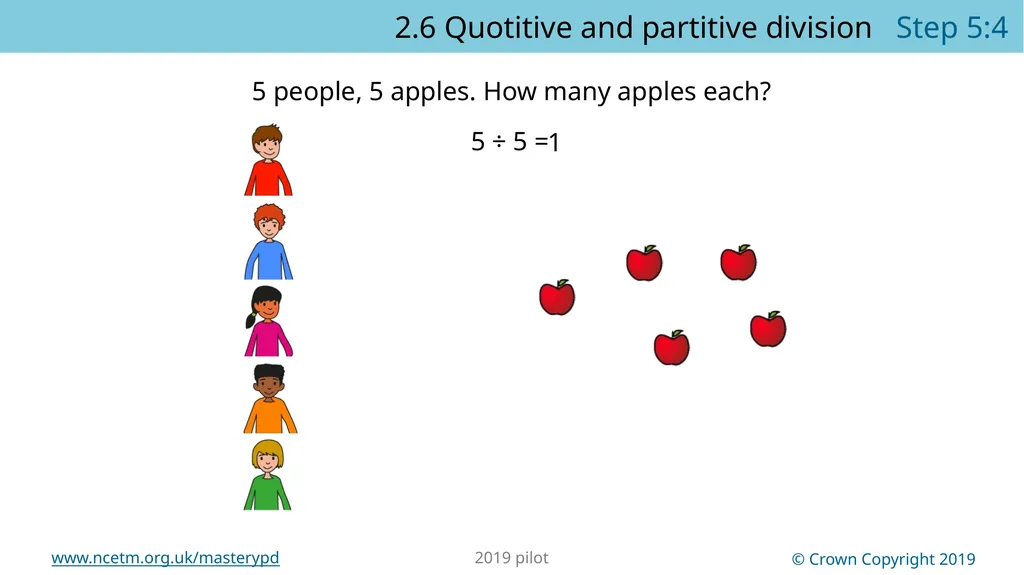
2.6 Quotitive and partitive division Step 5:4 5 people, 5 apples. How many apples each? 5 ÷ 5 = 1<br>
62
Curriculum Prioritisation for Primary Maths The following slides have been collated to support the teaching of this learning outcome. Year 2, Unit 13, Learning Outcome 16<br>
63
Year 2, Unit 13, Learning Outcome 16 Curriculum Prioritisation for Primary Maths Additional teacher guidance for this outcome should be read first and can be found in this segment of the NCETM Primary Mastery Professional Development Materials:
2.6 Structures: quotitive and partitive division
The spine materials are divided into ‘teaching points’ and ‘steps in learning’.<br>
2.6 Structures: quotitive and partitive division
The spine materials are divided into ‘teaching points’ and ‘steps in learning’.<br>
64
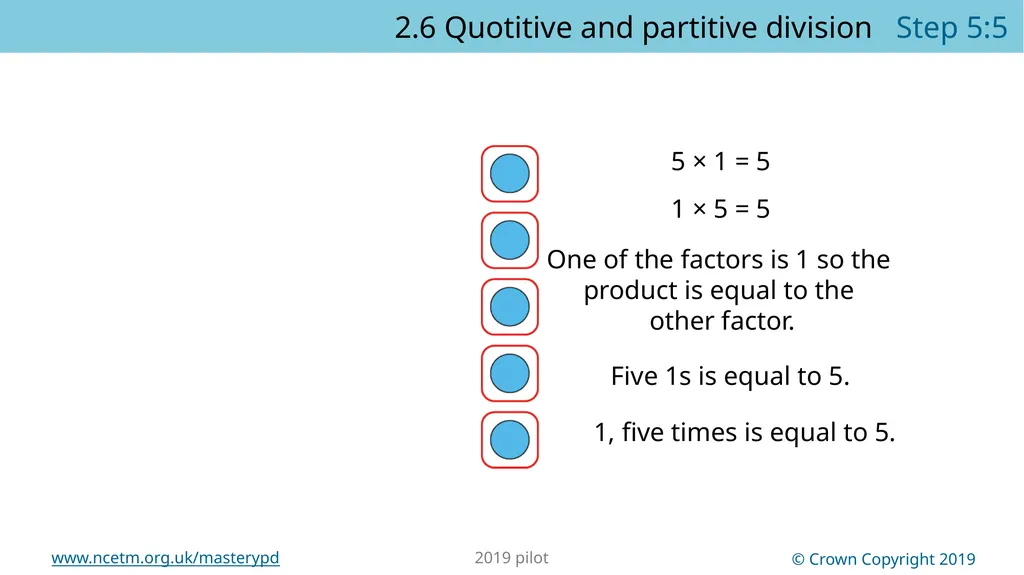
2.6 Quotitive and partitive division Step 5:5 5 × 1 = 5 1 × 5 = 5 One of the factors is 1 so the
product is equal to the
other factor. Five 1s is equal to 5. 1, five times is equal to 5.<br>
65
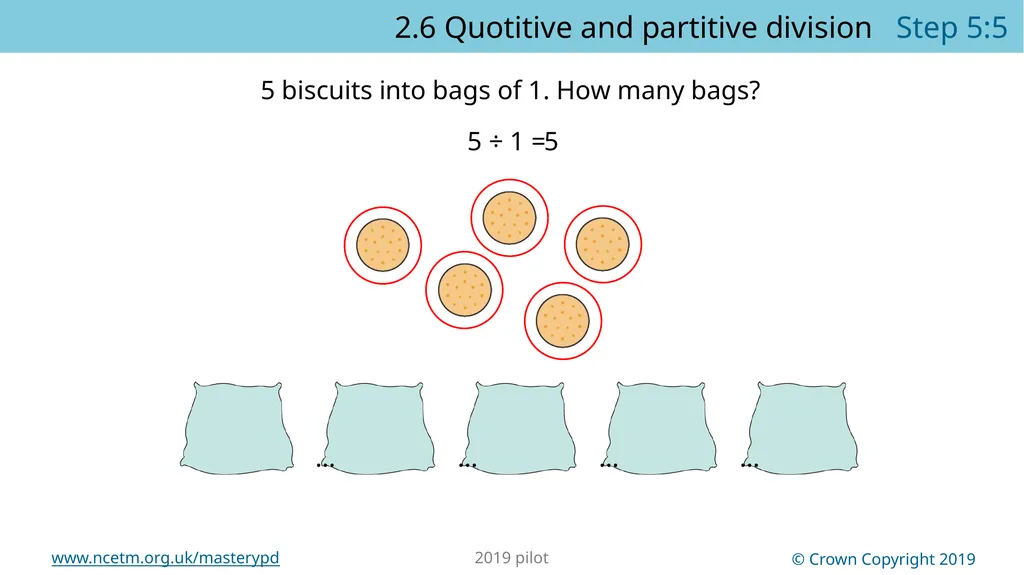
2.6 Quotitive and partitive division Step 5:5 5 biscuits into bags of 1. How many bags? 5 ÷ 1 = 5 … … … …<br>
66
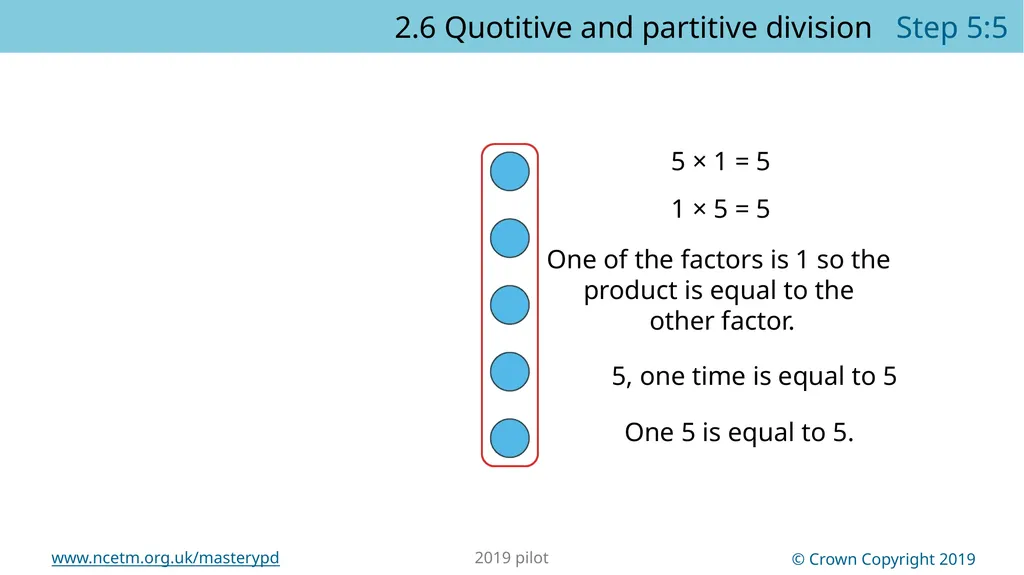
2.6 Quotitive and partitive division Step 5:5 5 × 1 = 5 1 × 5 = 5 One of the factors is 1 so the
product is equal to the
other factor. 5, one time is equal to 5 One 5 is equal to 5.<br>
67
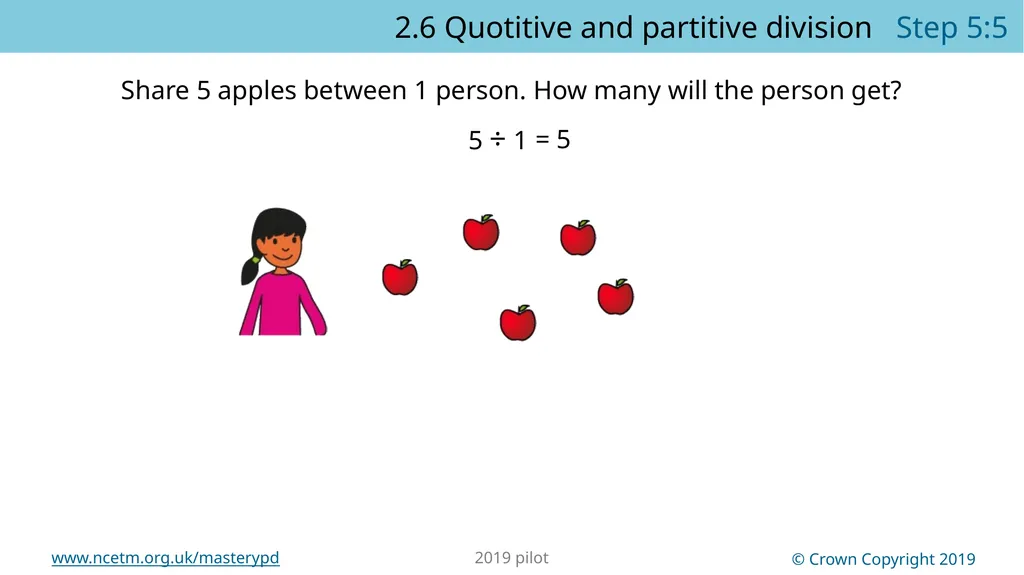
2.6 Quotitive and partitive division Step 5:5 Share 5 apples between 1 person. How many will the person get? 5 ÷ 1 = 5<br>