Year 34 Lesson 1: Safety rules and risks: medicines and household products Drug and alcohol education KS2 1 Ensure you read the guidance before teaching the lesson Teacher slide PSHE Association 2020 2 Using this PowerPoint Teacher slide
"Year 3/4 Lesson 1: Safety rules and risks:" is the property of its rightful owner. Permission is granted to
download and print the materials on this website for personal, non-commercial use only, and to display it
on your personal computer provided you do not modify the materials and that you retain all copyright
notices contained in the materials. By downloading content from our website, you accept the terms of this
agreement.
3 Challenge and support Teacher
slide The lesson includes suggestions for challenge and support activities, to help you differentiate appropriately for your class.
Challenge activities deepen and extend the learning for those who need more challenge or who finish the activity quickly.
Neither this, nor any of the other lessons, is designed to be taught in isolation, but should always form part of a planned, developmental PSHE education programme.<br>
explain the importance of taking medicines correctly and using household products safely
identify risk in relation to the use of medicines and household products, and suggest what action to take to help prevent or minimise harm
recognise sources of information and whom to ask for help with medicine safety Learning objective
To learn about the safe use of medicines and household products Teacher
slide<br>
07
Preparing to teach 7 Climate for learning
Make sure you have read the accompanying teacher guidance notes before teaching this lesson for guidance on establishing ground rules, the limits of confidentiality, communication and handling questions effectively. Resources required
Box or envelope for anonymous questions
Empty medicines packaging (boxes, clean and washed bottles) and instructions leaflets from over the counter and prescribed medicines. Ensure that personal information on printed labels from prescribed medicine is deleted.
Resource 1: Household products and medicines – benefits and risks list [1 per pupil, or pupils can create this grid in their work books or on a piece of paper]
Resource 2: A day in the life [1 per class]
Resource 3: Medicine safety scenarios [1 scenario per small group of three or pair] Duration
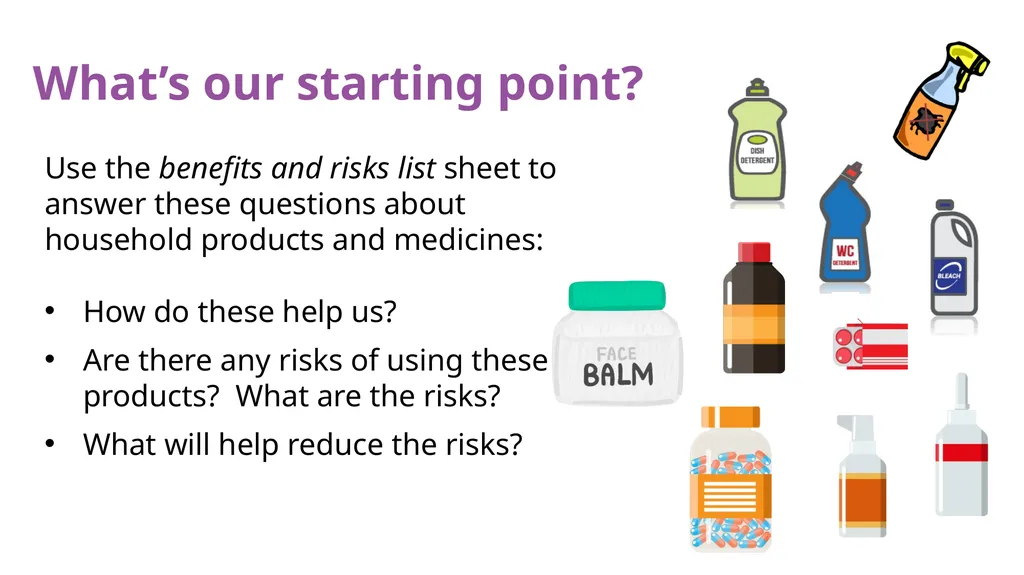
What’s our starting point? Use the benefits and risks list sheet to answer these questions about household products and medicines:
How do these help us?
Are there any risks of using these products? What are the risks?
What will help reduce the risks?<br>
13
A day in the life Listen to ‘A day in the life’ about the Grech family.
Talk about what different items are used by the family and how they are used safely.<br>
14
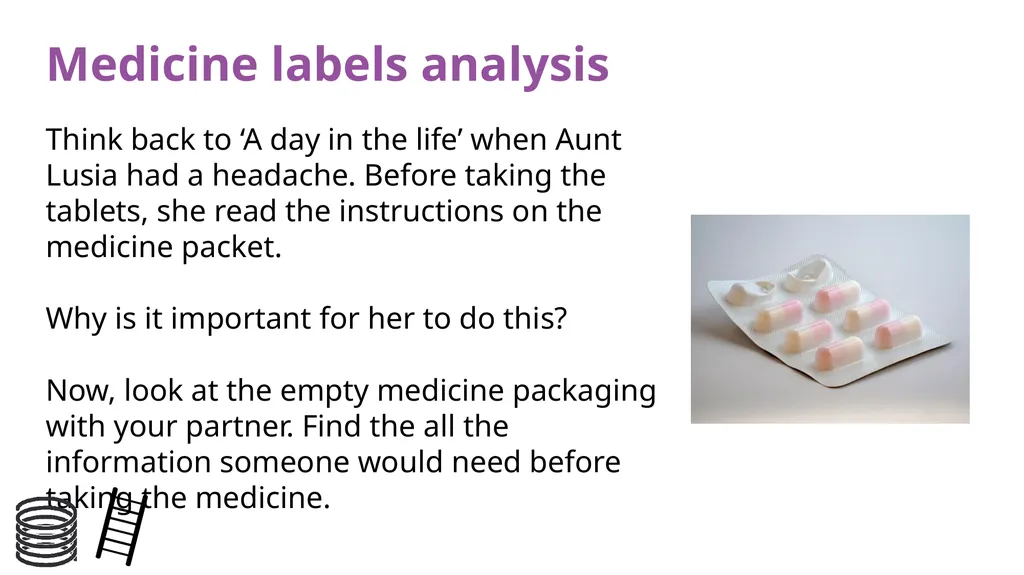
Medicine labels analysis Think back to ‘A day in the life’ when Aunt Lusia had a headache. Before taking the tablets, she read the instructions on the medicine packet.
Why is it important for her to do this?
Now, look at the empty medicine packaging with your partner. Find the all the information someone would need before taking the medicine.<br>
15
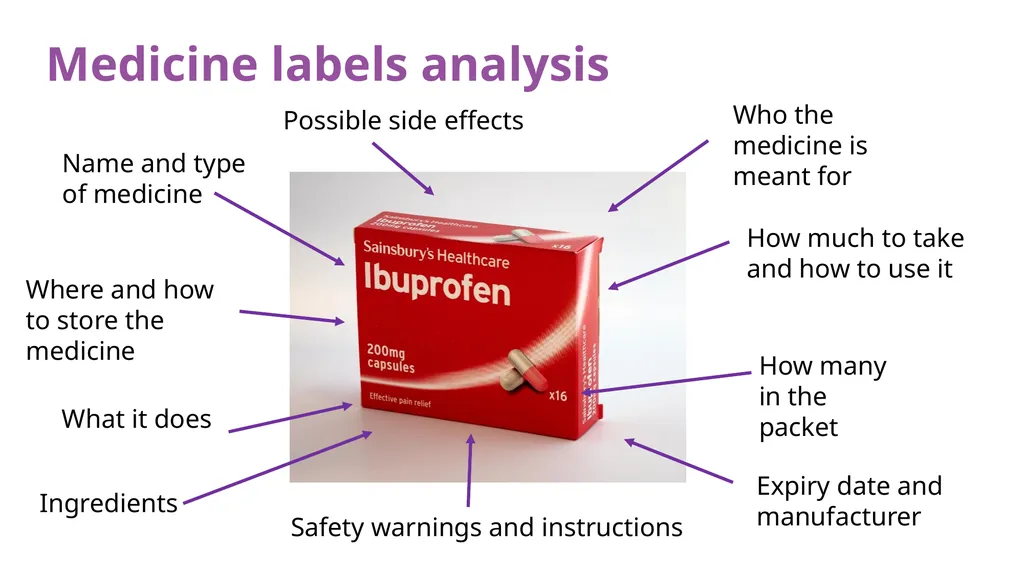
Medicine labels analysis Name and type of medicine How many in the packet What it does Who the medicine is meant for How much to take and how to use it Safety warnings and instructions Where and how to store the medicine Possible side effects Expiry date and manufacturer Ingredients<br>
16
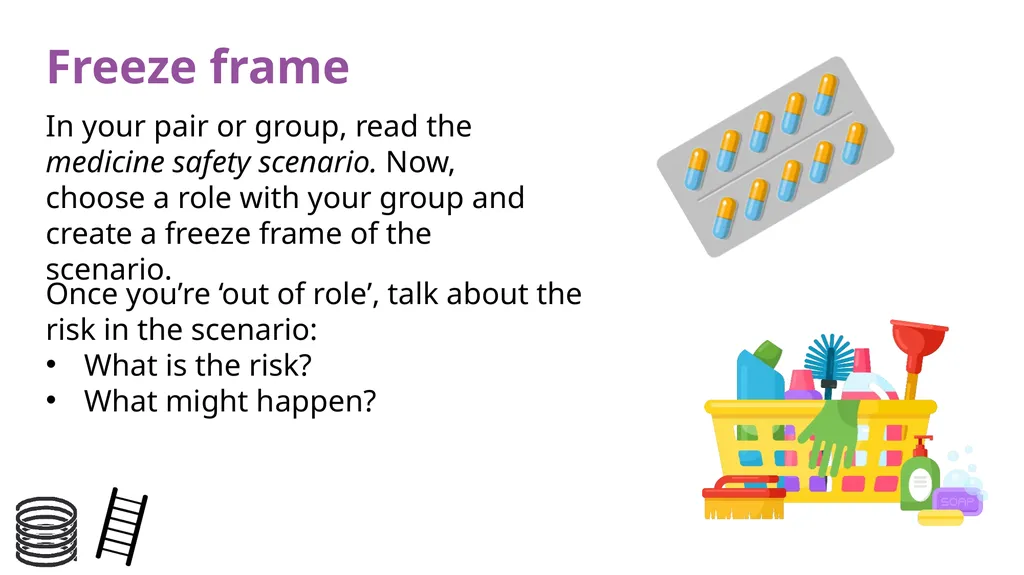
Freeze frame In your pair or group, read the medicine safety scenario. Now, choose a role with your group and create a freeze frame of the scenario. Once you’re ‘out of role’, talk about the risk in the scenario:
What is the risk?
What might happen?<br>
17
Role play Think about your scenario with your group.
What should the characters do now to prevent any further risk?
Who could help? Where could the person get more support or advice? Stepping back ‘into role’, role play what the characters should do to prevent any further risk and identify who could help.<br>
18
Reflecting and getting support Share one thing this lesson has made you think about medicine safety. It could be:
Something new you have learned
Something you think is important to remember in the future Remember that medicines are helpful for health but only if they are used correctly. Trusted adults should give medicine to children.
If you are unsure about using a medicine, ask a trusted adult.<br>
19
What has been learnt? Go back to the questions from your
benefits and risks list.
Is there anything you would like to change?
Is there anything you would like to add?
Use a different colour pen or pencil.<br>
20
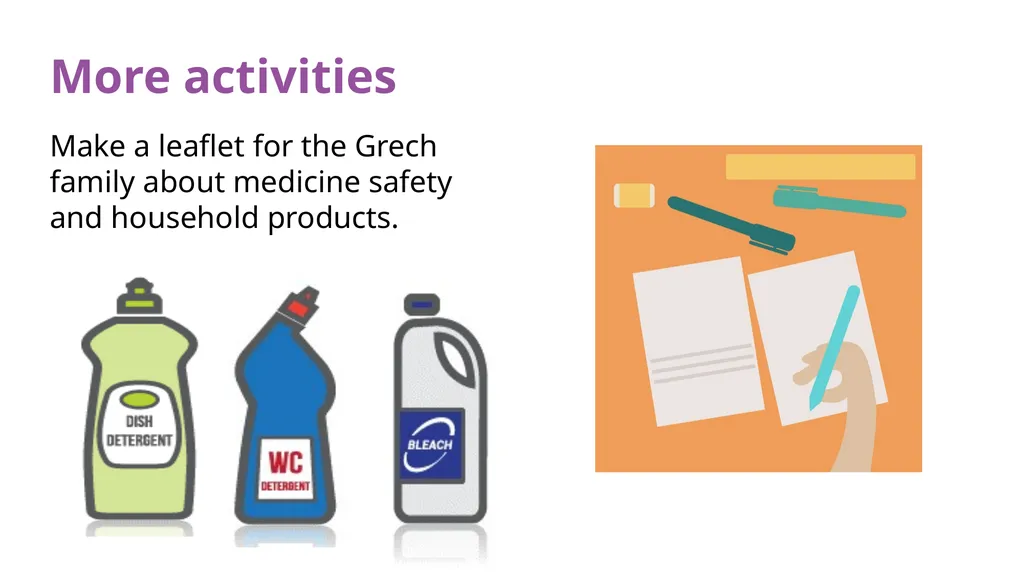
More activities Make a leaflet for the Grech family about medicine safety and household products.<br>