
Year 5, Unit 10 Angles Curriculum Prioritisation
SB
Published · 34 slides · 0 views
1 / 1
Description
Year 5, Unit 10 Angles Curriculum Prioritisation for Primary Maths These materials heavily reflect the prioritisation approach of the ready-to-progress criteria in the DfE Primary Mathematics Guidance 2020 and on the PPTs that exemplify
Related Topics
Share
Embed code
Download this presentation From Below
"Year 5, Unit 10 Angles Curriculum Prioritisation" is the property of its rightful owner. Permission is granted to download and print the materials on this website for personal, non-commercial use only, and to display it on your personal computer provided you do not modify the materials and that you retain all copyright notices contained in the materials. By downloading content from our website, you accept the terms of this agreement.
Presentation Transcript
01
Year 5, Unit 10 Angles<br>
02
Curriculum Prioritisation for Primary Maths These materials heavily reflect the prioritisation approach of the ready-to-progress criteria in the DfE Primary Mathematics Guidance 2020 and on the PPTs that exemplify them on the NCETM website. They also include other relevant National Curriculum content. Related sections of the NCETM Primary Mastery Professional Development Materials provide small-step teaching guidance.
Ready-to-progress criteria addressed by this unit
Teaching of this unit supports the following criteria from the ‘DfE Mathematics Guidance: key stages 1 & 2’ (the 335-page document available as a download)
5G-1 Page 265 Year 5, Unit 10<br>
Ready-to-progress criteria addressed by this unit
Teaching of this unit supports the following criteria from the ‘DfE Mathematics Guidance: key stages 1 & 2’ (the 335-page document available as a download)
5G-1 Page 265 Year 5, Unit 10<br>
03
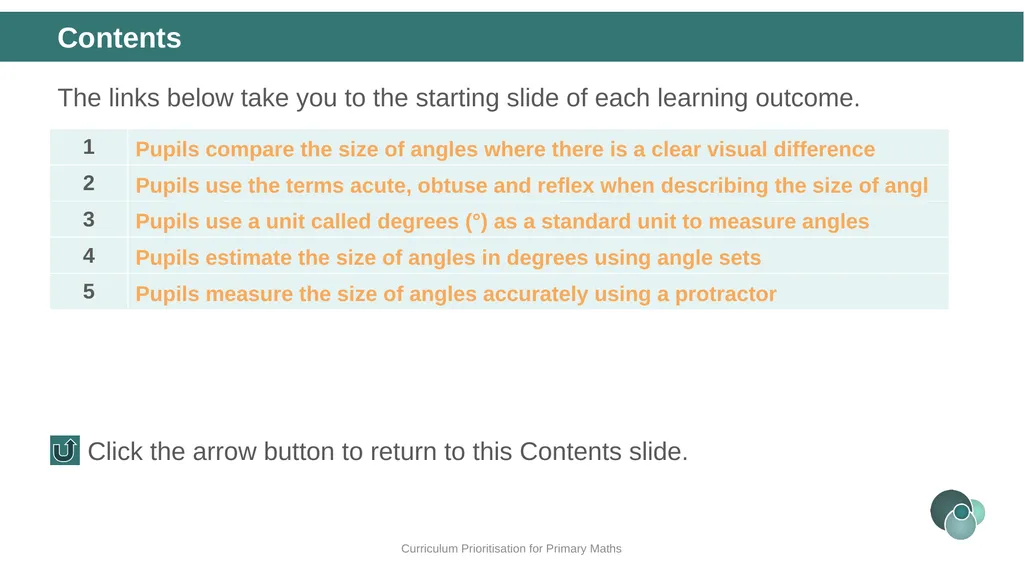
Curriculum Prioritisation for Primary Maths The links below take you to the starting slide of each learning outcome. Click the arrow button to return to this Contents slide. Contents<br>
04
Curriculum Prioritisation for Primary Maths The following slides have been collated to support the teaching of this learning outcome. Year 5, Unit 10, Learning Outcome 1<br>
05
Year 5, Unit 10, Learning Outcome 1 Curriculum Prioritisation for Primary Maths Additional teacher guidance for this outcome should be read first and can be found in the DfE Mathematics guidance. Page references relate to the 335-page document available as a download at the bottom of this web page.<br>
06
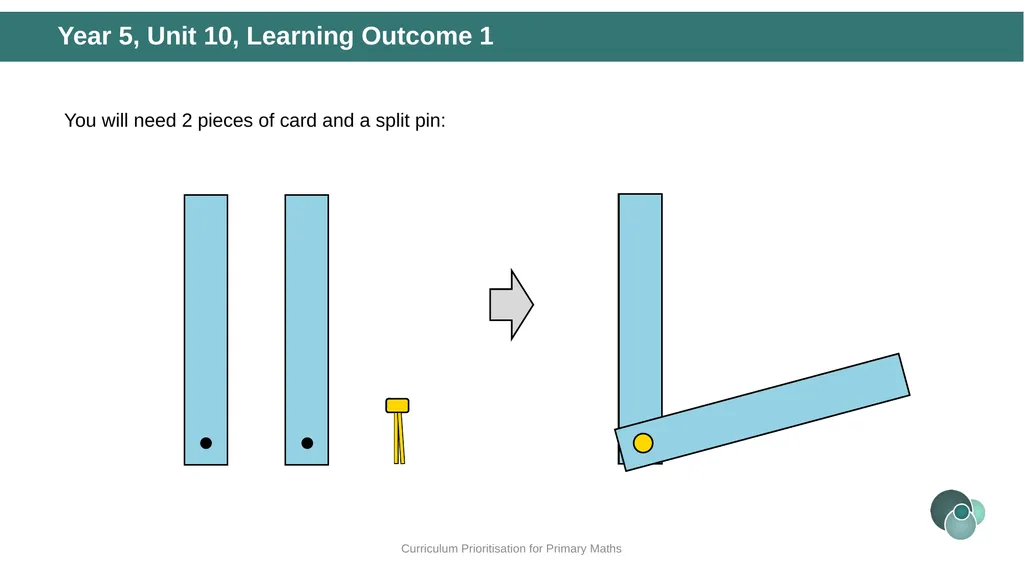
Curriculum Prioritisation for Primary Maths Year 5, Unit 10, Learning Outcome 1 You will need 2 pieces of card and a split pin:<br>
07
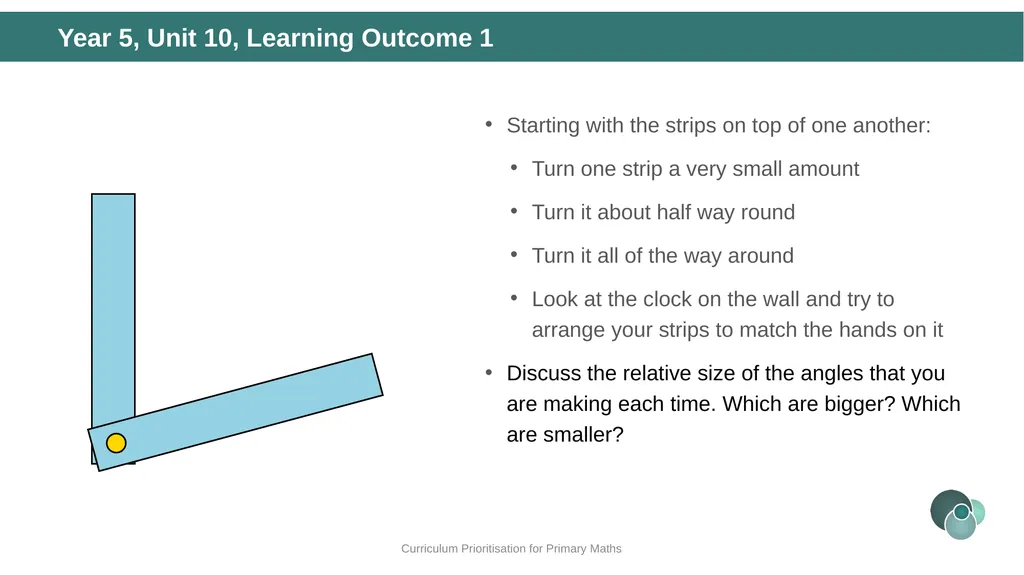
Curriculum Prioritisation for Primary Maths Year 5, Unit 10, Learning Outcome 1 Starting with the strips on top of one another:
Turn one strip a very small amount
Turn it about half way round
Turn it all of the way around
Look at the clock on the wall and try to arrange your strips to match the hands on it
Discuss the relative size of the angles that you are making each time. Which are bigger? Which are smaller?<br>
Turn one strip a very small amount
Turn it about half way round
Turn it all of the way around
Look at the clock on the wall and try to arrange your strips to match the hands on it
Discuss the relative size of the angles that you are making each time. Which are bigger? Which are smaller?<br>
08
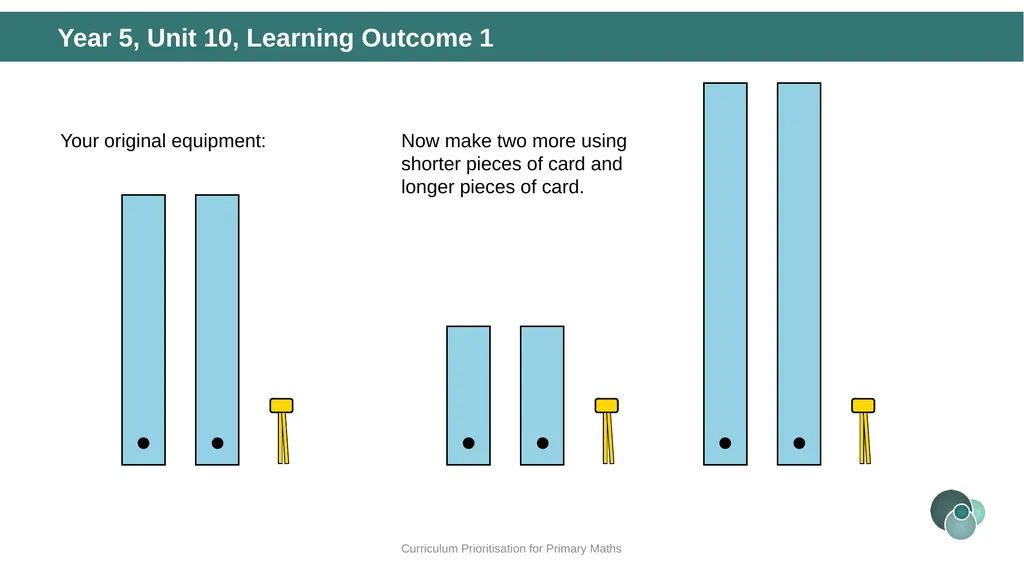
Curriculum Prioritisation for Primary Maths Year 5, Unit 10, Learning Outcome 1 Your original equipment: Now make two more using shorter pieces of card and longer pieces of card.<br>
09
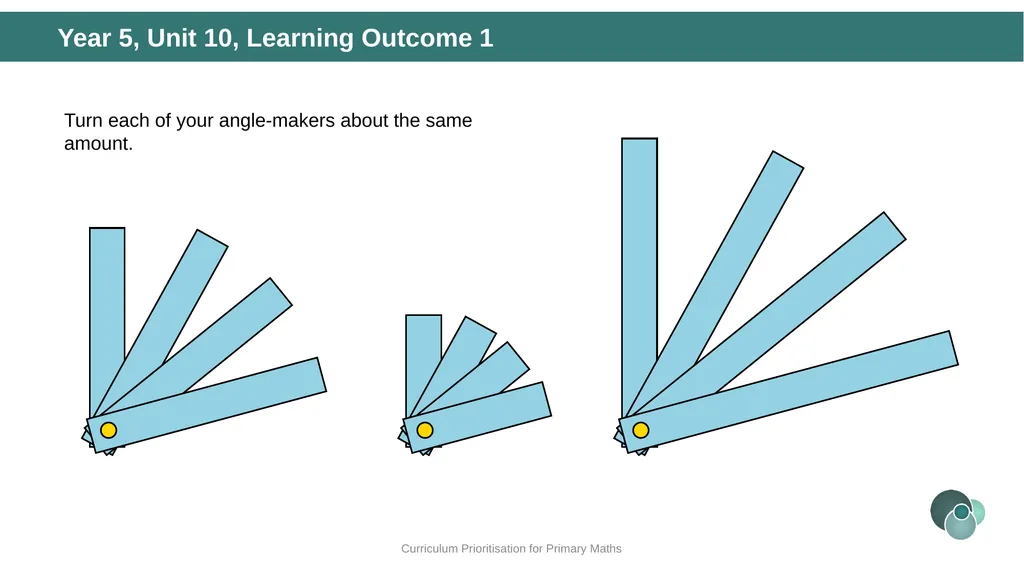
Curriculum Prioritisation for Primary Maths Year 5, Unit 10, Learning Outcome 1 Turn each of your angle-makers about the same amount.<br>
10
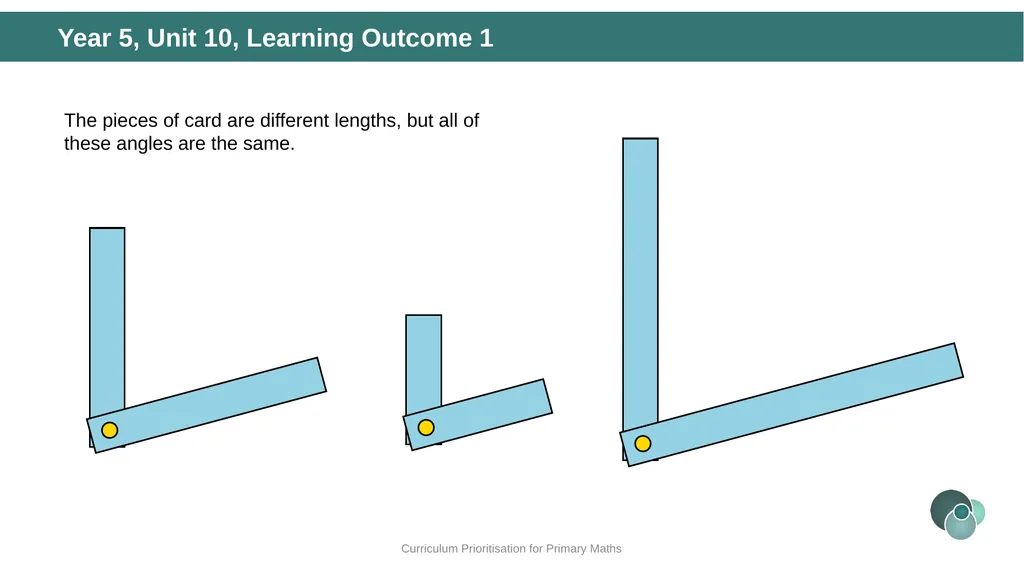
Curriculum Prioritisation for Primary Maths Year 5, Unit 10, Learning Outcome 1 The pieces of card are different lengths, but all of these angles are the same.<br>
11
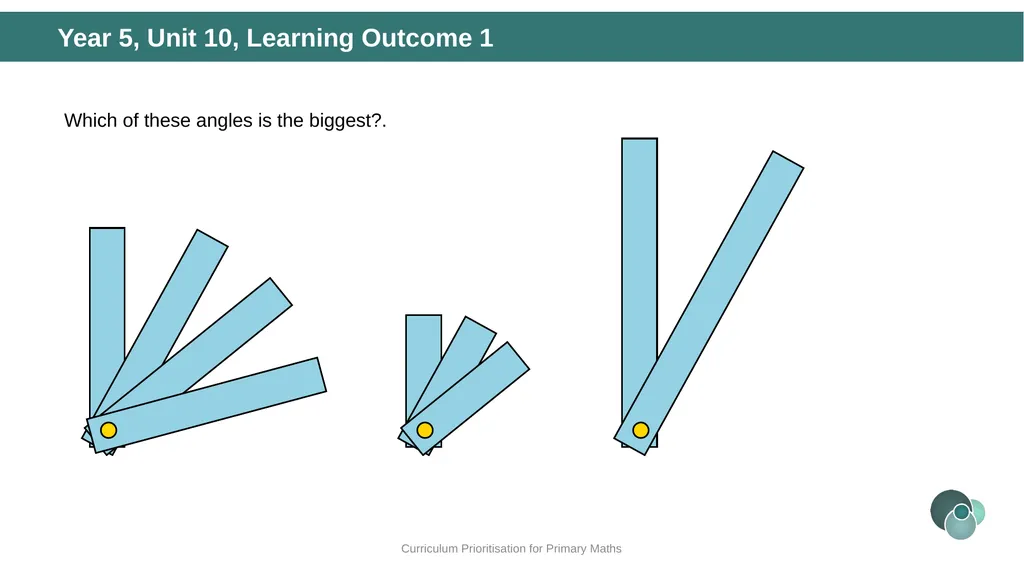
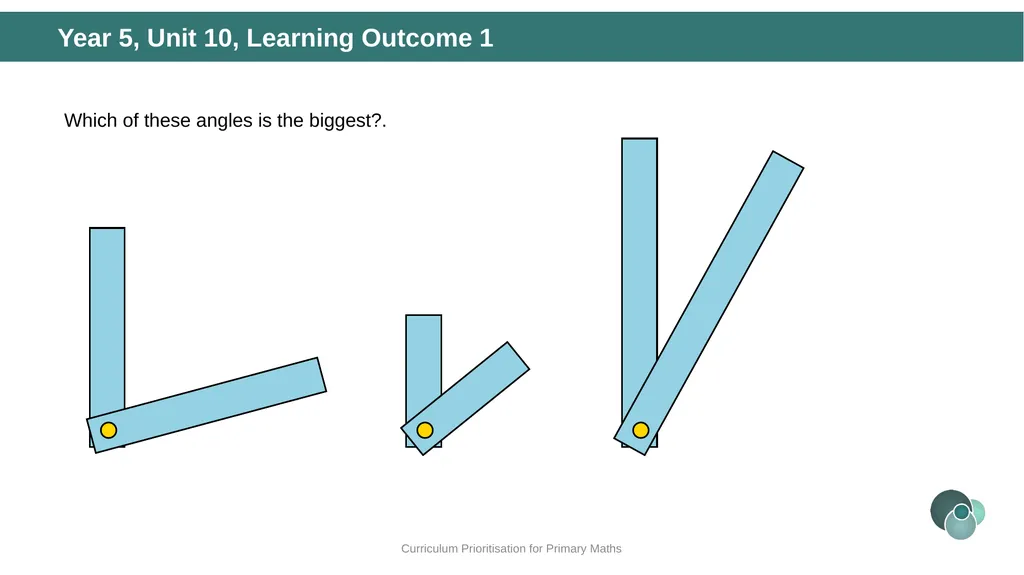
Curriculum Prioritisation for Primary Maths Year 5, Unit 10, Learning Outcome 1 Which of these angles is the biggest?.<br>
12
Curriculum Prioritisation for Primary Maths Year 5, Unit 10, Learning Outcome 1 Which of these angles is the biggest?.<br>
13
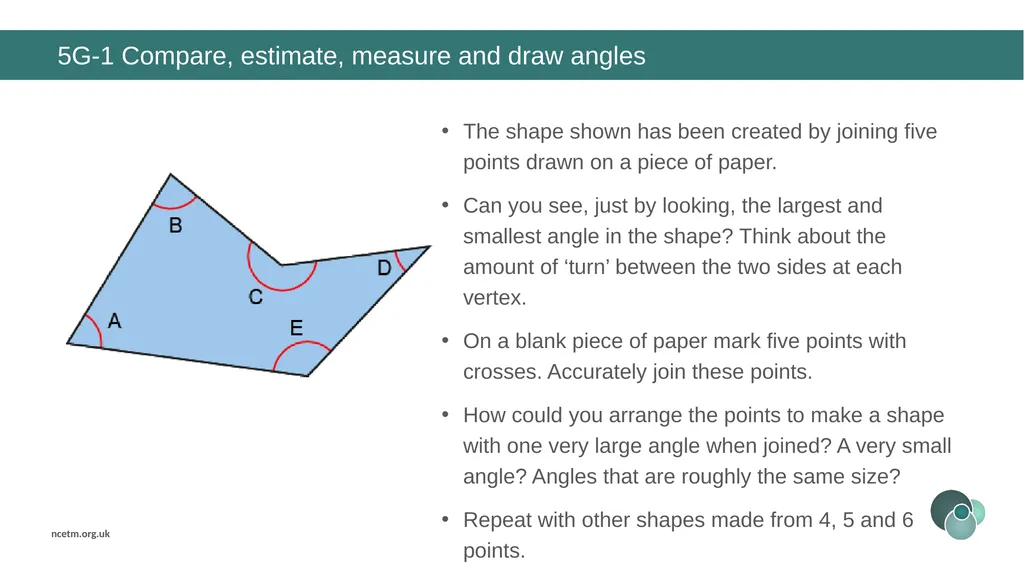
5G-1 Compare, estimate, measure and draw angles The shape shown has been created by joining five points drawn on a piece of paper.
Can you see, just by looking, the largest and smallest angle in the shape? Think about the amount of ‘turn’ between the two sides at each vertex.
On a blank piece of paper mark five points with crosses. Accurately join these points.
How could you arrange the points to make a shape with one very large angle when joined? A very small angle? Angles that are roughly the same size?
Repeat with other shapes made from 4, 5 and 6 points.<br>
Can you see, just by looking, the largest and smallest angle in the shape? Think about the amount of ‘turn’ between the two sides at each vertex.
On a blank piece of paper mark five points with crosses. Accurately join these points.
How could you arrange the points to make a shape with one very large angle when joined? A very small angle? Angles that are roughly the same size?
Repeat with other shapes made from 4, 5 and 6 points.<br>
14
Curriculum Prioritisation for Primary Maths The following slides have been collated to support the teaching of this learning outcome. Year 5, Unit 10, Learning Outcome 2<br>
15
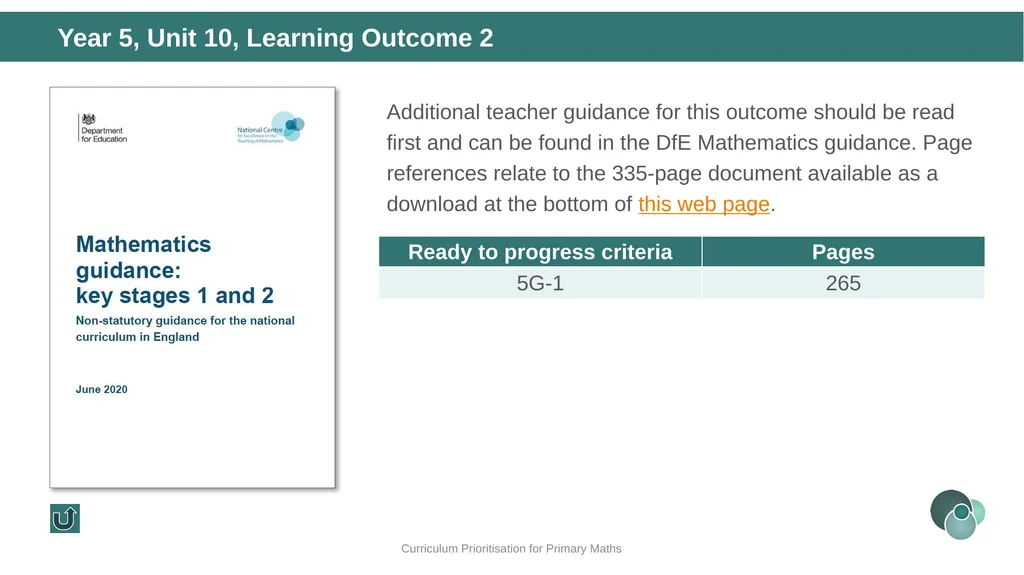
Year 5, Unit 10, Learning Outcome 2 Curriculum Prioritisation for Primary Maths Additional teacher guidance for this outcome should be read first and can be found in the DfE Mathematics guidance. Page references relate to the 335-page document available as a download at the bottom of this web page.<br>
16
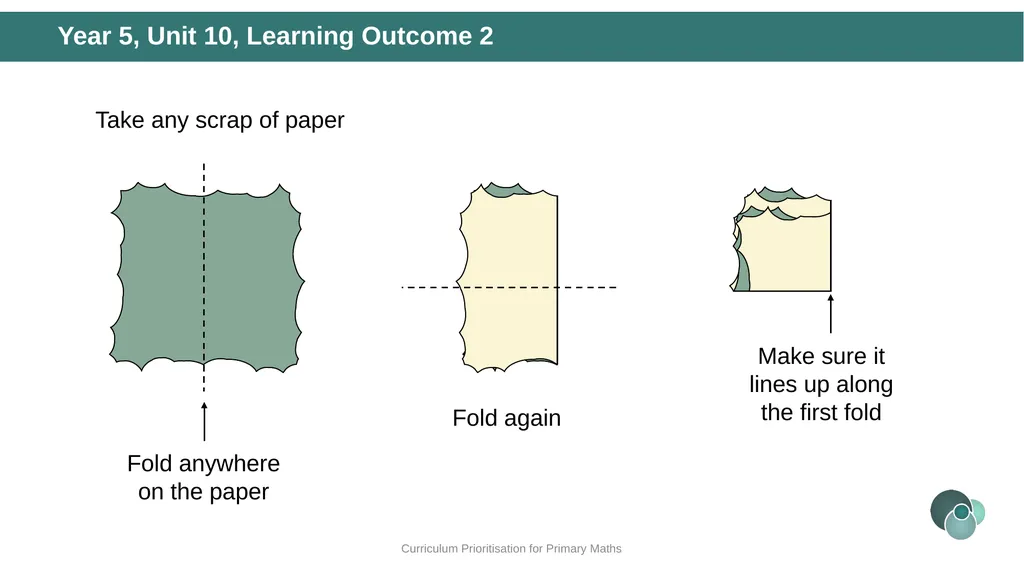
Curriculum Prioritisation for Primary Maths Year 5, Unit 10, Learning Outcome 2 Make sure it lines up along the first fold Fold anywhere on the paper Fold again Take any scrap of paper<br>
17
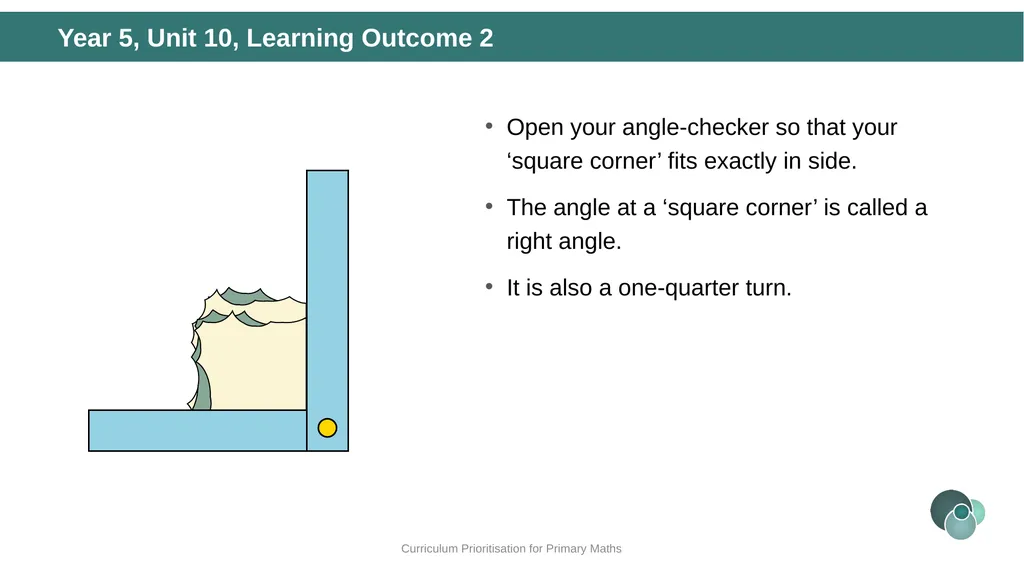
Curriculum Prioritisation for Primary Maths Year 5, Unit 10, Learning Outcome 2 Open your angle-checker so that your ‘square corner’ fits exactly in side.
The angle at a ‘square corner’ is called a right angle.
It is also a one-quarter turn.<br>
The angle at a ‘square corner’ is called a right angle.
It is also a one-quarter turn.<br>
18
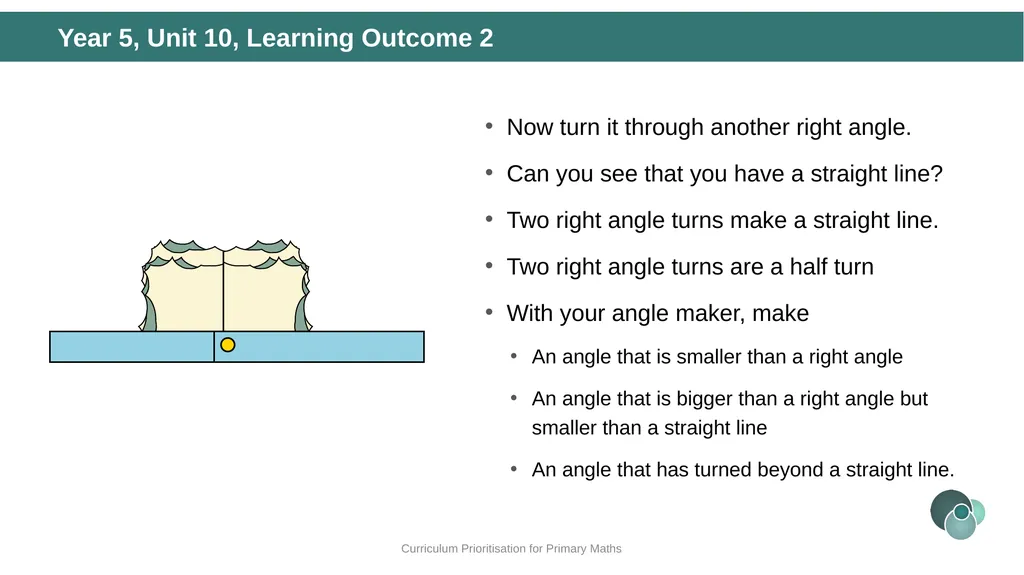
Curriculum Prioritisation for Primary Maths Year 5, Unit 10, Learning Outcome 2 Now turn it through another right angle.
Can you see that you have a straight line?
Two right angle turns make a straight line.
Two right angle turns are a half turn
With your angle maker, make
An angle that is smaller than a right angle
An angle that is bigger than a right angle but smaller than a straight line
An angle that has turned beyond a straight line.<br>
Can you see that you have a straight line?
Two right angle turns make a straight line.
Two right angle turns are a half turn
With your angle maker, make
An angle that is smaller than a right angle
An angle that is bigger than a right angle but smaller than a straight line
An angle that has turned beyond a straight line.<br>
19
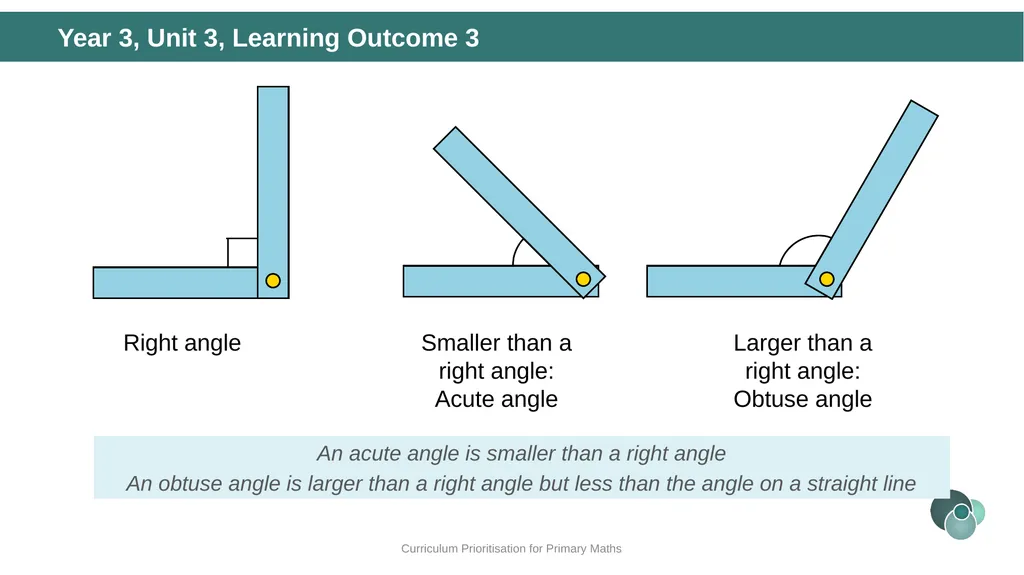
Year 3, Unit 3, Learning Outcome 3 Curriculum Prioritisation for Primary Maths Right angle Smaller than a right angle:
Acute angle Larger than a right angle: Obtuse angle An acute angle is smaller than a right angle
An obtuse angle is larger than a right angle but less than the angle on a straight line<br>
Acute angle Larger than a right angle: Obtuse angle An acute angle is smaller than a right angle
An obtuse angle is larger than a right angle but less than the angle on a straight line<br>
20
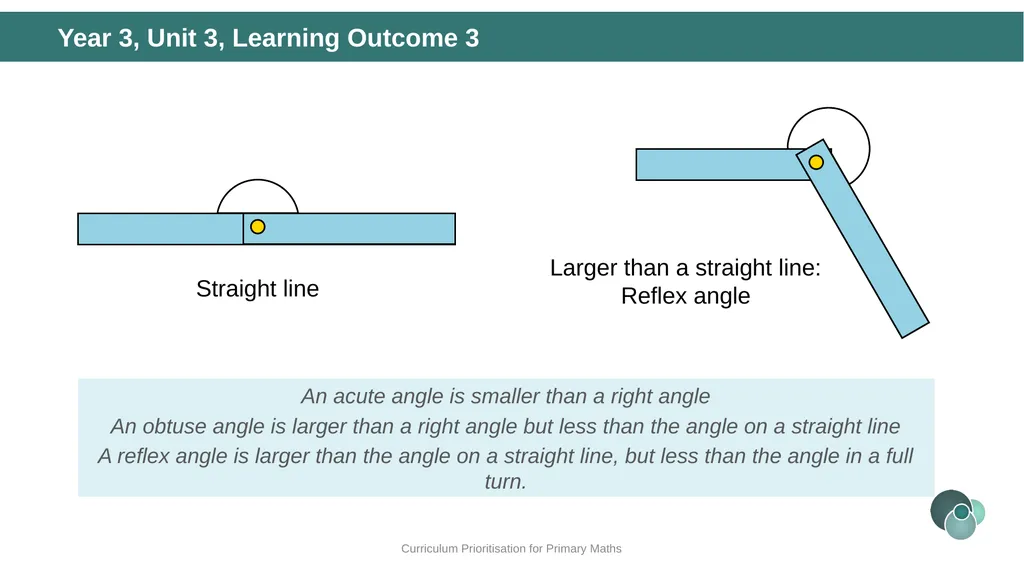
Year 3, Unit 3, Learning Outcome 3 Curriculum Prioritisation for Primary Maths Straight line Larger than a straight line:
Reflex angle An acute angle is smaller than a right angle
An obtuse angle is larger than a right angle but less than the angle on a straight line
A reflex angle is larger than the angle on a straight line, but less than the angle in a full turn.<br>
Reflex angle An acute angle is smaller than a right angle
An obtuse angle is larger than a right angle but less than the angle on a straight line
A reflex angle is larger than the angle on a straight line, but less than the angle in a full turn.<br>
21
Curriculum Prioritisation for Primary Maths The following slides have been collated to support the teaching of this learning outcome. Year 5, Unit 10, Learning Outcome 3<br>
22
Year 5, Unit 10, Learning Outcome 3 Curriculum Prioritisation for Primary Maths Additional teacher guidance for this outcome should be read first and can be found in the DfE Mathematics guidance. Page references relate to the 335-page document available as a download at the bottom of this web page.<br>
23
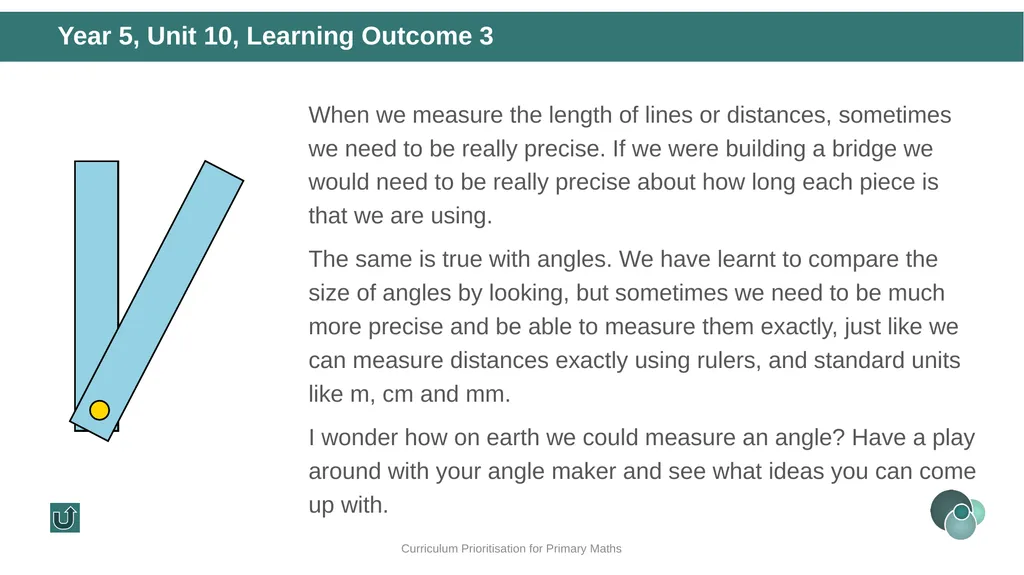
Curriculum Prioritisation for Primary Maths Year 5, Unit 10, Learning Outcome 3 When we measure the length of lines or distances, sometimes we need to be really precise. If we were building a bridge we would need to be really precise about how long each piece is that we are using.
The same is true with angles. We have learnt to compare the size of angles by looking, but sometimes we need to be much more precise and be able to measure them exactly, just like we can measure distances exactly using rulers, and standard units like m, cm and mm.
I wonder how on earth we could measure an angle? Have a play around with your angle maker and see what ideas you can come up with.<br>
The same is true with angles. We have learnt to compare the size of angles by looking, but sometimes we need to be much more precise and be able to measure them exactly, just like we can measure distances exactly using rulers, and standard units like m, cm and mm.
I wonder how on earth we could measure an angle? Have a play around with your angle maker and see what ideas you can come up with.<br>
24
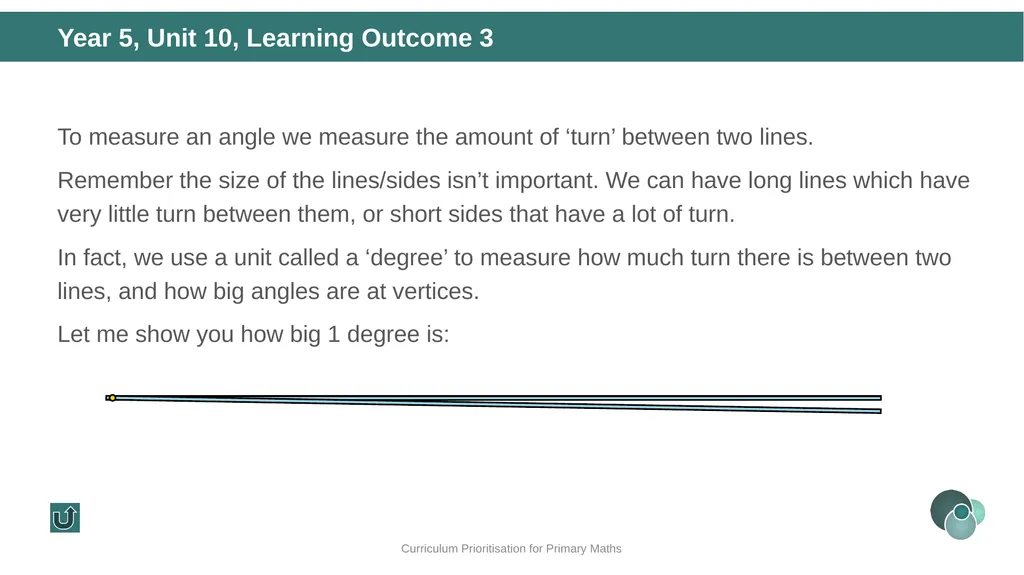
Curriculum Prioritisation for Primary Maths Year 5, Unit 10, Learning Outcome 3 To measure an angle we measure the amount of ‘turn’ between two lines.
Remember the size of the lines/sides isn’t important. We can have long lines which have very little turn between them, or short sides that have a lot of turn.
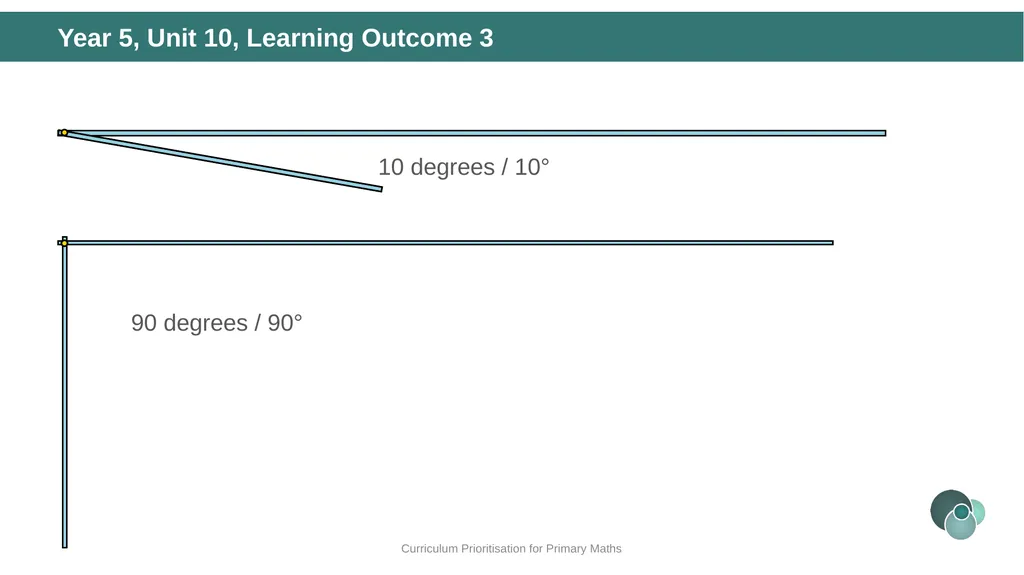
In fact, we use a unit called a ‘degree’ to measure how much turn there is between two lines, and how big angles are at vertices.
Let me show you how big 1 degree is:<br>
Remember the size of the lines/sides isn’t important. We can have long lines which have very little turn between them, or short sides that have a lot of turn.
In fact, we use a unit called a ‘degree’ to measure how much turn there is between two lines, and how big angles are at vertices.
Let me show you how big 1 degree is:<br>
25
Curriculum Prioritisation for Primary Maths Year 5, Unit 10, Learning Outcome 3 10 degrees / 10° 90 degrees / 90°<br>
26
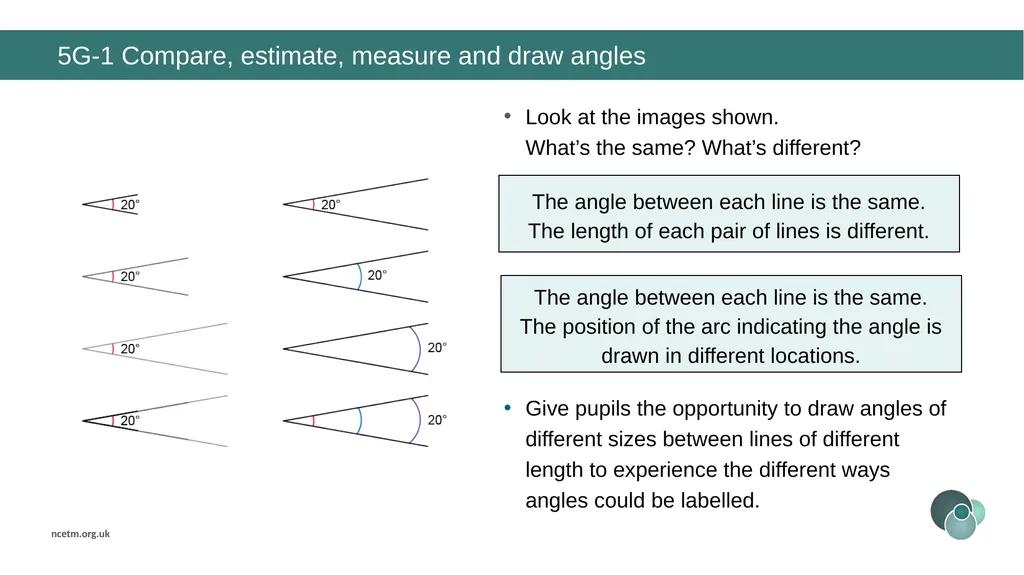
Look at the images shown. What’s the same? What’s different?
Give pupils the opportunity to draw angles of different sizes between lines of different length to experience the different ways angles could be labelled. 5G-1 Compare, estimate, measure and draw angles The angle between each line is the same.
The length of each pair of lines is different. The angle between each line is the same.
The position of the arc indicating the angle is drawn in different locations.<br>
Give pupils the opportunity to draw angles of different sizes between lines of different length to experience the different ways angles could be labelled. 5G-1 Compare, estimate, measure and draw angles The angle between each line is the same.
The length of each pair of lines is different. The angle between each line is the same.
The position of the arc indicating the angle is drawn in different locations.<br>
27
Curriculum Prioritisation for Primary Maths The following slides have been collated to support the teaching of this learning outcome. Year 5, Unit 10, Learning Outcome 4<br>
28
Year 5, Unit 10, Learning Outcome 4 Curriculum Prioritisation for Primary Maths Additional teacher guidance for this outcome should be read first and can be found in the DfE Mathematics guidance. Page references relate to the 335-page document available as a download at the bottom of this web page.<br>
29
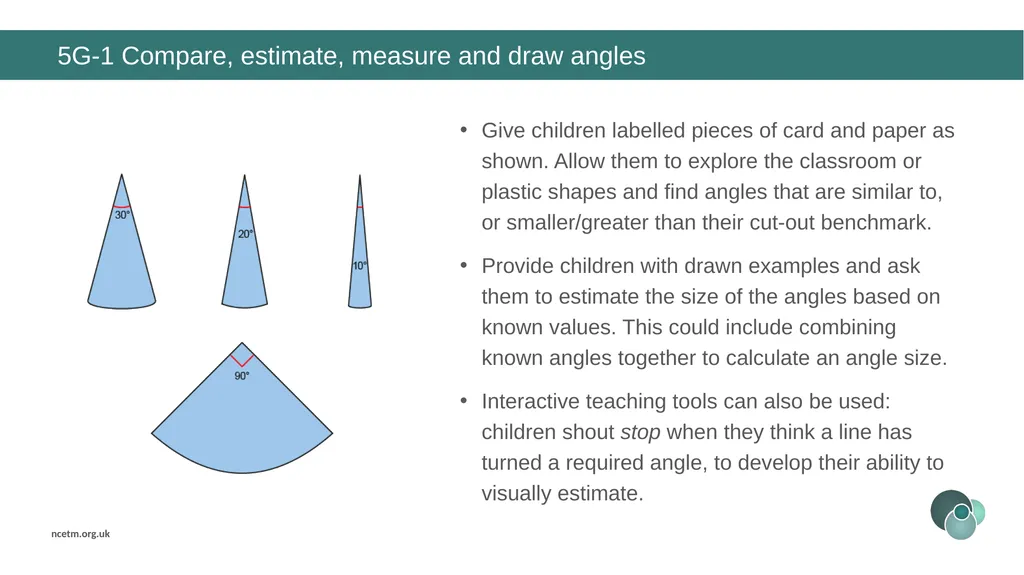
5G-1 Compare, estimate, measure and draw angles Give children labelled pieces of card and paper as shown. Allow them to explore the classroom or plastic shapes and find angles that are similar to, or smaller/greater than their cut-out benchmark.
Provide children with drawn examples and ask them to estimate the size of the angles based on known values. This could include combining known angles together to calculate an angle size.
Interactive teaching tools can also be used: children shout stop when they think a line has turned a required angle, to develop their ability to visually estimate.<br>
Provide children with drawn examples and ask them to estimate the size of the angles based on known values. This could include combining known angles together to calculate an angle size.
Interactive teaching tools can also be used: children shout stop when they think a line has turned a required angle, to develop their ability to visually estimate.<br>
30
Curriculum Prioritisation for Primary Maths The following slides have been collated to support the teaching of this learning outcome. Year 5, Unit 10, Learning Outcome 5<br>
31
Year 5, Unit 10, Learning Outcome 4 Curriculum Prioritisation for Primary Maths Additional teacher guidance for this outcome should be read first and can be found in the DfE Mathematics guidance. Page references relate to the 335-page document available as a download at the bottom of this web page.<br>
32
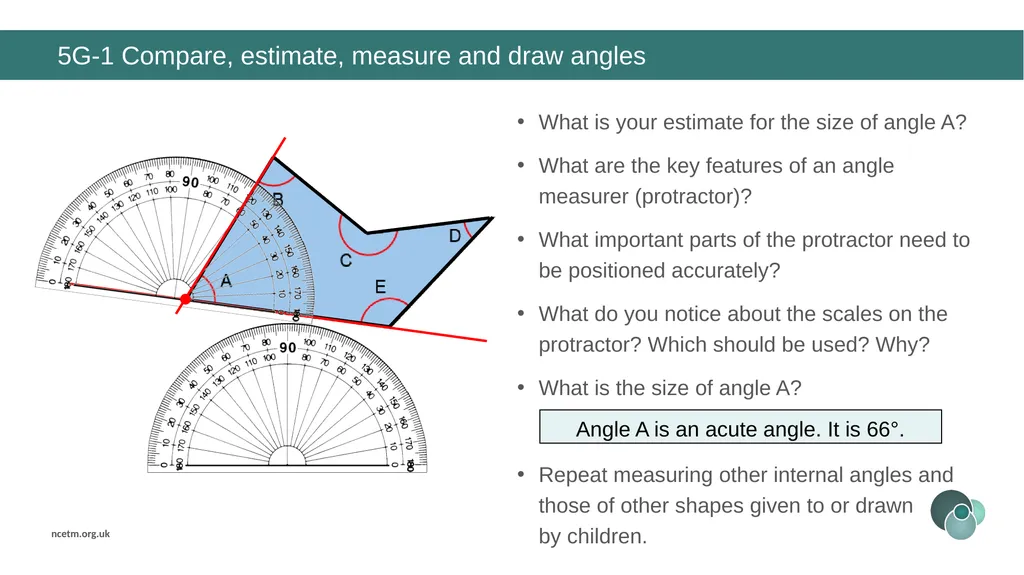
5G-1 Compare, estimate, measure and draw angles What is your estimate for the size of angle A?
What are the key features of an angle measurer (protractor)?
What important parts of the protractor need to be positioned accurately?
What do you notice about the scales on the protractor? Which should be used? Why?
What is the size of angle A?
Repeat measuring other internal angles and those of other shapes given to or drawn by children. Angle A is an acute angle. It is 66°.<br>
What are the key features of an angle measurer (protractor)?
What important parts of the protractor need to be positioned accurately?
What do you notice about the scales on the protractor? Which should be used? Why?
What is the size of angle A?
Repeat measuring other internal angles and those of other shapes given to or drawn by children. Angle A is an acute angle. It is 66°.<br>
33
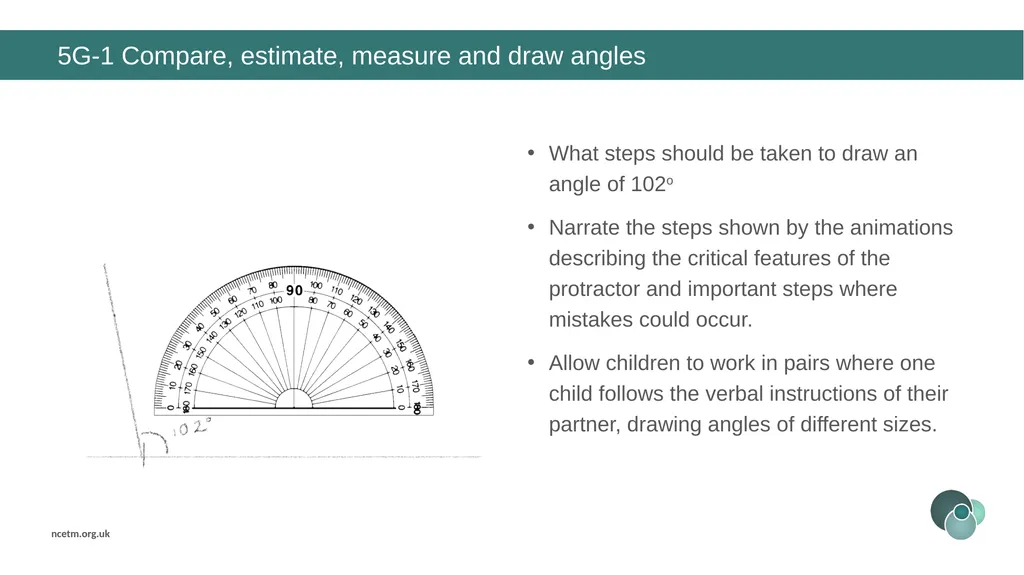
5G-1 Compare, estimate, measure and draw angles What steps should be taken to draw an angle of 102o
Narrate the steps shown by the animations describing the critical features of the protractor and important steps where mistakes could occur.
Allow children to work in pairs where one child follows the verbal instructions of their partner, drawing angles of different sizes.<br>
Narrate the steps shown by the animations describing the critical features of the protractor and important steps where mistakes could occur.
Allow children to work in pairs where one child follows the verbal instructions of their partner, drawing angles of different sizes.<br>