Search Results for 'carbon proteins'
carbon proteins published presentations and documents on DocSlides.
Notes: Chapter 2.3 Carbon Compounds
by jideborn
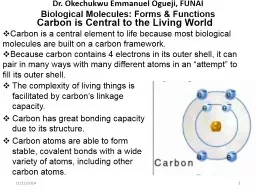
Chemistry of Carbon. Carbon can form four covalent...
Chapter 3 Biochemistry Section 1 – Carbon Compounds
by paige
Section 2 – Molecules of Life. Objectives. Disti...
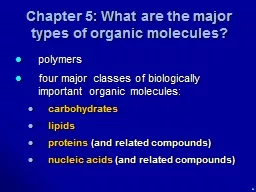
Chapter 5: What are the major types of organic molecules?
by ellena-manuel
polymers. four major classes of biologically impo...
Structure and Function of macromolecules
by olivia-moreira
SC.912.L.18.1 Describe the . basic molecular stru...
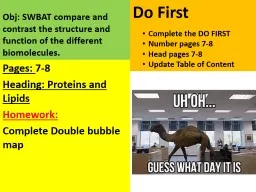
Obj : SWBAT compare and contrast the structure and function
by luanne-stotts
Pages: . 7. -8. Heading: . Proteins and Lipids. H...

MACROMOLECULES Describe in detail what you see in the diagram.
by tatiana-dople
MACROMOLECULES Describe in detail what you see in...
Cycles in Nature ¨ Law of Conservation of
by isla
Matter”. Matter cannot be created nor destroyed ...
YOU ARE WHAT YOU EAT! BIOCHEMISTRY UNIT
by pamella-moone
Chapter 2,. Sections 3 & 4 . Pages 44-48, 51-...
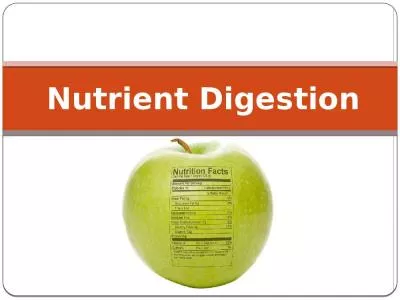
Nutrient Digestion What Are Nutrients?
by emmett324
Nutrients. are the . components . in food that pr...
N utritionally Essential & Nutritionally Non Essential Amino Acids
by deena
Lecture :4. Dr. . Shaimaa. . Munther. Nutritional...
Controlling protein overexpression from yeast shuttle vectors
by berey
GAL1. promoter is induced by galactose. How is re...
Macromolecules Organic Chemistry
by stefany-barnette
The element Carbon is found in most living organi...
Life’s Structure: Building the Molecules
by mitsue-stanley
All life uses 6 major elements. If we survey the ...
Biochemistry: Monomers and Polymers
by liane-varnes
Carbohydrates, lipids, proteins, and nucleic acid...
Organisms are mainly composed of C, H, O & N
by olivia-moreira
Living organisms also contain S and P as well as ...
Controlling protein overexpression from yeast shuttle vecto
by lois-ondreau
GAL1. promoter is induced by galactose. How is r...