04
Topic Description 5_Target Value Delivery
This topic introduces Target Value Delivery (TVD) and the associated phases.
Participants will learn the key difference between traditional versus TVD approach, key high level guidelines, and some Lean approaches supporting implementing TVD. 4 Note: For AIA or other Continuing Education Credits, participants will need to self-report attendance and learning.<br>
05
Lean Journey to Mastery Continuous Learning Cycle(s) 5 How will you reach the next level on your journey? Going from less aware to awareness<br>
06
Discussion Question 6 What are your dissatisfactions with how the design process goes?<br>
07
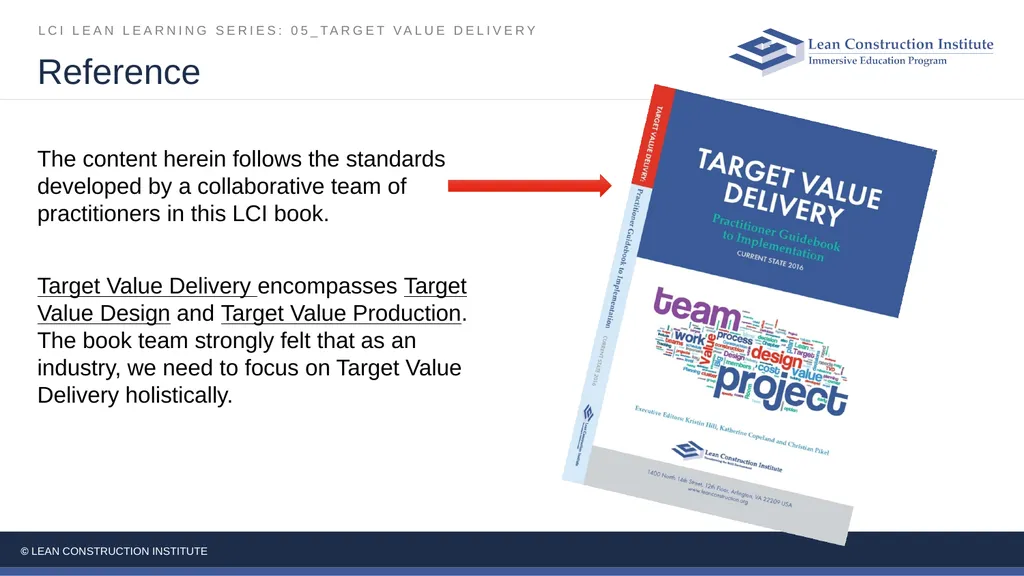
Reference The content herein follows the standards developed by a collaborative team of practitioners in this LCI book. Target Value Delivery encompasses Target Value Design and Target Value Production. The book team strongly felt that as an industry, we need to focus on Target Value Delivery holistically.<br>
08
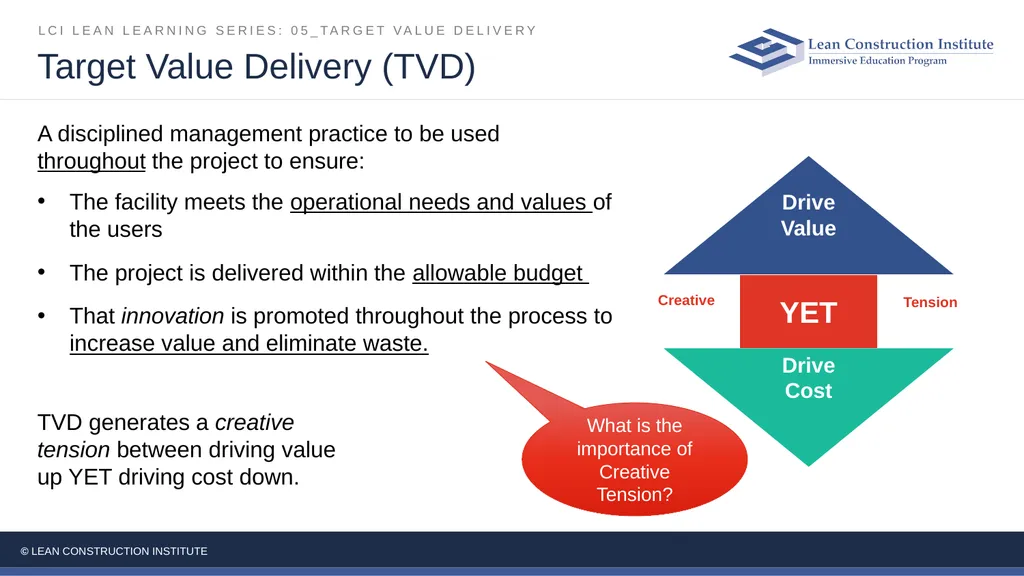
A disciplined management practice to be used throughout the project to ensure:
The facility meets the operational needs and values of the users
The project is delivered within the allowable budget
That innovation is promoted throughout the process to increase value and eliminate waste. Target Value Delivery (TVD) TVD generates a creative tension between driving value up YET driving cost down. What is the importance of Creative Tension?<br>
09
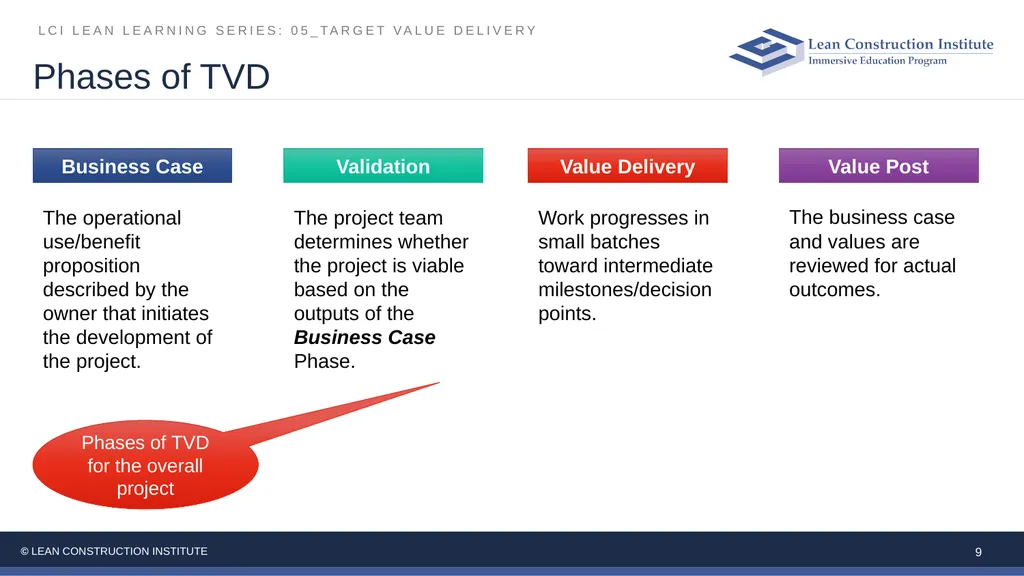
Phases of TVD 9 The operational use/benefit proposition described by the owner that initiates the development of the project. Business Case The project team determines whether the project is viable based on the outputs of the Business Case Phase. Validation Value Delivery Value Post Work progresses in small batches toward intermediate milestones/decision points. The business case and values are reviewed for actual outcomes. Phases of TVD for the overall project<br>
10
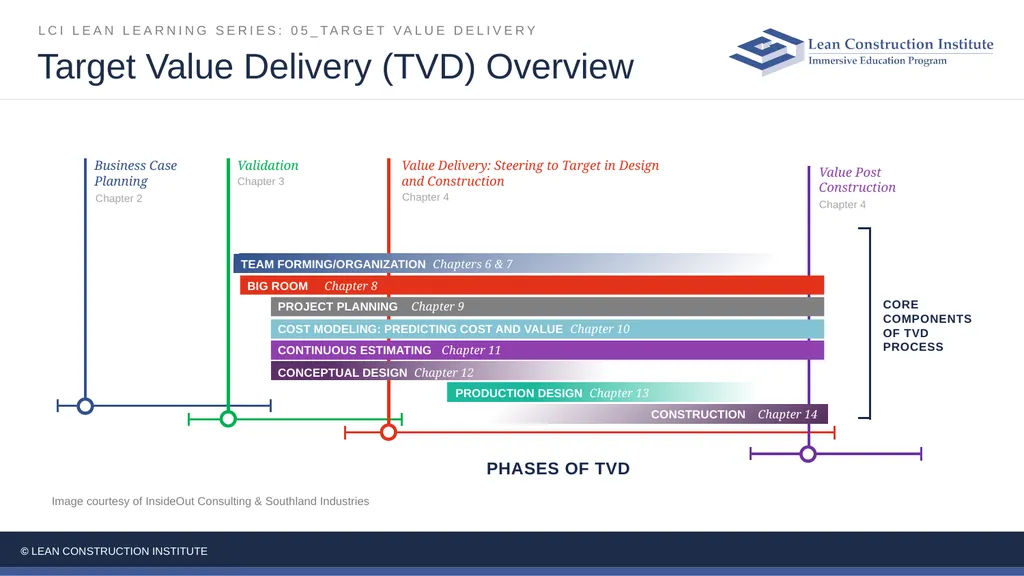
Business Case
Planning Chapter 2 Validation Chapter 3 Value Delivery: Steering to Target in Design �and Construction Chapter 4 Value Post
Construction Chapter 4 BIG ROOM Chapter 8 PROJECT PLANNING Chapter 9 COST MODELING: PREDICTING COST AND VALUE Chapter 10 CONTINUOUS ESTIMATING Chapter 11 CONCEPTUAL DESIGN Chapter 12 PRODUCTION DESIGN Chapter 13 TEAM FORMING/ORGANIZATION Chapters 6 & 7 CORE
COMPONENTS
OF TVD
PROCESS PHASES OF TVD CONSTRUCTION Chapter 14 Image courtesy of InsideOut Consulting & Southland Industries Target Value Delivery (TVD) Overview<br>
11
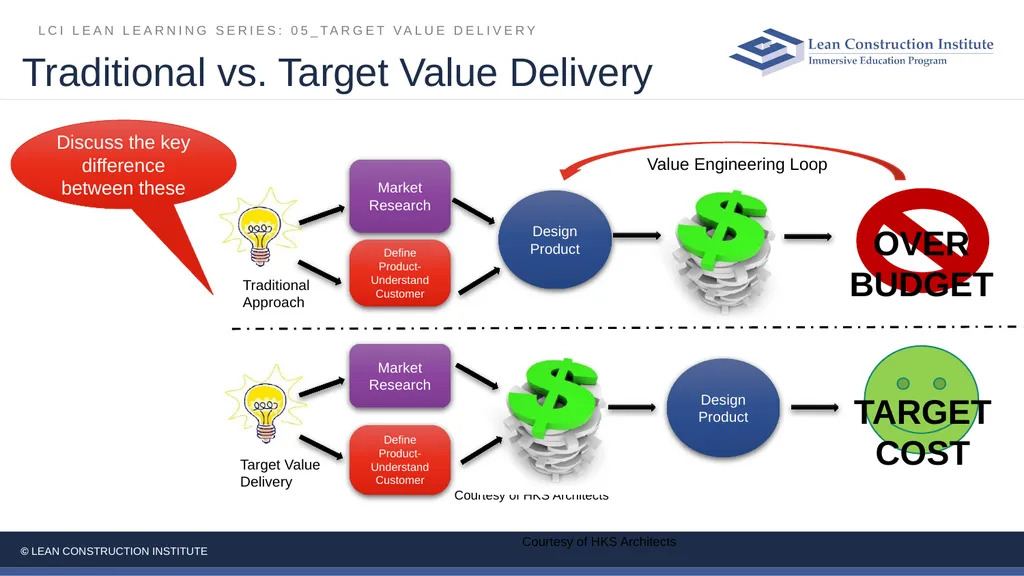
Traditional vs. Target Value Delivery Courtesy of HKS Architects Courtesy of HKS Architects Value Engineering Loop Discuss the key difference between these<br>
12
Discussion Question 12 What might the impact of the previous diagram have on project outcomes?<br>
13
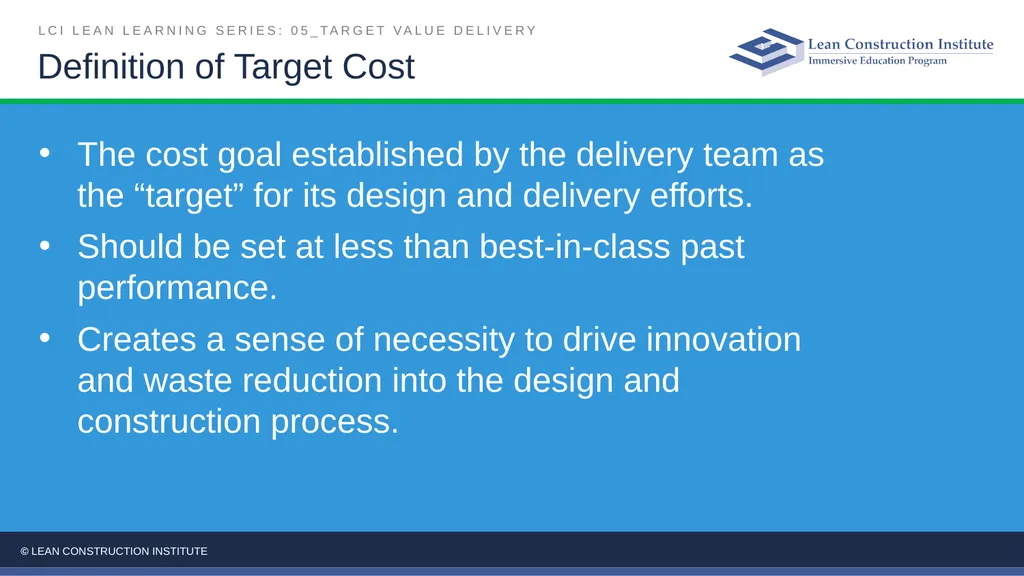
The cost goal established by the delivery team as the “target” for its design and delivery efforts.
Should be set at less than best-in-class past performance.
Creates a sense of necessity to drive innovation and waste reduction into the design and construction process. Definition of Target Cost<br>
14
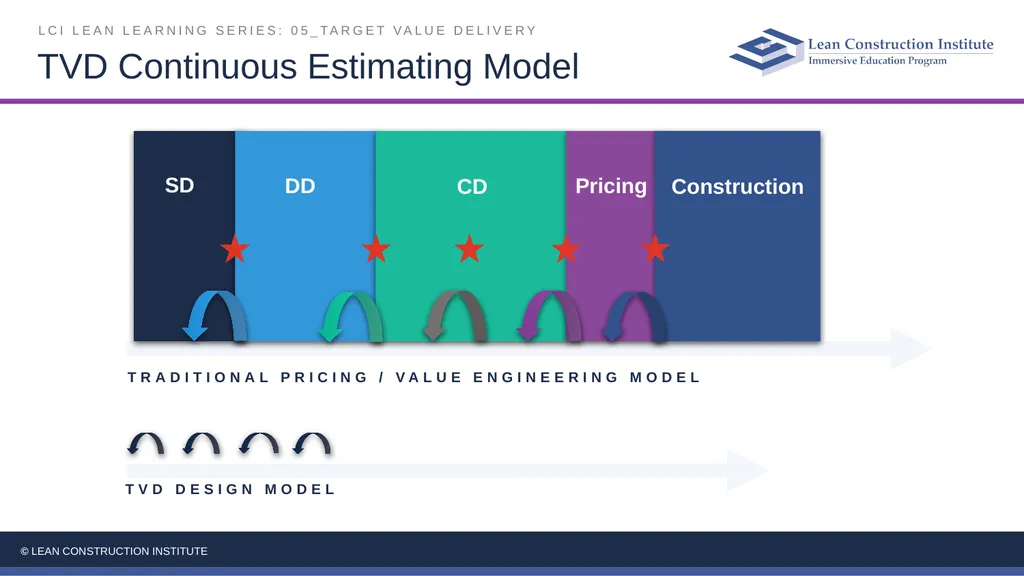
SD DD CD Pricing Construction TRADITIONAL PRICING / VALUE ENGINEERING MODEL TVD Continuous Estimating Model<br>
15
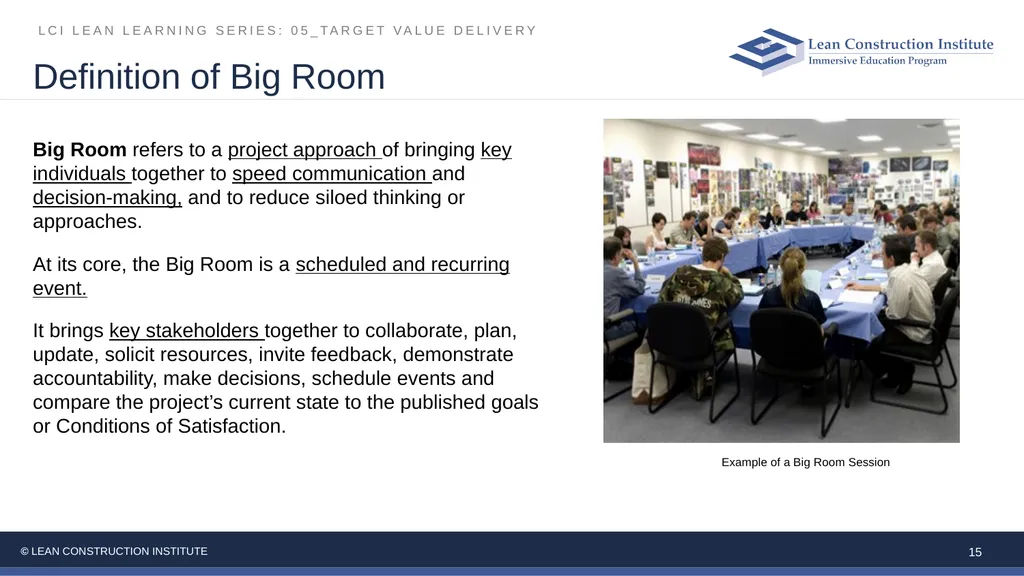
15 Big Room refers to a project approach of bringing key individuals together to speed communication and decision-making, and to reduce siloed thinking or approaches.
At its core, the Big Room is a scheduled and recurring event.
It brings key stakeholders together to collaborate, plan, update, solicit resources, invite feedback, demonstrate accountability, make decisions, schedule events and compare the project’s current state to the published goals or Conditions of Satisfaction. Example of a Big Room Session Module 1 Title: Big Room Overview Definition of Big Room<br>
16
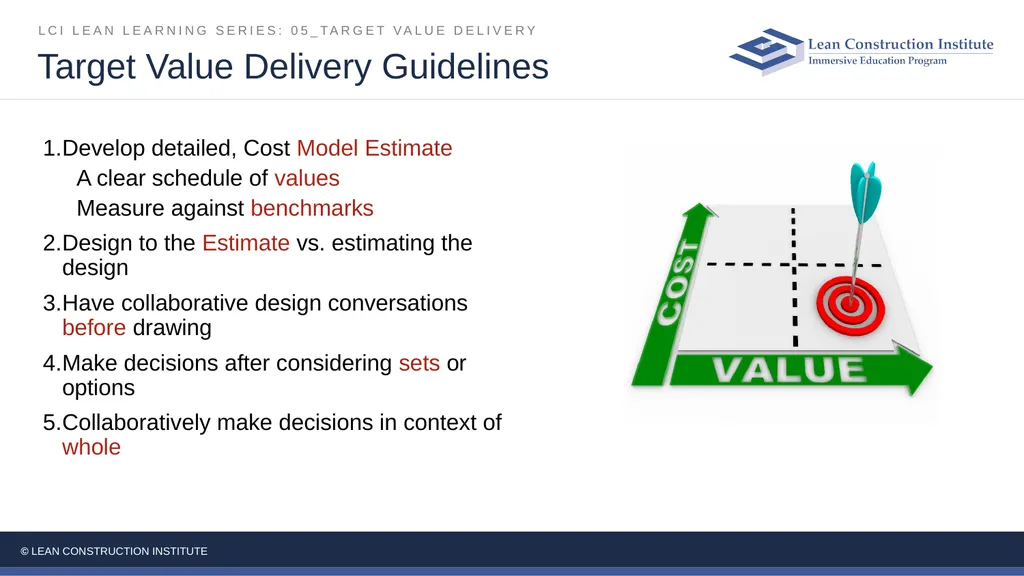
Develop detailed, Cost Model Estimate
A clear schedule of values
Measure against benchmarks
Design to the Estimate vs. estimating the design
Have collaborative design conversations before drawing
Make decisions after considering sets or options
Collaboratively make decisions in context of whole Module 4 Title: Key Lean Approaches Target Value Delivery Guidelines<br>
17
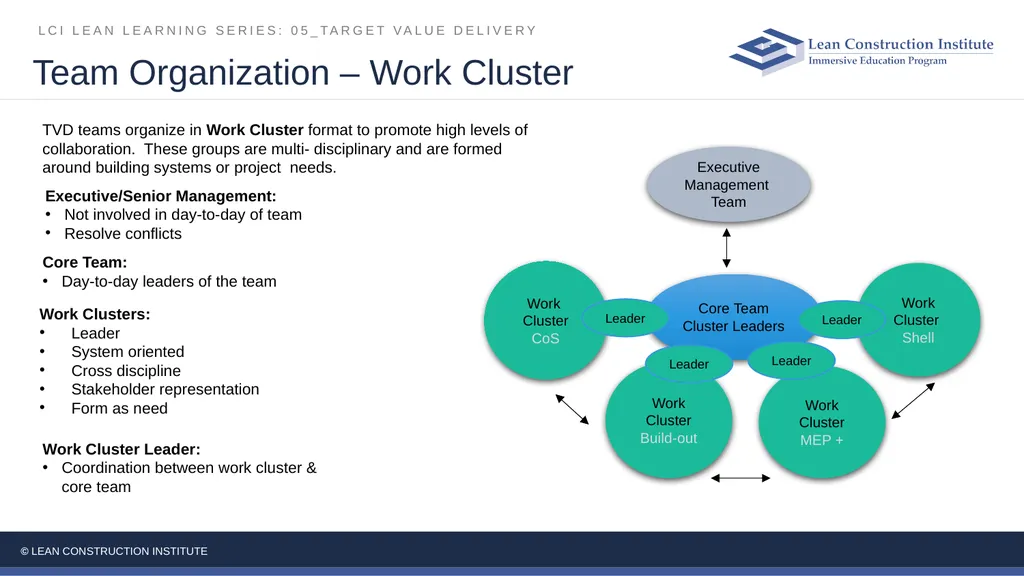
Team Organization – Work Cluster TVD teams organize in Work Cluster format to promote high levels of collaboration. These groups are multi- disciplinary and are formed around building systems or project needs.<br>
18
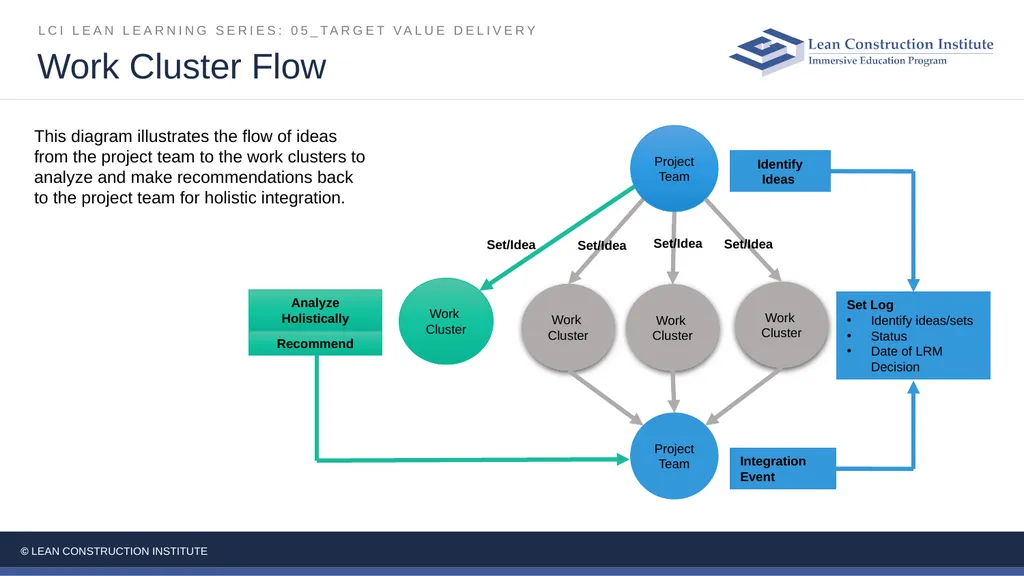
This diagram illustrates the flow of ideas from the project team to the work clusters to analyze and make recommendations back to the project team for holistic integration. Work Cluster Flow<br>
19
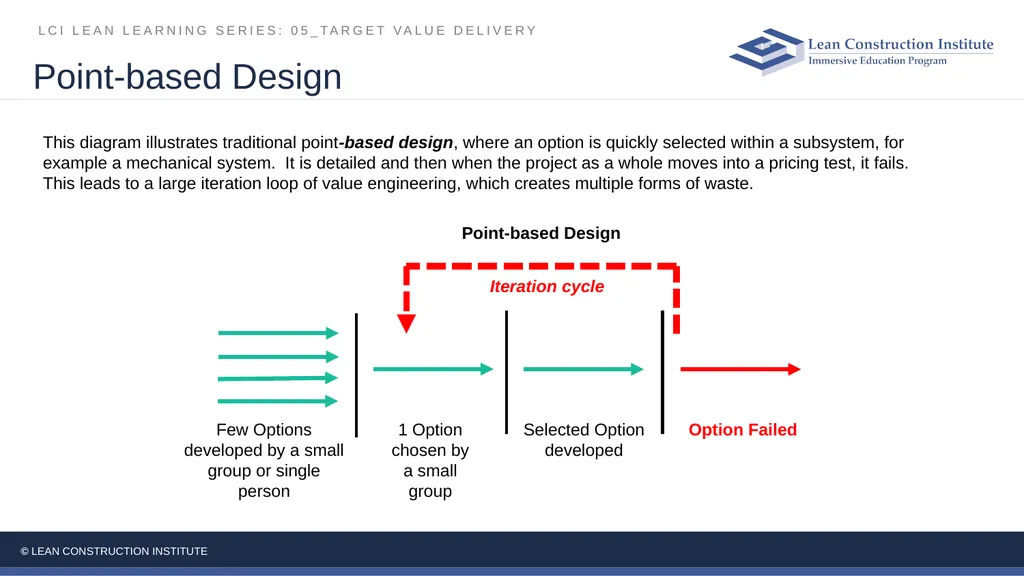
Module 4 Title: This diagram illustrates traditional point-based design, where an option is quickly selected within a subsystem, for example a mechanical system. It is detailed and then when the project as a whole moves into a pricing test, it fails. This leads to a large iteration loop of value engineering, which creates multiple forms of waste. Point-based Design<br>
20
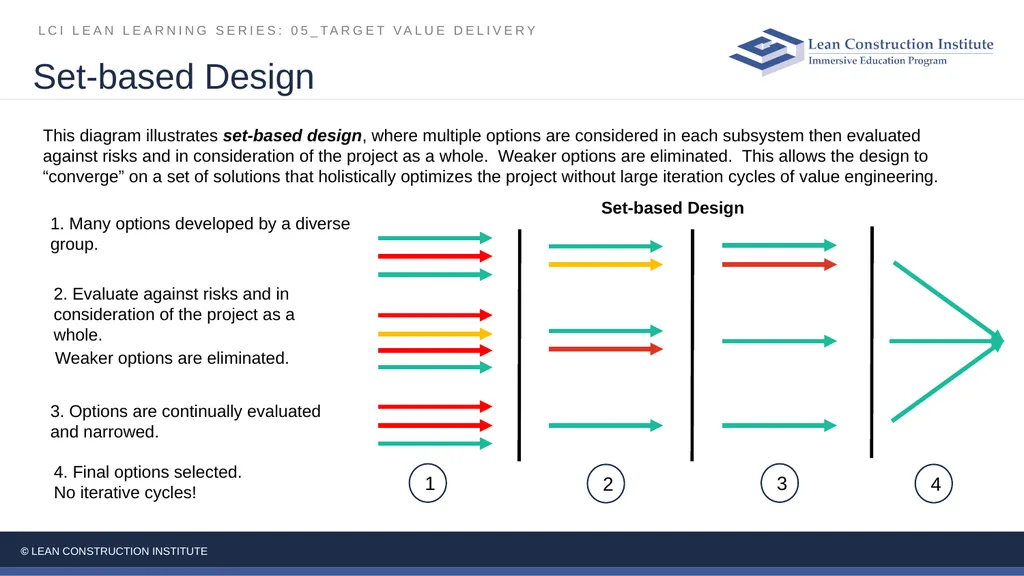
Module 4 Title: This diagram illustrates set-based design, where multiple options are considered in each subsystem then evaluated against risks and in consideration of the project as a whole. Weaker options are eliminated. This allows the design to “converge” on a set of solutions that holistically optimizes the project without large iteration cycles of value engineering. Set-based Design 1. Many options developed by a diverse group. 2. Evaluate against risks and in consideration of the project as a whole. Weaker options are eliminated. 3. Options are continually evaluated and narrowed. 4. Final options selected.
No iterative cycles! 1 2 3 4<br>
21
Discussion Question 21 What did you learn that is different than what you currently experience on projects?<br>
22
How to Implement Lean?
What new actions or ideas that you learned today, can you take back to your work? Discussion Question 22<br>
23
Lean Journey to Mastery 23 How will you reach the next level on your journey?<br>
24
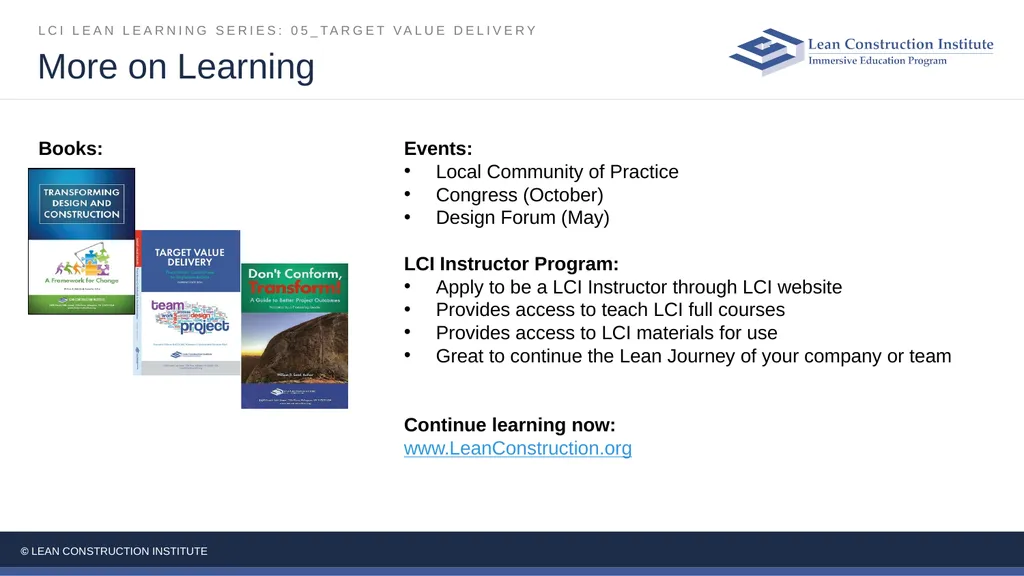
More on Learning Events:
Local Community of Practice
Congress (October)
Design Forum (May)
LCI Instructor Program:
Apply to be a LCI Instructor through LCI website
Provides access to teach LCI full courses
Provides access to LCI materials for use
Great to continue the Lean Journey of your company or team
Continue learning now:
www.LeanConstruction.org Books:<br>
25
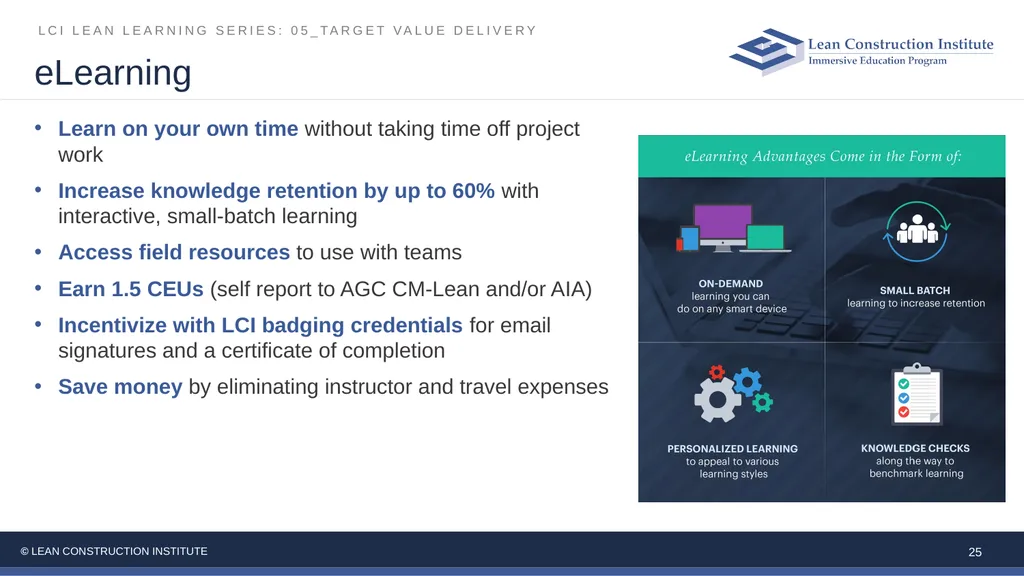
eLearning 25 Learn on your own time without taking time off project work
Increase knowledge retention by up to 60% with interactive, small-batch learning
Access field resources to use with teams
Earn 1.5 CEUs (self report to AGC CM-Lean and/or AIA)
Incentivize with LCI badging credentials for email signatures and a certificate of completion
Save money by eliminating instructor and travel expenses<br>
26
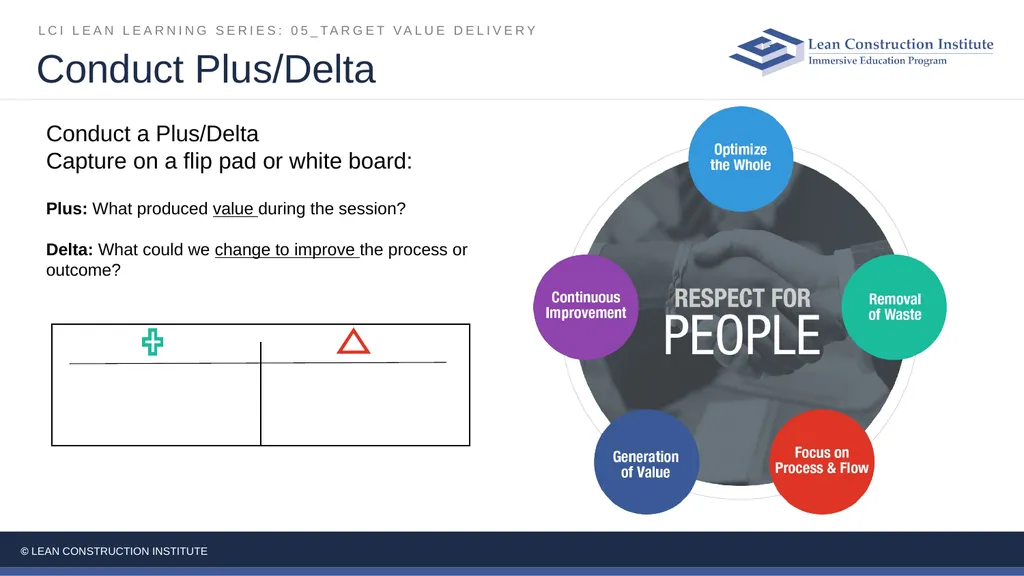
Conduct Plus/Delta 26 Conduct a Plus/Delta
Capture on a flip pad or white board: Plus: What produced value during the session?
Delta: What could we change to improve the process or outcome?<br>
27
Lean Construction Institute info@leanconstruction.org 27<br>