
Bacterial Comparative Genomics Christopher
PM
Published · 41 slides · 0 views
1 / 1

Description
Bacterial Comparative Genomics Christopher Desjardins, Ph.D. Earl Lab Broad Institute Outline Genomics Terminology Assemblies vs. Variants Assembly-based analyses Orthology Variant-based analyses How to choose? Basic Genomics Terminology
Related Topics
Share
Embed code
Download this presentation From Below
"Bacterial Comparative Genomics Christopher" is the property of its rightful owner. Permission is granted to download and print the materials on this website for personal, non-commercial use only, and to display it on your personal computer provided you do not modify the materials and that you retain all copyright notices contained in the materials. By downloading content from our website, you accept the terms of this agreement.
Presentation Transcript
01
Bacterial Comparative Genomics Christopher Desjardins, Ph.D.
Earl Lab
Broad Institute<br>
Earl Lab
Broad Institute<br>
02
Outline Genomics Terminology
Assemblies vs. Variants
Assembly-based analyses
Orthology
Variant-based analyses
How to choose?<br>
Assemblies vs. Variants
Assembly-based analyses
Orthology
Variant-based analyses
How to choose?<br>
03
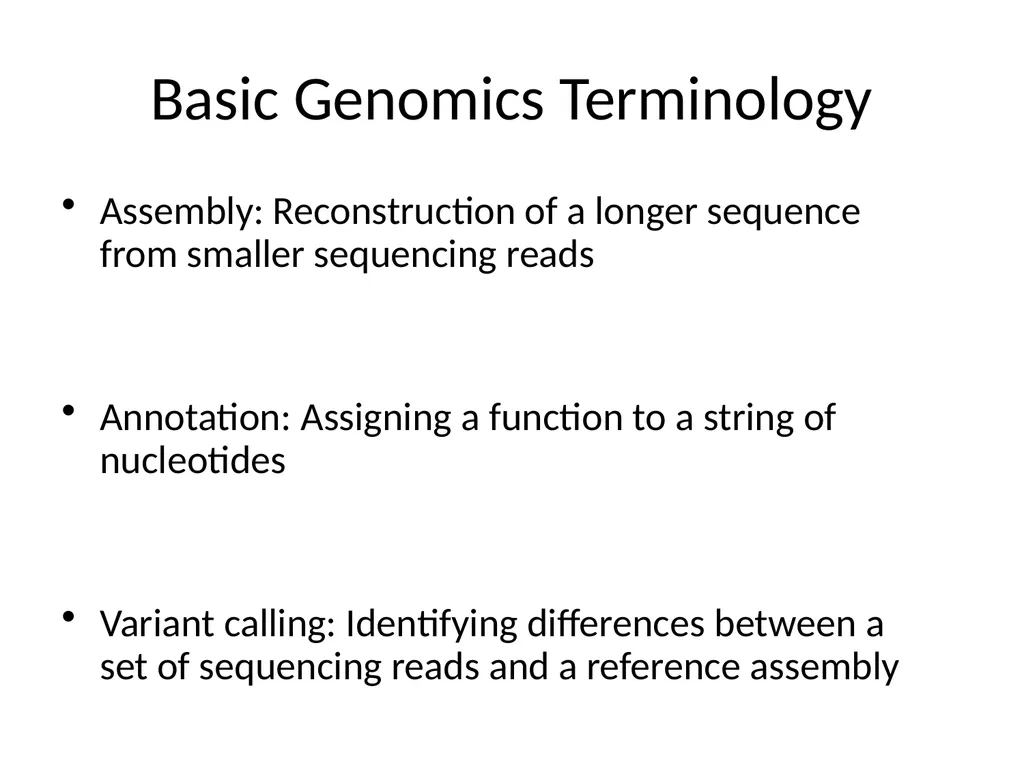
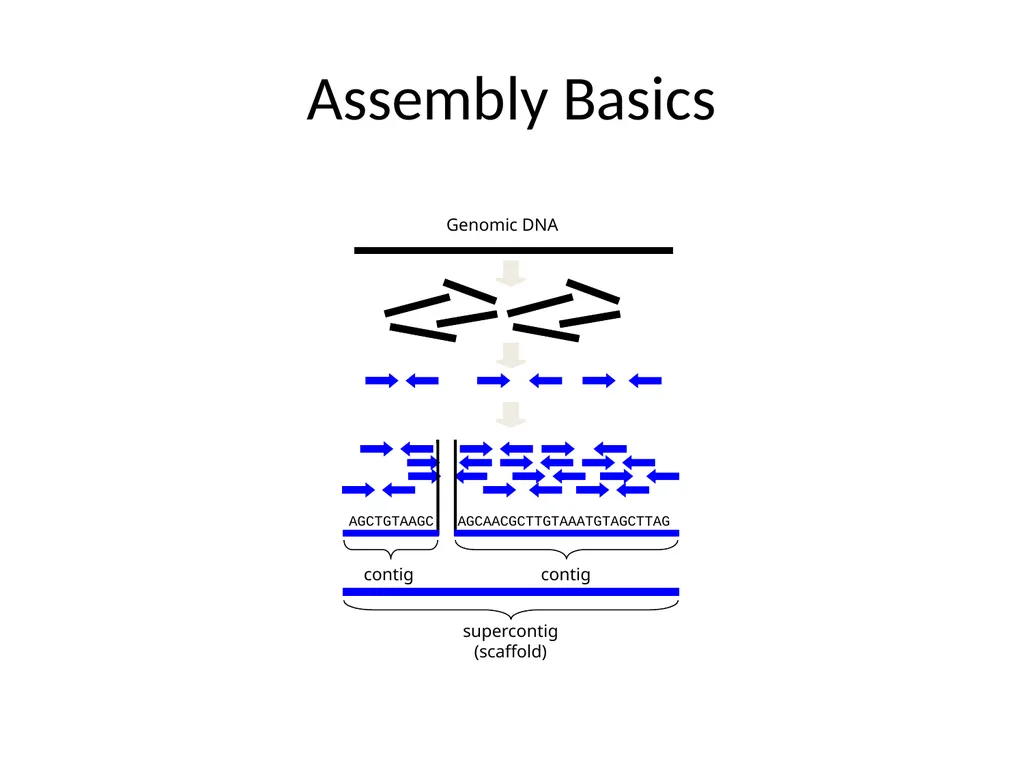
Basic Genomics Terminology Assembly: Reconstruction of a longer sequence from smaller sequencing reads
Annotation: Assigning a function to a string of nucleotides
Variant calling: Identifying differences between a set of sequencing reads and a reference assembly<br>
Annotation: Assigning a function to a string of nucleotides
Variant calling: Identifying differences between a set of sequencing reads and a reference assembly<br>
04
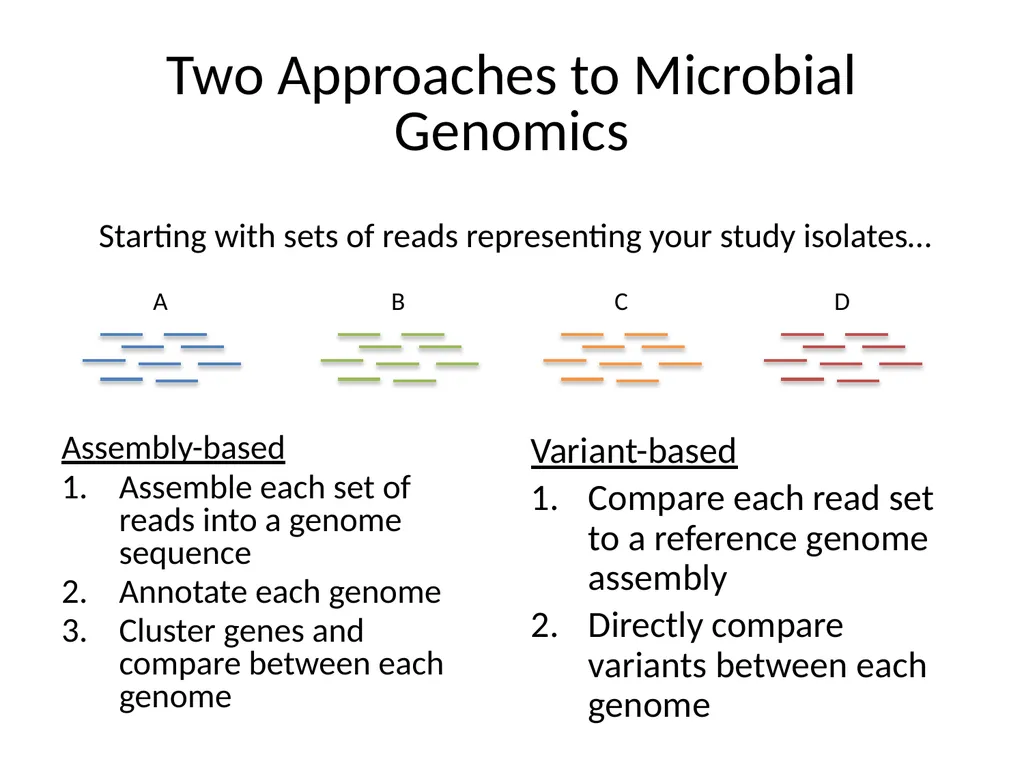
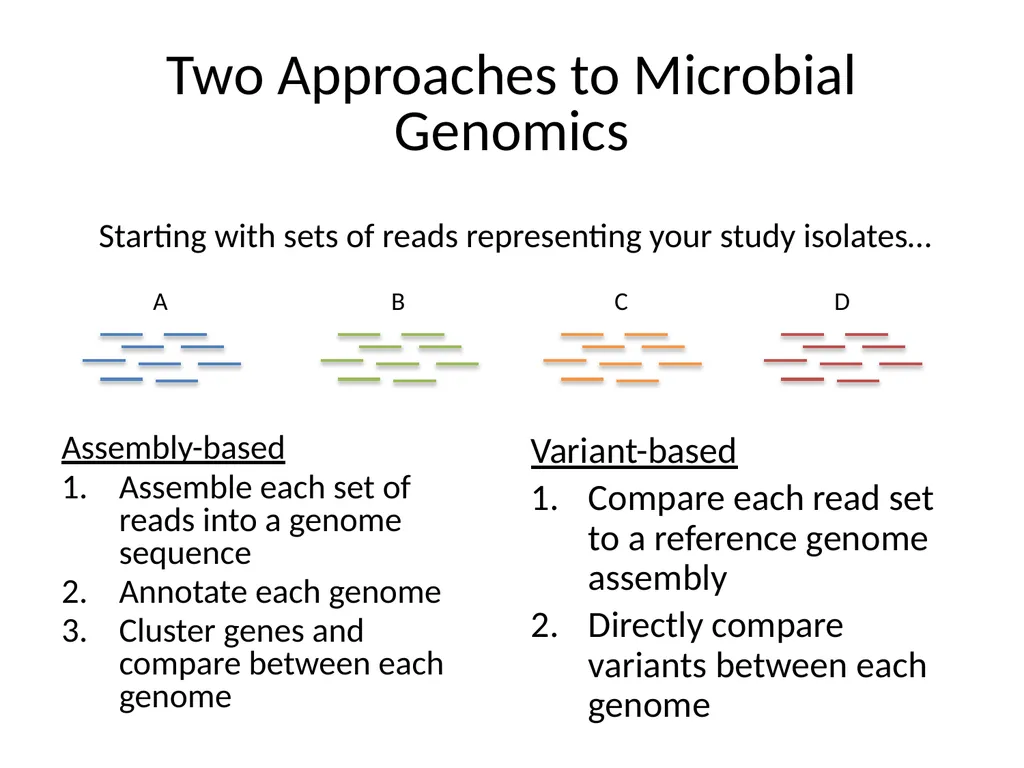
Two Approaches to Microbial Genomics Assembly-based
Assemble each set of reads into a genome sequence
Annotate each genome
Cluster genes and compare between each genome Variant-based
Compare each read set to a reference genome assembly
Directly compare variants between each genome Starting with sets of reads representing your study isolates…<br>
Assemble each set of reads into a genome sequence
Annotate each genome
Cluster genes and compare between each genome Variant-based
Compare each read set to a reference genome assembly
Directly compare variants between each genome Starting with sets of reads representing your study isolates…<br>
05
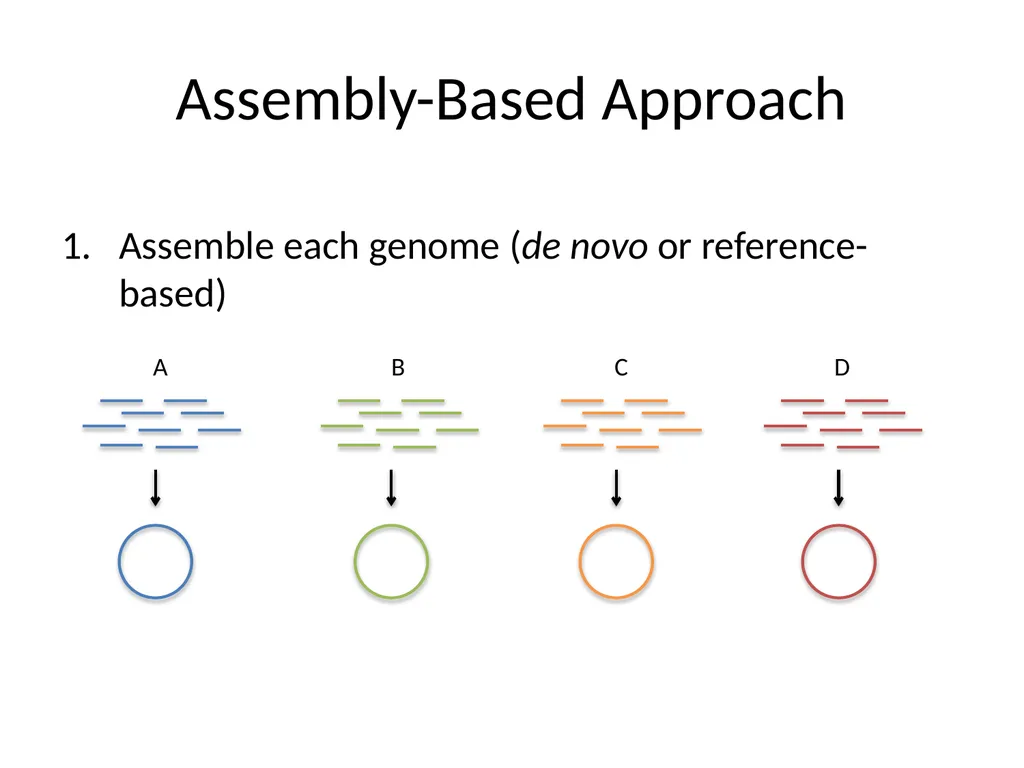
Assembly-Based Approach Assemble each genome (de novo or reference-based)<br>
06
Assembly Basics<br>
07
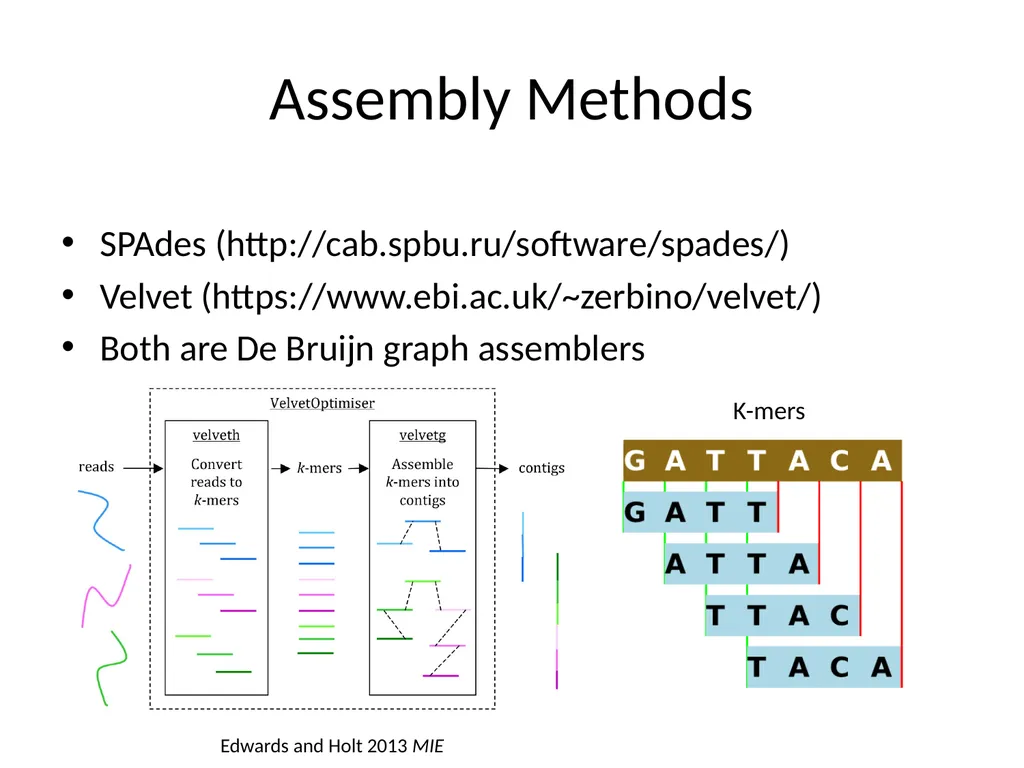
Assembly Methods SPAdes (http://cab.spbu.ru/software/spades/)
Velvet (https://www.ebi.ac.uk/~zerbino/velvet/)
Both are De Bruijn graph assemblers Edwards and Holt 2013 MIE K-mers<br>
Velvet (https://www.ebi.ac.uk/~zerbino/velvet/)
Both are De Bruijn graph assemblers Edwards and Holt 2013 MIE K-mers<br>
08
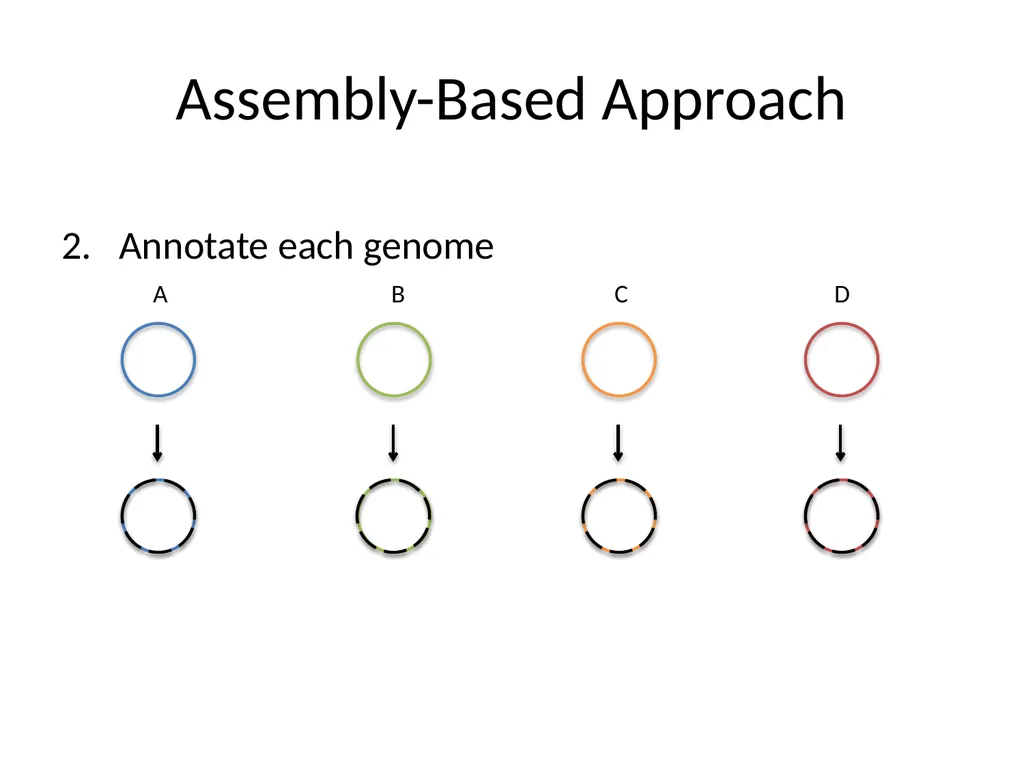
Assembly-Based Approach Annotate each genome A B C D<br>
09
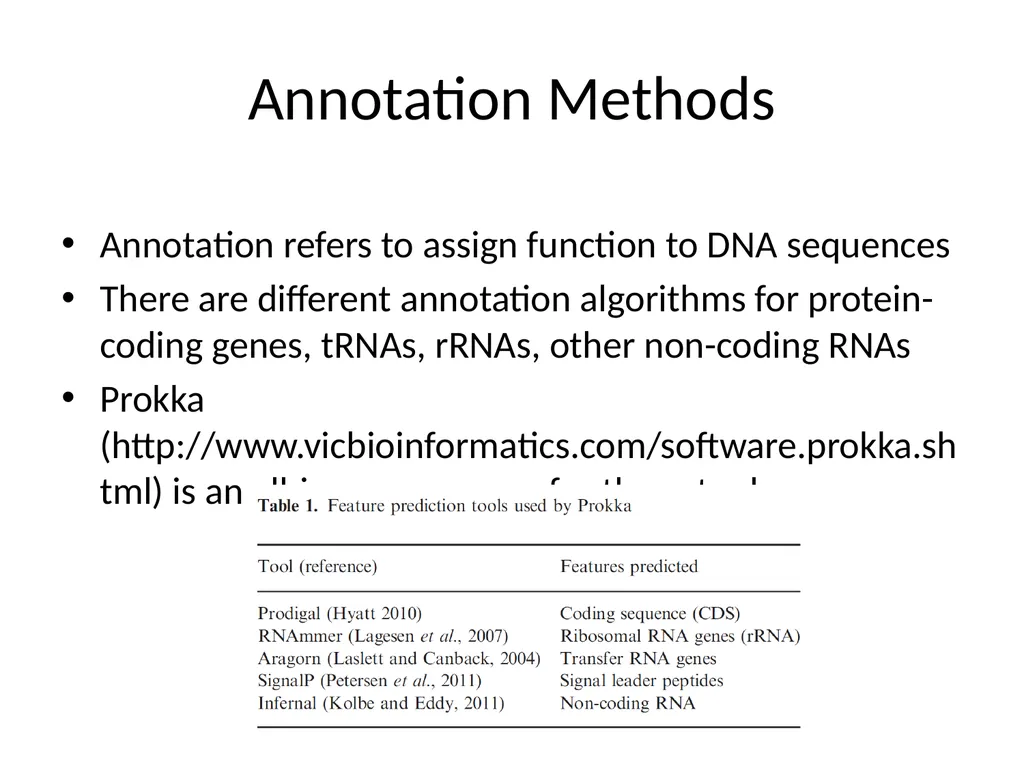
Annotation Methods Annotation refers to assign function to DNA sequences
There are different annotation algorithms for protein-coding genes, tRNAs, rRNAs, other non-coding RNAs
Prokka (http://www.vicbioinformatics.com/software.prokka.shtml) is an all-in-one wrapper for these tools<br>
There are different annotation algorithms for protein-coding genes, tRNAs, rRNAs, other non-coding RNAs
Prokka (http://www.vicbioinformatics.com/software.prokka.shtml) is an all-in-one wrapper for these tools<br>
10
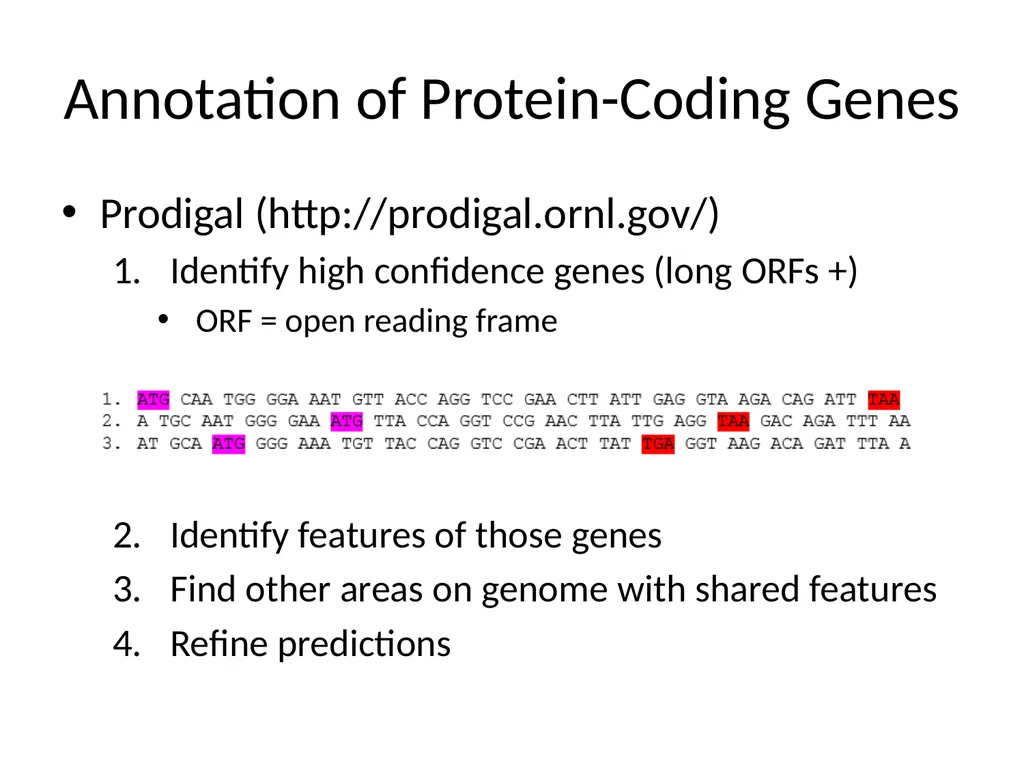
Annotation of Protein-Coding Genes Prodigal (http://prodigal.ornl.gov/)
Identify high confidence genes (long ORFs +)
ORF = open reading frame
Identify features of those genes
Find other areas on genome with shared features
Refine predictions<br>
Identify high confidence genes (long ORFs +)
ORF = open reading frame
Identify features of those genes
Find other areas on genome with shared features
Refine predictions<br>
11
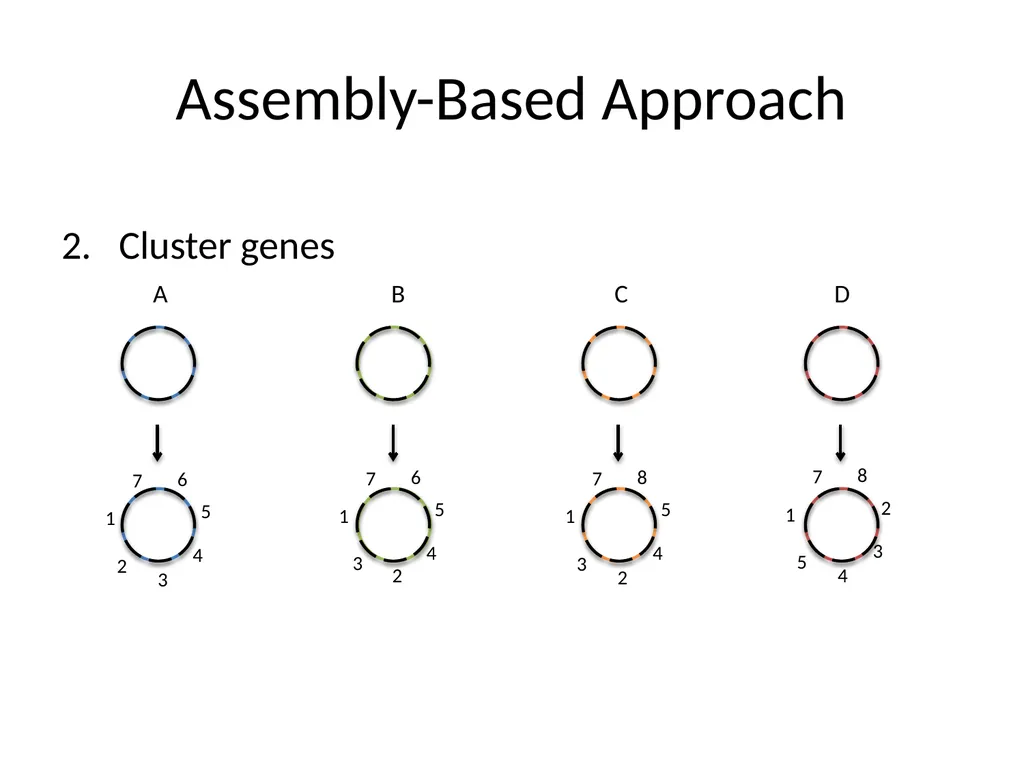
Assembly-Based Approach Cluster genes A B C D 1 2 3 4 5 6 7 1 2 3 4 5 6 7 1 3 2 4 5 8 7 1 5 4 3 2 8 7<br>
12
Orthology Orthologs are genes whose most recent divergence was a speciation event
Paralogs are genes whose most recent divergence was a gene duplication event
Groups of orthologous and paralogous genes are termed “ortholog clusters” or “gene clusters” or even just “genes” and form the basis of all gene-based comparative genomics<br>
Paralogs are genes whose most recent divergence was a gene duplication event
Groups of orthologous and paralogous genes are termed “ortholog clusters” or “gene clusters” or even just “genes” and form the basis of all gene-based comparative genomics<br>
13
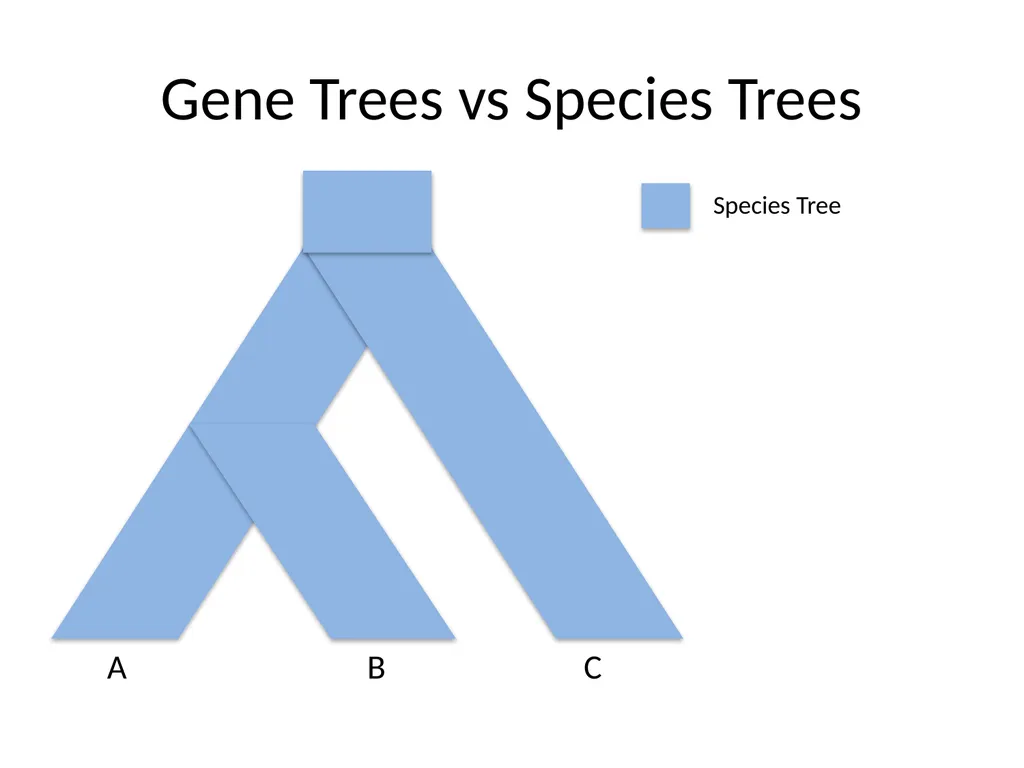
Gene Trees vs Species Trees Species Tree A B C<br>
14
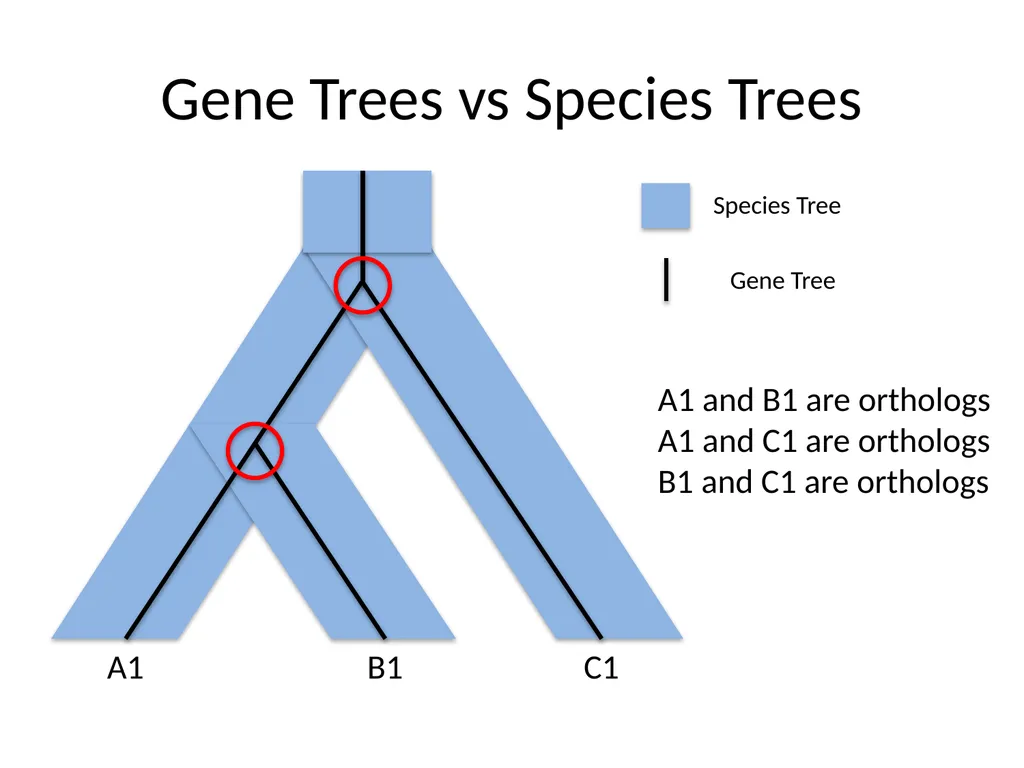
Gene Trees vs Species Trees Species Tree Gene Tree A1 B1 C1 A1 and B1 are orthologs
A1 and C1 are orthologs
B1 and C1 are orthologs<br>
A1 and C1 are orthologs
B1 and C1 are orthologs<br>
15
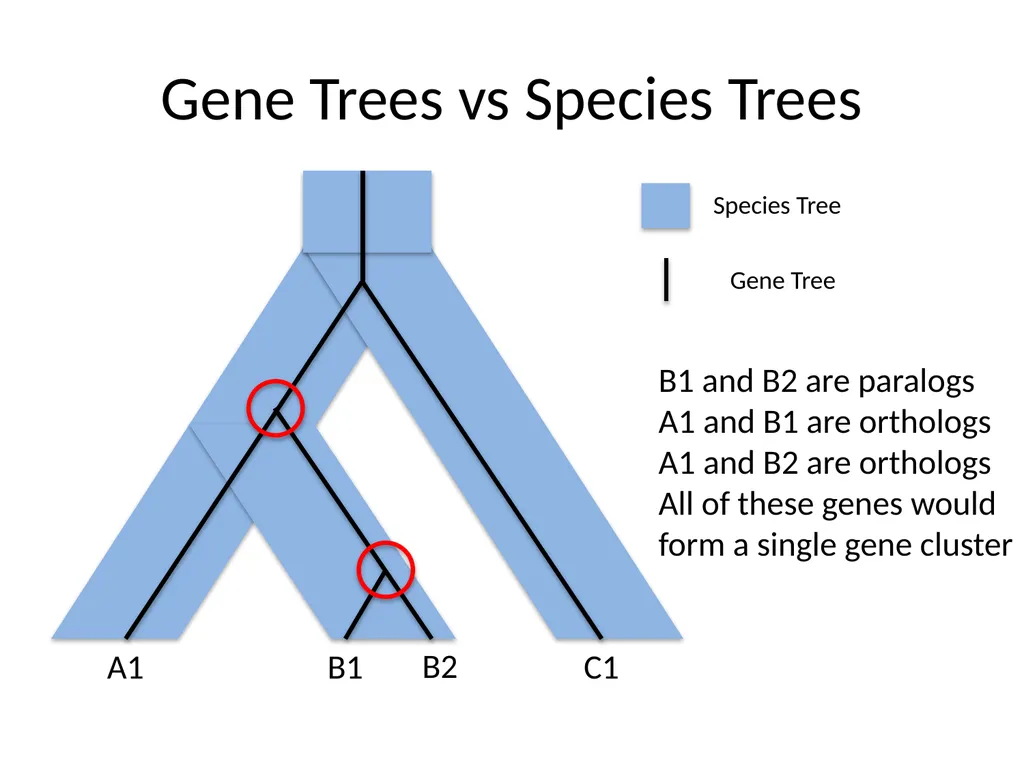
Gene Trees vs Species Trees Species Tree Gene Tree A1 B1 C1 B1 and B2 are paralogs
A1 and B1 are orthologs
A1 and B2 are orthologs
All of these genes would
form a single gene cluster B2<br>
A1 and B1 are orthologs
A1 and B2 are orthologs
All of these genes would
form a single gene cluster B2<br>
16
Gene Names, Orthology, and Function When you ask, does strain A have gene X?...
What you are really asking is, does strain A have an ortholog of gene X? (where gene X is characterized in another strain)
If two genes are orthologs, that does not imply they have same function, but they often do
If two genes are paralogs, they have traditionally thought to often differ in function, and paralogy is thought to be one of the main sources of “new” genes
…but there is some evidence to suggest that paralogs are often more similar in function<br>
What you are really asking is, does strain A have an ortholog of gene X? (where gene X is characterized in another strain)
If two genes are orthologs, that does not imply they have same function, but they often do
If two genes are paralogs, they have traditionally thought to often differ in function, and paralogy is thought to be one of the main sources of “new” genes
…but there is some evidence to suggest that paralogs are often more similar in function<br>
17
Gene Clustering - how it works Assess the similarity of every gene to every other gene
e.g., using BLAST
Use that similarity to join pairs of genes
e.g., using Reciprocal Best Hits
Connect the gene pairs into larger clusters
e.g., using Reciprocal Best Hits or Markov clustering<br>
e.g., using BLAST
Use that similarity to join pairs of genes
e.g., using Reciprocal Best Hits
Connect the gene pairs into larger clusters
e.g., using Reciprocal Best Hits or Markov clustering<br>
18
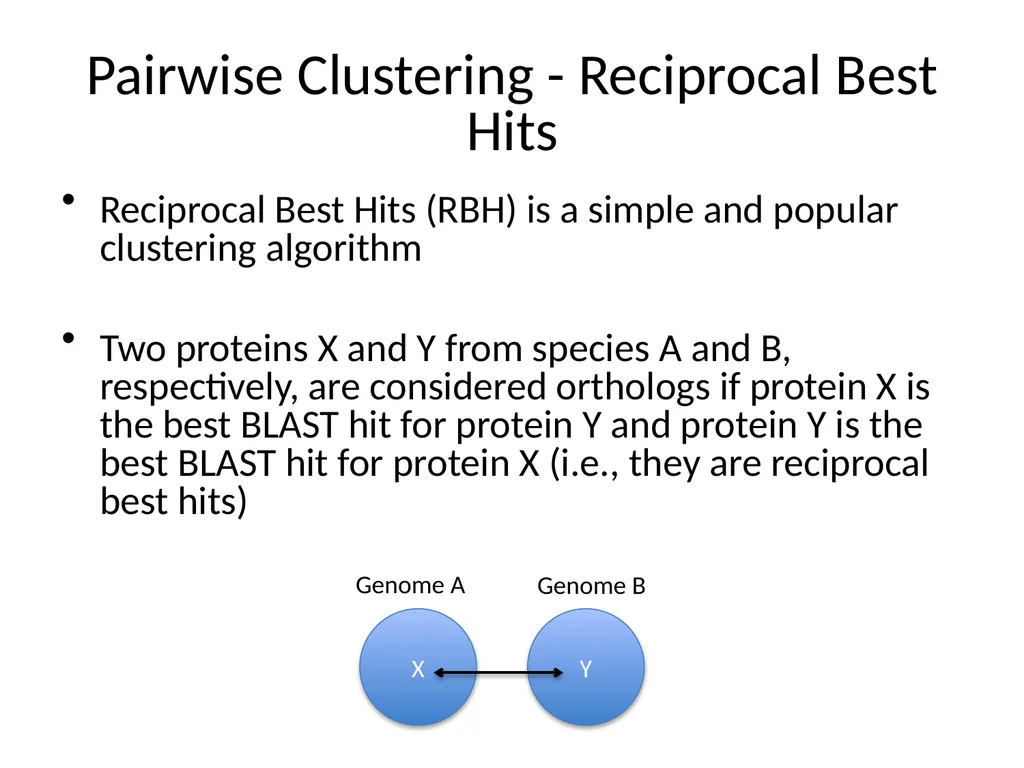
Pairwise Clustering - Reciprocal Best Hits Reciprocal Best Hits (RBH) is a simple and popular clustering algorithm
Two proteins X and Y from species A and B, respectively, are considered orthologs if protein X is the best BLAST hit for protein Y and protein Y is the best BLAST hit for protein X (i.e., they are reciprocal best hits) X Y Genome A Genome B<br>
Two proteins X and Y from species A and B, respectively, are considered orthologs if protein X is the best BLAST hit for protein Y and protein Y is the best BLAST hit for protein X (i.e., they are reciprocal best hits) X Y Genome A Genome B<br>
19
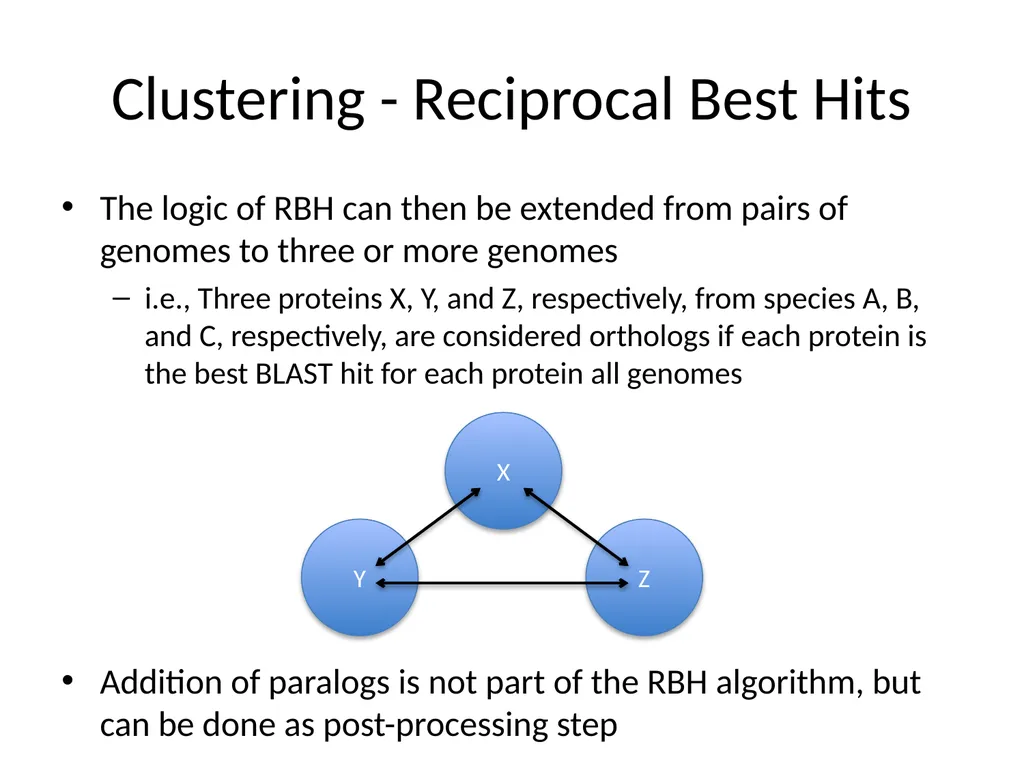
Clustering - Reciprocal Best Hits The logic of RBH can then be extended from pairs of genomes to three or more genomes
i.e., Three proteins X, Y, and Z, respectively, from species A, B, and C, respectively, are considered orthologs if each protein is the best BLAST hit for each protein all genomes
Addition of paralogs is not part of the RBH algorithm, but can be done as post-processing step X Y Z<br>
i.e., Three proteins X, Y, and Z, respectively, from species A, B, and C, respectively, are considered orthologs if each protein is the best BLAST hit for each protein all genomes
Addition of paralogs is not part of the RBH algorithm, but can be done as post-processing step X Y Z<br>
20
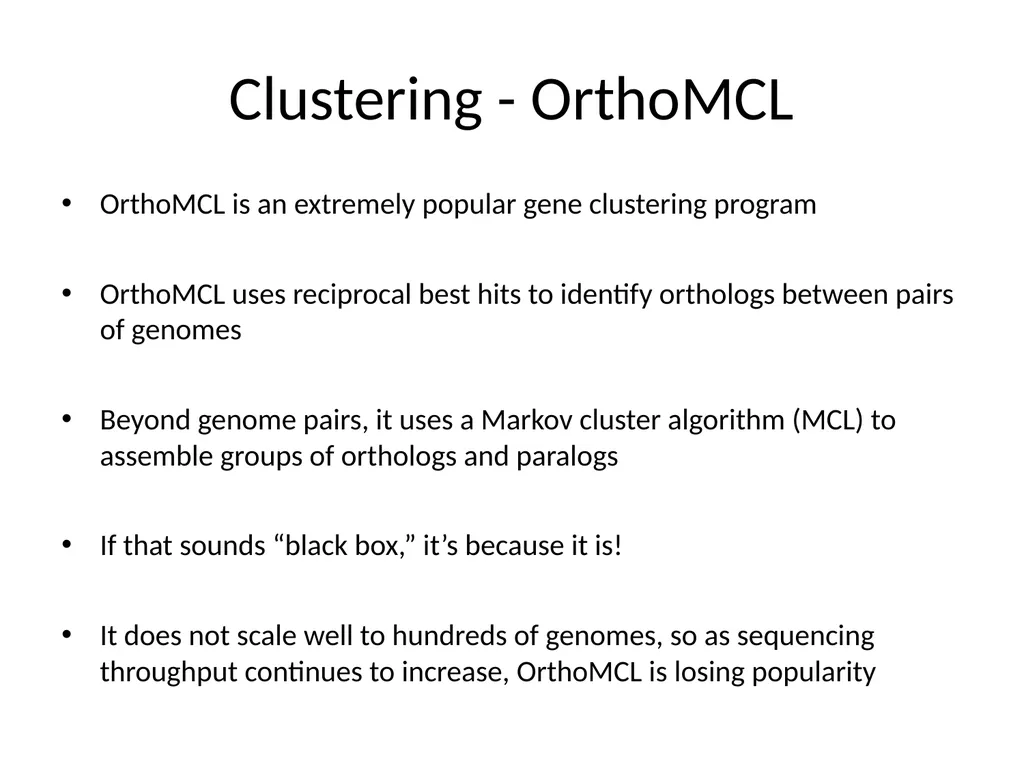
Clustering - OrthoMCL OrthoMCL is an extremely popular gene clustering program
OrthoMCL uses reciprocal best hits to identify orthologs between pairs of genomes
Beyond genome pairs, it uses a Markov cluster algorithm (MCL) to assemble groups of orthologs and paralogs
If that sounds “black box,” it’s because it is!
It does not scale well to hundreds of genomes, so as sequencing throughput continues to increase, OrthoMCL is losing popularity<br>
OrthoMCL uses reciprocal best hits to identify orthologs between pairs of genomes
Beyond genome pairs, it uses a Markov cluster algorithm (MCL) to assemble groups of orthologs and paralogs
If that sounds “black box,” it’s because it is!
It does not scale well to hundreds of genomes, so as sequencing throughput continues to increase, OrthoMCL is losing popularity<br>
21
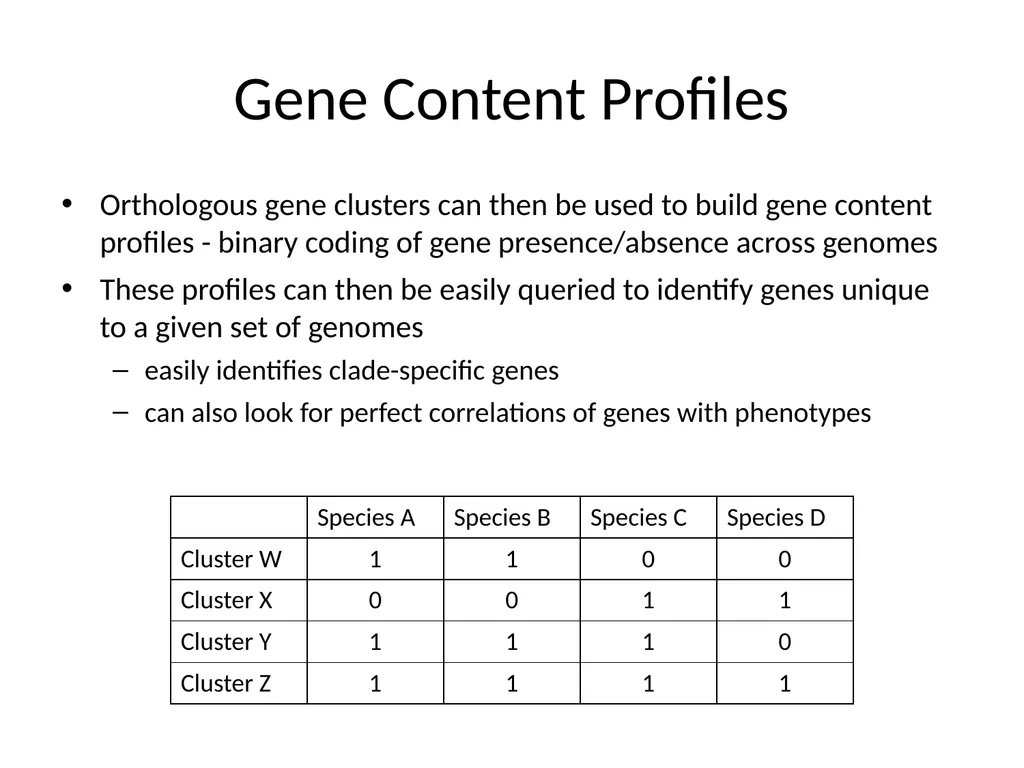
Gene Content Profiles Orthologous gene clusters can then be used to build gene content profiles - binary coding of gene presence/absence across genomes
These profiles can then be easily queried to identify genes unique to a given set of genomes
easily identifies clade-specific genes
can also look for perfect correlations of genes with phenotypes<br>
These profiles can then be easily queried to identify genes unique to a given set of genomes
easily identifies clade-specific genes
can also look for perfect correlations of genes with phenotypes<br>
22
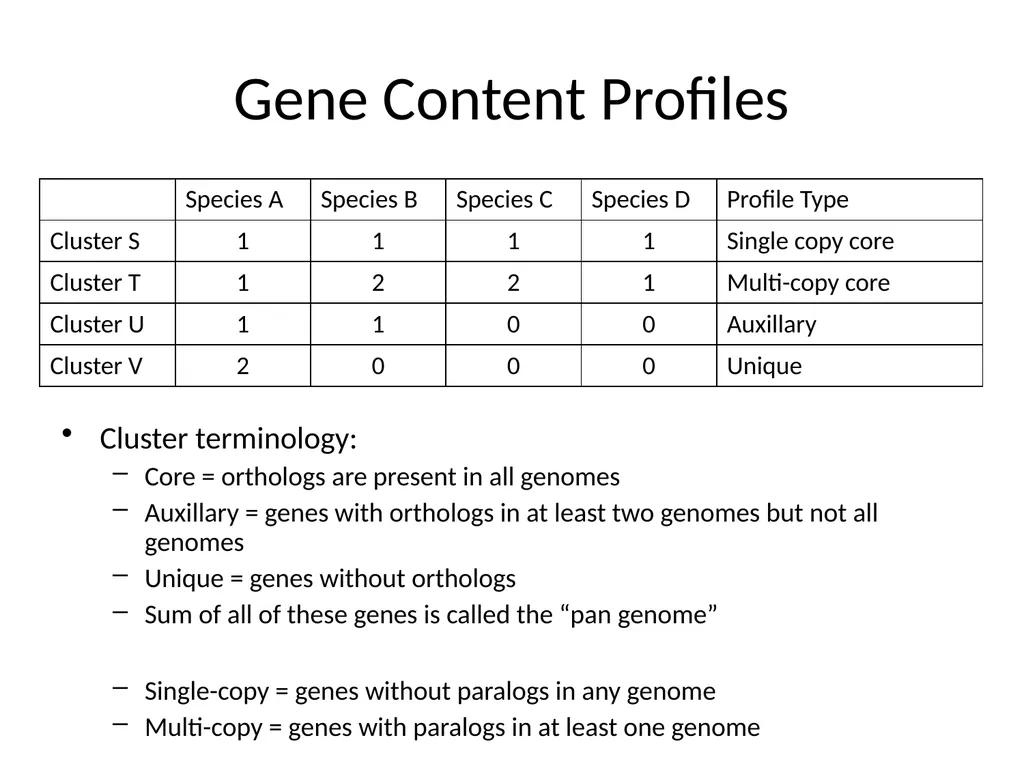
Gene Content Profiles Cluster terminology:
Core = orthologs are present in all genomes
Auxillary = genes with orthologs in at least two genomes but not all genomes
Unique = genes without orthologs
Sum of all of these genes is called the “pan genome”
Single-copy = genes without paralogs in any genome
Multi-copy = genes with paralogs in at least one genome<br>
Core = orthologs are present in all genomes
Auxillary = genes with orthologs in at least two genomes but not all genomes
Unique = genes without orthologs
Sum of all of these genes is called the “pan genome”
Single-copy = genes without paralogs in any genome
Multi-copy = genes with paralogs in at least one genome<br>
23
Organismal Phylogenies Single-copy core genes are often used to create organismal phylogenies
Genes can be aligned with MUSCLE or CLUSTAL
Then sequences are concatenated, or attached together end-to-end, so that the end of gene A is followed by the beginning of gene B
Then a phylogeny is generated using available software like RAxML or FastTree
Beware horizontal transfer!<br>
Genes can be aligned with MUSCLE or CLUSTAL
Then sequences are concatenated, or attached together end-to-end, so that the end of gene A is followed by the beginning of gene B
Then a phylogeny is generated using available software like RAxML or FastTree
Beware horizontal transfer!<br>
24
Other potential downstream analyses Look for rapidly evolving genes by calculating evolutionary rates
Functional enrichment of genes specific to a clade
Association tests of gene presence/absence with a specific phenotype<br>
Functional enrichment of genes specific to a clade
Association tests of gene presence/absence with a specific phenotype<br>
25
Two Approaches to Microbial Genomics Assembly-based
Assemble each set of reads into a genome sequence
Annotate each genome
Cluster genes and compare between each genome Variant-based
Compare each read set to a reference genome assembly
Directly compare variants between each genome Starting with sets of reads representing your study isolates…<br>
Assemble each set of reads into a genome sequence
Annotate each genome
Cluster genes and compare between each genome Variant-based
Compare each read set to a reference genome assembly
Directly compare variants between each genome Starting with sets of reads representing your study isolates…<br>
26
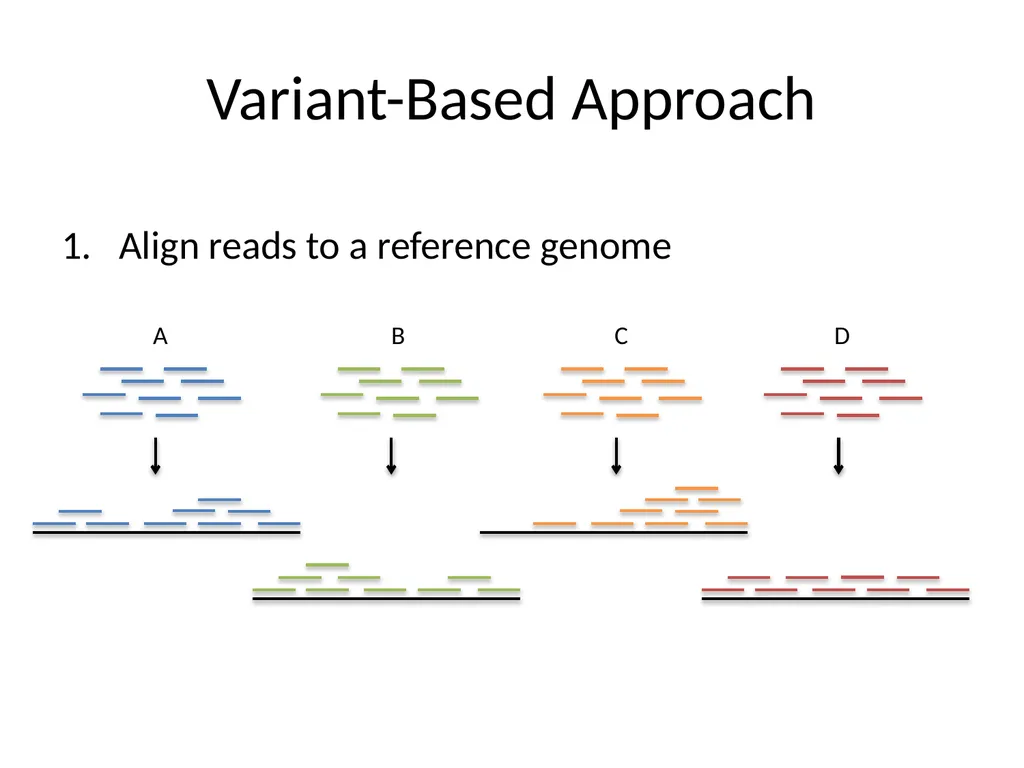
Variant-Based Approach Align reads to a reference genome A B C D<br>
27
Read Alignment Methods Goal: to find the best match or matches of a read to reference genome
While it seems simple, it’s actually a difficult problem since you cannot check all possibilities (need heuristics)
Un-spliced aligners (DNA to DNA, cDNA to cDNA)
BWA (http://bio-bwa.sourceforge.net/)
Bowtie2 (http://bowtie-bio.sourceforge.net/bowtie2/index.shtml)<br>
While it seems simple, it’s actually a difficult problem since you cannot check all possibilities (need heuristics)
Un-spliced aligners (DNA to DNA, cDNA to cDNA)
BWA (http://bio-bwa.sourceforge.net/)
Bowtie2 (http://bowtie-bio.sourceforge.net/bowtie2/index.shtml)<br>
28
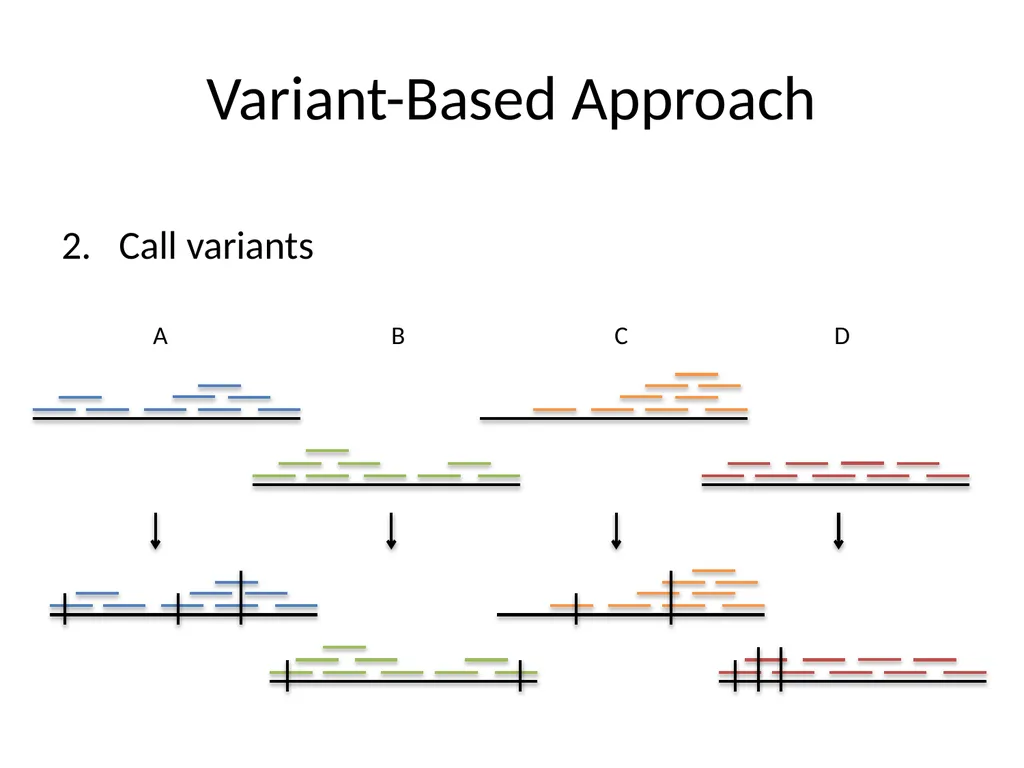
Variant-Based Approach Call variants A B C D<br>
29
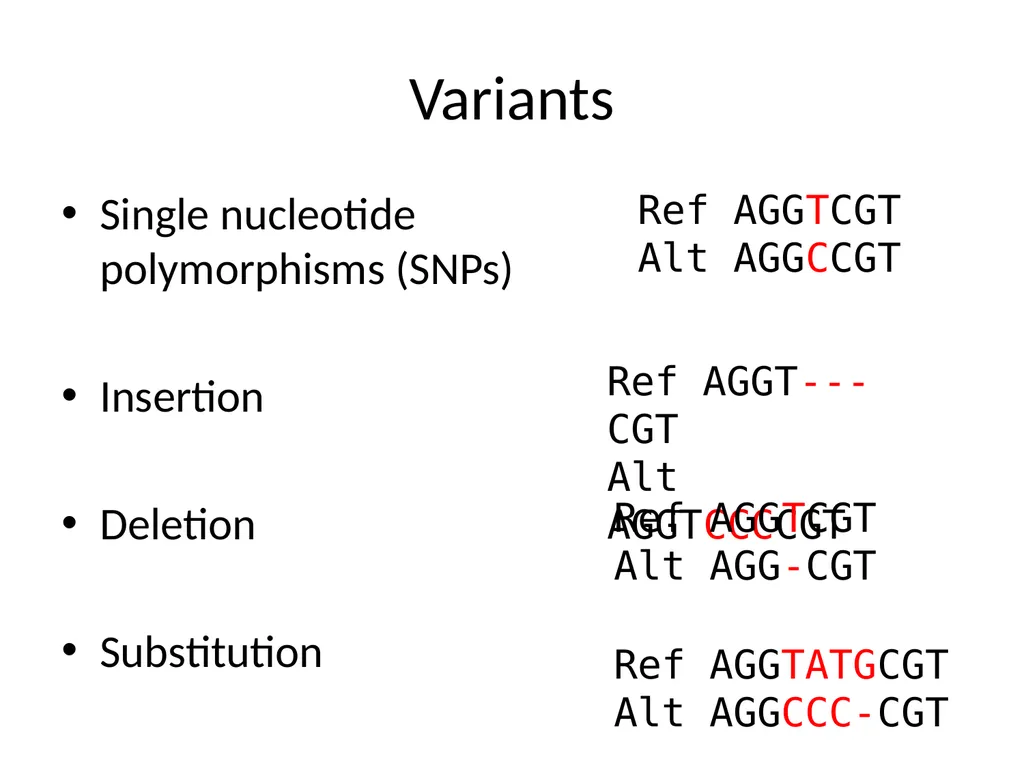
Variants Single nucleotide polymorphisms (SNPs)
Insertion
Deletion
Substitution Ref AGGTCGT
Alt AGGCCGT Ref AGGT---CGT
Alt AGGTCCCCGT Ref AGGTCGT
Alt AGG-CGT Ref AGGTATGCGT
Alt AGGCCC-CGT<br>
Insertion
Deletion
Substitution Ref AGGTCGT
Alt AGGCCGT Ref AGGT---CGT
Alt AGGTCCCCGT Ref AGGTCGT
Alt AGG-CGT Ref AGGTATGCGT
Alt AGGCCC-CGT<br>
30
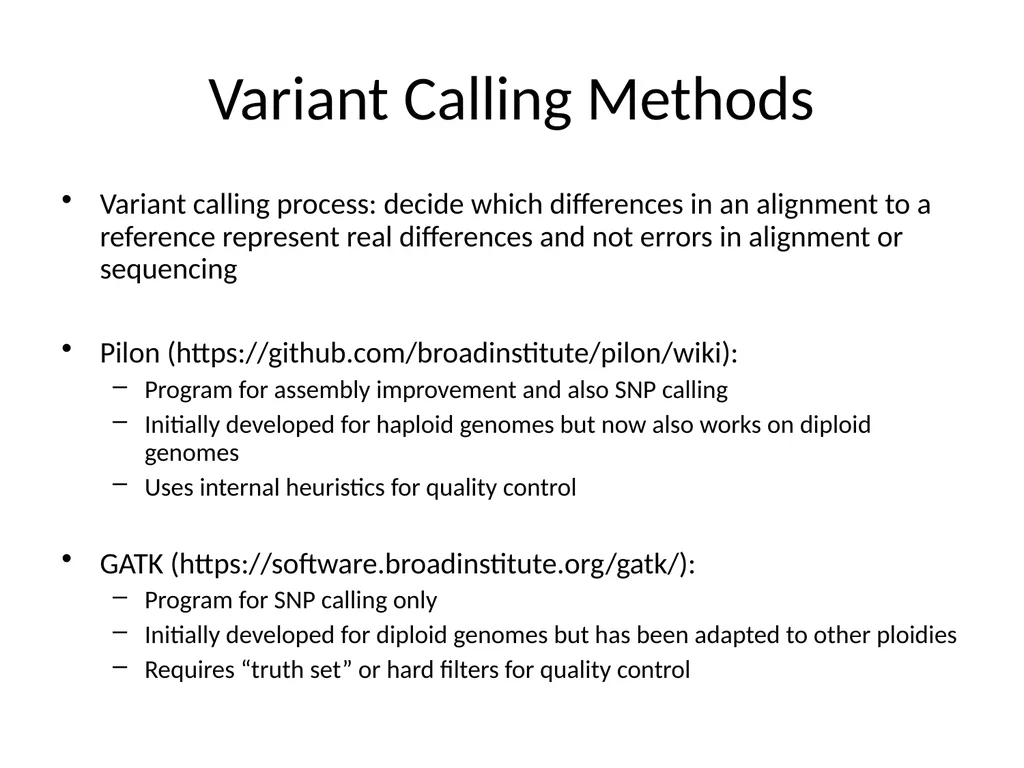
Variant Calling Methods Variant calling process: decide which differences in an alignment to a reference represent real differences and not errors in alignment or sequencing
Pilon (https://github.com/broadinstitute/pilon/wiki):
Program for assembly improvement and also SNP calling
Initially developed for haploid genomes but now also works on diploid genomes
Uses internal heuristics for quality control
GATK (https://software.broadinstitute.org/gatk/):
Program for SNP calling only
Initially developed for diploid genomes but has been adapted to other ploidies
Requires “truth set” or hard filters for quality control<br>
Pilon (https://github.com/broadinstitute/pilon/wiki):
Program for assembly improvement and also SNP calling
Initially developed for haploid genomes but now also works on diploid genomes
Uses internal heuristics for quality control
GATK (https://software.broadinstitute.org/gatk/):
Program for SNP calling only
Initially developed for diploid genomes but has been adapted to other ploidies
Requires “truth set” or hard filters for quality control<br>
31
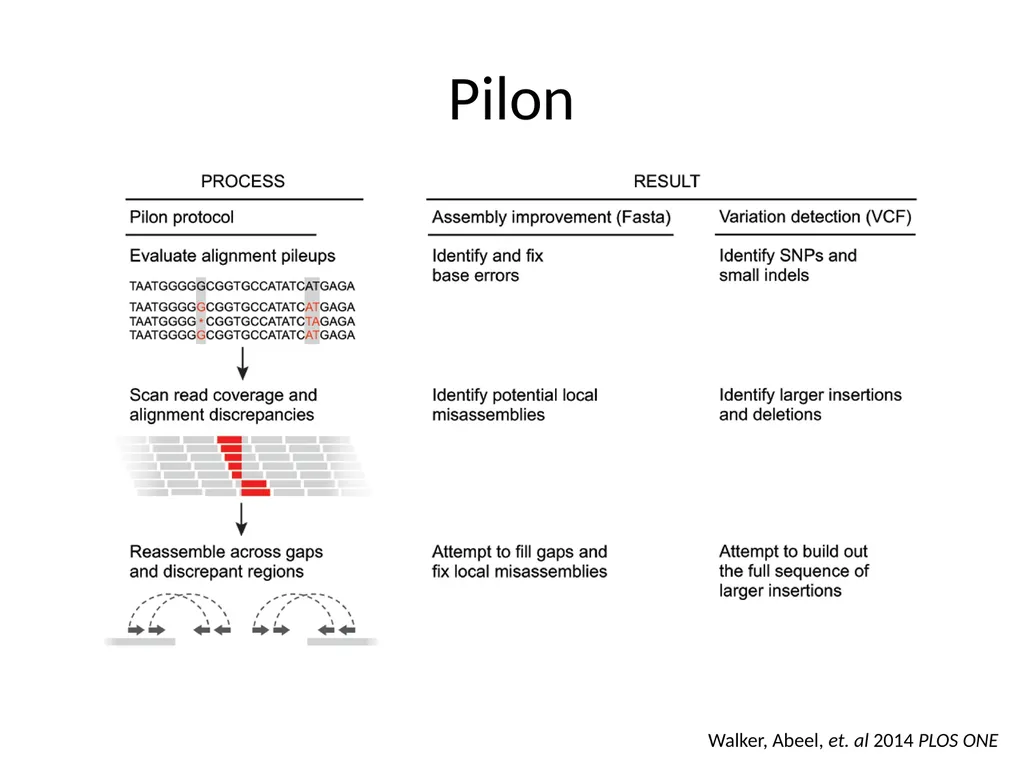
Pilon Walker, Abeel, et. al 2014 PLOS ONE<br>
32
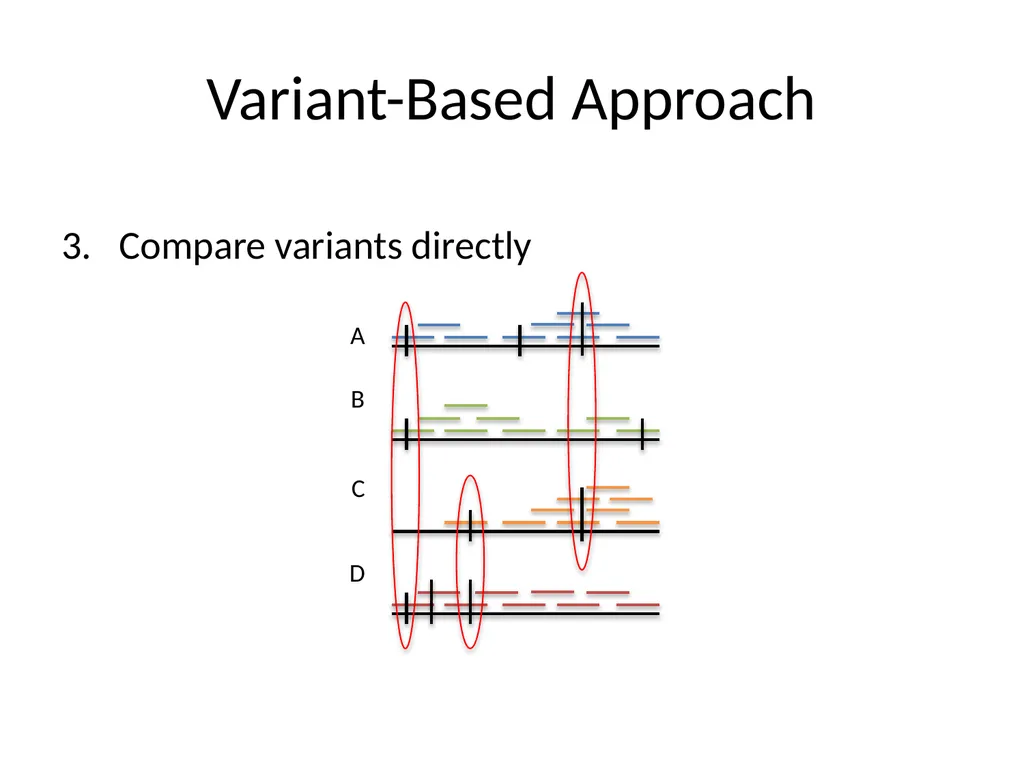
Variant-Based Approach Compare variants directly A B C D<br>
33
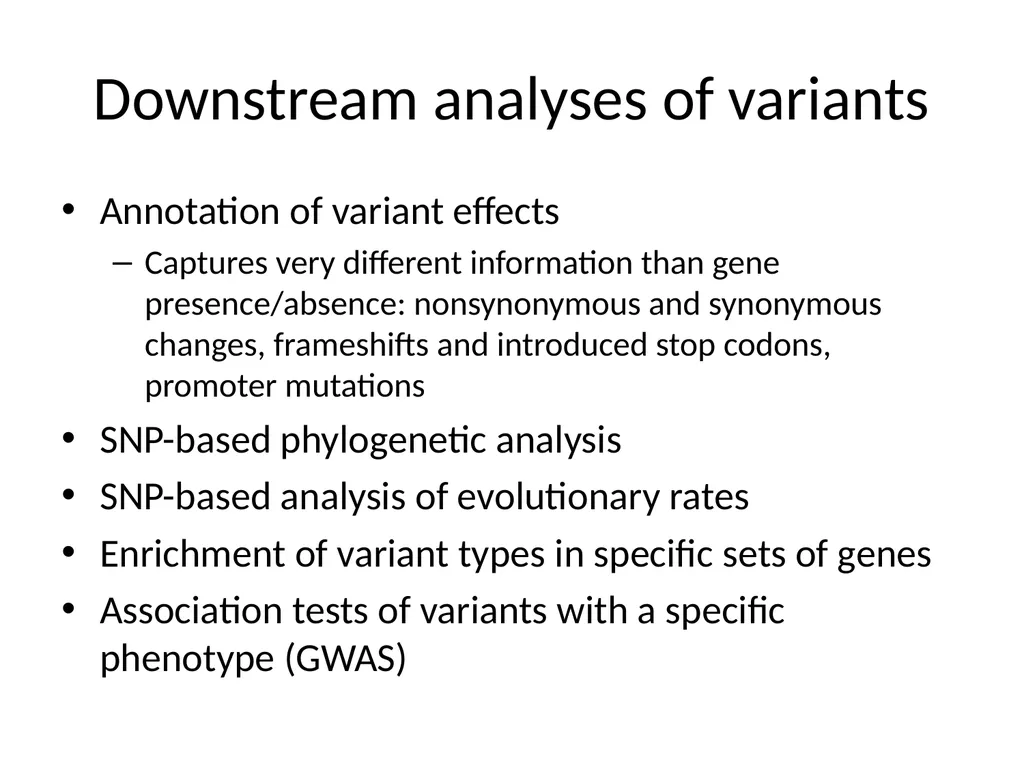
Downstream analyses of variants Annotation of variant effects
Captures very different information than gene presence/absence: nonsynonymous and synonymous changes, frameshifts and introduced stop codons, promoter mutations
SNP-based phylogenetic analysis
SNP-based analysis of evolutionary rates
Enrichment of variant types in specific sets of genes
Association tests of variants with a specific phenotype (GWAS)<br>
Captures very different information than gene presence/absence: nonsynonymous and synonymous changes, frameshifts and introduced stop codons, promoter mutations
SNP-based phylogenetic analysis
SNP-based analysis of evolutionary rates
Enrichment of variant types in specific sets of genes
Association tests of variants with a specific phenotype (GWAS)<br>
34
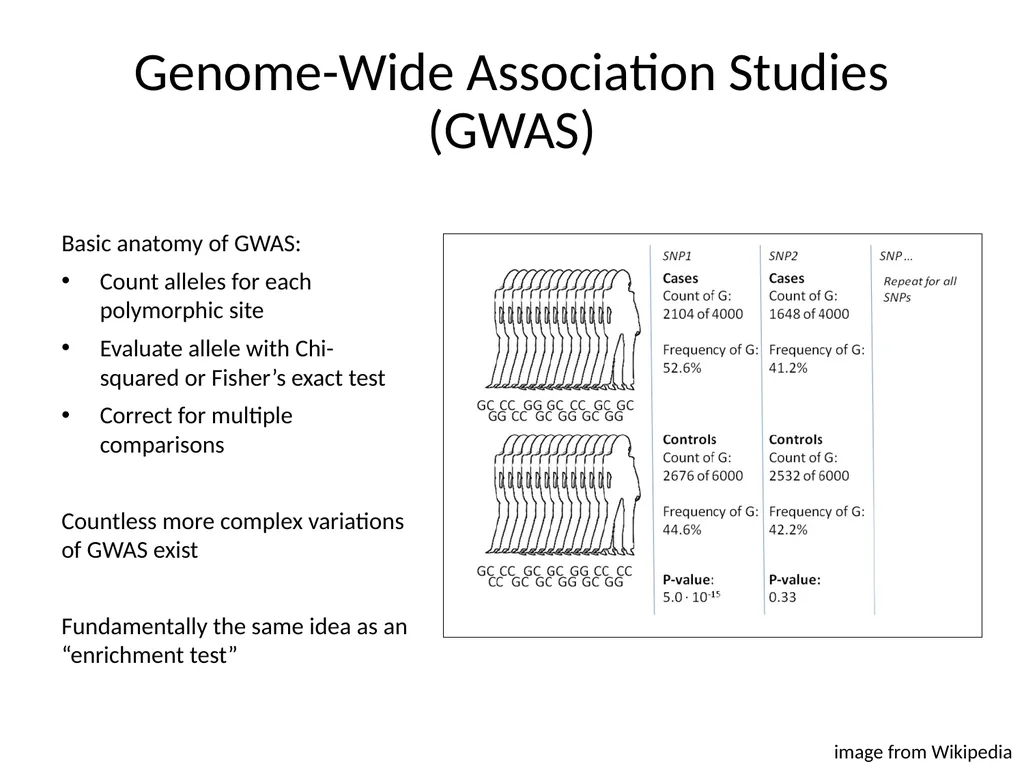
Genome-Wide Association Studies (GWAS) Basic anatomy of GWAS:
Count alleles for each polymorphic site
Evaluate allele with Chi-squared or Fisher’s exact test
Correct for multiple comparisons
Countless more complex variations of GWAS exist
Fundamentally the same idea as an “enrichment test” image from Wikipedia<br>
Count alleles for each polymorphic site
Evaluate allele with Chi-squared or Fisher’s exact test
Correct for multiple comparisons
Countless more complex variations of GWAS exist
Fundamentally the same idea as an “enrichment test” image from Wikipedia<br>
35
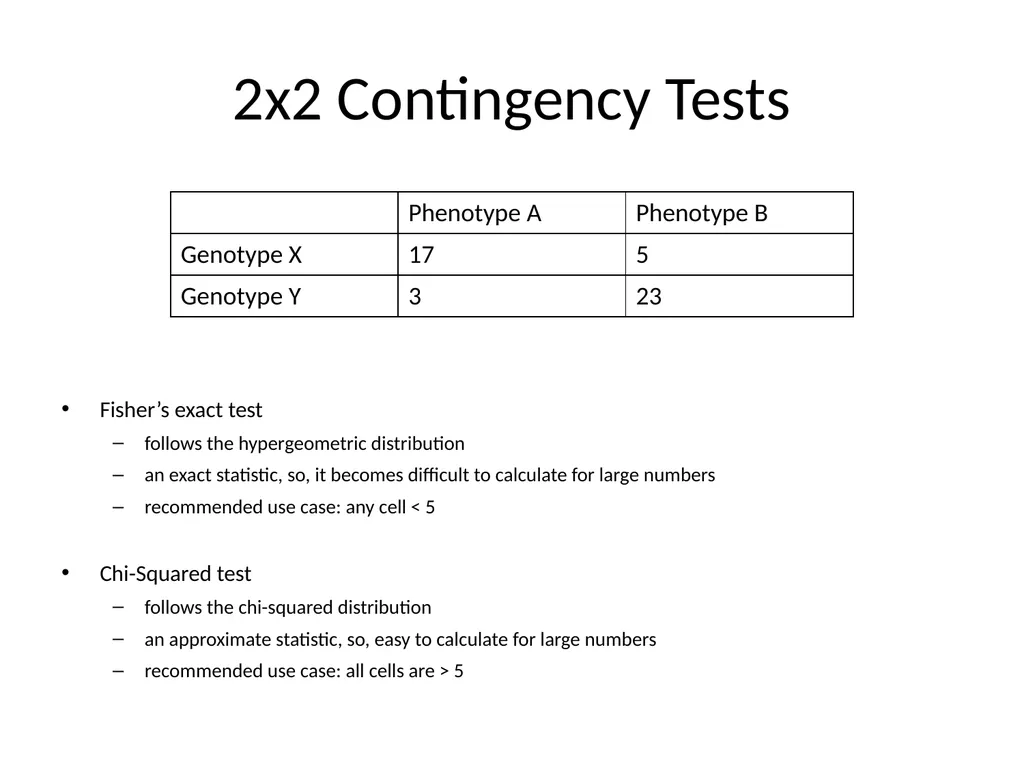
2x2 Contingency Tests Fisher’s exact test
follows the hypergeometric distribution
an exact statistic, so, it becomes difficult to calculate for large numbers
recommended use case: any cell < 5
Chi-Squared test
follows the chi-squared distribution
an approximate statistic, so, easy to calculate for large numbers
recommended use case: all cells are > 5<br>
follows the hypergeometric distribution
an exact statistic, so, it becomes difficult to calculate for large numbers
recommended use case: any cell < 5
Chi-Squared test
follows the chi-squared distribution
an approximate statistic, so, easy to calculate for large numbers
recommended use case: all cells are > 5<br>
36
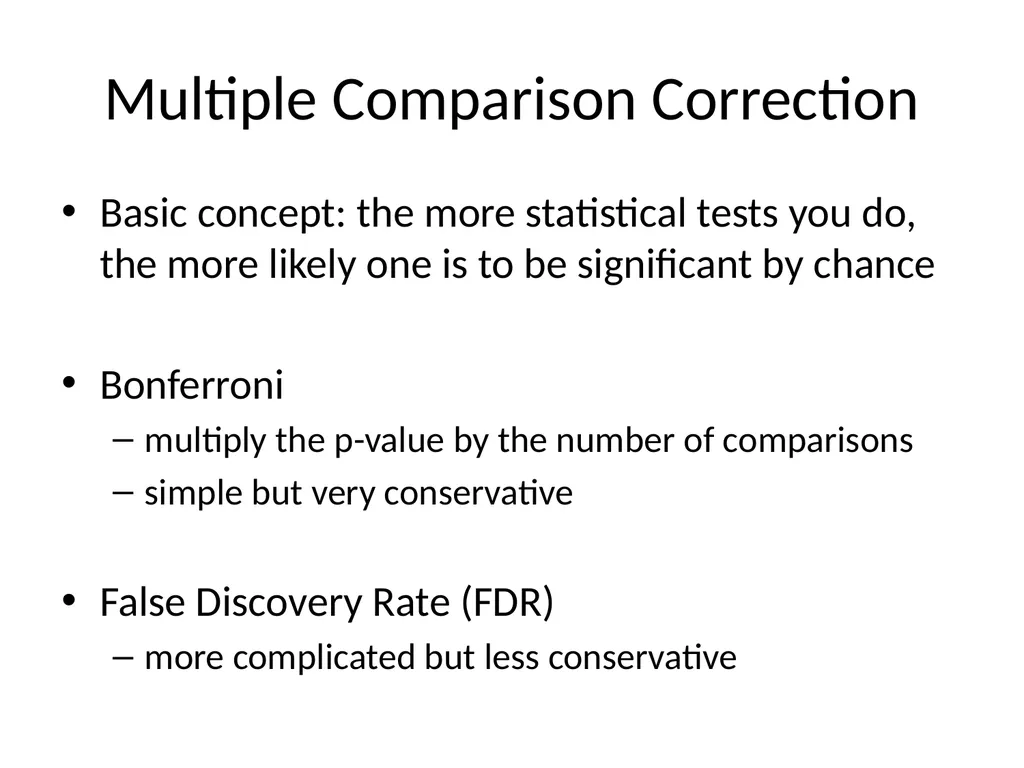
Multiple Comparison Correction Basic concept: the more statistical tests you do, the more likely one is to be significant by chance
Bonferroni
multiply the p-value by the number of comparisons
simple but very conservative
False Discovery Rate (FDR)
more complicated but less conservative<br>
Bonferroni
multiply the p-value by the number of comparisons
simple but very conservative
False Discovery Rate (FDR)
more complicated but less conservative<br>
37
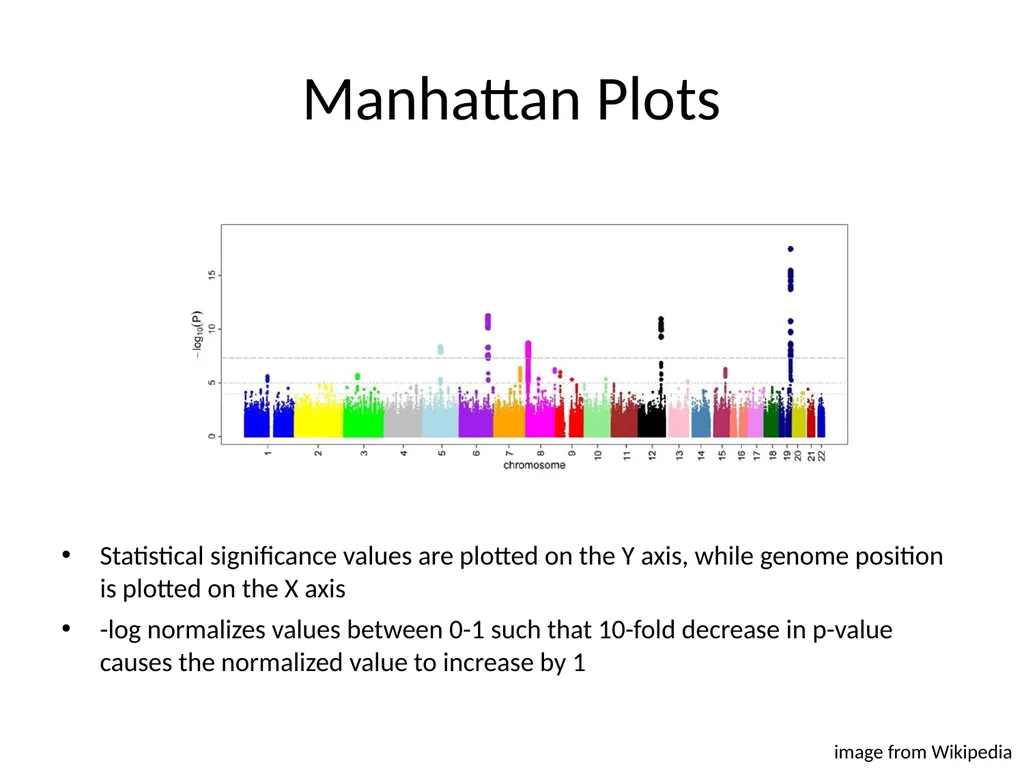
Manhattan Plots Statistical significance values are plotted on the Y axis, while genome position is plotted on the X axis
-log normalizes values between 0-1 such that 10-fold decrease in p-value causes the normalized value to increase by 1 image from Wikipedia<br>
-log normalizes values between 0-1 such that 10-fold decrease in p-value causes the normalized value to increase by 1 image from Wikipedia<br>
38
Bacteria and GWAS Most GWAS methods depend on linkage disequilibrium being slowly broken up by meiotic recombination, such that alleles physically distant from each other are independent
Many bacteria have limited or no recombination, making GWAS difficult
Adapting GWAS to bacteria is an active area of research Figure from Weissglas-Volkov et al. Diabetes 2006<br>
Many bacteria have limited or no recombination, making GWAS difficult
Adapting GWAS to bacteria is an active area of research Figure from Weissglas-Volkov et al. Diabetes 2006<br>
39
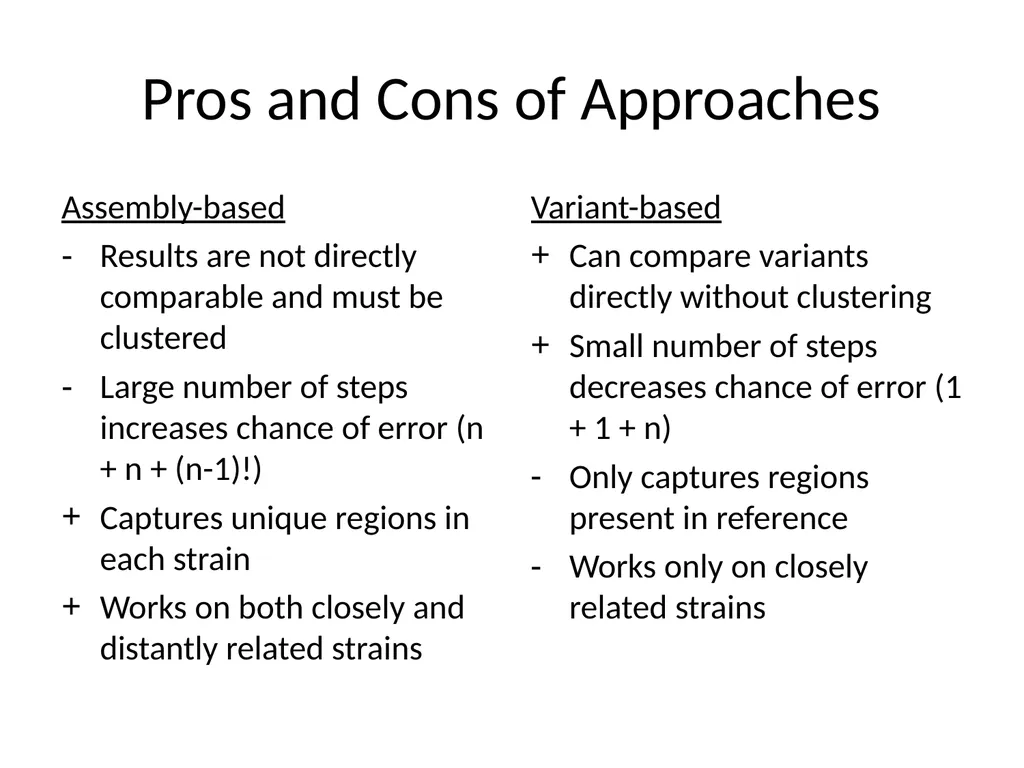
Pros and Cons of Approaches Assembly-based
Results are not directly comparable and must be clustered
Large number of steps increases chance of error (n + n + (n-1)!)
Captures unique regions in each strain
Works on both closely and distantly related strains Variant-based
Can compare variants directly without clustering
Small number of steps decreases chance of error (1 + 1 + n)
Only captures regions present in reference
Works only on closely related strains x<br>
Results are not directly comparable and must be clustered
Large number of steps increases chance of error (n + n + (n-1)!)
Captures unique regions in each strain
Works on both closely and distantly related strains Variant-based
Can compare variants directly without clustering
Small number of steps decreases chance of error (1 + 1 + n)
Only captures regions present in reference
Works only on closely related strains x<br>
40
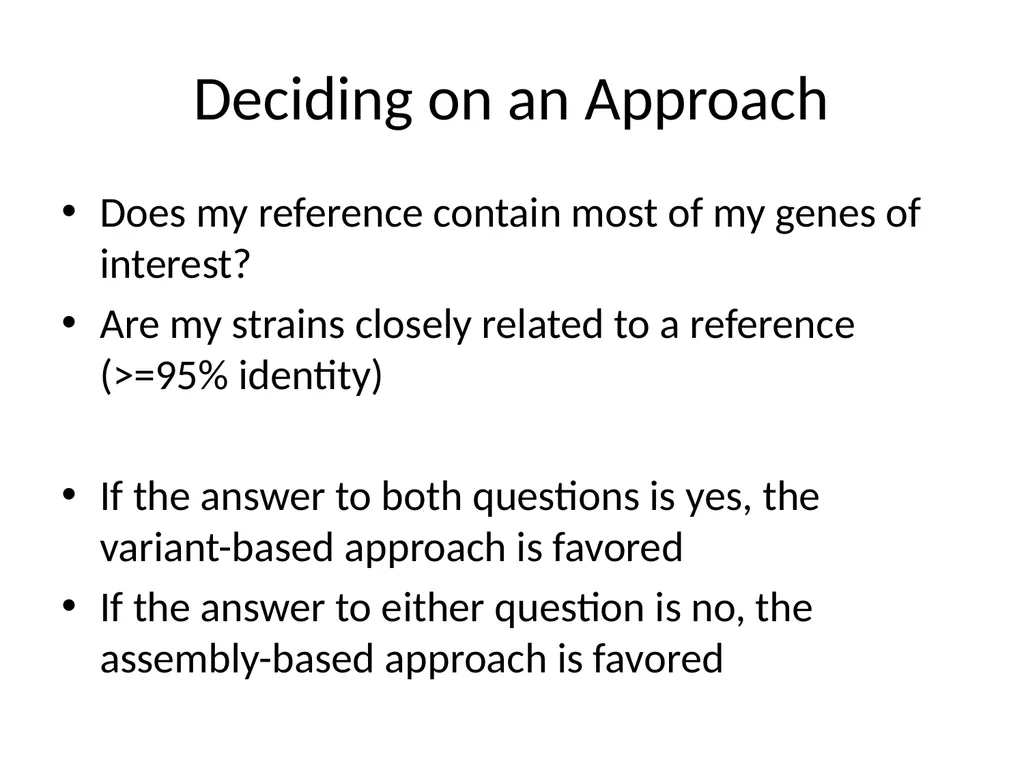
Deciding on an Approach Does my reference contain most of my genes of interest?
Are my strains closely related to a reference (>=95% identity)
If the answer to both questions is yes, the variant-based approach is favored
If the answer to either question is no, the assembly-based approach is favored<br>
Are my strains closely related to a reference (>=95% identity)
If the answer to both questions is yes, the variant-based approach is favored
If the answer to either question is no, the assembly-based approach is favored<br>
41
The afternoon laboratory will walk through the variant-based approach
Questions?<br>