
CHAPTER 06 ALGORITHMS AND FLOW CHARTS Unit 1: XI
KB
Published · 62 slides · 0 views
1 / 1




Description
CHAPTER 06 ALGORITHMS AND FLOW CHARTS Unit 1: XI Computer Science (083) Board : CBSE Computer Systems and Organisation (CSO) Unit 1: XI Computer Science (083) Board : CBSE Courtesy CBSE Computer Systems and Organisation (CSO) Unit I 10
Related Topics
Share
Embed code
Download this presentation From Below
"CHAPTER 06 ALGORITHMS AND FLOW CHARTS Unit 1: XI" is the property of its rightful owner. Permission is granted to download and print the materials on this website for personal, non-commercial use only, and to display it on your personal computer provided you do not modify the materials and that you retain all copyright notices contained in the materials. By downloading content from our website, you accept the terms of this agreement.
Presentation Transcript
01
CHAPTER 06
ALGORITHMS AND FLOW CHARTS Unit 1: XI
Computer Science (083)
Board : CBSE Computer Systems and Organisation (CSO)<br>
Computer Science (083)
Board : CBSE Computer Systems and Organisation (CSO)<br>
02
Unit 1: XI
Computer Science (083)
Board : CBSE Courtesy CBSE Computer Systems and Organisation (CSO)<br>
Computer Science (083)
Board : CBSE Courtesy CBSE Computer Systems and Organisation (CSO)<br>
03
Unit I 10 Theory + 02 Practical) Praveen M Jigajinni Prepared by Courtesy CBSE Computer Systems and Organisation (CSO) DCSc & Engg, PGDCA,ADCA,MCA.MSc(IT),Mtech(IT),MPhil (Comp. Sci)
Department of Computer Science, Sainik School Amaravathinagar
Cell No: 9431453730<br>
Department of Computer Science, Sainik School Amaravathinagar
Cell No: 9431453730<br>
04
PROBLEM SOLVING TECHNIQUES<br>
05
able to define problem;
able to define algorithm;
write algorithms for simple problems;
explain properties of an algorithm;
the meaning of flowchart;
explain the need of flow chart;
explain different symbols used in flow chart;
draw flow chart for simple problems; and convert a flow chart into an algorithm and vice versa. ALGORITHM AND FLOW CHART OBJECTIVES<br>
able to define algorithm;
write algorithms for simple problems;
explain properties of an algorithm;
the meaning of flowchart;
explain the need of flow chart;
explain different symbols used in flow chart;
draw flow chart for simple problems; and convert a flow chart into an algorithm and vice versa. ALGORITHM AND FLOW CHART OBJECTIVES<br>
06
ALGORITHM AND FLOW CHART Intelligence is one of the key characteristics which differentiate a human being from other living creatures on the earth. Basic intelligence covers day to day problem solving and making strategies to handle different situations which keep arising in day to day life. INTRODUCTION<br>
07
ALGORITHM AND FLOW CHART One person goes Bank to withdraw money. After knowing the balance in his account, he/she decides to withdraw the entire amount from his account but he/she has to leave minimum balance in his account. INTRODUCTION<br>
08
ALGORITHM AND FLOW CHART Here deciding about how much amount he/she may withdraw from the account is one of the example of the basic intelligence. During the process of solving any problem, one tries to find the necessary steps to be taken in a sequence. INTRODUCTION<br>
09
ALGORITHM AND FLOW CHART What is Algorithm? Algorithm can be defined as: “A sequence of activities to be processed for getting desired output from a given input.”<br>
10
ALGORITHM AND FLOW CHART What is Algorithm? Webopedia defines an algorithm as:
“A formula or set of steps for solving a
particularproblem. To be an algorithm, a set of rules must be unambiguous and have a clear stopping point”.<br>
“A formula or set of steps for solving a
particularproblem. To be an algorithm, a set of rules must be unambiguous and have a clear stopping point”.<br>
11
MUHAMMAD IBN MUSA AL-KHWARIZMI Muḥammad ibn Mūsā al-Khwārizmī (Persian: محمد بن موسى خوارزمی; c. 780 – c. 850), Formerly Latinized as Algoritmi, was a Persian scholar who produced works in mathematics, astronomy, & geography under the patronage of the Caliph Al-Ma'mun of the Abbasid Caliphate. Around 820 AD he was appointed as the astronomer and head of the library of the House of Wisdom in Baghdad.<br>
12
PROPERTIES OF ALGORITHM Donald Ervin Knuth has given a list of five properties for an algorithm, these properties are:
FINITENESS
DEFINITENESS
INPUT
OUTPUT
EFFECTIVENESS<br>
FINITENESS
DEFINITENESS
INPUT
OUTPUT
EFFECTIVENESS<br>
13
PROPERTIES OF ALGORITHM FINITENESS:
An algorithm must always terminate after a finite number of steps. It means after every step one reach closer to solution of the problem and after a finite number of steps algorithm reaches to an end point.<br>
An algorithm must always terminate after a finite number of steps. It means after every step one reach closer to solution of the problem and after a finite number of steps algorithm reaches to an end point.<br>
14
PROPERTIES OF ALGORITHM 2) DEFINITENESS
Each step of an algorithm must be precisely defined. It is done by well thought actions to be performed at each step of the algorithm. Also the actions are defined unambiguously for each activity in the algorithm.<br>
Each step of an algorithm must be precisely defined. It is done by well thought actions to be performed at each step of the algorithm. Also the actions are defined unambiguously for each activity in the algorithm.<br>
15
PROPERTIES OF ALGORITHM 3) INPUT
Any operation you perform need some beginning value/quantities associated with different activities in the operation. So the value/quantities are given to the algorithm before it begins.<br>
Any operation you perform need some beginning value/quantities associated with different activities in the operation. So the value/quantities are given to the algorithm before it begins.<br>
16
PROPERTIES OF ALGORITHM 4) OUTPUT:
One always expects output/result (expected value/quantities) in terms of output from an algorithm. The result may be obtained at different stages of the algorithm. If some result is from the intermediate stage of the operation then it is known as intermediate result and result obtained at the end of algorithm is known as end result. The output is expected value/quantities always have a specified relation to the inputs.<br>
One always expects output/result (expected value/quantities) in terms of output from an algorithm. The result may be obtained at different stages of the algorithm. If some result is from the intermediate stage of the operation then it is known as intermediate result and result obtained at the end of algorithm is known as end result. The output is expected value/quantities always have a specified relation to the inputs.<br>
17
PROPERTIES OF ALGORITHM 5) EFFECTIVENESS:
Algorithms to be developed/written using basic operations. Actually operations should be basic, so that even they can in principle be done exactly and in a finite amount of time by a person, by using paper and pencil only.<br>
Algorithms to be developed/written using basic operations. Actually operations should be basic, so that even they can in principle be done exactly and in a finite amount of time by a person, by using paper and pencil only.<br>
18
PROPERTIES OF ALGORITHM Any algorithm should have all these five properties otherwise it will not fulfil the basic objective of solving a problem in finite time. As you have seen in previous examples, every step of an algorithm puts you closer to the solution<br>
19
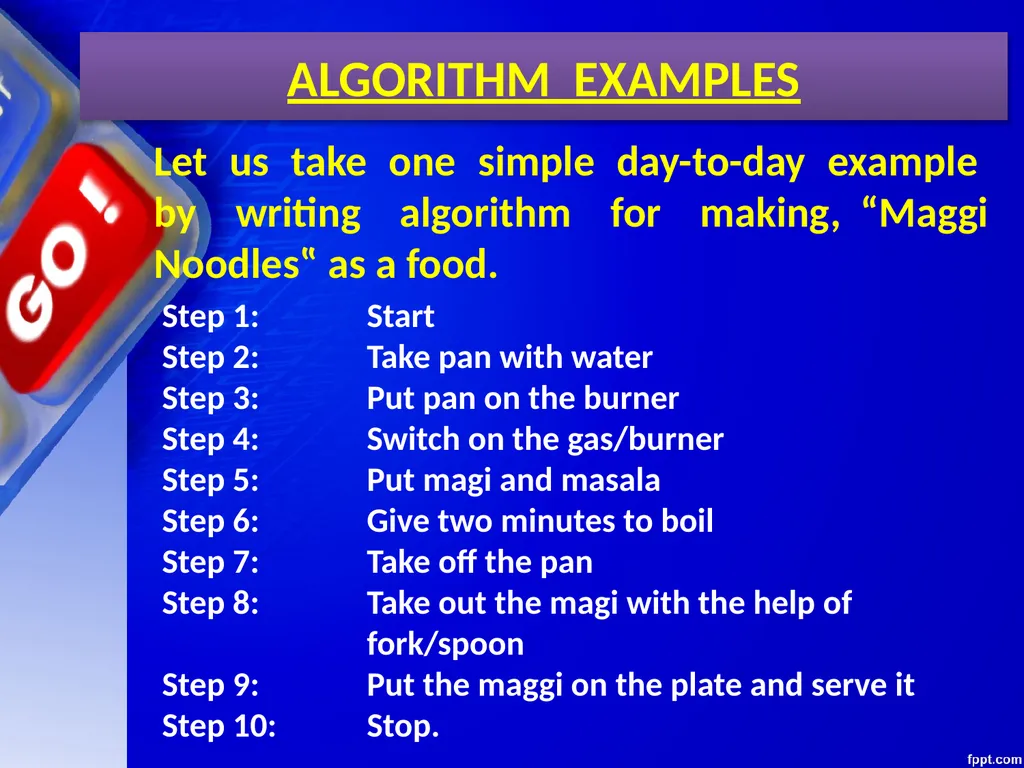
ALGORITHM EXAMPLES Let us take one simple day-to-day example by writing algorithm for making, “Maggi Noodles‟ as a food. Step 1: Start
Step 2: Take pan with water
Step 3: Put pan on the burner
Step 4: Switch on the gas/burner
Step 5: Put magi and masala
Step 6: Give two minutes to boil
Step 7: Take off the pan
Step 8: Take out the magi with the help of
fork/spoon
Step 9: Put the maggi on the plate and serve it
Step 10: Stop.<br>
Step 2: Take pan with water
Step 3: Put pan on the burner
Step 4: Switch on the gas/burner
Step 5: Put magi and masala
Step 6: Give two minutes to boil
Step 7: Take off the pan
Step 8: Take out the magi with the help of
fork/spoon
Step 9: Put the maggi on the plate and serve it
Step 10: Stop.<br>
20
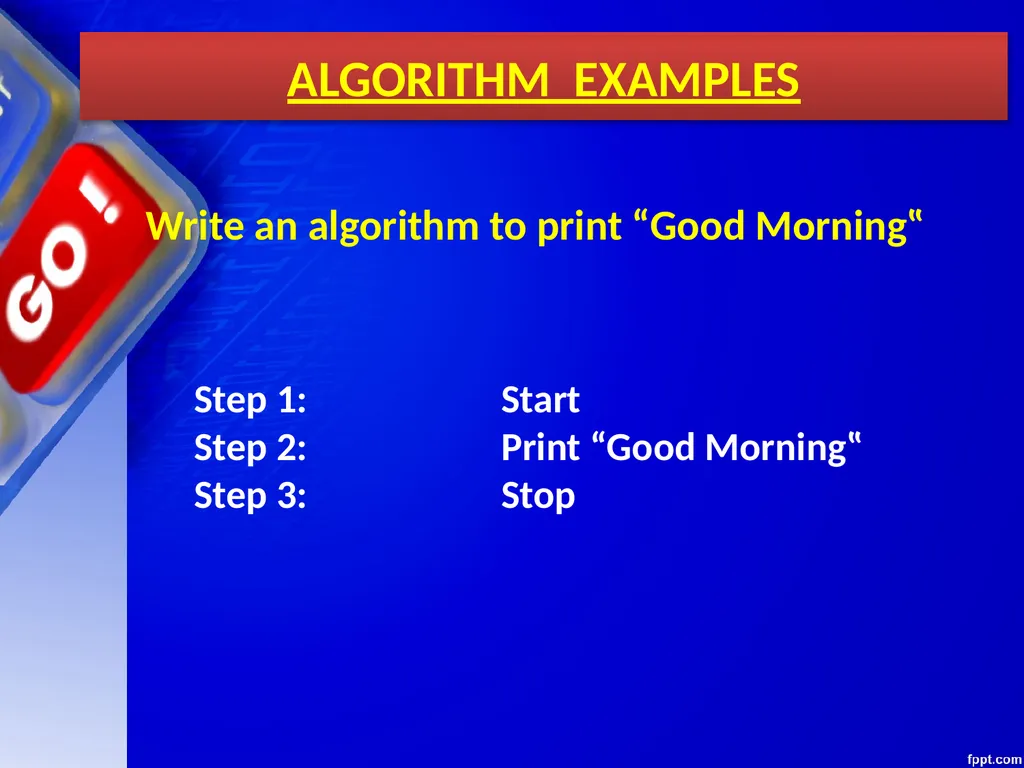
ALGORITHM EXAMPLES Write an algorithm to print “Good Morning‟ Step 1: Start
Step 2: Print “Good Morning‟
Step 3: Stop<br>
Step 2: Print “Good Morning‟
Step 3: Stop<br>
21
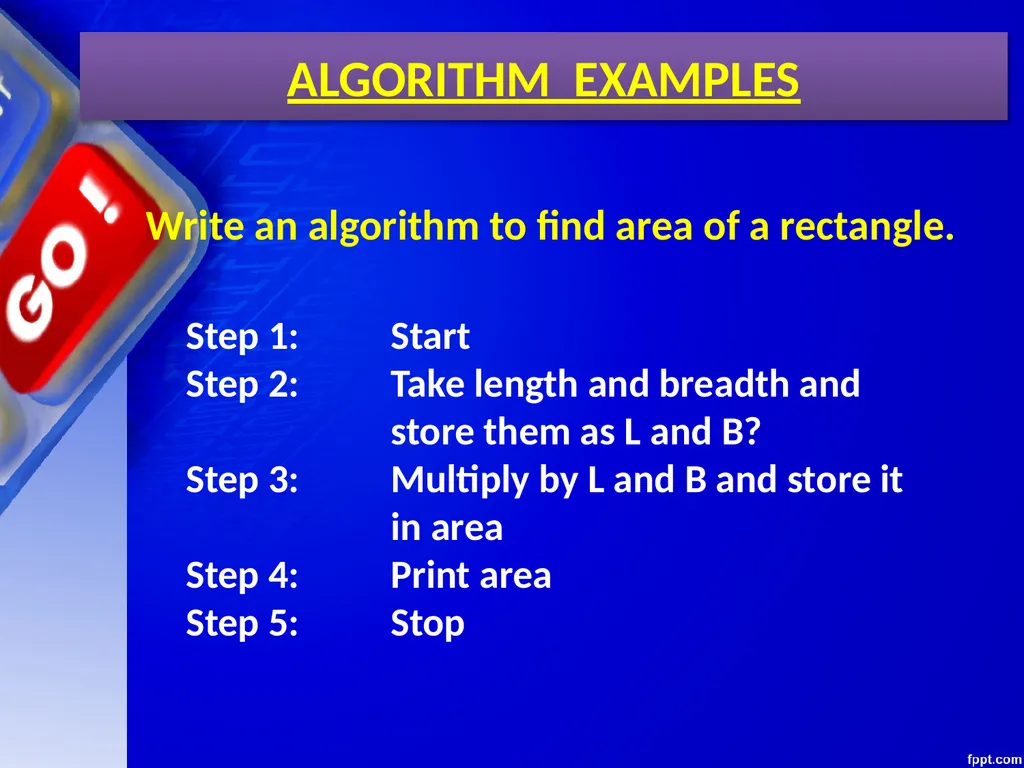
ALGORITHM EXAMPLES Write an algorithm to find area of a rectangle. Step 1: Start
Step 2: Take length and breadth and
store them as L and B?
Step 3: Multiply by L and B and store it
in area
Step 4: Print area
Step 5: Stop<br>
Step 2: Take length and breadth and
store them as L and B?
Step 3: Multiply by L and B and store it
in area
Step 4: Print area
Step 5: Stop<br>
22
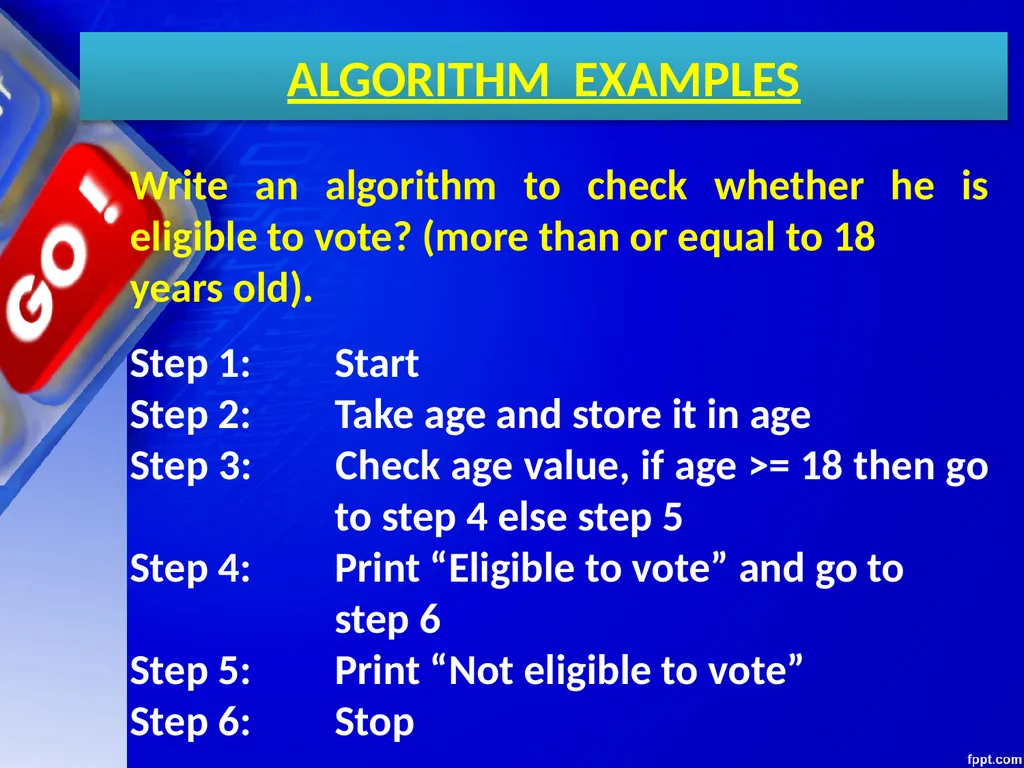
ALGORITHM EXAMPLES Write an algorithm to check whether he is eligible to vote? (more than or equal to 18
years old).
Step 1: Start
Step 2: Take age and store it in age
Step 3: Check age value, if age >= 18 then go to step 4 else step 5
Step 4: Print “Eligible to vote” and go to
step 6
Step 5: Print “Not eligible to vote”
Step 6: Stop<br>
years old).
Step 1: Start
Step 2: Take age and store it in age
Step 3: Check age value, if age >= 18 then go to step 4 else step 5
Step 4: Print “Eligible to vote” and go to
step 6
Step 5: Print “Not eligible to vote”
Step 6: Stop<br>
23
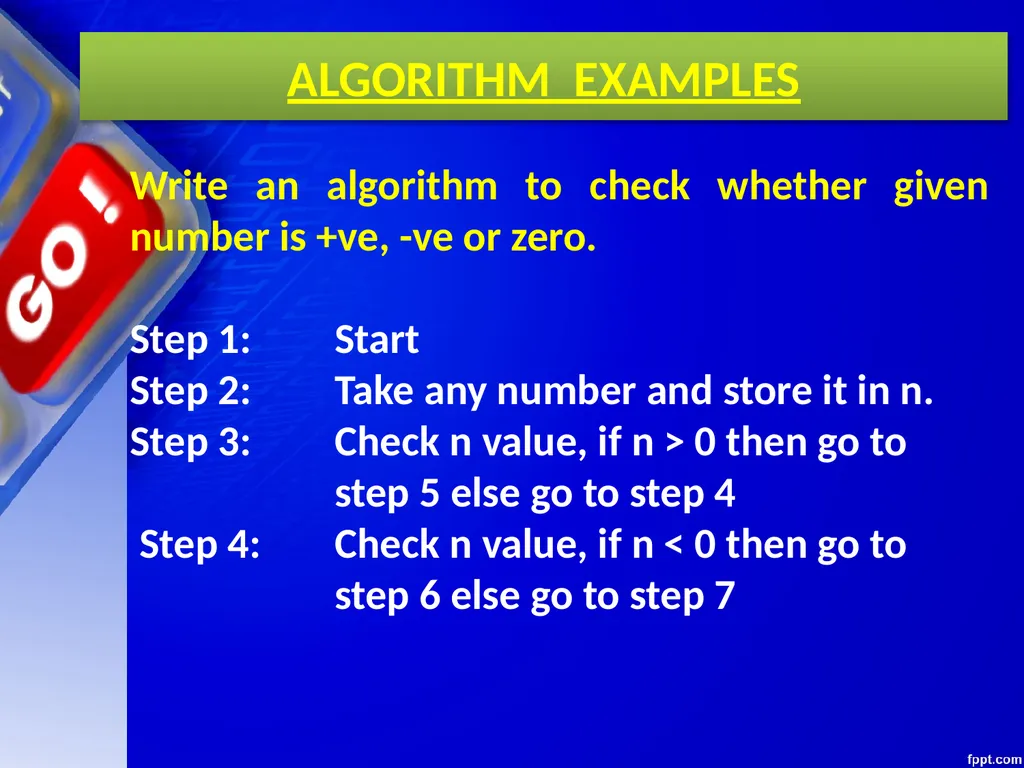
ALGORITHM EXAMPLES Write an algorithm to check whether given number is +ve, -ve or zero.
Step 1: Start
Step 2: Take any number and store it in n.
Step 3: Check n value, if n > 0 then go to
step 5 else go to step 4
Step 4: Check n value, if n < 0 then go to
step 6 else go to step 7<br>
Step 1: Start
Step 2: Take any number and store it in n.
Step 3: Check n value, if n > 0 then go to
step 5 else go to step 4
Step 4: Check n value, if n < 0 then go to
step 6 else go to step 7<br>
24
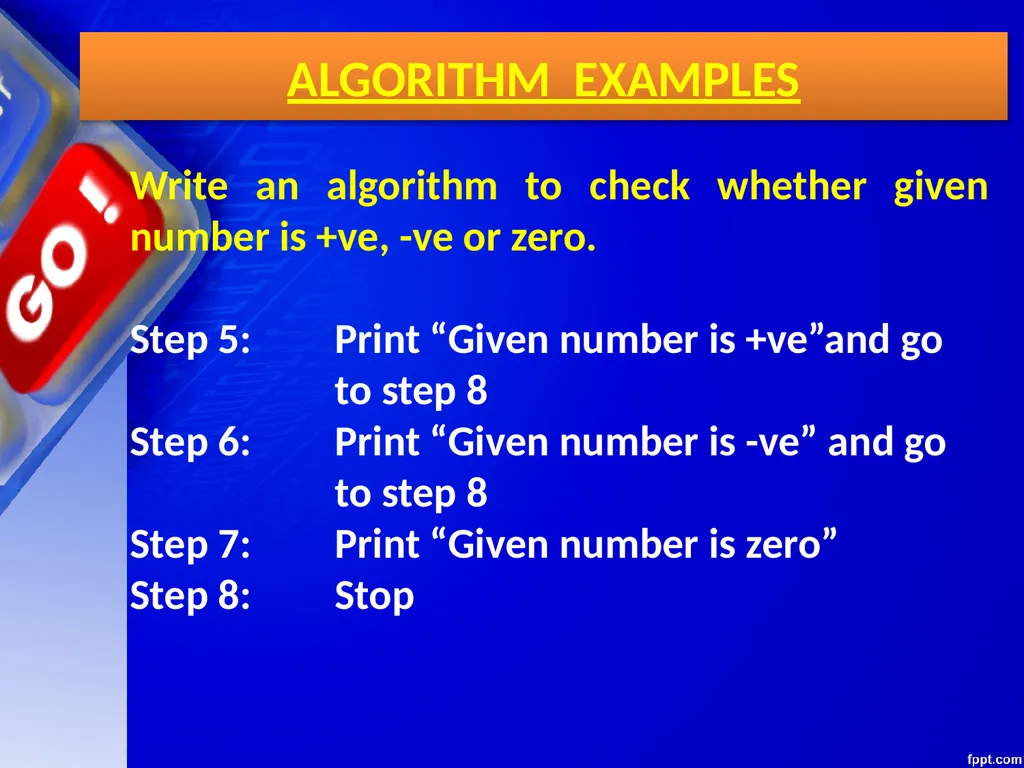
ALGORITHM EXAMPLES Write an algorithm to check whether given number is +ve, -ve or zero.
Step 5: Print “Given number is +ve”and go
to step 8
Step 6: Print “Given number is -ve” and go
to step 8
Step 7: Print “Given number is zero”
Step 8: Stop<br>
Step 5: Print “Given number is +ve”and go
to step 8
Step 6: Print “Given number is -ve” and go
to step 8
Step 7: Print “Given number is zero”
Step 8: Stop<br>
25
FLOWCHART<br>
26
The flowchart is a diagram which visually presents the flow of data through processing systems. This means by seeing a flow chart one can know the operations performed and the sequence of these operations in a system. Algorithms are nothing but sequence of steps for solving problems. So a flow chart can be used for representing an algorithm. A flowchart, will describe the operations (and in what sequence) are required to solve a given problem. FLOWCHART<br>
27
A flowchart is a type of diagram that represents an algorithm, workflow or process. The flowchart shows the steps as boxes of various kinds, and their order by connecting the boxes with arrows. This diagrammatic representation illustrates a solution model to a given problem. Flowcharts are used in analyzing, designing, documenting or managing a process or program in various fields. FLOWCHART<br>
28
BUILDING BLOCKS
OF
FLOW CHART
OR
COMMON SYMBOLS
OF
FLOW CHART<br>
29
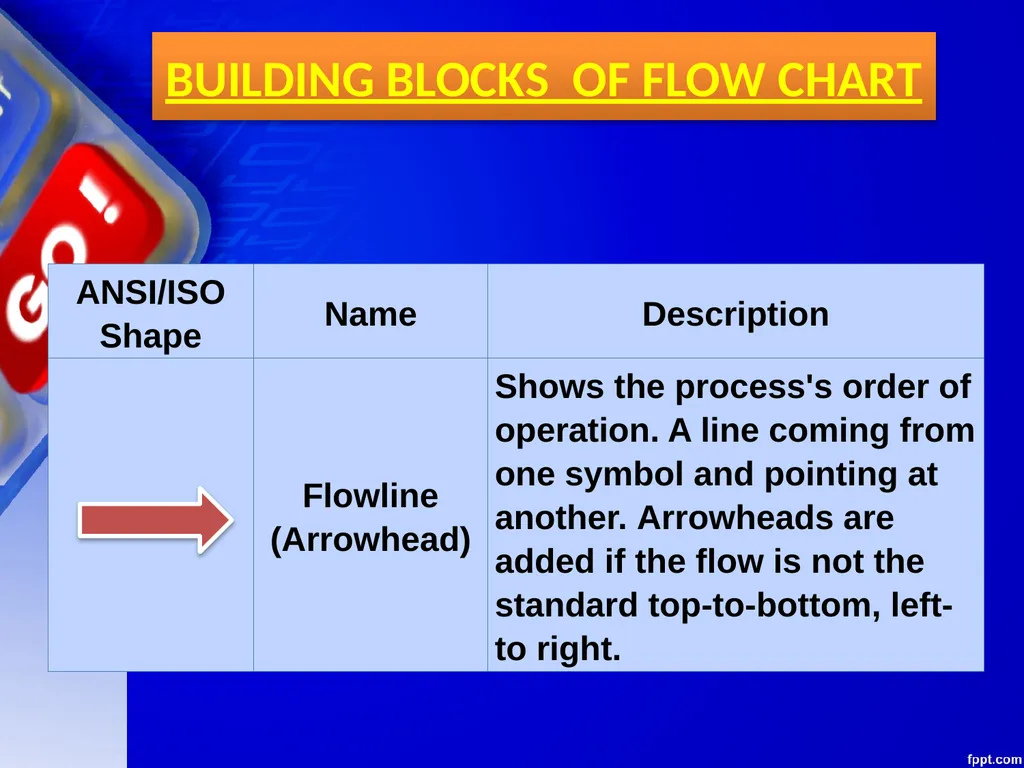
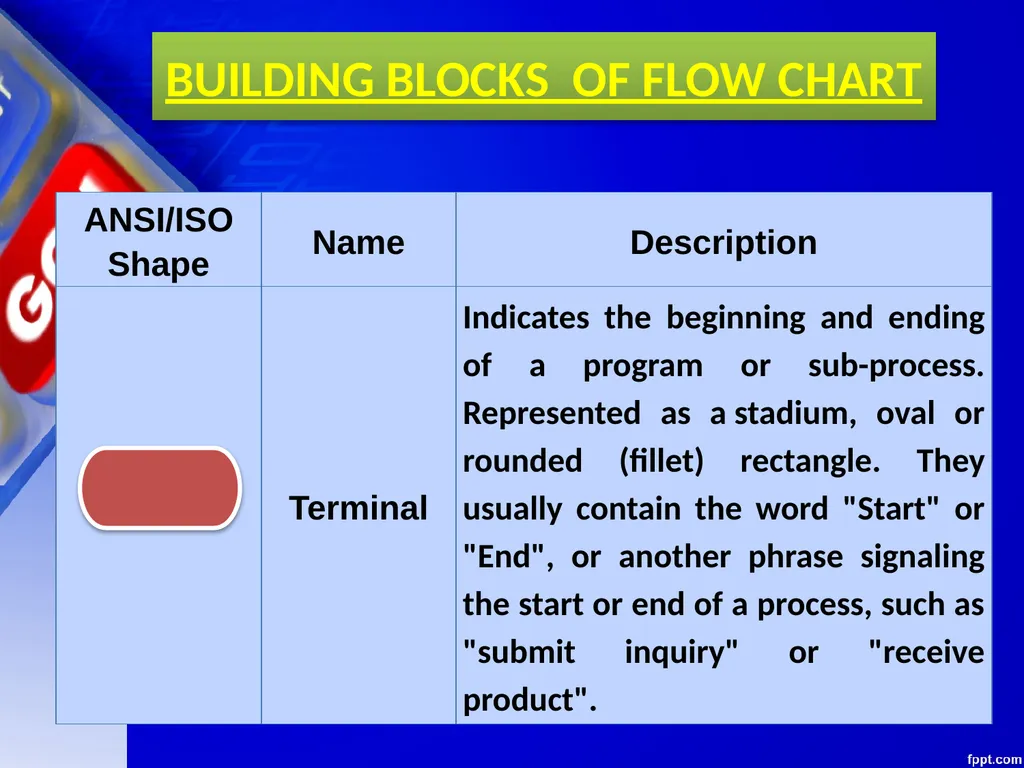
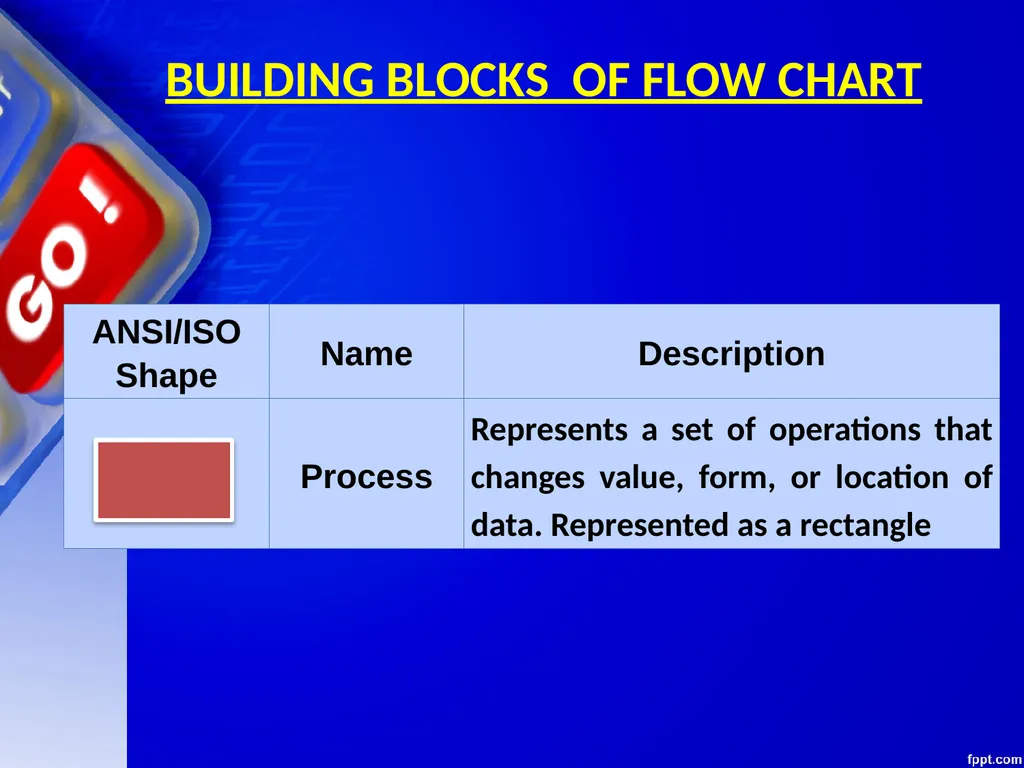
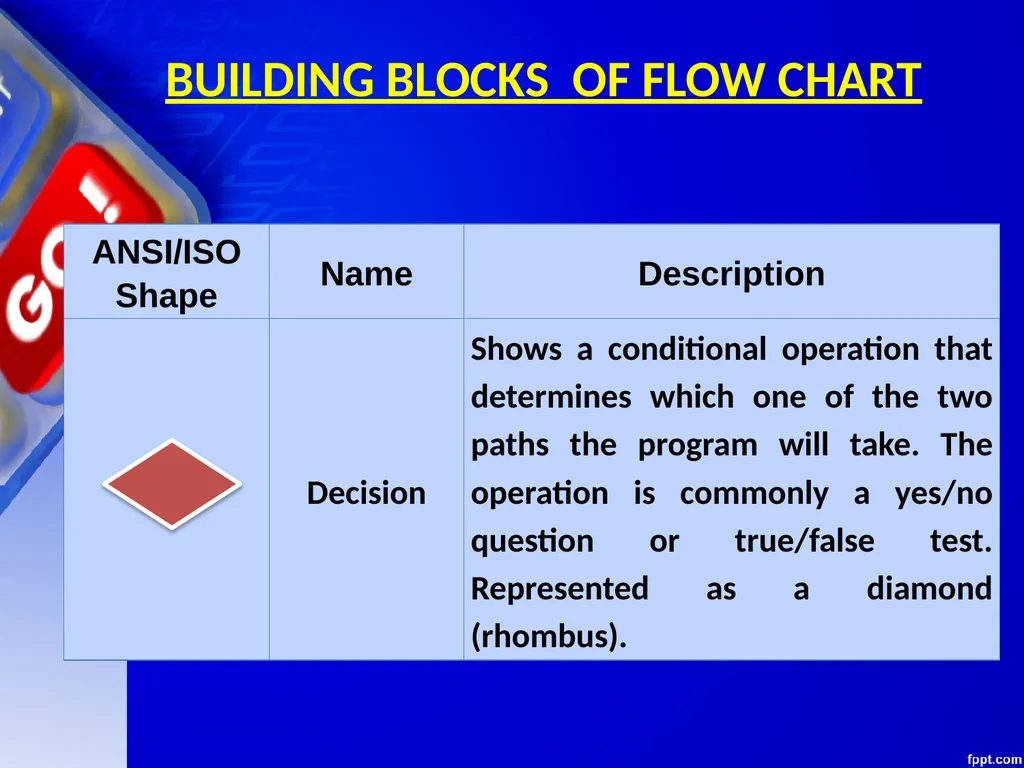
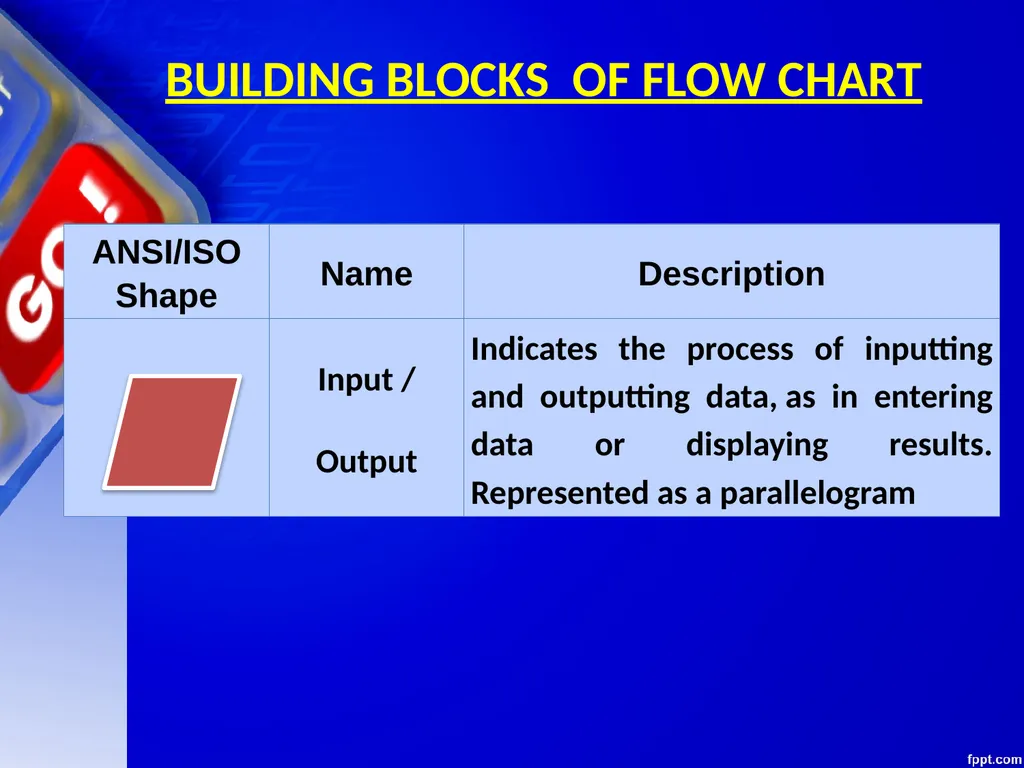
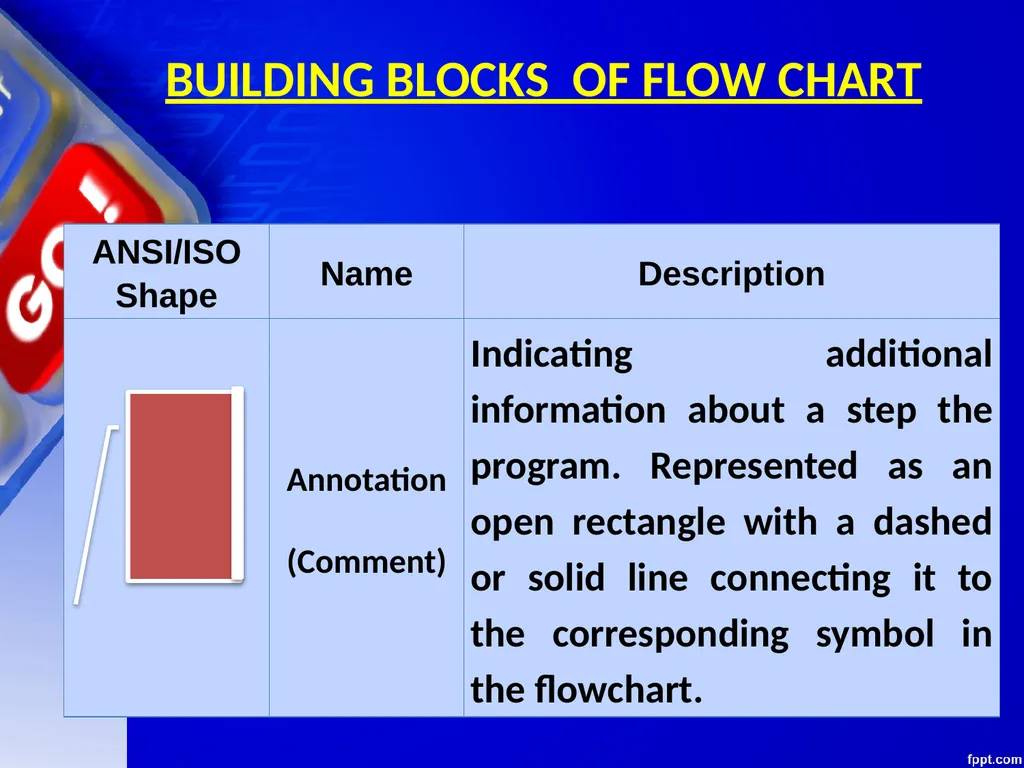
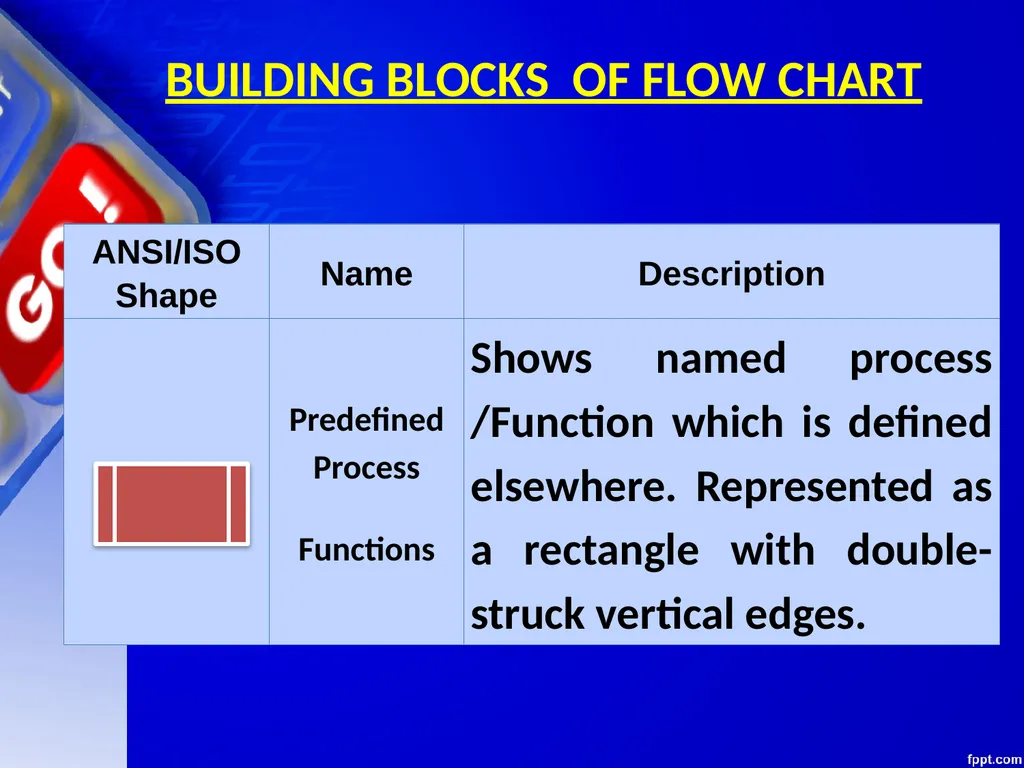
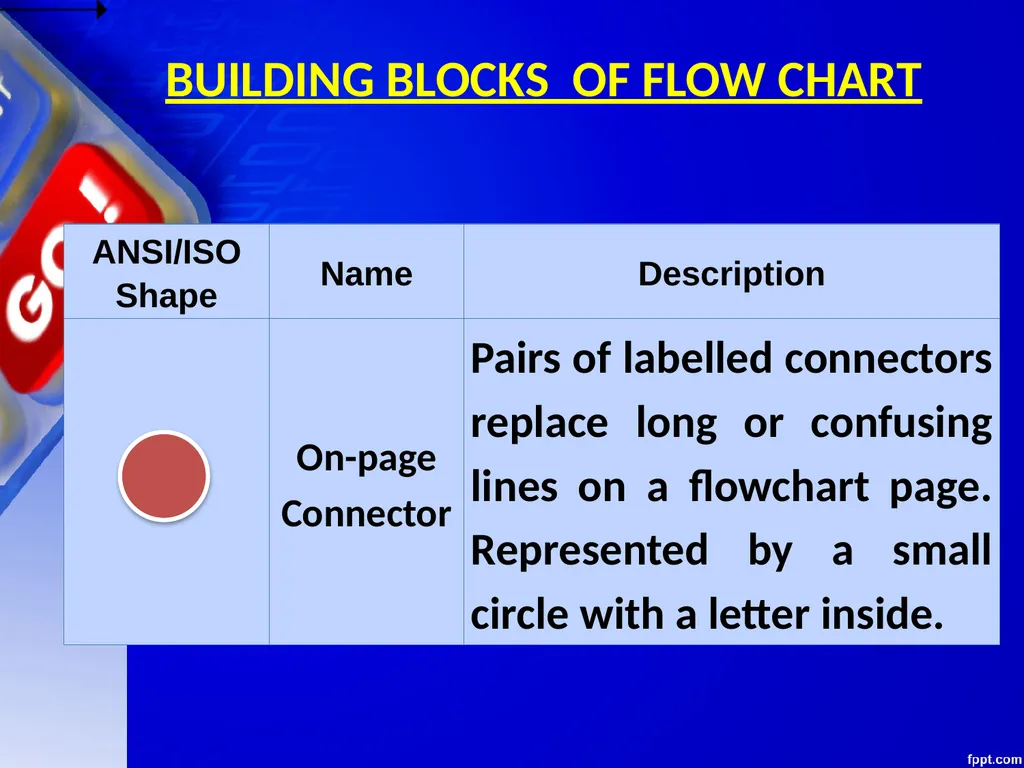
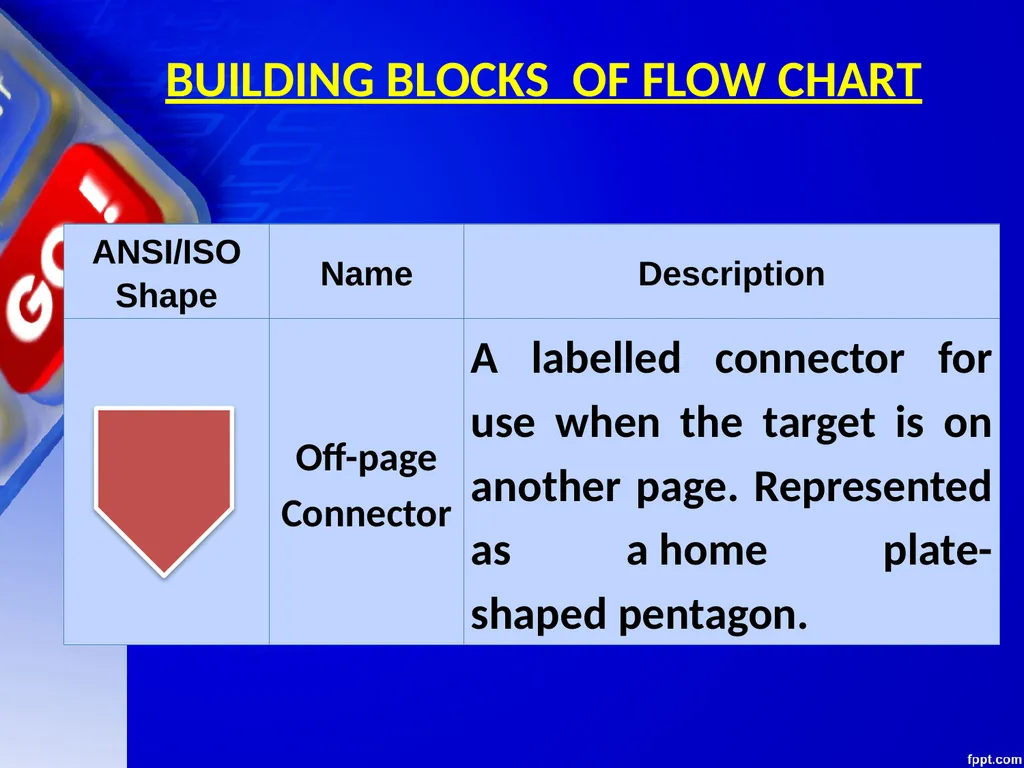
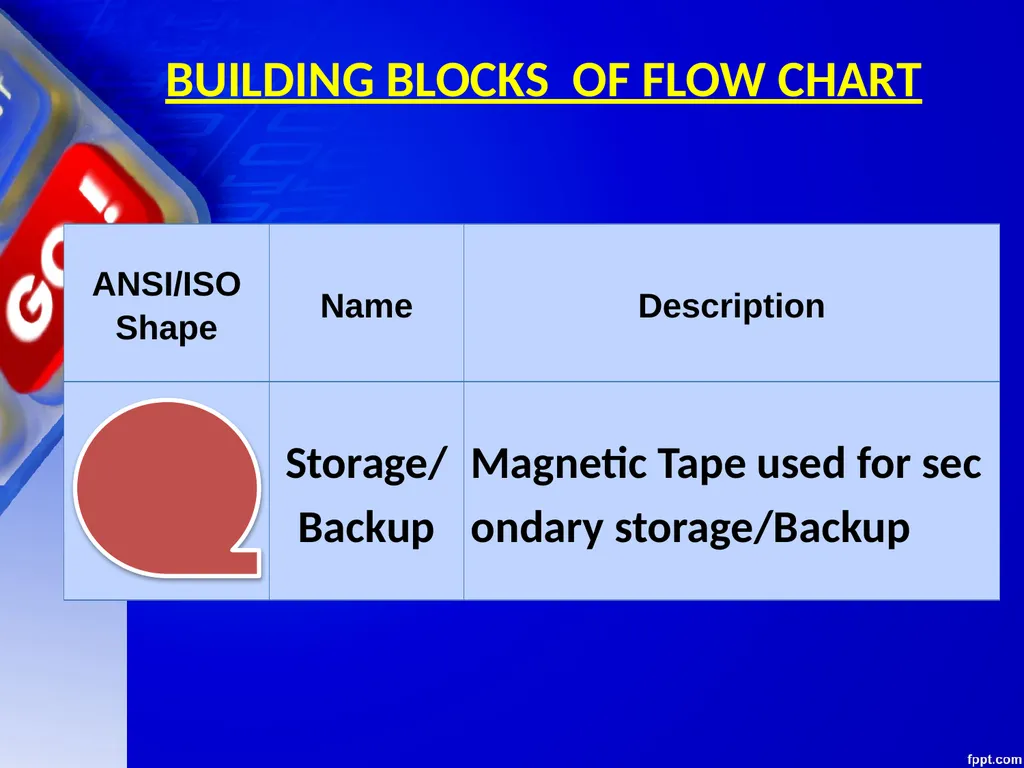
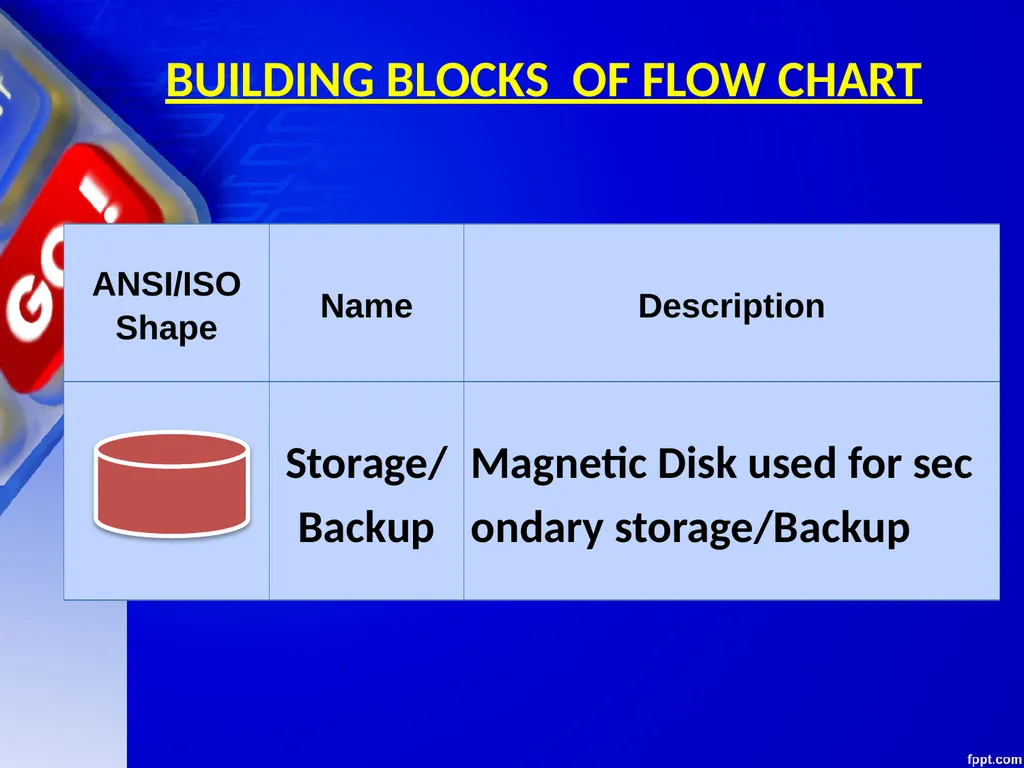
The American National Standards Institute (ANSI) set standards for flowcharts and their symbols in the 1960s. The International Organization for Standardization(ISO) adopted the ANSI symbols in 1970. The current standard was revised in 1985. Generally, flowcharts flow from top to bottom and left to right. BUILDING BLOCKS OF FLOW CHART<br>
30
BUILDING BLOCKS OF FLOW CHART<br>
31
BUILDING BLOCKS OF FLOW CHART<br>
32
BUILDING BLOCKS OF FLOW CHART<br>
33
BUILDING BLOCKS OF FLOW CHART<br>
34
BUILDING BLOCKS OF FLOW CHART<br>
35
BUILDING BLOCKS OF FLOW CHART<br>
36
BUILDING BLOCKS OF FLOW CHART<br>
37
BUILDING BLOCKS OF FLOW CHART<br>
38
BUILDING BLOCKS OF FLOW CHART<br>
39
BUILDING BLOCKS OF FLOW CHART<br>
40
BUILDING BLOCKS OF FLOW CHART<br>
41
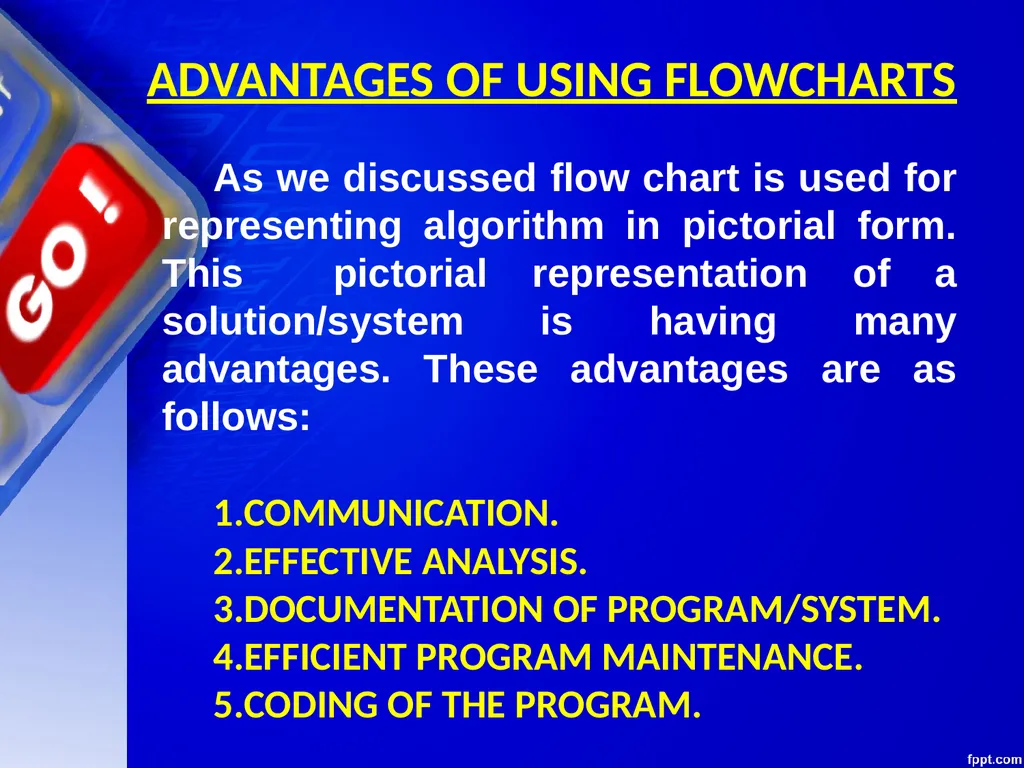
ADVANTAGES OF USING FLOWCHARTS As we discussed flow chart is used for representing algorithm in pictorial form. This pictorial representation of a solution/system is having many advantages. These advantages are as follows:
COMMUNICATION.
EFFECTIVE ANALYSIS.
DOCUMENTATION OF PROGRAM/SYSTEM.
EFFICIENT PROGRAM MAINTENANCE.
CODING OF THE PROGRAM.<br>
COMMUNICATION.
EFFECTIVE ANALYSIS.
DOCUMENTATION OF PROGRAM/SYSTEM.
EFFICIENT PROGRAM MAINTENANCE.
CODING OF THE PROGRAM.<br>
42
ADVANTAGES OF USING FLOWCHARTS COMMUNICATION:
A Flowchart can be used as a better way of communication of the logic of a system and steps involve in the solution, to all concerned particularly to the client of system.<br>
A Flowchart can be used as a better way of communication of the logic of a system and steps involve in the solution, to all concerned particularly to the client of system.<br>
43
ADVANTAGES OF USING FLOWCHARTS EFFECTIVE ANALYSIS:
A flowchart of a problem can be used for effective analysis of the problem.<br>
A flowchart of a problem can be used for effective analysis of the problem.<br>
44
ADVANTAGES OF USING FLOWCHARTS 3.DOCUMENTATION OF PROGRAM/ SYSTEM:
Program flowcharts are a vital part of a good program documentation. Program document is used for various purposes like knowing the components in the program, complexity of the program etc.<br>
Program flowcharts are a vital part of a good program documentation. Program document is used for various purposes like knowing the components in the program, complexity of the program etc.<br>
45
ADVANTAGES OF USING FLOWCHARTS 4. EFFICIENT PROGRAM MAINTENANCE:
Once a program is developed and becomes operational it needs time to time maintenance. With help of flowchart maintenance become easier.<br>
Once a program is developed and becomes operational it needs time to time maintenance. With help of flowchart maintenance become easier.<br>
46
ADVANTAGES OF USING FLOWCHARTS 5. CODING OF THE PROGRAM:
Any design of solution of a problem is finally converted into computer program. Writing code referring the flowchart of the solution become easy.<br>
Any design of solution of a problem is finally converted into computer program. Writing code referring the flowchart of the solution become easy.<br>
47
LIMITATIONS OF USING FLOWCHARTS COMPLEXITY OF LOGIC: If program logic is complex then flowchart of the program becomes complicated.
2) ALTERATIONS AND MODIFICATIONS IN LOGIC: any alterations in the program logic may require redrawing of flowchart completely.
3) REUSE IS NOT POSSIBLE: As the flowchart symbols cannot be typed, always reproduction of flowchart symbols are required.<br>
2) ALTERATIONS AND MODIFICATIONS IN LOGIC: any alterations in the program logic may require redrawing of flowchart completely.
3) REUSE IS NOT POSSIBLE: As the flowchart symbols cannot be typed, always reproduction of flowchart symbols are required.<br>
48
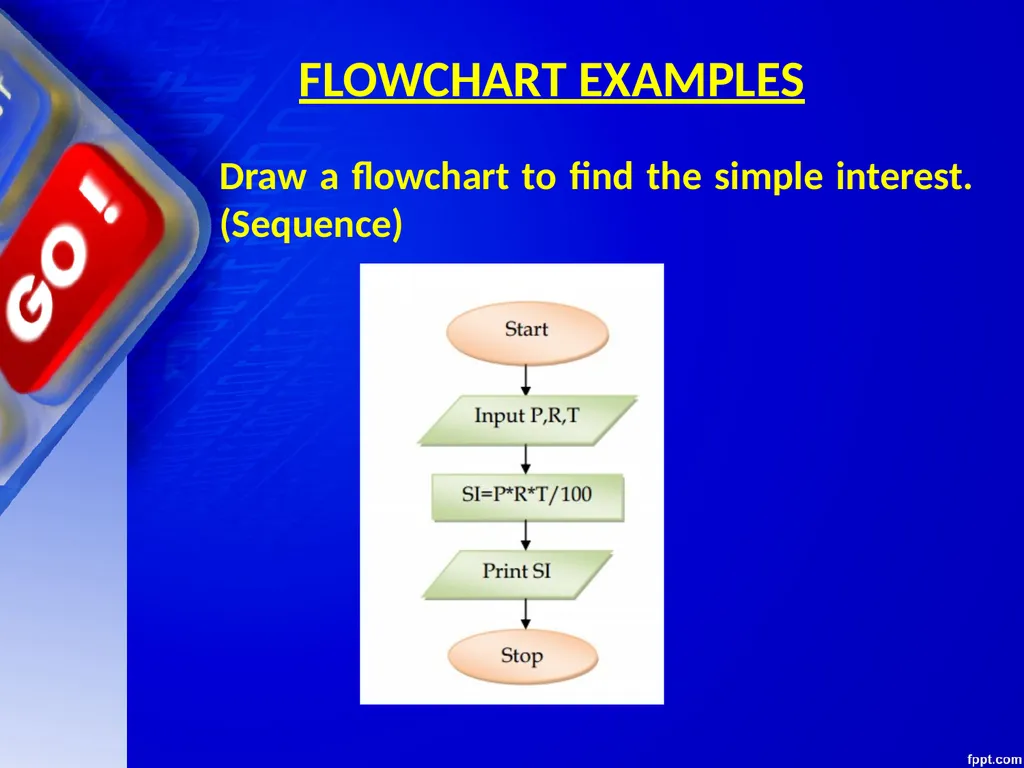
FLOWCHART EXAMPLES Draw a flowchart to find the simple interest. (Sequence)<br>
49
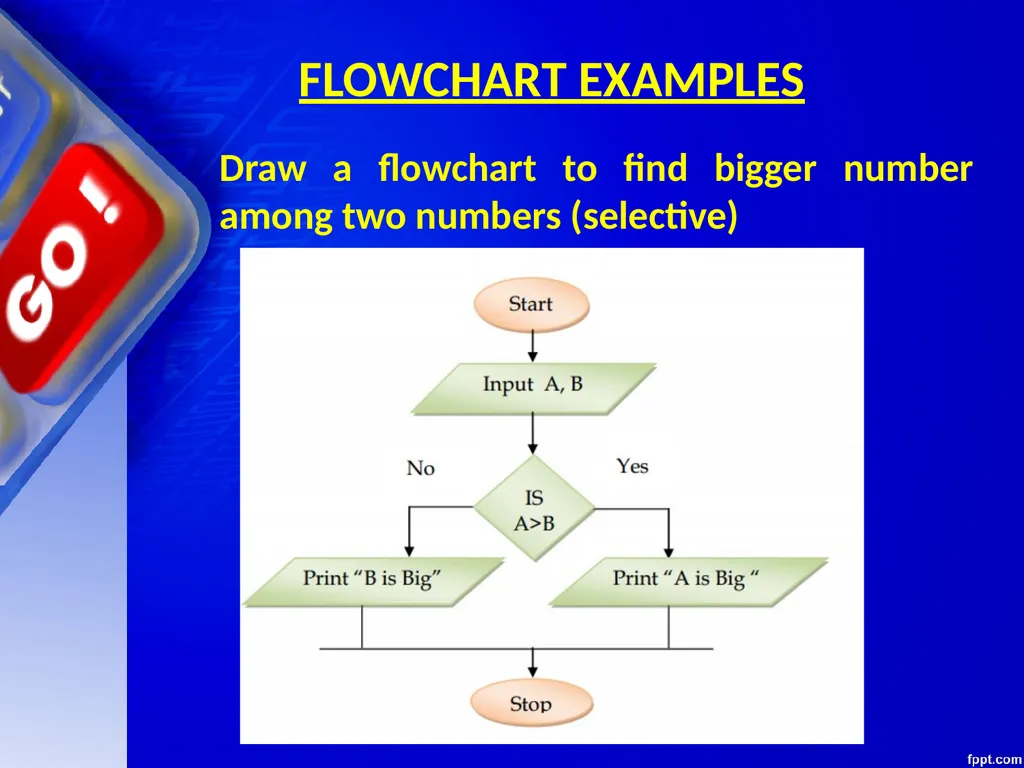
FLOWCHART EXAMPLES Draw a flowchart to find bigger number among two numbers (selective)<br>
50
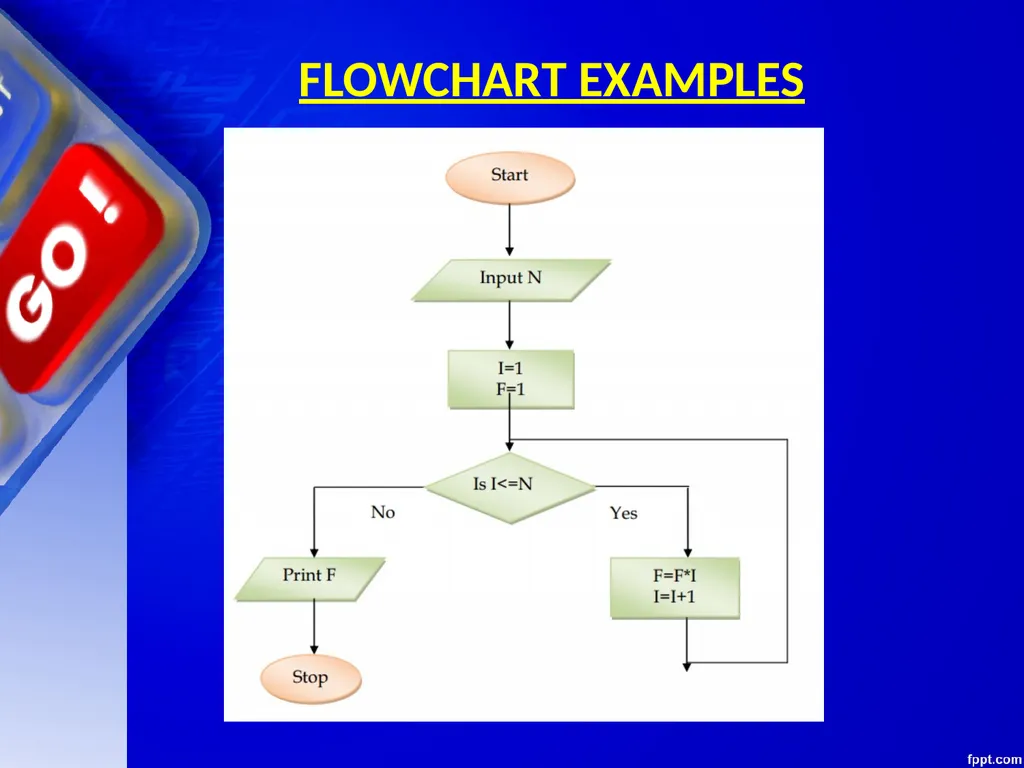
FLOWCHART EXAMPLES Draw a flow chart to find factorial of any number.<br>
51
FLOWCHART EXAMPLES<br>
52
FLOWCHART EXAMPLES Draw a flow chart to print the number from 1 to N.<br>
53
FLOWCHART EXAMPLES<br>
54
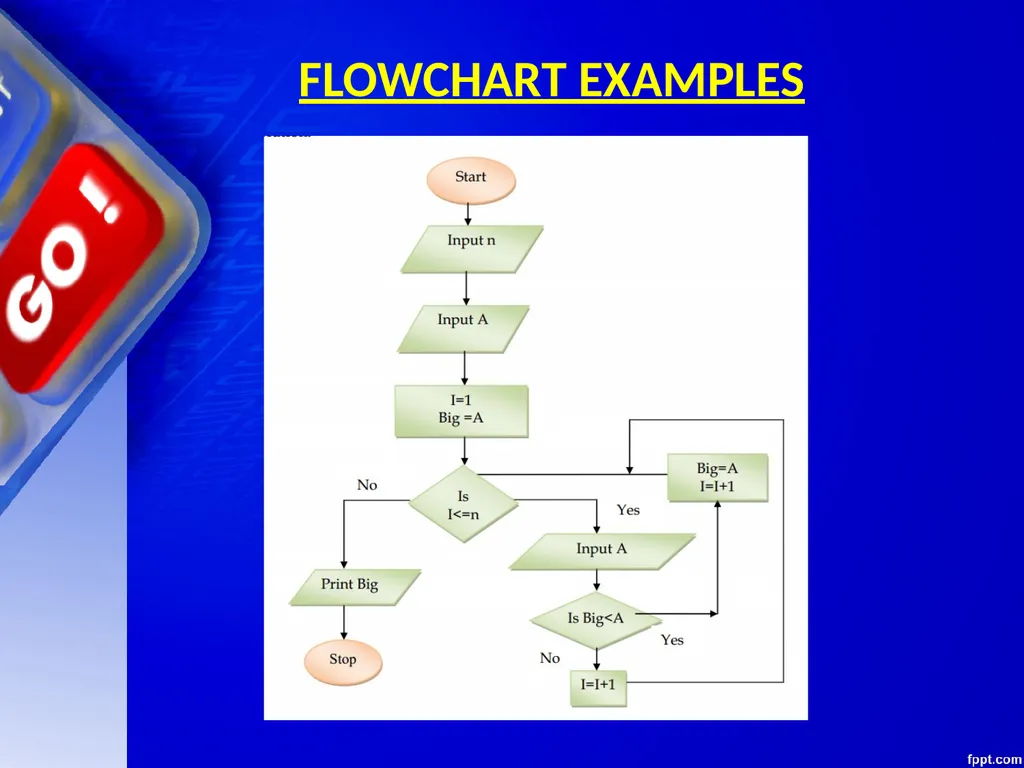
FLOWCHART EXAMPLES Draw a flow chart to find biggest number among N numbers.<br>
55
FLOWCHART EXAMPLES<br>
56
CLASS TEST<br>
57
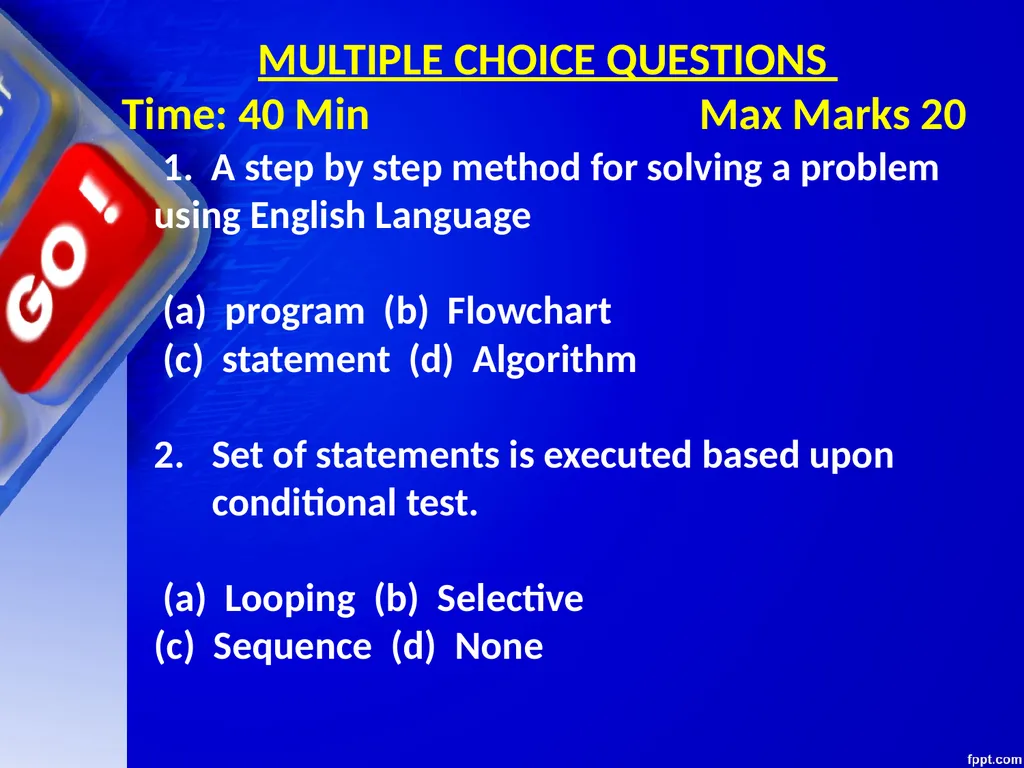
1. A step by step method for solving a problem using English Language
(a) program (b) Flowchart
(c) statement (d) Algorithm
Set of statements is executed based upon conditional test.
(a) Looping (b) Selective
(c) Sequence (d) None MULTIPLE CHOICE QUESTIONS
Time: 40 Min Max Marks 20<br>
(a) program (b) Flowchart
(c) statement (d) Algorithm
Set of statements is executed based upon conditional test.
(a) Looping (b) Selective
(c) Sequence (d) None MULTIPLE CHOICE QUESTIONS
Time: 40 Min Max Marks 20<br>
58
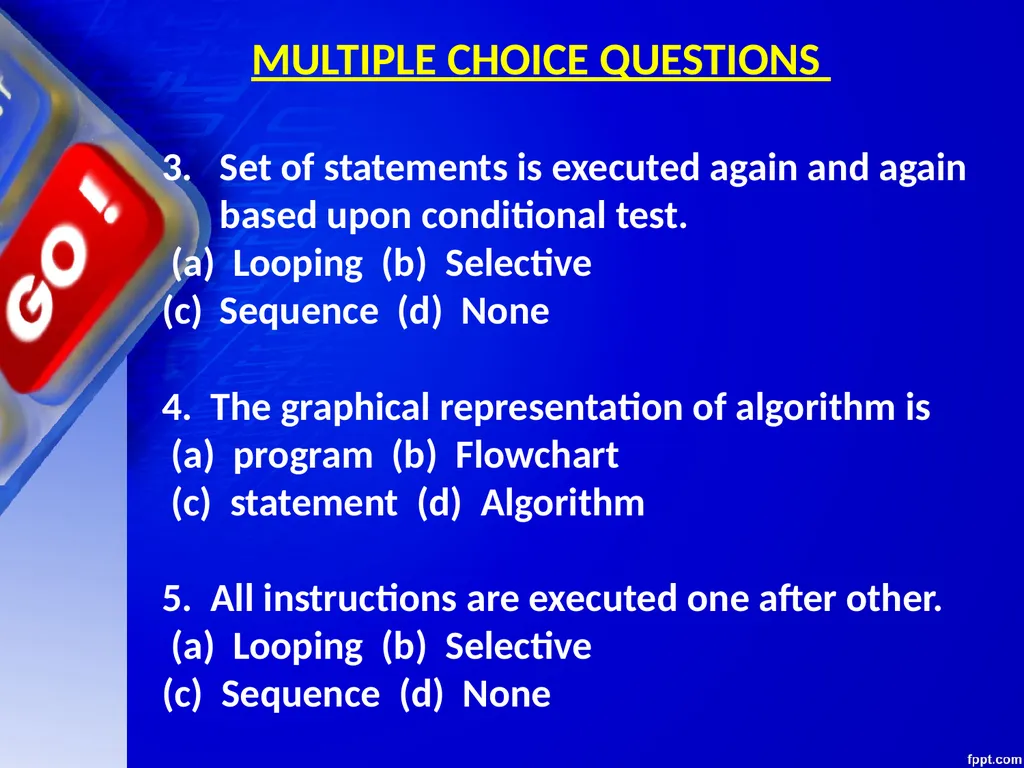
Set of statements is executed again and again based upon conditional test.
(a) Looping (b) Selective
Sequence (d) None
4. The graphical representation of algorithm is
(a) program (b) Flowchart
(c) statement (d) Algorithm
5. All instructions are executed one after other.
(a) Looping (b) Selective
(c) Sequence (d) None MULTIPLE CHOICE QUESTIONS<br>
(a) Looping (b) Selective
Sequence (d) None
4. The graphical representation of algorithm is
(a) program (b) Flowchart
(c) statement (d) Algorithm
5. All instructions are executed one after other.
(a) Looping (b) Selective
(c) Sequence (d) None MULTIPLE CHOICE QUESTIONS<br>
59
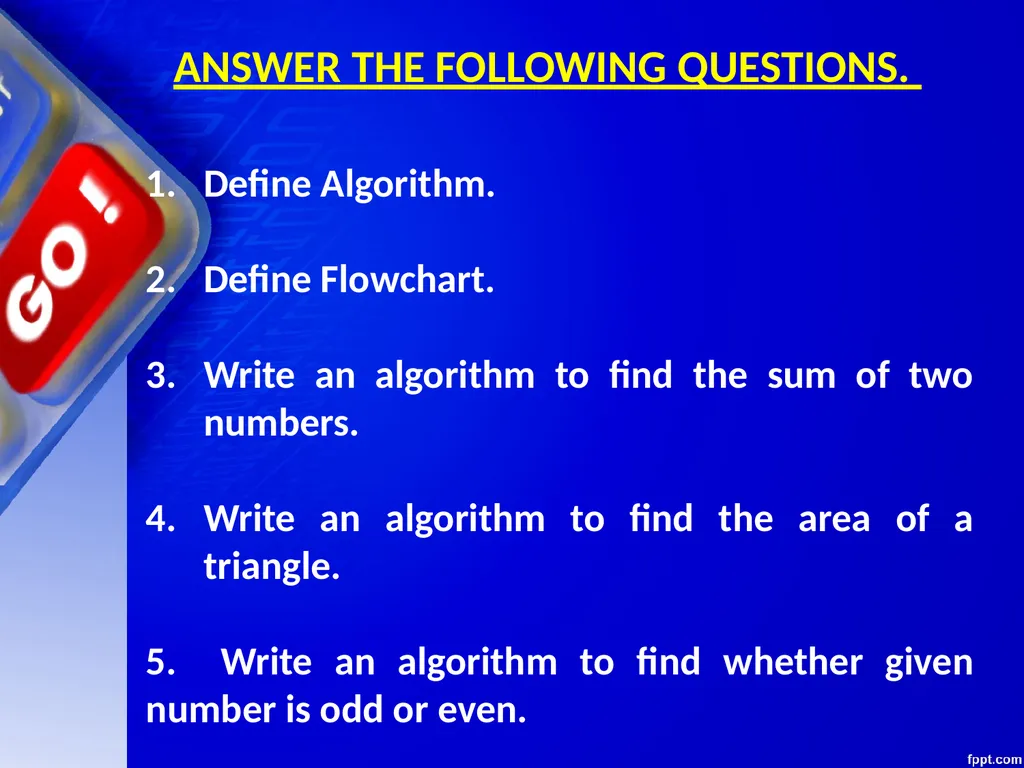
Define Algorithm.
Define Flowchart.
Write an algorithm to find the sum of two numbers.
Write an algorithm to find the area of a triangle.
5. Write an algorithm to find whether given number is odd or even. ANSWER THE FOLLOWING QUESTIONS.<br>
Define Flowchart.
Write an algorithm to find the sum of two numbers.
Write an algorithm to find the area of a triangle.
5. Write an algorithm to find whether given number is odd or even. ANSWER THE FOLLOWING QUESTIONS.<br>
60
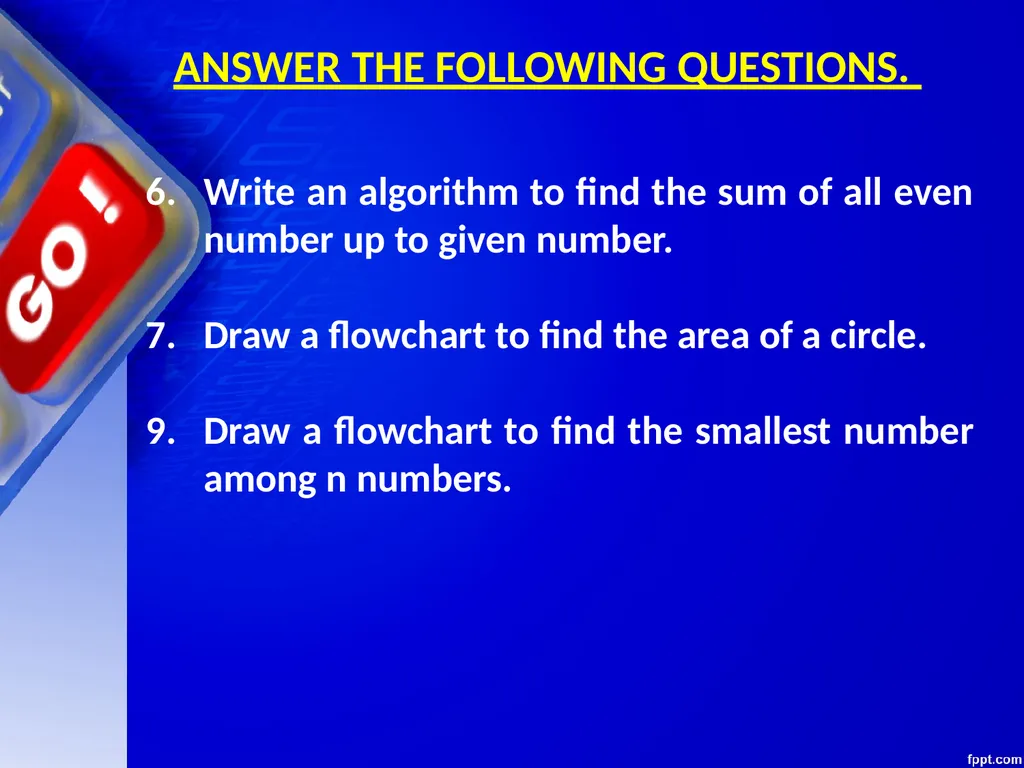
Write an algorithm to find the sum of all even number up to given number.
Draw a flowchart to find the area of a circle.
Draw a flowchart to find the smallest number among n numbers. ANSWER THE FOLLOWING QUESTIONS.<br>
Draw a flowchart to find the area of a circle.
Draw a flowchart to find the smallest number among n numbers. ANSWER THE FOLLOWING QUESTIONS.<br>
61
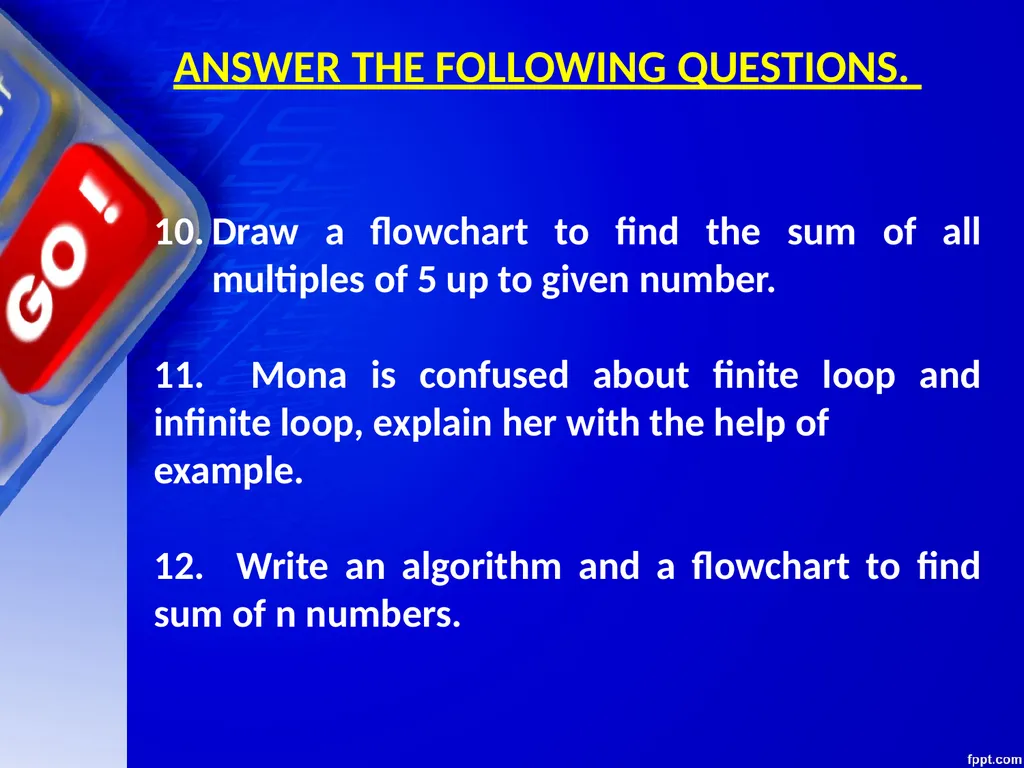
Draw a flowchart to find the sum of all multiples of 5 up to given number.
11. Mona is confused about finite loop and infinite loop, explain her with the help of
example.
12. Write an algorithm and a flowchart to find sum of n numbers. ANSWER THE FOLLOWING QUESTIONS.<br>
11. Mona is confused about finite loop and infinite loop, explain her with the help of
example.
12. Write an algorithm and a flowchart to find sum of n numbers. ANSWER THE FOLLOWING QUESTIONS.<br>
62
THANK YOU<br>