Classical Studies Transition Year Unit The Parthenon Vocabulary check! parthenos (παρθένος) maidengirl This was one of the names of the goddess Athena to whom the temple is dedicated! acropolis (ἀκρόπολις) upperhigh city acros (ἄκρος)
"Classical Studies Transition Year Unit The" is the property of its rightful owner. Permission is granted to
download and print the materials on this website for personal, non-commercial use only, and to display it
on your personal computer provided you do not modify the materials and that you retain all copyright
notices contained in the materials. By downloading content from our website, you accept the terms of this
agreement.
Presentation Transcript
01
Classical Studies Transition Year Unit The Parthenon<br>
02
Vocabulary check! parthenos (παρθένος) = maiden/girl
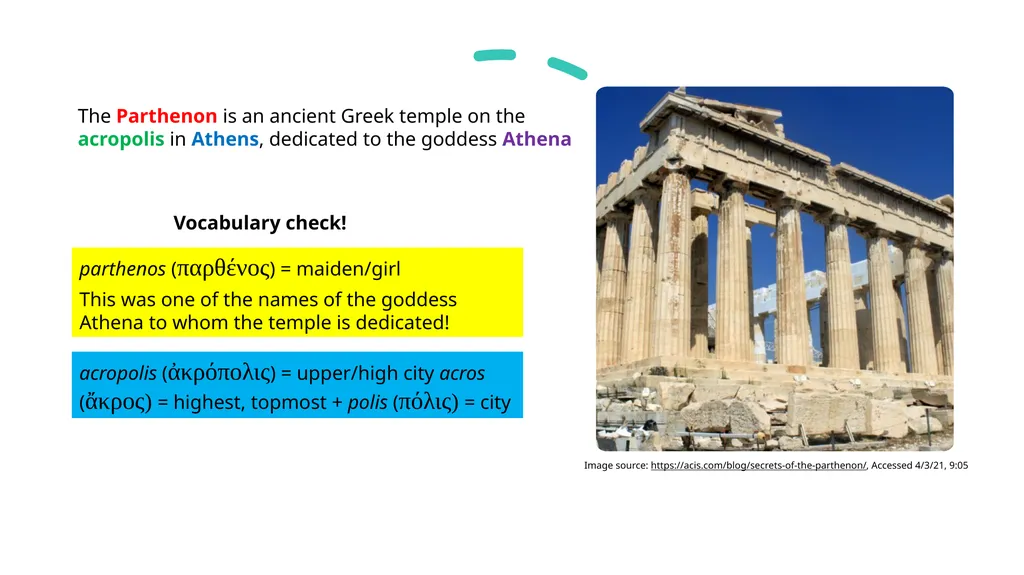
This was one of the names of the goddess Athena to whom the temple is dedicated! acropolis (ἀκρόπολις) = upper/high city acros (ἄκρος) = highest, topmost + polis (πόλις) = city The Parthenon is an ancient Greek temple on the acropolis in Athens, dedicated to the goddess Athena Image source: https://acis.com/blog/secrets-of-the-parthenon/, Accessed 4/3/21, 9:05<br>
03
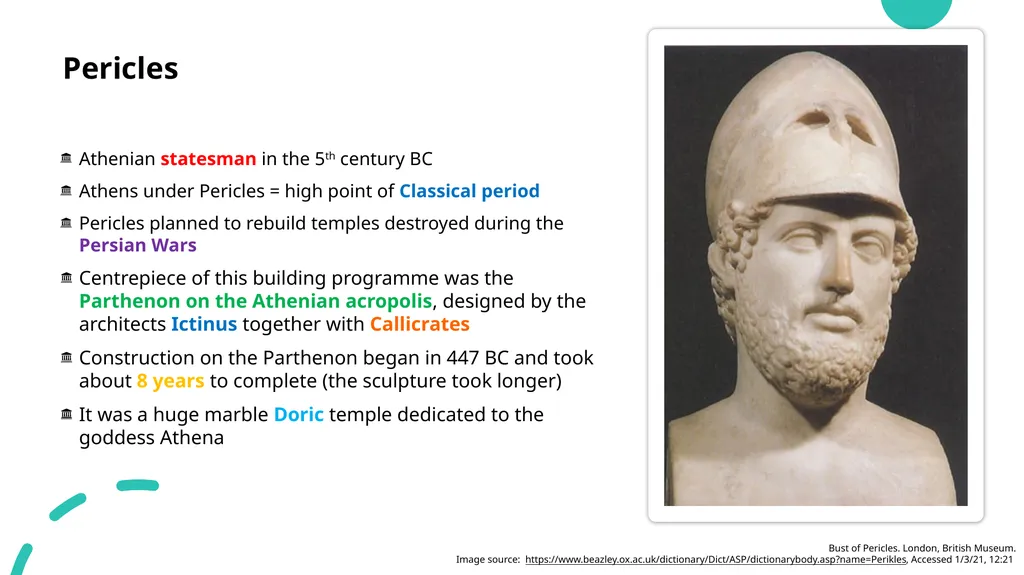
Pericles Athenian statesman in the 5th century BC
Athens under Pericles = high point of Classical period
Pericles planned to rebuild temples destroyed during the Persian Wars
Centrepiece of this building programme was the Parthenon on the Athenian acropolis, designed by the architects Ictinus together with Callicrates
Construction on the Parthenon began in 447 BC and took about 8 years to complete (the sculpture took longer)
It was a huge marble Doric temple dedicated to the goddess Athena Bust of Pericles. London, British Museum.
Image source: https://www.beazley.ox.ac.uk/dictionary/Dict/ASP/dictionarybody.asp?name=Perikles, Accessed 1/3/21, 12:21<br>
04
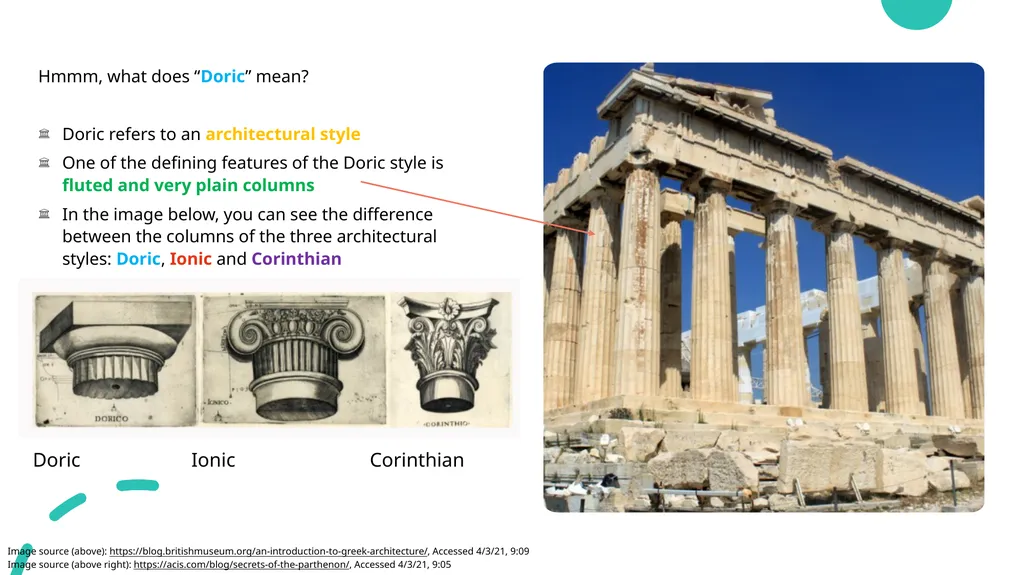
Hmmm, what does “Doric” mean?
Doric refers to an architectural style
One of the defining features of the Doric style is fluted and very plain columns
In the image below, you can see the difference between the columns of the three architectural styles: Doric, Ionic and Corinthian Doric Ionic Corinthian Image source (above): https://blog.britishmuseum.org/an-introduction-to-greek-architecture/, Accessed 4/3/21, 9:09
Image source (above right): https://acis.com/blog/secrets-of-the-parthenon/, Accessed 4/3/21, 9:05<br>
05
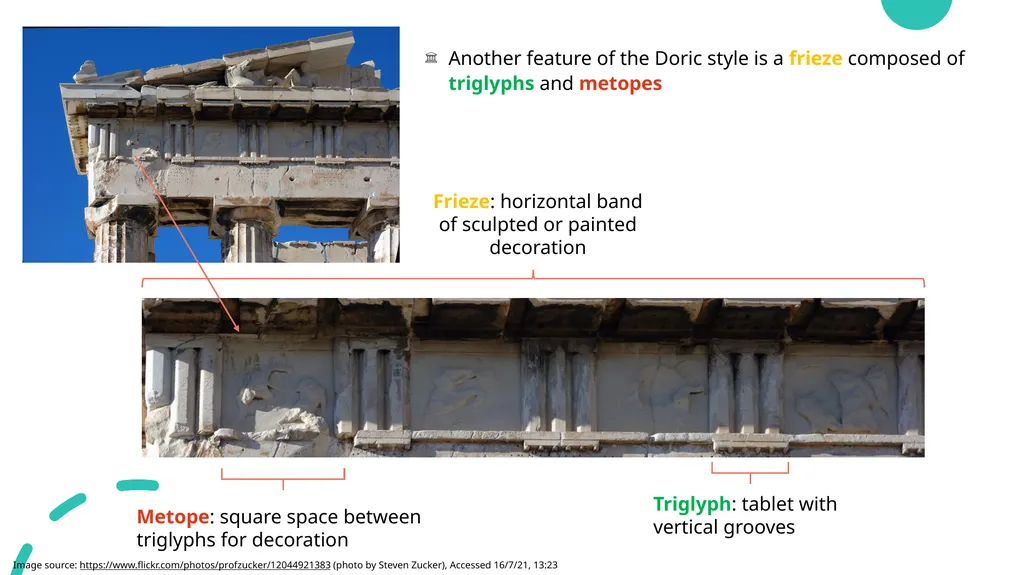
Another feature of the Doric style is a frieze composed of triglyphs and metopes Frieze: horizontal band of sculpted or painted decoration Metope: square space between triglyphs for decoration Triglyph: tablet with vertical grooves Image source: https://www.flickr.com/photos/profzucker/12044921383 (photo by Steven Zucker), Accessed 16/7/21, 13:23<br>
06
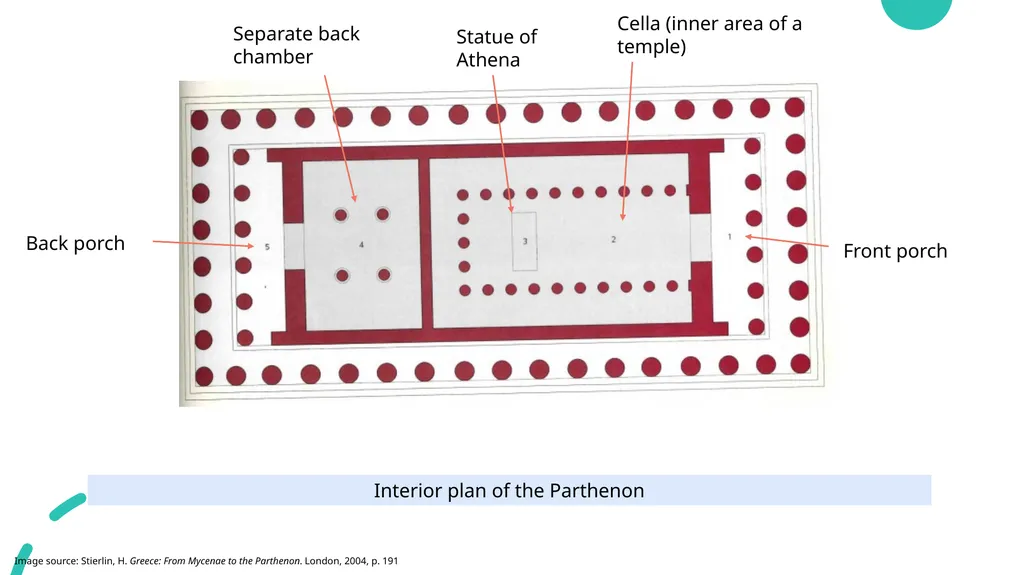
Interior plan of the Parthenon Front porch Cella (inner area of a temple) Statue of Athena Separate back chamber Back porch Image source: Stierlin, H. Greece: From Mycenae to the Parthenon. London, 2004, p. 191<br>
07
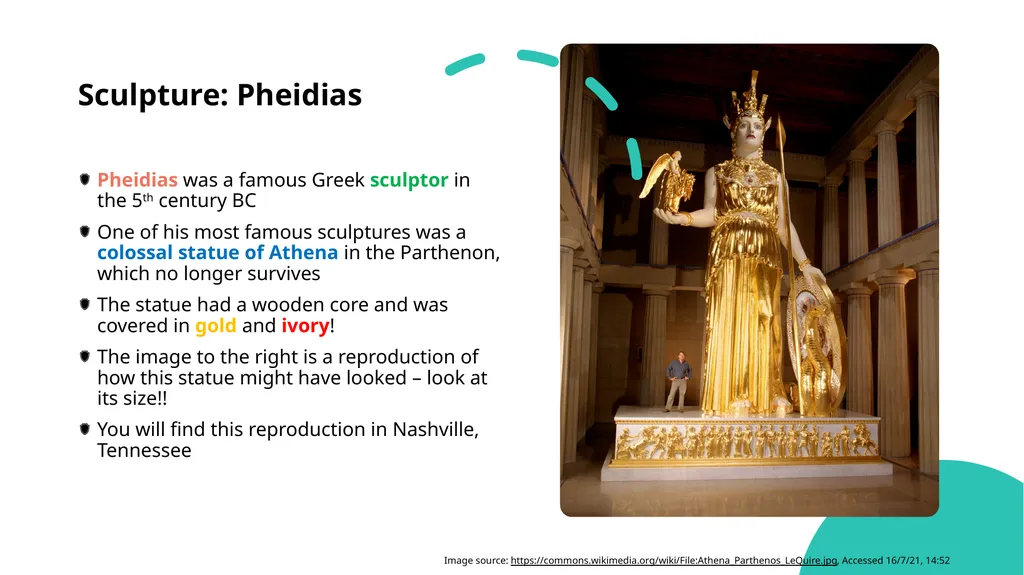
Sculpture: Pheidias Pheidias was a famous Greek sculptor in the 5th century BC
One of his most famous sculptures was a colossal statue of Athena in the Parthenon, which no longer survives
The statue had a wooden core and was covered in gold and ivory!
The image to the right is a reproduction of how this statue might have looked – look at its size!!
You will find this reproduction in Nashville, Tennessee Image source: https://commons.wikimedia.org/wiki/File:Athena_Parthenos_LeQuire.jpg, Accessed 16/7/21, 14:52<br>
08
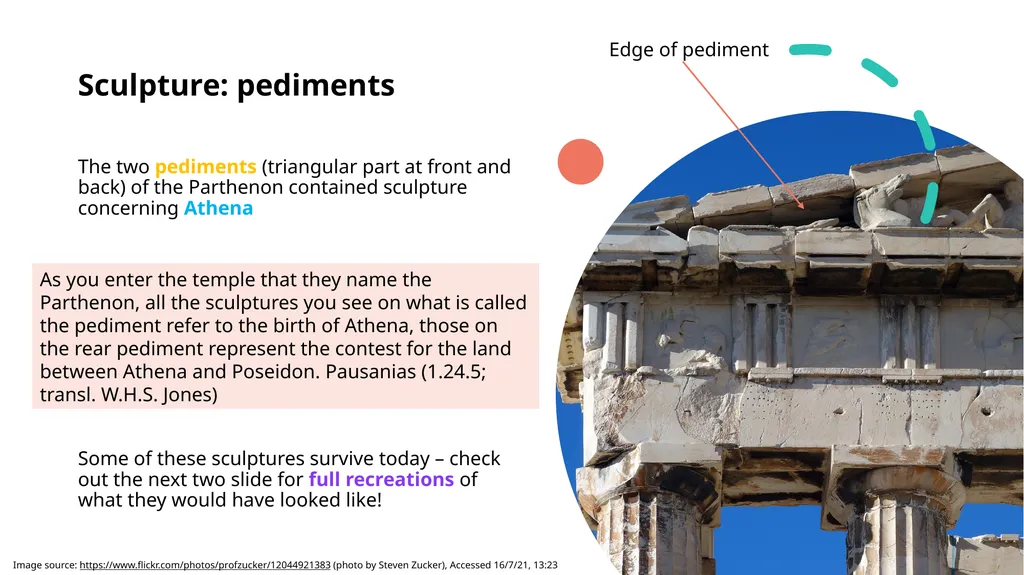
Sculpture: pediments The two pediments (triangular part at front and back) of the Parthenon contained sculpture concerning Athena
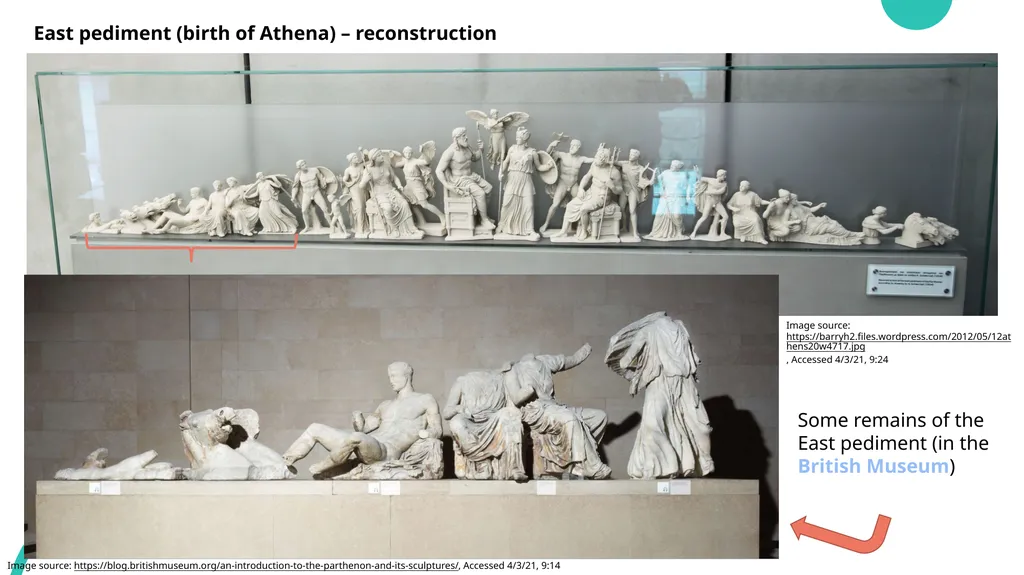
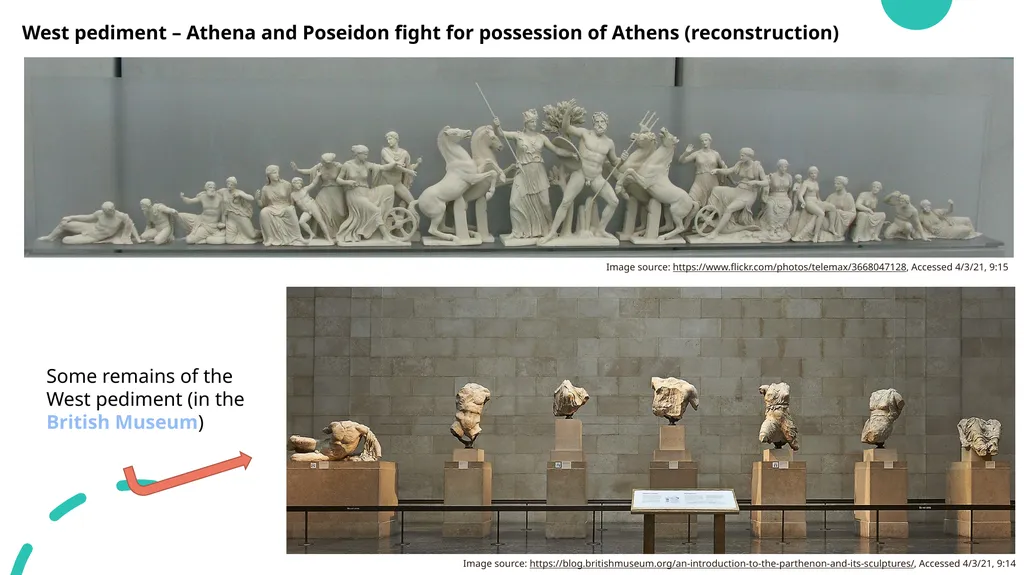
Some of these sculptures survive today – check out the next two slide for full recreations of what they would have looked like! As you enter the temple that they name the Parthenon, all the sculptures you see on what is called the pediment refer to the birth of Athena, those on the rear pediment represent the contest for the land between Athena and Poseidon. Pausanias (1.24.5; transl. W.H.S. Jones) Edge of pediment Image source: https://www.flickr.com/photos/profzucker/12044921383 (photo by Steven Zucker), Accessed 16/7/21, 13:23<br>
09
East pediment (birth of Athena) – reconstruction Image source: https://barryh2.files.wordpress.com/2012/05/12athens20w4717.jpg, Accessed 4/3/21, 9:24 Image source: https://blog.britishmuseum.org/an-introduction-to-the-parthenon-and-its-sculptures/, Accessed 4/3/21, 9:14 Some remains of the East pediment (in the British Museum)<br>
10
West pediment – Athena and Poseidon fight for possession of Athens (reconstruction) Image source: https://www.flickr.com/photos/telemax/3668047128, Accessed 4/3/21, 9:15 Some remains of the West pediment (in the British Museum) Image source: https://blog.britishmuseum.org/an-introduction-to-the-parthenon-and-its-sculptures/, Accessed 4/3/21, 9:14<br>
11
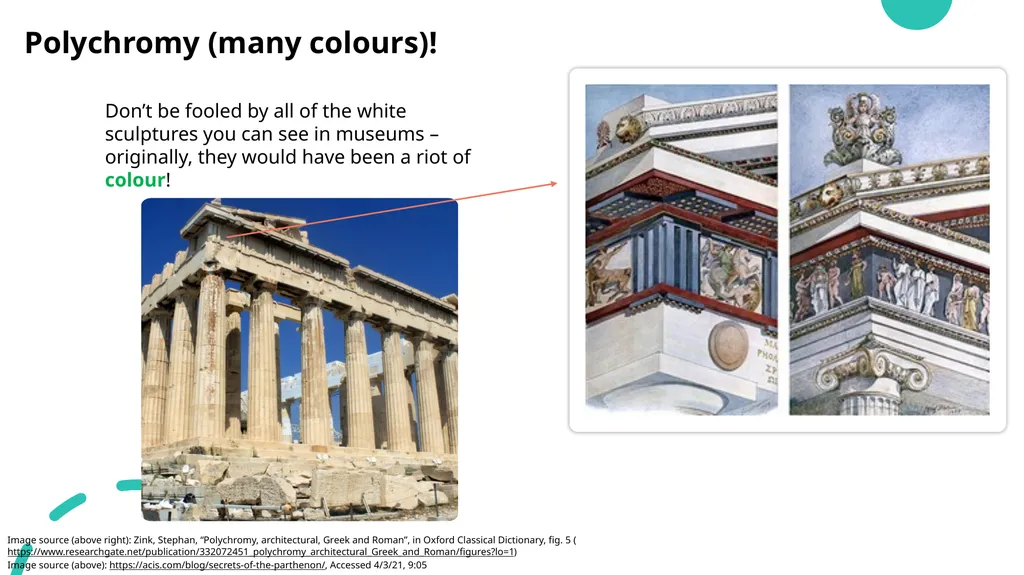
Polychromy (many colours)! Don’t be fooled by all of the white sculptures you can see in museums – originally, they would have been a riot of colour! Image source (above right): Zink, Stephan, “Polychromy, architectural, Greek and Roman”, in Oxford Classical Dictionary, fig. 5 (https://www.researchgate.net/publication/332072451_polychromy_architectural_Greek_and_Roman/figures?lo=1)
Image source (above): https://acis.com/blog/secrets-of-the-parthenon/, Accessed 4/3/21, 9:05<br>