Click anywhere to get started HAZWOPER Whats the Danger? How is the HAZWOPER Standard applied in the workplace and generally in our communities? The HAZWOPER standard covers employers performing in three categories of work operations:
"Click anywhere to get started… HAZWOPER What’s the" is the property of its rightful owner. Permission is granted to
download and print the materials on this website for personal, non-commercial use only, and to display it
on your personal computer provided you do not modify the materials and that you retain all copyright
notices contained in the materials. By downloading content from our website, you accept the terms of this
agreement.
Presentation Transcript
01
Click anywhere to get started…<br>
02
HAZWOPER<br>
03
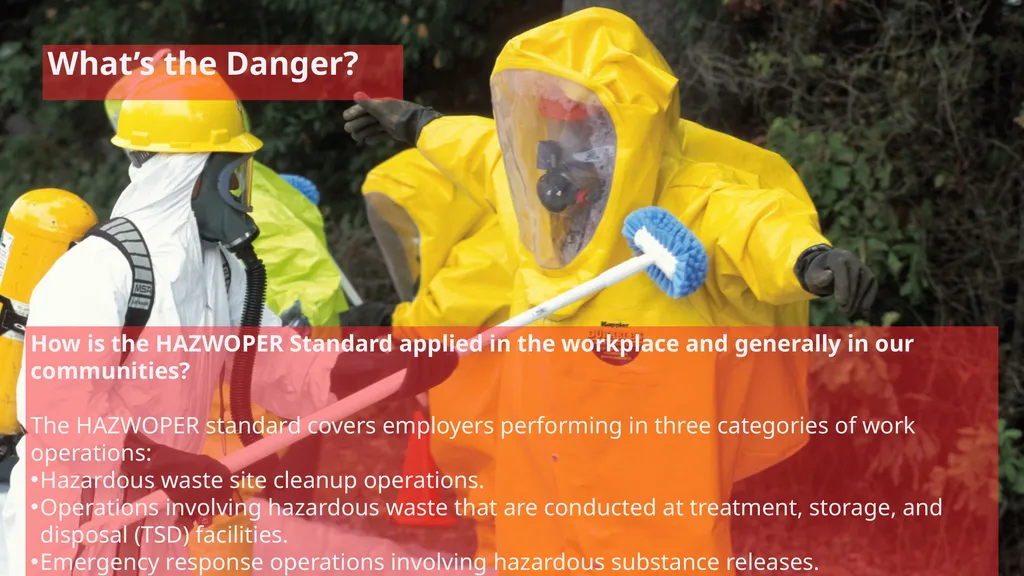
What’s the Danger? How is the HAZWOPER Standard applied in the workplace and generally in our communities?
The HAZWOPER standard covers employers performing in three categories of work operations:
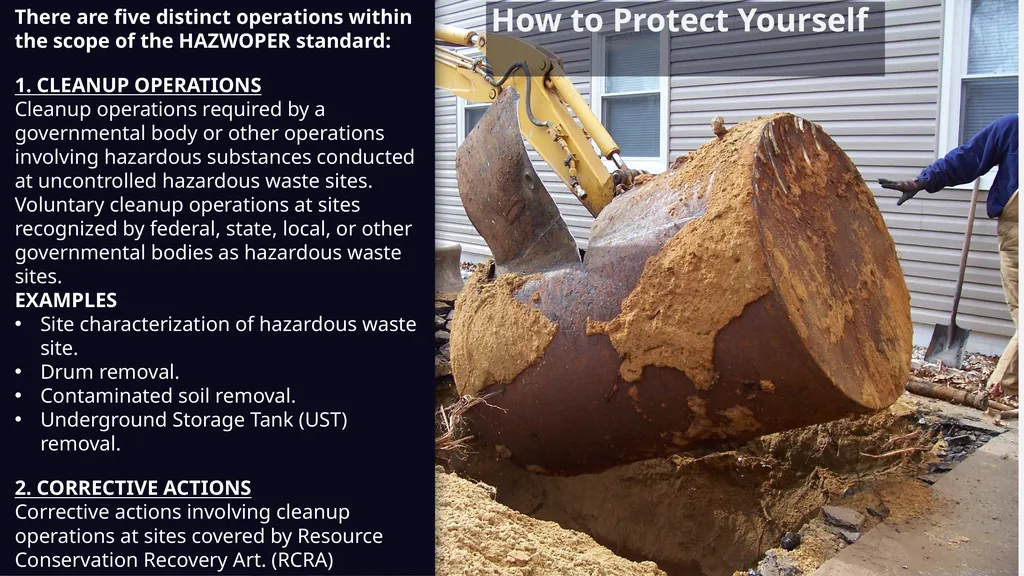
Hazardous waste site cleanup operations.
Operations involving hazardous waste that are conducted at treatment, storage, and disposal (TSD) facilities.
Emergency response operations involving hazardous substance releases.<br>
04
What’s the Danger? WHEN DOES HAZWOPER APPLY?
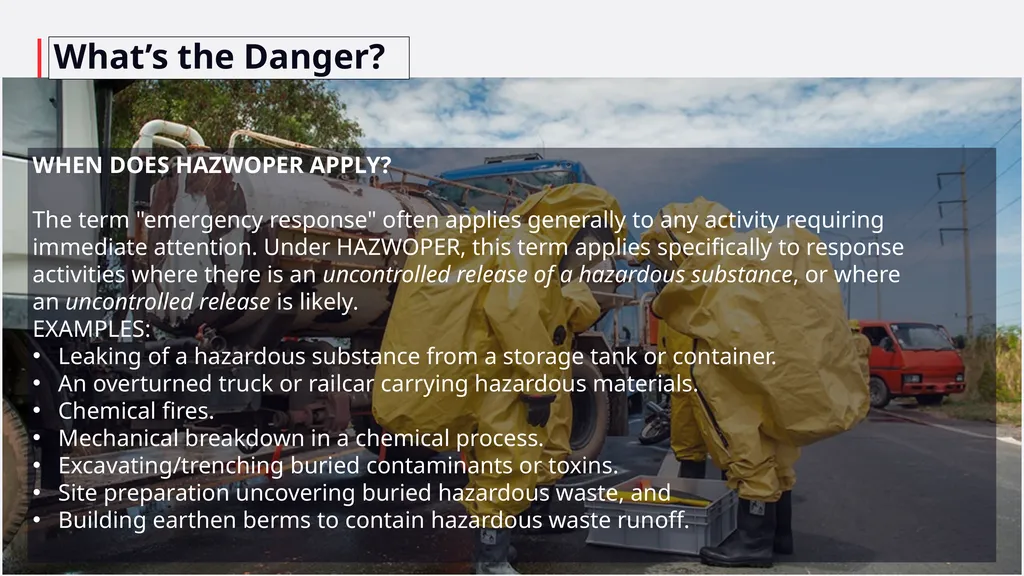
The term "emergency response" often applies generally to any activity requiring immediate attention. Under HAZWOPER, this term applies specifically to response activities where there is an uncontrolled release of a hazardous substance, or where an uncontrolled release is likely.
EXAMPLES:
Leaking of a hazardous substance from a storage tank or container.
An overturned truck or railcar carrying hazardous materials.
Chemical fires.
Mechanical breakdown in a chemical process.
Excavating/trenching buried contaminants or toxins.
Site preparation uncovering buried hazardous waste, and
Building earthen berms to contain hazardous waste runoff.<br>
05
What’s the Danger? WHEN DOES HAZWOPER NOT APPLY?
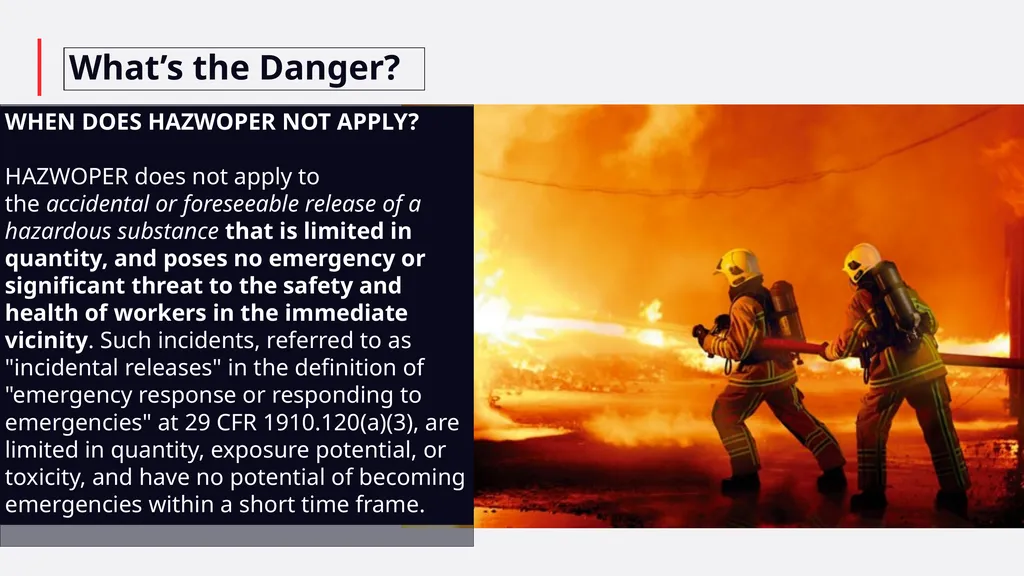
HAZWOPER does not apply to the accidental or foreseeable release of a hazardous substance that is limited in quantity, and poses no emergency or significant threat to the safety and health of workers in the immediate vicinity. Such incidents, referred to as "incidental releases" in the definition of "emergency response or responding to emergencies" at 29 CFR 1910.120(a)(3), are limited in quantity, exposure potential, or toxicity, and have no potential of becoming emergencies within a short time frame.<br>
06
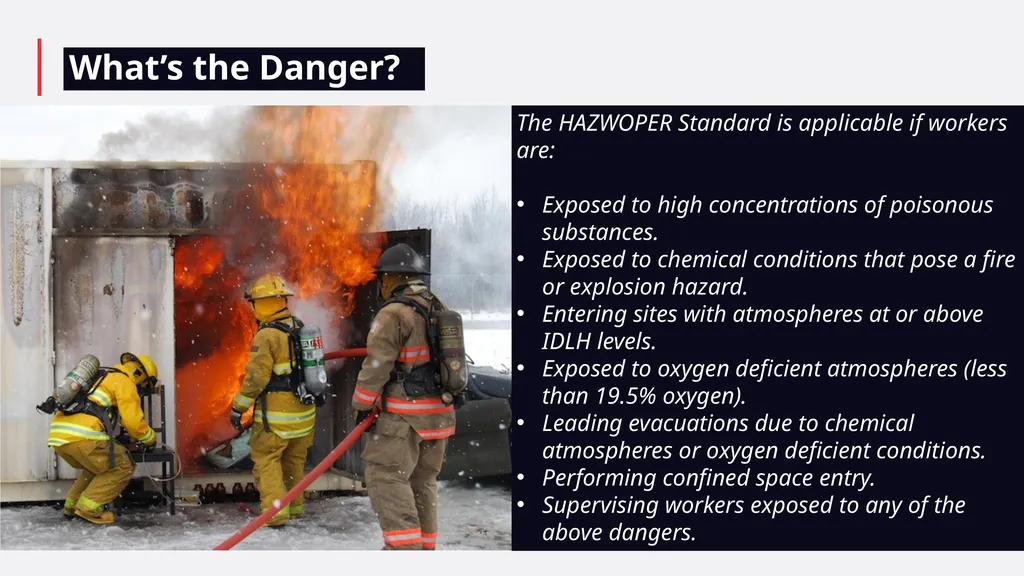
What’s the Danger? The HAZWOPER Standard is applicable if workers are:
Exposed to high concentrations of poisonous substances.
Exposed to chemical conditions that pose a fire or explosion hazard.
Entering sites with atmospheres at or above IDLH levels.
Exposed to oxygen deficient atmospheres (less than 19.5% oxygen).
Leading evacuations due to chemical atmospheres or oxygen deficient conditions.
Performing confined space entry.
Supervising workers exposed to any of the above dangers.<br>
07
How to Protect Yourself<br>
08
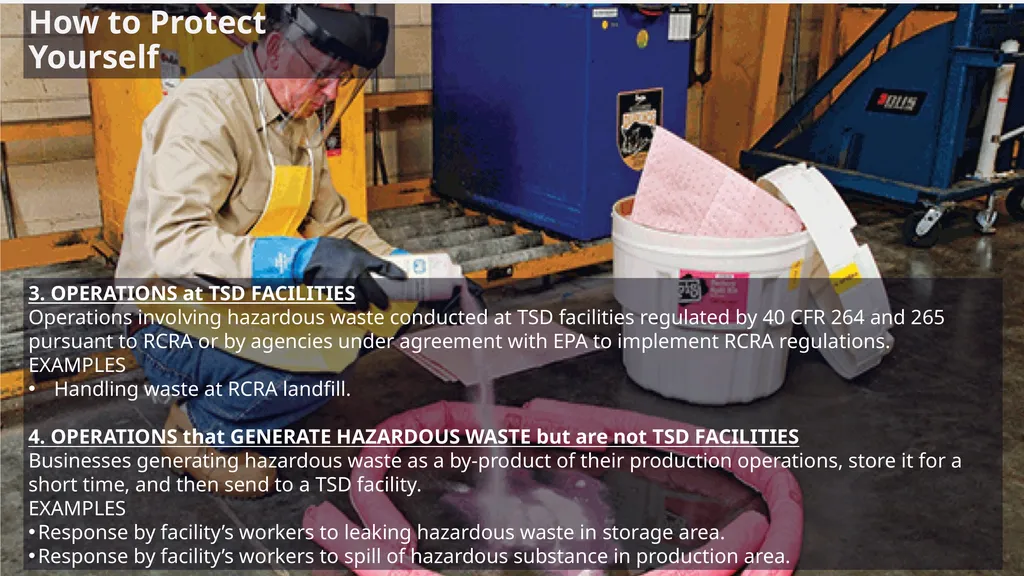
How to Protect Yourself 3. OPERATIONS at TSD FACILITIES
Operations involving hazardous waste conducted at TSD facilities regulated by 40 CFR 264 and 265 pursuant to RCRA or by agencies under agreement with EPA to implement RCRA regulations.
EXAMPLES
Handling waste at RCRA landfill.
4. OPERATIONS that GENERATE HAZARDOUS WASTE but are not TSD FACILITIES
Businesses generating hazardous waste as a by-product of their production operations, store it for a short time, and then send to a TSD facility.
EXAMPLES
Response by facility’s workers to leaking hazardous waste in storage area.
Response by facility’s workers to spill of hazardous substance in production area.<br>
09
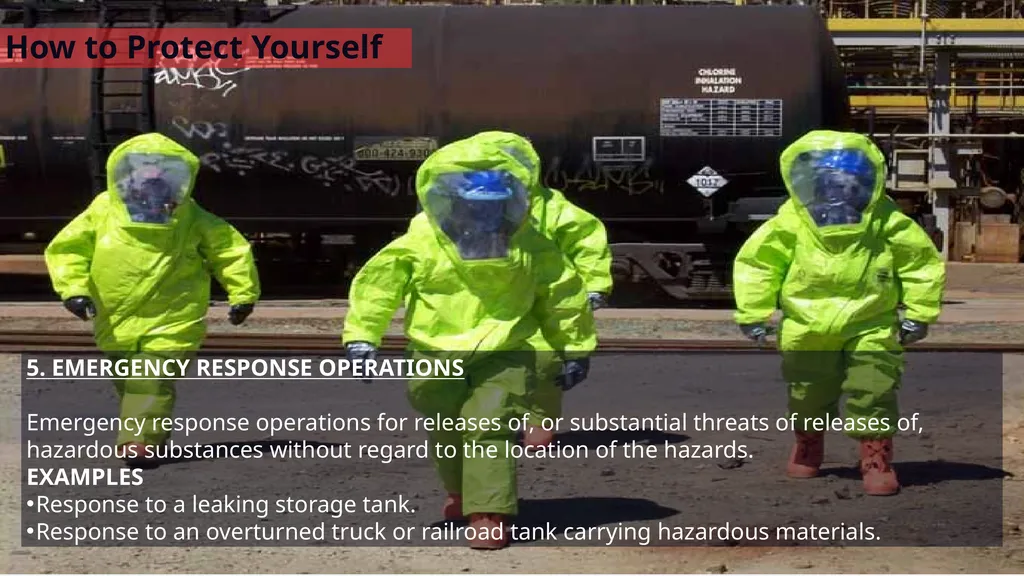
How to Protect Yourself 5. EMERGENCY RESPONSE OPERATIONS
Emergency response operations for releases of, or substantial threats of releases of, hazardous substances without regard to the location of the hazards.
EXAMPLES
Response to a leaking storage tank.
Response to an overturned truck or railroad tank carrying hazardous materials.<br>
10
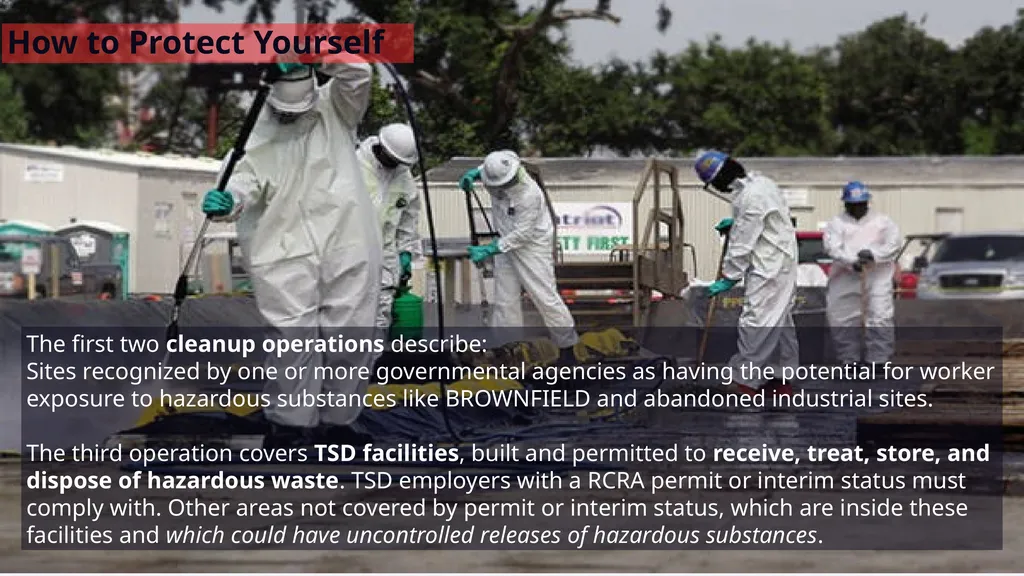
How to Protect Yourself The first two cleanup operations describe:
Sites recognized by one or more governmental agencies as having the potential for worker exposure to hazardous substances like BROWNFIELD and abandoned industrial sites.
The third operation covers TSD facilities, built and permitted to receive, treat, store, and dispose of hazardous waste. TSD employers with a RCRA permit or interim status must comply with. Other areas not covered by permit or interim status, which are inside these facilities and which could have uncontrolled releases of hazardous substances.<br>
11
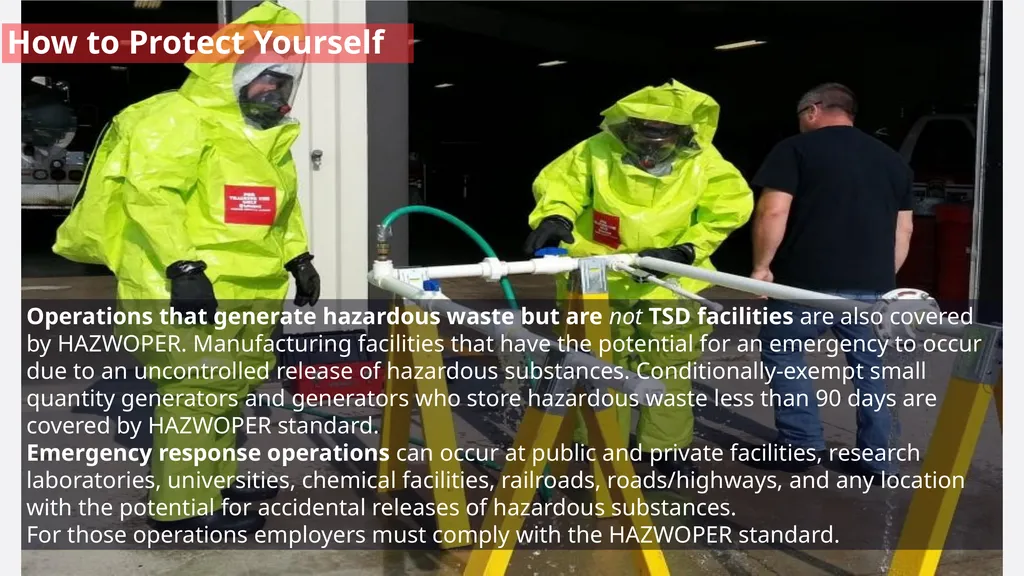
How to Protect Yourself Operations that generate hazardous waste but are not TSD facilities are also covered by HAZWOPER. Manufacturing facilities that have the potential for an emergency to occur due to an uncontrolled release of hazardous substances. Conditionally-exempt small quantity generators and generators who store hazardous waste less than 90 days are covered by HAZWOPER standard.
Emergency response operations can occur at public and private facilities, research laboratories, universities, chemical facilities, railroads, roads/highways, and any location with the potential for accidental releases of hazardous substances.
For those operations employers must comply with the HAZWOPER standard.<br>
12
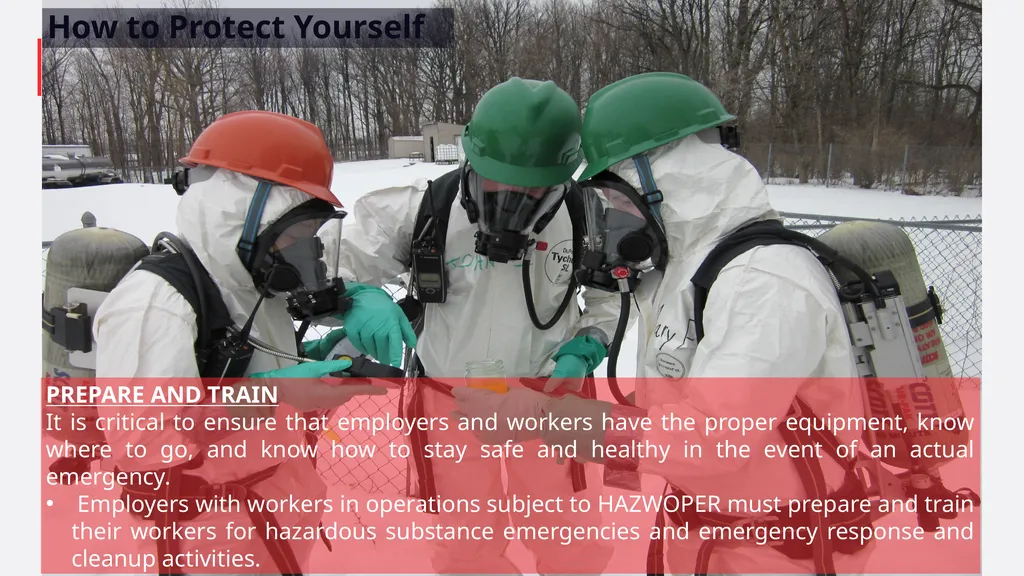
How to Protect Yourself PREPARE AND TRAIN
It is critical to ensure that employers and workers have the proper equipment, know where to go, and know how to stay safe and healthy in the event of an actual emergency.
Employers with workers in operations subject to HAZWOPER must prepare and train their workers for hazardous substance emergencies and emergency response and cleanup activities.<br>
13
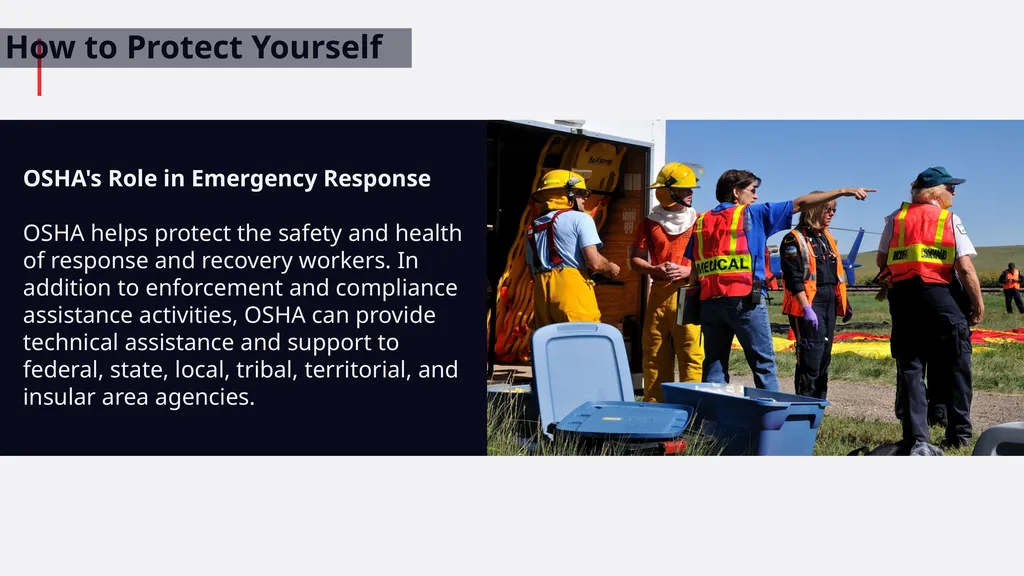
How to Protect Yourself OSHA's Role in Emergency Response
OSHA helps protect the safety and health of response and recovery workers. In addition to enforcement and compliance assistance activities, OSHA can provide technical assistance and support to federal, state, local, tribal, territorial, and insular area agencies.<br>
14
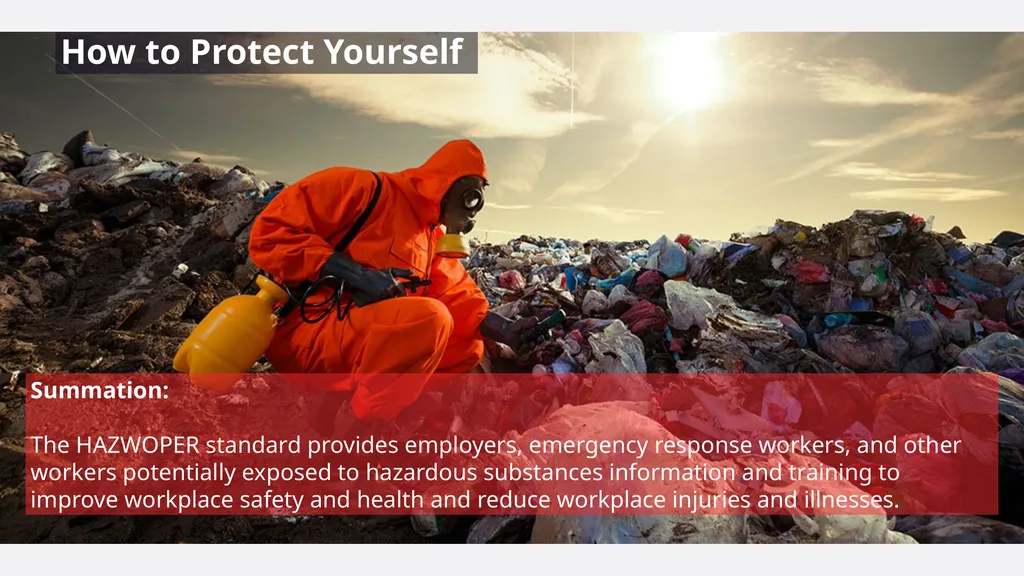
How to Protect Yourself Summation:
The HAZWOPER standard provides employers, emergency response workers, and other workers potentially exposed to hazardous substances information and training to improve workplace safety and health and reduce workplace injuries and illnesses.<br>