01
Coarse-Grained Mapping: A single DRAM partition with an error rate shown in yellow Enabling Energy-Efficient, High-Performance
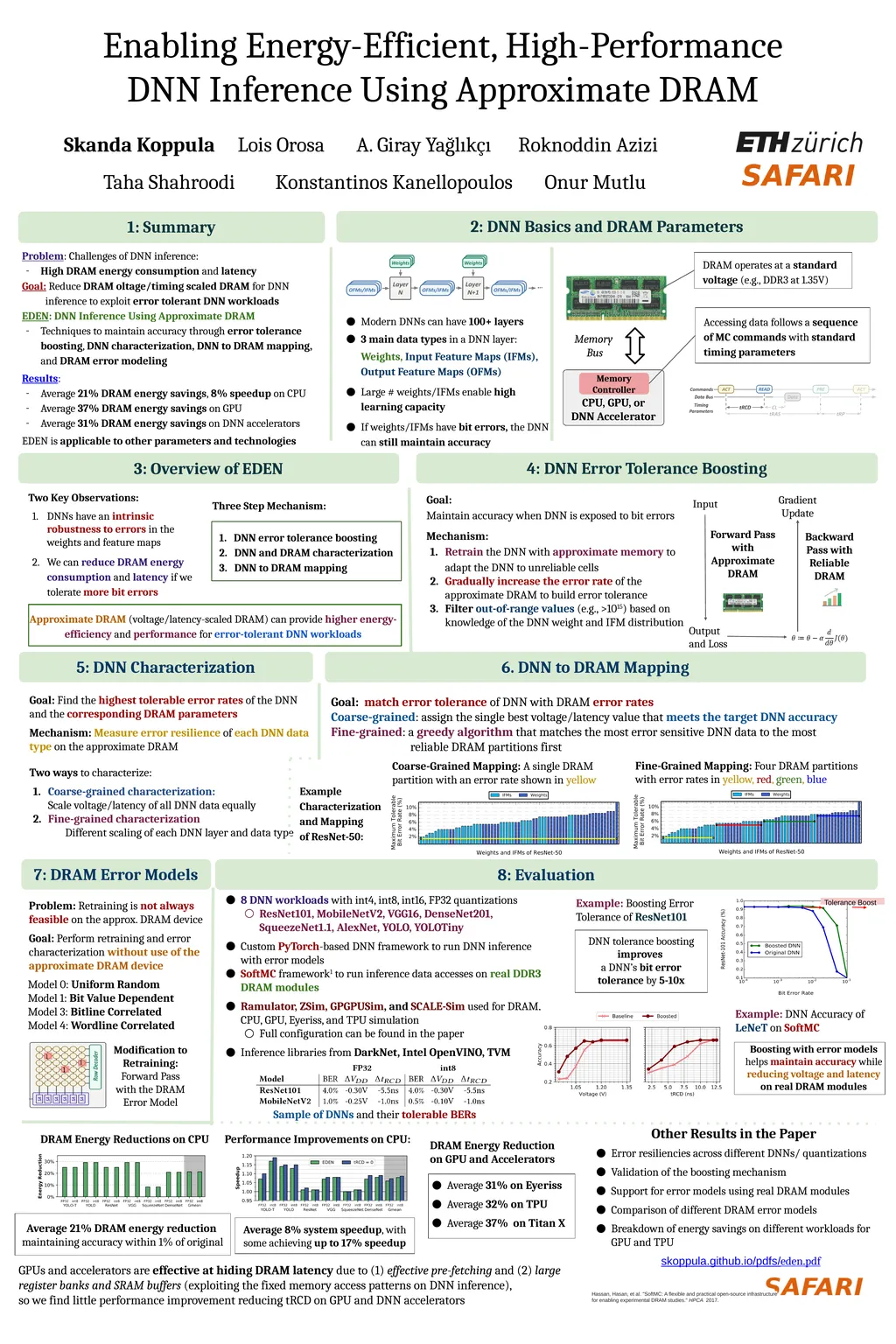
DNN Inference Using Approximate DRAM 1: Summary 2: DNN Basics and DRAM Parameters 3: Overview of EDEN Skanda Koppula Lois Orosa A. Giray Yağlıkçı Roknoddin Azizi
Taha Shahroodi Konstantinos Kanellopoulos Onur Mutlu 4: DNN Error Tolerance Boosting 5: DNN Characterization 8: Evaluation 6. DNN to DRAM Mapping Other Results in the Paper Error resiliencies across different DNNs/ quantizations
Validation of the boosting mechanism
Support for error models using real DRAM modules
Comparison of different DRAM error models
Breakdown of energy savings on different workloads for GPU and TPU
skoppula.github.io/pdfs/eden.pdf Problem: Challenges of DNN inference:
High DRAM energy consumption and latency
Goal: Reduce DRAM oltage/timing scaled DRAM for DNN inference to exploit error tolerant DNN workloads
EDEN: DNN Inference Using Approximate DRAM
Techniques to maintain accuracy through error tolerance boosting, DNN characterization, DNN to DRAM mapping, and DRAM error modeling
Results:
Average 21% DRAM energy savings, 8% speedup on CPU
Average 37% DRAM energy savings on GPU
Average 31% DRAM energy savings on DNN accelerators
EDEN is applicable to other parameters and technologies Memory
Bus CPU, GPU, or
DNN Accelerator Memory Controller Accessing data follows a sequence of MC commands with standard timing parameters DRAM operates at a standard voltage (e.g., DDR3 at 1.35V) Modern DNNs can have 100+ layers
3 main data types in a DNN layer:
Weights, Input Feature Maps (IFMs),
Output Feature Maps (OFMs)
Large # weights/IFMs enable high learning capacity
If weights/IFMs have bit errors, the DNN can still maintain accuracy Two Key Observations:
DNNs have an intrinsic robustness to errors in the weights and feature maps
We can reduce DRAM energy consumption and latency if we tolerate more bit errors 1. DNN error tolerance boosting
2. DNN and DRAM characterization
3. DNN to DRAM mapping Three Step Mechanism: Approximate DRAM (voltage/latency-scaled DRAM) can provide higher energy-efficiency and performance for error-tolerant DNN workloads Goal:
Maintain accuracy when DNN is exposed to bit errors
Mechanism:
Retrain the DNN with approximate memory to adapt the DNN to unreliable cells
Gradually increase the error rate of the approximate DRAM to build error tolerance
Filter out-of-range values (e.g., >1015) based on knowledge of the DNN weight and IFM distribution Forward Pass with Approximate DRAM Backward Pass with Reliable DRAM Gradient
Update Input Output
and Loss Goal: Find the highest tolerable error rates of the DNN and the corresponding DRAM parameters
Mechanism: Measure error resilience of each DNN data type on the approximate DRAM
Two ways to characterize:
Coarse-grained characterization:
Scale voltage/latency of all DNN data equally
Fine-grained characterization
Different scaling of each DNN layer and data type Goal: match error tolerance of DNN with DRAM error rates
Coarse-grained: assign the single best voltage/latency value that meets the target DNN accuracy
Fine-grained: a greedy algorithm that matches the most error sensitive DNN data to the most reliable DRAM partitions first Example
Characterization
and Mapping
of ResNet-50: 7: DRAM Error Models Problem: Retraining is not always feasible on the approx. DRAM device
Goal: Perform retraining and error characterization without use of the approximate DRAM device Model 0: Uniform Random
Model 1: Bit Value Dependent
Model 3: Bitline Correlated
Model 4: Wordline Correlated Modification to Retraining: Forward Pass with the DRAM Error Model 8 DNN workloads with int4, int8, int16, FP32 quantizations
ResNet101, MobileNetV2, VGG16, DenseNet201, SqueezeNet1.1, AlexNet, YOLO, YOLOTiny
Custom PyTorch-based DNN framework to run DNN inference with error models
SoftMC framework1 to run inference data accesses on real DDR3 DRAM modules
Ramulator, ZSim, GPGPUSim, and SCALE-Sim used for DRAM, CPU, GPU, Eyeriss, and TPU simulation
Full configuration can be found in the paper
Inference libraries from DarkNet, Intel OpenVINO, TVM Example: Boosting Error Tolerance of ResNet101 DNN tolerance boosting improves
a DNN’s bit error tolerance by 5-10x Example: DNN Accuracy of LeNeT on SoftMC Boosting with error models helps maintain accuracy while reducing voltage and latency on real DRAM modules Sample of DNNs and their tolerable BERs Hassan, Hasan, et al. "SoftMC: A flexible and practical open-source infrastructure for enabling experimental DRAM studies." HPCA 2017. DRAM Energy Reductions on CPU Performance Improvements on CPU: Average 21% DRAM energy reduction
maintaining accuracy within 1% of original Average 8% system speedup, with some achieving up to 17% speedup Average 31% on Eyeriss
Average 32% on TPU
Average 37% on Titan X DRAM Energy Reduction on GPU and Accelerators GPUs and accelerators are effective at hiding DRAM latency due to (1) effective pre-fetching and (2) large register banks and SRAM buffers (exploiting the fixed memory access patterns on DNN inference),
so we find little performance improvement reducing tRCD on GPU and DNN accelerators<br>