
Competitive Strategy . Outline Introduction
Description: Competitive Strategy . Outline Introduction Sustainable competitive advantage (SCA) Sources of SCA Strategies for Market Leaders Challengers Followers, and Nichers Introduction Having a competitive advantage is necessary for a firm to
Related Topics
Download Presentation
"Competitive Strategy . Outline Introduction" is the property of its rightful owner. Permission is granted to download and print the materials on this website for personal, non-commercial use only, and to display it on your personal computer provided you do not modify the materials and that you retain all copyright notices contained in the materials. By downloading content from our website, you accept the terms of this agreement.
Presentation Transcript
slide1. Competitive Strategy .<br>
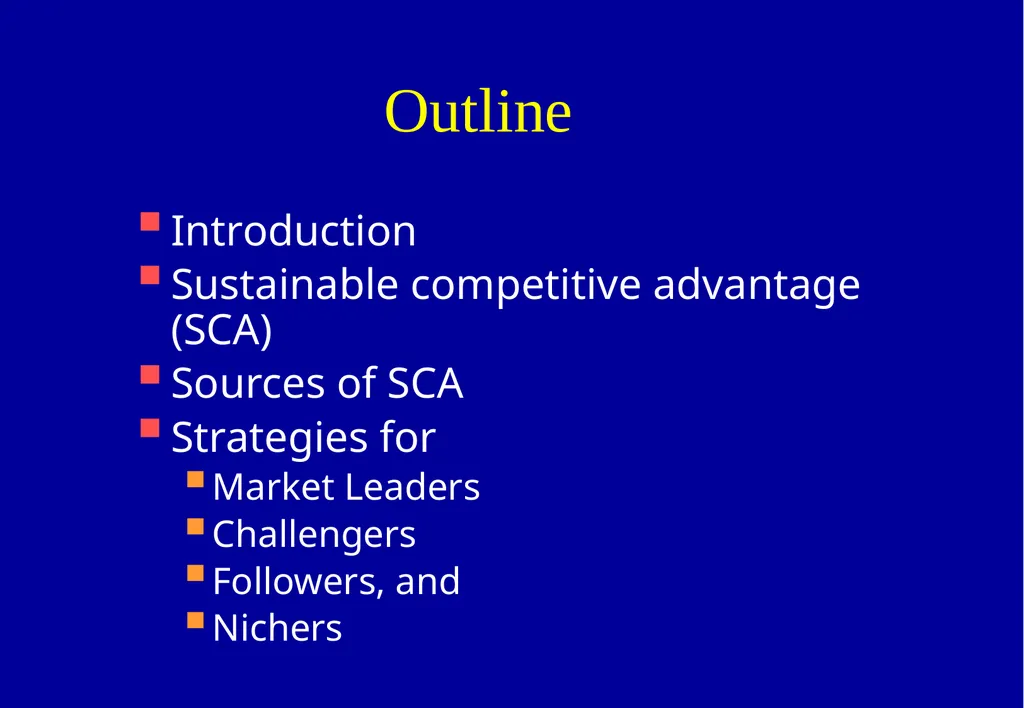
slide2. Outline Introduction
Sustainable competitive advantage (SCA)
Sources of SCA
Strategies for
Market Leaders
Challengers
Followers, and
Nichers<br>
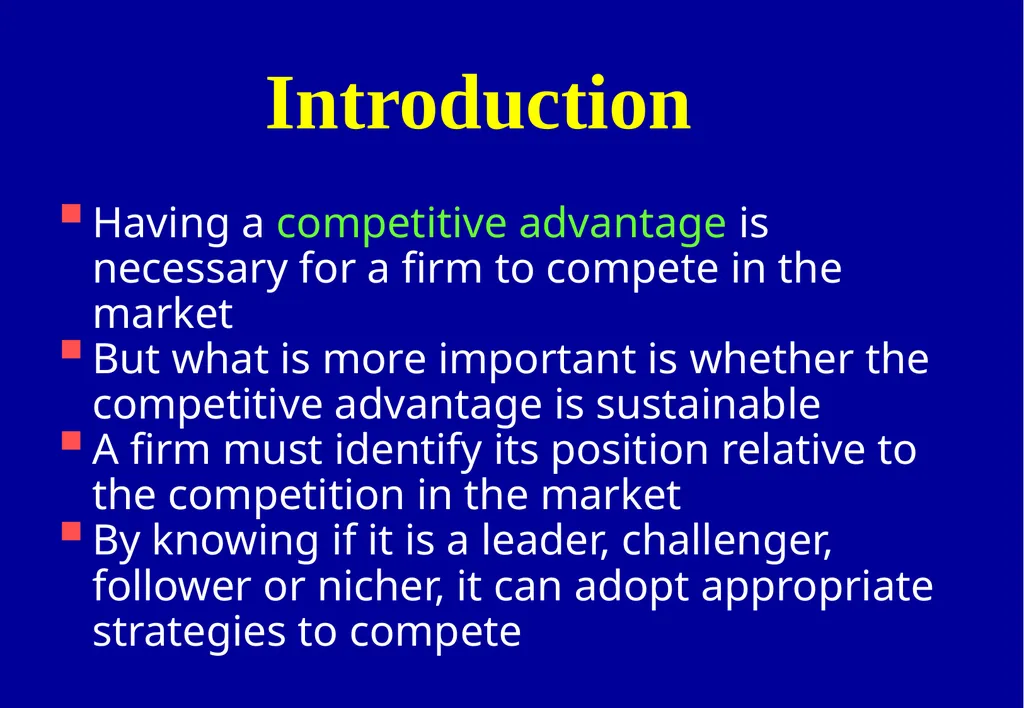
slide3. Introduction Having a competitive advantage is necessary for a firm to compete in the market
But what is more important is whether the competitive advantage is sustainable
A firm must identify its position relative to the competition in the market
By knowing if it is a leader, challenger, follower or nicher, it can adopt appropriate strategies to compete<br>
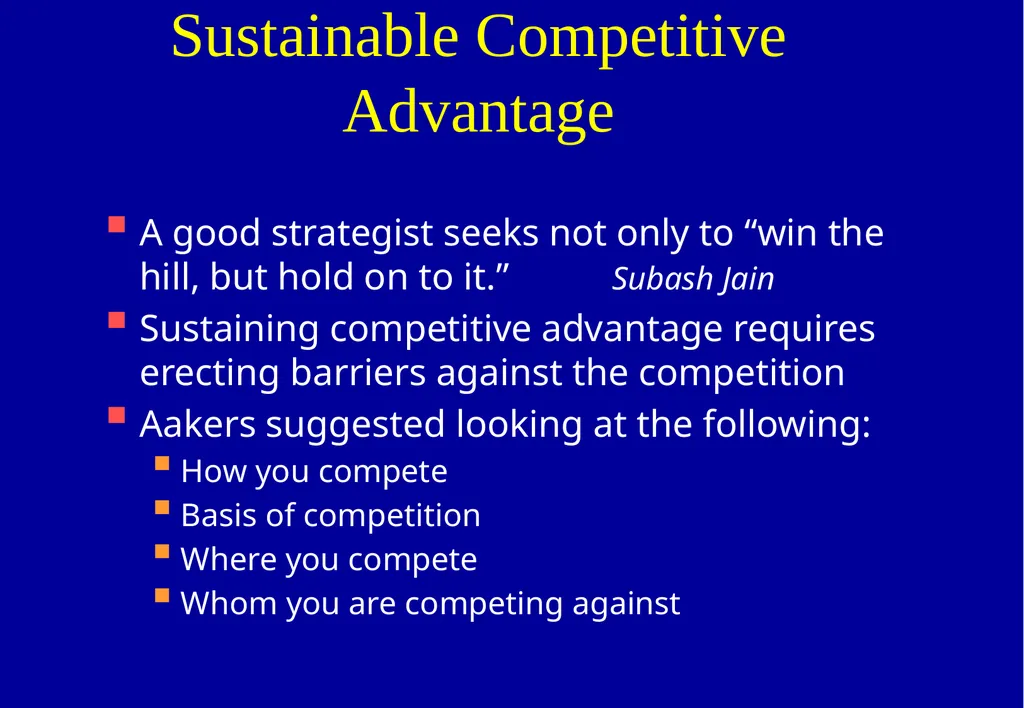
slide4. Sustainable Competitive Advantage A good strategist seeks not only to “win the hill, but hold on to it.” Subash Jain
Sustaining competitive advantage requires erecting barriers against the competition
Aakers suggested looking at the following:
How you compete
Basis of competition
Where you compete
Whom you are competing against<br>
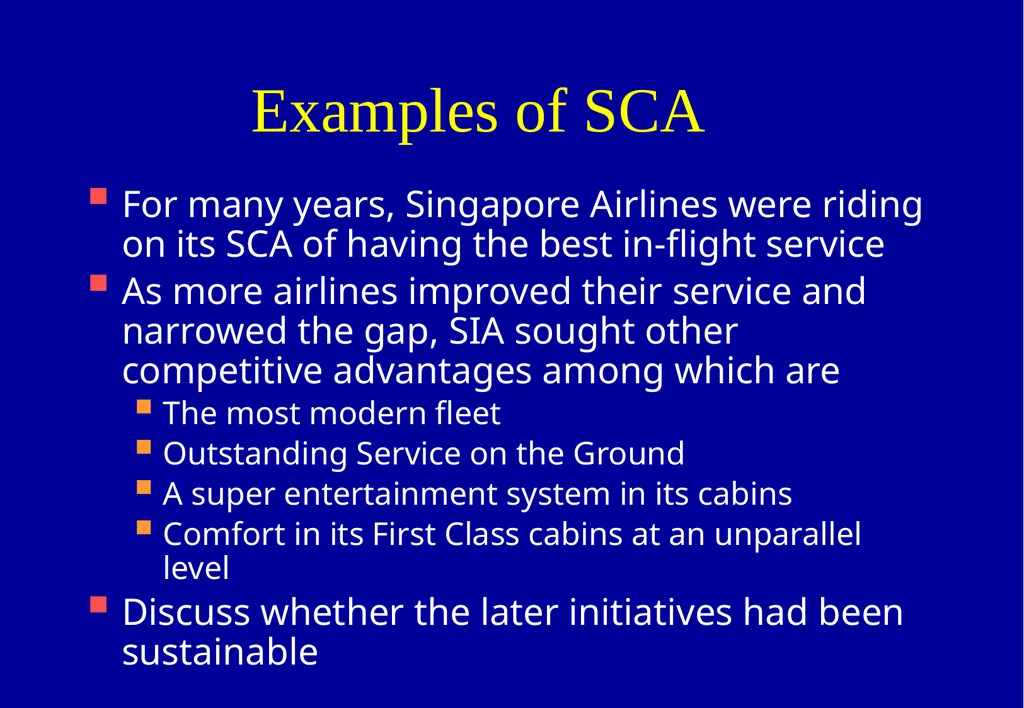
slide5. Examples of SCA For many years, Singapore Airlines were riding on its SCA of having the best in-flight service
As more airlines improved their service and narrowed the gap, SIA sought other competitive advantages among which are
The most modern fleet
Outstanding Service on the Ground
A super entertainment system in its cabins
Comfort in its First Class cabins at an unparallel level
Discuss whether the later initiatives had been sustainable<br>
slide6. Sun Tze’s defensive strategy “Do not assume the enemy will not come
but be prepared for his coming…
Do not presume he will not attack,
but instead make your own position unassailable.”<br>
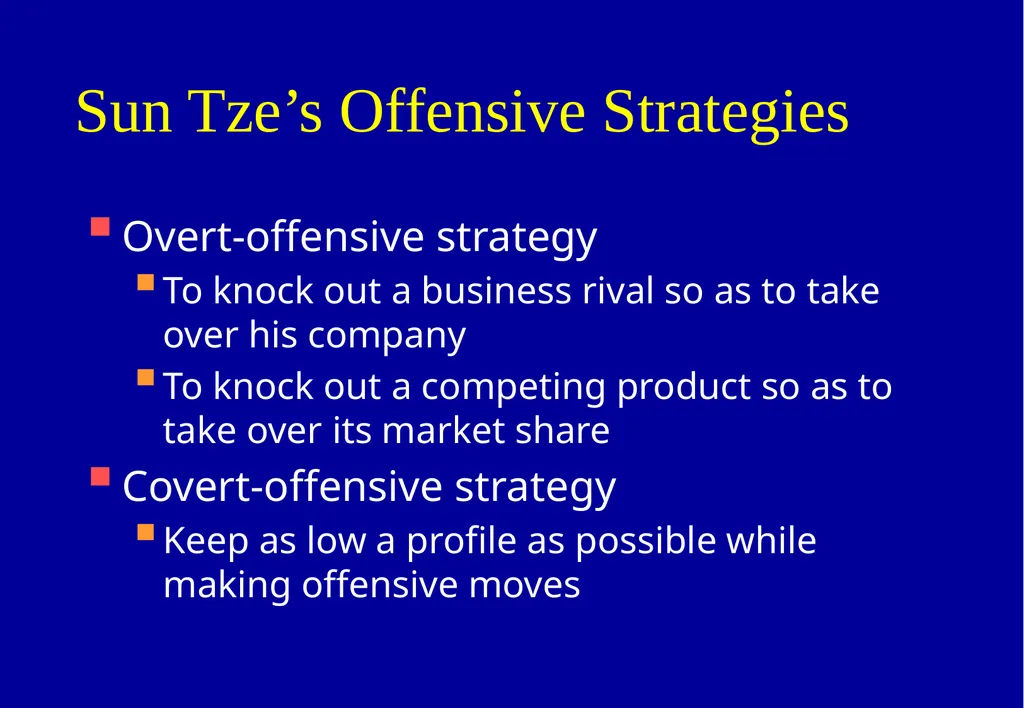
slide7. Sun Tze’s Offensive Strategies Overt-offensive strategy
To knock out a business rival so as to take over his company
To knock out a competing product so as to take over its market share
Covert-offensive strategy
Keep as low a profile as possible while making offensive moves<br>
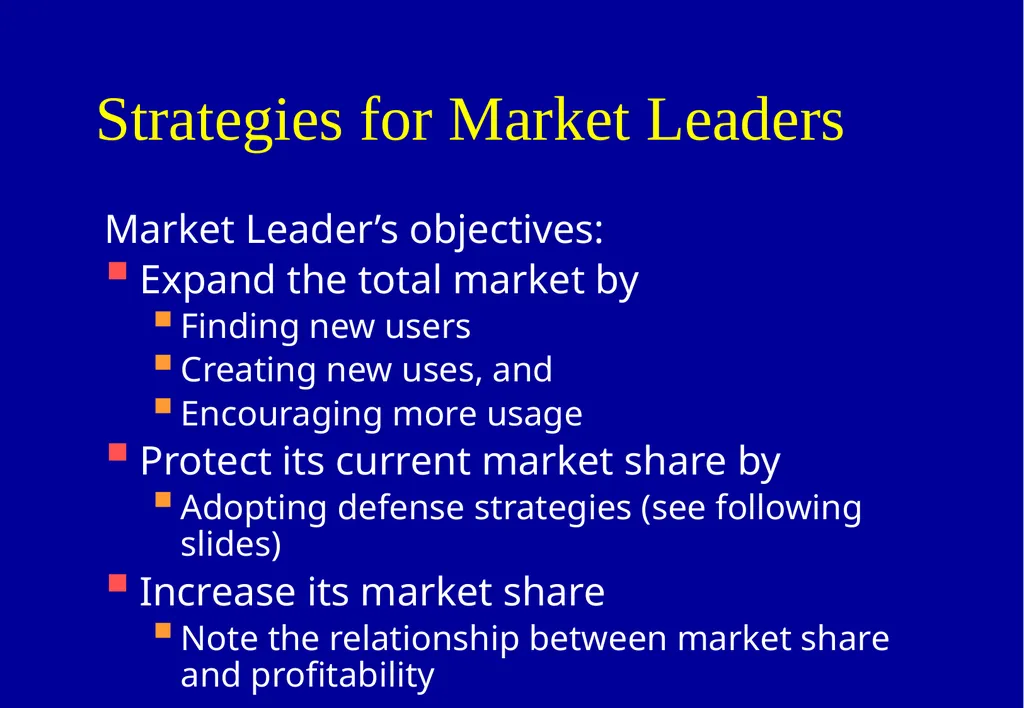
slide8. Strategies for Market Leaders Market Leader’s objectives:
Expand the total market by
Finding new users
Creating new uses, and
Encouraging more usage
Protect its current market share by
Adopting defense strategies (see following slides)
Increase its market share
Note the relationship between market share and profitability<br>
slide9. Which strategy to use? Depends on your answer to the following:
Is it worth fighting?
Are you strong enough to fight?
How strong is your defense?
Do you have any choice but to fight?<br>
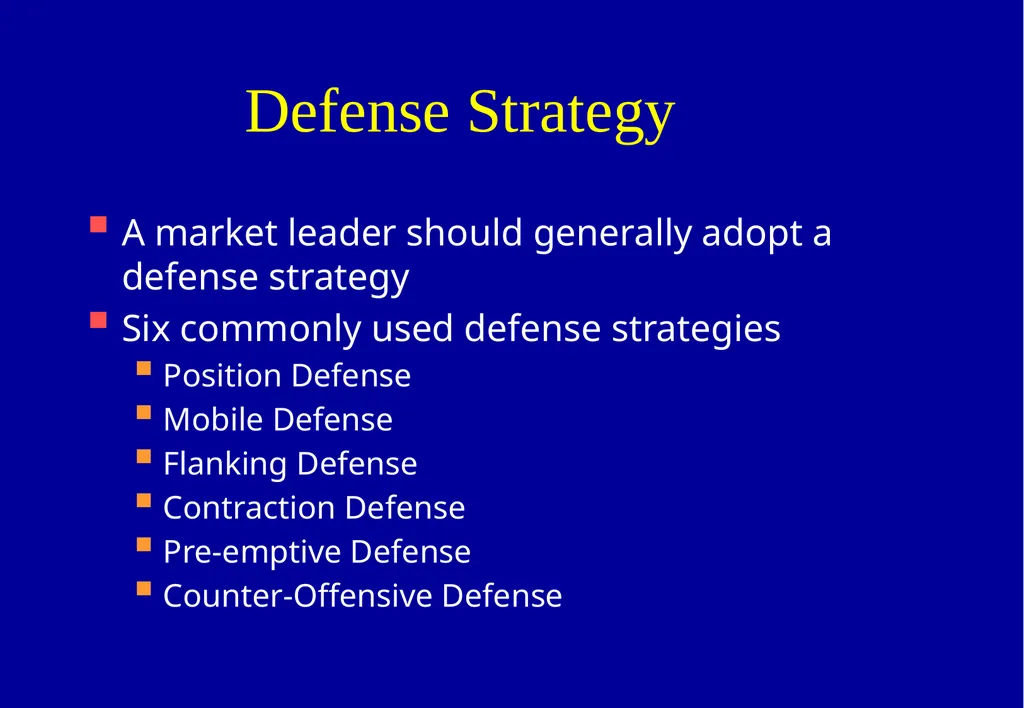
slide10. Defense Strategy A market leader should generally adopt a defense strategy
Six commonly used defense strategies
Position Defense
Mobile Defense
Flanking Defense
Contraction Defense
Pre-emptive Defense
Counter-Offensive Defense<br>
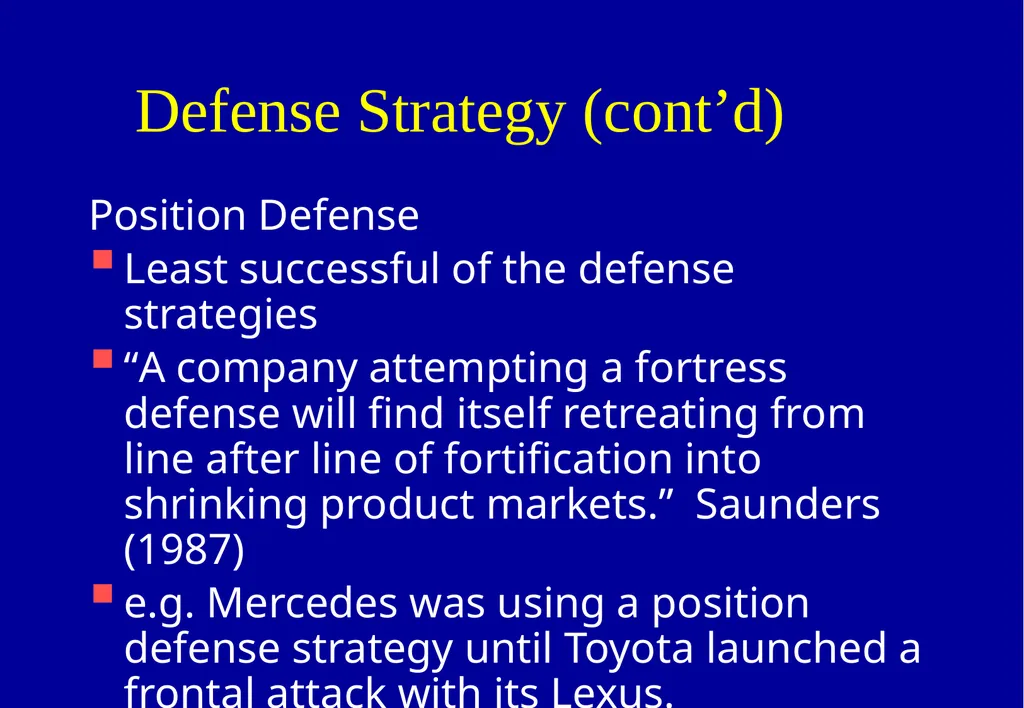
slide11. Defense Strategy (cont’d) Position Defense
Least successful of the defense strategies
“A company attempting a fortress defense will find itself retreating from line after line of fortification into shrinking product markets.” Saunders (1987)
e.g. Mercedes was using a position defense strategy until Toyota launched a frontal attack with its Lexus.<br>
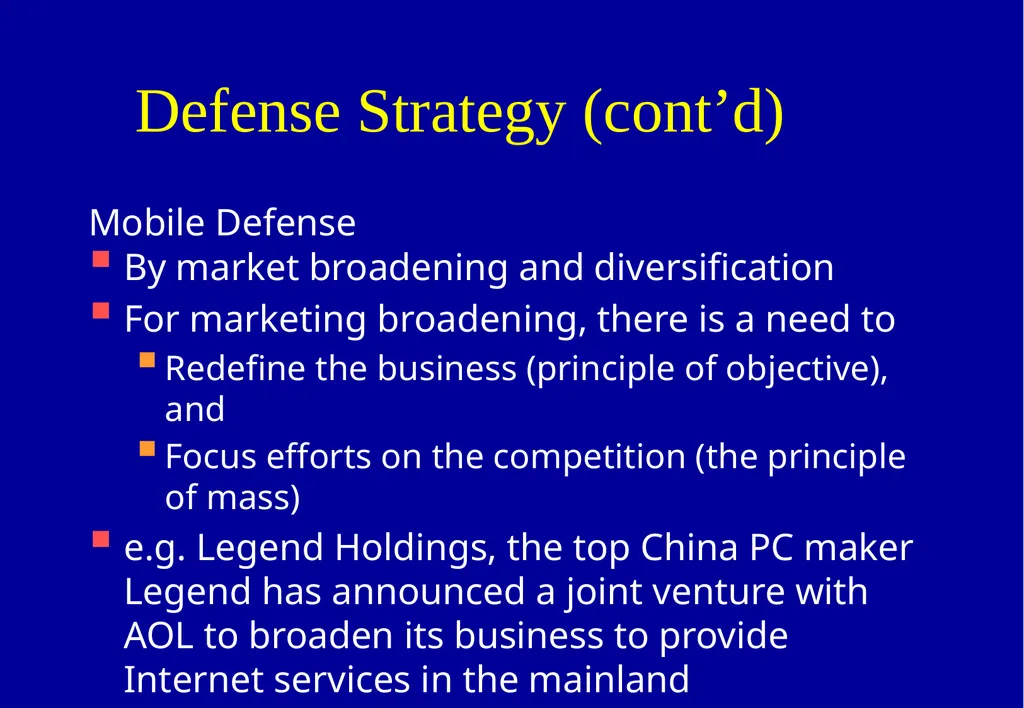
slide12. Defense Strategy (cont’d) Mobile Defense
By market broadening and diversification
For marketing broadening, there is a need to
Redefine the business (principle of objective), and
Focus efforts on the competition (the principle of mass)
e.g. Legend Holdings, the top China PC maker Legend has announced a joint venture with AOL to broaden its business to provide Internet services in the mainland<br>
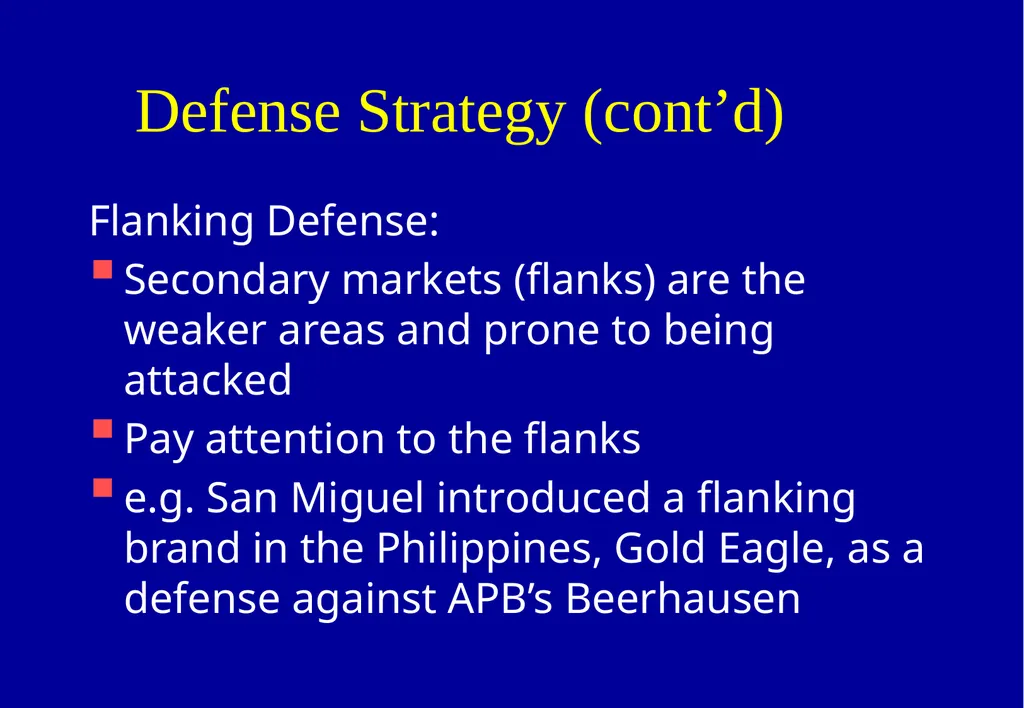
slide13. Defense Strategy (cont’d) Flanking Defense:
Secondary markets (flanks) are the weaker areas and prone to being attacked
Pay attention to the flanks
e.g. San Miguel introduced a flanking brand in the Philippines, Gold Eagle, as a defense against APB’s Beerhausen<br>
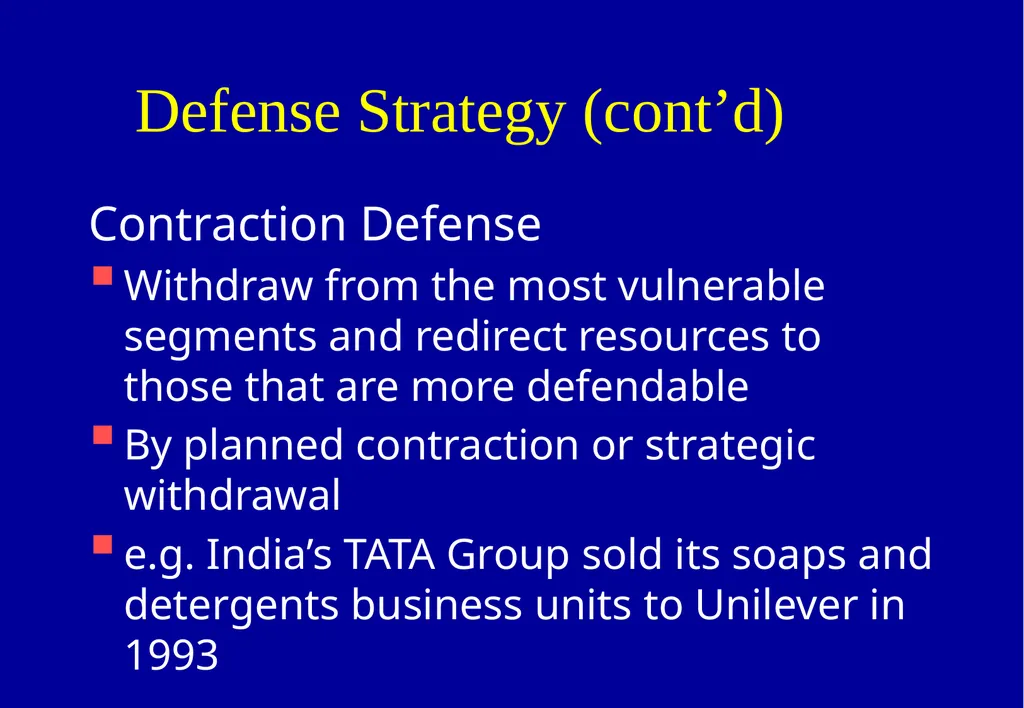
slide14. Defense Strategy (cont’d) Contraction Defense
Withdraw from the most vulnerable segments and redirect resources to those that are more defendable
By planned contraction or strategic withdrawal
e.g. India’s TATA Group sold its soaps and detergents business units to Unilever in 1993<br>
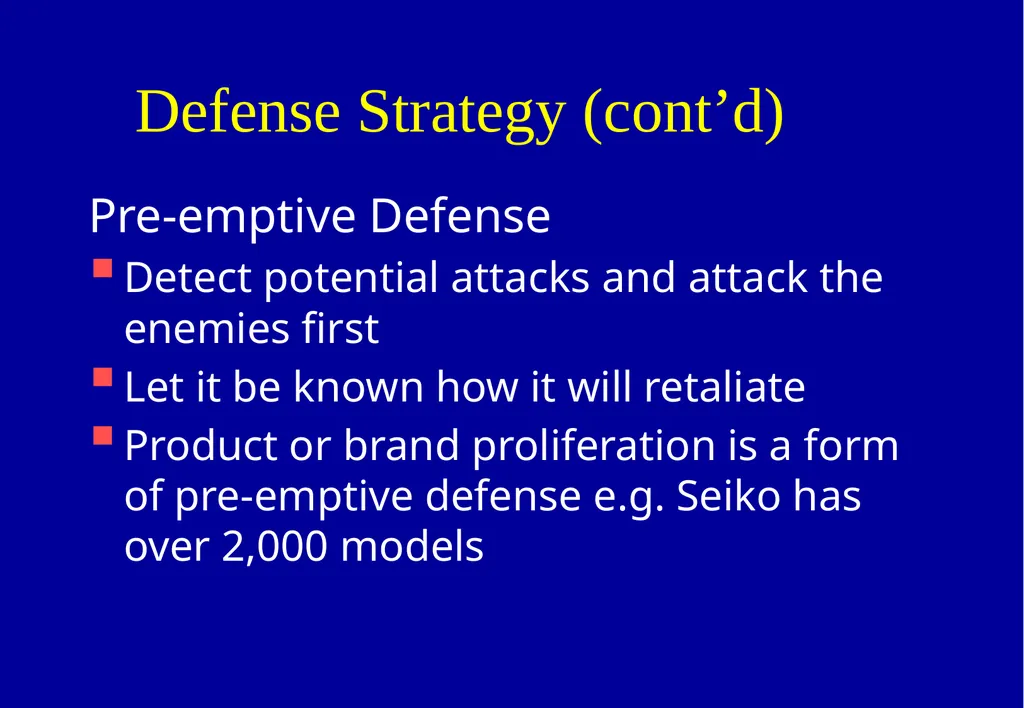
slide15. Defense Strategy (cont’d) Pre-emptive Defense
Detect potential attacks and attack the enemies first
Let it be known how it will retaliate
Product or brand proliferation is a form of pre-emptive defense e.g. Seiko has over 2,000 models<br>
slide16. Defense Strategy (cont’d) Counter-Offensive Defense
Responding to competitors’ head-on attack by identifying the attacker’s weakness and then launch a counter attack
e.g. Toyota launched the Lexus to respond to Mercedes attack<br>
slide17. Market Challenger Strategies The market challengers’ strategic objective is to gain market share and to become the leader eventually
How?
By attacking the market leader
By attacking other firms of the same size
By attacking smaller firms<br>
slide18. Market Challenger Strategies (cont’d) Types of Attack Strategies
Frontal attack
Flank attack
Encirclement attack
Bypass attack
Guerrilla attack<br>
slide19. Frontal Attack Seldom work unless
The challenger has sufficient fire-power (a 3:1 advantage) and staying power, and
The challenger has clear distinctive advantage(s)
e.g. Japanese and Korean firms launched frontal attacks in various ASPAC countries through quality, price and low cost<br>
slide20. Flank attack Attack the enemy at its weak points or blind spots i.e. its flanks
Ideal for challenger who does not have sufficient resources
e.g. In the 1990s, Yaohan attacked Mitsukoshi and Seibu’s flanks by opening numerous stores in overseas markets<br>
slide21. Encirclement attack Attack the enemy at many fronts at the same time
Ideal for challenger having superior resources
e.g. Seiko attacked on fashion, features, user preferences and anything that might interest the consumer<br>
slide22. Bypass attack By diversifying into unrelated products or markets neglected by the leader
Could overtake the leader by using new technologies
e.g. Pepsi use a bypass attack strategy against Coke in China by locating its bottling plants in the interior provinces<br>
slide23. Guerrilla attack By launching small, intermittent hit-and-run attacks to harass and destabilize the leader
Usually use to precede a stronger attack
e.g. airlines use short promotions to attack the national carriers especially when passenger loads in certain routes are low<br>
slide24. Which Attack Strategy should a Challenger Choose? Use a combination of several strategies to improve market share over time<br>
slide25. Market-Follower Strategies Theodore Levitt in his article, “Innovative Imitation” argued that a product imitation strategy might be just as profitable as a product innovation strategy
e.g. Product innovation--Sony
Product-imitation--Panasonic<br>
slide26. Market-Follower Strategies (cont’d) Each follower tries to bring distinctive advantages to its target market--location, services, financing
Four broad follower strategies:
Counterfeiter (which is illegal)
Cloner e.g. the IBM PC clones
Imitator e.g. car manufacturers imitate the style of one another
Adapter e.g. many Japanese firms are excellent adapters initially before developing into challengers and eventually leaders<br>
slide27. Market-Nicher Strategies Smaller firms can avoid larger firms by targeting smaller markets or niches that are of little or no interest to the larger firms
e.g. Logitech--mice
Microbrewers--special beers<br>
slide28. Market-Nicher Strategies (cont’d) Nichers must create niches, expand the niches and protect them
e.g. Nike constantly created new niches--cycling, walking, hiking, cheerleading, etc
What is the major risk faced by nichers?
Market niche may be attacked by larger firms once they notice the niches are successful<br>
slide29. Multiple Niching “[A] firm should `stick to its niching’ but not necessarily to its niche. That is why multiple niching is preferable to single niching. By developing strength in two or more niches the company increases its chances for survival.”
Philip Kotler<br>
slide2. Outline Introduction
Sustainable competitive advantage (SCA)
Sources of SCA
Strategies for
Market Leaders
Challengers
Followers, and
Nichers<br>
slide3. Introduction Having a competitive advantage is necessary for a firm to compete in the market
But what is more important is whether the competitive advantage is sustainable
A firm must identify its position relative to the competition in the market
By knowing if it is a leader, challenger, follower or nicher, it can adopt appropriate strategies to compete<br>
slide4. Sustainable Competitive Advantage A good strategist seeks not only to “win the hill, but hold on to it.” Subash Jain
Sustaining competitive advantage requires erecting barriers against the competition
Aakers suggested looking at the following:
How you compete
Basis of competition
Where you compete
Whom you are competing against<br>
slide5. Examples of SCA For many years, Singapore Airlines were riding on its SCA of having the best in-flight service
As more airlines improved their service and narrowed the gap, SIA sought other competitive advantages among which are
The most modern fleet
Outstanding Service on the Ground
A super entertainment system in its cabins
Comfort in its First Class cabins at an unparallel level
Discuss whether the later initiatives had been sustainable<br>
slide6. Sun Tze’s defensive strategy “Do not assume the enemy will not come
but be prepared for his coming…
Do not presume he will not attack,
but instead make your own position unassailable.”<br>
slide7. Sun Tze’s Offensive Strategies Overt-offensive strategy
To knock out a business rival so as to take over his company
To knock out a competing product so as to take over its market share
Covert-offensive strategy
Keep as low a profile as possible while making offensive moves<br>
slide8. Strategies for Market Leaders Market Leader’s objectives:
Expand the total market by
Finding new users
Creating new uses, and
Encouraging more usage
Protect its current market share by
Adopting defense strategies (see following slides)
Increase its market share
Note the relationship between market share and profitability<br>
slide9. Which strategy to use? Depends on your answer to the following:
Is it worth fighting?
Are you strong enough to fight?
How strong is your defense?
Do you have any choice but to fight?<br>
slide10. Defense Strategy A market leader should generally adopt a defense strategy
Six commonly used defense strategies
Position Defense
Mobile Defense
Flanking Defense
Contraction Defense
Pre-emptive Defense
Counter-Offensive Defense<br>
slide11. Defense Strategy (cont’d) Position Defense
Least successful of the defense strategies
“A company attempting a fortress defense will find itself retreating from line after line of fortification into shrinking product markets.” Saunders (1987)
e.g. Mercedes was using a position defense strategy until Toyota launched a frontal attack with its Lexus.<br>
slide12. Defense Strategy (cont’d) Mobile Defense
By market broadening and diversification
For marketing broadening, there is a need to
Redefine the business (principle of objective), and
Focus efforts on the competition (the principle of mass)
e.g. Legend Holdings, the top China PC maker Legend has announced a joint venture with AOL to broaden its business to provide Internet services in the mainland<br>
slide13. Defense Strategy (cont’d) Flanking Defense:
Secondary markets (flanks) are the weaker areas and prone to being attacked
Pay attention to the flanks
e.g. San Miguel introduced a flanking brand in the Philippines, Gold Eagle, as a defense against APB’s Beerhausen<br>
slide14. Defense Strategy (cont’d) Contraction Defense
Withdraw from the most vulnerable segments and redirect resources to those that are more defendable
By planned contraction or strategic withdrawal
e.g. India’s TATA Group sold its soaps and detergents business units to Unilever in 1993<br>
slide15. Defense Strategy (cont’d) Pre-emptive Defense
Detect potential attacks and attack the enemies first
Let it be known how it will retaliate
Product or brand proliferation is a form of pre-emptive defense e.g. Seiko has over 2,000 models<br>
slide16. Defense Strategy (cont’d) Counter-Offensive Defense
Responding to competitors’ head-on attack by identifying the attacker’s weakness and then launch a counter attack
e.g. Toyota launched the Lexus to respond to Mercedes attack<br>
slide17. Market Challenger Strategies The market challengers’ strategic objective is to gain market share and to become the leader eventually
How?
By attacking the market leader
By attacking other firms of the same size
By attacking smaller firms<br>
slide18. Market Challenger Strategies (cont’d) Types of Attack Strategies
Frontal attack
Flank attack
Encirclement attack
Bypass attack
Guerrilla attack<br>
slide19. Frontal Attack Seldom work unless
The challenger has sufficient fire-power (a 3:1 advantage) and staying power, and
The challenger has clear distinctive advantage(s)
e.g. Japanese and Korean firms launched frontal attacks in various ASPAC countries through quality, price and low cost<br>
slide20. Flank attack Attack the enemy at its weak points or blind spots i.e. its flanks
Ideal for challenger who does not have sufficient resources
e.g. In the 1990s, Yaohan attacked Mitsukoshi and Seibu’s flanks by opening numerous stores in overseas markets<br>
slide21. Encirclement attack Attack the enemy at many fronts at the same time
Ideal for challenger having superior resources
e.g. Seiko attacked on fashion, features, user preferences and anything that might interest the consumer<br>
slide22. Bypass attack By diversifying into unrelated products or markets neglected by the leader
Could overtake the leader by using new technologies
e.g. Pepsi use a bypass attack strategy against Coke in China by locating its bottling plants in the interior provinces<br>
slide23. Guerrilla attack By launching small, intermittent hit-and-run attacks to harass and destabilize the leader
Usually use to precede a stronger attack
e.g. airlines use short promotions to attack the national carriers especially when passenger loads in certain routes are low<br>
slide24. Which Attack Strategy should a Challenger Choose? Use a combination of several strategies to improve market share over time<br>
slide25. Market-Follower Strategies Theodore Levitt in his article, “Innovative Imitation” argued that a product imitation strategy might be just as profitable as a product innovation strategy
e.g. Product innovation--Sony
Product-imitation--Panasonic<br>
slide26. Market-Follower Strategies (cont’d) Each follower tries to bring distinctive advantages to its target market--location, services, financing
Four broad follower strategies:
Counterfeiter (which is illegal)
Cloner e.g. the IBM PC clones
Imitator e.g. car manufacturers imitate the style of one another
Adapter e.g. many Japanese firms are excellent adapters initially before developing into challengers and eventually leaders<br>
slide27. Market-Nicher Strategies Smaller firms can avoid larger firms by targeting smaller markets or niches that are of little or no interest to the larger firms
e.g. Logitech--mice
Microbrewers--special beers<br>
slide28. Market-Nicher Strategies (cont’d) Nichers must create niches, expand the niches and protect them
e.g. Nike constantly created new niches--cycling, walking, hiking, cheerleading, etc
What is the major risk faced by nichers?
Market niche may be attacked by larger firms once they notice the niches are successful<br>
slide29. Multiple Niching “[A] firm should `stick to its niching’ but not necessarily to its niche. That is why multiple niching is preferable to single niching. By developing strength in two or more niches the company increases its chances for survival.”
Philip Kotler<br>