Electronic Customer Relationship Management And Supply Chain Management SEM -II Teacher:- S.BHATTACHARYYA Dept. of Commerce T H K Jain College CRM definitions CRM is mainly Shifting Goals of handling the Customer from T raditional Seller-
Related Topics
Share
Embed code
Download this presentation From Below
"Electronic Customer Relationship Management And" is the property of its rightful owner. Permission is granted to
download and print the materials on this website for personal, non-commercial use only, and to display it
on your personal computer provided you do not modify the materials and that you retain all copyright
notices contained in the materials. By downloading content from our website, you accept the terms of this
agreement.
Presentation Transcript
01
Electronic Customer Relationship Management And Supply Chain Management SEM -II Teacher:- S.BHATTACHARYYA
Dept. of Commerce
T H K Jain College<br>
02
CRM definitions
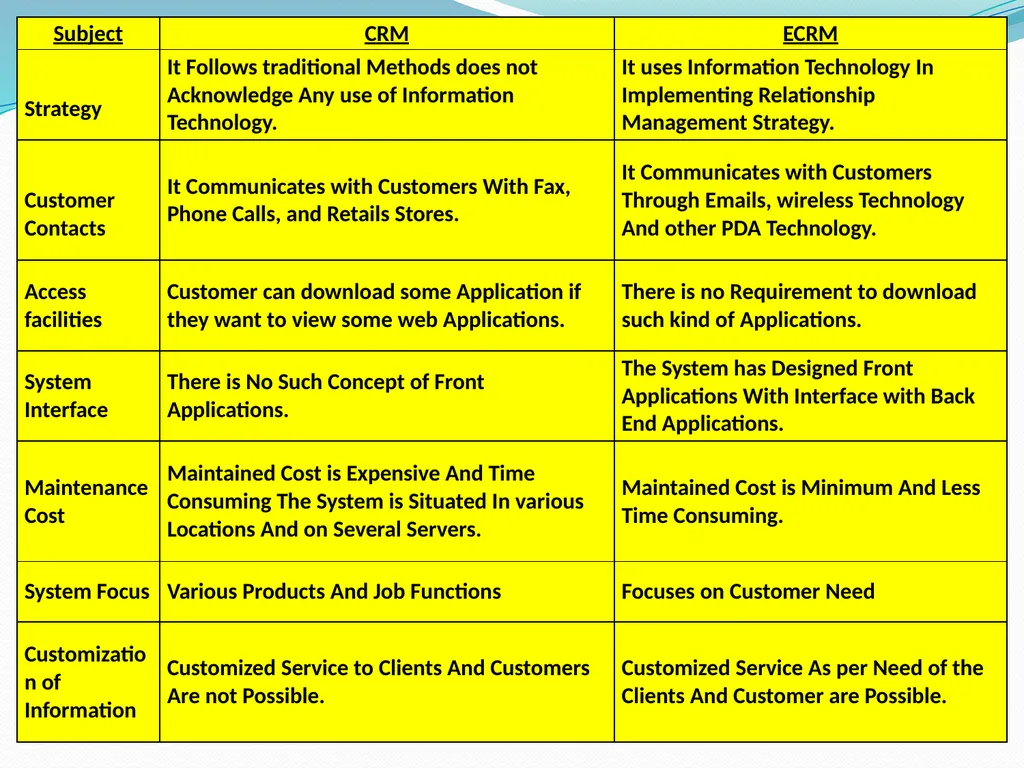
CRM is mainly Shifting Goals of handling the Customer from T
raditional Seller- Oriented Approach to the Customer.
It May be defined as the Aligning of the Business Strategy Relating
to the Corporate Culture of the Organisation together with the
Customer Information And Supporting Information Technology Of
the Interaction of the Customer Which will Promote a Mutually
Beneficial Relationship Between the Customer And the Enterprise.<br>
03
CRM is a Business Strategy that Enables Any Business To Achieve the Following Goals:
Better Understanding of Customer
Better Service
Better Way Handling new Contacts
Better Relationship with Clients And Customers
Better Profit through Customer Satisfaction
Decline in Customer management Cost E CRM uses Various Electronic Media to Integrate the Various Customer-
Related Business Process.
E CRM is the Application of Internet Based Technologies such as Emails,
Websites, And Other Channels to Achieve CRM Objectives. It is Well
Structured and Coordinated Process of CRM that Automates the Processes
IN Marketing, Sales, and Other Customer Services.<br>
04
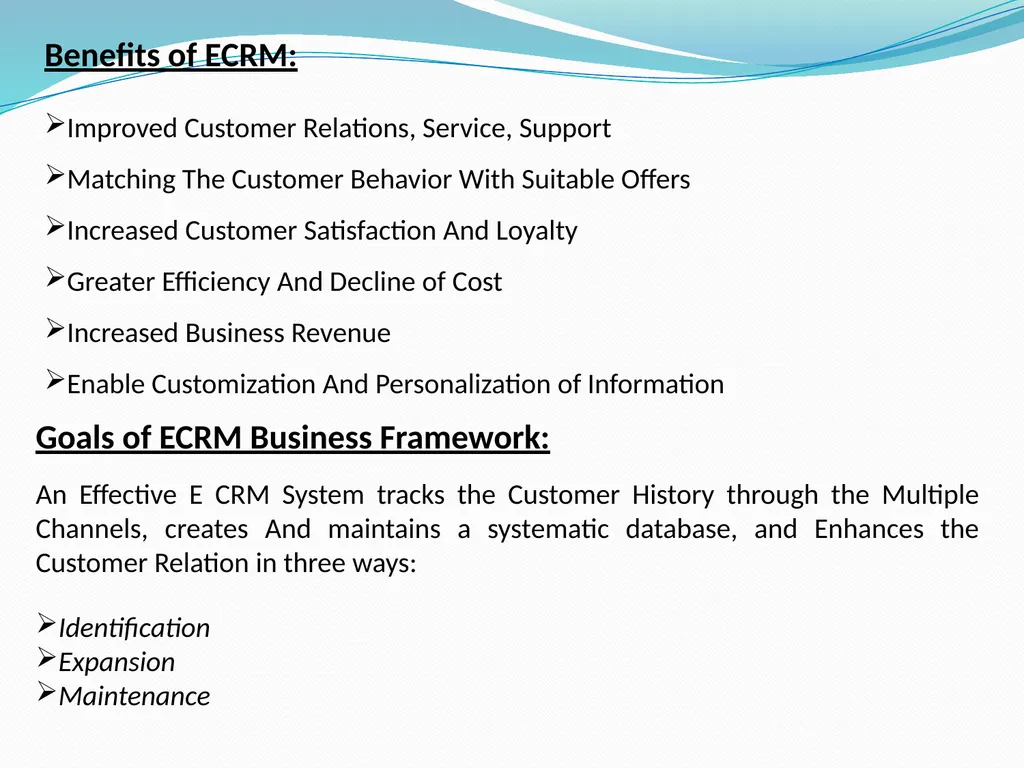
Benefits of ECRM:
Improved Customer Relations, Service, Support
Matching The Customer Behavior With Suitable Offers
Increased Customer Satisfaction And Loyalty
Greater Efficiency And Decline of Cost
Increased Business Revenue
Enable Customization And Personalization of Information Goals of ECRM Business Framework:
An Effective E CRM System tracks the Customer History through the Multiple Channels, creates And maintains a systematic database, and Enhances the Customer Relation in three ways:
Identification
Expansion
Maintenance<br>
05
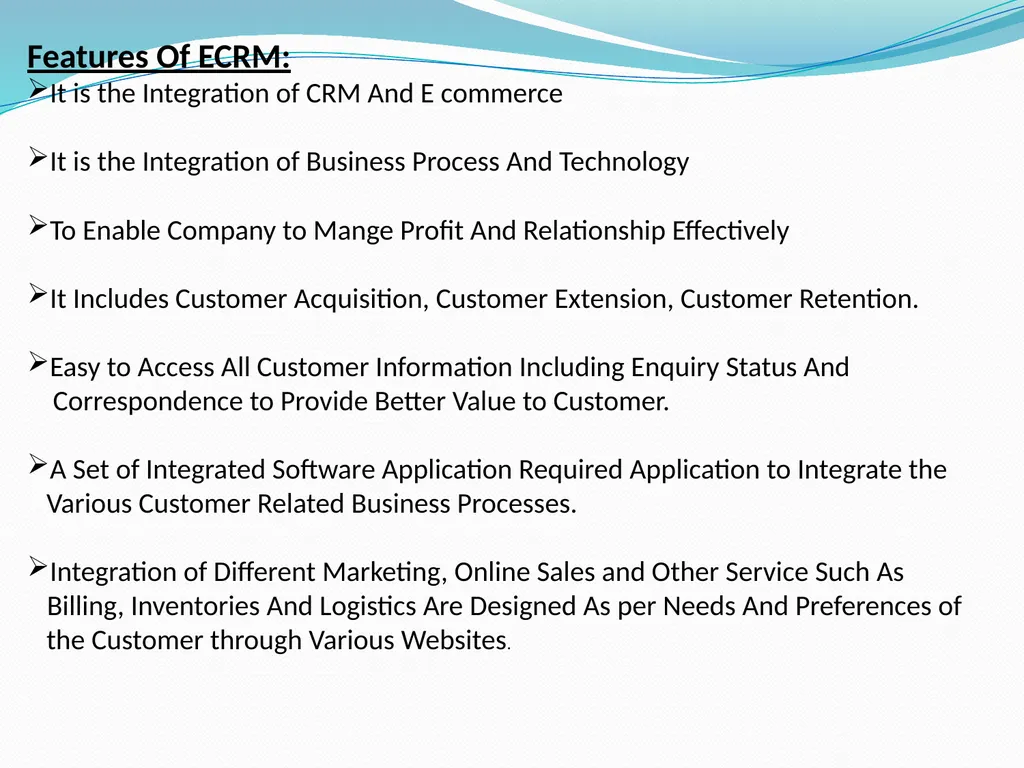
Features Of ECRM:
It is the Integration of CRM And E commerce
It is the Integration of Business Process And Technology
To Enable Company to Mange Profit And Relationship Effectively
It Includes Customer Acquisition, Customer Extension, Customer Retention.
Easy to Access All Customer Information Including Enquiry Status And
Correspondence to Provide Better Value to Customer.
A Set of Integrated Software Application Required Application to Integrate the
Various Customer Related Business Processes.
Integration of Different Marketing, Online Sales and Other Service Such As
Billing, Inventories And Logistics Are Designed As per Needs And Preferences of
the Customer through Various Websites.<br>
06
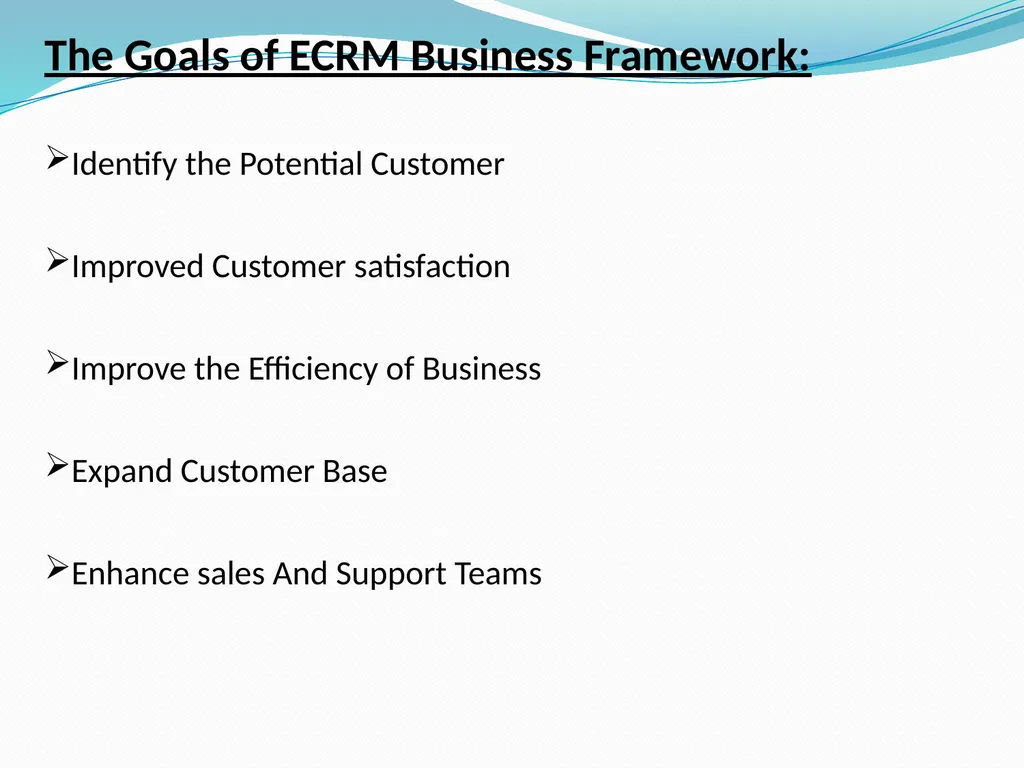
The Goals of ECRM Business Framework:
Identify the Potential Customer
Improved Customer satisfaction
Improve the Efficiency of Business
Expand Customer Base
Enhance sales And Support Teams<br>
07
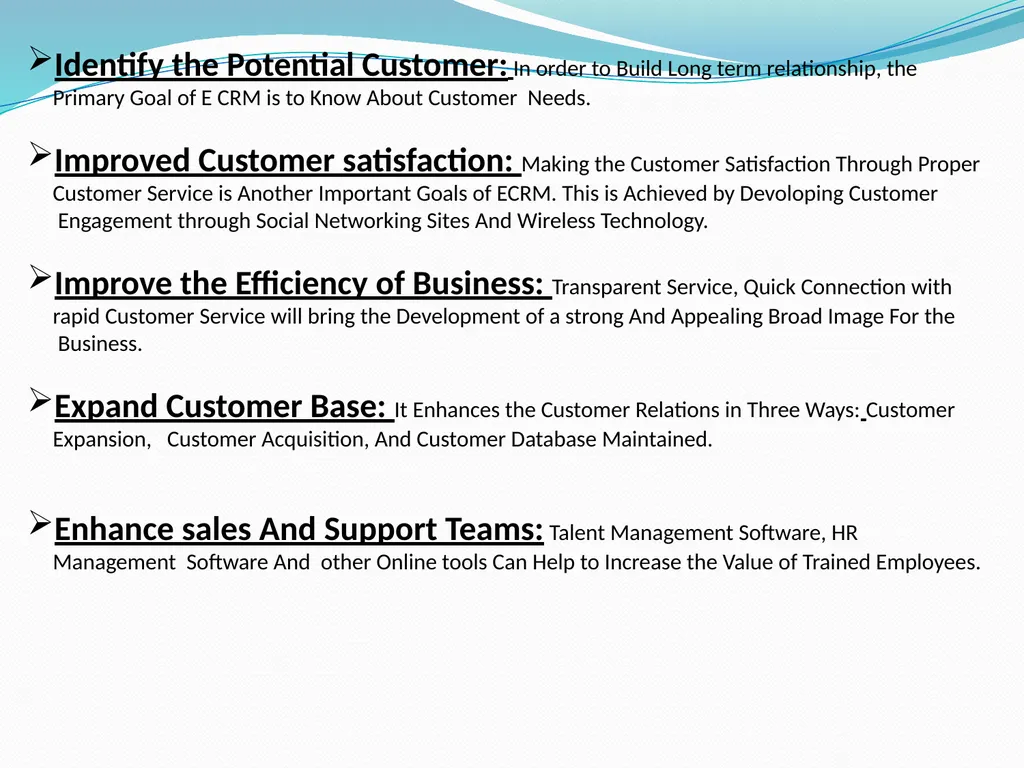
Identify the Potential Customer: In order to Build Long term relationship, the
Primary Goal of E CRM is to Know About Customer Needs.
Improved Customer satisfaction: Making the Customer Satisfaction Through Proper
Customer Service is Another Important Goals of ECRM. This is Achieved by Devoloping Customer
Engagement through Social Networking Sites And Wireless Technology.
Improve the Efficiency of Business: Transparent Service, Quick Connection with
rapid Customer Service will bring the Development of a strong And Appealing Broad Image For the
Business.
Expand Customer Base: It Enhances the Customer Relations in Three Ways: Customer
Expansion, Customer Acquisition, And Customer Database Maintained.
Enhance sales And Support Teams: Talent Management Software, HR
Management Software And other Online tools Can Help to Increase the Value of Trained Employees.<br>
08
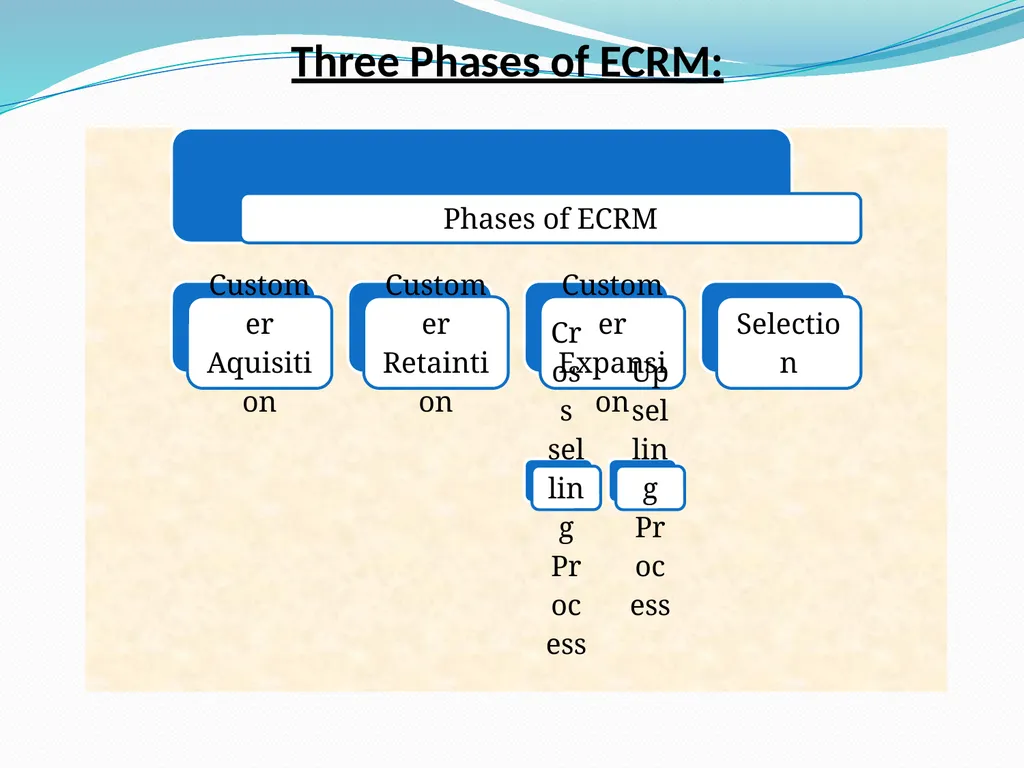
Three Phases of ECRM:<br>
09
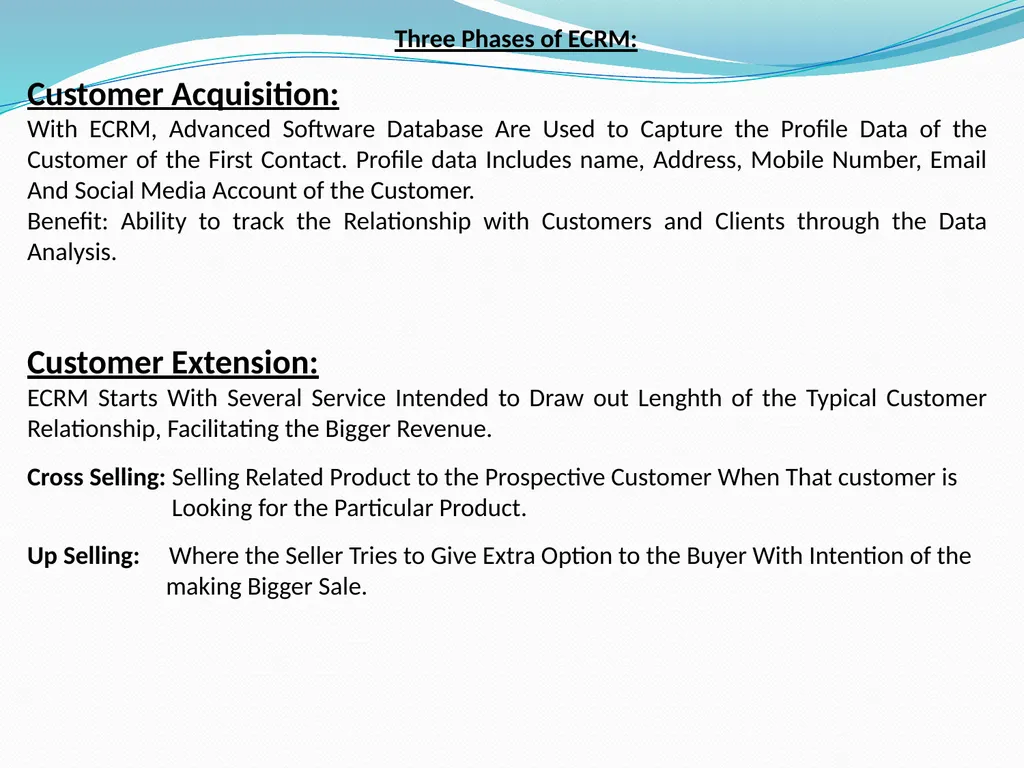
Customer Acquisition:
With ECRM, Advanced Software Database Are Used to Capture the Profile Data of the Customer of the First Contact. Profile data Includes name, Address, Mobile Number, Email And Social Media Account of the Customer.
Benefit: Ability to track the Relationship with Customers and Clients through the Data Analysis.
Customer Extension:
ECRM Starts With Several Service Intended to Draw out Lenghth of the Typical Customer Relationship, Facilitating the Bigger Revenue.
Cross Selling: Selling Related Product to the Prospective Customer When That customer is
Looking for the Particular Product.
Up Selling: Where the Seller Tries to Give Extra Option to the Buyer With Intention of the
making Bigger Sale. Three Phases of ECRM:<br>
10
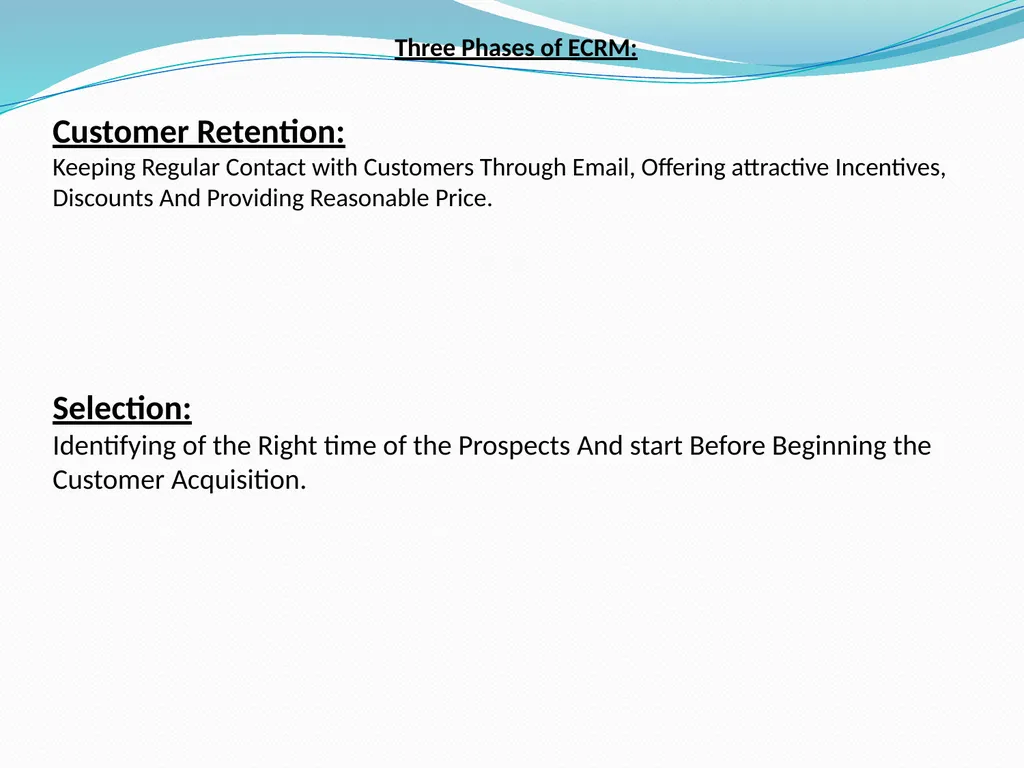
Customer Retention:
Keeping Regular Contact with Customers Through Email, Offering attractive Incentives, Discounts And Providing Reasonable Price.
Selection:
Identifying of the Right time of the Prospects And start Before Beginning the Customer Acquisition. Three Phases of ECRM:<br>
11
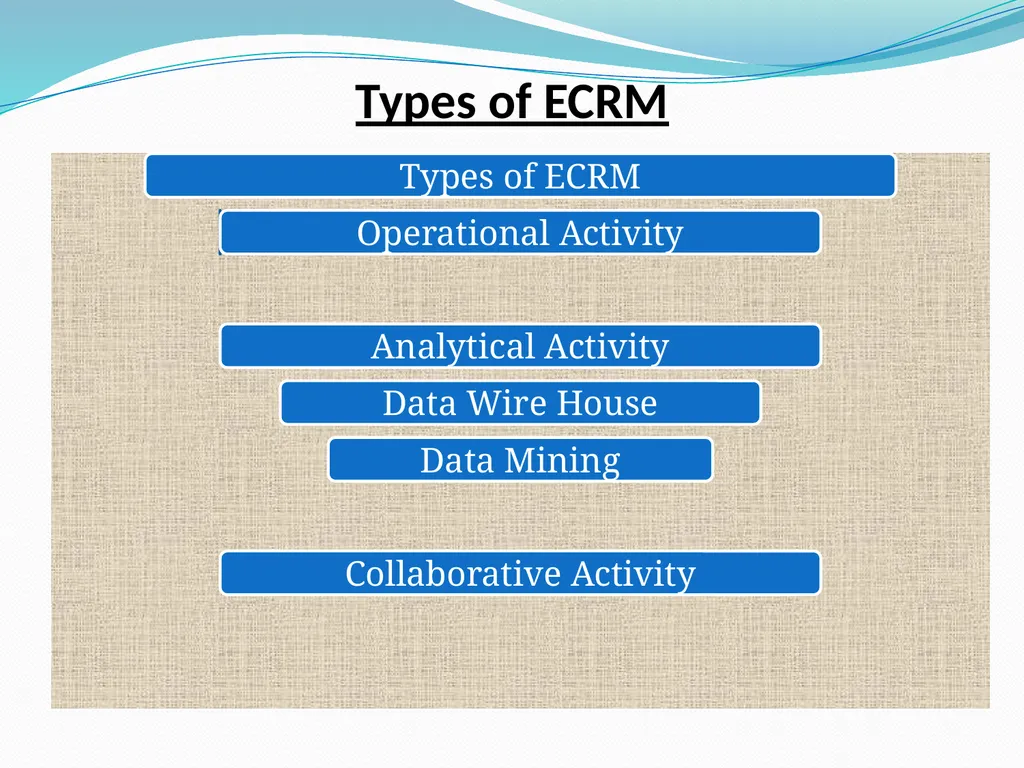
Types of ECRM<br>
12
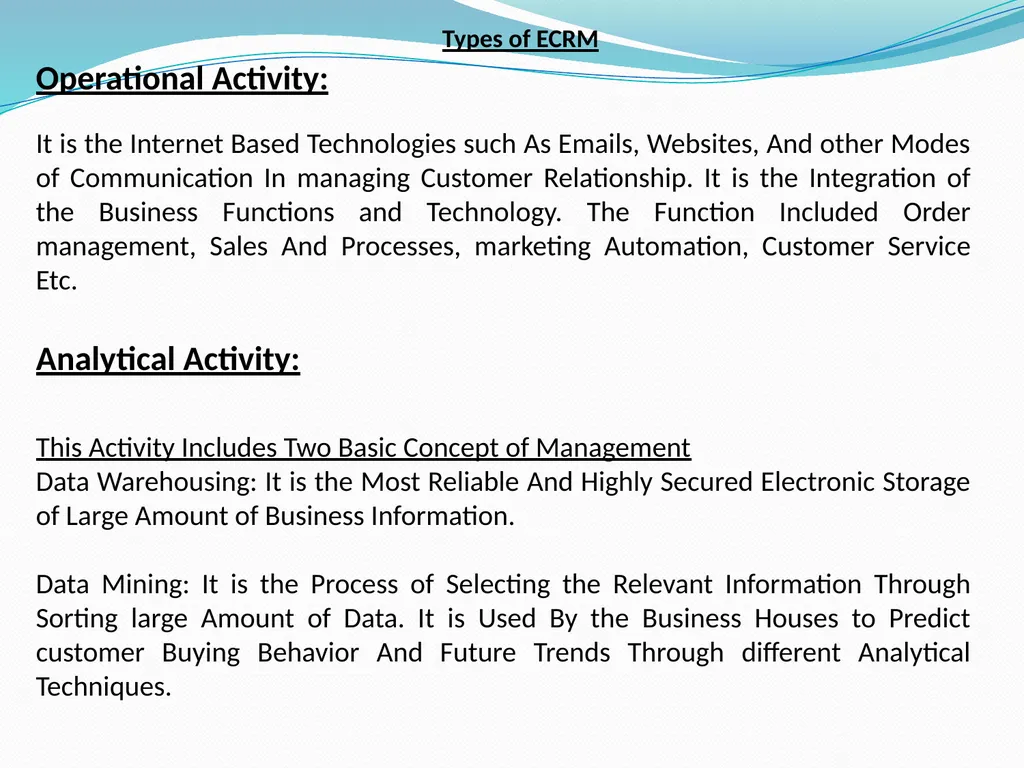
Operational Activity:
It is the Internet Based Technologies such As Emails, Websites, And other Modes of Communication In managing Customer Relationship. It is the Integration of the Business Functions and Technology. The Function Included Order management, Sales And Processes, marketing Automation, Customer Service Etc.
Analytical Activity:
This Activity Includes Two Basic Concept of Management
Data Warehousing: It is the Most Reliable And Highly Secured Electronic Storage of Large Amount of Business Information.
Data Mining: It is the Process of Selecting the Relevant Information Through Sorting large Amount of Data. It is Used By the Business Houses to Predict customer Buying Behavior And Future Trends Through different Analytical Techniques. Types of ECRM<br>
13
Collaborative Activity:
It is the Communication Center that Provide Different collaborative Service Including Emails, help lines etc. The purpose to Increase Customer satisfaction And Loyalty By Providing Better Quality of the Customer Service. Types of ECRM<br>
14
Functional Component of CRM:
Module Based Software: It is Used From Cloud, Virtually, through Mobiles.
Business Process: It Includes Panning , management And Control
Users Of ECRM: Employees, Workers, Customers etc.
Operating System And hardware: The large Operating system for Running CRM
Software.
People Management: Proper Integration And Co-ordination Between Employees And
Customers.
Sales Force Automation: To automate Business Task And Sales.
Workflow Automation: It Aims to Preventing Loss of Time And Excess Effort.<br>
15
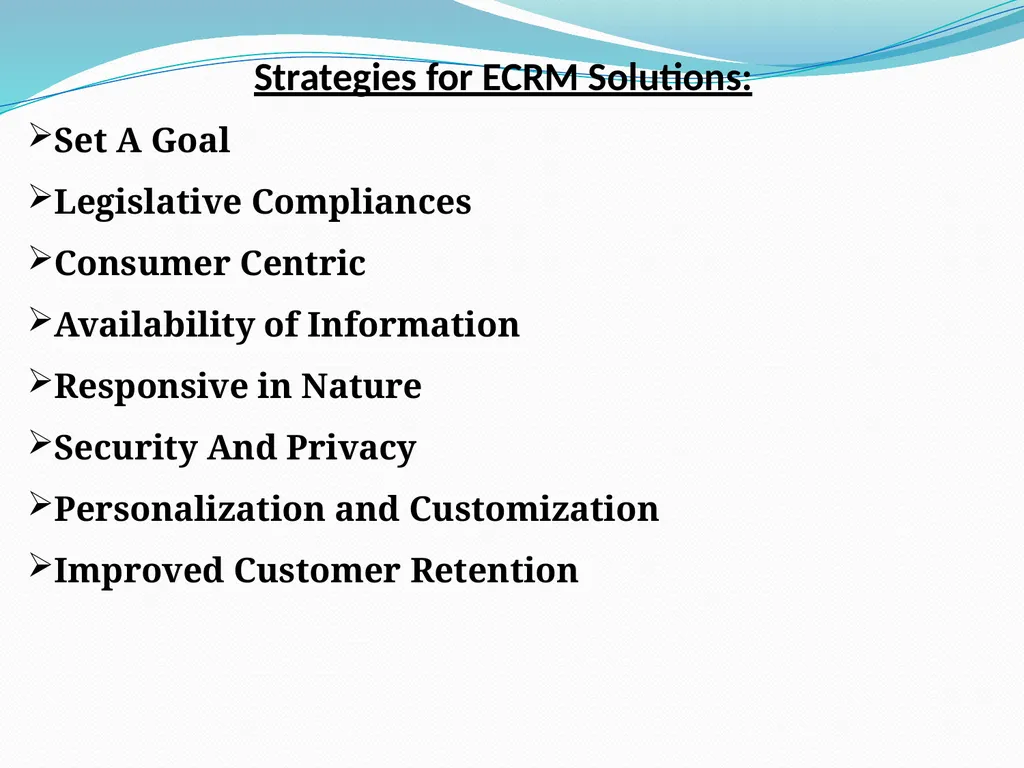
Strategies for ECRM Solutions:
Set A Goal
Legislative Compliances
Consumer Centric
Availability of Information
Responsive in Nature
Security And Privacy
Personalization and Customization
Improved Customer Retention<br>
16
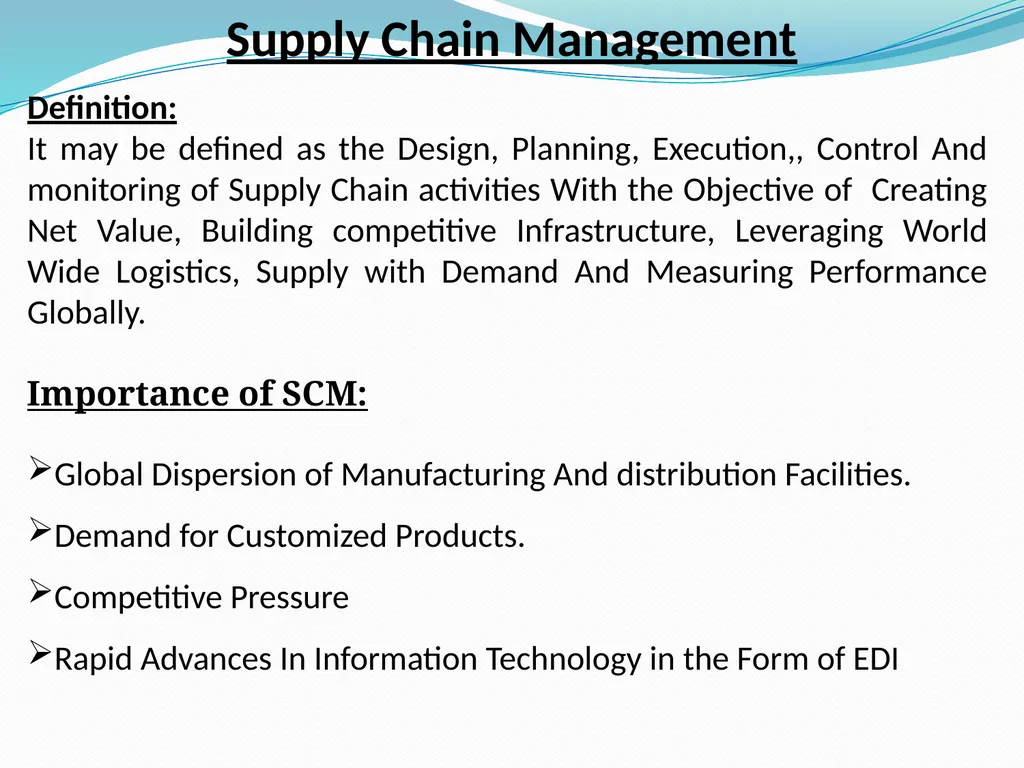
Supply Chain Management Definition:
It may be defined as the Design, Planning, Execution,, Control And monitoring of Supply Chain activities With the Objective of Creating Net Value, Building competitive Infrastructure, Leveraging World Wide Logistics, Supply with Demand And Measuring Performance Globally.
Importance of SCM:
Global Dispersion of Manufacturing And distribution Facilities.
Demand for Customized Products.
Competitive Pressure
Rapid Advances In Information Technology in the Form of EDI<br>
17
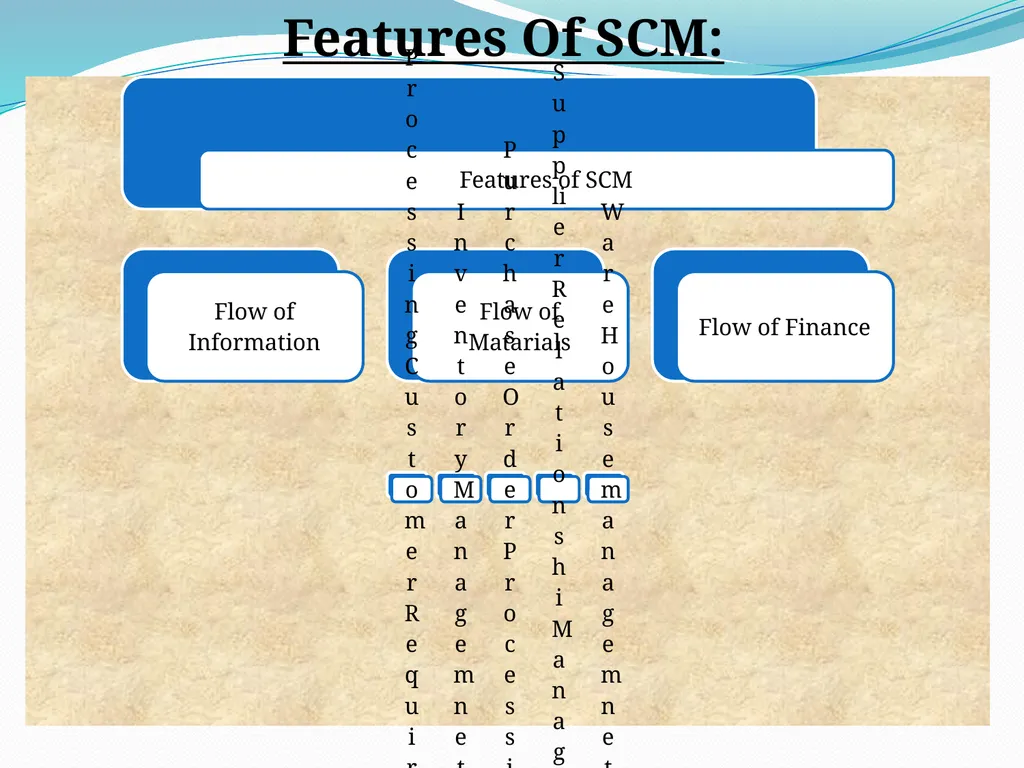
Features Of SCM:<br>
18
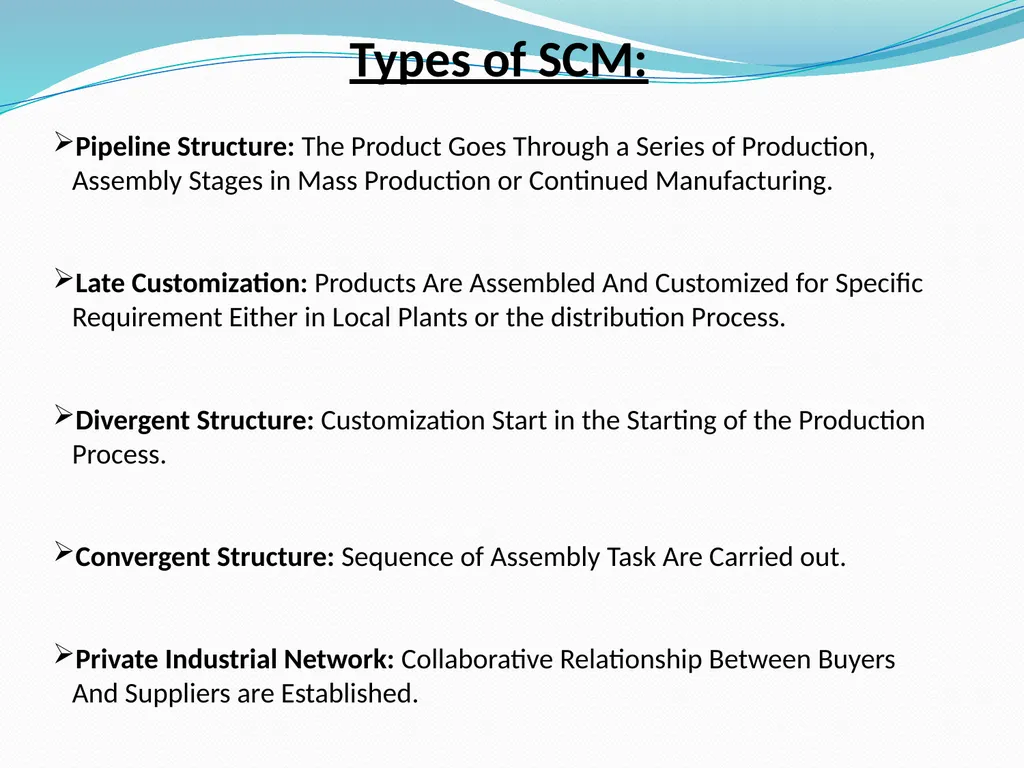
Types of SCM:
Pipeline Structure: The Product Goes Through a Series of Production,
Assembly Stages in Mass Production or Continued Manufacturing.
Late Customization: Products Are Assembled And Customized for Specific
Requirement Either in Local Plants or the distribution Process.
Divergent Structure: Customization Start in the Starting of the Production
Process.
Convergent Structure: Sequence of Assembly Task Are Carried out.
Private Industrial Network: Collaborative Relationship Between Buyers
And Suppliers are Established.<br>
19
Components of ESCM Planning
Advance scheduling And Manufactured Planning: The Detail
co Ordination of All manufacturing And Supply Efforts Based on
the Customer Order.
Demand Forecasting: A Range of Business forecasting Tools in
order to Make Decision on Changing Market Situations.
Transporation Planning: Flow of Materials And Finished Goods
Right At a time and Right Place according to the Planning
Schedule.
Distribution Planning: It is the Integration of Demand
Forecasting Manufacturing And Transportation Planning.<br>