
Emotional Intelligence in the Workplace Presenter:
Description: Emotional Intelligence in the Workplace Presenter: Vice President, Client Services ESI Employee Assistance Group Role Play Five employees have been assigned to work on a project and they are having difficulty working together and completing
Related Topics
Download Presentation
"Emotional Intelligence in the Workplace Presenter:" is the property of its rightful owner. Permission is granted to download and print the materials on this website for personal, non-commercial use only, and to display it on your personal computer provided you do not modify the materials and that you retain all copyright notices contained in the materials. By downloading content from our website, you accept the terms of this agreement.
Presentation Transcript
slide1. Emotional
Intelligence in
the Workplace Presenter:
Vice President, Client Services ESI Employee Assistance Group<br>
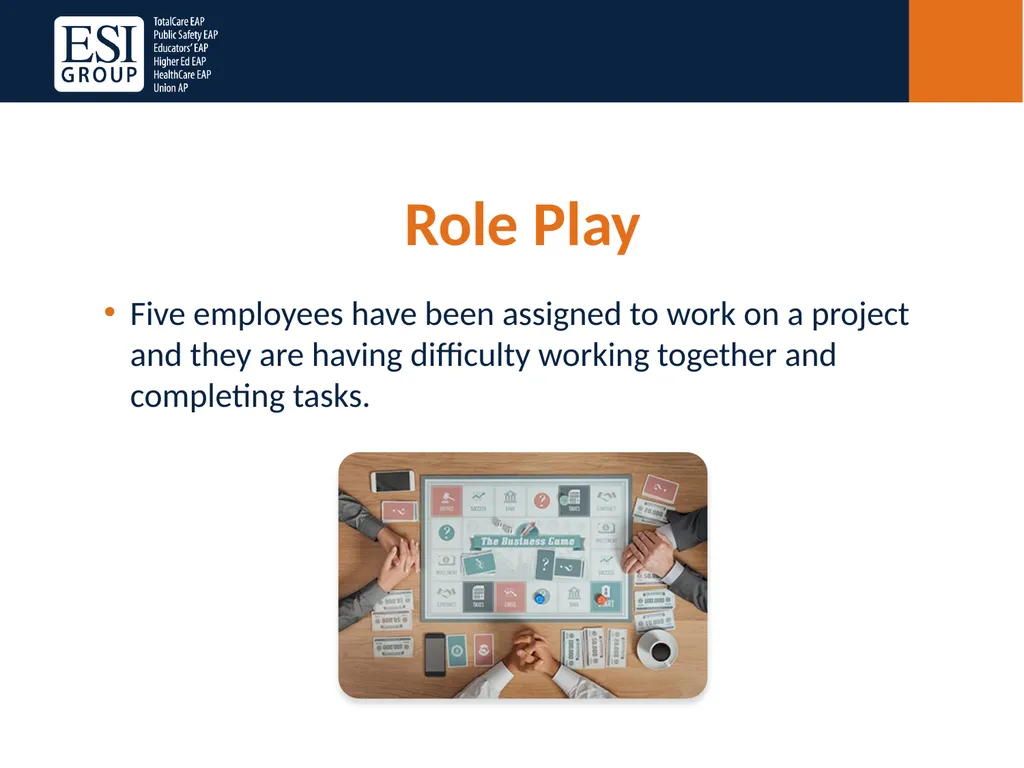
slide2. Role Play Five employees have been assigned to work on a project and they are having difficulty working together and completing tasks.<br>
slide3. Role Play Questions Can you see this scenario happening in the workplace?
What could Maureen have done differently?
Did Michelle and Phil express themselves in a professional manner? What would you say or do that would be more effective?
What can be done about Susan and Patty’s behavior?<br>
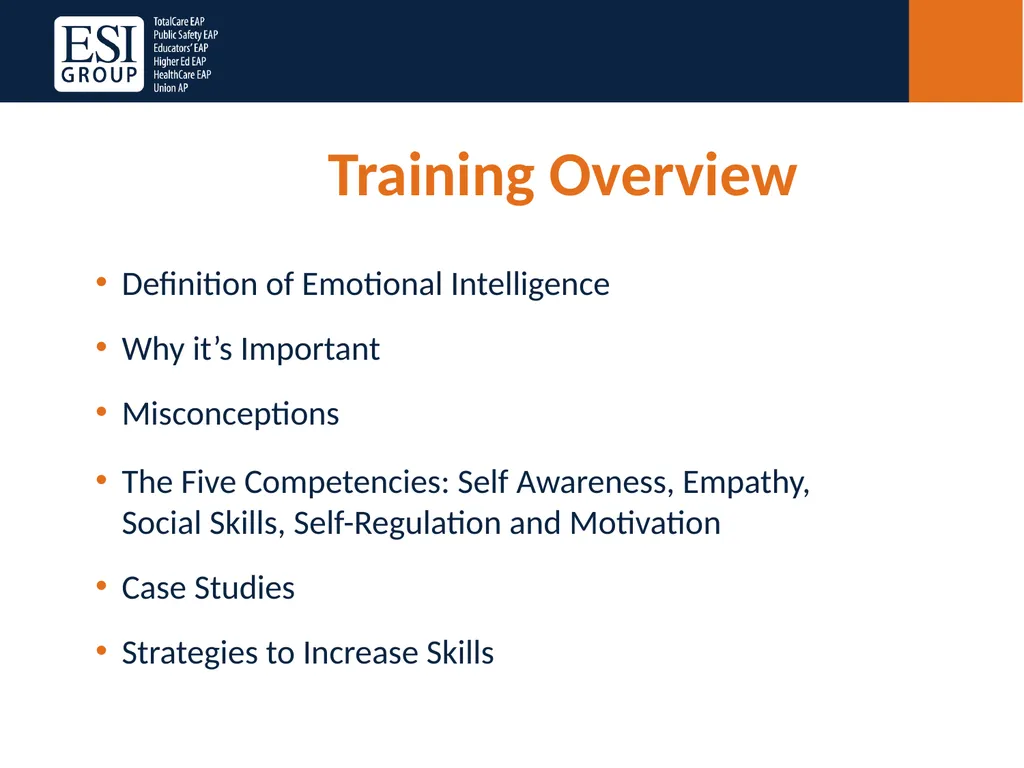
slide4. Training Overview Definition of Emotional Intelligence
Why it’s Important
Misconceptions
The Five Competencies: Self Awareness, Empathy, Social Skills, Self-Regulation and Motivation
Case Studies
Strategies to Increase Skills<br>
slide5. How Would You Define
Emotional Intelligence?<br>
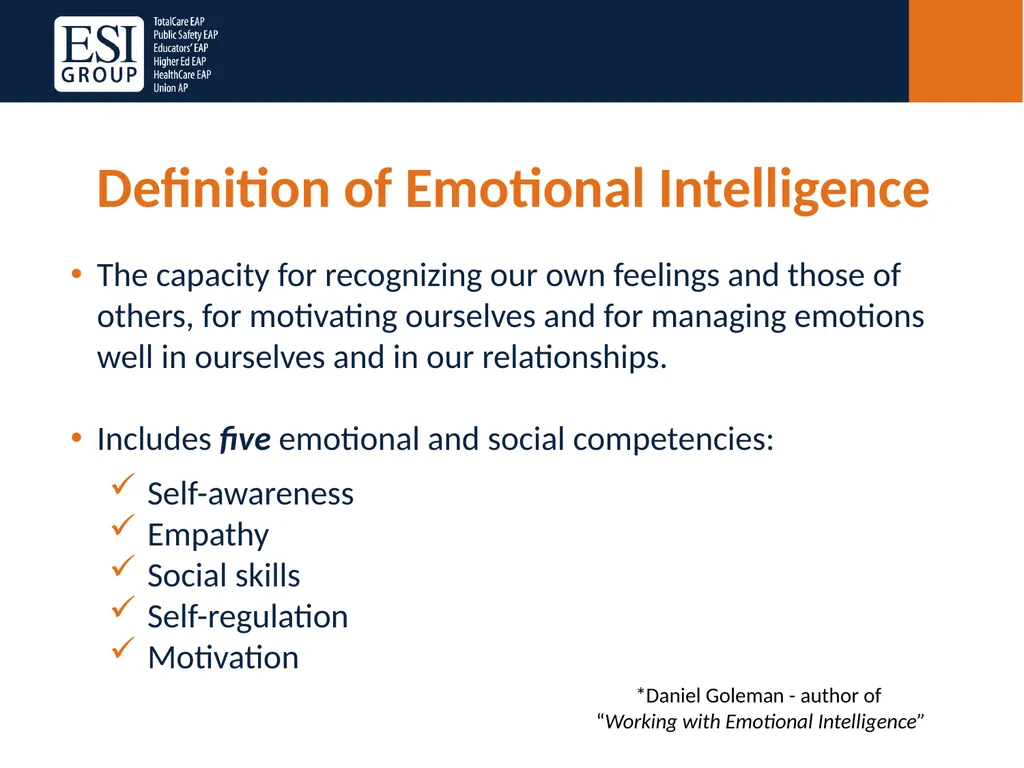
slide6. Definition of Emotional Intelligence The capacity for recognizing our own feelings and those of others, for motivating ourselves and for managing emotions well in ourselves and in our relationships.
Includes five emotional and social competencies:
Self-awareness
Empathy
Social skills
Self-regulation
Motivation *Daniel Goleman - author of
“Working with Emotional Intelligence”<br>
slide8. Why Do You Think Emotional
Intelligence Is Important?<br>
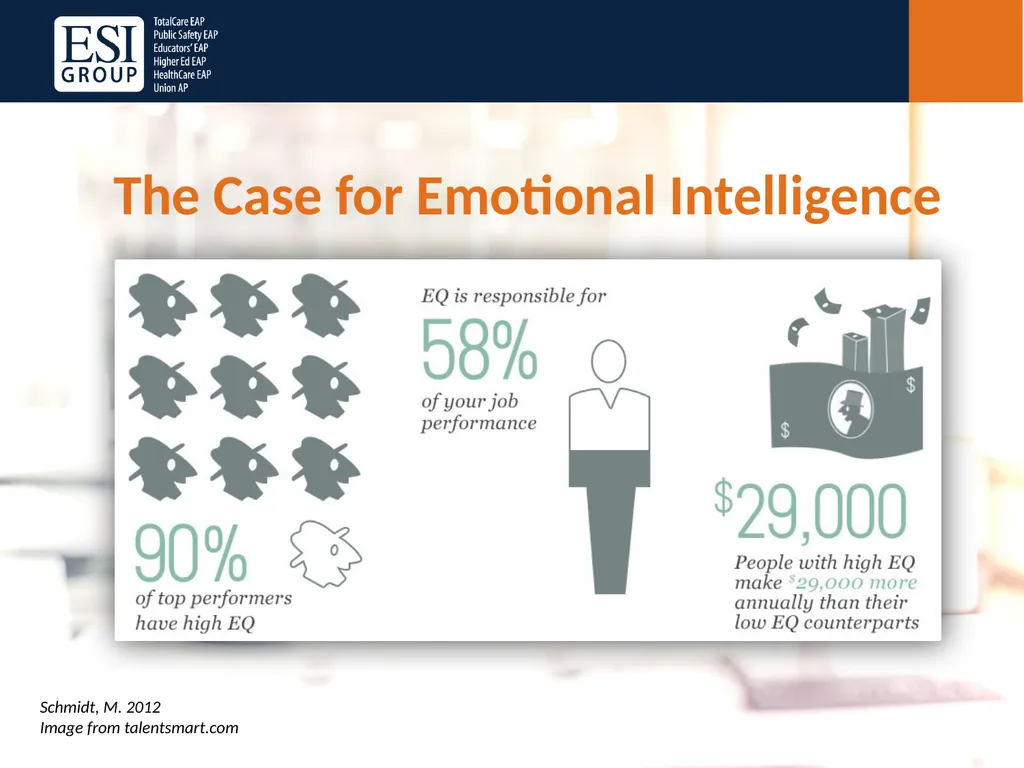
slide9. Schmidt, M. 2012
Image from talentsmart.com The Case for Emotional Intelligence<br>
slide10. Misconceptions About
Emotional Intelligence It’s just about being nice to everyone and thinking positively
It means letting emotions run freely, or being completely robotic
Women are better at it
It’s connected with intellectual or cognitive abilities
It’s fixed or genetic<br>
slide11. Self-Awareness Recognize your emotions early on and their effects
Know your strengths and limits
Have a strong sense of self-worth and capabilities<br>
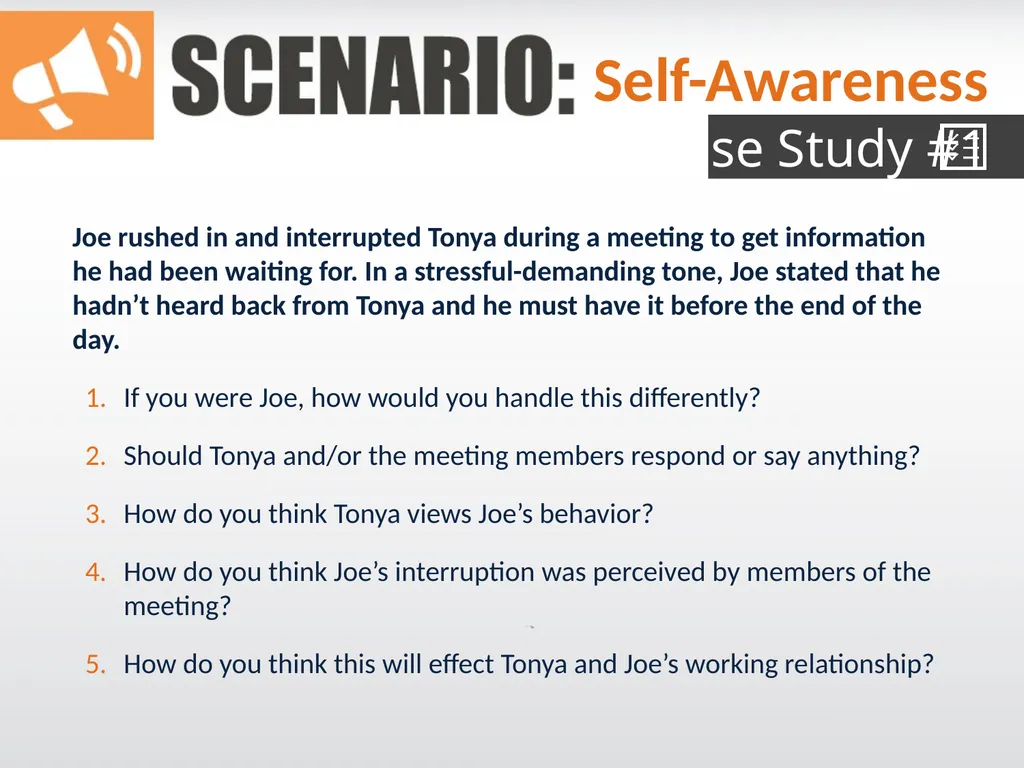
slide12. Case Study #1 Self-Awareness Joe rushed in and interrupted Tonya during a meeting to get information he had been waiting for. In a stressful-demanding tone, Joe stated that he hadn’t heard back from Tonya and he must have it before the end of the day.
If you were Joe, how would you handle this differently?
Should Tonya and/or the meeting members respond or say anything?
How do you think Tonya views Joe’s behavior?
How do you think Joe’s interruption was perceived by members of the meeting?
How do you think this will effect Tonya and Joe’s working relationship?<br>
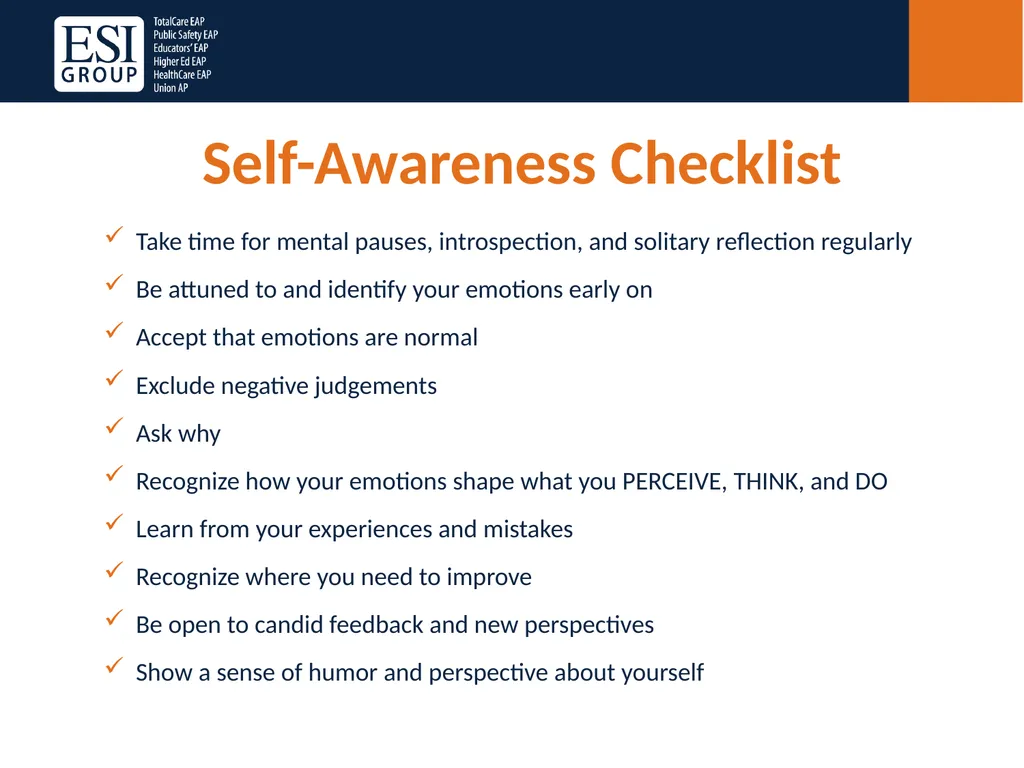
slide13. Self-Awareness Checklist Take time for mental pauses, introspection, and solitary reflection regularly
Be attuned to and identify your emotions early on
Accept that emotions are normal
Exclude negative judgements
Ask why
Recognize how your emotions shape what you PERCEIVE, THINK, and DO
Learn from your experiences and mistakes
Recognize where you need to improve
Be open to candid feedback and new perspectives
Show a sense of humor and perspective about yourself<br>
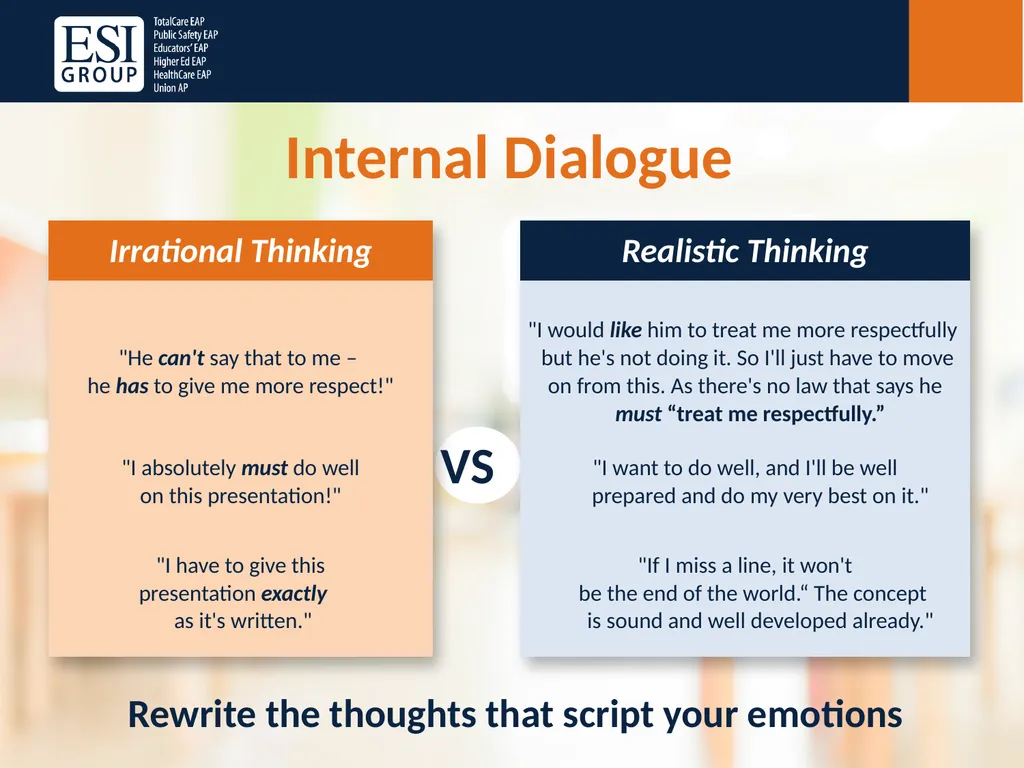
slide14. Internal Dialogue Rewrite the thoughts that script your emotions<br>
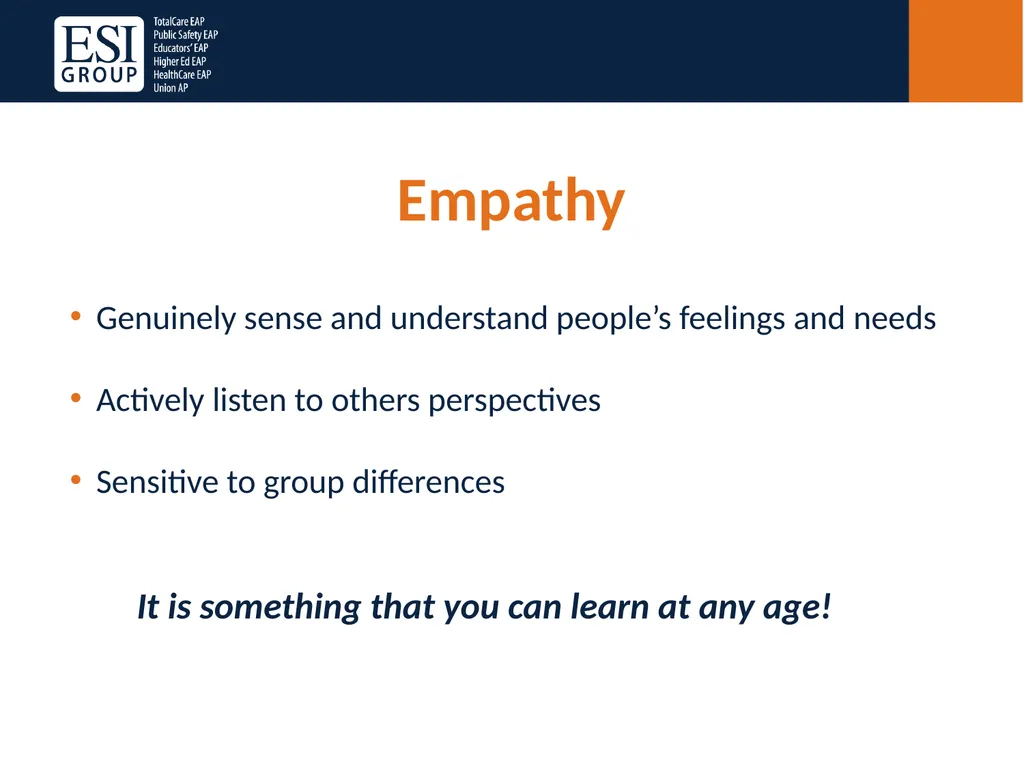
slide15. Empathy Genuinely sense and understand people’s feelings and needs
Actively listen to others perspectives
Sensitive to group differences
It is something that you can learn at any age!<br>
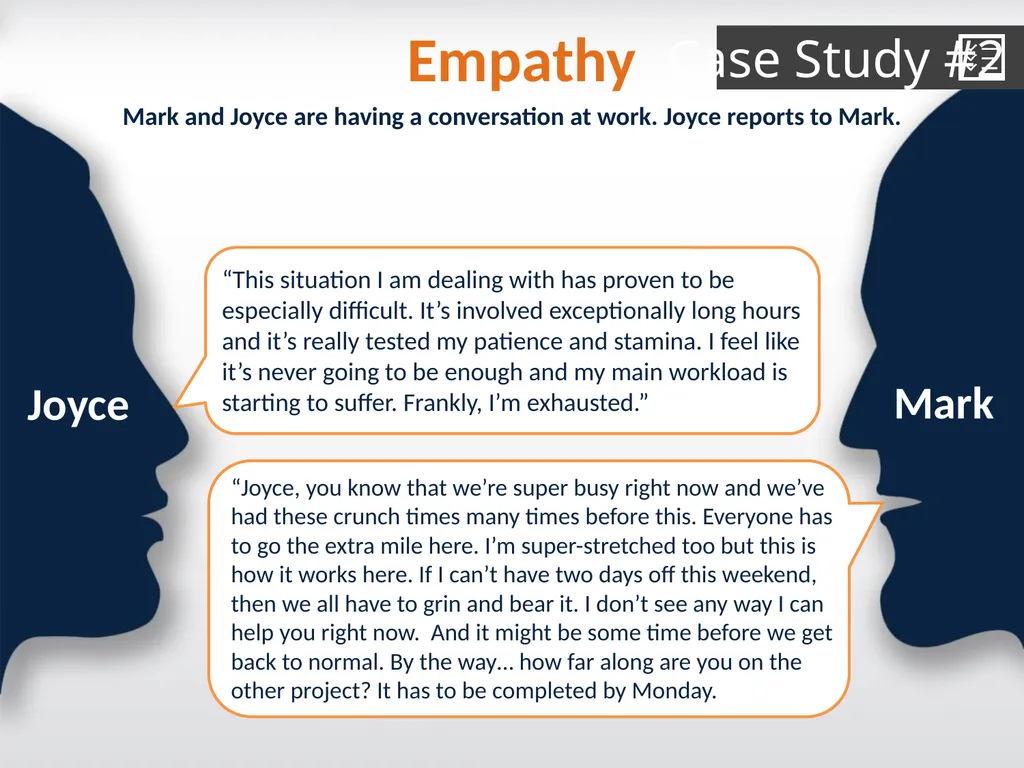
slide16. Empathy “Joyce, you know that we’re super busy right now and we’ve had these crunch times many times before this. Everyone has to go the extra mile here. I’m super-stretched too but this is how it works here. If I can’t have two days off this weekend, then we all have to grin and bear it. I don’t see any way I can help you right now. And it might be some time before we get back to normal. By the way… how far along are you on the other project? It has to be completed by Monday. Mark and Joyce are having a conversation at work. Joyce reports to Mark. Joyce Mark “This situation I am dealing with has proven to be especially difficult. It’s involved exceptionally long hours and it’s really tested my patience and stamina. I feel like it’s never going to be enough and my main workload is starting to suffer. Frankly, I’m exhausted.” Case Study #2<br>
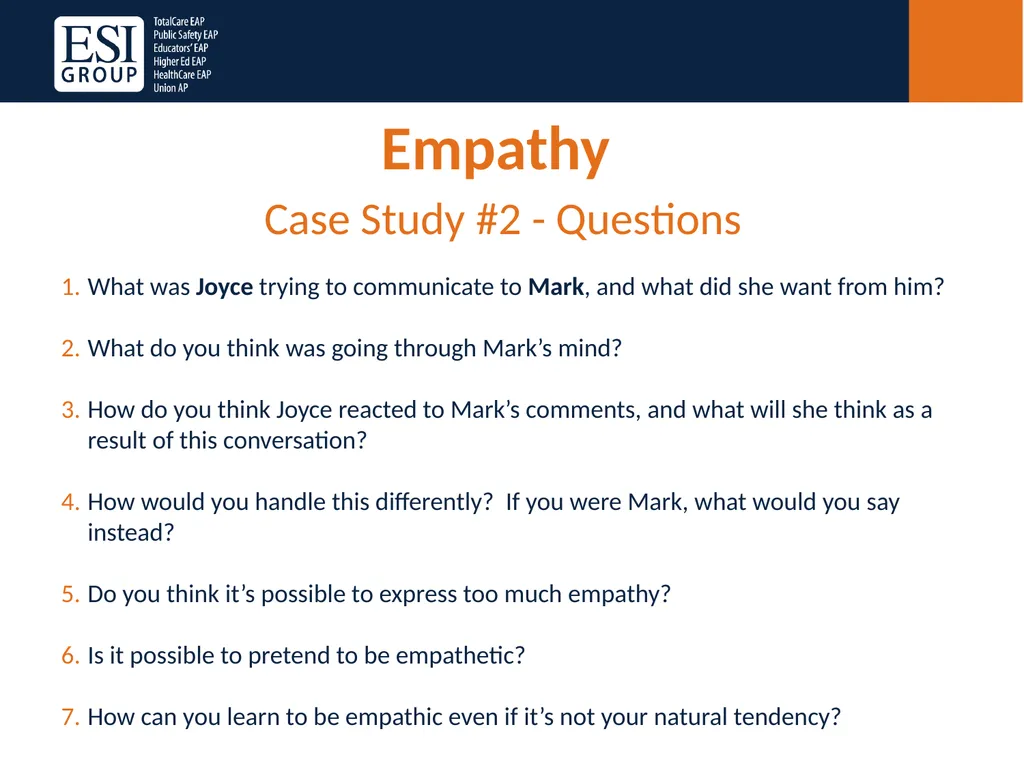
slide17. Empathy What was Joyce trying to communicate to Mark, and what did she want from him?
What do you think was going through Mark’s mind?
How do you think Joyce reacted to Mark’s comments, and what will she think as a result of this conversation?
How would you handle this differently? If you were Mark, what would you say instead?
Do you think it’s possible to express too much empathy?
Is it possible to pretend to be empathetic?
How can you learn to be empathic even if it’s not your natural tendency? Case Study #2 - Questions<br>
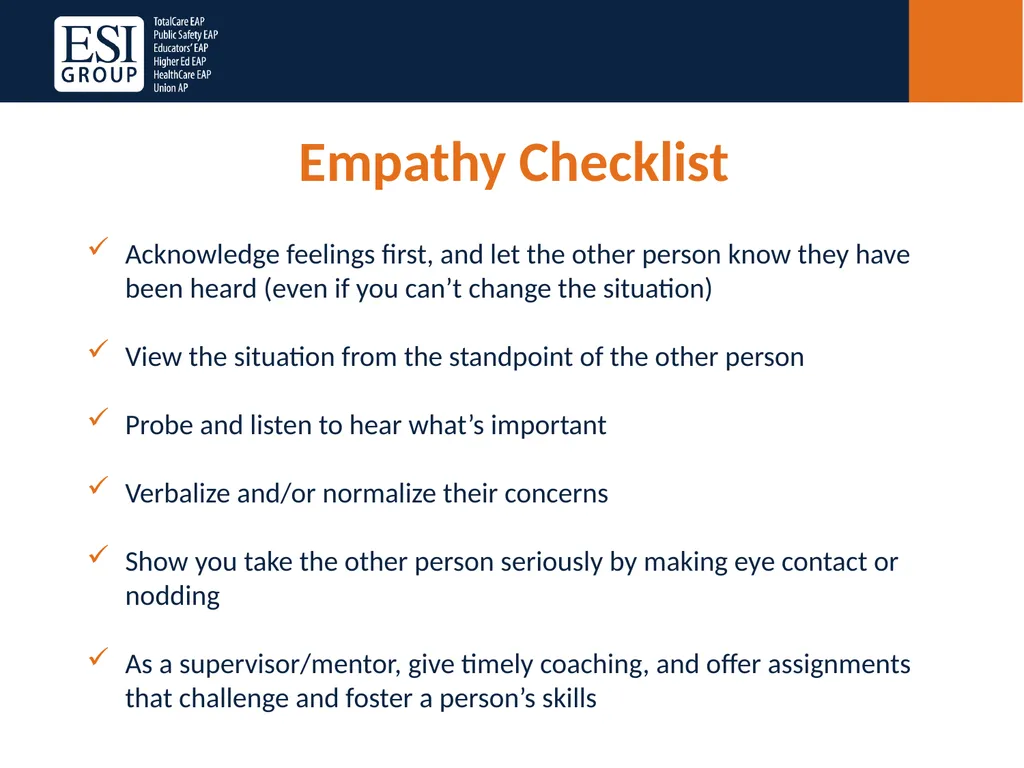
slide18. Empathy Checklist Acknowledge feelings first, and let the other person know they have been heard (even if you can’t change the situation)
View the situation from the standpoint of the other person
Probe and listen to hear what’s important
Verbalize and/or normalize their concerns
Show you take the other person seriously by making eye contact or nodding
As a supervisor/mentor, give timely coaching, and offer assignments that challenge and foster a person’s skills<br>
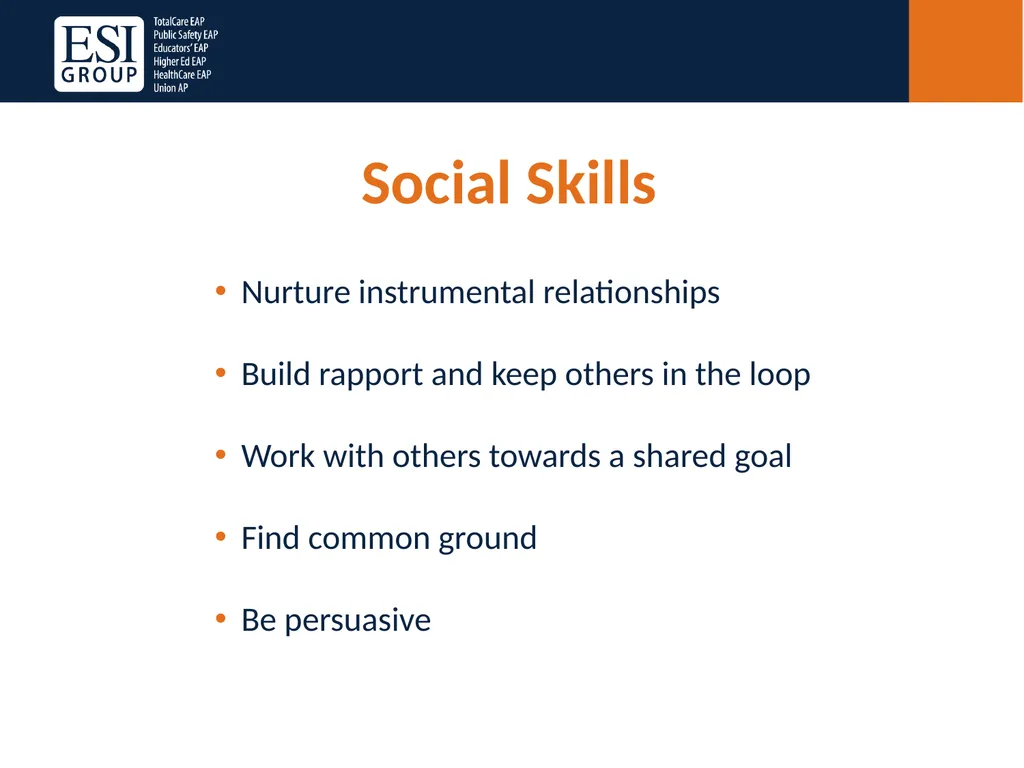
slide19. Social Skills Nurture instrumental relationships
Build rapport and keep others in the loop
Work with others towards a shared goal
Find common ground
Be persuasive<br>
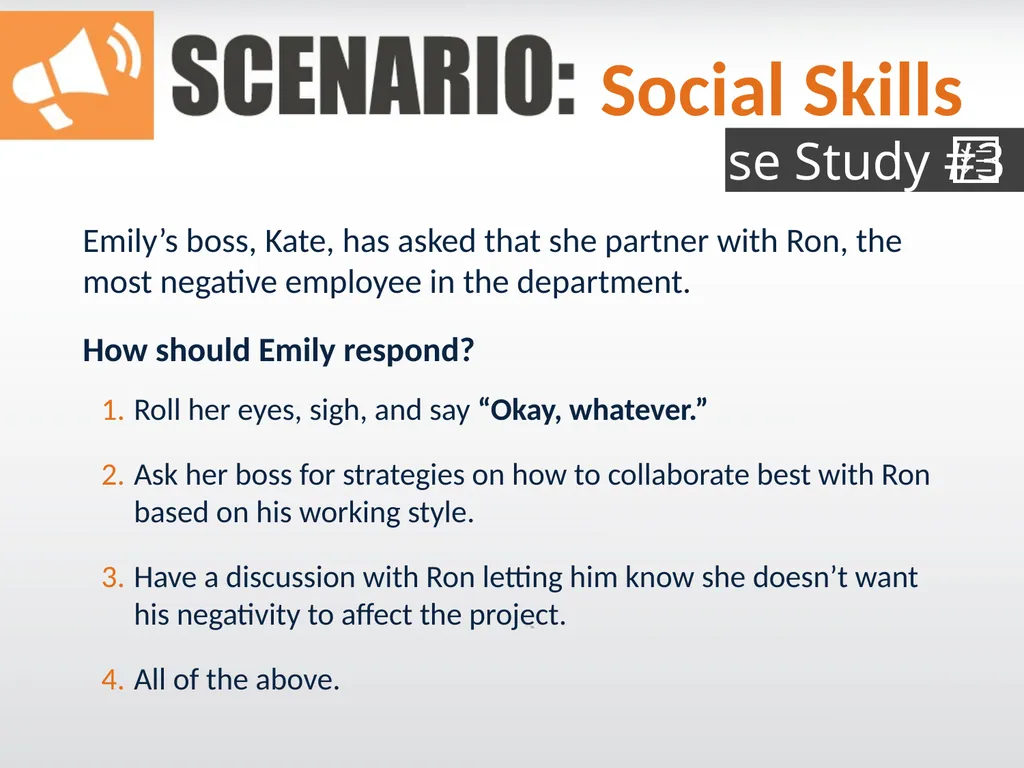
slide20. Social Skills Emily’s boss, Kate, has asked that she partner with Ron, the most negative employee in the department.
How should Emily respond?
Roll her eyes, sigh, and say “Okay, whatever.”
Ask her boss for strategies on how to collaborate best with Ron based on his working style.
Have a discussion with Ron letting him know she doesn’t want his negativity to affect the project.
All of the above. Case Study #3<br>
slide21. Social Skills How could Kate, Ron’s boss, approach him about his negativity?
How could Ron help himself to be perceived as less negative?
How can Emily be more effective in dealing with Ron? Case Study #3 - Questions<br>
slide22. True or False?
Having strong social skills and being easy to talk with are both signs of high emotional intelligence. Social Skills<br>
slide23. Social Skills Checklist Value others
Balance a focus on task with as much attention to relationships
Collaborate and openly communicate
Promote a friendly, cooperative climate
Share credit with team members
Handle and influence other people’s emotions effectively<br>
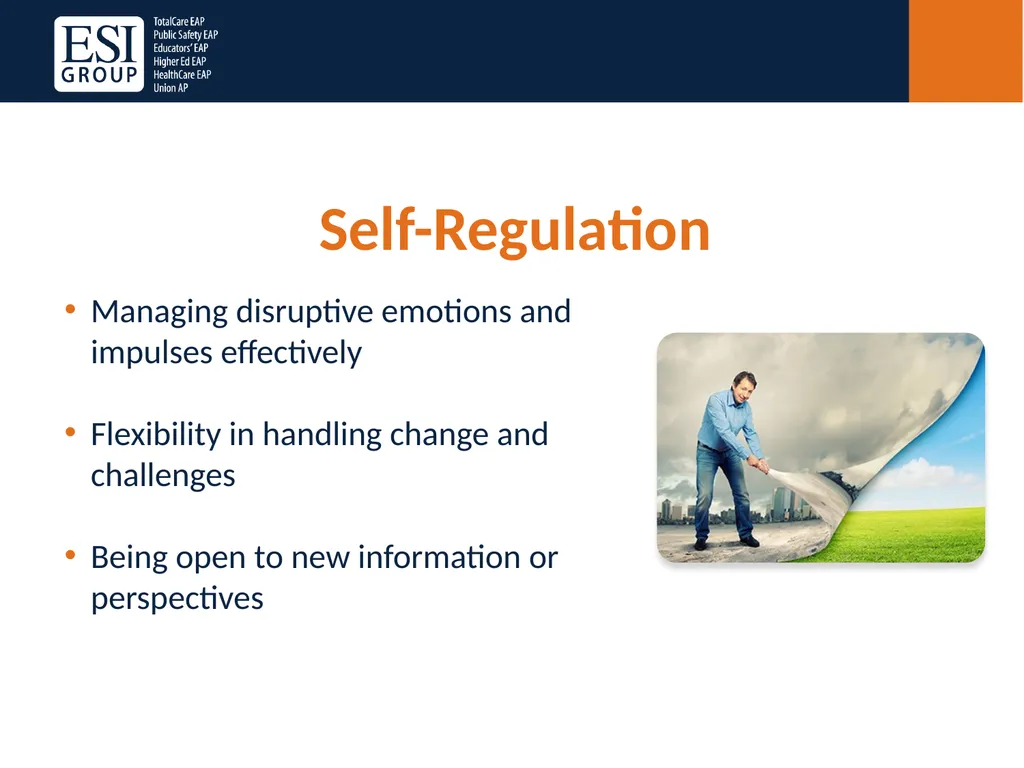
slide24. Self-Regulation Managing disruptive emotions and impulses effectively
Flexibility in handling change and challenges
Being open to new information or perspectives<br>
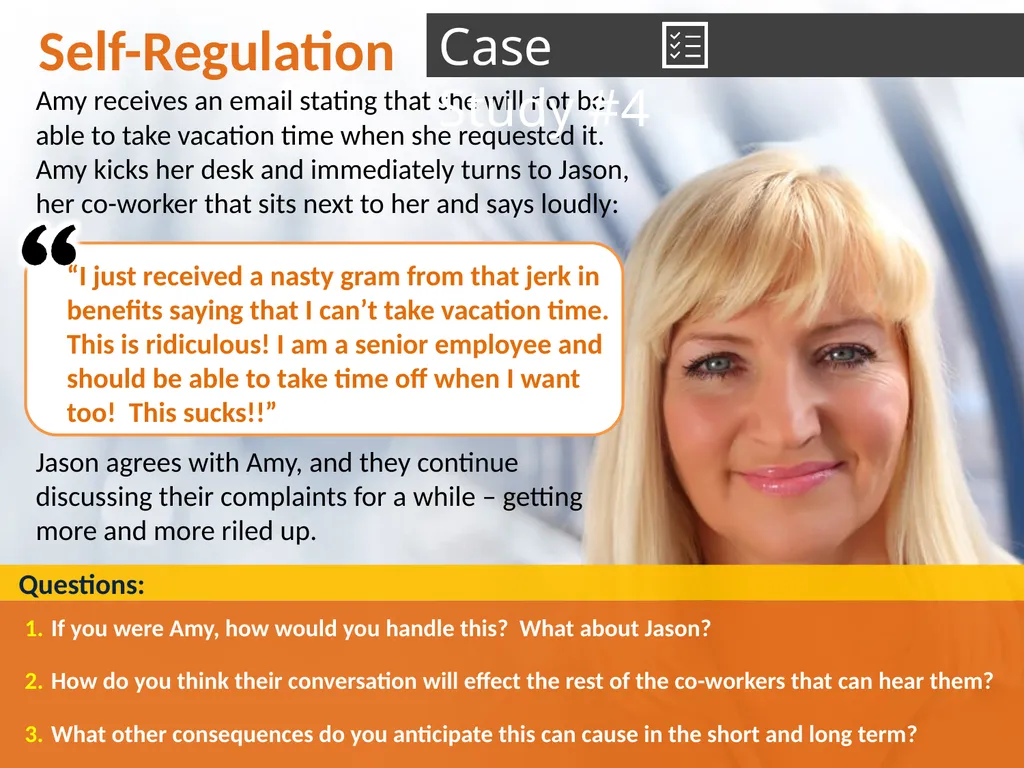
slide25. Self-Regulation Questions:
If you were Amy, how would you handle this? What about Jason?
How do you think their conversation will effect the rest of the co-workers that can hear them?
What other consequences do you anticipate this can cause in the short and long term? Amy receives an email stating that she will not be able to take vacation time when she requested it. Amy kicks her desk and immediately turns to Jason, her co-worker that sits next to her and says loudly: Jason agrees with Amy, and they continue discussing their complaints for a while – getting more and more riled up. Case Study #4 “I just received a nasty gram from that jerk in benefits saying that I can’t take vacation time. This is ridiculous! I am a senior employee and should be able to take time off when I want too! This sucks!!”<br>
slide26. Self-Regulation Sandra, the director of the department enters the conference room where several employees are sitting and waiting to discuss a customer service issue. Sandra is visibly upset with a red splotchy face. She begins with a litany of questions for everyone, and doesn’t hold back.
What would be the best response by an employee:
Gary fumbles and stutters while trying to explain the reasons for the mistakes. He blames another department for the issue.
Amy keeps quiet and hopes Sandra calms down soon.
Helen looks at Sandra and addresses her clearly in an even tone, acknowledges the problem, and calmly explains the situation.
Dylan silently fumes and thinks of ways to get back at Sandra.
Rose defensively says “Sandra please calm down. This isn’t a big deal. Everyone here works very hard with our customers, and I don’t understand why you are so angry.” Alternate Case Study<br>
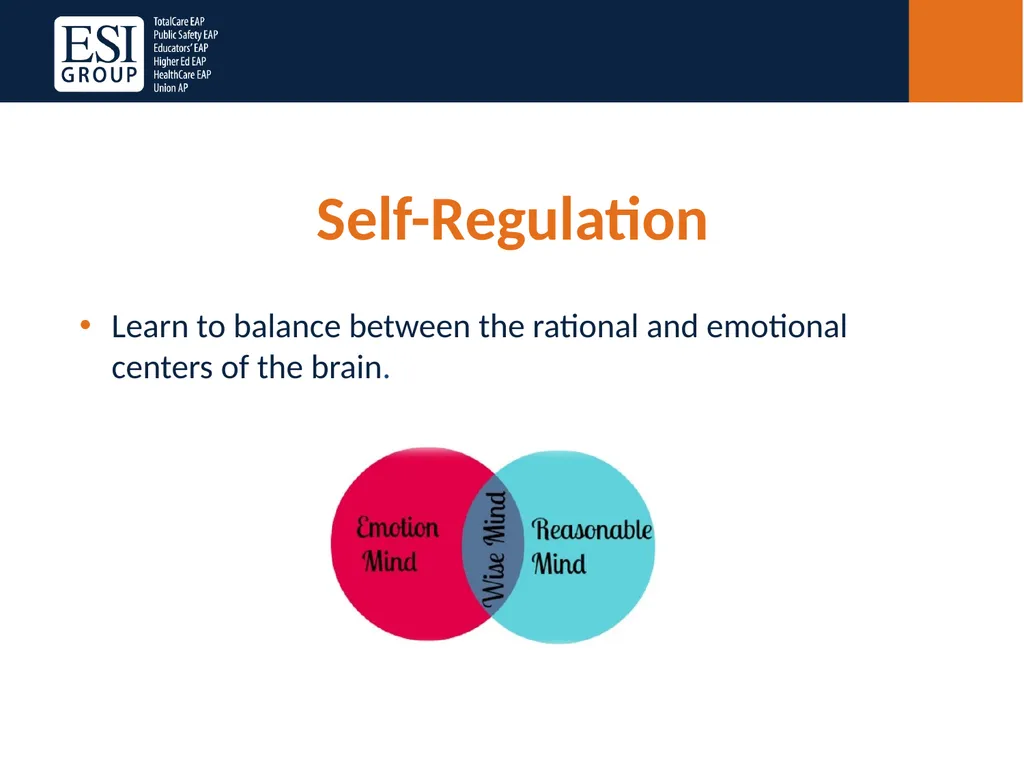
slide27. Self-Regulation Learn to balance between the rational and emotional centers of the brain.<br>
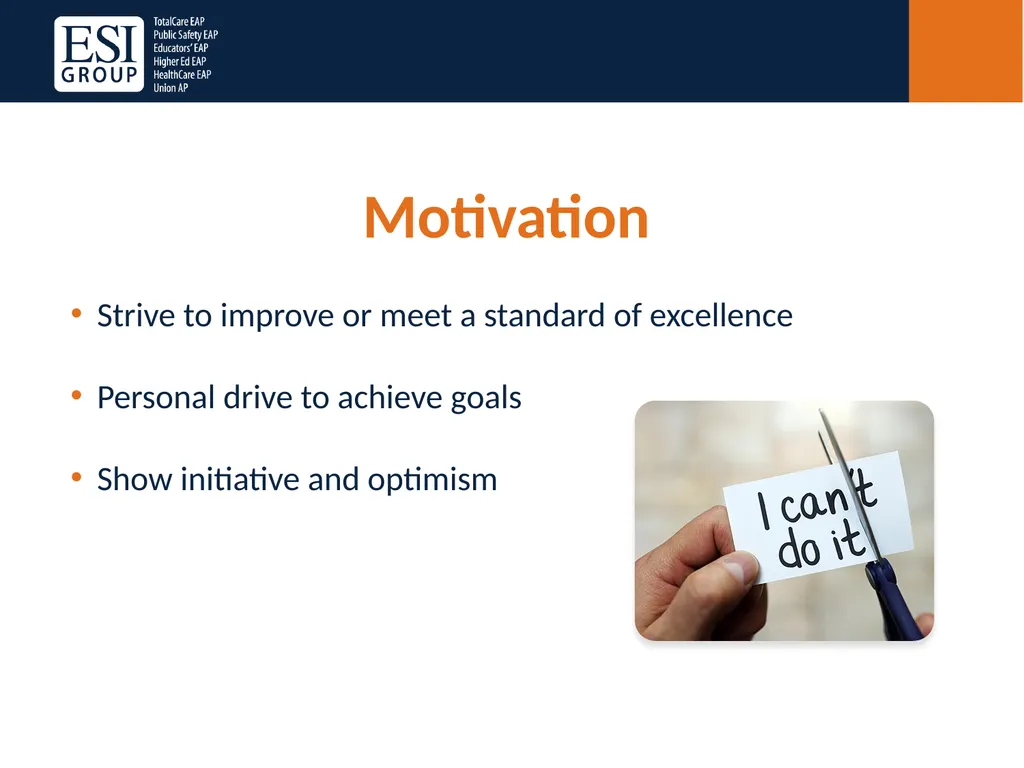
slide28. Motivation Strive to improve or meet a standard of excellence
Personal drive to achieve goals
Show initiative and optimism<br>
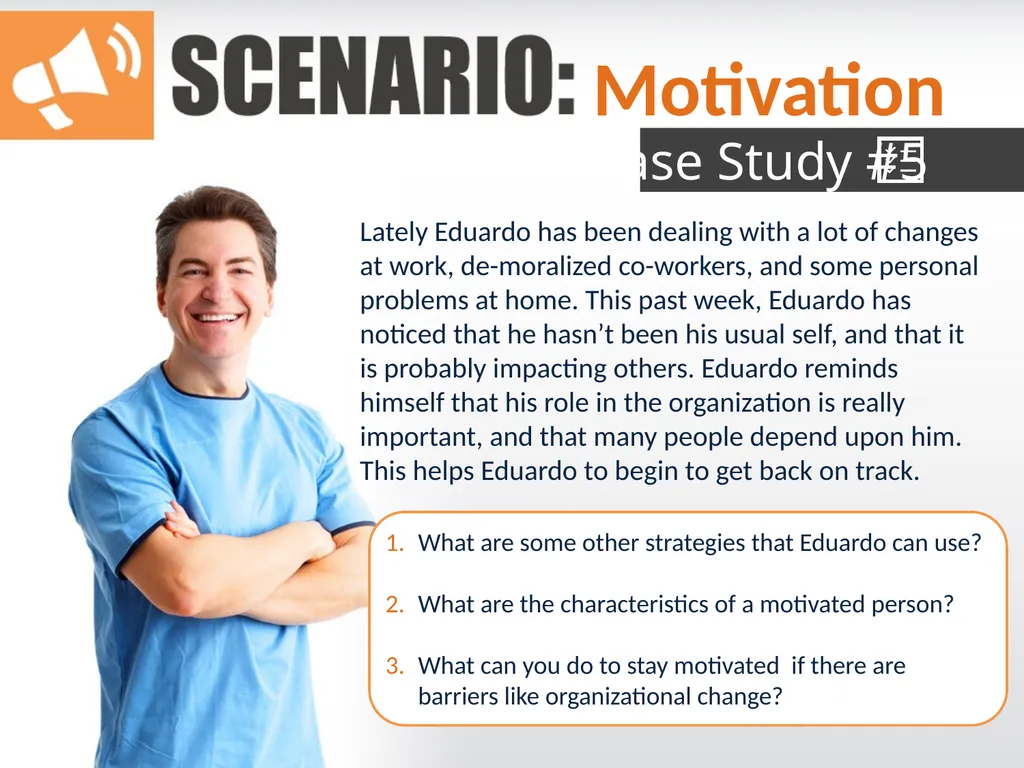
slide29. Motivation Lately Eduardo has been dealing with a lot of changes at work, de-moralized co-workers, and some personal problems at home. This past week, Eduardo has noticed that he hasn’t been his usual self, and that it is probably impacting others. Eduardo reminds himself that his role in the organization is really important, and that many people depend upon him. This helps Eduardo to begin to get back on track. What are some other strategies that Eduardo can use?
What are the characteristics of a motivated person?
What can you do to stay motivated if there are barriers like organizational change? Case Study #5<br>
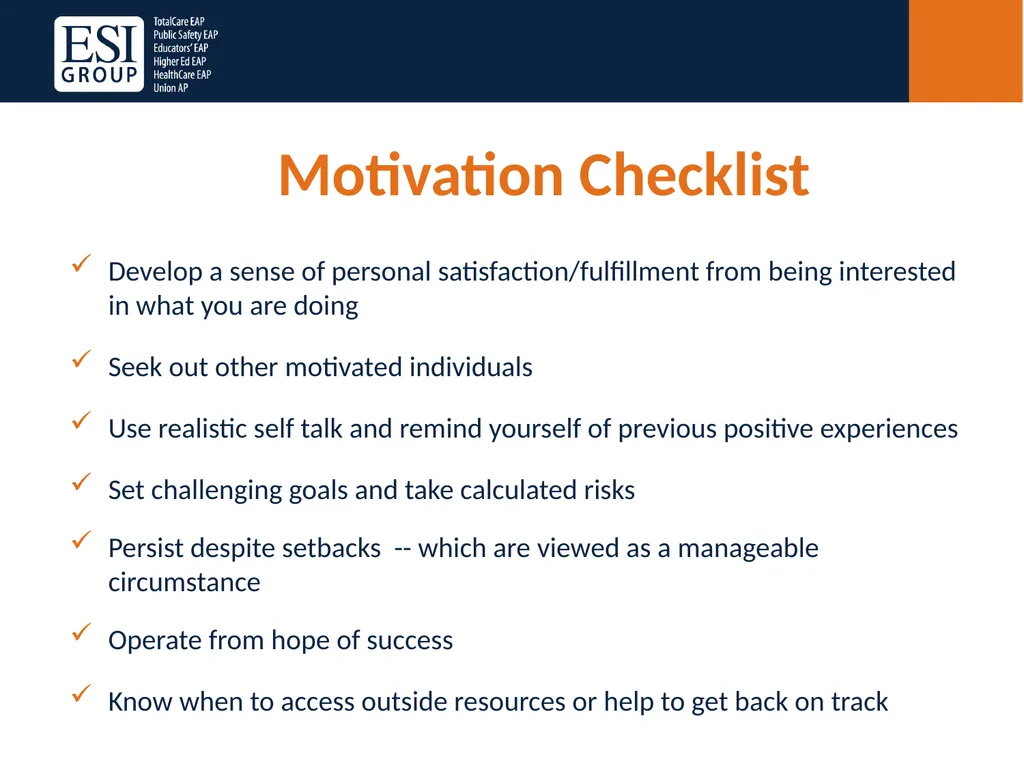
slide30. Motivation Checklist Develop a sense of personal satisfaction/fulfillment from being interested in what you are doing
Seek out other motivated individuals
Use realistic self talk and remind yourself of previous positive experiences
Set challenging goals and take calculated risks
Persist despite setbacks -- which are viewed as a manageable circumstance
Operate from hope of success
Know when to access outside resources or help to get back on track<br>
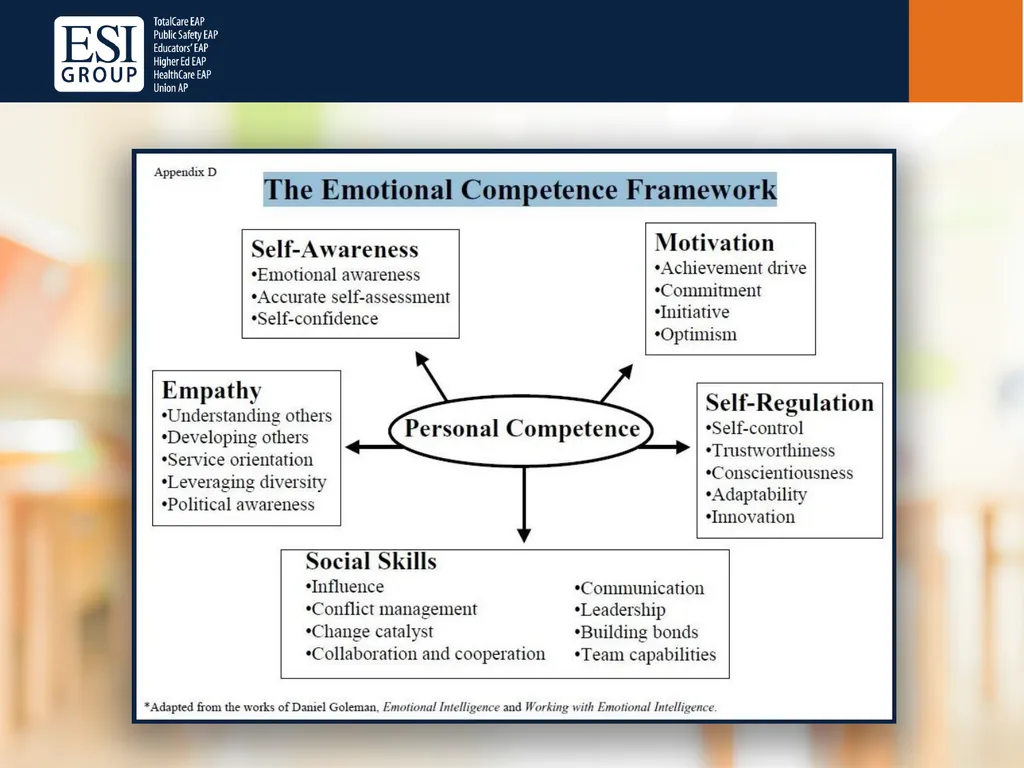
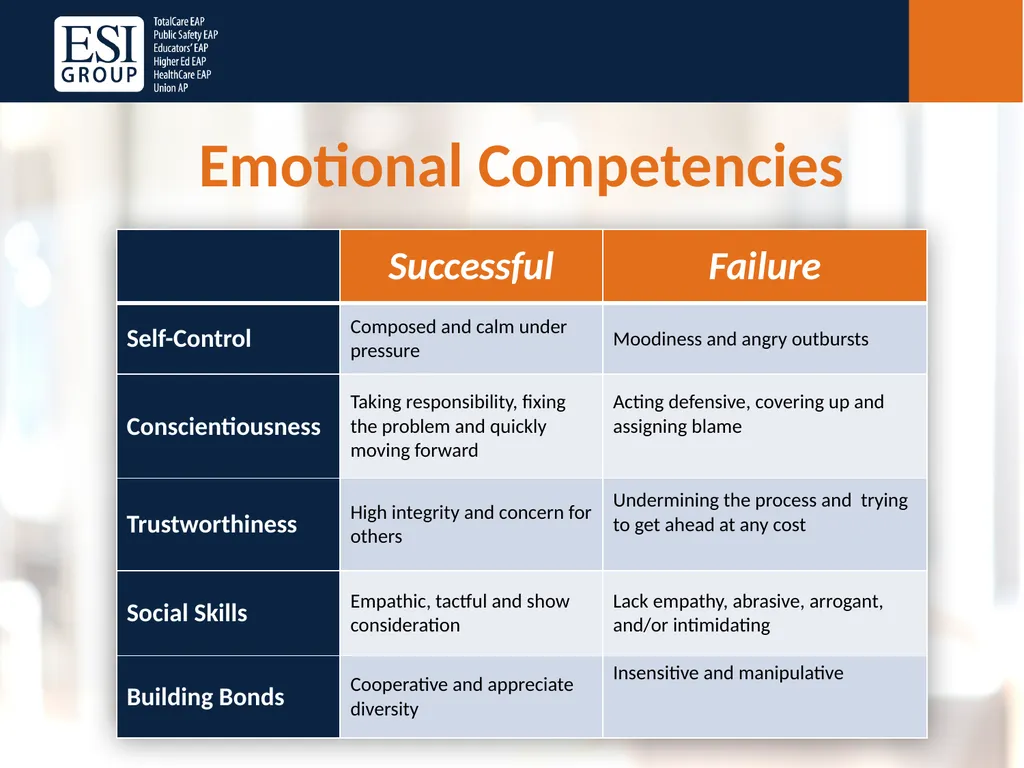
slide31. Emotional Competencies<br>
slide33. Questions & Discussion<br>
Intelligence in
the Workplace Presenter:
Vice President, Client Services ESI Employee Assistance Group<br>
slide2. Role Play Five employees have been assigned to work on a project and they are having difficulty working together and completing tasks.<br>
slide3. Role Play Questions Can you see this scenario happening in the workplace?
What could Maureen have done differently?
Did Michelle and Phil express themselves in a professional manner? What would you say or do that would be more effective?
What can be done about Susan and Patty’s behavior?<br>
slide4. Training Overview Definition of Emotional Intelligence
Why it’s Important
Misconceptions
The Five Competencies: Self Awareness, Empathy, Social Skills, Self-Regulation and Motivation
Case Studies
Strategies to Increase Skills<br>
slide5. How Would You Define
Emotional Intelligence?<br>
slide6. Definition of Emotional Intelligence The capacity for recognizing our own feelings and those of others, for motivating ourselves and for managing emotions well in ourselves and in our relationships.
Includes five emotional and social competencies:
Self-awareness
Empathy
Social skills
Self-regulation
Motivation *Daniel Goleman - author of
“Working with Emotional Intelligence”<br>
slide8. Why Do You Think Emotional
Intelligence Is Important?<br>
slide9. Schmidt, M. 2012
Image from talentsmart.com The Case for Emotional Intelligence<br>
slide10. Misconceptions About
Emotional Intelligence It’s just about being nice to everyone and thinking positively
It means letting emotions run freely, or being completely robotic
Women are better at it
It’s connected with intellectual or cognitive abilities
It’s fixed or genetic<br>
slide11. Self-Awareness Recognize your emotions early on and their effects
Know your strengths and limits
Have a strong sense of self-worth and capabilities<br>
slide12. Case Study #1 Self-Awareness Joe rushed in and interrupted Tonya during a meeting to get information he had been waiting for. In a stressful-demanding tone, Joe stated that he hadn’t heard back from Tonya and he must have it before the end of the day.
If you were Joe, how would you handle this differently?
Should Tonya and/or the meeting members respond or say anything?
How do you think Tonya views Joe’s behavior?
How do you think Joe’s interruption was perceived by members of the meeting?
How do you think this will effect Tonya and Joe’s working relationship?<br>
slide13. Self-Awareness Checklist Take time for mental pauses, introspection, and solitary reflection regularly
Be attuned to and identify your emotions early on
Accept that emotions are normal
Exclude negative judgements
Ask why
Recognize how your emotions shape what you PERCEIVE, THINK, and DO
Learn from your experiences and mistakes
Recognize where you need to improve
Be open to candid feedback and new perspectives
Show a sense of humor and perspective about yourself<br>
slide14. Internal Dialogue Rewrite the thoughts that script your emotions<br>
slide15. Empathy Genuinely sense and understand people’s feelings and needs
Actively listen to others perspectives
Sensitive to group differences
It is something that you can learn at any age!<br>
slide16. Empathy “Joyce, you know that we’re super busy right now and we’ve had these crunch times many times before this. Everyone has to go the extra mile here. I’m super-stretched too but this is how it works here. If I can’t have two days off this weekend, then we all have to grin and bear it. I don’t see any way I can help you right now. And it might be some time before we get back to normal. By the way… how far along are you on the other project? It has to be completed by Monday. Mark and Joyce are having a conversation at work. Joyce reports to Mark. Joyce Mark “This situation I am dealing with has proven to be especially difficult. It’s involved exceptionally long hours and it’s really tested my patience and stamina. I feel like it’s never going to be enough and my main workload is starting to suffer. Frankly, I’m exhausted.” Case Study #2<br>
slide17. Empathy What was Joyce trying to communicate to Mark, and what did she want from him?
What do you think was going through Mark’s mind?
How do you think Joyce reacted to Mark’s comments, and what will she think as a result of this conversation?
How would you handle this differently? If you were Mark, what would you say instead?
Do you think it’s possible to express too much empathy?
Is it possible to pretend to be empathetic?
How can you learn to be empathic even if it’s not your natural tendency? Case Study #2 - Questions<br>
slide18. Empathy Checklist Acknowledge feelings first, and let the other person know they have been heard (even if you can’t change the situation)
View the situation from the standpoint of the other person
Probe and listen to hear what’s important
Verbalize and/or normalize their concerns
Show you take the other person seriously by making eye contact or nodding
As a supervisor/mentor, give timely coaching, and offer assignments that challenge and foster a person’s skills<br>
slide19. Social Skills Nurture instrumental relationships
Build rapport and keep others in the loop
Work with others towards a shared goal
Find common ground
Be persuasive<br>
slide20. Social Skills Emily’s boss, Kate, has asked that she partner with Ron, the most negative employee in the department.
How should Emily respond?
Roll her eyes, sigh, and say “Okay, whatever.”
Ask her boss for strategies on how to collaborate best with Ron based on his working style.
Have a discussion with Ron letting him know she doesn’t want his negativity to affect the project.
All of the above. Case Study #3<br>
slide21. Social Skills How could Kate, Ron’s boss, approach him about his negativity?
How could Ron help himself to be perceived as less negative?
How can Emily be more effective in dealing with Ron? Case Study #3 - Questions<br>
slide22. True or False?
Having strong social skills and being easy to talk with are both signs of high emotional intelligence. Social Skills<br>
slide23. Social Skills Checklist Value others
Balance a focus on task with as much attention to relationships
Collaborate and openly communicate
Promote a friendly, cooperative climate
Share credit with team members
Handle and influence other people’s emotions effectively<br>
slide24. Self-Regulation Managing disruptive emotions and impulses effectively
Flexibility in handling change and challenges
Being open to new information or perspectives<br>
slide25. Self-Regulation Questions:
If you were Amy, how would you handle this? What about Jason?
How do you think their conversation will effect the rest of the co-workers that can hear them?
What other consequences do you anticipate this can cause in the short and long term? Amy receives an email stating that she will not be able to take vacation time when she requested it. Amy kicks her desk and immediately turns to Jason, her co-worker that sits next to her and says loudly: Jason agrees with Amy, and they continue discussing their complaints for a while – getting more and more riled up. Case Study #4 “I just received a nasty gram from that jerk in benefits saying that I can’t take vacation time. This is ridiculous! I am a senior employee and should be able to take time off when I want too! This sucks!!”<br>
slide26. Self-Regulation Sandra, the director of the department enters the conference room where several employees are sitting and waiting to discuss a customer service issue. Sandra is visibly upset with a red splotchy face. She begins with a litany of questions for everyone, and doesn’t hold back.
What would be the best response by an employee:
Gary fumbles and stutters while trying to explain the reasons for the mistakes. He blames another department for the issue.
Amy keeps quiet and hopes Sandra calms down soon.
Helen looks at Sandra and addresses her clearly in an even tone, acknowledges the problem, and calmly explains the situation.
Dylan silently fumes and thinks of ways to get back at Sandra.
Rose defensively says “Sandra please calm down. This isn’t a big deal. Everyone here works very hard with our customers, and I don’t understand why you are so angry.” Alternate Case Study<br>
slide27. Self-Regulation Learn to balance between the rational and emotional centers of the brain.<br>
slide28. Motivation Strive to improve or meet a standard of excellence
Personal drive to achieve goals
Show initiative and optimism<br>
slide29. Motivation Lately Eduardo has been dealing with a lot of changes at work, de-moralized co-workers, and some personal problems at home. This past week, Eduardo has noticed that he hasn’t been his usual self, and that it is probably impacting others. Eduardo reminds himself that his role in the organization is really important, and that many people depend upon him. This helps Eduardo to begin to get back on track. What are some other strategies that Eduardo can use?
What are the characteristics of a motivated person?
What can you do to stay motivated if there are barriers like organizational change? Case Study #5<br>
slide30. Motivation Checklist Develop a sense of personal satisfaction/fulfillment from being interested in what you are doing
Seek out other motivated individuals
Use realistic self talk and remind yourself of previous positive experiences
Set challenging goals and take calculated risks
Persist despite setbacks -- which are viewed as a manageable circumstance
Operate from hope of success
Know when to access outside resources or help to get back on track<br>
slide31. Emotional Competencies<br>
slide33. Questions & Discussion<br>