
Framework for action Peter Damary, based on work
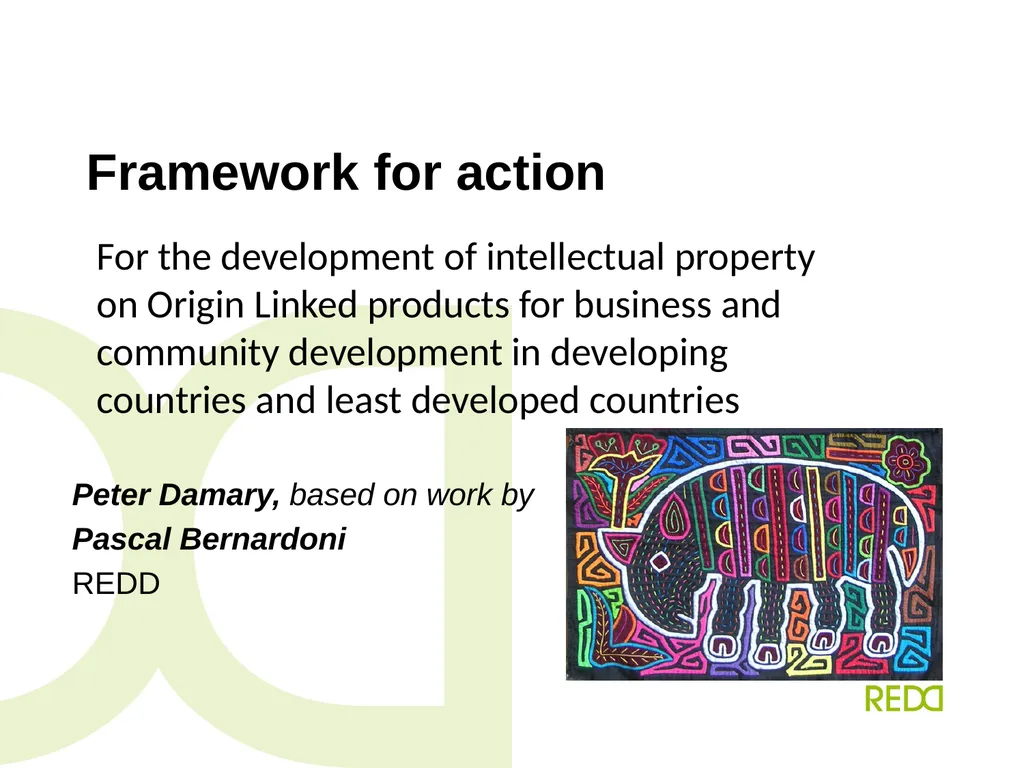
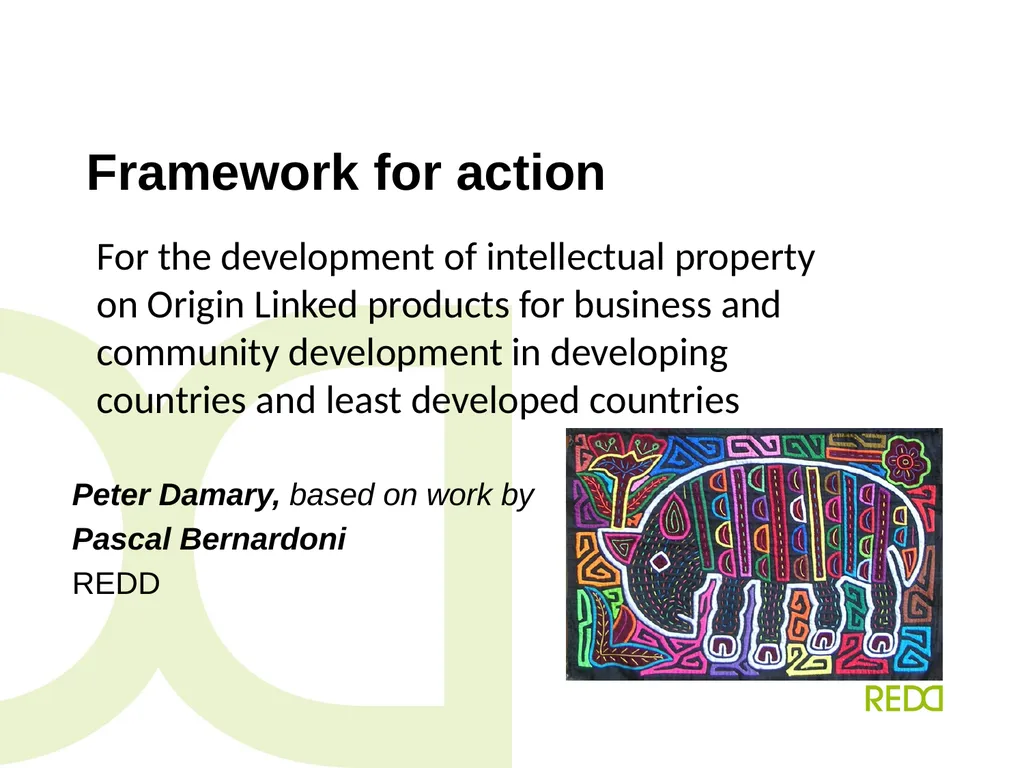

Description: Framework for action Peter Damary, based on work by Pascal Bernardoni REDD For the development of intellectual property on Origin Linked products for business and community development in developing countries and least developed countries
Related Topics
Download Presentation
"Framework for action Peter Damary, based on work" is the property of its rightful owner. Permission is granted to download and print the materials on this website for personal, non-commercial use only, and to display it on your personal computer provided you do not modify the materials and that you retain all copyright notices contained in the materials. By downloading content from our website, you accept the terms of this agreement.
Presentation Transcript
slide1. Framework for action Peter Damary, based on work by
Pascal Bernardoni
REDD For the development of intellectual property on Origin Linked products for business and community development in developing countries and least developed countries<br>
slide2. Context The document is still a working document
Wednesday multidisciplinary expert meeting to review the document : Getachew Mengistie, María Gilma Arrocha, Fabrice Mattei, Audrey Aubard, Jacky Charbonneau , Boo-Young Eom, Pauline Tiffen,
REDD : Training, consultancy and project management on voluntary standards in agriculture.
This presentations intends to provide an overview of the “revised” document.<br>
slide3. Developed by WIPO
in the framework of the “Development Agenda project on Intellectual Property and Product Branding for Business Development in Developing and Least Developed Countries.”<br>
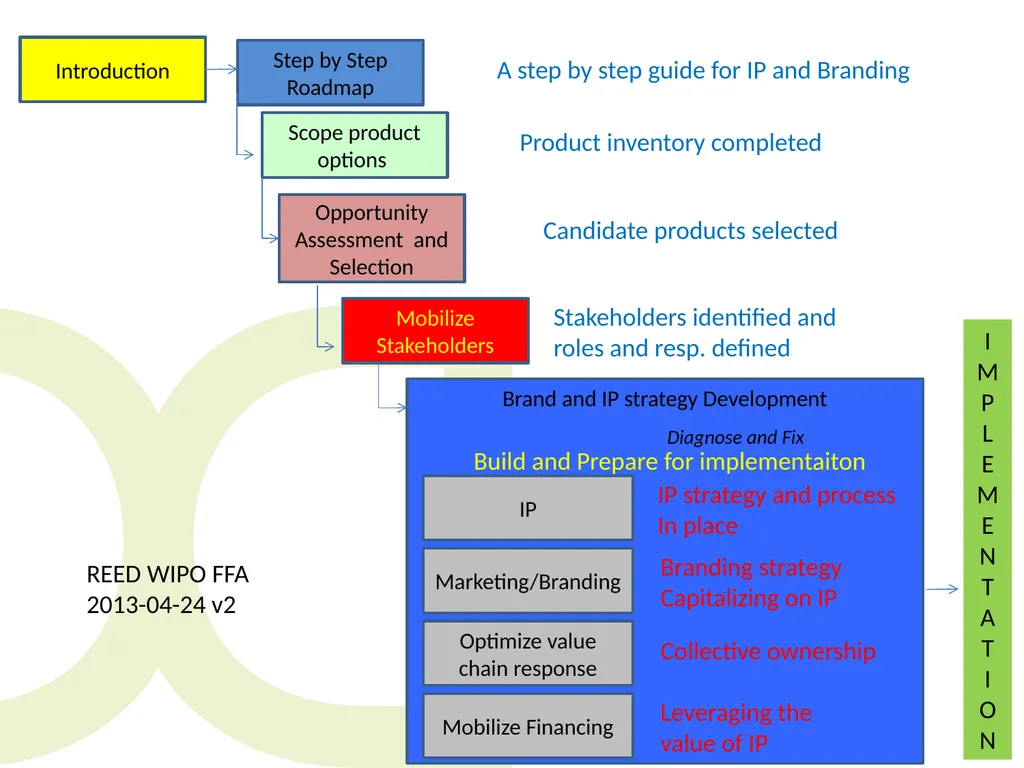
slide4. Brand and IP strategy Development Scope product options Opportunity Assessment and
Selection Mobilize Stakeholders IP Marketing/Branding Optimize value chain response Mobilize Financing Diagnose and Fix Product inventory completed Candidate products selected Stakeholders identified and
roles and resp. defined IP strategy and process
In place Branding strategy
Capitalizing on IP Collective ownership Leveraging the
value of IP Step by Step
Roadmap A step by step guide for IP and Branding Introduction REED WIPO FFA
2013-04-24 v2 I
MP
L
EMENT
A
T
I
ON Build and Prepare for implementaiton<br>
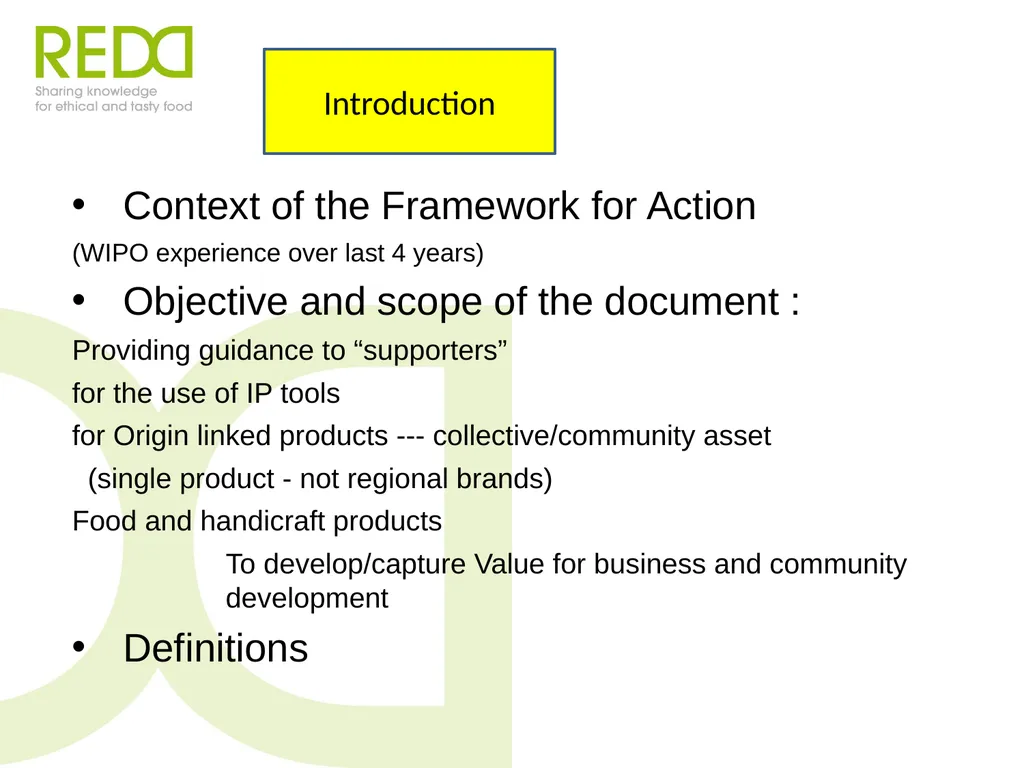
slide5. Context of the Framework for Action
(WIPO experience over last 4 years)
Objective and scope of the document :
Providing guidance to “supporters”
for the use of IP tools
for Origin linked products --- collective/community asset
(single product - not regional brands)
Food and handicraft products
To develop/capture Value for business and community development
Definitions Introduction<br>
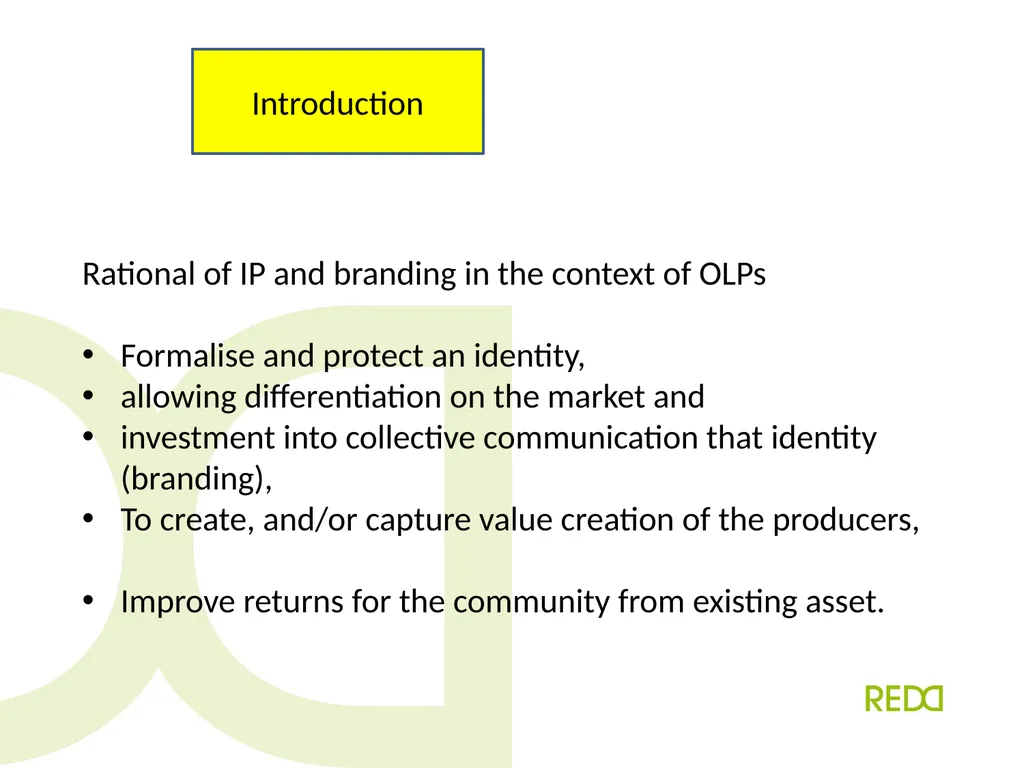
slide6. Introduction Rational of IP and branding in the context of OLPs
Formalise and protect an identity,
allowing differentiation on the market and
investment into collective communication that identity (branding),
To create, and/or capture value creation of the producers,
Improve returns for the community from existing asset.<br>
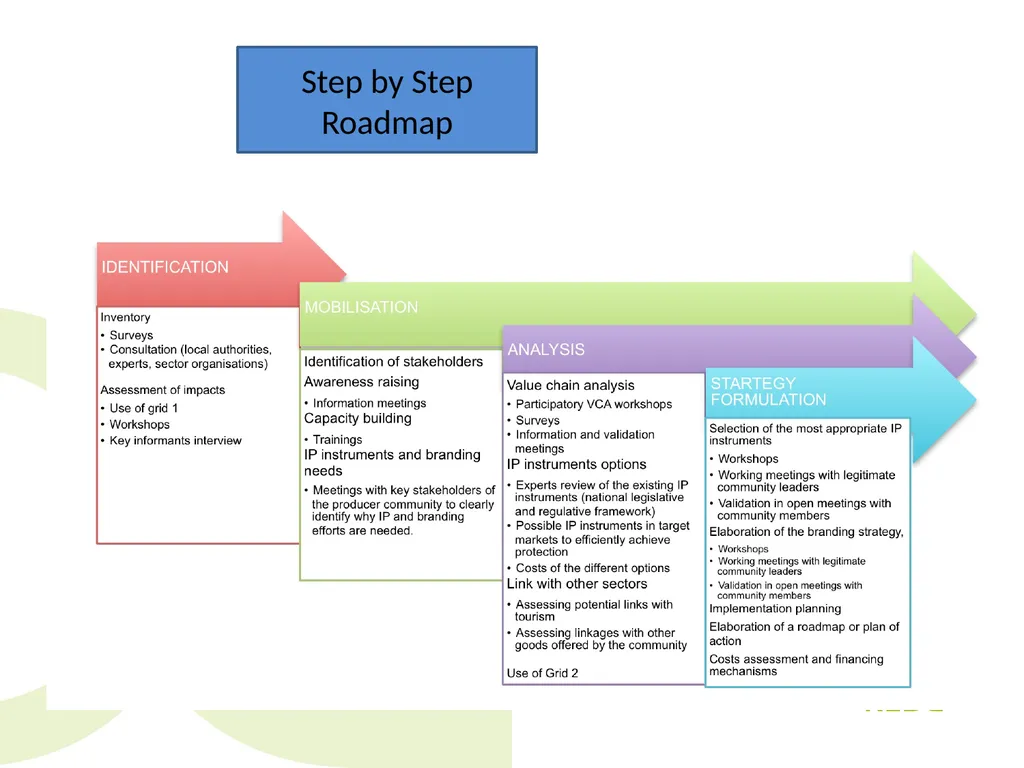
slide7. Step by Step
Roadmap<br>
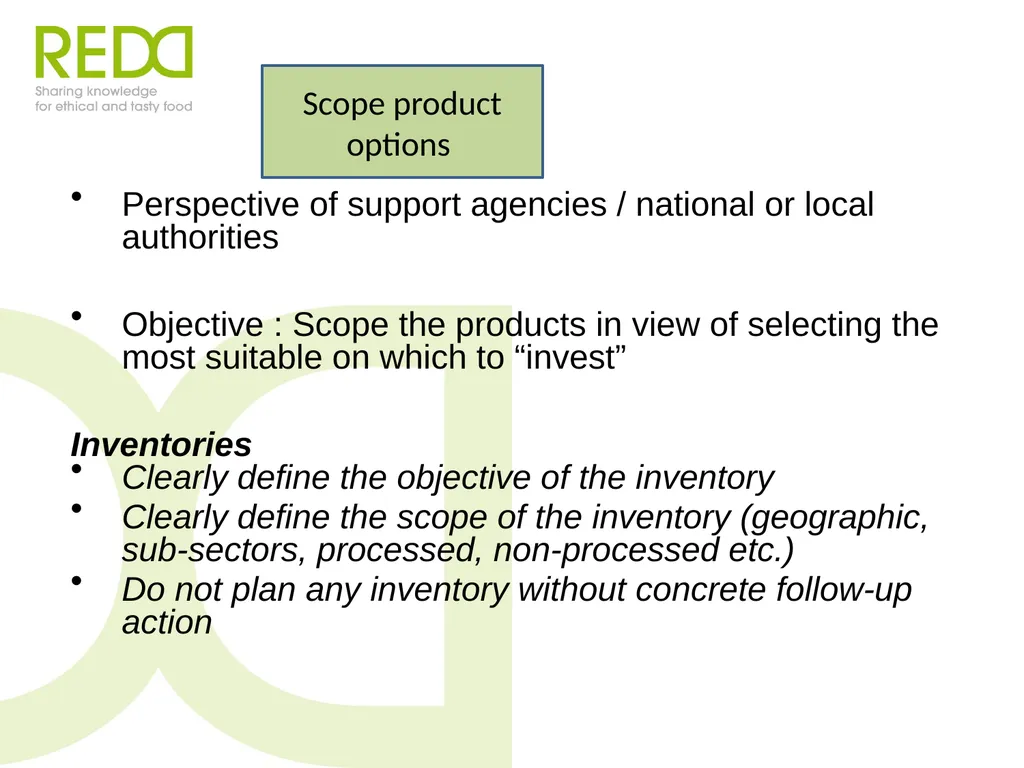
slide8. Perspective of support agencies / national or local authorities
Objective : Scope the products in view of selecting the most suitable on which to “invest”
Inventories
Clearly define the objective of the inventory
Clearly define the scope of the inventory (geographic, sub-sectors, processed, non-processed etc.)
Do not plan any inventory without concrete follow-up action Scope product options<br>
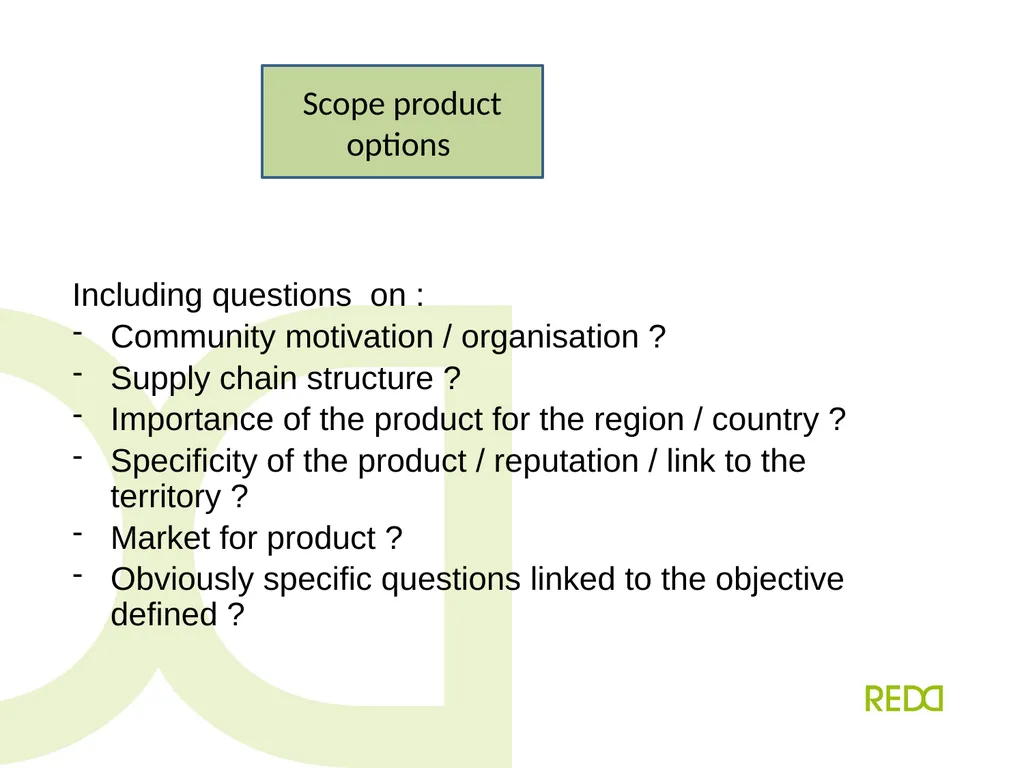
slide9. Including questions on :
Community motivation / organisation ?
Supply chain structure ?
Importance of the product for the region / country ?
Specificity of the product / reputation / link to the territory ?
Market for product ?
Obviously specific questions linked to the objective defined ? Scope product options<br>
slide10. Assessment criteria must be fine-tune on the basis of overall objectives On depth study of: the Value chain, the market(s), the value and specificity of the product, the structure and motivation of the producers, the legal options … As a basis for IP and branding strategy Are we sure that an OLP branding strategy is the best option for the producer communities? Opportunity Assessment and final
Selection<br>
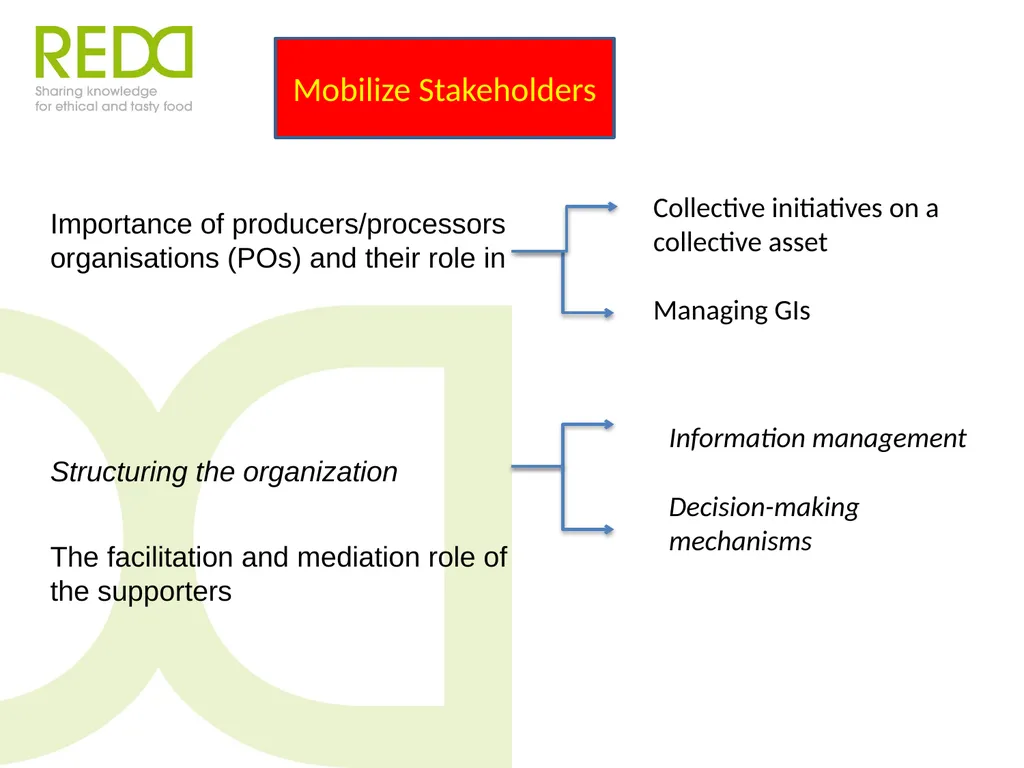
slide11. Importance of producers/processors organisations (POs) and their role in
Structuring the organization
The facilitation and mediation role of the supporters Collective initiatives on a collective asset
Managing GIs Information management
Decision-making mechanisms Mobilize Stakeholders<br>
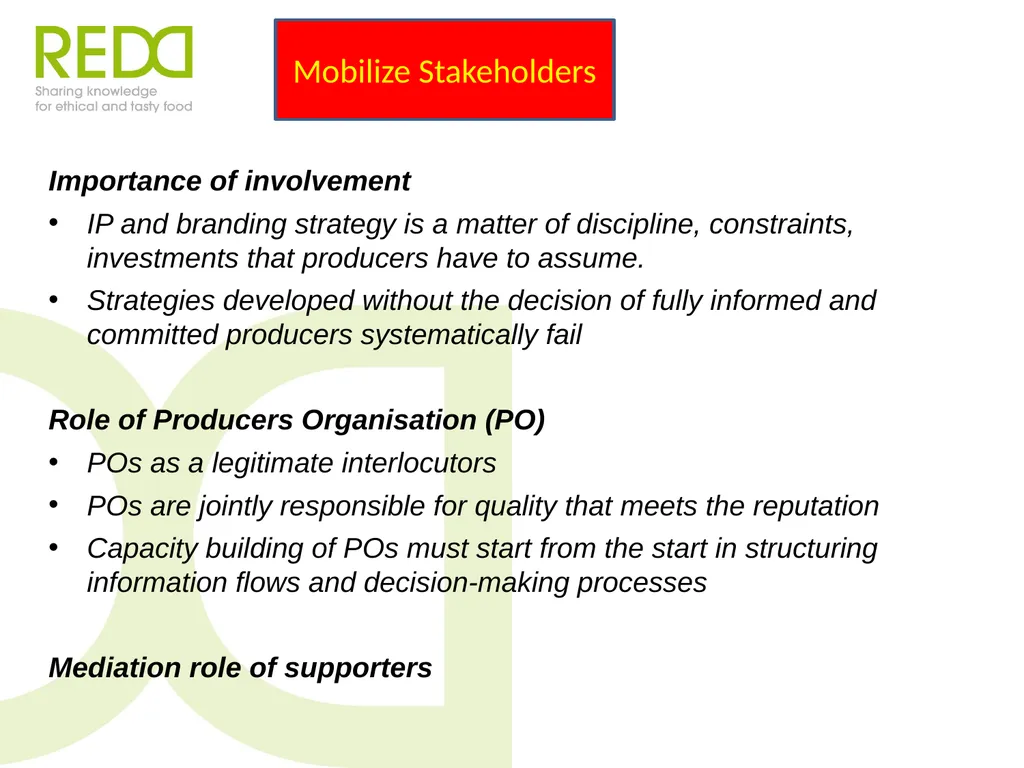
slide12. Importance of involvement
IP and branding strategy is a matter of discipline, constraints, investments that producers have to assume.
Strategies developed without the decision of fully informed and committed producers systematically fail
Role of Producers Organisation (PO)
POs as a legitimate interlocutors
POs are jointly responsible for quality that meets the reputation
Capacity building of POs must start from the start in structuring information flows and decision-making processes
Mediation role of supporters Mobilize Stakeholders<br>
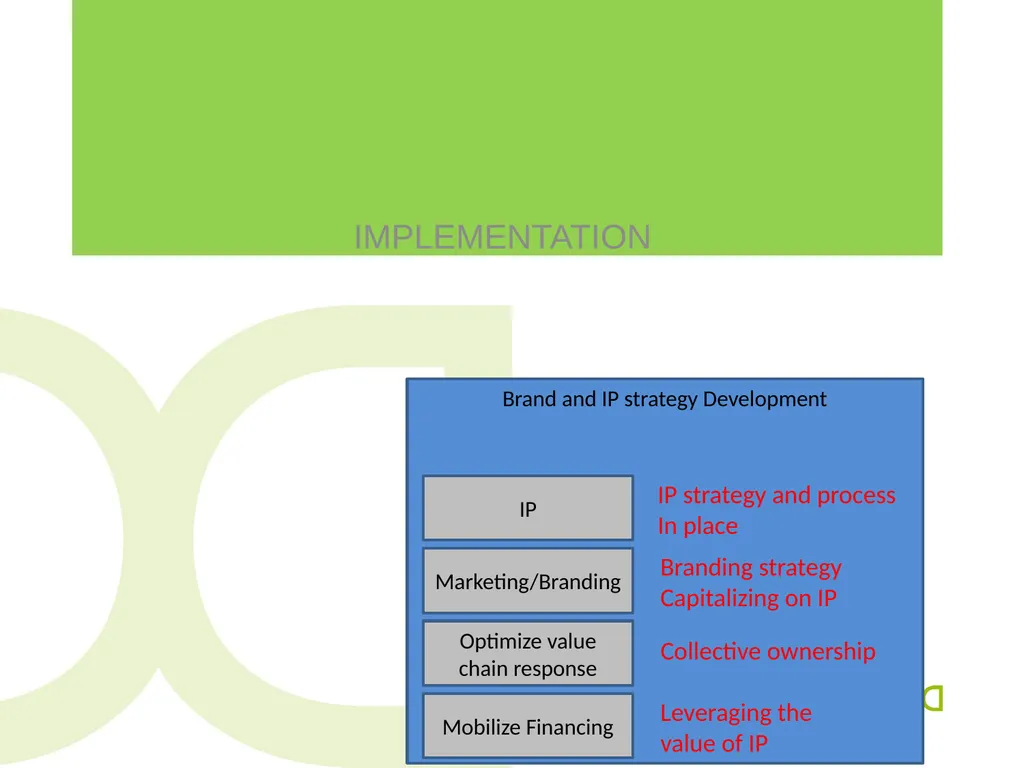
slide13. Brand and IP strategy Development IP Marketing/Branding Optimize value chain response Mobilize Financing IP strategy and process
In place Branding strategy
Capitalizing on IP Collective ownership Leveraging the
value of IP IMPLEMENTATION<br>
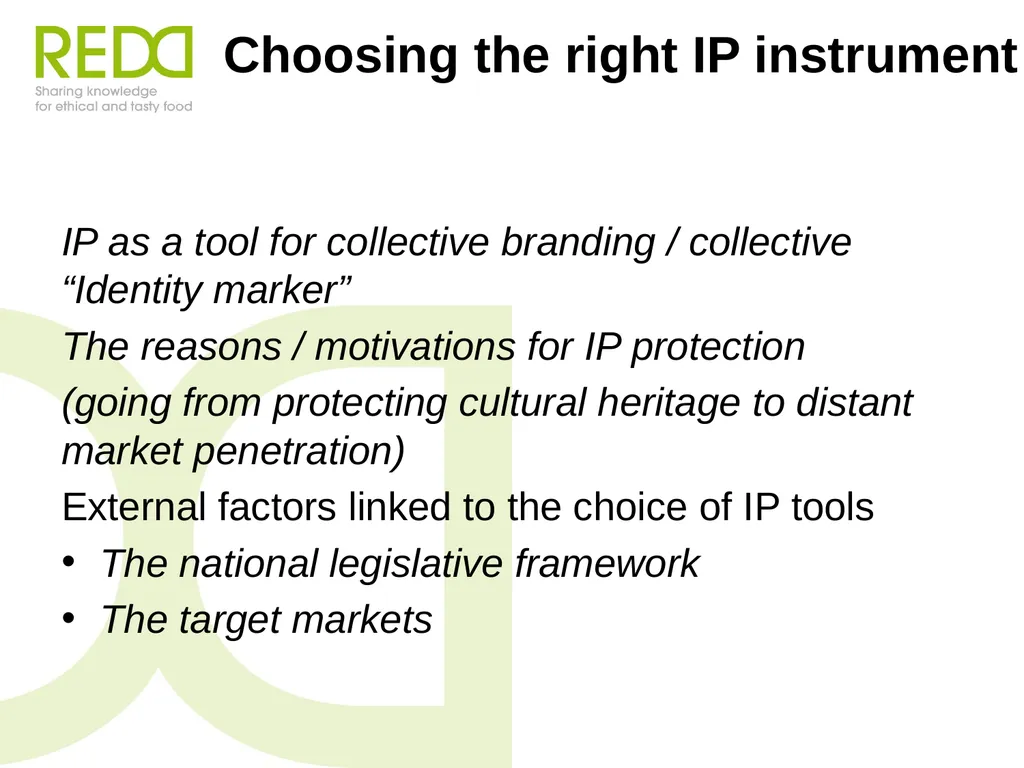
slide14. Choosing the right IP instrument IP as a tool for collective branding / collective “Identity marker”
The reasons / motivations for IP protection
(going from protecting cultural heritage to distant market penetration)
External factors linked to the choice of IP tools
The national legislative framework
The target markets<br>
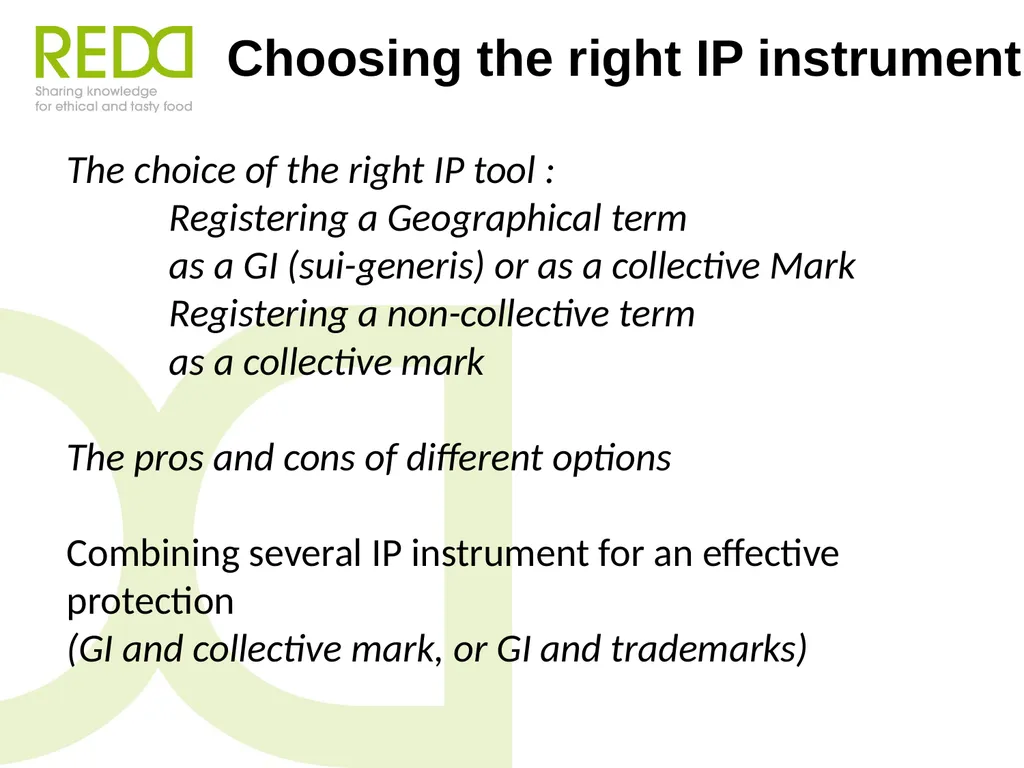
slide15. Choosing the right IP instrument The choice of the right IP tool :
Registering a Geographical term
as a GI (sui-generis) or as a collective Mark
Registering a non-collective term
as a collective mark
The pros and cons of different options
Combining several IP instrument for an effective protection
(GI and collective mark, or GI and trademarks)<br>
slide16. Marketing / Branding OLP branding is based on the distinctive quality.
The need to reflect the values of the community/product,
but “simple” message
The communication to the consumer is based on the product identity
The target markets must be able to reward IP and Branding efforts with premium prices
Branding on near-by markets or distant markets
The need to speak to both the “heart” and the “mind” (different emphasis depending on target)<br>
slide17. Marketing / branding Branding strategies options
Co-existence of collective marks and individual trademarks
Co-branding (OLP with other types of products)
Linking OLPs with voluntary standards (Organic, FairTrade)
Linking OLPs with tourism services
Twinning (other OLPs or traditional products)
Licensing (the Starbuck model)
OLPs as flagship products of baskets of goods
Some best practice examples<br>
slide18. Optimize value chain response The importance of building the collective ownership organisation, to set-up and manage the brand
For legitimate and efficient decision making,
To be able to raise « investment » support (for both « hard » and « soft » assets),
To be able to finance long term “brand development” (economic sustainability)
Some principals for an efficient collective management<br>
slide19. Mobilizing funding The need to clarify the “business proposition”
How and where will the money be made ?
What are the investments costs ? Who makes them, who takes the risk ?
What are the running costs ? How will they be covered ?
to what “social or environmental” objectives will it contribute ?<br>
slide20. Mobilizing funding To cover different types of investments costs
« hardware » (physical infrastructure, but also IP registration, business plan development)
“software” (community mobilisation, organisation, governance structures)
Identifying sources of
Grants (careful the strings attached),
Soft loans
Commercial loans<br>
slide21. Evaluation The different reasons to perform evaluation activities
What do we measure in IP and branding strategies
When to evaluate IP and branding strategies
How to evaluate IP and branding strategies?
Participatory Monitoring and Evaluation
Harmonised evaluation approach<br>
slide22. Evaluation Lack of data and documentation on OLP branding and protection
Importance of opt for wide set of criteria that goes beyond the strategy objectives
Participatory evaluation favour the learning process<br>
slide23. THANK-YOU ! www.redd,pro<br>
Pascal Bernardoni
REDD For the development of intellectual property on Origin Linked products for business and community development in developing countries and least developed countries<br>
slide2. Context The document is still a working document
Wednesday multidisciplinary expert meeting to review the document : Getachew Mengistie, María Gilma Arrocha, Fabrice Mattei, Audrey Aubard, Jacky Charbonneau , Boo-Young Eom, Pauline Tiffen,
REDD : Training, consultancy and project management on voluntary standards in agriculture.
This presentations intends to provide an overview of the “revised” document.<br>
slide3. Developed by WIPO
in the framework of the “Development Agenda project on Intellectual Property and Product Branding for Business Development in Developing and Least Developed Countries.”<br>
slide4. Brand and IP strategy Development Scope product options Opportunity Assessment and
Selection Mobilize Stakeholders IP Marketing/Branding Optimize value chain response Mobilize Financing Diagnose and Fix Product inventory completed Candidate products selected Stakeholders identified and
roles and resp. defined IP strategy and process
In place Branding strategy
Capitalizing on IP Collective ownership Leveraging the
value of IP Step by Step
Roadmap A step by step guide for IP and Branding Introduction REED WIPO FFA
2013-04-24 v2 I
MP
L
EMENT
A
T
I
ON Build and Prepare for implementaiton<br>
slide5. Context of the Framework for Action
(WIPO experience over last 4 years)
Objective and scope of the document :
Providing guidance to “supporters”
for the use of IP tools
for Origin linked products --- collective/community asset
(single product - not regional brands)
Food and handicraft products
To develop/capture Value for business and community development
Definitions Introduction<br>
slide6. Introduction Rational of IP and branding in the context of OLPs
Formalise and protect an identity,
allowing differentiation on the market and
investment into collective communication that identity (branding),
To create, and/or capture value creation of the producers,
Improve returns for the community from existing asset.<br>
slide7. Step by Step
Roadmap<br>
slide8. Perspective of support agencies / national or local authorities
Objective : Scope the products in view of selecting the most suitable on which to “invest”
Inventories
Clearly define the objective of the inventory
Clearly define the scope of the inventory (geographic, sub-sectors, processed, non-processed etc.)
Do not plan any inventory without concrete follow-up action Scope product options<br>
slide9. Including questions on :
Community motivation / organisation ?
Supply chain structure ?
Importance of the product for the region / country ?
Specificity of the product / reputation / link to the territory ?
Market for product ?
Obviously specific questions linked to the objective defined ? Scope product options<br>
slide10. Assessment criteria must be fine-tune on the basis of overall objectives On depth study of: the Value chain, the market(s), the value and specificity of the product, the structure and motivation of the producers, the legal options … As a basis for IP and branding strategy Are we sure that an OLP branding strategy is the best option for the producer communities? Opportunity Assessment and final
Selection<br>
slide11. Importance of producers/processors organisations (POs) and their role in
Structuring the organization
The facilitation and mediation role of the supporters Collective initiatives on a collective asset
Managing GIs Information management
Decision-making mechanisms Mobilize Stakeholders<br>
slide12. Importance of involvement
IP and branding strategy is a matter of discipline, constraints, investments that producers have to assume.
Strategies developed without the decision of fully informed and committed producers systematically fail
Role of Producers Organisation (PO)
POs as a legitimate interlocutors
POs are jointly responsible for quality that meets the reputation
Capacity building of POs must start from the start in structuring information flows and decision-making processes
Mediation role of supporters Mobilize Stakeholders<br>
slide13. Brand and IP strategy Development IP Marketing/Branding Optimize value chain response Mobilize Financing IP strategy and process
In place Branding strategy
Capitalizing on IP Collective ownership Leveraging the
value of IP IMPLEMENTATION<br>
slide14. Choosing the right IP instrument IP as a tool for collective branding / collective “Identity marker”
The reasons / motivations for IP protection
(going from protecting cultural heritage to distant market penetration)
External factors linked to the choice of IP tools
The national legislative framework
The target markets<br>
slide15. Choosing the right IP instrument The choice of the right IP tool :
Registering a Geographical term
as a GI (sui-generis) or as a collective Mark
Registering a non-collective term
as a collective mark
The pros and cons of different options
Combining several IP instrument for an effective protection
(GI and collective mark, or GI and trademarks)<br>
slide16. Marketing / Branding OLP branding is based on the distinctive quality.
The need to reflect the values of the community/product,
but “simple” message
The communication to the consumer is based on the product identity
The target markets must be able to reward IP and Branding efforts with premium prices
Branding on near-by markets or distant markets
The need to speak to both the “heart” and the “mind” (different emphasis depending on target)<br>
slide17. Marketing / branding Branding strategies options
Co-existence of collective marks and individual trademarks
Co-branding (OLP with other types of products)
Linking OLPs with voluntary standards (Organic, FairTrade)
Linking OLPs with tourism services
Twinning (other OLPs or traditional products)
Licensing (the Starbuck model)
OLPs as flagship products of baskets of goods
Some best practice examples<br>
slide18. Optimize value chain response The importance of building the collective ownership organisation, to set-up and manage the brand
For legitimate and efficient decision making,
To be able to raise « investment » support (for both « hard » and « soft » assets),
To be able to finance long term “brand development” (economic sustainability)
Some principals for an efficient collective management<br>
slide19. Mobilizing funding The need to clarify the “business proposition”
How and where will the money be made ?
What are the investments costs ? Who makes them, who takes the risk ?
What are the running costs ? How will they be covered ?
to what “social or environmental” objectives will it contribute ?<br>
slide20. Mobilizing funding To cover different types of investments costs
« hardware » (physical infrastructure, but also IP registration, business plan development)
“software” (community mobilisation, organisation, governance structures)
Identifying sources of
Grants (careful the strings attached),
Soft loans
Commercial loans<br>
slide21. Evaluation The different reasons to perform evaluation activities
What do we measure in IP and branding strategies
When to evaluate IP and branding strategies
How to evaluate IP and branding strategies?
Participatory Monitoring and Evaluation
Harmonised evaluation approach<br>
slide22. Evaluation Lack of data and documentation on OLP branding and protection
Importance of opt for wide set of criteria that goes beyond the strategy objectives
Participatory evaluation favour the learning process<br>
slide23. THANK-YOU ! www.redd,pro<br>