Getting along and dealing with conflict I can reflect on my own communication skills. I consider how I respond to cues from a partner that may be verbal or non-verbal. I talk about empathy as a characteristic of a healthy relationship. I
"Getting along and dealing with conflict I can" is the property of its rightful owner. Permission is granted to
download and print the materials on this website for personal, non-commercial use only, and to display it
on your personal computer provided you do not modify the materials and that you retain all copyright
notices contained in the materials. By downloading content from our website, you accept the terms of this
agreement.
Presentation Transcript
01
Getting along and dealing with conflict I can reflect on my own communication skills.
I consider how I respond to cues from a partner that may be verbal or non-verbal.
I talk about empathy as a characteristic of a healthy relationship.
I can describe what behaviours and attitudes will help and nurture a relationship.
I am developing skills to de-escalate conflict, and I can give examples of strategies to do so. rshp.scot<br>
02
Our task was…..
Pay attention in the next few days to how other people communicate with you. Do they use verbal or non-verbal communication?
Thinking also about empathy: Do you see and do you show empathy? rshp.scot<br>
03
About relationships:
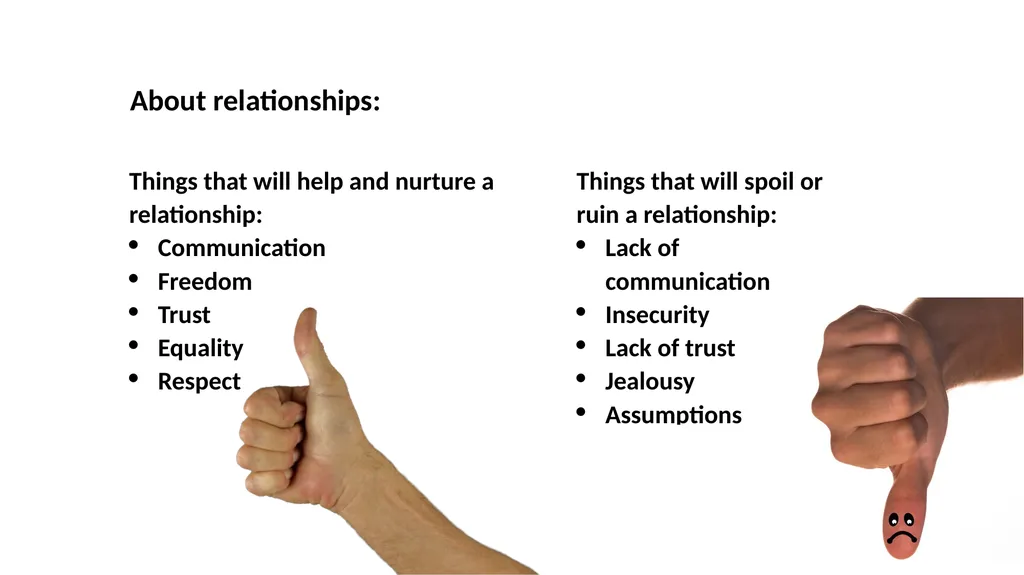
Things that will help and nurture a relationship.
Things that will spoil or ruin a relationship. rshp.scot<br>
04
About relationships:<br>
05
rshp.scot What is conflict? Conflict is when two or more people want different things. We tend to think of conflict as more than just a disagreement.
It’s normal to have times when you don’t get on with a partner. Conflict is a situation in which one or both parties feel some kind of threat. Conflict can make people feel emotions very strongly. It can leave people feeling stressed, upset or angry. It makes it hard to see the other person’s point of view.<br>
06
rshp.scot What is conflict resolution? Conflict resolution is a way for two or more parties to find a peaceful solution to a disagreement. The disagreement may be personal, financial, political, or emotional. When a dispute arises, often the best course of action is negotiation to resolve the disagreement.<br>
07
Conflict in relationships rshp.scot<br>
08
Conflict in relationships
What suggestions will de-escalate the conflict and lead to a better outcome?
What suggestions escalate and cause further problems? rshp.scot<br>
09
rshp.scot 10 tips to deal with conflict in a relationship Be direct, say what’s bothering you.
Talk about how you feel without blaming your partner.<br>
10
rshp.scot Never say never or always: as in “You never speak to me about….” Or “You’re always on your phone…”
Deal with one thing – focus on one issue rather than lots of things.<br>
11
rshp.scot Really listen – pay attention and don’t interrupt.
Don’t automatically object to your partner’s complaints – try not to get defensive from the start.<br>
12
rshp.scot Try to understand where they are coming from.
Respect the other person’s perspective – don’t put them down or be sarcastic.<br>
13
rshp.scot Don’t be negative about everything.
Take time out, take a breath, go calm down.
Adapted from Psychology Today https://www.psychologytoday.com/gb/blog/close-encounters/201704/10-tips-solving-relationship-conflicts<br>
14
Important things to remember
Childline provides free confidential advice and support for all young people your age.
Whatever your worry, if it’s about you or someone you love, Childline counsellors are there to help.
Speak to them by phone, online or email 24 hours a day.
Information and chat online https://www.childline.org.uk/
Phone 0800 1111 rshp.scot<br>