
How and When to Implement AAC An Overview of
Description: How and When to Implement AAC An Overview of Important Strategies and Tools Things to remember as you begin Knowing how child is currently communicating is key to identifying their skills and areas of need. Remember that AAC supports
Related Topics
Download Presentation
"How and When to Implement AAC An Overview of" is the property of its rightful owner. Permission is granted to download and print the materials on this website for personal, non-commercial use only, and to display it on your personal computer provided you do not modify the materials and that you retain all copyright notices contained in the materials. By downloading content from our website, you accept the terms of this agreement.
Presentation Transcript
slide1. How and When to Implement AAC An Overview of Important Strategies and Tools<br>
slide2. Things to remember as you begin… Knowing how child is currently communicating is key to identifying their skills and areas of need.
Remember that AAC supports receptive (input) and expressive (output) language development
AAC provides support for individuals who need alternative access to language input and processing<br>
slide3. Things to remember as you begin… AAC is a tool that can foster the development receptive language skills, as well as expressive language
At first children are learning to communicate and eventually shift to communicating to learn…
The skills of understanding symbols carry meaning are key for developing language and literacy skills.<br>
slide4. More Shared Context and Definitions All solutions represented on the AAC continuum can offer access to:
Core Vocabulary—general language used across multiple environments
Examples: more, go, all done, here, help, want, mine
Fringe Vocabulary—language that is specific to a certain activity/environment
Examples: blueberries, mask, coco melon, crayon, field trip specific vocab<br>
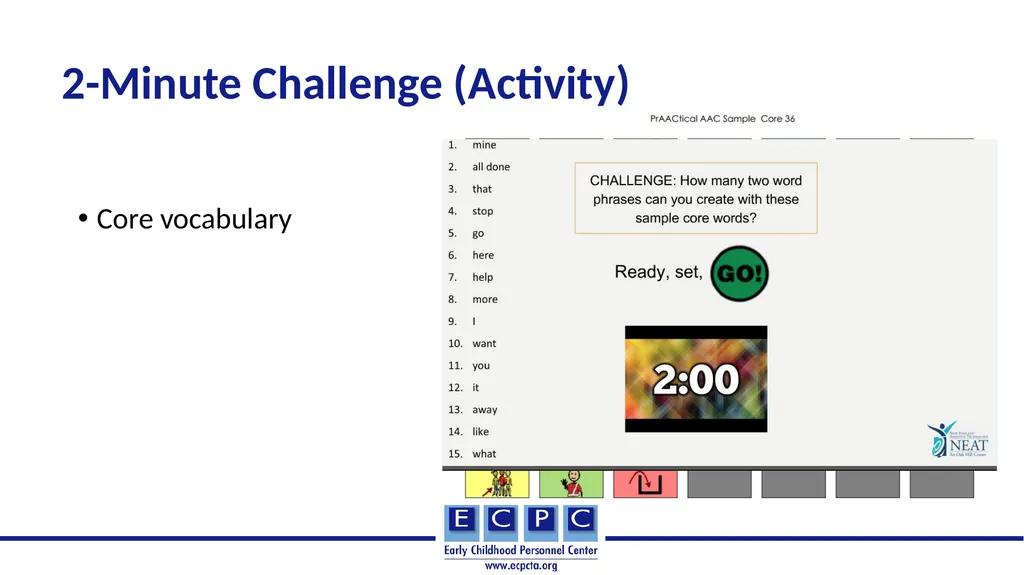
slide5. 2-Minute Challenge (Activity) Core vocabulary<br>
slide6. Vocabulary (what does the child want to say?) Core High frequency words that are functional across tasks and environments
Most predictable Fringe Low frequency are fringe vocabulary words that are functional in highly specific contexts only
Most personal and motivating!
Gives power of specificity<br>
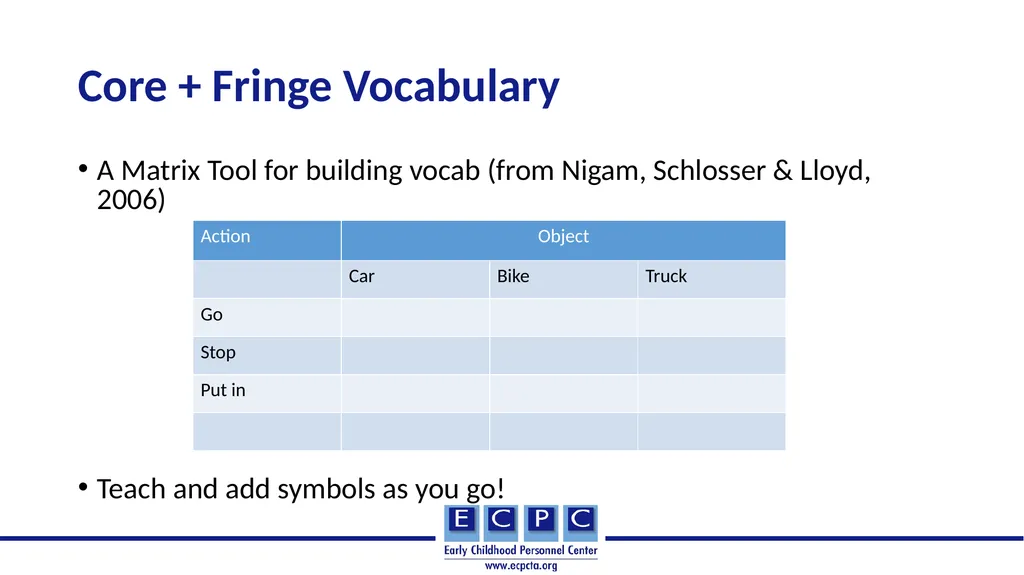
slide7. Core + Fringe Vocabulary A Matrix Tool for building vocab (from Nigam, Schlosser & Lloyd, 2006)
Teach and add symbols as you go!<br>
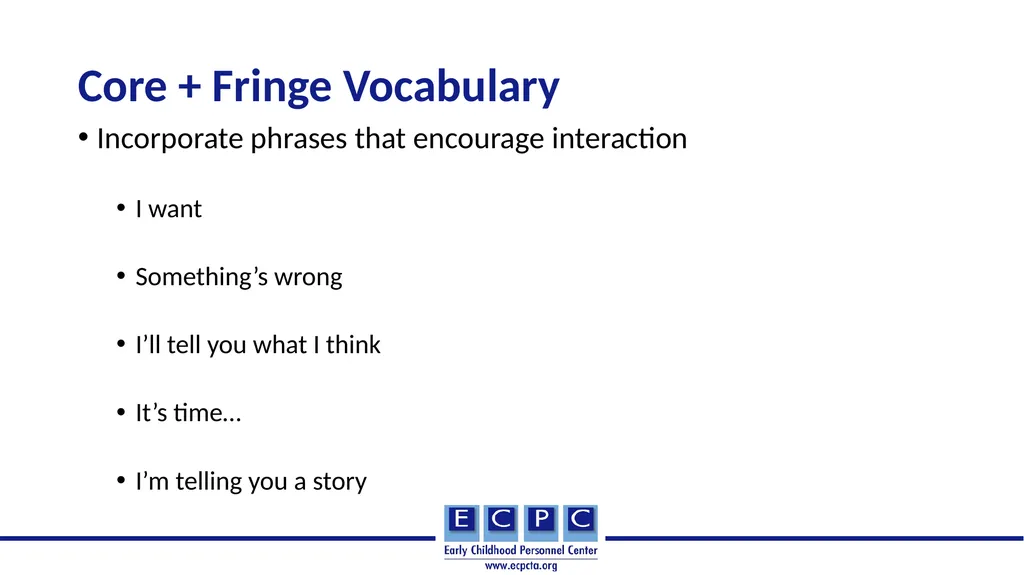
slide8. Core + Fringe Vocabulary Incorporate phrases that encourage interaction
I want
Something’s wrong
I’ll tell you what I think
It’s time…
I’m telling you a story<br>
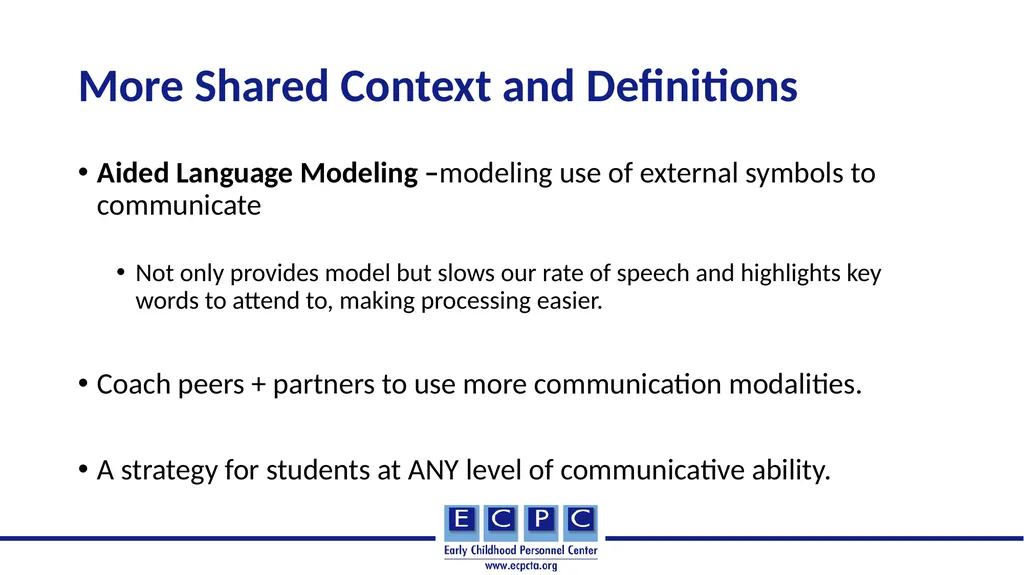
slide9. More Shared Context and Definitions Aided Language Modeling –modeling use of external symbols to communicate
Not only provides model but slows our rate of speech and highlights key words to attend to, making processing easier.
Coach peers + partners to use more communication modalities.
A strategy for students at ANY level of communicative ability.<br>
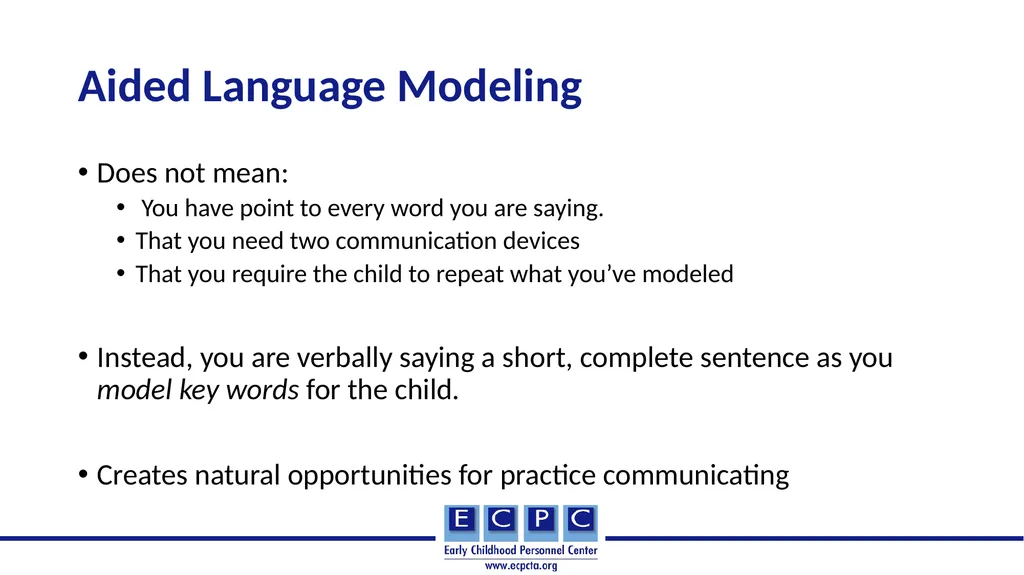
slide10. Aided Language Modeling Does not mean:
You have point to every word you are saying.
That you need two communication devices
That you require the child to repeat what you’ve modeled
Instead, you are verbally saying a short, complete sentence as you model key words for the child.
Creates natural opportunities for practice communicating<br>
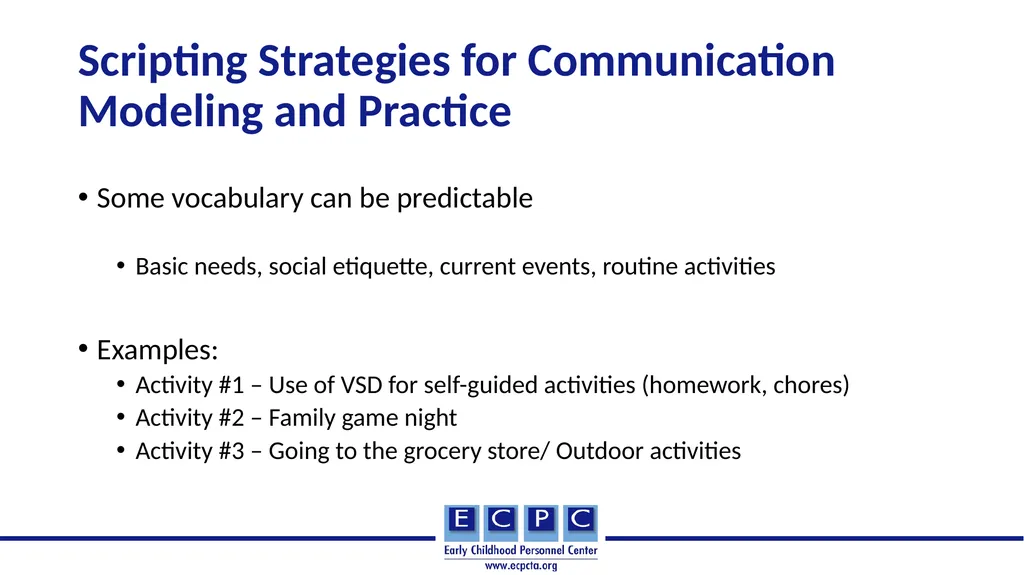
slide11. Scripting Strategies for Communication Modeling and Practice Some vocabulary can be predictable
Basic needs, social etiquette, current events, routine activities
Examples:
Activity #1 – Use of VSD for self-guided activities (homework, chores)
Activity #2 – Family game night
Activity #3 – Going to the grocery store/ Outdoor activities<br>
slide12. Scripting as a Tool For infusing daily routine and recreation with AAC
Everyday events and routines provide scripts
Help individual anticipate upcoming events
Examples:
BINGO
Follow the leader
Board games
Card games
Duck, duck, goose
Picnic / Cook out
Trip to the Beach<br>
slide13. A note about Symbols Not all symbols will be meaningful, guessable or transparent by the child and/or his/her partners.
Consider the child’s receptive (understanding) skills when selecting symbolic language for modeling and scripting.
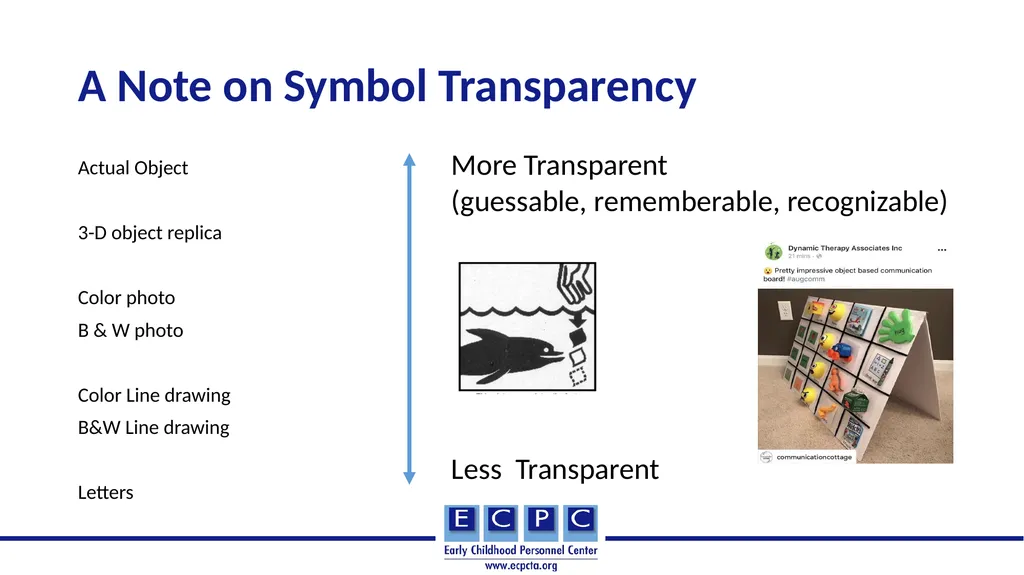
Actual object is more recognizable than 3-D objects, which are more recognizable than pictures, which are more recognizable than line drawings, which are more recognizable than letters of the alphabet.
It is okay to mix different types of symbols (e.g., picture + object)<br>
slide14. A Note on Symbol Transparency Actual Object
3-D object replica
Color photo
B & W photo
Color Line drawing
B&W Line drawing
Letters More Transparent
(guessable, rememberable, recognizable) Less Transparent<br>
slide15. Disclaimer This is a product of the Early Childhood Personnel Center (ECPC) awarded to the University of Connecticut Center for Excellence in Developmental Disabilities and was made possible by Cooperative Agreement #H325B170008 which is funded by the U.S. Department of Education, Office of Special Education Programs. However, those contents do not necessarily represent the policy of the Department of Education, and you should not assume endorsement by the Federal Government.<br>
slide2. Things to remember as you begin… Knowing how child is currently communicating is key to identifying their skills and areas of need.
Remember that AAC supports receptive (input) and expressive (output) language development
AAC provides support for individuals who need alternative access to language input and processing<br>
slide3. Things to remember as you begin… AAC is a tool that can foster the development receptive language skills, as well as expressive language
At first children are learning to communicate and eventually shift to communicating to learn…
The skills of understanding symbols carry meaning are key for developing language and literacy skills.<br>
slide4. More Shared Context and Definitions All solutions represented on the AAC continuum can offer access to:
Core Vocabulary—general language used across multiple environments
Examples: more, go, all done, here, help, want, mine
Fringe Vocabulary—language that is specific to a certain activity/environment
Examples: blueberries, mask, coco melon, crayon, field trip specific vocab<br>
slide5. 2-Minute Challenge (Activity) Core vocabulary<br>
slide6. Vocabulary (what does the child want to say?) Core High frequency words that are functional across tasks and environments
Most predictable Fringe Low frequency are fringe vocabulary words that are functional in highly specific contexts only
Most personal and motivating!
Gives power of specificity<br>
slide7. Core + Fringe Vocabulary A Matrix Tool for building vocab (from Nigam, Schlosser & Lloyd, 2006)
Teach and add symbols as you go!<br>
slide8. Core + Fringe Vocabulary Incorporate phrases that encourage interaction
I want
Something’s wrong
I’ll tell you what I think
It’s time…
I’m telling you a story<br>
slide9. More Shared Context and Definitions Aided Language Modeling –modeling use of external symbols to communicate
Not only provides model but slows our rate of speech and highlights key words to attend to, making processing easier.
Coach peers + partners to use more communication modalities.
A strategy for students at ANY level of communicative ability.<br>
slide10. Aided Language Modeling Does not mean:
You have point to every word you are saying.
That you need two communication devices
That you require the child to repeat what you’ve modeled
Instead, you are verbally saying a short, complete sentence as you model key words for the child.
Creates natural opportunities for practice communicating<br>
slide11. Scripting Strategies for Communication Modeling and Practice Some vocabulary can be predictable
Basic needs, social etiquette, current events, routine activities
Examples:
Activity #1 – Use of VSD for self-guided activities (homework, chores)
Activity #2 – Family game night
Activity #3 – Going to the grocery store/ Outdoor activities<br>
slide12. Scripting as a Tool For infusing daily routine and recreation with AAC
Everyday events and routines provide scripts
Help individual anticipate upcoming events
Examples:
BINGO
Follow the leader
Board games
Card games
Duck, duck, goose
Picnic / Cook out
Trip to the Beach<br>
slide13. A note about Symbols Not all symbols will be meaningful, guessable or transparent by the child and/or his/her partners.
Consider the child’s receptive (understanding) skills when selecting symbolic language for modeling and scripting.
Actual object is more recognizable than 3-D objects, which are more recognizable than pictures, which are more recognizable than line drawings, which are more recognizable than letters of the alphabet.
It is okay to mix different types of symbols (e.g., picture + object)<br>
slide14. A Note on Symbol Transparency Actual Object
3-D object replica
Color photo
B & W photo
Color Line drawing
B&W Line drawing
Letters More Transparent
(guessable, rememberable, recognizable) Less Transparent<br>
slide15. Disclaimer This is a product of the Early Childhood Personnel Center (ECPC) awarded to the University of Connecticut Center for Excellence in Developmental Disabilities and was made possible by Cooperative Agreement #H325B170008 which is funded by the U.S. Department of Education, Office of Special Education Programs. However, those contents do not necessarily represent the policy of the Department of Education, and you should not assume endorsement by the Federal Government.<br>