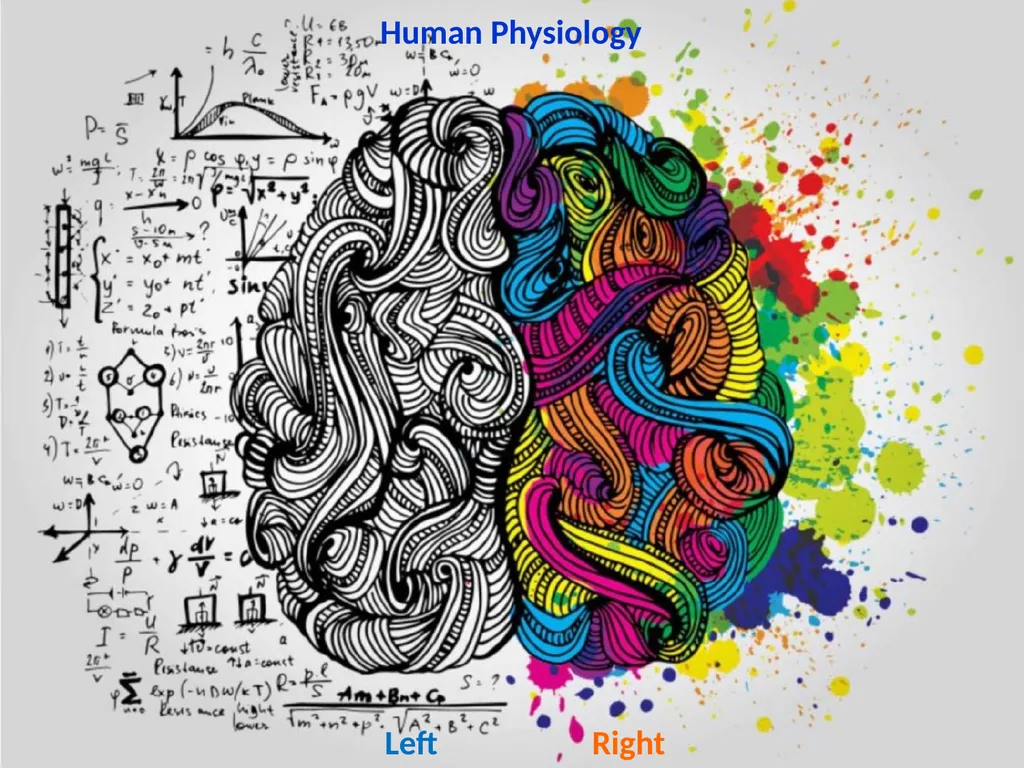
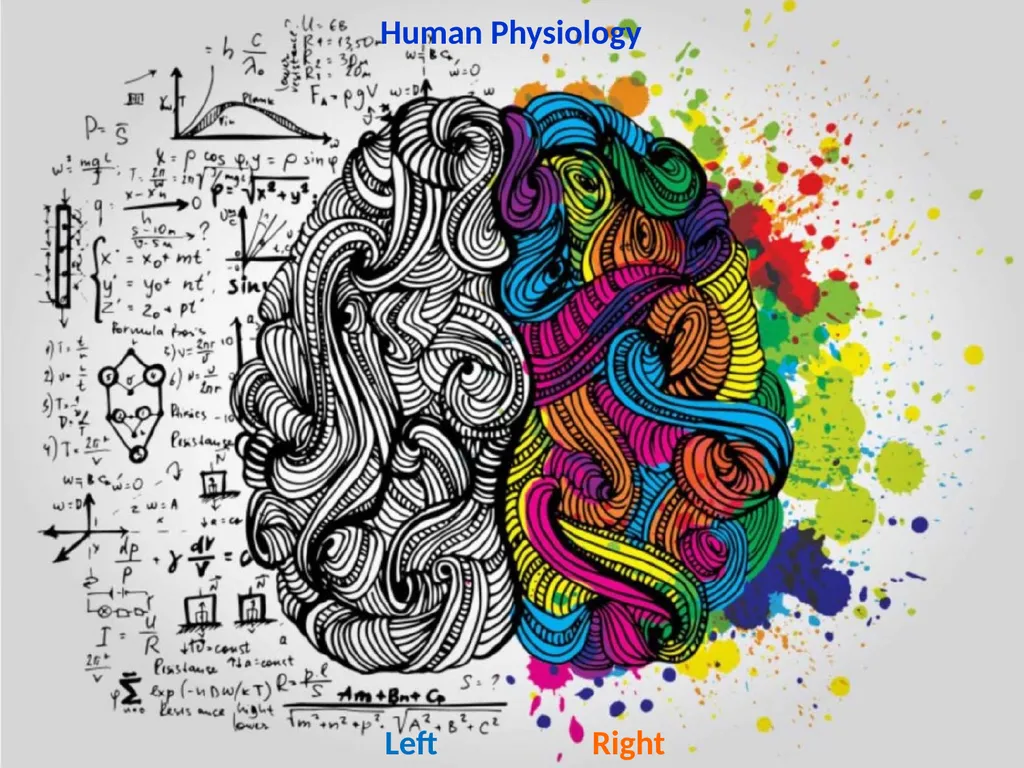
Human Physiology Left Right Analytical Logical
Description: Human Physiology Left Right Analytical Logical Precise Repetitive Organized Detailed Belief Sequential Literal Detached Verbal Creative Imaginative General Intuitive Conceptual Holistic Heuristic Irregular Figurative Empathetic Non-Verbal
Related Topics
Download Presentation
"Human Physiology Left Right Analytical Logical" is the property of its rightful owner. Permission is granted to download and print the materials on this website for personal, non-commercial use only, and to display it on your personal computer provided you do not modify the materials and that you retain all copyright notices contained in the materials. By downloading content from our website, you accept the terms of this agreement.
Presentation Transcript
slide1. Human Physiology Left Right<br>
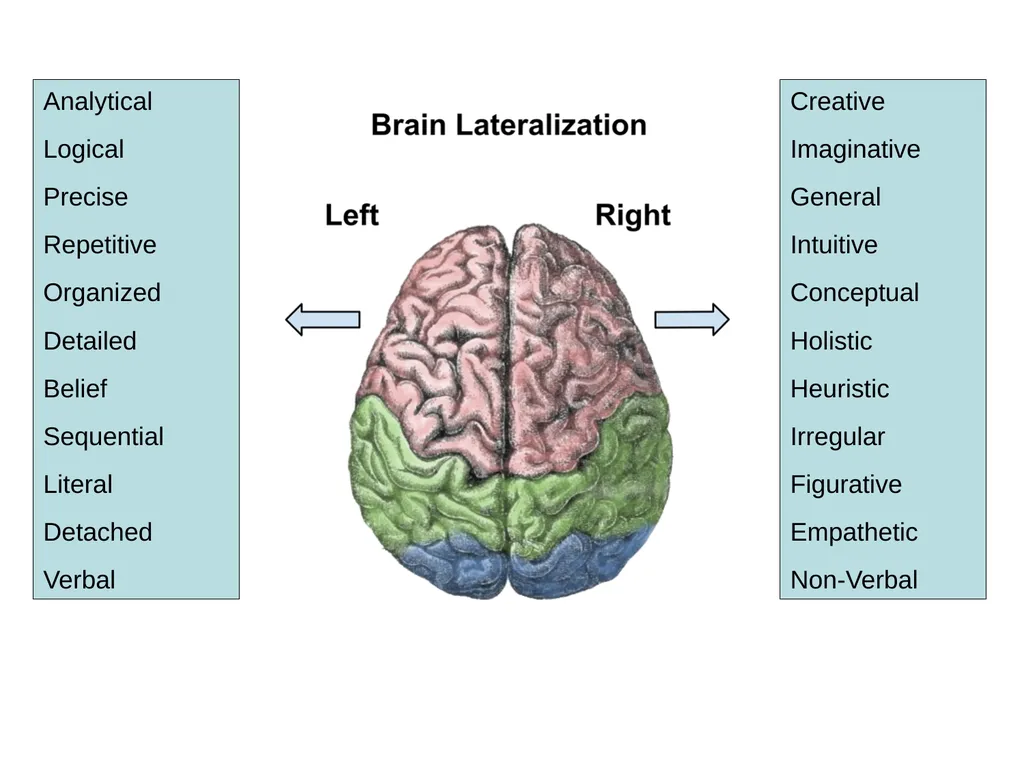
slide2. Analytical
Logical
Precise
Repetitive
Organized
Detailed
Belief
Sequential
Literal
Detached
Verbal Creative
Imaginative
General
Intuitive
Conceptual
Holistic
Heuristic
Irregular
Figurative
Empathetic
Non-Verbal<br>
slide3. Etymology (word origin; derivation of words):
Physiology
From 1560’s, French and directly from Latin physiologia.
“Study and description of natural objects, natural philosophy".
Derived from physios = "nature, natural, physical"; and logia = "study".
This gives the meaning of "science of the normal function of living things".
Anatomy
From Late 1300’s, Latin anatomia, Greek anatome.
“Study or knowledge of the structure and function of the human body“.
Derived from ana = "up"; and tomos (or temnein) = "to cut".
Together this gives "a cutting up" involving dissection.<br>
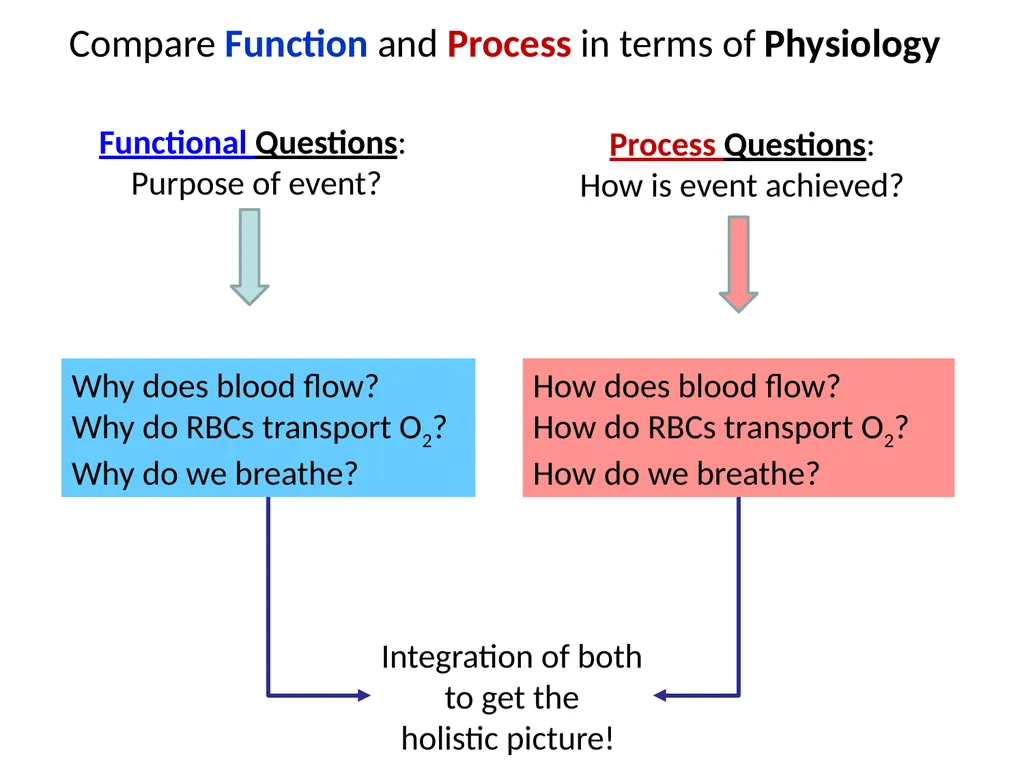
slide4. Compare Function and Process in terms of Physiology Process Questions:
How is event achieved? Integration of both to get the
holistic picture! Functional Questions:
Purpose of event? Why does blood flow?
Why do RBCs transport O2? Why do we breathe? How does blood flow?
How do RBCs transport O2? How do we breathe?<br>
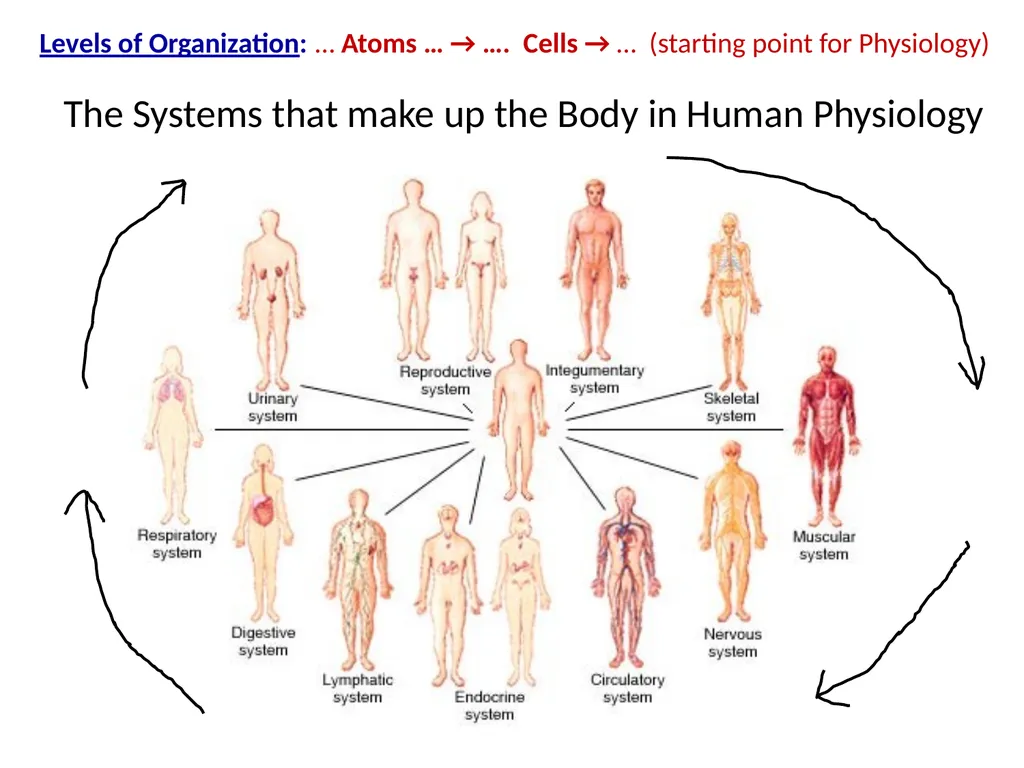
slide5. The Systems that make up the Body in Human Physiology Levels of Organization: … Atoms … → …. Cells → … (starting point for Physiology)<br>
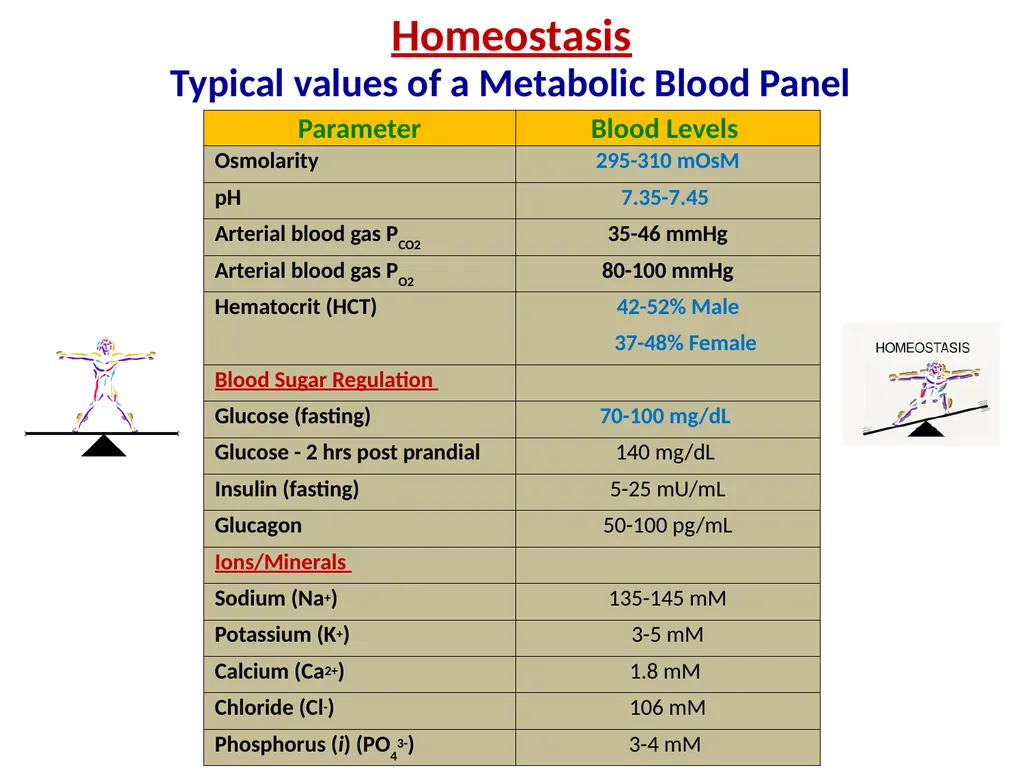
slide6. Homeostasis Typical values of a Metabolic Blood Panel<br>
slide7. Figure 1. Circadian rhythms of several physiological variables in a human subject with room lights on (clear bars) for 16 h and lights off (blue bars) for 8 h. Lights on (daytime) Lights off<br>
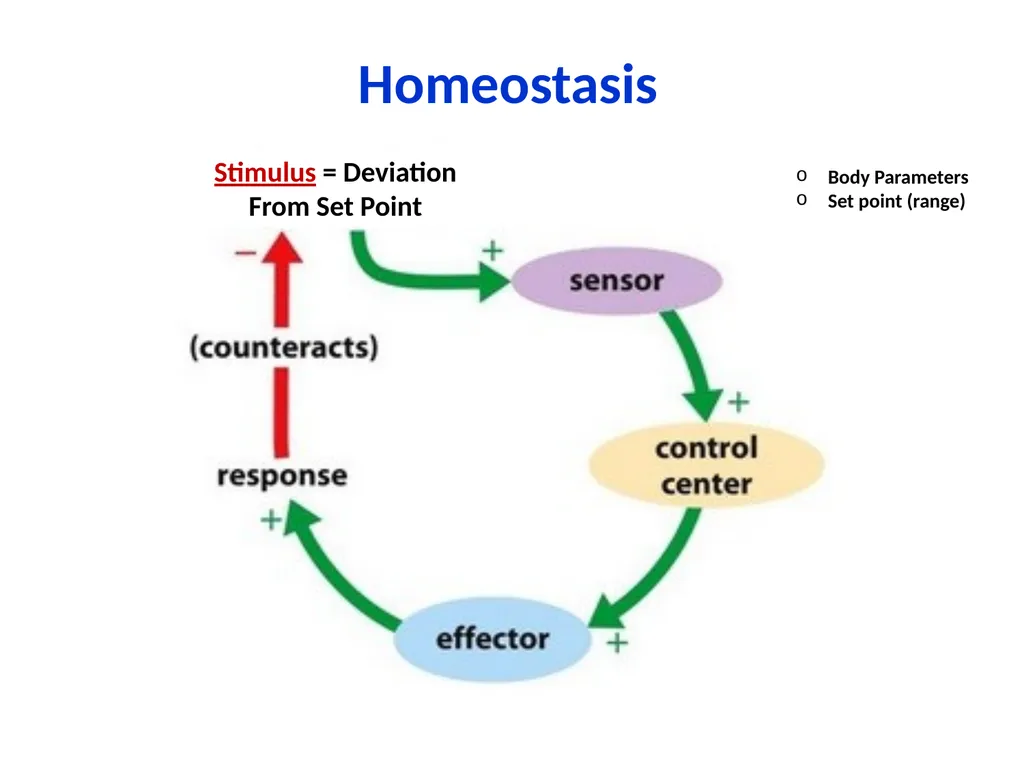
slide8. Homeostasis Stimulus = Deviation
From Set Point Body Parameters
Set point (range)<br>
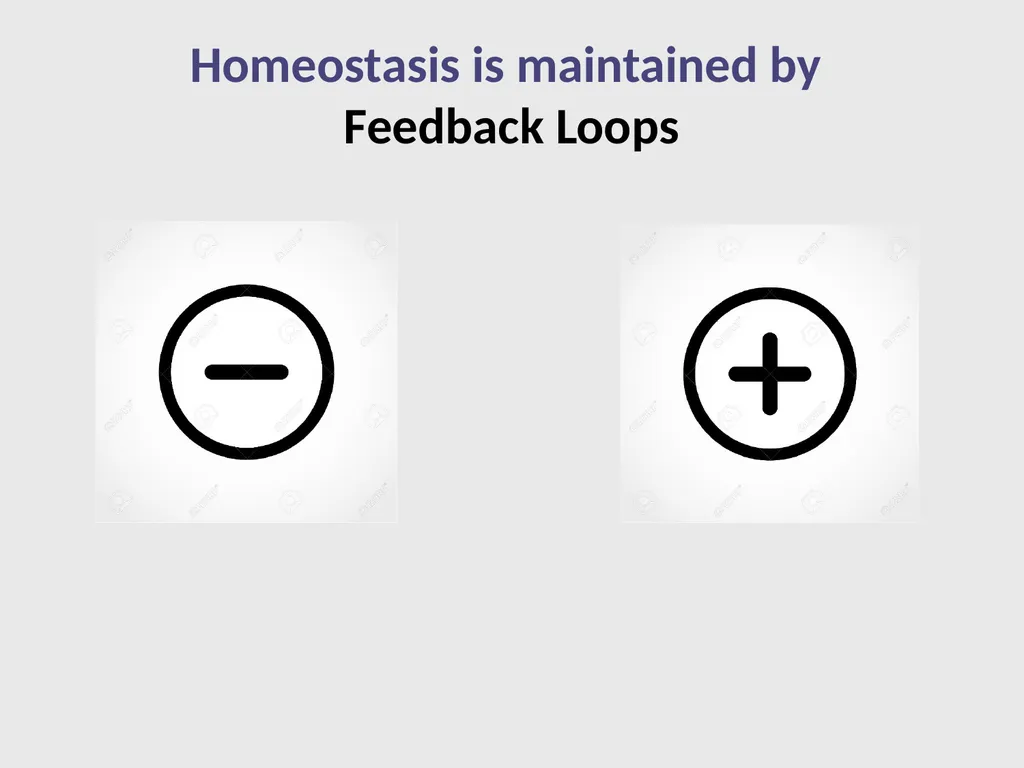
slide9. Homeostasis is maintained by
Feedback Loops<br>
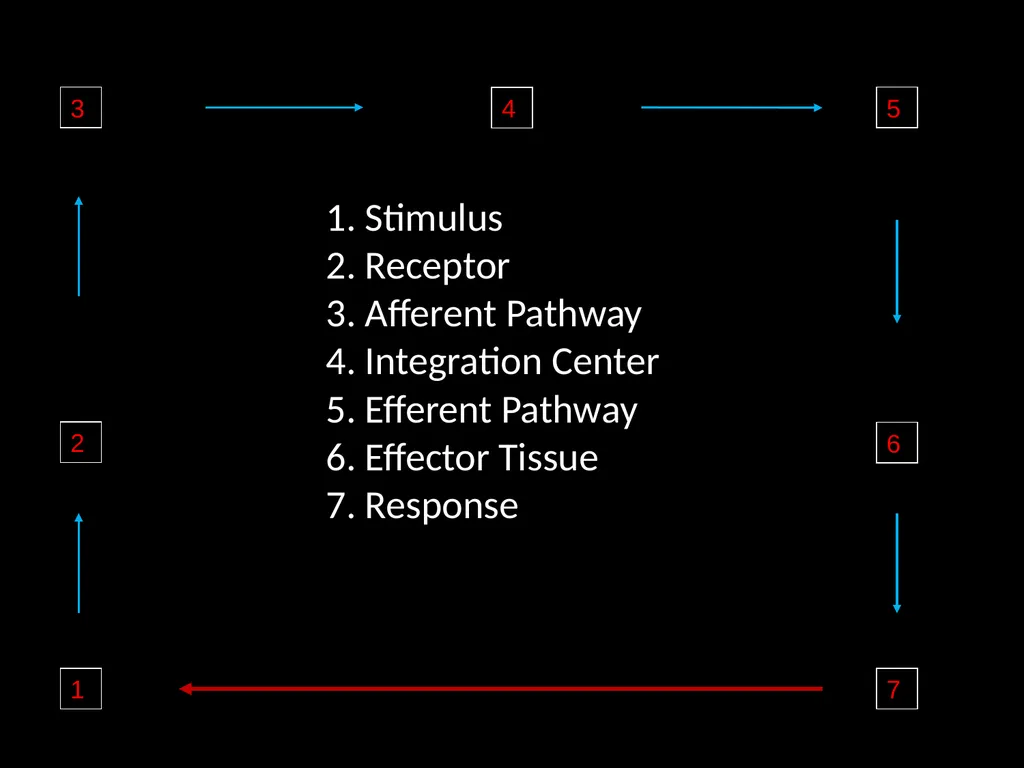
slide10. 1. Stimulus
2. Receptor
3. Afferent Pathway
4. Integration Center
5. Efferent Pathway
6. Effector Tissue
7. Response 1 3 2 4 5 6 7<br>
slide11. THE CHEMISTRY OF PHYSIOLOGY - REVIEW
Levels of Organization:
atoms > molecules > organelles > cells > tissues > organs > organ systems > organism
Valence e- –> outer shell electrons = chemical properties of atom.<br>
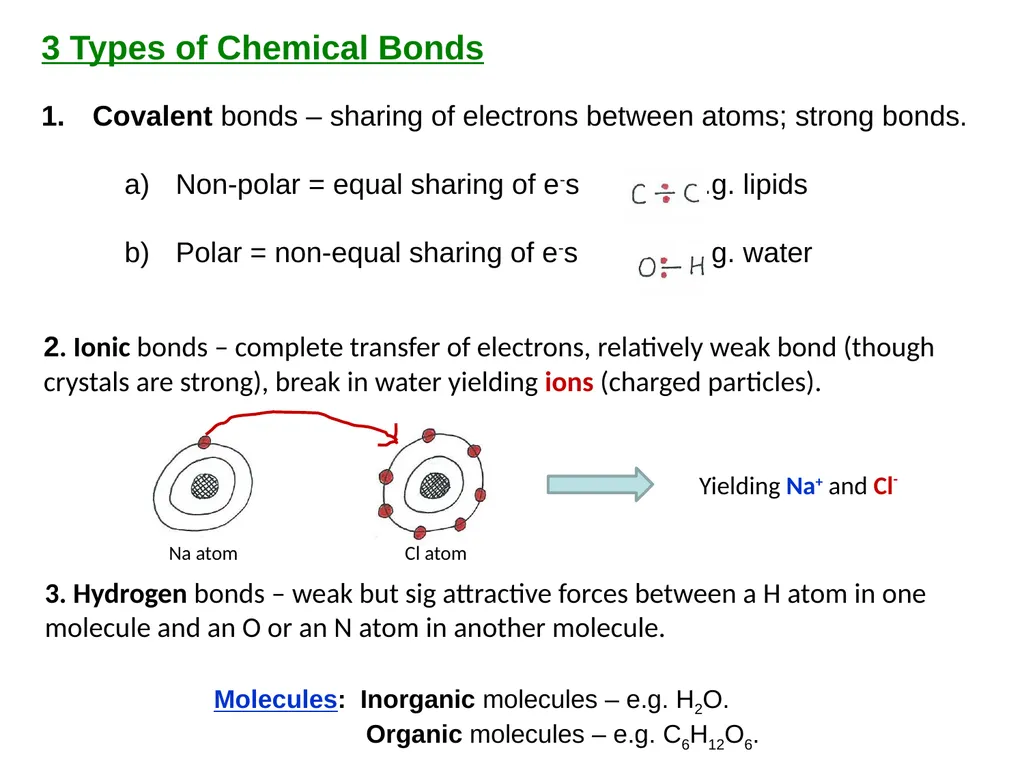
slide12. 3 Types of Chemical Bonds
Covalent bonds – sharing of electrons between atoms; strong bonds.
Non-polar = equal sharing of e-s e.g. lipids
Polar = non-equal sharing of e-s e.g. water Molecules: Inorganic molecules – e.g. H2O.
Organic molecules – e.g. C6H12O6. 2. Ionic bonds – complete transfer of electrons, relatively weak bond (though crystals are strong), break in water yielding ions (charged particles). Yielding Na+ and Cl- 3. Hydrogen bonds – weak but sig attractive forces between a H atom in one molecule and an O or an N atom in another molecule. Na atom Cl atom<br>
slide13. Properties of Water
1) Solvency - universal solvent.
2) Cohesion - surface tension and adhesion.
3) Thermostability - high heat capacity, high heat of
vaporization. Define calorie.
4) Reactivity - Water participates in chemical
reactions
e.g. Hydrolysis and Dehydration Synthesis<br>
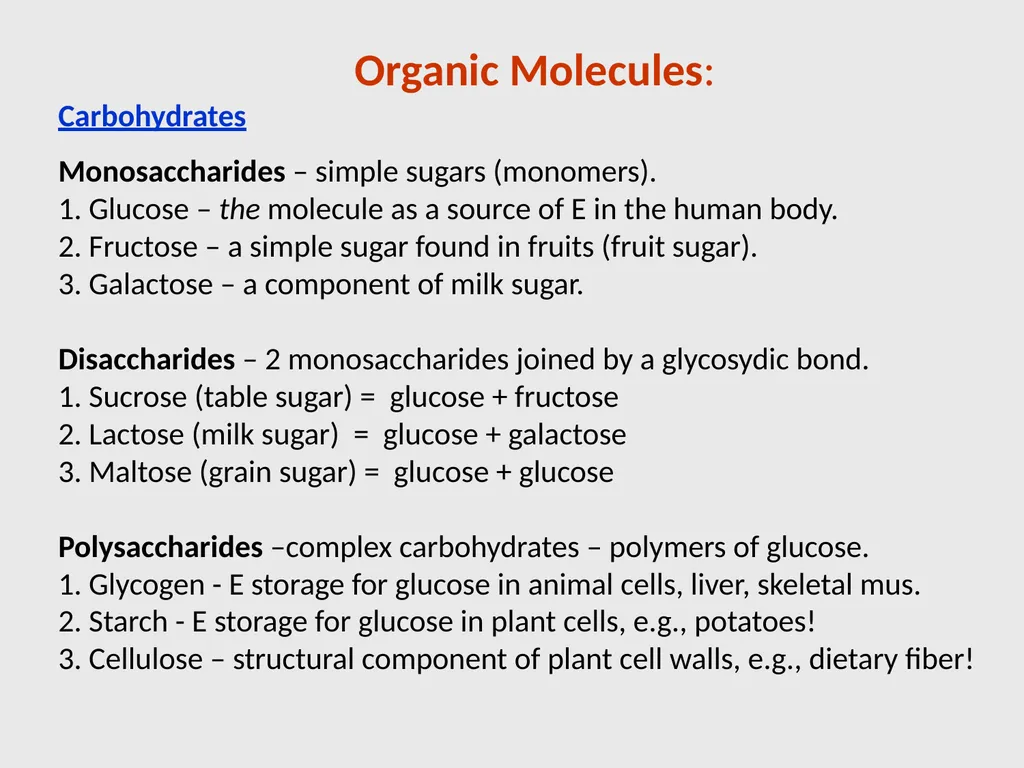
slide14. Organic Molecules:
Carbohydrates
Monosaccharides – simple sugars (monomers).
1. Glucose – the molecule as a source of E in the human body.
2. Fructose – a simple sugar found in fruits (fruit sugar).
3. Galactose – a component of milk sugar.
Disaccharides – 2 monosaccharides joined by a glycosydic bond.
1. Sucrose (table sugar) = glucose + fructose
2. Lactose (milk sugar) = glucose + galactose
3. Maltose (grain sugar) = glucose + glucose
Polysaccharides –complex carbohydrates – polymers of glucose.
1. Glycogen - E storage for glucose in animal cells, liver, skeletal mus.
2. Starch - E storage for glucose in plant cells, e.g., potatoes!
3. Cellulose – structural component of plant cell walls, e.g., dietary fiber!<br>
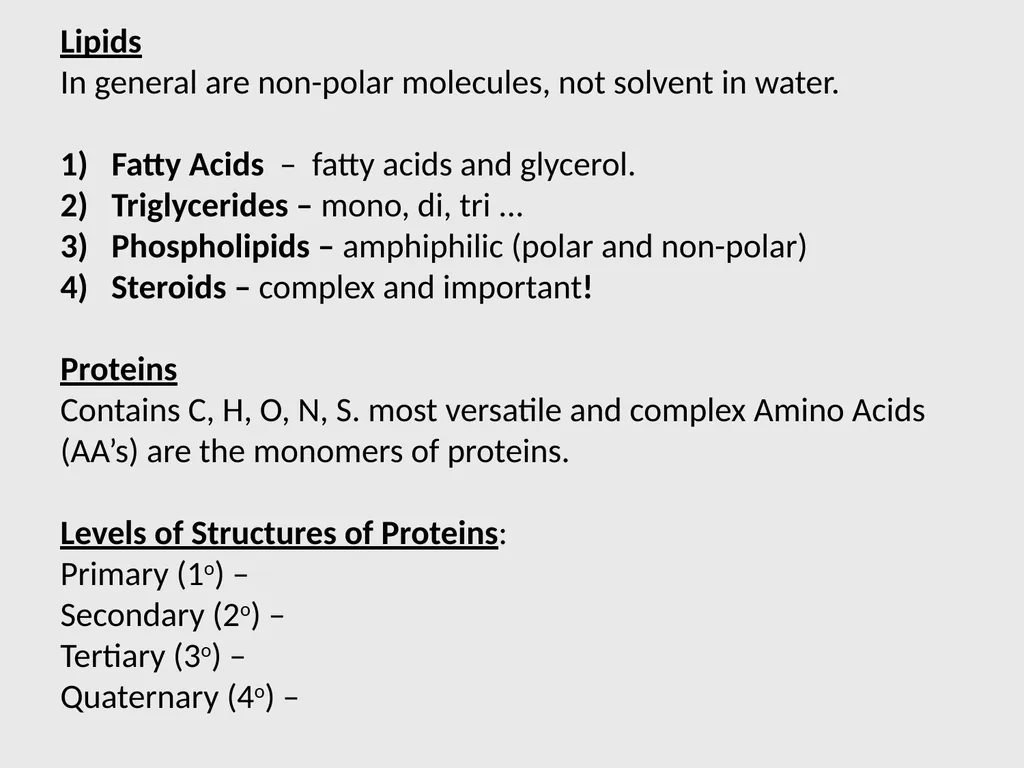
slide15. Lipids
In general are non-polar molecules, not solvent in water.
Fatty Acids – fatty acids and glycerol.
Triglycerides – mono, di, tri ...
3) Phospholipids – amphiphilic (polar and non-polar)
4) Steroids – complex and important!
Proteins
Contains C, H, O, N, S. most versatile and complex Amino Acids (AA’s) are the monomers of proteins.
Levels of Structures of Proteins:
Primary (1o) –
Secondary (2o) –
Tertiary (3o) –
Quaternary (4o) –<br>
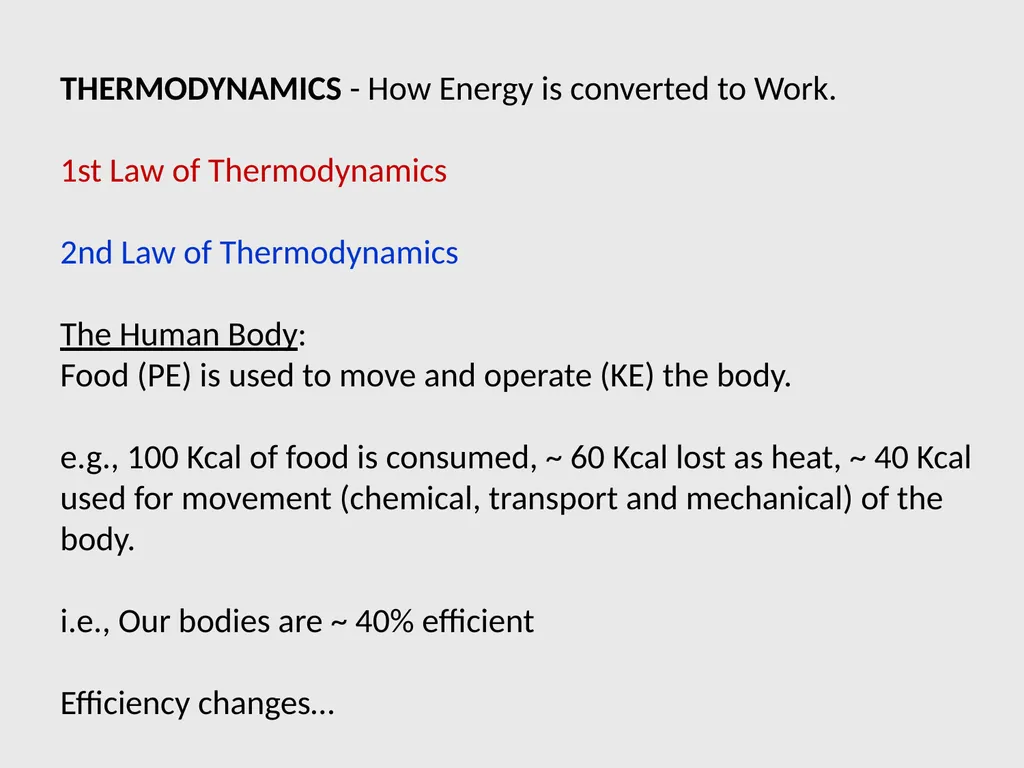
slide16. THERMODYNAMICS - How Energy is converted to Work.
1st Law of Thermodynamics
2nd Law of Thermodynamics
The Human Body:
Food (PE) is used to move and operate (KE) the body.
e.g., 100 Kcal of food is consumed, ~ 60 Kcal lost as heat, ~ 40 Kcal used for movement (chemical, transport and mechanical) of the body.
i.e., Our bodies are ~ 40% efficient
Efficiency changes…<br>
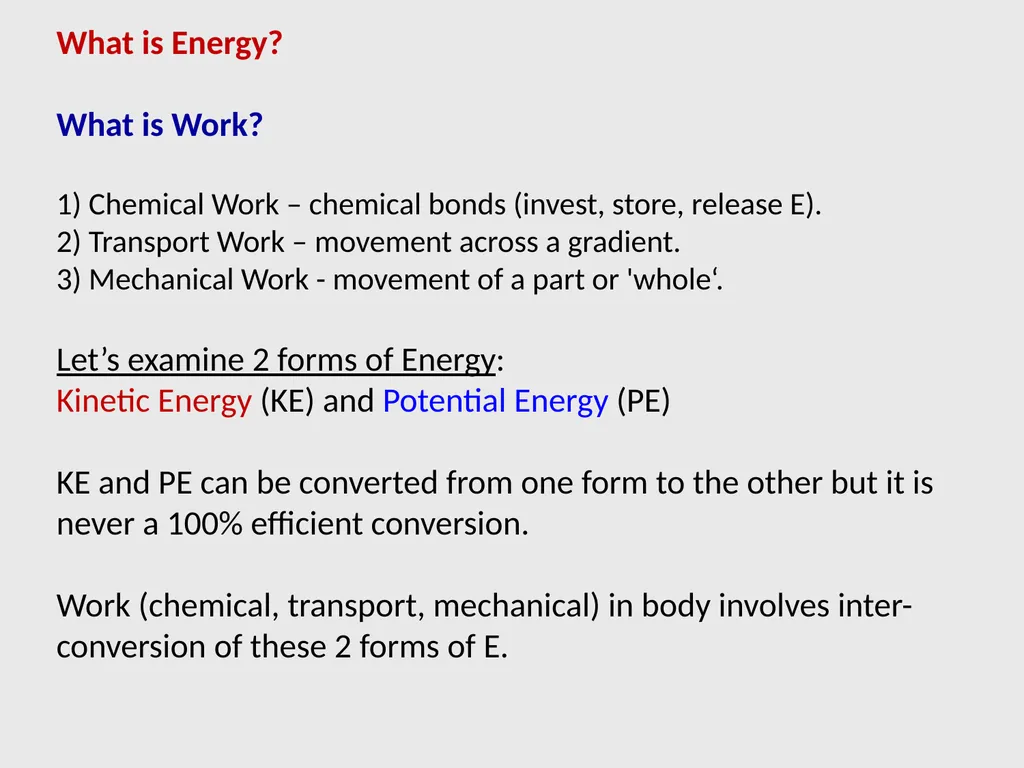
slide17. What is Energy?
What is Work?
1) Chemical Work – chemical bonds (invest, store, release E).
2) Transport Work – movement across a gradient.
3) Mechanical Work - movement of a part or 'whole‘.
Let’s examine 2 forms of Energy:
Kinetic Energy (KE) and Potential Energy (PE)
KE and PE can be converted from one form to the other but it is never a 100% efficient conversion.
Work (chemical, transport, mechanical) in body involves inter-conversion of these 2 forms of E.<br>
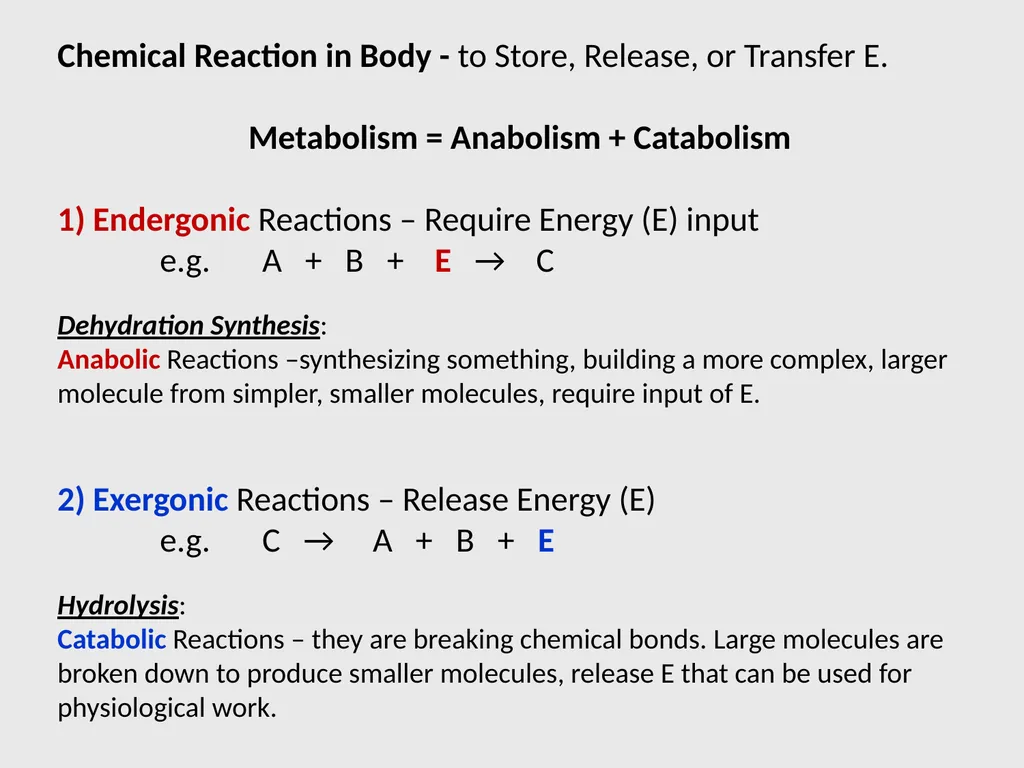
slide18. Chemical Reaction in Body - to Store, Release, or Transfer E.
Metabolism = Anabolism + Catabolism
1) Endergonic Reactions – Require Energy (E) input
e.g. A + B + E → C
Dehydration Synthesis:
Anabolic Reactions –synthesizing something, building a more complex, larger molecule from simpler, smaller molecules, require input of E.
2) Exergonic Reactions – Release Energy (E)
e.g. C → A + B + E
Hydrolysis:
Catabolic Reactions – they are breaking chemical bonds. Large molecules are broken down to produce smaller molecules, release E that can be used for physiological work.<br>

slide2. Analytical
Logical
Precise
Repetitive
Organized
Detailed
Belief
Sequential
Literal
Detached
Verbal Creative
Imaginative
General
Intuitive
Conceptual
Holistic
Heuristic
Irregular
Figurative
Empathetic
Non-Verbal<br>
slide3. Etymology (word origin; derivation of words):
Physiology
From 1560’s, French and directly from Latin physiologia.
“Study and description of natural objects, natural philosophy".
Derived from physios = "nature, natural, physical"; and logia = "study".
This gives the meaning of "science of the normal function of living things".
Anatomy
From Late 1300’s, Latin anatomia, Greek anatome.
“Study or knowledge of the structure and function of the human body“.
Derived from ana = "up"; and tomos (or temnein) = "to cut".
Together this gives "a cutting up" involving dissection.<br>
slide4. Compare Function and Process in terms of Physiology Process Questions:
How is event achieved? Integration of both to get the
holistic picture! Functional Questions:
Purpose of event? Why does blood flow?
Why do RBCs transport O2? Why do we breathe? How does blood flow?
How do RBCs transport O2? How do we breathe?<br>
slide5. The Systems that make up the Body in Human Physiology Levels of Organization: … Atoms … → …. Cells → … (starting point for Physiology)<br>
slide6. Homeostasis Typical values of a Metabolic Blood Panel<br>
slide7. Figure 1. Circadian rhythms of several physiological variables in a human subject with room lights on (clear bars) for 16 h and lights off (blue bars) for 8 h. Lights on (daytime) Lights off<br>
slide8. Homeostasis Stimulus = Deviation
From Set Point Body Parameters
Set point (range)<br>
slide9. Homeostasis is maintained by
Feedback Loops<br>
slide10. 1. Stimulus
2. Receptor
3. Afferent Pathway
4. Integration Center
5. Efferent Pathway
6. Effector Tissue
7. Response 1 3 2 4 5 6 7<br>
slide11. THE CHEMISTRY OF PHYSIOLOGY - REVIEW
Levels of Organization:
atoms > molecules > organelles > cells > tissues > organs > organ systems > organism
Valence e- –> outer shell electrons = chemical properties of atom.<br>
slide12. 3 Types of Chemical Bonds
Covalent bonds – sharing of electrons between atoms; strong bonds.
Non-polar = equal sharing of e-s e.g. lipids
Polar = non-equal sharing of e-s e.g. water Molecules: Inorganic molecules – e.g. H2O.
Organic molecules – e.g. C6H12O6. 2. Ionic bonds – complete transfer of electrons, relatively weak bond (though crystals are strong), break in water yielding ions (charged particles). Yielding Na+ and Cl- 3. Hydrogen bonds – weak but sig attractive forces between a H atom in one molecule and an O or an N atom in another molecule. Na atom Cl atom<br>
slide13. Properties of Water
1) Solvency - universal solvent.
2) Cohesion - surface tension and adhesion.
3) Thermostability - high heat capacity, high heat of
vaporization. Define calorie.
4) Reactivity - Water participates in chemical
reactions
e.g. Hydrolysis and Dehydration Synthesis<br>
slide14. Organic Molecules:
Carbohydrates
Monosaccharides – simple sugars (monomers).
1. Glucose – the molecule as a source of E in the human body.
2. Fructose – a simple sugar found in fruits (fruit sugar).
3. Galactose – a component of milk sugar.
Disaccharides – 2 monosaccharides joined by a glycosydic bond.
1. Sucrose (table sugar) = glucose + fructose
2. Lactose (milk sugar) = glucose + galactose
3. Maltose (grain sugar) = glucose + glucose
Polysaccharides –complex carbohydrates – polymers of glucose.
1. Glycogen - E storage for glucose in animal cells, liver, skeletal mus.
2. Starch - E storage for glucose in plant cells, e.g., potatoes!
3. Cellulose – structural component of plant cell walls, e.g., dietary fiber!<br>
slide15. Lipids
In general are non-polar molecules, not solvent in water.
Fatty Acids – fatty acids and glycerol.
Triglycerides – mono, di, tri ...
3) Phospholipids – amphiphilic (polar and non-polar)
4) Steroids – complex and important!
Proteins
Contains C, H, O, N, S. most versatile and complex Amino Acids (AA’s) are the monomers of proteins.
Levels of Structures of Proteins:
Primary (1o) –
Secondary (2o) –
Tertiary (3o) –
Quaternary (4o) –<br>
slide16. THERMODYNAMICS - How Energy is converted to Work.
1st Law of Thermodynamics
2nd Law of Thermodynamics
The Human Body:
Food (PE) is used to move and operate (KE) the body.
e.g., 100 Kcal of food is consumed, ~ 60 Kcal lost as heat, ~ 40 Kcal used for movement (chemical, transport and mechanical) of the body.
i.e., Our bodies are ~ 40% efficient
Efficiency changes…<br>
slide17. What is Energy?
What is Work?
1) Chemical Work – chemical bonds (invest, store, release E).
2) Transport Work – movement across a gradient.
3) Mechanical Work - movement of a part or 'whole‘.
Let’s examine 2 forms of Energy:
Kinetic Energy (KE) and Potential Energy (PE)
KE and PE can be converted from one form to the other but it is never a 100% efficient conversion.
Work (chemical, transport, mechanical) in body involves inter-conversion of these 2 forms of E.<br>
slide18. Chemical Reaction in Body - to Store, Release, or Transfer E.
Metabolism = Anabolism + Catabolism
1) Endergonic Reactions – Require Energy (E) input
e.g. A + B + E → C
Dehydration Synthesis:
Anabolic Reactions –synthesizing something, building a more complex, larger molecule from simpler, smaller molecules, require input of E.
2) Exergonic Reactions – Release Energy (E)
e.g. C → A + B + E
Hydrolysis:
Catabolic Reactions – they are breaking chemical bonds. Large molecules are broken down to produce smaller molecules, release E that can be used for physiological work.<br>