
Keeping Children Safe in Education: Prevent
CM
Published · 31 slides · 0 views

1 / 1


Description
Keeping Children Safe in Education: Prevent training for education settings Essex Education Safeguarding Team September 2026 Copyright Essex County Council 2026 No part of this publication may reproduced, stored in a retrieval system of
Related Topics
Share
Embed code
Download this presentation From Below
"Keeping Children Safe in Education: Prevent" is the property of its rightful owner. Permission is granted to download and print the materials on this website for personal, non-commercial use only, and to display it on your personal computer provided you do not modify the materials and that you retain all copyright notices contained in the materials. By downloading content from our website, you accept the terms of this agreement.
Presentation Transcript
01
Keeping Children Safe in Education:
Prevent training for education settings Essex Education Safeguarding Team
September 2026 Copyright © Essex County Council 2026 No part of this publication may reproduced, stored in a retrieval system of any nature, downloaded, transmitted or distributed in any form or by any means including photocopying and recording, without the prior written permission of Essex County Council, the copyright owner<br>
September 2026 Copyright © Essex County Council 2026 No part of this publication may reproduced, stored in a retrieval system of any nature, downloaded, transmitted or distributed in any form or by any means including photocopying and recording, without the prior written permission of Essex County Council, the copyright owner<br>
02
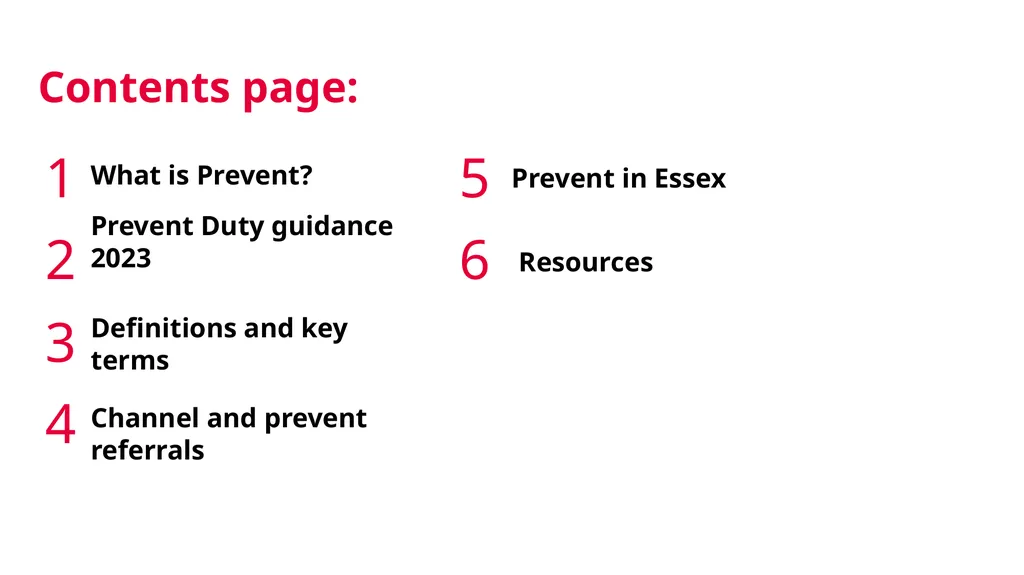
Contents page: 1 What is Prevent? 2 Prevent Duty guidance 2023 3 Definitions and key terms 4 Channel and prevent referrals 5 Prevent in Essex 6 Resources<br>
03
Set the scene When you think of Prevent, how does it make you feel?
Take a couple of minutes – discuss together.
Your thoughts please?<br>
Take a couple of minutes – discuss together.
Your thoughts please?<br>
04
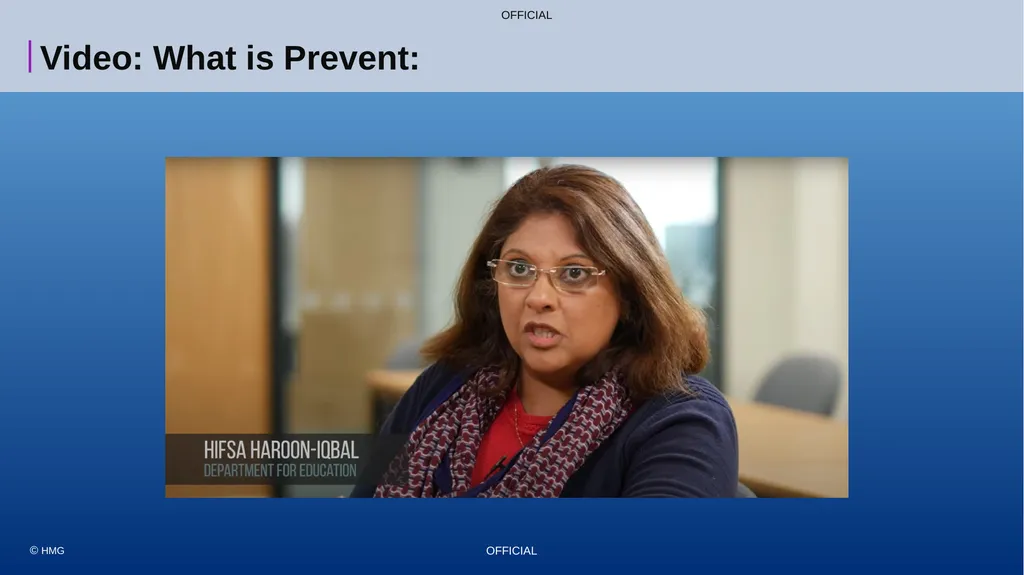
Video: What is Prevent:<br>
05
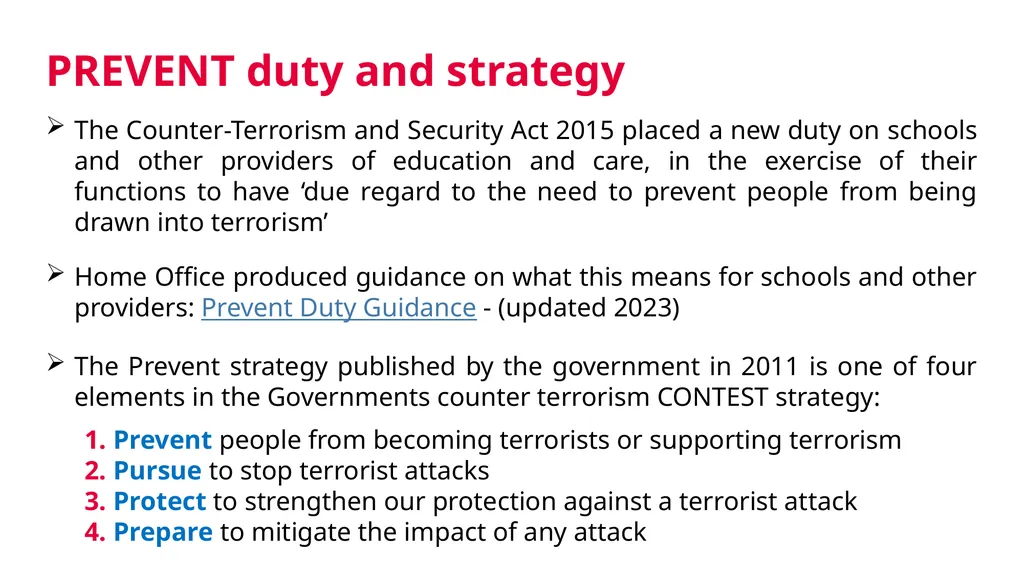
PREVENT duty and strategy The Counter-Terrorism and Security Act 2015 placed a new duty on schools and other providers of education and care, in the exercise of their functions to have ‘due regard to the need to prevent people from being drawn into terrorism’
Home Office produced guidance on what this means for schools and other providers: Prevent Duty Guidance - (updated 2023)
The Prevent strategy published by the government in 2011 is one of four elements in the Governments counter terrorism CONTEST strategy:
Prevent people from becoming terrorists or supporting terrorism
Pursue to stop terrorist attacks
Protect to strengthen our protection against a terrorist attack
Prepare to mitigate the impact of any attack<br>
Home Office produced guidance on what this means for schools and other providers: Prevent Duty Guidance - (updated 2023)
The Prevent strategy published by the government in 2011 is one of four elements in the Governments counter terrorism CONTEST strategy:
Prevent people from becoming terrorists or supporting terrorism
Pursue to stop terrorist attacks
Protect to strengthen our protection against a terrorist attack
Prepare to mitigate the impact of any attack<br>
06
Prevent duty guidance (2023) Strategy
Education
Summary<br>
Education
Summary<br>
07
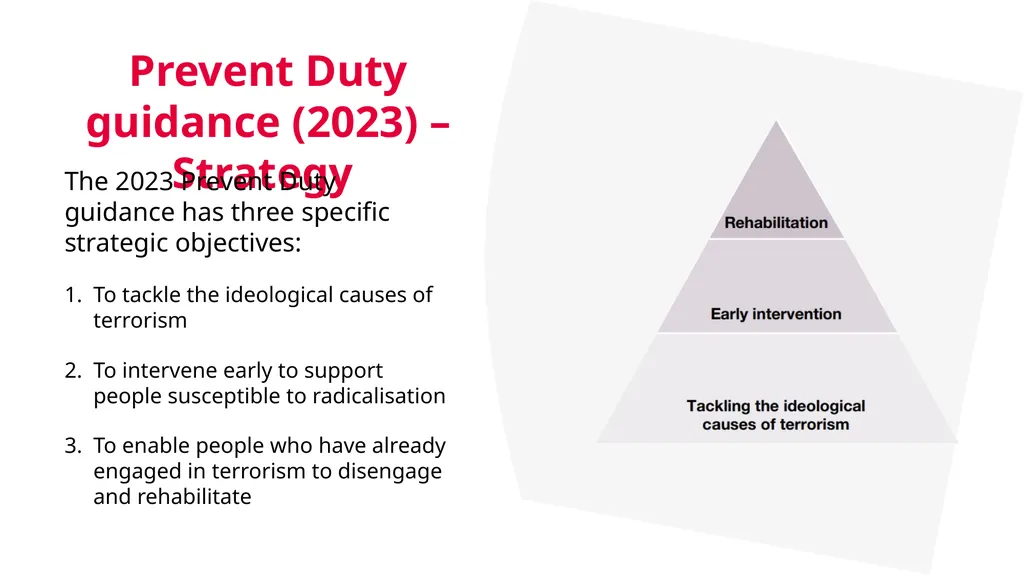
Prevent Duty guidance (2023) – Strategy The 2023 Prevent Duty guidance has three specific strategic objectives:
To tackle the ideological causes of terrorism
To intervene early to support people susceptible to radicalisation
To enable people who have already engaged in terrorism to disengage and rehabilitate<br>
To tackle the ideological causes of terrorism
To intervene early to support people susceptible to radicalisation
To enable people who have already engaged in terrorism to disengage and rehabilitate<br>
08
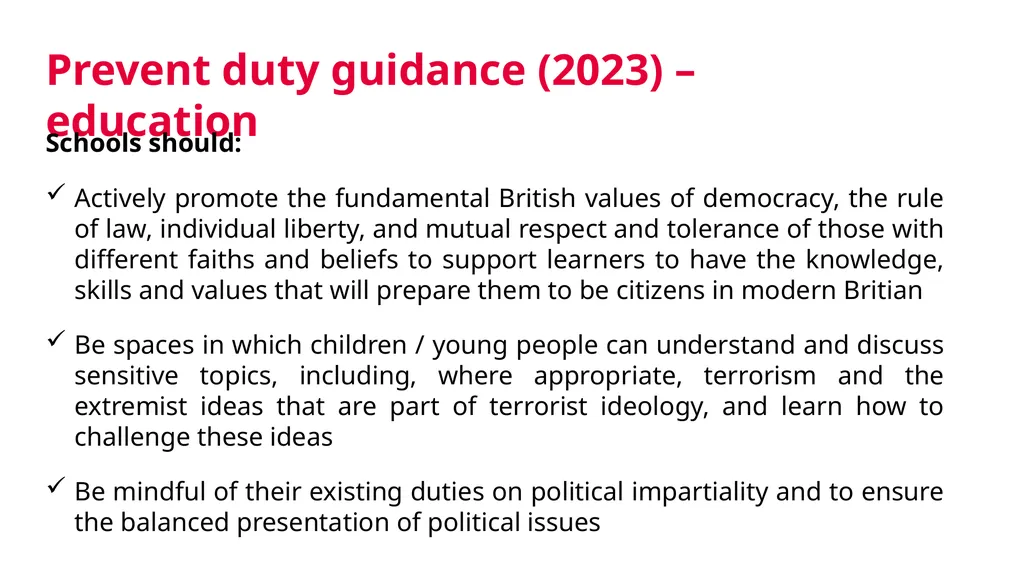
Prevent duty guidance (2023) – education Schools should:
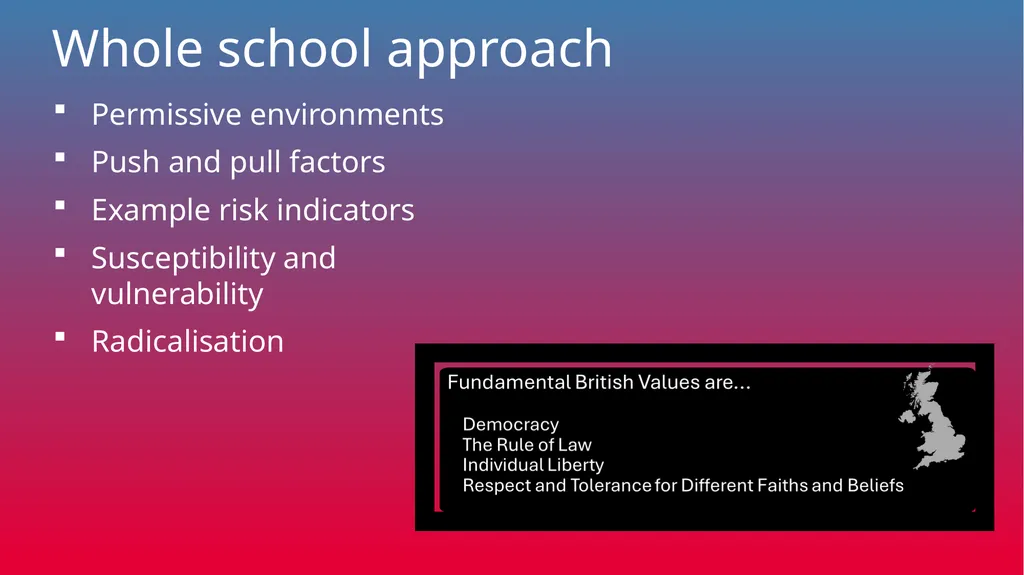
Actively promote the fundamental British values of democracy, the rule of law, individual liberty, and mutual respect and tolerance of those with different faiths and beliefs to support learners to have the knowledge, skills and values that will prepare them to be citizens in modern Britian
Be spaces in which children / young people can understand and discuss sensitive topics, including, where appropriate, terrorism and the extremist ideas that are part of terrorist ideology, and learn how to challenge these ideas
Be mindful of their existing duties on political impartiality and to ensure the balanced presentation of political issues<br>
Actively promote the fundamental British values of democracy, the rule of law, individual liberty, and mutual respect and tolerance of those with different faiths and beliefs to support learners to have the knowledge, skills and values that will prepare them to be citizens in modern Britian
Be spaces in which children / young people can understand and discuss sensitive topics, including, where appropriate, terrorism and the extremist ideas that are part of terrorist ideology, and learn how to challenge these ideas
Be mindful of their existing duties on political impartiality and to ensure the balanced presentation of political issues<br>
09
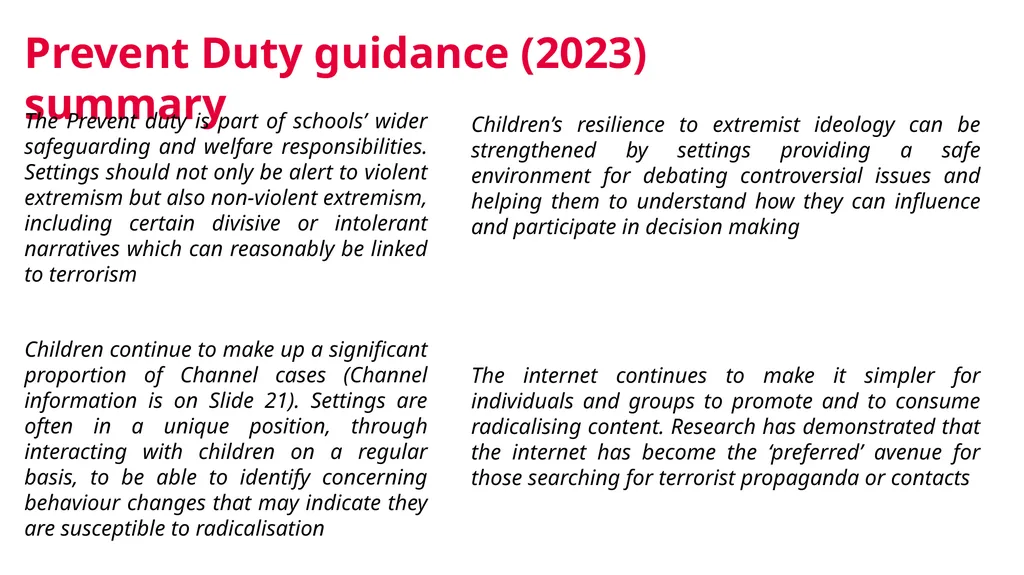
Prevent Duty guidance (2023) summary The Prevent duty is part of schools’ wider safeguarding and welfare responsibilities. Settings should not only be alert to violent extremism but also non-violent extremism, including certain divisive or intolerant narratives which can reasonably be linked to terrorism
Children continue to make up a significant proportion of Channel cases (Channel information is on Slide 21). Settings are often in a unique position, through interacting with children on a regular basis, to be able to identify concerning behaviour changes that may indicate they are susceptible to radicalisation Children’s resilience to extremist ideology can be strengthened by settings providing a safe environment for debating controversial issues and helping them to understand how they can influence and participate in decision making
The internet continues to make it simpler for individuals and groups to promote and to consume radicalising content. Research has demonstrated that the internet has become the ‘preferred’ avenue for those searching for terrorist propaganda or contacts<br>
Children continue to make up a significant proportion of Channel cases (Channel information is on Slide 21). Settings are often in a unique position, through interacting with children on a regular basis, to be able to identify concerning behaviour changes that may indicate they are susceptible to radicalisation Children’s resilience to extremist ideology can be strengthened by settings providing a safe environment for debating controversial issues and helping them to understand how they can influence and participate in decision making
The internet continues to make it simpler for individuals and groups to promote and to consume radicalising content. Research has demonstrated that the internet has become the ‘preferred’ avenue for those searching for terrorist propaganda or contacts<br>
10
Whole school approach Permissive environments
Push and pull factors
Example risk indicators
Susceptibility and vulnerability
Radicalisation<br>
Push and pull factors
Example risk indicators
Susceptibility and vulnerability
Radicalisation<br>
11
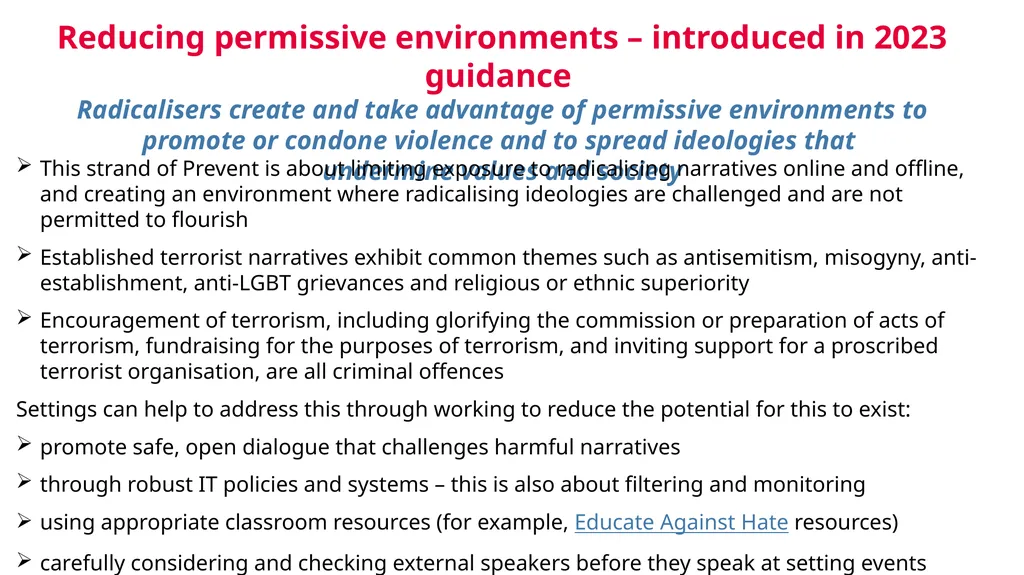
Reducing permissive environments – introduced in 2023 guidance
Radicalisers create and take advantage of permissive environments to promote or condone violence and to spread ideologies that
undermine values and society This strand of Prevent is about limiting exposure to radicalising narratives online and offline, and creating an environment where radicalising ideologies are challenged and are not permitted to flourish
Established terrorist narratives exhibit common themes such as antisemitism, misogyny, anti-establishment, anti-LGBT grievances and religious or ethnic superiority
Encouragement of terrorism, including glorifying the commission or preparation of acts of terrorism, fundraising for the purposes of terrorism, and inviting support for a proscribed terrorist organisation, are all criminal offences
Settings can help to address this through working to reduce the potential for this to exist:
promote safe, open dialogue that challenges harmful narratives
through robust IT policies and systems – this is also about filtering and monitoring
using appropriate classroom resources (for example, Educate Against Hate resources)
carefully considering and checking external speakers before they speak at setting events<br>
Radicalisers create and take advantage of permissive environments to promote or condone violence and to spread ideologies that
undermine values and society This strand of Prevent is about limiting exposure to radicalising narratives online and offline, and creating an environment where radicalising ideologies are challenged and are not permitted to flourish
Established terrorist narratives exhibit common themes such as antisemitism, misogyny, anti-establishment, anti-LGBT grievances and religious or ethnic superiority
Encouragement of terrorism, including glorifying the commission or preparation of acts of terrorism, fundraising for the purposes of terrorism, and inviting support for a proscribed terrorist organisation, are all criminal offences
Settings can help to address this through working to reduce the potential for this to exist:
promote safe, open dialogue that challenges harmful narratives
through robust IT policies and systems – this is also about filtering and monitoring
using appropriate classroom resources (for example, Educate Against Hate resources)
carefully considering and checking external speakers before they speak at setting events<br>
12
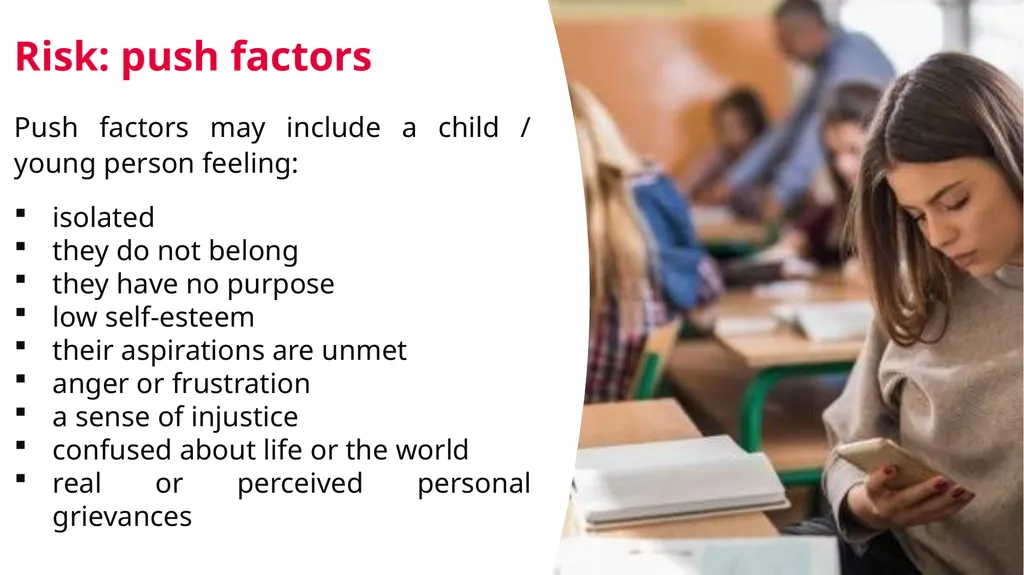
Risk: push factors Push factors may include a child / young person feeling:
isolated
they do not belong
they have no purpose
low self-esteem
their aspirations are unmet
anger or frustration
a sense of injustice
confused about life or the world
real or perceived personal grievances This Photo by Unknown Author is licensed under CC BY-SA-NC<br>
isolated
they do not belong
they have no purpose
low self-esteem
their aspirations are unmet
anger or frustration
a sense of injustice
confused about life or the world
real or perceived personal grievances This Photo by Unknown Author is licensed under CC BY-SA-NC<br>
13
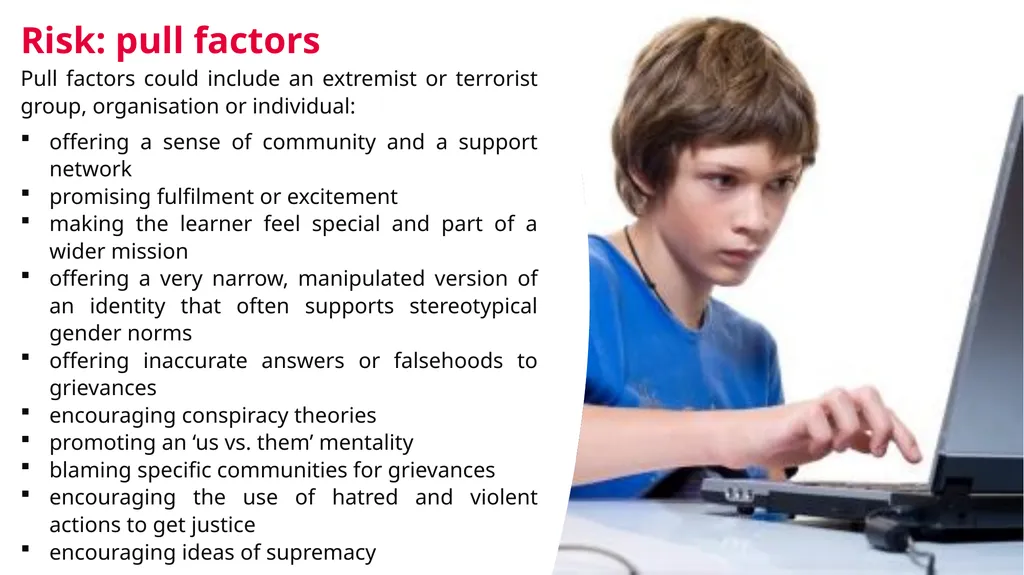
Risk: pull factors Pull factors could include an extremist or terrorist group, organisation or individual:
offering a sense of community and a support network
promising fulfilment or excitement
making the learner feel special and part of a wider mission
offering a very narrow, manipulated version of an identity that often supports stereotypical gender norms
offering inaccurate answers or falsehoods to grievances
encouraging conspiracy theories
promoting an ‘us vs. them’ mentality
blaming specific communities for grievances
encouraging the use of hatred and violent actions to get justice
encouraging ideas of supremacy This Photo by Unknown Author is licensed under CC BY-NC-ND<br>
offering a sense of community and a support network
promising fulfilment or excitement
making the learner feel special and part of a wider mission
offering a very narrow, manipulated version of an identity that often supports stereotypical gender norms
offering inaccurate answers or falsehoods to grievances
encouraging conspiracy theories
promoting an ‘us vs. them’ mentality
blaming specific communities for grievances
encouraging the use of hatred and violent actions to get justice
encouraging ideas of supremacy This Photo by Unknown Author is licensed under CC BY-NC-ND<br>
14
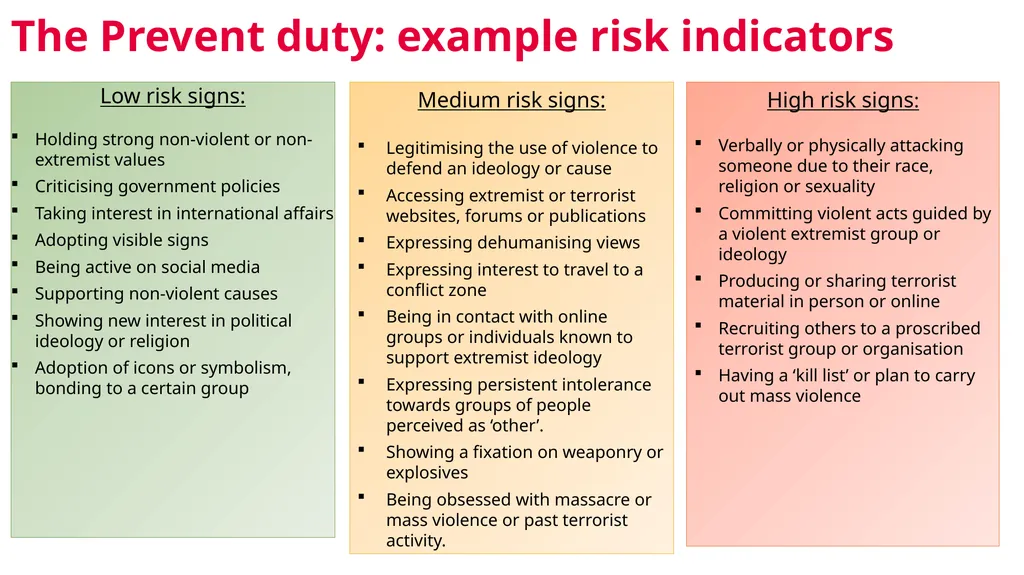
The Prevent duty: example risk indicators Low risk signs:
Holding strong non-violent or non-extremist values
Criticising government policies
Taking interest in international affairs
Adopting visible signs
Being active on social media
Supporting non-violent causes
Showing new interest in political ideology or religion
Adoption of icons or symbolism, bonding to a certain group Medium risk signs:
Legitimising the use of violence to defend an ideology or cause
Accessing extremist or terrorist websites, forums or publications
Expressing dehumanising views
Expressing interest to travel to a conflict zone
Being in contact with online groups or individuals known to support extremist ideology
Expressing persistent intolerance towards groups of people perceived as ‘other’.
Showing a fixation on weaponry or explosives
Being obsessed with massacre or mass violence or past terrorist activity. High risk signs:
Verbally or physically attacking someone due to their race, religion or sexuality
Committing violent acts guided by a violent extremist group or ideology
Producing or sharing terrorist material in person or online
Recruiting others to a proscribed terrorist group or organisation
Having a ‘kill list’ or plan to carry out mass violence<br>
Holding strong non-violent or non-extremist values
Criticising government policies
Taking interest in international affairs
Adopting visible signs
Being active on social media
Supporting non-violent causes
Showing new interest in political ideology or religion
Adoption of icons or symbolism, bonding to a certain group Medium risk signs:
Legitimising the use of violence to defend an ideology or cause
Accessing extremist or terrorist websites, forums or publications
Expressing dehumanising views
Expressing interest to travel to a conflict zone
Being in contact with online groups or individuals known to support extremist ideology
Expressing persistent intolerance towards groups of people perceived as ‘other’.
Showing a fixation on weaponry or explosives
Being obsessed with massacre or mass violence or past terrorist activity. High risk signs:
Verbally or physically attacking someone due to their race, religion or sexuality
Committing violent acts guided by a violent extremist group or ideology
Producing or sharing terrorist material in person or online
Recruiting others to a proscribed terrorist group or organisation
Having a ‘kill list’ or plan to carry out mass violence<br>
15
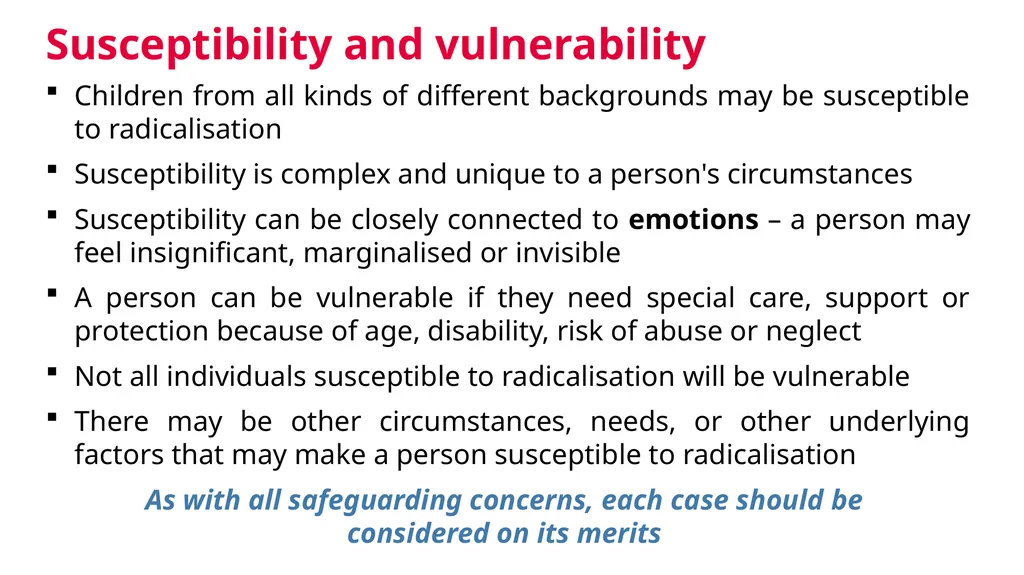
Susceptibility and vulnerability Children from all kinds of different backgrounds may be susceptible to radicalisation
Susceptibility is complex and unique to a person's circumstances
Susceptibility can be closely connected to emotions – a person may feel insignificant, marginalised or invisible
A person can be vulnerable if they need special care, support or protection because of age, disability, risk of abuse or neglect
Not all individuals susceptible to radicalisation will be vulnerable
There may be other circumstances, needs, or other underlying factors that may make a person susceptible to radicalisation
As with all safeguarding concerns, each case should be
considered on its merits<br>
Susceptibility is complex and unique to a person's circumstances
Susceptibility can be closely connected to emotions – a person may feel insignificant, marginalised or invisible
A person can be vulnerable if they need special care, support or protection because of age, disability, risk of abuse or neglect
Not all individuals susceptible to radicalisation will be vulnerable
There may be other circumstances, needs, or other underlying factors that may make a person susceptible to radicalisation
As with all safeguarding concerns, each case should be
considered on its merits<br>
16
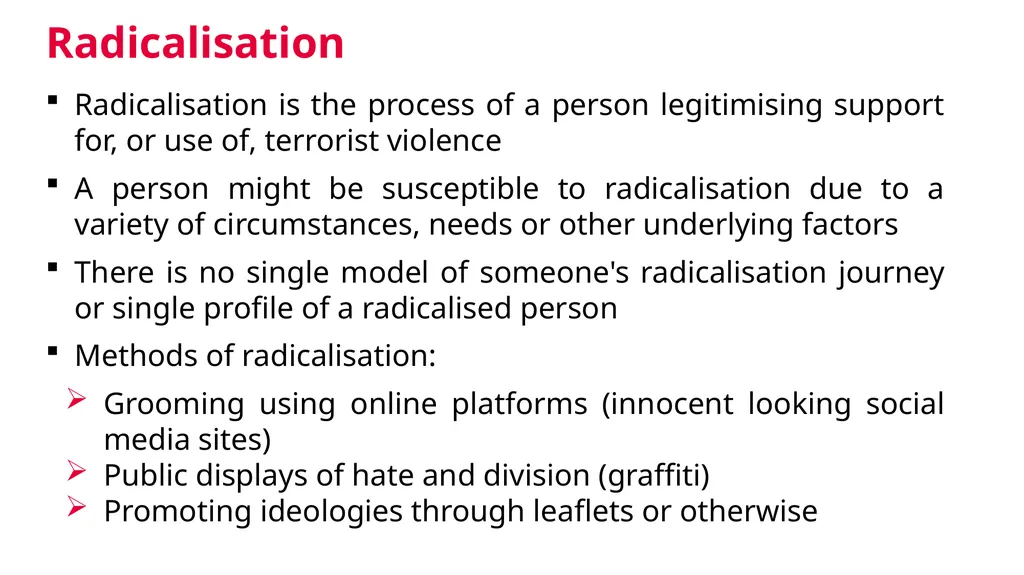
Radicalisation Radicalisation is the process of a person legitimising support for, or use of, terrorist violence
A person might be susceptible to radicalisation due to a variety of circumstances, needs or other underlying factors
There is no single model of someone's radicalisation journey or single profile of a radicalised person
Methods of radicalisation:
Grooming using online platforms (innocent looking social media sites)
Public displays of hate and division (graffiti)
Promoting ideologies through leaflets or otherwise<br>
A person might be susceptible to radicalisation due to a variety of circumstances, needs or other underlying factors
There is no single model of someone's radicalisation journey or single profile of a radicalised person
Methods of radicalisation:
Grooming using online platforms (innocent looking social media sites)
Public displays of hate and division (graffiti)
Promoting ideologies through leaflets or otherwise<br>
17
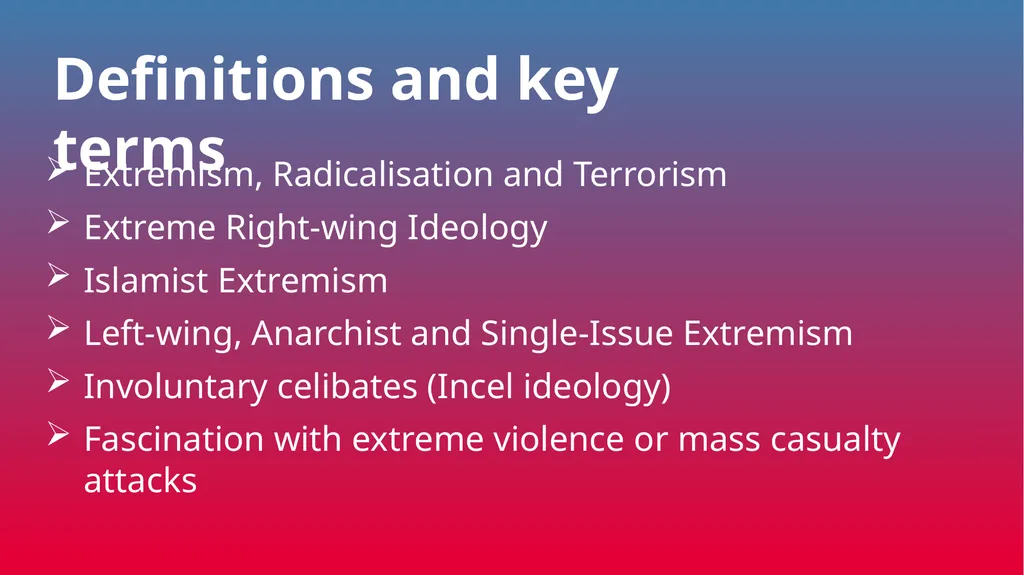
Definitions and key terms Extremism, Radicalisation and Terrorism
Extreme Right-wing Ideology
Islamist Extremism
Left-wing, Anarchist and Single-Issue Extremism
Involuntary celibates (Incel ideology)
Fascination with extreme violence or mass casualty attacks<br>
Extreme Right-wing Ideology
Islamist Extremism
Left-wing, Anarchist and Single-Issue Extremism
Involuntary celibates (Incel ideology)
Fascination with extreme violence or mass casualty attacks<br>
18
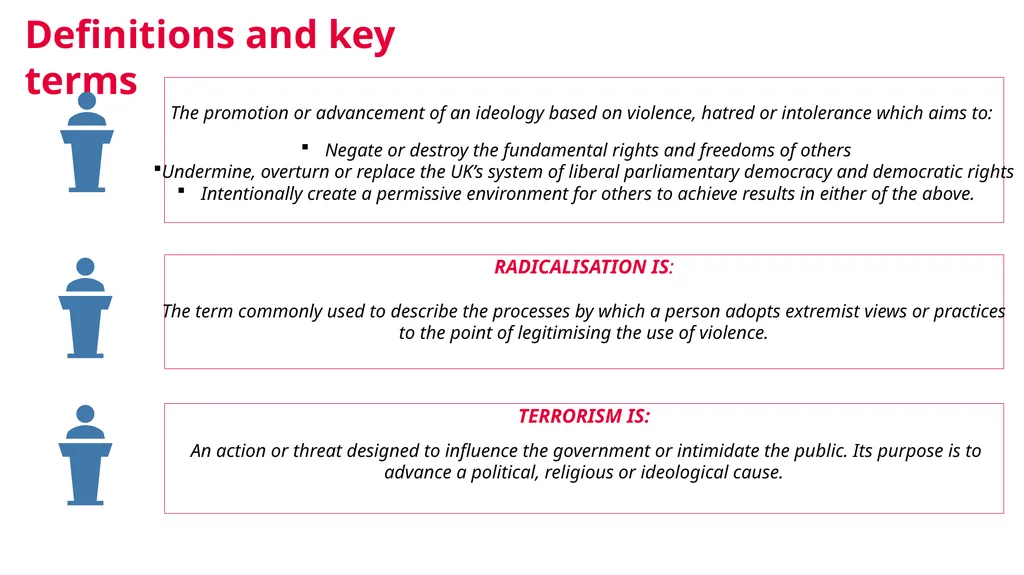
Definitions and key terms EXTREMISM IS:
The promotion or advancement of an ideology based on violence, hatred or intolerance which aims to:
Negate or destroy the fundamental rights and freedoms of others
Undermine, overturn or replace the UK’s system of liberal parliamentary democracy and democratic rights
Intentionally create a permissive environment for others to achieve results in either of the above. RADICALISATION IS:
The term commonly used to describe the processes by which a person adopts extremist views or practices
to the point of legitimising the use of violence. TERRORISM IS:
An action or threat designed to influence the government or intimidate the public. Its purpose is to advance a political, religious or ideological cause.<br>
The promotion or advancement of an ideology based on violence, hatred or intolerance which aims to:
Negate or destroy the fundamental rights and freedoms of others
Undermine, overturn or replace the UK’s system of liberal parliamentary democracy and democratic rights
Intentionally create a permissive environment for others to achieve results in either of the above. RADICALISATION IS:
The term commonly used to describe the processes by which a person adopts extremist views or practices
to the point of legitimising the use of violence. TERRORISM IS:
An action or threat designed to influence the government or intimidate the public. Its purpose is to advance a political, religious or ideological cause.<br>
19
Extreme Right Wing Ideology This covers sub-ideologies including Cultural Nationalism, White Nationalism and White Supremacism - often spans a range of extreme beliefs such as antisemitism, anti-Islam, neo-Nazism, ethno-nationalism or anti-establishment This Photo by Unknown Author is licensed under CC BY-SA<br>
20
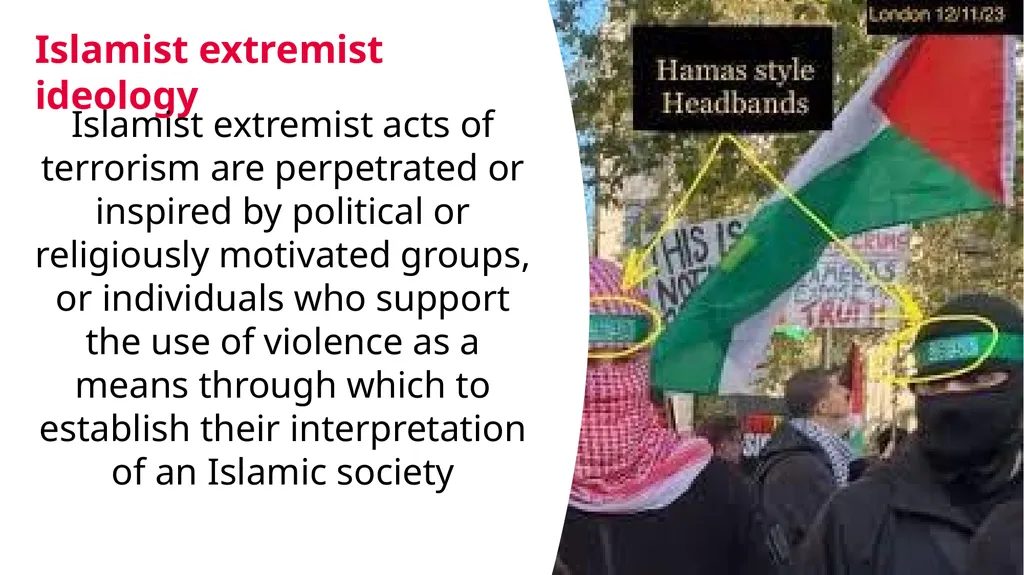
Islamist extremist ideology Islamist extremist acts of terrorism are perpetrated or inspired by political or religiously motivated groups, or individuals who support the use of violence as a means through which to establish their interpretation of an Islamic society<br>
21
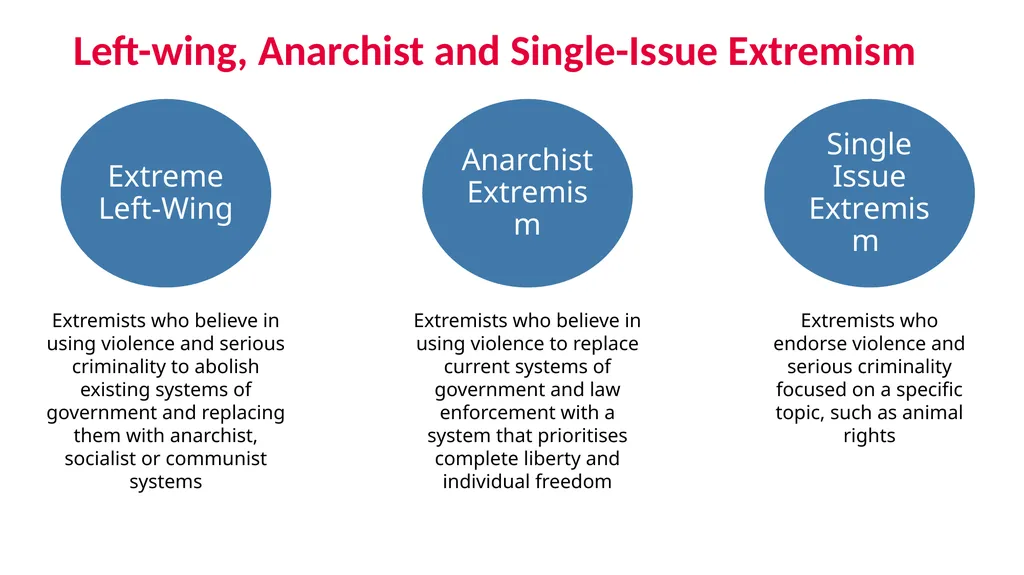
Left-wing, Anarchist and Single-Issue Extremism Extreme Left-Wing Extremists who believe in using violence and serious criminality to abolish existing systems of government and replacing them with anarchist, socialist or communist systems Anarchist Extremism Extremists who believe in using violence to replace current systems of government and law enforcement with a system that prioritises complete liberty and individual freedom Single Issue Extremism Extremists who endorse violence and serious criminality focused on a specific topic, such as animal rights<br>
22
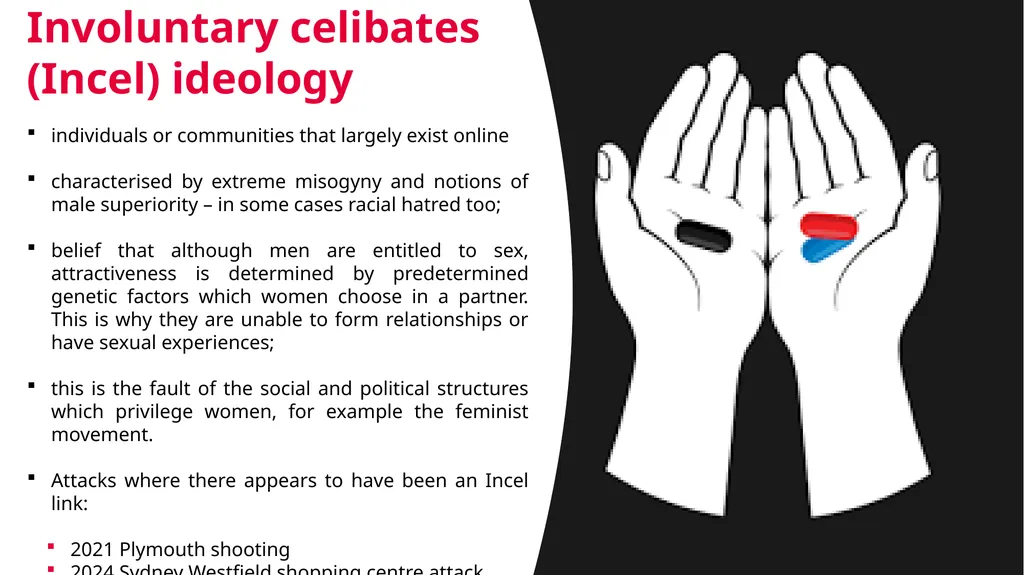
Involuntary celibates (Incel) ideology individuals or communities that largely exist online
characterised by extreme misogyny and notions of male superiority – in some cases racial hatred too;
belief that although men are entitled to sex, attractiveness is determined by predetermined genetic factors which women choose in a partner. This is why they are unable to form relationships or have sexual experiences;
this is the fault of the social and political structures which privilege women, for example the feminist movement.
Attacks where there appears to have been an Incel link:
2021 Plymouth shooting
2024 Sydney Westfield shopping centre attack<br>
characterised by extreme misogyny and notions of male superiority – in some cases racial hatred too;
belief that although men are entitled to sex, attractiveness is determined by predetermined genetic factors which women choose in a partner. This is why they are unable to form relationships or have sexual experiences;
this is the fault of the social and political structures which privilege women, for example the feminist movement.
Attacks where there appears to have been an Incel link:
2021 Plymouth shooting
2024 Sydney Westfield shopping centre attack<br>
23
Fascination with extreme violence or mass casualty attacks This has been a Prevent category since April 2024, despite having no recognised ideological basis – risk indicators:
Fixation on massacres: persistent interest in overseas school shootings, historical mass killings, or genocide
Idolisation of attackers: glorifying previous mass murderers or drawing inspiration from battle sites and extremist symbols
Extreme online behaviour: unsupervised, excessive viewing of gore, violent subcultures, or instructional material on weapons
Justifying violence: expressing a desire for revenge or asserting that violence is an acceptable solution to personal grievances
Social isolation: drastic changes in daily routine, increasing secrecy, or sudden withdrawal from family and friends<br>
Fixation on massacres: persistent interest in overseas school shootings, historical mass killings, or genocide
Idolisation of attackers: glorifying previous mass murderers or drawing inspiration from battle sites and extremist symbols
Extreme online behaviour: unsupervised, excessive viewing of gore, violent subcultures, or instructional material on weapons
Justifying violence: expressing a desire for revenge or asserting that violence is an acceptable solution to personal grievances
Social isolation: drastic changes in daily routine, increasing secrecy, or sudden withdrawal from family and friends<br>
24
Radicalisation using technology Online radicalisation:
The internet (including the ‘Dark Web’) has become a mechanism that groups and individuals with extreme views and ideologies use to find those with similar views, and to groom / radicalise vulnerable children and adults
Apps like WhatsApp, Telegram and Discord provide the opportunity for groups and individuals to meet and befriend individuals in order to radicalise them - End-to-end encryption offered by offered by these apps enables the discussions to remain hidden
Online gaming:
The world of online gaming provides a space for extremists to lure vulnerable individuals into spaces where they can be radicalised
In-game functions such as ‘team-speak’ facilitate this as it enables individuals to vocally communicate with others in-game without being ‘friends’ with them
The connectivity of online gaming provides extremists with the opportunity to befriend vulnerable people, luring them into groups who (under the pretext of gaming) can seek to radicalise them<br>
The internet (including the ‘Dark Web’) has become a mechanism that groups and individuals with extreme views and ideologies use to find those with similar views, and to groom / radicalise vulnerable children and adults
Apps like WhatsApp, Telegram and Discord provide the opportunity for groups and individuals to meet and befriend individuals in order to radicalise them - End-to-end encryption offered by offered by these apps enables the discussions to remain hidden
Online gaming:
The world of online gaming provides a space for extremists to lure vulnerable individuals into spaces where they can be radicalised
In-game functions such as ‘team-speak’ facilitate this as it enables individuals to vocally communicate with others in-game without being ‘friends’ with them
The connectivity of online gaming provides extremists with the opportunity to befriend vulnerable people, luring them into groups who (under the pretext of gaming) can seek to radicalise them<br>
25
Channel Panel: Voluntary support programme to provide support at early stage to people identified as vulnerable to being drawn into terrorism
Multi-agency panel (Head of Education Safeguarding and Wellbeing sits on panel for Education)
Education setting invited to join meeting to contribute information and be involved in planning (where an individual is linked to the setting)
Young person could refuse to consent, but that may constitute a child protection concern in itself (if not willing to work with agencies)
If adopted to Channel, appropriate intervention and support will be identified to address concerns, educate the individual and provide a counter-narrative<br>
Multi-agency panel (Head of Education Safeguarding and Wellbeing sits on panel for Education)
Education setting invited to join meeting to contribute information and be involved in planning (where an individual is linked to the setting)
Young person could refuse to consent, but that may constitute a child protection concern in itself (if not willing to work with agencies)
If adopted to Channel, appropriate intervention and support will be identified to address concerns, educate the individual and provide a counter-narrative<br>
26
Prevent in Essex<br>
27
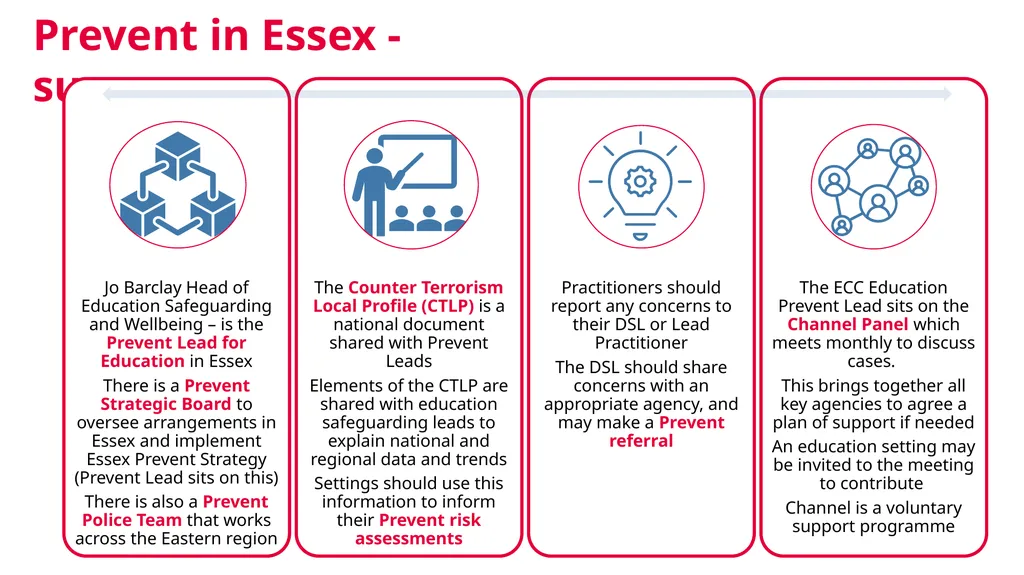
Prevent in Essex - summary<br>
28
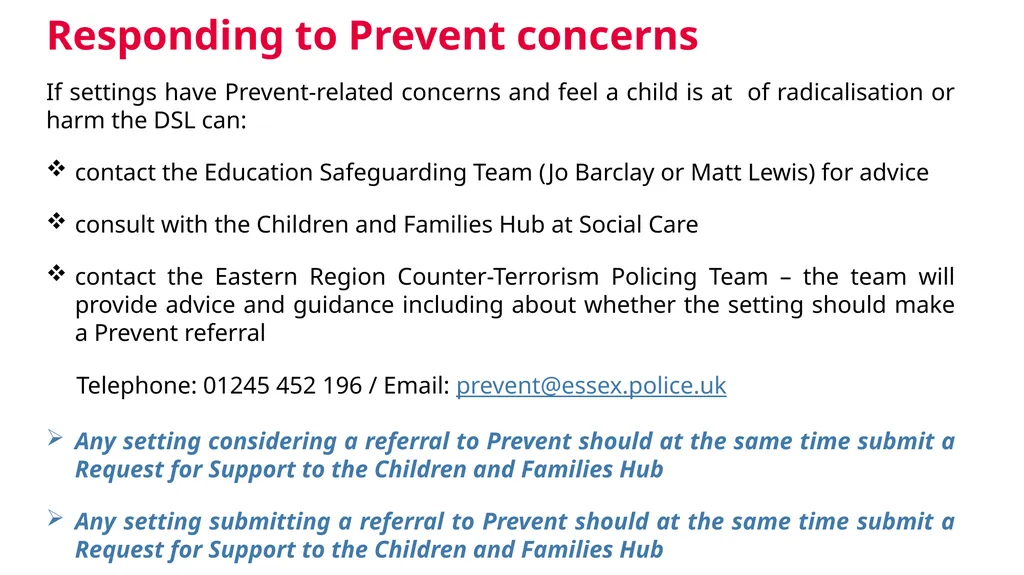
Responding to Prevent concerns If settings have Prevent-related concerns and feel a child is at of radicalisation or harm the DSL can:
contact the Education Safeguarding Team (Jo Barclay or Matt Lewis) for advice
consult with the Children and Families Hub at Social Care
contact the Eastern Region Counter-Terrorism Policing Team – the team will provide advice and guidance including about whether the setting should make a Prevent referral
Telephone: 01245 452 196 / Email: prevent@essex.police.uk
Any setting considering a referral to Prevent should at the same time submit a Request for Support to the Children and Families Hub
Any setting submitting a referral to Prevent should at the same time submit a Request for Support to the Children and Families Hub
PREVENT response section on Essex Schools Infolink<br>
contact the Education Safeguarding Team (Jo Barclay or Matt Lewis) for advice
consult with the Children and Families Hub at Social Care
contact the Eastern Region Counter-Terrorism Policing Team – the team will provide advice and guidance including about whether the setting should make a Prevent referral
Telephone: 01245 452 196 / Email: prevent@essex.police.uk
Any setting considering a referral to Prevent should at the same time submit a Request for Support to the Children and Families Hub
Any setting submitting a referral to Prevent should at the same time submit a Request for Support to the Children and Families Hub
PREVENT response section on Essex Schools Infolink<br>
29
Prevent: government resources Prevent duty guidance
The Prevent duty: safeguarding learners vulnerable to radicalisation - GOV.UK (www.gov.uk)
How to complete a risk assessment to assess the risk of people becoming terrorists or supporting terrorism - GOV.UK (www.gov.uk)
Understanding and identifying radicalisation risk in your education setting - GOV.UK
Managing risk of radicalisation in your education setting - GOV.UK
Making a referral to Prevent - GOV.UK
Case studies - GOV.UK<br>
The Prevent duty: safeguarding learners vulnerable to radicalisation - GOV.UK (www.gov.uk)
How to complete a risk assessment to assess the risk of people becoming terrorists or supporting terrorism - GOV.UK (www.gov.uk)
Understanding and identifying radicalisation risk in your education setting - GOV.UK
Managing risk of radicalisation in your education setting - GOV.UK
Making a referral to Prevent - GOV.UK
Case studies - GOV.UK<br>
30
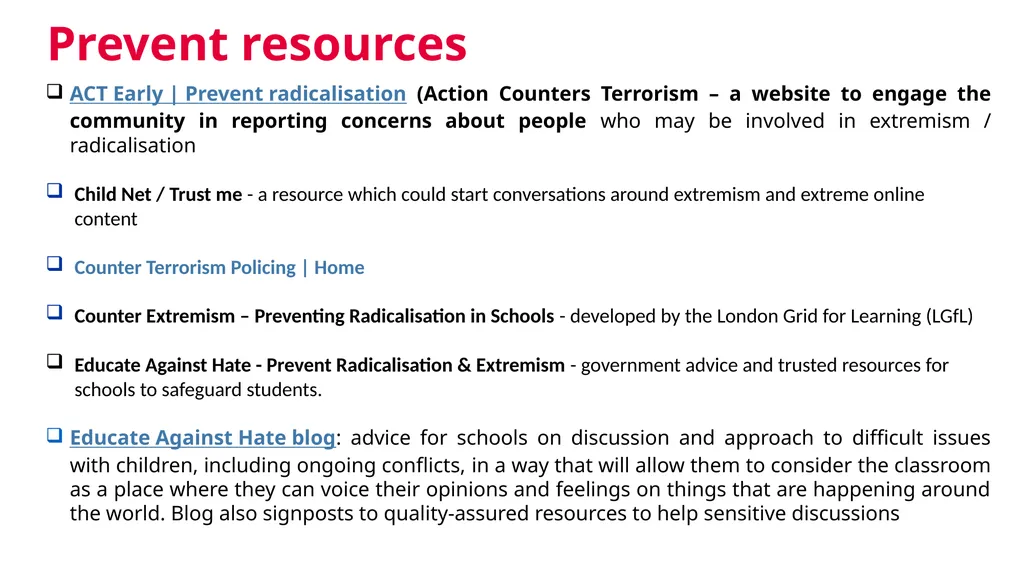
Prevent resources ACT Early | Prevent radicalisation (Action Counters Terrorism – a website to engage the community in reporting concerns about people who may be involved in extremism / radicalisation
Child Net / Trust me - a resource which could start conversations around extremism and extreme online content
Counter Terrorism Policing | Home
Counter Extremism – Preventing Radicalisation in Schools - developed by the London Grid for Learning (LGfL)
Educate Against Hate - Prevent Radicalisation & Extremism - government advice and trusted resources for schools to safeguard students.
Educate Against Hate blog: advice for schools on discussion and approach to difficult issues with children, including ongoing conflicts, in a way that will allow them to consider the classroom as a place where they can voice their opinions and feelings on things that are happening around the world. Blog also signposts to quality-assured resources to help sensitive discussions<br>
Child Net / Trust me - a resource which could start conversations around extremism and extreme online content
Counter Terrorism Policing | Home
Counter Extremism – Preventing Radicalisation in Schools - developed by the London Grid for Learning (LGfL)
Educate Against Hate - Prevent Radicalisation & Extremism - government advice and trusted resources for schools to safeguard students.
Educate Against Hate blog: advice for schools on discussion and approach to difficult issues with children, including ongoing conflicts, in a way that will allow them to consider the classroom as a place where they can voice their opinions and feelings on things that are happening around the world. Blog also signposts to quality-assured resources to help sensitive discussions<br>
31
This information is issued by: Essex County Council Contact us:
educationsafeguarding@essex.gov.uk
Education Safeguarding Team Essex County Council County Hall, Chelmsford Essex, CM1 1QH Essex_CC facebook.com/essexcountycouncil Published August Autumn 2026<br>
Education Safeguarding Team Essex County Council County Hall, Chelmsford Essex, CM1 1QH Essex_CC facebook.com/essexcountycouncil Published August Autumn 2026<br>