MasculinityFemininity in 10 minutes Geert Hofstede August 2014 Origin of the terms masculinity and femininity The adjectives masculine and feminine are latinized versions of male and female, used for man-like and woman-like
"Masculinity/Femininity in 10 minutes Geert" is the property of its rightful owner. Permission is granted to
download and print the materials on this website for personal, non-commercial use only, and to display it
on your personal computer provided you do not modify the materials and that you retain all copyright
notices contained in the materials. By downloading content from our website, you accept the terms of this
agreement.
Presentation Transcript
01
Masculinity/Femininity in 10 minutes Geert Hofstede
August 2014<br>
02
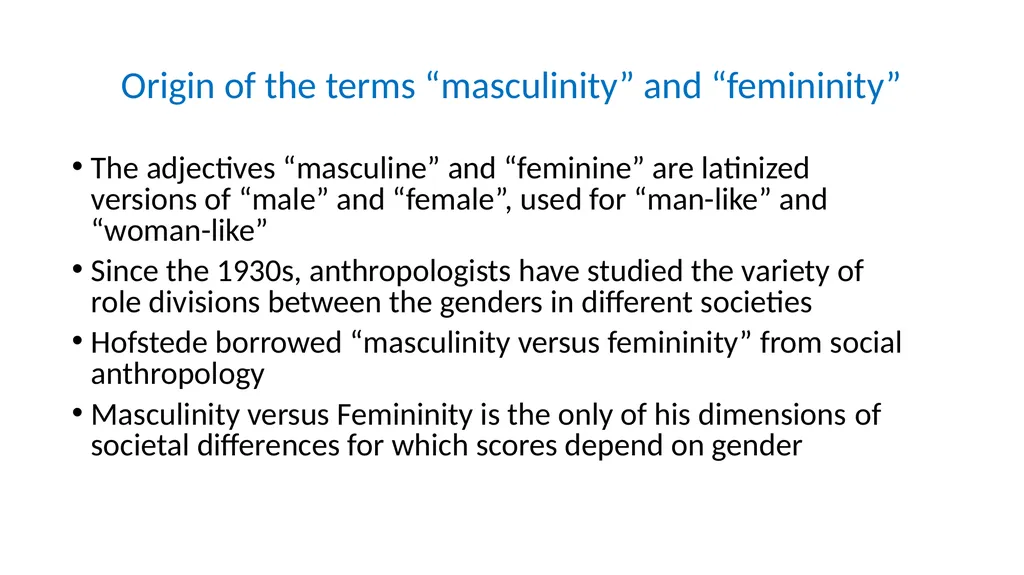
Origin of the terms “masculinity” and “femininity” The adjectives “masculine” and “feminine” are latinized versions of “male” and “female”, used for “man-like” and “woman-like”
Since the 1930s, anthropologists have studied the variety of role divisions between the genders in different societies
Hofstede borrowed “masculinity versus femininity” from social anthropology
Masculinity versus Femininity is the only of his dimensions of societal differences for which scores depend on gender<br>
03
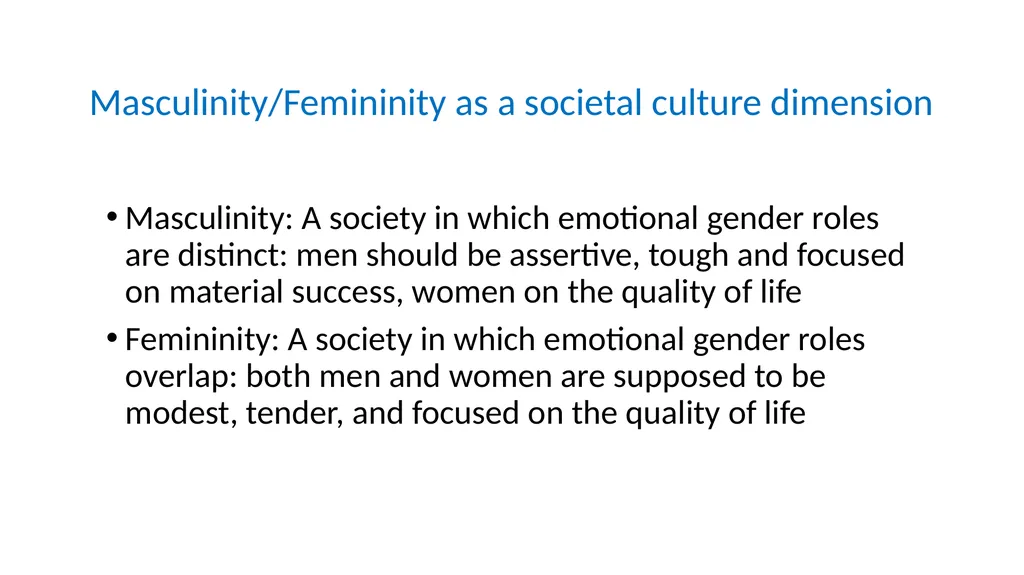
Masculinity/Femininity as a societal culture dimension Masculinity: A society in which emotional gender roles are distinct: men should be assertive, tough and focused on material success, women on the quality of life
Femininity: A society in which emotional gender roles overlap: both men and women are supposed to be modest, tender, and focused on the quality of life<br>
04
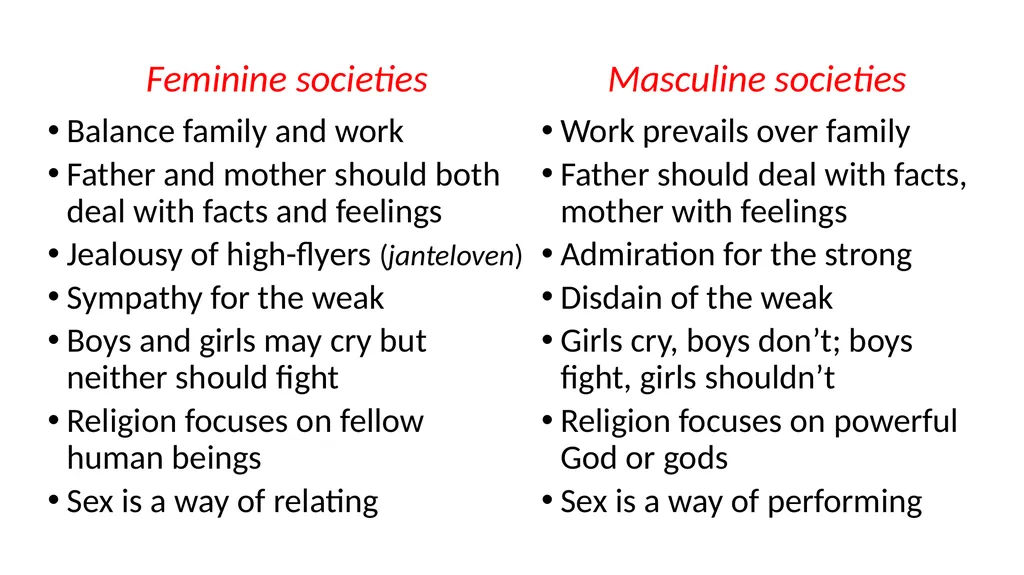
Feminine societies
Balance family and work
Father and mother should both deal with facts and feelings
Jealousy of high-flyers (janteloven)
Sympathy for the weak
Boys and girls may cry but neither should fight
Religion focuses on fellow human beings
Sex is a way of relating Masculine societies
Work prevails over family
Father should deal with facts, mother with feelings
Admiration for the strong
Disdain of the weak
Girls cry, boys don’t; boys fight, girls shouldn’t
Religion focuses on powerful God or gods
Sex is a way of performing<br>
05
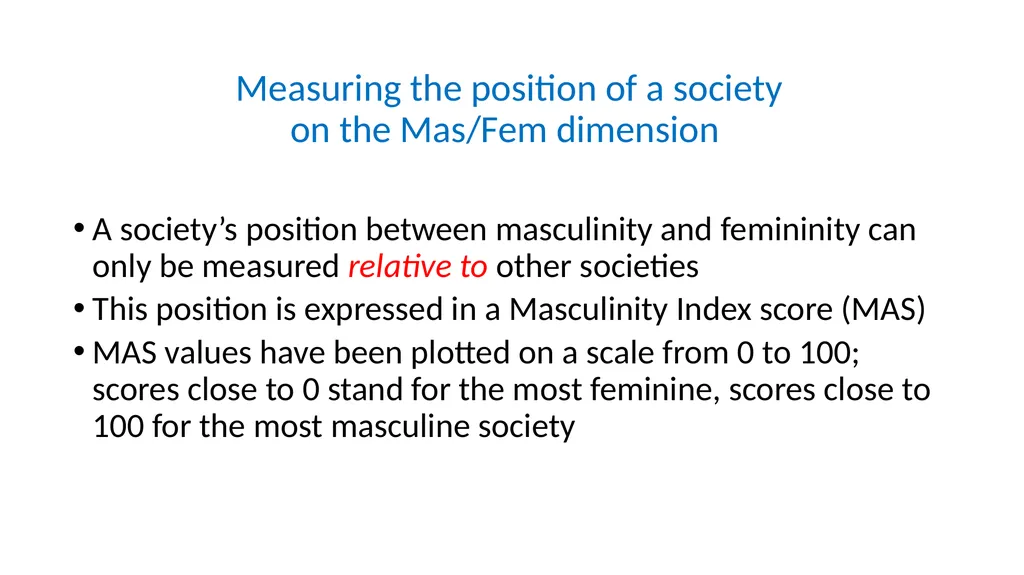
Measuring the position of a society on the Mas/Fem dimension A society’s position between masculinity and femininity can only be measured relative to other societies
This position is expressed in a Masculinity Index score (MAS)
MAS values have been plotted on a scale from 0 to 100; scores close to 0 stand for the most feminine, scores close to 100 for the most masculine society<br>
06
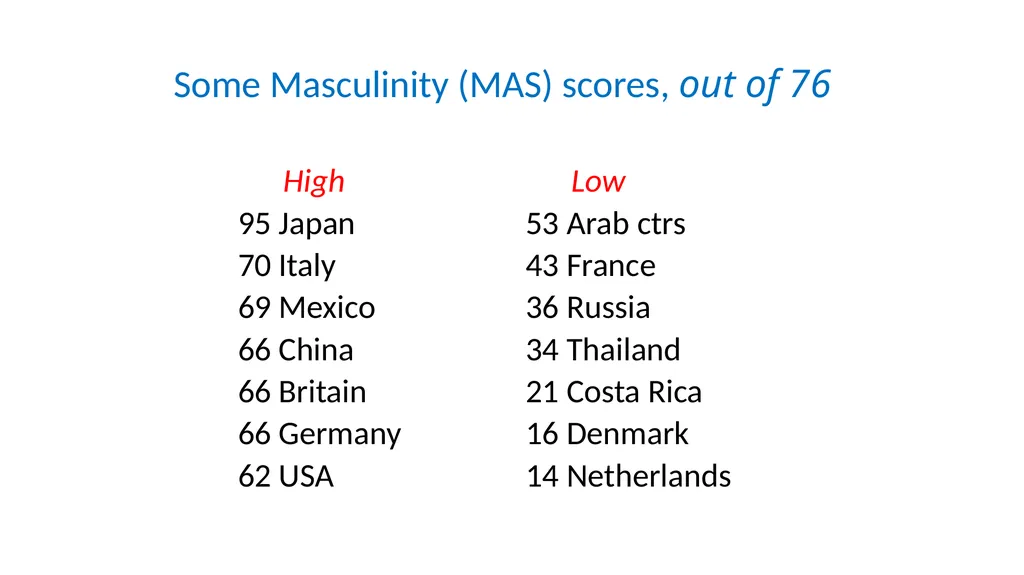
Some Masculinity (MAS) scores, out of 76 High
95 Japan
70 Italy
69 Mexico
66 China
66 Britain
66 Germany
62 USA Low
53 Arab ctrs
43 France
36 Russia
34 Thailand
21 Costa Rica
16 Denmark
14 Netherlands<br>
07
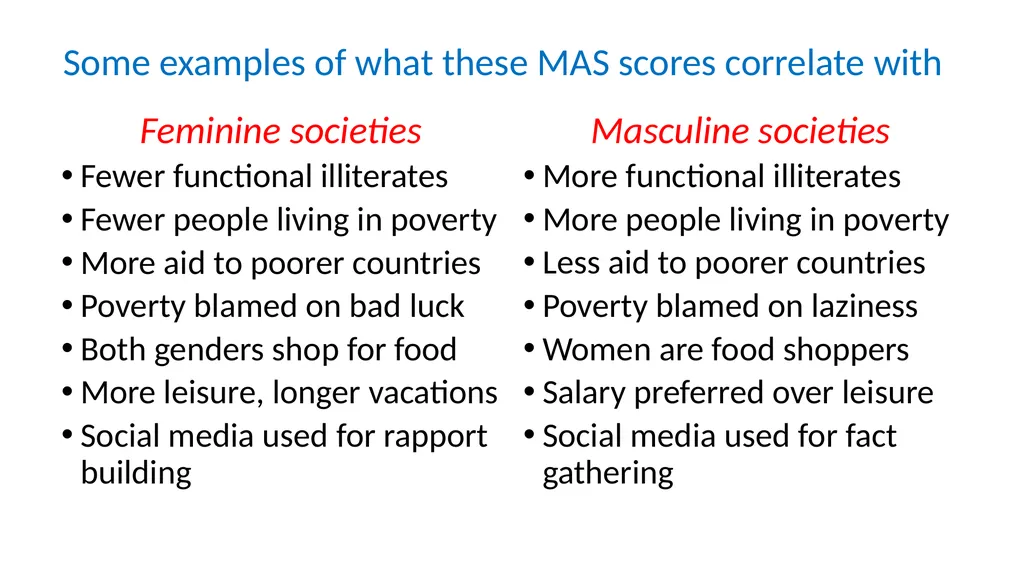
Some examples of what these MAS scores correlate with Feminine societies
Fewer functional illiterates
Fewer people living in poverty
More aid to poorer countries
Poverty blamed on bad luck
Both genders shop for food
More leisure, longer vacations
Social media used for rapport building Masculine societies
More functional illiterates
More people living in poverty
Less aid to poorer countries
Poverty blamed on laziness
Women are food shoppers
Salary preferred over leisure
Social media used for fact gathering<br>
08
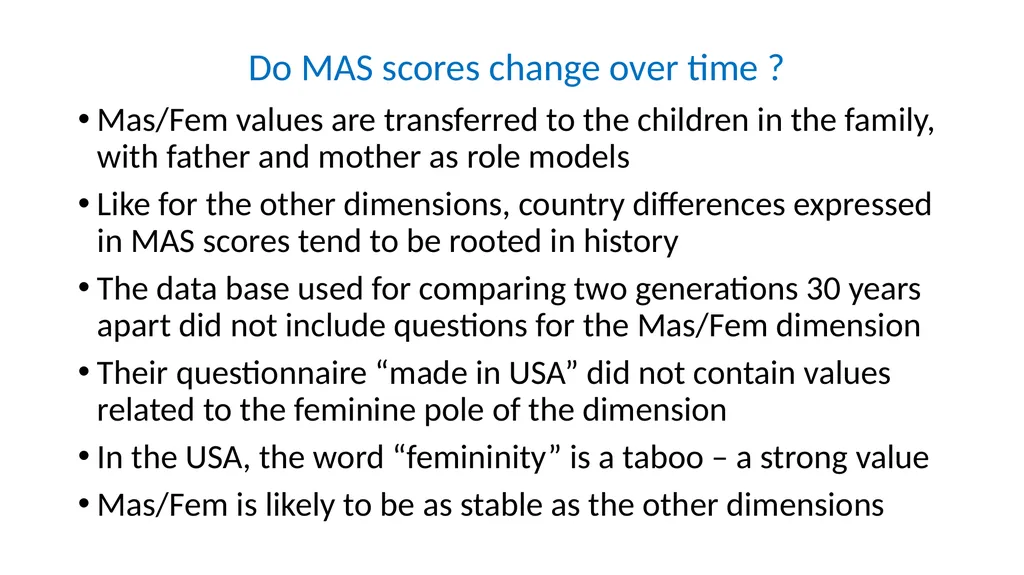
Do MAS scores change over time ? Mas/Fem values are transferred to the children in the family, with father and mother as role models
Like for the other dimensions, country differences expressed in MAS scores tend to be rooted in history
The data base used for comparing two generations 30 years apart did not include questions for the Mas/Fem dimension
Their questionnaire “made in USA” did not contain values related to the feminine pole of the dimension
In the USA, the word “femininity” is a taboo – a strong value
Mas/Fem is likely to be as stable as the other dimensions<br>