
Mind Management Skills Workshops Striking The
KL
Published · 35 slides · 0 views

1 / 1








Description
Mind Management Skills Workshops Striking The Balance Mind management skills to help you lead a balanced student life in the face of university demands PTTRC Mind Management Workshops Our clinic Psychological Therapies Training and
Related Topics
Share
Embed code
Download this presentation From Below
"Mind Management Skills Workshops Striking The" is the property of its rightful owner. Permission is granted to download and print the materials on this website for personal, non-commercial use only, and to display it on your personal computer provided you do not modify the materials and that you retain all copyright notices contained in the materials. By downloading content from our website, you accept the terms of this agreement.
Presentation Transcript
01
Mind Management Skills Workshops Striking The Balance
Mind management skills to help you lead a balanced student life in the face of university demands<br>
Mind management skills to help you lead a balanced student life in the face of university demands<br>
02
PTTRC Mind Management Workshops Our clinic – Psychological Therapies Training and Research Clinic – data is required to help us develop these groups and understand what works
Our roles: Cognitive Behavioural Therapists and Clinical Psychologists (and trainee clinicians)
The purpose of these workshops – to reach a greater number of students experiencing common emotional problems and stressors
Based fully on the student voices and reports of what issues cause you distress
Based on Cognitive Behavioural Therapy (CBT)
Invitation to learn new skills and meet new people<br>
Our roles: Cognitive Behavioural Therapists and Clinical Psychologists (and trainee clinicians)
The purpose of these workshops – to reach a greater number of students experiencing common emotional problems and stressors
Based fully on the student voices and reports of what issues cause you distress
Based on Cognitive Behavioural Therapy (CBT)
Invitation to learn new skills and meet new people<br>
03
Housekeeping Today’s workshop will run for 90 minutes and is designed to be interactive – we encourage participation
Confidentiality – you are not expected to share anything that you do not want to, however we do request that anything that is shared remains confidential and is not shared with any one else outside of the group
Please be respectful of other group members who may choose to share their experiences – maintain the confidentiality of the group<br>
Confidentiality – you are not expected to share anything that you do not want to, however we do request that anything that is shared remains confidential and is not shared with any one else outside of the group
Please be respectful of other group members who may choose to share their experiences – maintain the confidentiality of the group<br>
04
Further Support The workshops are designed to be skills-focussed, rather than problem-centred. However, if any of today’s discussion or exercises cause you to experience distress, or you feel you need further support, you may wish to pursue further help
Services:
Accessing the Student Health and Wellbeing Service
Listening services such as the Nightline and the Samaritans
Evidence based therapy through NHS IAPT services (GP referral or self referral)<br>
Services:
Accessing the Student Health and Wellbeing Service
Listening services such as the Nightline and the Samaritans
Evidence based therapy through NHS IAPT services (GP referral or self referral)<br>
05
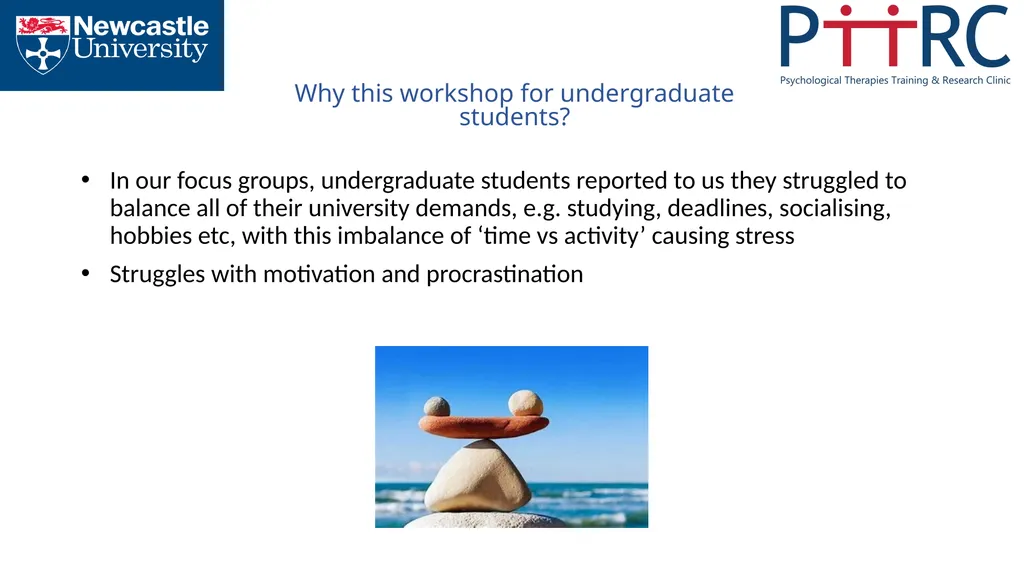
Why this workshop for undergraduate students? In our focus groups, undergraduate students reported to us they struggled to balance all of their university demands, e.g. studying, deadlines, socialising, hobbies etc, with this imbalance of ‘time vs activity’ causing stress
Struggles with motivation and procrastination<br>
Struggles with motivation and procrastination<br>
06
Goals for today Understand how we get caught in vicious cycles based on CBT principles
The science behind motivation and what we can do about it
Learn behavioural strategies/s based on evidence based CBT to schedule activities in a balanced way
Identify behaviours within each area of activity that are important to you, and mechanisms to ensure a balance is executed and maintained
Tips for procastination<br>
The science behind motivation and what we can do about it
Learn behavioural strategies/s based on evidence based CBT to schedule activities in a balanced way
Identify behaviours within each area of activity that are important to you, and mechanisms to ensure a balance is executed and maintained
Tips for procastination<br>
07
Questionnaire<br>
08
Cognitive: refers to the thoughts you have about yourself, other people and the situations/events that take place around you.
Behavioural refers to what you do or don’t do because of how you are thinking or feeling
We will explore now how your thoughts, emotions and behaviours are interconnected and relate to situations/events you find yourself in. We call this the ‘vicious cycle’. What is CBT<br>
Behavioural refers to what you do or don’t do because of how you are thinking or feeling
We will explore now how your thoughts, emotions and behaviours are interconnected and relate to situations/events you find yourself in. We call this the ‘vicious cycle’. What is CBT<br>
09
Unhelpful thoughts and behavioural responses to life’s events happen all the time
Depending on how the person responds to them, they can pass quickly or linger on, causing greater impact
Vicious cycles can occur, between what we think, how we feel and what we do
Thoughts, emotions and behaviours
When these become unhelpful in response to a trigger, they can lead to difficulties with stress and other unwanted emotions (e.g. anxiety) Vicious Cycle<br>
Depending on how the person responds to them, they can pass quickly or linger on, causing greater impact
Vicious cycles can occur, between what we think, how we feel and what we do
Thoughts, emotions and behaviours
When these become unhelpful in response to a trigger, they can lead to difficulties with stress and other unwanted emotions (e.g. anxiety) Vicious Cycle<br>
10
Psychological Therapies Training and Research Clinic; School of Psychology Thoughts Emotions Behaviour Trigger Vicious Cycle<br>
11
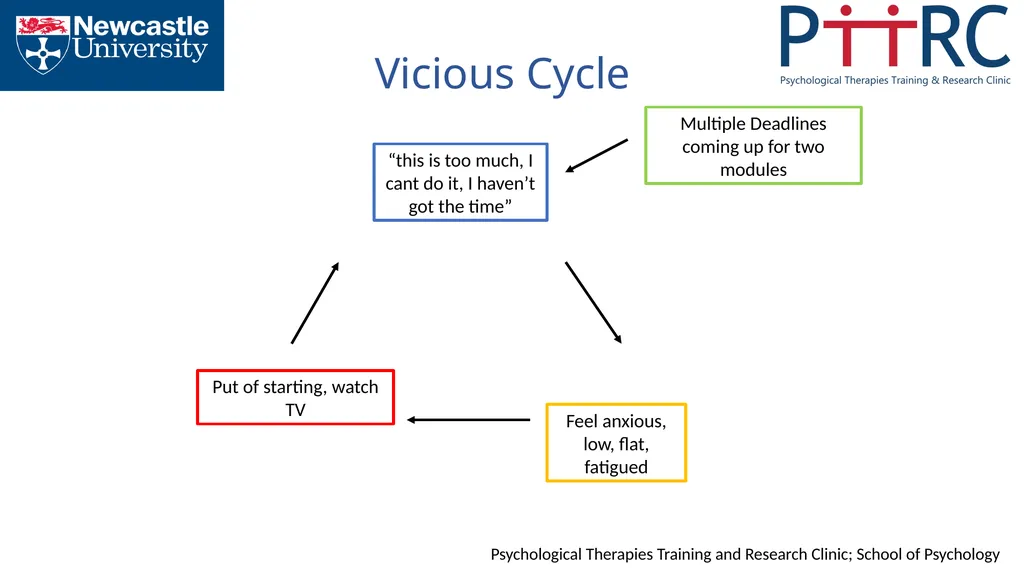
Psychological Therapies Training and Research Clinic; School of Psychology “this is too much, I cant do it, I haven’t got the time” Feel anxious, low, flat, fatigued Put of starting, watch TV Multiple Deadlines coming up for two modules Vicious Cycle<br>
12
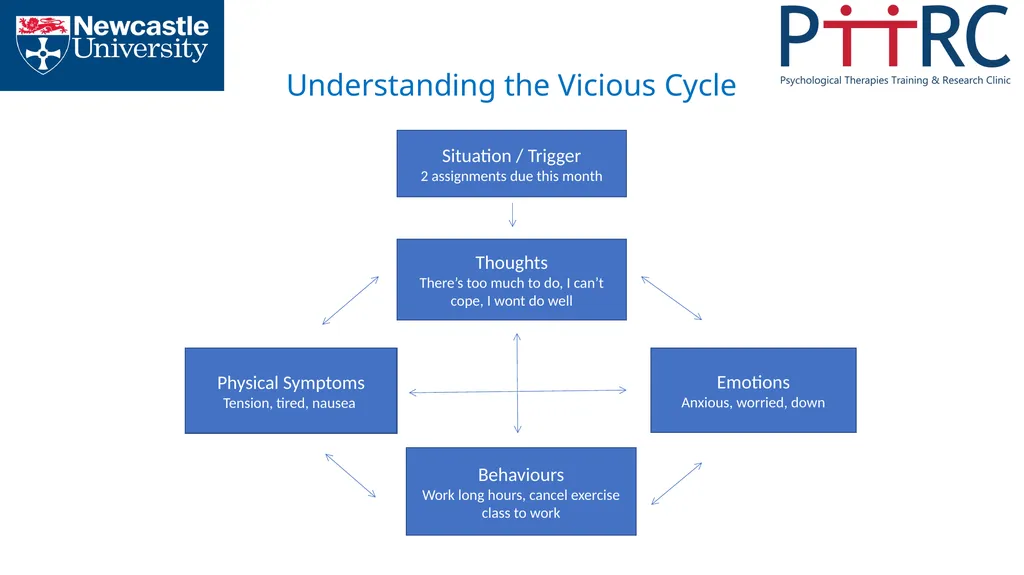
Understanding the Vicious Cycle Situation / Trigger
2 assignments due this month Thoughts
There’s too much to do, I can’t cope, I wont do well Physical Symptoms
Tension, tired, nausea Emotions
Anxious, worried, down Behaviours
Work long hours, cancel exercise class to work<br>
2 assignments due this month Thoughts
There’s too much to do, I can’t cope, I wont do well Physical Symptoms
Tension, tired, nausea Emotions
Anxious, worried, down Behaviours
Work long hours, cancel exercise class to work<br>
13
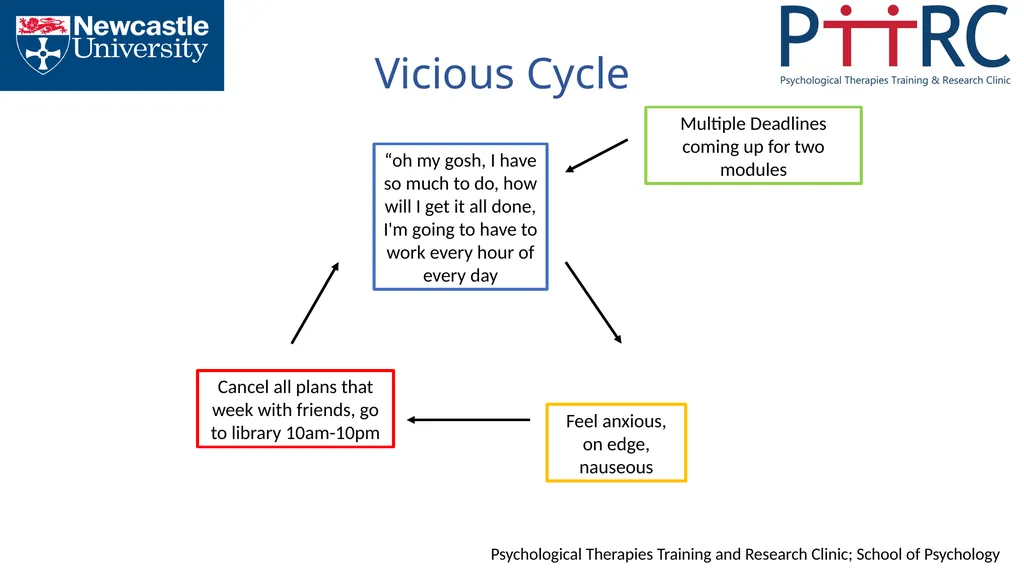
Psychological Therapies Training and Research Clinic; School of Psychology “oh my gosh, I have so much to do, how will I get it all done, I'm going to have to work every hour of every day Feel anxious, on edge, nauseous Cancel all plans that week with friends, go to library 10am-10pm Multiple Deadlines coming up for two modules Vicious Cycle<br>
14
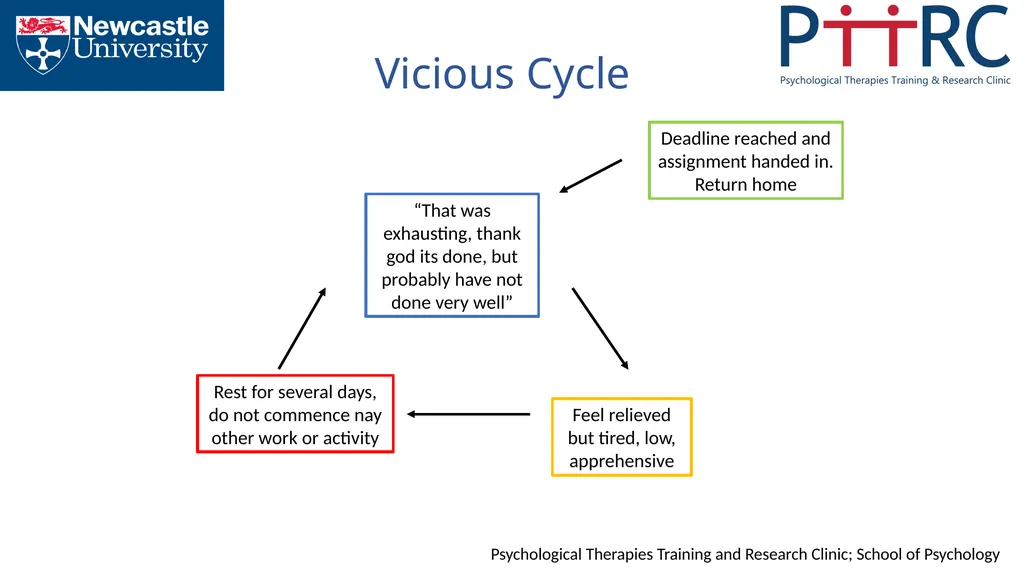
Psychological Therapies Training and Research Clinic; School of Psychology “That was exhausting, thank god its done, but probably have not done very well” Feel relieved but tired, low, apprehensive Rest for several days, do not commence nay other work or activity Deadline reached and assignment handed in. Return home Vicious Cycle<br>
15
In small groups of 2 or 3, consider an example of a time that you felt overwhelmed, stressed, anxious or low in relation to a time you were too busy, overwhelmed, or your life felt out of balance.
Consider:
What situation, event or “trigger” was happening at the time? (what was happening that meant I was too busy, overwhelmed etc)
What thoughts were going through your mind then, about the events?
How did those thoughts make you feel? (emotionally and/or physically)
How did the way you were feeling make you behave? What did you do at the time?
Were you in a “vicious cycle?” Over to you<br>
Consider:
What situation, event or “trigger” was happening at the time? (what was happening that meant I was too busy, overwhelmed etc)
What thoughts were going through your mind then, about the events?
How did those thoughts make you feel? (emotionally and/or physically)
How did the way you were feeling make you behave? What did you do at the time?
Were you in a “vicious cycle?” Over to you<br>
16
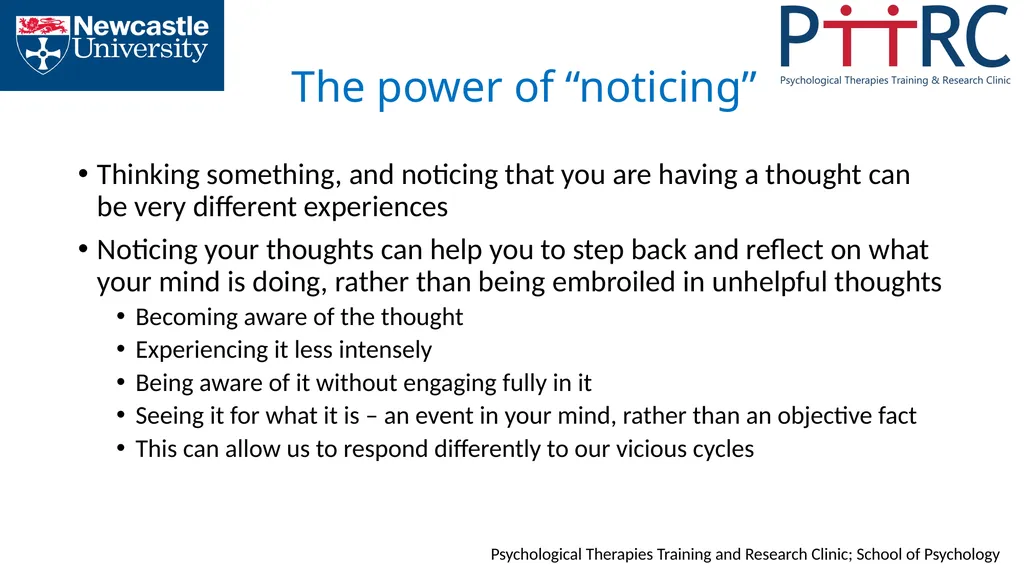
The power of “noticing” Thinking something, and noticing that you are having a thought can be very different experiences
Noticing your thoughts can help you to step back and reflect on what your mind is doing, rather than being embroiled in unhelpful thoughts
Becoming aware of the thought
Experiencing it less intensely
Being aware of it without engaging fully in it
Seeing it for what it is – an event in your mind, rather than an objective fact
This can allow us to respond differently to our vicious cycles Psychological Therapies Training and Research Clinic; School of Psychology<br>
Noticing your thoughts can help you to step back and reflect on what your mind is doing, rather than being embroiled in unhelpful thoughts
Becoming aware of the thought
Experiencing it less intensely
Being aware of it without engaging fully in it
Seeing it for what it is – an event in your mind, rather than an objective fact
This can allow us to respond differently to our vicious cycles Psychological Therapies Training and Research Clinic; School of Psychology<br>
17
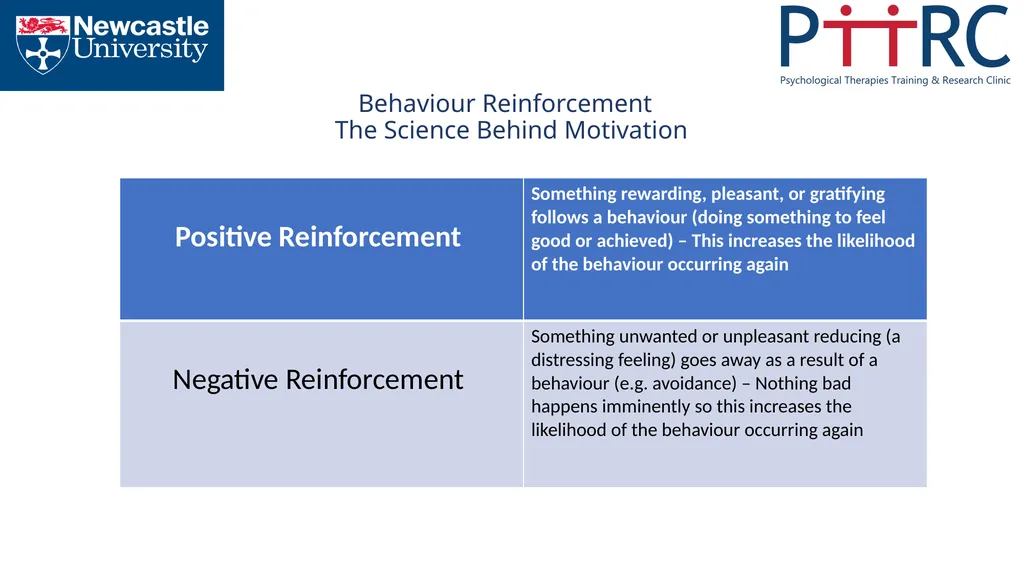
Behaviour Reinforcement
The Science Behind Motivation<br>
18
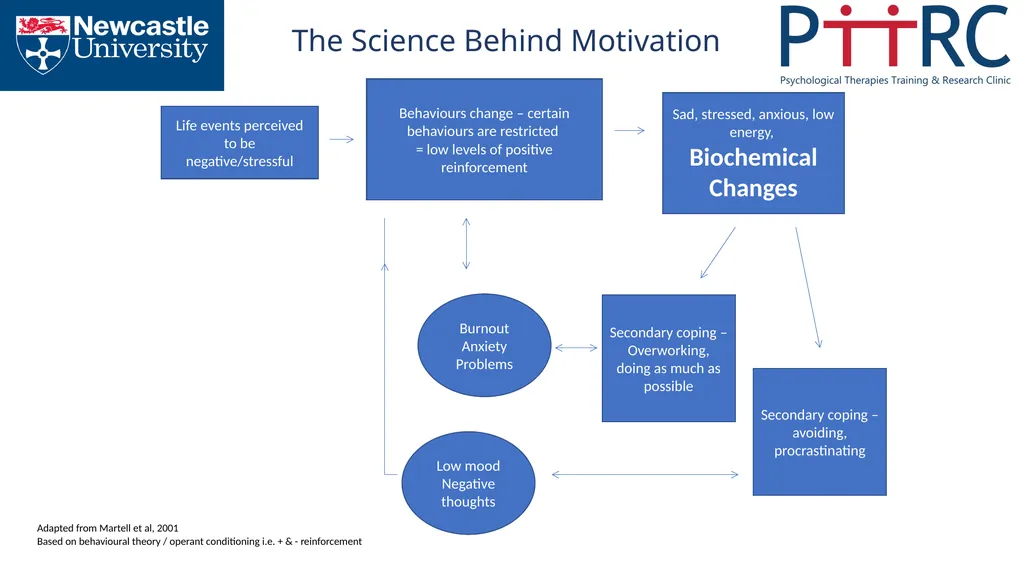
The Science Behind Motivation Life events perceived to be negative/stressful Behaviours change – certain behaviours are restricted
= low levels of positive reinforcement Sad, stressed, anxious, low energy, Biochemical Changes Secondary coping – avoiding, procrastinating Secondary coping – Overworking, doing as much as possible Burnout
Anxiety Problems Low mood
Negative thoughts Adapted from Martell et al, 2001
Based on behavioural theory / operant conditioning i.e. + & - reinforcement<br>
= low levels of positive reinforcement Sad, stressed, anxious, low energy, Biochemical Changes Secondary coping – avoiding, procrastinating Secondary coping – Overworking, doing as much as possible Burnout
Anxiety Problems Low mood
Negative thoughts Adapted from Martell et al, 2001
Based on behavioural theory / operant conditioning i.e. + & - reinforcement<br>
19
The Science Behind Motivation<br>
20
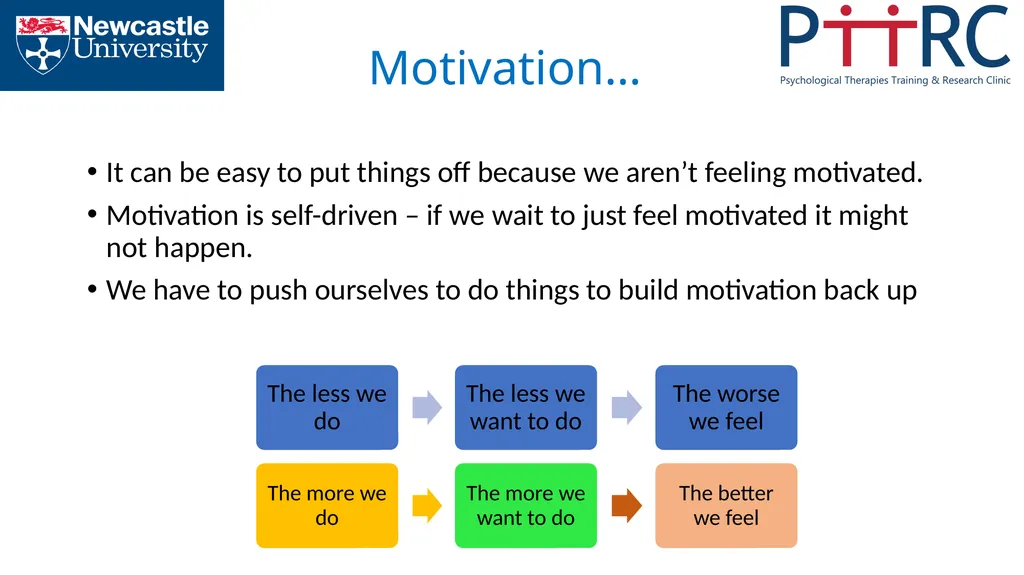
Motivation… It can be easy to put things off because we aren’t feeling motivated.
Motivation is self-driven – if we wait to just feel motivated it might not happen.
We have to push ourselves to do things to build motivation back up<br>
Motivation is self-driven – if we wait to just feel motivated it might not happen.
We have to push ourselves to do things to build motivation back up<br>
21
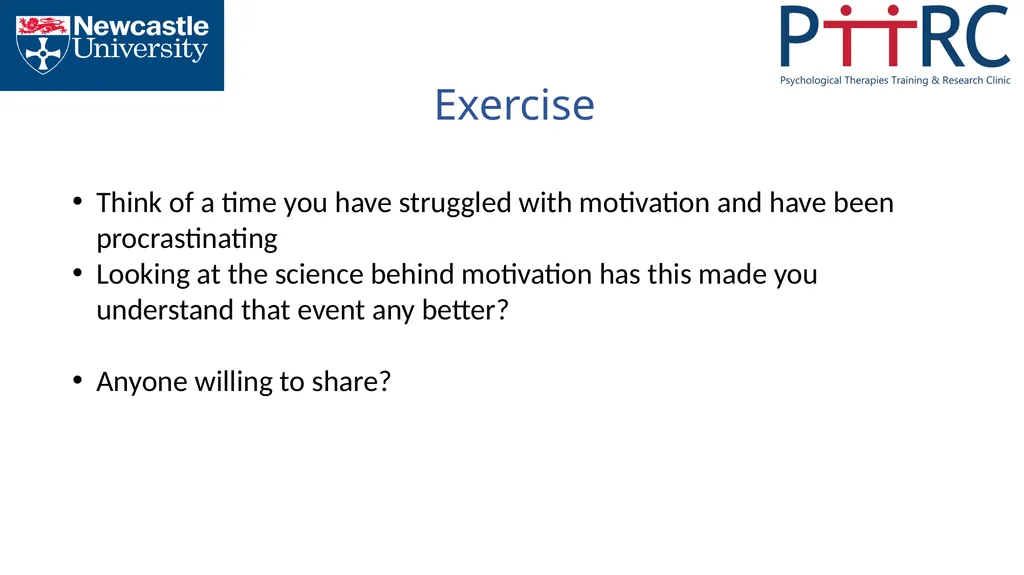
Exercise Think of a time you have struggled with motivation and have been procrastinating
Looking at the science behind motivation has this made you understand that event any better?
Anyone willing to share?<br>
Looking at the science behind motivation has this made you understand that event any better?
Anyone willing to share?<br>
22
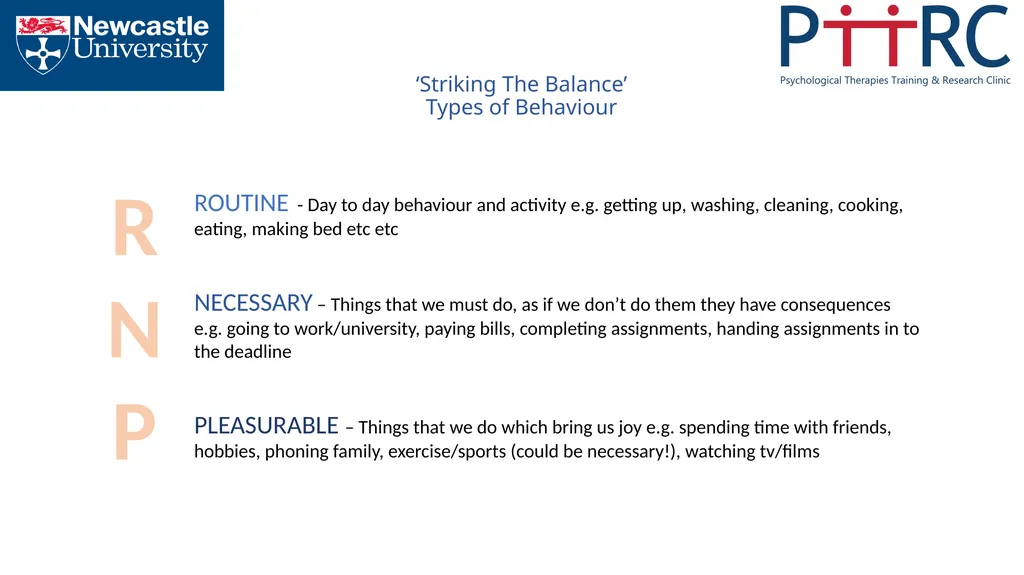
‘Striking The Balance’
Types of Behaviour R
N
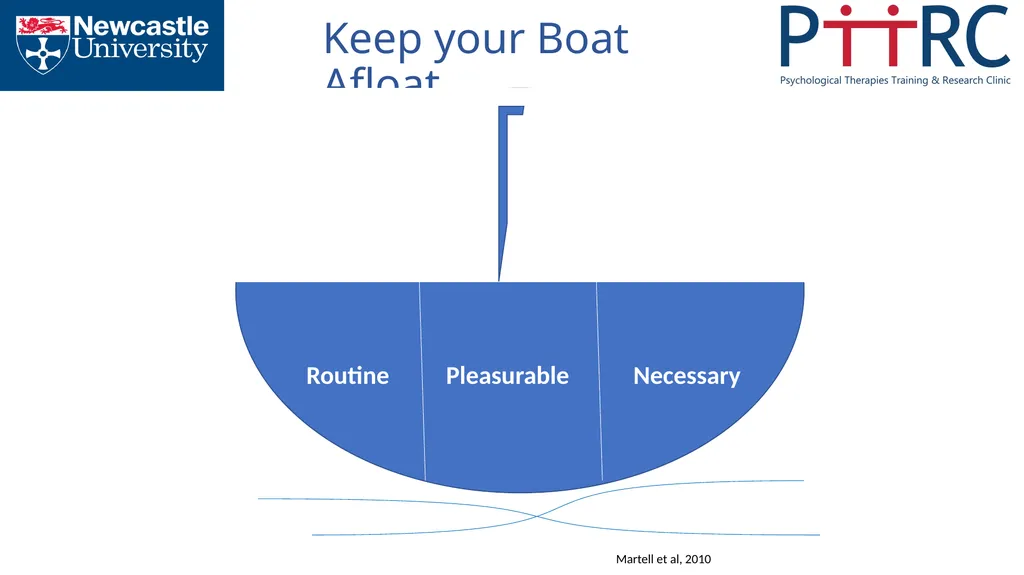
P ROUTINE - Day to day behaviour and activity e.g. getting up, washing, cleaning, cooking, eating, making bed etc etc
NECESSARY – Things that we must do, as if we don’t do them they have consequences e.g. going to work/university, paying bills, completing assignments, handing assignments in to the deadline
PLEASURABLE – Things that we do which bring us joy e.g. spending time with friends, hobbies, phoning family, exercise/sports (could be necessary!), watching tv/films<br>
N
P ROUTINE - Day to day behaviour and activity e.g. getting up, washing, cleaning, cooking, eating, making bed etc etc
NECESSARY – Things that we must do, as if we don’t do them they have consequences e.g. going to work/university, paying bills, completing assignments, handing assignments in to the deadline
PLEASURABLE – Things that we do which bring us joy e.g. spending time with friends, hobbies, phoning family, exercise/sports (could be necessary!), watching tv/films<br>
23
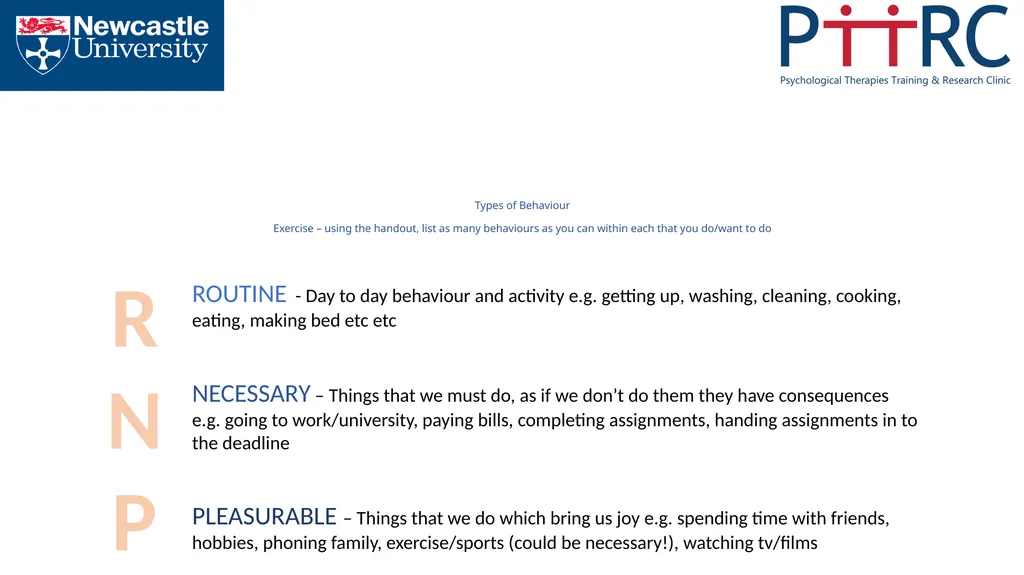
Types of Behaviour
Exercise – using the handout, list as many behaviours as you can within each that you do/want to do R
N
P ROUTINE - Day to day behaviour and activity e.g. getting up, washing, cleaning, cooking, eating, making bed etc etc
NECESSARY – Things that we must do, as if we don’t do them they have consequences e.g. going to work/university, paying bills, completing assignments, handing assignments in to the deadline
PLEASURABLE – Things that we do which bring us joy e.g. spending time with friends, hobbies, phoning family, exercise/sports (could be necessary!), watching tv/films<br>
N
P ROUTINE - Day to day behaviour and activity e.g. getting up, washing, cleaning, cooking, eating, making bed etc etc
NECESSARY – Things that we must do, as if we don’t do them they have consequences e.g. going to work/university, paying bills, completing assignments, handing assignments in to the deadline
PLEASURABLE – Things that we do which bring us joy e.g. spending time with friends, hobbies, phoning family, exercise/sports (could be necessary!), watching tv/films<br>
24
Keep your Boat Afloat Routine Pleasurable Necessary Martell et al, 2010<br>
25
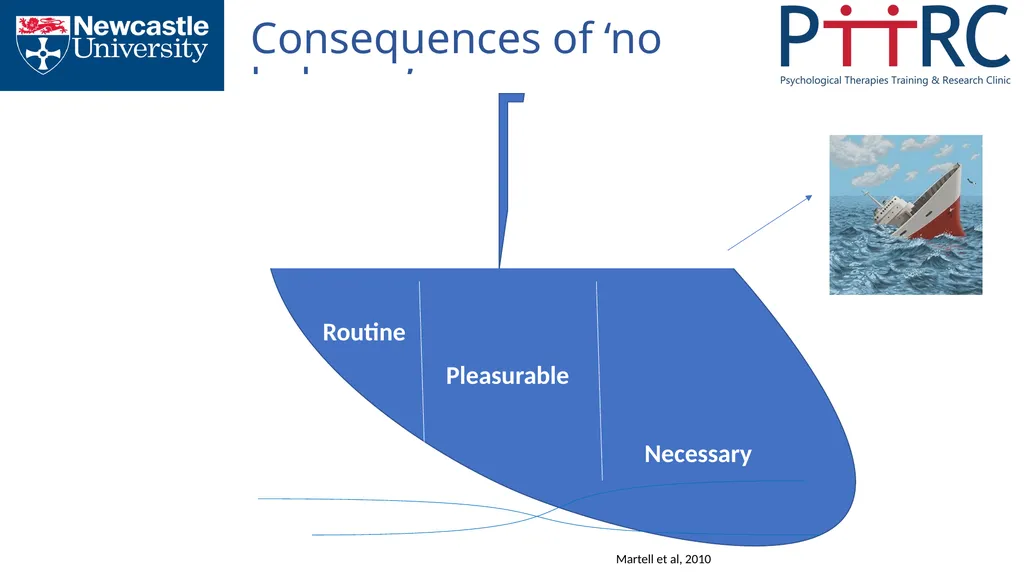
Consequences of ‘no balance’ Routine Pleasurable Necessary Martell et al, 2010<br>
26
Striking The Balance<br>
27
Striking The Balance
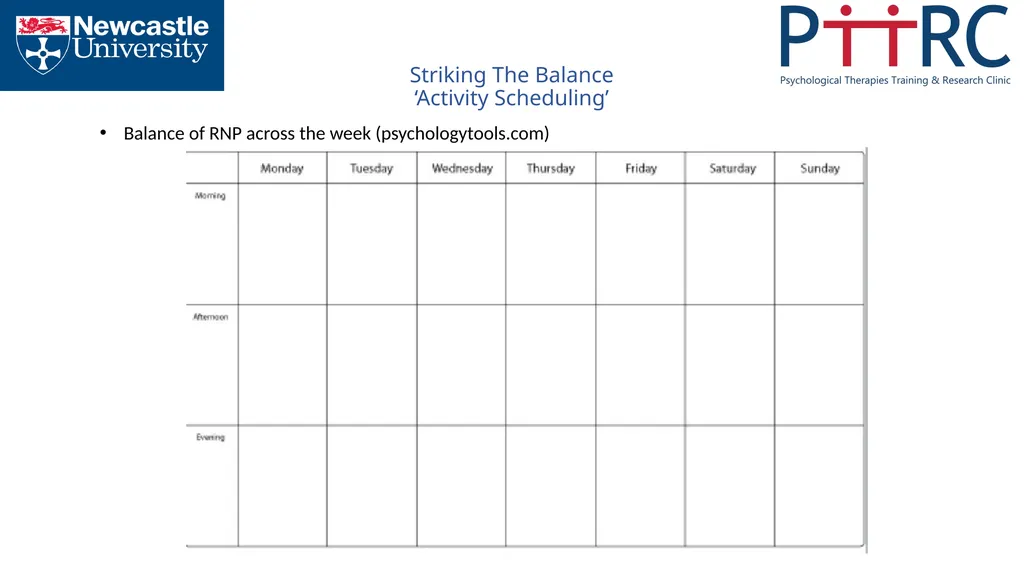
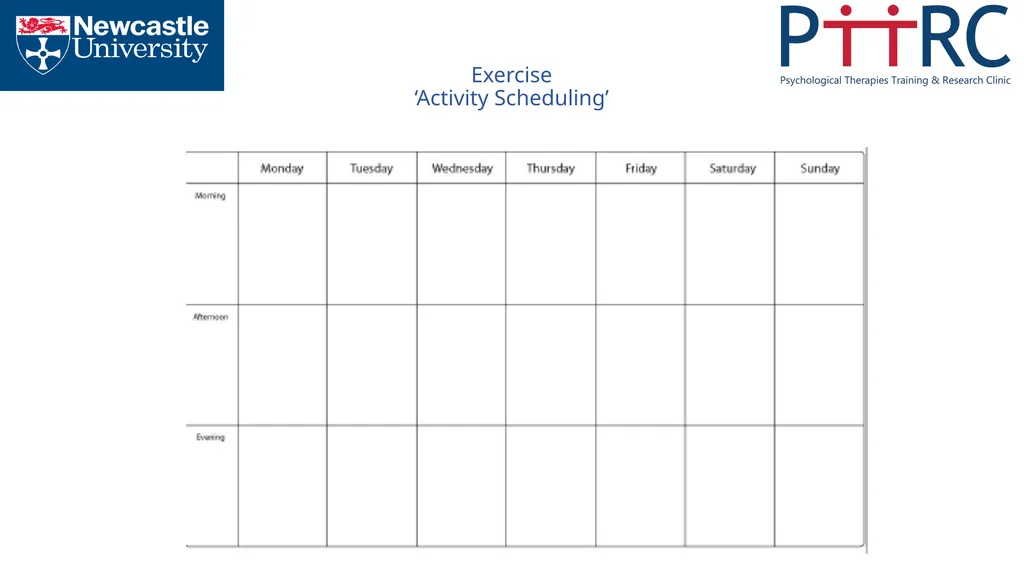
‘Activity Scheduling’ Balance of RNP across the week (psychologytools.com)<br>
28
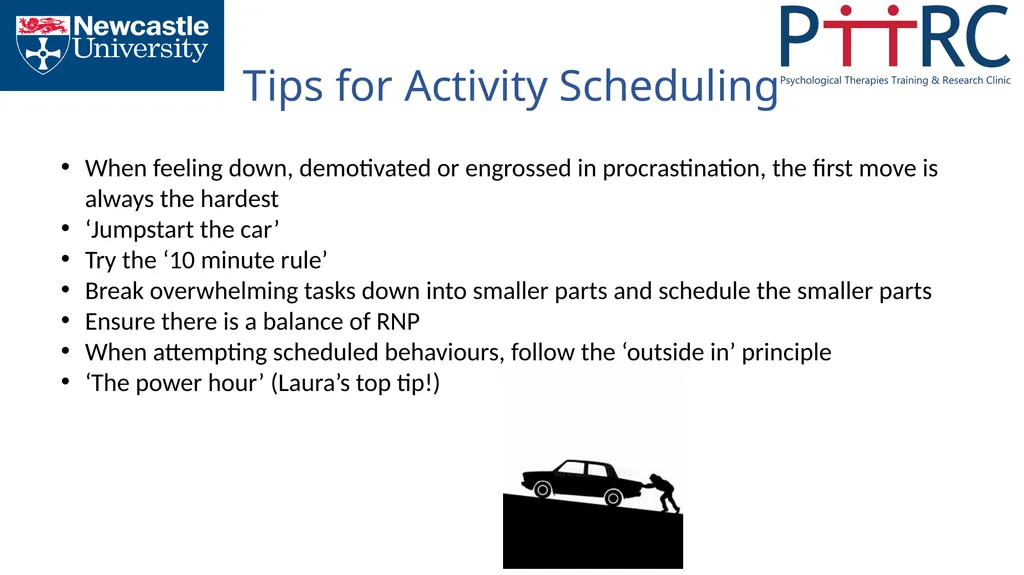
Tips for Activity Scheduling When feeling down, demotivated or engrossed in procrastination, the first move is always the hardest
‘Jumpstart the car’
Try the ‘10 minute rule’
Break overwhelming tasks down into smaller parts and schedule the smaller parts
Ensure there is a balance of RNP
When attempting scheduled behaviours, follow the ‘outside in’ principle
‘The power hour’ (Laura’s top tip!)<br>
‘Jumpstart the car’
Try the ‘10 minute rule’
Break overwhelming tasks down into smaller parts and schedule the smaller parts
Ensure there is a balance of RNP
When attempting scheduled behaviours, follow the ‘outside in’ principle
‘The power hour’ (Laura’s top tip!)<br>
29
Exercise
‘Activity Scheduling’<br>
30
Feedback
Questions??<br>
31
Summary When we feel overwhelmed by life events/situations, our behaviour starts to change
Behaviour change usually has consequences on our emotional wellbeing and thoughts – this becomes a vicious cycle
A balance of routine, necessary and pleasurable activities in your day to life is pivotal to wellbeing
At times you are overwhelmed, try activity scheduling with the top tips
There is science behind motivation – use it!<br>
Behaviour change usually has consequences on our emotional wellbeing and thoughts – this becomes a vicious cycle
A balance of routine, necessary and pleasurable activities in your day to life is pivotal to wellbeing
At times you are overwhelmed, try activity scheduling with the top tips
There is science behind motivation – use it!<br>
32
Questionnaire<br>