Motivation and Achieving Goals Math Study Skills, 2nd Edition Allen Bass Spring 2016 Motivating and Achieving Goals Motivation is what drives you to stay in college. what makes you study. the WHY behind your habits, good or bad. the
Related Topics
Share
Embed code
Download this presentation From Below
"Motivation and Achieving Goals Math Study Skills," is the property of its rightful owner. Permission is granted to
download and print the materials on this website for personal, non-commercial use only, and to display it
on your personal computer provided you do not modify the materials and that you retain all copyright
notices contained in the materials. By downloading content from our website, you accept the terms of this
agreement.
Presentation Transcript
01
Motivation and Achieving Goals Math Study Skills, 2nd Edition
Allen Bass Spring 2016<br>
02
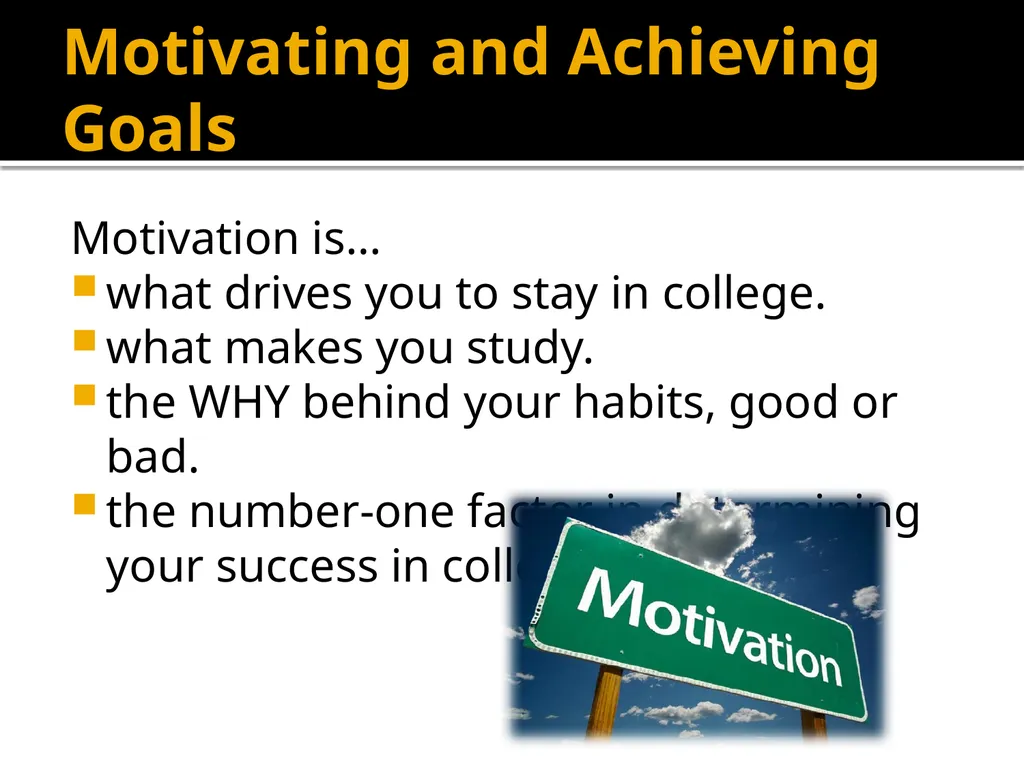
Motivating and Achieving Goals Motivation is…
what drives you to stay in college.
what makes you study.
the WHY behind your habits, good or bad.
the number-one factor in determining your success in college.<br>
03
Motivation to Stay in College: Learning- Some people just love to learn.
Career- Some people are in college because they know exactly what they want to do for their lifelong career and they know that college-level skills are important for that career.<br>
04
Motivation to Stay in College, continued. Opportunity- Some students are not exactly sure what they want to do after college, but know that they will have many more opportunities if they have a college degree.
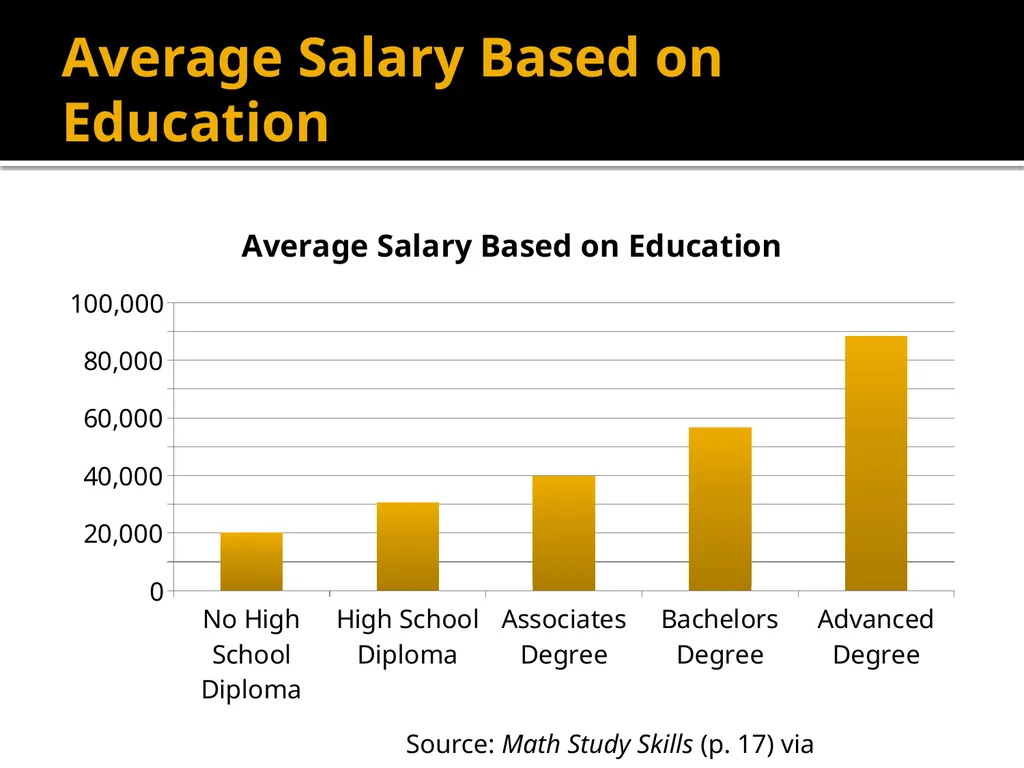
Money- Some students know that whatever they decide to do after college, they will make more money if they have a college degree. There is nothing wrong with this.
(See the chart on the next slide)<br>
05
Average Salary Based on Education Source: Math Study Skills (p. 17) via www.census.gov<br>
06
Exercises Now it is your turn to think about what motivates you.
Complete Exercise 7 in your Math Study Skills book (p. 18).
Complete Exercise 8 (p. 19).<br>
07
Motivation for a College Student There is a good chance that college will be the best time of your life.
You’ll meet tons of good people and mature in ways you can’t imagine.
Very few, if any, college graduates regret toing to college.
Our planet and particularly our nation NEED people who are educated.<br>
08
Motivation for a College Student, continued. Perspective:
College will probably take between 4 – 7 years.
Most college graduates will have a career of some sort for up to 50 years!<br>
09
Motivating Actions Find your mantra. It may help you find something that symbolizes your will to succeed.
It could be:
a poem.
a short phrase.
a song.
a drawing.
a small statue you carry around.
anything!<br>
10
Motivating Actions, continued. Make some friends who want to succeed. Making friends in college is important.
Look for other students who are serious about succeeding in college.<br>
11
Motivating Actions, continued. Help ME help YOU. The author has a Facebook page called “Math Study Skills.”
“Like” it to find extra tips and get some support.
(this is not an affiliate of Crafton Hills College)<br>
12
Motivating Actions, continued. Make it a point to think about your future. Think about what you want when you graduate from college.
Some students do not know what career they want and that’s okay.
The more you think about it the more you will realize that college is an important part of getting into your future career.<br>
13
Motivating Actions, continued. Visit a college counselor. Counselors give academic information and advice.
College counselors are great at motivating students to succeed.
They have all the information you could possibly want on classes, transferring, financial aid, etc.
They WANT you to be successful.
CHC Counseling website: http://www.craftonhills.edu/Current_Students/Counseling<br>
14
Motivating Actions, continued. Use a “To Do” list. Making a list of important activities for the day or the week can make it easier to act on them for several reasons.
Complete Exercise 9 in your Math Study Skills book (p. 21).<br>
15
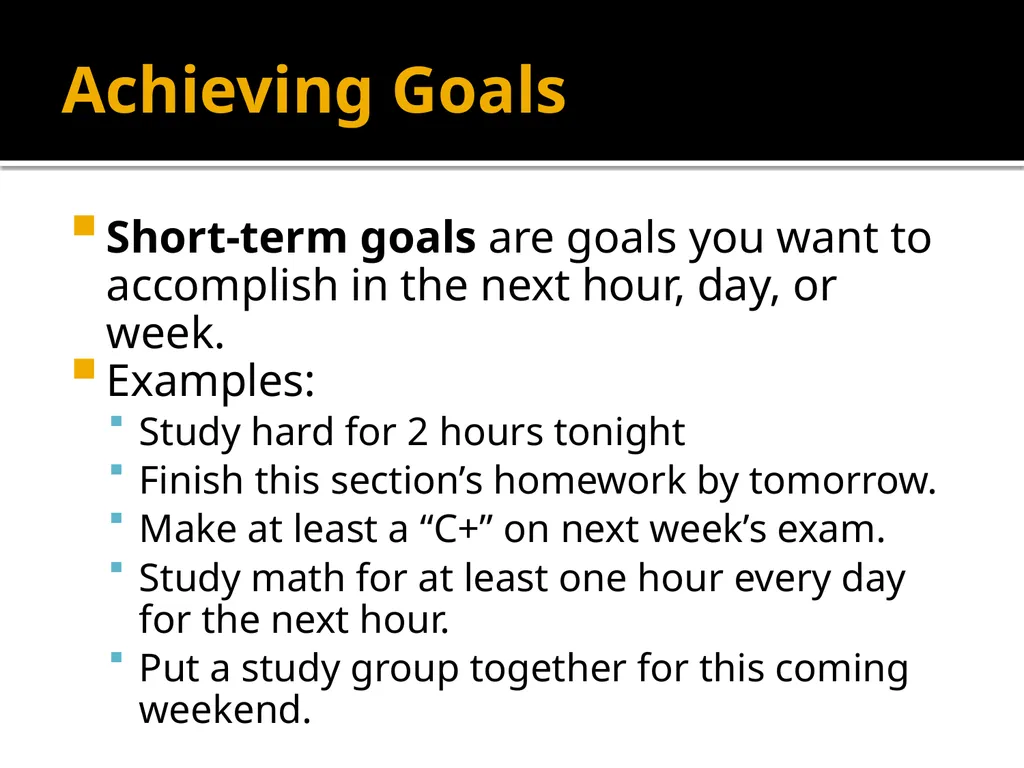
Achieving Goals Short-term goals are goals you want to accomplish in the next hour, day, or week.
Examples:
Study hard for 2 hours tonight
Finish this section’s homework by tomorrow.
Make at least a “C+” on next week’s exam.
Study math for at least one hour every day for the next hour.
Put a study group together for this coming weekend.<br>
16
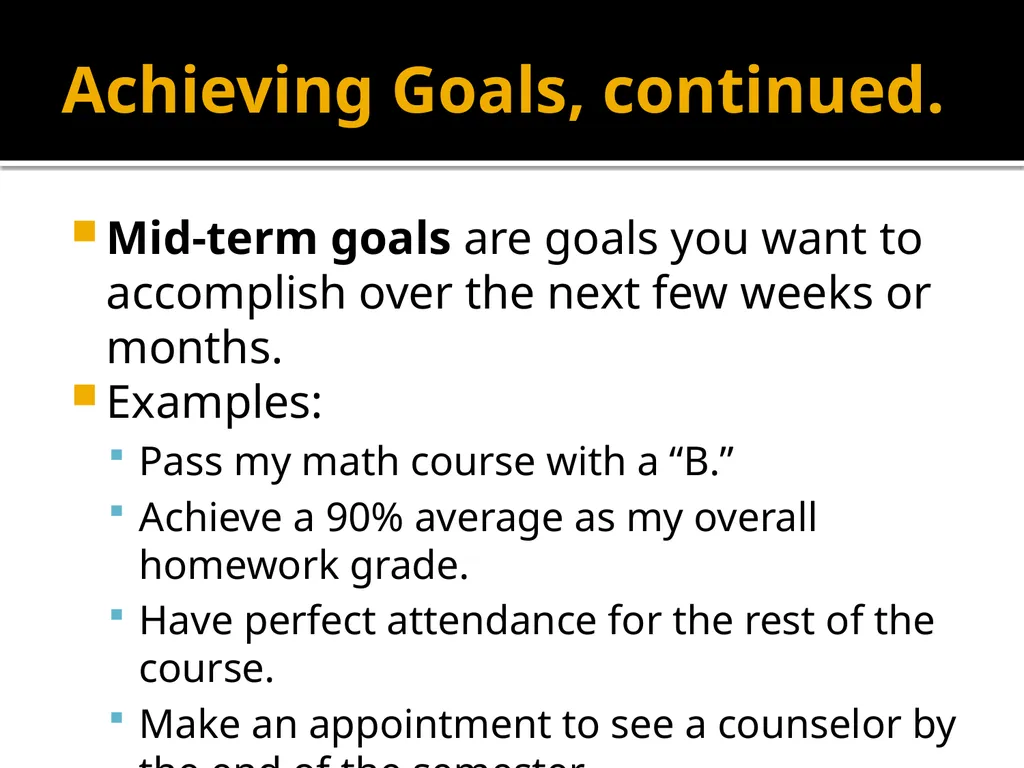
Achieving Goals, continued. Mid-term goals are goals you want to accomplish over the next few weeks or months.
Examples:
Pass my math course with a “B.”
Achieve a 90% average as my overall homework grade.
Have perfect attendance for the rest of the course.
Make an appointment to see a counselor by the end of the semester.<br>
17
Achieving Goals, continued. Long-term goals are goals you set for several months out, the next few years, or even your lifetime.
Examples:
Obtain an AA degree in Nursing in the next three years.
Successfully transfer from a community college to a university within two years.
Graduate with at least a 3.1 grade point average.<br>
18
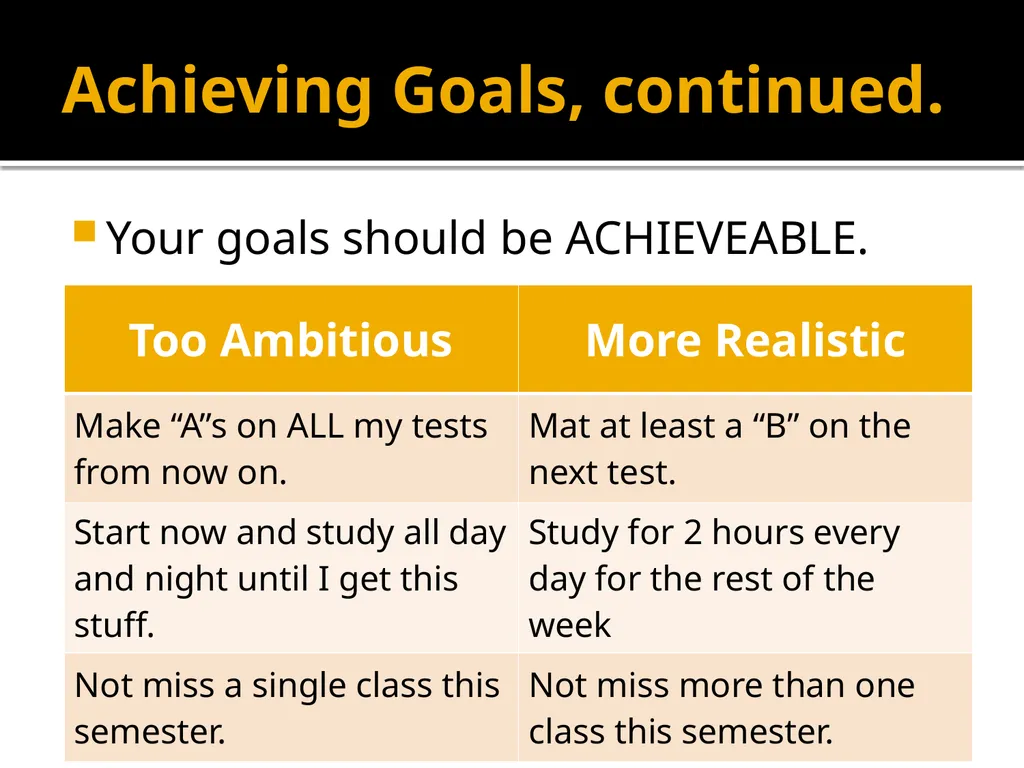
Achieving Goals, continued. Your goals should be ACHIEVEABLE.<br>
19
Achieving Goals, continued. Your goals should be SPECIFIC.<br>
20
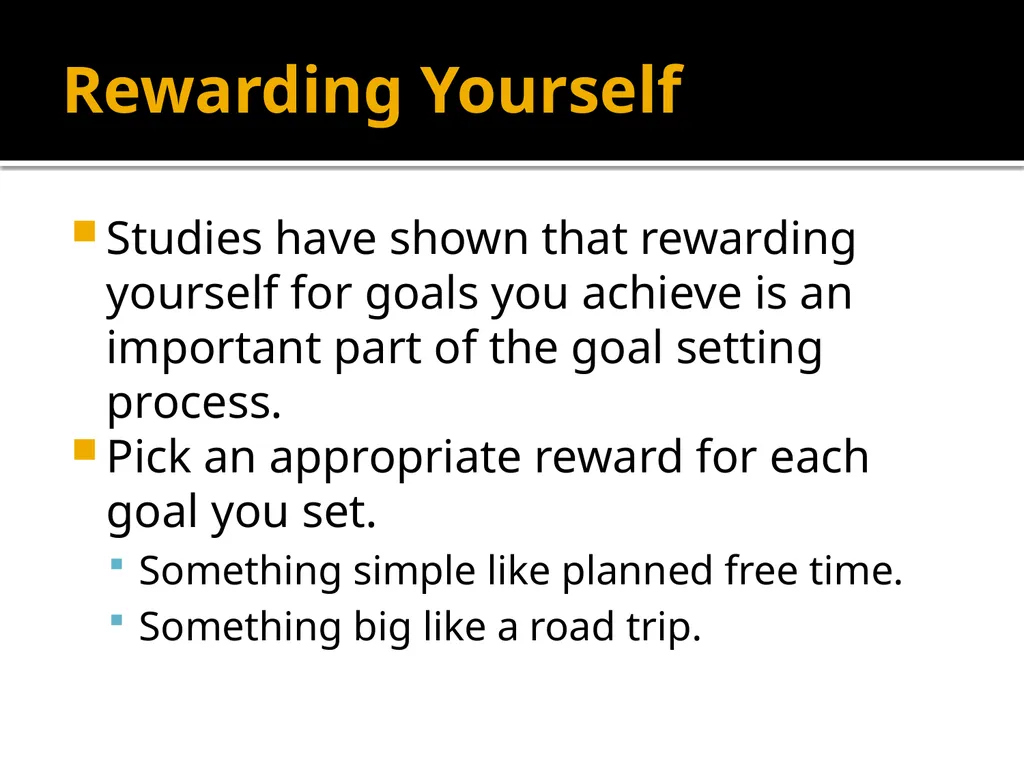
Rewarding Yourself Studies have shown that rewarding yourself for goals you achieve is an important part of the goal setting process.
Pick an appropriate reward for each goal you set.
Something simple like planned free time.
Something big like a road trip.<br>
21
Procrastination Procrastination is the act of replacing high-priority tasks with low-priority activities.
How does procrastination affect you?
Stress
Fear of failure
Boredom
Rebellion
Fatigue<br>
22
Motivating and Achieving Goals Develop good time-management skills and set realistic but meaningful goals for yourself.<br>