
NLP Linguistics 101 David Kauchak CS159 – Spring

Description: NLP Linguistics 101 David Kauchak CS159 Spring 2023 some slides adapted from Ray Mooney Admin Assignment 2 Quiz 1 Monday at the beginning of class (first 30 minutes) Open book and open notes Quiz 1 material TF, short answer, pencil and
Related Topics
Download Presentation
"NLP Linguistics 101 David Kauchak CS159 – Spring" is the property of its rightful owner. Permission is granted to download and print the materials on this website for personal, non-commercial use only, and to display it on your personal computer provided you do not modify the materials and that you retain all copyright notices contained in the materials. By downloading content from our website, you accept the terms of this agreement.
Presentation Transcript
slide1. NLP Linguistics 101 David Kauchak
CS159 – Spring 2023 some slides adapted from Ray Mooney<br>
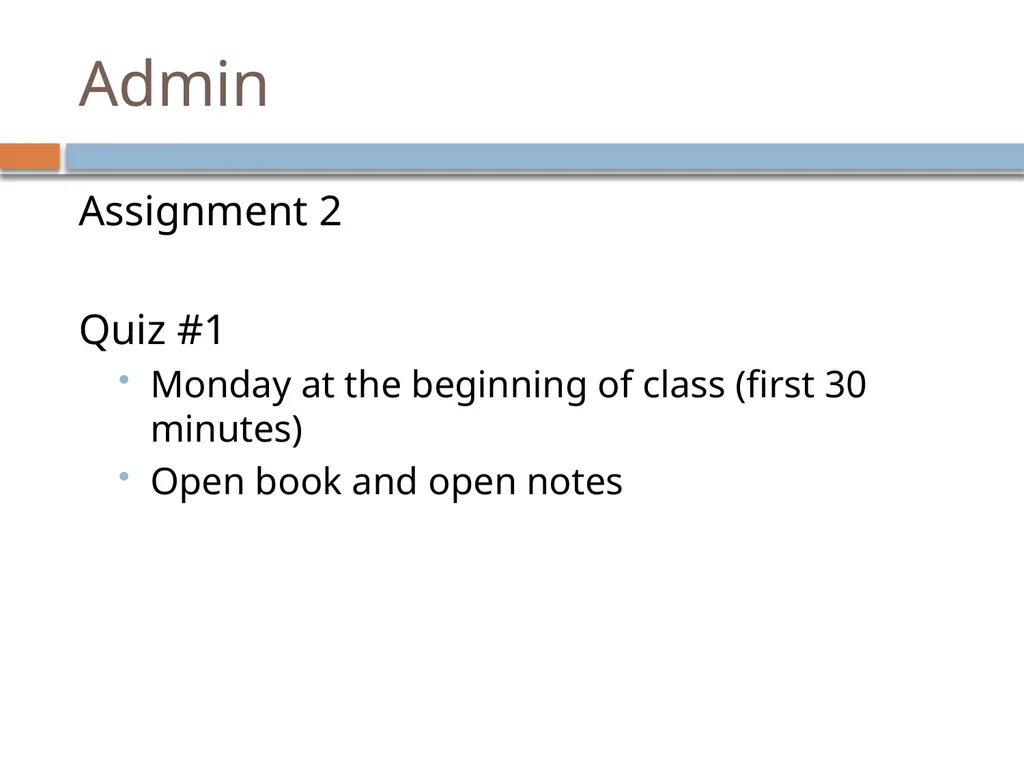
slide2. Admin Assignment 2
Quiz #1
Monday at the beginning of class (first 30 minutes)
Open book and open notes<br>
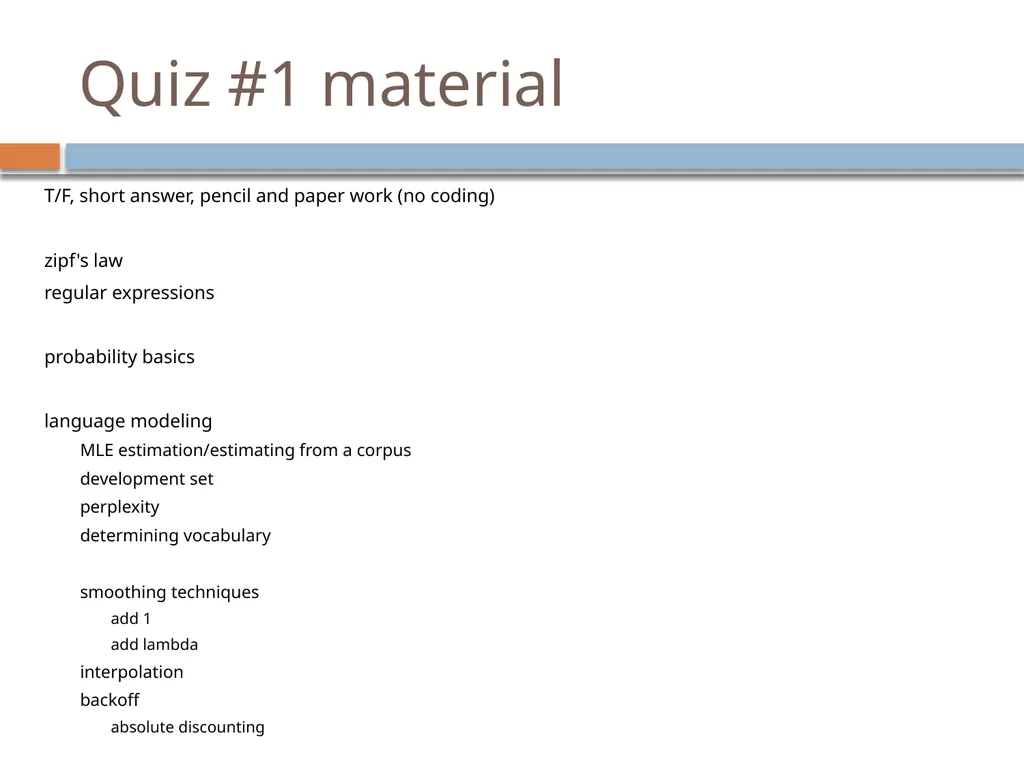
slide3. Quiz #1 material T/F, short answer, pencil and paper work (no coding)
zipf's law
regular expressions
probability basics
language modeling
MLE estimation/estimating from a corpus
development set
perplexity
determining vocabulary
smoothing techniques
add 1
add lambda
interpolation
backoff
absolute discounting<br>
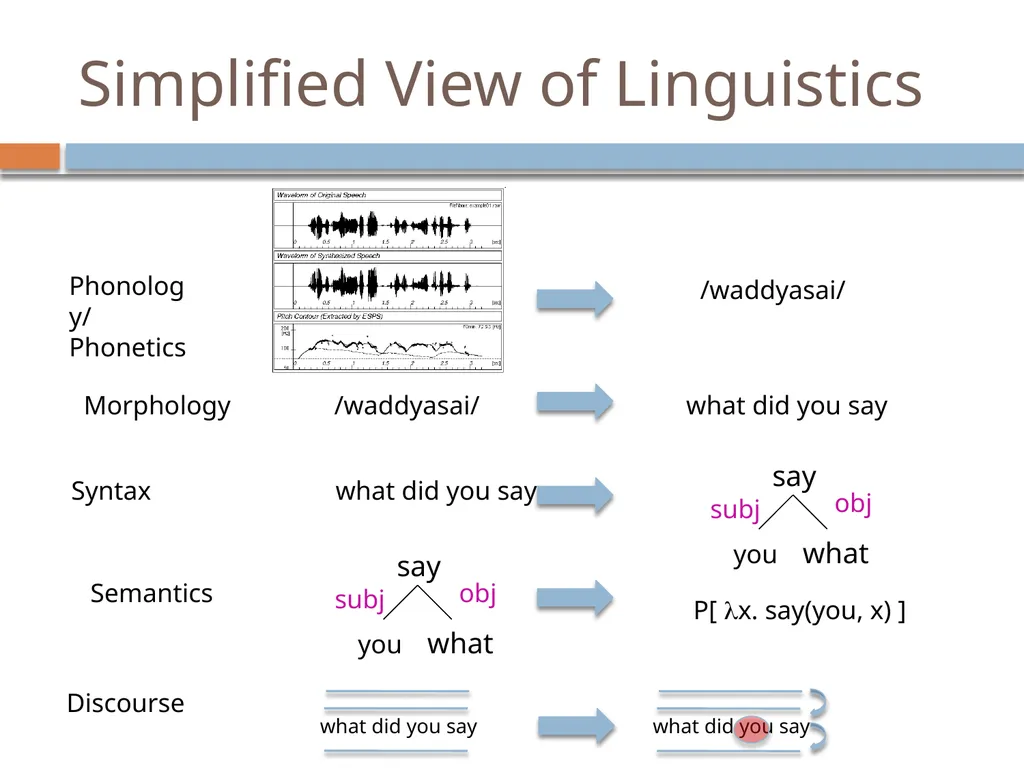
slide4. Simplified View of Linguistics /waddyasai/ Phonology/Phonetics Morphology /waddyasai/ what did you say Syntax what did you say say you what obj subj Semantics say you what obj subj P[ x. say(you, x) ] Discourse what did you say what did you say<br>
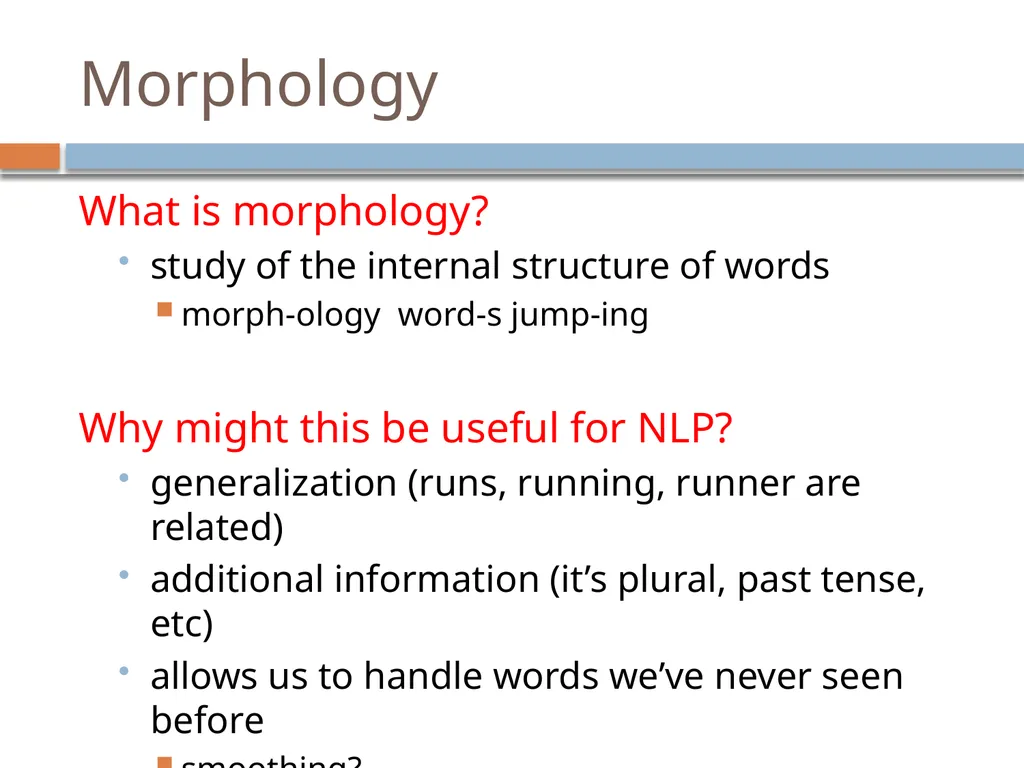
slide5. Morphology What is morphology?
study of the internal structure of words
morph-ology word-s jump-ing
Why might this be useful for NLP?
generalization (runs, running, runner are related)
additional information (it’s plural, past tense, etc)
allows us to handle words we’ve never seen before
smoothing?<br>
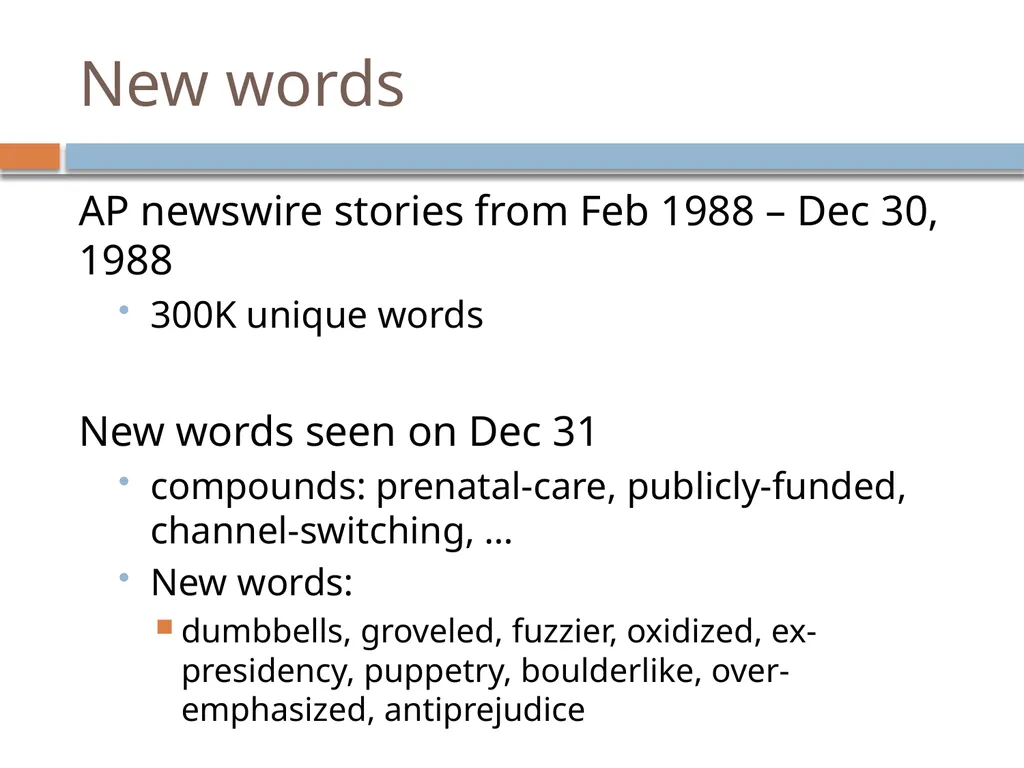
slide6. New words AP newswire stories from Feb 1988 – Dec 30, 1988
300K unique words
New words seen on Dec 31
compounds: prenatal-care, publicly-funded, channel-switching, …
New words:
dumbbells, groveled, fuzzier, oxidized, ex-presidency, puppetry, boulderlike, over-emphasized, antiprejudice<br>
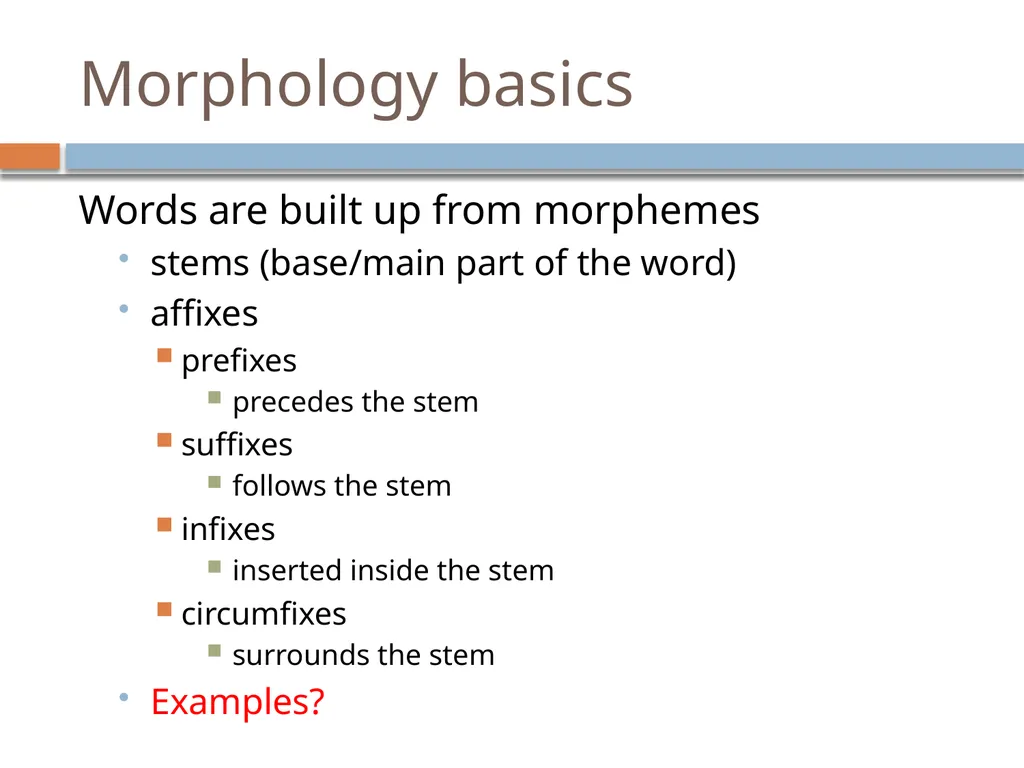
slide7. Morphology basics Words are built up from morphemes
stems (base/main part of the word)
affixes
prefixes
precedes the stem
suffixes
follows the stem
infixes
inserted inside the stem
circumfixes
surrounds the stem
Examples?<br>
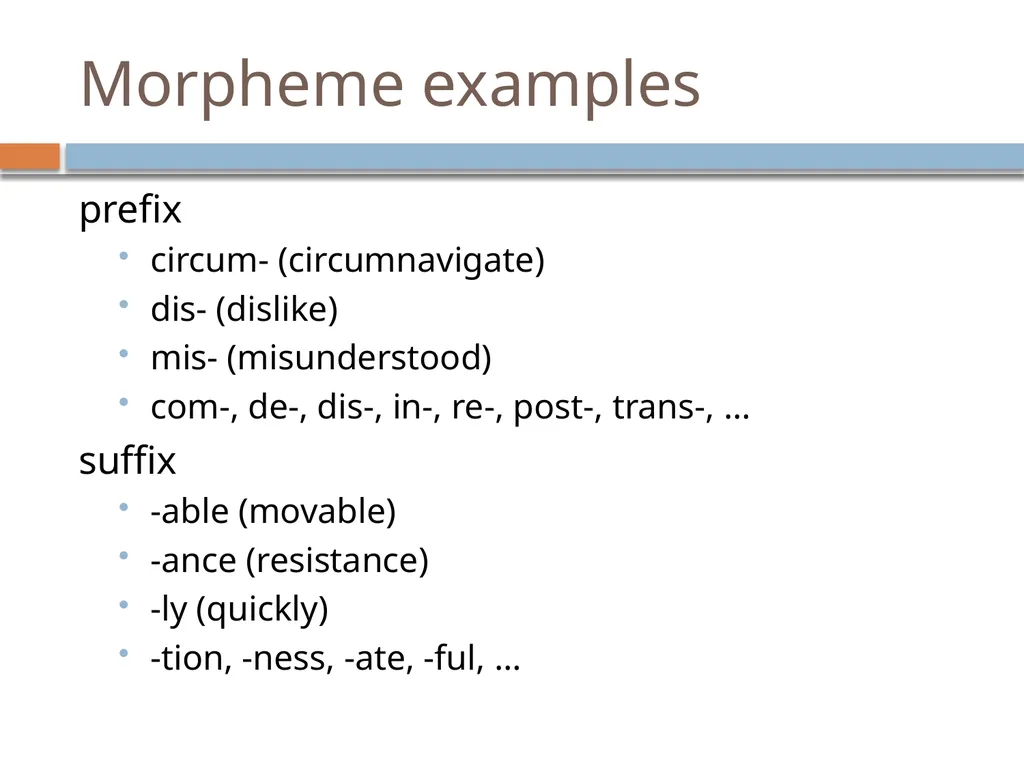
slide8. Morpheme examples prefix
circum- (circumnavigate)
dis- (dislike)
mis- (misunderstood)
com-, de-, dis-, in-, re-, post-, trans-, …
suffix
-able (movable)
-ance (resistance)
-ly (quickly)
-tion, -ness, -ate, -ful, …<br>
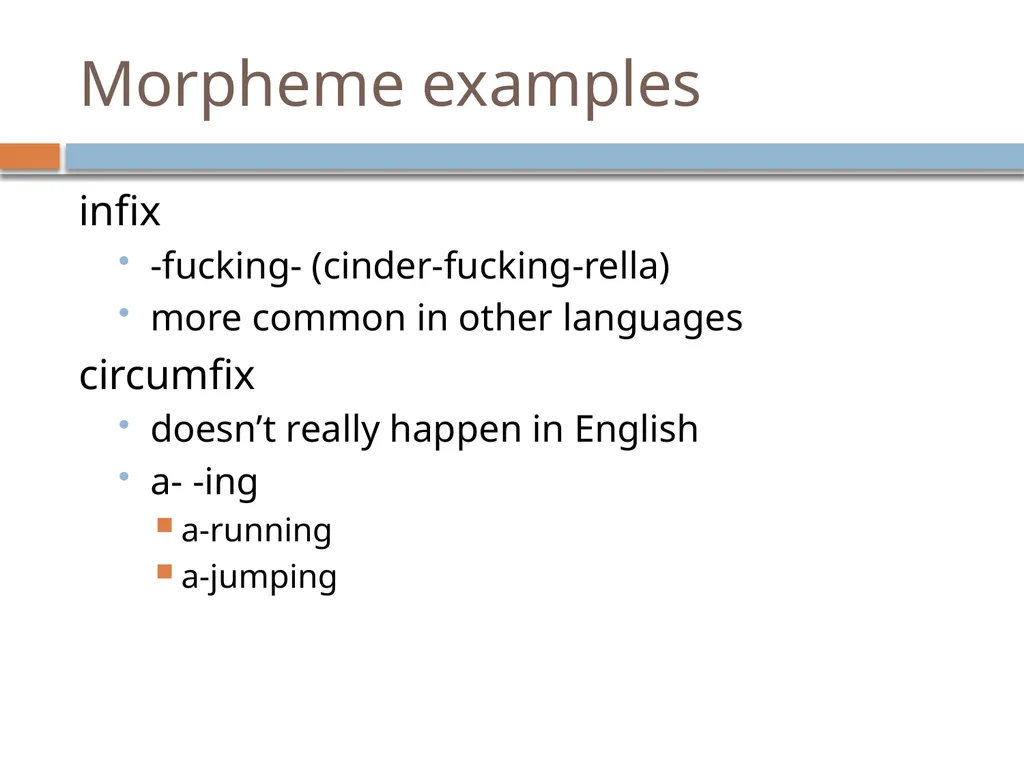
slide9. Morpheme examples infix
-fucking- (cinder-fucking-rella)
more common in other languages
circumfix
doesn’t really happen in English
a- -ing
a-running
a-jumping<br>
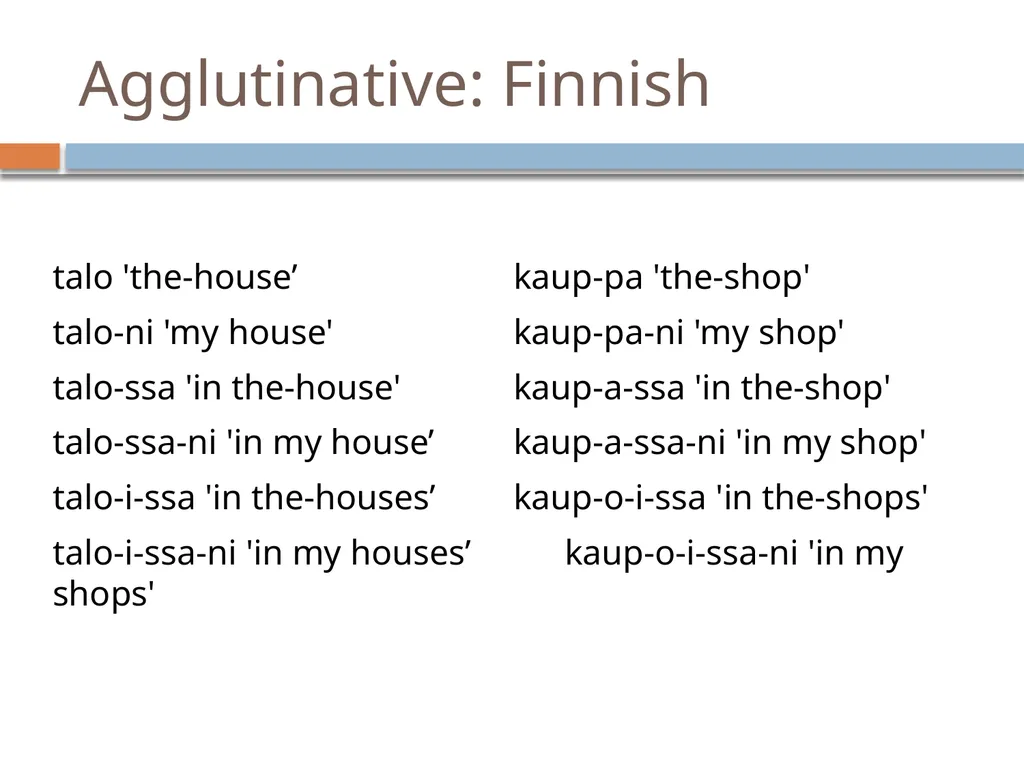
slide10. Agglutinative: Finnish talo 'the-house’ kaup-pa 'the-shop'
talo-ni 'my house' kaup-pa-ni 'my shop'
talo-ssa 'in the-house' kaup-a-ssa 'in the-shop'
talo-ssa-ni 'in my house’ kaup-a-ssa-ni 'in my shop'
talo-i-ssa 'in the-houses’ kaup-o-i-ssa 'in the-shops'
talo-i-ssa-ni 'in my houses’ kaup-o-i-ssa-ni 'in my shops'<br>
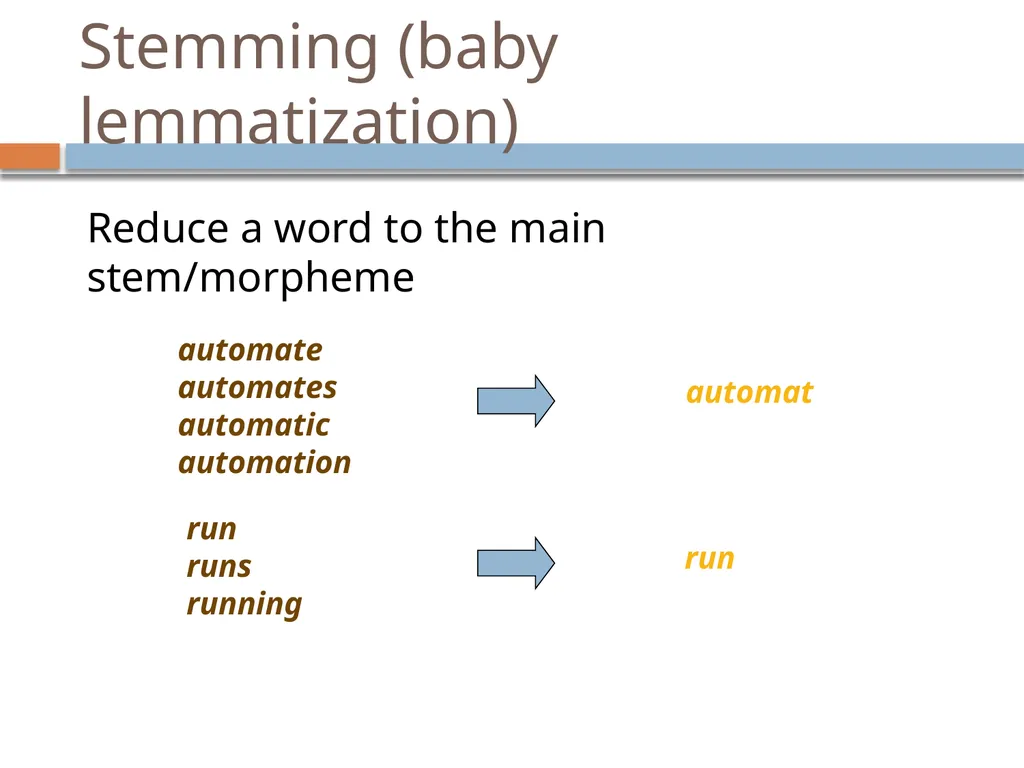
slide11. Stemming (baby lemmatization) Reduce a word to the main stem/morpheme automate
automates automatic
automation run
runs
running automat run<br>
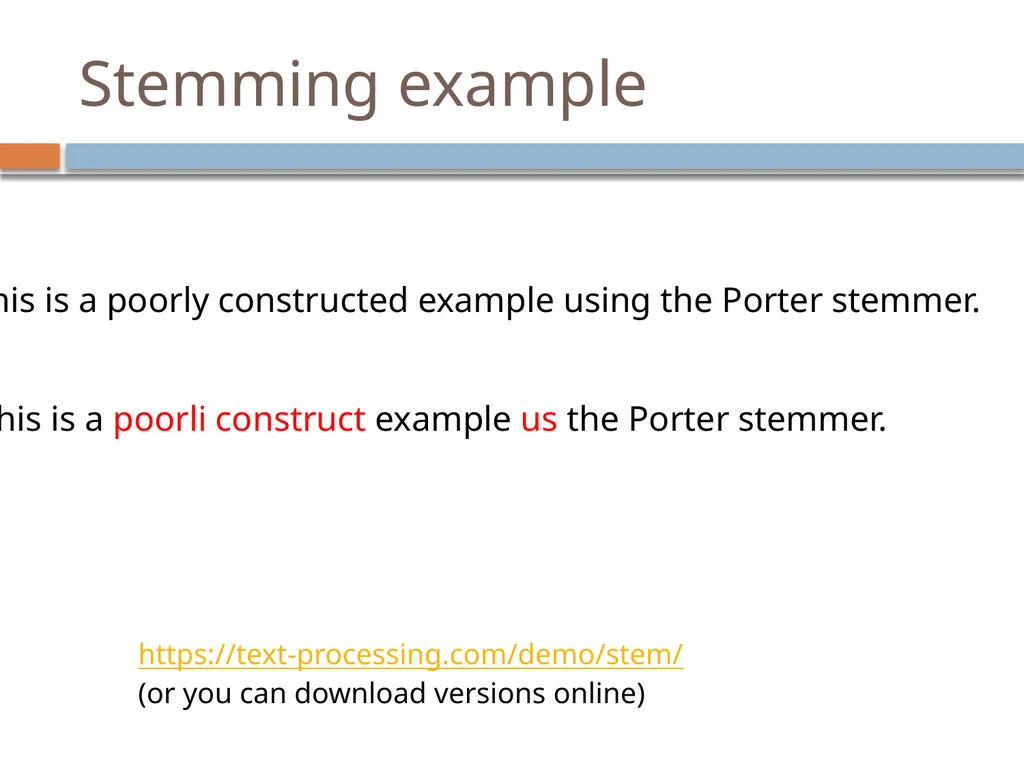
slide12. Stemming example This is a poorly constructed example using the Porter stemmer. https://text-processing.com/demo/stem/
(or you can download versions online) This is a poorli construct example us the Porter stemmer.<br>
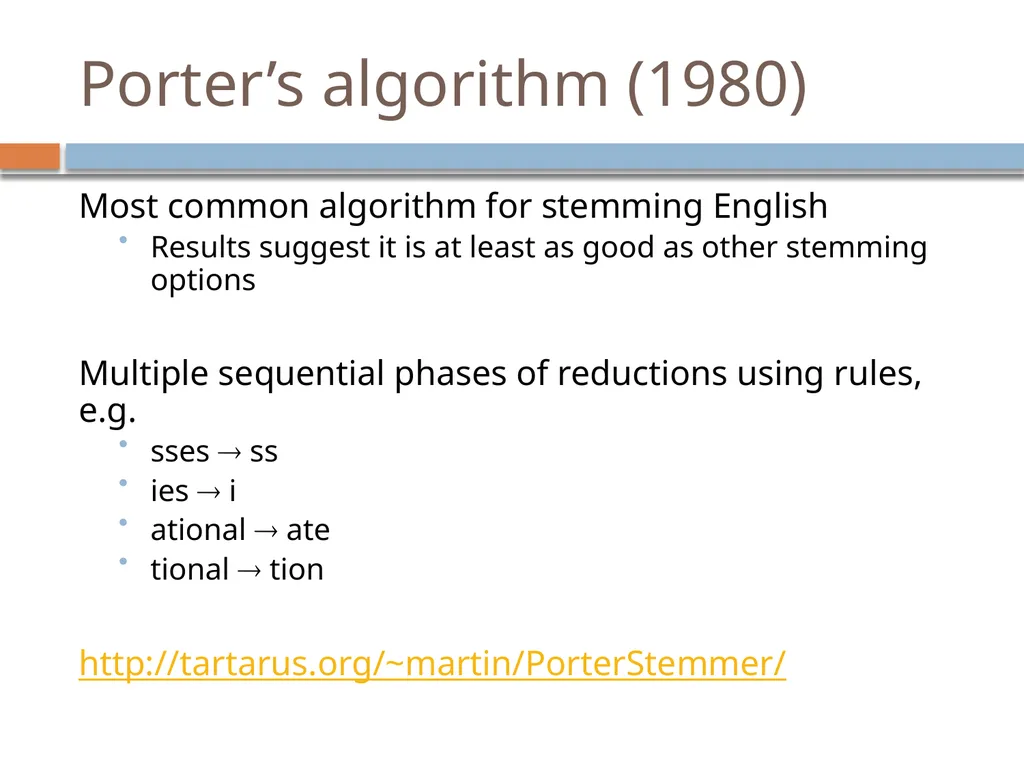
slide13. Porter’s algorithm (1980) Most common algorithm for stemming English
Results suggest it is at least as good as other stemming options
Multiple sequential phases of reductions using rules, e.g.
sses ss
ies i
ational ate
tional tion
http://tartarus.org/~martin/PorterStemmer/<br>
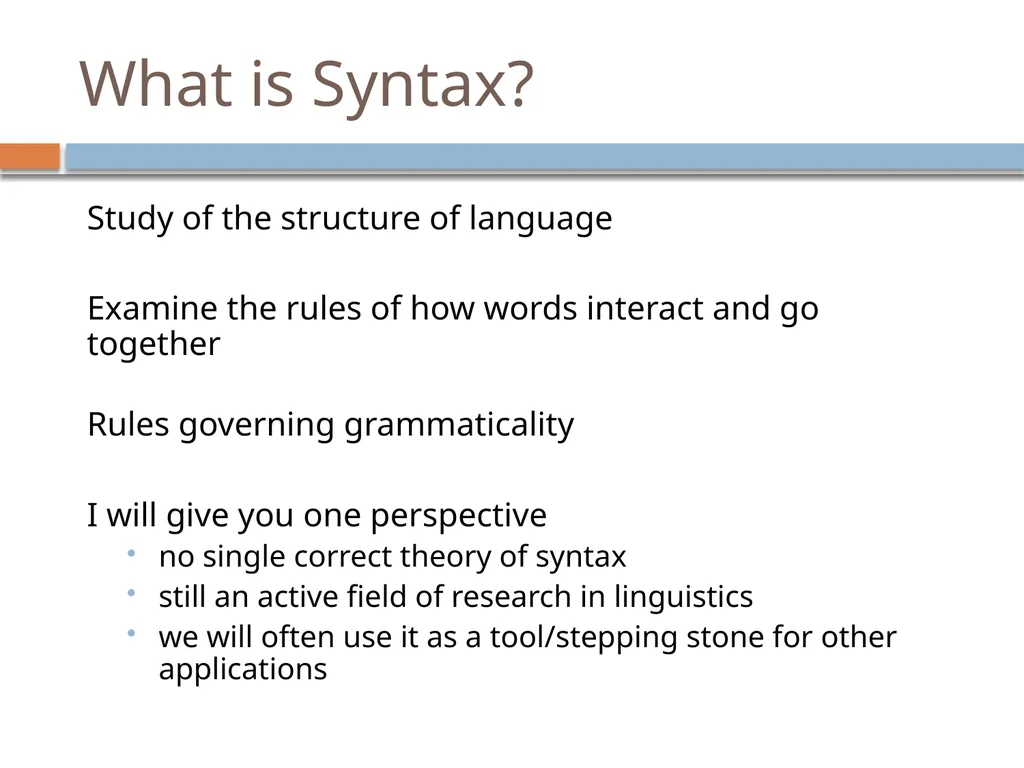
slide14. What is Syntax? Study of the structure of language
Examine the rules of how words interact and go together
Rules governing grammaticality
I will give you one perspective
no single correct theory of syntax
still an active field of research in linguistics
we will often use it as a tool/stepping stone for other applications<br>
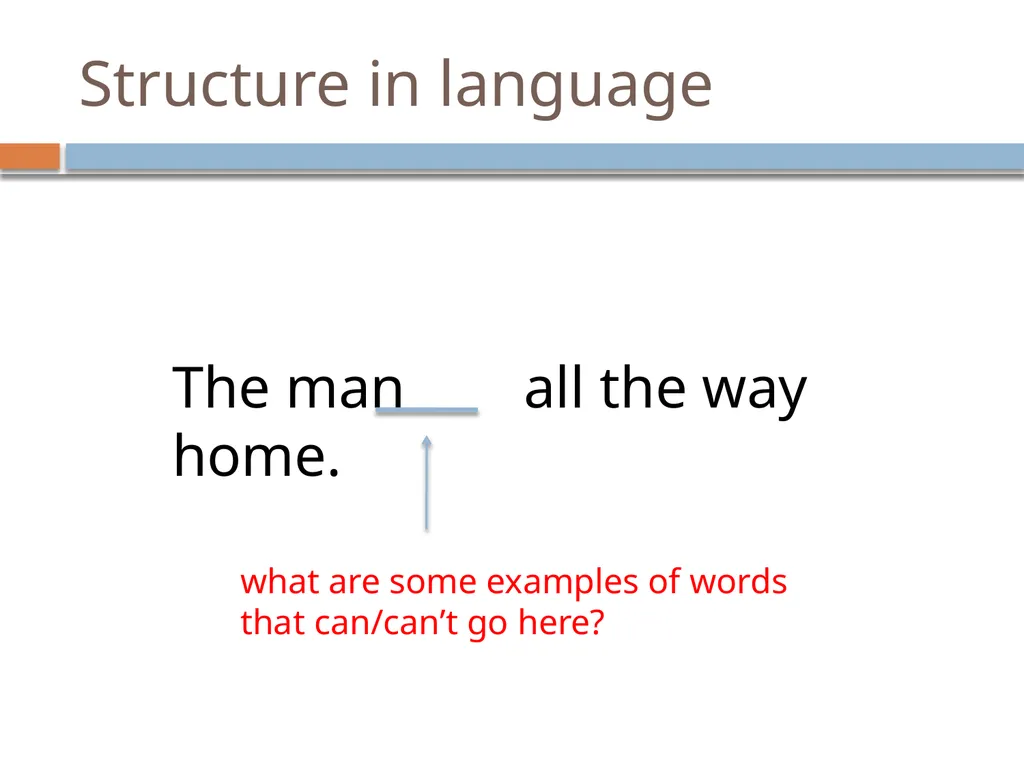
slide15. Structure in language The man all the way home. what are some examples of words that can/can’t go here?<br>
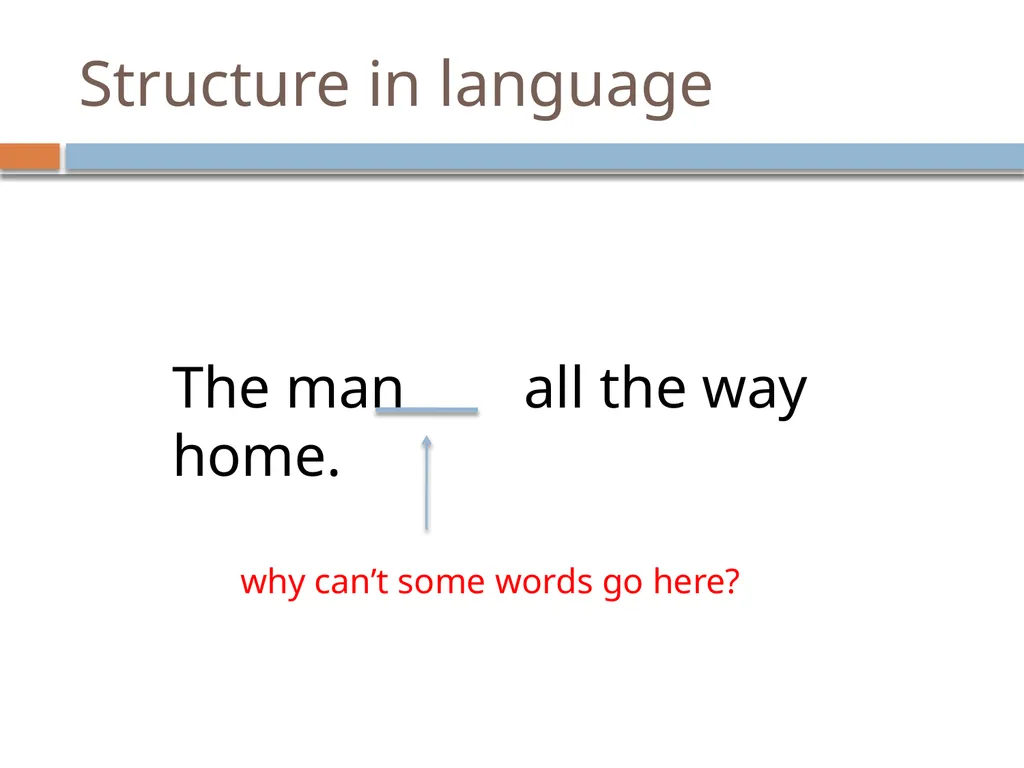
slide16. Structure in language The man all the way home. why can’t some words go here?<br>
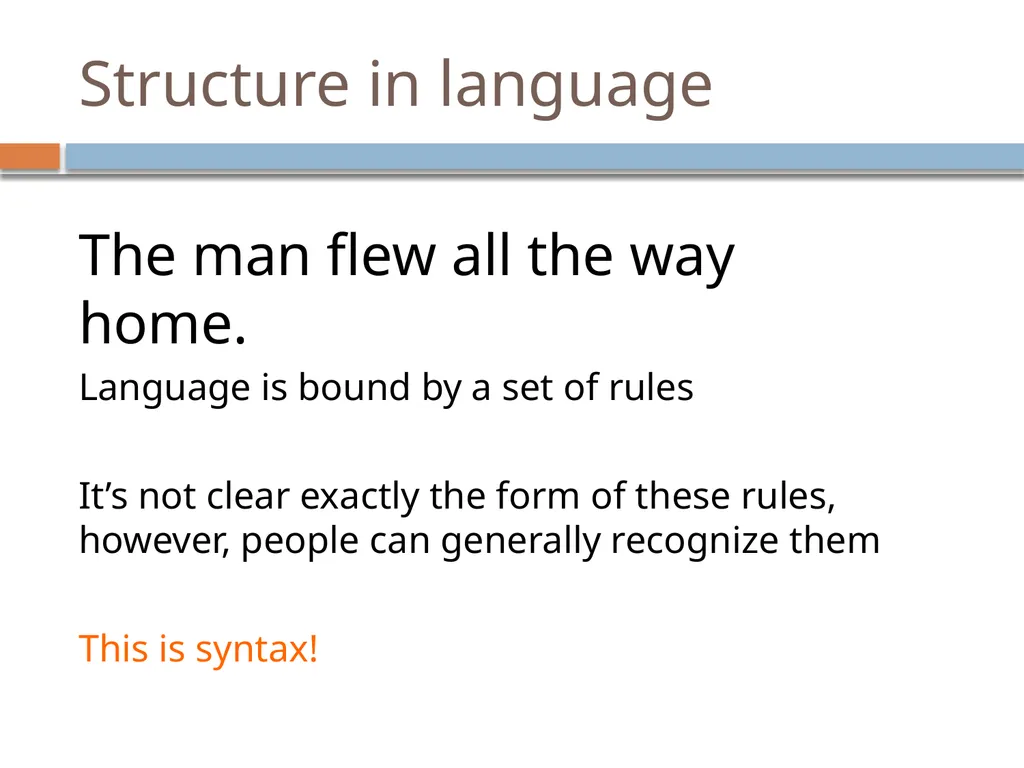
slide17. Structure in language Language is bound by a set of rules
It’s not clear exactly the form of these rules, however, people can generally recognize them
This is syntax! The man flew all the way home.<br>
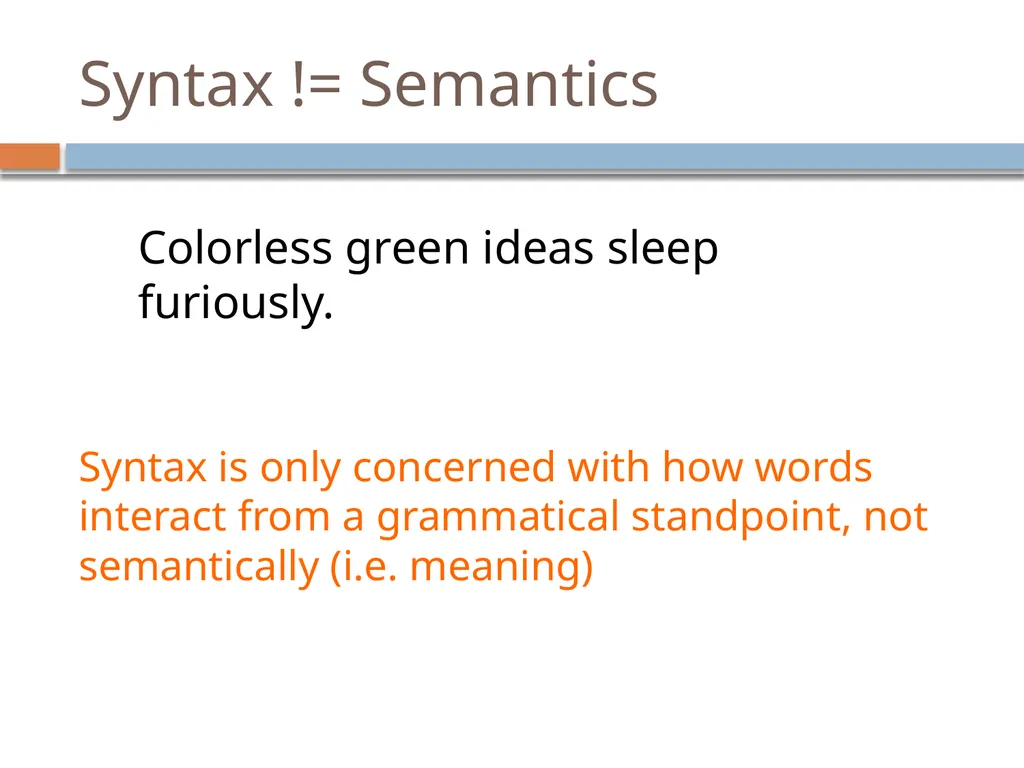
slide18. Syntax != Semantics Syntax is only concerned with how words interact from a grammatical standpoint, not semantically (i.e. meaning) Colorless green ideas sleep furiously.<br>
slide19. Parts of speech What are parts of speech (think 3rd grade)?<br>
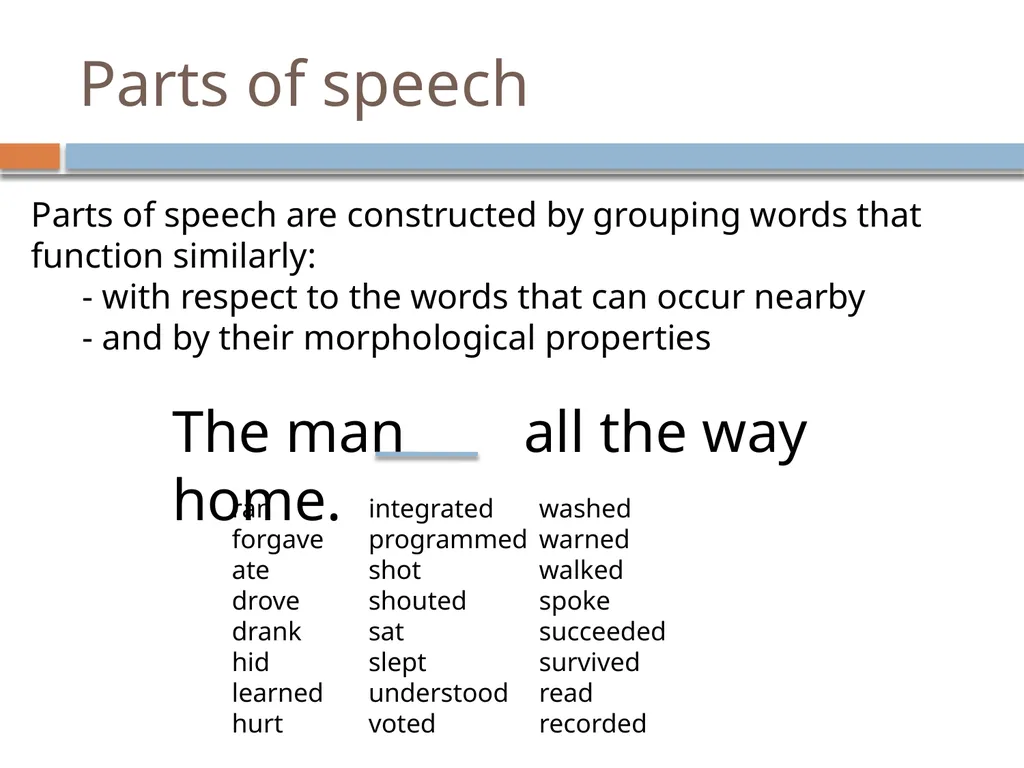
slide20. Parts of speech Parts of speech are constructed by grouping words that function similarly:
- with respect to the words that can occur nearby
- and by their morphological properties The man all the way home. ran
forgave
ate
drove
drank
hid
learned
hurt integrated
programmed
shot
shouted
sat
slept
understood
voted washed
warned
walked
spoke
succeeded
survived
read
recorded<br>
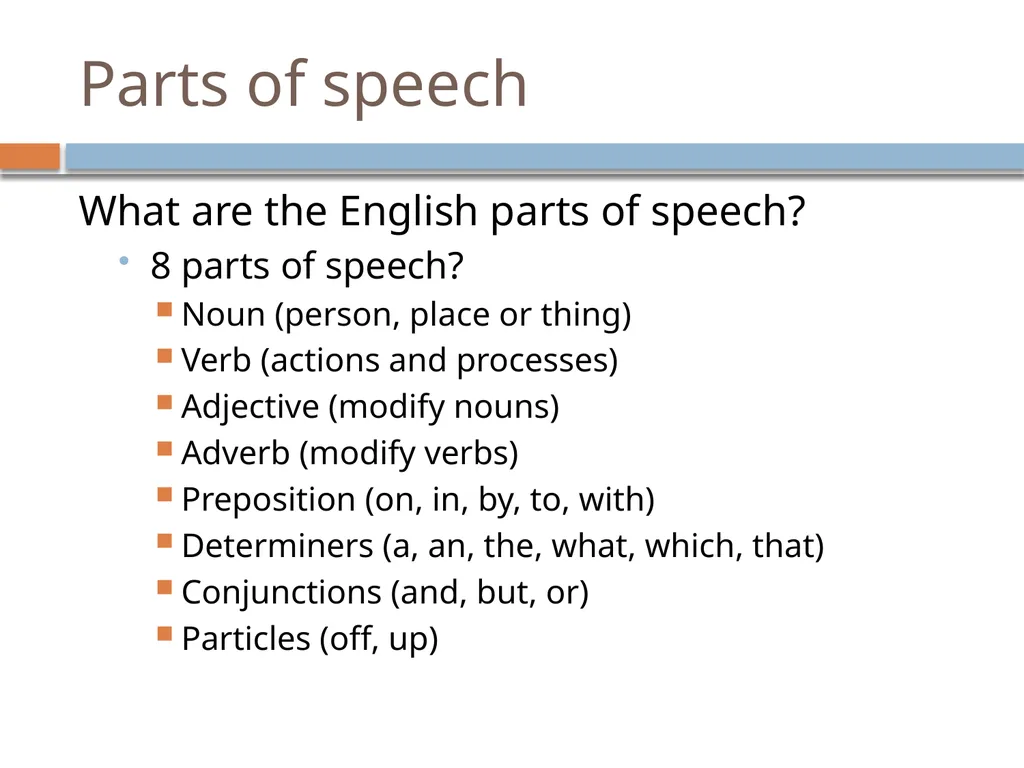
slide21. Parts of speech What are the English parts of speech?
8 parts of speech?
Noun (person, place or thing)
Verb (actions and processes)
Adjective (modify nouns)
Adverb (modify verbs)
Preposition (on, in, by, to, with)
Determiners (a, an, the, what, which, that)
Conjunctions (and, but, or)
Particles (off, up)<br>
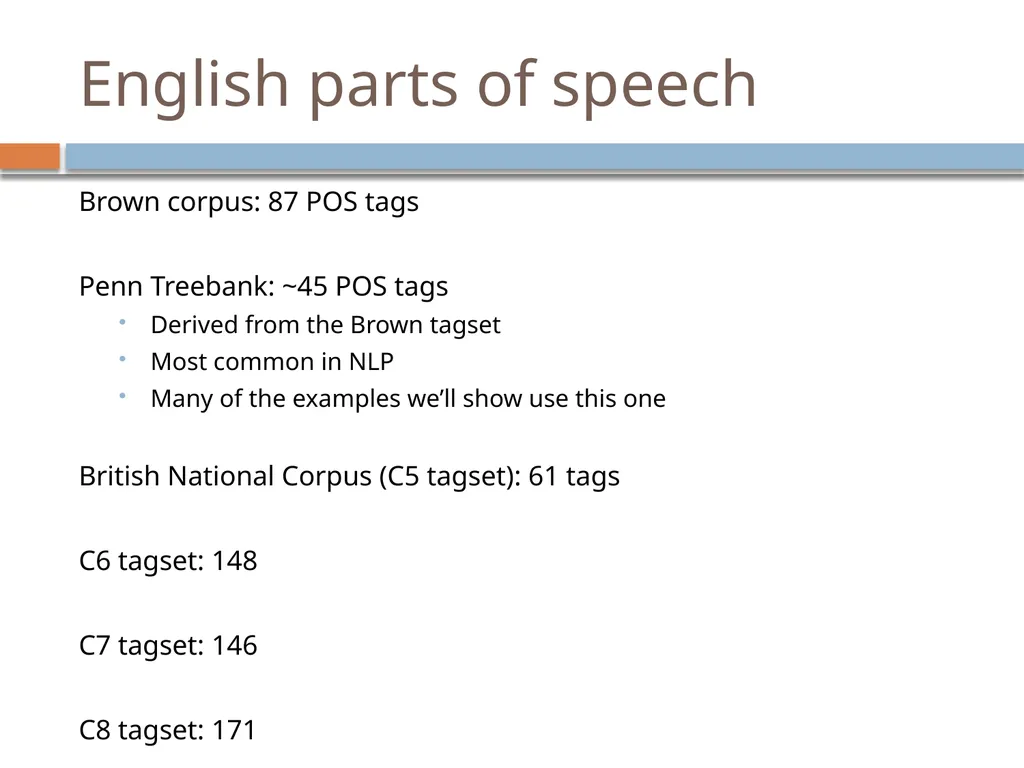
slide22. English parts of speech Brown corpus: 87 POS tags
Penn Treebank: ~45 POS tags
Derived from the Brown tagset
Most common in NLP
Many of the examples we’ll show use this one
British National Corpus (C5 tagset): 61 tags
C6 tagset: 148
C7 tagset: 146
C8 tagset: 171<br>
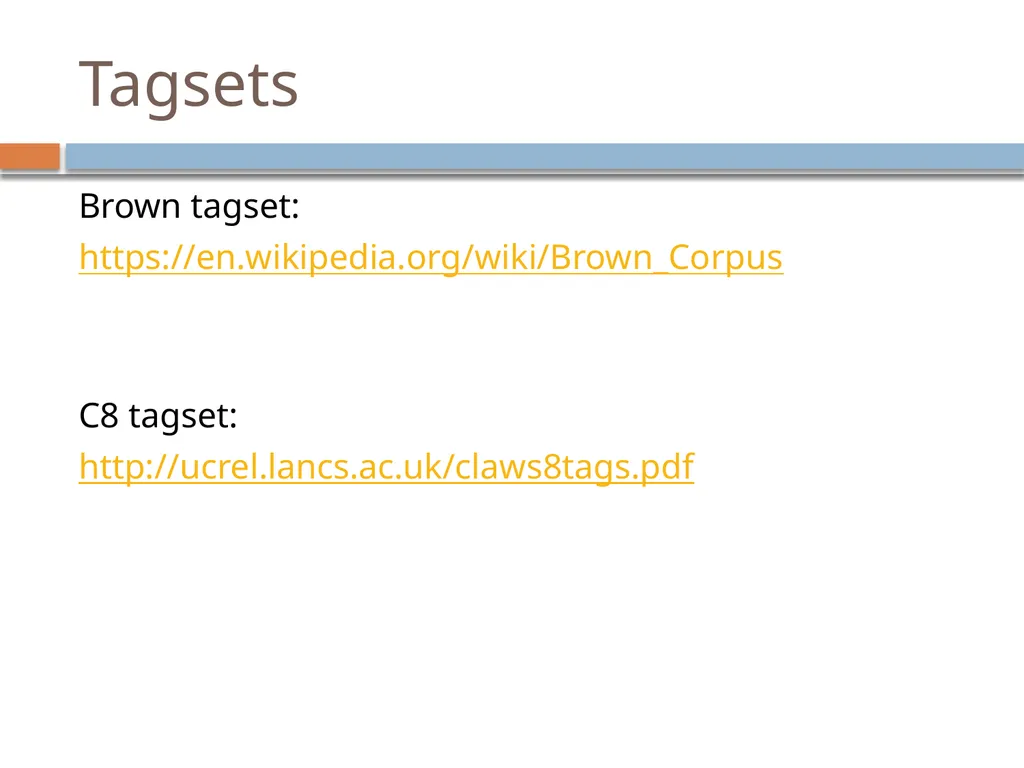
slide23. Tagsets Brown tagset:
https://en.wikipedia.org/wiki/Brown_Corpus
C8 tagset:
http://ucrel.lancs.ac.uk/claws8tags.pdf<br>
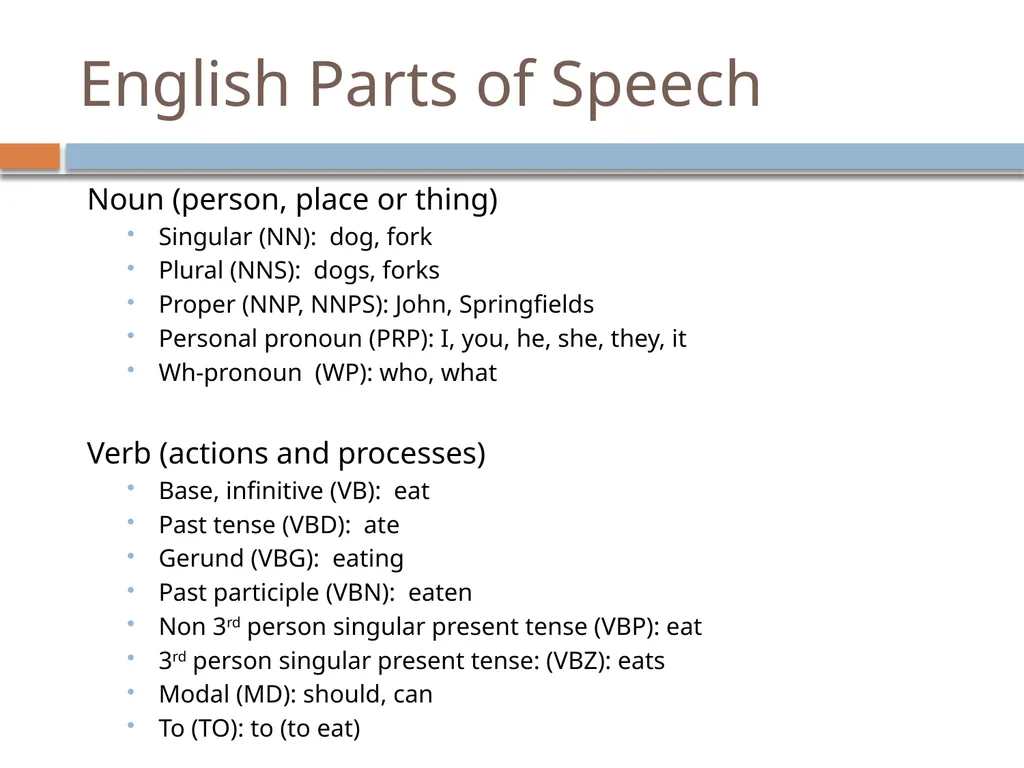
slide24. English Parts of Speech Noun (person, place or thing)
Singular (NN): dog, fork
Plural (NNS): dogs, forks
Proper (NNP, NNPS): John, Springfields
Personal pronoun (PRP): I, you, he, she, they, it
Wh-pronoun (WP): who, what
Verb (actions and processes)
Base, infinitive (VB): eat
Past tense (VBD): ate
Gerund (VBG): eating
Past participle (VBN): eaten
Non 3rd person singular present tense (VBP): eat
3rd person singular present tense: (VBZ): eats
Modal (MD): should, can
To (TO): to (to eat)<br>
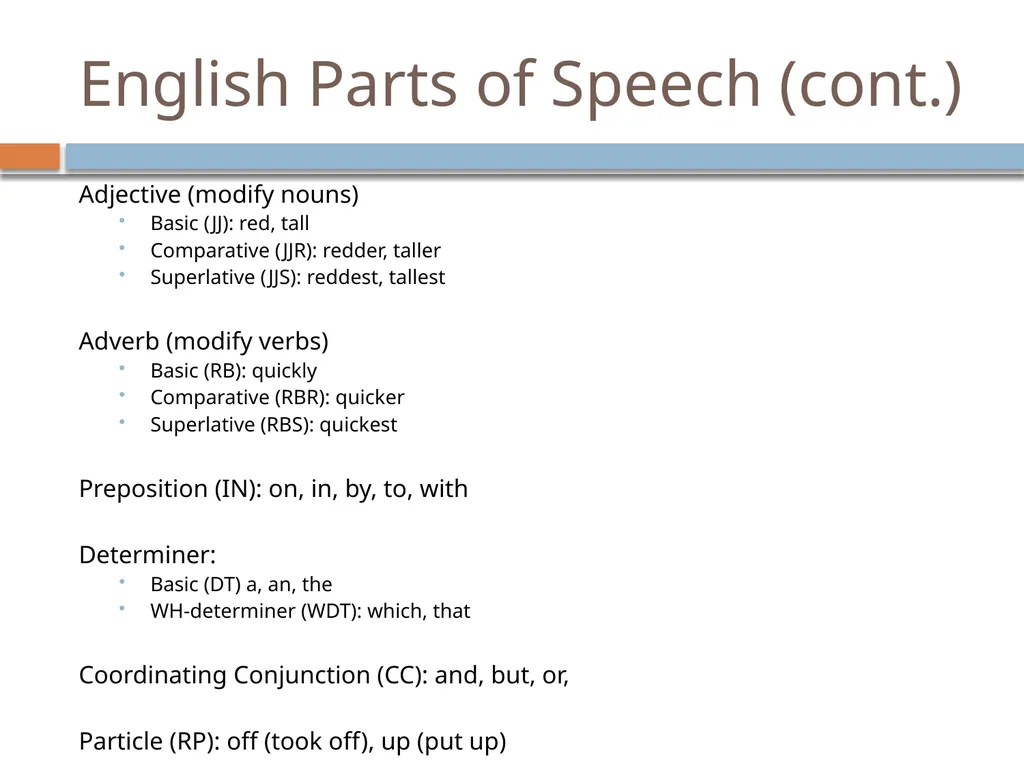
slide25. English Parts of Speech (cont.) Adjective (modify nouns)
Basic (JJ): red, tall
Comparative (JJR): redder, taller
Superlative (JJS): reddest, tallest
Adverb (modify verbs)
Basic (RB): quickly
Comparative (RBR): quicker
Superlative (RBS): quickest
Preposition (IN): on, in, by, to, with
Determiner:
Basic (DT) a, an, the
WH-determiner (WDT): which, that
Coordinating Conjunction (CC): and, but, or,
Particle (RP): off (took off), up (put up)<br>
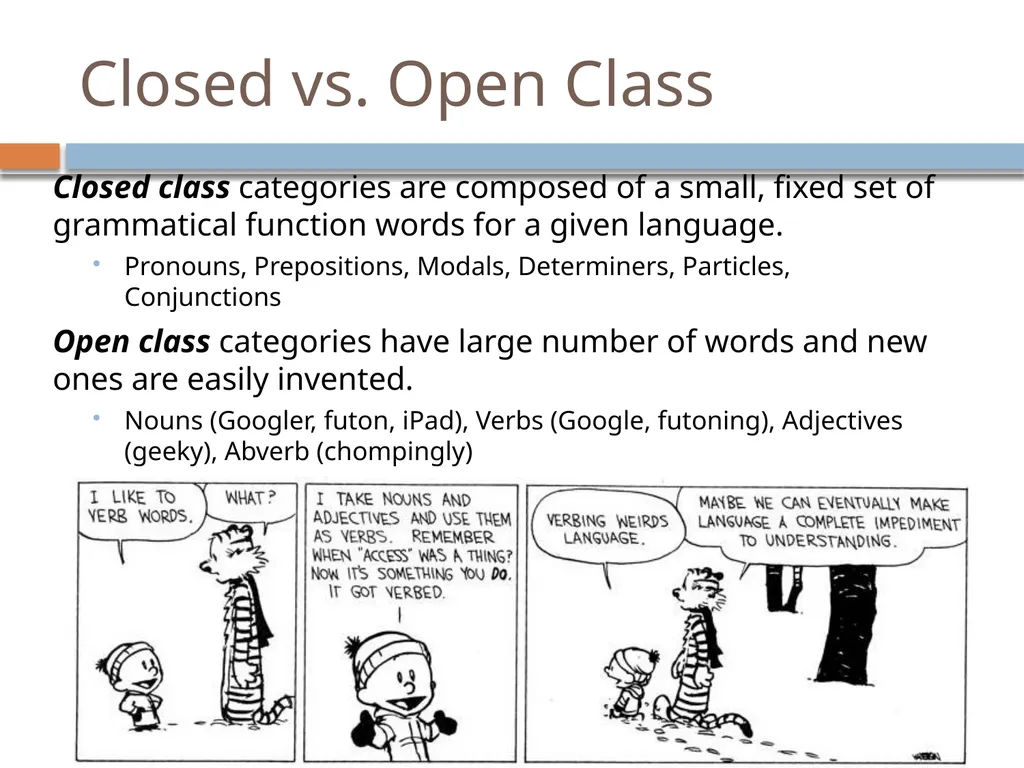
slide26. Closed vs. Open Class Closed class categories are composed of a small, fixed set of grammatical function words for a given language.
Pronouns, Prepositions, Modals, Determiners, Particles, Conjunctions
Open class categories have large number of words and new ones are easily invented.
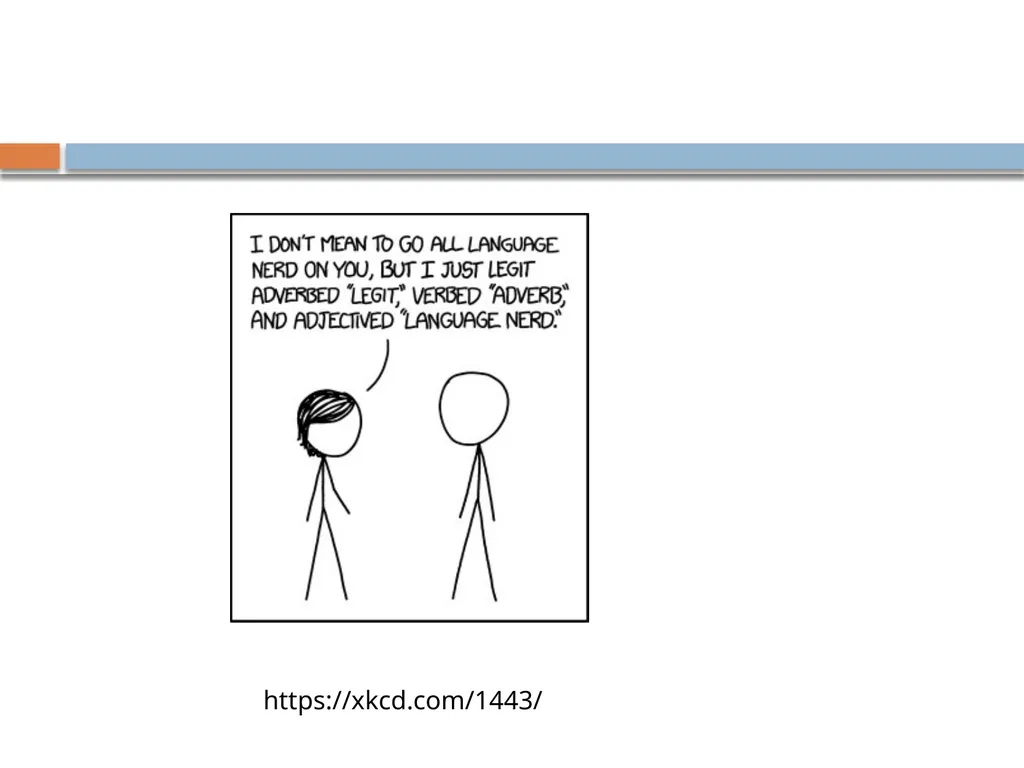
Nouns (Googler, futon, iPad), Verbs (Google, futoning), Adjectives (geeky), Abverb (chompingly)<br>
slide27. https://xkcd.com/1443/<br>
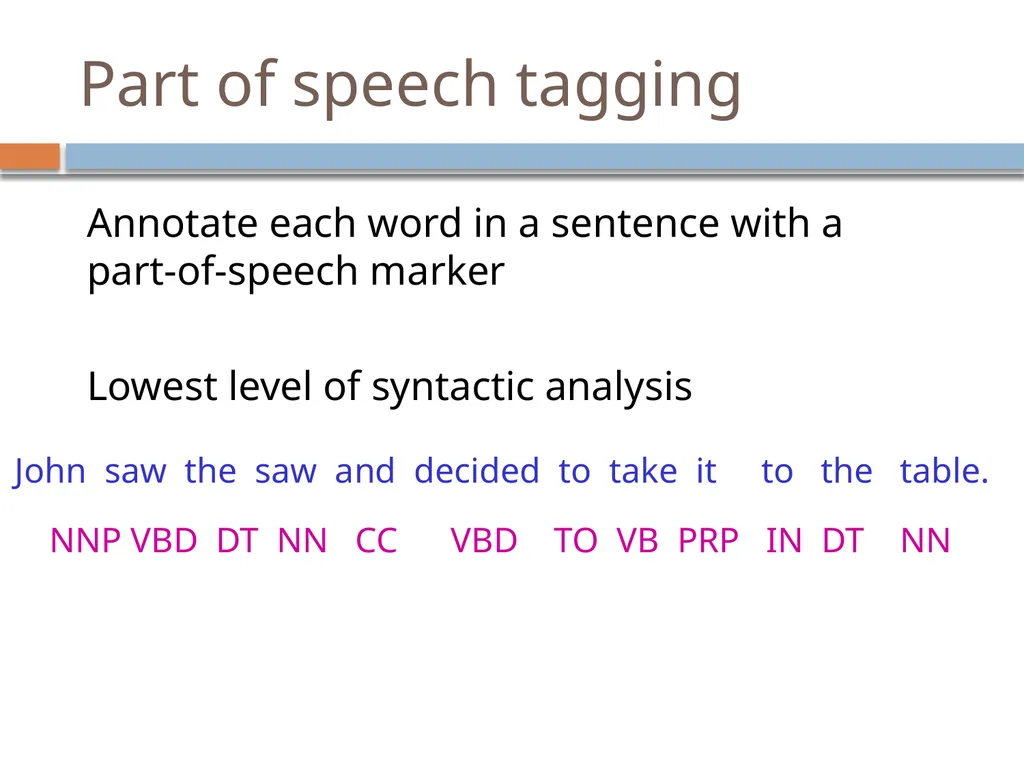
slide28. Part of speech tagging Annotate each word in a sentence with a part-of-speech marker
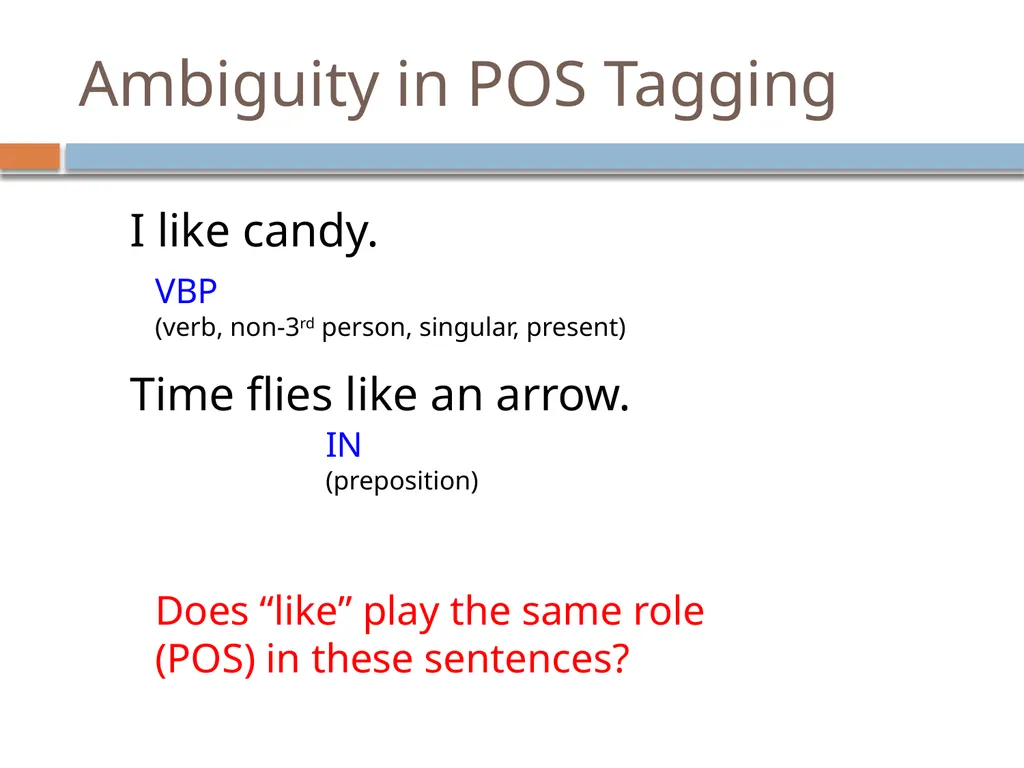
Lowest level of syntactic analysis John saw the saw and decided to take it to the table. NNP VBD DT NN CC VBD TO VB PRP IN DT NN<br>
slide29. Ambiguity in POS Tagging I like candy.
Time flies like an arrow. Does “like” play the same role (POS) in these sentences? VBP
(verb, non-3rd person, singular, present) IN
(preposition)<br>
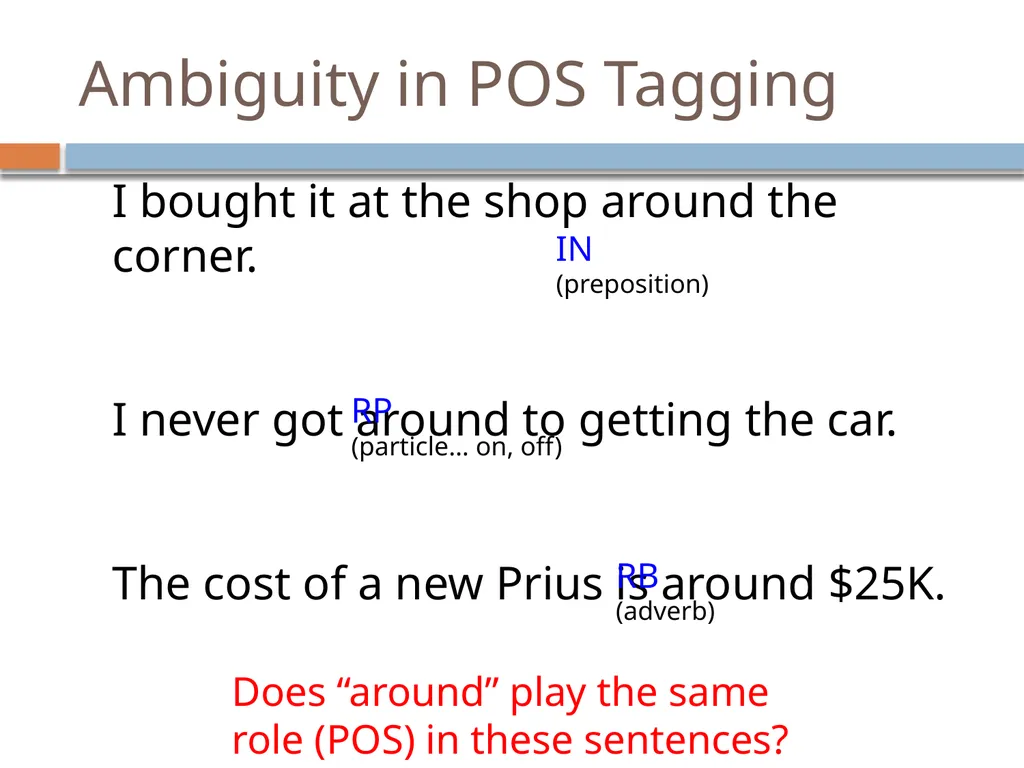
slide30. Ambiguity in POS Tagging I bought it at the shop around the corner.
I never got around to getting the car.
The cost of a new Prius is around $25K. Does “around” play the same role (POS) in these sentences? IN
(preposition) RP
(particle… on, off) RB
(adverb)<br>
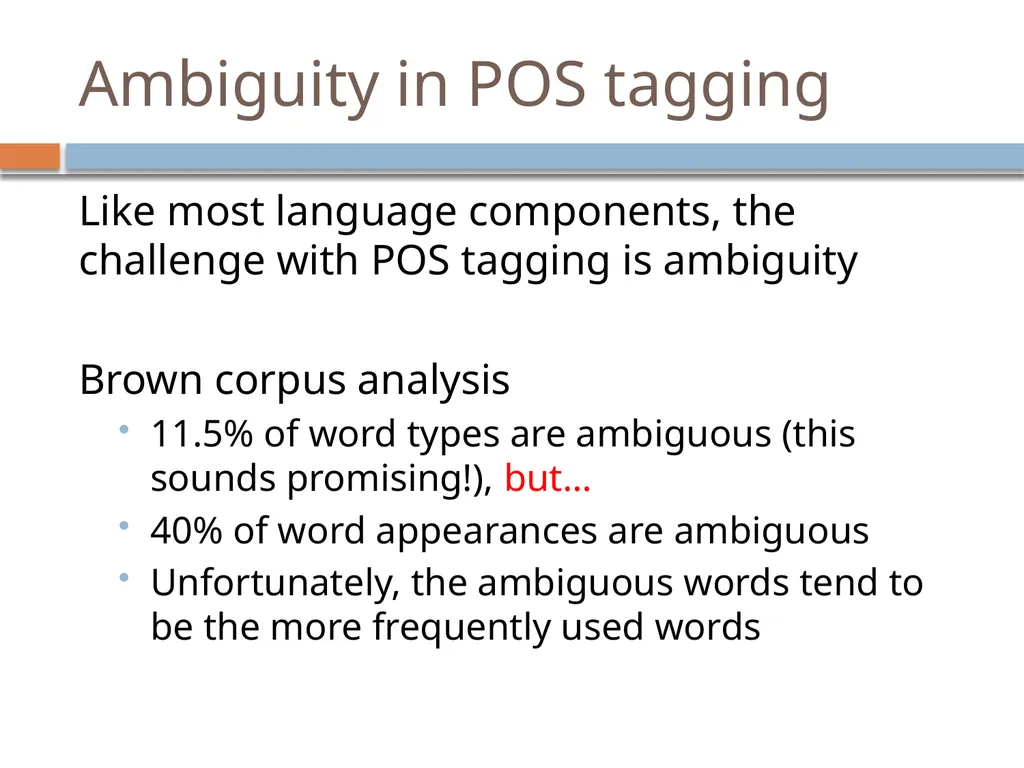
slide31. Ambiguity in POS tagging Like most language components, the challenge with POS tagging is ambiguity
Brown corpus analysis
11.5% of word types are ambiguous (this sounds promising!), but…
40% of word appearances are ambiguous
Unfortunately, the ambiguous words tend to be the more frequently used words<br>
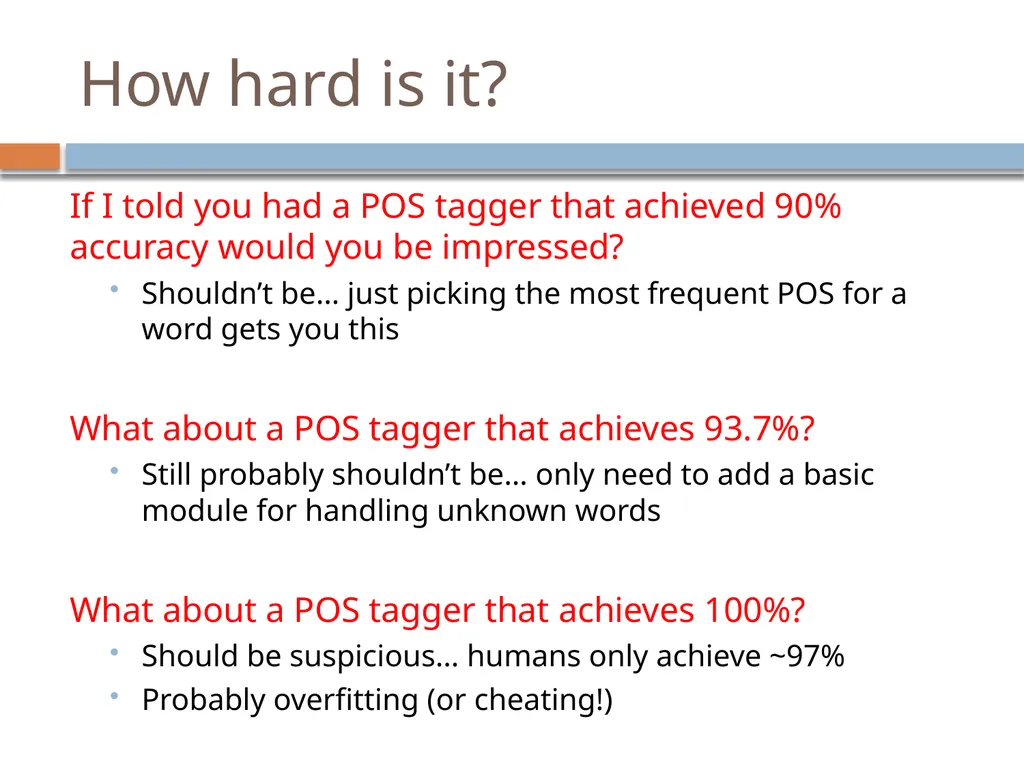
slide32. How hard is it? If I told you had a POS tagger that achieved 90% accuracy would you be impressed?
Shouldn’t be… just picking the most frequent POS for a word gets you this
What about a POS tagger that achieves 93.7%?
Still probably shouldn’t be… only need to add a basic module for handling unknown words
What about a POS tagger that achieves 100%?
Should be suspicious… humans only achieve ~97%
Probably overfitting (or cheating!)<br>
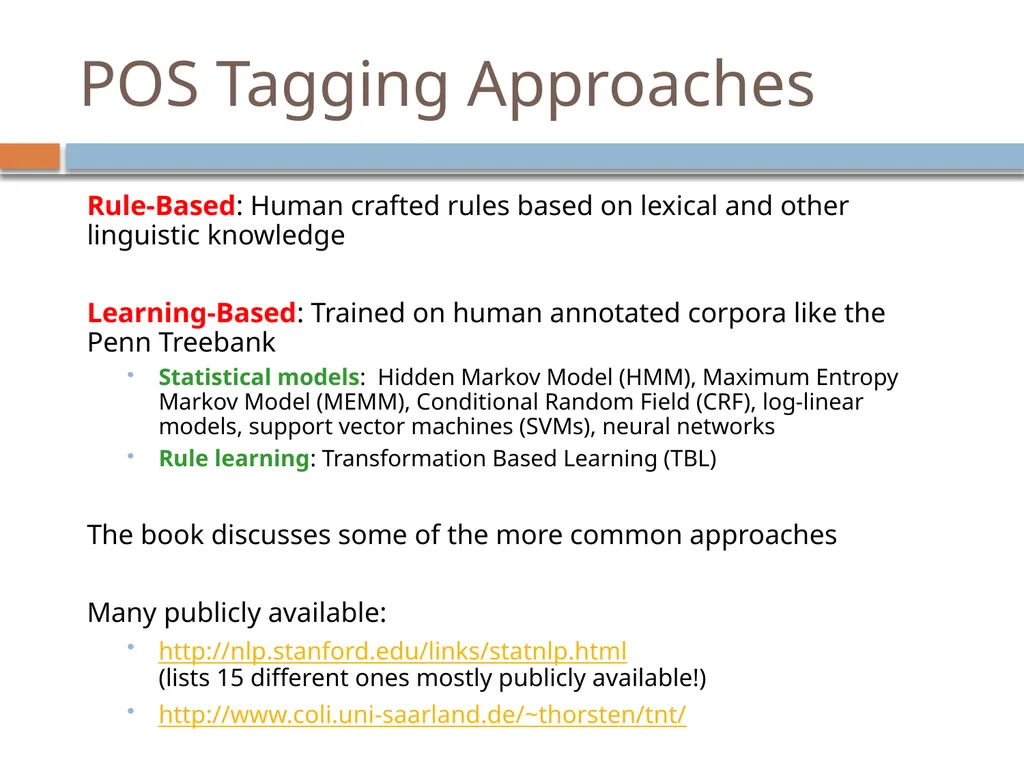
slide33. POS Tagging Approaches Rule-Based: Human crafted rules based on lexical and other linguistic knowledge
Learning-Based: Trained on human annotated corpora like the Penn Treebank
Statistical models: Hidden Markov Model (HMM), Maximum Entropy Markov Model (MEMM), Conditional Random Field (CRF), log-linear models, support vector machines (SVMs), neural networks
Rule learning: Transformation Based Learning (TBL)
The book discusses some of the more common approaches
Many publicly available:
http://nlp.stanford.edu/links/statnlp.html (lists 15 different ones mostly publicly available!)
http://www.coli.uni-saarland.de/~thorsten/tnt/<br>
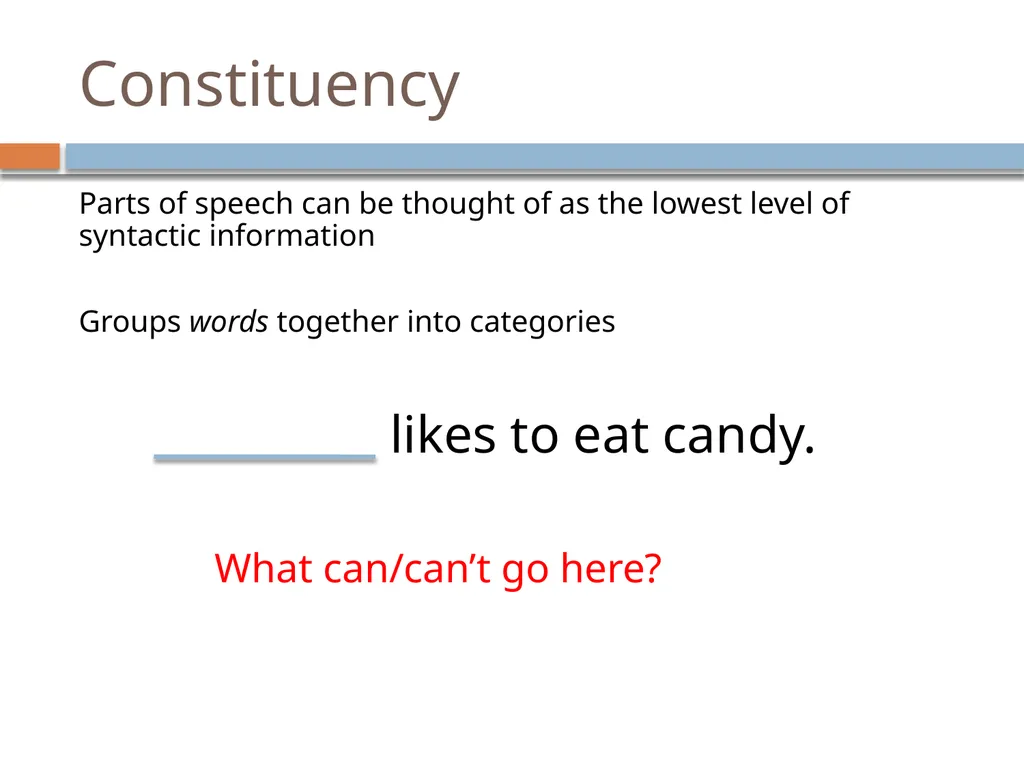
slide34. Constituency Parts of speech can be thought of as the lowest level of syntactic information
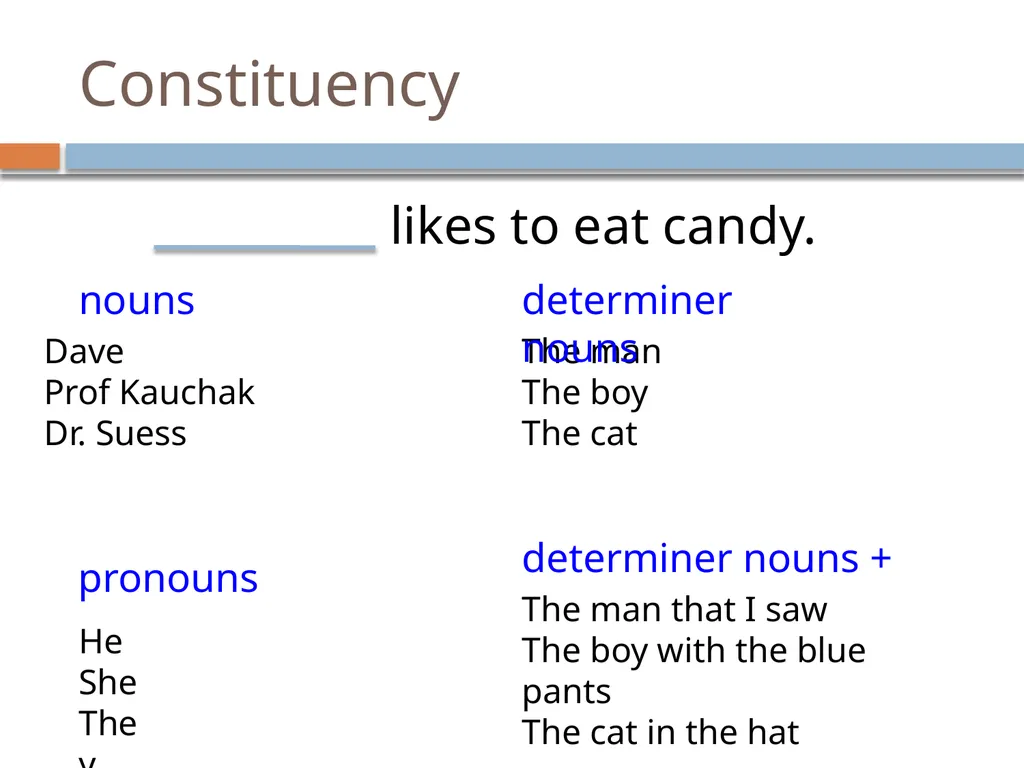
Groups words together into categories likes to eat candy. What can/can’t go here?<br>
slide35. Constituency likes to eat candy. He
She
They The man
The boy
The cat Dave
Prof Kauchak
Dr. Suess nouns determiner nouns pronouns The man that I saw
The boy with the blue pants
The cat in the hat determiner nouns +<br>
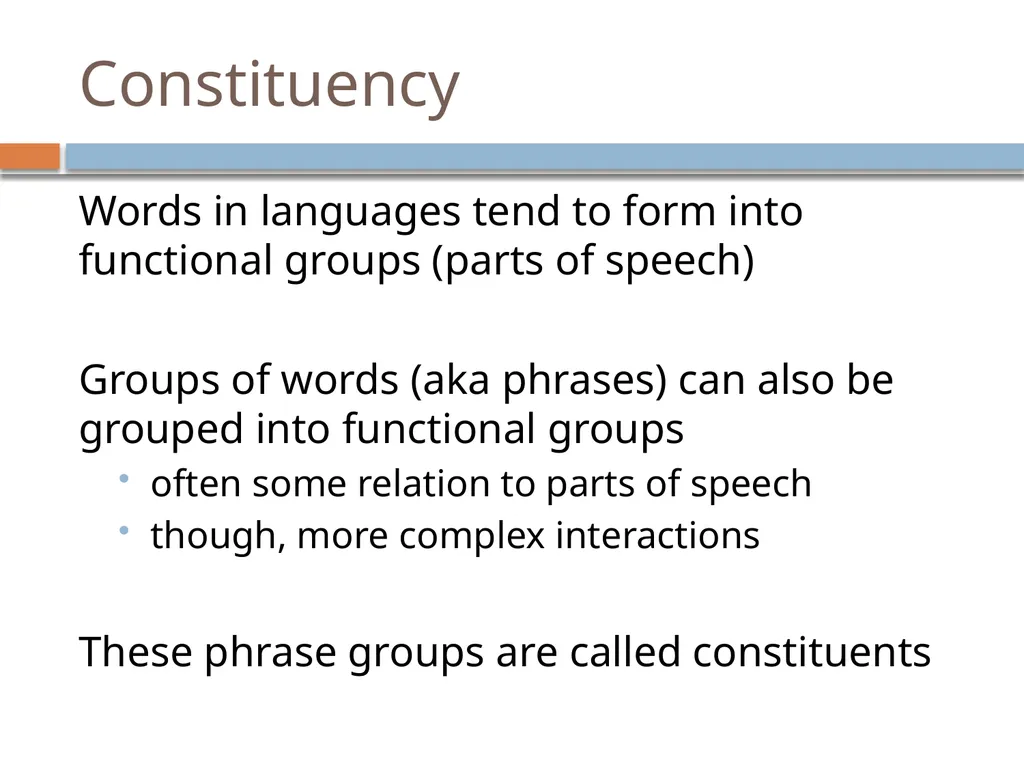
slide36. Constituency Words in languages tend to form into functional groups (parts of speech)
Groups of words (aka phrases) can also be grouped into functional groups
often some relation to parts of speech
though, more complex interactions
These phrase groups are called constituents<br>
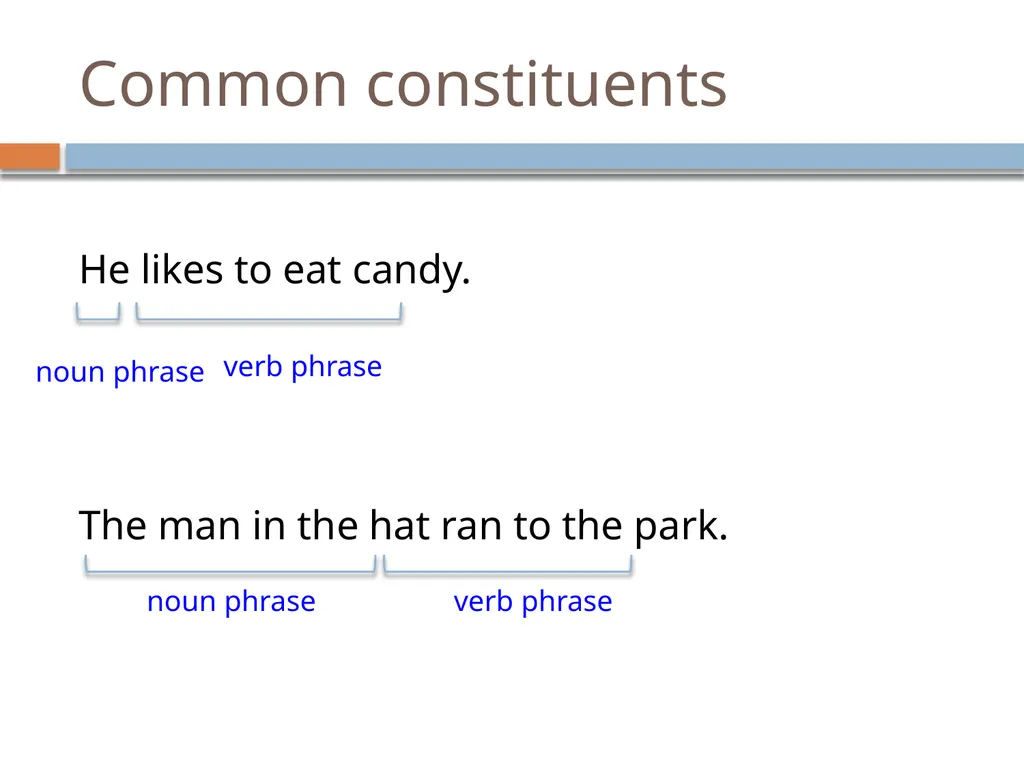
slide37. Common constituents He likes to eat candy. The man in the hat ran to the park. noun phrase verb phrase noun phrase verb phrase<br>
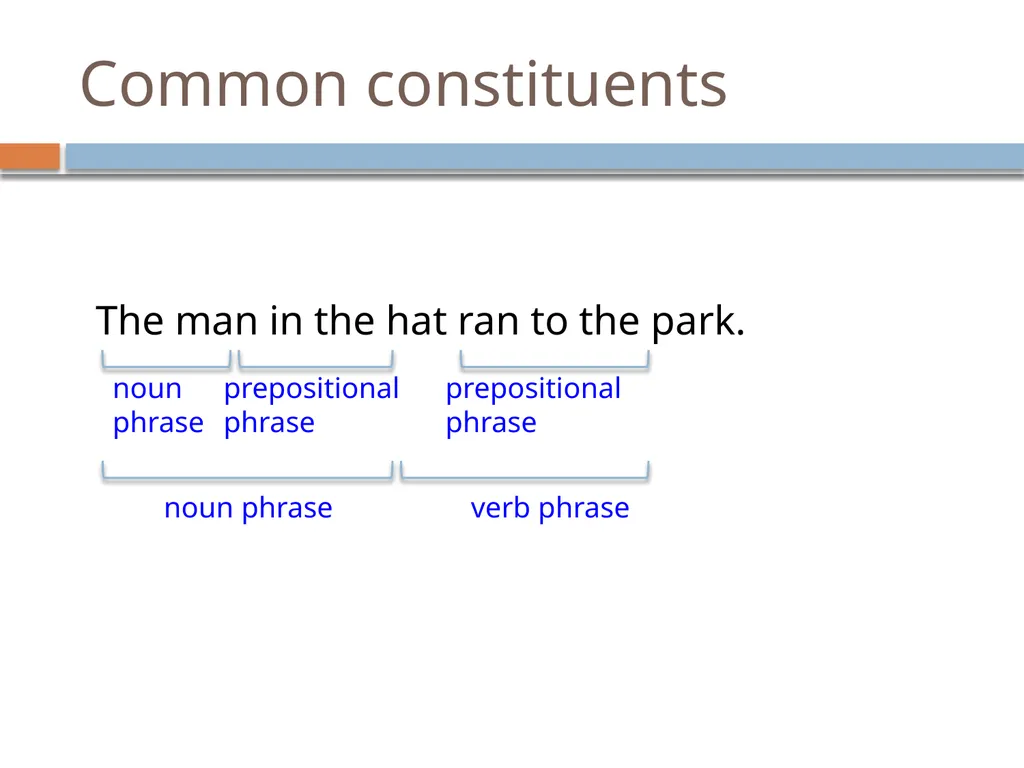
slide38. Common constituents The man in the hat ran to the park. noun phrase verb phrase noun phrase prepositional phrase prepositional phrase<br>
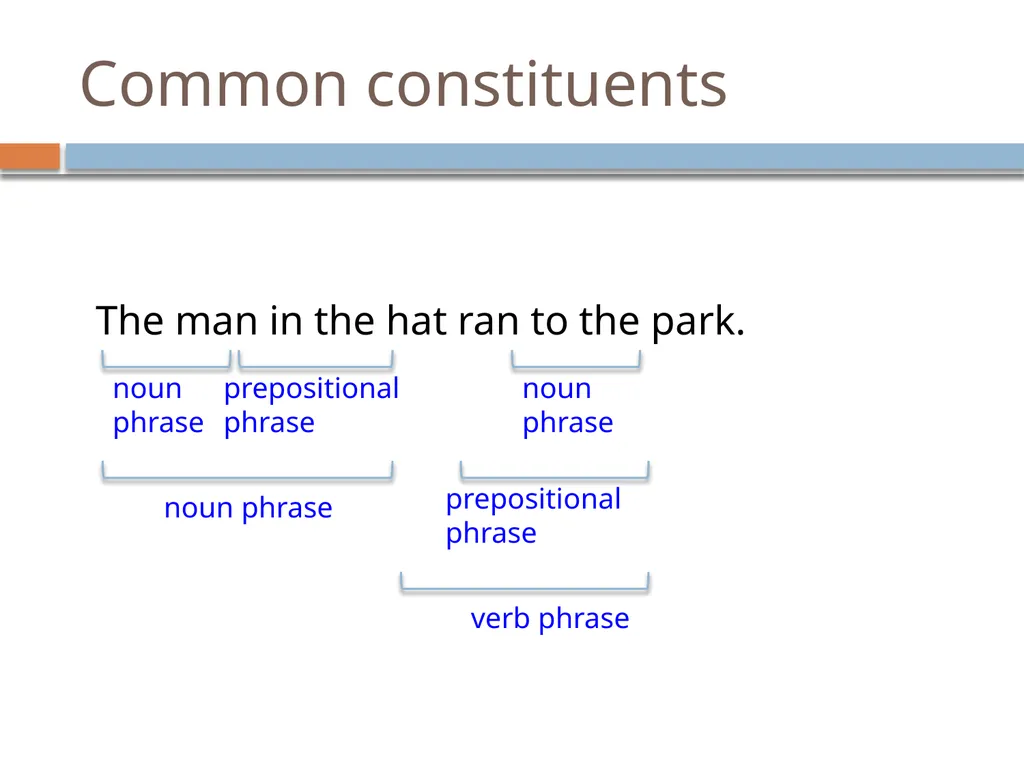
slide39. Common constituents The man in the hat ran to the park. noun phrase verb phrase noun phrase prepositional phrase prepositional phrase noun phrase<br>
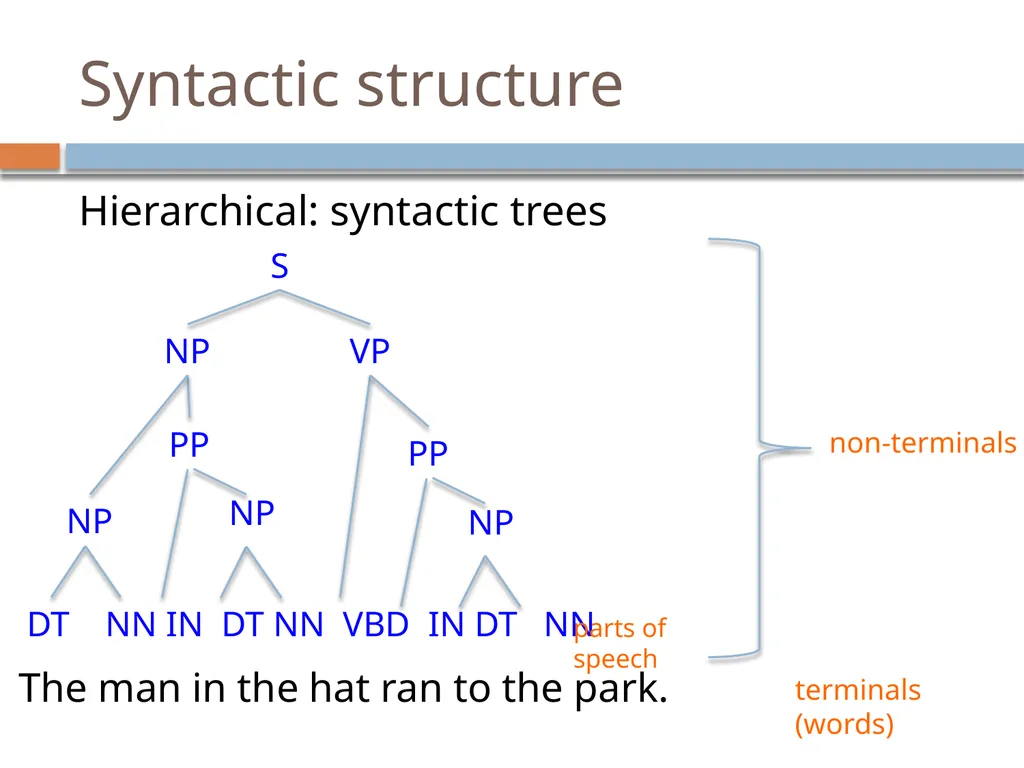
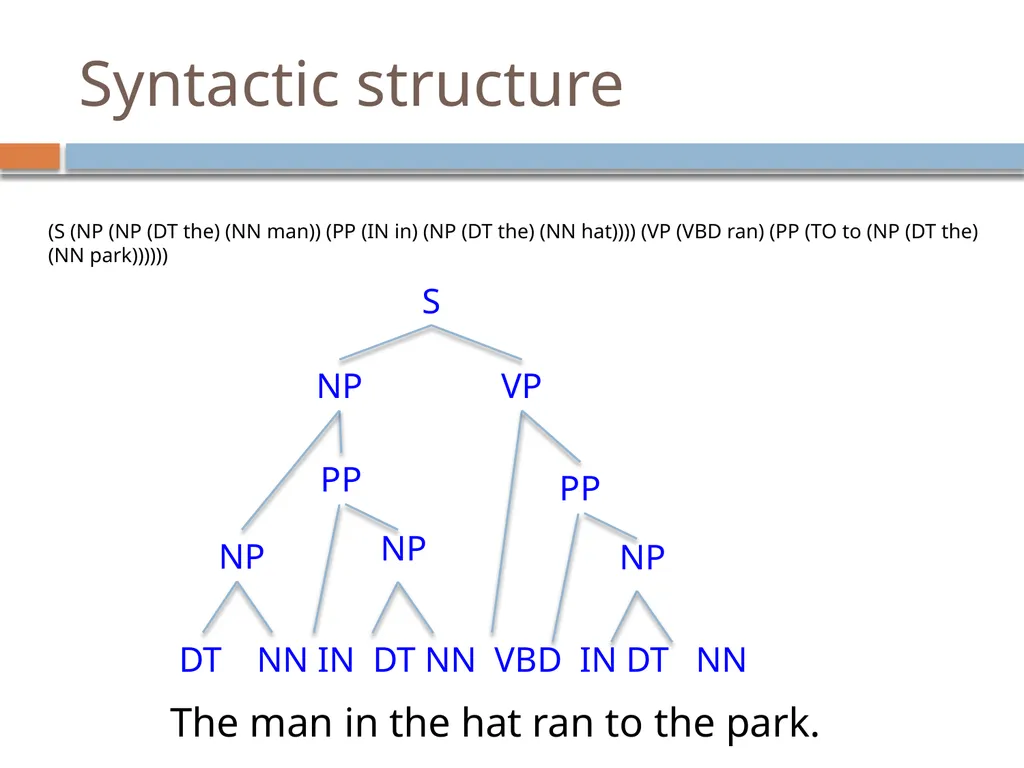
slide40. Syntactic structure Hierarchical: syntactic trees The man in the hat ran to the park. DT NN IN DT NN VBD IN DT NN NP NP NP PP NP PP VP S parts of speech terminals (words) non-terminals<br>
slide41. Syntactic structure The man in the hat ran to the park. DT NN IN DT NN VBD IN DT NN NP NP NP PP NP PP VP S (S (NP (NP (DT the) (NN man)) (PP (IN in) (NP (DT the) (NN hat)))) (VP (VBD ran) (PP (TO to (NP (DT the) (NN park))))))<br>
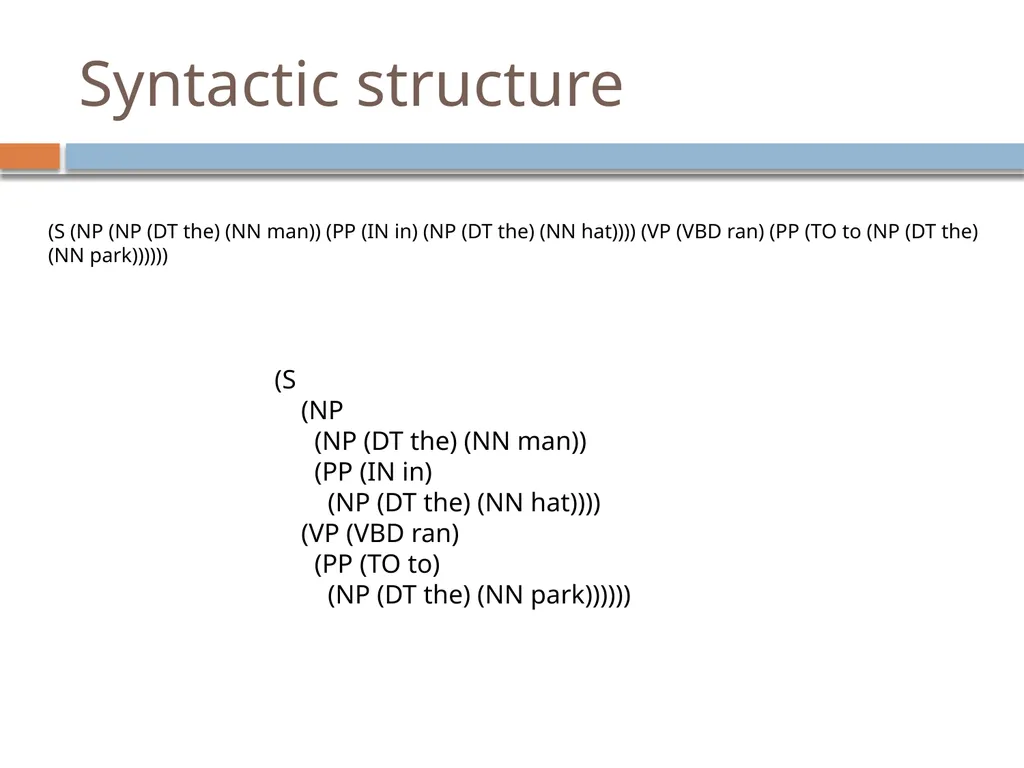
slide42. Syntactic structure (S
(NP
(NP (DT the) (NN man))
(PP (IN in)
(NP (DT the) (NN hat))))
(VP (VBD ran)
(PP (TO to)
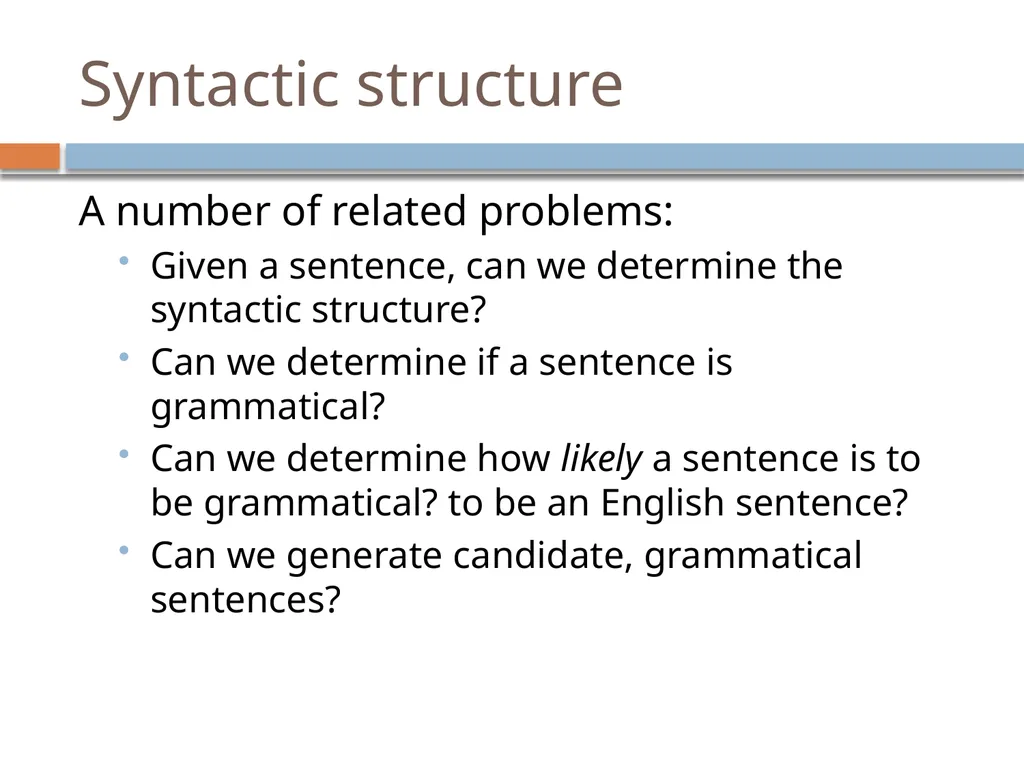
(NP (DT the) (NN park)))))) (S (NP (NP (DT the) (NN man)) (PP (IN in) (NP (DT the) (NN hat)))) (VP (VBD ran) (PP (TO to (NP (DT the) (NN park))))))<br>
slide43. Syntactic structure A number of related problems:
Given a sentence, can we determine the syntactic structure?
Can we determine if a sentence is grammatical?
Can we determine how likely a sentence is to be grammatical? to be an English sentence?
Can we generate candidate, grammatical sentences?<br>
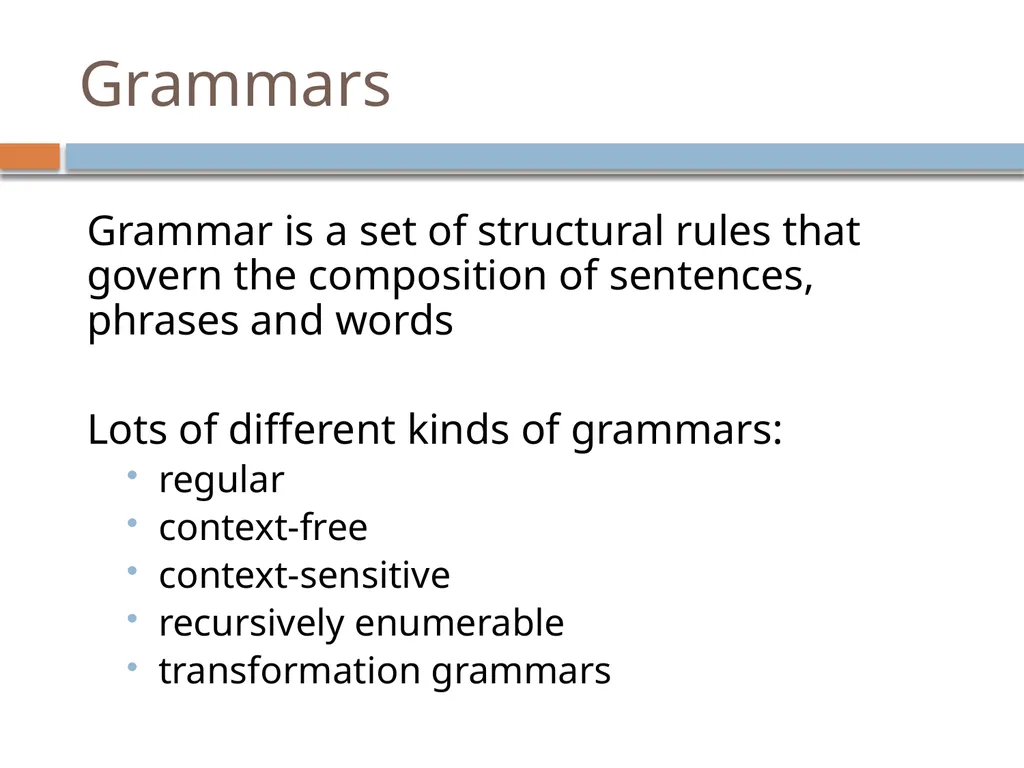
slide44. Grammars What is a grammar (3rd grade again…)?<br>
slide45. Grammars Grammar is a set of structural rules that govern the composition of sentences, phrases and words
Lots of different kinds of grammars:
regular
context-free
context-sensitive
recursively enumerable
transformation grammars<br>
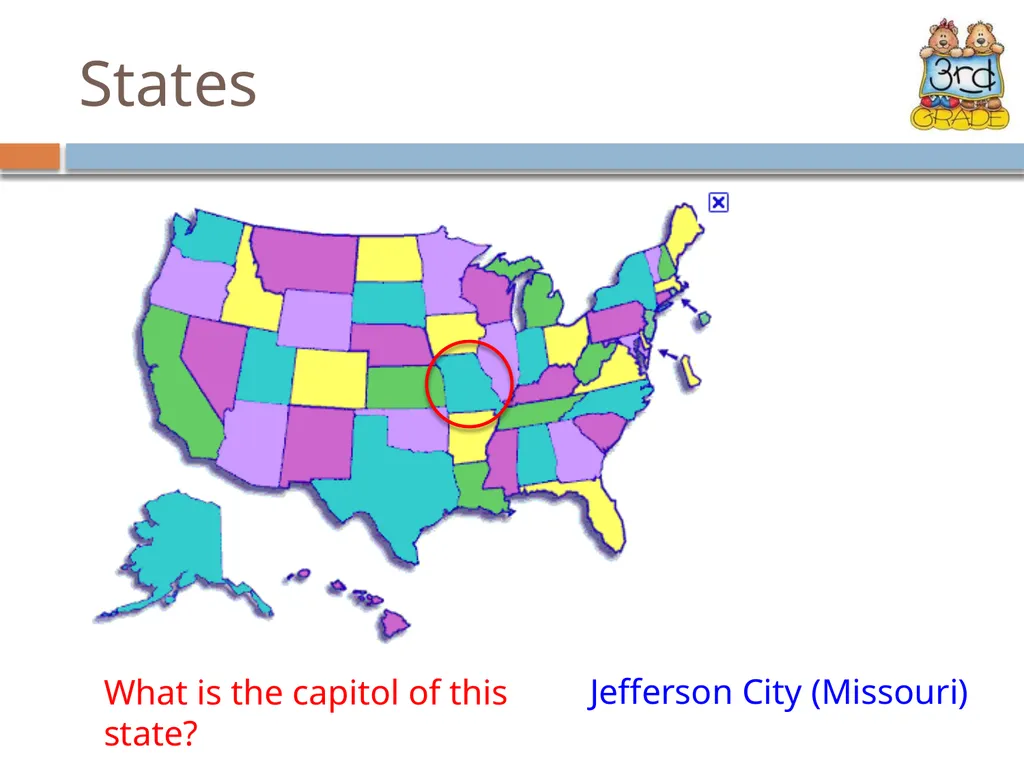
slide46. States What is the capitol of this state? Jefferson City (Missouri)<br>
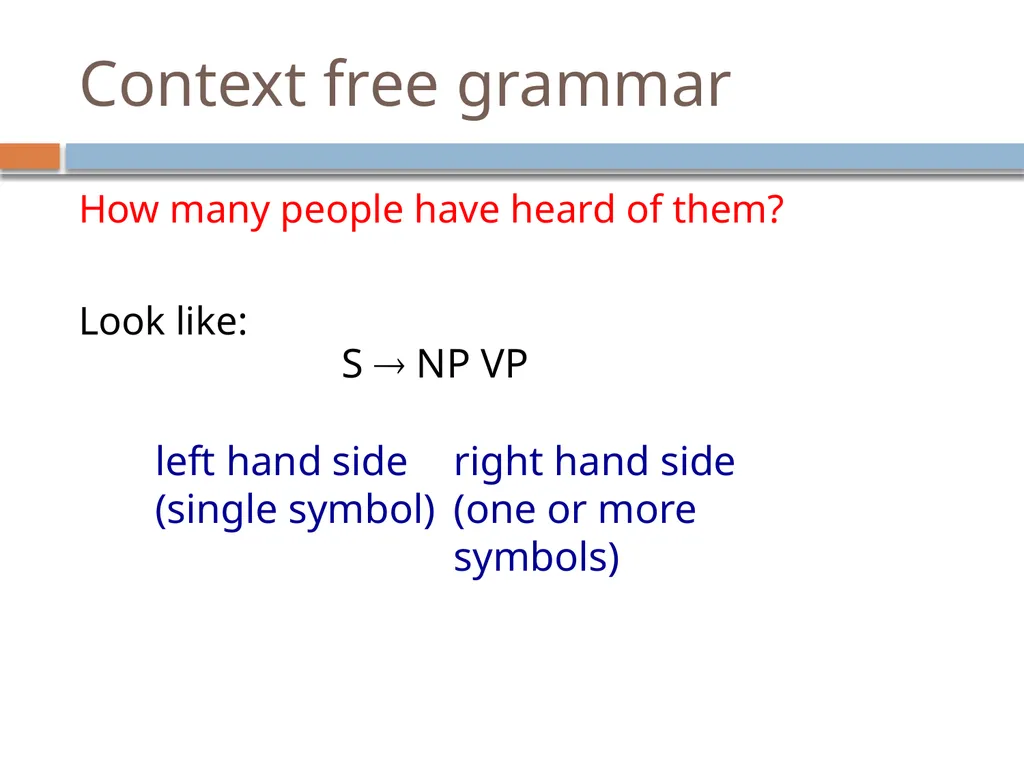
slide47. Context free grammar How many people have heard of them?
Look like: S NP VP left hand side
(single symbol) right hand side
(one or more symbols)<br>
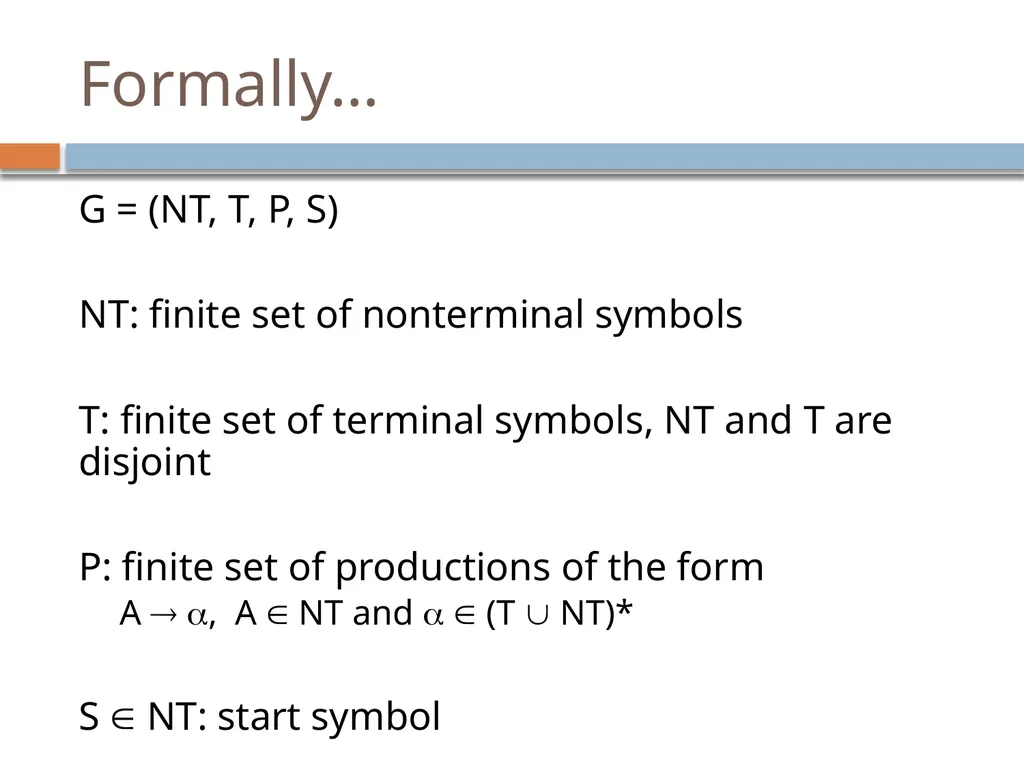
slide48. Formally… G = (NT, T, P, S)
NT: finite set of nonterminal symbols
T: finite set of terminal symbols, NT and T are disjoint
P: finite set of productions of the form
A , A NT and (T NT)*
S NT: start symbol<br>
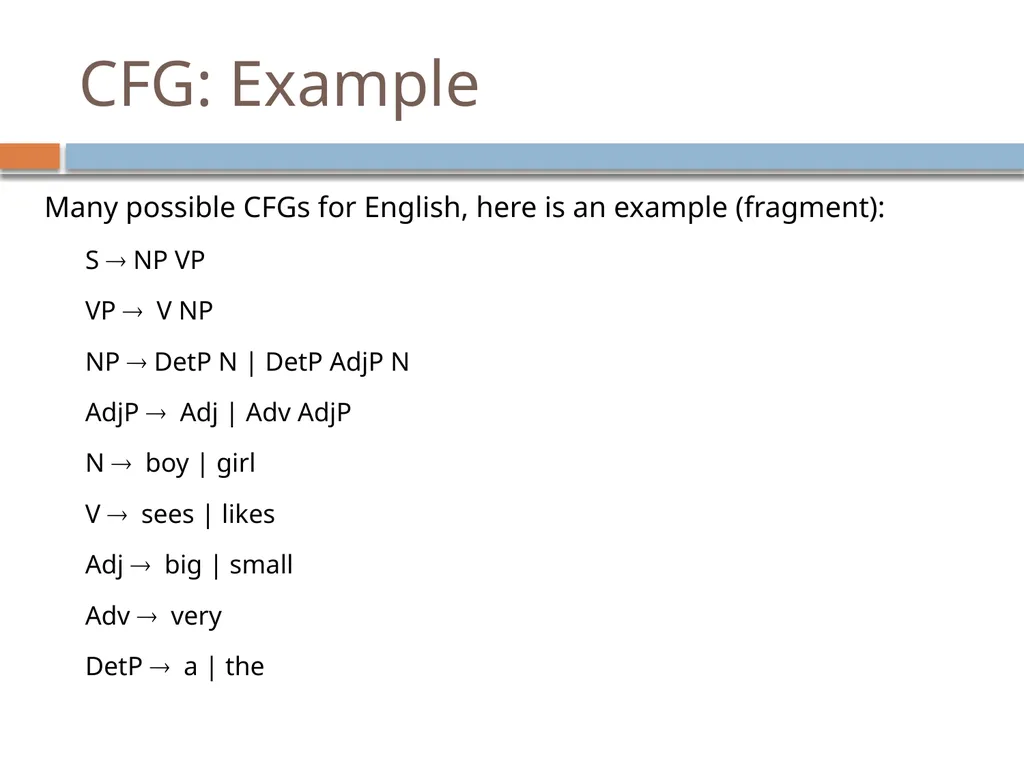
slide49. CFG: Example Many possible CFGs for English, here is an example (fragment):
S NP VP
VP V NP
NP DetP N | DetP AdjP N
AdjP Adj | Adv AdjP
N boy | girl
V sees | likes
Adj big | small
Adv very
DetP a | the<br>
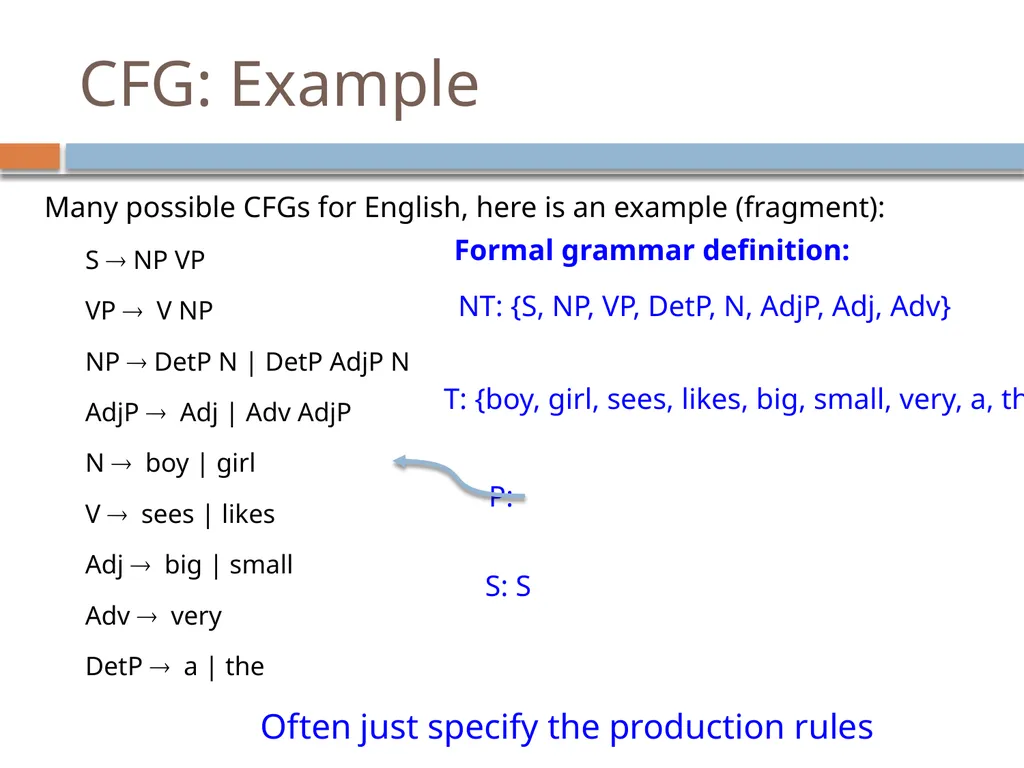
slide50. CFG: Example Many possible CFGs for English, here is an example (fragment):
S NP VP
VP V NP
NP DetP N | DetP AdjP N
AdjP Adj | Adv AdjP
N boy | girl
V sees | likes
Adj big | small
Adv very
DetP a | the NT: {S, NP, VP, DetP, N, AdjP, Adj, Adv} T: {boy, girl, sees, likes, big, small, very, a, the} P: S: S Often just specify the production rules Formal grammar definition:<br>
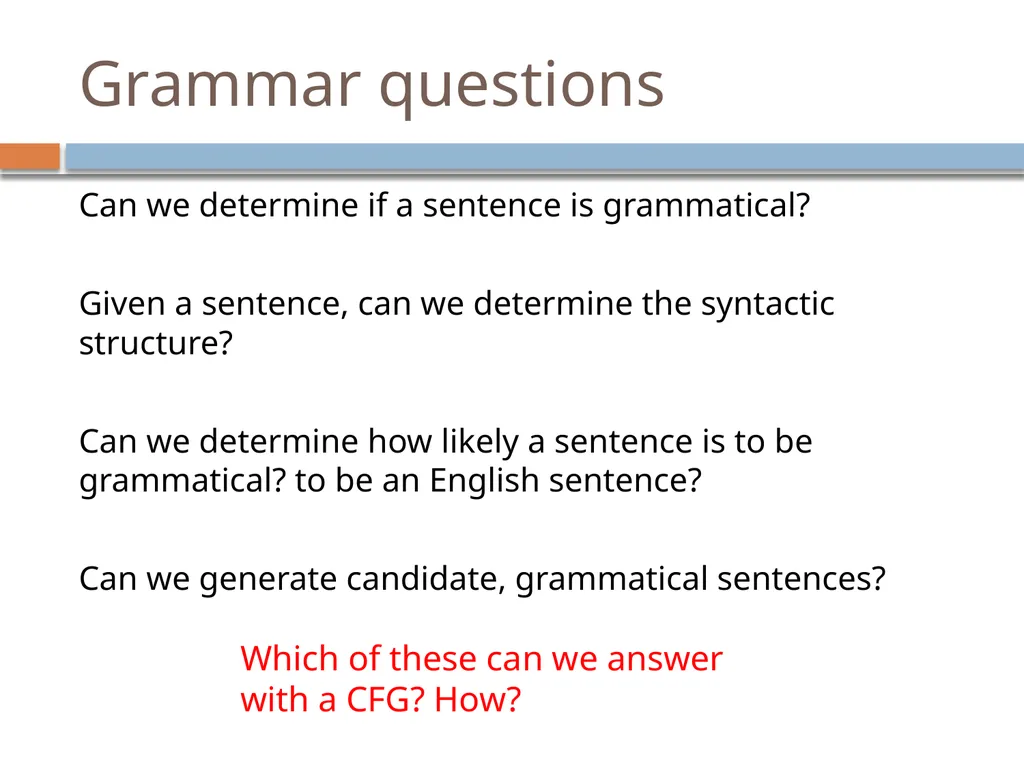
slide51. Grammar questions Can we determine if a sentence is grammatical?
Given a sentence, can we determine the syntactic structure?
Can we determine how likely a sentence is to be grammatical? to be an English sentence?
Can we generate candidate, grammatical sentences? Which of these can we answer with a CFG? How?<br>
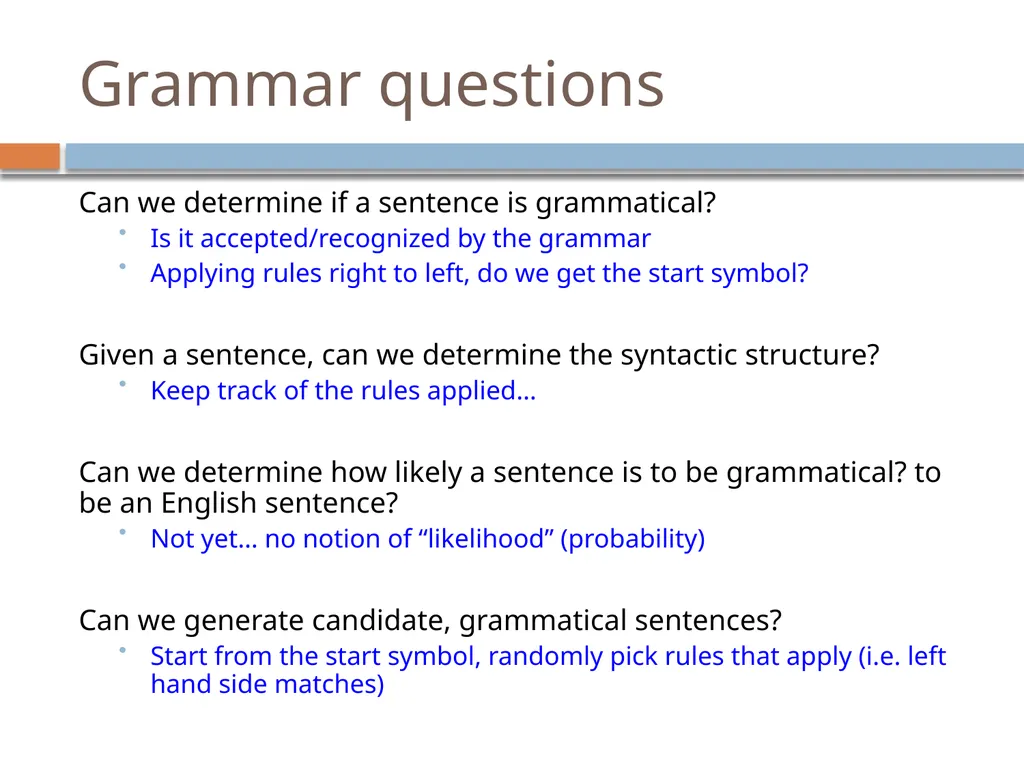
slide52. Grammar questions Can we determine if a sentence is grammatical?
Is it accepted/recognized by the grammar
Applying rules right to left, do we get the start symbol?
Given a sentence, can we determine the syntactic structure?
Keep track of the rules applied…
Can we determine how likely a sentence is to be grammatical? to be an English sentence?
Not yet… no notion of “likelihood” (probability)
Can we generate candidate, grammatical sentences?
Start from the start symbol, randomly pick rules that apply (i.e. left hand side matches)<br>
CS159 – Spring 2023 some slides adapted from Ray Mooney<br>
slide2. Admin Assignment 2
Quiz #1
Monday at the beginning of class (first 30 minutes)
Open book and open notes<br>
slide3. Quiz #1 material T/F, short answer, pencil and paper work (no coding)
zipf's law
regular expressions
probability basics
language modeling
MLE estimation/estimating from a corpus
development set
perplexity
determining vocabulary
smoothing techniques
add 1
add lambda
interpolation
backoff
absolute discounting<br>
slide4. Simplified View of Linguistics /waddyasai/ Phonology/Phonetics Morphology /waddyasai/ what did you say Syntax what did you say say you what obj subj Semantics say you what obj subj P[ x. say(you, x) ] Discourse what did you say what did you say<br>
slide5. Morphology What is morphology?
study of the internal structure of words
morph-ology word-s jump-ing
Why might this be useful for NLP?
generalization (runs, running, runner are related)
additional information (it’s plural, past tense, etc)
allows us to handle words we’ve never seen before
smoothing?<br>
slide6. New words AP newswire stories from Feb 1988 – Dec 30, 1988
300K unique words
New words seen on Dec 31
compounds: prenatal-care, publicly-funded, channel-switching, …
New words:
dumbbells, groveled, fuzzier, oxidized, ex-presidency, puppetry, boulderlike, over-emphasized, antiprejudice<br>
slide7. Morphology basics Words are built up from morphemes
stems (base/main part of the word)
affixes
prefixes
precedes the stem
suffixes
follows the stem
infixes
inserted inside the stem
circumfixes
surrounds the stem
Examples?<br>
slide8. Morpheme examples prefix
circum- (circumnavigate)
dis- (dislike)
mis- (misunderstood)
com-, de-, dis-, in-, re-, post-, trans-, …
suffix
-able (movable)
-ance (resistance)
-ly (quickly)
-tion, -ness, -ate, -ful, …<br>
slide9. Morpheme examples infix
-fucking- (cinder-fucking-rella)
more common in other languages
circumfix
doesn’t really happen in English
a- -ing
a-running
a-jumping<br>
slide10. Agglutinative: Finnish talo 'the-house’ kaup-pa 'the-shop'
talo-ni 'my house' kaup-pa-ni 'my shop'
talo-ssa 'in the-house' kaup-a-ssa 'in the-shop'
talo-ssa-ni 'in my house’ kaup-a-ssa-ni 'in my shop'
talo-i-ssa 'in the-houses’ kaup-o-i-ssa 'in the-shops'
talo-i-ssa-ni 'in my houses’ kaup-o-i-ssa-ni 'in my shops'<br>
slide11. Stemming (baby lemmatization) Reduce a word to the main stem/morpheme automate
automates automatic
automation run
runs
running automat run<br>
slide12. Stemming example This is a poorly constructed example using the Porter stemmer. https://text-processing.com/demo/stem/
(or you can download versions online) This is a poorli construct example us the Porter stemmer.<br>
slide13. Porter’s algorithm (1980) Most common algorithm for stemming English
Results suggest it is at least as good as other stemming options
Multiple sequential phases of reductions using rules, e.g.
sses ss
ies i
ational ate
tional tion
http://tartarus.org/~martin/PorterStemmer/<br>
slide14. What is Syntax? Study of the structure of language
Examine the rules of how words interact and go together
Rules governing grammaticality
I will give you one perspective
no single correct theory of syntax
still an active field of research in linguistics
we will often use it as a tool/stepping stone for other applications<br>
slide15. Structure in language The man all the way home. what are some examples of words that can/can’t go here?<br>
slide16. Structure in language The man all the way home. why can’t some words go here?<br>
slide17. Structure in language Language is bound by a set of rules
It’s not clear exactly the form of these rules, however, people can generally recognize them
This is syntax! The man flew all the way home.<br>
slide18. Syntax != Semantics Syntax is only concerned with how words interact from a grammatical standpoint, not semantically (i.e. meaning) Colorless green ideas sleep furiously.<br>
slide19. Parts of speech What are parts of speech (think 3rd grade)?<br>
slide20. Parts of speech Parts of speech are constructed by grouping words that function similarly:
- with respect to the words that can occur nearby
- and by their morphological properties The man all the way home. ran
forgave
ate
drove
drank
hid
learned
hurt integrated
programmed
shot
shouted
sat
slept
understood
voted washed
warned
walked
spoke
succeeded
survived
read
recorded<br>
slide21. Parts of speech What are the English parts of speech?
8 parts of speech?
Noun (person, place or thing)
Verb (actions and processes)
Adjective (modify nouns)
Adverb (modify verbs)
Preposition (on, in, by, to, with)
Determiners (a, an, the, what, which, that)
Conjunctions (and, but, or)
Particles (off, up)<br>
slide22. English parts of speech Brown corpus: 87 POS tags
Penn Treebank: ~45 POS tags
Derived from the Brown tagset
Most common in NLP
Many of the examples we’ll show use this one
British National Corpus (C5 tagset): 61 tags
C6 tagset: 148
C7 tagset: 146
C8 tagset: 171<br>
slide23. Tagsets Brown tagset:
https://en.wikipedia.org/wiki/Brown_Corpus
C8 tagset:
http://ucrel.lancs.ac.uk/claws8tags.pdf<br>
slide24. English Parts of Speech Noun (person, place or thing)
Singular (NN): dog, fork
Plural (NNS): dogs, forks
Proper (NNP, NNPS): John, Springfields
Personal pronoun (PRP): I, you, he, she, they, it
Wh-pronoun (WP): who, what
Verb (actions and processes)
Base, infinitive (VB): eat
Past tense (VBD): ate
Gerund (VBG): eating
Past participle (VBN): eaten
Non 3rd person singular present tense (VBP): eat
3rd person singular present tense: (VBZ): eats
Modal (MD): should, can
To (TO): to (to eat)<br>
slide25. English Parts of Speech (cont.) Adjective (modify nouns)
Basic (JJ): red, tall
Comparative (JJR): redder, taller
Superlative (JJS): reddest, tallest
Adverb (modify verbs)
Basic (RB): quickly
Comparative (RBR): quicker
Superlative (RBS): quickest
Preposition (IN): on, in, by, to, with
Determiner:
Basic (DT) a, an, the
WH-determiner (WDT): which, that
Coordinating Conjunction (CC): and, but, or,
Particle (RP): off (took off), up (put up)<br>
slide26. Closed vs. Open Class Closed class categories are composed of a small, fixed set of grammatical function words for a given language.
Pronouns, Prepositions, Modals, Determiners, Particles, Conjunctions
Open class categories have large number of words and new ones are easily invented.
Nouns (Googler, futon, iPad), Verbs (Google, futoning), Adjectives (geeky), Abverb (chompingly)<br>
slide27. https://xkcd.com/1443/<br>
slide28. Part of speech tagging Annotate each word in a sentence with a part-of-speech marker
Lowest level of syntactic analysis John saw the saw and decided to take it to the table. NNP VBD DT NN CC VBD TO VB PRP IN DT NN<br>
slide29. Ambiguity in POS Tagging I like candy.
Time flies like an arrow. Does “like” play the same role (POS) in these sentences? VBP
(verb, non-3rd person, singular, present) IN
(preposition)<br>
slide30. Ambiguity in POS Tagging I bought it at the shop around the corner.
I never got around to getting the car.
The cost of a new Prius is around $25K. Does “around” play the same role (POS) in these sentences? IN
(preposition) RP
(particle… on, off) RB
(adverb)<br>
slide31. Ambiguity in POS tagging Like most language components, the challenge with POS tagging is ambiguity
Brown corpus analysis
11.5% of word types are ambiguous (this sounds promising!), but…
40% of word appearances are ambiguous
Unfortunately, the ambiguous words tend to be the more frequently used words<br>
slide32. How hard is it? If I told you had a POS tagger that achieved 90% accuracy would you be impressed?
Shouldn’t be… just picking the most frequent POS for a word gets you this
What about a POS tagger that achieves 93.7%?
Still probably shouldn’t be… only need to add a basic module for handling unknown words
What about a POS tagger that achieves 100%?
Should be suspicious… humans only achieve ~97%
Probably overfitting (or cheating!)<br>
slide33. POS Tagging Approaches Rule-Based: Human crafted rules based on lexical and other linguistic knowledge
Learning-Based: Trained on human annotated corpora like the Penn Treebank
Statistical models: Hidden Markov Model (HMM), Maximum Entropy Markov Model (MEMM), Conditional Random Field (CRF), log-linear models, support vector machines (SVMs), neural networks
Rule learning: Transformation Based Learning (TBL)
The book discusses some of the more common approaches
Many publicly available:
http://nlp.stanford.edu/links/statnlp.html (lists 15 different ones mostly publicly available!)
http://www.coli.uni-saarland.de/~thorsten/tnt/<br>
slide34. Constituency Parts of speech can be thought of as the lowest level of syntactic information
Groups words together into categories likes to eat candy. What can/can’t go here?<br>
slide35. Constituency likes to eat candy. He
She
They The man
The boy
The cat Dave
Prof Kauchak
Dr. Suess nouns determiner nouns pronouns The man that I saw
The boy with the blue pants
The cat in the hat determiner nouns +<br>
slide36. Constituency Words in languages tend to form into functional groups (parts of speech)
Groups of words (aka phrases) can also be grouped into functional groups
often some relation to parts of speech
though, more complex interactions
These phrase groups are called constituents<br>
slide37. Common constituents He likes to eat candy. The man in the hat ran to the park. noun phrase verb phrase noun phrase verb phrase<br>
slide38. Common constituents The man in the hat ran to the park. noun phrase verb phrase noun phrase prepositional phrase prepositional phrase<br>
slide39. Common constituents The man in the hat ran to the park. noun phrase verb phrase noun phrase prepositional phrase prepositional phrase noun phrase<br>
slide40. Syntactic structure Hierarchical: syntactic trees The man in the hat ran to the park. DT NN IN DT NN VBD IN DT NN NP NP NP PP NP PP VP S parts of speech terminals (words) non-terminals<br>
slide41. Syntactic structure The man in the hat ran to the park. DT NN IN DT NN VBD IN DT NN NP NP NP PP NP PP VP S (S (NP (NP (DT the) (NN man)) (PP (IN in) (NP (DT the) (NN hat)))) (VP (VBD ran) (PP (TO to (NP (DT the) (NN park))))))<br>
slide42. Syntactic structure (S
(NP
(NP (DT the) (NN man))
(PP (IN in)
(NP (DT the) (NN hat))))
(VP (VBD ran)
(PP (TO to)
(NP (DT the) (NN park)))))) (S (NP (NP (DT the) (NN man)) (PP (IN in) (NP (DT the) (NN hat)))) (VP (VBD ran) (PP (TO to (NP (DT the) (NN park))))))<br>
slide43. Syntactic structure A number of related problems:
Given a sentence, can we determine the syntactic structure?
Can we determine if a sentence is grammatical?
Can we determine how likely a sentence is to be grammatical? to be an English sentence?
Can we generate candidate, grammatical sentences?<br>
slide44. Grammars What is a grammar (3rd grade again…)?<br>
slide45. Grammars Grammar is a set of structural rules that govern the composition of sentences, phrases and words
Lots of different kinds of grammars:
regular
context-free
context-sensitive
recursively enumerable
transformation grammars<br>
slide46. States What is the capitol of this state? Jefferson City (Missouri)<br>
slide47. Context free grammar How many people have heard of them?
Look like: S NP VP left hand side
(single symbol) right hand side
(one or more symbols)<br>
slide48. Formally… G = (NT, T, P, S)
NT: finite set of nonterminal symbols
T: finite set of terminal symbols, NT and T are disjoint
P: finite set of productions of the form
A , A NT and (T NT)*
S NT: start symbol<br>
slide49. CFG: Example Many possible CFGs for English, here is an example (fragment):
S NP VP
VP V NP
NP DetP N | DetP AdjP N
AdjP Adj | Adv AdjP
N boy | girl
V sees | likes
Adj big | small
Adv very
DetP a | the<br>
slide50. CFG: Example Many possible CFGs for English, here is an example (fragment):
S NP VP
VP V NP
NP DetP N | DetP AdjP N
AdjP Adj | Adv AdjP
N boy | girl
V sees | likes
Adj big | small
Adv very
DetP a | the NT: {S, NP, VP, DetP, N, AdjP, Adj, Adv} T: {boy, girl, sees, likes, big, small, very, a, the} P: S: S Often just specify the production rules Formal grammar definition:<br>
slide51. Grammar questions Can we determine if a sentence is grammatical?
Given a sentence, can we determine the syntactic structure?
Can we determine how likely a sentence is to be grammatical? to be an English sentence?
Can we generate candidate, grammatical sentences? Which of these can we answer with a CFG? How?<br>
slide52. Grammar questions Can we determine if a sentence is grammatical?
Is it accepted/recognized by the grammar
Applying rules right to left, do we get the start symbol?
Given a sentence, can we determine the syntactic structure?
Keep track of the rules applied…
Can we determine how likely a sentence is to be grammatical? to be an English sentence?
Not yet… no notion of “likelihood” (probability)
Can we generate candidate, grammatical sentences?
Start from the start symbol, randomly pick rules that apply (i.e. left hand side matches)<br>