
North-South Tensions and Challenges in academic
MJ
Published · 15 slides · 0 views

1 / 1


Description
North-South Tensions and Challenges in academic writing for African Scholars Presentation to British Academy Writing Workshop for sub-Saharan Africa (Early Career Researchers) 24-27 September 2019 Professor Stella M. Nkomo University of
Related Topics
Share
Embed code
Download this presentation From Below
"North-South Tensions and Challenges in academic" is the property of its rightful owner. Permission is granted to download and print the materials on this website for personal, non-commercial use only, and to display it on your personal computer provided you do not modify the materials and that you retain all copyright notices contained in the materials. By downloading content from our website, you accept the terms of this agreement.
Presentation Transcript
01
North-South Tensions and Challenges in academic writing for African Scholars
Presentation to British Academy Writing Workshop for sub-Saharan Africa (Early Career Researchers)
24-27 September 2019
Professor Stella M. Nkomo
University of Pretoria, South Africa<br>
02
Writing an Article is a Conversation with Scholars in Your Field 2 Written work is the most enduring and the most influential contribution a scholar makes to an academic community!<br>
03
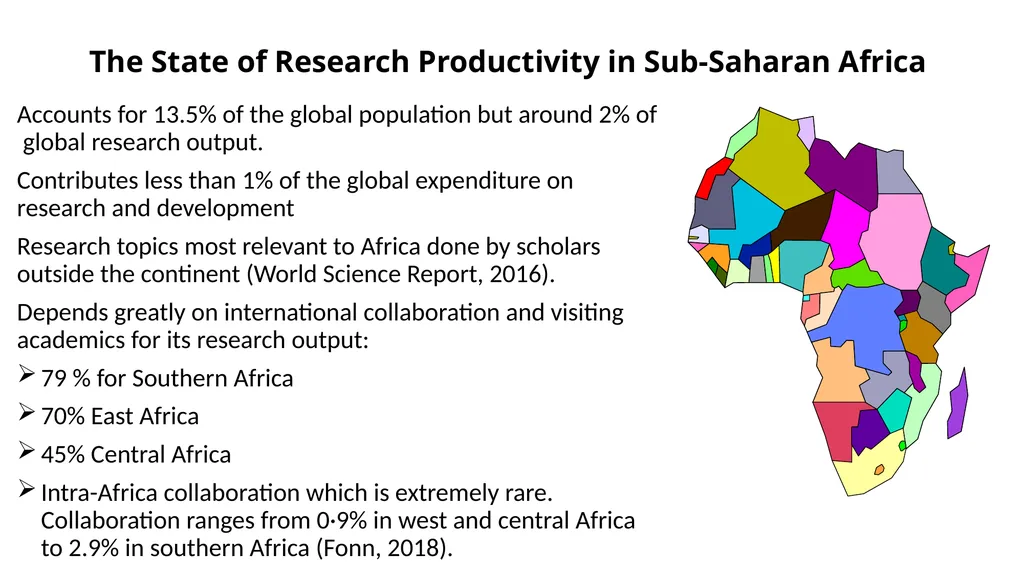
The State of Research Productivity in Sub-Saharan Africa Accounts for 13.5% of the global population but around 2% of global research output.
Contributes less than 1% of the global expenditure on research and development
Research topics most relevant to Africa done by scholars outside the continent (World Science Report, 2016).
Depends greatly on international collaboration and visiting academics for its research output:
79 % for Southern Africa
70% East Africa
45% Central Africa
Intra-Africa collaboration which is extremely rare. Collaboration ranges from 0·9% in west and central Africa to 2.9% in southern Africa (Fonn, 2018).<br>
04
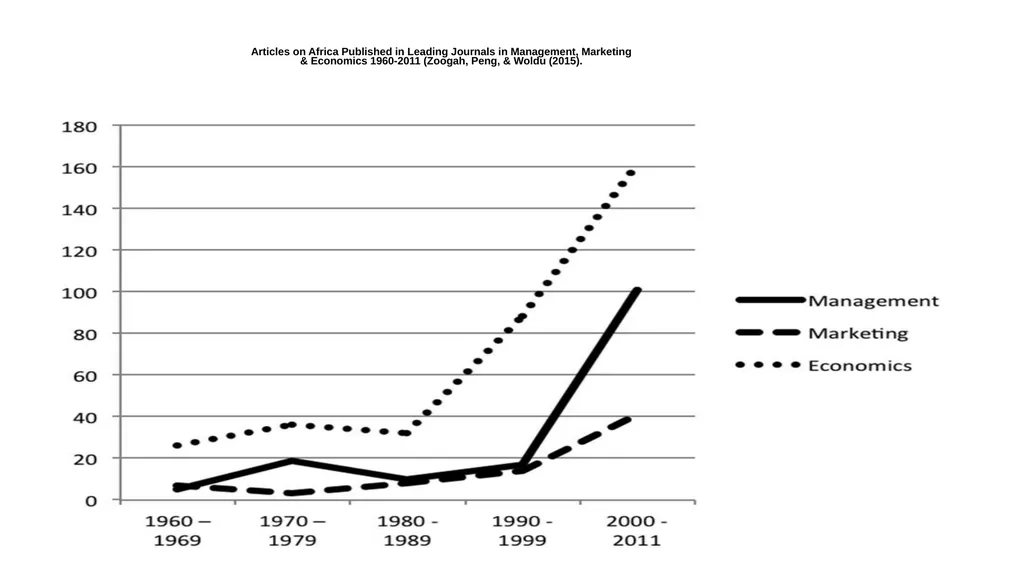
Articles on Africa Published in Leading Journals in Management, Marketing
& Economics 1960-2011 (Zoogah, Peng, & Woldu (2015).<br>
05
Challenges of Doing Research From Africa and About Africa Low presence in top journals in the field
Some good quality local journals but low visibility
Predatory Publishing
Capacity and resource constraints but demands to publish in international journals
Research tensions between the ‘North’ and ‘South’ and Global and ‘Local’
Domination of management theory, knowledge and journals by the North: Hegemonic ethnocentrism (Alcadipani, et al., 2012) African scholars trapped in a vise between: Colony vs. Enclave (see Hamann et al., forthcoming) 5<br>
06
Strategies for Writing Africa Into Management Knowledge Can the ‘sub-altern’ speak unproblematically about knowledge? (Spivak, 1988)
Contributing to global knowledge requires the right HOOK: Positioning the significance of the contribution the article can make to current conversations in your discipline!
Three writing strategies for achieving local relevance and global impact and publishing in international journals:
Mainstreaming, Outside-In, Inside-Out<br>
07
1) Mainstreaming Strategy Research a mainstream topic/area debate in your discipline
The goal is to make a significant contribution to the theoretical or empirical knowledge on that topic!
Sampling just happens to be from an African country but it is not the focus (Context is not a limitation)<br>
The goal is to make a significant contribution to the theoretical or empirical knowledge on that topic!
Sampling just happens to be from an African country but it is not the focus (Context is not a limitation)<br>
08
Gielnik, M. M., Frese, M., Kahara-Kawuki, A., Wasswa Katono, I., Kyejjusa, S., Ngoma, M., ... & Oyugi, J. (2015). Action and action-regulation in entrepreneurship: Evaluating a student training for promoting entrepreneurship. Academy of Management Learning & Education, 14(1), 69-94. RQ: Given the central role of action in entrepreneurship, an important question discussed in the literature is about the best method to train entrepreneurial action (Edelman, Manolova, & Brush, 2008; Neck & Greene, 2011). We seek to contribute to this discussion in two ways. First, our study presents a training program that combines an action-based and a theory-based training method. Second, and this is our main focus, we present a theoretical model on the short- and long-term effects of the training to explain how the training exerts an influence on starting a new business. . .
Contribution Section: First, the study thus contributes to developing a theory of action-based entrepreneurship trainings that explain why and how these trainings work . . . Last, we think that the context of our study also contributes to the entrepreneurship literature. We conducted our study in a developing country, where entrepreneurship plays an important role for economic development and wealth creation (Mead & Liedholm, 1998). Scholars note that entrepreneurship research has so far almost exclusively focused on North America and Europe (Bruton, Ahlstrom, & Obloj, 2008); however, people living in developing countries form the majority of the world (Arnett, 2008). Therefore, developing and testing theoretical models that explain successful entrepreneurship in developing countries is an important scholarly task. Our study is a step in this direction!<br>
Contribution Section: First, the study thus contributes to developing a theory of action-based entrepreneurship trainings that explain why and how these trainings work . . . Last, we think that the context of our study also contributes to the entrepreneurship literature. We conducted our study in a developing country, where entrepreneurship plays an important role for economic development and wealth creation (Mead & Liedholm, 1998). Scholars note that entrepreneurship research has so far almost exclusively focused on North America and Europe (Bruton, Ahlstrom, & Obloj, 2008); however, people living in developing countries form the majority of the world (Arnett, 2008). Therefore, developing and testing theoretical models that explain successful entrepreneurship in developing countries is an important scholarly task. Our study is a step in this direction!<br>
09
(2) Outside In: (1) Making the familiar novel: Ask a commonly studied theoretical relationship/model/construct in an African context (or apply it) to an African ‘context’
Show how a context variable sets a boundary to an existing theory or construct
Must be explicit about contextualisation: Incorporate the context factors (e.g. culture, economic system, political system, legal system, etc.) in describing, understanding and theorizing about phenomena.
African Context: See Zoogah, Peng & Woldu (2015)<br>
10
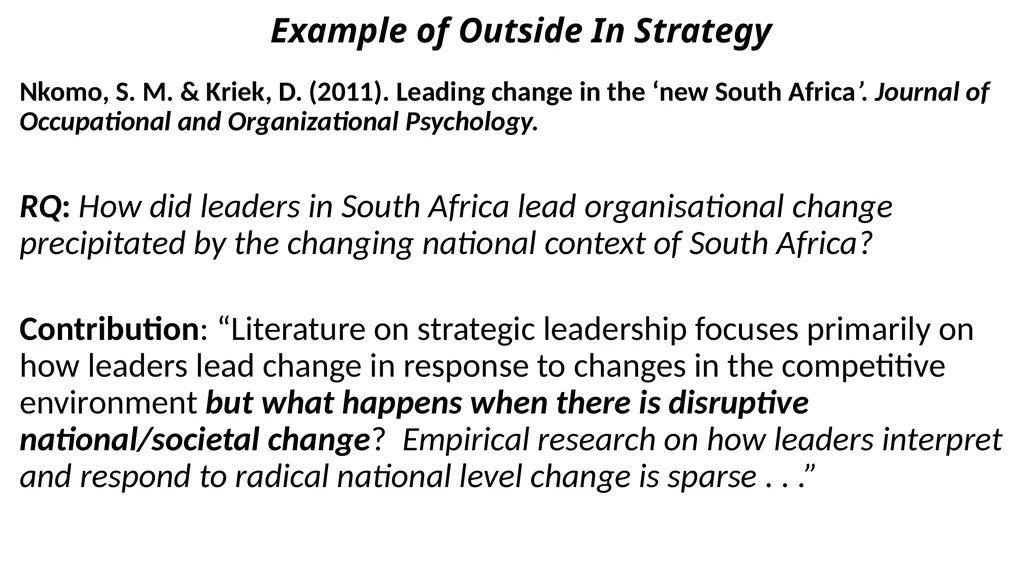
Example of Outside In Strategy Nkomo, S. M. & Kriek, D. (2011). Leading change in the ‘new South Africa’. Journal of Occupational and Organizational Psychology.
RQ: How did leaders in South Africa lead organisational change precipitated by the changing national context of South Africa?
Contribution: “Literature on strategic leadership focuses primarily on how leaders lead change in response to changes in the competitive environment but what happens when there is disruptive national/societal change? Empirical research on how leaders interpret and respond to radical national level change is sparse . . .”<br>
11
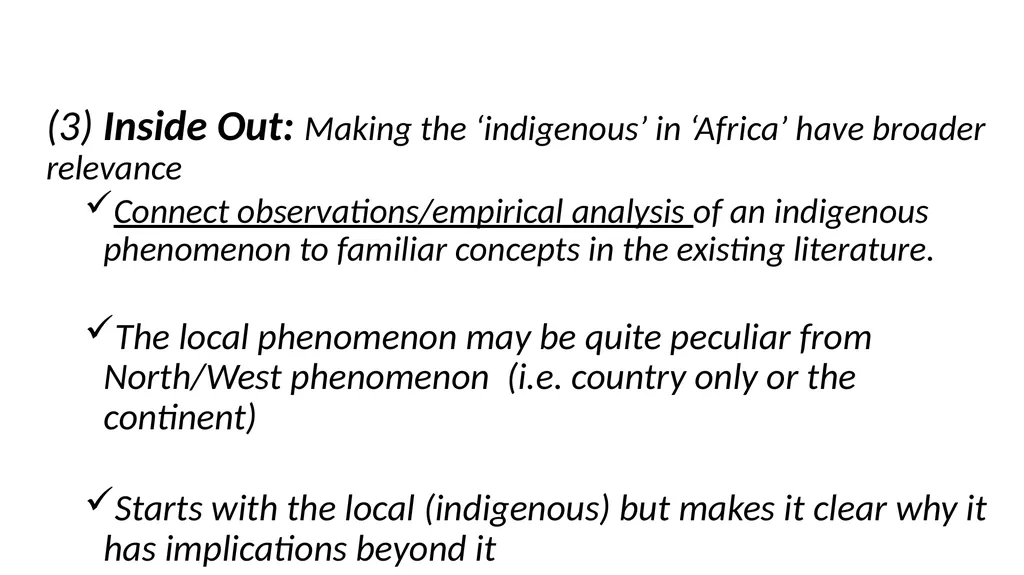
(3) Inside Out: Making the ‘indigenous’ in ‘Africa’ have broader relevance
Connect observations/empirical analysis of an indigenous phenomenon to familiar concepts in the existing literature.
The local phenomenon may be quite peculiar from North/West phenomenon (i.e. country only or the continent)
Starts with the local (indigenous) but makes it clear why it has implications beyond it<br>
12
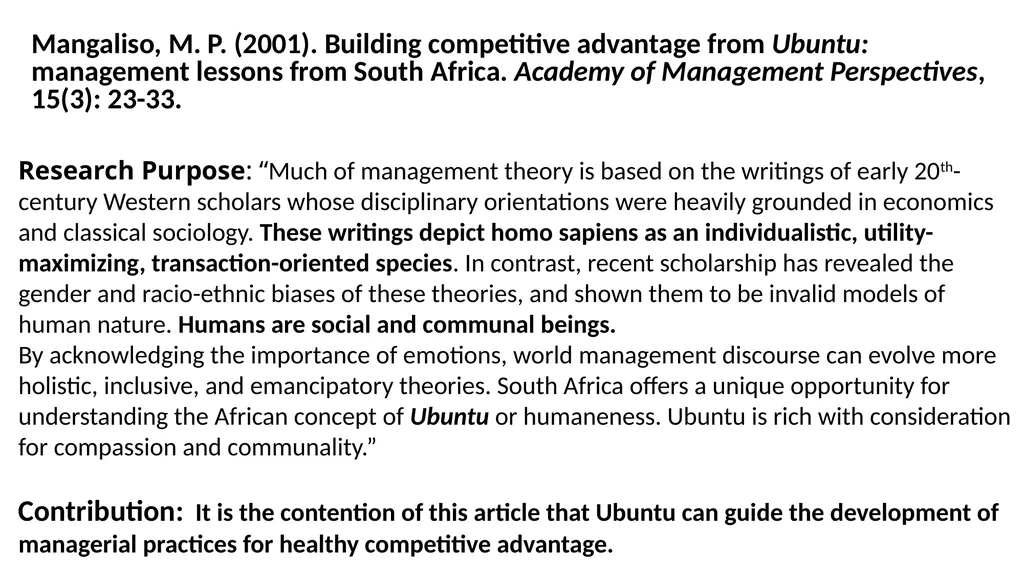
Mangaliso, M. P. (2001). Building competitive advantage from Ubuntu: management lessons from South Africa. Academy of Management Perspectives, 15(3): 23-33. Research Purpose: “Much of management theory is based on the writings of early 20th-century Western scholars whose disciplinary orientations were heavily grounded in economics and classical sociology. These writings depict homo sapiens as an individualistic, utility-maximizing, transaction-oriented species. In contrast, recent scholarship has revealed the gender and racio-ethnic biases of these theories, and shown them to be invalid models of human nature. Humans are social and communal beings.
By acknowledging the importance of emotions, world management discourse can evolve more holistic, inclusive, and emancipatory theories. South Africa offers a unique opportunity for understanding the African concept of Ubuntu or humaneness. Ubuntu is rich with consideration for compassion and communality.”
Contribution: It is the contention of this article that Ubuntu can guide the development of managerial practices for healthy competitive advantage.<br>
13
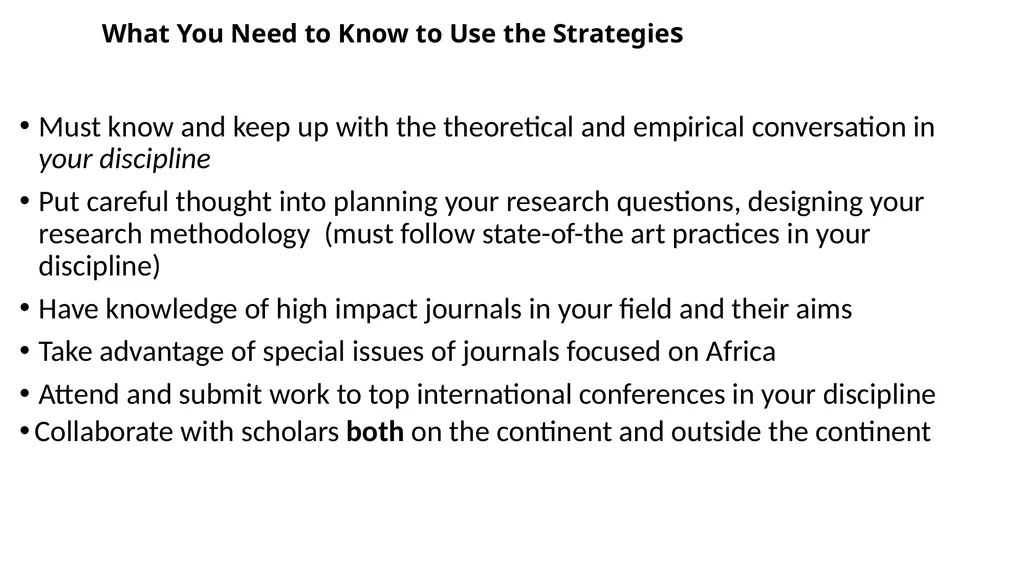
What You Need to Know to Use the Strategies Must know and keep up with the theoretical and empirical conversation in your discipline
Put careful thought into planning your research questions, designing your research methodology (must follow state-of-the art practices in your discipline)
Have knowledge of high impact journals in your field and their aims
Take advantage of special issues of journals focused on Africa
Attend and submit work to top international conferences in your discipline
Collaborate with scholars both on the continent and outside the continent<br>
14
To adopt an image, everything take places as if the African intellectual were trapped in an elevator that perpetually goes up and down. In principle, a single gesture would be sufficient to stop the machine, get out, and rent a flat or room; in sum, live and experience the reality of the world. But apparently, he (sic) does not understand that the initiative to escape belongs to him (sic).
L’autre face du royaume (translation: The other side of the kingdom), V. Y. Mudimbe (1973:102) Closing Thoughts<br>
L’autre face du royaume (translation: The other side of the kingdom), V. Y. Mudimbe (1973:102) Closing Thoughts<br>
15
Closing Thought If not us, then who?
If not from Africa, then whence?
If not now, then when?
If not for Africa and humanity, why not?
Let Africa rise to its quintessential challenge.
It is our destiny.
Reuel Khoza (2004). Let Africa Lead: African Transformational Leadership for 21st Century Business<br>
Reuel Khoza (2004). Let Africa Lead: African Transformational Leadership for 21st Century Business<br>