
Planning Complex Text Instruction Timothy Shanahan


Description: Planning Complex Text Instruction Timothy Shanahan University of Illinois at Chicago www.shanahanonliteracy.com Common Core Requires Complex Text Students are leaving high school without the skills required to read texts that they need to
Related Topics
Download Presentation
"Planning Complex Text Instruction Timothy Shanahan" is the property of its rightful owner. Permission is granted to download and print the materials on this website for personal, non-commercial use only, and to display it on your personal computer provided you do not modify the materials and that you retain all copyright notices contained in the materials. By downloading content from our website, you accept the terms of this agreement.
Presentation Transcript
slide1. Planning Complex Text Instruction Timothy Shanahan
University of Illinois at Chicago
www.shanahanonliteracy.com<br>
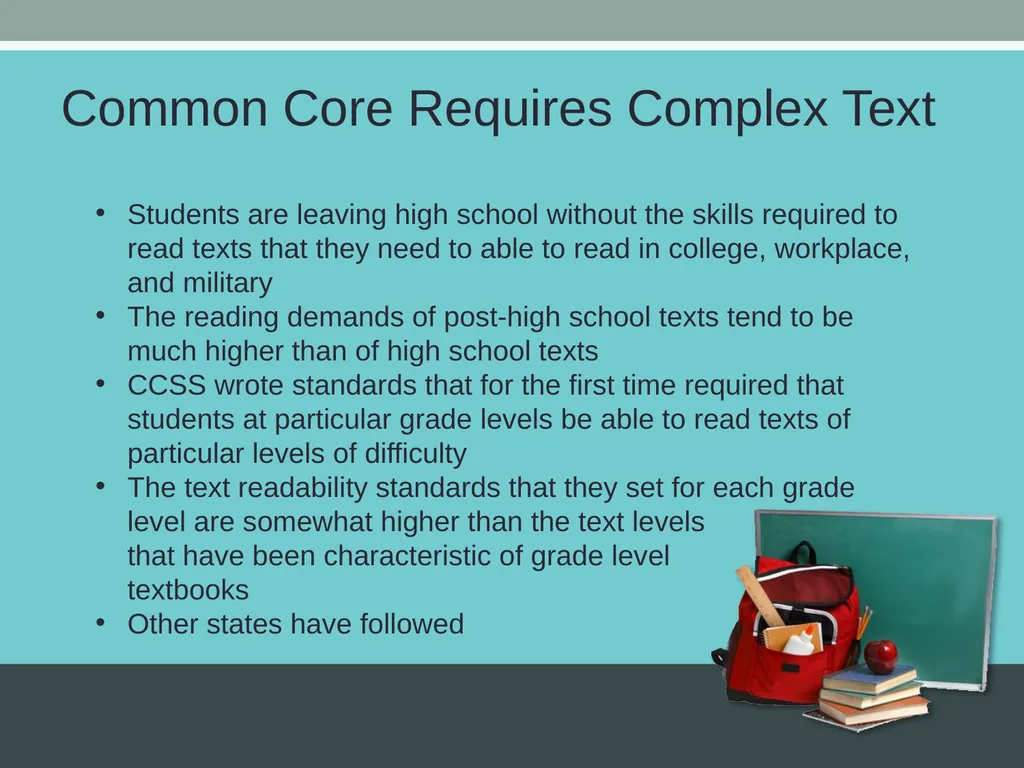
slide2. Common Core Requires Complex Text Students are leaving high school without the skills required to read texts that they need to able to read in college, workplace, and military
The reading demands of post-high school texts tend to be much higher than of high school texts
CCSS wrote standards that for the first time required that students at particular grade levels be able to read texts of particular levels of difficulty
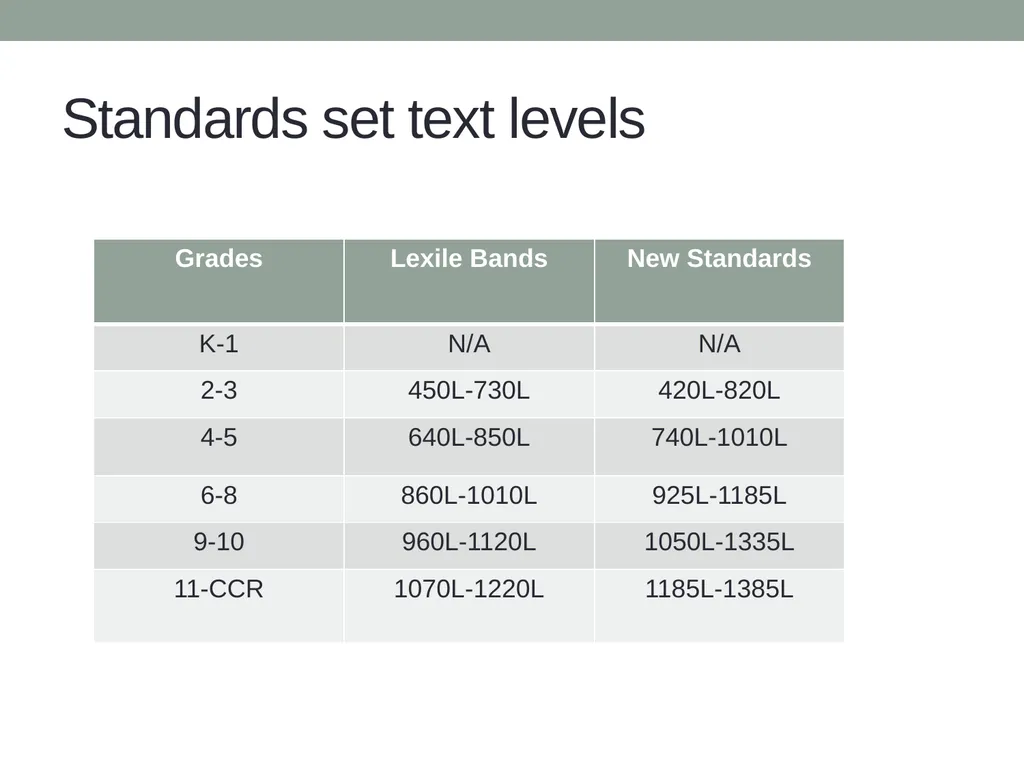
The text readability standards that they set for each grade level are somewhat higher than the text levels that have been characteristic of grade level textbooks
Other states have followed<br>
slide3. Standards set text levels<br>
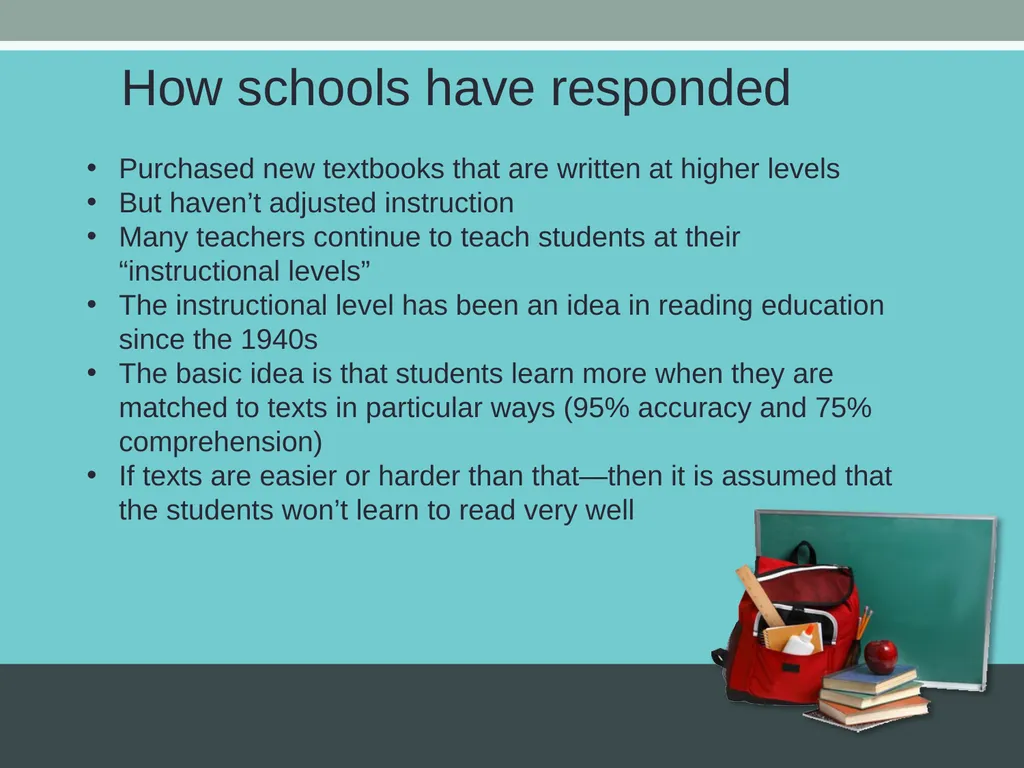
slide4. How schools have responded Purchased new textbooks that are written at higher levels
But haven’t adjusted instruction
Many teachers continue to teach students at their “instructional levels”
The instructional level has been an idea in reading education since the 1940s
The basic idea is that students learn more when they are matched to texts in particular ways (95% accuracy and 75% comprehension)
If texts are easier or harder than that—then it is assumed that the students won’t learn to read very well<br>
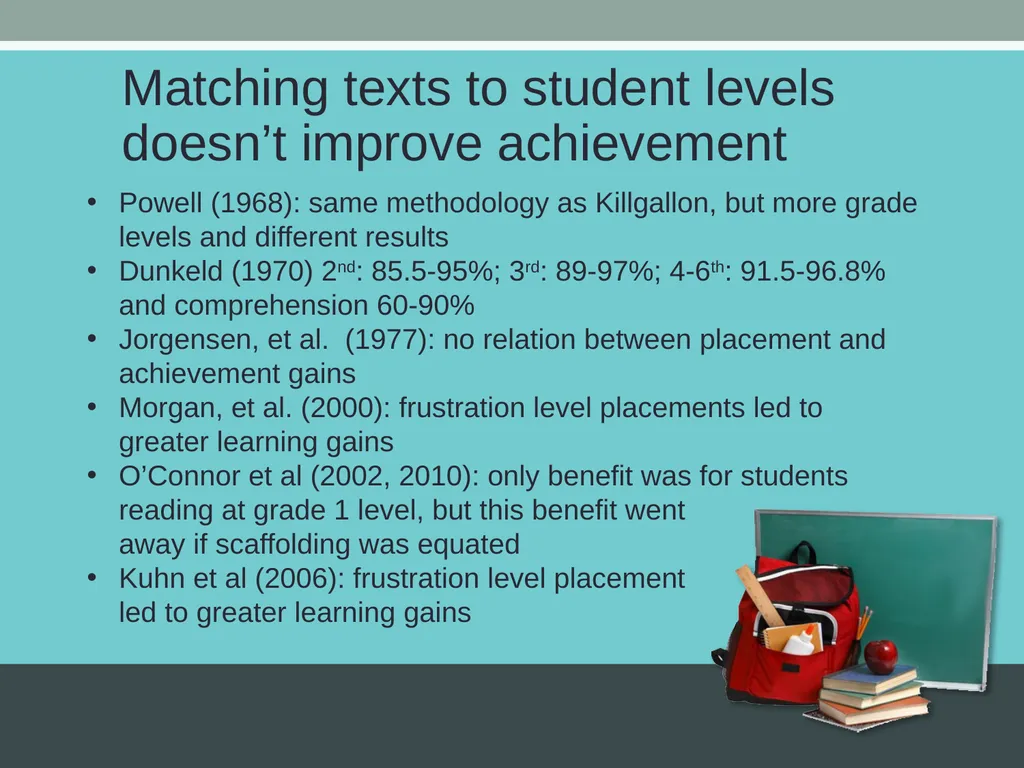
slide5. Matching texts to student levels doesn’t improve achievement Powell (1968): same methodology as Killgallon, but more grade levels and different results
Dunkeld (1970) 2nd: 85.5-95%; 3rd: 89-97%; 4-6th: 91.5-96.8% and comprehension 60-90%
Jorgensen, et al. (1977): no relation between placement and achievement gains
Morgan, et al. (2000): frustration level placements led to greater learning gains
O’Connor et al (2002, 2010): only benefit was for students reading at grade 1 level, but this benefit went away if scaffolding was equated
Kuhn et al (2006): frustration level placement led to greater learning gains<br>
slide6. Reconceptualize Reading Texts are an attempt to communicate meaning
Reading is not the ability to answer particular kinds of questions
Authors structure their meanings through written language
Every feature that may facilitate the grasp of meaning for some readers will serve as a barrier for other readers
Reading is the ability to negotiate these barriers to meaning that are embedded in text to gain the author’s meaning<br>
slide7. Scaffolding an Instructional Level Bonfiglio, Daly, Persampieri, & Andersen, 2006
Burns, 2007
Burns, Dean, & Foley, 2004
Carney, Anderson, Blackburn, & Blessings, 1984
Daly & Martens, 1994
Eckert, Ardoin, Daisey, & Scarola, 2000
Faulkner & Levy, 1999
Gickling & Armstrong, 1978
Hall, Sabey, & McClellan, 2005
Levy, Nicholls, & Kohen, 1993
McComas, Wacker, & Cooper, 1996
Neill, 1979<br>
slide8. Scaffolding an Instructional Level O’Shea, Sindelar, & O’Shea, 1985
Pany & McCoy, 1988
Rasinski, 1990
Reitsma, 1988
Rose & Beattie, 1986
Sanford & Horner, 2013
Sindelar, Monda, & O’Shea, 1990
Smith, 1979
Stoddard, Valcante, Sindelar, O’Shea, et al., 1993
Taylor, Wade, & Yekovich, 1985
Turpie & Paratore, 1995
VanWagenen, Williams, & McLaughlin, 1994
Weinstein & Cooke, 1992
Wixson, 1986<br>
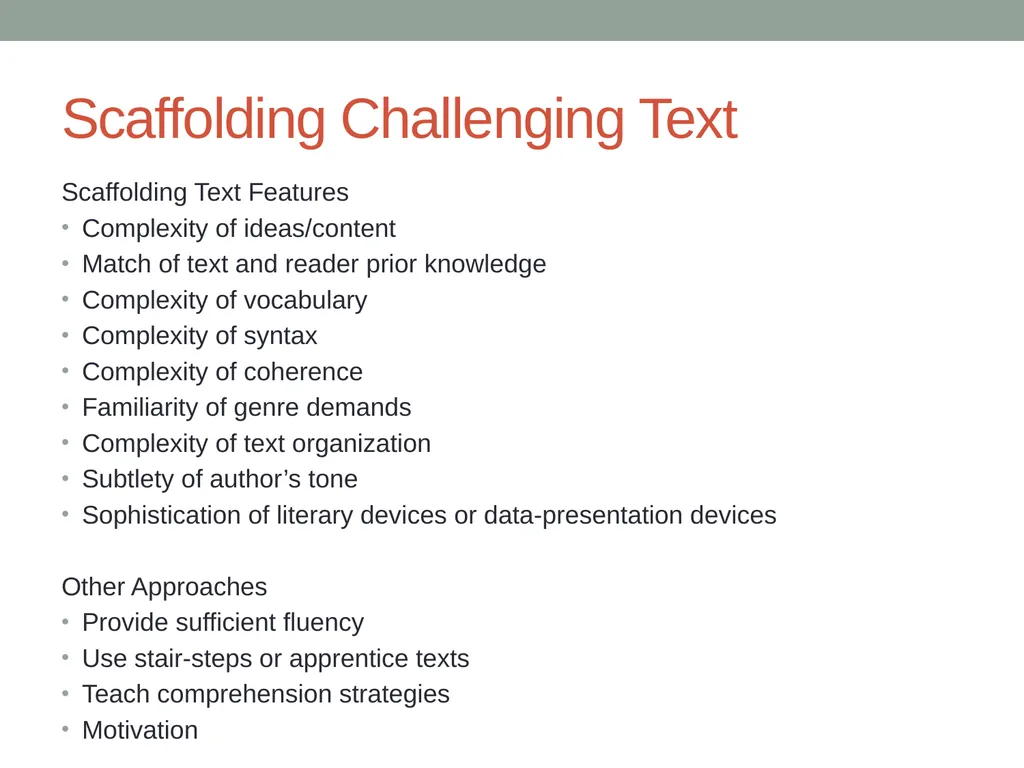
slide9. Scaffolding Challenging Text Scaffolding Text Features
Complexity of ideas/content
Match of text and reader prior knowledge
Complexity of vocabulary
Complexity of syntax
Complexity of coherence
Familiarity of genre demands
Complexity of text organization
Subtlety of author’s tone
Sophistication of literary devices or data-presentation devices
Other Approaches
Provide sufficient fluency
Use stair-steps or apprentice texts
Teach comprehension strategies
Motivation<br>
slide10. The Princess and the Pizza by Mary Jane and Herm Auch Fact or fiction?
Narrative or expository?
Literary or informational?
Tone?
Literary devices?<br>
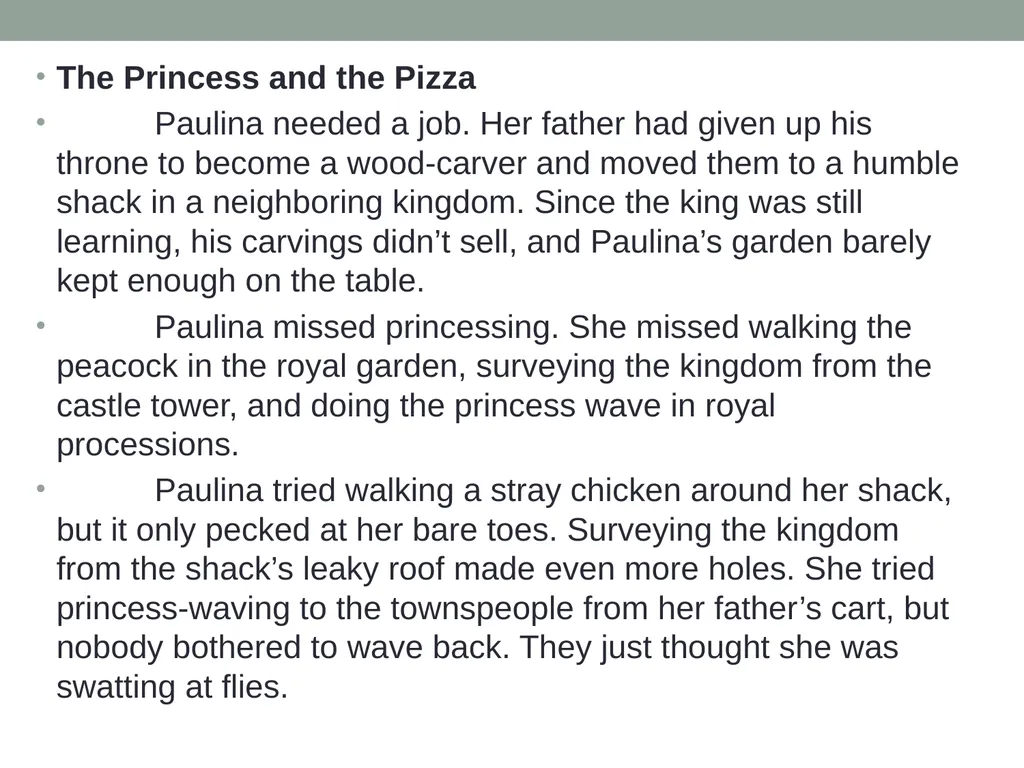
slide11. The Princess and the Pizza
Paulina needed a job. Her father had given up his throne to become a wood-carver and moved them to a humble shack in a neighboring kingdom. Since the king was still learning, his carvings didn’t sell, and Paulina’s garden barely kept enough on the table.
Paulina missed princessing. She missed walking the peacock in the royal garden, surveying the kingdom from the castle tower, and doing the princess wave in royal processions.
Paulina tried walking a stray chicken around her shack, but it only pecked at her bare toes. Surveying the kingdom from the shack’s leaky roof made even more holes. She tried princess-waving to the townspeople from her father’s cart, but nobody bothered to wave back. They just thought she was swatting at flies.<br>
slide12. Background information Is the author presuming particular knowledge on the readers’ part?
Is the reader likely to be able to bridge the gap?
Difference between comprehension and full appreciation<br>
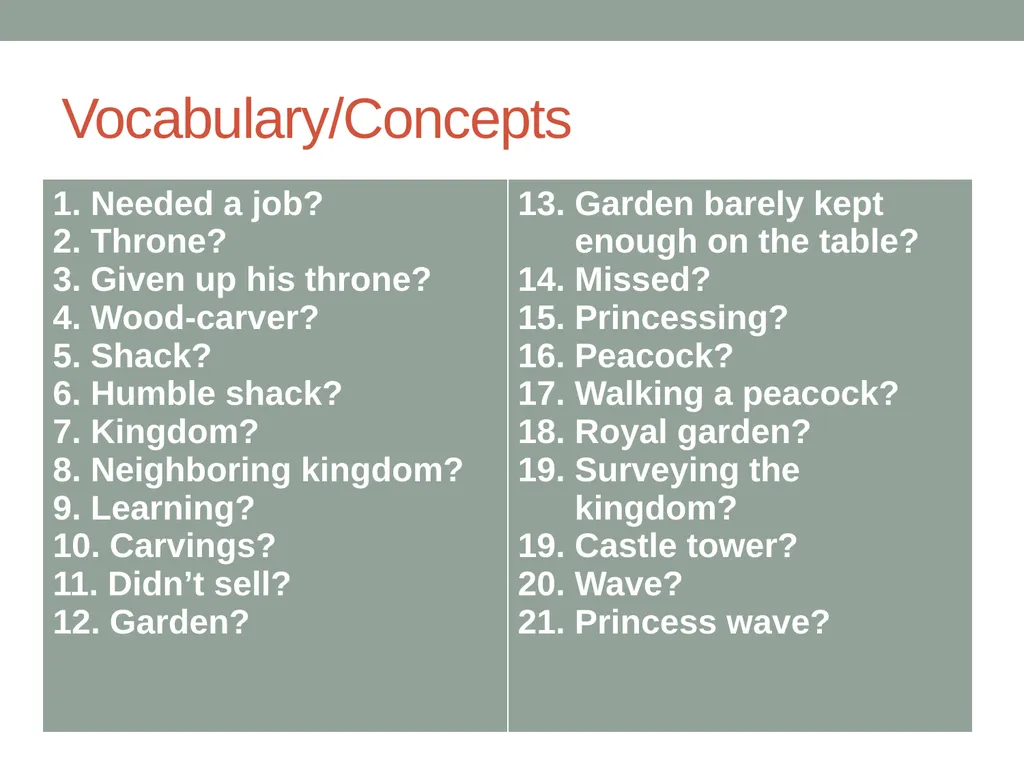
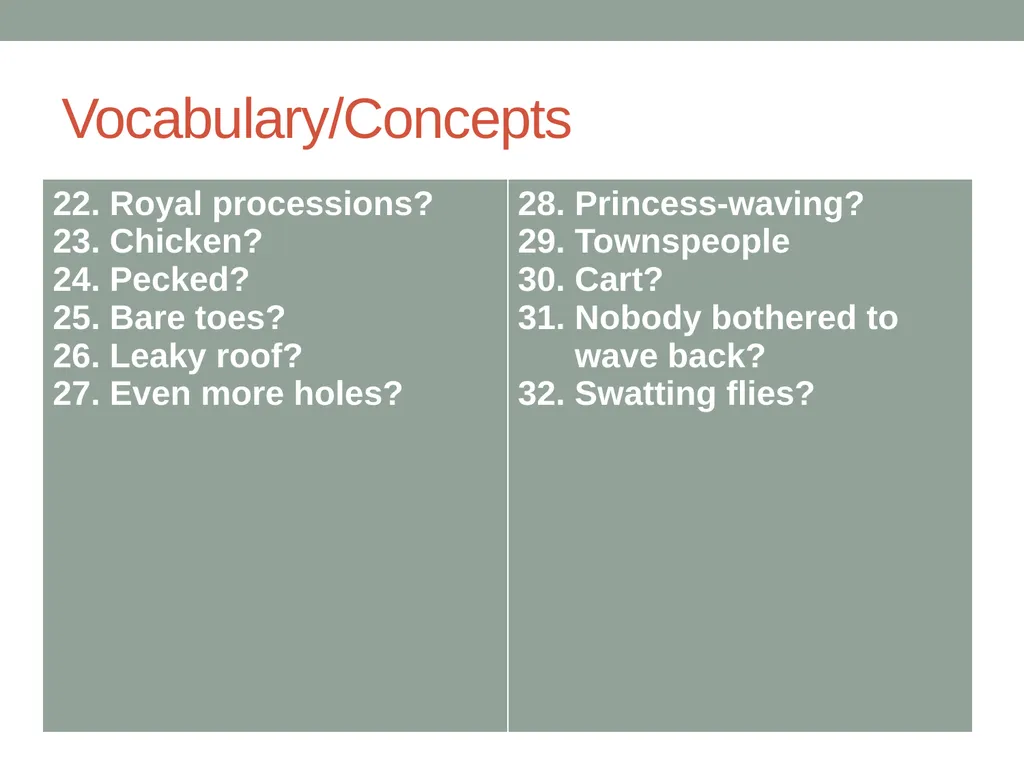
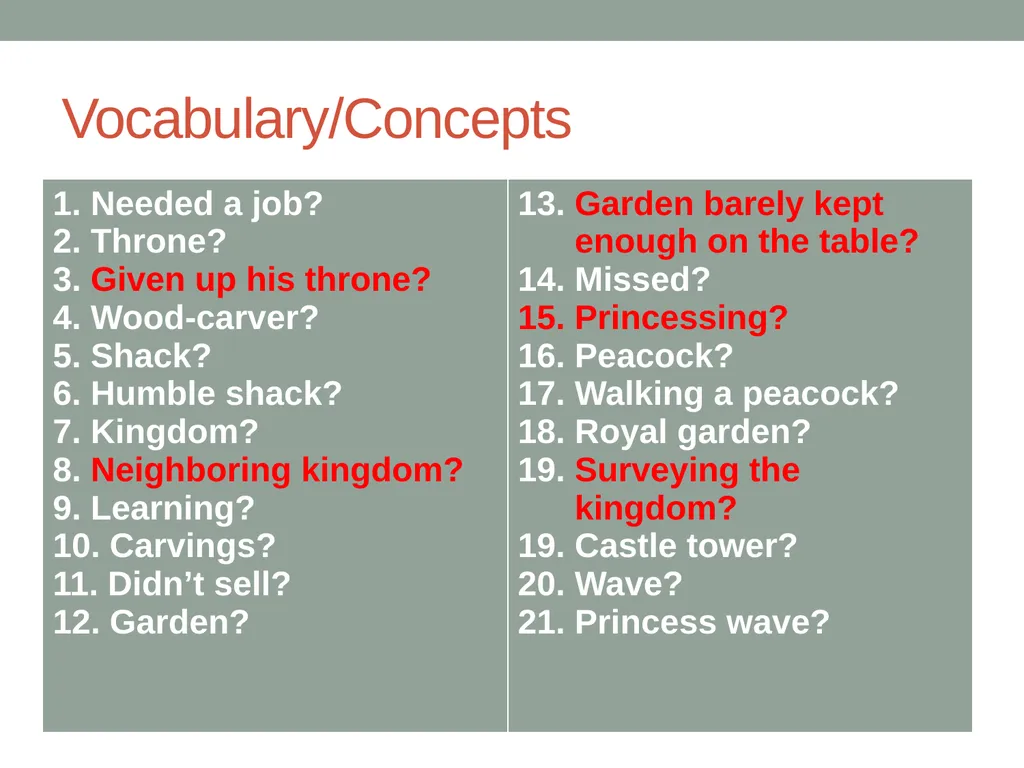
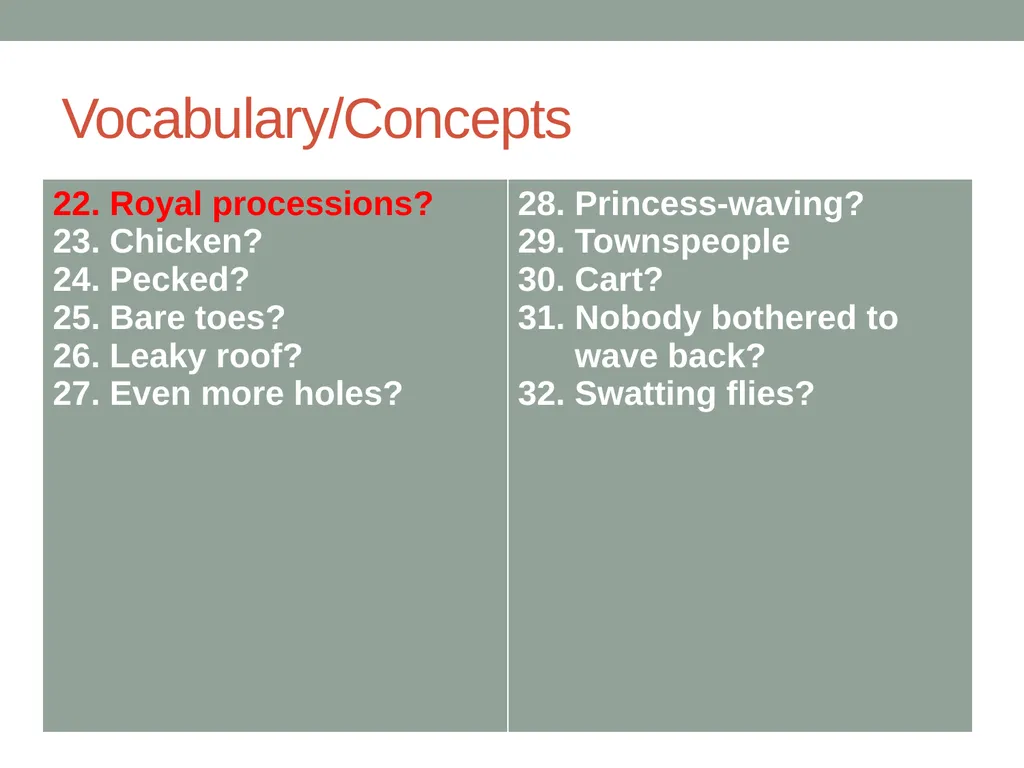
slide13. Vocabulary/Concepts<br>
slide14. Vocabulary/Concepts<br>
slide15. Vocabulary/Concepts<br>
slide16. Vocabulary/Concepts<br>
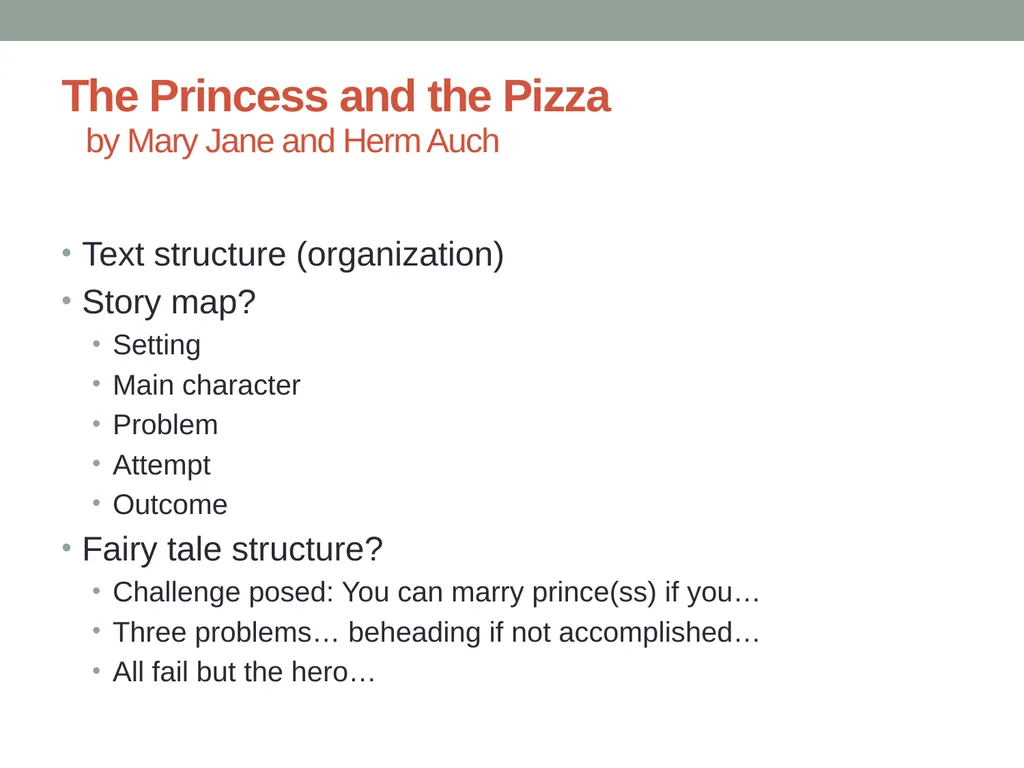
slide17. The Princess and the Pizza by Mary Jane and Herm Auch Text structure (organization)
Story map?
Setting
Main character
Problem
Attempt
Outcome
Fairy tale structure?
Challenge posed: You can marry prince(ss) if you…
Three problems… beheading if not accomplished…
All fail but the hero…<br>
slide18. Syntax 1 Since the king was still learning, his carvings didn’t sell, and Paulina’s garden barely kept enough on the table.<br>
slide19. Syntax 1 Since the king was still learning, his carvings didn’t sell, and Paulina’s garden barely kept enough on the table.
Why were they so poor?<br>
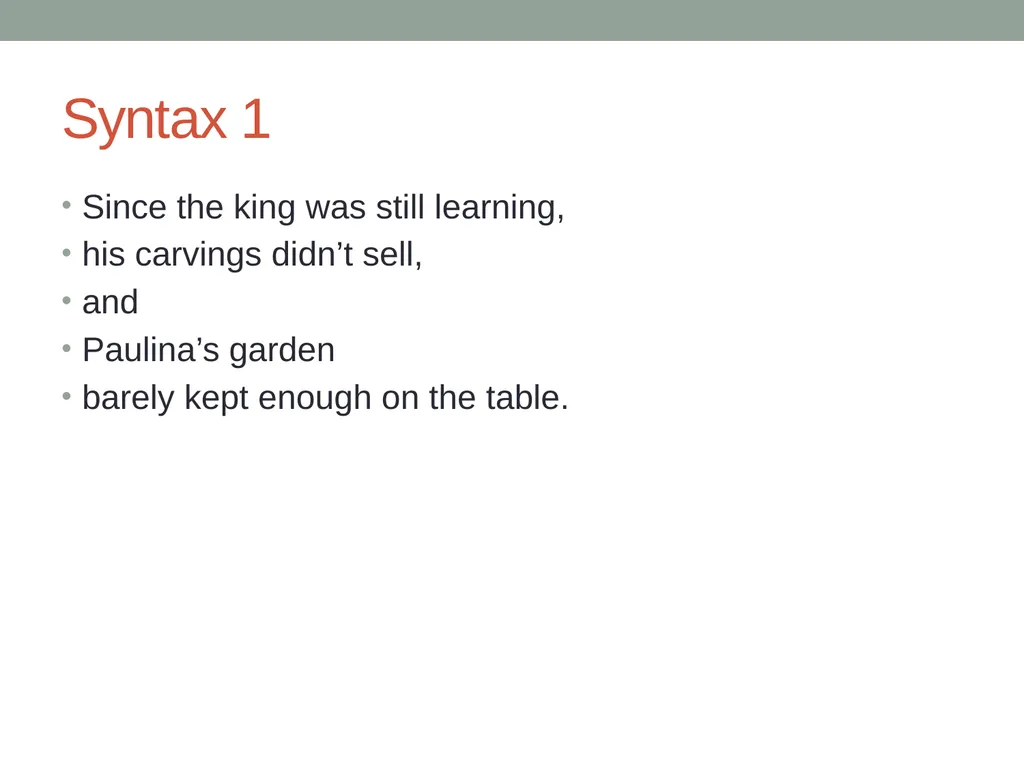
slide20. Syntax 1 Since the king was still learning,
his carvings didn’t sell,
and
Paulina’s garden
barely kept enough on the table.<br>
slide21. Syntax 2 As Paulina started for the table, the long-haired princess tripped her, then loaded up with food.<br>
slide22. Syntax 2 As Paulina started for the table, the long-haired princess tripped her, then loaded up with food.
How did the long-haired princess trick Paulina?<br>
slide23. Syntax 2 As Paulina started for the table,
the long-haired princess tripped her,
then loaded up with food.<br>
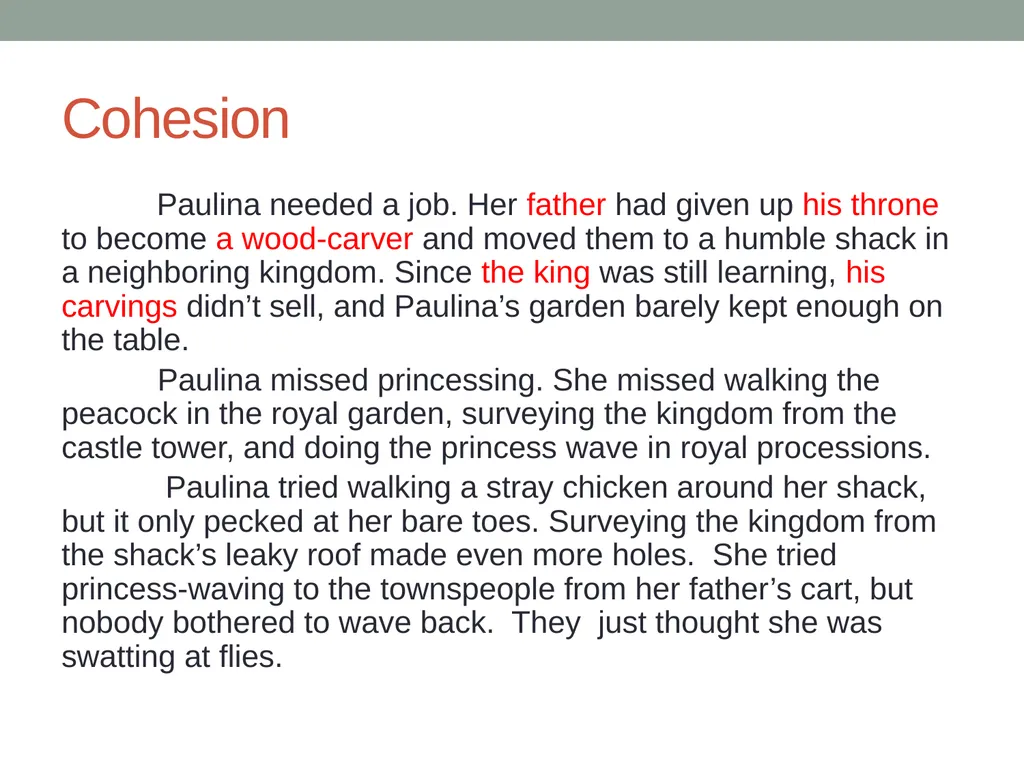
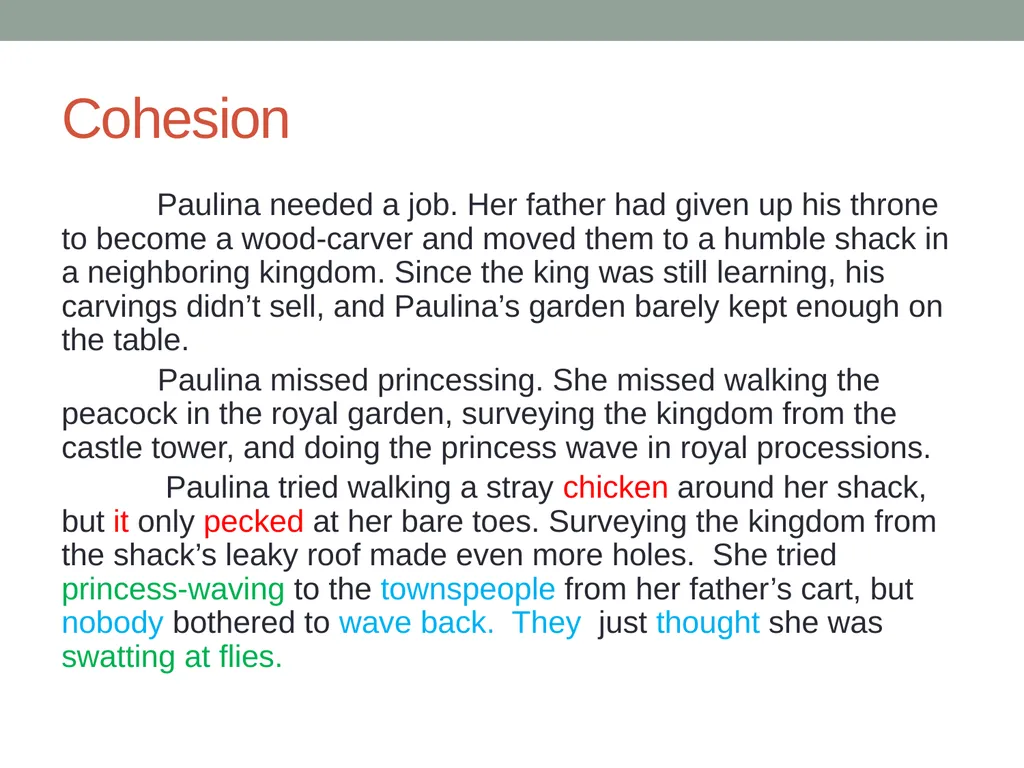
slide24. Cohesion Paulina needed a job. Her father had given up his throne to become a wood-carver and moved them to a humble shack in a neighboring kingdom. Since the king was still learning, his carvings didn’t sell, and Paulina’s garden barely kept enough on the table.
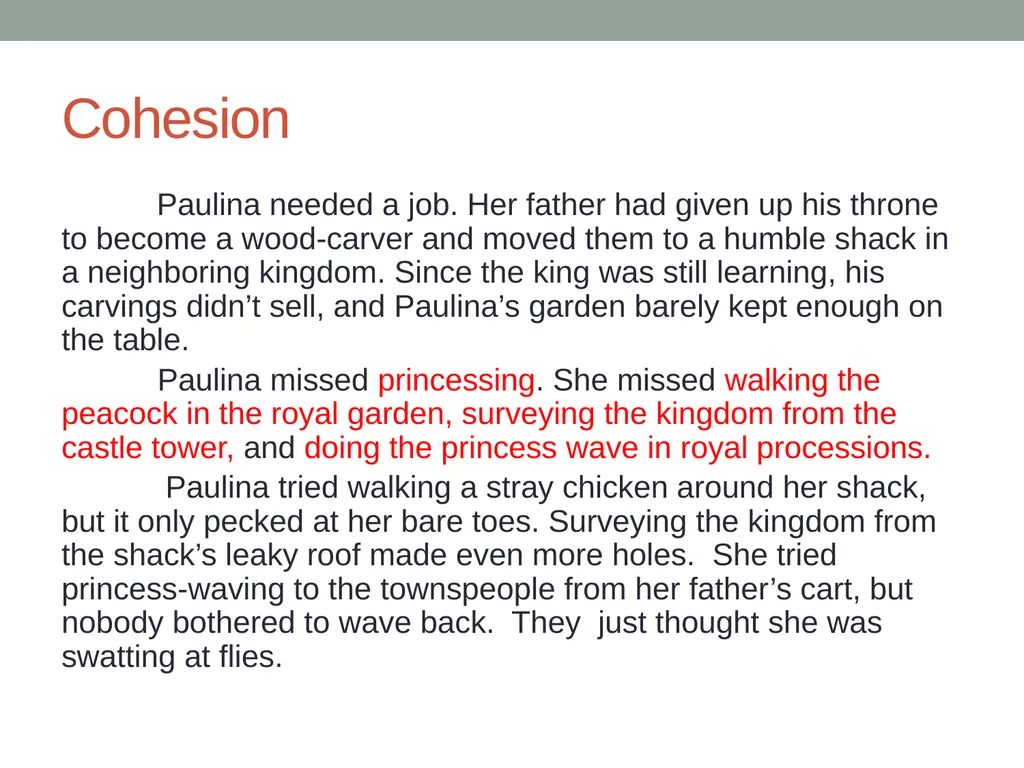
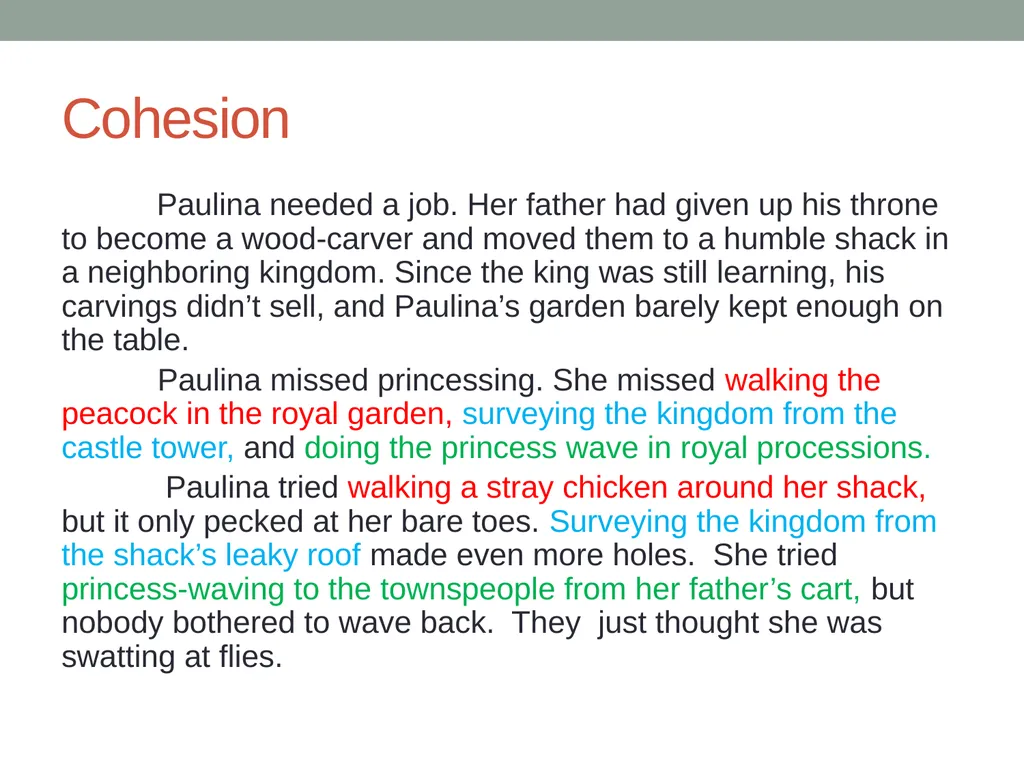
Paulina missed princessing. She missed walking the peacock in the royal garden, surveying the kingdom from the castle tower, and doing the princess wave in royal processions.
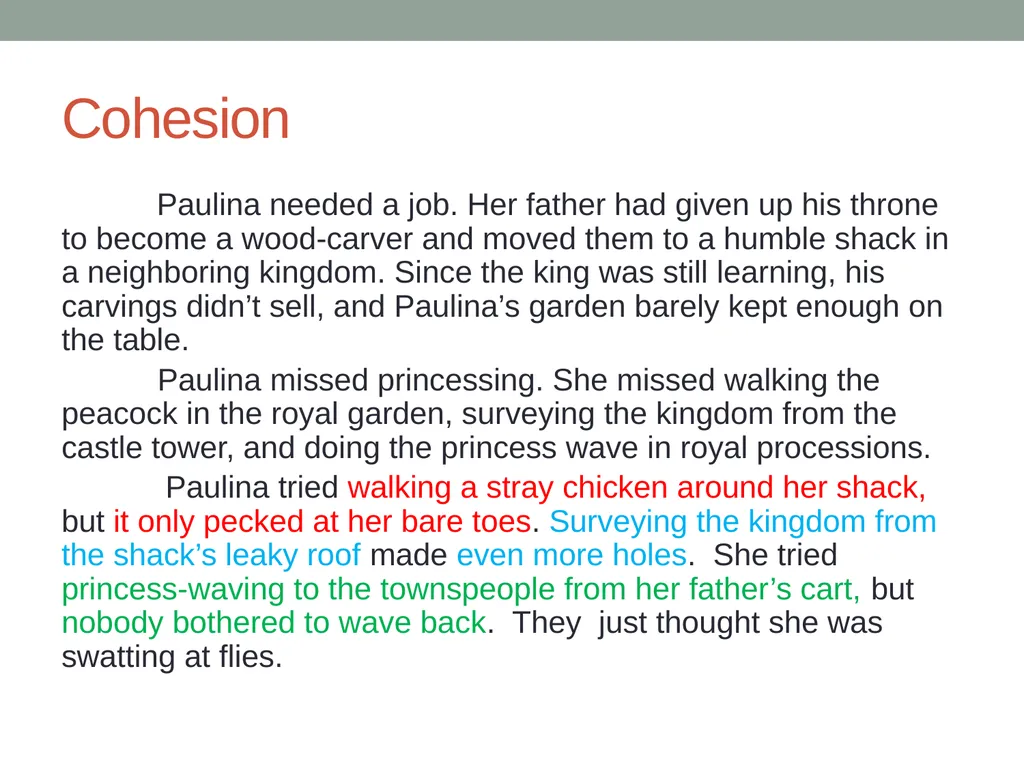
Paulina tried walking a stray chicken around her shack, but it only pecked at her bare toes. Surveying the kingdom from the shack’s leaky roof made even more holes. She tried princess-waving to the townspeople from her father’s cart, but nobody bothered to wave back. They just thought she was swatting at flies.<br>
slide25. Cohesion Paulina needed a job. Her father had given up his throne to become a wood-carver and moved them to a humble shack in a neighboring kingdom. Since the king was still learning, his carvings didn’t sell, and Paulina’s garden barely kept enough on the table.
Paulina missed princessing. She missed walking the peacock in the royal garden, surveying the kingdom from the castle tower, and doing the princess wave in royal processions.
Paulina tried walking a stray chicken around her shack, but it only pecked at her bare toes. Surveying the kingdom from the shack’s leaky roof made even more holes. She tried princess-waving to the townspeople from her father’s cart, but nobody bothered to wave back. They just thought she was swatting at flies.<br>
slide26. Cohesion Paulina needed a job. Her father had given up his throne to become a wood-carver and moved them to a humble shack in a neighboring kingdom. Since the king was still learning, his carvings didn’t sell, and Paulina’s garden barely kept enough on the table.
Paulina missed princessing. She missed walking the peacock in the royal garden, surveying the kingdom from the castle tower, and doing the princess wave in royal processions.
Paulina tried walking a stray chicken around her shack, but it only pecked at her bare toes. Surveying the kingdom from the shack’s leaky roof made even more holes. She tried princess-waving to the townspeople from her father’s cart, but nobody bothered to wave back. They just thought she was swatting at flies.<br>
slide27. Cohesion Paulina needed a job. Her father had given up his throne to become a wood-carver and moved them to a humble shack in a neighboring kingdom. Since the king was still learning, his carvings didn’t sell, and Paulina’s garden barely kept enough on the table.
Paulina missed princessing. She missed walking the peacock in the royal garden, surveying the kingdom from the castle tower, and doing the princess wave in royal processions.
Paulina tried walking a stray chicken around her shack, but it only pecked at her bare toes. Surveying the kingdom from the shack’s leaky roof made even more holes. She tried princess-waving to the townspeople from her father’s cart, but nobody bothered to wave back. They just thought she was swatting at flies.<br>
slide28. Cohesion Paulina needed a job. Her father had given up his throne to become a wood-carver and moved them to a humble shack in a neighboring kingdom. Since the king was still learning, his carvings didn’t sell, and Paulina’s garden barely kept enough on the table.
Paulina missed princessing. She missed walking the peacock in the royal garden, surveying the kingdom from the castle tower, and doing the princess wave in royal processions.
Paulina tried walking a stray chicken around her shack, but it only pecked at her bare toes. Surveying the kingdom from the shack’s leaky roof made even more holes. She tried princess-waving to the townspeople from her father’s cart, but nobody bothered to wave back. They just thought she was swatting at flies.<br>
slide29. Cohesion Paulina needed a job. Her father had given up his throne to become a wood-carver and moved them to a humble shack in a neighboring kingdom. Since the king was still learning, his carvings didn’t sell, and Paulina’s garden barely kept enough on the table.
Paulina missed princessing. She missed walking the peacock in the royal garden, surveying the kingdom from the castle tower, and doing the princess wave in royal processions.
Paulina tried walking a stray chicken around her shack, but it only pecked at her bare toes. Surveying the kingdom from the shack’s leaky roof made even more holes. She tried princess-waving to the townspeople from her father’s cart, but nobody bothered to wave back. They just thought she was swatting at flies.<br>
slide30. Cohesion Paulina needed a job. Her father had given up his throne to become a wood-carver and moved them to a humble shack in a neighboring kingdom. Since the king was still learning, his carvings didn’t sell, and Paulina’s garden barely kept enough on the table.
Paulina missed princessing. She missed walking the peacock in the royal garden, surveying the kingdom from the castle tower, and doing the princess wave in royal processions.
Paulina tried walking a stray chicken around her shack, but it only pecked at her bare toes. Surveying the kingdom from the shack’s leaky roof made even more holes. She tried princess-waving to the townspeople from her father’s cart, but nobody bothered to wave back. They just thought she was swatting at flies.<br>
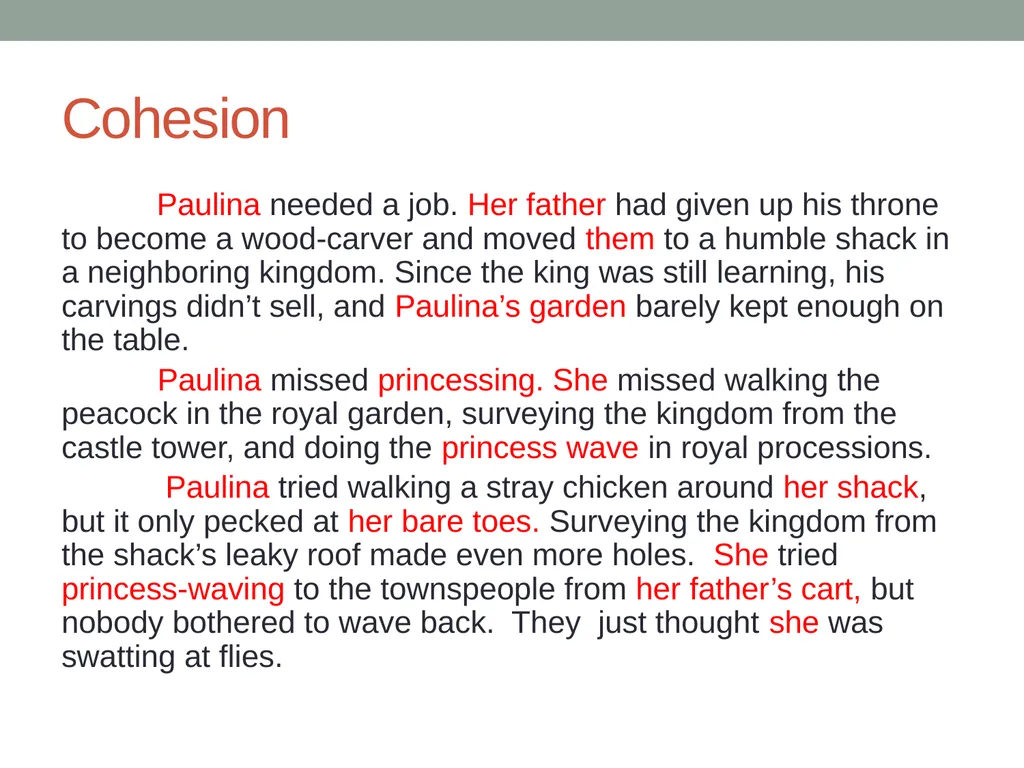
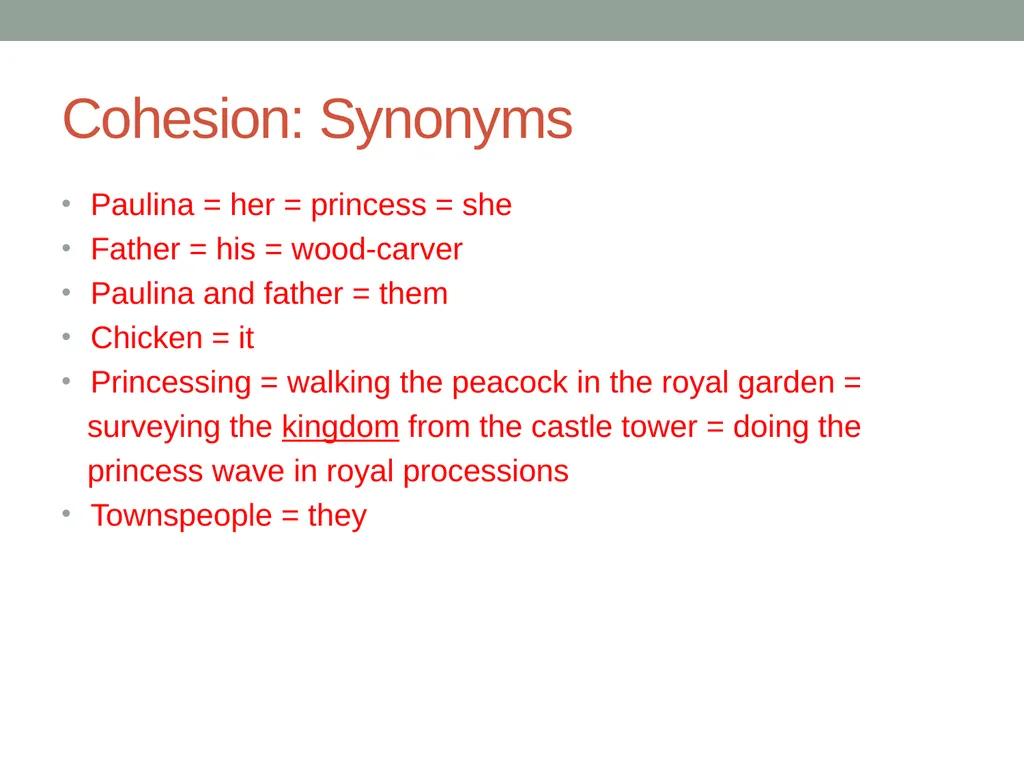
slide31. Cohesion: Synonyms Paulina = her = princess = she
Father = his = wood-carver
Paulina and father = them
Chicken = it
Princessing = walking the peacock in the royal garden =
surveying the kingdom from the castle tower = doing the
princess wave in royal processions
Townspeople = they<br>
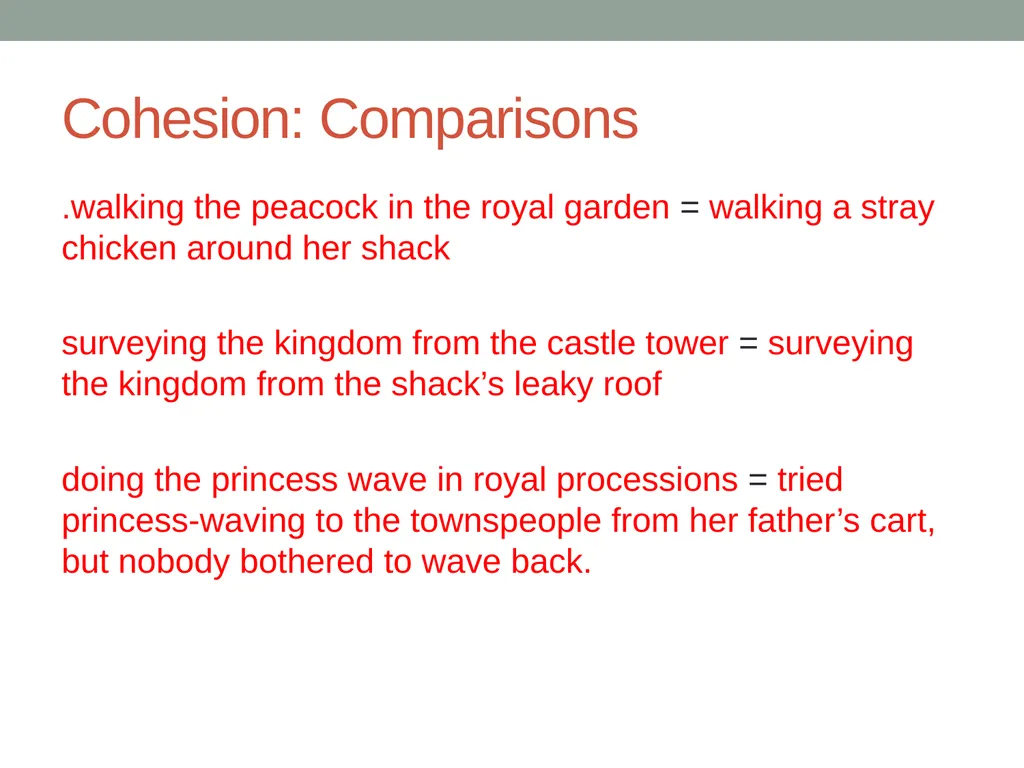
slide32. Cohesion: Comparisons .walking the peacock in the royal garden = walking a stray chicken around her shack
surveying the kingdom from the castle tower = surveying the kingdom from the shack’s leaky roof
doing the princess wave in royal processions = tried princess-waving to the townspeople from her father’s cart, but nobody bothered to wave back.<br>
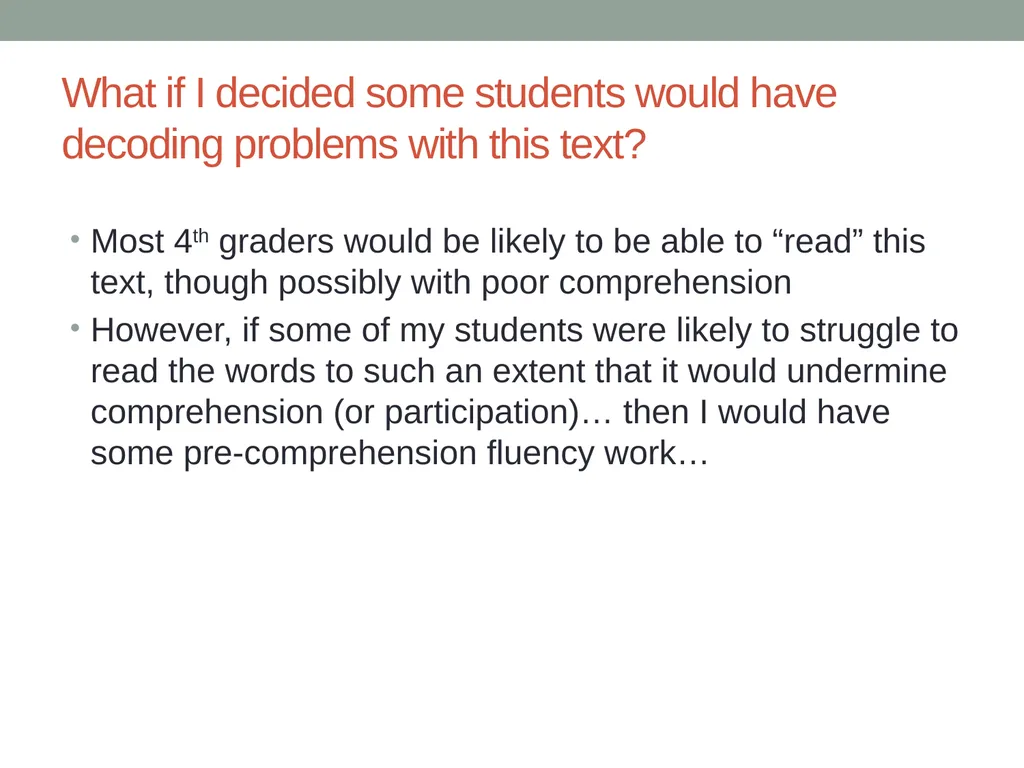
slide33. What if I decided some students would have decoding problems with this text? Most 4th graders would be likely to be able to “read” this text, though possibly with poor comprehension
However, if some of my students were likely to struggle to read the words to such an extent that it would undermine comprehension (or participation)… then I would have some pre-comprehension fluency work…<br>
slide34. Resources Shanahan, T., Fisher, D., & Frey, N. (2012), March. The challenge of challenging text. Educational Leadership.
Shanahan, T. (2013). Letting the text take center stage. American Educator, 4-11, 43.<br>
University of Illinois at Chicago
www.shanahanonliteracy.com<br>
slide2. Common Core Requires Complex Text Students are leaving high school without the skills required to read texts that they need to able to read in college, workplace, and military
The reading demands of post-high school texts tend to be much higher than of high school texts
CCSS wrote standards that for the first time required that students at particular grade levels be able to read texts of particular levels of difficulty
The text readability standards that they set for each grade level are somewhat higher than the text levels that have been characteristic of grade level textbooks
Other states have followed<br>
slide3. Standards set text levels<br>
slide4. How schools have responded Purchased new textbooks that are written at higher levels
But haven’t adjusted instruction
Many teachers continue to teach students at their “instructional levels”
The instructional level has been an idea in reading education since the 1940s
The basic idea is that students learn more when they are matched to texts in particular ways (95% accuracy and 75% comprehension)
If texts are easier or harder than that—then it is assumed that the students won’t learn to read very well<br>
slide5. Matching texts to student levels doesn’t improve achievement Powell (1968): same methodology as Killgallon, but more grade levels and different results
Dunkeld (1970) 2nd: 85.5-95%; 3rd: 89-97%; 4-6th: 91.5-96.8% and comprehension 60-90%
Jorgensen, et al. (1977): no relation between placement and achievement gains
Morgan, et al. (2000): frustration level placements led to greater learning gains
O’Connor et al (2002, 2010): only benefit was for students reading at grade 1 level, but this benefit went away if scaffolding was equated
Kuhn et al (2006): frustration level placement led to greater learning gains<br>
slide6. Reconceptualize Reading Texts are an attempt to communicate meaning
Reading is not the ability to answer particular kinds of questions
Authors structure their meanings through written language
Every feature that may facilitate the grasp of meaning for some readers will serve as a barrier for other readers
Reading is the ability to negotiate these barriers to meaning that are embedded in text to gain the author’s meaning<br>
slide7. Scaffolding an Instructional Level Bonfiglio, Daly, Persampieri, & Andersen, 2006
Burns, 2007
Burns, Dean, & Foley, 2004
Carney, Anderson, Blackburn, & Blessings, 1984
Daly & Martens, 1994
Eckert, Ardoin, Daisey, & Scarola, 2000
Faulkner & Levy, 1999
Gickling & Armstrong, 1978
Hall, Sabey, & McClellan, 2005
Levy, Nicholls, & Kohen, 1993
McComas, Wacker, & Cooper, 1996
Neill, 1979<br>
slide8. Scaffolding an Instructional Level O’Shea, Sindelar, & O’Shea, 1985
Pany & McCoy, 1988
Rasinski, 1990
Reitsma, 1988
Rose & Beattie, 1986
Sanford & Horner, 2013
Sindelar, Monda, & O’Shea, 1990
Smith, 1979
Stoddard, Valcante, Sindelar, O’Shea, et al., 1993
Taylor, Wade, & Yekovich, 1985
Turpie & Paratore, 1995
VanWagenen, Williams, & McLaughlin, 1994
Weinstein & Cooke, 1992
Wixson, 1986<br>
slide9. Scaffolding Challenging Text Scaffolding Text Features
Complexity of ideas/content
Match of text and reader prior knowledge
Complexity of vocabulary
Complexity of syntax
Complexity of coherence
Familiarity of genre demands
Complexity of text organization
Subtlety of author’s tone
Sophistication of literary devices or data-presentation devices
Other Approaches
Provide sufficient fluency
Use stair-steps or apprentice texts
Teach comprehension strategies
Motivation<br>
slide10. The Princess and the Pizza by Mary Jane and Herm Auch Fact or fiction?
Narrative or expository?
Literary or informational?
Tone?
Literary devices?<br>
slide11. The Princess and the Pizza
Paulina needed a job. Her father had given up his throne to become a wood-carver and moved them to a humble shack in a neighboring kingdom. Since the king was still learning, his carvings didn’t sell, and Paulina’s garden barely kept enough on the table.
Paulina missed princessing. She missed walking the peacock in the royal garden, surveying the kingdom from the castle tower, and doing the princess wave in royal processions.
Paulina tried walking a stray chicken around her shack, but it only pecked at her bare toes. Surveying the kingdom from the shack’s leaky roof made even more holes. She tried princess-waving to the townspeople from her father’s cart, but nobody bothered to wave back. They just thought she was swatting at flies.<br>
slide12. Background information Is the author presuming particular knowledge on the readers’ part?
Is the reader likely to be able to bridge the gap?
Difference between comprehension and full appreciation<br>
slide13. Vocabulary/Concepts<br>
slide14. Vocabulary/Concepts<br>
slide15. Vocabulary/Concepts<br>
slide16. Vocabulary/Concepts<br>
slide17. The Princess and the Pizza by Mary Jane and Herm Auch Text structure (organization)
Story map?
Setting
Main character
Problem
Attempt
Outcome
Fairy tale structure?
Challenge posed: You can marry prince(ss) if you…
Three problems… beheading if not accomplished…
All fail but the hero…<br>
slide18. Syntax 1 Since the king was still learning, his carvings didn’t sell, and Paulina’s garden barely kept enough on the table.<br>
slide19. Syntax 1 Since the king was still learning, his carvings didn’t sell, and Paulina’s garden barely kept enough on the table.
Why were they so poor?<br>
slide20. Syntax 1 Since the king was still learning,
his carvings didn’t sell,
and
Paulina’s garden
barely kept enough on the table.<br>
slide21. Syntax 2 As Paulina started for the table, the long-haired princess tripped her, then loaded up with food.<br>
slide22. Syntax 2 As Paulina started for the table, the long-haired princess tripped her, then loaded up with food.
How did the long-haired princess trick Paulina?<br>
slide23. Syntax 2 As Paulina started for the table,
the long-haired princess tripped her,
then loaded up with food.<br>
slide24. Cohesion Paulina needed a job. Her father had given up his throne to become a wood-carver and moved them to a humble shack in a neighboring kingdom. Since the king was still learning, his carvings didn’t sell, and Paulina’s garden barely kept enough on the table.
Paulina missed princessing. She missed walking the peacock in the royal garden, surveying the kingdom from the castle tower, and doing the princess wave in royal processions.
Paulina tried walking a stray chicken around her shack, but it only pecked at her bare toes. Surveying the kingdom from the shack’s leaky roof made even more holes. She tried princess-waving to the townspeople from her father’s cart, but nobody bothered to wave back. They just thought she was swatting at flies.<br>
slide25. Cohesion Paulina needed a job. Her father had given up his throne to become a wood-carver and moved them to a humble shack in a neighboring kingdom. Since the king was still learning, his carvings didn’t sell, and Paulina’s garden barely kept enough on the table.
Paulina missed princessing. She missed walking the peacock in the royal garden, surveying the kingdom from the castle tower, and doing the princess wave in royal processions.
Paulina tried walking a stray chicken around her shack, but it only pecked at her bare toes. Surveying the kingdom from the shack’s leaky roof made even more holes. She tried princess-waving to the townspeople from her father’s cart, but nobody bothered to wave back. They just thought she was swatting at flies.<br>
slide26. Cohesion Paulina needed a job. Her father had given up his throne to become a wood-carver and moved them to a humble shack in a neighboring kingdom. Since the king was still learning, his carvings didn’t sell, and Paulina’s garden barely kept enough on the table.
Paulina missed princessing. She missed walking the peacock in the royal garden, surveying the kingdom from the castle tower, and doing the princess wave in royal processions.
Paulina tried walking a stray chicken around her shack, but it only pecked at her bare toes. Surveying the kingdom from the shack’s leaky roof made even more holes. She tried princess-waving to the townspeople from her father’s cart, but nobody bothered to wave back. They just thought she was swatting at flies.<br>
slide27. Cohesion Paulina needed a job. Her father had given up his throne to become a wood-carver and moved them to a humble shack in a neighboring kingdom. Since the king was still learning, his carvings didn’t sell, and Paulina’s garden barely kept enough on the table.
Paulina missed princessing. She missed walking the peacock in the royal garden, surveying the kingdom from the castle tower, and doing the princess wave in royal processions.
Paulina tried walking a stray chicken around her shack, but it only pecked at her bare toes. Surveying the kingdom from the shack’s leaky roof made even more holes. She tried princess-waving to the townspeople from her father’s cart, but nobody bothered to wave back. They just thought she was swatting at flies.<br>
slide28. Cohesion Paulina needed a job. Her father had given up his throne to become a wood-carver and moved them to a humble shack in a neighboring kingdom. Since the king was still learning, his carvings didn’t sell, and Paulina’s garden barely kept enough on the table.
Paulina missed princessing. She missed walking the peacock in the royal garden, surveying the kingdom from the castle tower, and doing the princess wave in royal processions.
Paulina tried walking a stray chicken around her shack, but it only pecked at her bare toes. Surveying the kingdom from the shack’s leaky roof made even more holes. She tried princess-waving to the townspeople from her father’s cart, but nobody bothered to wave back. They just thought she was swatting at flies.<br>
slide29. Cohesion Paulina needed a job. Her father had given up his throne to become a wood-carver and moved them to a humble shack in a neighboring kingdom. Since the king was still learning, his carvings didn’t sell, and Paulina’s garden barely kept enough on the table.
Paulina missed princessing. She missed walking the peacock in the royal garden, surveying the kingdom from the castle tower, and doing the princess wave in royal processions.
Paulina tried walking a stray chicken around her shack, but it only pecked at her bare toes. Surveying the kingdom from the shack’s leaky roof made even more holes. She tried princess-waving to the townspeople from her father’s cart, but nobody bothered to wave back. They just thought she was swatting at flies.<br>
slide30. Cohesion Paulina needed a job. Her father had given up his throne to become a wood-carver and moved them to a humble shack in a neighboring kingdom. Since the king was still learning, his carvings didn’t sell, and Paulina’s garden barely kept enough on the table.
Paulina missed princessing. She missed walking the peacock in the royal garden, surveying the kingdom from the castle tower, and doing the princess wave in royal processions.
Paulina tried walking a stray chicken around her shack, but it only pecked at her bare toes. Surveying the kingdom from the shack’s leaky roof made even more holes. She tried princess-waving to the townspeople from her father’s cart, but nobody bothered to wave back. They just thought she was swatting at flies.<br>
slide31. Cohesion: Synonyms Paulina = her = princess = she
Father = his = wood-carver
Paulina and father = them
Chicken = it
Princessing = walking the peacock in the royal garden =
surveying the kingdom from the castle tower = doing the
princess wave in royal processions
Townspeople = they<br>
slide32. Cohesion: Comparisons .walking the peacock in the royal garden = walking a stray chicken around her shack
surveying the kingdom from the castle tower = surveying the kingdom from the shack’s leaky roof
doing the princess wave in royal processions = tried princess-waving to the townspeople from her father’s cart, but nobody bothered to wave back.<br>
slide33. What if I decided some students would have decoding problems with this text? Most 4th graders would be likely to be able to “read” this text, though possibly with poor comprehension
However, if some of my students were likely to struggle to read the words to such an extent that it would undermine comprehension (or participation)… then I would have some pre-comprehension fluency work…<br>
slide34. Resources Shanahan, T., Fisher, D., & Frey, N. (2012), March. The challenge of challenging text. Educational Leadership.
Shanahan, T. (2013). Letting the text take center stage. American Educator, 4-11, 43.<br>