Rhetorical Proofs and Fallacies Week 10 Wednesday, October 28 QUIZ What is the mnemonic device the text provides to help you remember the logical proofs? Which proof does a cause-and-effect argument appeal to? What is another name for a
"Rhetorical Proofs and Fallacies Week 10 –" is the property of its rightful owner. Permission is granted to
download and print the materials on this website for personal, non-commercial use only, and to display it
on your personal computer provided you do not modify the materials and that you retain all copyright
notices contained in the materials. By downloading content from our website, you accept the terms of this
agreement.
Presentation Transcript
01
Rhetorical Proofs and Fallacies Week 10 – Wednesday, October 28<br>
02
QUIZ What is the mnemonic device the text provides to help you remember the logical proofs?
Which proof does a cause-and-effect argument appeal to?
What is another name for a cause-and-effect argument?
What are two examples of things an author might do to build credibility (or, to use arguments from authority)?
What are two types of emotional proofs?<br>
03
QUIZ - answers What is the mnemonic device the text provides to help you remember the logical proofs?
SICDADS (Sign, Induction, Cause, Deduction, Analogy, Definition, Statistics)
Which proof does a cause-and-effect argument appeal to?
Logos
What is another name for a cause-and-effect argument?
Argument from cause<br>
04
What are two examples of things an author might do to build credibility (or, to use arguments from authority)?
1. Refer to their credentials/experience that establish their own expertise
2. Quote others who are experts
What are two types of emotional proofs?
motivational and value proofs<br>
05
Rhetorical Proofs Logos, Ethos, and Pathos – Aristotelian proofs, or appeals
The “appeals” as we call them – not strategies, but they can be distinguished by the type of strategy that’s used
Logical/Logos
Argument from sign – visible sign to prove either certainty or probability of a claim
Argument from generalization/example (induction) – “uses examples to lead into a claim or generalization about the examples” (Wood 144)
Argument from cause (or a cause-and-effect argument) – develops a cause/effect situation (either the whole text or one aspect of the argument)
Argument from principle (deduction) – starts with a general principle, applies to an example, and draws a conclusion<br>
06
Argument from analogy – explains that something we don’t know about in terms of something we do know about
Historical (similar cases) – connects now to the past
Literal (same category) – compares two things from the same category and connects what happened in one case could happen in the other case (similarities/differences)
Figurative (different categories) – similar to metaphor, which compares to unlike things
only works when used to “identify real qualities that are shared by both items and that can then be applied to help prove the claim logically” (Wood 146)
Argument from definition – using specific definitions of key terms to argue about a subject<br>
07
Argument from statistics – uses quantitative data to support a claim
Credibility/Ethos
Argument from authority
Describe their own credentials or experience
Uses quotes from experts
Emotional/Pathos
Motivational – motivate people to change
Political speech, product ads
Value
Describes what everyone supposedly values<br>
08
Language
Logos – uses rational and often denotative language (words that are not likely to have connotations that vary by individuals and groups)
Ethos – uses language that is:
appropriate for the audience and context (no jargon, slang, colloquial language)
Correct grammar and editing (lack of these, and inappropriate vocabulary can destroy ethos)<br>
09
Pathos – language that appeals to pathos includes:
Emotionally loaded language (draws on connotative meaning)
Emotional examples
Vivid description
Narrative of emotional event(s)
Emotional tone, including irony and sarcasm
Figurative analogies<br>
10
See Box 7.1 in Essentials of Argument (154) for a brief overview of these types of proofs and how language and style might be used in argument<br>
11
Fallacies Fallacy: the use of faulty reasoning and bad evidence; the use of ineffective proofs
Logical Fallacies – Wood urges you to focus on the “fallacious thinking” of these fallacies rather than worry about the exact names (but you will be expected to use the appropriate terms in your paper if you identify any of these fallacies).
Begging the Question
Red Herring
Non Sequitur<br>
12
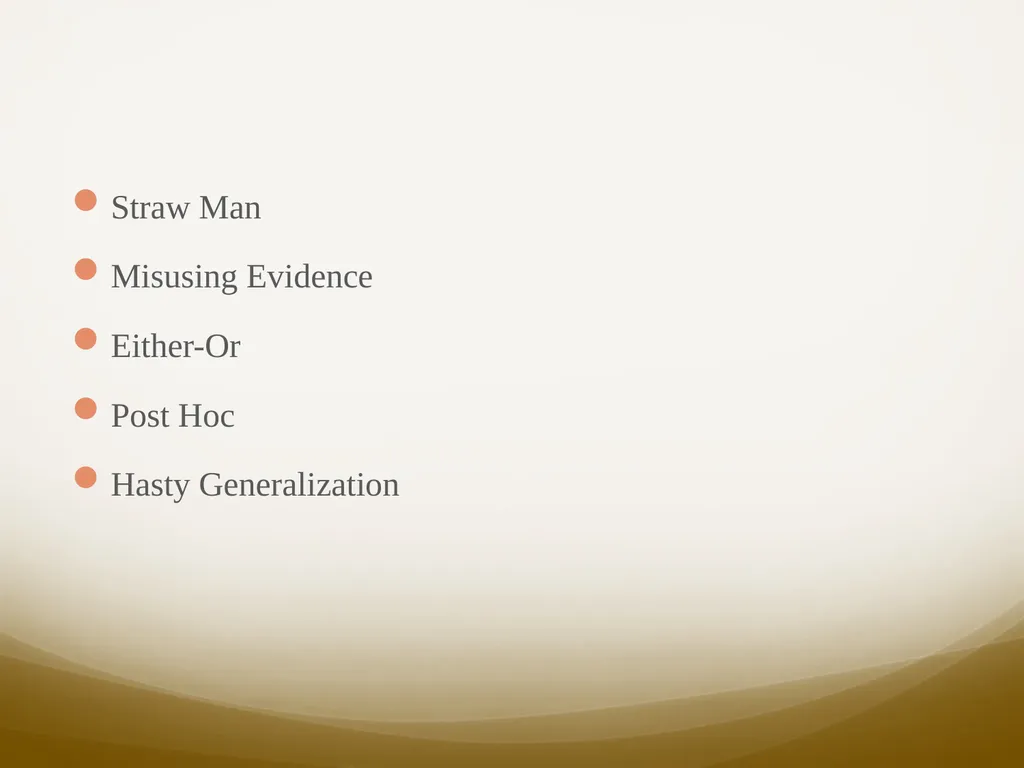
Straw Man
Misusing Evidence
Either-Or
Post Hoc
Hasty Generalization<br>
13
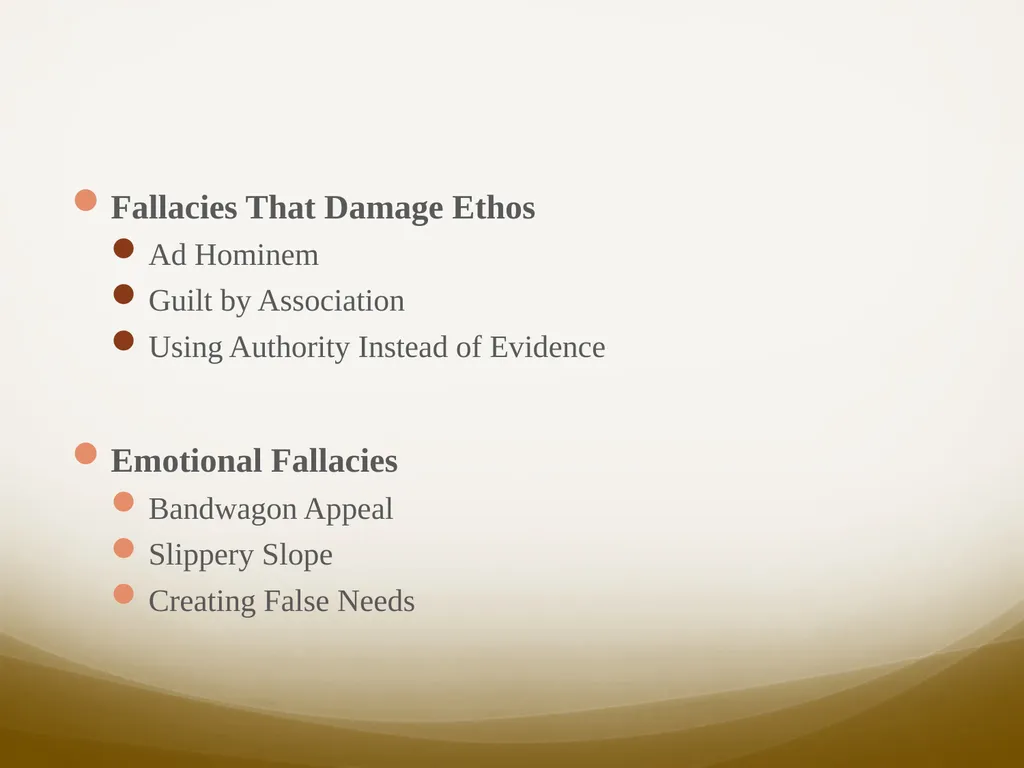
Fallacies That Damage Ethos
Ad Hominem
Guilt by Association
Using Authority Instead of Evidence