SC.912.L.17.2 Explain the general distribution of life in aquatic systems as a function of chemistry, geography, light, depth, salinity, and temperature. Clarification : Students will explain that different types of organisms exist within
"SC.912.L.17.2 Explain the general distribution of" is the property of its rightful owner. Permission is granted to
download and print the materials on this website for personal, non-commercial use only, and to display it
on your personal computer provided you do not modify the materials and that you retain all copyright
notices contained in the materials. By downloading content from our website, you accept the terms of this
agreement.
Presentation Transcript
01
SC.912.L.17.2 Explain the general distribution of life in aquatic systems as a function of chemistry, geography, light, depth, salinity, and temperature.
Clarification :
Students will explain that different types of organisms exist within aquatic systems due to chemistry, geography, light, depth, salinity, and/or temperature.
Content Limits : Items referring to chemical factors in aquatic systems are limited to pH, oxygen, carbon dioxide, nitrogen, phosphorous, and salinity.
Items referring to geography in aquatic systems are limited to water depth, latitude, temperature, underwater topography, and proximity to land.
Items will not require the identification of oceanic zones.<br>
02
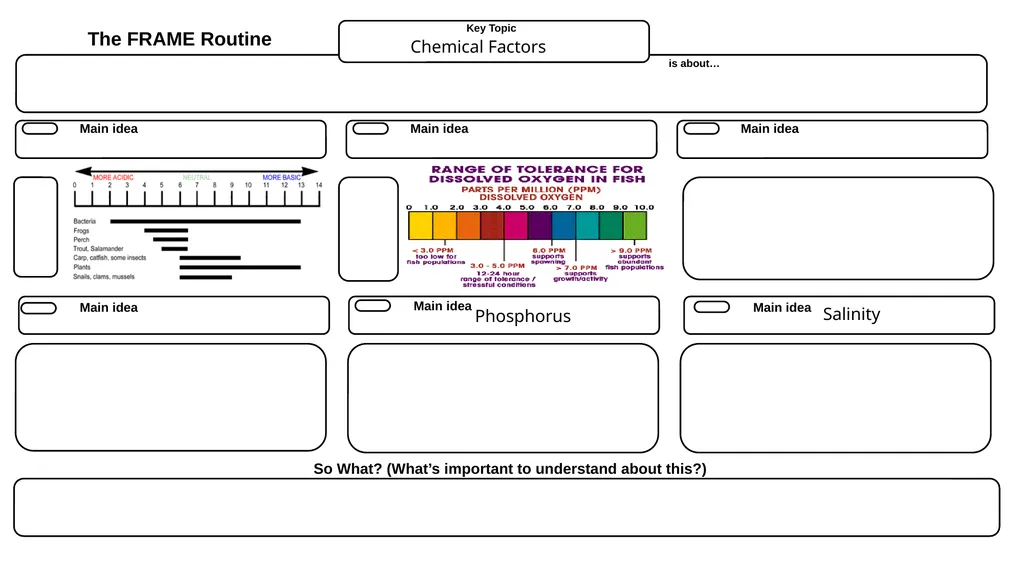
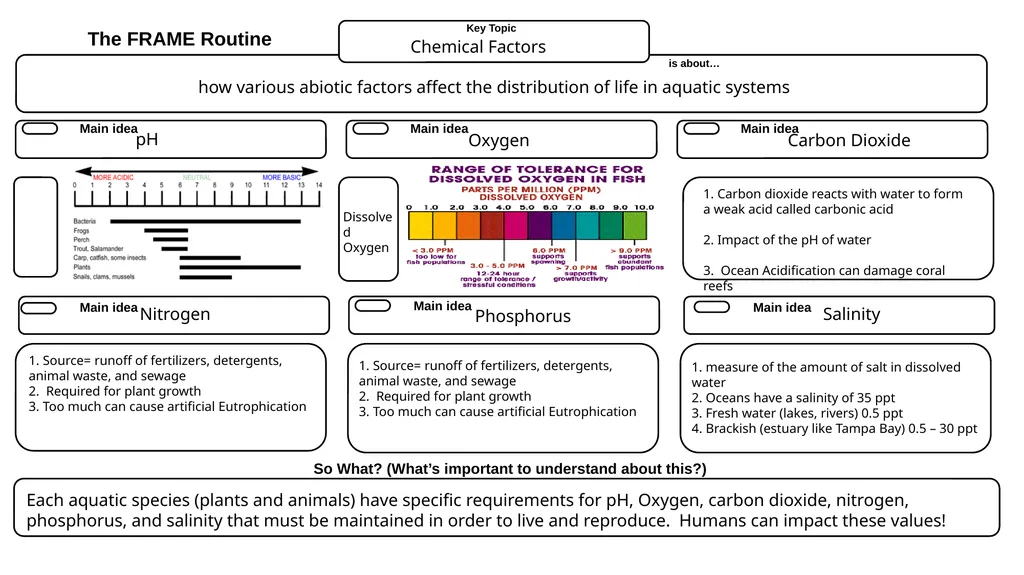
Chemical Factors Main idea Main idea Main idea Phosphorus Salinity<br>
03
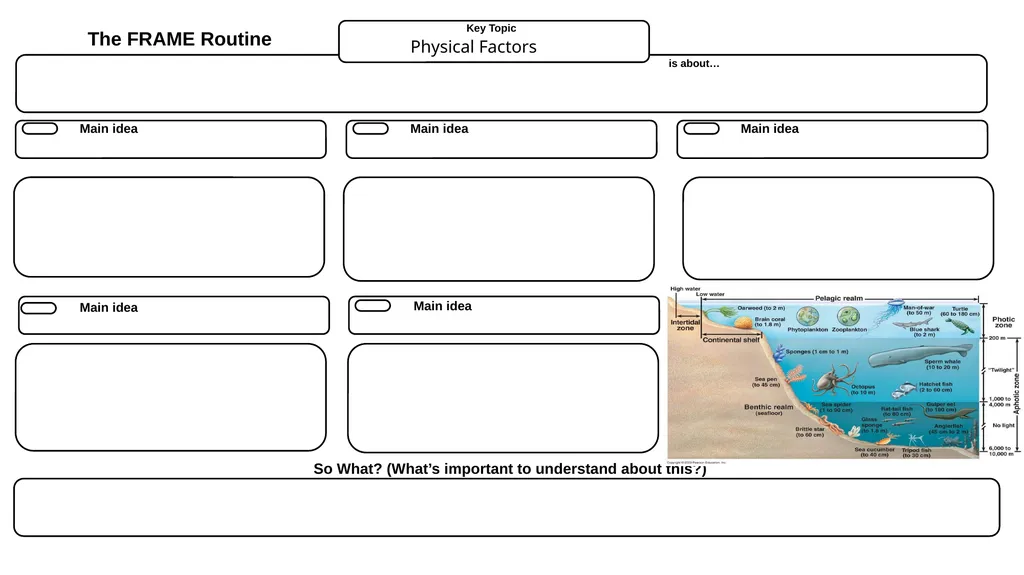
Physical Factors Main idea Main idea<br>
04
Extend Understanding Answer these follow up questions:
Which factors may contribute to high biodiversity?
Which factors may contribute to a decrease in biodiversity?
Explain which factors can influence the carrying capacity of a population.
Are all of these limiting factors? Explain.
OR
Research the chemical and physical factors required for an aquatic species of your choosing. Be sure to discuss all factors present on these frames.<br>
05
1. measure of the amount of salt in dissolved water
2. Oceans have a salinity of 35 ppt
3. Fresh water (lakes, rivers) 0.5 ppt
4. Brackish (estuary like Tampa Bay) 0.5 – 30 ppt Each aquatic species (plants and animals) have specific requirements for pH, Oxygen, carbon dioxide, nitrogen, phosphorus, and salinity that must be maintained in order to live and reproduce. Humans can impact these values! Dissolved Oxygen 1. Carbon dioxide reacts with water to form a weak acid called carbonic acid
2. Impact of the pH of water
3. Ocean Acidification can damage coral reefs 1. Source= runoff of fertilizers, detergents, animal waste, and sewage
2. Required for plant growth
3. Too much can cause artificial Eutrophication Carbon Dioxide pH how various abiotic factors affect the distribution of life in aquatic systems Chemical Factors Oxygen Nitrogen Main idea Main idea Main idea Phosphorus Salinity 1. Source= runoff of fertilizers, detergents, animal waste, and sewage
2. Required for plant growth
3. Too much can cause artificial Eutrophication<br>
06
Aquatic species (plants and animals) live in different locations in the world and within bodies of water due to factors like water temperature, available sunlight, proximity to land, underwater topography, latitude, etc. 1.Rivers move materials from land to water
Nutrients, Sediment, & pollution
2.Human activities are concentrated closest to land 1. Affects amount of gasses dissolved in water
2. Colder=more gasses (oxygen/carbon dioxide)
3. As oceans get warmer: Can’t hold as much oxygen they release Carbon dioxide into the atmosphere Areas closest to the equator Receive greatest amount of sunlight
warmer
High biodiversity Photic zone=depth of sunlight penetrating water
(Higher biodiversity closer to the surface)
2. Pressure increases with depth 1. Can impact ocean currents
2. Can impact availability of nutrients (upwelling)
3. Can impact temperature (deep sea thermal vents) Temperature Water Depth how various abiotic factors affect the distribution of life in aquatic systems Physical Factors Latitude Underwater Topography Main idea Main idea Proximity to Land<br>