Synthetic, but How Much Risk Transfer? Alex Osberghaus Glenn Schepens IWH-FIN-FIRE Workshop Discussion by Jennifer Dlugosz Sept. 25, 2025 Disclaimer: The views expressed in this presentation are the authors and do not necessarily
"Synthetic, but How Much Risk Transfer? Alex" is the property of its rightful owner. Permission is granted to
download and print the materials on this website for personal, non-commercial use only, and to display it
on your personal computer provided you do not modify the materials and that you retain all copyright
notices contained in the materials. By downloading content from our website, you accept the terms of this
agreement.
Presentation Transcript
01
Synthetic, but How Much Risk Transfer? Alex Osberghaus Glenn Schepens IWH-FIN-FIRE Workshop
Discussion by Jennifer Dlugosz*
Sept. 25, 2025 * Disclaimer: The views expressed in this presentation are the author’s and do not necessarily reflect the positions of the Federal Reserve Board or the Federal Reserve System.<br>
02
First detailed look at SRTs using confidential data from the ECB
Established market in Europe, growing in the US
SRTs part of a broader migration of activity outside of banks:
Non-bank mortgage lenders (Buchak et al. (2018), Jiang et al. (2022), Berg et al. (2022))
Private credit (Chernenko, et al. (2022), Haque et al (2025))
BDCs (Chernenko et al. (2025))
Spurred by increased bank regulation, technological advances, etc. Overview<br>
03
Paper identifies three channels through which SRTs can create risks to financial stability: (1) ↓ bank capital (2) ↓ loan monitoring (3) ↑ interconnectedness
A lot to like:
Amazing data!
Assortment of nice identification and measurement techniques
Outline of my comments/thoughts:
Clarify banks’ motives for engaging in SRTs
Are (1)-(3) the most important risks? Are they quantitatively important?
Perspective from the performance of securitized products during the GFC Overview, cont.<br>
04
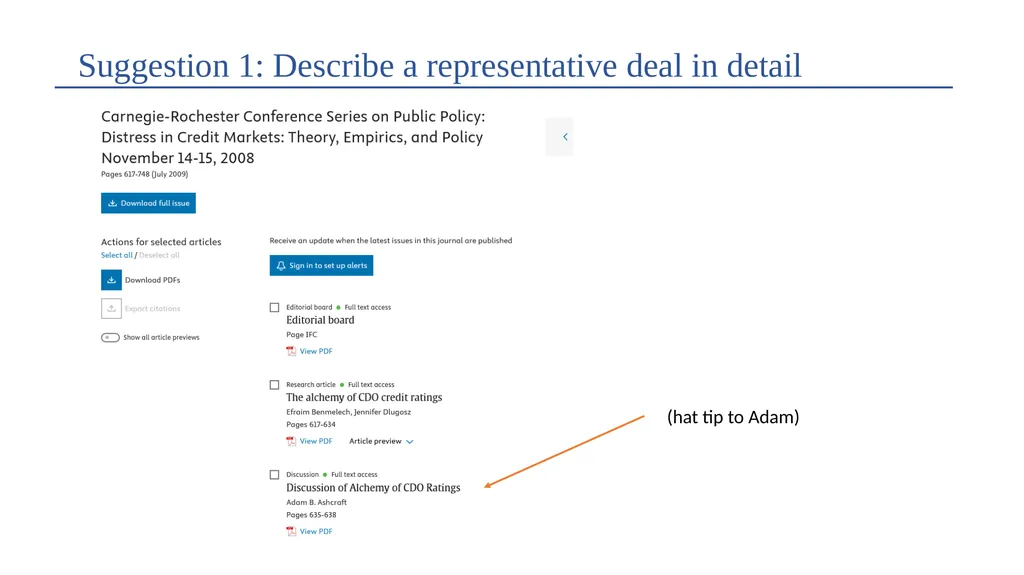
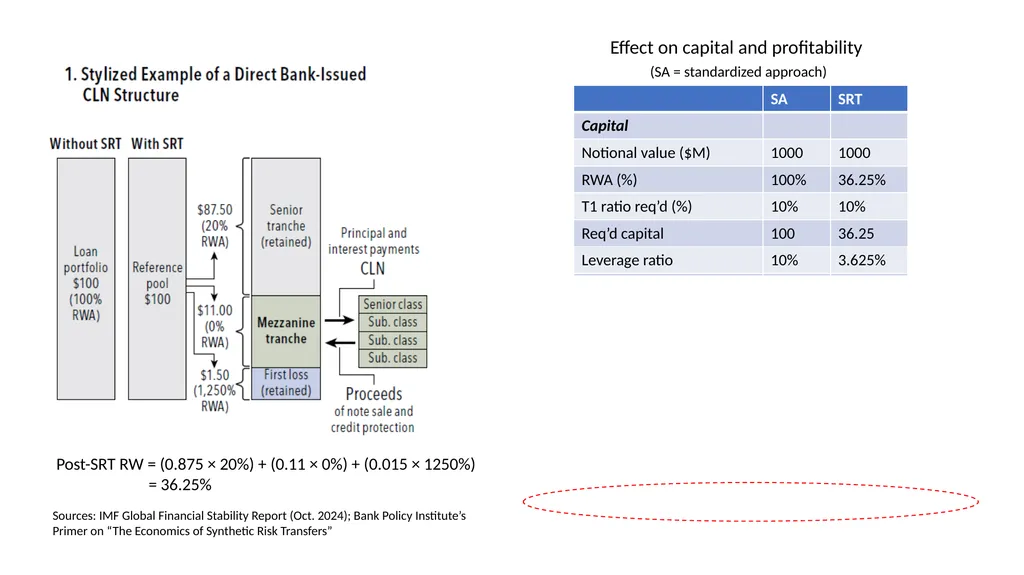
Suggestion 1: Describe a representative deal in detail (hat tip to Adam)<br>
05
Sources: IMF Global Financial Stability Report (Oct. 2024); Bank Policy Institute’s Primer on “The Economics of Synthetic Risk Transfers” Effect on capital and profitability
(SA = standardized approach) Post-SRT RW = (0.875 × 20%) + (0.11 × 0%) + (0.015 × 1250%)
= 36.25%<br>
06
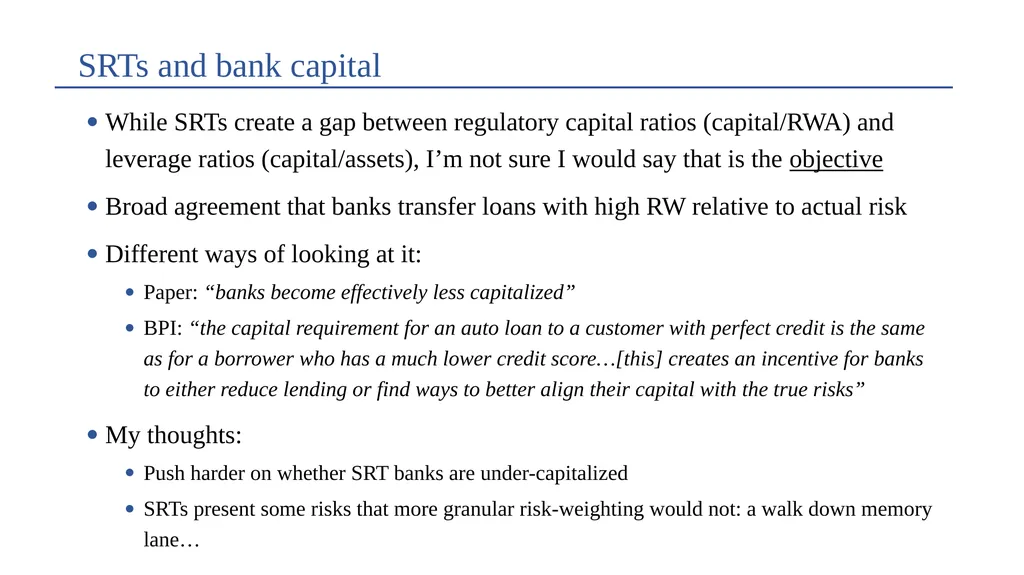
While SRTs create a gap between regulatory capital ratios (capital/RWA) and leverage ratios (capital/assets), I’m not sure I would say that is the objective
Broad agreement that banks transfer loans with high RW relative to actual risk
Different ways of looking at it:
Paper: “banks become effectively less capitalized”
BPI: “the capital requirement for an auto loan to a customer with perfect credit is the same as for a borrower who has a much lower credit score…[this] creates an incentive for banks to either reduce lending or find ways to better align their capital with the true risks”
My thoughts:
Push harder on whether SRT banks are under-capitalized
SRTs present some risks that more granular risk-weighting would not: a walk down memory lane… SRTs and bank capital<br>
07
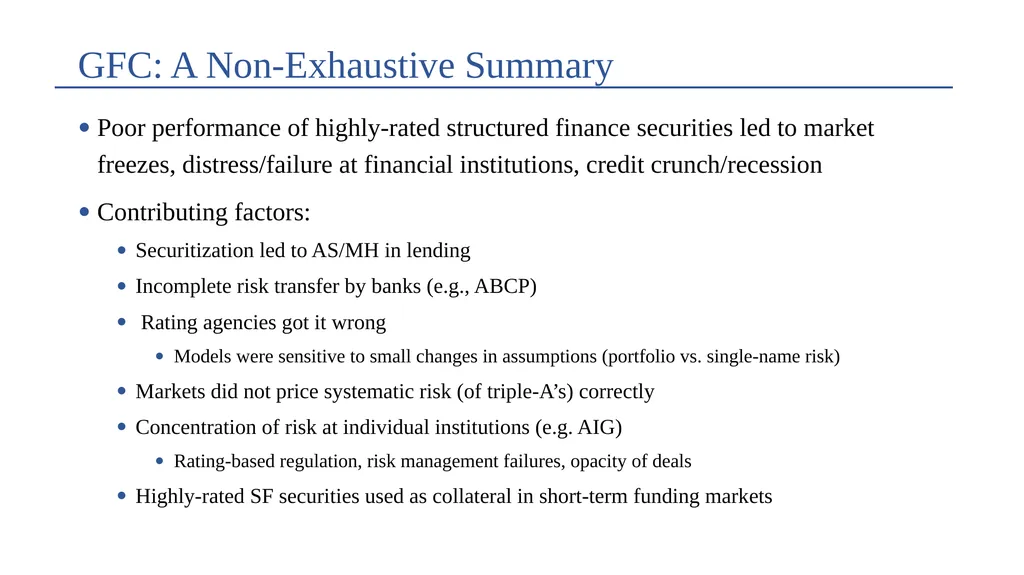
Poor performance of highly-rated structured finance securities led to market freezes, distress/failure at financial institutions, credit crunch/recession
Contributing factors:
Securitization led to AS/MH in lending
Incomplete risk transfer by banks (e.g., ABCP)
Rating agencies got it wrong
Models were sensitive to small changes in assumptions (portfolio vs. single-name risk)
Markets did not price systematic risk (of triple-A’s) correctly
Concentration of risk at individual institutions (e.g. AIG)
Rating-based regulation, risk management failures, opacity of deals
Highly-rated SF securities used as collateral in short-term funding markets GFC: A Non-Exhaustive Summary<br>
08
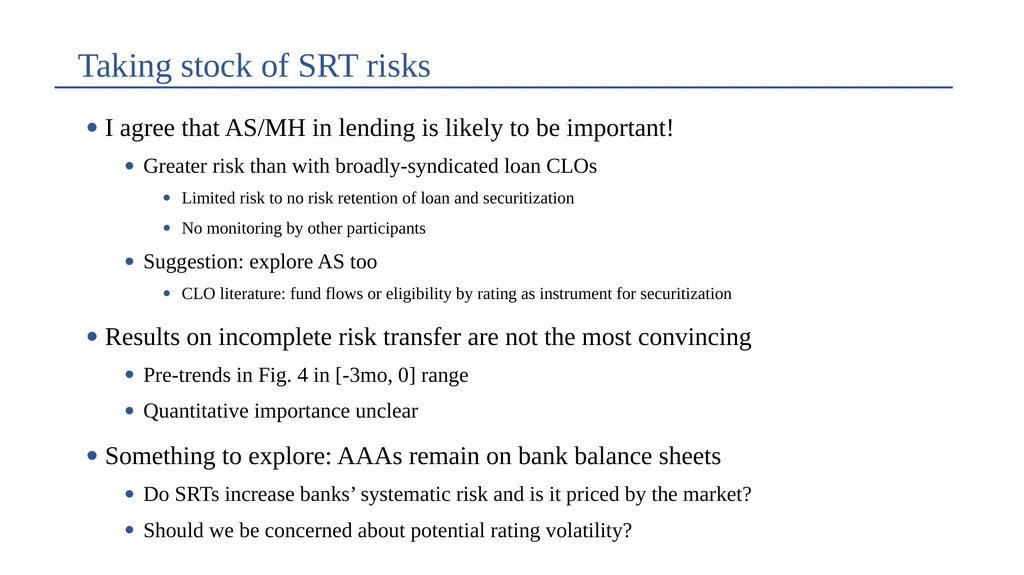
I agree that AS/MH in lending is likely to be important!
Greater risk than with broadly-syndicated loan CLOs
Limited risk to no risk retention of loan and securitization
No monitoring by other participants
Suggestion: explore AS too
CLO literature: fund flows or eligibility by rating as instrument for securitization
Results on incomplete risk transfer are not the most convincing
Pre-trends in Fig. 4 in [-3mo, 0] range
Quantitative importance unclear
Something to explore: AAAs remain on bank balance sheets
Do SRTs increase banks’ systematic risk and is it priced by the market?
Should we be concerned about potential rating volatility? Taking stock of SRT risks<br>
09
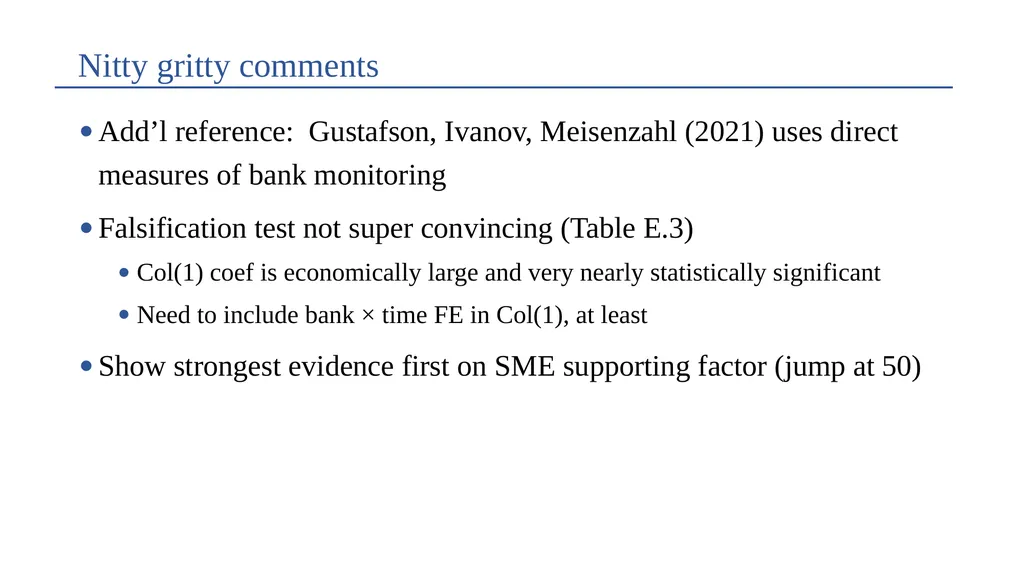
Add’l reference: Gustafson, Ivanov, Meisenzahl (2021) uses direct measures of bank monitoring
Falsification test not super convincing (Table E.3)
Col(1) coef is economically large and very nearly statistically significant
Need to include bank × time FE in Col(1), at least
Show strongest evidence first on SME supporting factor (jump at 50) Nitty gritty comments<br>
10
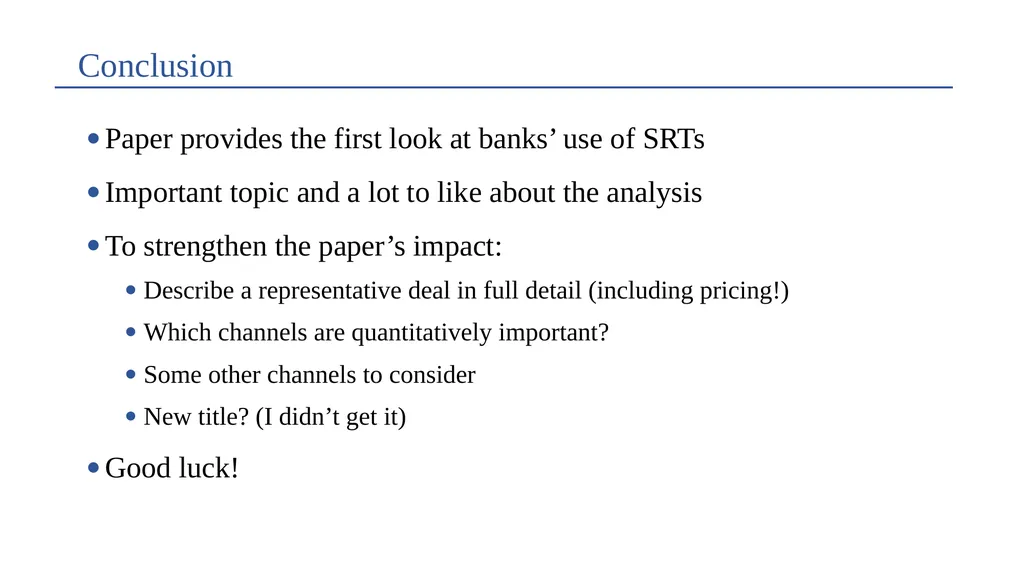
Conclusion Paper provides the first look at banks’ use of SRTs
Important topic and a lot to like about the analysis
To strengthen the paper’s impact:
Describe a representative deal in full detail (including pricing!)
Which channels are quantitatively important?
Some other channels to consider
New title? (I didn’t get it)
Good luck!<br>