Understanding Cultural Competence in the Classroom Faculty Development Workshop April 5, 2013 Donna L. Pattison, PhD Instructional Professor Department of Biology Biochemistry
"Understanding Cultural Competence in the Classroom" is the property of its rightful owner. Permission is granted to
download and print the materials on this website for personal, non-commercial use only, and to display it
on your personal computer provided you do not modify the materials and that you retain all copyright
notices contained in the materials. By downloading content from our website, you accept the terms of this
agreement.
Presentation Transcript
01
Understanding Cultural Competence in the Classroom Faculty Development Workshop
April 5, 2013 Donna L. Pattison, PhD
Instructional Professor
Department of Biology & Biochemistry<br>
02
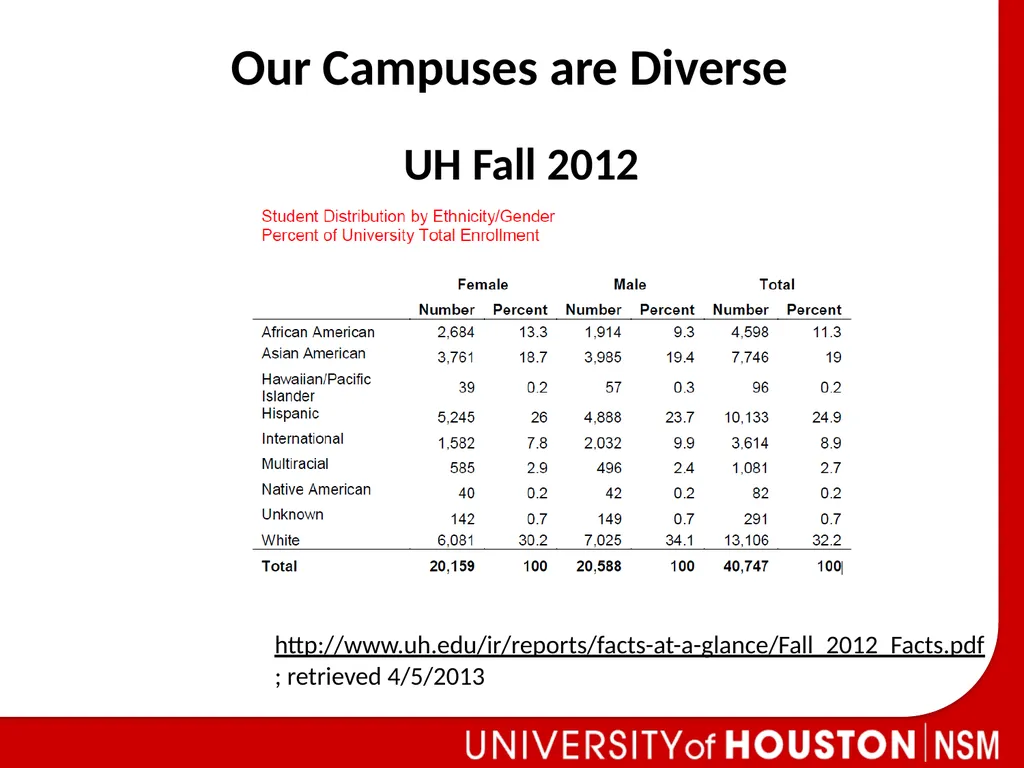
http://www.uh.edu/ir/reports/facts-at-a-glance/Fall_2012_Facts.pdf; retrieved 4/5/2013 UH Fall 2012 Our Campuses are Diverse<br>
03
Culture:
Competence:
Cultural Competence: Define Cultural Competence<br>
04
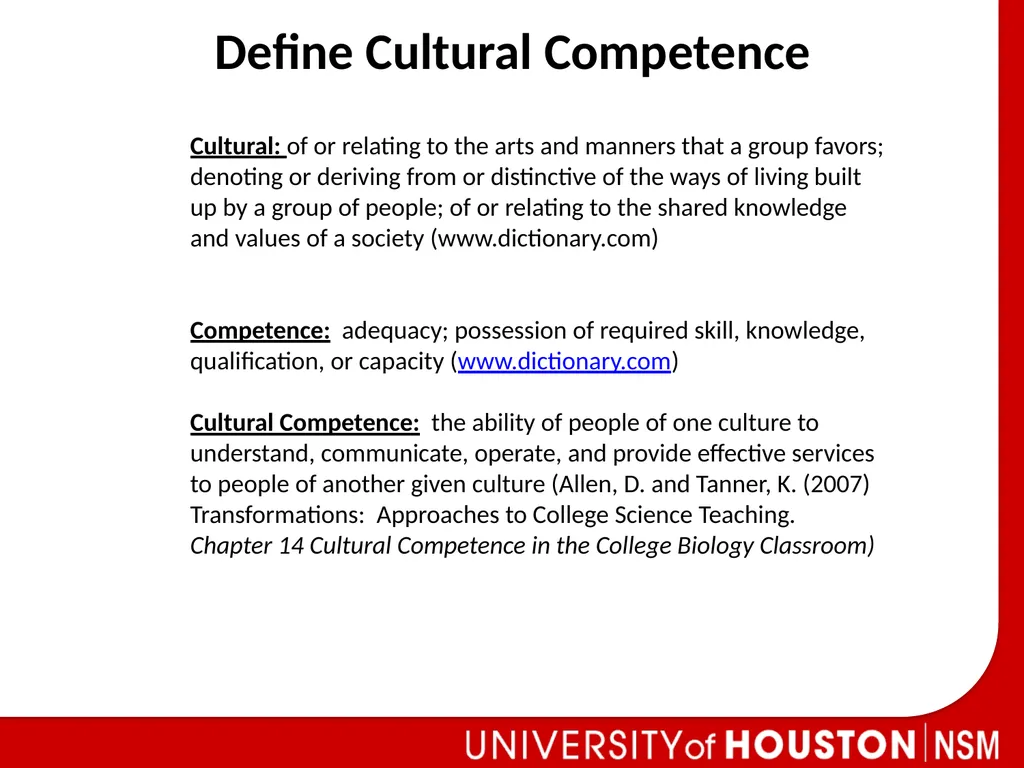
Cultural: of or relating to the arts and manners that a group favors; denoting or deriving from or distinctive of the ways of living built up by a group of people; of or relating to the shared knowledge and values of a society (www.dictionary.com)
Competence: adequacy; possession of required skill, knowledge, qualification, or capacity (www.dictionary.com)
Cultural Competence: the ability of people of one culture to understand, communicate, operate, and provide effective services to people of another given culture (Allen, D. and Tanner, K. (2007) Transformations: Approaches to College Science Teaching. Chapter 14 Cultural Competence in the College Biology Classroom) Define Cultural Competence<br>
05
What is it?
Why should we care?
What are common pitfalls that reveal a lack of it? Allen, D. and Tanner, K. (2007) Transformations: Approaches to College Science Teaching. Chapter 14 Cultural Competence in the College Biology Classroom. Cultural Competence<br>
06
List at least 5 characteristics that vary between individuals that can be considered “cultural considerations”. 1.
2.
3.
4.
5.<br>
07
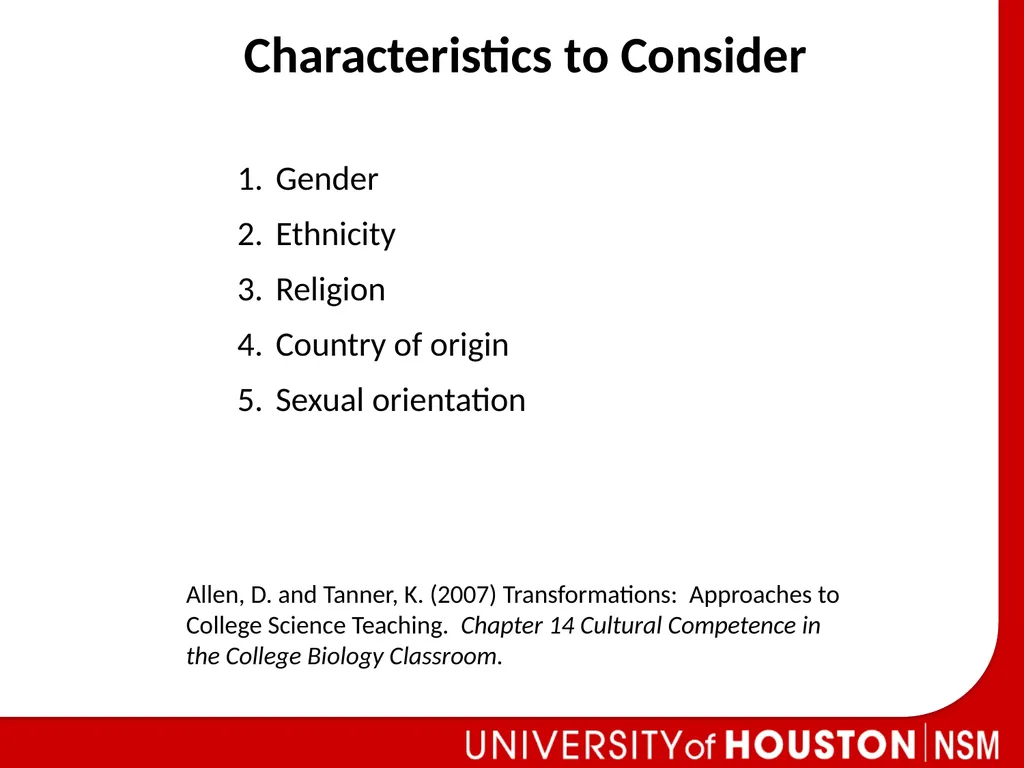
Characteristics to Consider Gender
Ethnicity
Religion
Country of origin
Sexual orientation Allen, D. and Tanner, K. (2007) Transformations: Approaches to College Science Teaching. Chapter 14 Cultural Competence in the College Biology Classroom.<br>
08
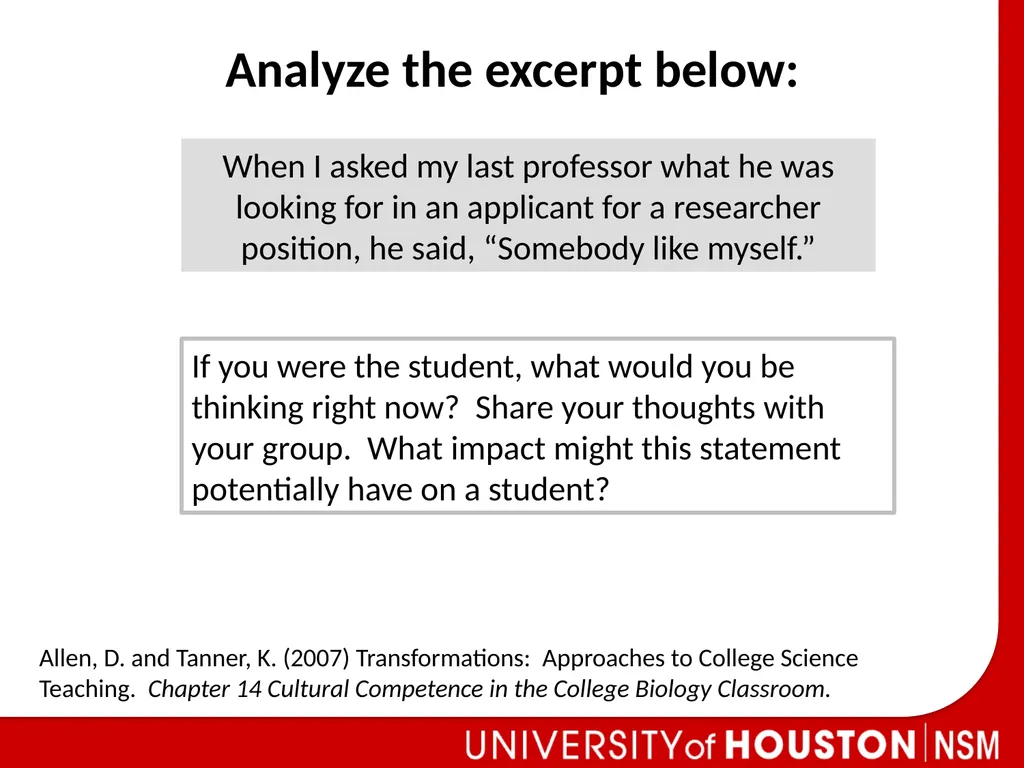
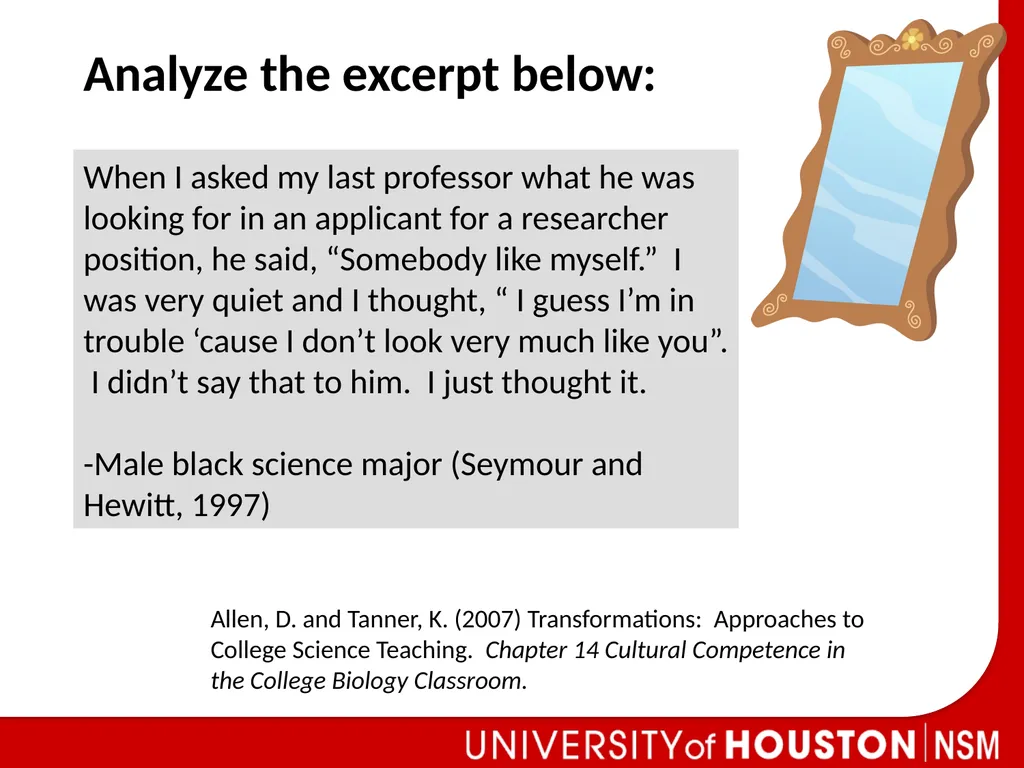
Analyze the excerpt below: When I asked my last professor what he was looking for in an applicant for a researcher position, he said, “Somebody like myself.” Allen, D. and Tanner, K. (2007) Transformations: Approaches to College Science Teaching. Chapter 14 Cultural Competence in the College Biology Classroom. If you were the student, what would you be thinking right now? Share your thoughts with your group. What impact might this statement potentially have on a student?<br>
09
Analyze the excerpt below: When I asked my last professor what he was looking for in an applicant for a researcher position, he said, “Somebody like myself.” I was very quiet and I thought, “ I guess I’m in trouble ‘cause I don’t look very much like you”. I didn’t say that to him. I just thought it.
-Male black science major (Seymour and Hewitt, 1997) Allen, D. and Tanner, K. (2007) Transformations: Approaches to College Science Teaching. Chapter 14 Cultural Competence in the College Biology Classroom.<br>
10
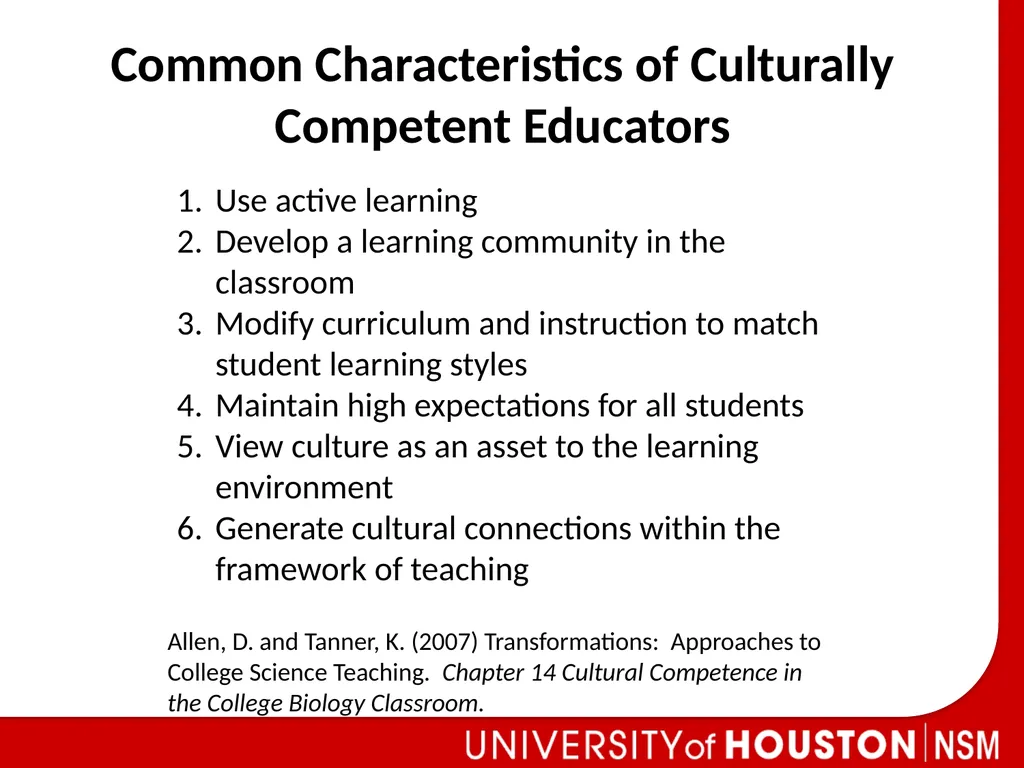
Common Characteristics of Culturally Competent Educators Use active learning
Develop a learning community in the classroom
Modify curriculum and instruction to match student learning styles
Maintain high expectations for all students
View culture as an asset to the learning environment
Generate cultural connections within the framework of teaching Allen, D. and Tanner, K. (2007) Transformations: Approaches to College Science Teaching. Chapter 14 Cultural Competence in the College Biology Classroom.<br>
11
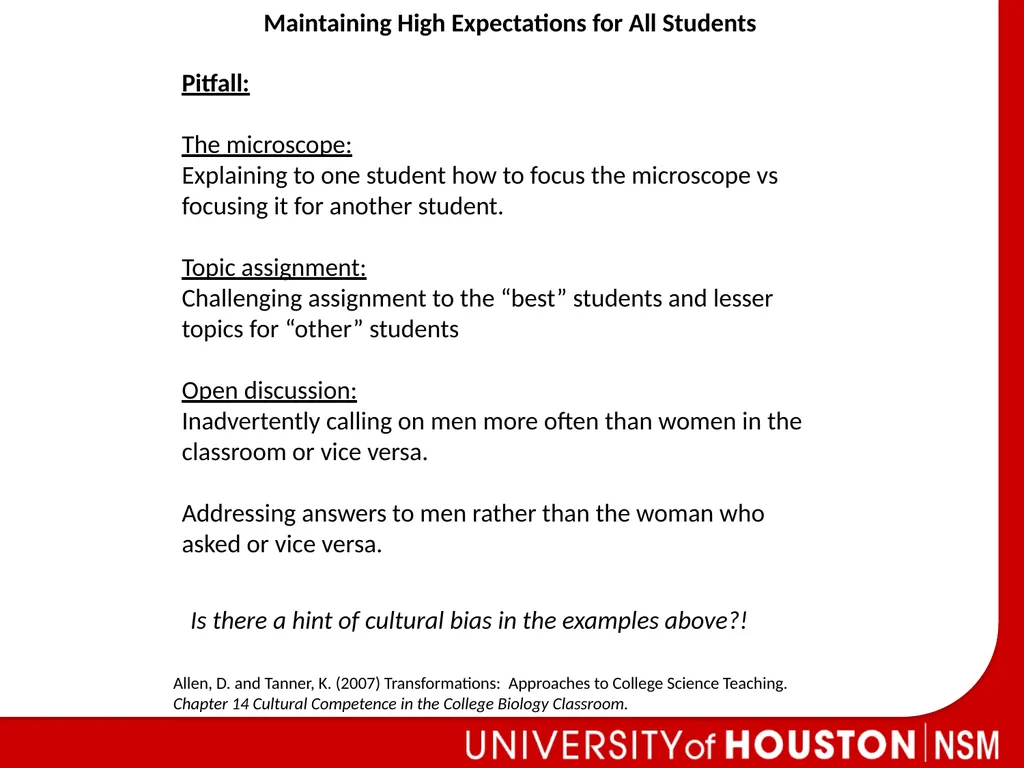
Maintaining High Expectations for All Students Pitfall:
The microscope:
Explaining to one student how to focus the microscope vs focusing it for another student.
Topic assignment:
Challenging assignment to the “best” students and lesser topics for “other” students
Open discussion:
Inadvertently calling on men more often than women in the classroom or vice versa.
Addressing answers to men rather than the woman who asked or vice versa. Allen, D. and Tanner, K. (2007) Transformations: Approaches to College Science Teaching. Chapter 14 Cultural Competence in the College Biology Classroom. Is there a hint of cultural bias in the examples above?!<br>
12
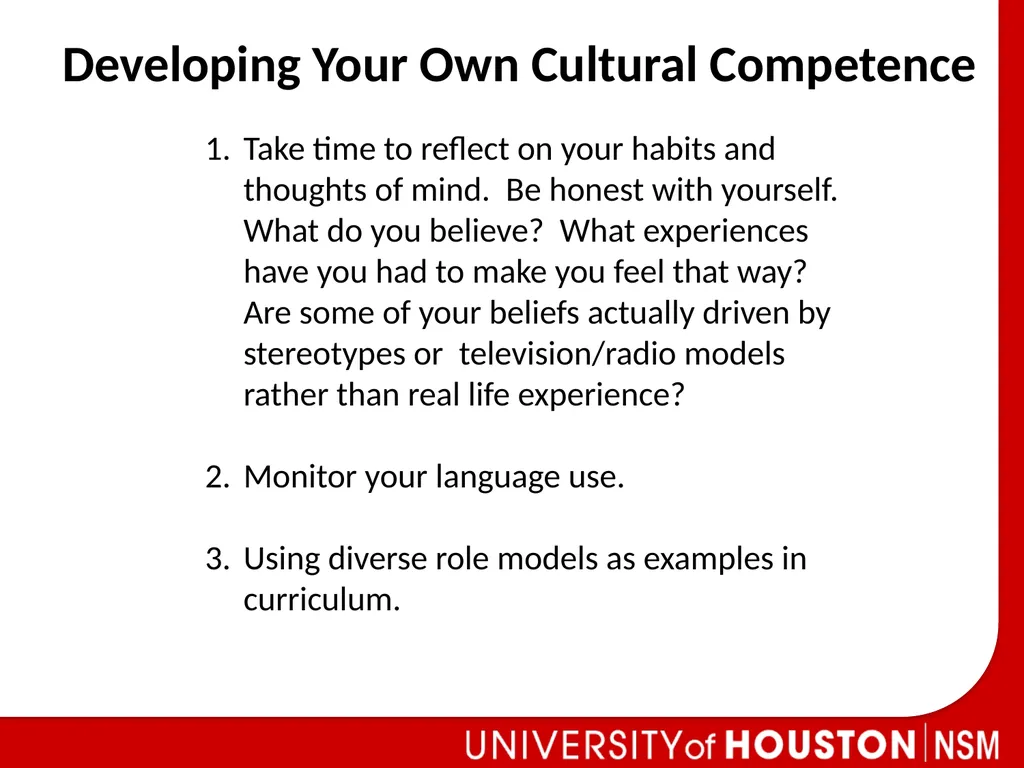
Developing Your Own Cultural Competence Take time to reflect on your habits and thoughts of mind. Be honest with yourself. What do you believe? What experiences have you had to make you feel that way? Are some of your beliefs actually driven by stereotypes or television/radio models rather than real life experience?
Monitor your language use.
Using diverse role models as examples in curriculum.<br>
13
Be aware of your patterns
of interaction with students Who do you call on?
Who do you praise?
Who do you correct?
Whose name do you use when referring to a group project?
Who do you interact with?
To whom do you tend to gravitate?
Whose names do you remember? The clipboard method: If the class is small enough, track your interactions as they unfold during class.<br>
14
Integrating Cultural Relevance and
Diverse Role Models into Curricula Provide examples of diverse role models when possible.
Case studies and problem-based learning can link content to real-world issues.<br>
15
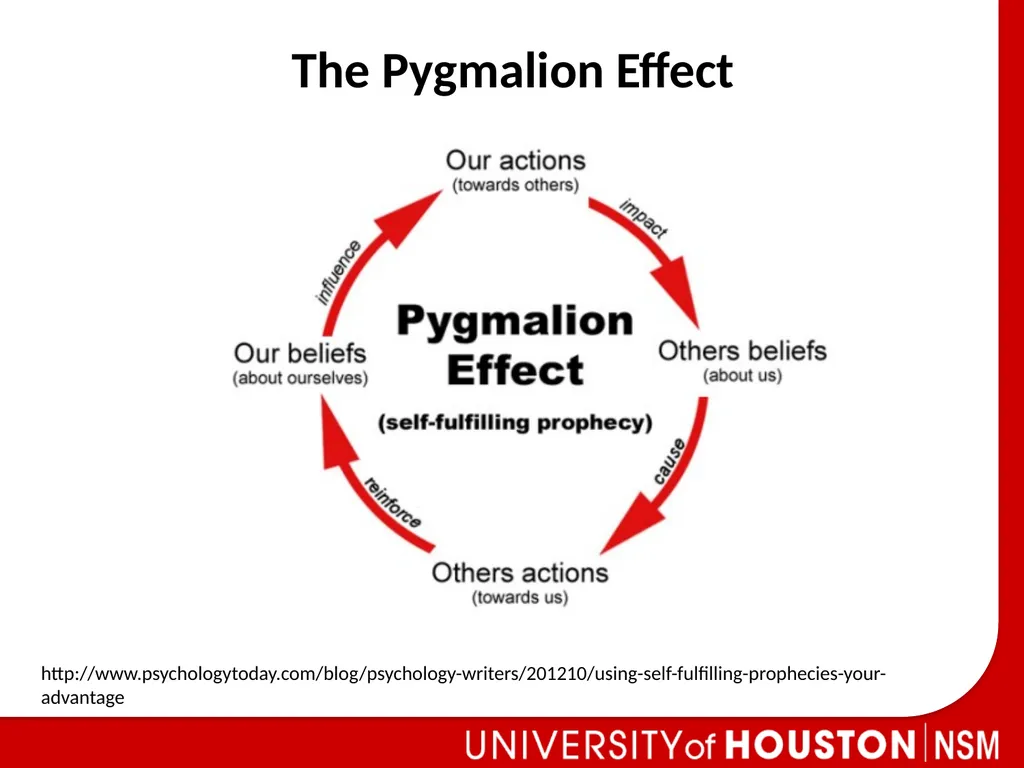
The Pygmalion Effect http://www.psychologytoday.com/blog/psychology-writers/201210/using-self-fulfilling-prophecies-your-advantage<br>