
UNIT -3 BRANDING ,PACKAGING AND LABELLING By Mrs
BR
Published · 32 slides · 0 views

1 / 1




Description
UNIT -3 BRANDING ,PACKAGING AND LABELLING By Mrs Sarika Singh Faculty of Management Studies MLSU Udaipur BRAND According to American Marketing Association - Brand is A name, term, design, symbol, or any other feature that identifies one
Related Topics
Share
Embed code
Download this presentation From Below
"UNIT -3 BRANDING ,PACKAGING AND LABELLING By Mrs" is the property of its rightful owner. Permission is granted to download and print the materials on this website for personal, non-commercial use only, and to display it on your personal computer provided you do not modify the materials and that you retain all copyright notices contained in the materials. By downloading content from our website, you accept the terms of this agreement.
Presentation Transcript
01
UNIT -3
BRANDING ,PACKAGING AND LABELLING By
Mrs Sarika Singh
Faculty of Management Studies MLSU Udaipur<br>
Mrs Sarika Singh
Faculty of Management Studies MLSU Udaipur<br>
02
BRAND According to American Marketing Association - Brand is “A name, term, design, symbol, or any other feature that identifies one seller’s good or service as distinct from those of other sellers. The legal term for brand is trademark. A brand may identify one item, a family of items, or all items of that seller. If used for the firm as a whole, the preferred term is trade name.”<br>
03
According to Philip Kotler - “Brand is a name, term, sign, symbol, design, or a combination of them, intended to identify the goods or services of one seller or group of sellers and to differentiate them from those of competitors”
Branding is “a seller’s promise to deliver a specific set of features, benefits and services consistent to the buyers.”<br>
Branding is “a seller’s promise to deliver a specific set of features, benefits and services consistent to the buyers.”<br>
04
BRANDING Branding is a process of creating a unique name and image for a product in the mind of consumer, mainly through advertising campaigns. A brand is a name, term, symbol, design or combination of these elements, used to identify a product, a family of products, or all products of an organisation<br>
05
ELEMENTS OF BRANDING Brand includes various elements like –
Brand names,
Trade names,
Brand marks,
Trade marks,
Trade characters.
The combination of these elements form a firm's corporate symbol or name.<br>
Brand names,
Trade names,
Brand marks,
Trade marks,
Trade characters.
The combination of these elements form a firm's corporate symbol or name.<br>
06
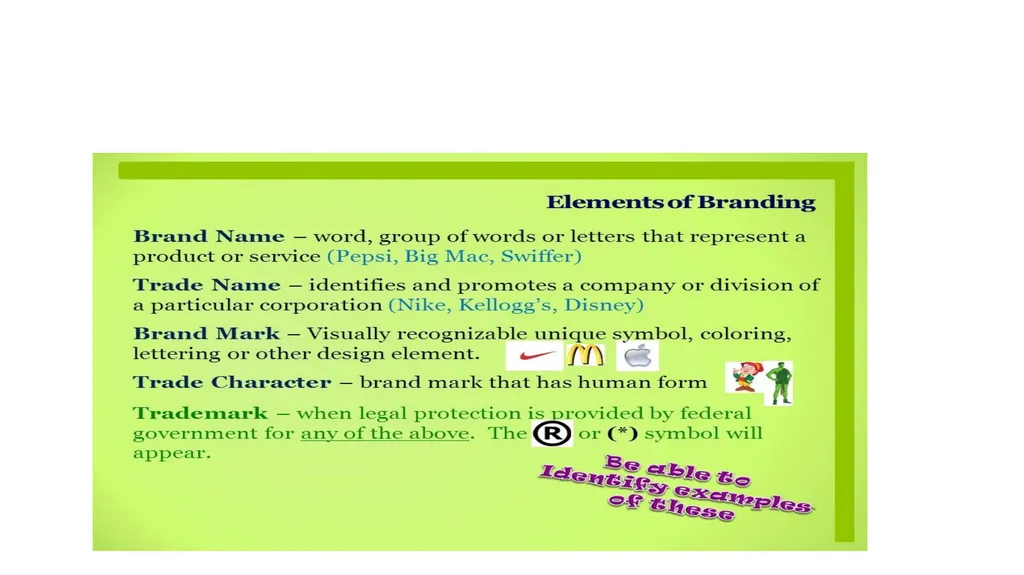
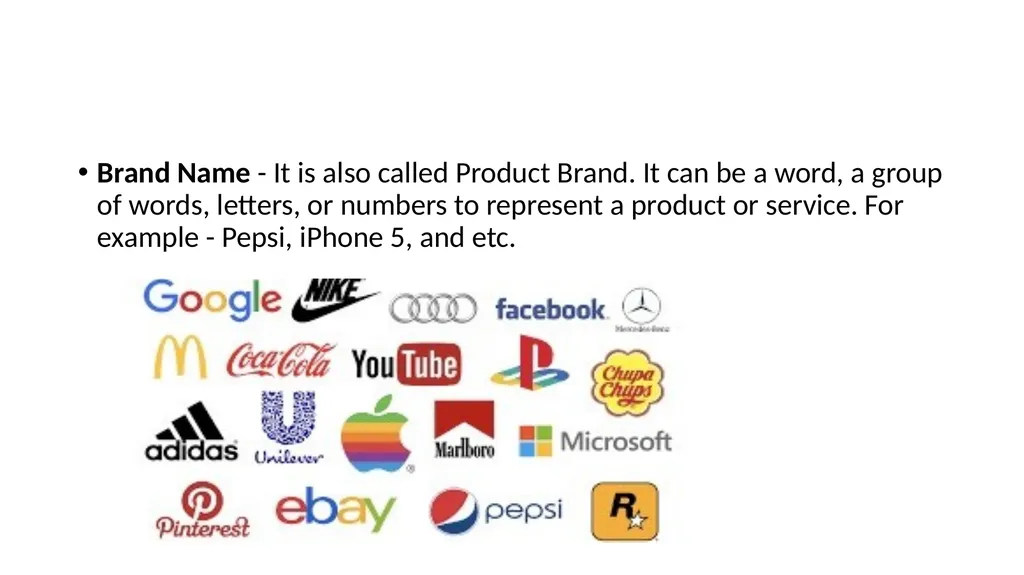
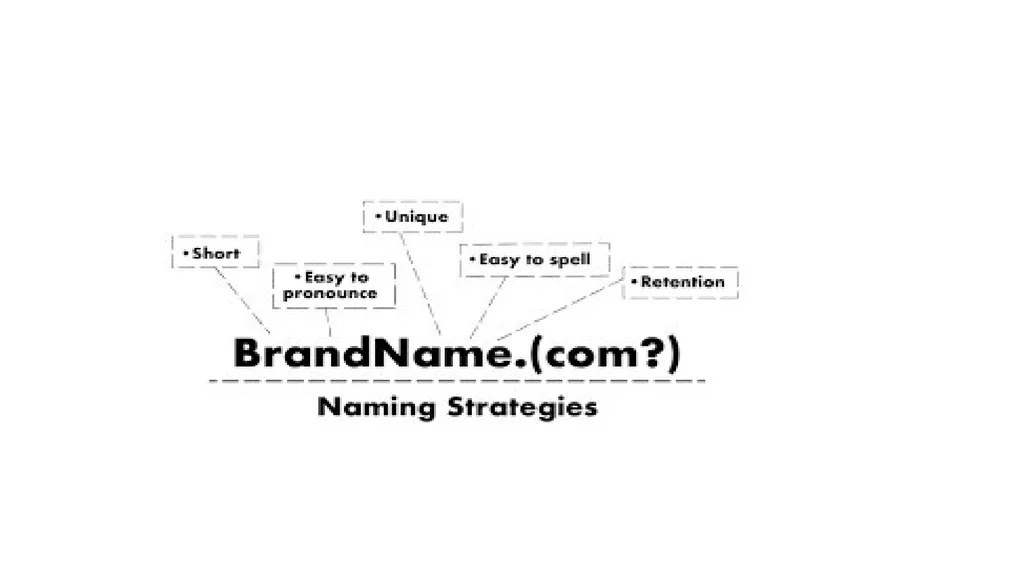
Brand Name - It is also called Product Brand. It can be a word, a group of words, letters, or numbers to represent a product or service. For example - Pepsi, iPhone 5, and etc.<br>
07
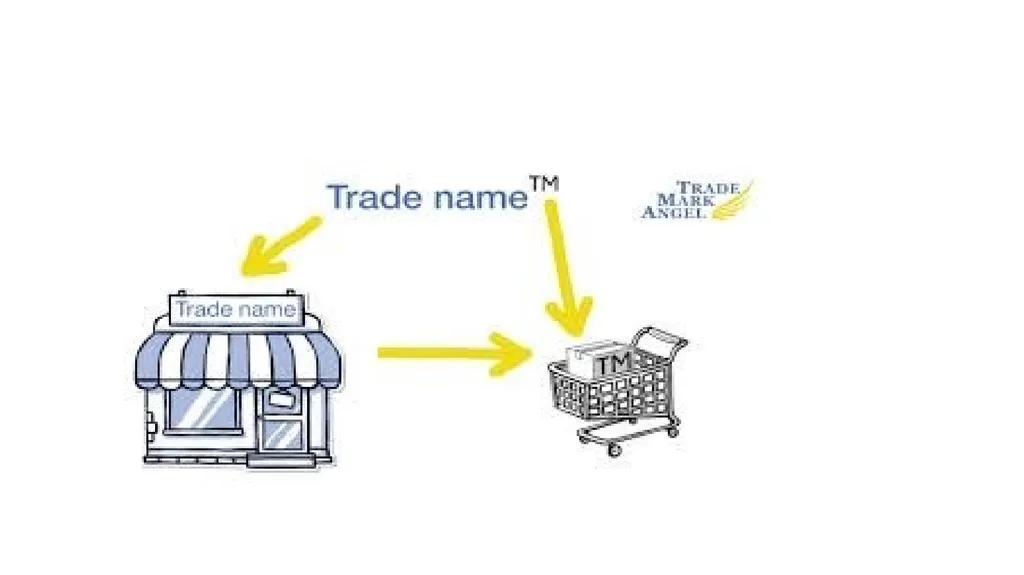
Trade Name - It is also called Corporate Brand. It identifies and promotes a company or a division of a particular corporation. For example - Dell, Nike, Google, and etc.<br>
08
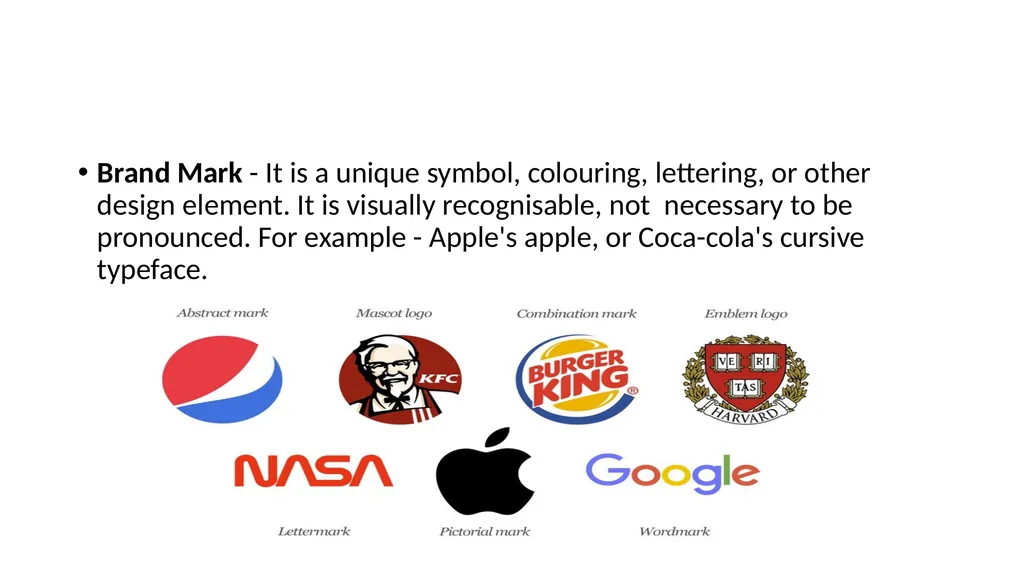
Brand Mark - It is a unique symbol, colouring, lettering, or other design element. It is visually recognisable, not necessary to be pronounced. For example - Apple's apple, or Coca-cola's cursive typeface.<br>
09
Trade Mark - It is a word, name, symbol, or combination of these elements. Trade mark is legally protected by government. For example - NBC colourful peacock, or McDonald's golden arches. No other organisation can use these symbols.<br>
10
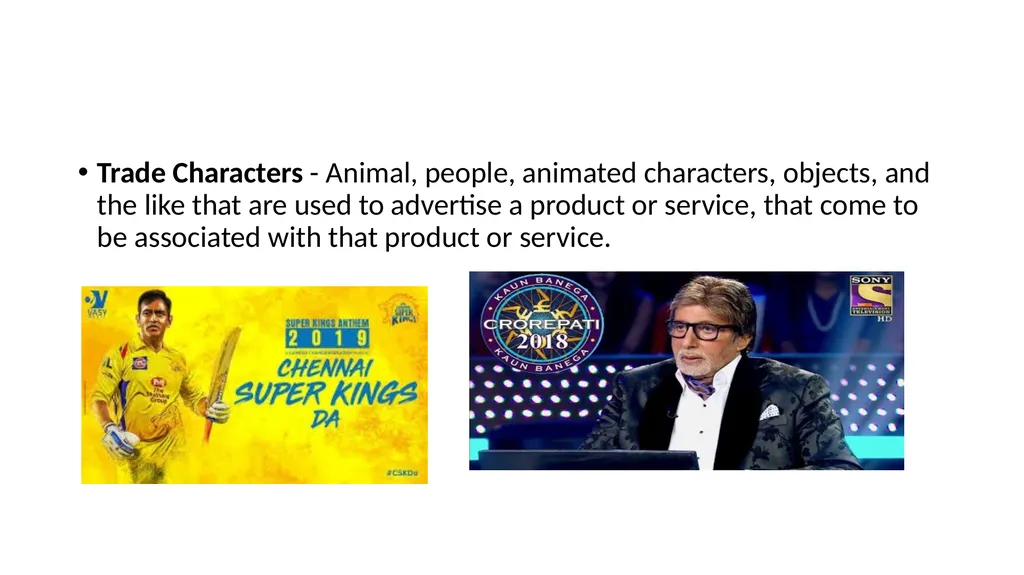
Trade Characters - Animal, people, animated characters, objects, and the like that are used to advertise a product or service, that come to be associated with that product or service.<br>
11
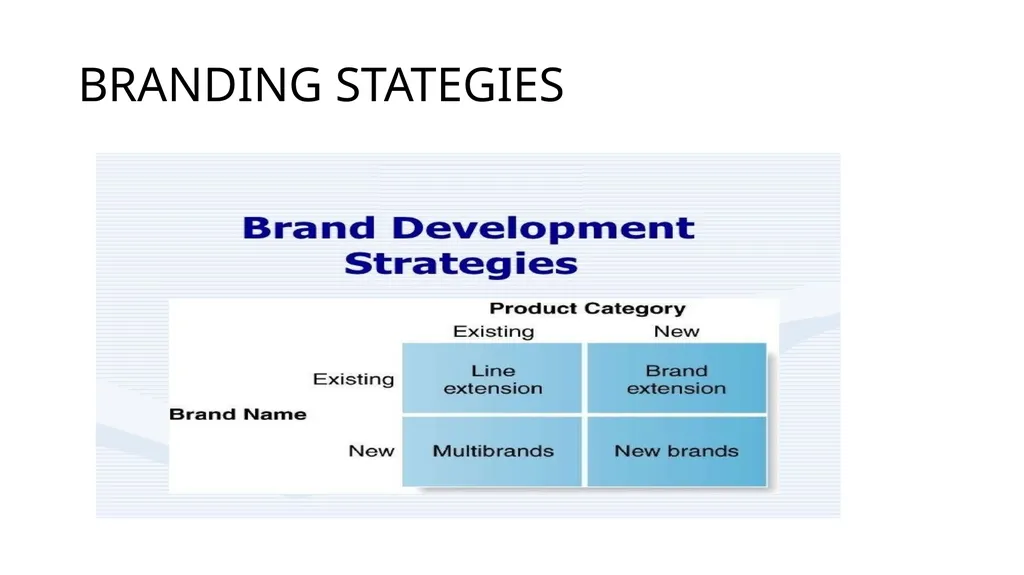
BRANDING STATEGIES<br>
12
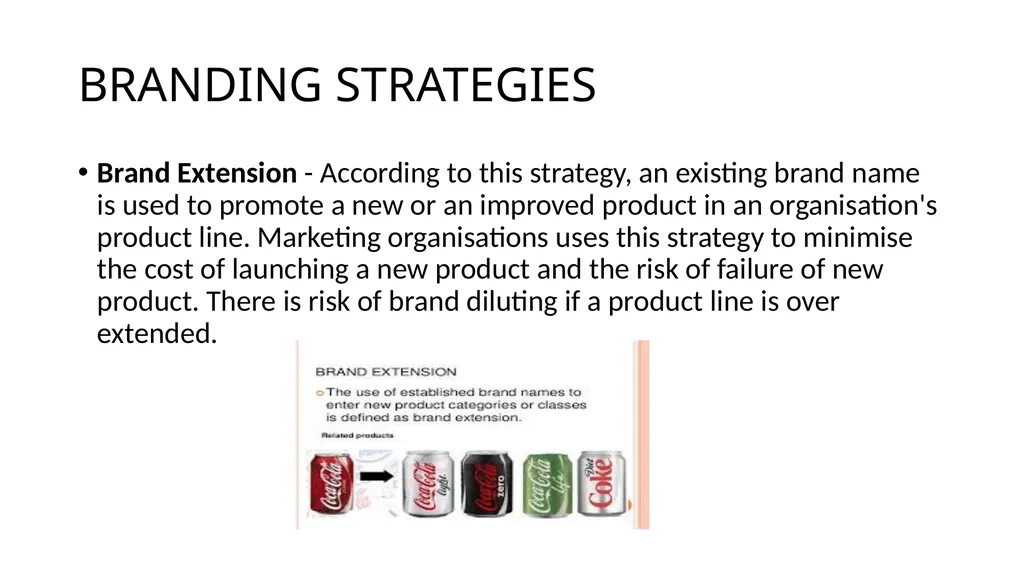
BRANDING STRATEGIES Brand Extension - According to this strategy, an existing brand name is used to promote a new or an improved product in an organisation's product line. Marketing organisations uses this strategy to minimise the cost of launching a new product and the risk of failure of new product. There is risk of brand diluting if a product line is over extended.<br>
13
LINE EXTENTION-
When the same brand is used to launch a product in a different way it is called line extension. By line extension, the product will be a slight variation to the existing ones. For example, Amul launched condensed milk which is an extension of milk; head and shoulders launched many shampoos that cater to different hairs. It can also indicate the resizing of the product. For example, Tropicana juice that comes with long and small packs<br>
When the same brand is used to launch a product in a different way it is called line extension. By line extension, the product will be a slight variation to the existing ones. For example, Amul launched condensed milk which is an extension of milk; head and shoulders launched many shampoos that cater to different hairs. It can also indicate the resizing of the product. For example, Tropicana juice that comes with long and small packs<br>
14
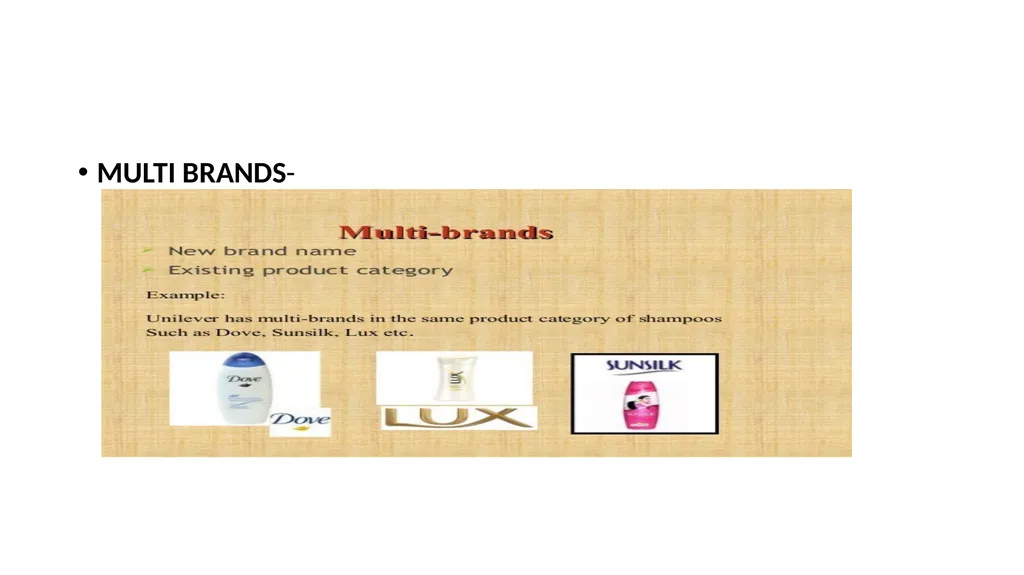
MULTI BRANDS-<br>
15
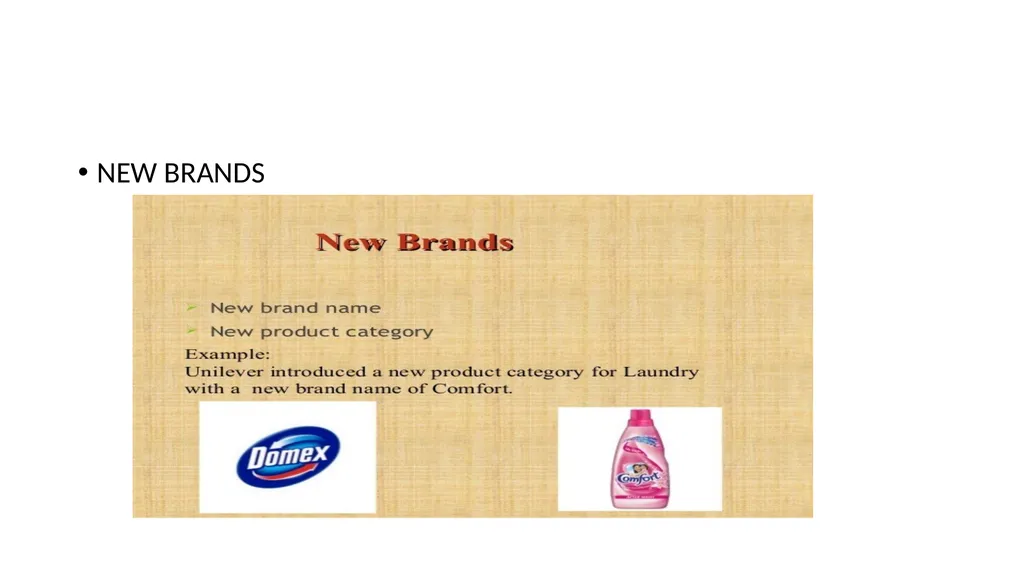
NEW BRANDS<br>
16
BRAND EQUITY Brand equity is a multidimensional concept that allows consumers' to evaluate a brand and determine its perceived benefits.
Brand equity refers to the value added to the same product under a particular brand. This makes one product preferable over others. This is brand equity which makes a brand superior or inferior to that of others.
Example : Apple is the best example of brand equity
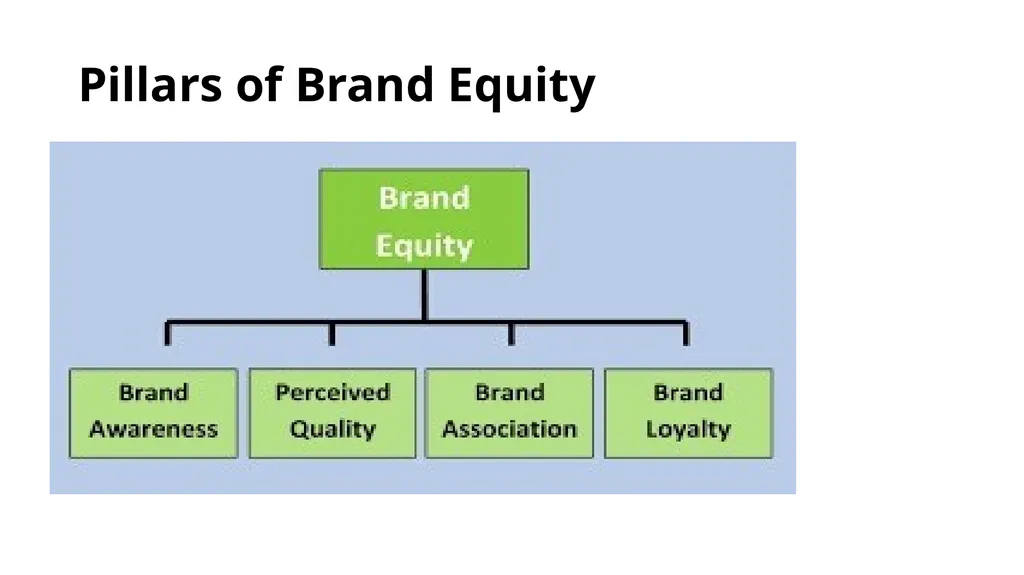
Nike has successfully created a strong brand by fulfilling the pillars of brand equity, which include: brand loyalty, brand awareness, brand associations and perceived quality.<br>
Brand equity refers to the value added to the same product under a particular brand. This makes one product preferable over others. This is brand equity which makes a brand superior or inferior to that of others.
Example : Apple is the best example of brand equity
Nike has successfully created a strong brand by fulfilling the pillars of brand equity, which include: brand loyalty, brand awareness, brand associations and perceived quality.<br>
17
Pillars of Brand Equity<br>
18
Brand awareness: This refers to the strength of a brands presence in the mind of the consumer. Awareness is measured according to the recognition and the recall of brand.
Perceived Quality: Perceived quality means level of expected quality that product holds in the mind of consumer It is the ultimate measure of the impact on the minds of consumer.<br>
Perceived Quality: Perceived quality means level of expected quality that product holds in the mind of consumer It is the ultimate measure of the impact on the minds of consumer.<br>
19
Brand Loyalty: Brand loyalty is a pattern of consumer behavior through which consumers tend to get committed to a specific brand or product and make repeat purchases over time. Businesses plan different creative marketing strategies like reward and loyalty programs, incentives, trials and brand ambassadors to create brand loyalty.
Brand Association. Brand Associations are not benefits, but are images and symbols associated with a brand or a brand benefit. For example- The Nike Swoosh, Nokia sound, Film Stars as with “Lux”, signature tune Ting-ting-ta-ding with Britannia, Blue colour with Pepsi, etc.
An effective brand increases its brand equity by having a consistent set of traits that a specific consumer segment enjoys<br>
Brand Association. Brand Associations are not benefits, but are images and symbols associated with a brand or a brand benefit. For example- The Nike Swoosh, Nokia sound, Film Stars as with “Lux”, signature tune Ting-ting-ta-ding with Britannia, Blue colour with Pepsi, etc.
An effective brand increases its brand equity by having a consistent set of traits that a specific consumer segment enjoys<br>
20
BRAND NAME DECISIONS Marketers have to decide, while branding the product, which brand names to use. Four strategies are available.
1. Individual names
In this, company gives separate name to each product. So if the product fails or appears to have low quality, the company’s name is not hurt e.g. sprite by Coca-cola.
2. Blanket Family Names
In this case company gives corporate name to the product. Development cost is less because there is no need for name research as heavy expenditures to create brand name recognition. Furthermore, sale of product is likely to be more if the corporate image is good e.g. Bajaj, Godrej, IBM.<br>
1. Individual names
In this, company gives separate name to each product. So if the product fails or appears to have low quality, the company’s name is not hurt e.g. sprite by Coca-cola.
2. Blanket Family Names
In this case company gives corporate name to the product. Development cost is less because there is no need for name research as heavy expenditures to create brand name recognition. Furthermore, sale of product is likely to be more if the corporate image is good e.g. Bajaj, Godrej, IBM.<br>
21
3. Separate Family Names for All Products
Here company after inventing different family names for different quality lines within the same product class e.g. HLL has different brand names within soap category ego Liril, Lux, etc.
4. Company trade name combined with individual Product Names
Some manufactures tie their company name to an individual brand name for each product, e.g. Kellogg’s Rice rispies, Kellog’s Raissin Bran and Kellog’s Corn Flakes.
Care should be taken at the time of deciding brand name. It should suggest something about the products benefits. Examples- Boost, Sunsilk, Ayur etc. It should suggest about product qualities e.g. 5star chocolates, milk maid, Lazer blades.<br>
Here company after inventing different family names for different quality lines within the same product class e.g. HLL has different brand names within soap category ego Liril, Lux, etc.
4. Company trade name combined with individual Product Names
Some manufactures tie their company name to an individual brand name for each product, e.g. Kellogg’s Rice rispies, Kellog’s Raissin Bran and Kellog’s Corn Flakes.
Care should be taken at the time of deciding brand name. It should suggest something about the products benefits. Examples- Boost, Sunsilk, Ayur etc. It should suggest about product qualities e.g. 5star chocolates, milk maid, Lazer blades.<br>
22
PACKAGING “Packaging includes the activities of designing and producing the container for a product”.<br>
23
Packaging and the resulting packages are intended to serve several vital purchases.
(i) It protects a product in a way to the consumer.
(ii) It provides protection to the product after it is purchased.
(iii) Package size and shape must be suitable for displaying and
stocking the product in the store.
(iv) It helps to identify a product and this may prevent
substitution of competitive products.<br>
(i) It protects a product in a way to the consumer.
(ii) It provides protection to the product after it is purchased.
(iii) Package size and shape must be suitable for displaying and
stocking the product in the store.
(iv) It helps to identify a product and this may prevent
substitution of competitive products.<br>
24
LIMITATIONS OF PACKAGING Packaging depletes natural resources
Packaging is too expensive
Some forms of plastic packaging are health hazards.
Packaging is deceptive
The biggest challenges facing packagers is how to dispose of used container.<br>
Packaging is too expensive
Some forms of plastic packaging are health hazards.
Packaging is deceptive
The biggest challenges facing packagers is how to dispose of used container.<br>
25
PACKAGING STRATEGIES Packaging the product line: A company must decide whether to develop a family resemblance when packaging related products. Family packaging uses either highly similar packages for all products or packages with a common and clearly noticeable feature. For example, compbell soup uses virtually identical packaging on all its condensed soup products. When new products are added to a line recognition and images associated with established products extend to the new ones.<br>
26
Multiple Packaging: It is a practice of placing several units of the same product in one container. Candy bar, towels, beer, cricket balls are packaged in the multiple units.<br>
27
Changing the package: A firm may need to correct a poor feature in an existing package. It may want to take the advantage of a new development as the container made up of lamination of papers, plastic and aluminium foil. However, this farm of packaging might be slowed because it is not biodegradable.<br>
28
LABELLING Labelling, which is closely related to the packaging, is another feature that requires managerial attention.
A label is a part of the product that carries information about the product and the seller. A label may be part of a package or it may be a tag attached to a product. The seller must label products. The label might carry only the brand name or a great deal of information.<br>
A label is a part of the product that carries information about the product and the seller. A label may be part of a package or it may be a tag attached to a product. The seller must label products. The label might carry only the brand name or a great deal of information.<br>
29
Labels are of three types:
1. Brand label: Brand label is simply the brand alone applied to the product or package. Some clothes carry the brand label like Mc wear.
2. Descriptive label: It gives the information about the product use, care, performance, and other features. On a descriptive label for a Maggi Noodles, there are statements concerning the weight, ingredients, tastes, price etc.
3. A Grade Label: It identifies the product judged quality with a letter, number, or word. Corn and wheat are grade-labelled 1 and 2.<br>
1. Brand label: Brand label is simply the brand alone applied to the product or package. Some clothes carry the brand label like Mc wear.
2. Descriptive label: It gives the information about the product use, care, performance, and other features. On a descriptive label for a Maggi Noodles, there are statements concerning the weight, ingredients, tastes, price etc.
3. A Grade Label: It identifies the product judged quality with a letter, number, or word. Corn and wheat are grade-labelled 1 and 2.<br>