Unit I: Meat Processing: Introduction By: Dr. R. K. Jaiswal Asstt. Prof.-cum-Jr. Scientist Dept. of LPT Bihar Veterinary College Bihar Animal Sciences University Patna-800014 (Bihar) LPT 602: MEAT PROCESSING , PACKAGING, QUALITY CONTROL AND
"Unit I: Meat Processing: Introduction By: Dr. R." is the property of its rightful owner. Permission is granted to
download and print the materials on this website for personal, non-commercial use only, and to display it
on your personal computer provided you do not modify the materials and that you retain all copyright
notices contained in the materials. By downloading content from our website, you accept the terms of this
agreement.
Presentation Transcript
01
Unit I: Meat Processing: Introduction By:
Dr. R. K. Jaiswal
Asstt. Prof.-cum-Jr. Scientist
Dept. of LPT
Bihar Veterinary College
Bihar Animal Sciences University
Patna-800014 (Bihar) LPT 602: MEAT PROCESSING , PACKAGING, QUALITY CONTROL AND MARKETING<br>
02
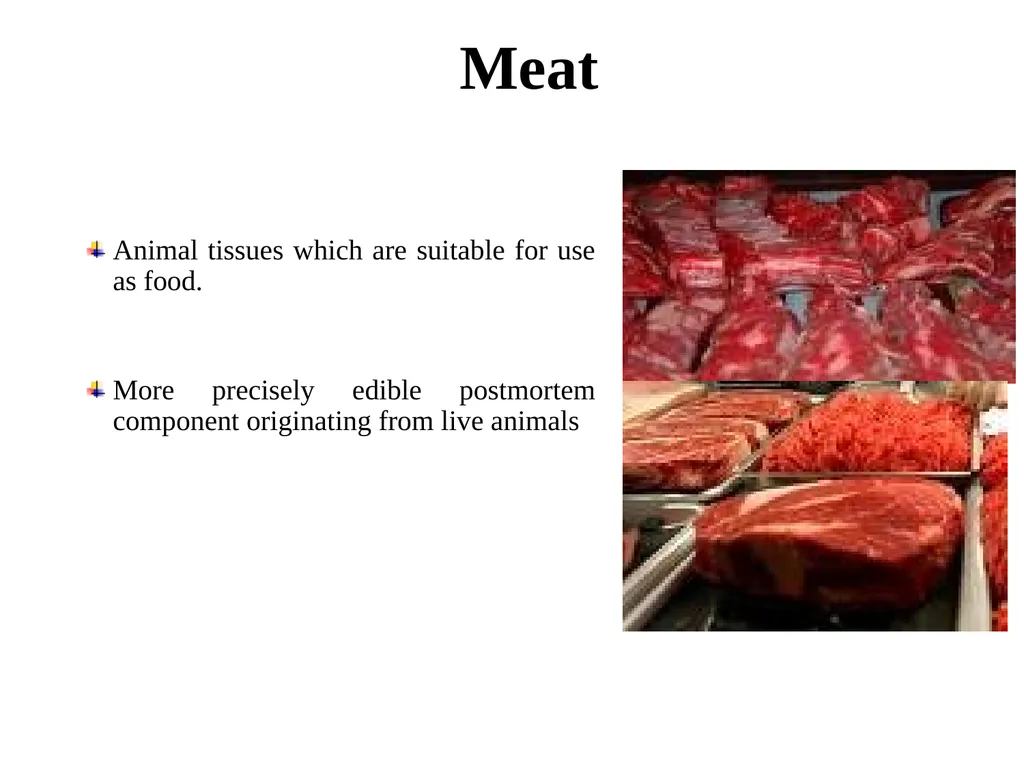
Meat Animal tissues which are suitable for use as food.
More precisely edible postmortem component originating from live animals<br>
03
What meat processing means? All process utilized in altering fresh meat except for simple grinding, cutting and mixing Excludes cutting, grinding and packaging of fresh meat in retail stores and in homes Includes curing, smoking, canning, cooking, freezing, dehydration, production of intermediate moisture products and the use of certain additives such as chemicals and enzymes<br>
04
Meat Processing Origin before the dawn of civilization
Egyptian- preservation of meat products by salting and sun drying.
Romans- 1st to use ice and snow as a means of preserving foods.
Modern food processing- Canning- Nicholas Appert.
Newer methods of meat preservation- Chemical additives, development of IMF, freeze dehydration, Enzymes treatments, Irradiation.
Jerky a thin dried strips of meat- American Indians.
Pemmican, mixture of dry and semidry meat pounded with dried fruits and vegetables covered with melted fat.
High energy and lightweight foods.
Emphasis over nutritional adequacy and balanced diets
Future of Meat Processing- Carefully controlled sanitation and quality control practices, emphasis on growth, expansion, diversity and efficiency processing plant, production of mixed foods.<br>
05
PURPOSE OF MEAT PROCESSING Changing from time to time
Improve shelf life, flavour and nutritive value
Modify or upgrade the less desirable meat cuts to desirable products
Provide convenience and variety products<br>
06
ADVANTAGES OF MEAT PROCESSING Addition of different ingredients to meat improves taste and flavour.
Specific processing conditions and ingredients improve shelf life.
Processed products are convenient to handle and eat.
Processing improves nutritive value.
Products of specific requirements can be prepared e.g. for children, old age or fat people.
Processing add value to meat.<br>
07
ADVANTAGES OF MEAT PROCESSING Low value meat cuts can be better utilized in the processed products.
Edible meat byproducts can be effectively utilized in the processed products.
Processing improves demand and marketability of meat.
Meat protein can be provided to consumers at affordable price.
Processing industry creates/provides employment.<br>
08
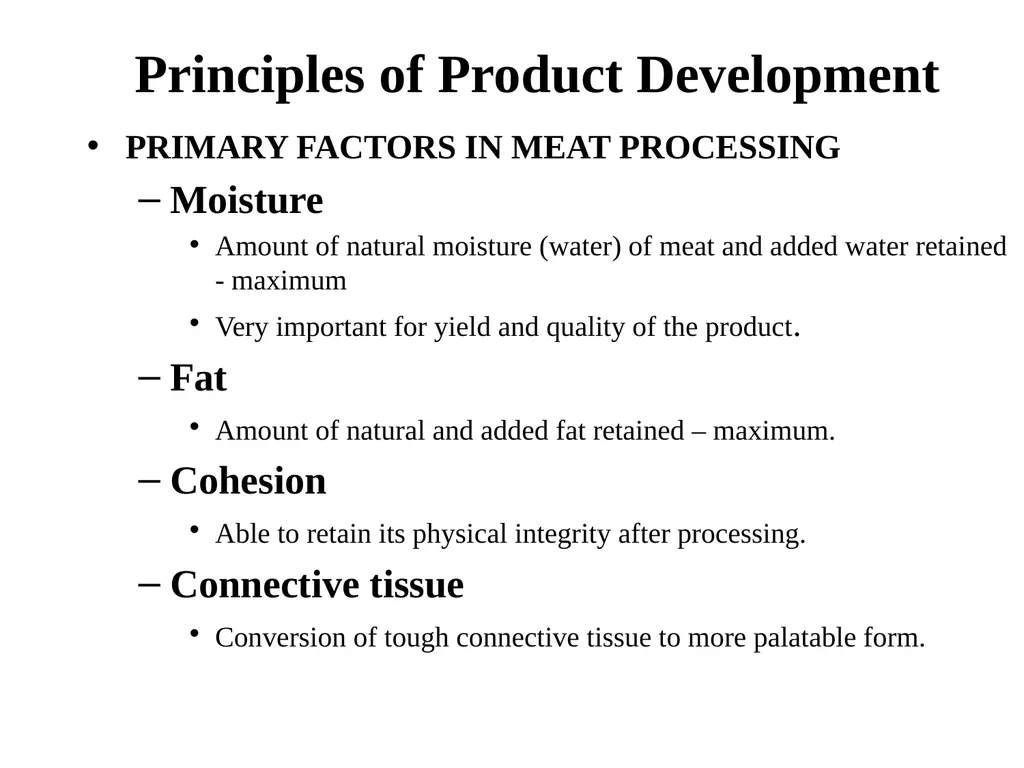
Principles of Product Development PRIMARY FACTORS IN MEAT PROCESSING
Moisture
Amount of natural moisture (water) of meat and added water retained - maximum
Very important for yield and quality of the product.
Fat
Amount of natural and added fat retained – maximum.
Cohesion
Able to retain its physical integrity after processing.
Connective tissue
Conversion of tough connective tissue to more palatable form.<br>
09
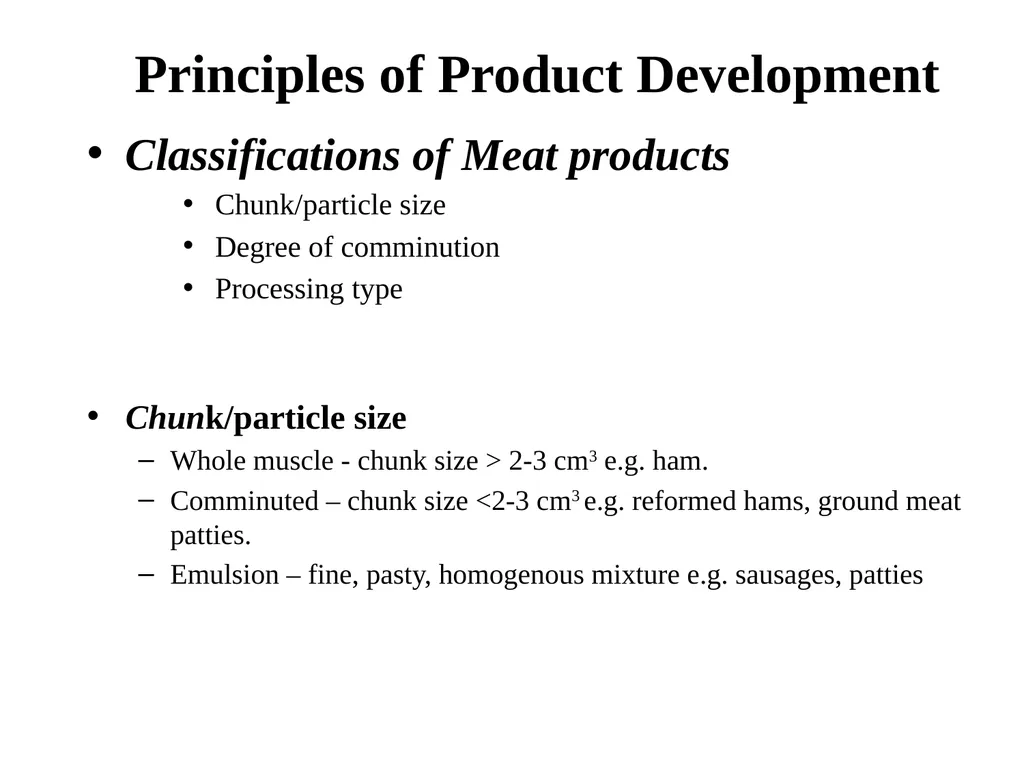
Principles of Product Development Classifications of Meat products
Chunk/particle size
Degree of comminution
Processing type
Chunk/particle size
Whole muscle - chunk size > 2-3 cm3 e.g. ham.
Comminuted – chunk size <2-3 cm3 e.g. reformed hams, ground meat patties.
Emulsion – fine, pasty, homogenous mixture e.g. sausages, patties<br>
10
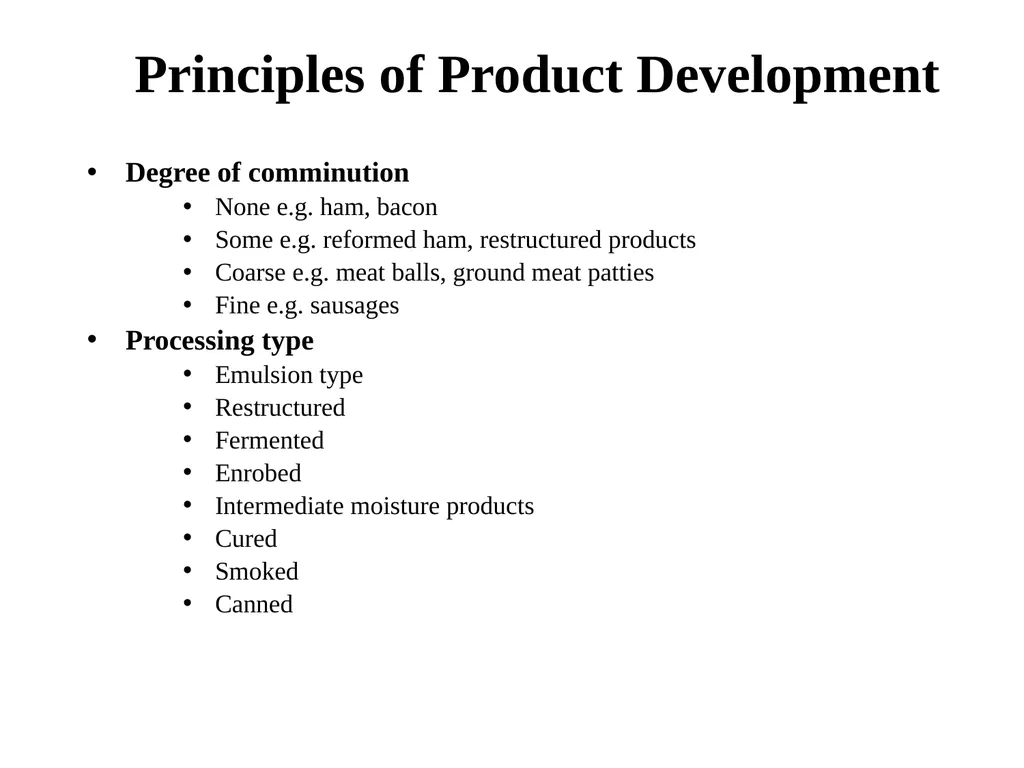
Principles of Product Development Degree of comminution
None e.g. ham, bacon
Some e.g. reformed ham, restructured products
Coarse e.g. meat balls, ground meat patties
Fine e.g. sausages
Processing type
Emulsion type
Restructured
Fermented
Enrobed
Intermediate moisture products
Cured
Smoked
Canned<br>