
Using material from Item A and elsewhere, assess
Description: Using material from Item A and elsewhere, assess the usefulness of labelling theory in explaining crime and deviance. Mark Scheme 16 21 In this band, interpretation, application, analysis and evaluation will be explicit and relevant, and
Related Topics
Download Presentation
"Using material from Item A and elsewhere, assess" is the property of its rightful owner. Permission is granted to download and print the materials on this website for personal, non-commercial use only, and to display it on your personal computer provided you do not modify the materials and that you retain all copyright notices contained in the materials. By downloading content from our website, you accept the terms of this agreement.
Presentation Transcript
slide1. Using material from Item A and elsewhere, assess the usefulness of labelling theory
in explaining crime and deviance.<br>
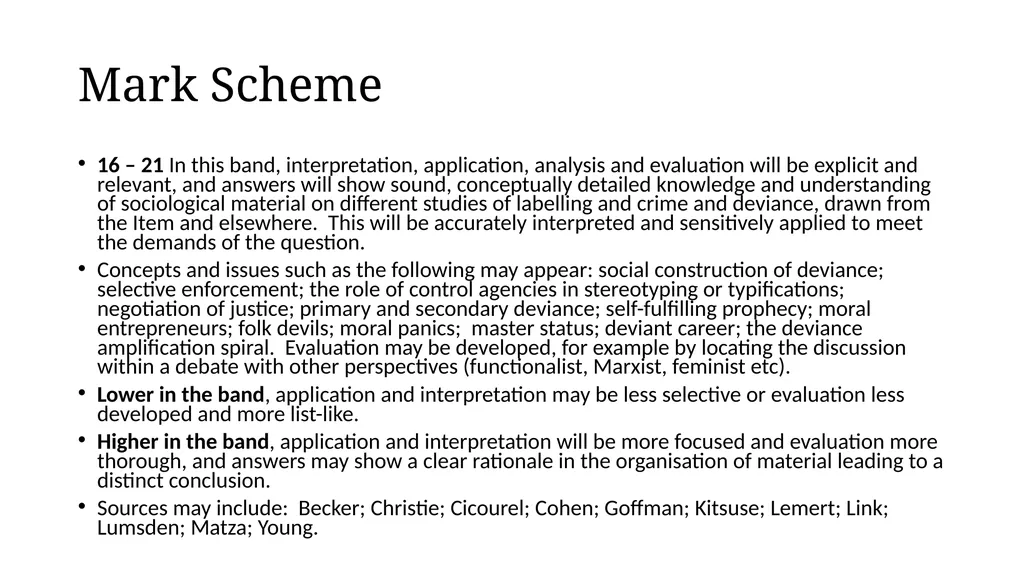
slide2. Mark Scheme 16 – 21 In this band, interpretation, application, analysis and evaluation will be explicit and relevant, and answers will show sound, conceptually detailed knowledge and understanding of sociological material on different studies of labelling and crime and deviance, drawn from the Item and elsewhere. This will be accurately interpreted and sensitively applied to meet the demands of the question.
Concepts and issues such as the following may appear: social construction of deviance; selective enforcement; the role of control agencies in stereotyping or typifications; negotiation of justice; primary and secondary deviance; self-fulfilling prophecy; moral entrepreneurs; folk devils; moral panics; master status; deviant career; the deviance amplification spiral. Evaluation may be developed, for example by locating the discussion within a debate with other perspectives (functionalist, Marxist, feminist etc).
Lower in the band, application and interpretation may be less selective or evaluation less developed and more list-like.
Higher in the band, application and interpretation will be more focused and evaluation more thorough, and answers may show a clear rationale in the organisation of material leading to a distinct conclusion.
Sources may include: Becker; Christie; Cicourel; Cohen; Goffman; Kitsuse; Lemert; Link; Lumsden; Matza; Young.<br>
slide3. Definitions Negotiation of Justice
Self-fulfilling Prophecy
Folk Devils
Master Status
Stereotype
Moral Entrepreneur
Male Stream<br>
slide4. Item A Labelling theory explains how actions become labelled as criminal or deviant in society. This is a micro-approach that looks at how individuals construct society, based on their interactions with each other.
Labelling theorists argue that an action is criminal only when society views it as criminal and that crime, therefore, is a social construction. Criminality exists only because of the laws constructed by society; deviance exists only because of the norms constructed by society.
Deviant or criminal individuals are labelled when their actions are discovered and provoke a reaction from society. However, this reaction will take differing forms, depending on how the nature of the action is perceived.<br>
slide5. What is labelling? Becker – Outsiders – used the example of incest, which was provided by Malinowski's study of a Pacific island.
Although the act of incest breaks the rules, it is only once someone has drawn attention to the act, thus enforcing the rules that the act becomes labelled as deviant. Upon which social reactions occur.
Once the person has been labelled as a deviant/criminal, which is obviously a negative label, Becker would argue that it becomes their master status. Regardless of what other roles they may have e.g. teacher, parent etc, they simply are known as a criminal.<br>
slide6. This in turn is likely to lead to exclusion from society, combined with the master status this could lead to a largely deviant lifestyle and then fulfilling the self-fulfilling prophecy.
Goffman can be used to support Becker’s work, his findings from looking at Total Institutions also show how effective a negative label can be.
However the interactionalist school of thought can be criticised for being out-dated and too deterministic, it seems to suggest that there is almost nothing which can be done once a negative label has taken hold.
Ronald Ackers stated: “One sometimes gets the impression from reading the literature that people go about minding their own business, and then – ‘wham’ – bad society comes along and slaps them in the face with a stigmatized label. Forced into the role of deviant the individual has little choice but to be deviant”.<br>
slide7. He's essentially saying that people may simply choose to become deviant.
Becker also suggests that there is no such thing as a deviant act. An act only becomes deviant when it is perceived and defined as it. Becker provided the example of a tussle amongst teenagers.
In a low income area (postcode) it may be labelled by the police delinquent behaviour , in a higher income area on the other hand as evidence of harmless fun.
If the agents of social control define the youngsters as delinquents and they are convicted of breaking the law, that is when they become deviant. ‘Deviance is not a quality that lies in behaviour itself, but in the interaction between the potential deviant and the agents of social control.<br>
slide8. This concept can also be linked with Marxism and theories such as the negotiations of justice.
This is the idea that the more middle class people are better able to get away with deviant behaviour as they are more adept at being able to change the way their behaviour is operationalised and therefore escaping negative labels.
However generally Marxists criticise Interactionalism for failing to recognise the role of power and crime + deviance (some groups have the power to influence what is categorised as deviant).
Feminists would also argue this is true for women due to the chivalry factor and perhaps the beauty myth in some cases.<br>
slide9. Jock Young studied marihuana users in Notting Hill during the 1960’s. It's an example of self-fulfilling prophecy and primary and secondary deviance.
Young found that the police targeted a group of hippies who smoked marihuana. This was obviously illegal, and they were marked as different. The consequence of this was that they were alienated from society.
Smoking marihuana became a bigger part of the group’s identity and its usage increased as it was a symbol of their difference and a reaction to being singled out. This led to the development of a deviant subculture and the gap between the sub-culture and society grew.
However Young’s work is now outdated and failed to recognise the fact that a deviant subculture could become integrated into wider society, marijuana usage has become increasingly popular, while still largely illegal.<br>
slide10. Finally labelling can also be used by the media to help create Folk Devils and Moral Panics.
Cohen (1972) found that the minor fights between Mods and Rockers at seaside resorts was greatly exaggerated by the media. For instance one headline was “Wild ones invade seaside town – 97 arrests”. While in reality there were only 24 arrests. Cohen found that the media reporting led to increased policing which actually intensified the problem.
A more contemporary example can be found in the 2011 London Riots, David Cameron referred to the perpetrators as “feral youth” after the 1st night, which the media latched on to. This meant that any political motivation or credibility which the youths may have had was removed and that on the 2nd night there were even greater numbers of youth on the streets.<br>
slide11. So while young people in Britain were portrayed as “feral youth” by the media, the young people taking part in the Arab Spring Uprisings were on the other hand portrayed as brave, revolutionary heroes. Thus showing the effects of both positive and negative labelling.
Marxists would support this as it fits with the divide and rule theory and perhaps Althusser’s idea that RSA steps in once the ISA has failed. However Marxism is an outdated conspiracy theory.
Finally post modernists such as Gideon would criticise the entire notion of labelling as they believe that society is in a state of flux, and therefore that the individual and what it is to be the individual is constantly changing, which is why you cannot he tied down to one identity.<br>
slide2. Mark Scheme 16 – 21 In this band, interpretation, application, analysis and evaluation will be explicit and relevant, and answers will show sound, conceptually detailed knowledge and understanding of sociological material on different studies of labelling and crime and deviance, drawn from the Item and elsewhere. This will be accurately interpreted and sensitively applied to meet the demands of the question.
Concepts and issues such as the following may appear: social construction of deviance; selective enforcement; the role of control agencies in stereotyping or typifications; negotiation of justice; primary and secondary deviance; self-fulfilling prophecy; moral entrepreneurs; folk devils; moral panics; master status; deviant career; the deviance amplification spiral. Evaluation may be developed, for example by locating the discussion within a debate with other perspectives (functionalist, Marxist, feminist etc).
Lower in the band, application and interpretation may be less selective or evaluation less developed and more list-like.
Higher in the band, application and interpretation will be more focused and evaluation more thorough, and answers may show a clear rationale in the organisation of material leading to a distinct conclusion.
Sources may include: Becker; Christie; Cicourel; Cohen; Goffman; Kitsuse; Lemert; Link; Lumsden; Matza; Young.<br>
slide3. Definitions Negotiation of Justice
Self-fulfilling Prophecy
Folk Devils
Master Status
Stereotype
Moral Entrepreneur
Male Stream<br>
slide4. Item A Labelling theory explains how actions become labelled as criminal or deviant in society. This is a micro-approach that looks at how individuals construct society, based on their interactions with each other.
Labelling theorists argue that an action is criminal only when society views it as criminal and that crime, therefore, is a social construction. Criminality exists only because of the laws constructed by society; deviance exists only because of the norms constructed by society.
Deviant or criminal individuals are labelled when their actions are discovered and provoke a reaction from society. However, this reaction will take differing forms, depending on how the nature of the action is perceived.<br>
slide5. What is labelling? Becker – Outsiders – used the example of incest, which was provided by Malinowski's study of a Pacific island.
Although the act of incest breaks the rules, it is only once someone has drawn attention to the act, thus enforcing the rules that the act becomes labelled as deviant. Upon which social reactions occur.
Once the person has been labelled as a deviant/criminal, which is obviously a negative label, Becker would argue that it becomes their master status. Regardless of what other roles they may have e.g. teacher, parent etc, they simply are known as a criminal.<br>
slide6. This in turn is likely to lead to exclusion from society, combined with the master status this could lead to a largely deviant lifestyle and then fulfilling the self-fulfilling prophecy.
Goffman can be used to support Becker’s work, his findings from looking at Total Institutions also show how effective a negative label can be.
However the interactionalist school of thought can be criticised for being out-dated and too deterministic, it seems to suggest that there is almost nothing which can be done once a negative label has taken hold.
Ronald Ackers stated: “One sometimes gets the impression from reading the literature that people go about minding their own business, and then – ‘wham’ – bad society comes along and slaps them in the face with a stigmatized label. Forced into the role of deviant the individual has little choice but to be deviant”.<br>
slide7. He's essentially saying that people may simply choose to become deviant.
Becker also suggests that there is no such thing as a deviant act. An act only becomes deviant when it is perceived and defined as it. Becker provided the example of a tussle amongst teenagers.
In a low income area (postcode) it may be labelled by the police delinquent behaviour , in a higher income area on the other hand as evidence of harmless fun.
If the agents of social control define the youngsters as delinquents and they are convicted of breaking the law, that is when they become deviant. ‘Deviance is not a quality that lies in behaviour itself, but in the interaction between the potential deviant and the agents of social control.<br>
slide8. This concept can also be linked with Marxism and theories such as the negotiations of justice.
This is the idea that the more middle class people are better able to get away with deviant behaviour as they are more adept at being able to change the way their behaviour is operationalised and therefore escaping negative labels.
However generally Marxists criticise Interactionalism for failing to recognise the role of power and crime + deviance (some groups have the power to influence what is categorised as deviant).
Feminists would also argue this is true for women due to the chivalry factor and perhaps the beauty myth in some cases.<br>
slide9. Jock Young studied marihuana users in Notting Hill during the 1960’s. It's an example of self-fulfilling prophecy and primary and secondary deviance.
Young found that the police targeted a group of hippies who smoked marihuana. This was obviously illegal, and they were marked as different. The consequence of this was that they were alienated from society.
Smoking marihuana became a bigger part of the group’s identity and its usage increased as it was a symbol of their difference and a reaction to being singled out. This led to the development of a deviant subculture and the gap between the sub-culture and society grew.
However Young’s work is now outdated and failed to recognise the fact that a deviant subculture could become integrated into wider society, marijuana usage has become increasingly popular, while still largely illegal.<br>
slide10. Finally labelling can also be used by the media to help create Folk Devils and Moral Panics.
Cohen (1972) found that the minor fights between Mods and Rockers at seaside resorts was greatly exaggerated by the media. For instance one headline was “Wild ones invade seaside town – 97 arrests”. While in reality there were only 24 arrests. Cohen found that the media reporting led to increased policing which actually intensified the problem.
A more contemporary example can be found in the 2011 London Riots, David Cameron referred to the perpetrators as “feral youth” after the 1st night, which the media latched on to. This meant that any political motivation or credibility which the youths may have had was removed and that on the 2nd night there were even greater numbers of youth on the streets.<br>
slide11. So while young people in Britain were portrayed as “feral youth” by the media, the young people taking part in the Arab Spring Uprisings were on the other hand portrayed as brave, revolutionary heroes. Thus showing the effects of both positive and negative labelling.
Marxists would support this as it fits with the divide and rule theory and perhaps Althusser’s idea that RSA steps in once the ISA has failed. However Marxism is an outdated conspiracy theory.
Finally post modernists such as Gideon would criticise the entire notion of labelling as they believe that society is in a state of flux, and therefore that the individual and what it is to be the individual is constantly changing, which is why you cannot he tied down to one identity.<br>