
www.studymafia.org Submitted To: Submitted By:
DJ
Published · 26 slides · 0 views
1 / 1




Description
www.studymafia.org Submitted To: Submitted By: www.studymafia.org www.studymafia.org Seminar On Hybrid Electric Vehicle CONTENT Introduction What is Hybrid Electric Vehicle (HEV) ? Hybrid Structure Components of HEV Advantages of HEV
Related Topics
Download this presentation From Below
"www.studymafia.org Submitted To: Submitted By:" is the property of its rightful owner. Permission is granted to download and print the materials on this website for personal, non-commercial use only, and to display it on your personal computer provided you do not modify the materials and that you retain all copyright notices contained in the materials. By downloading content from our website, you accept the terms of this agreement.
Share
Embed code
Presentation Transcript
01
www.studymafia.org Submitted To: Submitted By:
www.studymafia.org www.studymafia.org Seminar
On
Hybrid Electric
Vehicle<br>
www.studymafia.org www.studymafia.org Seminar
On
Hybrid Electric
Vehicle<br>
02
CONTENT Introduction
What is Hybrid Electric Vehicle (HEV) ?
Hybrid Structure
Components of HEV
Advantages of HEV
Conclusion<br>
What is Hybrid Electric Vehicle (HEV) ?
Hybrid Structure
Components of HEV
Advantages of HEV
Conclusion<br>
03
A hybrid electric vehicle (HEV) augments an electric vehicle (EV) with a second source of power referred to as the alternative power unit (APU).
A hybrid can achieve the cruising range and performance advantages of conventional vehicles with the low-noise, low-exhaust emissions, and energy independence benefits of electric vehicles
Accordingly, the hybrid concept, where the alternative power unit is used as a second source of energy, is gaining acceptance and is overcoming some of the problems of pure electric vehicles. 3<br>
A hybrid can achieve the cruising range and performance advantages of conventional vehicles with the low-noise, low-exhaust emissions, and energy independence benefits of electric vehicles
Accordingly, the hybrid concept, where the alternative power unit is used as a second source of energy, is gaining acceptance and is overcoming some of the problems of pure electric vehicles. 3<br>
04
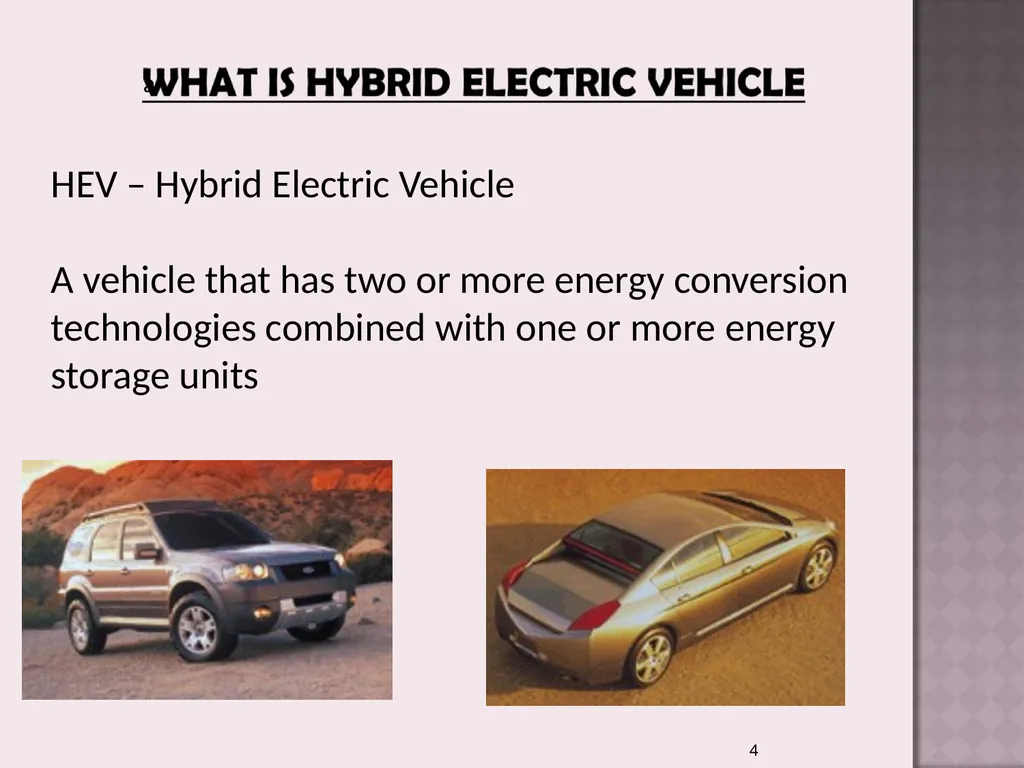
a HEV – Hybrid Electric Vehicle
A vehicle that has two or more energy conversion technologies combined with one or more energy storage units 4<br>
A vehicle that has two or more energy conversion technologies combined with one or more energy storage units 4<br>
05
Two types of hybrid vehicle configurations Parallel Hybrids
Series Hybrids 5<br>
Series Hybrids 5<br>
06
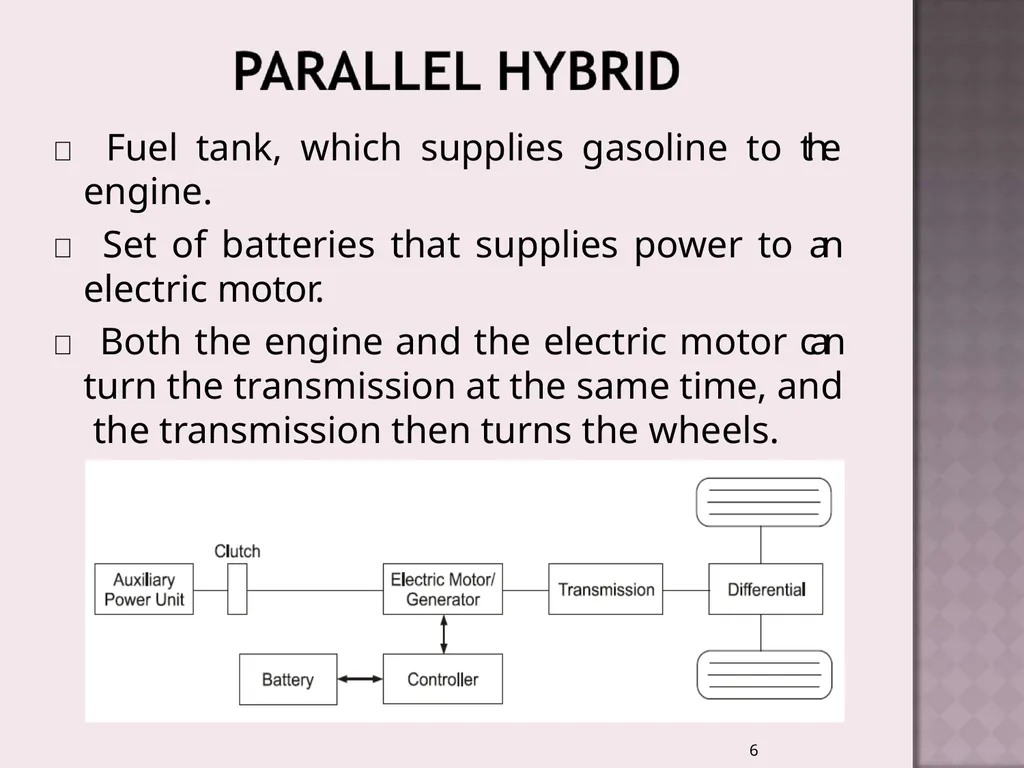
Fuel tank, which supplies gasoline to the engine.
Set of batteries that supplies power to an electric motor.
Both the engine and the electric motor can turn the transmission at the same time, and the transmission then turns the wheels. 6<br>
Set of batteries that supplies power to an electric motor.
Both the engine and the electric motor can turn the transmission at the same time, and the transmission then turns the wheels. 6<br>
07
When the APU is off, the parallel hybrid runs like an electric vehicle
When the APU is on, the controller divides energy between the drive train (propulsion) and the batteries (energy storage).
Under acceleration, more power is allocated to the drive train than to the batteries. During periods of idle or low speeds, more power goes to the batteries than the drive train.
The batteries also provide additional power to the drive train when the APU is not producing enough and also to power auxiliary systems such as the air conditioner and heater. 7<br>
When the APU is on, the controller divides energy between the drive train (propulsion) and the batteries (energy storage).
Under acceleration, more power is allocated to the drive train than to the batteries. During periods of idle or low speeds, more power goes to the batteries than the drive train.
The batteries also provide additional power to the drive train when the APU is not producing enough and also to power auxiliary systems such as the air conditioner and heater. 7<br>
08
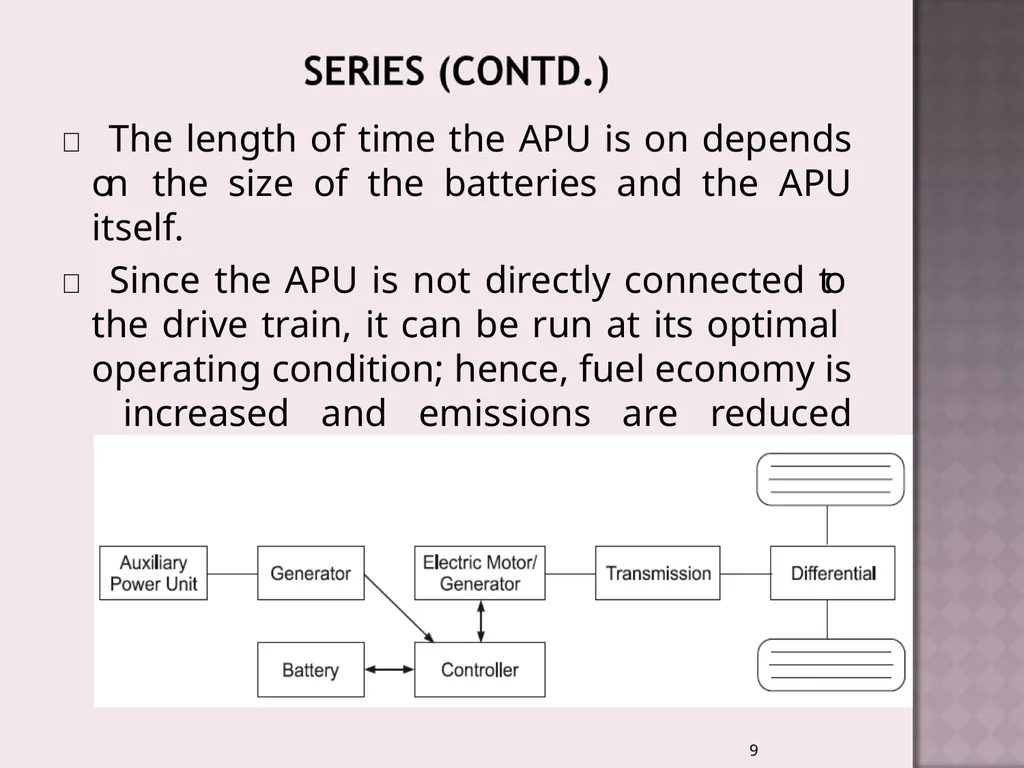
Similar to an electric vehicle with an on- board generator
The vehicle runs on battery power like a pure electric vehicle until the batteries reach a predetermined discharged level.
At that point the APU turns on and begins recharging the battery.
The APU operates until the batteries are charged to a predetermined level.
APU never directly powers the vehicle 8<br>
The vehicle runs on battery power like a pure electric vehicle until the batteries reach a predetermined discharged level.
At that point the APU turns on and begins recharging the battery.
The APU operates until the batteries are charged to a predetermined level.
APU never directly powers the vehicle 8<br>
09
The length of time the APU is on depends on the size of the batteries and the APU itself.
Since the APU is not directly connected to the drive train, it can be run at its optimal operating condition; hence, fuel economy is increased and emissions are reduced relative to a pure IC engine vehicle. 9<br>
Since the APU is not directly connected to the drive train, it can be run at its optimal operating condition; hence, fuel economy is increased and emissions are reduced relative to a pure IC engine vehicle. 9<br>
10
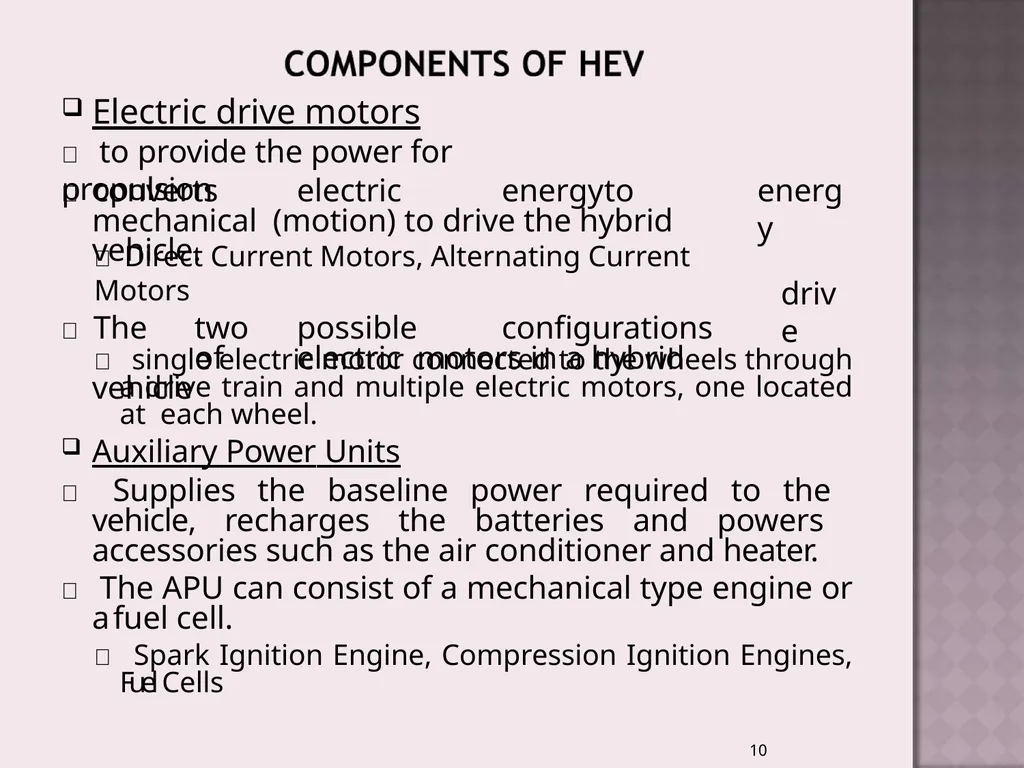
Electric drive motors
to provide the power for propulsion energy converts electric energy to mechanical (motion) to drive the hybrid vehicle. drive Direct Current Motors, Alternating Current Motors
The two possible configurations of electric motors in a hybrid vehicle single electric motor connected to the wheels through a drive train and multiple electric motors, one located at each wheel.
Auxiliary Power Units
Supplies the baseline power required to the vehicle, recharges the batteries and powers accessories such as the air conditioner and heater.
The APU can consist of a mechanical type engine or a fuel cell.
Spark Ignition Engine, Compression Ignition Engines, Fuel Cells 10<br>
to provide the power for propulsion energy converts electric energy to mechanical (motion) to drive the hybrid vehicle. drive Direct Current Motors, Alternating Current Motors
The two possible configurations of electric motors in a hybrid vehicle single electric motor connected to the wheels through a drive train and multiple electric motors, one located at each wheel.
Auxiliary Power Units
Supplies the baseline power required to the vehicle, recharges the batteries and powers accessories such as the air conditioner and heater.
The APU can consist of a mechanical type engine or a fuel cell.
Spark Ignition Engine, Compression Ignition Engines, Fuel Cells 10<br>
11
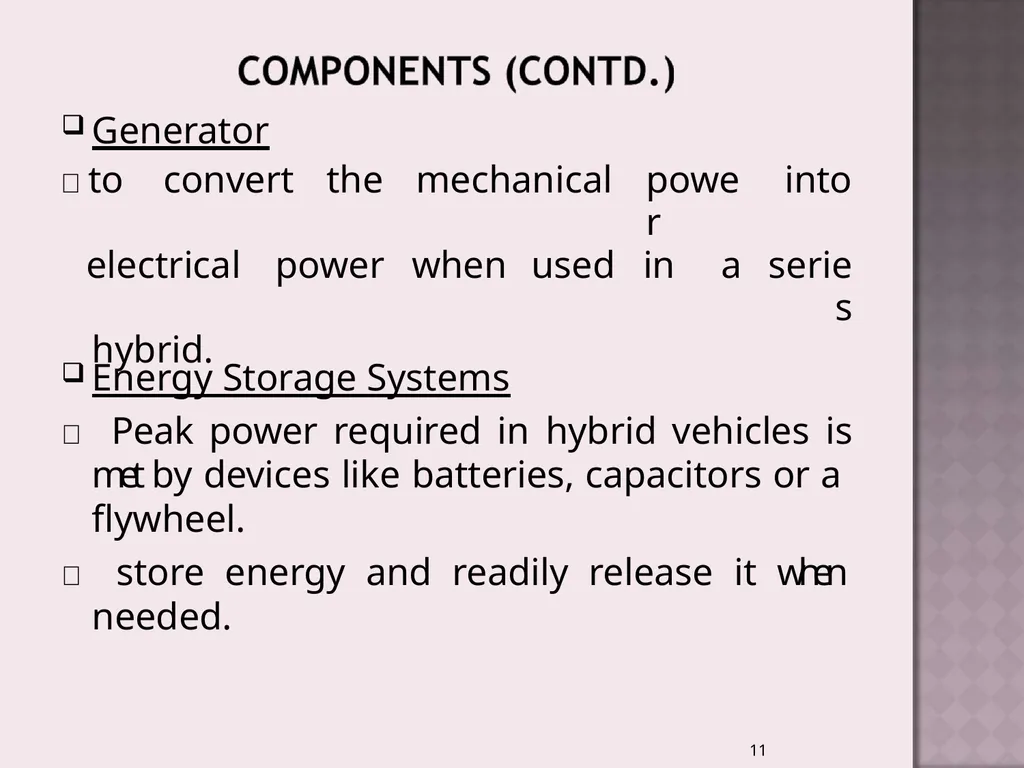
Generators Energy Storage Systems
Peak power required in hybrid vehicles is met by devices like batteries, capacitors or a flywheel.
store energy and readily release it when needed. 11<br>
Peak power required in hybrid vehicles is met by devices like batteries, capacitors or a flywheel.
store energy and readily release it when needed. 11<br>
12
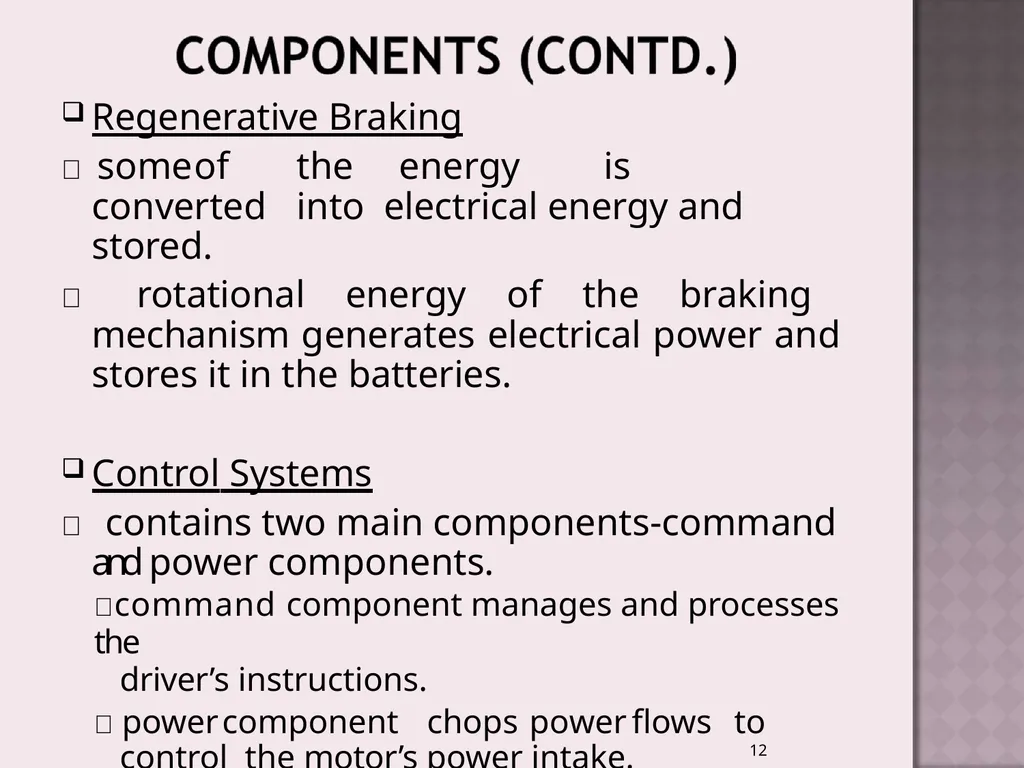
Regenerative Braking
some of the energy is converted into electrical energy and stored.
rotational energy of the braking mechanism generates electrical power and stores it in the batteries.
Control Systems
contains two main components-command and power components.
command component manages and processes the
driver’s instructions.
power component chops power flows to control the motor’s power intake. 12<br>
some of the energy is converted into electrical energy and stored.
rotational energy of the braking mechanism generates electrical power and stores it in the batteries.
Control Systems
contains two main components-command and power components.
command component manages and processes the
driver’s instructions.
power component chops power flows to control the motor’s power intake. 12<br>
13
13<br>
14
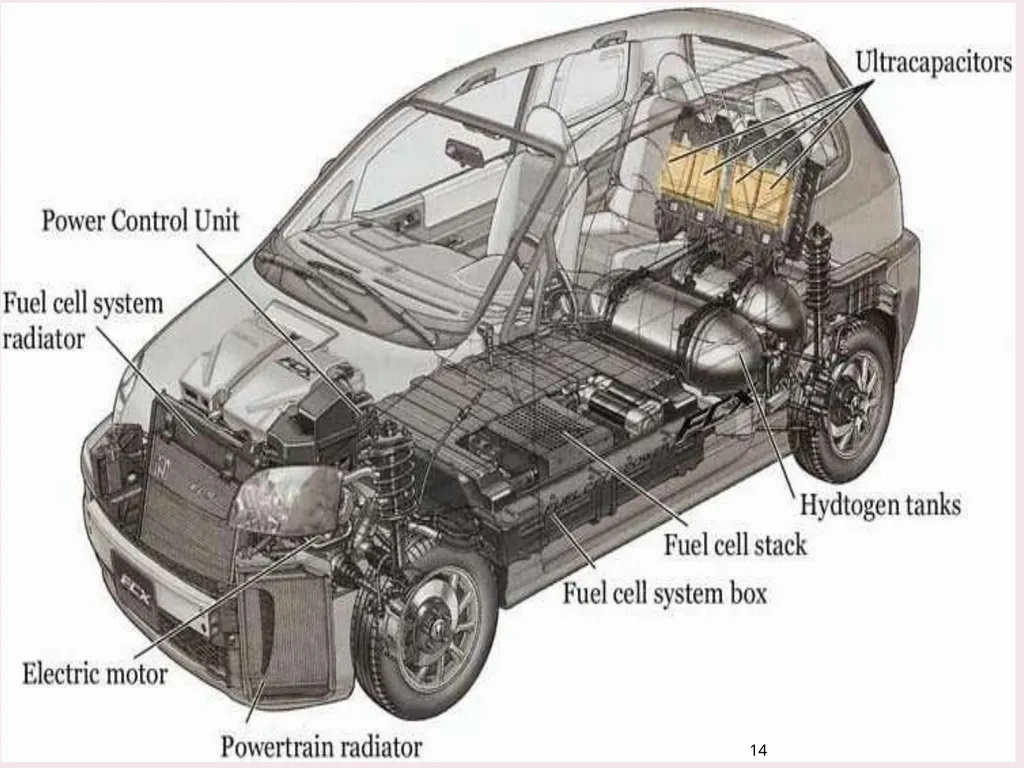
14<br>
15
Electric vehicle equipped with a fuel cell
Use hydrogen as a fuel and power the electric battery when it is depleted
In the 21 century, the auto fuel will be replaced by such regenerative resources as hydrogen and the power system with traditional internal combustion engine will be replaced by hybrid system and finally be replaced by fuel cell power system to realize multi-resources, electric driving and zero emission.
For the fuel cell hybrid electric bus developed, high- pressure PEMFC and high-power NiMH battery pack forms the hybrid system.
In order to obtain the higher fuel efficiency and avoid the frequent charge & discharge of battery pack, the active control for the fuel cell pack to follow the driver’s pedal and the surplus peak power from NiMH battery pack passively is used. 15<br>
Use hydrogen as a fuel and power the electric battery when it is depleted
In the 21 century, the auto fuel will be replaced by such regenerative resources as hydrogen and the power system with traditional internal combustion engine will be replaced by hybrid system and finally be replaced by fuel cell power system to realize multi-resources, electric driving and zero emission.
For the fuel cell hybrid electric bus developed, high- pressure PEMFC and high-power NiMH battery pack forms the hybrid system.
In order to obtain the higher fuel efficiency and avoid the frequent charge & discharge of battery pack, the active control for the fuel cell pack to follow the driver’s pedal and the surplus peak power from NiMH battery pack passively is used. 15<br>
16
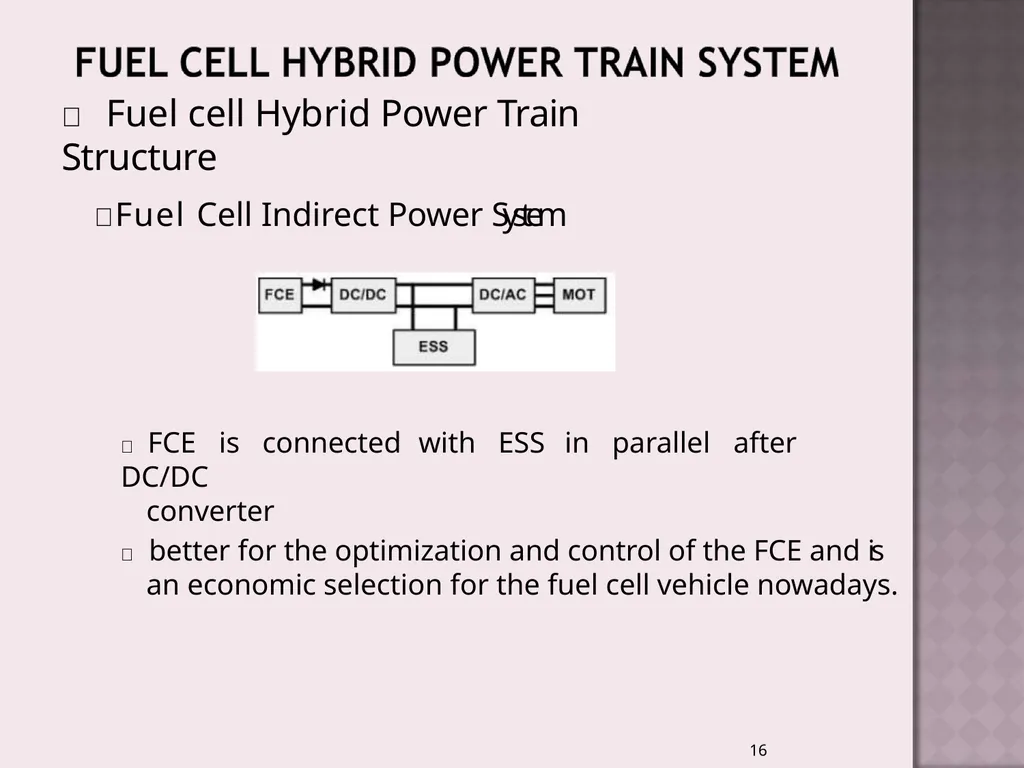
Fuel cell Hybrid Power Train Structure Fuel Cell Indirect Power System FCE is connected with ESS in parallel after DC/DC
converter
better for the optimization and control of the FCE and is an economic selection for the fuel cell vehicle nowadays. 16<br>
converter
better for the optimization and control of the FCE and is an economic selection for the fuel cell vehicle nowadays. 16<br>
17
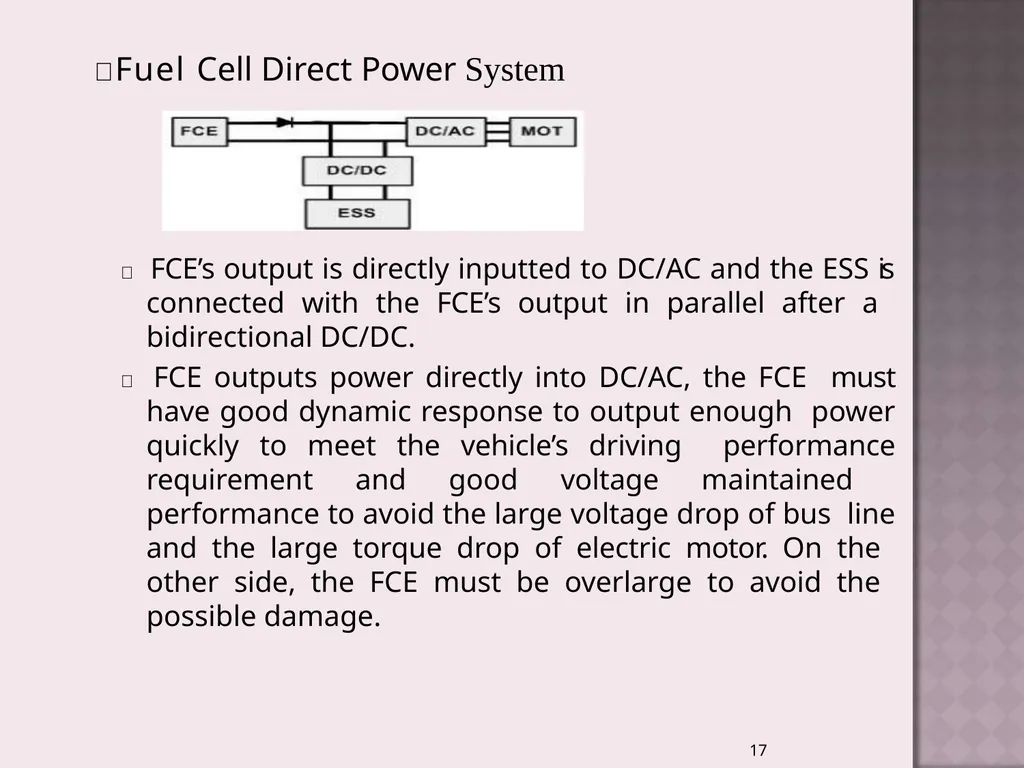
Fuel Cell Direct Power System FCE’s output is directly inputted to DC/AC and the ESS is connected with the FCE’s output in parallel after a bidirectional DC/DC.
FCE outputs power directly into DC/AC, the FCE must have good dynamic response to output enough power quickly to meet the vehicle’s driving performance requirement and good voltage maintained performance to avoid the large voltage drop of bus line and the large torque drop of electric motor. On the other side, the FCE must be overlarge to avoid the possible damage. 17<br>
FCE outputs power directly into DC/AC, the FCE must have good dynamic response to output enough power quickly to meet the vehicle’s driving performance requirement and good voltage maintained performance to avoid the large voltage drop of bus line and the large torque drop of electric motor. On the other side, the FCE must be overlarge to avoid the possible damage. 17<br>
18
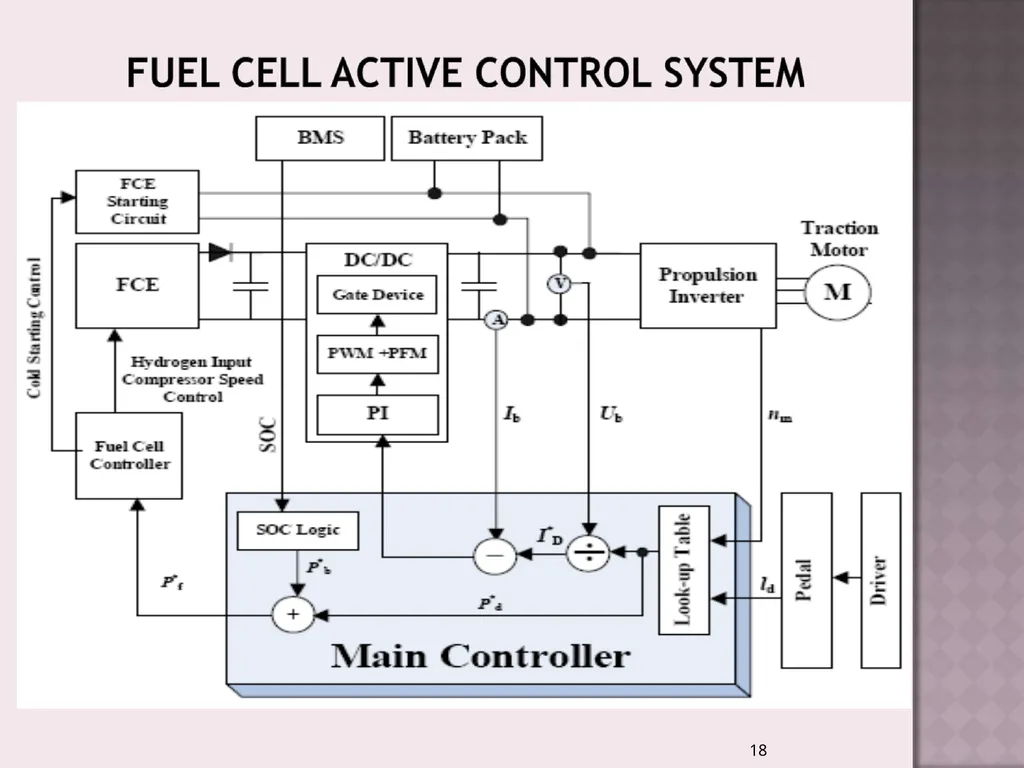
18<br>
19
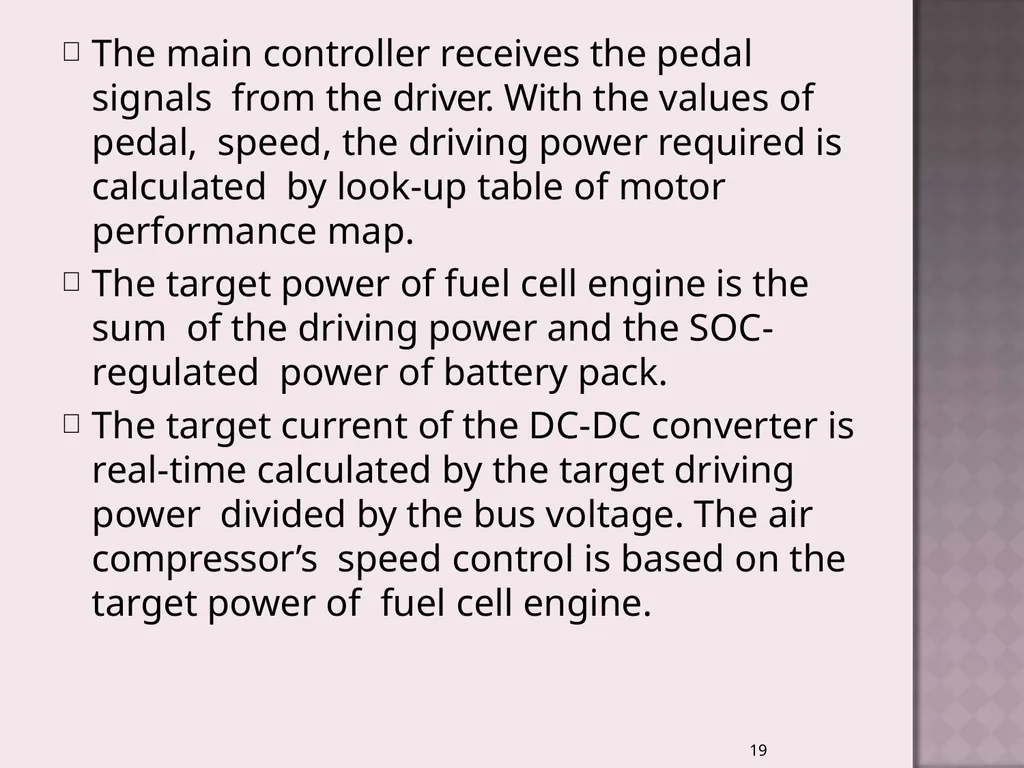
The main controller receives the pedal signals from the driver. With the values of pedal, speed, the driving power required is calculated by look-up table of motor performance map.
The target power of fuel cell engine is the sum of the driving power and the SOC-regulated power of battery pack.
The target current of the DC-DC converter is real-time calculated by the target driving power divided by the bus voltage. The air compressor’s speed control is based on the target power of fuel cell engine. 19<br>
The target power of fuel cell engine is the sum of the driving power and the SOC-regulated power of battery pack.
The target current of the DC-DC converter is real-time calculated by the target driving power divided by the bus voltage. The air compressor’s speed control is based on the target power of fuel cell engine. 19<br>
20
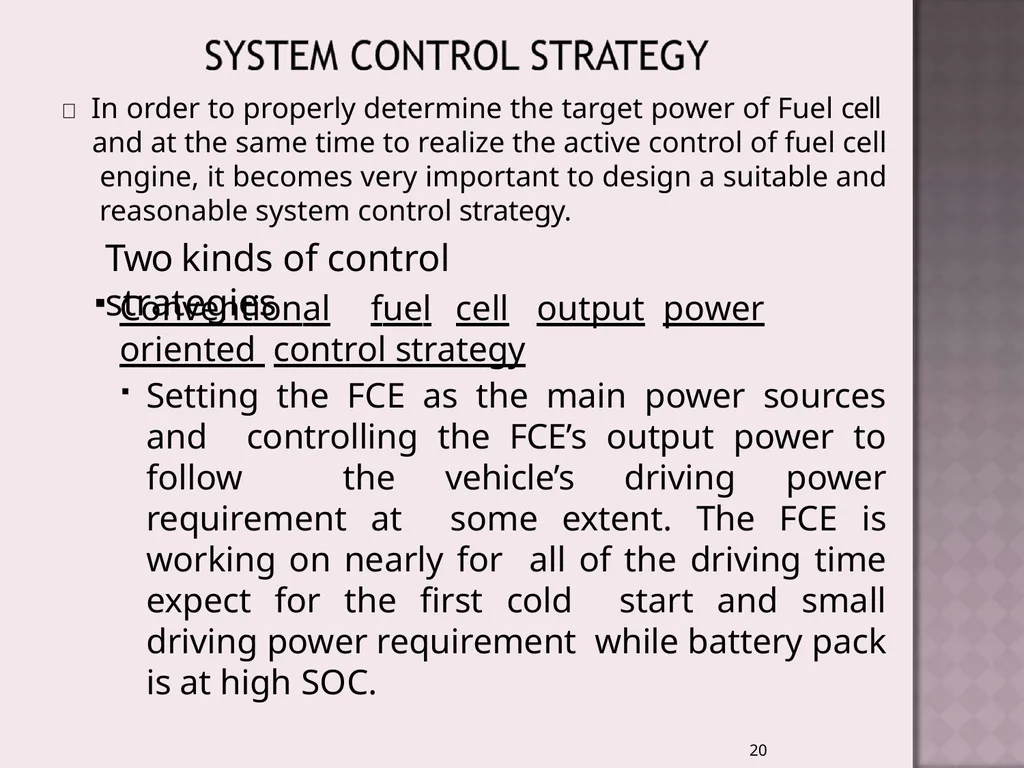
In order to properly determine the target power of Fuel cell and at the same time to realize the active control of fuel cell engine, it becomes very important to design a suitable and reasonable system control strategy. Two kinds of control strategies Conventional fuel cell output power oriented control strategy
Setting the FCE as the main power sources and controlling the FCE’s output power to follow the vehicle’s driving power requirement at some extent. The FCE is working on nearly for all of the driving time expect for the first cold start and small driving power requirement while battery pack is at high SOC. 20<br>
Setting the FCE as the main power sources and controlling the FCE’s output power to follow the vehicle’s driving power requirement at some extent. The FCE is working on nearly for all of the driving time expect for the first cold start and small driving power requirement while battery pack is at high SOC. 20<br>
21
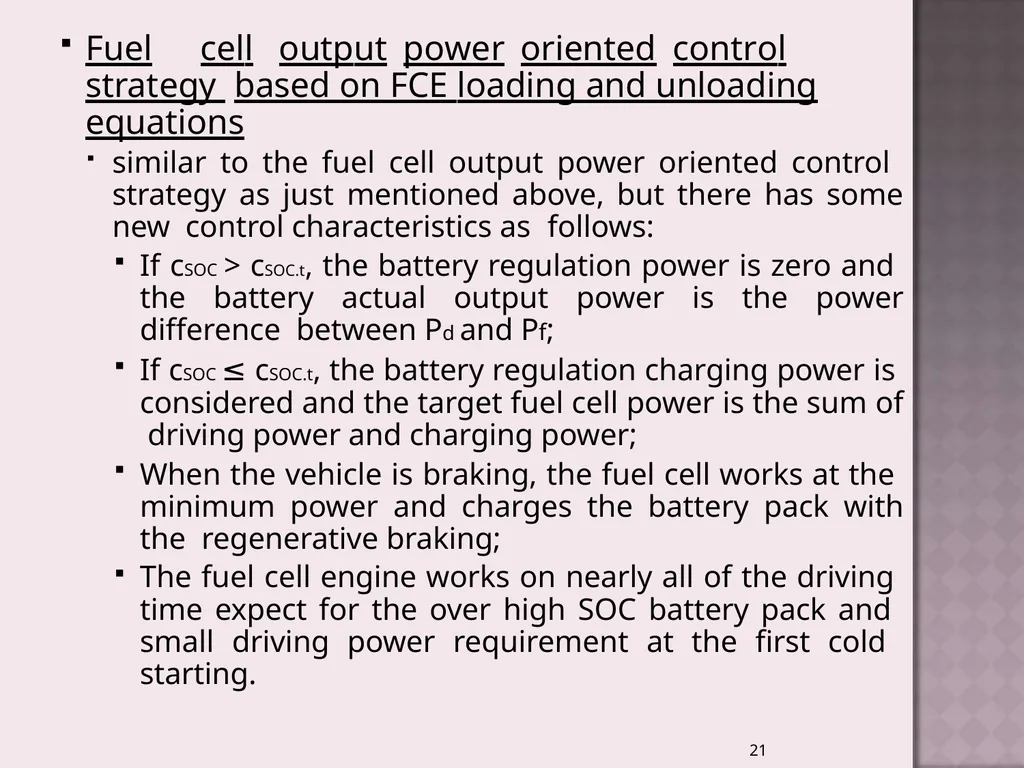
Fuel cell output power oriented control strategy based on FCE loading and unloading equations
similar to the fuel cell output power oriented control strategy as just mentioned above, but there has some new control characteristics as follows:
If cSOC > cSOC.t, the battery regulation power is zero and the battery actual output power is the power difference between Pd and Pf;
If cSOC ≤ cSOC.t, the battery regulation charging power is considered and the target fuel cell power is the sum of driving power and charging power;
When the vehicle is braking, the fuel cell works at the minimum power and charges the battery pack with the regenerative braking;
The fuel cell engine works on nearly all of the driving time expect for the over high SOC battery pack and small driving power requirement at the first cold starting. 21<br>
similar to the fuel cell output power oriented control strategy as just mentioned above, but there has some new control characteristics as follows:
If cSOC > cSOC.t, the battery regulation power is zero and the battery actual output power is the power difference between Pd and Pf;
If cSOC ≤ cSOC.t, the battery regulation charging power is considered and the target fuel cell power is the sum of driving power and charging power;
When the vehicle is braking, the fuel cell works at the minimum power and charges the battery pack with the regenerative braking;
The fuel cell engine works on nearly all of the driving time expect for the over high SOC battery pack and small driving power requirement at the first cold starting. 21<br>
22
to transport and store hydrogen fuel in the vehicle.
the cost of producing a powerful fuel cell is high.
the size and weight issue as fuel cells powerful enough to power a car or truck are still rather bulky and heavy.
However technology is maturing fast, so fuel cells may well prove to be a viable option in automotive technology in the not so distant future.<br>
the cost of producing a powerful fuel cell is high.
the size and weight issue as fuel cells powerful enough to power a car or truck are still rather bulky and heavy.
However technology is maturing fast, so fuel cells may well prove to be a viable option in automotive technology in the not so distant future.<br>
23
Drive slower - The aerodynamic drag on the car increases dramatically the faster you drive. For example, the drag force at 70 mph (113 kph) is about double that at 50 mph (81 kph). So, keeping your speed down can increase your mileage significantly.
Maintain a constant speed - Each time you speed up the car you use energy, some of which is wasted when you slow the car down again. By maintaining a constant speed, you will make the most efficient use of your fuel.
Avoid abrupt stops - When you stop your car, the electric motor in the hybrid acts like a generator and take some of the energy out of the car while slowing it down. If you give the electric motor more time to slow the vehicle, it can recover more of the energy. If you stop quickly, the brakes on the car will do most of the work of slowing the car down, and that energy will be wasted 23<br>
Maintain a constant speed - Each time you speed up the car you use energy, some of which is wasted when you slow the car down again. By maintaining a constant speed, you will make the most efficient use of your fuel.
Avoid abrupt stops - When you stop your car, the electric motor in the hybrid acts like a generator and take some of the energy out of the car while slowing it down. If you give the electric motor more time to slow the vehicle, it can recover more of the energy. If you stop quickly, the brakes on the car will do most of the work of slowing the car down, and that energy will be wasted 23<br>
24
Advantages of HEV Use less oil than ICE
Emit less CO2 than ICE
Fuel efficiency increased
Less overall mass
Regenerative braking
Battery level efficiency
Tax incentives<br>
Emit less CO2 than ICE
Fuel efficiency increased
Less overall mass
Regenerative braking
Battery level efficiency
Tax incentives<br>
25
Using the concept of Hybridization of cars results in better efficiency and also saves a lot of fuel in today’s fuel deficit world.
A hybrid gives a solution to all the problems to some extent.
If proper research and development is done in this field, hybrid vehicle promises a vehicle for practical, efficient, low pollution the coming era. One can surely conclude that this concept and the similar ones to follow with even better efficiency & conservation rate are very much on the anvil in today’s energy deficit world. 25<br>
A hybrid gives a solution to all the problems to some extent.
If proper research and development is done in this field, hybrid vehicle promises a vehicle for practical, efficient, low pollution the coming era. One can surely conclude that this concept and the similar ones to follow with even better efficiency & conservation rate are very much on the anvil in today’s energy deficit world. 25<br>
26
THANK YOU<br>