
Year 12 English Standard Module A: Language,











Description: Year 12 English Standard Module A: Language, Identity and Culture Inside my Mother by Ali Cobby Eckermann Module description and glossary 1 Decoding the module description Developing familiarity with the language and concepts of the module
Related Topics
Download Presentation
"Year 12 English Standard Module A: Language," is the property of its rightful owner. Permission is granted to download and print the materials on this website for personal, non-commercial use only, and to display it on your personal computer provided you do not modify the materials and that you retain all copyright notices contained in the materials. By downloading content from our website, you accept the terms of this agreement.
Presentation Transcript
slide1. Year 12 English Standard Module A: Language, Identity and Culture
Inside my Mother by Ali Cobby Eckermann<br>
slide2. Module description and glossary 1<br>
slide3. Decoding the module description Developing familiarity with the language and concepts of the module description<br>
slide4. The module description (1 of 3) Module A: Language, identity and culture Language has the power to both reflect and shape individual and collective identity. In this module, students consider how their responses to written, spoken, audio and visual texts can shape their self-perception. They also consider the impact texts have on shaping a sense of identity for individuals and/or communities. Through their responding and composing students deepen their understanding of how language can be used to affirm, ignore, reveal, challenge or disrupt prevailing assumptions and beliefs about themselves, individuals and cultural groups.
Students study one prescribed text in detail, as well as a range of textual material to explore, analyse and assess the ways in which meaning about individual and community identity, as well as cultural perspectives, is shaped in and through texts. They investigate how textual forms and conventions, as well as language structures and features, are used to communicate information, ideas, values and attitudes which inform and influence perceptions of ourselves and other people and various cultural perspectives.
Through reading, viewing and listening, students analyse, assess and critique the specific language features and form of texts. In their responding and composing students develop increasingly complex arguments and express their ideas clearly and cohesively using appropriate register, structure and modality. Students also experiment with language and form to compose imaginative texts that explore representations of identity and culture, including their own. Students draft, appraise and refine their own texts, applying the conventions of syntax, spelling and grammar appropriately and for particular effects. 4<br>
slide5. The module description (2 of 3) Decoding the module description You will need Resource 1: Decoding the module description.
As we read the module description together, underline any unknown terms and phrases.
Reread the module description independently and highlight the key words of the module description that capture the essentials of what must be studied in the module.
Using different colours, highlight the words ‘language’, ‘identity’ and ‘culture’ and note how frequently they appear.
In another colour, highlight all the verbs stated within the module statement. You can refer to Resource 2: NESA terminology for a summary of these terms. 5<br>
slide6. Personal engagement with the module description Developing knowledge of the key vocabulary and investigate its applications<br>
slide7. The module description (3 of 3) Jigsaw activity You will be assigned a section of the module description to look at closely in small groups. As you examine your section, respond to the following questions:
What are the essentials? (What are the key ideas or points?)
What does it mean? (How can I translate this into plain English?)
What questions does the module description pose? (What don’t I understand yet?) 7<br>
slide8. Extending familiarity with key vocabulary relevant to the module Engaging with important module vocabulary<br>
slide9. Defining the key terms Module A: Language, Identity and Culture Language and culture are defined in the syllabus as:
Language: A system of meaning, in spoken, written, visual and physical modes, for communicating ideas, thoughts and feelings.
Culture: The social practices and ways of thinking of a particular people or group, including shared beliefs, values, knowledge, customs, lifestyle and artefacts. 9<br>
slide10. Expanding the key terms Module A: Language, Identity and Culture How can the terms 'language' and 'culture' be defined in more detail?
What other concepts or terms do you associate with these words? 10<br>
slide11. Key terms word map Module A: Language, Identity and Culture Using Resource 3: Word map, select one concept (either language, identity or culture) and complete the word map. You will need to:
Define the term. You may use your own definition or the class definition we have jointly constructed.
Identify what you associate with the term (what is it like?) and what you don’t (what is it not like?).
Name examples from other texts that explore this concept. These could be in films, novels, TV shows or similar. 11<br>
slide12. Student engagement in the topic 2<br>
slide13. Student engagement and orientation to the module concepts – perceptions of culture Understanding the dangers that arise from relying on preconceived notions of culture, and considering how this occurs within your own contextual environment<br>
slide14. The power of language (1 of 2) The danger of a single story (18:33) by Chimamanda Ngozi Adichie Before we watch the TED talk, consider as a class what preconceived ideas about poverty and violence in Africa you may have encountered.
As you view the clip, take notes about insightful conceptual statements made by Adichie regarding inaccurate perceptions of culture and the perceived realities of tradition.
After viewing, brainstorm responses to the following question: How have inaccurate perceptions of African culture influenced Adichie's life? Using this class brainstorm, respond in a paragraph summarising your understanding. 14<br>
slide15. The power of language (2 of 2) The danger of a single story (18:33) by Chimamanda Ngozi Adichie Adichie's TED talk offers an interesting parallel to preconceived ideas about Aboriginal cultures in Australia.
What examples of inaccurate perceptions of Aboriginal cultures have you encountered or are aware of?
How have inaccurate perceptions of Aboriginal cultures shaped modern Australia? 15<br>
slide16. Engagement in module ideas through the poem 'Trance' Engaging with the poem ‘Trance’ as a first impression of Eckermann’s poetry<br>
slide17. ‘Trance’ Consolidating our learning on cultural understanding Listen to Eckermann read her poem, ‘Trance’ (1:49) and read along with your printed copy.
After reading, discuss as a class:
What imagery is found in the poem that evokes Aboriginal cultures and experiences?
Which aspects of cultural experience do you not understand or possess prior knowledge to recognise?
Based on what you have just learnt about cultural perceptions and the dangers of single stories, what might be the impact and benefits on you studying the poetry of Eckermann? 17<br>
slide18. Introducing the prescribed text 3<br>
slide19. Exploring the personal, social and historical context of the composer Engaging with Eckermann as a composer and developing a biographical understanding of her life, and the connections to her personal experience in her work<br>
slide20. Who is Ali Cobby Eckermann? (1 of 3) Red Room Poetry interview In the clip we are about to watch, Eckermann describes poetry as being both a ‘liberation’ and a ‘medicine’ to her?
Why would someone need to be liberated?
Why would a person require medication?
Can poetry liberate and medicate a person? What does Eckermann’s use of figurative language suggest to you about her view on poetry?
Keep the idea of ‘liberation’ and ‘medicine’ in your mind as we view the clip ‘About Ali Cobby Eckermann’ (7:04).
Complete a think, pair and share with a partner. What do you think Eckermann means when she says that ‘poetry is liberation and medicine’? Consider your prior understanding of historical context. 20<br>
slide21. Who is Ali Cobby Eckermann? (2 of 3) Read and view the following texts to gain an understanding of Eckermann ABC News article – 'Indigenous poet Ali Cobby Eckermann turns life of pain into poetry success'
NITV article – 'My entire view of the world changed when I had the proof that I'd been wanted’
Optional (requires ClickView login) TV episode – 'Our Stories: Inside My Mother, Ali Cobby-Eckermann' 21<br>
slide22. Who is Ali Cobby Eckermann? (3 of 3) Personal reflection Compose a written, personal reflection answering the following driving question:
‘What is it about life events that makes them significant enough to be documented as a public representation of culture and identity?’ 22<br>
slide23. Exploring context and form through a close reading of ‘Trance’ Developing an analytical understanding of the poem ‘Trance’<br>
slide24. ‘Trance’ (1 of 6) Reading the poem On the surface, 'Trance' provides a distinctively traditional image of an Aboriginal woman.
Listen to Eckermann reading 'Trance’ (1:49) and make annotations of poetic devices and structures used. Some devices and structures to note are:
two stanzas
four lines each
free verse
possessive apostrophe as the only punctuation
written to ‘honour the love of our old people’
shows connection to Country through instinct
persona remembers married life before her husband died
Eckermann states that the woman uses Pituri, a traditional bush tobacco, hence her dreaming of former times: her trance. 24<br>
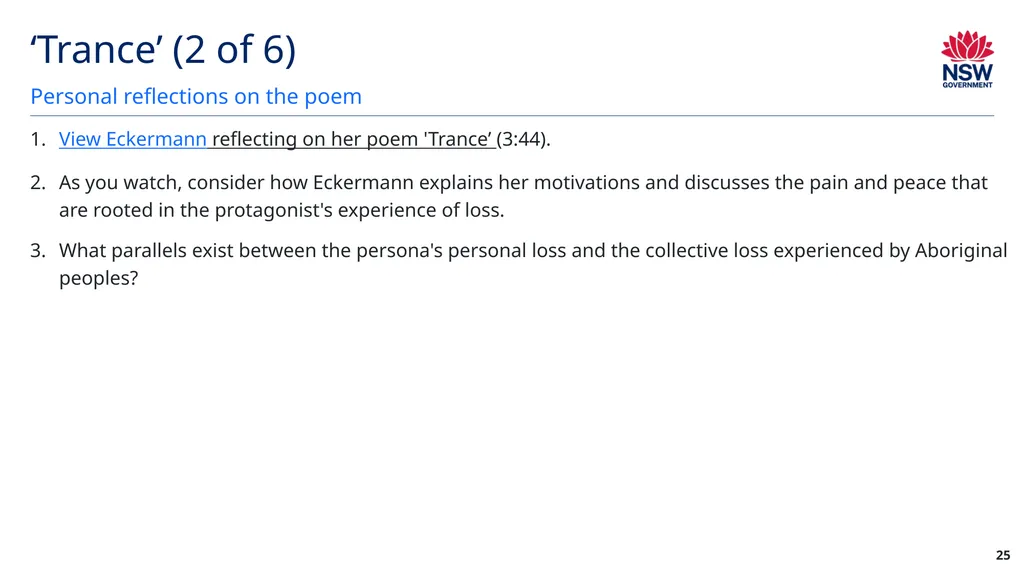
slide25. ‘Trance’ (2 of 6) Personal reflections on the poem View Eckermann reflecting on her poem 'Trance’ (3:44).
As you watch, consider how Eckermann explains her motivations and discusses the pain and peace that are rooted in the protagonist's experience of loss.
What parallels exist between the persona's personal loss and the collective loss experienced by Aboriginal peoples? 25<br>
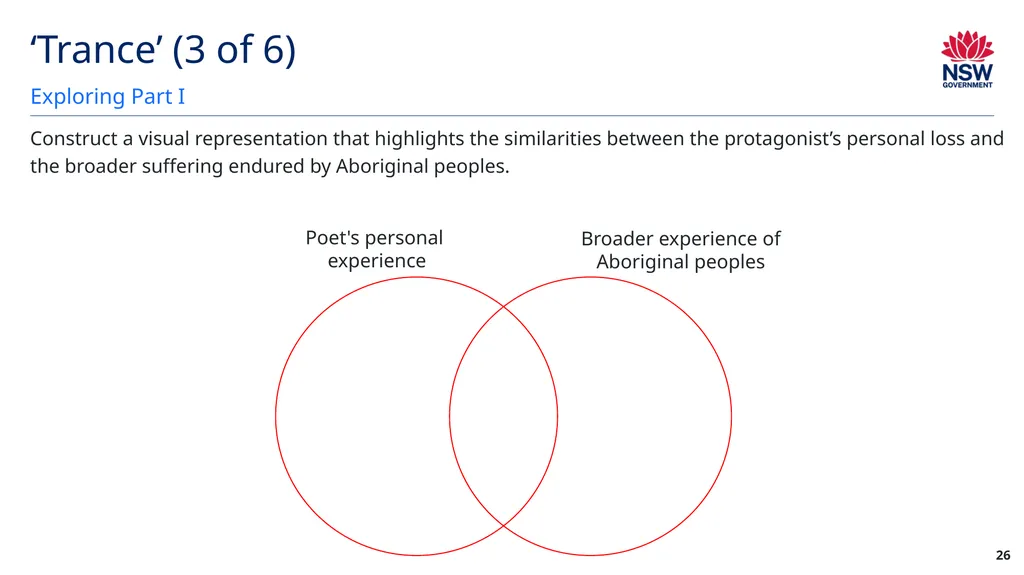
slide26. ‘Trance’ (3 of 6) Exploring Part I Construct a visual representation that highlights the similarities between the protagonist’s personal loss and the broader suffering endured by Aboriginal peoples. Poet's personal
experience Broader experience of Aboriginal peoples 26<br>
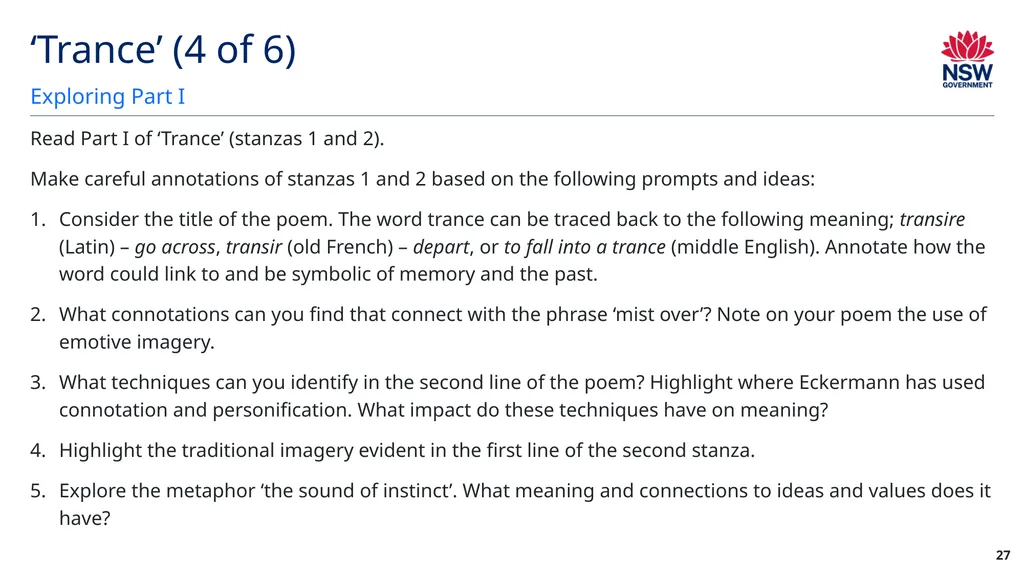
slide27. ‘Trance’ (4 of 6) Exploring Part I Read Part I of ‘Trance’ (stanzas 1 and 2).
Make careful annotations of stanzas 1 and 2 based on the following prompts and ideas:
Consider the title of the poem. The word trance can be traced back to the following meaning; transire (Latin) – go across, transir (old French) – depart, or to fall into a trance (middle English). Annotate how the word could link to and be symbolic of memory and the past.
What connotations can you find that connect with the phrase ‘mist over’? Note on your poem the use of emotive imagery.
What techniques can you identify in the second line of the poem? Highlight where Eckermann has used connotation and personification. What impact do these techniques have on meaning?
Highlight the traditional imagery evident in the first line of the second stanza.
Explore the metaphor ‘the sound of instinct’. What meaning and connections to ideas and values does it have? 27<br>
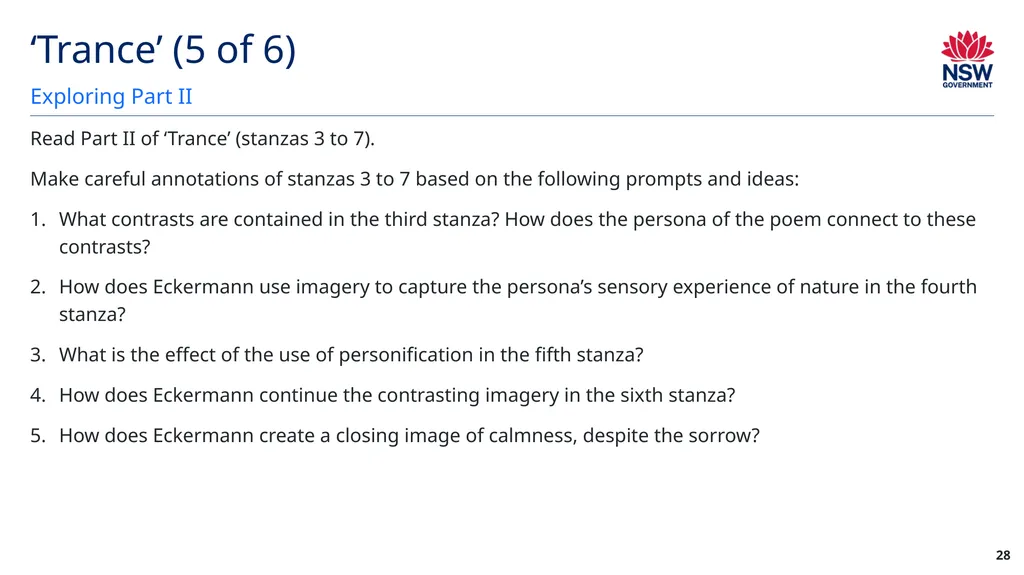
slide28. ‘Trance’ (5 of 6) Exploring Part II Read Part II of ‘Trance’ (stanzas 3 to 7).
Make careful annotations of stanzas 3 to 7 based on the following prompts and ideas:
What contrasts are contained in the third stanza? How does the persona of the poem connect to these contrasts?
How does Eckermann use imagery to capture the persona’s sensory experience of nature in the fourth stanza?
What is the effect of the use of personification in the fifth stanza?
How does Eckermann continue the contrasting imagery in the sixth stanza?
How does Eckermann create a closing image of calmness, despite the sorrow? 28<br>
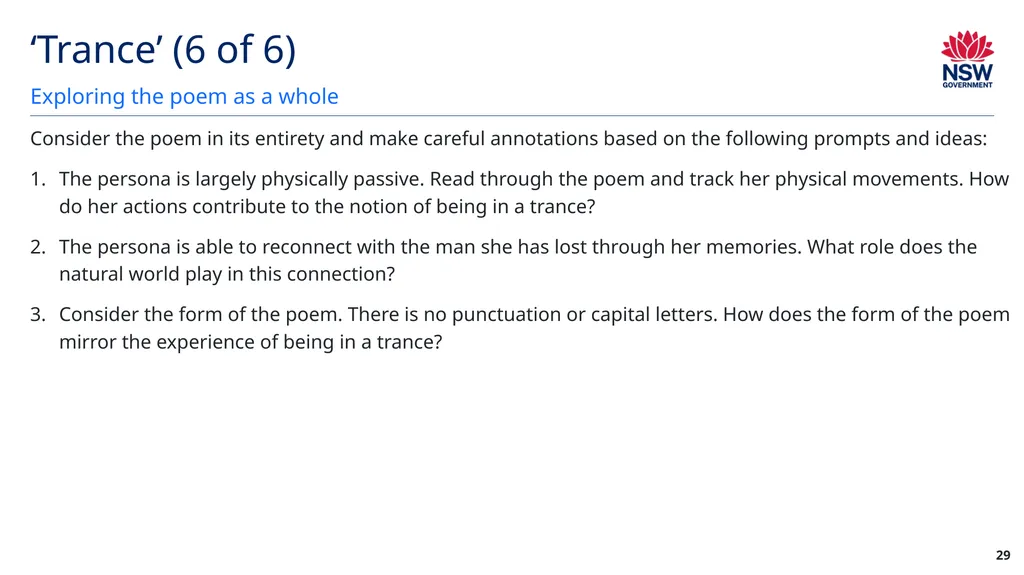
slide29. ‘Trance’ (6 of 6) Exploring the poem as a whole Consider the poem in its entirety and make careful annotations based on the following prompts and ideas:
The persona is largely physically passive. Read through the poem and track her physical movements. How do her actions contribute to the notion of being in a trance?
The persona is able to reconnect with the man she has lost through her memories. What role does the natural world play in this connection?
Consider the form of the poem. There is no punctuation or capital letters. How does the form of the poem mirror the experience of being in a trance? 29<br>
slide30. Exploring motif through a close reading of ‘Eyes’ Exploring the effect of motif in creating meaning<br>
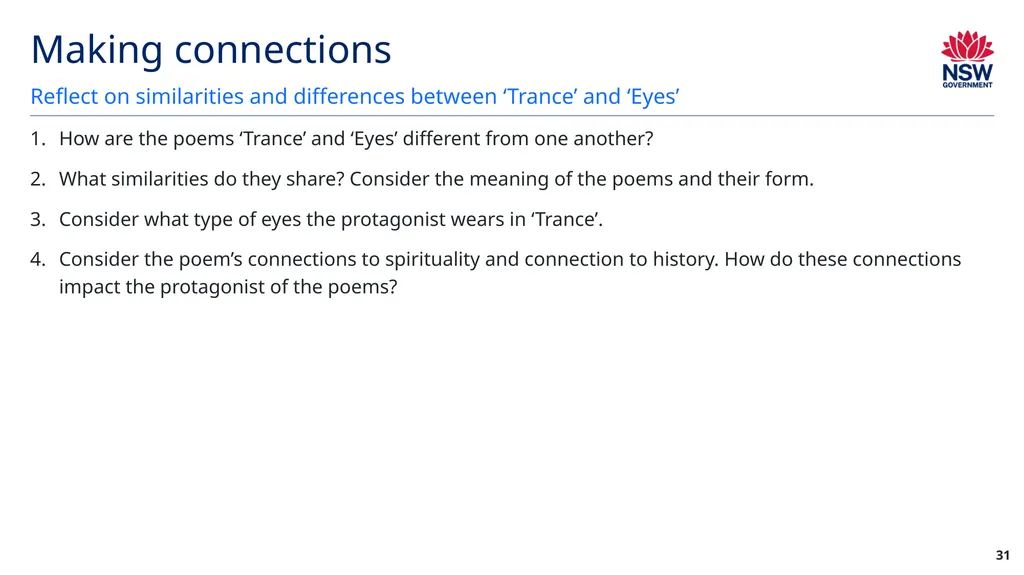
slide31. Making connections Reflect on similarities and differences between ‘Trance’ and ‘Eyes’ How are the poems ‘Trance’ and ‘Eyes’ different from one another?
What similarities do they share? Consider the meaning of the poems and their form.
Consider what type of eyes the protagonist wears in ‘Trance’.
Consider the poem’s connections to spirituality and connection to history. How do these connections impact the protagonist of the poems? 31<br>
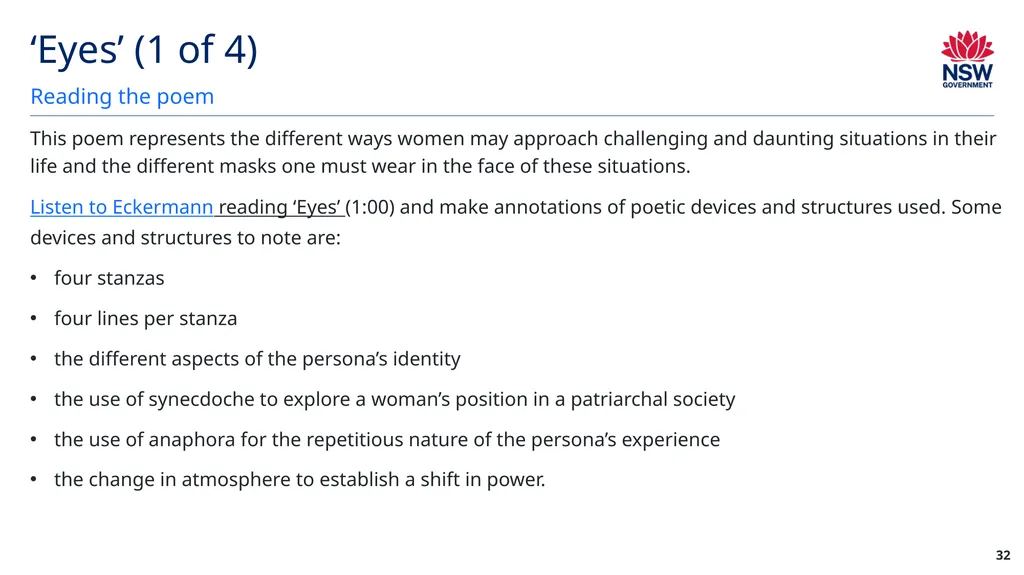
slide32. ‘Eyes’ (1 of 4) Reading the poem This poem represents the different ways women may approach challenging and daunting situations in their life and the different masks one must wear in the face of these situations.
Listen to Eckermann reading ‘Eyes’ (1:00) and make annotations of poetic devices and structures used. Some devices and structures to note are:
four stanzas
four lines per stanza
the different aspects of the persona’s identity
the use of synecdoche to explore a woman’s position in a patriarchal society
the use of anaphora for the repetitious nature of the persona’s experience
the change in atmosphere to establish a shift in power. 32<br>
slide33. ‘Eyes’ (2 of 4) Personal reflections on the poem View Eckermann reflecting on her poem ‘Eyes’ (2:10).
As you watch, consider how Eckermann explains her motivations and discusses the pain and peace that are rooted in the protagonist's experience of domestic violence and the normal reactions to challenging life experiences.
What are the multi-layered meanings of the poem? How does this poem explore and give recognition to the challenges faced by Aboriginal women and all women? 33<br>
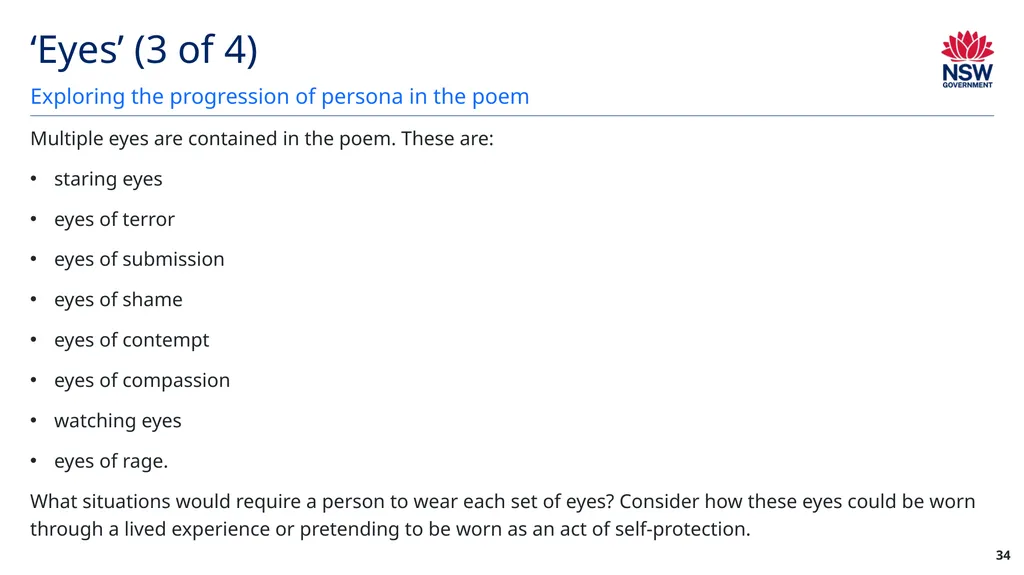
slide34. ‘Eyes’ (3 of 4) Exploring the progression of persona in the poem Multiple eyes are contained in the poem. These are:
staring eyes
eyes of terror
eyes of submission
eyes of shame
eyes of contempt
eyes of compassion
watching eyes
eyes of rage.
What situations would require a person to wear each set of eyes? Consider how these eyes could be worn through a lived experience or pretending to be worn as an act of self-protection. 34<br>
slide35. ‘Eyes’ (4 of 4) Exploring the motif in the poem ‘Eyes are a window to the soul’
Consider the motif of the eye and how it is a symbol of our inner thoughts, feelings and emotions. Read through the poem and explore the way Eckermann has used the motif to explore the history, experiences and layered emotions of women in domestic and challenging situations.
How does the motif change and develop throughout the poem? Consider and conclude how the changing nature of the motif establishes meaning. 35<br>
slide36. The masks you wear Which masks do you wear? Reflect on your own position in the world and answer the following questions.
How do you present yourself to the world?
How do you intend for others to perceive you?
What inaccurate assumptions might be made about you?
Describe a time or circumstance where you presented a façade to protect yourself? 36<br>
slide37. Contextual connections Visual representation Create a visual representation of the different eyes, or masks, represented in the poem.
Assign each set of eyes an image that visually represents the experiences associated with the mask. Rather than choosing a literal image, for example a frightened face for eyes of terror, choose an image that has a symbolic meaning.
Justify your choice of image for each set of eyes by sharing with the class or a small group.
Connect sets of eyes to the collective experience of the Aboriginal community and discuss the experiences and feelings they may represent. 37<br>
slide38. Engaging critically with texts 4<br>
slide39. Critical engagement through reconsidering definitions Deepening appreciation of Eckermann’s poetry by reconsidering notions of family and Country through the lens of First Nations beliefs and values<br>
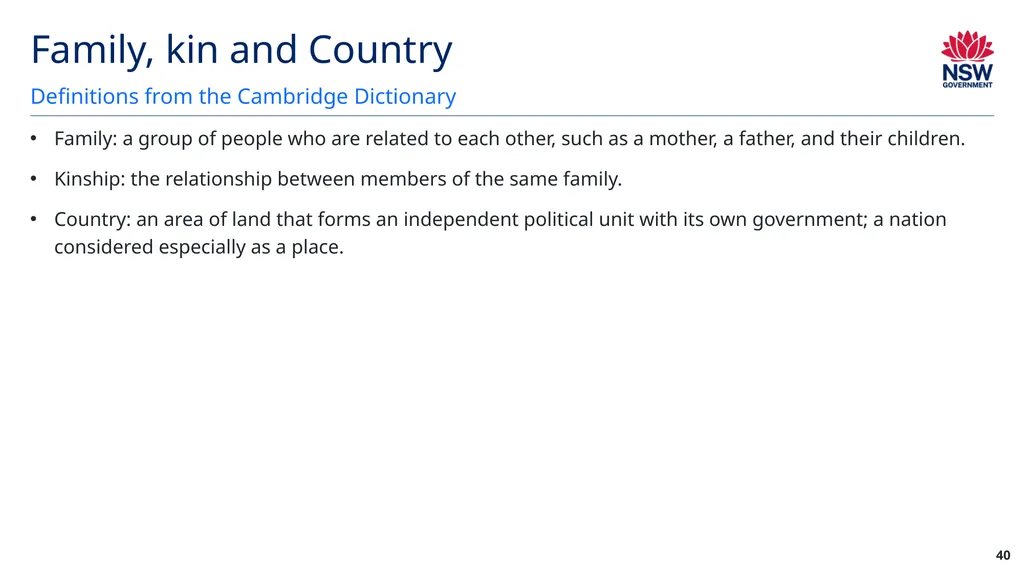
slide40. Family, kin and Country Definitions from the Cambridge Dictionary Family: a group of people who are related to each other, such as a mother, a father, and their children.
Kinship: the relationship between members of the same family.
Country: an area of land that forms an independent political unit with its own government; a nation considered especially as a place. 40<br>
slide41. Understanding family, kin and Country through a First Nations lens Compare the previous definitions to the following:
Kinship, as defined by Australians Together: Kinship is at the heart of First Nations society. A person’s position in the kinship system establishes their relationship to others and to the universe, prescribing their responsibilities towards other people, the land and natural resources. Traditional kinship structures remain important in many First Nations communities today. There are over 500 Aboriginal and Torres Strait Islander nations across this continent, which cover wide geographical areas, and have distinct borders. Within these nations there are clan groups, and within the clan groups there are family groups. Clan groups share a common language and kinship system, which is based on either patrilineal or matrilineal lines of descent. There are three levels of kinship in First Nations society: Moiety, Totem and Skin Names.
Country, as defined by AIATSIS: Country is the term often used by Aboriginal peoples to describe the lands, waterways and seas to which they are connected. The term contains complex ideas about law, place, custom, language, spiritual belief, cultural practice, material sustenance, family and identity. 41<br>
slide42. Forming your own definitions Personal reflection How do you define family, kin and Country?
Reflect personally on what each of these terms means to you in a paragraph. Has your understanding of these terms been changed by considering them through a First Nations lens? 42<br>
slide43. Kinship and the Stolen Generation A Look Inside the Heartbreaking Story of Australia’s “Stolen Generation” View the clip “A Look Inside the Heartbreaking Story of Australia's Stolen Generation” (3:54).
In the clip, Deanne Kenyon tells the story of her grandparents and their experiences with the Stolen Generation. Each of the points below comes from the definition of kinship you read earlier. For each point, discuss the impact the Stolen Generation would have had on Aboriginal families and their kinship.
Kinship is at the heart of First Nations society.
A person’s position in the kinship system establishes their relationship to others and to the universe, prescribing their responsibilities towards other people, the land and natural resources.
Traditional kinship structures remain important in many First Nations communities today.
Within the over 500 Aboriginal and Torres Strait Islander nations there are clan groups, and within the clan groups there are family groups.
Clan groups share a common language and kinship system, which is based on either patrilineal or matrilineal lines of descent. 43<br>
slide44. Poem – ‘Leaves’ Developing a detailed understanding of the poem ‘Leaves’<br>
slide45. ‘Leaves’ (1 of 4) Reading the poem This poem is autobiographical and references Eckermann’s connections with family and culture. The leaves are symbolic of the pieces of culture and family her father gave to her. It explores the impact of connecting and creating cultural identity.
Listen to Eckermann reading ‘Leaves’ (1:06) and make annotations of poetic devices used. Some devices to note are:
tense changes between stanzas 4 and 5
symbolism
enjambment
the atmosphere of contentment
changes in the persona’s engagement with the leaves
seven stanzas
rhetorical questions
three lines per stanza. 45<br>
slide46. ‘Leaves’ (2 of 4) Personal reflections on the poem View Eckermann reflecting on her poem ‘Leaves’ (1:47).
Eckermann explains the autobiographical nature of the poem and the connection it has to family and her father.
How does she explain the symbolism of the leaves and what do they represent?
Consider what aspect of Eckermann’s identity is explored through this poem and her feeling towards this aspect of her life and person.
In what ways does the poem explore a connection to Country? Explore how personification of the environment connects the poem to Country. 46<br>
slide47. ‘Leaves’ (3 of 4) Exploring meaning in the poem The representation of the Stolen Generation is explored throughout this poem. It is autobiographical and describes Ali Cobby Eckermann meeting her father for the first and last time. What clues can you see that hint at this being their first meeting? What atmosphere is associated with this life event and how does the poem express her feeling towards meeting her father?
Can you identify specific quotations from the poem that allude to Eckermann’s personal experience with the Stolen Generation? 47<br>
slide48. ‘Leaves’ (4 of 4) The role of the persona The persona is the speaker of a poem. A poet creates a persona in the same way that an author creates a character in a fiction novel.
While ‘Eyes’ and ‘Trance’ adopt an unknown persona that embodies the experience of Aboriginal women, ‘Leaves’ is a more personal piece that draws on Eckermann’s own personal experience.
The poem is deeply personal and the interview you just watched reveals the biographical nature of the poem.
In what ways does Eckermann use her own personal experience to simultaneously explore her own personal history and the shared history of Aboriginal cultures? 48<br>
slide49. Poem – ‘Key’ Developing a detailed understanding of the poem ‘Key’<br>
slide50. ‘Key’ (1 of 2) Reading the poem Eckermann explores her parentage and regresses back to childhood. The poem explores the significance of both her adoptive German grandmother and her Aboriginal grandmother, whom she met in her adult life. Like ‘Leaves’, ‘Key’ highlights that when we are in the presence of our parents and grandparents we regress to childhood.
Listen to Eckermann reading ‘Key’ (2:25) and make annotations of poetic devices used. Some devices to note are:
imagery of Eckermann as a child
metaphor of time
atmosphere of calm and connection
references to physical distance
imagery of the two different maternal grandmothers, the German grandmother and the Aboriginal grandmother. 50<br>
slide51. ‘Key’ (2 of 2) Personal reflection on the poem View Eckermann reflecting on her poem ‘Key’ (4:01).
Consider what Eckermann says about her family and the women in her family. How do they inform her identity?
How is the key metaphorical? What deeper meaning does this metaphor hold for both Eckermann and Aboriginal peoples? 51<br>
slide52. ‘Key’ and ‘Leaves’ Contrasting the poems for meaning Both ‘Key’ and ‘Leaves’ explore relationships with family that Eckermann reconnected with as an adult. In describing the connections in each poem, there also exists a distance.
Explore the contrasting language and images of both poems. Why might Eckermann change her diction when discussing maternal and paternal relationships?
Using Resource 4: Comparison of ‘Key’ and ‘Leaves’, complete the comparison table exploring the similarities and differences. 52<br>
slide53. Connecting and deepening responses to the prescribed text 5<br>
slide54. Deepening understanding through personal response to Gordon Bennett’s ‘Self Portrait’ Engaging with visual representations of Aboriginal cultures and experience through transferring understanding of Eckermann’s poetry to the works of Aboriginal artists engaging in self-expression through art<br>
slide55. Deepening understanding through personal response to Gordon Bennett’s Self Portrait Deepening and connecting your understanding Gordon Bennett (1955–2014) was a First Nations contemporary artist, who lived and worked in Brisbane.
The Museum of Contemporary Art describes Bennett as someone whose ‘…bold and humane art challenged racial stereotypes and provoked critical reflection on Australia’s official history and national identity. Bennett was one of Australia’s most significant and critically engaged contemporary artists, addressing issues relating to the role of language and systems of thought in forging identity.’
Before examining the final 2 poems, we are going to deepen our understanding of the complex notions of identity by making connections with the ideas of Eckermann’s poetry and Bennett’s art. 55<br>
slide56. Gordon Bennett Deepening and connecting your understanding View the promotional clip (1:00) from Queensland Gallery of Modern Art’s 2021 exhibition Unfinished Business: The Art of Gordon Bennett to gain a sense of Bennett’s artistic style.
Reflection task: before we look at the work, Self Portrait, reflect on your own personal identity. Spend 5 minutes responding to the prompt ‘I am …’.
You may wish to write a paragraph, or a series of dot points.
Post reflection task:
How easily did you think of what to write in response to this prompt?
How many of your statements reflect certain beliefs you hold of yourself?
Was it easy to identify these qualities, or did you need to think deeply about who you are?
How does your process of responding to the personas of ‘Trance’, ‘Eyes’, ‘Leaves’ and ‘Key’ differ? 56<br>
slide57. What is a self-portrait? Deepening and connecting your understanding What is a self-portrait? Consider the famous Picasso quote about painting a self-portrait: ‘Are we to paint what's on the face, what's inside the face, or what's behind it?’
Would you consider your school photo a self-portrait? Why or why not?
Image search the term ‘self-portrait’ and other variations. Share 2 images to the class Jamboard that resonate most strongly with you as an example of a self-portrait.
Once all images have been collected, discuss the similarities and differences of the choices made by the class. 57<br>
slide58. Gordon Bennett, ‘Self Portrait’ (1 of 2) Responding to Self portrait (But I always wanted to be one of the good guys) View the artwork via the National Gallery of Victoria. The full title of the piece is Self portrait (But I always wanted to be one of the good guys).
In the process of viewing, discuss the following:
What sense of Bennett’s self-identity emerges from the artwork?
What visual features contribute to your interpretation of the artwork? 58<br>
slide59. Gordon Bennett, ‘Self Portrait’ (2 of 2) Responding to Self portrait (But I always wanted to be one of the good guys) The following statements come from the accompanying educational resource from the National Gallery of Victoria. Complete a think, pair, share for each statement, connecting your own interpretation with the ideas below.
Gordon Bennett’s art challenges us to question the stereotypes and racist labelling of Aboriginal Australians found in some history books written for and by Europeans.
[The artwork] questions how stereotypes create a sense of identity. Bennett investigates the way stereotypes are constructed by exploring words and images in opposites.
The powerful image/word ‘I AM’, while central, is accompanied by statements of opposite, ‘I am light – I am dark’.
This artwork is constructed of obvious layers: The layers of dots, reminiscent of Aboriginal Western Desert dot painting, with lines of perspective – a Western tradition.
This rich interplay of words and images raises many questions. 59<br>
slide60. Julie Dowling, ‘Self-portrait: in our country’ Making connections with other artworks View the artwork by Julie Dowling, Self-portrait: in our country.
In pairs or small groups, consider the artwork and prepare one statement, similar to the Gordon Bennett statements you just read, that offers an interpretation of Dowling’s work and its impact.
We will compile these statements into a class collection, to repeat the think-pair-share process by responding to your peers’ statements. 60<br>
slide61. Poem – ‘Oombulgarri’ Developing a detailed understanding of the poem ‘Oombulgarri’<br>
slide62. ‘Oombulgarri’ context research Research one of the following places, and prepare a short summary presentation Oombulgarri
Forrest River massacre
The Gunbarrel Highway
Kati Thanda-Lake Eyre
Ooldea Soak
Hindmarsh Island
In your summary, address the following:
location, including the First Nations Country
the significance and importance to First Nations history
any other relevant information. 62<br>
slide63. ‘Oombulgarri’ (1 of 4) Reading the poem ‘Oombulgarri’ informs the responder of modern dispossession and removal from Country. Eckermann explores the impact of this dispossession and encourages the responder to reflect on the actions of the government.
Listen to Eckermann reading ‘Oombulgarri’ (1:09) and make annotations of poetic devices used. Some devices to note are:
imagery
emotive language
simile
alliteration
repetition. 63<br>
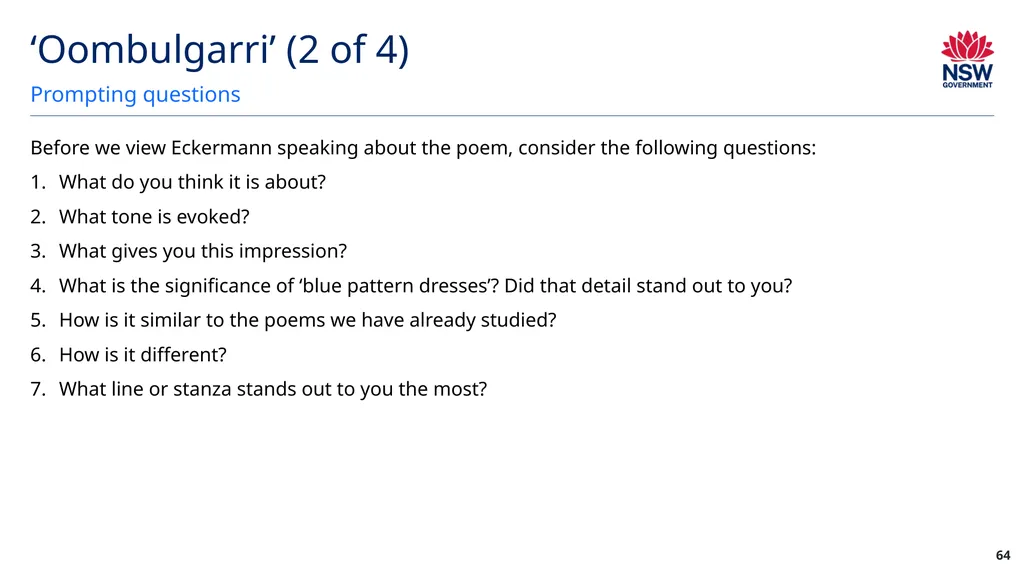
slide64. ‘Oombulgarri’ (2 of 4) Prompting questions Before we view Eckermann speaking about the poem, consider the following questions:
What do you think it is about?
What tone is evoked?
What gives you this impression?
What is the significance of ‘blue pattern dresses’? Did that detail stand out to you?
How is it similar to the poems we have already studied?
How is it different?
What line or stanza stands out to you the most? 64<br>
slide65. ‘Oombulgarri’ (3 of 4) Personal reflection on the poem View Eckermann reflecting on her poem ‘Oombulgarri’ (3:46).
In the interview, she says “I’m hoping to plant curiosity in the reader that they’ll go ‘what’s Ombulgarri?’, and we all have access to Google now and, you know, a fast way of learning, and so much is recorded via phones and even people in remote areas being able to upload things on to the community. So I guess it’s a bit of a challenge too, for the reader to research the place names, and to find out the bigger story of these places.”
Reflection task: Did you feel the curiosity and think ‘what’s Ombulgarri?’ Did you feel challenged by Eckermann to research and know more about the bigger story of Ombulgarri? What does this suggest to you about the power and potential of poetry as a tool for reflection and education in wider Australian society? 65<br>
slide66. ‘Oombulgarri’ (4 of 4) Creative response Reread the poem and make a list of all the words that hold negative connotations.
Using these words as a starting point, compose at least one additional stanza to this poem, capturing the desertion of Oombulgarri. 66<br>
slide67. Poem – ‘Unearth’ Developing a detailed understanding of the poem ‘Unearth’<br>
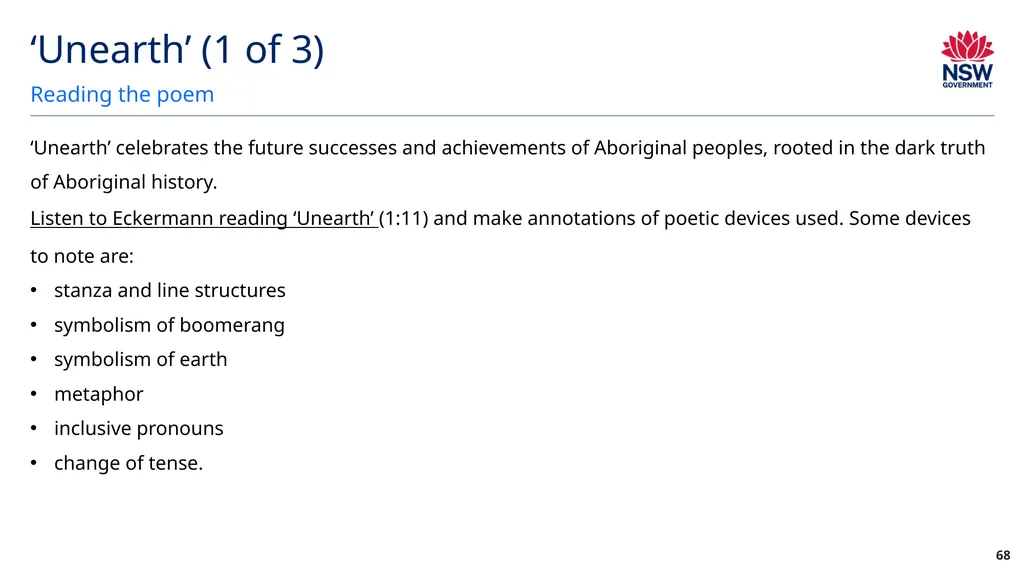
slide68. ‘Unearth’ (1 of 3) Reading the poem ‘Unearth’ celebrates the future successes and achievements of Aboriginal peoples, rooted in the dark truth of Aboriginal history.
Listen to Eckermann reading ‘Unearth’ (1:11) and make annotations of poetic devices used. Some devices to note are:
stanza and line structures
symbolism of boomerang
symbolism of earth
metaphor
inclusive pronouns
change of tense. 68<br>
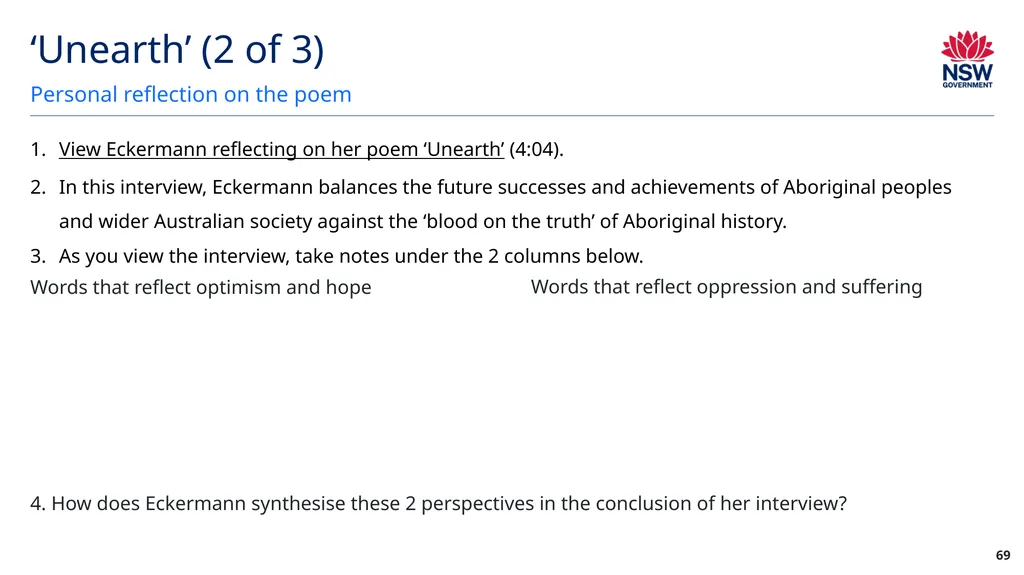
slide69. ‘Unearth’ (2 of 3) Personal reflection on the poem View Eckermann reflecting on her poem ‘Unearth’ (4:04).
In this interview, Eckermann balances the future successes and achievements of Aboriginal peoples and wider Australian society against the ‘blood on the truth’ of Aboriginal history.
As you view the interview, take notes under the 2 columns below. Words that reflect optimism and hope Words that reflect oppression and suffering 4. How does Eckermann synthesise these 2 perspectives in the conclusion of her interview? 69<br>
slide70. ‘Unearth’ (3 of 3) Making connections across the prescribed poems We are now going to start drawing more connections between Eckermann’s poems.
Resource 5 – Connecting the meaning of ‘Unearth’ lists a number of quotes from the poem. For each quote, explain what connotations and meanings this line creates for you in both ‘Unearth’ and another of Eckermann’s poems you have studied. 70<br>
slide71. Writing in response to the module and text 6<br>
slide72. The symbolic meaning of Inside my Mother Developing an appreciation of the interwoven connotations within the prescribed poems<br>
slide73. Inside my Mother (1 of 5) Connotations of ‘mother’ The cover of Inside my Mother shows a fish trap that the poet has woven from old fence wire, painted brightly. Like her sculptures, Eckermann's poems use simple elements to weave something complex, delicate and strong. The word ‘mother’ has many connotations and each of those are layered in Eckermann’s poems.
What connotations of mother exist in your reading of Eckermann’s poetry? 73<br>
slide74. Inside my Mother (2 of 5) Mother as a familial figure Mother, as a familial figure, is one connotation. The dedication of Inside my Mother reads:
‘This book is dedicated to my mothers
Mum Audrey, Ngingali, Aunty Mabel,
Aunty Lorna, Aunty Lola, Aunty Nura,
who in their passing strengthened me
to know who I am
and to
Mum Freida and Mum Jennifer
who still remain
my dearest friends’
Eckermann’s poetry widens the concept of mother beyond a single person, encompassing both her personal experience and Aboriginal notions of kinship. 74<br>
slide75. Inside my Mother (3 of 5) Motherland There is also the notion of mother as mother Country or motherland, with all of its cultural history and spiritual connection. This is the land to which Eckermann belongs and her connection to the histories and traditions of Aboriginal peoples. 75<br>
slide76. Inside my Mother (4 of 5) Mother tongue Another connotation is the notion of mother tongue, that being the Aboriginal languages that have been lost through colonisation. In one of Eckermann’s poems not set for study, ‘Lament’, she writes ‘I am the last speaker / of my mother tongue’. Eckermann’s mother tongue has been submerged but remains as a ghost through the work. Eckermann’s poems are written in English but there is a combination of vernacular alongside the ‘voice’ of the natural world: birdsong, water, rock, tribal music, and the collective sound of a nation (Cobby Eckermann 2015:24). 76<br>
slide77. Inside my Mother (5 of 5) Familial mother, motherland and mother tongue Use Resource 6 – Connotations of mother to track these connotations across Eckermann’s body of work. For each connotation, find evidence from 2 different poems where this symbolic meaning can be found. 77<br>
slide78. The power of the poetic word Developing an understanding of Eckermann’s choices as a poet, and the power of her poetic words on others<br>
slide79. The power of the poetic word – reflection Poetry as a tool for reflection Eckermann’s poetry is both a deeply personal reflection of her own unique human experience, and the shared collective experience of many Aboriginal people. Her poetry also entices the reader to reconsider their assumed knowledge, or lack of knowledge, of the experiences of Aboriginal peoples.
Eckermann describes her writing experiences as “I think I wrote them as chapters, in reflection that I mentioned before, in that time of grief with my mother, I was doing a lot of reflection. So they’re like chapters. And I guess that’s also a gift to read. One chapter: pause, reflect. Go to the next chapter: pause, reflect. Most things as I see (with) Aboriginal culture there’s always a journey, so with even in my literature, there’s little journeys embedded.”
Discussion question: In what ways does Eckermann’s poetry offer the reader a powerful journey? 79<br>
slide80. Poetic style Punctuation Unique to Eckermann’s poetic style is her minimal use of punctuation.
View Eckermann reflecting on Inside my Mother (9:31). Take notes of the ideas she discusses, particularly when discussing her choices in using punctuation. This section starts at 3:20.
Resource 7 – poetic style lists 3 quotes from the interview. For each quote, respond to the question posed to deepen your understanding and appreciation of Eckermann’s conscious choices as a poet. 80<br>
slide81. Drawing ideas together into concept summaries Determining the conceptual ideas of Eckermann’s poetry and making connections between the poems to draw these ideas together<br>
slide82. Drawing together the ideas of Eckermann’s poetry (1 of 2) Considering Eckermann’s body of work Eckermann’s poetry, when considered as a whole text, offers personal insights and explores many powerful ideas that are reinforced when considered across multiple poems.
Spend a few minutes in pairs or small groups and write a list of the ideas Eckermann explores in her poetry. 82<br>
slide83. Drawing together the ideas of Eckermann’s poetry (2 of 2) Considering Eckermann’s body of work Some possible ideas you may have identified are:
connection to culture
dispossession
family and kinship
connections to land and Country
natural world.
Add any class ideas to this list. 83<br>
slide84. Chalk talk Drawing together the ideas of Eckermann’s poetry Around the room there are several chalk talk sheets. Each sheet of paper corresponds to an idea found in Eckermann’s poems. This process allows you to think about your own ideas, and consider the ideas of others, through silent reflection. To complete the chalk talk process, you will need to do the following:
Think about the idea written at the top of the sheet, and where this is reflected in the 6 poems you have studied.
Under the heading of each poem, find quotes which reflect this idea. In brackets you could identify the technique used or expand on your idea.
As you walk around the room, read the ideas your peers have written. You can place a tick on any ideas you agree with, or draw an arrow and add to their ideas.
Continue rotating around the room reading and adding to the sheets. When you have finished, return to your desk. 84<br>
slide85. Narrowing your focus (1 of 2) Looking at one idea In groups, you will be given one of the chalk talk sheets. In your group, discuss the idea first. Respond to the following questions and take notes while you discuss:
How is this idea personally important to Eckermann, based on your knowledge of her context and personal experiences?
What message is Eckermann communicating to her readers through exploring this idea?
What deeper understanding of this idea have you gained through studying Eckermann’s poems?
After discussing, select 2 poems which you feel most strongly explore your idea. 85<br>
slide86. Narrowing your focus (2 of 2) Analysing through writing In groups, compose a paragraph explaining the importance of your idea to Eckermann’s poetry. In your paragraph, discuss the deeper understanding she has offered readers and justify this by making reference to 2 of her poems. 86<br>
slide87. Preparing critical responses 7<br>
slide88. Annotating a sample response Examining a sample response to identify the strengths and weaknesses, and transferring this process to your own writing<br>
slide89. Annotating a sample response (1 of 5) Identifying the strengths and weaknesses Read Resource 9 – sample student response.
This response was written in response to the 2019 HSC question:
Poetry relies primarily on symbolism to create cultural tension. To what extent do you agree with this statement? In your response, make detailed reference to your prescribed text.
A strength of this response is its strong personal voice. A weakness is the fluency of the overall expression. Read the response and make annotations in the right column identifying the strengths of this response, and any feedback you would give to this student. 89<br>
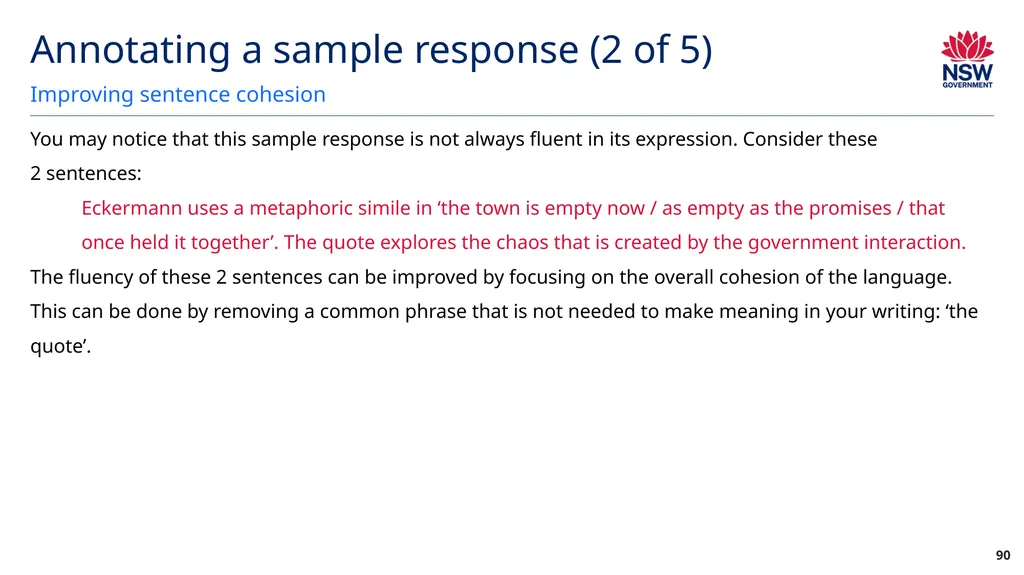
slide90. Annotating a sample response (2 of 5) Improving sentence cohesion You may notice that this sample response is not always fluent in its expression. Consider these 2 sentences:
Eckermann uses a metaphoric simile in ‘the town is empty now / as empty as the promises / that once held it together’. The quote explores the chaos that is created by the government interaction.
The fluency of these 2 sentences can be improved by focusing on the overall cohesion of the language. This can be done by removing a common phrase that is not needed to make meaning in your writing: ‘the quote’. 90<br>
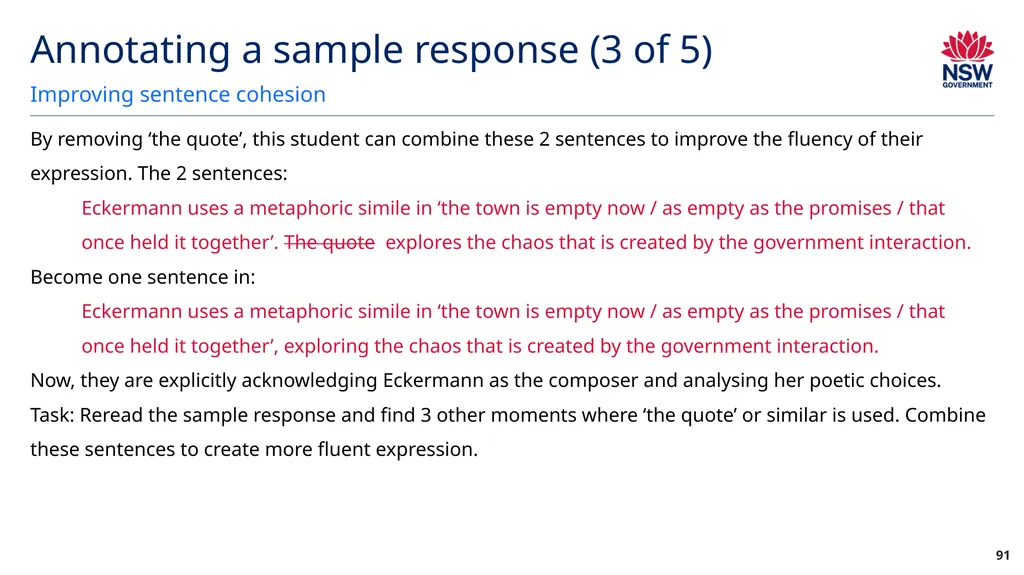
slide91. Annotating a sample response (3 of 5) Improving sentence cohesion By removing ‘the quote’, this student can combine these 2 sentences to improve the fluency of their expression. The 2 sentences:
Eckermann uses a metaphoric simile in ‘the town is empty now / as empty as the promises / that once held it together’. The quote explores the chaos that is created by the government interaction.
Become one sentence in:
Eckermann uses a metaphoric simile in ‘the town is empty now / as empty as the promises / that once held it together’, exploring the chaos that is created by the government interaction.
Now, they are explicitly acknowledging Eckermann as the composer and analysing her poetic choices.
Task: Reread the sample response and find 3 other moments where ‘the quote’ or similar is used. Combine these sentences to create more fluent expression. 91<br>
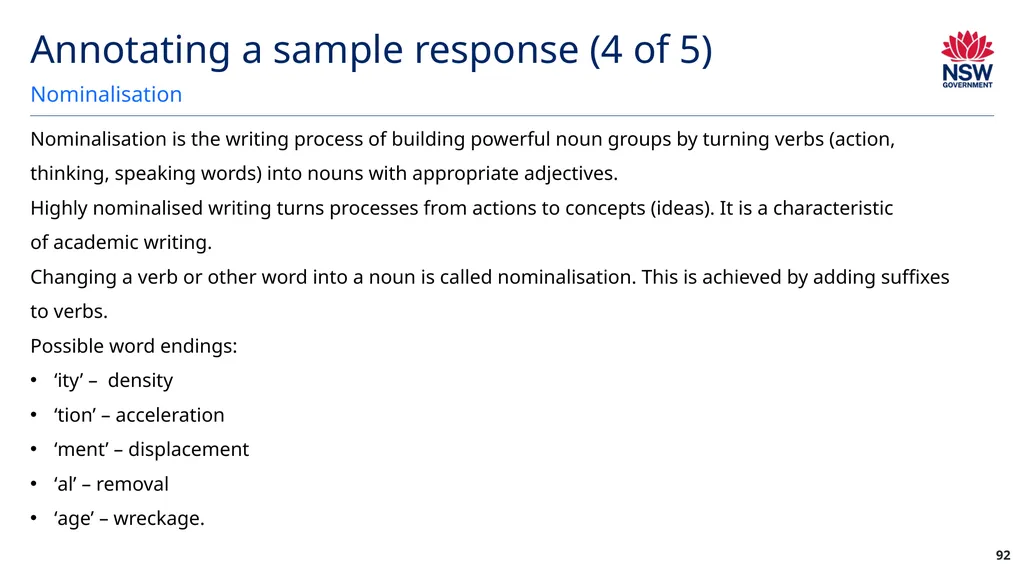
slide92. Annotating a sample response (4 of 5) Nominalisation Nominalisation is the writing process of building powerful noun groups by turning verbs (action, thinking, speaking words) into nouns with appropriate adjectives.
Highly nominalised writing turns processes from actions to concepts (ideas). It is a characteristic of academic writing.
Changing a verb or other word into a noun is called nominalisation. This is achieved by adding suffixes to verbs.
Possible word endings:
‘ity’ – density
‘tion’ – acceleration
‘ment’ – displacement
‘al’ – removal
‘age’ – wreckage. 92<br>
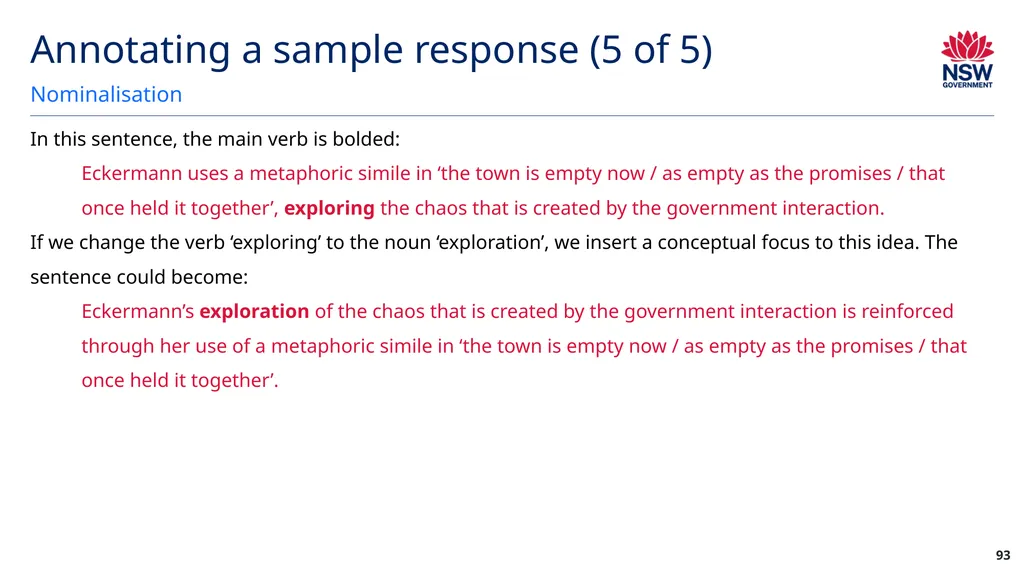
slide93. Annotating a sample response (5 of 5) Nominalisation In this sentence, the main verb is bolded:
Eckermann uses a metaphoric simile in ‘the town is empty now / as empty as the promises / that once held it together’, exploring the chaos that is created by the government interaction.
If we change the verb ‘exploring’ to the noun ‘exploration’, we insert a conceptual focus to this idea. The sentence could become:
Eckermann’s exploration of the chaos that is created by the government interaction is reinforced through her use of a metaphoric simile in ‘the town is empty now / as empty as the promises / that once held it together’. 93<br>
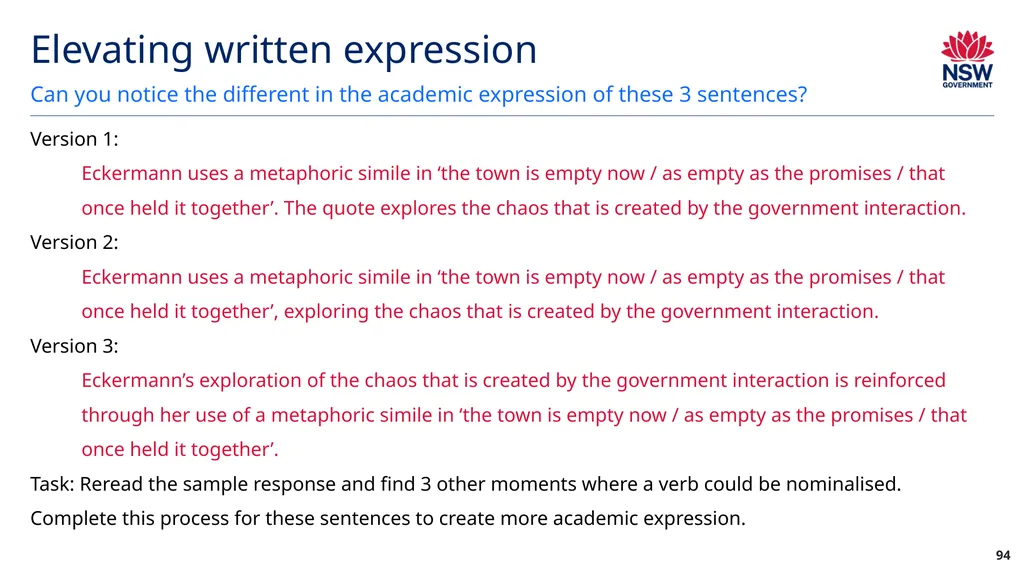
slide94. Elevating written expression Can you notice the different in the academic expression of these 3 sentences? Version 1:
Eckermann uses a metaphoric simile in ‘the town is empty now / as empty as the promises / that once held it together’. The quote explores the chaos that is created by the government interaction.
Version 2:
Eckermann uses a metaphoric simile in ‘the town is empty now / as empty as the promises / that once held it together’, exploring the chaos that is created by the government interaction.
Version 3:
Eckermann’s exploration of the chaos that is created by the government interaction is reinforced through her use of a metaphoric simile in ‘the town is empty now / as empty as the promises / that once held it together’.
Task: Reread the sample response and find 3 other moments where a verb could be nominalised. Complete this process for these sentences to create more academic expression. 94<br>
slide95. Elevating your written expression Closely examining your own writing Find a piece of extended writing you have completed during your study of this module. Reread this piece and identify opportunities to improve the 2 features you have learnt today:
sentence cohesion
nominalisation
Rewrite this response and compare the difference once completed. You may like to swap with a peer to see this in their work also. 95<br>
slide96. Copyright © State of New South Wales (Department of Education), 2023 The copyright material published in this resource is subject to the Copyright Act 1968 (Cth) and is owned by the NSW Department of Education or, where indicated, by a party other than the NSW Department of Education (third-party material).
Copyright material available in this resource and owned by the NSW Department of Education is licensed under a Creative Commons Attribution 4.0 International (CC BY 4.0) licence.
This licence allows you to share and adapt the material for any purpose, even commercially.
Attribution should be given to © State of New South Wales (Department of Education), 2023.
Material in this resource not available under a Creative Commons licence:
the NSW Department of Education logo, other logos and trademark-protected material
Material owned by a third party that has been reproduced with permission. You will need to obtain permission from the third party to reuse its material.
Links to third-party material and websites
Please note that the provided (reading/viewing material/list/links/texts) are a suggestion only and implies no endorsement, by the New South Wales Department of Education, of any author, publisher, or book title. School principals and teachers are best placed to assess the suitability of resources that would complement the curriculum and reflect the needs and interests of their students.
If you use the links provided in this document to access a third party’s website, you acknowledge that the terms of use, including licence terms set out on the third-party’s website apply to the use which may be made of the materials on that third-party website or where permitted by the Copyright Act 1968 (Cth). The department accepts no responsibility for content on third-party websites. 96<br>
Inside my Mother by Ali Cobby Eckermann<br>
slide2. Module description and glossary 1<br>
slide3. Decoding the module description Developing familiarity with the language and concepts of the module description<br>
slide4. The module description (1 of 3) Module A: Language, identity and culture Language has the power to both reflect and shape individual and collective identity. In this module, students consider how their responses to written, spoken, audio and visual texts can shape their self-perception. They also consider the impact texts have on shaping a sense of identity for individuals and/or communities. Through their responding and composing students deepen their understanding of how language can be used to affirm, ignore, reveal, challenge or disrupt prevailing assumptions and beliefs about themselves, individuals and cultural groups.
Students study one prescribed text in detail, as well as a range of textual material to explore, analyse and assess the ways in which meaning about individual and community identity, as well as cultural perspectives, is shaped in and through texts. They investigate how textual forms and conventions, as well as language structures and features, are used to communicate information, ideas, values and attitudes which inform and influence perceptions of ourselves and other people and various cultural perspectives.
Through reading, viewing and listening, students analyse, assess and critique the specific language features and form of texts. In their responding and composing students develop increasingly complex arguments and express their ideas clearly and cohesively using appropriate register, structure and modality. Students also experiment with language and form to compose imaginative texts that explore representations of identity and culture, including their own. Students draft, appraise and refine their own texts, applying the conventions of syntax, spelling and grammar appropriately and for particular effects. 4<br>
slide5. The module description (2 of 3) Decoding the module description You will need Resource 1: Decoding the module description.
As we read the module description together, underline any unknown terms and phrases.
Reread the module description independently and highlight the key words of the module description that capture the essentials of what must be studied in the module.
Using different colours, highlight the words ‘language’, ‘identity’ and ‘culture’ and note how frequently they appear.
In another colour, highlight all the verbs stated within the module statement. You can refer to Resource 2: NESA terminology for a summary of these terms. 5<br>
slide6. Personal engagement with the module description Developing knowledge of the key vocabulary and investigate its applications<br>
slide7. The module description (3 of 3) Jigsaw activity You will be assigned a section of the module description to look at closely in small groups. As you examine your section, respond to the following questions:
What are the essentials? (What are the key ideas or points?)
What does it mean? (How can I translate this into plain English?)
What questions does the module description pose? (What don’t I understand yet?) 7<br>
slide8. Extending familiarity with key vocabulary relevant to the module Engaging with important module vocabulary<br>
slide9. Defining the key terms Module A: Language, Identity and Culture Language and culture are defined in the syllabus as:
Language: A system of meaning, in spoken, written, visual and physical modes, for communicating ideas, thoughts and feelings.
Culture: The social practices and ways of thinking of a particular people or group, including shared beliefs, values, knowledge, customs, lifestyle and artefacts. 9<br>
slide10. Expanding the key terms Module A: Language, Identity and Culture How can the terms 'language' and 'culture' be defined in more detail?
What other concepts or terms do you associate with these words? 10<br>
slide11. Key terms word map Module A: Language, Identity and Culture Using Resource 3: Word map, select one concept (either language, identity or culture) and complete the word map. You will need to:
Define the term. You may use your own definition or the class definition we have jointly constructed.
Identify what you associate with the term (what is it like?) and what you don’t (what is it not like?).
Name examples from other texts that explore this concept. These could be in films, novels, TV shows or similar. 11<br>
slide12. Student engagement in the topic 2<br>
slide13. Student engagement and orientation to the module concepts – perceptions of culture Understanding the dangers that arise from relying on preconceived notions of culture, and considering how this occurs within your own contextual environment<br>
slide14. The power of language (1 of 2) The danger of a single story (18:33) by Chimamanda Ngozi Adichie Before we watch the TED talk, consider as a class what preconceived ideas about poverty and violence in Africa you may have encountered.
As you view the clip, take notes about insightful conceptual statements made by Adichie regarding inaccurate perceptions of culture and the perceived realities of tradition.
After viewing, brainstorm responses to the following question: How have inaccurate perceptions of African culture influenced Adichie's life? Using this class brainstorm, respond in a paragraph summarising your understanding. 14<br>
slide15. The power of language (2 of 2) The danger of a single story (18:33) by Chimamanda Ngozi Adichie Adichie's TED talk offers an interesting parallel to preconceived ideas about Aboriginal cultures in Australia.
What examples of inaccurate perceptions of Aboriginal cultures have you encountered or are aware of?
How have inaccurate perceptions of Aboriginal cultures shaped modern Australia? 15<br>
slide16. Engagement in module ideas through the poem 'Trance' Engaging with the poem ‘Trance’ as a first impression of Eckermann’s poetry<br>
slide17. ‘Trance’ Consolidating our learning on cultural understanding Listen to Eckermann read her poem, ‘Trance’ (1:49) and read along with your printed copy.
After reading, discuss as a class:
What imagery is found in the poem that evokes Aboriginal cultures and experiences?
Which aspects of cultural experience do you not understand or possess prior knowledge to recognise?
Based on what you have just learnt about cultural perceptions and the dangers of single stories, what might be the impact and benefits on you studying the poetry of Eckermann? 17<br>
slide18. Introducing the prescribed text 3<br>
slide19. Exploring the personal, social and historical context of the composer Engaging with Eckermann as a composer and developing a biographical understanding of her life, and the connections to her personal experience in her work<br>
slide20. Who is Ali Cobby Eckermann? (1 of 3) Red Room Poetry interview In the clip we are about to watch, Eckermann describes poetry as being both a ‘liberation’ and a ‘medicine’ to her?
Why would someone need to be liberated?
Why would a person require medication?
Can poetry liberate and medicate a person? What does Eckermann’s use of figurative language suggest to you about her view on poetry?
Keep the idea of ‘liberation’ and ‘medicine’ in your mind as we view the clip ‘About Ali Cobby Eckermann’ (7:04).
Complete a think, pair and share with a partner. What do you think Eckermann means when she says that ‘poetry is liberation and medicine’? Consider your prior understanding of historical context. 20<br>
slide21. Who is Ali Cobby Eckermann? (2 of 3) Read and view the following texts to gain an understanding of Eckermann ABC News article – 'Indigenous poet Ali Cobby Eckermann turns life of pain into poetry success'
NITV article – 'My entire view of the world changed when I had the proof that I'd been wanted’
Optional (requires ClickView login) TV episode – 'Our Stories: Inside My Mother, Ali Cobby-Eckermann' 21<br>
slide22. Who is Ali Cobby Eckermann? (3 of 3) Personal reflection Compose a written, personal reflection answering the following driving question:
‘What is it about life events that makes them significant enough to be documented as a public representation of culture and identity?’ 22<br>
slide23. Exploring context and form through a close reading of ‘Trance’ Developing an analytical understanding of the poem ‘Trance’<br>
slide24. ‘Trance’ (1 of 6) Reading the poem On the surface, 'Trance' provides a distinctively traditional image of an Aboriginal woman.
Listen to Eckermann reading 'Trance’ (1:49) and make annotations of poetic devices and structures used. Some devices and structures to note are:
two stanzas
four lines each
free verse
possessive apostrophe as the only punctuation
written to ‘honour the love of our old people’
shows connection to Country through instinct
persona remembers married life before her husband died
Eckermann states that the woman uses Pituri, a traditional bush tobacco, hence her dreaming of former times: her trance. 24<br>
slide25. ‘Trance’ (2 of 6) Personal reflections on the poem View Eckermann reflecting on her poem 'Trance’ (3:44).
As you watch, consider how Eckermann explains her motivations and discusses the pain and peace that are rooted in the protagonist's experience of loss.
What parallels exist between the persona's personal loss and the collective loss experienced by Aboriginal peoples? 25<br>
slide26. ‘Trance’ (3 of 6) Exploring Part I Construct a visual representation that highlights the similarities between the protagonist’s personal loss and the broader suffering endured by Aboriginal peoples. Poet's personal
experience Broader experience of Aboriginal peoples 26<br>
slide27. ‘Trance’ (4 of 6) Exploring Part I Read Part I of ‘Trance’ (stanzas 1 and 2).
Make careful annotations of stanzas 1 and 2 based on the following prompts and ideas:
Consider the title of the poem. The word trance can be traced back to the following meaning; transire (Latin) – go across, transir (old French) – depart, or to fall into a trance (middle English). Annotate how the word could link to and be symbolic of memory and the past.
What connotations can you find that connect with the phrase ‘mist over’? Note on your poem the use of emotive imagery.
What techniques can you identify in the second line of the poem? Highlight where Eckermann has used connotation and personification. What impact do these techniques have on meaning?
Highlight the traditional imagery evident in the first line of the second stanza.
Explore the metaphor ‘the sound of instinct’. What meaning and connections to ideas and values does it have? 27<br>
slide28. ‘Trance’ (5 of 6) Exploring Part II Read Part II of ‘Trance’ (stanzas 3 to 7).
Make careful annotations of stanzas 3 to 7 based on the following prompts and ideas:
What contrasts are contained in the third stanza? How does the persona of the poem connect to these contrasts?
How does Eckermann use imagery to capture the persona’s sensory experience of nature in the fourth stanza?
What is the effect of the use of personification in the fifth stanza?
How does Eckermann continue the contrasting imagery in the sixth stanza?
How does Eckermann create a closing image of calmness, despite the sorrow? 28<br>
slide29. ‘Trance’ (6 of 6) Exploring the poem as a whole Consider the poem in its entirety and make careful annotations based on the following prompts and ideas:
The persona is largely physically passive. Read through the poem and track her physical movements. How do her actions contribute to the notion of being in a trance?
The persona is able to reconnect with the man she has lost through her memories. What role does the natural world play in this connection?
Consider the form of the poem. There is no punctuation or capital letters. How does the form of the poem mirror the experience of being in a trance? 29<br>
slide30. Exploring motif through a close reading of ‘Eyes’ Exploring the effect of motif in creating meaning<br>
slide31. Making connections Reflect on similarities and differences between ‘Trance’ and ‘Eyes’ How are the poems ‘Trance’ and ‘Eyes’ different from one another?
What similarities do they share? Consider the meaning of the poems and their form.
Consider what type of eyes the protagonist wears in ‘Trance’.
Consider the poem’s connections to spirituality and connection to history. How do these connections impact the protagonist of the poems? 31<br>
slide32. ‘Eyes’ (1 of 4) Reading the poem This poem represents the different ways women may approach challenging and daunting situations in their life and the different masks one must wear in the face of these situations.
Listen to Eckermann reading ‘Eyes’ (1:00) and make annotations of poetic devices and structures used. Some devices and structures to note are:
four stanzas
four lines per stanza
the different aspects of the persona’s identity
the use of synecdoche to explore a woman’s position in a patriarchal society
the use of anaphora for the repetitious nature of the persona’s experience
the change in atmosphere to establish a shift in power. 32<br>
slide33. ‘Eyes’ (2 of 4) Personal reflections on the poem View Eckermann reflecting on her poem ‘Eyes’ (2:10).
As you watch, consider how Eckermann explains her motivations and discusses the pain and peace that are rooted in the protagonist's experience of domestic violence and the normal reactions to challenging life experiences.
What are the multi-layered meanings of the poem? How does this poem explore and give recognition to the challenges faced by Aboriginal women and all women? 33<br>
slide34. ‘Eyes’ (3 of 4) Exploring the progression of persona in the poem Multiple eyes are contained in the poem. These are:
staring eyes
eyes of terror
eyes of submission
eyes of shame
eyes of contempt
eyes of compassion
watching eyes
eyes of rage.
What situations would require a person to wear each set of eyes? Consider how these eyes could be worn through a lived experience or pretending to be worn as an act of self-protection. 34<br>
slide35. ‘Eyes’ (4 of 4) Exploring the motif in the poem ‘Eyes are a window to the soul’
Consider the motif of the eye and how it is a symbol of our inner thoughts, feelings and emotions. Read through the poem and explore the way Eckermann has used the motif to explore the history, experiences and layered emotions of women in domestic and challenging situations.
How does the motif change and develop throughout the poem? Consider and conclude how the changing nature of the motif establishes meaning. 35<br>
slide36. The masks you wear Which masks do you wear? Reflect on your own position in the world and answer the following questions.
How do you present yourself to the world?
How do you intend for others to perceive you?
What inaccurate assumptions might be made about you?
Describe a time or circumstance where you presented a façade to protect yourself? 36<br>
slide37. Contextual connections Visual representation Create a visual representation of the different eyes, or masks, represented in the poem.
Assign each set of eyes an image that visually represents the experiences associated with the mask. Rather than choosing a literal image, for example a frightened face for eyes of terror, choose an image that has a symbolic meaning.
Justify your choice of image for each set of eyes by sharing with the class or a small group.
Connect sets of eyes to the collective experience of the Aboriginal community and discuss the experiences and feelings they may represent. 37<br>
slide38. Engaging critically with texts 4<br>
slide39. Critical engagement through reconsidering definitions Deepening appreciation of Eckermann’s poetry by reconsidering notions of family and Country through the lens of First Nations beliefs and values<br>
slide40. Family, kin and Country Definitions from the Cambridge Dictionary Family: a group of people who are related to each other, such as a mother, a father, and their children.
Kinship: the relationship between members of the same family.
Country: an area of land that forms an independent political unit with its own government; a nation considered especially as a place. 40<br>
slide41. Understanding family, kin and Country through a First Nations lens Compare the previous definitions to the following:
Kinship, as defined by Australians Together: Kinship is at the heart of First Nations society. A person’s position in the kinship system establishes their relationship to others and to the universe, prescribing their responsibilities towards other people, the land and natural resources. Traditional kinship structures remain important in many First Nations communities today. There are over 500 Aboriginal and Torres Strait Islander nations across this continent, which cover wide geographical areas, and have distinct borders. Within these nations there are clan groups, and within the clan groups there are family groups. Clan groups share a common language and kinship system, which is based on either patrilineal or matrilineal lines of descent. There are three levels of kinship in First Nations society: Moiety, Totem and Skin Names.
Country, as defined by AIATSIS: Country is the term often used by Aboriginal peoples to describe the lands, waterways and seas to which they are connected. The term contains complex ideas about law, place, custom, language, spiritual belief, cultural practice, material sustenance, family and identity. 41<br>
slide42. Forming your own definitions Personal reflection How do you define family, kin and Country?
Reflect personally on what each of these terms means to you in a paragraph. Has your understanding of these terms been changed by considering them through a First Nations lens? 42<br>
slide43. Kinship and the Stolen Generation A Look Inside the Heartbreaking Story of Australia’s “Stolen Generation” View the clip “A Look Inside the Heartbreaking Story of Australia's Stolen Generation” (3:54).
In the clip, Deanne Kenyon tells the story of her grandparents and their experiences with the Stolen Generation. Each of the points below comes from the definition of kinship you read earlier. For each point, discuss the impact the Stolen Generation would have had on Aboriginal families and their kinship.
Kinship is at the heart of First Nations society.
A person’s position in the kinship system establishes their relationship to others and to the universe, prescribing their responsibilities towards other people, the land and natural resources.
Traditional kinship structures remain important in many First Nations communities today.
Within the over 500 Aboriginal and Torres Strait Islander nations there are clan groups, and within the clan groups there are family groups.
Clan groups share a common language and kinship system, which is based on either patrilineal or matrilineal lines of descent. 43<br>
slide44. Poem – ‘Leaves’ Developing a detailed understanding of the poem ‘Leaves’<br>
slide45. ‘Leaves’ (1 of 4) Reading the poem This poem is autobiographical and references Eckermann’s connections with family and culture. The leaves are symbolic of the pieces of culture and family her father gave to her. It explores the impact of connecting and creating cultural identity.
Listen to Eckermann reading ‘Leaves’ (1:06) and make annotations of poetic devices used. Some devices to note are:
tense changes between stanzas 4 and 5
symbolism
enjambment
the atmosphere of contentment
changes in the persona’s engagement with the leaves
seven stanzas
rhetorical questions
three lines per stanza. 45<br>
slide46. ‘Leaves’ (2 of 4) Personal reflections on the poem View Eckermann reflecting on her poem ‘Leaves’ (1:47).
Eckermann explains the autobiographical nature of the poem and the connection it has to family and her father.
How does she explain the symbolism of the leaves and what do they represent?
Consider what aspect of Eckermann’s identity is explored through this poem and her feeling towards this aspect of her life and person.
In what ways does the poem explore a connection to Country? Explore how personification of the environment connects the poem to Country. 46<br>
slide47. ‘Leaves’ (3 of 4) Exploring meaning in the poem The representation of the Stolen Generation is explored throughout this poem. It is autobiographical and describes Ali Cobby Eckermann meeting her father for the first and last time. What clues can you see that hint at this being their first meeting? What atmosphere is associated with this life event and how does the poem express her feeling towards meeting her father?
Can you identify specific quotations from the poem that allude to Eckermann’s personal experience with the Stolen Generation? 47<br>
slide48. ‘Leaves’ (4 of 4) The role of the persona The persona is the speaker of a poem. A poet creates a persona in the same way that an author creates a character in a fiction novel.
While ‘Eyes’ and ‘Trance’ adopt an unknown persona that embodies the experience of Aboriginal women, ‘Leaves’ is a more personal piece that draws on Eckermann’s own personal experience.
The poem is deeply personal and the interview you just watched reveals the biographical nature of the poem.
In what ways does Eckermann use her own personal experience to simultaneously explore her own personal history and the shared history of Aboriginal cultures? 48<br>
slide49. Poem – ‘Key’ Developing a detailed understanding of the poem ‘Key’<br>
slide50. ‘Key’ (1 of 2) Reading the poem Eckermann explores her parentage and regresses back to childhood. The poem explores the significance of both her adoptive German grandmother and her Aboriginal grandmother, whom she met in her adult life. Like ‘Leaves’, ‘Key’ highlights that when we are in the presence of our parents and grandparents we regress to childhood.
Listen to Eckermann reading ‘Key’ (2:25) and make annotations of poetic devices used. Some devices to note are:
imagery of Eckermann as a child
metaphor of time
atmosphere of calm and connection
references to physical distance
imagery of the two different maternal grandmothers, the German grandmother and the Aboriginal grandmother. 50<br>
slide51. ‘Key’ (2 of 2) Personal reflection on the poem View Eckermann reflecting on her poem ‘Key’ (4:01).
Consider what Eckermann says about her family and the women in her family. How do they inform her identity?
How is the key metaphorical? What deeper meaning does this metaphor hold for both Eckermann and Aboriginal peoples? 51<br>
slide52. ‘Key’ and ‘Leaves’ Contrasting the poems for meaning Both ‘Key’ and ‘Leaves’ explore relationships with family that Eckermann reconnected with as an adult. In describing the connections in each poem, there also exists a distance.
Explore the contrasting language and images of both poems. Why might Eckermann change her diction when discussing maternal and paternal relationships?
Using Resource 4: Comparison of ‘Key’ and ‘Leaves’, complete the comparison table exploring the similarities and differences. 52<br>
slide53. Connecting and deepening responses to the prescribed text 5<br>
slide54. Deepening understanding through personal response to Gordon Bennett’s ‘Self Portrait’ Engaging with visual representations of Aboriginal cultures and experience through transferring understanding of Eckermann’s poetry to the works of Aboriginal artists engaging in self-expression through art<br>
slide55. Deepening understanding through personal response to Gordon Bennett’s Self Portrait Deepening and connecting your understanding Gordon Bennett (1955–2014) was a First Nations contemporary artist, who lived and worked in Brisbane.
The Museum of Contemporary Art describes Bennett as someone whose ‘…bold and humane art challenged racial stereotypes and provoked critical reflection on Australia’s official history and national identity. Bennett was one of Australia’s most significant and critically engaged contemporary artists, addressing issues relating to the role of language and systems of thought in forging identity.’
Before examining the final 2 poems, we are going to deepen our understanding of the complex notions of identity by making connections with the ideas of Eckermann’s poetry and Bennett’s art. 55<br>
slide56. Gordon Bennett Deepening and connecting your understanding View the promotional clip (1:00) from Queensland Gallery of Modern Art’s 2021 exhibition Unfinished Business: The Art of Gordon Bennett to gain a sense of Bennett’s artistic style.
Reflection task: before we look at the work, Self Portrait, reflect on your own personal identity. Spend 5 minutes responding to the prompt ‘I am …’.
You may wish to write a paragraph, or a series of dot points.
Post reflection task:
How easily did you think of what to write in response to this prompt?
How many of your statements reflect certain beliefs you hold of yourself?
Was it easy to identify these qualities, or did you need to think deeply about who you are?
How does your process of responding to the personas of ‘Trance’, ‘Eyes’, ‘Leaves’ and ‘Key’ differ? 56<br>
slide57. What is a self-portrait? Deepening and connecting your understanding What is a self-portrait? Consider the famous Picasso quote about painting a self-portrait: ‘Are we to paint what's on the face, what's inside the face, or what's behind it?’
Would you consider your school photo a self-portrait? Why or why not?
Image search the term ‘self-portrait’ and other variations. Share 2 images to the class Jamboard that resonate most strongly with you as an example of a self-portrait.
Once all images have been collected, discuss the similarities and differences of the choices made by the class. 57<br>
slide58. Gordon Bennett, ‘Self Portrait’ (1 of 2) Responding to Self portrait (But I always wanted to be one of the good guys) View the artwork via the National Gallery of Victoria. The full title of the piece is Self portrait (But I always wanted to be one of the good guys).
In the process of viewing, discuss the following:
What sense of Bennett’s self-identity emerges from the artwork?
What visual features contribute to your interpretation of the artwork? 58<br>
slide59. Gordon Bennett, ‘Self Portrait’ (2 of 2) Responding to Self portrait (But I always wanted to be one of the good guys) The following statements come from the accompanying educational resource from the National Gallery of Victoria. Complete a think, pair, share for each statement, connecting your own interpretation with the ideas below.
Gordon Bennett’s art challenges us to question the stereotypes and racist labelling of Aboriginal Australians found in some history books written for and by Europeans.
[The artwork] questions how stereotypes create a sense of identity. Bennett investigates the way stereotypes are constructed by exploring words and images in opposites.
The powerful image/word ‘I AM’, while central, is accompanied by statements of opposite, ‘I am light – I am dark’.
This artwork is constructed of obvious layers: The layers of dots, reminiscent of Aboriginal Western Desert dot painting, with lines of perspective – a Western tradition.
This rich interplay of words and images raises many questions. 59<br>
slide60. Julie Dowling, ‘Self-portrait: in our country’ Making connections with other artworks View the artwork by Julie Dowling, Self-portrait: in our country.
In pairs or small groups, consider the artwork and prepare one statement, similar to the Gordon Bennett statements you just read, that offers an interpretation of Dowling’s work and its impact.
We will compile these statements into a class collection, to repeat the think-pair-share process by responding to your peers’ statements. 60<br>
slide61. Poem – ‘Oombulgarri’ Developing a detailed understanding of the poem ‘Oombulgarri’<br>
slide62. ‘Oombulgarri’ context research Research one of the following places, and prepare a short summary presentation Oombulgarri
Forrest River massacre
The Gunbarrel Highway
Kati Thanda-Lake Eyre
Ooldea Soak
Hindmarsh Island
In your summary, address the following:
location, including the First Nations Country
the significance and importance to First Nations history
any other relevant information. 62<br>
slide63. ‘Oombulgarri’ (1 of 4) Reading the poem ‘Oombulgarri’ informs the responder of modern dispossession and removal from Country. Eckermann explores the impact of this dispossession and encourages the responder to reflect on the actions of the government.
Listen to Eckermann reading ‘Oombulgarri’ (1:09) and make annotations of poetic devices used. Some devices to note are:
imagery
emotive language
simile
alliteration
repetition. 63<br>
slide64. ‘Oombulgarri’ (2 of 4) Prompting questions Before we view Eckermann speaking about the poem, consider the following questions:
What do you think it is about?
What tone is evoked?
What gives you this impression?
What is the significance of ‘blue pattern dresses’? Did that detail stand out to you?
How is it similar to the poems we have already studied?
How is it different?
What line or stanza stands out to you the most? 64<br>
slide65. ‘Oombulgarri’ (3 of 4) Personal reflection on the poem View Eckermann reflecting on her poem ‘Oombulgarri’ (3:46).
In the interview, she says “I’m hoping to plant curiosity in the reader that they’ll go ‘what’s Ombulgarri?’, and we all have access to Google now and, you know, a fast way of learning, and so much is recorded via phones and even people in remote areas being able to upload things on to the community. So I guess it’s a bit of a challenge too, for the reader to research the place names, and to find out the bigger story of these places.”
Reflection task: Did you feel the curiosity and think ‘what’s Ombulgarri?’ Did you feel challenged by Eckermann to research and know more about the bigger story of Ombulgarri? What does this suggest to you about the power and potential of poetry as a tool for reflection and education in wider Australian society? 65<br>
slide66. ‘Oombulgarri’ (4 of 4) Creative response Reread the poem and make a list of all the words that hold negative connotations.
Using these words as a starting point, compose at least one additional stanza to this poem, capturing the desertion of Oombulgarri. 66<br>
slide67. Poem – ‘Unearth’ Developing a detailed understanding of the poem ‘Unearth’<br>
slide68. ‘Unearth’ (1 of 3) Reading the poem ‘Unearth’ celebrates the future successes and achievements of Aboriginal peoples, rooted in the dark truth of Aboriginal history.
Listen to Eckermann reading ‘Unearth’ (1:11) and make annotations of poetic devices used. Some devices to note are:
stanza and line structures
symbolism of boomerang
symbolism of earth
metaphor
inclusive pronouns
change of tense. 68<br>
slide69. ‘Unearth’ (2 of 3) Personal reflection on the poem View Eckermann reflecting on her poem ‘Unearth’ (4:04).
In this interview, Eckermann balances the future successes and achievements of Aboriginal peoples and wider Australian society against the ‘blood on the truth’ of Aboriginal history.
As you view the interview, take notes under the 2 columns below. Words that reflect optimism and hope Words that reflect oppression and suffering 4. How does Eckermann synthesise these 2 perspectives in the conclusion of her interview? 69<br>
slide70. ‘Unearth’ (3 of 3) Making connections across the prescribed poems We are now going to start drawing more connections between Eckermann’s poems.
Resource 5 – Connecting the meaning of ‘Unearth’ lists a number of quotes from the poem. For each quote, explain what connotations and meanings this line creates for you in both ‘Unearth’ and another of Eckermann’s poems you have studied. 70<br>
slide71. Writing in response to the module and text 6<br>
slide72. The symbolic meaning of Inside my Mother Developing an appreciation of the interwoven connotations within the prescribed poems<br>
slide73. Inside my Mother (1 of 5) Connotations of ‘mother’ The cover of Inside my Mother shows a fish trap that the poet has woven from old fence wire, painted brightly. Like her sculptures, Eckermann's poems use simple elements to weave something complex, delicate and strong. The word ‘mother’ has many connotations and each of those are layered in Eckermann’s poems.
What connotations of mother exist in your reading of Eckermann’s poetry? 73<br>
slide74. Inside my Mother (2 of 5) Mother as a familial figure Mother, as a familial figure, is one connotation. The dedication of Inside my Mother reads:
‘This book is dedicated to my mothers
Mum Audrey, Ngingali, Aunty Mabel,
Aunty Lorna, Aunty Lola, Aunty Nura,
who in their passing strengthened me
to know who I am
and to
Mum Freida and Mum Jennifer
who still remain
my dearest friends’
Eckermann’s poetry widens the concept of mother beyond a single person, encompassing both her personal experience and Aboriginal notions of kinship. 74<br>
slide75. Inside my Mother (3 of 5) Motherland There is also the notion of mother as mother Country or motherland, with all of its cultural history and spiritual connection. This is the land to which Eckermann belongs and her connection to the histories and traditions of Aboriginal peoples. 75<br>
slide76. Inside my Mother (4 of 5) Mother tongue Another connotation is the notion of mother tongue, that being the Aboriginal languages that have been lost through colonisation. In one of Eckermann’s poems not set for study, ‘Lament’, she writes ‘I am the last speaker / of my mother tongue’. Eckermann’s mother tongue has been submerged but remains as a ghost through the work. Eckermann’s poems are written in English but there is a combination of vernacular alongside the ‘voice’ of the natural world: birdsong, water, rock, tribal music, and the collective sound of a nation (Cobby Eckermann 2015:24). 76<br>
slide77. Inside my Mother (5 of 5) Familial mother, motherland and mother tongue Use Resource 6 – Connotations of mother to track these connotations across Eckermann’s body of work. For each connotation, find evidence from 2 different poems where this symbolic meaning can be found. 77<br>
slide78. The power of the poetic word Developing an understanding of Eckermann’s choices as a poet, and the power of her poetic words on others<br>
slide79. The power of the poetic word – reflection Poetry as a tool for reflection Eckermann’s poetry is both a deeply personal reflection of her own unique human experience, and the shared collective experience of many Aboriginal people. Her poetry also entices the reader to reconsider their assumed knowledge, or lack of knowledge, of the experiences of Aboriginal peoples.
Eckermann describes her writing experiences as “I think I wrote them as chapters, in reflection that I mentioned before, in that time of grief with my mother, I was doing a lot of reflection. So they’re like chapters. And I guess that’s also a gift to read. One chapter: pause, reflect. Go to the next chapter: pause, reflect. Most things as I see (with) Aboriginal culture there’s always a journey, so with even in my literature, there’s little journeys embedded.”
Discussion question: In what ways does Eckermann’s poetry offer the reader a powerful journey? 79<br>
slide80. Poetic style Punctuation Unique to Eckermann’s poetic style is her minimal use of punctuation.
View Eckermann reflecting on Inside my Mother (9:31). Take notes of the ideas she discusses, particularly when discussing her choices in using punctuation. This section starts at 3:20.
Resource 7 – poetic style lists 3 quotes from the interview. For each quote, respond to the question posed to deepen your understanding and appreciation of Eckermann’s conscious choices as a poet. 80<br>
slide81. Drawing ideas together into concept summaries Determining the conceptual ideas of Eckermann’s poetry and making connections between the poems to draw these ideas together<br>
slide82. Drawing together the ideas of Eckermann’s poetry (1 of 2) Considering Eckermann’s body of work Eckermann’s poetry, when considered as a whole text, offers personal insights and explores many powerful ideas that are reinforced when considered across multiple poems.
Spend a few minutes in pairs or small groups and write a list of the ideas Eckermann explores in her poetry. 82<br>
slide83. Drawing together the ideas of Eckermann’s poetry (2 of 2) Considering Eckermann’s body of work Some possible ideas you may have identified are:
connection to culture
dispossession
family and kinship
connections to land and Country
natural world.
Add any class ideas to this list. 83<br>
slide84. Chalk talk Drawing together the ideas of Eckermann’s poetry Around the room there are several chalk talk sheets. Each sheet of paper corresponds to an idea found in Eckermann’s poems. This process allows you to think about your own ideas, and consider the ideas of others, through silent reflection. To complete the chalk talk process, you will need to do the following:
Think about the idea written at the top of the sheet, and where this is reflected in the 6 poems you have studied.
Under the heading of each poem, find quotes which reflect this idea. In brackets you could identify the technique used or expand on your idea.
As you walk around the room, read the ideas your peers have written. You can place a tick on any ideas you agree with, or draw an arrow and add to their ideas.
Continue rotating around the room reading and adding to the sheets. When you have finished, return to your desk. 84<br>
slide85. Narrowing your focus (1 of 2) Looking at one idea In groups, you will be given one of the chalk talk sheets. In your group, discuss the idea first. Respond to the following questions and take notes while you discuss:
How is this idea personally important to Eckermann, based on your knowledge of her context and personal experiences?
What message is Eckermann communicating to her readers through exploring this idea?
What deeper understanding of this idea have you gained through studying Eckermann’s poems?
After discussing, select 2 poems which you feel most strongly explore your idea. 85<br>
slide86. Narrowing your focus (2 of 2) Analysing through writing In groups, compose a paragraph explaining the importance of your idea to Eckermann’s poetry. In your paragraph, discuss the deeper understanding she has offered readers and justify this by making reference to 2 of her poems. 86<br>
slide87. Preparing critical responses 7<br>
slide88. Annotating a sample response Examining a sample response to identify the strengths and weaknesses, and transferring this process to your own writing<br>
slide89. Annotating a sample response (1 of 5) Identifying the strengths and weaknesses Read Resource 9 – sample student response.
This response was written in response to the 2019 HSC question:
Poetry relies primarily on symbolism to create cultural tension. To what extent do you agree with this statement? In your response, make detailed reference to your prescribed text.
A strength of this response is its strong personal voice. A weakness is the fluency of the overall expression. Read the response and make annotations in the right column identifying the strengths of this response, and any feedback you would give to this student. 89<br>
slide90. Annotating a sample response (2 of 5) Improving sentence cohesion You may notice that this sample response is not always fluent in its expression. Consider these 2 sentences:
Eckermann uses a metaphoric simile in ‘the town is empty now / as empty as the promises / that once held it together’. The quote explores the chaos that is created by the government interaction.
The fluency of these 2 sentences can be improved by focusing on the overall cohesion of the language. This can be done by removing a common phrase that is not needed to make meaning in your writing: ‘the quote’. 90<br>
slide91. Annotating a sample response (3 of 5) Improving sentence cohesion By removing ‘the quote’, this student can combine these 2 sentences to improve the fluency of their expression. The 2 sentences:
Eckermann uses a metaphoric simile in ‘the town is empty now / as empty as the promises / that once held it together’. The quote explores the chaos that is created by the government interaction.
Become one sentence in:
Eckermann uses a metaphoric simile in ‘the town is empty now / as empty as the promises / that once held it together’, exploring the chaos that is created by the government interaction.
Now, they are explicitly acknowledging Eckermann as the composer and analysing her poetic choices.
Task: Reread the sample response and find 3 other moments where ‘the quote’ or similar is used. Combine these sentences to create more fluent expression. 91<br>
slide92. Annotating a sample response (4 of 5) Nominalisation Nominalisation is the writing process of building powerful noun groups by turning verbs (action, thinking, speaking words) into nouns with appropriate adjectives.
Highly nominalised writing turns processes from actions to concepts (ideas). It is a characteristic of academic writing.
Changing a verb or other word into a noun is called nominalisation. This is achieved by adding suffixes to verbs.
Possible word endings:
‘ity’ – density
‘tion’ – acceleration
‘ment’ – displacement
‘al’ – removal
‘age’ – wreckage. 92<br>
slide93. Annotating a sample response (5 of 5) Nominalisation In this sentence, the main verb is bolded:
Eckermann uses a metaphoric simile in ‘the town is empty now / as empty as the promises / that once held it together’, exploring the chaos that is created by the government interaction.
If we change the verb ‘exploring’ to the noun ‘exploration’, we insert a conceptual focus to this idea. The sentence could become:
Eckermann’s exploration of the chaos that is created by the government interaction is reinforced through her use of a metaphoric simile in ‘the town is empty now / as empty as the promises / that once held it together’. 93<br>
slide94. Elevating written expression Can you notice the different in the academic expression of these 3 sentences? Version 1:
Eckermann uses a metaphoric simile in ‘the town is empty now / as empty as the promises / that once held it together’. The quote explores the chaos that is created by the government interaction.
Version 2:
Eckermann uses a metaphoric simile in ‘the town is empty now / as empty as the promises / that once held it together’, exploring the chaos that is created by the government interaction.
Version 3:
Eckermann’s exploration of the chaos that is created by the government interaction is reinforced through her use of a metaphoric simile in ‘the town is empty now / as empty as the promises / that once held it together’.
Task: Reread the sample response and find 3 other moments where a verb could be nominalised. Complete this process for these sentences to create more academic expression. 94<br>
slide95. Elevating your written expression Closely examining your own writing Find a piece of extended writing you have completed during your study of this module. Reread this piece and identify opportunities to improve the 2 features you have learnt today:
sentence cohesion
nominalisation
Rewrite this response and compare the difference once completed. You may like to swap with a peer to see this in their work also. 95<br>
slide96. Copyright © State of New South Wales (Department of Education), 2023 The copyright material published in this resource is subject to the Copyright Act 1968 (Cth) and is owned by the NSW Department of Education or, where indicated, by a party other than the NSW Department of Education (third-party material).
Copyright material available in this resource and owned by the NSW Department of Education is licensed under a Creative Commons Attribution 4.0 International (CC BY 4.0) licence.
This licence allows you to share and adapt the material for any purpose, even commercially.
Attribution should be given to © State of New South Wales (Department of Education), 2023.
Material in this resource not available under a Creative Commons licence:
the NSW Department of Education logo, other logos and trademark-protected material
Material owned by a third party that has been reproduced with permission. You will need to obtain permission from the third party to reuse its material.
Links to third-party material and websites
Please note that the provided (reading/viewing material/list/links/texts) are a suggestion only and implies no endorsement, by the New South Wales Department of Education, of any author, publisher, or book title. School principals and teachers are best placed to assess the suitability of resources that would complement the curriculum and reflect the needs and interests of their students.
If you use the links provided in this document to access a third party’s website, you acknowledge that the terms of use, including licence terms set out on the third-party’s website apply to the use which may be made of the materials on that third-party website or where permitted by the Copyright Act 1968 (Cth). The department accepts no responsibility for content on third-party websites. 96<br>