
Year 2, Unit 7 Shape Curriculum Prioritisation for
Description: Year 2, Unit 7 Shape Curriculum Prioritisation for Primary Maths These materials heavily reflect the prioritisation approach of the ready-to-progress criteria in the DfE Primary Mathematics Guidance 2020 and on the PPTs that exemplify them
Related Topics
Download Presentation
"Year 2, Unit 7 Shape Curriculum Prioritisation for" is the property of its rightful owner. Permission is granted to download and print the materials on this website for personal, non-commercial use only, and to display it on your personal computer provided you do not modify the materials and that you retain all copyright notices contained in the materials. By downloading content from our website, you accept the terms of this agreement.
Presentation Transcript
slide1. Year 2, Unit 7 Shape<br>
slide2. Curriculum Prioritisation for Primary Maths These materials heavily reflect the prioritisation approach of the ready-to-progress criteria in the DfE Primary Mathematics Guidance 2020 and on the PPTs that exemplify them on the NCETM website. They also include other relevant National Curriculum content. Related sections of the NCETM Primary Mastery Professional Development Materials provide small-step teaching guidance.
Ready-to-progress criteria addressed by this unit
Teaching of this unit supports the following criteria from the ‘DfE Mathematics Guidance: key stages 1 & 2’ (the 335-page document available as a download)
2G-1 Page 74
Prior learning
If the following ready-to-progress criteria, contained in the same DfE guidance document as above, were secured in Year 1, children will be ready to start on this unit.
1G-1 Page 42 Year 2, Unit 7<br>
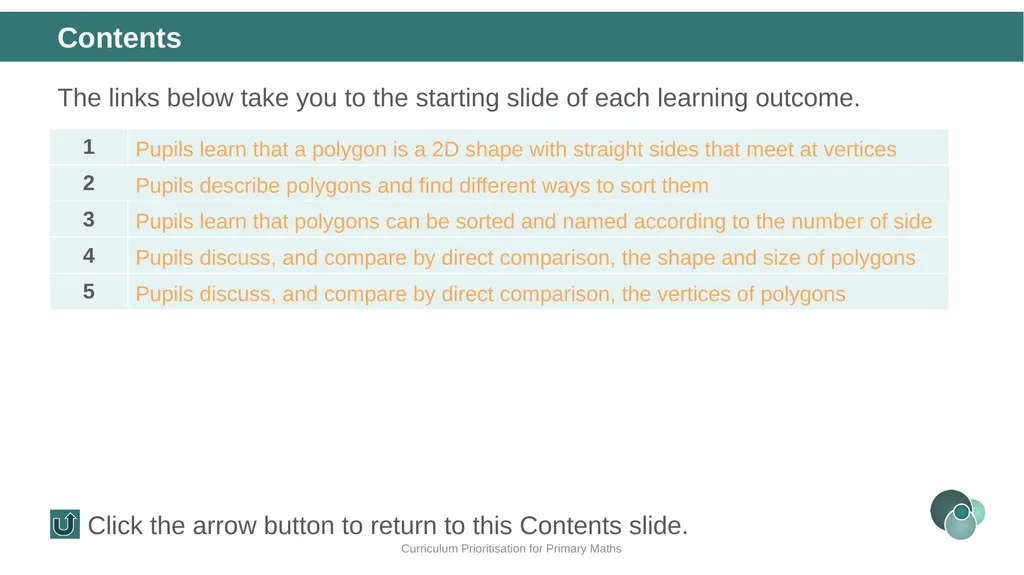
slide3. Curriculum Prioritisation for Primary Maths The links below take you to the starting slide of each learning outcome. Click the arrow button to return to this Contents slide. Contents<br>
slide4. Curriculum Prioritisation for Primary Maths The links below take you to the starting slide of each learning outcome. Click the arrow button to return to this Contents slide. Contents<br>
slide5. Curriculum Prioritisation for Primary Maths The following slides have been collated to support the teaching of this learning outcome. Year 2, Unit 7, Learning Outcome 1<br>
slide6. Year 2, Unit 7, Learning Outcome 1 Curriculum Prioritisation for Primary Maths Additional teacher guidance for this outcome should be read first and can be found in the DfE Mathematics guidance. Page references relate to the 335-page document available as a download at the bottom of this web page.<br>
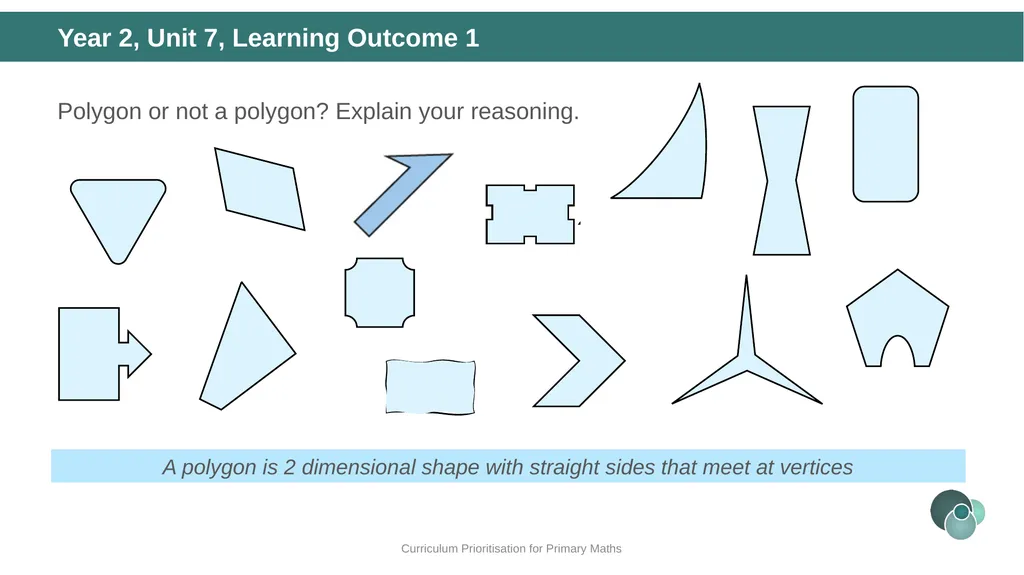
slide7. Curriculum Prioritisation for Primary Maths Polygon or not a polygon? Explain your reasoning. Year 2, Unit 7, Learning Outcome 1 A polygon is 2 dimensional shape with straight sides that meet at vertices<br>
slide8. Curriculum Prioritisation for Primary Maths The following slides have been collated to support the teaching of this learning outcome. Year 2, Unit 7, Learning Outcome 2<br>
slide9. Year 2, Unit 7, Learning Outcome 2 Curriculum Prioritisation for Primary Maths Additional teacher guidance for this outcome should be read first and can be found in the DfE Mathematics guidance. Page references relate to the 335-page document available as a download at the bottom of this web page.<br>
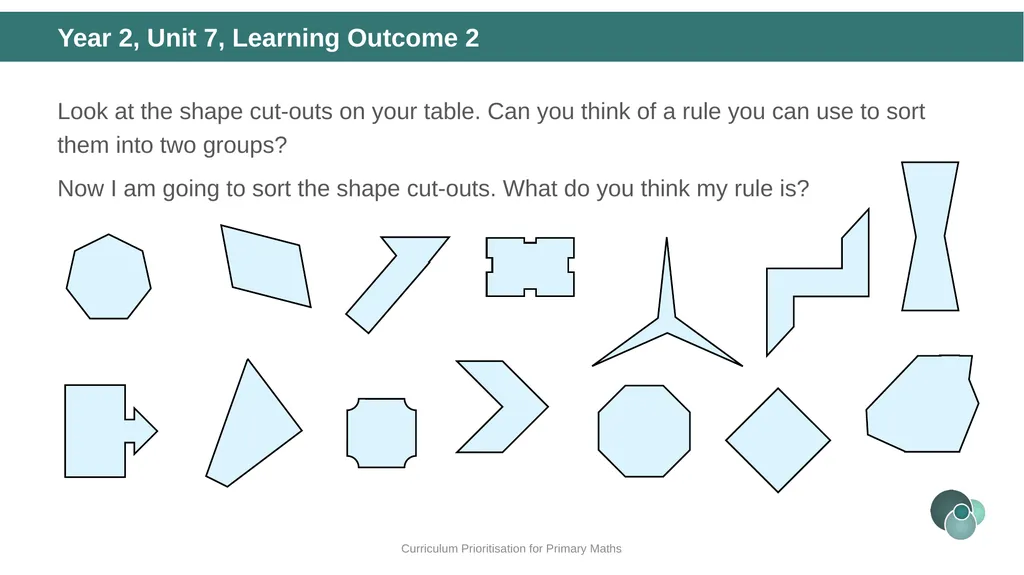
slide10. Curriculum Prioritisation for Primary Maths Look at the shape cut-outs on your table. Can you think of a rule you can use to sort them into two groups?
Now I am going to sort the shape cut-outs. What do you think my rule is? Year 2, Unit 7, Learning Outcome 2<br>
slide11. Curriculum Prioritisation for Primary Maths The following slides have been collated to support the teaching of this learning outcome. Year 2, Unit 7, Learning Outcome 3<br>
slide12. Year 2, Unit 7, Learning Outcome 3 Curriculum Prioritisation for Primary Maths Additional teacher guidance for this outcome should be read first and can be found in the DfE Mathematics guidance. Page references relate to the 335-page document available as a download at the bottom of this web page.<br>
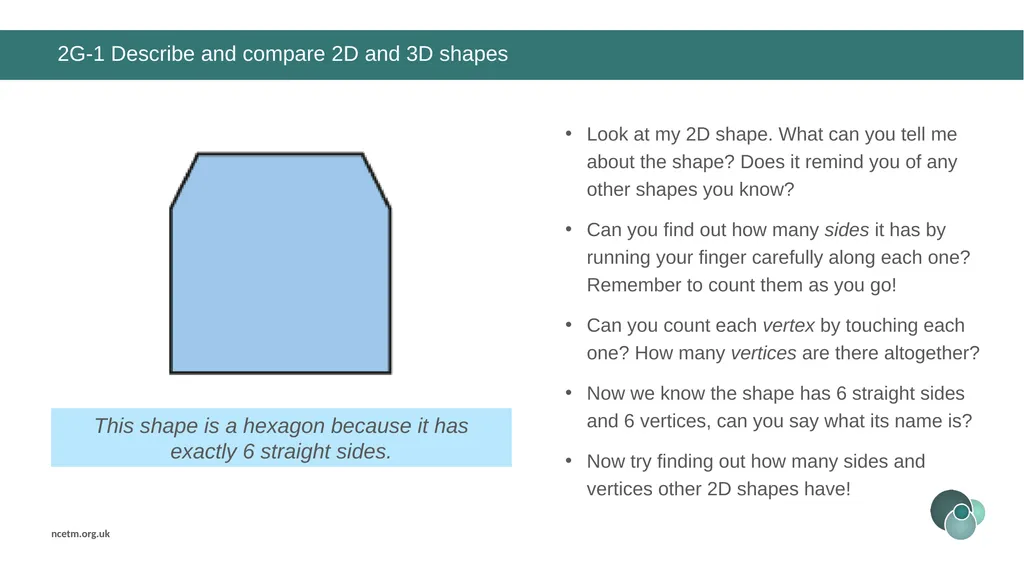
slide13. 2G-1 Describe and compare 2D and 3D shapes Look at my 2D shape. What can you tell me about the shape? Does it remind you of any other shapes you know?
Can you find out how many sides it has by running your finger carefully along each one? Remember to count them as you go!
Can you count each vertex by touching each one? How many vertices are there altogether?
Now we know the shape has 6 straight sides and 6 vertices, can you say what its name is?
Now try finding out how many sides and vertices other 2D shapes have! This shape is a hexagon because it has exactly 6 straight sides.<br>
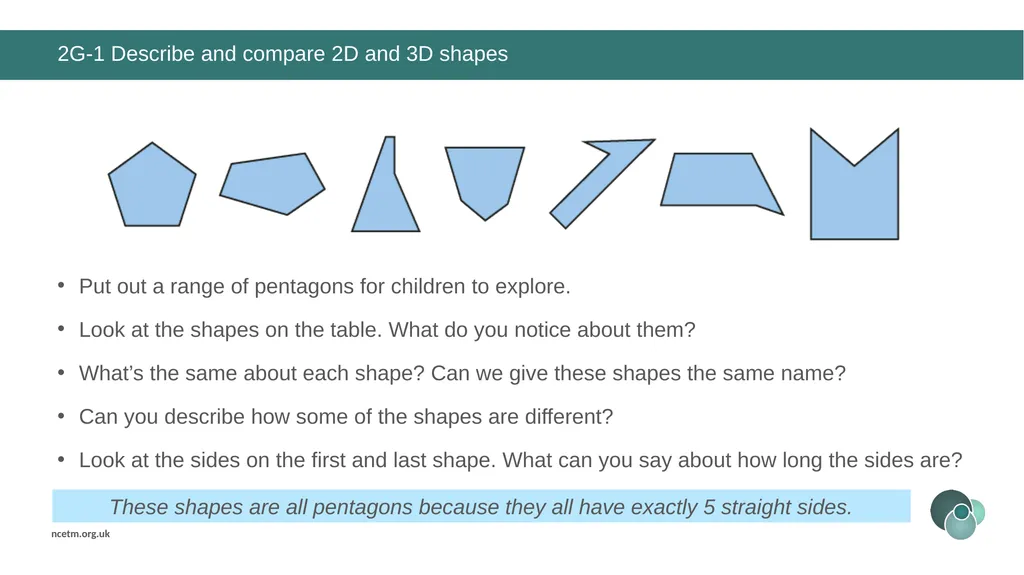
slide14. 2G-1 Describe and compare 2D and 3D shapes Put out a range of pentagons for children to explore.
Look at the shapes on the table. What do you notice about them?
What’s the same about each shape? Can we give these shapes the same name?
Can you describe how some of the shapes are different?
Look at the sides on the first and last shape. What can you say about how long the sides are?
Can you find a shape which you think has sides which are all different lengths? These shapes are all pentagons because they all have exactly 5 straight sides.<br>
slide15. Curriculum Prioritisation for Primary Maths The following slides have been collated to support the teaching of this learning outcome. Year 2, Unit 7, Learning Outcome 4<br>
slide16. Year 2, Unit 7, Learning Outcome 4 Curriculum Prioritisation for Primary Maths Additional teacher guidance for this outcome should be read first and can be found in the DfE Mathematics guidance. Page references relate to the 335-page document available as a download at the bottom of this web page.<br>
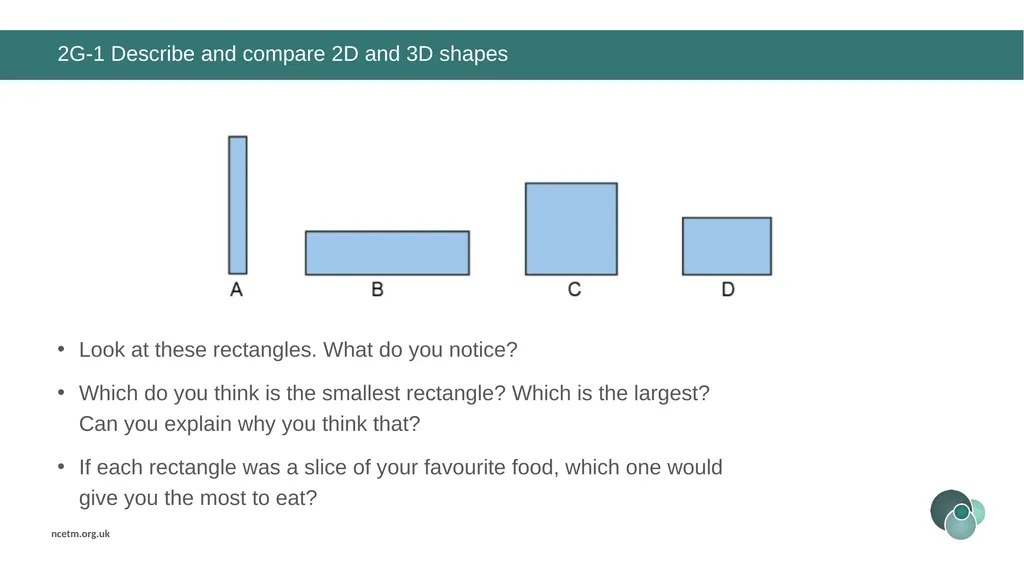
slide17. 2G-1 Describe and compare 2D and 3D shapes Look at these rectangles. What do you notice?
Which do you think is the smallest rectangle? Which is the largest? Can you explain why you think that?
If each rectangle was a slice of your favourite food, which one would give you the most to eat?<br>
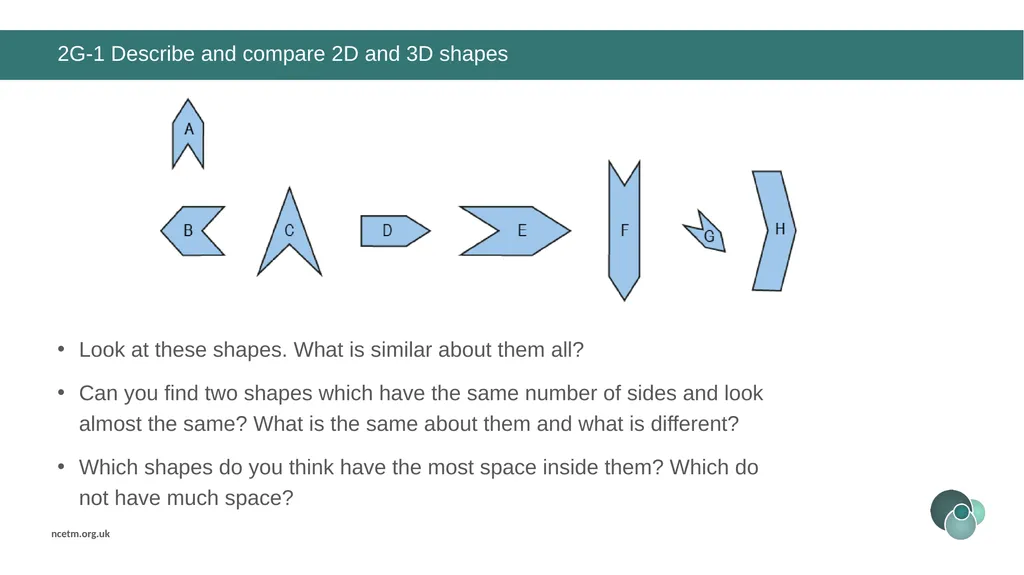
slide18. 2G-1 Describe and compare 2D and 3D shapes Look at these shapes. What is similar about them all?
Can you find two shapes which have the same number of sides and look almost the same? What is the same about them and what is different?
Which shapes do you think have the most space inside them? Which do not have much space?<br>
slide19. Curriculum Prioritisation for Primary Maths The following slides have been collated to support the teaching of this learning outcome. Year 2, Unit 7, Learning Outcome 5<br>
slide20. Year 2, Unit 7, Learning Outcome 5 Curriculum Prioritisation for Primary Maths Additional teacher guidance for this outcome should be read first and can be found in the DfE Mathematics guidance. Page references relate to the 335-page document available as a download at the bottom of this web page.<br>
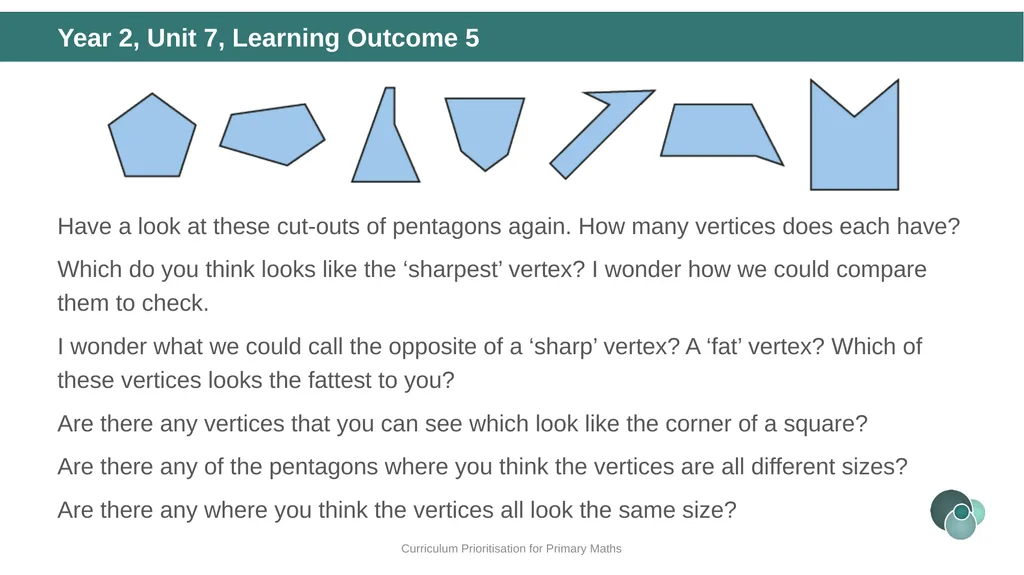
slide21. Curriculum Prioritisation for Primary Maths Have a look at these cut-outs of pentagons again. How many vertices does each have?
Which do you think looks like the ‘sharpest’ vertex? I wonder how we could compare them to check.
I wonder what we could call the opposite of a ‘sharp’ vertex? A ‘fat’ vertex? Which of these vertices looks the fattest to you?
Are there any vertices that you can see which look like the corner of a square?
Are there any of the pentagons where you think the vertices are all different sizes?
Are there any where you think the vertices all look the same size? Year 2, Unit 7, Learning Outcome 5<br>
slide22. Curriculum Prioritisation for Primary Maths The following slides have been collated to support the teaching of this learning outcome. Year 2, Unit 7, Learning Outcome 6<br>
slide23. Year 2, Unit 7, Learning Outcome 6 Curriculum Prioritisation for Primary Maths Additional teacher guidance for this outcome should be read first and can be found in the DfE Mathematics guidance. Page references relate to the 335-page document available as a download at the bottom of this web page.<br>
slide24. Curriculum Prioritisation for Primary Maths On your table you have some 2D shape tiles.
Find different ways that you can join them together so that you can fold them up exactly to make a closed 3D shape. Describe the shape that you have made.
Have a look at these 3D shapes I have at the front of the class. Which of these 3D shapes do you think you might be able to make from the flat 2D shape tiles? Which of the 3D shapes will I definitely not be able to make with the flat 2D shape tiles?
Can you make a 3D shape that has:
more than one square face? What is the greatest number of squares faces you can use in a closed 3D shape?
more than one triangular face? What is the greatest number of triangular faces you can use in a closed 3D shape? Year 2, Unit 7, Learning Outcome 6<br>
slide25. Curriculum Prioritisation for Primary Maths The following slides have been collated to support the teaching of this learning outcome. Year 2, Unit 7, Learning Outcome 7<br>
slide26. Year 2, Unit 7, Learning Outcome 7 Curriculum Prioritisation for Primary Maths Additional teacher guidance for this outcome should be read first and can be found in the DfE Mathematics guidance. Page references relate to the 335-page document available as a download at the bottom of this web page.<br>
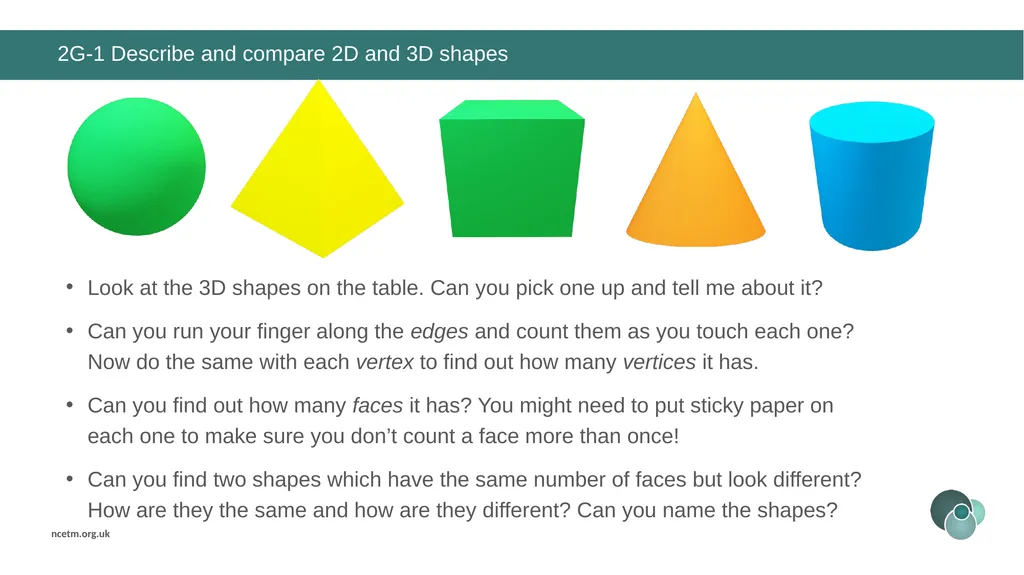
slide27. 2G-1 Describe and compare 2D and 3D shapes Look at the 3D shapes on the table. Can you pick one up and tell me about it?
Can you run your finger along the edges and count them as you touch each one? Now do the same with each vertex to find out how many vertices it has.
Can you find out how many faces it has? You might need to put sticky paper on each one to make sure you don’t count a face more than once!
Can you find two shapes which have the same number of faces but look different? How are they the same and how are they different? Can you name the shapes?<br>
slide28. Curriculum Prioritisation for Primary Maths The following slides have been collated to support the teaching of this learning outcome. Year 2, Unit 7, Learning Outcome 8<br>
slide29. Year 2, Unit 7, Learning Outcome 8 Curriculum Prioritisation for Primary Maths Additional teacher guidance for this outcome should be read first and can be found in the DfE Mathematics guidance. Page references relate to the 335-page document available as a download at the bottom of this web page.<br>
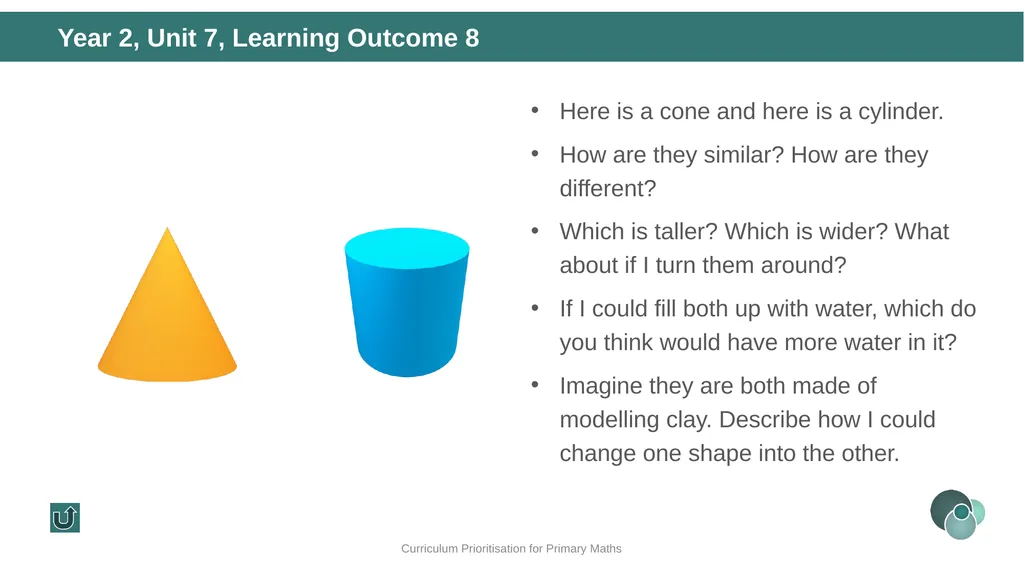
slide30. Curriculum Prioritisation for Primary Maths Here is a cone and here is a cylinder.
How are they similar? How are they different?
Which is taller? Which is wider? What about if I turn them around?
If I could fill both up with water, which do you think would have more water in it?
Imagine they are both made of modelling clay. Describe how I could change one shape into the other. Year 2, Unit 7, Learning Outcome 8<br>
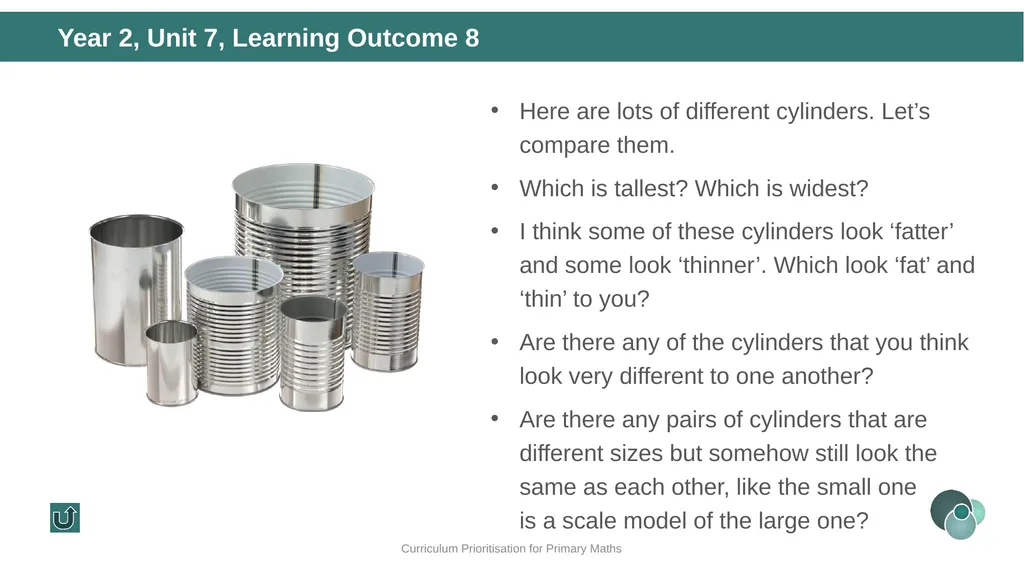
slide31. Curriculum Prioritisation for Primary Maths Year 2, Unit 7, Learning Outcome 8 Here are lots of different cylinders. Let’s compare them.
Which is tallest? Which is widest?
I think some of these cylinders look ‘fatter’ and some look ‘thinner’. Which look ‘fat’ and ‘thin’ to you?
Are there any of the cylinders that you think look very different to one another?
Are there any pairs of cylinders that are different sizes but somehow still look the same as each other, like the small one is a scale model of the large one?<br>
slide2. Curriculum Prioritisation for Primary Maths These materials heavily reflect the prioritisation approach of the ready-to-progress criteria in the DfE Primary Mathematics Guidance 2020 and on the PPTs that exemplify them on the NCETM website. They also include other relevant National Curriculum content. Related sections of the NCETM Primary Mastery Professional Development Materials provide small-step teaching guidance.
Ready-to-progress criteria addressed by this unit
Teaching of this unit supports the following criteria from the ‘DfE Mathematics Guidance: key stages 1 & 2’ (the 335-page document available as a download)
2G-1 Page 74
Prior learning
If the following ready-to-progress criteria, contained in the same DfE guidance document as above, were secured in Year 1, children will be ready to start on this unit.
1G-1 Page 42 Year 2, Unit 7<br>
slide3. Curriculum Prioritisation for Primary Maths The links below take you to the starting slide of each learning outcome. Click the arrow button to return to this Contents slide. Contents<br>
slide4. Curriculum Prioritisation for Primary Maths The links below take you to the starting slide of each learning outcome. Click the arrow button to return to this Contents slide. Contents<br>
slide5. Curriculum Prioritisation for Primary Maths The following slides have been collated to support the teaching of this learning outcome. Year 2, Unit 7, Learning Outcome 1<br>
slide6. Year 2, Unit 7, Learning Outcome 1 Curriculum Prioritisation for Primary Maths Additional teacher guidance for this outcome should be read first and can be found in the DfE Mathematics guidance. Page references relate to the 335-page document available as a download at the bottom of this web page.<br>
slide7. Curriculum Prioritisation for Primary Maths Polygon or not a polygon? Explain your reasoning. Year 2, Unit 7, Learning Outcome 1 A polygon is 2 dimensional shape with straight sides that meet at vertices<br>
slide8. Curriculum Prioritisation for Primary Maths The following slides have been collated to support the teaching of this learning outcome. Year 2, Unit 7, Learning Outcome 2<br>
slide9. Year 2, Unit 7, Learning Outcome 2 Curriculum Prioritisation for Primary Maths Additional teacher guidance for this outcome should be read first and can be found in the DfE Mathematics guidance. Page references relate to the 335-page document available as a download at the bottom of this web page.<br>
slide10. Curriculum Prioritisation for Primary Maths Look at the shape cut-outs on your table. Can you think of a rule you can use to sort them into two groups?
Now I am going to sort the shape cut-outs. What do you think my rule is? Year 2, Unit 7, Learning Outcome 2<br>
slide11. Curriculum Prioritisation for Primary Maths The following slides have been collated to support the teaching of this learning outcome. Year 2, Unit 7, Learning Outcome 3<br>
slide12. Year 2, Unit 7, Learning Outcome 3 Curriculum Prioritisation for Primary Maths Additional teacher guidance for this outcome should be read first and can be found in the DfE Mathematics guidance. Page references relate to the 335-page document available as a download at the bottom of this web page.<br>
slide13. 2G-1 Describe and compare 2D and 3D shapes Look at my 2D shape. What can you tell me about the shape? Does it remind you of any other shapes you know?
Can you find out how many sides it has by running your finger carefully along each one? Remember to count them as you go!
Can you count each vertex by touching each one? How many vertices are there altogether?
Now we know the shape has 6 straight sides and 6 vertices, can you say what its name is?
Now try finding out how many sides and vertices other 2D shapes have! This shape is a hexagon because it has exactly 6 straight sides.<br>
slide14. 2G-1 Describe and compare 2D and 3D shapes Put out a range of pentagons for children to explore.
Look at the shapes on the table. What do you notice about them?
What’s the same about each shape? Can we give these shapes the same name?
Can you describe how some of the shapes are different?
Look at the sides on the first and last shape. What can you say about how long the sides are?
Can you find a shape which you think has sides which are all different lengths? These shapes are all pentagons because they all have exactly 5 straight sides.<br>
slide15. Curriculum Prioritisation for Primary Maths The following slides have been collated to support the teaching of this learning outcome. Year 2, Unit 7, Learning Outcome 4<br>
slide16. Year 2, Unit 7, Learning Outcome 4 Curriculum Prioritisation for Primary Maths Additional teacher guidance for this outcome should be read first and can be found in the DfE Mathematics guidance. Page references relate to the 335-page document available as a download at the bottom of this web page.<br>
slide17. 2G-1 Describe and compare 2D and 3D shapes Look at these rectangles. What do you notice?
Which do you think is the smallest rectangle? Which is the largest? Can you explain why you think that?
If each rectangle was a slice of your favourite food, which one would give you the most to eat?<br>
slide18. 2G-1 Describe and compare 2D and 3D shapes Look at these shapes. What is similar about them all?
Can you find two shapes which have the same number of sides and look almost the same? What is the same about them and what is different?
Which shapes do you think have the most space inside them? Which do not have much space?<br>
slide19. Curriculum Prioritisation for Primary Maths The following slides have been collated to support the teaching of this learning outcome. Year 2, Unit 7, Learning Outcome 5<br>
slide20. Year 2, Unit 7, Learning Outcome 5 Curriculum Prioritisation for Primary Maths Additional teacher guidance for this outcome should be read first and can be found in the DfE Mathematics guidance. Page references relate to the 335-page document available as a download at the bottom of this web page.<br>
slide21. Curriculum Prioritisation for Primary Maths Have a look at these cut-outs of pentagons again. How many vertices does each have?
Which do you think looks like the ‘sharpest’ vertex? I wonder how we could compare them to check.
I wonder what we could call the opposite of a ‘sharp’ vertex? A ‘fat’ vertex? Which of these vertices looks the fattest to you?
Are there any vertices that you can see which look like the corner of a square?
Are there any of the pentagons where you think the vertices are all different sizes?
Are there any where you think the vertices all look the same size? Year 2, Unit 7, Learning Outcome 5<br>
slide22. Curriculum Prioritisation for Primary Maths The following slides have been collated to support the teaching of this learning outcome. Year 2, Unit 7, Learning Outcome 6<br>
slide23. Year 2, Unit 7, Learning Outcome 6 Curriculum Prioritisation for Primary Maths Additional teacher guidance for this outcome should be read first and can be found in the DfE Mathematics guidance. Page references relate to the 335-page document available as a download at the bottom of this web page.<br>
slide24. Curriculum Prioritisation for Primary Maths On your table you have some 2D shape tiles.
Find different ways that you can join them together so that you can fold them up exactly to make a closed 3D shape. Describe the shape that you have made.
Have a look at these 3D shapes I have at the front of the class. Which of these 3D shapes do you think you might be able to make from the flat 2D shape tiles? Which of the 3D shapes will I definitely not be able to make with the flat 2D shape tiles?
Can you make a 3D shape that has:
more than one square face? What is the greatest number of squares faces you can use in a closed 3D shape?
more than one triangular face? What is the greatest number of triangular faces you can use in a closed 3D shape? Year 2, Unit 7, Learning Outcome 6<br>
slide25. Curriculum Prioritisation for Primary Maths The following slides have been collated to support the teaching of this learning outcome. Year 2, Unit 7, Learning Outcome 7<br>
slide26. Year 2, Unit 7, Learning Outcome 7 Curriculum Prioritisation for Primary Maths Additional teacher guidance for this outcome should be read first and can be found in the DfE Mathematics guidance. Page references relate to the 335-page document available as a download at the bottom of this web page.<br>
slide27. 2G-1 Describe and compare 2D and 3D shapes Look at the 3D shapes on the table. Can you pick one up and tell me about it?
Can you run your finger along the edges and count them as you touch each one? Now do the same with each vertex to find out how many vertices it has.
Can you find out how many faces it has? You might need to put sticky paper on each one to make sure you don’t count a face more than once!
Can you find two shapes which have the same number of faces but look different? How are they the same and how are they different? Can you name the shapes?<br>
slide28. Curriculum Prioritisation for Primary Maths The following slides have been collated to support the teaching of this learning outcome. Year 2, Unit 7, Learning Outcome 8<br>
slide29. Year 2, Unit 7, Learning Outcome 8 Curriculum Prioritisation for Primary Maths Additional teacher guidance for this outcome should be read first and can be found in the DfE Mathematics guidance. Page references relate to the 335-page document available as a download at the bottom of this web page.<br>
slide30. Curriculum Prioritisation for Primary Maths Here is a cone and here is a cylinder.
How are they similar? How are they different?
Which is taller? Which is wider? What about if I turn them around?
If I could fill both up with water, which do you think would have more water in it?
Imagine they are both made of modelling clay. Describe how I could change one shape into the other. Year 2, Unit 7, Learning Outcome 8<br>
slide31. Curriculum Prioritisation for Primary Maths Year 2, Unit 7, Learning Outcome 8 Here are lots of different cylinders. Let’s compare them.
Which is tallest? Which is widest?
I think some of these cylinders look ‘fatter’ and some look ‘thinner’. Which look ‘fat’ and ‘thin’ to you?
Are there any of the cylinders that you think look very different to one another?
Are there any pairs of cylinders that are different sizes but somehow still look the same as each other, like the small one is a scale model of the large one?<br>