
A level ENGLISH LANGUAGE Component 2 QUESTION 1(a)
CS
Published · 53 slides · 0 views
1 / 1




Description
A level ENGLISH LANGUAGE Component 2 QUESTION 1(a) Identify the word class and archaic spelling patterns of the following words using appropriate terminology. haue poore wooll Component 2 Section A RECOGNISING A successful RESPONSE
Related Topics
Share
Embed code
Download this presentation From Below
"A level ENGLISH LANGUAGE Component 2 QUESTION 1(a)" is the property of its rightful owner. Permission is granted to download and print the materials on this website for personal, non-commercial use only, and to display it on your personal computer provided you do not modify the materials and that you retain all copyright notices contained in the materials. By downloading content from our website, you accept the terms of this agreement.
Presentation Transcript
01
A level ENGLISH LANGUAGE
Component 2<br>
Component 2<br>
02
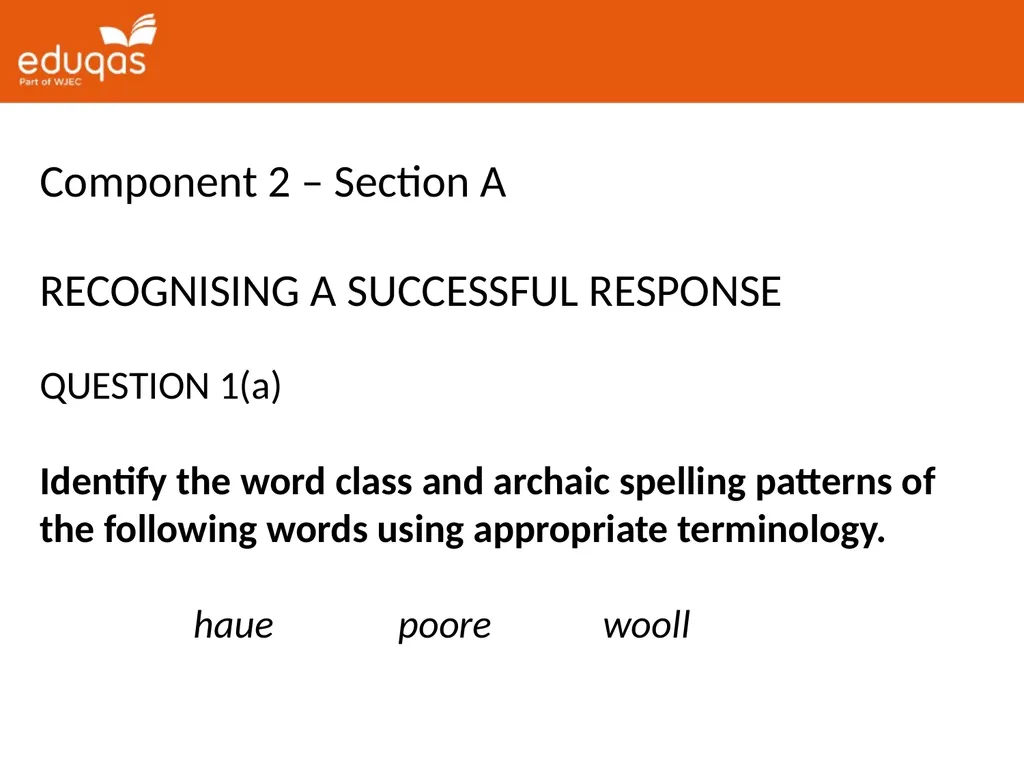
QUESTION 1(a)
Identify the word class and archaic spelling patterns of the following words using appropriate terminology.
haue poore wooll Component 2 – Section A
RECOGNISING A successful RESPONSE<br>
Identify the word class and archaic spelling patterns of the following words using appropriate terminology.
haue poore wooll Component 2 – Section A
RECOGNISING A successful RESPONSE<br>
03
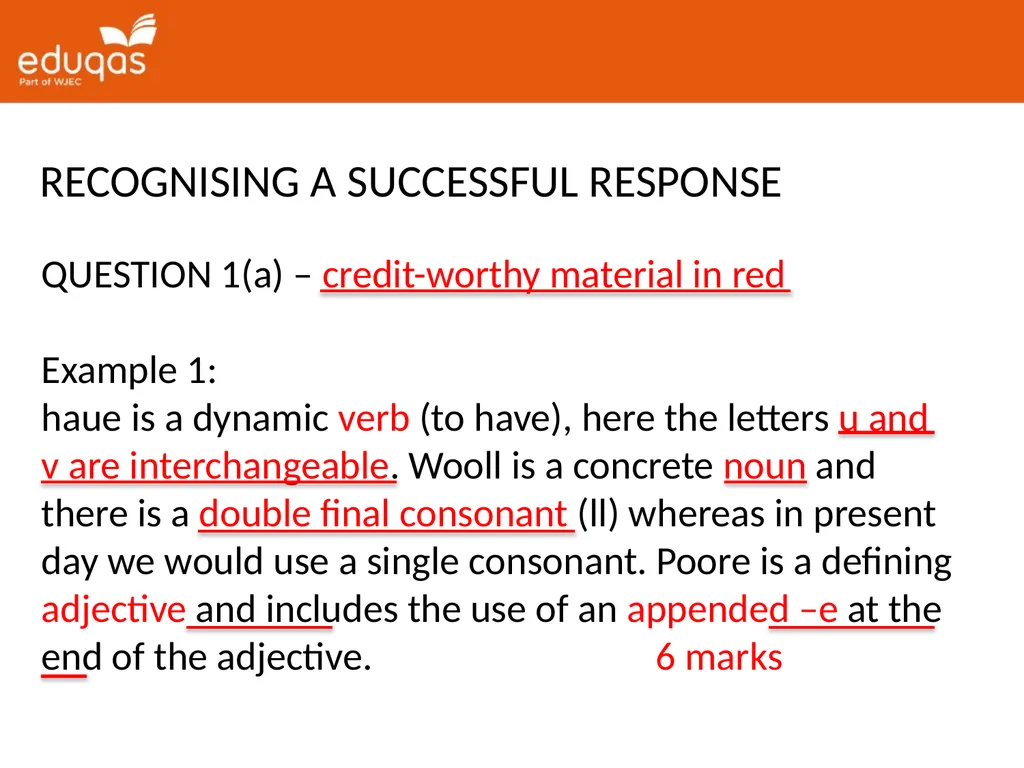
QUESTION 1(a) – credit-worthy material in red
Example 1:
haue is a dynamic verb (to have), here the letters u and v are interchangeable. Wooll is a concrete noun and there is a double final consonant (ll) whereas in present day we would use a single consonant. Poore is a defining adjective and includes the use of an appended –e at the end of the adjective. 6 marks RECOGNISING A successful RESPONSE<br>
Example 1:
haue is a dynamic verb (to have), here the letters u and v are interchangeable. Wooll is a concrete noun and there is a double final consonant (ll) whereas in present day we would use a single consonant. Poore is a defining adjective and includes the use of an appended –e at the end of the adjective. 6 marks RECOGNISING A successful RESPONSE<br>
04
QUESTION 1(a) – credit-worthy material in red
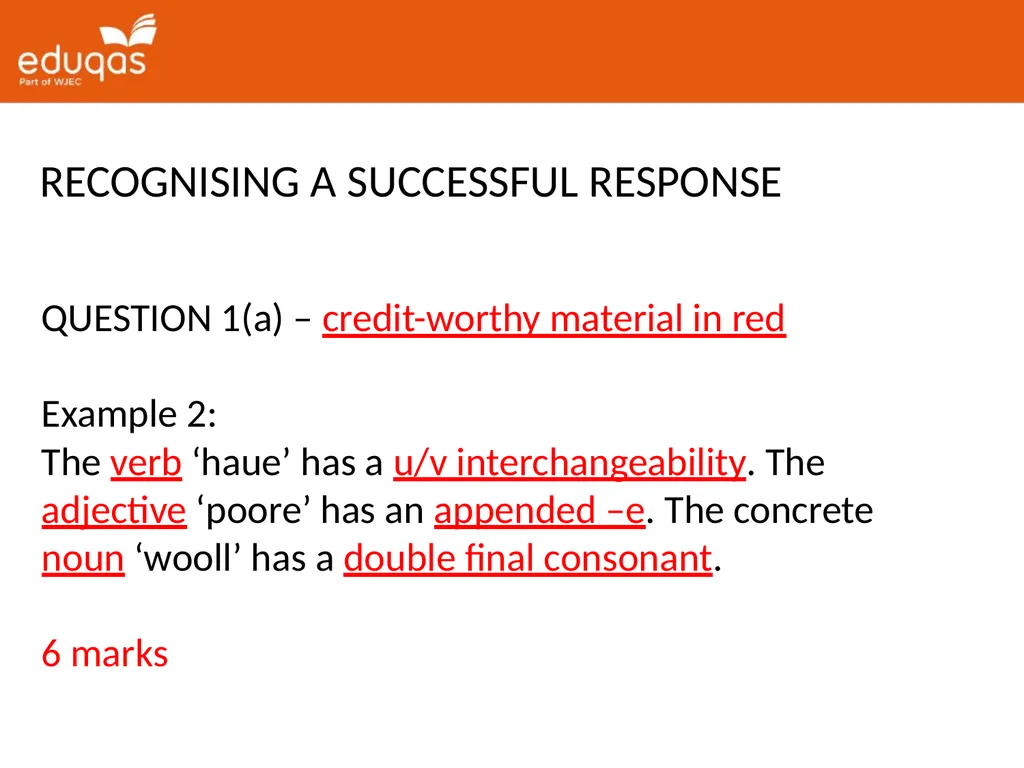
Example 2:
The verb ‘haue’ has a u/v interchangeability. The adjective ‘poore’ has an appended –e. The concrete noun ‘wooll’ has a double final consonant.
6 marks RECOGNISING A successful RESPONSE<br>
Example 2:
The verb ‘haue’ has a u/v interchangeability. The adjective ‘poore’ has an appended –e. The concrete noun ‘wooll’ has a double final consonant.
6 marks RECOGNISING A successful RESPONSE<br>
05
QUESTION 1(a) – credit-worthy material in red
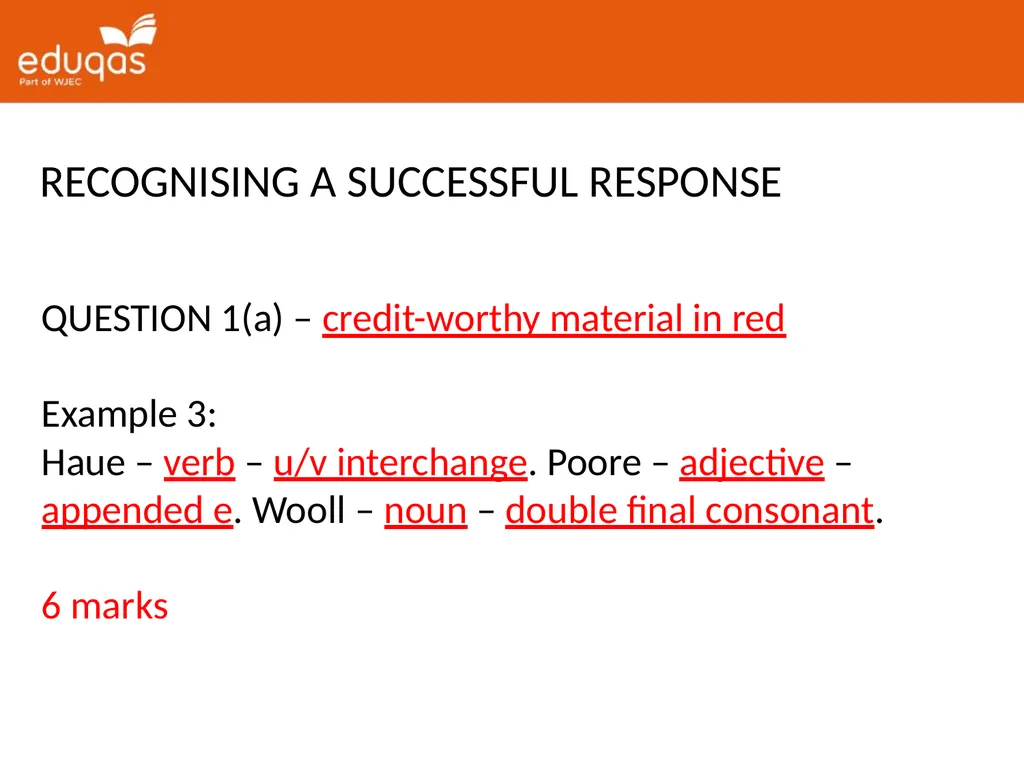
Example 3:
Haue – verb – u/v interchange. Poore – adjective – appended e. Wooll – noun – double final consonant.
6 marks RECOGNISING A successful RESPONSE<br>
Example 3:
Haue – verb – u/v interchange. Poore – adjective – appended e. Wooll – noun – double final consonant.
6 marks RECOGNISING A successful RESPONSE<br>
06
QUESTION 1(a) – Summary
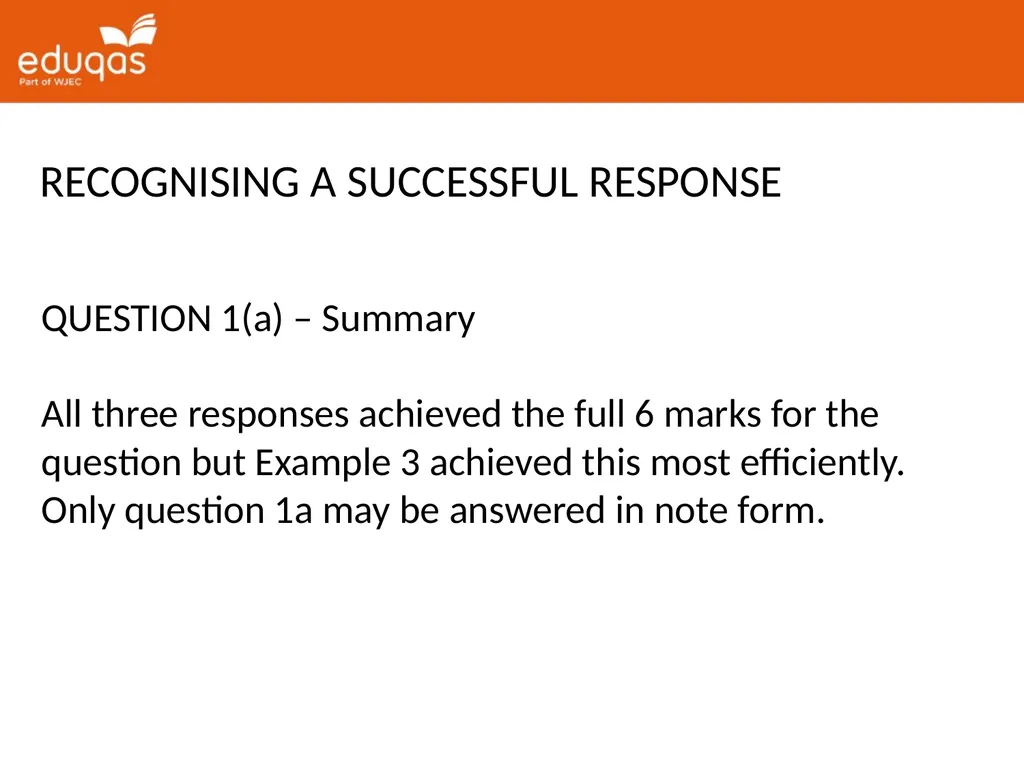
All three responses achieved the full 6 marks for the question but Example 3 achieved this most efficiently. Only question 1a may be answered in note form. RECOGNISING A successful RESPONSE<br>
All three responses achieved the full 6 marks for the question but Example 3 achieved this most efficiently. Only question 1a may be answered in note form. RECOGNISING A successful RESPONSE<br>
07
QUESTION 1(b)
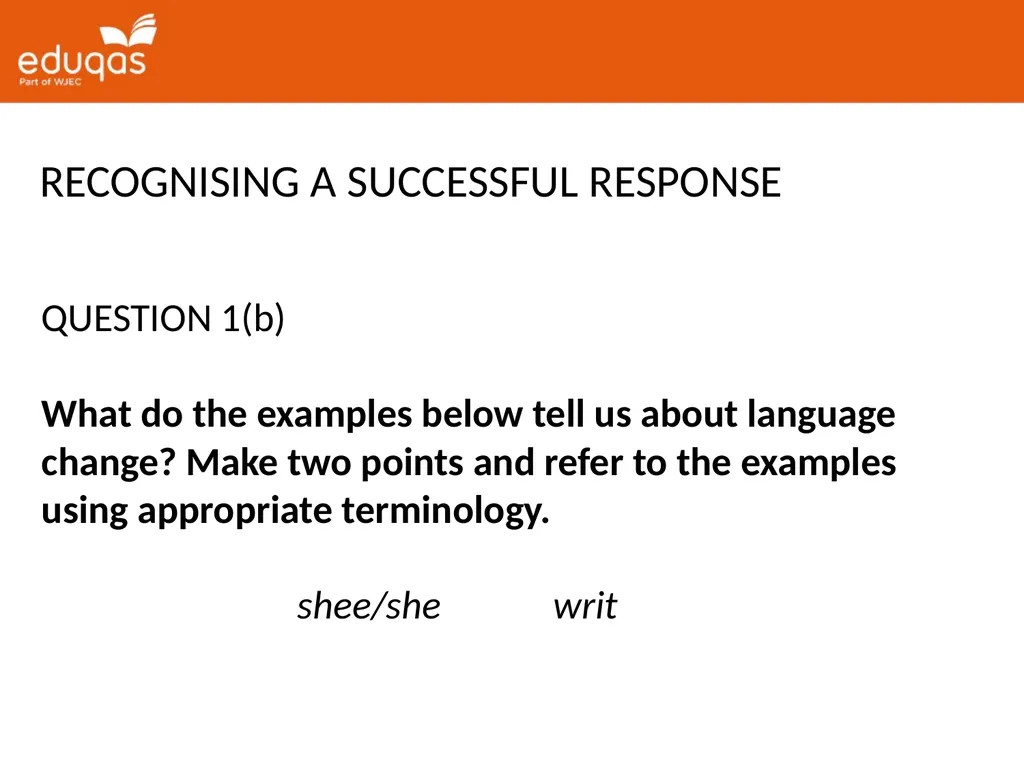
What do the examples below tell us about language change? Make two points and refer to the examples using appropriate terminology.
shee/she writ RECOGNISING A successful RESPONSE<br>
What do the examples below tell us about language change? Make two points and refer to the examples using appropriate terminology.
shee/she writ RECOGNISING A successful RESPONSE<br>
08
QUESTION 1(b) – credit-worthy material in red
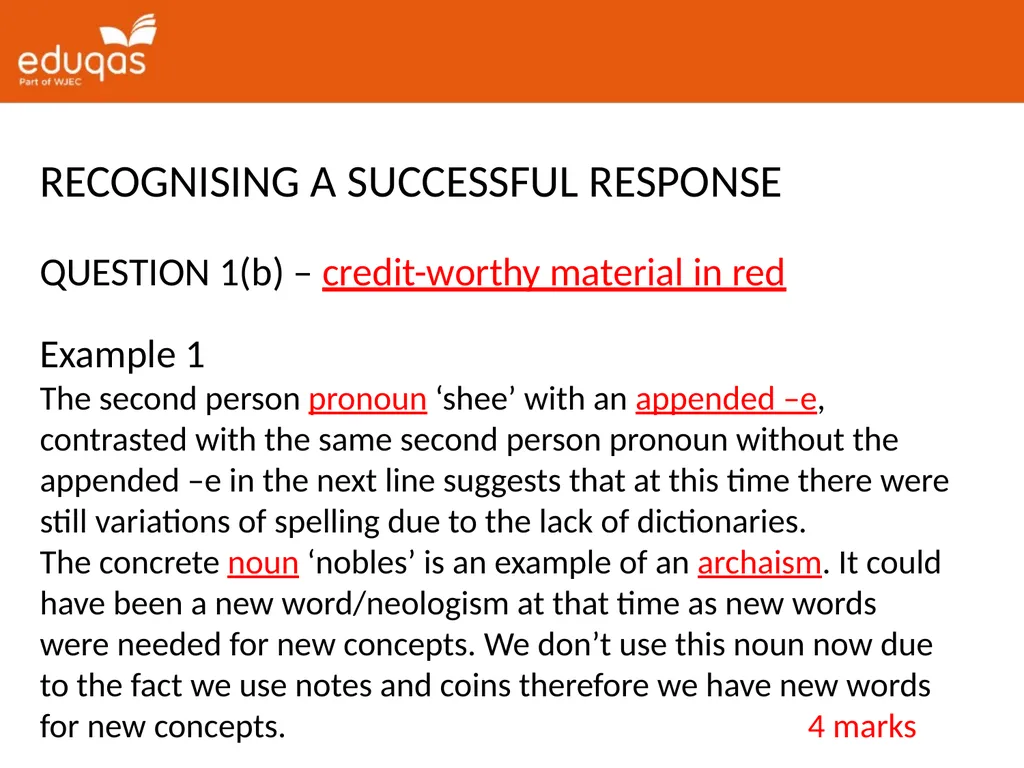
Example 1
The second person pronoun ‘shee’ with an appended –e, contrasted with the same second person pronoun without the appended –e in the next line suggests that at this time there were still variations of spelling due to the lack of dictionaries.
The concrete noun ‘nobles’ is an example of an archaism. It could have been a new word/neologism at that time as new words were needed for new concepts. We don’t use this noun now due to the fact we use notes and coins therefore we have new words for new concepts. 4 marks RECOGNISING A successful RESPONSE<br>
Example 1
The second person pronoun ‘shee’ with an appended –e, contrasted with the same second person pronoun without the appended –e in the next line suggests that at this time there were still variations of spelling due to the lack of dictionaries.
The concrete noun ‘nobles’ is an example of an archaism. It could have been a new word/neologism at that time as new words were needed for new concepts. We don’t use this noun now due to the fact we use notes and coins therefore we have new words for new concepts. 4 marks RECOGNISING A successful RESPONSE<br>
09
QUESTION 1(b) – credit-worthy material in red
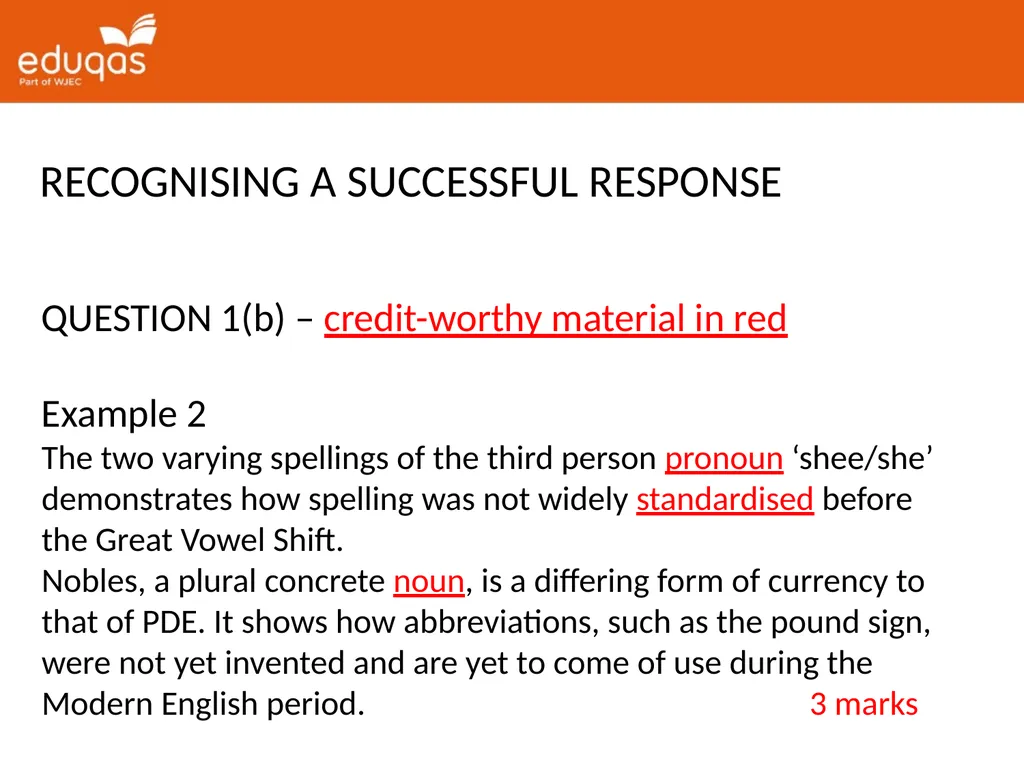
Example 2
The two varying spellings of the third person pronoun ‘shee/she’ demonstrates how spelling was not widely standardised before the Great Vowel Shift.
Nobles, a plural concrete noun, is a differing form of currency to that of PDE. It shows how abbreviations, such as the pound sign, were not yet invented and are yet to come of use during the Modern English period. 3 marks RECOGNISING A successful RESPONSE<br>
Example 2
The two varying spellings of the third person pronoun ‘shee/she’ demonstrates how spelling was not widely standardised before the Great Vowel Shift.
Nobles, a plural concrete noun, is a differing form of currency to that of PDE. It shows how abbreviations, such as the pound sign, were not yet invented and are yet to come of use during the Modern English period. 3 marks RECOGNISING A successful RESPONSE<br>
10
QUESTION 1(b) – credit-worthy material in red
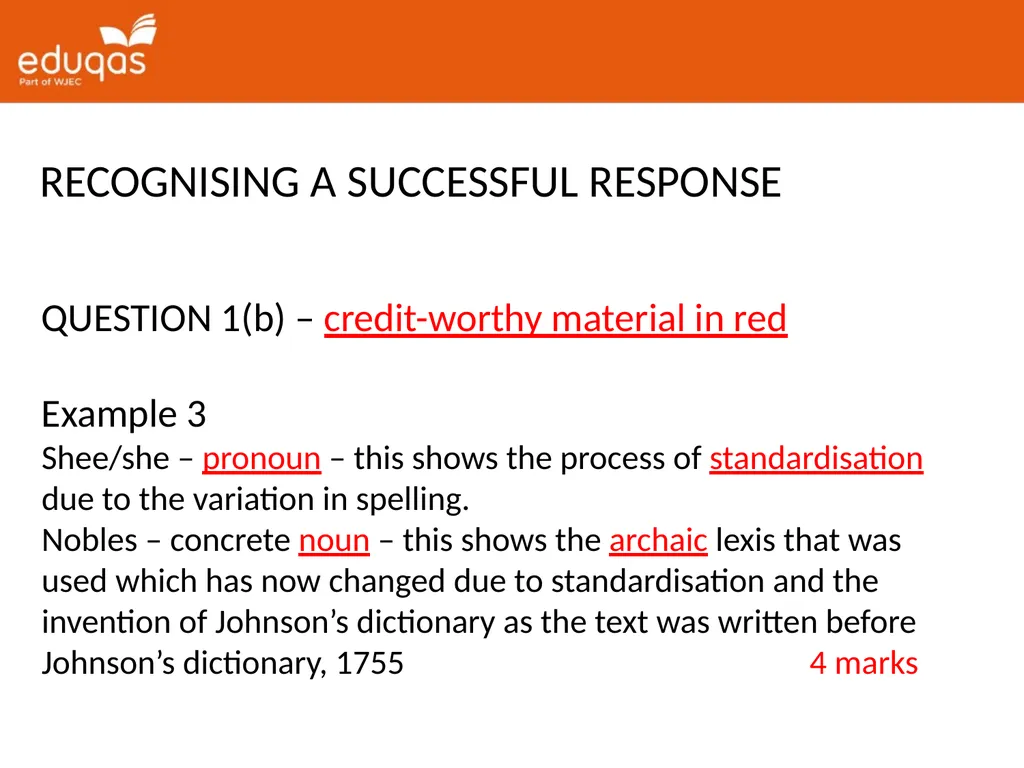
Example 3
Shee/she – pronoun – this shows the process of standardisation due to the variation in spelling.
Nobles – concrete noun – this shows the archaic lexis that was used which has now changed due to standardisation and the invention of Johnson’s dictionary as the text was written before Johnson’s dictionary, 1755 4 marks RECOGNISING A successful RESPONSE<br>
Example 3
Shee/she – pronoun – this shows the process of standardisation due to the variation in spelling.
Nobles – concrete noun – this shows the archaic lexis that was used which has now changed due to standardisation and the invention of Johnson’s dictionary as the text was written before Johnson’s dictionary, 1755 4 marks RECOGNISING A successful RESPONSE<br>
11
QUESTION 1(b) – Summary
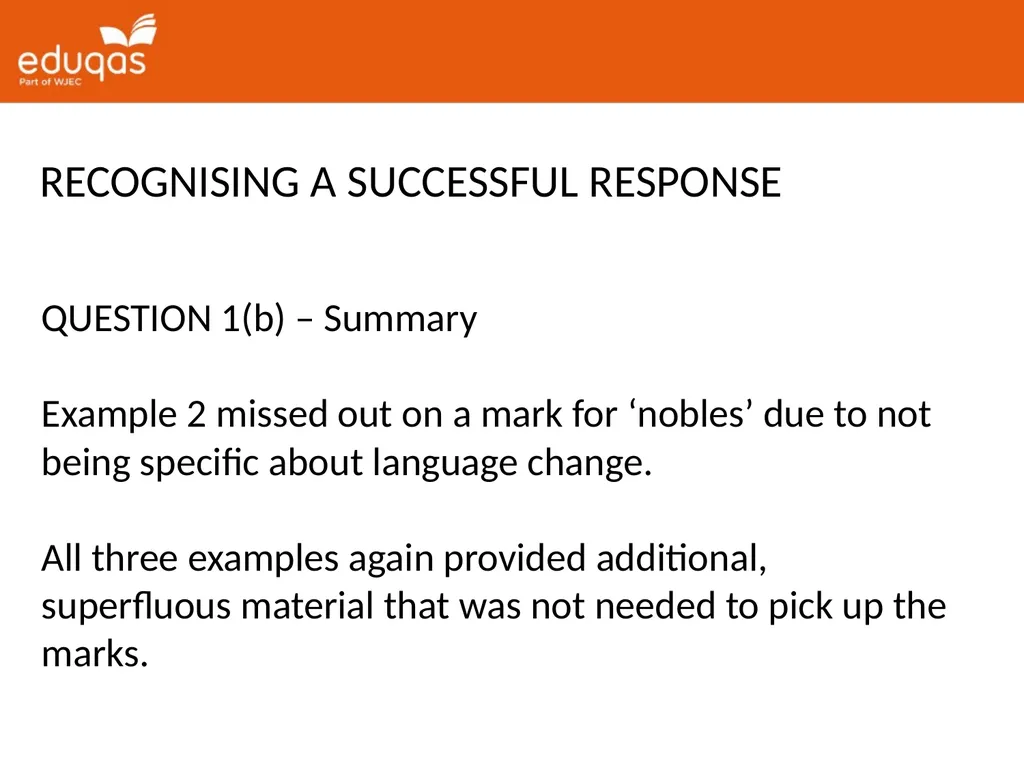
Example 2 missed out on a mark for ‘nobles’ due to not being specific about language change.
All three examples again provided additional, superfluous material that was not needed to pick up the marks. RECOGNISING A successful RESPONSE<br>
Example 2 missed out on a mark for ‘nobles’ due to not being specific about language change.
All three examples again provided additional, superfluous material that was not needed to pick up the marks. RECOGNISING A successful RESPONSE<br>
12
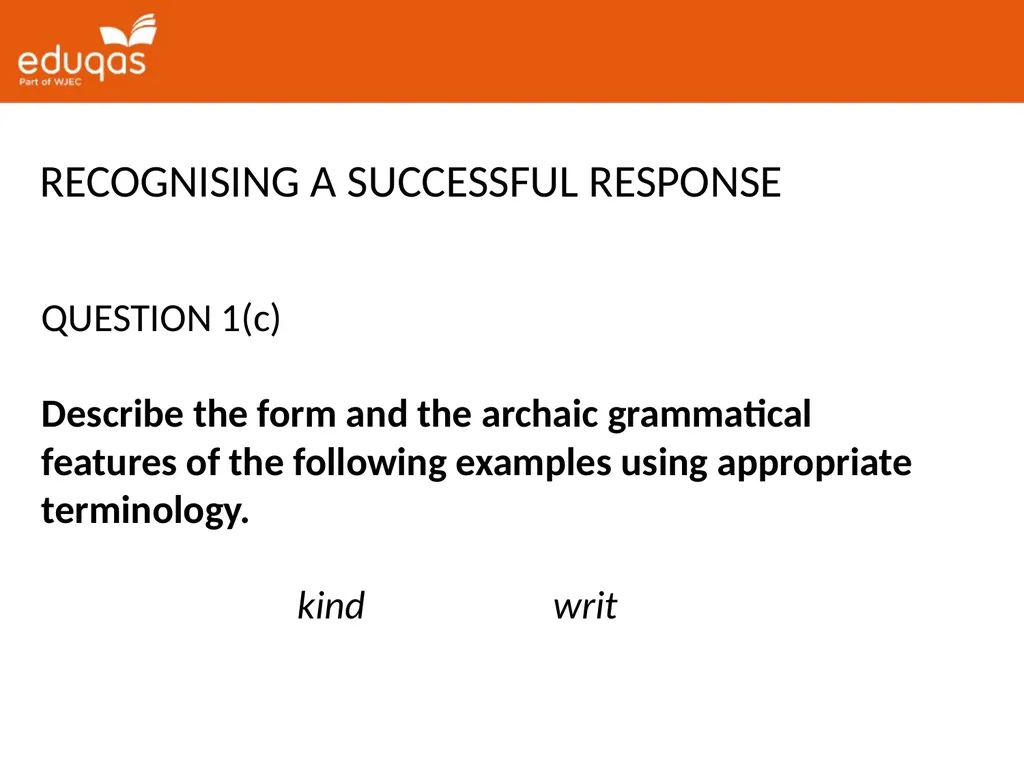
QUESTION 1(c)
Describe the form and the archaic grammatical features of the following examples using appropriate terminology.
kind writ RECOGNISING A successful RESPONSE<br>
Describe the form and the archaic grammatical features of the following examples using appropriate terminology.
kind writ RECOGNISING A successful RESPONSE<br>
13
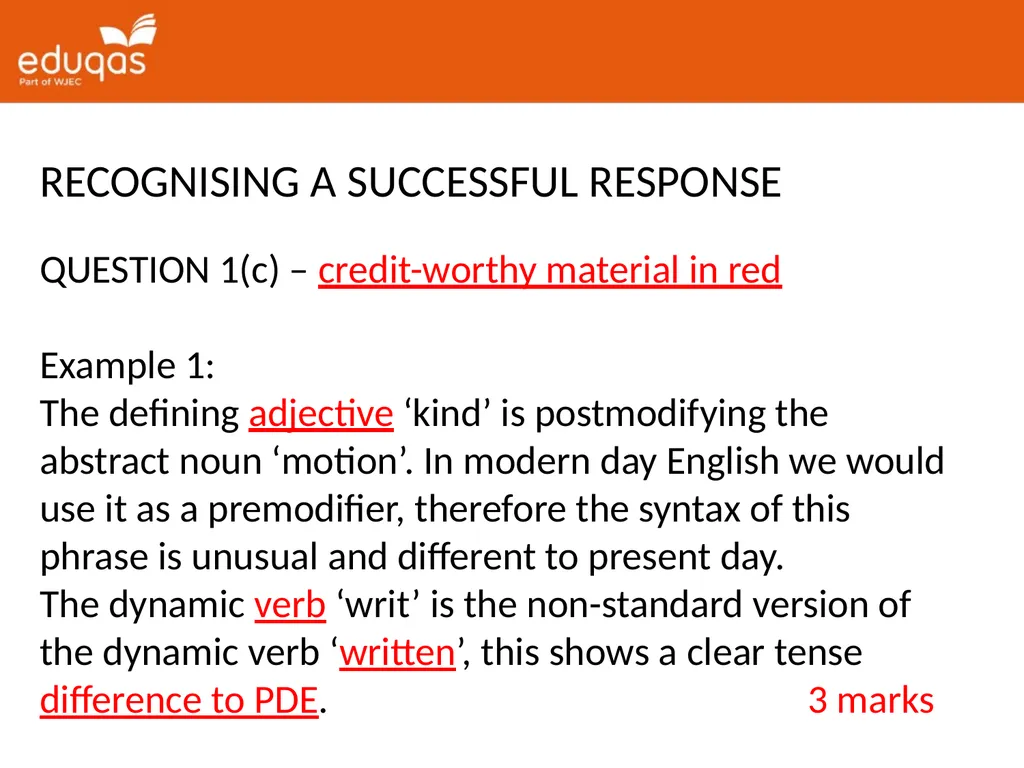
QUESTION 1(c) – credit-worthy material in red
Example 1:
The defining adjective ‘kind’ is postmodifying the abstract noun ‘motion’. In modern day English we would use it as a premodifier, therefore the syntax of this phrase is unusual and different to present day.
The dynamic verb ‘writ’ is the non-standard version of the dynamic verb ‘written’, this shows a clear tense difference to PDE. 3 marks RECOGNISING A successful RESPONSE<br>
Example 1:
The defining adjective ‘kind’ is postmodifying the abstract noun ‘motion’. In modern day English we would use it as a premodifier, therefore the syntax of this phrase is unusual and different to present day.
The dynamic verb ‘writ’ is the non-standard version of the dynamic verb ‘written’, this shows a clear tense difference to PDE. 3 marks RECOGNISING A successful RESPONSE<br>
14
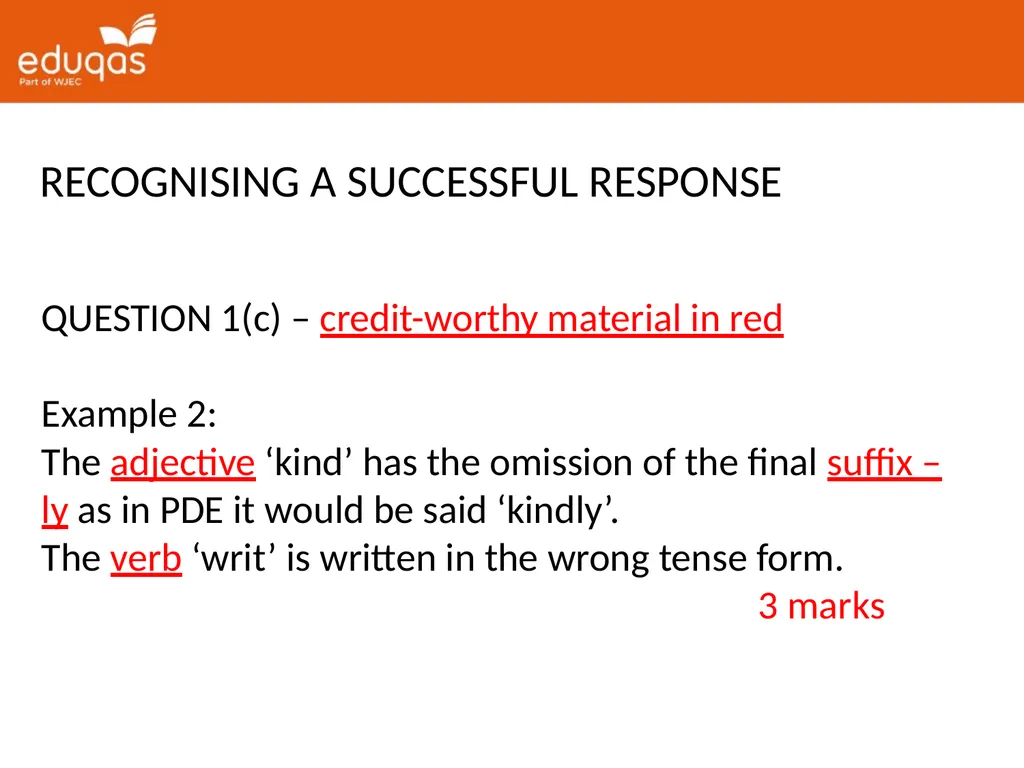
QUESTION 1(c) – credit-worthy material in red
Example 2:
The adjective ‘kind’ has the omission of the final suffix –ly as in PDE it would be said ‘kindly’.
The verb ‘writ’ is written in the wrong tense form.
3 marks RECOGNISING A successful RESPONSE<br>
Example 2:
The adjective ‘kind’ has the omission of the final suffix –ly as in PDE it would be said ‘kindly’.
The verb ‘writ’ is written in the wrong tense form.
3 marks RECOGNISING A successful RESPONSE<br>
15
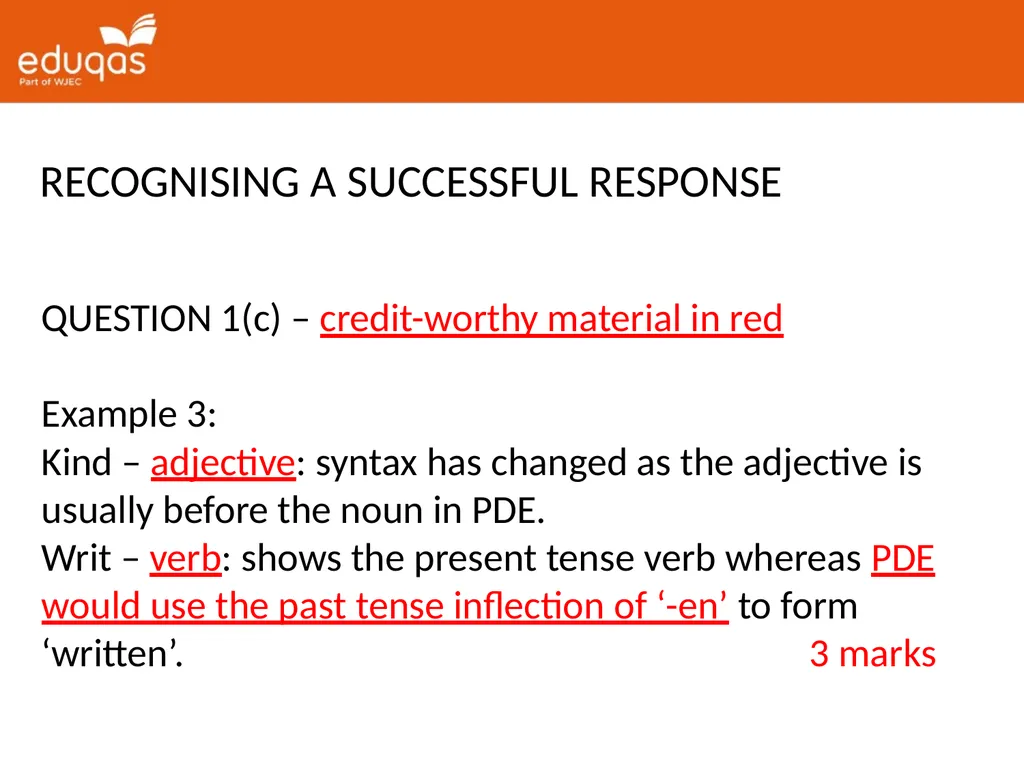
QUESTION 1(c) – credit-worthy material in red
Example 3:
Kind – adjective: syntax has changed as the adjective is usually before the noun in PDE.
Writ – verb: shows the present tense verb whereas PDE would use the past tense inflection of ‘-en’ to form ‘written’. 3 marks RECOGNISING A successful RESPONSE<br>
Example 3:
Kind – adjective: syntax has changed as the adjective is usually before the noun in PDE.
Writ – verb: shows the present tense verb whereas PDE would use the past tense inflection of ‘-en’ to form ‘written’. 3 marks RECOGNISING A successful RESPONSE<br>
16
QUESTION 1(c) – Summary
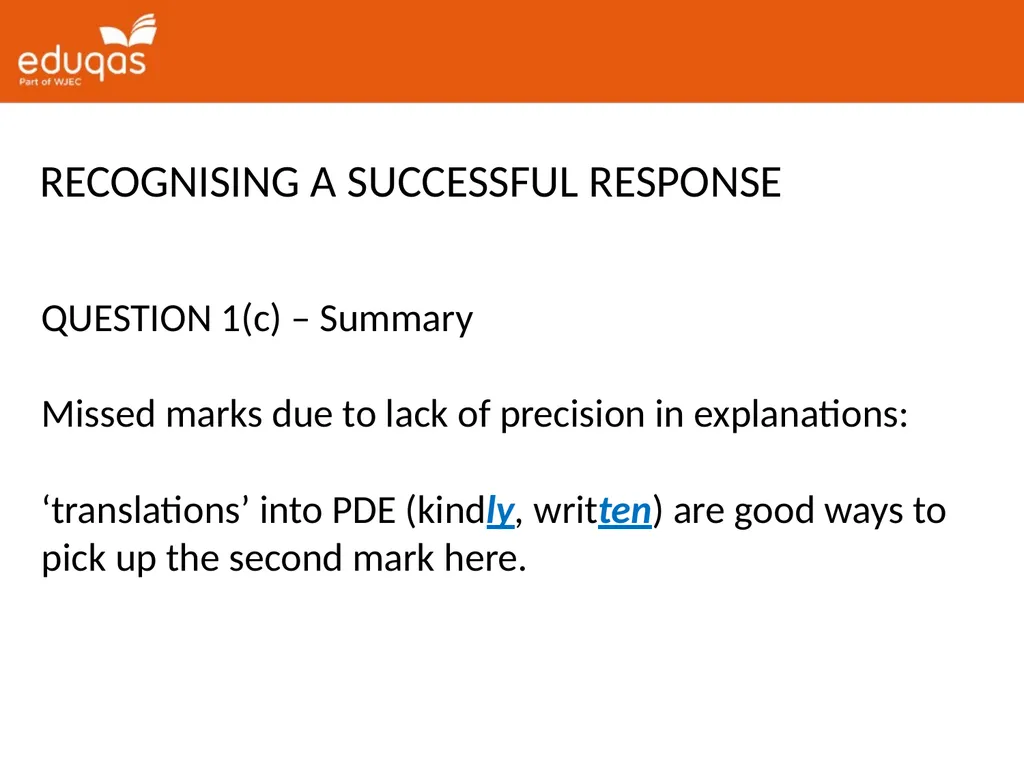
Missed marks due to lack of precision in explanations:
‘translations’ into PDE (kindly, written) are good ways to pick up the second mark here. RECOGNISING A successful RESPONSE<br>
Missed marks due to lack of precision in explanations:
‘translations’ into PDE (kindly, written) are good ways to pick up the second mark here. RECOGNISING A successful RESPONSE<br>
17
QUESTION 1(d)
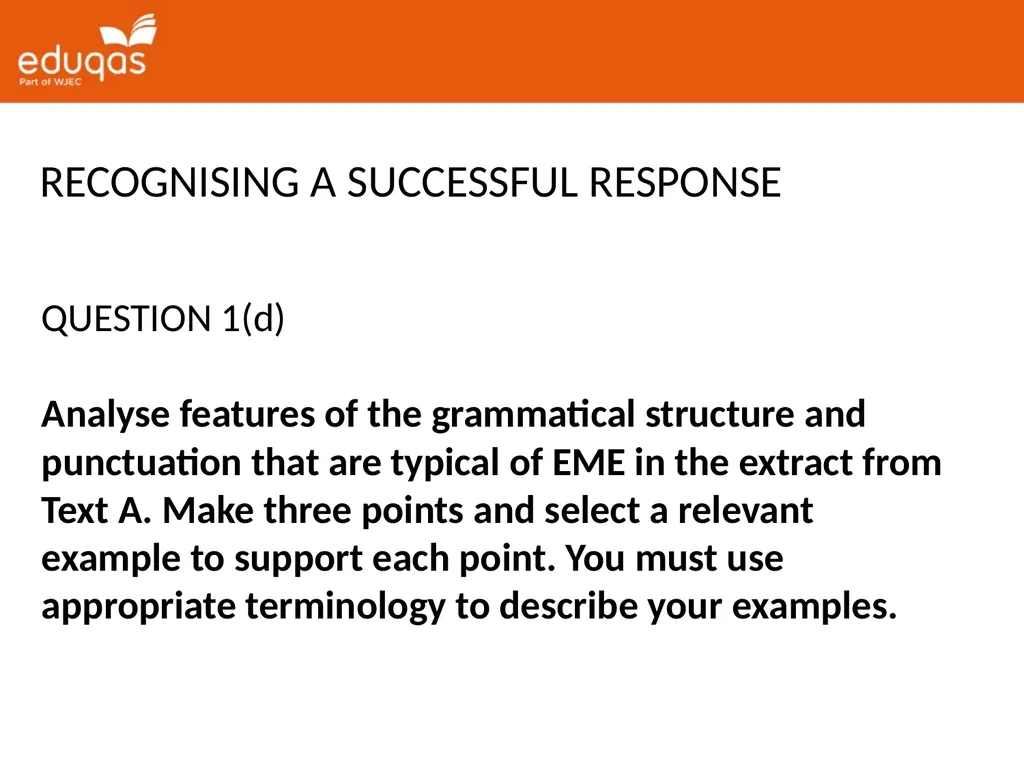
Analyse features of the grammatical structure and punctuation that are typical of EME in the extract from Text A. Make three points and select a relevant example to support each point. You must use appropriate terminology to describe your examples. RECOGNISING A successful RESPONSE<br>
Analyse features of the grammatical structure and punctuation that are typical of EME in the extract from Text A. Make three points and select a relevant example to support each point. You must use appropriate terminology to describe your examples. RECOGNISING A successful RESPONSE<br>
18
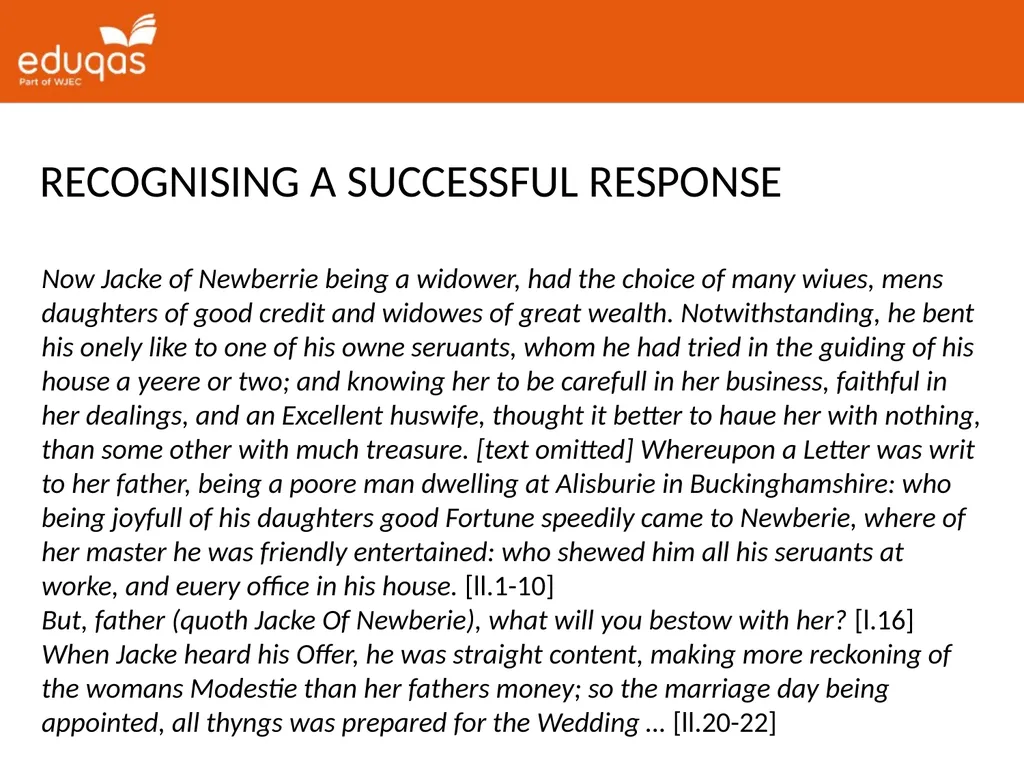
Now Jacke of Newberrie being a widower, had the choice of many wiues, mens daughters of good credit and widowes of great wealth. Notwithstanding, he bent his onely like to one of his owne seruants, whom he had tried in the guiding of his house a yeere or two; and knowing her to be carefull in her business, faithful in her dealings, and an Excellent huswife, thought it better to haue her with nothing, than some other with much treasure. [text omitted] Whereupon a Letter was writ to her father, being a poore man dwelling at Alisburie in Buckinghamshire: who being joyfull of his daughters good Fortune speedily came to Newberie, where of her master he was friendly entertained: who shewed him all his seruants at worke, and euery office in his house. [ll.1-10]
But, father (quoth Jacke Of Newberie), what will you bestow with her? [l.16]
When Jacke heard his Offer, he was straight content, making more reckoning of the womans Modestie than her fathers money; so the marriage day being appointed, all thyngs was prepared for the Wedding … [ll.20-22] RECOGNISING A successful RESPONSE<br>
But, father (quoth Jacke Of Newberie), what will you bestow with her? [l.16]
When Jacke heard his Offer, he was straight content, making more reckoning of the womans Modestie than her fathers money; so the marriage day being appointed, all thyngs was prepared for the Wedding … [ll.20-22] RECOGNISING A successful RESPONSE<br>
19
QUESTION 1(d) – credit-worthy material in red
Example 1:
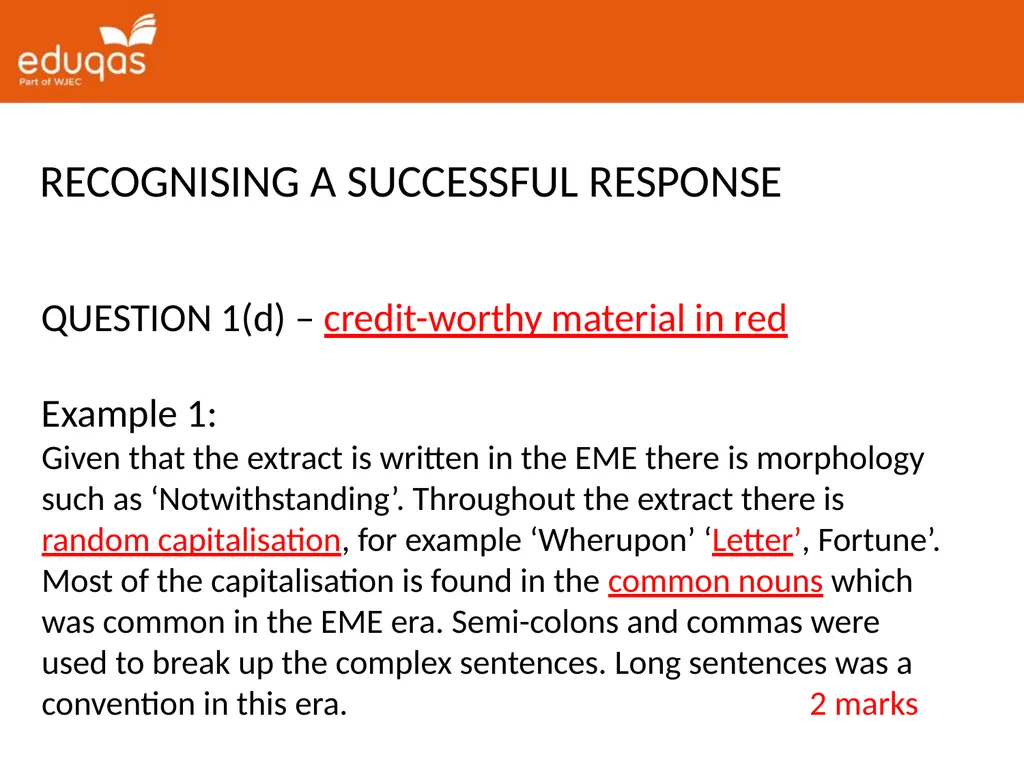
Given that the extract is written in the EME there is morphology such as ‘Notwithstanding’. Throughout the extract there is random capitalisation, for example ‘Wherupon’ ‘Letter’, Fortune’. Most of the capitalisation is found in the common nouns which was common in the EME era. Semi-colons and commas were used to break up the complex sentences. Long sentences was a convention in this era. 2 marks RECOGNISING A successful RESPONSE<br>
Example 1:
Given that the extract is written in the EME there is morphology such as ‘Notwithstanding’. Throughout the extract there is random capitalisation, for example ‘Wherupon’ ‘Letter’, Fortune’. Most of the capitalisation is found in the common nouns which was common in the EME era. Semi-colons and commas were used to break up the complex sentences. Long sentences was a convention in this era. 2 marks RECOGNISING A successful RESPONSE<br>
20
QUESTION 1(d) – credit-worthy material in red
Example 2:
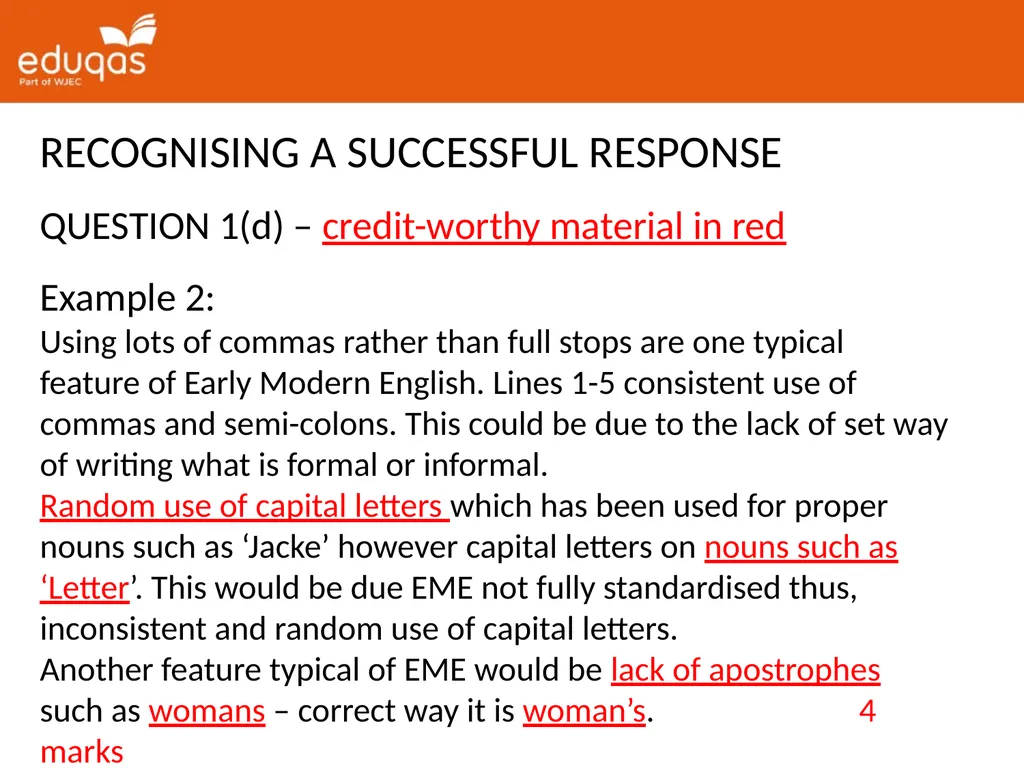
Using lots of commas rather than full stops are one typical feature of Early Modern English. Lines 1-5 consistent use of commas and semi-colons. This could be due to the lack of set way of writing what is formal or informal.
Random use of capital letters which has been used for proper nouns such as ‘Jacke’ however capital letters on nouns such as ‘Letter’. This would be due EME not fully standardised thus, inconsistent and random use of capital letters.
Another feature typical of EME would be lack of apostrophes such as womans – correct way it is woman’s. 4 marks RECOGNISING A successful RESPONSE<br>
Example 2:
Using lots of commas rather than full stops are one typical feature of Early Modern English. Lines 1-5 consistent use of commas and semi-colons. This could be due to the lack of set way of writing what is formal or informal.
Random use of capital letters which has been used for proper nouns such as ‘Jacke’ however capital letters on nouns such as ‘Letter’. This would be due EME not fully standardised thus, inconsistent and random use of capital letters.
Another feature typical of EME would be lack of apostrophes such as womans – correct way it is woman’s. 4 marks RECOGNISING A successful RESPONSE<br>
21
QUESTION 1(d) – credit-worthy material in red
Example 3:
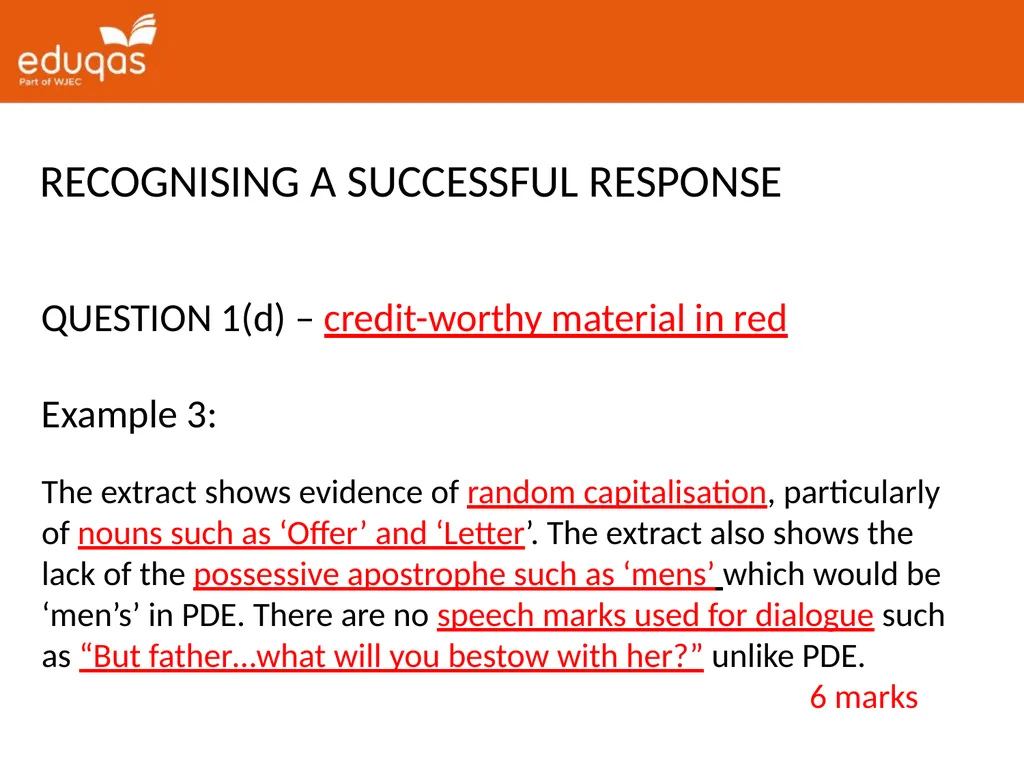
The extract shows evidence of random capitalisation, particularly of nouns such as ‘Offer’ and ‘Letter’. The extract also shows the lack of the possessive apostrophe such as ‘mens’ which would be ‘men’s’ in PDE. There are no speech marks used for dialogue such as “But father…what will you bestow with her?” unlike PDE. 6 marks RECOGNISING A successful RESPONSE<br>
Example 3:
The extract shows evidence of random capitalisation, particularly of nouns such as ‘Offer’ and ‘Letter’. The extract also shows the lack of the possessive apostrophe such as ‘mens’ which would be ‘men’s’ in PDE. There are no speech marks used for dialogue such as “But father…what will you bestow with her?” unlike PDE. 6 marks RECOGNISING A successful RESPONSE<br>
22
QUESTION 1(d) – Summary
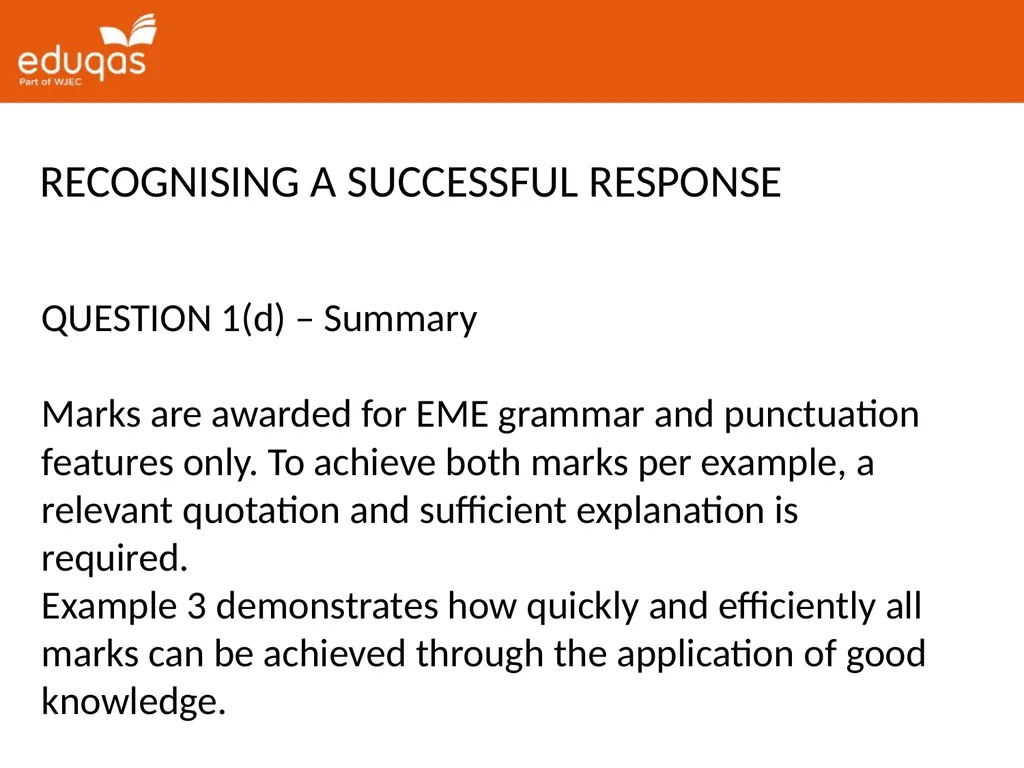
Marks are awarded for EME grammar and punctuation features only. To achieve both marks per example, a relevant quotation and sufficient explanation is required.
Example 3 demonstrates how quickly and efficiently all marks can be achieved through the application of good knowledge. RECOGNISING A successful RESPONSE<br>
Marks are awarded for EME grammar and punctuation features only. To achieve both marks per example, a relevant quotation and sufficient explanation is required.
Example 3 demonstrates how quickly and efficiently all marks can be achieved through the application of good knowledge. RECOGNISING A successful RESPONSE<br>
23
QUESTION 1(a-d)
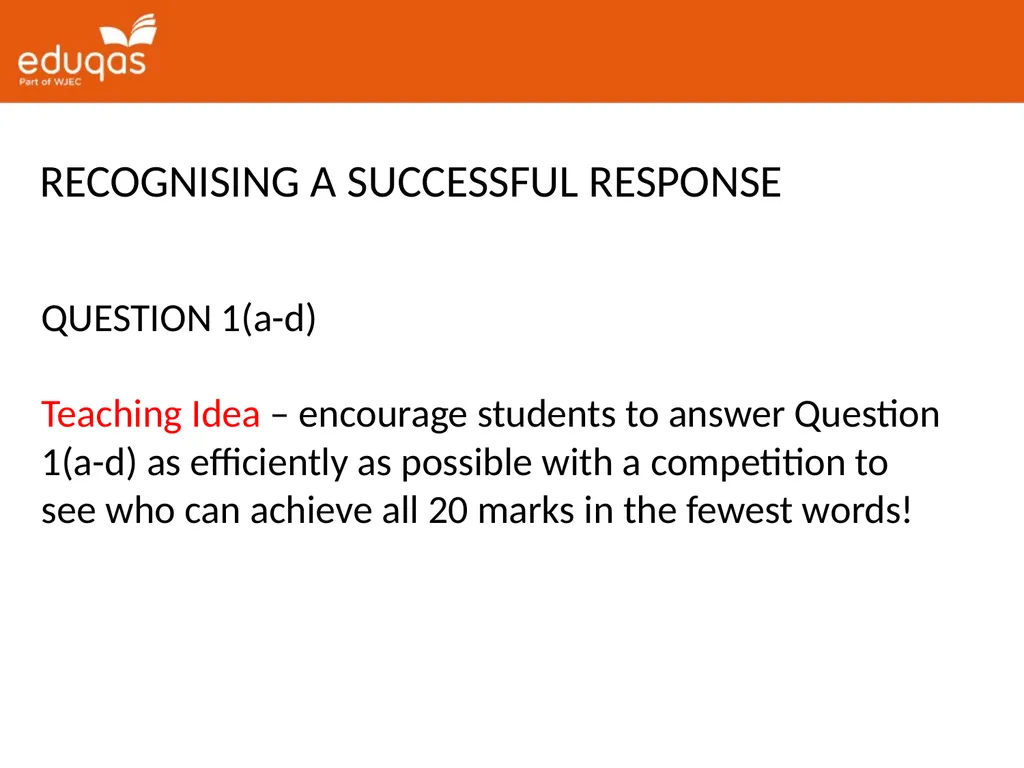
Teaching Idea – encourage students to answer Question 1(a-d) as efficiently as possible with a competition to see who can achieve all 20 marks in the fewest words! RECOGNISING A successful RESPONSE<br>
Teaching Idea – encourage students to answer Question 1(a-d) as efficiently as possible with a competition to see who can achieve all 20 marks in the fewest words! RECOGNISING A successful RESPONSE<br>
24
The following is a full Band 5 response to Question 2.
Read through and identify where there is discussion of relevant contextual factors.
Highlight any accurate use of terminology and where textual support is provided.
Identify connections drawn between texts.
Use the table to decide where the response fulfils the criteria for AO3. Write notes on your findings and remember to provide evidence to support your decisions.
The response scored slightly lower in Band 5 for one AO in comparison to the other two. Can you work out which and think of the advice you would give the candidate to improve this? READING AND APPLYING CONTEXTUAL INFORMATION<br>
Read through and identify where there is discussion of relevant contextual factors.
Highlight any accurate use of terminology and where textual support is provided.
Identify connections drawn between texts.
Use the table to decide where the response fulfils the criteria for AO3. Write notes on your findings and remember to provide evidence to support your decisions.
The response scored slightly lower in Band 5 for one AO in comparison to the other two. Can you work out which and think of the advice you would give the candidate to improve this? READING AND APPLYING CONTEXTUAL INFORMATION<br>
25
READING AND APPLYING CONTEXTUAL INFORMATION *Note – terminology is assessed under AO4 for this question<br>
26
READING AND APPLYING CONTEXTUAL INFORMATION<br>
27
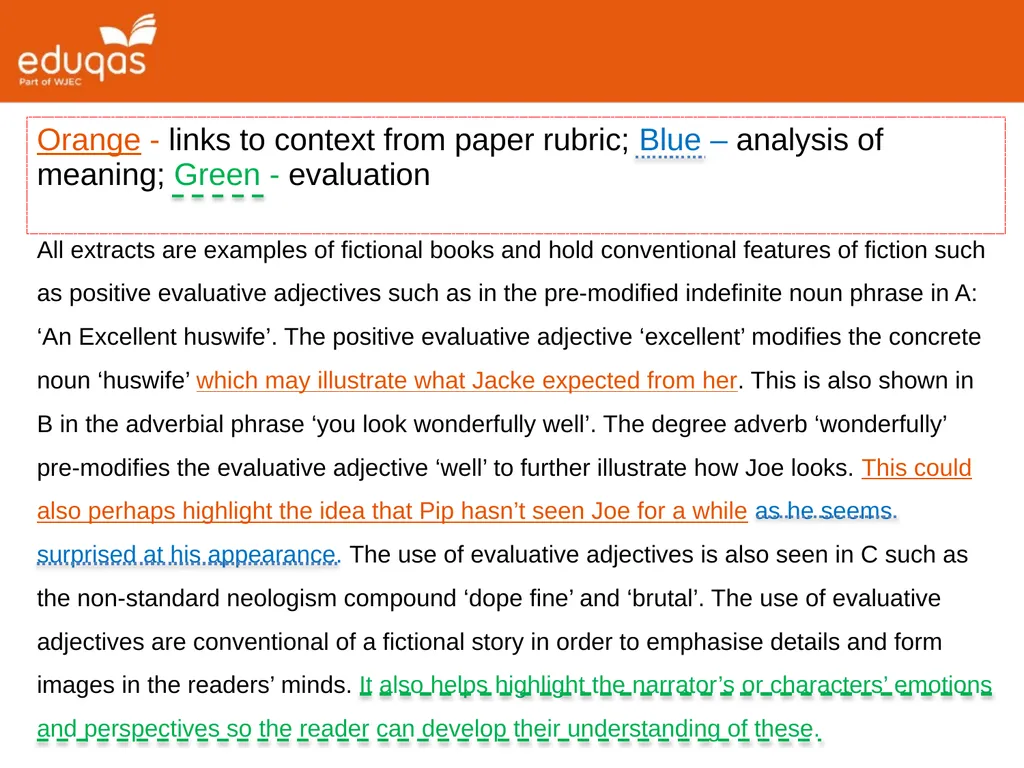
Orange - links to context from paper rubric; Blue – analysis of meaning; Green - evaluation All extracts are examples of fictional books and hold conventional features of fiction such as positive evaluative adjectives such as in the pre-modified indefinite noun phrase in A: ‘An Excellent huswife’. The positive evaluative adjective ‘excellent’ modifies the concrete noun ‘huswife’ which may illustrate what Jacke expected from her. This is also shown in B in the adverbial phrase ‘you look wonderfully well’. The degree adverb ‘wonderfully’ pre-modifies the evaluative adjective ‘well’ to further illustrate how Joe looks. This could also perhaps highlight the idea that Pip hasn’t seen Joe for a while as he seems surprised at his appearance. The use of evaluative adjectives is also seen in C such as the non-standard neologism compound ‘dope fine’ and ‘brutal’. The use of evaluative adjectives are conventional of a fictional story in order to emphasise details and form images in the readers’ minds. It also helps highlight the narrator’s or characters’ emotions and perspectives so the reader can develop their understanding of these.<br>
28
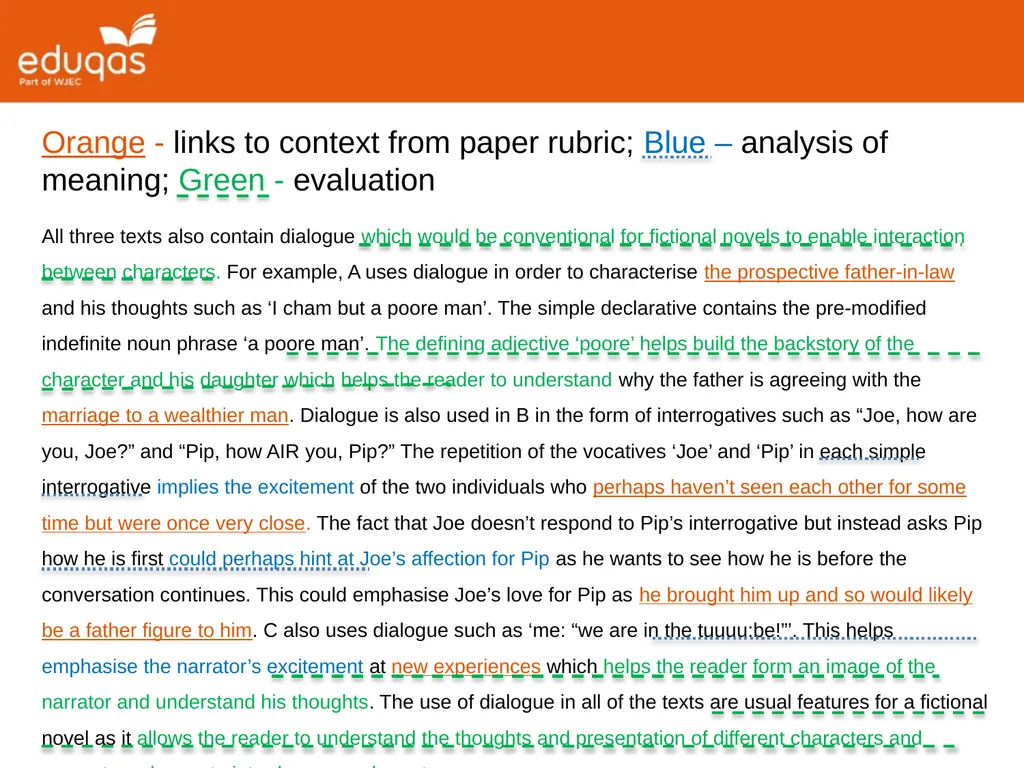
All three texts also contain dialogue which would be conventional for fictional novels to enable interaction between characters. For example, A uses dialogue in order to characterise the prospective father-in-law and his thoughts such as ‘I cham but a poore man’. The simple declarative contains the pre-modified indefinite noun phrase ‘a poore man’. The defining adjective ‘poore’ helps build the backstory of the character and his daughter which helps the reader to understand why the father is agreeing with the marriage to a wealthier man. Dialogue is also used in B in the form of interrogatives such as “Joe, how are you, Joe?” and “Pip, how AIR you, Pip?” The repetition of the vocatives ‘Joe’ and ‘Pip’ in each simple interrogative implies the excitement of the two individuals who perhaps haven’t seen each other for some time but were once very close. The fact that Joe doesn’t respond to Pip’s interrogative but instead asks Pip how he is first could perhaps hint at Joe’s affection for Pip as he wants to see how he is before the conversation continues. This could emphasise Joe’s love for Pip as he brought him up and so would likely be a father figure to him. C also uses dialogue such as ‘me: “we are in the tuuuu:be!”’. This helps emphasise the narrator’s excitement at new experiences which helps the reader form an image of the narrator and understand his thoughts. The use of dialogue in all of the texts are usual features for a fictional novel as it allows the reader to understand the thoughts and presentation of different characters and presents a chance to introduce new characters. Orange - links to context from paper rubric; Blue – analysis of meaning; Green - evaluation<br>
29
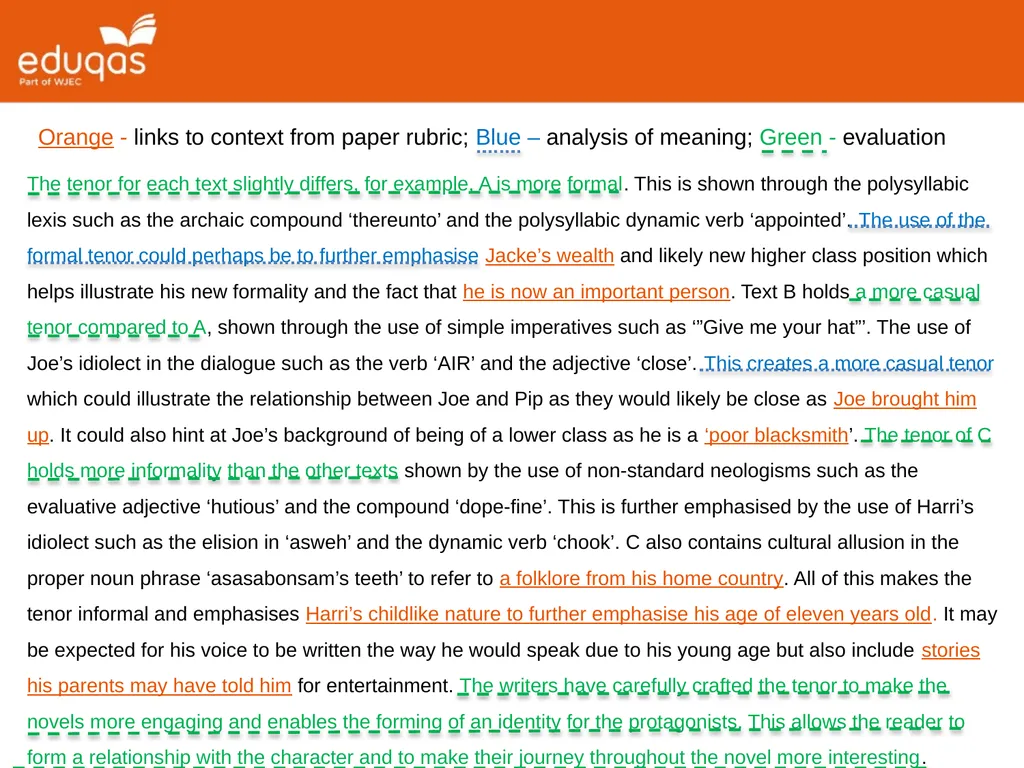
The tenor for each text slightly differs, for example, A is more formal. This is shown through the polysyllabic lexis such as the archaic compound ‘thereunto’ and the polysyllabic dynamic verb ‘appointed’. The use of the formal tenor could perhaps be to further emphasise Jacke’s wealth and likely new higher class position which helps illustrate his new formality and the fact that he is now an important person. Text B holds a more casual tenor compared to A, shown through the use of simple imperatives such as ‘”Give me your hat”’. The use of Joe’s idiolect in the dialogue such as the verb ‘AIR’ and the adjective ‘close’. This creates a more casual tenor which could illustrate the relationship between Joe and Pip as they would likely be close as Joe brought him up. It could also hint at Joe’s background of being of a lower class as he is a ‘poor blacksmith’. The tenor of C holds more informality than the other texts shown by the use of non-standard neologisms such as the evaluative adjective ‘hutious’ and the compound ‘dope-fine’. This is further emphasised by the use of Harri’s idiolect such as the elision in ‘asweh’ and the dynamic verb ‘chook’. C also contains cultural allusion in the proper noun phrase ‘asasabonsam’s teeth’ to refer to a folklore from his home country. All of this makes the tenor informal and emphasises Harri’s childlike nature to further emphasise his age of eleven years old. It may be expected for his voice to be written the way he would speak due to his young age but also include stories his parents may have told him for entertainment. The writers have carefully crafted the tenor to make the novels more engaging and enables the forming of an identity for the protagonists. This allows the reader to form a relationship with the character and to make their journey throughout the novel more interesting. Orange - links to context from paper rubric; Blue – analysis of meaning; Green - evaluation<br>
30
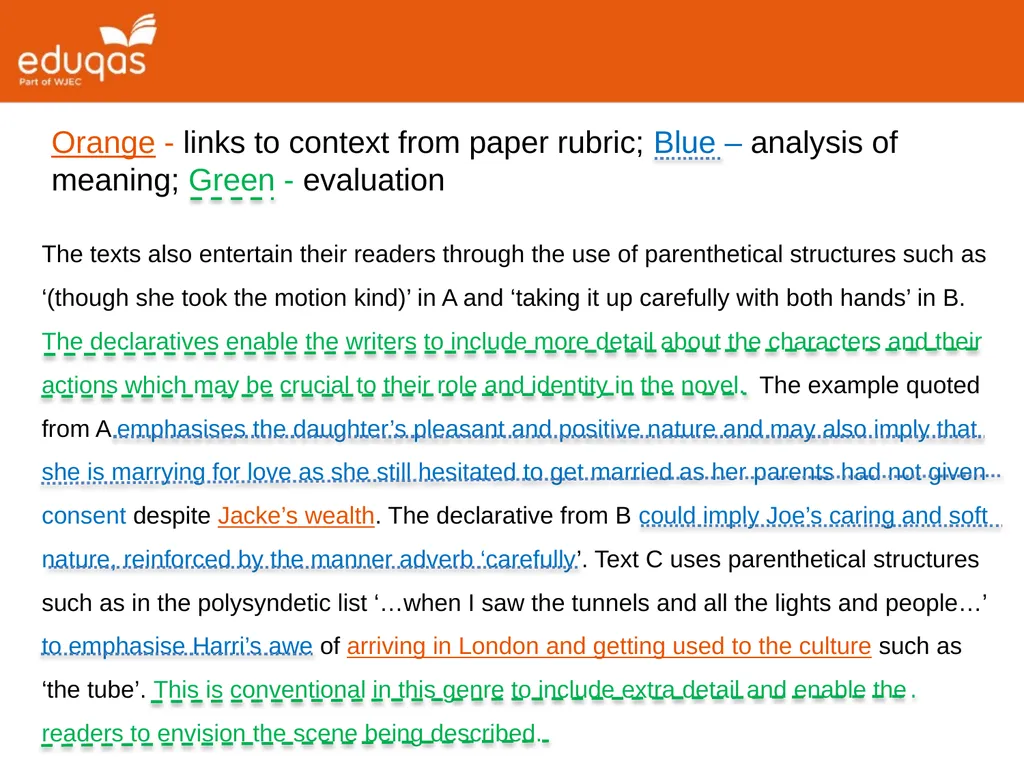
The texts also entertain their readers through the use of parenthetical structures such as ‘(though she took the motion kind)’ in A and ‘taking it up carefully with both hands’ in B. The declaratives enable the writers to include more detail about the characters and their actions which may be crucial to their role and identity in the novel. The example quoted from A emphasises the daughter’s pleasant and positive nature and may also imply that she is marrying for love as she still hesitated to get married as her parents had not given consent despite Jacke’s wealth. The declarative from B could imply Joe’s caring and soft nature, reinforced by the manner adverb ‘carefully’. Text C uses parenthetical structures such as in the polysyndetic list ‘…when I saw the tunnels and all the lights and people…’ to emphasise Harri’s awe of arriving in London and getting used to the culture such as ‘the tube’. This is conventional in this genre to include extra detail and enable the readers to envision the scene being described. Orange - links to context from paper rubric; Blue – analysis of meaning; Green - evaluation<br>
31
Harri’s childlike nature is further reinforced in C through the use of the lexical field of Haribos in the list ‘cola bottles, worms, milkshakes…’ which could emphasise that he didn’t have this back home. This engages the reader as it makes them sympathise with Harri as he is excited about sweets which may be deemed “simple” by some readers if they were born in a wealthier area as they may take this simple pleasure for granted. Harri is also slightly humorous through his beliefs which reflect a child’s thoughts such as the concrete noun ‘creatures’ that ‘live in the tunnels’ as well as the declarative with prepositional phrase ‘I’m going to sleep inside it’. This engages the reader due to the slight humour that can be taken from Harri. The reader remains engaged in A through the use of lists such as ‘with bride laces and rosemary tied about their silken sleeves’. This emphasises the wealth she is going to marry into which is further reinforced with the simile ‘hair as yellow as gold’. The defining adjective ‘gold’ holds positive connotations and could hint at her wealth after marriage but could also hint at ‘victory’ as gold is a loaded word with positive connotations. This could imply that she is in a ‘winning’ or ‘excellent’ position in life due to marriage. B also uses a simile ‘…like a birds-nest within it’ with another prepositional phrase. This emphasises how delicate Joe was with the hat which could imply that it was expensive or sentimental. The use of lexical fields in A related to wealth such as ‘gold’, ‘silken’ and ‘rich’ also help to emphasise the wealth of Jacke. The use of lexical fields and similes in all of the texts help entertain the readers as it enables them to connect with the characters as their emotions are emphasised. This is conventional for fiction readers as it is vital to engage the reader so they continue reading and perhaps even form an emotional attachment to the characters so they can relate to the story more. Orange - links to context from paper rubric; Blue – analysis of meaning; Green - evaluation<br>
32
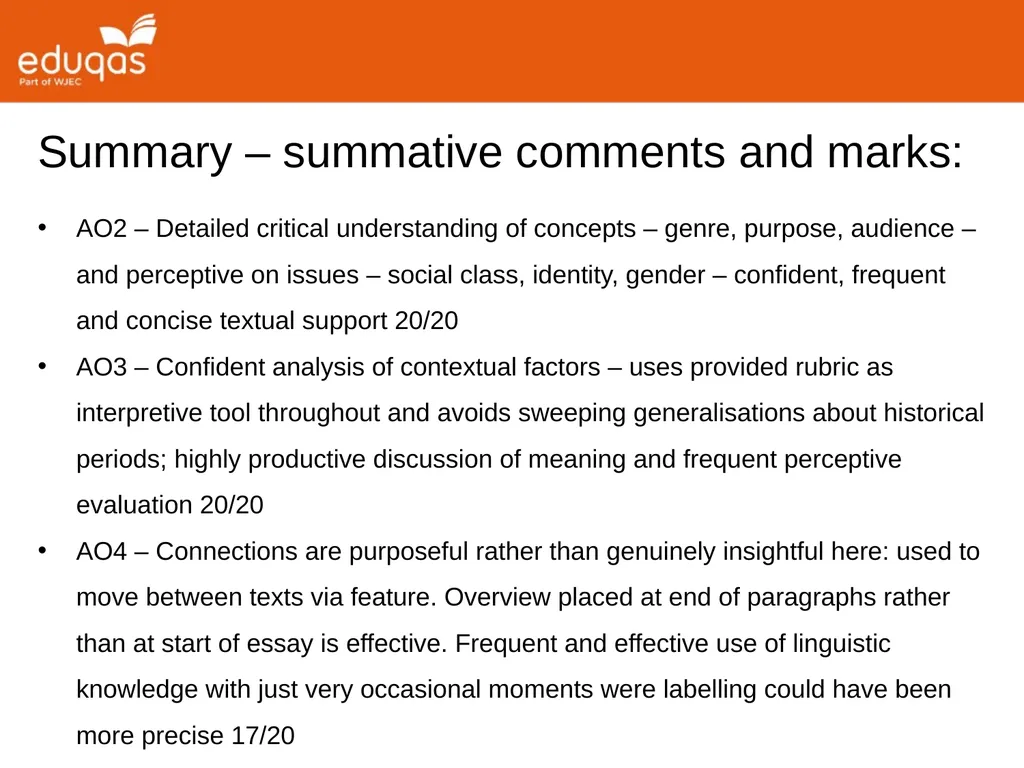
Summary – summative comments and marks: AO2 – Detailed critical understanding of concepts – genre, purpose, audience – and perceptive on issues – social class, identity, gender – confident, frequent and concise textual support 20/20
AO3 – Confident analysis of contextual factors – uses provided rubric as interpretive tool throughout and avoids sweeping generalisations about historical periods; highly productive discussion of meaning and frequent perceptive evaluation 20/20
AO4 – Connections are purposeful rather than genuinely insightful here: used to move between texts via feature. Overview placed at end of paragraphs rather than at start of essay is effective. Frequent and effective use of linguistic knowledge with just very occasional moments were labelling could have been more precise 17/20<br>
AO3 – Confident analysis of contextual factors – uses provided rubric as interpretive tool throughout and avoids sweeping generalisations about historical periods; highly productive discussion of meaning and frequent perceptive evaluation 20/20
AO4 – Connections are purposeful rather than genuinely insightful here: used to move between texts via feature. Overview placed at end of paragraphs rather than at start of essay is effective. Frequent and effective use of linguistic knowledge with just very occasional moments were labelling could have been more precise 17/20<br>
33
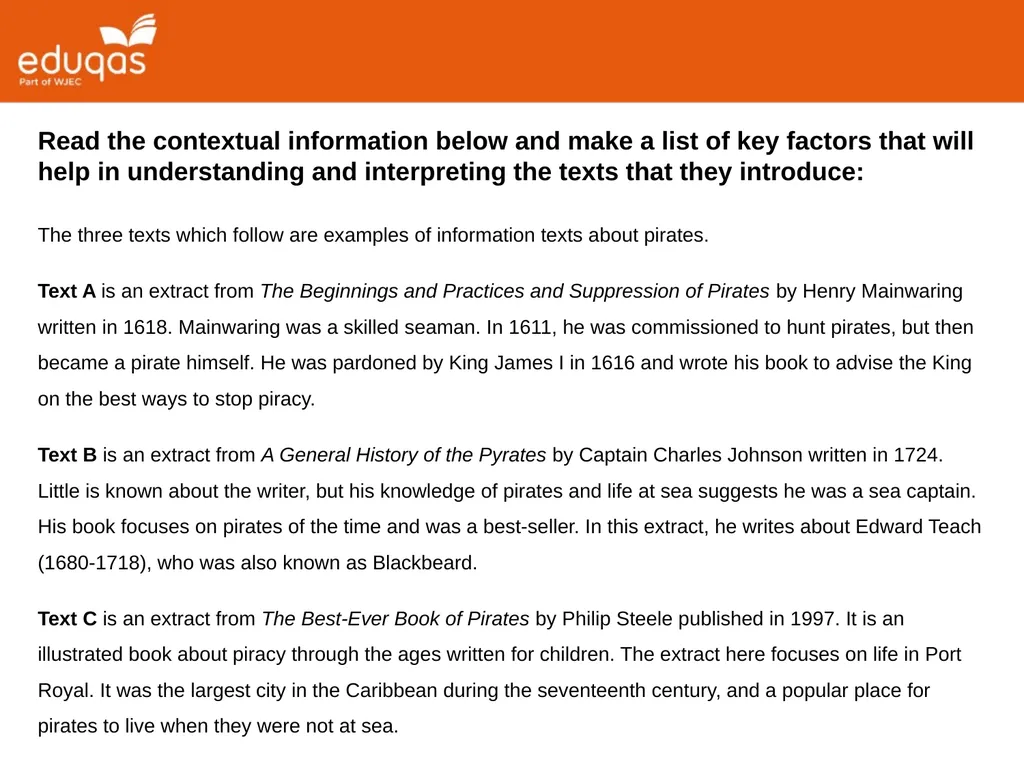
Read the contextual information below and make a list of key factors that will help in understanding and interpreting the texts that they introduce: The three texts which follow are examples of information texts about pirates.
Text A is an extract from The Beginnings and Practices and Suppression of Pirates by Henry Mainwaring written in 1618. Mainwaring was a skilled seaman. In 1611, he was commissioned to hunt pirates, but then became a pirate himself. He was pardoned by King James I in 1616 and wrote his book to advise the King on the best ways to stop piracy.
Text B is an extract from A General History of the Pyrates by Captain Charles Johnson written in 1724. Little is known about the writer, but his knowledge of pirates and life at sea suggests he was a sea captain. His book focuses on pirates of the time and was a best-seller. In this extract, he writes about Edward Teach (1680-1718), who was also known as Blackbeard.
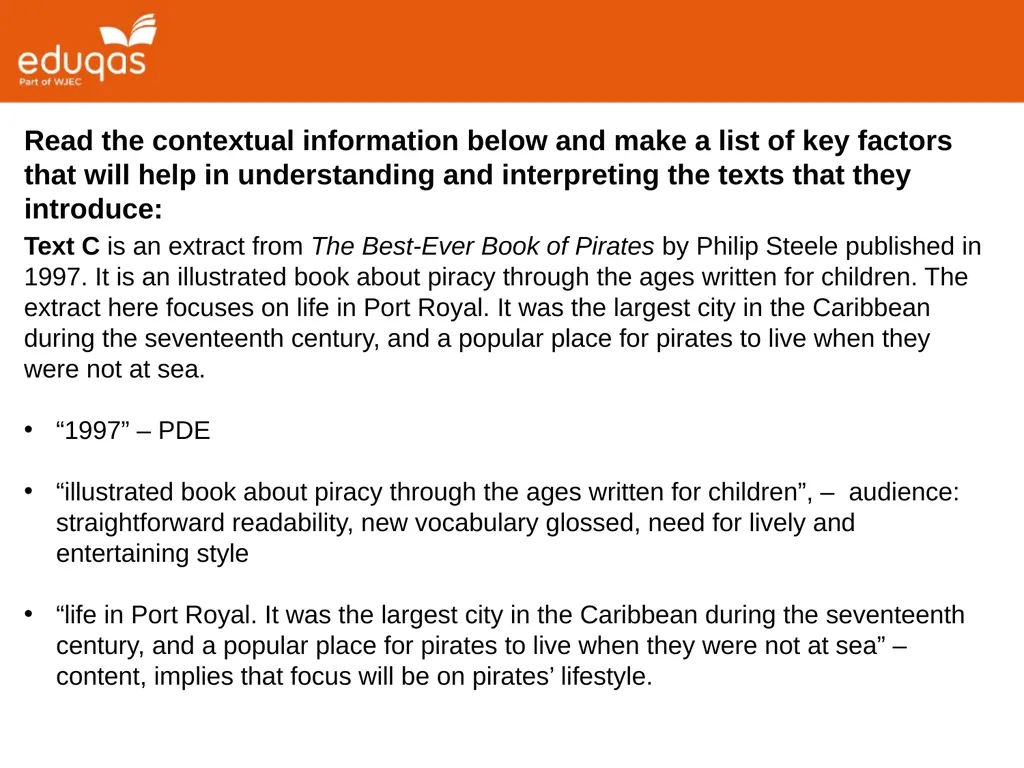
Text C is an extract from The Best-Ever Book of Pirates by Philip Steele published in 1997. It is an illustrated book about piracy through the ages written for children. The extract here focuses on life in Port Royal. It was the largest city in the Caribbean during the seventeenth century, and a popular place for pirates to live when they were not at sea.<br>
Text A is an extract from The Beginnings and Practices and Suppression of Pirates by Henry Mainwaring written in 1618. Mainwaring was a skilled seaman. In 1611, he was commissioned to hunt pirates, but then became a pirate himself. He was pardoned by King James I in 1616 and wrote his book to advise the King on the best ways to stop piracy.
Text B is an extract from A General History of the Pyrates by Captain Charles Johnson written in 1724. Little is known about the writer, but his knowledge of pirates and life at sea suggests he was a sea captain. His book focuses on pirates of the time and was a best-seller. In this extract, he writes about Edward Teach (1680-1718), who was also known as Blackbeard.
Text C is an extract from The Best-Ever Book of Pirates by Philip Steele published in 1997. It is an illustrated book about piracy through the ages written for children. The extract here focuses on life in Port Royal. It was the largest city in the Caribbean during the seventeenth century, and a popular place for pirates to live when they were not at sea.<br>
34
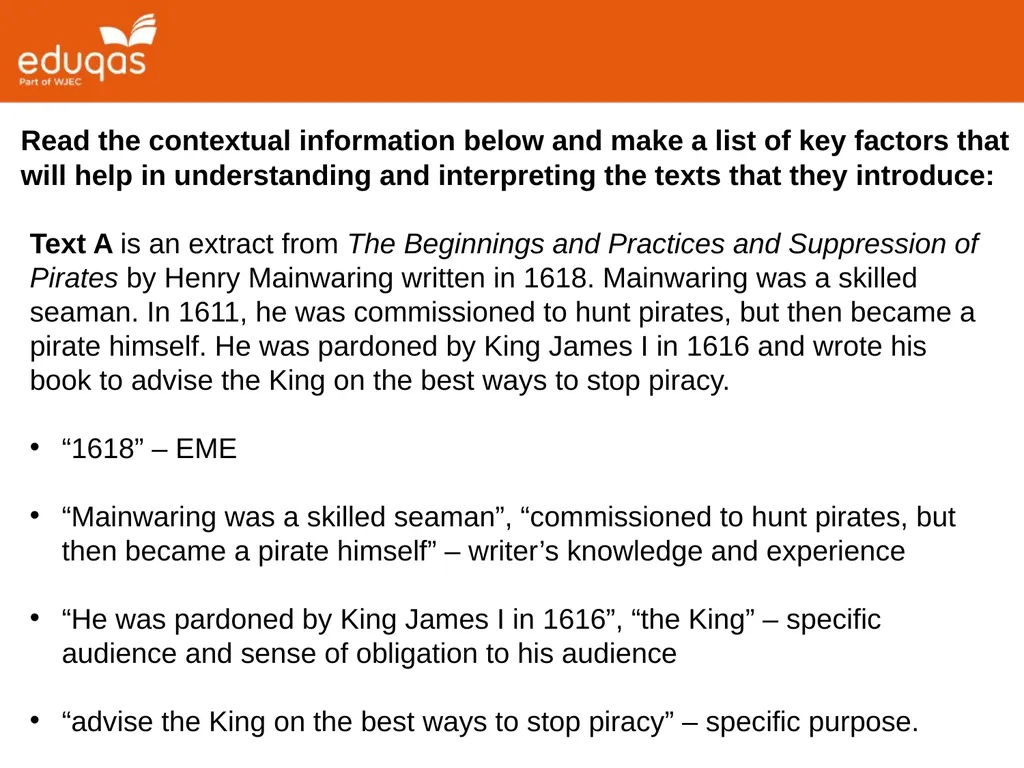
Read the contextual information below and make a list of key factors that will help in understanding and interpreting the texts that they introduce: Text A is an extract from The Beginnings and Practices and Suppression of Pirates by Henry Mainwaring written in 1618. Mainwaring was a skilled seaman. In 1611, he was commissioned to hunt pirates, but then became a pirate himself. He was pardoned by King James I in 1616 and wrote his book to advise the King on the best ways to stop piracy.
“1618” – EME
“Mainwaring was a skilled seaman”, “commissioned to hunt pirates, but then became a pirate himself” – writer’s knowledge and experience
“He was pardoned by King James I in 1616”, “the King” – specific audience and sense of obligation to his audience
“advise the King on the best ways to stop piracy” – specific purpose.<br>
“1618” – EME
“Mainwaring was a skilled seaman”, “commissioned to hunt pirates, but then became a pirate himself” – writer’s knowledge and experience
“He was pardoned by King James I in 1616”, “the King” – specific audience and sense of obligation to his audience
“advise the King on the best ways to stop piracy” – specific purpose.<br>
35
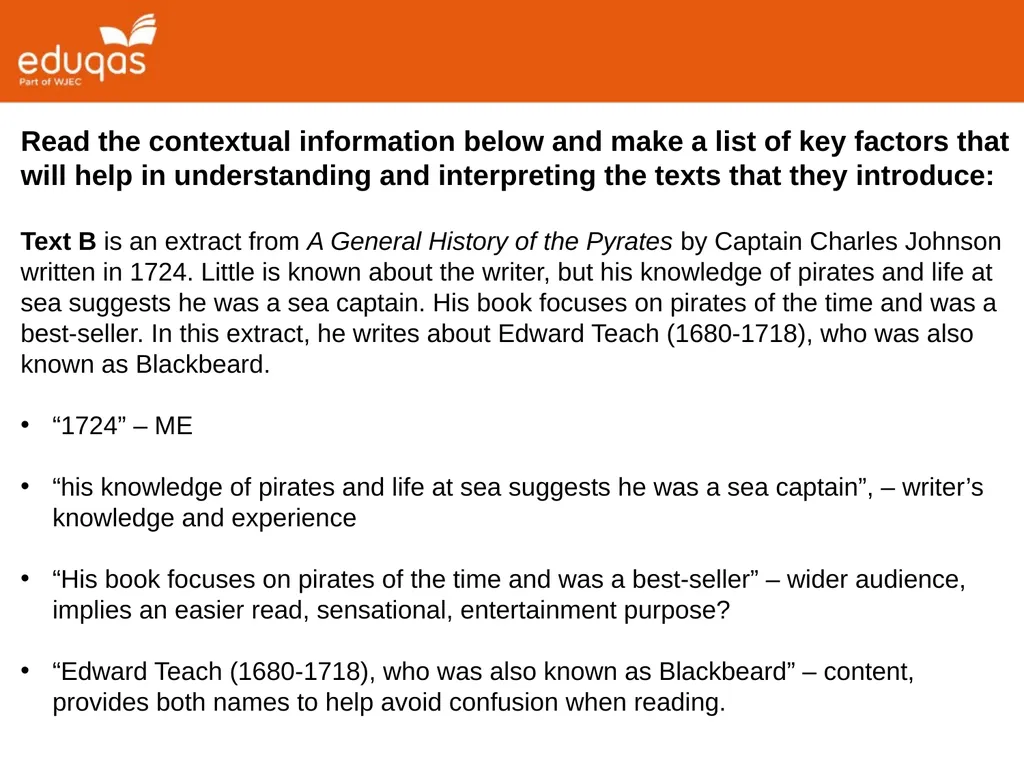
Read the contextual information below and make a list of key factors that will help in understanding and interpreting the texts that they introduce: Text B is an extract from A General History of the Pyrates by Captain Charles Johnson written in 1724. Little is known about the writer, but his knowledge of pirates and life at sea suggests he was a sea captain. His book focuses on pirates of the time and was a best-seller. In this extract, he writes about Edward Teach (1680-1718), who was also known as Blackbeard.
“1724” – ME
“his knowledge of pirates and life at sea suggests he was a sea captain”, – writer’s knowledge and experience
“His book focuses on pirates of the time and was a best-seller” – wider audience, implies an easier read, sensational, entertainment purpose?
“Edward Teach (1680-1718), who was also known as Blackbeard” – content, provides both names to help avoid confusion when reading.<br>
“1724” – ME
“his knowledge of pirates and life at sea suggests he was a sea captain”, – writer’s knowledge and experience
“His book focuses on pirates of the time and was a best-seller” – wider audience, implies an easier read, sensational, entertainment purpose?
“Edward Teach (1680-1718), who was also known as Blackbeard” – content, provides both names to help avoid confusion when reading.<br>
36
Text C is an extract from The Best-Ever Book of Pirates by Philip Steele published in 1997. It is an illustrated book about piracy through the ages written for children. The extract here focuses on life in Port Royal. It was the largest city in the Caribbean during the seventeenth century, and a popular place for pirates to live when they were not at sea.
“1997” – PDE
“illustrated book about piracy through the ages written for children”, – audience: straightforward readability, new vocabulary glossed, need for lively and entertaining style
“life in Port Royal. It was the largest city in the Caribbean during the seventeenth century, and a popular place for pirates to live when they were not at sea” – content, implies that focus will be on pirates’ lifestyle. Read the contextual information below and make a list of key factors that will help in understanding and interpreting the texts that they introduce:<br>
“1997” – PDE
“illustrated book about piracy through the ages written for children”, – audience: straightforward readability, new vocabulary glossed, need for lively and entertaining style
“life in Port Royal. It was the largest city in the Caribbean during the seventeenth century, and a popular place for pirates to live when they were not at sea” – content, implies that focus will be on pirates’ lifestyle. Read the contextual information below and make a list of key factors that will help in understanding and interpreting the texts that they introduce:<br>
37
Component 2 – Section B<br>
38
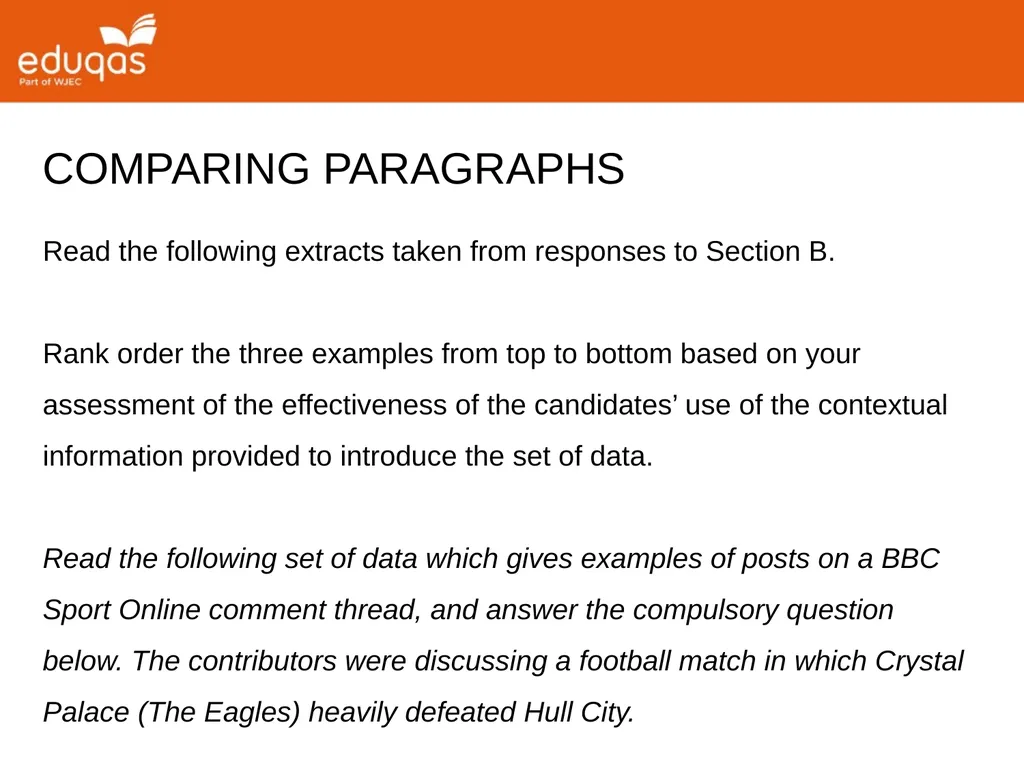
COMPARING PARAGRAPHS Read the following extracts taken from responses to Section B.
Rank order the three examples from top to bottom based on your assessment of the effectiveness of the candidates’ use of the contextual information provided to introduce the set of data.
Read the following set of data which gives examples of posts on a BBC Sport Online comment thread, and answer the compulsory question below. The contributors were discussing a football match in which Crystal Palace (The Eagles) heavily defeated Hull City.<br>
Rank order the three examples from top to bottom based on your assessment of the effectiveness of the candidates’ use of the contextual information provided to introduce the set of data.
Read the following set of data which gives examples of posts on a BBC Sport Online comment thread, and answer the compulsory question below. The contributors were discussing a football match in which Crystal Palace (The Eagles) heavily defeated Hull City.<br>
39
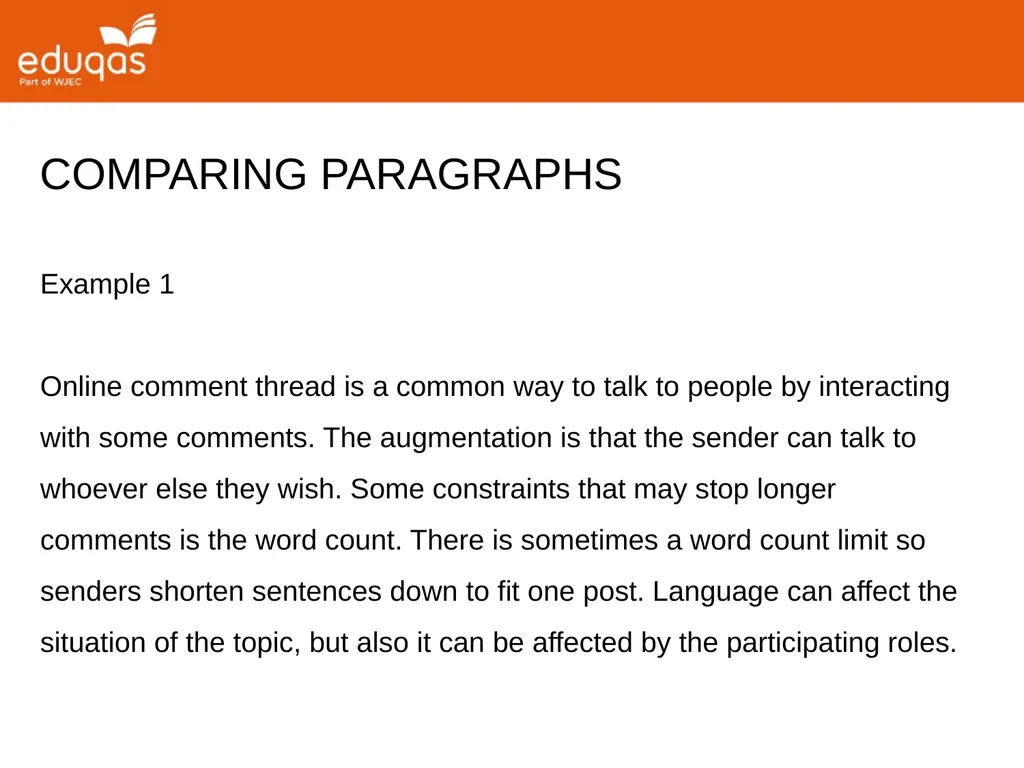
COMPARING PARAGRAPHS Example 1
Online comment thread is a common way to talk to people by interacting with some comments. The augmentation is that the sender can talk to whoever else they wish. Some constraints that may stop longer comments is the word count. There is sometimes a word count limit so senders shorten sentences down to fit one post. Language can affect the situation of the topic, but also it can be affected by the participating roles.<br>
Online comment thread is a common way to talk to people by interacting with some comments. The augmentation is that the sender can talk to whoever else they wish. Some constraints that may stop longer comments is the word count. There is sometimes a word count limit so senders shorten sentences down to fit one post. Language can affect the situation of the topic, but also it can be affected by the participating roles.<br>
40
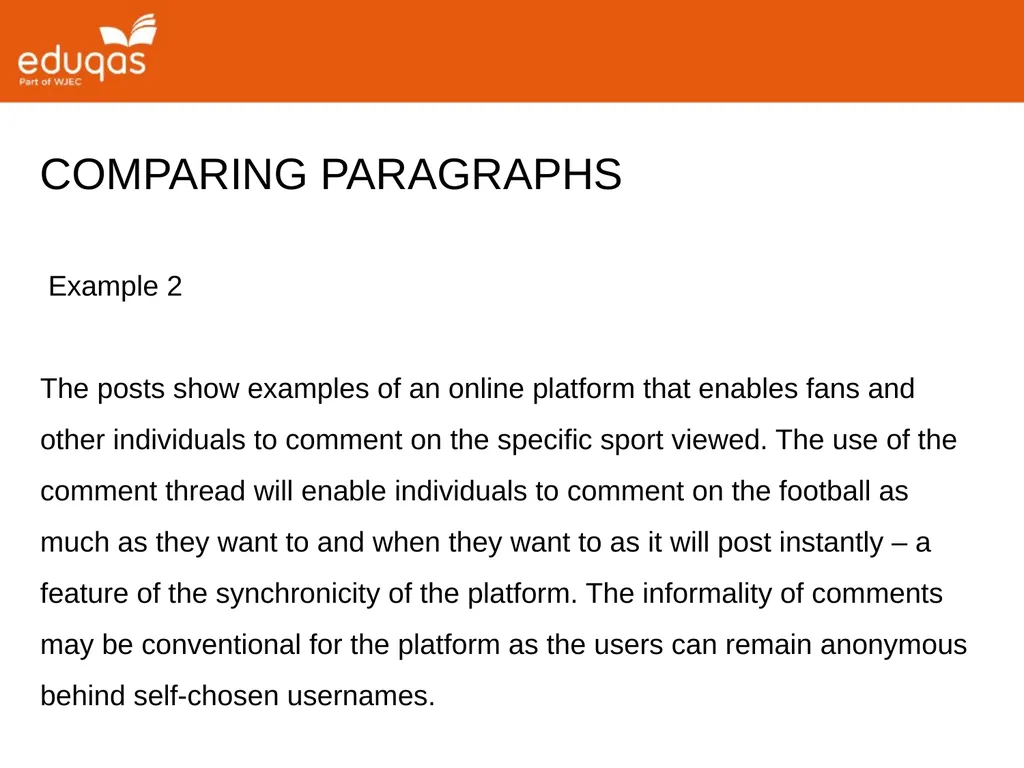
Example 2
The posts show examples of an online platform that enables fans and other individuals to comment on the specific sport viewed. The use of the comment thread will enable individuals to comment on the football as much as they want to and when they want to as it will post instantly – a feature of the synchronicity of the platform. The informality of comments may be conventional for the platform as the users can remain anonymous behind self-chosen usernames. COMPARING PARAGRAPHS<br>
The posts show examples of an online platform that enables fans and other individuals to comment on the specific sport viewed. The use of the comment thread will enable individuals to comment on the football as much as they want to and when they want to as it will post instantly – a feature of the synchronicity of the platform. The informality of comments may be conventional for the platform as the users can remain anonymous behind self-chosen usernames. COMPARING PARAGRAPHS<br>
41
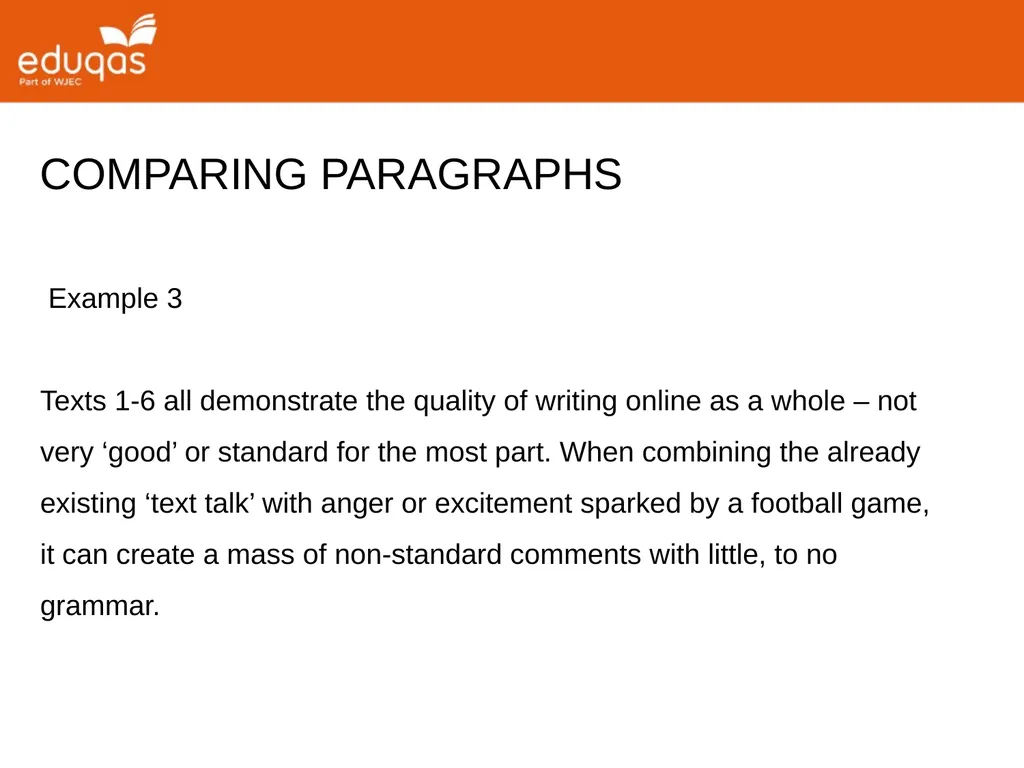
Example 3
Texts 1-6 all demonstrate the quality of writing online as a whole – not very ‘good’ or standard for the most part. When combining the already existing ‘text talk’ with anger or excitement sparked by a football game, it can create a mass of non-standard comments with little, to no grammar. COMPARING PARAGRAPHS<br>
Texts 1-6 all demonstrate the quality of writing online as a whole – not very ‘good’ or standard for the most part. When combining the already existing ‘text talk’ with anger or excitement sparked by a football game, it can create a mass of non-standard comments with little, to no grammar. COMPARING PARAGRAPHS<br>
42
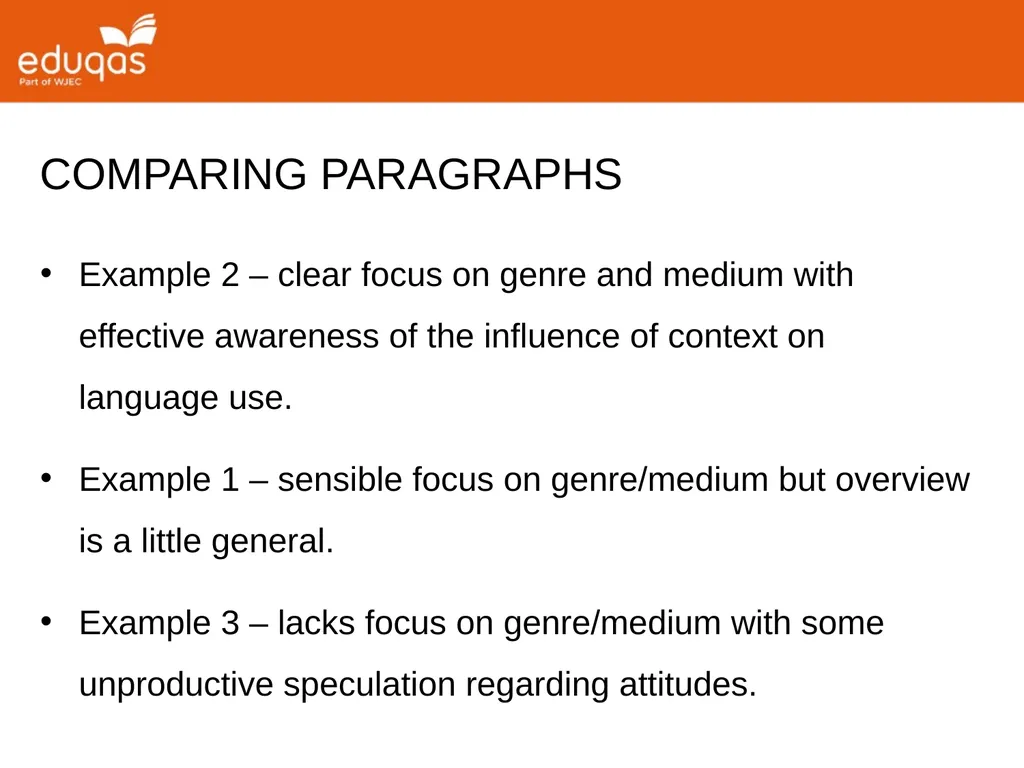
Example 2 – clear focus on genre and medium with effective awareness of the influence of context on language use.
Example 1 – sensible focus on genre/medium but overview is a little general.
Example 3 – lacks focus on genre/medium with some unproductive speculation regarding attitudes. COMPARING PARAGRAPHS<br>
Example 1 – sensible focus on genre/medium but overview is a little general.
Example 3 – lacks focus on genre/medium with some unproductive speculation regarding attitudes. COMPARING PARAGRAPHS<br>
43
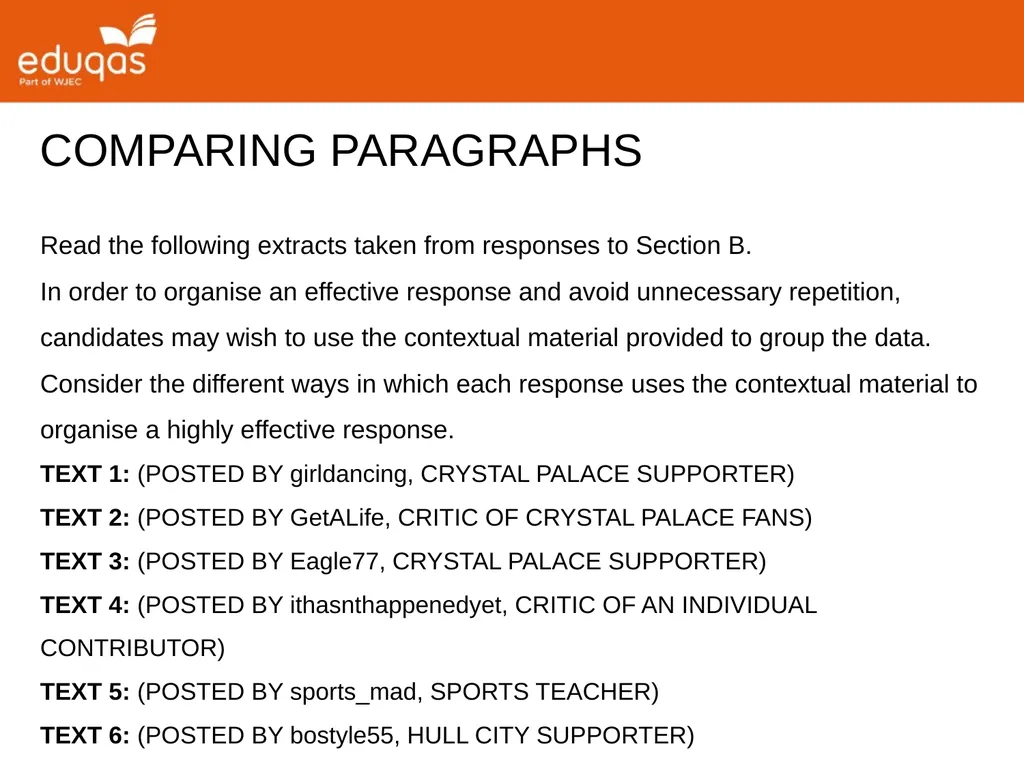
Read the following extracts taken from responses to Section B.
In order to organise an effective response and avoid unnecessary repetition, candidates may wish to use the contextual material provided to group the data.
Consider the different ways in which each response uses the contextual material to organise a highly effective response.
TEXT 1: (POSTED BY girldancing, CRYSTAL PALACE SUPPORTER)
TEXT 2: (POSTED BY GetALife, CRITIC OF CRYSTAL PALACE FANS)
TEXT 3: (POSTED BY Eagle77, CRYSTAL PALACE SUPPORTER)
TEXT 4: (POSTED BY ithasnthappenedyet, CRITIC OF AN INDIVIDUAL CONTRIBUTOR)
TEXT 5: (POSTED BY sports_mad, SPORTS TEACHER)
TEXT 6: (POSTED BY bostyle55, HULL CITY SUPPORTER) COMPARING PARAGRAPHS<br>
In order to organise an effective response and avoid unnecessary repetition, candidates may wish to use the contextual material provided to group the data.
Consider the different ways in which each response uses the contextual material to organise a highly effective response.
TEXT 1: (POSTED BY girldancing, CRYSTAL PALACE SUPPORTER)
TEXT 2: (POSTED BY GetALife, CRITIC OF CRYSTAL PALACE FANS)
TEXT 3: (POSTED BY Eagle77, CRYSTAL PALACE SUPPORTER)
TEXT 4: (POSTED BY ithasnthappenedyet, CRITIC OF AN INDIVIDUAL CONTRIBUTOR)
TEXT 5: (POSTED BY sports_mad, SPORTS TEACHER)
TEXT 6: (POSTED BY bostyle55, HULL CITY SUPPORTER) COMPARING PARAGRAPHS<br>
44
Example 1
Texts 1,3 and 6 are all supporters of football teams however 1 and 3 support Crystal Palace while 6 supports Hull City. Text 1 uses a simple declarative that could be interpreted to be patronising in ‘at least they tried’ and 3 celebrates the win with the use of pseudo-prosody in ‘EEAAGGLLEESS!!!’. The use of the capitalisation in the exclamatory represents the excitement of the fan and emulates face-to-face interaction – a feature of the virtuality of the platform. Virtuality is also shown in in text 6 by the Hull fan who criticises his own team with the hyperbole ‘Gutted, no passion, no fight… ’. The abstract nouns ‘passion’ and ‘fight’ emphasise that Hull City lacked the qualities needed to win. The use of the emojis add paralinguistic features and the individual’s emotions emulating face to face interaction. COMPARING PARAGRAPHS<br>
Texts 1,3 and 6 are all supporters of football teams however 1 and 3 support Crystal Palace while 6 supports Hull City. Text 1 uses a simple declarative that could be interpreted to be patronising in ‘at least they tried’ and 3 celebrates the win with the use of pseudo-prosody in ‘EEAAGGLLEESS!!!’. The use of the capitalisation in the exclamatory represents the excitement of the fan and emulates face-to-face interaction – a feature of the virtuality of the platform. Virtuality is also shown in in text 6 by the Hull fan who criticises his own team with the hyperbole ‘Gutted, no passion, no fight… ’. The abstract nouns ‘passion’ and ‘fight’ emphasise that Hull City lacked the qualities needed to win. The use of the emojis add paralinguistic features and the individual’s emotions emulating face to face interaction. COMPARING PARAGRAPHS<br>
45
Example 2
Texts 2 and 4 both direct criticism towards different individuals: Text 2 criticises Palace fans directly with the interrogative ‘How fickle can you get…’, the use of synthetic personalisation through the second person pronoun ‘you’ addresses the group of fans directly, expressing the opinion of the poster. The use of the unusual collocation ‘HIPPO HEAD’ insults them indirectly through a criticism of the manager. Text 4 also shows criticism which could highlight ‘internet trolling’ in which an individual contributor is being mocked. This is shown in ‘@thelegendlad…you really are pathetic’. Use of the @ sign enables the writer to ‘tag’ the other user so that they are directly linked to the comment. COMPARING PARAGRAPHS<br>
Texts 2 and 4 both direct criticism towards different individuals: Text 2 criticises Palace fans directly with the interrogative ‘How fickle can you get…’, the use of synthetic personalisation through the second person pronoun ‘you’ addresses the group of fans directly, expressing the opinion of the poster. The use of the unusual collocation ‘HIPPO HEAD’ insults them indirectly through a criticism of the manager. Text 4 also shows criticism which could highlight ‘internet trolling’ in which an individual contributor is being mocked. This is shown in ‘@thelegendlad…you really are pathetic’. Use of the @ sign enables the writer to ‘tag’ the other user so that they are directly linked to the comment. COMPARING PARAGRAPHS<br>
46
Example 3
Text 5’s use of language is no doubt influenced by the writer’s position as a ‘sports teacher’ and, as such, we see a level of formality in his post that is typical of such a position. Despite being a ‘Palace fan’, he remains sympathetic – seen in the short declarative ‘hope to see Hull fighting back before long’ that conveys the level of general respect required as a teacher posting publicly. We also see expertise with the sports metaphors ‘imploded within their play’ and ‘soaked up any pressure’, perhaps acting as jargonistic expression to convey that expertise. However, the teacher does use some initialism in the noun phrase ‘v. careless errors’, perhaps indicating some level of convergence to the medium where informality is expected, while still maintaining Standard English. COMPARING PARAGRAPHS<br>
Text 5’s use of language is no doubt influenced by the writer’s position as a ‘sports teacher’ and, as such, we see a level of formality in his post that is typical of such a position. Despite being a ‘Palace fan’, he remains sympathetic – seen in the short declarative ‘hope to see Hull fighting back before long’ that conveys the level of general respect required as a teacher posting publicly. We also see expertise with the sports metaphors ‘imploded within their play’ and ‘soaked up any pressure’, perhaps acting as jargonistic expression to convey that expertise. However, the teacher does use some initialism in the noun phrase ‘v. careless errors’, perhaps indicating some level of convergence to the medium where informality is expected, while still maintaining Standard English. COMPARING PARAGRAPHS<br>
47
Example 1 – picks up on the fact that texts 1,3 and 6 are all identified as ‘supporters’ of the teams involved, using this as a topic sentence before going on to consider the differing ways in which they express their feelings about the game.
Example 2 – Similarly, picks up on the identification of writers of texts 2 and 4 as ‘critics’ and sets up analysis to consider different types of criticism typical to genre/medium.
Example 3 – focuses closely on identity of writer as ‘sports teacher’ and uses this to consider implications of this as a context for language use. COMPARING PARAGRAPHS<br>
Example 2 – Similarly, picks up on the identification of writers of texts 2 and 4 as ‘critics’ and sets up analysis to consider different types of criticism typical to genre/medium.
Example 3 – focuses closely on identity of writer as ‘sports teacher’ and uses this to consider implications of this as a context for language use. COMPARING PARAGRAPHS<br>
48
Read the following extracts taken from responses to Section B.
Rank order the three examples from top to bottom based on your assessment of the effectiveness of the candidates’ use of the contextual information provided to identify the writer of each text – their usernames. COMPARING PARAGRAPHS<br>
Rank order the three examples from top to bottom based on your assessment of the effectiveness of the candidates’ use of the contextual information provided to identify the writer of each text – their usernames. COMPARING PARAGRAPHS<br>
49
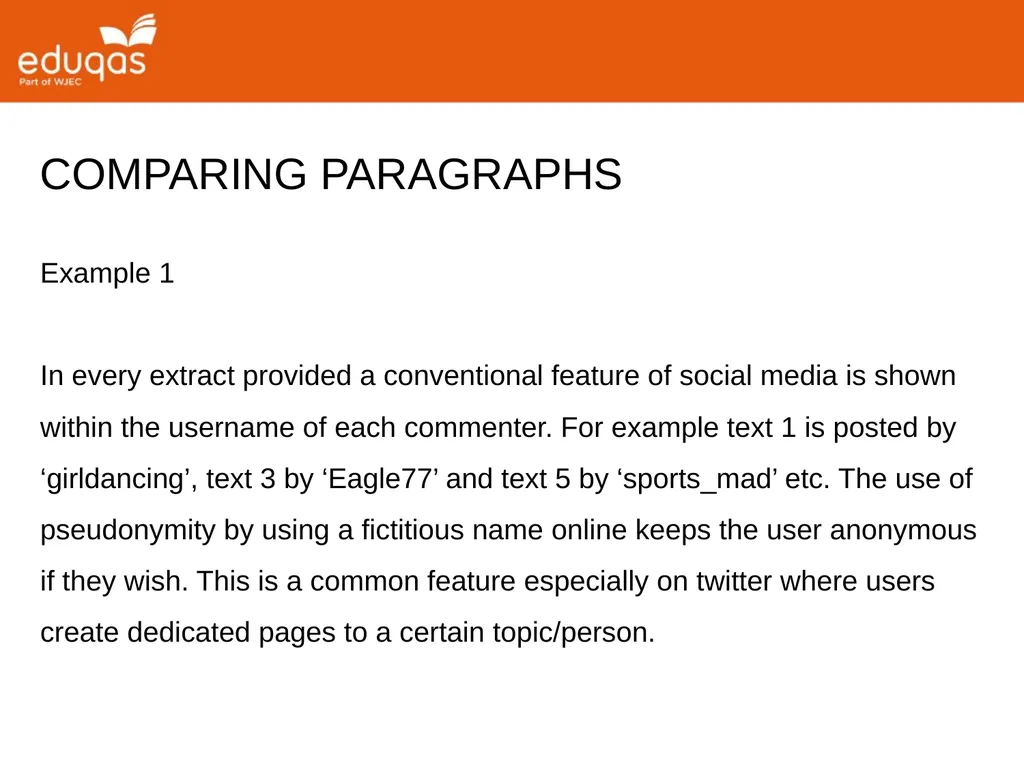
Example 1
In every extract provided a conventional feature of social media is shown within the username of each commenter. For example text 1 is posted by ‘girldancing’, text 3 by ‘Eagle77’ and text 5 by ‘sports_mad’ etc. The use of pseudonymity by using a fictitious name online keeps the user anonymous if they wish. This is a common feature especially on twitter where users create dedicated pages to a certain topic/person. COMPARING PARAGRAPHS<br>
In every extract provided a conventional feature of social media is shown within the username of each commenter. For example text 1 is posted by ‘girldancing’, text 3 by ‘Eagle77’ and text 5 by ‘sports_mad’ etc. The use of pseudonymity by using a fictitious name online keeps the user anonymous if they wish. This is a common feature especially on twitter where users create dedicated pages to a certain topic/person. COMPARING PARAGRAPHS<br>
50
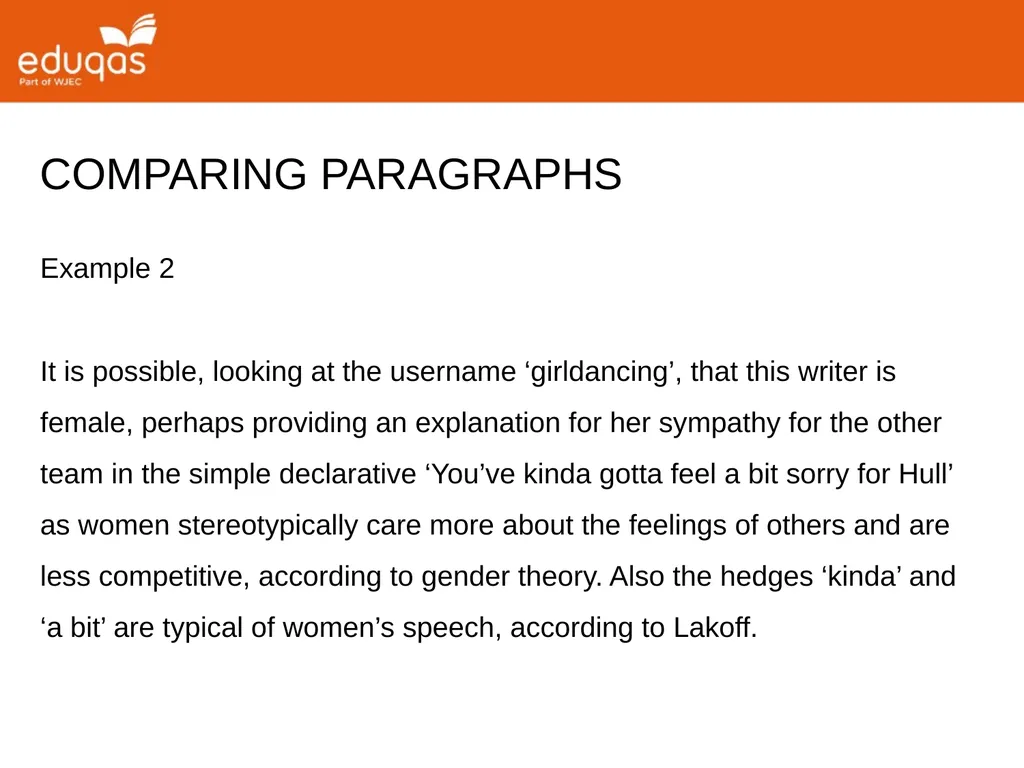
Example 2
It is possible, looking at the username ‘girldancing’, that this writer is female, perhaps providing an explanation for her sympathy for the other team in the simple declarative ‘You’ve kinda gotta feel a bit sorry for Hull’ as women stereotypically care more about the feelings of others and are less competitive, according to gender theory. Also the hedges ‘kinda’ and ‘a bit’ are typical of women’s speech, according to Lakoff. COMPARING PARAGRAPHS<br>
It is possible, looking at the username ‘girldancing’, that this writer is female, perhaps providing an explanation for her sympathy for the other team in the simple declarative ‘You’ve kinda gotta feel a bit sorry for Hull’ as women stereotypically care more about the feelings of others and are less competitive, according to gender theory. Also the hedges ‘kinda’ and ‘a bit’ are typical of women’s speech, according to Lakoff. COMPARING PARAGRAPHS<br>
51
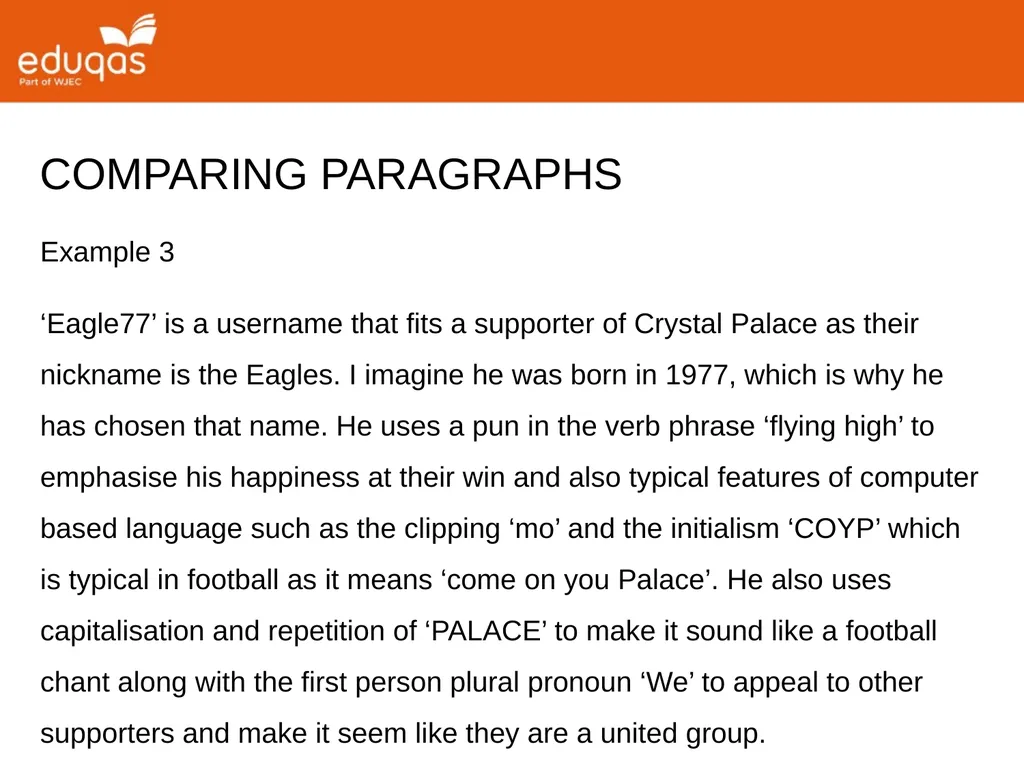
Example 3
‘Eagle77’ is a username that fits a supporter of Crystal Palace as their nickname is the Eagles. I imagine he was born in 1977, which is why he has chosen that name. He uses a pun in the verb phrase ‘flying high’ to emphasise his happiness at their win and also typical features of computer based language such as the clipping ‘mo’ and the initialism ‘COYP’ which is typical in football as it means ‘come on you Palace’. He also uses capitalisation and repetition of ‘PALACE’ to make it sound like a football chant along with the first person plural pronoun ‘We’ to appeal to other supporters and make it seem like they are a united group. COMPARING PARAGRAPHS<br>
‘Eagle77’ is a username that fits a supporter of Crystal Palace as their nickname is the Eagles. I imagine he was born in 1977, which is why he has chosen that name. He uses a pun in the verb phrase ‘flying high’ to emphasise his happiness at their win and also typical features of computer based language such as the clipping ‘mo’ and the initialism ‘COYP’ which is typical in football as it means ‘come on you Palace’. He also uses capitalisation and repetition of ‘PALACE’ to make it sound like a football chant along with the first person plural pronoun ‘We’ to appeal to other supporters and make it seem like they are a united group. COMPARING PARAGRAPHS<br>
52
Example 3 – Less well written, perhaps, but maintains a strong focus on the question and applies the username information as a springboard to analysis of the language of the text in a highly productive manner.
Example 2 – Written expression is more secure than 3 and certainly achieves credit for discussion of gender under AO2 (issues) but this leads the response away from the question somewhat.
Example 1 – Rather general, lacking focus on genre/medium, certainly not helped by reference to ‘twitter’. There is, nevertheless, content worthy of credit here in the discussion of concepts (AO2). COMPARING PARAGRAPHS<br>
Example 2 – Written expression is more secure than 3 and certainly achieves credit for discussion of gender under AO2 (issues) but this leads the response away from the question somewhat.
Example 1 – Rather general, lacking focus on genre/medium, certainly not helped by reference to ‘twitter’. There is, nevertheless, content worthy of credit here in the discussion of concepts (AO2). COMPARING PARAGRAPHS<br>
53
Any Questions?<br>