
Communication N5 www.futuremanagers.com
KL
Published · 88 slides · 0 views

1 / 1

Description
Communication N5 www.futuremanagers.com INTRODUCTION An organisation is an organised group of people with a particular purpose or aim. Your college is an organisation, as is any government department, or an institution, such as Capitec
Related Topics
Share
Embed code
Download this presentation From Below
"Communication N5 www.futuremanagers.com" is the property of its rightful owner. Permission is granted to download and print the materials on this website for personal, non-commercial use only, and to display it on your personal computer provided you do not modify the materials and that you retain all copyright notices contained in the materials. By downloading content from our website, you accept the terms of this agreement.
Presentation Transcript
01
Communication
N5<br>
N5<br>
02
www.futuremanagers.com INTRODUCTION
An organisation is an organised group of people with a particular purpose or aim. Your college is an organisation, as is any government department, or an institution, such as Capitec Bank, or a business, such as Shoprite, or an NGO like The Endangered Wildlife Trust. These organisations all have managers who have the task of achieving the aim of the organisation with the help of employees. Module 1: Organisational communication<br>
An organisation is an organised group of people with a particular purpose or aim. Your college is an organisation, as is any government department, or an institution, such as Capitec Bank, or a business, such as Shoprite, or an NGO like The Endangered Wildlife Trust. These organisations all have managers who have the task of achieving the aim of the organisation with the help of employees. Module 1: Organisational communication<br>
03
www.futuremanagers.com Module 1: Organisational communication (continued) CORPORATE CULTURE
Corporate culture is the basic beliefs and values shared by the people in the organisation, and it makes the organisation and its way of doing things, unique.<br>
Corporate culture is the basic beliefs and values shared by the people in the organisation, and it makes the organisation and its way of doing things, unique.<br>
04
www.futuremanagers.com Module 1: Organisational communication (continued) EXTERNAL COMMUNICATION
External communication is the way that members of an organisation communicate with their external stakeholders through marketing and public relations, and this helps to create the corporate image of the organisation.<br>
External communication is the way that members of an organisation communicate with their external stakeholders through marketing and public relations, and this helps to create the corporate image of the organisation.<br>
05
www.futuremanagers.com Module 1: Organisational communication (continued) INTERNAL COMMUNICATION
Internal communication occurs when members of an organisation communicate verbally or nonverbally with individuals or groups at all levels within the organisational system of superiors and subordinates in order to achieve the goals of the organisation.<br>
Internal communication occurs when members of an organisation communicate verbally or nonverbally with individuals or groups at all levels within the organisational system of superiors and subordinates in order to achieve the goals of the organisation.<br>
06
www.futuremanagers.com Module 1: Organisational communication (continued) ORGANISATIONAL HIERARCHY
Every organisation needs to be structured in a way that will help it to achieve its goals. Most often, the structure is a hierarchy. An organogram is a more detailed graphic representation of how the organisation is hierarchically structured. It shows who has authority over whom within the hierarchy, what types of authority there are, the communication relationships between jobs and also departments.<br>
Every organisation needs to be structured in a way that will help it to achieve its goals. Most often, the structure is a hierarchy. An organogram is a more detailed graphic representation of how the organisation is hierarchically structured. It shows who has authority over whom within the hierarchy, what types of authority there are, the communication relationships between jobs and also departments.<br>
07
www.futuremanagers.com Module 1: Organisational communication (continued) FORMAL COMMUNICATION CHANNELS
Formal communication channels refer to task-oriented communication that follows the official lines of communication in the organisation. There are three formal channels:
Vertical;
Horizontal; and
Diagonal.<br>
Formal communication channels refer to task-oriented communication that follows the official lines of communication in the organisation. There are three formal channels:
Vertical;
Horizontal; and
Diagonal.<br>
08
www.futuremanagers.com Module 1: Organisational communication (continued) INFORMAL COMMUNICATION CHANNELS
Informal communication is unofficial oral, written and nonverbal communication that does not flow along the formal communication channels which follow the formal hierarchy of the organisation, but follows its own unofficial channels. It is relationship-oriented, not task focused.<br>
Informal communication is unofficial oral, written and nonverbal communication that does not flow along the formal communication channels which follow the formal hierarchy of the organisation, but follows its own unofficial channels. It is relationship-oriented, not task focused.<br>
09
www.futuremanagers.com Module 1: Organisational communication (continued) COMPONENTS OF MANAGEMENT TERMINOLOGY
Terminology is the set of technical words or expressions used in a particular subject. It is sometimes called jargon.<br>
Terminology is the set of technical words or expressions used in a particular subject. It is sometimes called jargon.<br>
10
www.futuremanagers.com Module 1: Organisational communication (continued) BRIEFING
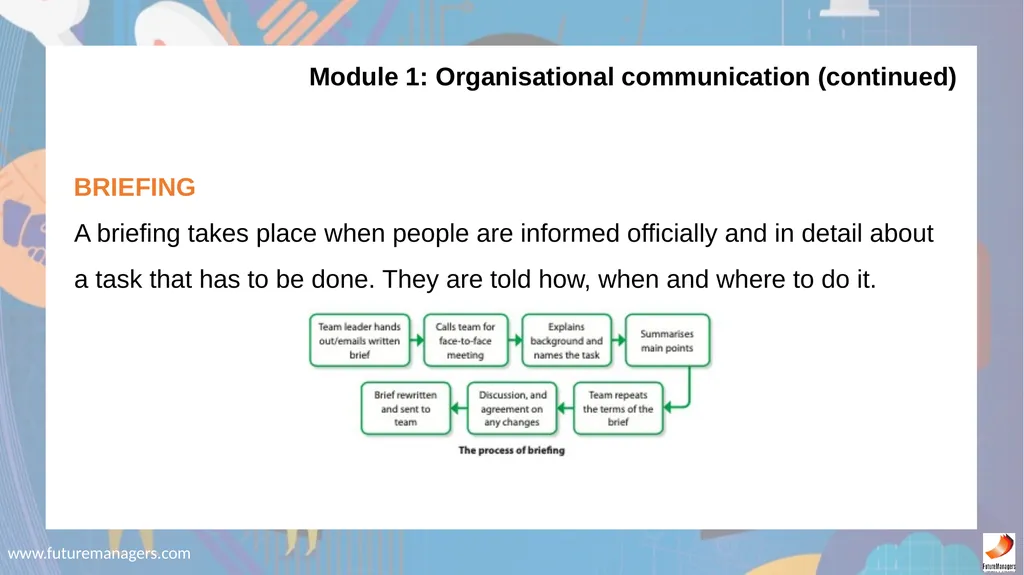
A briefing takes place when people are informed officially and in detail about a task that has to be done. They are told how, when and where to do it.<br>
A briefing takes place when people are informed officially and in detail about a task that has to be done. They are told how, when and where to do it.<br>
11
www.futuremanagers.com Module 1: Organisational communication (continued) INTERVENTION AND NEGOTIATION
Intervention is the organisation providing help in a formal way in order to solve problems. Interventions are formal, written-down, step-by-step strategies to follow when required. A negotiation is a formal discussion to reach agreement about an issue. It is an important method of reducing conflict and resolving issues.<br>
Intervention is the organisation providing help in a formal way in order to solve problems. Interventions are formal, written-down, step-by-step strategies to follow when required. A negotiation is a formal discussion to reach agreement about an issue. It is an important method of reducing conflict and resolving issues.<br>
12
www.futuremanagers.com Module 1: Organisational communication (continued) WORK ETHICS
Work ethics refers to contemporary organisational standards, moral principles, values and norms that govern the actions and behaviour of an individual or a group in the organisation.<br>
Work ethics refers to contemporary organisational standards, moral principles, values and norms that govern the actions and behaviour of an individual or a group in the organisation.<br>
13
www.futuremanagers.com INTRODUCTION
A promise you make to yourself is called a goal. At college, students’ personal goals might possibly be in a number of different areas, such as education, or relationships, or spirituality/religion, or physical health and sport, etc. At work, goals are usually set by management and are aimed at achieving greater success for the organisation. Module 2: Formulation of aims, goals and objectives in planning<br>
A promise you make to yourself is called a goal. At college, students’ personal goals might possibly be in a number of different areas, such as education, or relationships, or spirituality/religion, or physical health and sport, etc. At work, goals are usually set by management and are aimed at achieving greater success for the organisation. Module 2: Formulation of aims, goals and objectives in planning<br>
14
www.futuremanagers.com Module 2: Formulation of aims, goals and objectives in planning (continued) AIMS, GOALS AND OBJECTIVES
Aims are long term. They explain in general what it is that you hope to achieve in the future. However, they do not specify exactly what you want to achieve, a time limit or how you are going to achieve it. Goals are medium to long term. They break up the aim into large sections that must be achieved, explaining in broad terms what should be achieved and how it should be achieved.<br>
Aims are long term. They explain in general what it is that you hope to achieve in the future. However, they do not specify exactly what you want to achieve, a time limit or how you are going to achieve it. Goals are medium to long term. They break up the aim into large sections that must be achieved, explaining in broad terms what should be achieved and how it should be achieved.<br>
15
www.futuremanagers.com Module 2: Formulation of aims, goals and objectives in planning (continued) DETERMINING AIMS, GOALS AND OBJECTIVES
To determine an aim, goal or objective, you have to think about what you want to do with your life, write it down, and then ask key questions to check if they are valid goals. These questions are:
How relevant is the goal?
How realistic is the goal?
How will its progress be measured?
Is realistic/valuable feedback possible?<br>
To determine an aim, goal or objective, you have to think about what you want to do with your life, write it down, and then ask key questions to check if they are valid goals. These questions are:
How relevant is the goal?
How realistic is the goal?
How will its progress be measured?
Is realistic/valuable feedback possible?<br>
16
www.futuremanagers.com Module 2: Formulation of aims, goals and objectives in planning (continued) EVALUATING AIMS, GOALS AND OBJECTIVES
We need to look critically at the goals we set ourselves in order to make sure that they can be achieved. If we follow certain well-known guidelines known as SMART guidelines when evaluating the goals and objectives we have set, we can do it. SMART is a mnemonic made from the words Specific, Measurable, Attainable, Relevant and Traceable (or Time-bound).<br>
We need to look critically at the goals we set ourselves in order to make sure that they can be achieved. If we follow certain well-known guidelines known as SMART guidelines when evaluating the goals and objectives we have set, we can do it. SMART is a mnemonic made from the words Specific, Measurable, Attainable, Relevant and Traceable (or Time-bound).<br>
17
www.futuremanagers.com Module 2: Formulation of aims, goals and objectives in planning (continued) GOAL FORMULATION
The formulations and strategies that work for business goals also work for personal goals and vice versa. When formulating goals, we must consider the aims, goals and objectives and the different time frames for achieving them.<br>
The formulations and strategies that work for business goals also work for personal goals and vice versa. When formulating goals, we must consider the aims, goals and objectives and the different time frames for achieving them.<br>
18
www.futuremanagers.com Module 2: Formulation of aims, goals and objectives in planning (continued) TIME MANAGEMENT AND PRODUCTIVITY
Time management is the process of planning time, and exercising conscious control of time spent on specific activities, especially to increase effectiveness, efficiency, and productivity. Productivity for organisations/businesses means the rate at which (or how fast) a worker, a company or a country produces goods and services, and the amount produced, compared with how much time, work and money is needed to produce them.<br>
Time management is the process of planning time, and exercising conscious control of time spent on specific activities, especially to increase effectiveness, efficiency, and productivity. Productivity for organisations/businesses means the rate at which (or how fast) a worker, a company or a country produces goods and services, and the amount produced, compared with how much time, work and money is needed to produce them.<br>
19
www.futuremanagers.com Module 2: Formulation of aims, goals and objectives in planning (continued) HANDLING SOCIAL MEDIA, EMAIL AND TELEPHONE CALLS
Social media with its incredible networking ability enhances your private life and similarly the marketing and public relations life of the business you work for. Email is important in communication, but it should be treated in such a way that it does not rule your time. Telephones should be treated professionally and purposefully.<br>
Social media with its incredible networking ability enhances your private life and similarly the marketing and public relations life of the business you work for. Email is important in communication, but it should be treated in such a way that it does not rule your time. Telephones should be treated professionally and purposefully.<br>
20
www.futuremanagers.com Module 2: Formulation of aims, goals and objectives in planning (continued) PARETO PRINCIPLE AND PRODUCTIVITY
The Pareto principle states that in many areas of life, 80 per cent of the results come from 20 per cent of the actions.<br>
The Pareto principle states that in many areas of life, 80 per cent of the results come from 20 per cent of the actions.<br>
21
www.futuremanagers.com INTRODUCTION
The mass media affect much of our lives as they provide us with most of our entertainment and information. Social media are forms of electronic communication, such as websites and applications (‘apps’) that enable users to create and share information, ideas, personal messages, and other content, such as videos and pictures online. Module 3: Social and mass media and advertising<br>
The mass media affect much of our lives as they provide us with most of our entertainment and information. Social media are forms of electronic communication, such as websites and applications (‘apps’) that enable users to create and share information, ideas, personal messages, and other content, such as videos and pictures online. Module 3: Social and mass media and advertising<br>
22
www.futuremanagers.com Module 3: Social and mass media and advertising (continued) COMMUNICATION IN THE MASS MEDIA
Mass media communication occurs when a sender, or source, uses an appropriate medium/ channel to send a message to a large group of receivers who receive the message individually and whose feedback is usually indirect and probably delayed.<br>
Mass media communication occurs when a sender, or source, uses an appropriate medium/ channel to send a message to a large group of receivers who receive the message individually and whose feedback is usually indirect and probably delayed.<br>
23
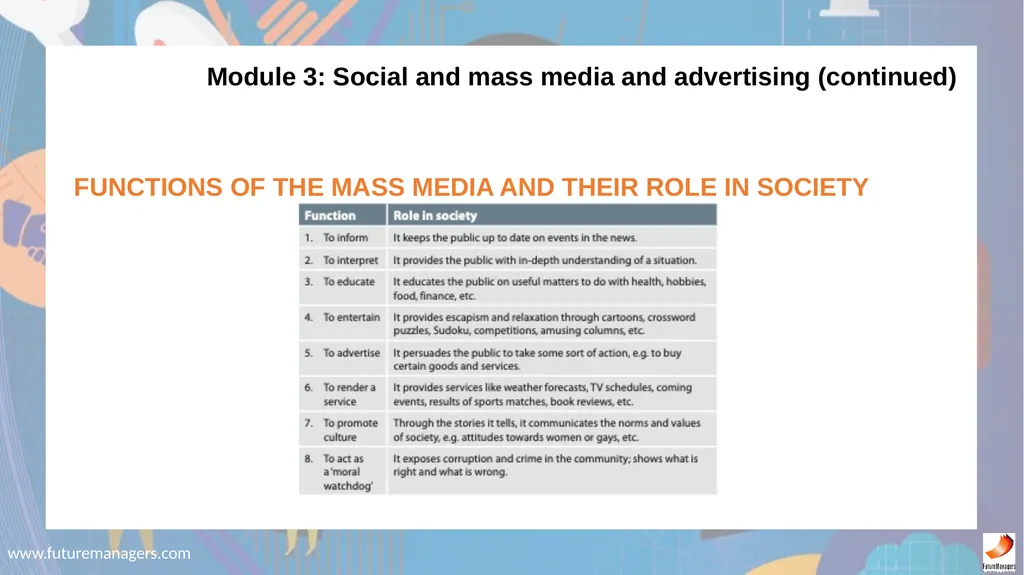
www.futuremanagers.com Module 3: Social and mass media and advertising (continued) FUNCTIONS OF THE MASS MEDIA AND THEIR ROLE IN SOCIETY<br>
24
www.futuremanagers.com Module 3: Social and mass media and advertising (continued) THE LANGUAGE EMPLOYED BY THE MASS MEDIA
The mass media uses written and oral language, visuals, music, and other nonverbal communication to fulfil its functions via the different media channels available. The type of language used by a mass medium is influenced by two main factors:
The target group (audience);
The objective of the message (purpose).<br>
The mass media uses written and oral language, visuals, music, and other nonverbal communication to fulfil its functions via the different media channels available. The type of language used by a mass medium is influenced by two main factors:
The target group (audience);
The objective of the message (purpose).<br>
25
www.futuremanagers.com Module 3: Social and mass media and advertising (continued) MANIPULATIVE REPORTING
Manipulative reporting is also known as selective reporting or biased reporting. This refers to a process where a newspaper, website, radio or TV station reports news in such a way that the audience perceives the information either negatively or positively – just as the media intended.<br>
Manipulative reporting is also known as selective reporting or biased reporting. This refers to a process where a newspaper, website, radio or TV station reports news in such a way that the audience perceives the information either negatively or positively – just as the media intended.<br>
26
www.futuremanagers.com Module 3: Social and mass media and advertising (continued) PROPAGANDA
Propaganda is an extreme form of manipulative reporting. It is something we recognise in the streets every time an election comes round. Propaganda is a deliberate attempt by an individual or a group to influence people’s minds by any means available, for their own gain.<br>
Propaganda is an extreme form of manipulative reporting. It is something we recognise in the streets every time an election comes round. Propaganda is a deliberate attempt by an individual or a group to influence people’s minds by any means available, for their own gain.<br>
27
www.futuremanagers.com Module 3: Social and mass media and advertising (continued) ADVERTISING IN THE MASS MEDIA
Advertising is when a company promotes its products, services or ideas to the public by paying for announcements in newspapers and magazines, over radio or television, on billboards, etc. The three main purposes of advertising are to inform, remind, and persuade.<br>
Advertising is when a company promotes its products, services or ideas to the public by paying for announcements in newspapers and magazines, over radio or television, on billboards, etc. The three main purposes of advertising are to inform, remind, and persuade.<br>
28
www.futuremanagers.com Module 3: Social and mass media and advertising (continued) ADVERTISING PRINCIPLES: ASPECTS OF CONSUMER BEHAVIOUR
Good advertising depends on in-depth research of the consumers – their needs, wants, preferences, income, where and how they spend their money, as well as what influences them most. Organisations plan and target their advertising according to the results of such research.<br>
Good advertising depends on in-depth research of the consumers – their needs, wants, preferences, income, where and how they spend their money, as well as what influences them most. Organisations plan and target their advertising according to the results of such research.<br>
29
www.futuremanagers.com Module 3: Social and mass media and advertising (continued) REQUIREMENTS FOR EFFECTIVE ADVERTISING
The advertiser must know the following requirements: AIDA formula;
Product/service;
Target audience/market;
Objective/aim of advertisement;
Feedback from consumer;
Different consumer needs (Maslow);
Presentation styles; and
Existing budget.<br>
The advertiser must know the following requirements: AIDA formula;
Product/service;
Target audience/market;
Objective/aim of advertisement;
Feedback from consumer;
Different consumer needs (Maslow);
Presentation styles; and
Existing budget.<br>
30
www.futuremanagers.com INTRODUCTION
An oral presentation is the process of presenting a topic to a large, live audience for a specific purpose. An oral presentation could be a demonstration, introduction, lecture, or other speech with a different purpose, such as to amuse or motivate. Presentations are structured and time-limited, and the presenter must apply learned public-speaking skills. An organisation makes use of presentations in both internal and external communication. Module 4: Presentation communication<br>
An oral presentation is the process of presenting a topic to a large, live audience for a specific purpose. An oral presentation could be a demonstration, introduction, lecture, or other speech with a different purpose, such as to amuse or motivate. Presentations are structured and time-limited, and the presenter must apply learned public-speaking skills. An organisation makes use of presentations in both internal and external communication. Module 4: Presentation communication<br>
31
www.futuremanagers.com Module 4: Presentation communication (continued) SPEECH-MAKING
Presentation speeches play an important role in organisational communication. This type of communication is a powerful tool for reaching fairly large, either external or internal groups of stakeholders. A successful presentation can, therefore, contribute greatly towards a good image for the organisation.<br>
Presentation speeches play an important role in organisational communication. This type of communication is a powerful tool for reaching fairly large, either external or internal groups of stakeholders. A successful presentation can, therefore, contribute greatly towards a good image for the organisation.<br>
32
www.futuremanagers.com Module 4: Presentation communication (continued) PREPARING A SPEECH
A basic way to draft your speech is with the following structure:
Introduction;
Body; and
Conclusion.<br>
A basic way to draft your speech is with the following structure:
Introduction;
Body; and
Conclusion.<br>
33
www.futuremanagers.com Module 4: Presentation communication (continued) APPLICABLE LANGUAGE USAGE
Check the verbal aspects of your speech. Make sure your language usage is correct, clear and applicable to audience, topic and purpose.<br>
Check the verbal aspects of your speech. Make sure your language usage is correct, clear and applicable to audience, topic and purpose.<br>
34
www.futuremanagers.com Module 4: Presentation communication (continued) ASPECTS DETERMINING THE SUCCESS OF A SPEECH
Once a speech is written, only half the work has been done. Now you have to practise delivering the speech using nonverbal communication skills and prepare to face the audience without allowing nervousness to spoil the delivery. To combat nerves, be yourself, prepare adequately, practice, dress appropriately, and do breathing exercises.<br>
Once a speech is written, only half the work has been done. Now you have to practise delivering the speech using nonverbal communication skills and prepare to face the audience without allowing nervousness to spoil the delivery. To combat nerves, be yourself, prepare adequately, practice, dress appropriately, and do breathing exercises.<br>
35
www.futuremanagers.com Module 4: Presentation communication (continued) VISUAL AIDS
Visual aids allow us to add pictures, diagrams, graphs and written text summaries to our oral presentations. Our purpose in using visual aids is to make our ideas more concrete, emphasise key points and keep the attention of the audience.<br>
Visual aids allow us to add pictures, diagrams, graphs and written text summaries to our oral presentations. Our purpose in using visual aids is to make our ideas more concrete, emphasise key points and keep the attention of the audience.<br>
36
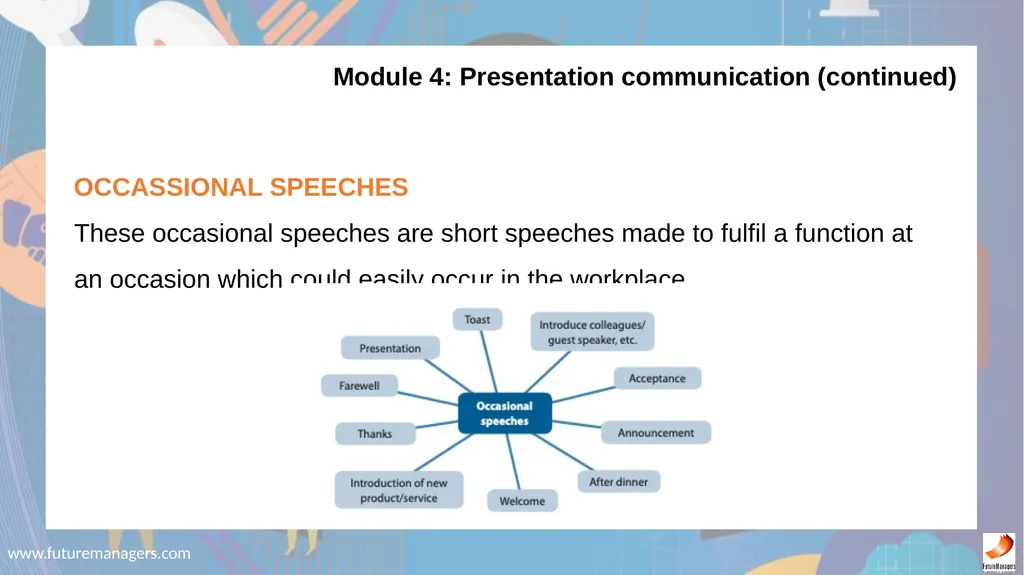
www.futuremanagers.com Module 4: Presentation communication (continued) OCCASSIONAL SPEECHES
These occasional speeches are short speeches made to fulfil a function at an occasion which could easily occur in the workplace.<br>
These occasional speeches are short speeches made to fulfil a function at an occasion which could easily occur in the workplace.<br>
37
www.futuremanagers.com Module 4: Presentation communication (continued) ACTIONS TO PROMOTE GOODWILL
In business, creating goodwill can help you to build business relationships that ensure the long-term success of your business.
This means practicing polite, good behaviour in meetings and interactions, on the phone and through social media with clients and guests and the general public.<br>
In business, creating goodwill can help you to build business relationships that ensure the long-term success of your business.
This means practicing polite, good behaviour in meetings and interactions, on the phone and through social media with clients and guests and the general public.<br>
38
www.futuremanagers.com CULTURE
Culture is a system of beliefs, values and norms of behaviour that is learned within a group and enables all group members to see things in the same way, and which is different from the system of any other similar group. Module 5: Multicultural communication in the business world<br>
Culture is a system of beliefs, values and norms of behaviour that is learned within a group and enables all group members to see things in the same way, and which is different from the system of any other similar group. Module 5: Multicultural communication in the business world<br>
39
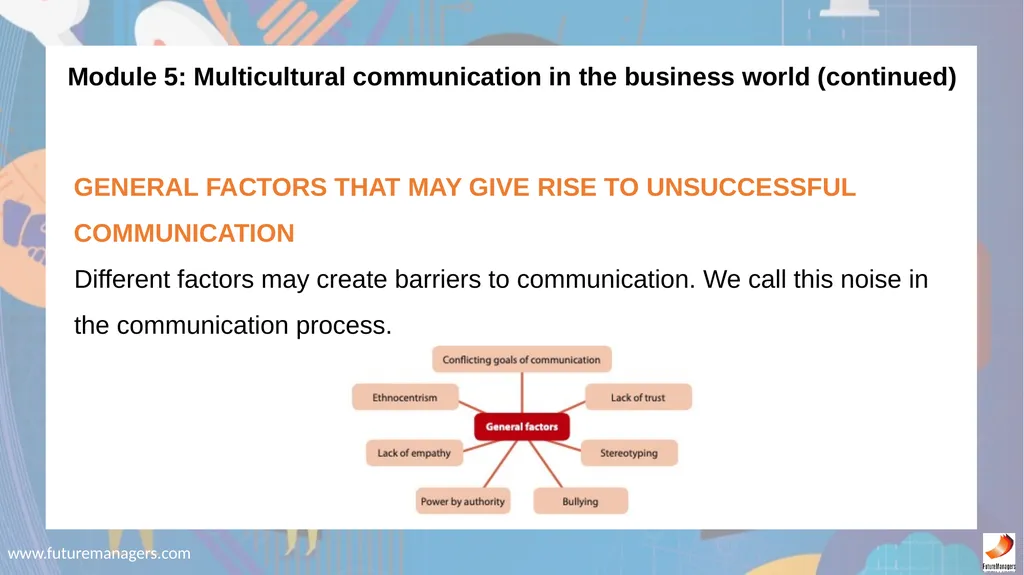
www.futuremanagers.com Module 5: Multicultural communication in the business world (continued) GENERAL FACTORS THAT MAY GIVE RISE TO UNSUCCESSFUL COMMUNICATION
Different factors may create barriers to communication. We call this noise in the communication process.<br>
Different factors may create barriers to communication. We call this noise in the communication process.<br>
40
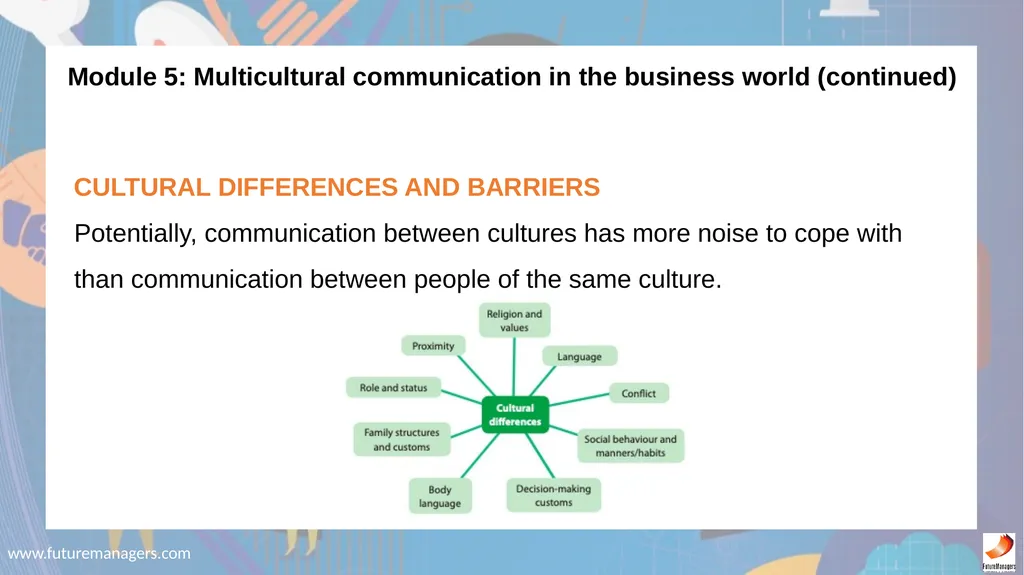
www.futuremanagers.com Module 5: Multicultural communication in the business world (continued) CULTURAL DIFFERENCES AND BARRIERS
Potentially, communication between cultures has more noise to cope with than communication between people of the same culture.<br>
Potentially, communication between cultures has more noise to cope with than communication between people of the same culture.<br>
41
www.futuremanagers.com Module 5: Multicultural communication in the business world (continued) CLUES TO UNSUCCESSFUL COMMUNICATION
Nonverbal signs include a blank facial expression, a frown, and bored yawn.
Poor feedback could include a missed joke, an incorrect answer to an ambiguous question, or misunderstanding of particular language differences.
Wrong actions include different ways of getting, and personal traits which might affect communication.<br>
Nonverbal signs include a blank facial expression, a frown, and bored yawn.
Poor feedback could include a missed joke, an incorrect answer to an ambiguous question, or misunderstanding of particular language differences.
Wrong actions include different ways of getting, and personal traits which might affect communication.<br>
42
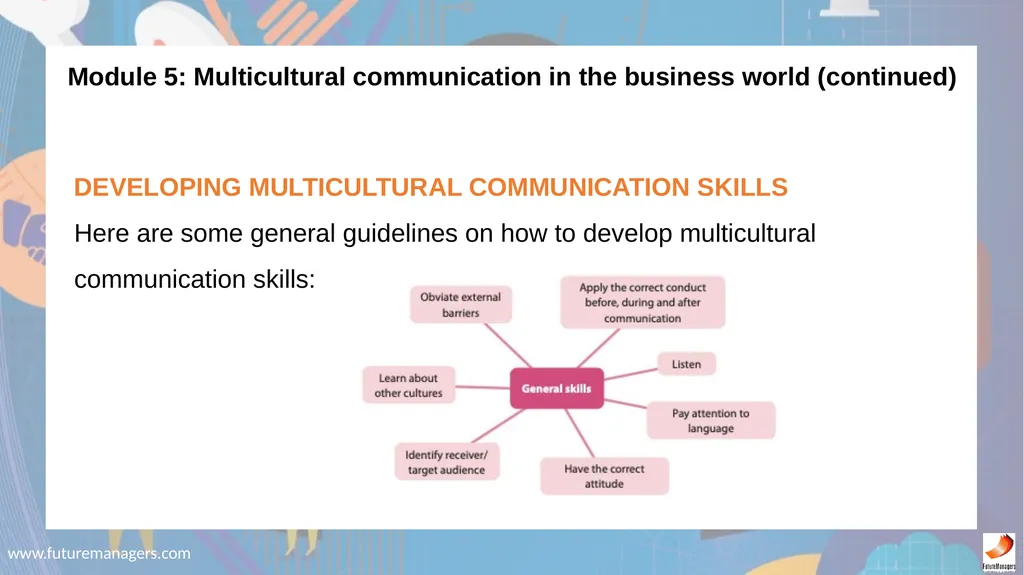
www.futuremanagers.com Module 5: Multicultural communication in the business world (continued) DEVELOPING MULTICULTURAL COMMUNICATION SKILLS
Here are some general guidelines on how to develop multicultural communication skills:<br>
Here are some general guidelines on how to develop multicultural communication skills:<br>
43
www.futuremanagers.com INTRODUCTION
In business, we sometimes have to summarise long documents, such as reports or newspaper articles. When expanding the notes into a coherent précis, we need to choose our words carefully and know how to change direct into indirect (reported) speech and also how to use the passive voice correctly, and only where needed. Above all, we must know how to write concisely. Module 6: Language usage when reducing documentation<br>
In business, we sometimes have to summarise long documents, such as reports or newspaper articles. When expanding the notes into a coherent précis, we need to choose our words carefully and know how to change direct into indirect (reported) speech and also how to use the passive voice correctly, and only where needed. Above all, we must know how to write concisely. Module 6: Language usage when reducing documentation<br>
44
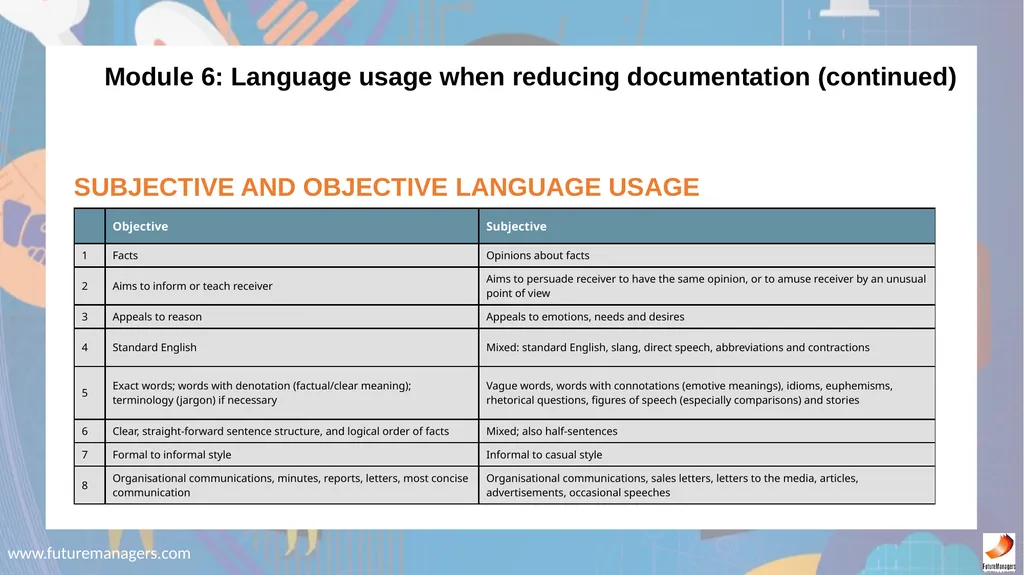
www.futuremanagers.com Module 6: Language usage when reducing documentation (continued) SUBJECTIVE AND OBJECTIVE LANGUAGE USAGE<br>
45
www.futuremanagers.com Module 6: Language usage when reducing documentation (continued) DIRECT AND INDIRECT SPEECH, ACTIVE AND PASSIVE VOICE
Direct speech is the actual words spoken by someone. It includes any emotive or casual words which indicate how they said it. Changing someone’s actual words into indirect speech is a way of making subjective language usage more objective. The active voice is used when the attention is on the subject doing the action. The passive voice is used when the attention is on the object of the verb, or the result of the action.<br>
Direct speech is the actual words spoken by someone. It includes any emotive or casual words which indicate how they said it. Changing someone’s actual words into indirect speech is a way of making subjective language usage more objective. The active voice is used when the attention is on the subject doing the action. The passive voice is used when the attention is on the object of the verb, or the result of the action.<br>
46
www.futuremanagers.com Module 6: Language usage when reducing documentation (continued) CONCISE WRITING IN BUSINESS
Effective business writing is clear and concise. The reader understands the message.<br>
Effective business writing is clear and concise. The reader understands the message.<br>
47
www.futuremanagers.com Module 6: Language usage when reducing documentation (continued) CORE NOTES
In order to eventually summarise either an oral or a written text, you have to start by making core notes. This is the first step in the reduction process.<br>
In order to eventually summarise either an oral or a written text, you have to start by making core notes. This is the first step in the reduction process.<br>
48
www.futuremanagers.com Module 6: Language usage when reducing documentation (continued) PRÉCIS/SUMMARY WRITING
Read with comprehension;
Identify writer’s intention;
Read to identify main & supporting arguments;
Differentiate between facts and opinion;
Summarise points logically;
Point form summary.<br>
Read with comprehension;
Identify writer’s intention;
Read to identify main & supporting arguments;
Differentiate between facts and opinion;
Summarise points logically;
Point form summary.<br>
49
www.futuremanagers.com INTRODUCTION
The following guidelines are important with regards to language usage:
Remember who your target audience is.
Use clear, concise, simple language – use plain, informal English.
Use the correct tone – neutral and business-like.
Avoid subjective and emotive language.
Choose polite language, e.g. could, may, please and thank you.
Add phrases or sentences that promote goodwill. Module 7: Concise business communication<br>
The following guidelines are important with regards to language usage:
Remember who your target audience is.
Use clear, concise, simple language – use plain, informal English.
Use the correct tone – neutral and business-like.
Avoid subjective and emotive language.
Choose polite language, e.g. could, may, please and thank you.
Add phrases or sentences that promote goodwill. Module 7: Concise business communication<br>
50
www.futuremanagers.com Module 7: Concise business communication (continued) TELEPHONE MESSAGE
A telephone message is taken by the person answering the telephone, if the person the call is meant for is unable to take it. An assistant does this when the manager is with a client, or in a meeting, or out of office.<br>
A telephone message is taken by the person answering the telephone, if the person the call is meant for is unable to take it. An assistant does this when the manager is with a client, or in a meeting, or out of office.<br>
51
www.futuremanagers.com Module 7: Concise business communication (continued) FAX
'Fax' is an abbreviation for the word 'facsimile' which means 'an exact copy.'
A fax is useful because it can send copies of written information through in the time that it takes to make a telephone call.<br>
'Fax' is an abbreviation for the word 'facsimile' which means 'an exact copy.'
A fax is useful because it can send copies of written information through in the time that it takes to make a telephone call.<br>
52
www.futuremanagers.com Module 7: Concise business communication (continued) MEMORANDUM (SHORT)
The memorandum, often simply referred to as a memo, is used within an organisation to circulate information among employees. It is brief, simple, deals with only one subject and usually demands immediate action. A memo can be sent from one branch to another, from one department to another, or from one office to another.<br>
The memorandum, often simply referred to as a memo, is used within an organisation to circulate information among employees. It is brief, simple, deals with only one subject and usually demands immediate action. A memo can be sent from one branch to another, from one department to another, or from one office to another.<br>
53
www.futuremanagers.com Module 7: Concise business communication (continued) FORMAL (3RD PERSON) INVITATION
Organisations often hold special functions. Examples are a cocktail party to celebrate receiving a special award or a formal dinner to announce the merging with another company.<br>
Organisations often hold special functions. Examples are a cocktail party to celebrate receiving a special award or a formal dinner to announce the merging with another company.<br>
54
www.futuremanagers.com Module 7: Concise business communication (continued) FORMS
The completing of forms is a common activity. We may find it annoying at times, but once we know the aim of the form, we usually grin and bear it! Make a point of reading the instructions and/or questions with understanding. Use your dictionary to help you with unfamiliar words. Complete the form by supplying all the necessary information. A form should never be handed back to us because we did not complete it properly.<br>
The completing of forms is a common activity. We may find it annoying at times, but once we know the aim of the form, we usually grin and bear it! Make a point of reading the instructions and/or questions with understanding. Use your dictionary to help you with unfamiliar words. Complete the form by supplying all the necessary information. A form should never be handed back to us because we did not complete it properly.<br>
55
www.futuremanagers.com Module 7: Concise business communication (continued) NOTICES ON PAPER AND ELECTRONIC BULLETIN BOARDS
Using the bulletin board (noticeboard) is common practice in most organisations. The main purpose is to share relevant information – be it a notice, graph, reminder, advertisement or announcement. The bulletin board may also be used to display individual or company certificates and accomplishments, thus helping to boost the morale of employees.<br>
Using the bulletin board (noticeboard) is common practice in most organisations. The main purpose is to share relevant information – be it a notice, graph, reminder, advertisement or announcement. The bulletin board may also be used to display individual or company certificates and accomplishments, thus helping to boost the morale of employees.<br>
56
www.futuremanagers.com Module 7: Concise business communication (continued) SIMPLE QUESTIONNAIRE
Questionnaires are used for different reasons. The main aims are marketing, public relations and investigation.<br>
Questionnaires are used for different reasons. The main aims are marketing, public relations and investigation.<br>
57
www.futuremanagers.com Module 7: Concise business communication (continued) EMAILS
Email has become the most popular form of communication in the workplace as emails are sent both internally, as well as externally.<br>
Email has become the most popular form of communication in the workplace as emails are sent both internally, as well as externally.<br>
58
www.futuremanagers.com Module 7: Concise business communication (continued) SIMPLE GRAPHIC MATERIAL
Graphic material is often used as visual aids to explain abstract concepts. It is a short and direct way to present information and because it is in picture form, we understand it better. Graphics are used in business to present information concisely and clearly.<br>
Graphic material is often used as visual aids to explain abstract concepts. It is a short and direct way to present information and because it is in picture form, we understand it better. Graphics are used in business to present information concisely and clearly.<br>
59
www.futuremanagers.com INTRODUCTION
Business letters have an important place in business correspondence because they are regarded as serious communication. Whether they are posted, faxed or emailed as an attachment, they carry more weight than a simple email or faxed message. Module 8: Business letters<br>
Business letters have an important place in business correspondence because they are regarded as serious communication. Whether they are posted, faxed or emailed as an attachment, they carry more weight than a simple email or faxed message. Module 8: Business letters<br>
60
www.futuremanagers.com Module 8: Business letters (continued) FORMAT AND LAYOUT OF A BUSINESS LETTER
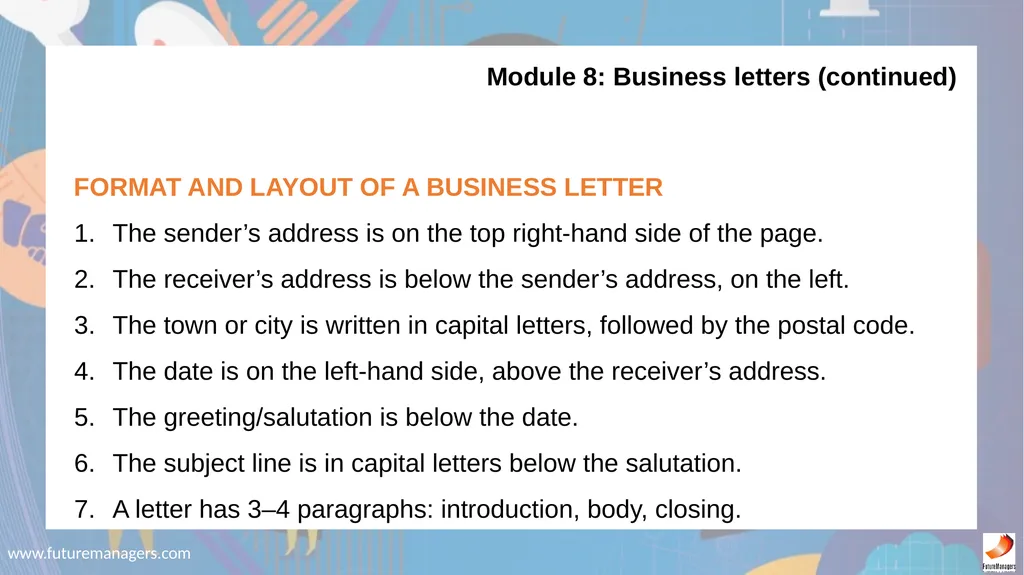
The sender’s address is on the top right-hand side of the page.
The receiver’s address is below the sender’s address, on the left.
The town or city is written in capital letters, followed by the postal code.
The date is on the left-hand side, above the receiver’s address.
The greeting/salutation is below the date.
The subject line is in capital letters below the salutation.
A letter has 3–4 paragraphs: introduction, body, closing.<br>
The sender’s address is on the top right-hand side of the page.
The receiver’s address is below the sender’s address, on the left.
The town or city is written in capital letters, followed by the postal code.
The date is on the left-hand side, above the receiver’s address.
The greeting/salutation is below the date.
The subject line is in capital letters below the salutation.
A letter has 3–4 paragraphs: introduction, body, closing.<br>
61
www.futuremanagers.com Module 8: Business letters (continued) LETTER OF INVITATION TO A GUEST SPEAKER
Businesses, organisations, clubs and other institutions often ask important people to speak at functions. A letter of invitation must be sent well in advance to the guest speaker to ensure that the person has enough time to make the necessary arrangements. Full details of the function and the responsibilities of the speaker must be stated in this letter.<br>
Businesses, organisations, clubs and other institutions often ask important people to speak at functions. A letter of invitation must be sent well in advance to the guest speaker to ensure that the person has enough time to make the necessary arrangements. Full details of the function and the responsibilities of the speaker must be stated in this letter.<br>
62
www.futuremanagers.com Module 8: Business letters (continued) LETTER TO THE PRESS (EDITOR)
There are different reasons why people write to the press, for example:
To complain, compliment or say thank you.
To vent (express a strong emotion) about something they agree or disagree with.
To draw people’s attention to a topic that has been in the news, e.g. politics, environment, sport.<br>
There are different reasons why people write to the press, for example:
To complain, compliment or say thank you.
To vent (express a strong emotion) about something they agree or disagree with.
To draw people’s attention to a topic that has been in the news, e.g. politics, environment, sport.<br>
63
www.futuremanagers.com Module 8: Business letters (continued) SALES LETTER
A sales letter is an advertisement presented in the form of a letter. It is designed to persuade the reader to purchase a particular product or service in the absence of a salesman.<br>
A sales letter is an advertisement presented in the form of a letter. It is designed to persuade the reader to purchase a particular product or service in the absence of a salesman.<br>
64
www.futuremanagers.com Module 8: Business letters (continued) CIRCULAR
Circular letters are like sales letters. They are also directed at a selected target group, e.g. established clients or customers, ratepayers, parents of students, graduates, etc. They serve the following two important purposes in the business world:
To provide information; and
To advertise.<br>
Circular letters are like sales letters. They are also directed at a selected target group, e.g. established clients or customers, ratepayers, parents of students, graduates, etc. They serve the following two important purposes in the business world:
To provide information; and
To advertise.<br>
65
www.futuremanagers.com INTRODUCTION
Advertising is a huge field and millions of people all over the world make a living from it. The goal of advertising is to reach our target audience – the people most likely to pay for the products or services we advertise. Module 9: Correspondence in the business world<br>
Advertising is a huge field and millions of people all over the world make a living from it. The goal of advertising is to reach our target audience – the people most likely to pay for the products or services we advertise. Module 9: Correspondence in the business world<br>
66
www.futuremanagers.com Module 9: Correspondence in the business world (continued) CLASSIFIED ADVERTISEMENTS
Classified ads generally fall into two categories, namely
Individuals who advertise the sales of their personal goods;
Local businesses who advertise their products or services.<br>
Classified ads generally fall into two categories, namely
Individuals who advertise the sales of their personal goods;
Local businesses who advertise their products or services.<br>
67
www.futuremanagers.com Module 9: Correspondence in the business world (continued) DISPLAY ADVERTISEMENTS
Display advertisements usually take up a few columns and cost far more than classified advertisements. They should, therefore, be well designed. An important factor to consider is our target group – the people the advertisement is aimed at.<br>
Display advertisements usually take up a few columns and cost far more than classified advertisements. They should, therefore, be well designed. An important factor to consider is our target group – the people the advertisement is aimed at.<br>
68
www.futuremanagers.com Module 9: Correspondence in the business world (continued) NOTICES
One member of staff is generally responsible for the noticeboard. This person must ensure that the notices are put up promptly and that the old ones are removed regularly. Other requirements relating to the information:
It must be attractively presented – visual and/or written.
It must be correct in every detail.
It must be easily understandable.<br>
One member of staff is generally responsible for the noticeboard. This person must ensure that the notices are put up promptly and that the old ones are removed regularly. Other requirements relating to the information:
It must be attractively presented – visual and/or written.
It must be correct in every detail.
It must be easily understandable.<br>
69
www.futuremanagers.com INTRODUCTION
Once you start working as a management assistant, you will be expected to attend meetings, conduct yourself appropriately during a meeting and handle the meeting correspondence. In your private life, you may also be secretary of a club or association and then have to do the meeting correspondence. You must, therefore, know how to write the notice, agenda and minutes of various types of meetings. Module 10: Meeting correspondence<br>
Once you start working as a management assistant, you will be expected to attend meetings, conduct yourself appropriately during a meeting and handle the meeting correspondence. In your private life, you may also be secretary of a club or association and then have to do the meeting correspondence. You must, therefore, know how to write the notice, agenda and minutes of various types of meetings. Module 10: Meeting correspondence<br>
70
www.futuremanagers.com Module 10: Meeting correspondence (continued) NOTICES, AGENDA AND MINUTES OF A MEETING
The secretary sends a notice to all members to inform them that a meeting will take place. The agenda is a numbered list of all the items/matters (also called business) that will be discussed at a meeting. Minutes are an accurate, written record to inform attendees and non-attendees of what happened, what was discussed and what decisions were made at a meeting.<br>
The secretary sends a notice to all members to inform them that a meeting will take place. The agenda is a numbered list of all the items/matters (also called business) that will be discussed at a meeting. Minutes are an accurate, written record to inform attendees and non-attendees of what happened, what was discussed and what decisions were made at a meeting.<br>
71
www.futuremanagers.com Module 10: Meeting correspondence (continued) COMMITTEE MEETING
The committee is a group of individuals elected by the members of a club/ association to operate the club on a day to day and week to week basis throughout the year. Typically, a committee consists of the following office bearers: chairperson, vice-chairperson, secretary, treasurer, two or three additional committee members.<br>
The committee is a group of individuals elected by the members of a club/ association to operate the club on a day to day and week to week basis throughout the year. Typically, a committee consists of the following office bearers: chairperson, vice-chairperson, secretary, treasurer, two or three additional committee members.<br>
72
www.futuremanagers.com Module 10: Meeting correspondence (continued) MONTHLY MEETING
A monthly general meeting is an example of a frequent/regular meeting. It is informal and can be presented as a circular/letter or a memorandum. Holding a monthly meeting is an effective way of communicating to make decisions, discuss and solve problems, monitor situations, progress, etc. Most clubs/societies meet on a monthly basis, e.g. a book club.<br>
A monthly general meeting is an example of a frequent/regular meeting. It is informal and can be presented as a circular/letter or a memorandum. Holding a monthly meeting is an effective way of communicating to make decisions, discuss and solve problems, monitor situations, progress, etc. Most clubs/societies meet on a monthly basis, e.g. a book club.<br>
73
www.futuremanagers.com Module 10: Meeting correspondence (continued) SPECIAL MEETING
A special meeting is called to discuss an unexpected and urgent matter that cannot wait until the next scheduled meeting.<br>
A special meeting is called to discuss an unexpected and urgent matter that cannot wait until the next scheduled meeting.<br>
74
www.futuremanagers.com Module 10: Meeting correspondence (continued) ANNUAL GENERAL MEETING (AGM)
An annual general meeting of a club or association is held once a year when the chairperson presents his/her report, the treasurer presents the financial report and new office bearers (committee members) are elected. An AGM is a formal occasion and, therefore, a formal notice is sent out or published in the press.<br>
An annual general meeting of a club or association is held once a year when the chairperson presents his/her report, the treasurer presents the financial report and new office bearers (committee members) are elected. An AGM is a formal occasion and, therefore, a formal notice is sent out or published in the press.<br>
75
www.futuremanagers.com INTRODUCTION
Paperwork refers to routine work – the part of a job that involves writing reports and keeping records. That is often a task for management assistants. They are requested to gather certain information and compile a report for the manager. Module 11: Reports<br>
Paperwork refers to routine work – the part of a job that involves writing reports and keeping records. That is often a task for management assistants. They are requested to gather certain information and compile a report for the manager. Module 11: Reports<br>
76
www.futuremanagers.com Module 11: Reports (continued) INVESTIGATION REPORT
Usually an investigation report is required when there is a problem and the owner or manager wants it to be investigated with the purpose of finding a solution. Once we have conducted the investigation by means of various procedures, we analyse the information, make and evaluate our findings, then come to a conclusion.<br>
Usually an investigation report is required when there is a problem and the owner or manager wants it to be investigated with the purpose of finding a solution. Once we have conducted the investigation by means of various procedures, we analyse the information, make and evaluate our findings, then come to a conclusion.<br>
77
www.futuremanagers.com Module 11: Reports (continued) FEEDBACK REPORT
The purpose of a feedback report could be:
Provide information;
Evaluate the success of an event;
Give recognition;
Give a general evaluation; and
Make recommendations.<br>
The purpose of a feedback report could be:
Provide information;
Evaluate the success of an event;
Give recognition;
Give a general evaluation; and
Make recommendations.<br>
78
www.futuremanagers.com Module 11: Reports (continued) PROGRESS REPORT
This type of report is used to supply information on the progress of an on-going project, assignment or event. This report is written while you are still busy organising the specific event – you are in fact reporting on the tasks completed, the tasks currently being attended to and the tasks still to be completed.<br>
This type of report is used to supply information on the progress of an on-going project, assignment or event. This report is written while you are still busy organising the specific event – you are in fact reporting on the tasks completed, the tasks currently being attended to and the tasks still to be completed.<br>
79
www.futuremanagers.com Module 11: Reports (continued) INCIDENT/ACCIDENT REPORT
Companies usually have a standardised form that must be filled in when an incident/accident occurs during working hours. This form is a report of what exactly happened. It must be filled in correctly, with all the relevant information.<br>
Companies usually have a standardised form that must be filled in when an incident/accident occurs during working hours. This form is a report of what exactly happened. It must be filled in correctly, with all the relevant information.<br>
80
www.futuremanagers.com INTRODUCTION
The image of a business or organisation depends a great deal on the image created by the communication that goes out. We should do everything in our power to make sure that a positive image is created. For that, the secret lies in critical evaluation and editing BEFORE the communication goes out. Module 12: Critical evaluation of written and visual material<br>
The image of a business or organisation depends a great deal on the image created by the communication that goes out. We should do everything in our power to make sure that a positive image is created. For that, the secret lies in critical evaluation and editing BEFORE the communication goes out. Module 12: Critical evaluation of written and visual material<br>
81
www.futuremanagers.com Module 12: Critical evaluation of written and visual material (continued) WRITTEN COMMUNICATION
When we evaluate these communications, we ask ourselves:
What is the purpose of the document and has it been achieved?
Who are the readers of the document and will they be able to get the message clearly?<br>
When we evaluate these communications, we ask ourselves:
What is the purpose of the document and has it been achieved?
Who are the readers of the document and will they be able to get the message clearly?<br>
82
www.futuremanagers.com Module 12: Critical evaluation of written and visual material (continued) LAYOUT, DESIGN AND CONTENT
It is important to select the correct layout for a specific communication. Most business communications have a specific layout and format (design) because that has been proved to be the best way to organise and present the information. If we present content in a specific order, with headings, spaces, different size fonts, etc., it helps to make the communication more easily understood and acceptable to the reader (the audience).<br>
It is important to select the correct layout for a specific communication. Most business communications have a specific layout and format (design) because that has been proved to be the best way to organise and present the information. If we present content in a specific order, with headings, spaces, different size fonts, etc., it helps to make the communication more easily understood and acceptable to the reader (the audience).<br>
83
www.futuremanagers.com Module 12: Critical evaluation of written and visual material (continued) CHOICE OF WORDS
Because most business communication needs to be clear, objective and polite, choose words that fit in with that style.<br>
Because most business communication needs to be clear, objective and polite, choose words that fit in with that style.<br>
84
www.futuremanagers.com Module 12: Critical evaluation of written and visual material (continued) AUDIO-VISUAL COMMUNICATION
We use the following criteria to analyse the suitability/success of an audio-visual communication:
The clarity of images/design;
The atmosphere created by through the use of sound and colour; and
The final effect created, or message conveyed.<br>
We use the following criteria to analyse the suitability/success of an audio-visual communication:
The clarity of images/design;
The atmosphere created by through the use of sound and colour; and
The final effect created, or message conveyed.<br>
85
www.futuremanagers.com ASPECTS OF TELEPHONE TECHNIQUE
As a management or personal assistant, you will spend a lot of time speaking on the telephone. Your career success depends a great deal on how good your telephone technique is. Telephone technique includes these three: voice quality, knowledge of etiquette, and the ability to deal with difficult telephone conversations. Module 13: Critical evaluation of auditive and oral material<br>
As a management or personal assistant, you will spend a lot of time speaking on the telephone. Your career success depends a great deal on how good your telephone technique is. Telephone technique includes these three: voice quality, knowledge of etiquette, and the ability to deal with difficult telephone conversations. Module 13: Critical evaluation of auditive and oral material<br>
86
www.futuremanagers.com Module 12: Critical evaluation of auditive and oral material (continued) DEVELOPMENT OF LISTENING SKILLS
In your vocation, listening plays an important part. In order to listen, you have to pay attention. In this way, you could get past many barriers present in the hearing and/or listening process. Without understanding, listening cannot be processed. We have to work on retaining what we have heard and want to remember. We do this when we listen effectively.<br>
In your vocation, listening plays an important part. In order to listen, you have to pay attention. In this way, you could get past many barriers present in the hearing and/or listening process. Without understanding, listening cannot be processed. We have to work on retaining what we have heard and want to remember. We do this when we listen effectively.<br>
87
www.futuremanagers.com Module 12: Critical evaluation of auditive and oral material (continued) COMMUNICATION IN SMALL GROUPS
When working with a small group, we should use voice control techniques to help our colleagues in the group to listen to our ideas with ease and understand them. We can also use these techniques to persuade the others to accept an idea we feel strongly about.<br>
When working with a small group, we should use voice control techniques to help our colleagues in the group to listen to our ideas with ease and understand them. We can also use these techniques to persuade the others to accept an idea we feel strongly about.<br>
88
www.futuremanagers.com Module 12: Critical evaluation of auditive and oral material (continued) INTERVIEW
Interviews are situations where speaking (oral) and listening (auditive) skills are tested to the full. In nearly all of them, a face-to-face question-and answer process takes place between an interviewer and an interviewee.<br>
Interviews are situations where speaking (oral) and listening (auditive) skills are tested to the full. In nearly all of them, a face-to-face question-and answer process takes place between an interviewer and an interviewee.<br>