
Competing Behaviors Pathways and Behavior Support





Description: Competing Behaviors Pathways and Behavior Support Plans You need to know WHY You can make a behavior worse Need to know the function of the behavior Gain something or avoid something? Before You Can Work on Changing a Behavior Think of it
Related Topics
Download Presentation
"Competing Behaviors Pathways and Behavior Support" is the property of its rightful owner. Permission is granted to download and print the materials on this website for personal, non-commercial use only, and to display it on your personal computer provided you do not modify the materials and that you retain all copyright notices contained in the materials. By downloading content from our website, you accept the terms of this agreement.
Presentation Transcript
slide1. Competing Behaviors Pathways and Behavior Support Plans<br>
slide2. You need to know WHY
You can make a behavior worse
Need to know the function of the behavior
Gain something or avoid something? Before You Can Work on Changing a Behavior<br>
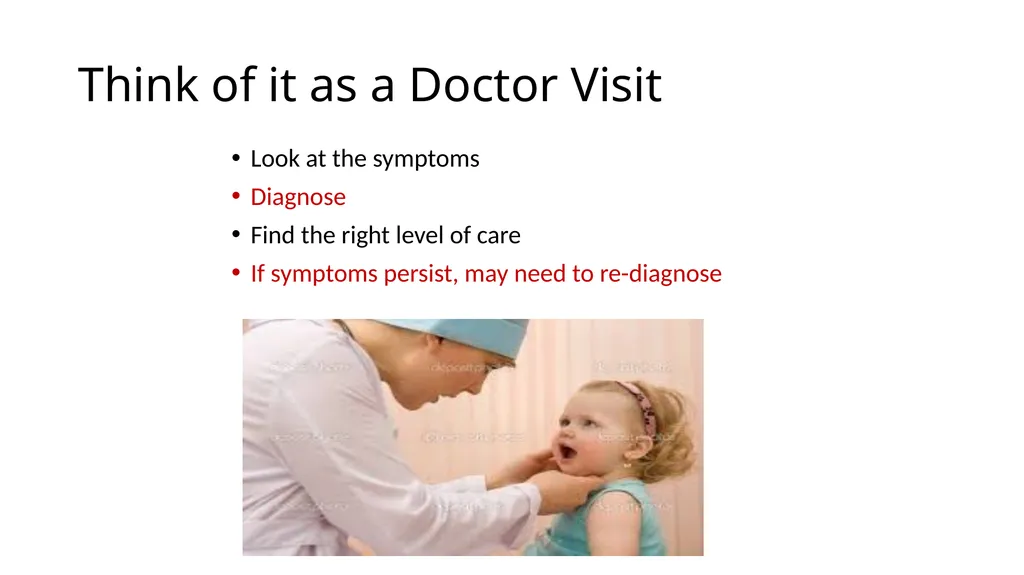
slide3. Think of it as a Doctor Visit Look at the symptoms
Diagnose
Find the right level of care
If symptoms persist, may need to re-diagnose<br>
slide4. Tools needed 1. Data Collection
2. Competing Behaviors Pathways
3. Behavior Support Plans (Don’t always need)<br>
slide5. Where Do You Start? Data Collection Gather information
Collect data on the problem behavior
Through observations
Through interviews
Past information
Look at what is happening before (antecedent)
Look at what happens after (reinforcing behavior)<br>
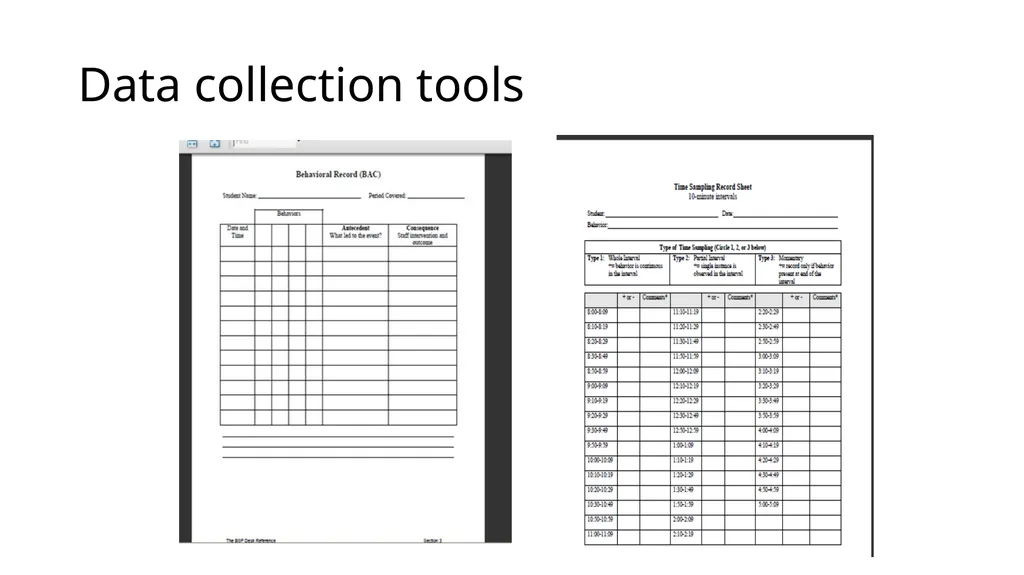
slide6. Data collection tools<br>
slide8. Consensus
Establishes buy-in
Visual of the real issues Why use the Pathways chart?<br>
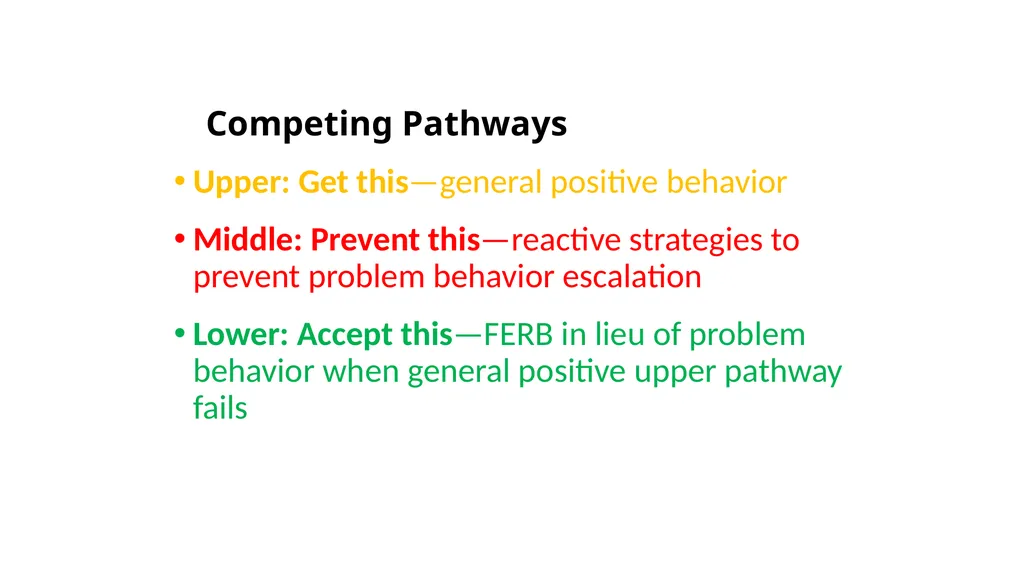
slide9. Competing Pathways Upper: Get this—general positive behavior
Middle: Prevent this—reactive strategies to prevent problem behavior escalation
Lower: Accept this—FERB in lieu of problem behavior when general positive upper pathway fails<br>
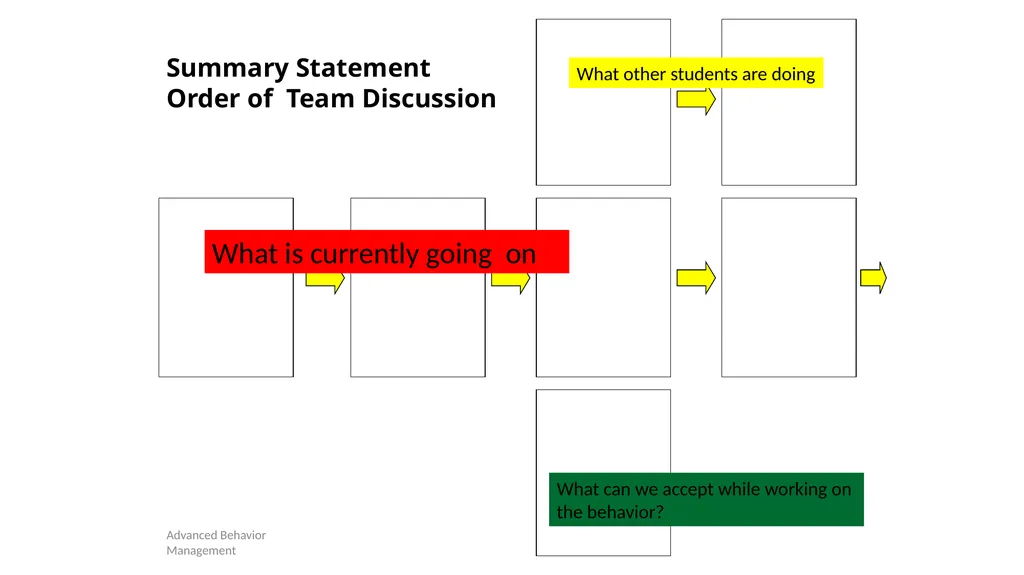
slide10. Advanced Behavior Management Summary Statement
Order of Team Discussion What other students are doing What is currently going on What can we accept while working on
the behavior?<br>
slide11. Please read the next slide to yourself
On a piece of paper please write down
Main behavior
Antecedents
Consequences Meet Our Example Student Brian<br>
slide12. Brian is a kindergartener on IEP for speech
Has many features suggestive of autism
He is verbal, and uses 3-4 word sentences routinely to express needs and wants, but never to comment on something in the environment.
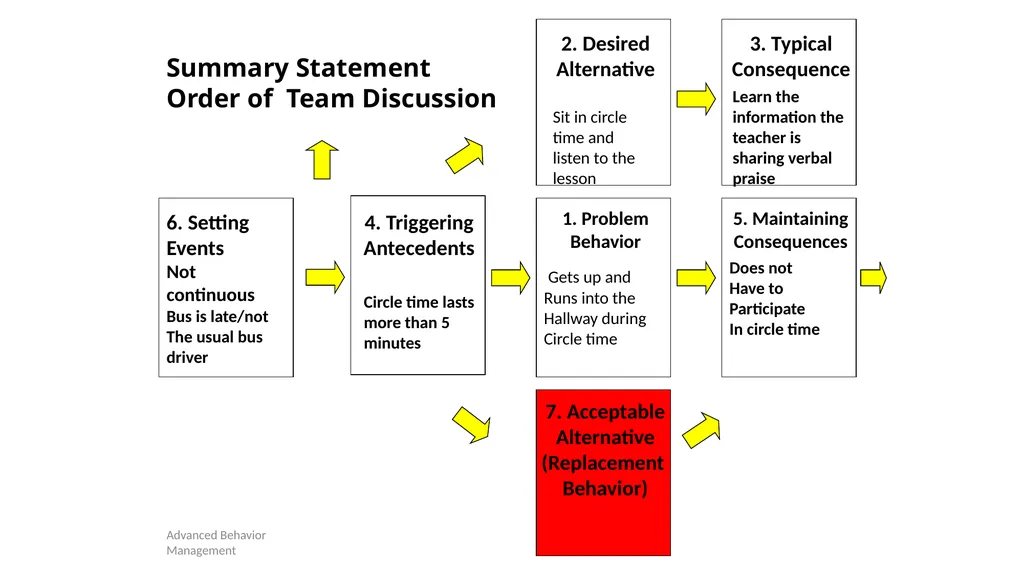
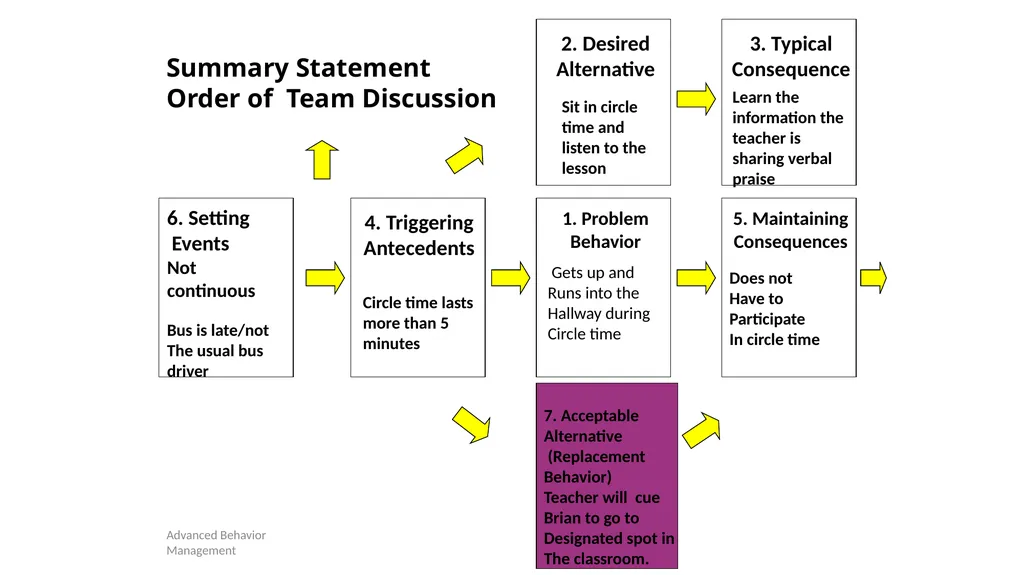
Brian likes routines, and becomes very upset if the bus is late, or if the bus driver is not the expected one. On those days, when Brian’s bus routine has changed, staff members say they “know he will have problems.”
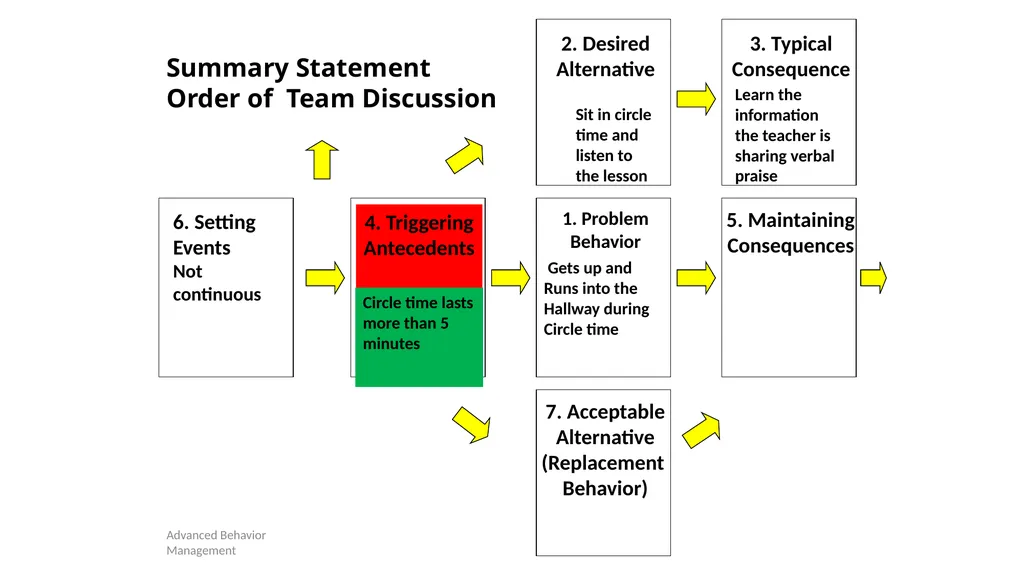
Each school day Brian puts his coat away, and goes to circle time. After going to circle, on many days, Brian will run away, and kick and head butt if captured after running away, if the activity at circle time lasts more than five minutes.
Brian is more likely to leave circle by running away, on days when the bus routine has changed from the typical bus routine<br>
slide13. Look at the boxes one by one
*Very important to fill the boxes out in the order the are numbered*
Look at the information that should go there
Look at some examples
Decide what should go there for Brian The process:<br>
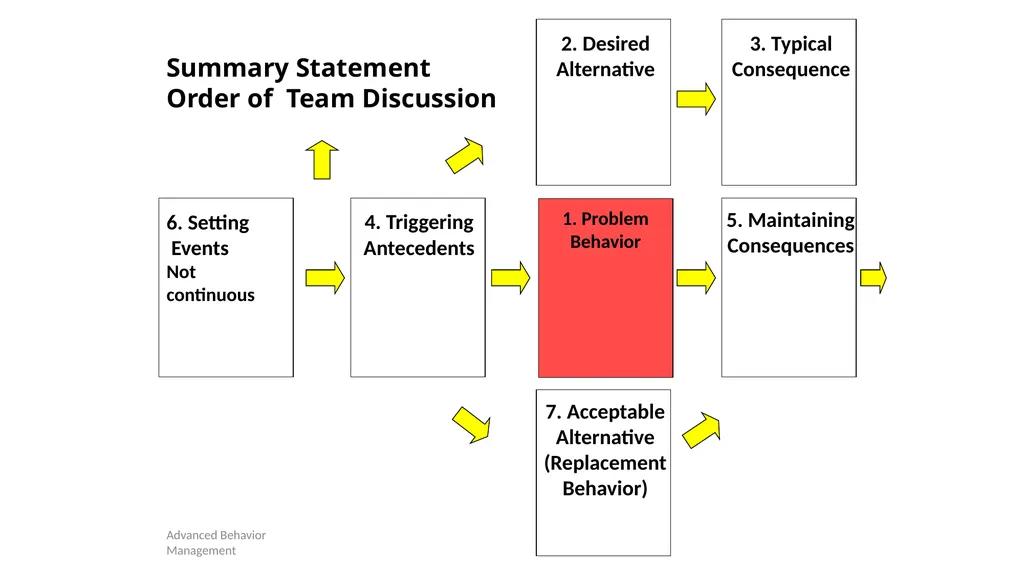
slide14. Advanced Behavior Management 6. Setting
Events
Not
continuous 4. Triggering
Antecedents 5. Maintaining
Consequences 1. Problem
Behavior 2. Desired
Alternative 3. Typical
Consequence Summary Statement
Order of Team Discussion 7. Acceptable
Alternative
(Replacement
Behavior)<br>
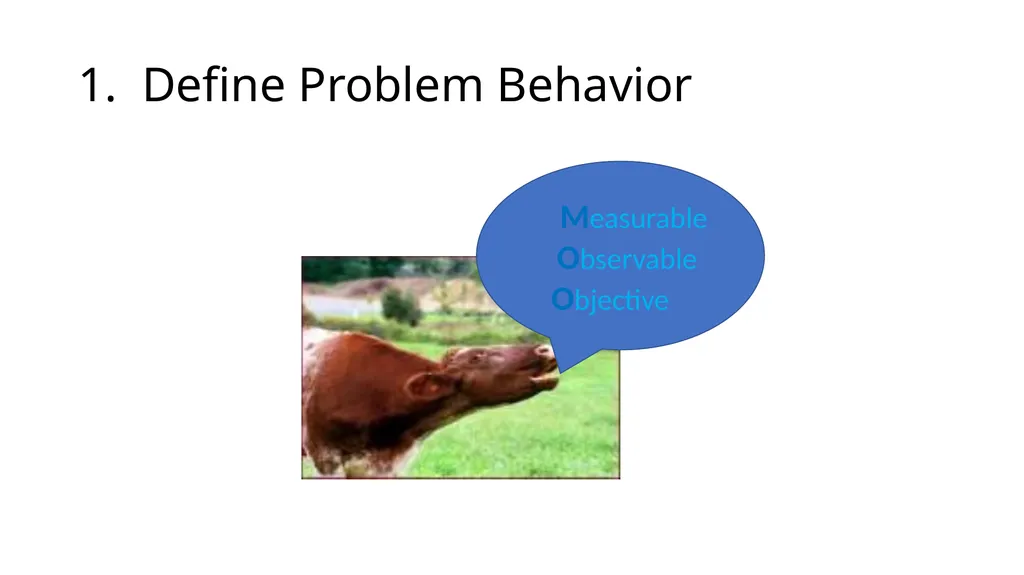
slide15. 1. Define Problem Behavior Measurable
Observable
Objective<br>
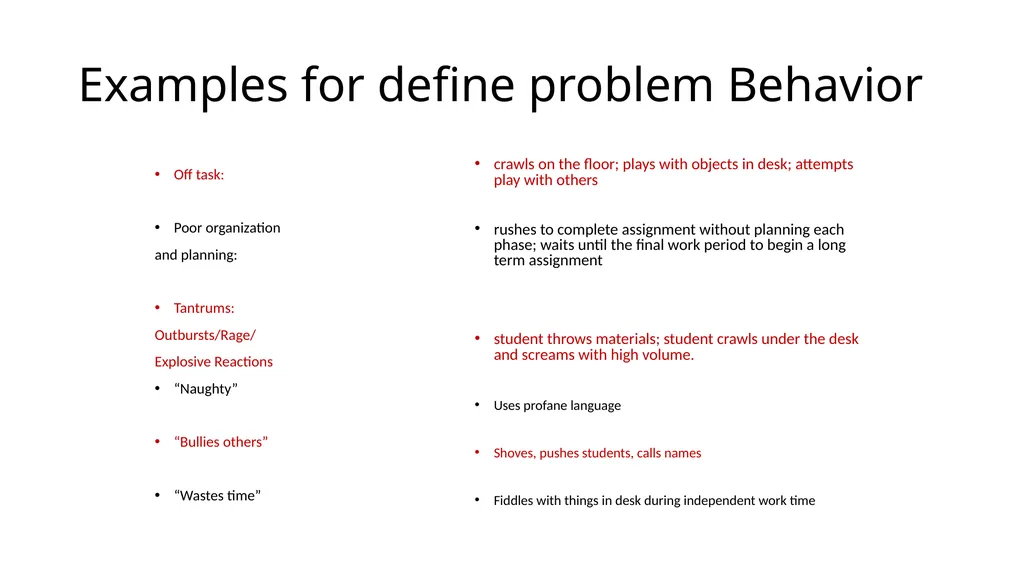
slide16. Off task:
Poor organization
and planning:
Tantrums:
Outbursts/Rage/
Explosive Reactions
“Naughty”
“Bullies others”
“Wastes time” crawls on the floor; plays with objects in desk; attempts play with others
rushes to complete assignment without planning each phase; waits until the final work period to begin a long term assignment
student throws materials; student crawls under the desk and screams with high volume.
Uses profane language
Shoves, pushes students, calls names
Fiddles with things in desk during independent work time Examples for define problem Behavior<br>
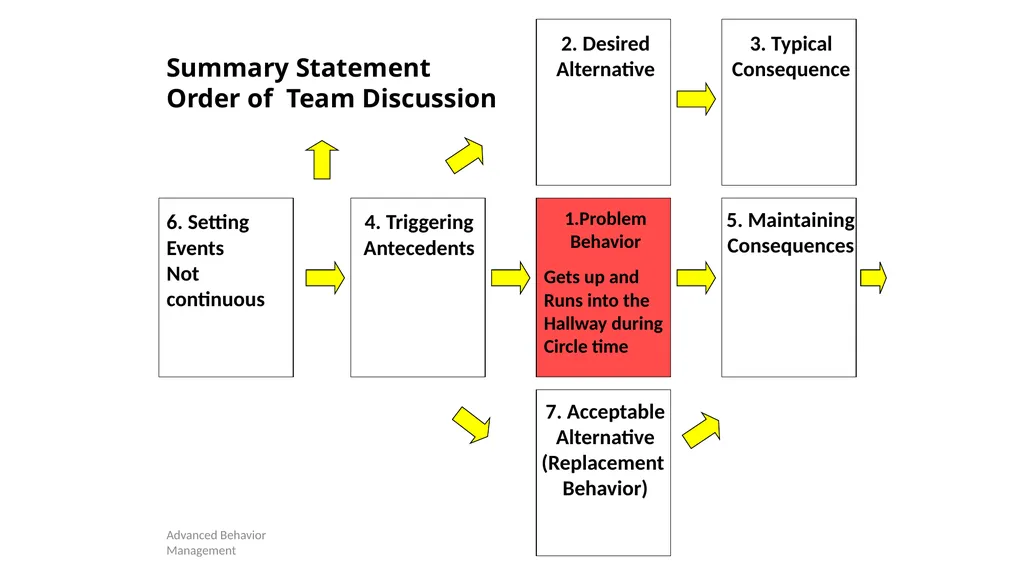
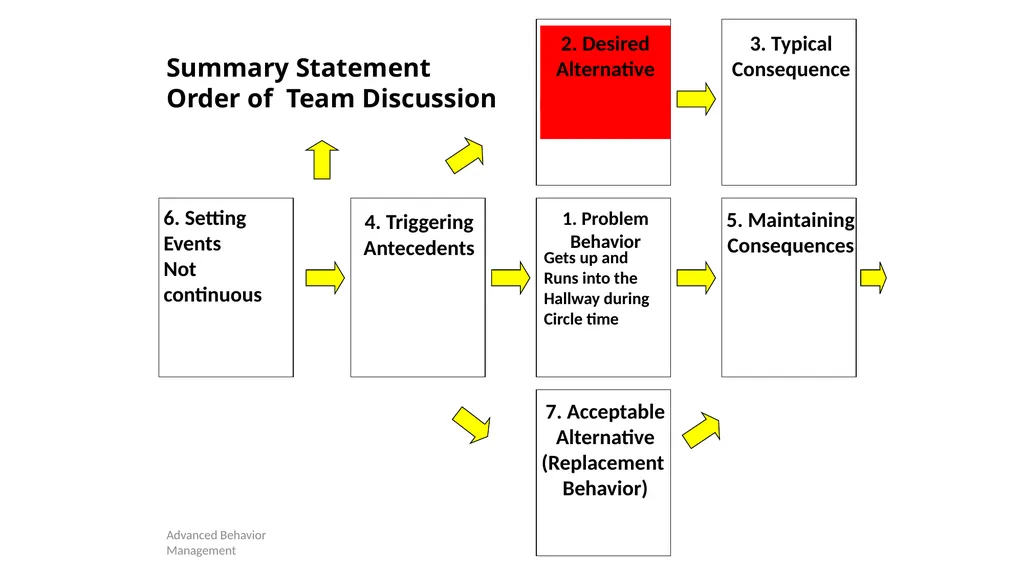
slide17. Advanced Behavior Management Gets up and
Runs into the
Hallway during
Circle time 6. Setting
Events
Not
continuous 4. Triggering
Antecedents 5. Maintaining
Consequences 1.Problem
Behavior 2. Desired
Alternative 3. Typical
Consequence Summary Statement
Order of Team Discussion 7. Acceptable
Alternative
(Replacement
Behavior)<br>
slide18. Advanced Behavior Management Gets up and
Runs into the
Hallway during
Circle time 6. Setting
Events
Not
continuous 4. Triggering
Antecedents 5. Maintaining
Consequences 1. Problem
Behavior 2. Desired
Alternative 3. Typical
Consequence Summary Statement
Order of Team Discussion 7. Acceptable
Alternative
(Replacement
Behavior)<br>
slide19. Supposed to do
Other students doing 2. Desired Alternative Behavior<br>
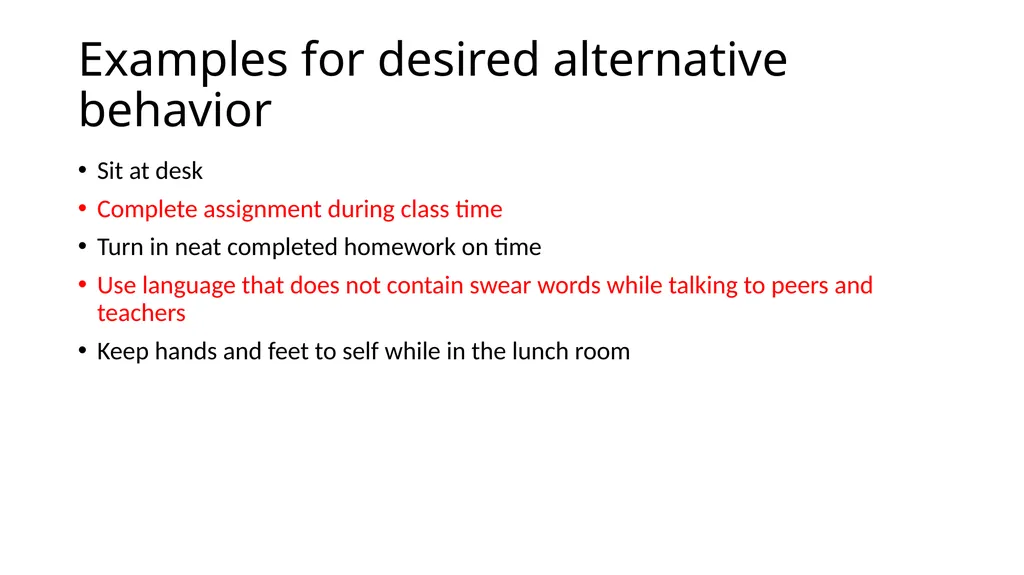
slide20. Sit at desk
Complete assignment during class time
Turn in neat completed homework on time
Use language that does not contain swear words while talking to peers and teachers
Keep hands and feet to self while in the lunch room Examples for desired alternative behavior<br>
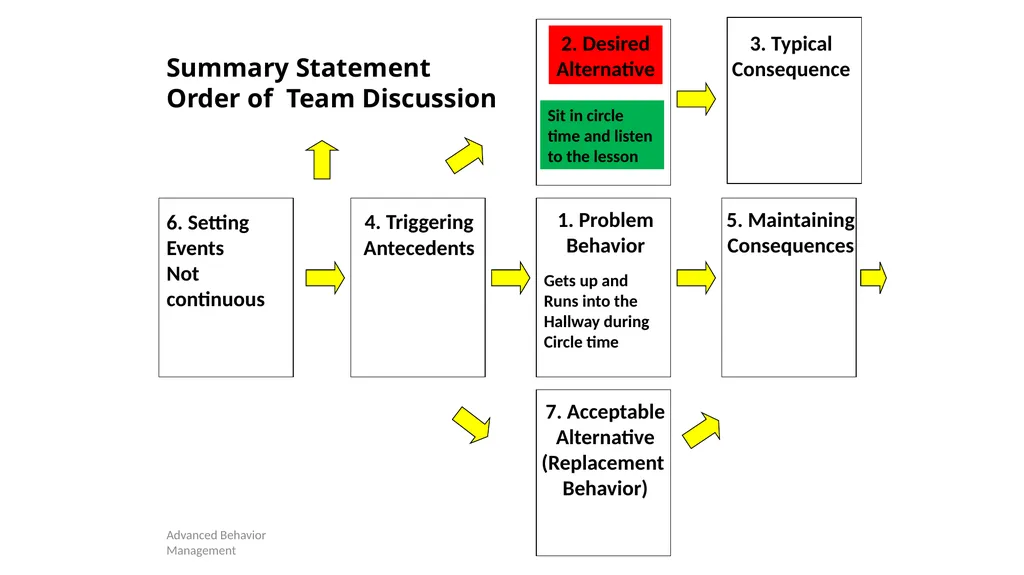
slide21. Advanced Behavior Management Gets up and
Runs into the
Hallway during
Circle time 6. Setting
Events
Not
continuous
. 4. Triggering
Antecedents 5. Maintaining
Consequences 1. Problem
Behavior 2. Desired
Alternative 3. Typical
Consequence Summary Statement
Order of Team Discussion 7. Acceptable
Alternative
(Replacement
Behavior) Sit in circle time and listen to the lesson<br>
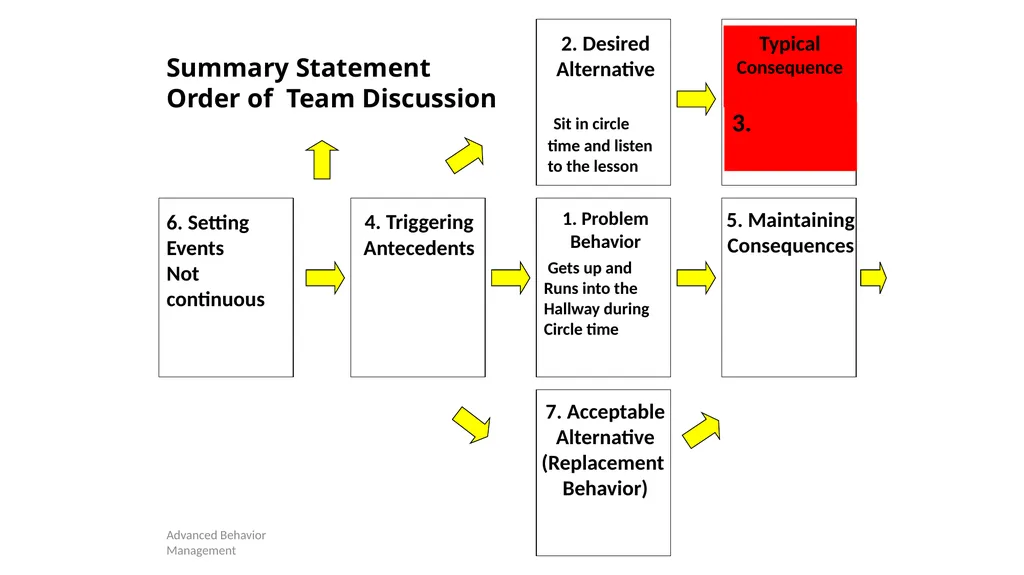
slide22. Advanced Behavior Management Gets up and
Runs into the
Hallway during
Circle time 6. Setting
Events
Not
continuous 4. Triggering
Antecedents 5. Maintaining
Consequences 1. Problem
Behavior 2. Desired
Alternative Typical
Consequence Summary Statement
Order of Team Discussion 7. Acceptable
Alternative
(Replacement
Behavior) Sit in circle time and listen to the lesson 3.<br>
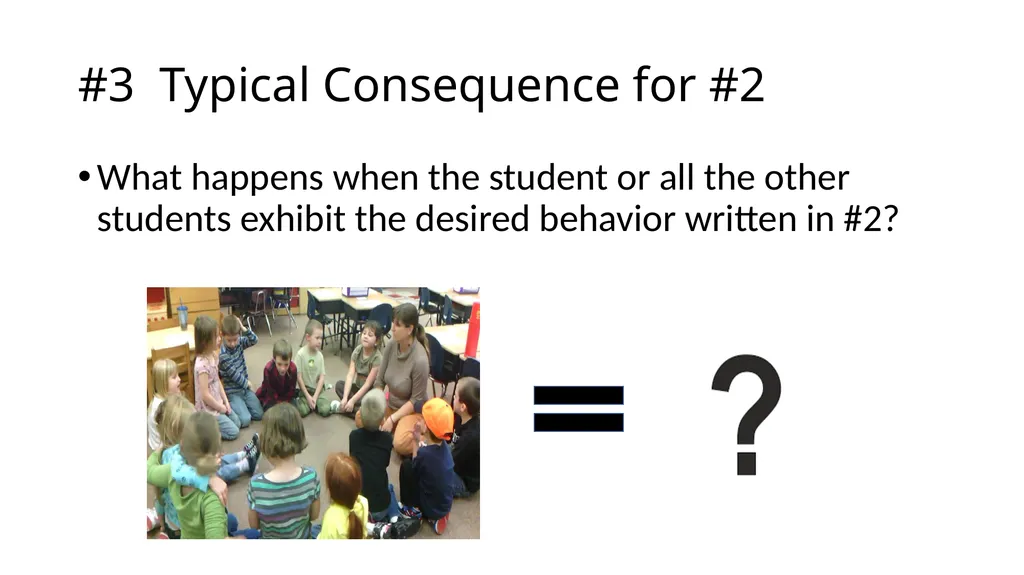
slide23. What happens when the student or all the other students exhibit the desired behavior written in #2? #3 Typical Consequence for #2<br>
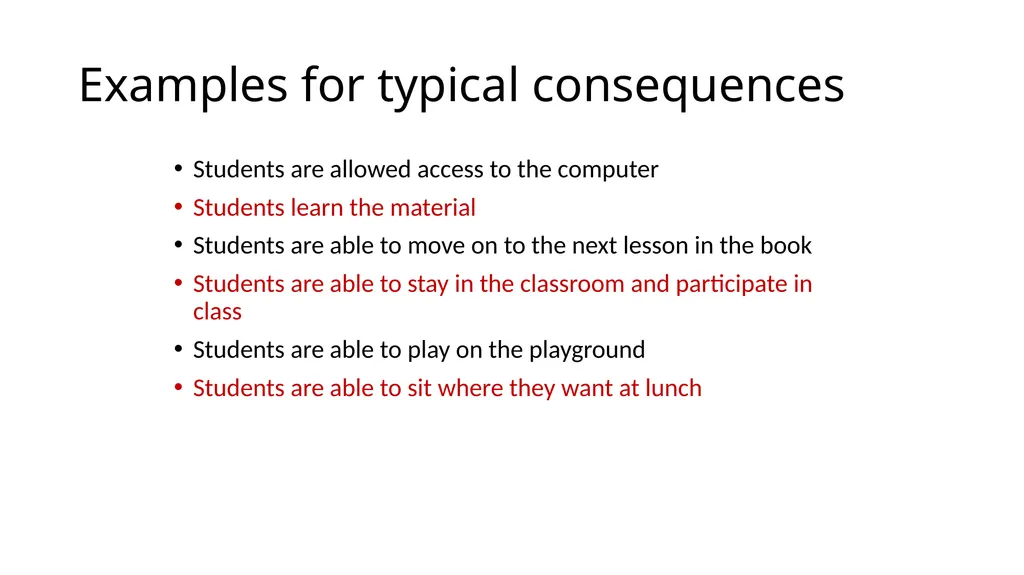
slide24. Students are allowed access to the computer
Students learn the material
Students are able to move on to the next lesson in the book
Students are able to stay in the classroom and participate in class
Students are able to play on the playground
Students are able to sit where they want at lunch Examples for typical consequences<br>
slide25. Advanced Behavior Management Gets up and
Runs into the
Hallway during
Circle time 6. Setting
Events
Not
continuous 4. Triggering
Antecedents 5. Maintaining
Consequences 1. Problem
Behavior 2. Desired
Alternative 3. Typical
Consequence Summary Statement
Order of Team Discussion 7. Acceptable
Alternative
(Replacement
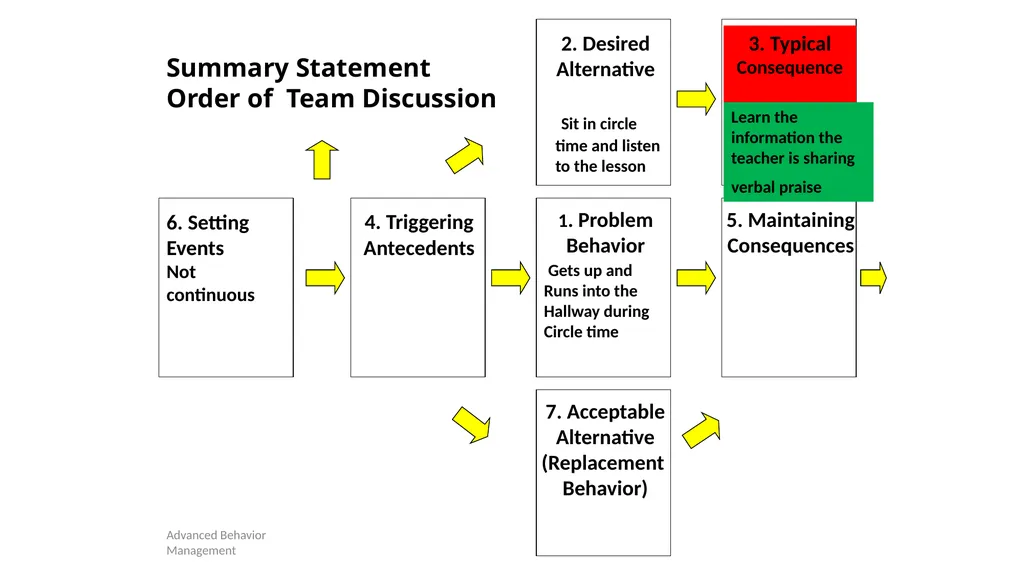
Behavior) Sit in circle time and listen to the lesson Learn the information the teacher is sharing verbal praise<br>
slide26. Advanced Behavior Management 6. Setting
Events
Not
continuous 4. Triggering
Antecedents 5. Maintaining
Consequences 1. Problem
Behavior 2. Desired
Alternative 3. Typical
Consequence Summary Statement
Order of Team Discussion 7. Acceptable
Alternative
(Replacement
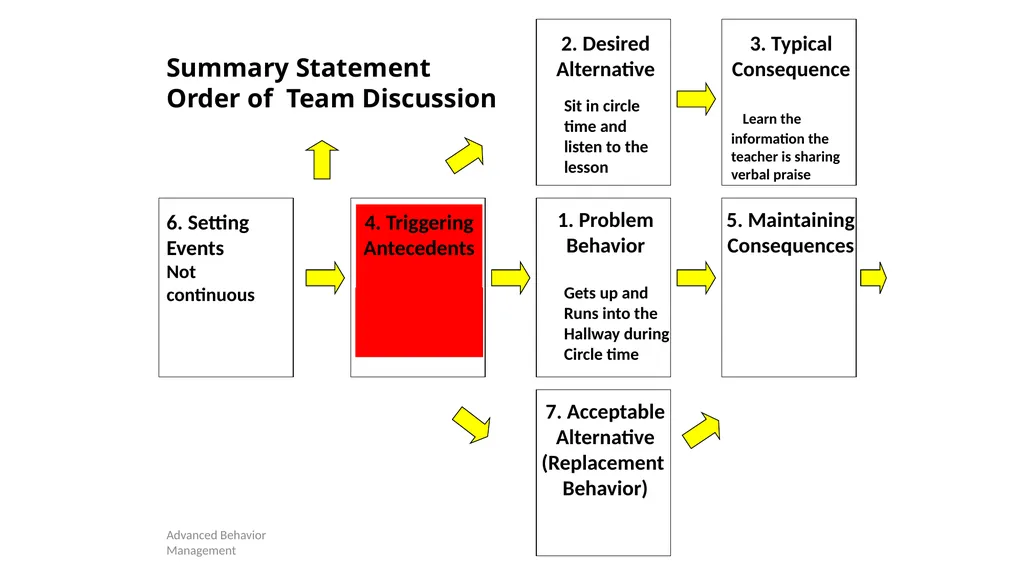
Behavior) Sit in circle time and listen to the lesson Learn the information the teacher is sharing verbal praise Gets up and
Runs into the
Hallway during
Circle time<br>
slide27. Situations
People
Time
Place
Object
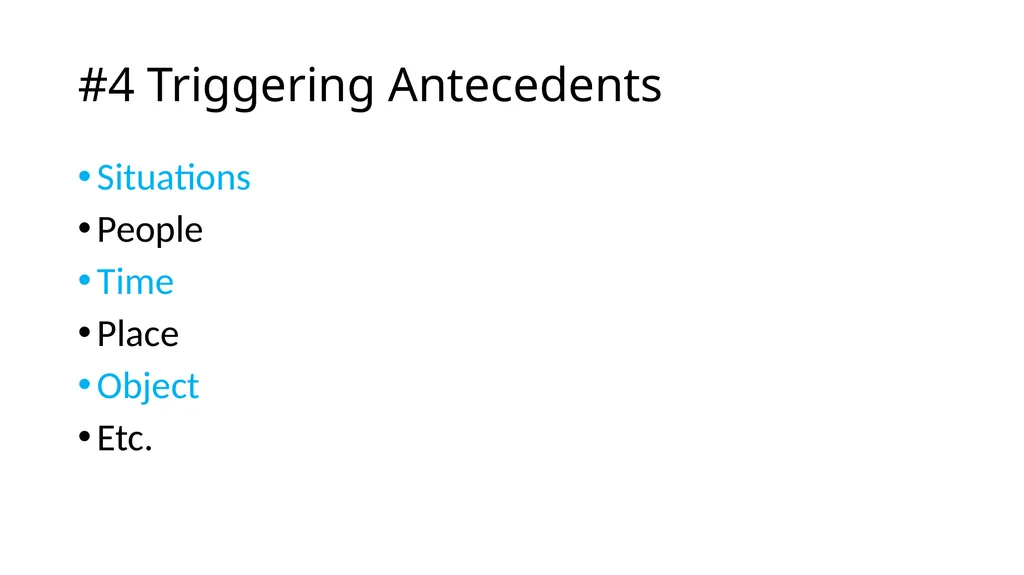
Etc. #4 Triggering Antecedents<br>
slide28. Physical Setting
Social Setting
Instructional
Strategies
Scheduling
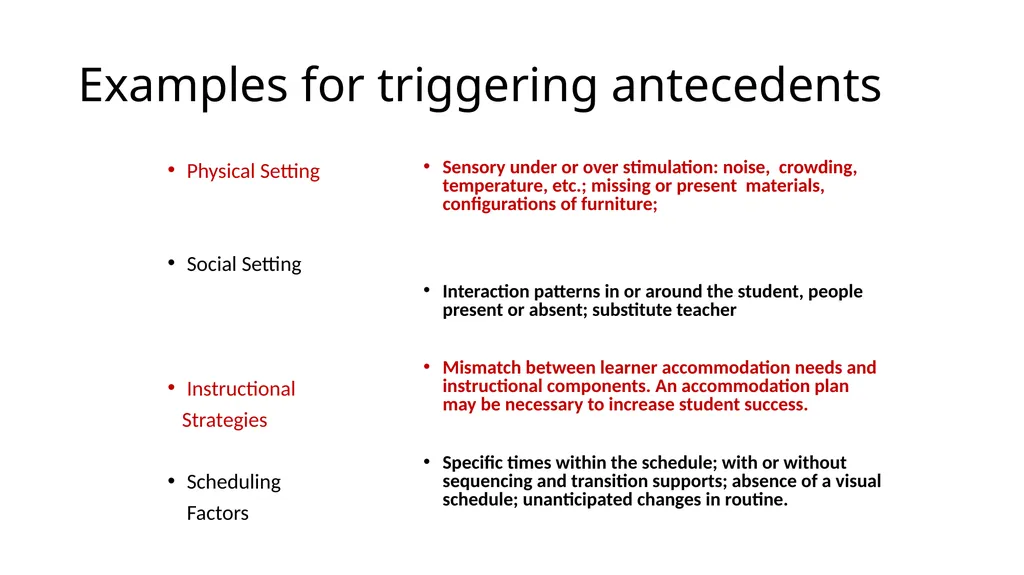
Factors Sensory under or over stimulation: noise, crowding, temperature, etc.; missing or present materials, configurations of furniture;
Interaction patterns in or around the student, people present or absent; substitute teacher
Mismatch between learner accommodation needs and instructional components. An accommodation plan may be necessary to increase student success.
Specific times within the schedule; with or without sequencing and transition supports; absence of a visual schedule; unanticipated changes in routine. Examples for triggering antecedents<br>
slide29. Advanced Behavior Management Gets up and
Runs into the
Hallway during
Circle time 6. Setting
Events
Not
continuous 4. Triggering
Antecedents 5. Maintaining
Consequences 1. Problem
Behavior 2. Desired
Alternative 3. Typical
Consequence Summary Statement
Order of Team Discussion 7. Acceptable
Alternative
(Replacement
Behavior) Sit in circle time and listen to the lesson Learn the information the teacher is sharing verbal praise Circle time lasts more than 5 minutes<br>
slide30. Advanced Behavior Management 6. Setting
Events
Not
continuous 4. Triggering
Antecedents 5. Maintaining
Consequences 1. Problem
Behavior 2. Desired
Alternative 3. Typical
Consequence Summary Statement
Order of Team Discussion 7. Acceptable
Alternative
(Replacement
Behavior) Learn the information the teacher is sharing verbal praise Circle time lasts more than 5 minutes Gets up and Runs into the Hallway during
Circle time Sit in circle time and listen to the lesson<br>
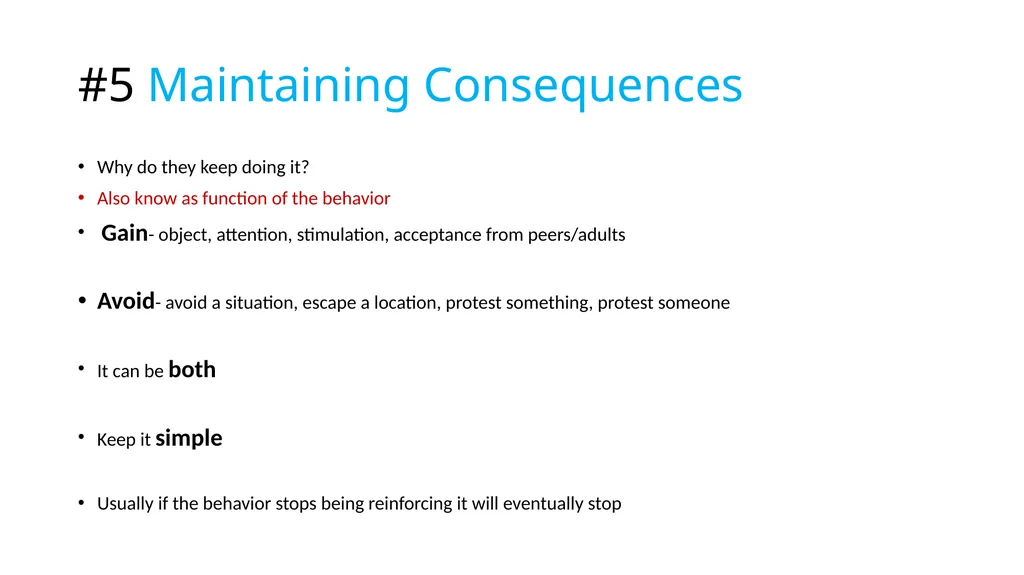
slide31. Why do they keep doing it?
Also know as function of the behavior
Gain- object, attention, stimulation, acceptance from peers/adults
Avoid- avoid a situation, escape a location, protest something, protest someone
It can be both
Keep it simple
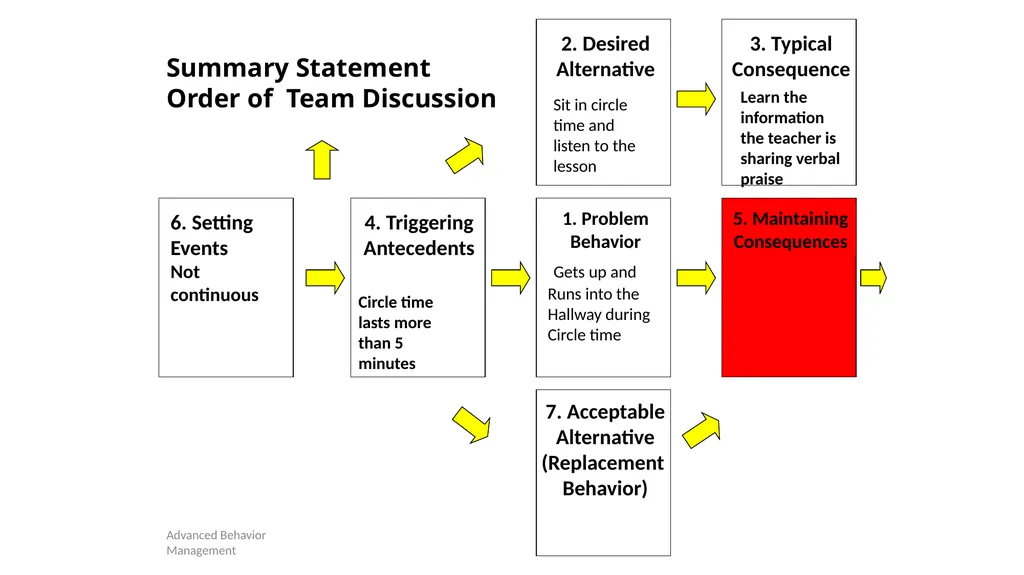
Usually if the behavior stops being reinforcing it will eventually stop #5 Maintaining Consequences<br>
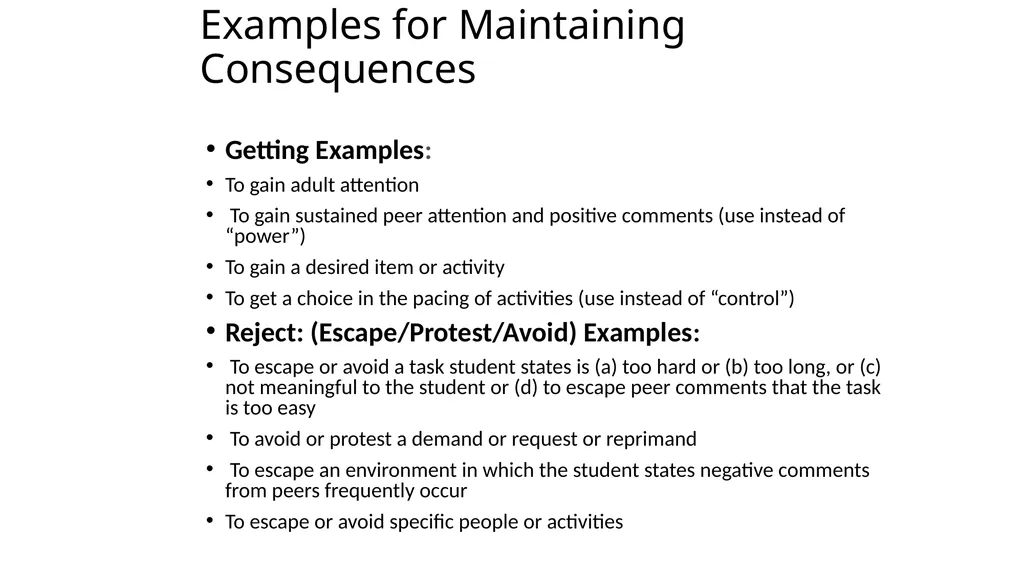
slide32. Getting Examples:
To gain adult attention
To gain sustained peer attention and positive comments (use instead of “power”)
To gain a desired item or activity
To get a choice in the pacing of activities (use instead of “control”)
Reject: (Escape/Protest/Avoid) Examples:
To escape or avoid a task student states is (a) too hard or (b) too long, or (c) not meaningful to the student or (d) to escape peer comments that the task is too easy
To avoid or protest a demand or request or reprimand
To escape an environment in which the student states negative comments from peers frequently occur
To escape or avoid specific people or activities Examples for Maintaining Consequences<br>
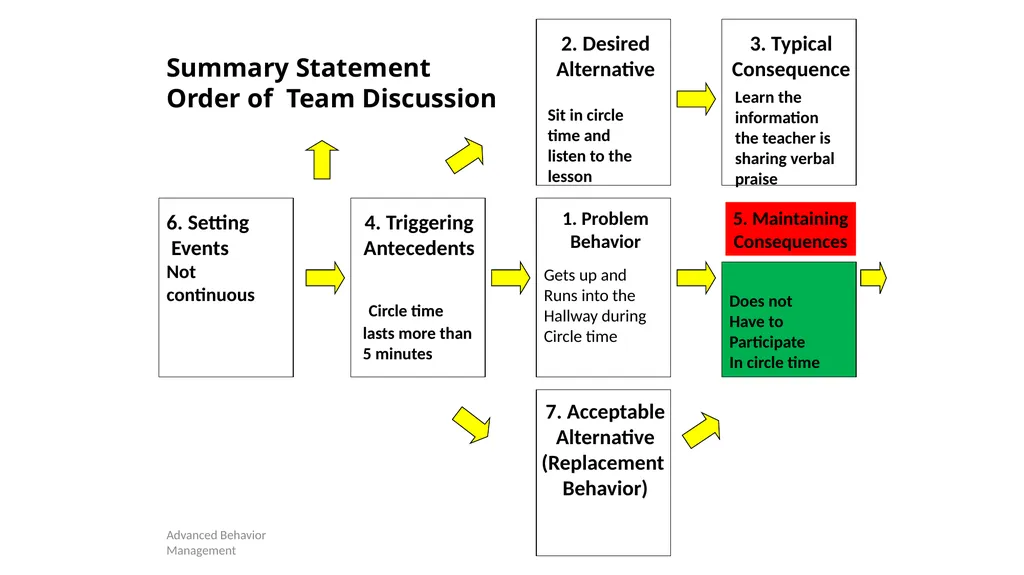
slide33. Advanced Behavior Management Does not
Have to
Participate
In circle time 6. Setting
Events
Not
continuous 4. Triggering
Antecedents 5. Maintaining
Consequences 1. Problem
Behavior 2. Desired
Alternative 3. Typical
Consequence Summary Statement
Order of Team Discussion 7. Acceptable
Alternative
(Replacement
Behavior) Sit in circle time and listen to the lesson Learn the information the teacher is sharing verbal praise Circle time lasts more than 5 minutes Gets up and
Runs into the
Hallway during
Circle time<br>
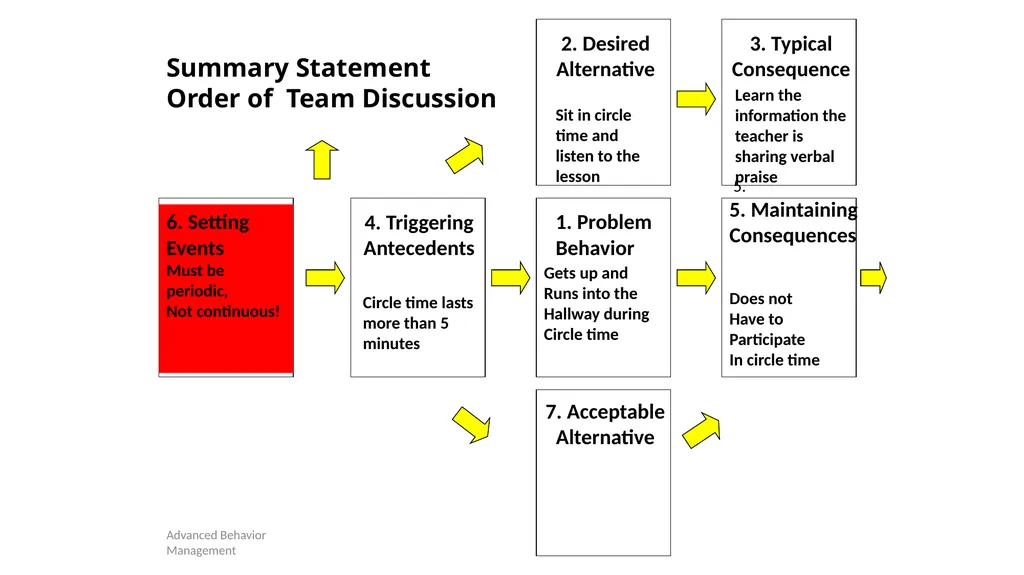
slide34. Advanced Behavior Management Gets up and
Runs into the
Hallway during
Circle time 5.
5. Maintaining
Consequences
Does not
Have to
Participate
In circle time 6. Setting Events
Must be
periodic,
Not continuous! 4. Triggering
Antecedents 1. Problem
Behavior 2. Desired
Alternative 3. Typical
Consequence Summary Statement
Order of Team Discussion 7. Acceptable
Alternative Sit in circle time and listen to the lesson Learn the information the teacher is sharing verbal praise Circle time lasts more than 5 minutes<br>
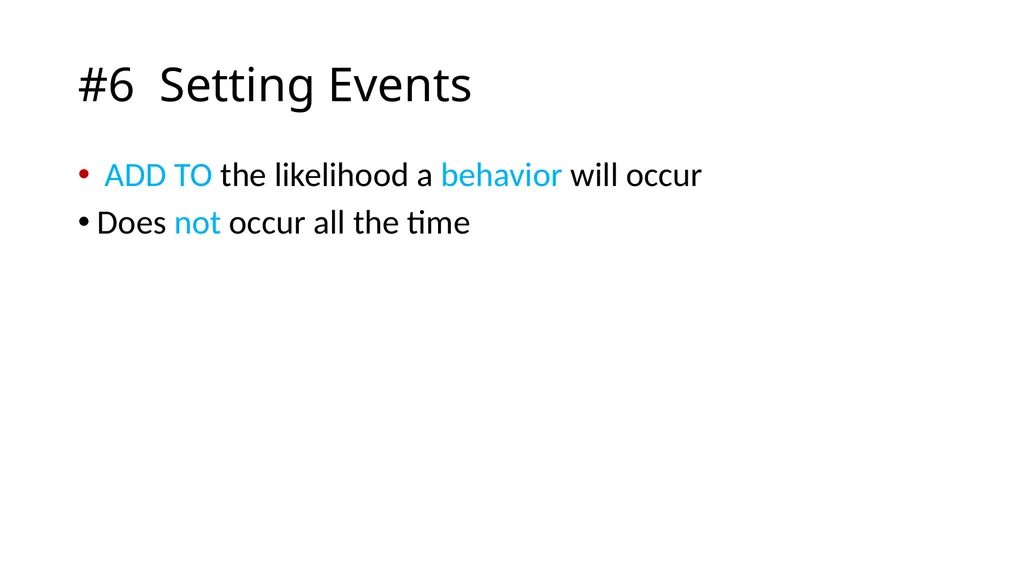
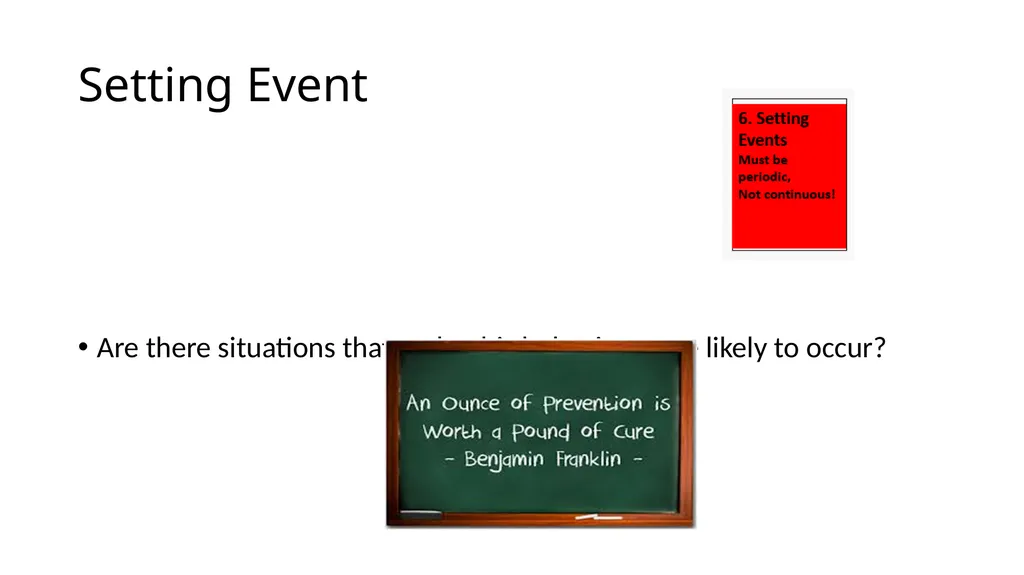
slide35. ADD TO the likelihood a behavior will occur
Does not occur all the time #6 Setting Events<br>
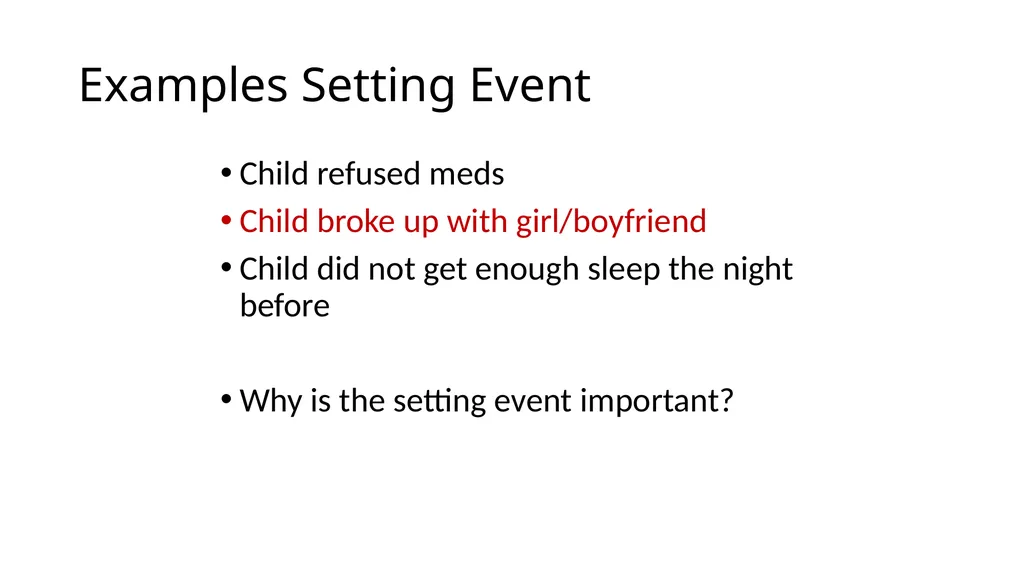
slide36. Child refused meds
Child broke up with girl/boyfriend
Child did not get enough sleep the night before
Why is the setting event important? Examples Setting Event<br>
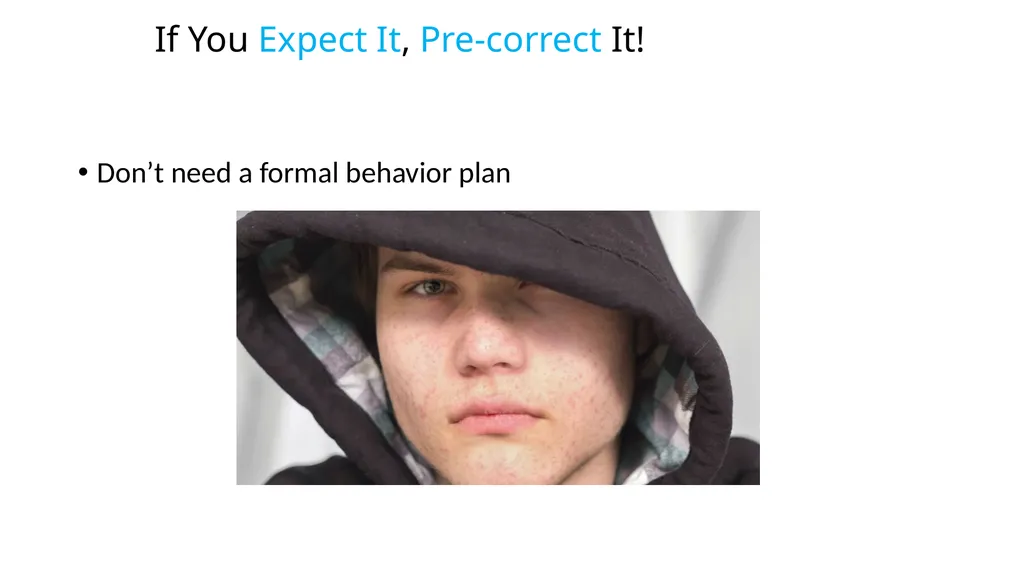
slide37. If You Expect It, Pre-correct It! Don’t need a formal behavior plan<br>
slide38. Brian likes routines, and becomes very upset if the bus is late, or if the bus driver is not the expected one. On those days, when Brian’s bus routine has changed, staff members say they “know he will have problems.” Each school day Brian puts his coat away, and goes to circle time. After going to circle, on many days, Brian will run away, and kick and head butt if captured after running away, if the activity at circle time lasts more than five minutes. Brian is more likely to leave circle by running away, on days when the bus routine has changed from the typical bus routine.<br>
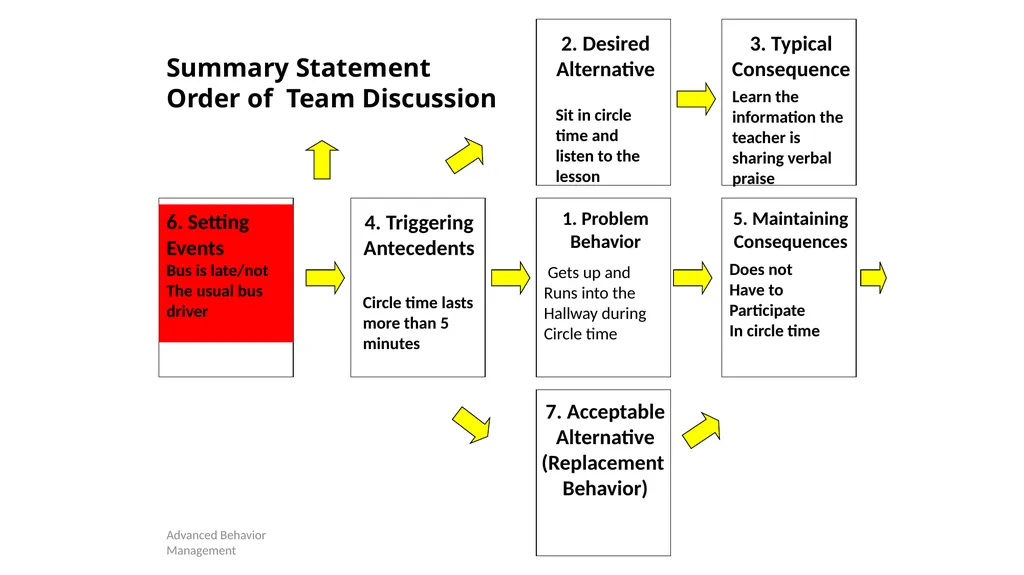
slide39. Advanced Behavior Management Does not
Have to
Participate
In circle time 6. Setting Events
Bus is late/not
The usual bus
driver 4. Triggering
Antecedents 5. Maintaining
Consequences 1. Problem
Behavior 2. Desired
Alternative 3. Typical
Consequence Summary Statement
Order of Team Discussion seventh 7. Acceptable
Alternative
(Replacement
Behavior) Sit in circle time and listen to the lesson Learn the information the teacher is sharing verbal praise Circle time lasts more than 5 minutes Gets up and
Runs into the
Hallway during
Circle time<br>
slide40. Advanced Behavior Management Does not
Have to
Participate
In circle time 6. Setting
Events
Not
continuous
Bus is late/not
The usual bus
driver 4. Triggering
Antecedents 5. Maintaining
Consequences 1. Problem
Behavior 2. Desired
Alternative 3. Typical
Consequence Summary Statement
Order of Team Discussion 7. Acceptable
Alternative
(Replacement
Behavior) Learn the information the teacher is sharing verbal praise Circle time lasts more than 5 minutes Gets up and
Runs into the
Hallway during
Circle time Sit in circle time and listen to the lesson<br>
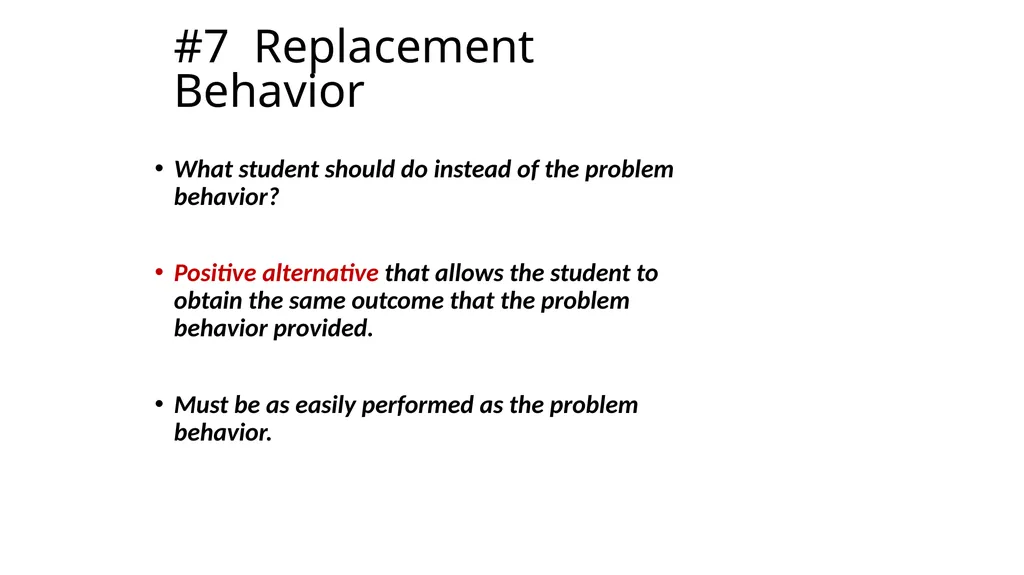
slide41. What student should do instead of the problem behavior?
Positive alternative that allows the student to obtain the same outcome that the problem behavior provided.
Must be as easily performed as the problem behavior. #7 Replacement Behavior<br>
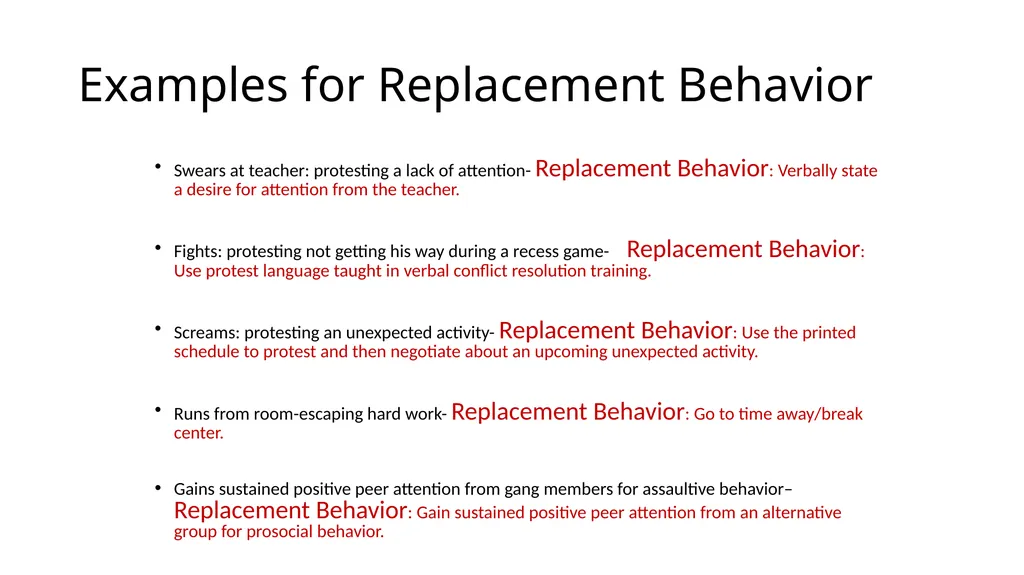
slide42. Swears at teacher: protesting a lack of attention- Replacement Behavior: Verbally state a desire for attention from the teacher.
Fights: protesting not getting his way during a recess game- – Replacement Behavior: Use protest language taught in verbal conflict resolution training.
Screams: protesting an unexpected activity- Replacement Behavior: Use the printed schedule to protest and then negotiate about an upcoming unexpected activity.
Runs from room-escaping hard work- Replacement Behavior: Go to time away/break center.
Gains sustained positive peer attention from gang members for assaultive behavior–Replacement Behavior: Gain sustained positive peer attention from an alternative group for prosocial behavior. Examples for Replacement Behavior<br>
slide43. Advanced Behavior Management Does not
Have to
Participate
In circle time 6. Setting
Events
Not
continuous
Bus is late/not
The usual bus
driver 4. Triggering
Antecedents 5. Maintaining
Consequences 1. Problem
Behavior 2. Desired
Alternative 3. Typical
Consequence Summary Statement
Order of Team Discussion 7. Acceptable
Alternative
(Replacement
Behavior)
Teacher will cue
Brian to go to
Designated spot in
The classroom. Sit in circle time and listen to the lesson Learn the information the teacher is sharing verbal praise Circle time lasts more than 5 minutes Gets up and
Runs into the
Hallway during
Circle time<br>
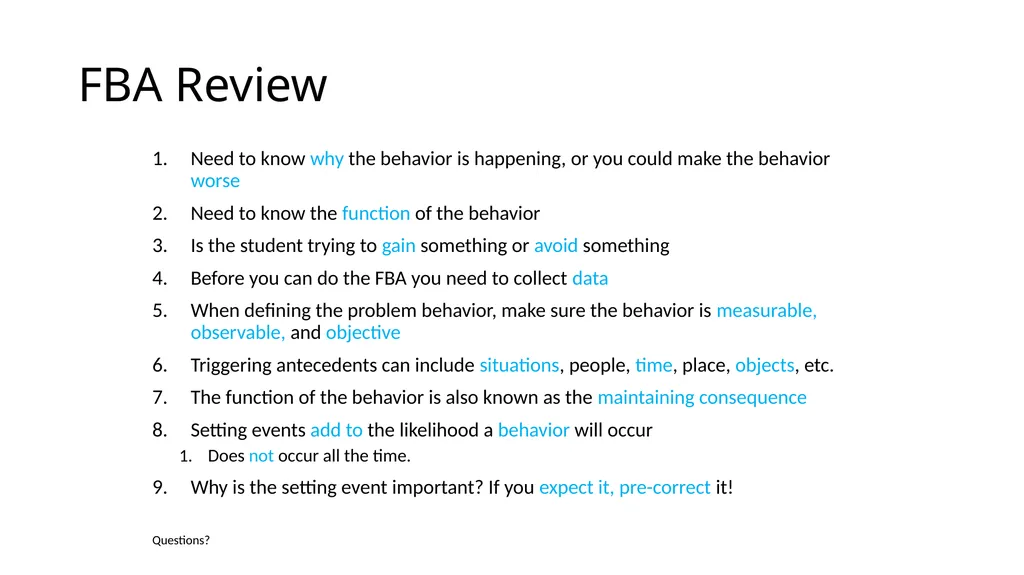
slide44. Need to know why the behavior is happening, or you could make the behavior worse
Need to know the function of the behavior
Is the student trying to gain something or avoid something
Before you can do the FBA you need to collect data
When defining the problem behavior, make sure the behavior is measurable, observable, and objective
Triggering antecedents can include situations, people, time, place, objects, etc.
The function of the behavior is also known as the maintaining consequence
Setting events add to the likelihood a behavior will occur
Does not occur all the time.
Why is the setting event important? If you expect it, pre-correct it!
Questions? FBA Review<br>
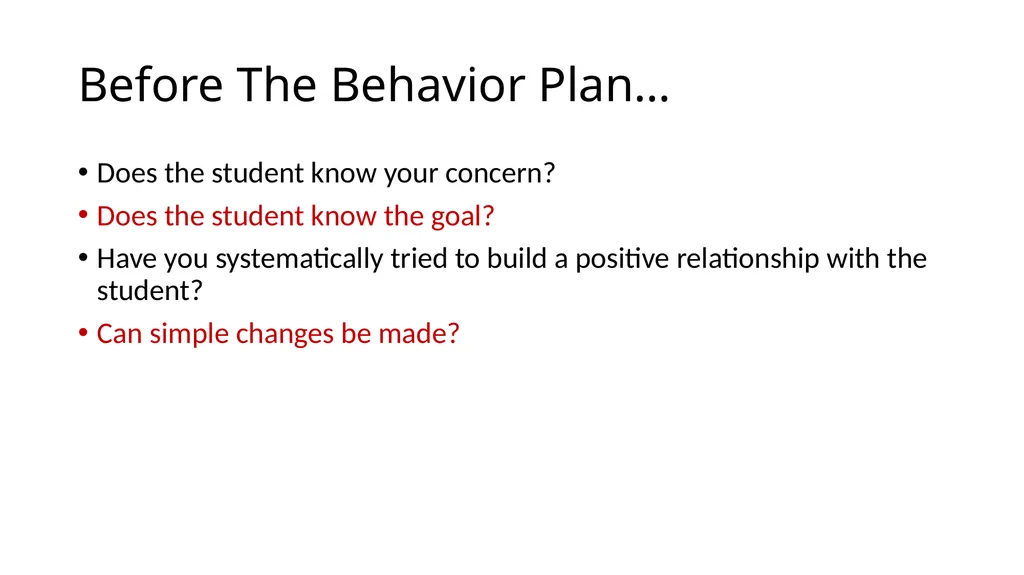
slide45. Does the student know your concern?
Does the student know the goal?
Have you systematically tried to build a positive relationship with the student?
Can simple changes be made? Before The Behavior Plan…<br>
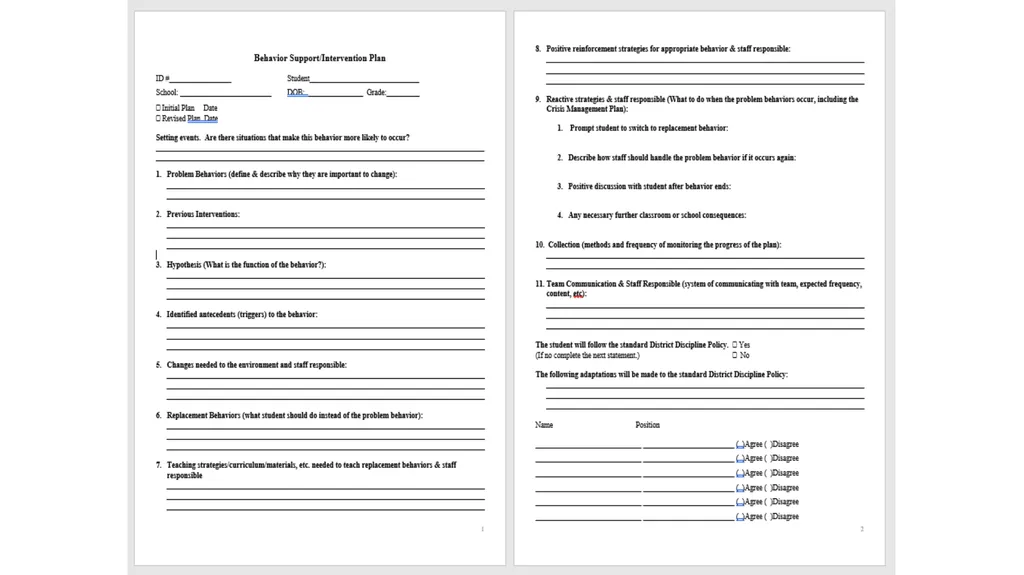
slide47. Are there situations that make this behavior more likely to occur? Setting Event<br>
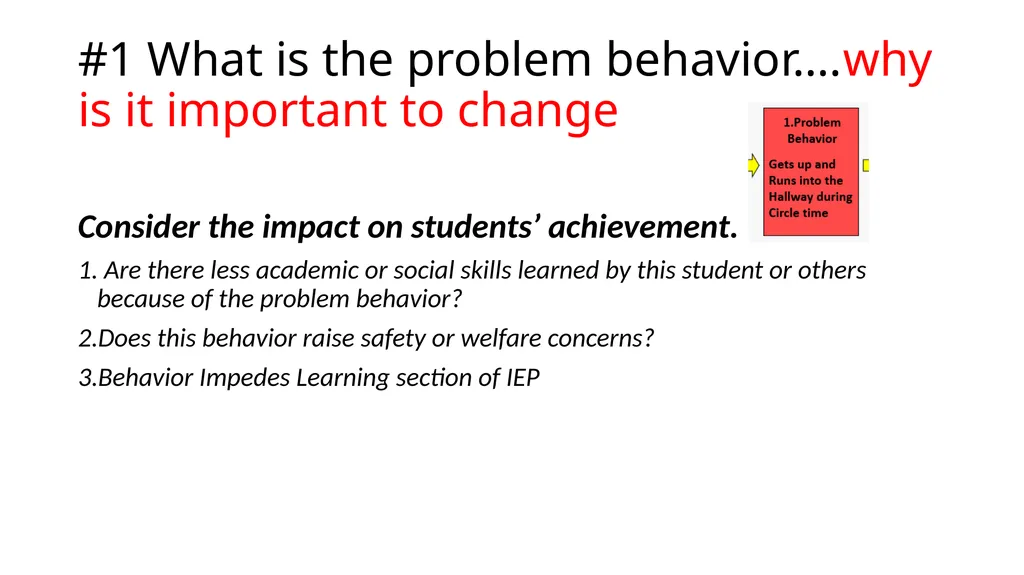
slide48. Consider the impact on students’ achievement.
Are there less academic or social skills learned by this student or others because of the problem behavior?
Does this behavior raise safety or welfare concerns?
Behavior Impedes Learning section of IEP #1 What is the problem behavior….why is it important to change<br>
slide49. Look at what has been done at home and school
If the intervention did not change behavior:
Look to see how long the intervention was implemented
Look to see who was implementing
Did parts of it work? #2. Previous Interventions<br>
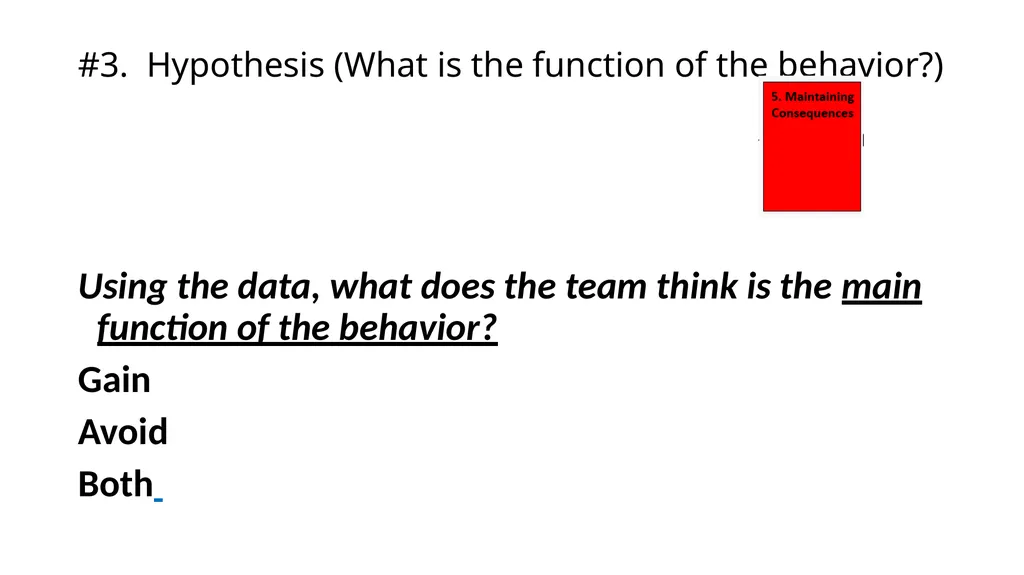
slide50. Using the data, what does the team think is the main function of the behavior?
Gain
Avoid
Both #3. Hypothesis (What is the function of the behavior?)<br>
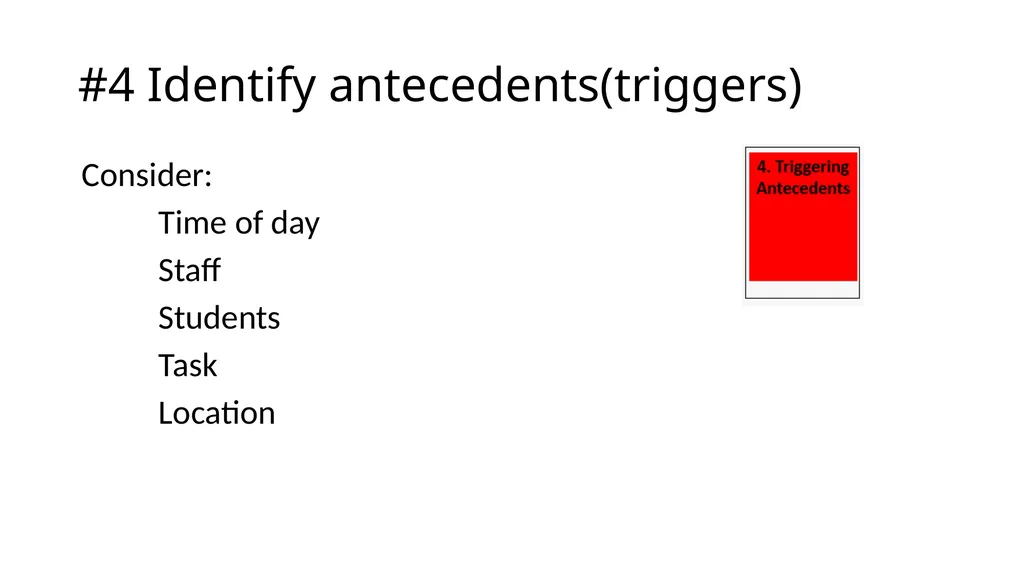
slide51. #4 Identify antecedents(triggers) Consider:
Time of day
Staff
Students
Task
Location<br>
slide52. Changes in time/space/materials/ interactions to remove likelihood of behavior #5 changes needed to the environment<br>
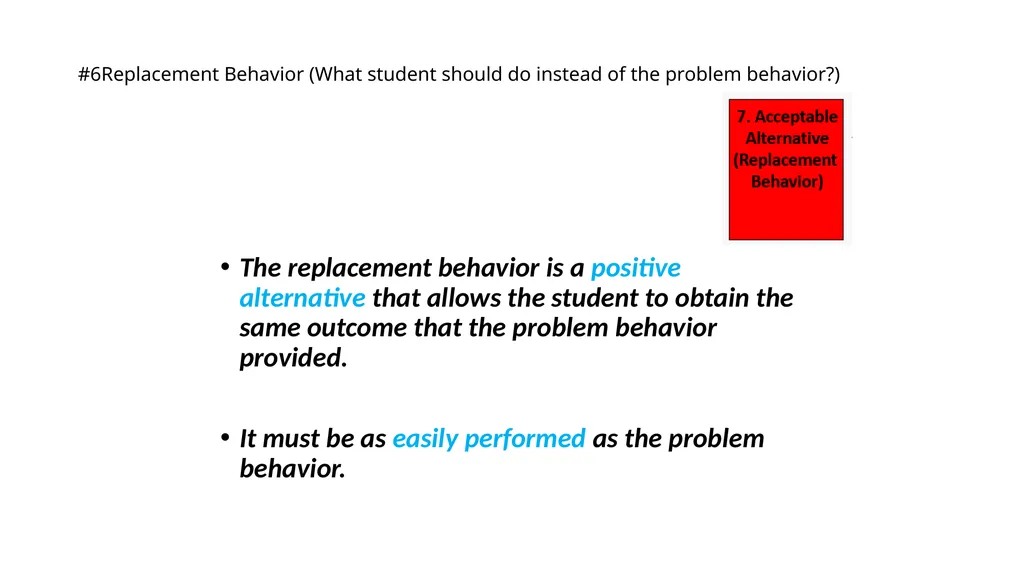
slide53. The replacement behavior is a positive alternative that allows the student to obtain the same outcome that the problem behavior provided.
It must be as easily performed as the problem behavior. #6Replacement Behavior (What student should do instead of the problem behavior?)<br>
slide54. List successive teaching steps for student to learn replacement behavior/s
Teaching of underlying pivotal skills that will increase the student’s ability to perform general positive behaviors #7 List teaching strategies/ curriculum/materials needed to teach replacement behaviors and staff responsible.<br>
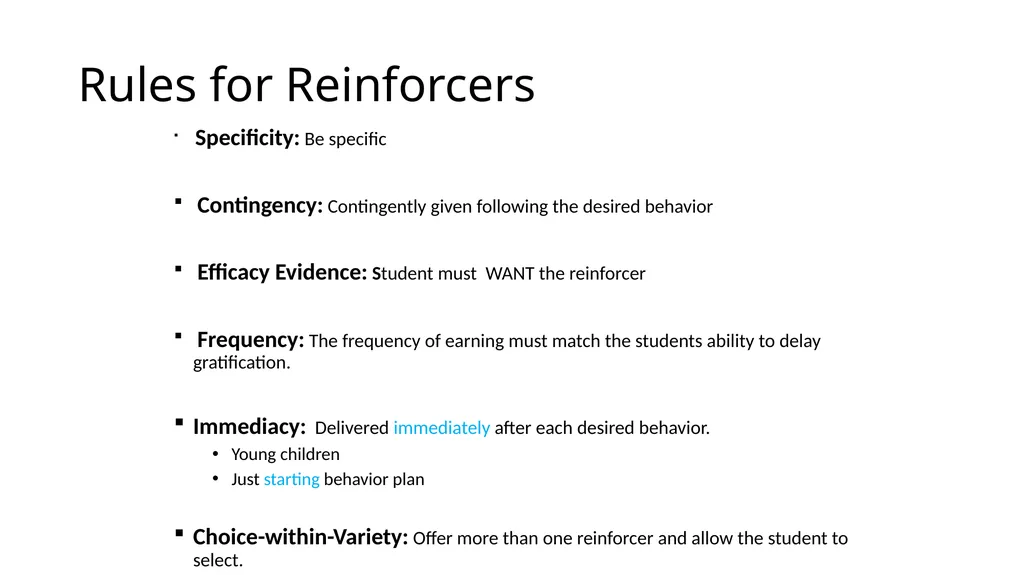
slide55. A reinforcer is something proven to increase the behavior.
A reward is something we hope the student will strive to earn, but there is no current evidence supporting that conclusion. #8 Positive reinforcement strategies for displaying appropriate behavior and staff responsible<br>
slide56. Specificity: Be specific
Contingency: Contingently given following the desired behavior
Efficacy Evidence: Student must WANT the reinforcer
Frequency: The frequency of earning must match the students ability to delay gratification.
Immediacy: Delivered immediately after each desired behavior.
Young children
Just starting behavior plan
Choice-within-Variety: Offer more than one reinforcer and allow the student to select. Rules for Reinforcers<br>
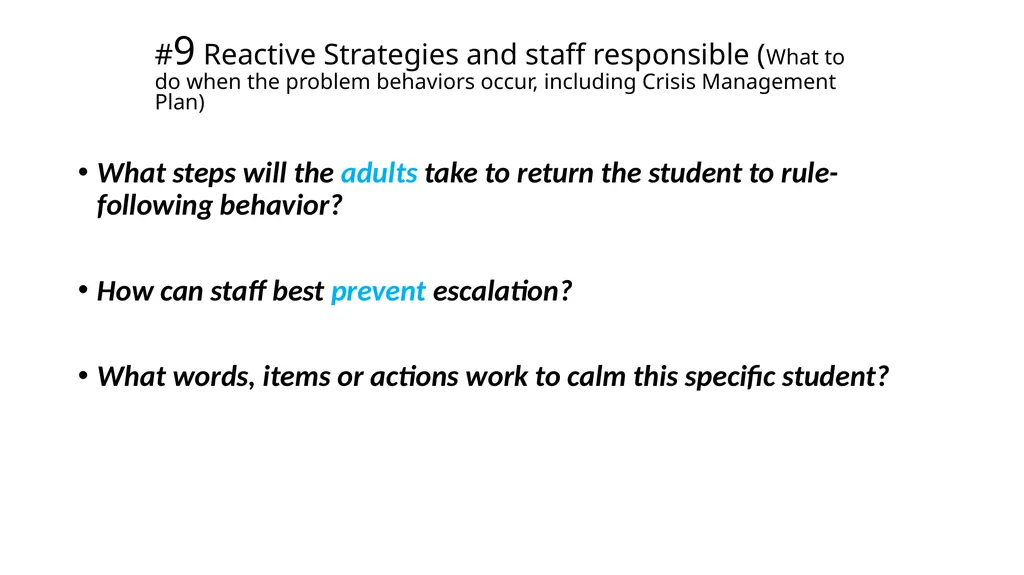
slide57. What steps will the adults take to return the student to rule-following behavior?
How can staff best prevent escalation?
What words, items or actions work to calm this specific student? #9 Reactive Strategies and staff responsible (What to do when the problem behaviors occur, including Crisis Management Plan)<br>
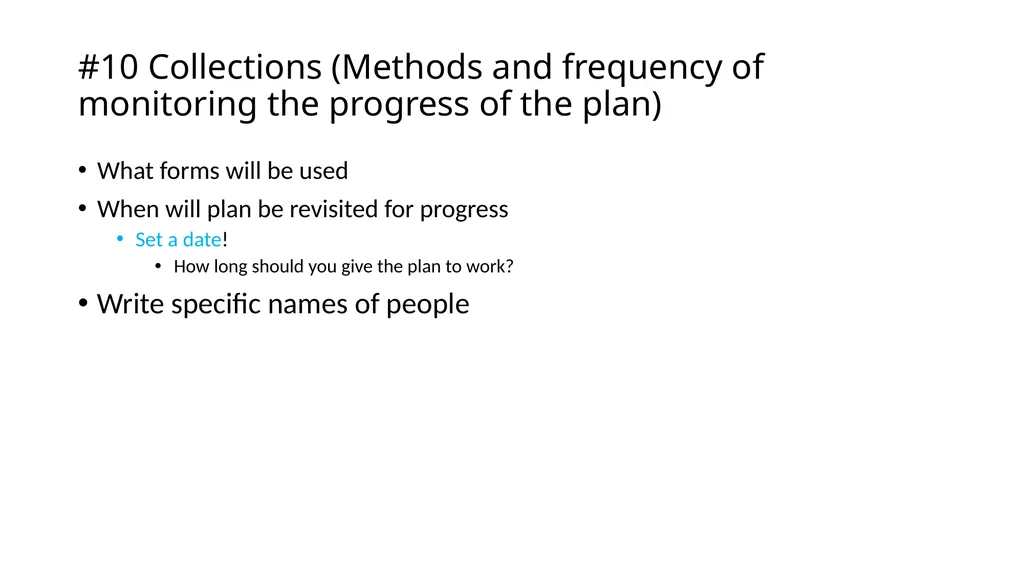
slide58. What forms will be used
When will plan be revisited for progress
Set a date!
How long should you give the plan to work?
Write specific names of people #10 Collections (Methods and frequency of monitoring the progress of the plan)<br>
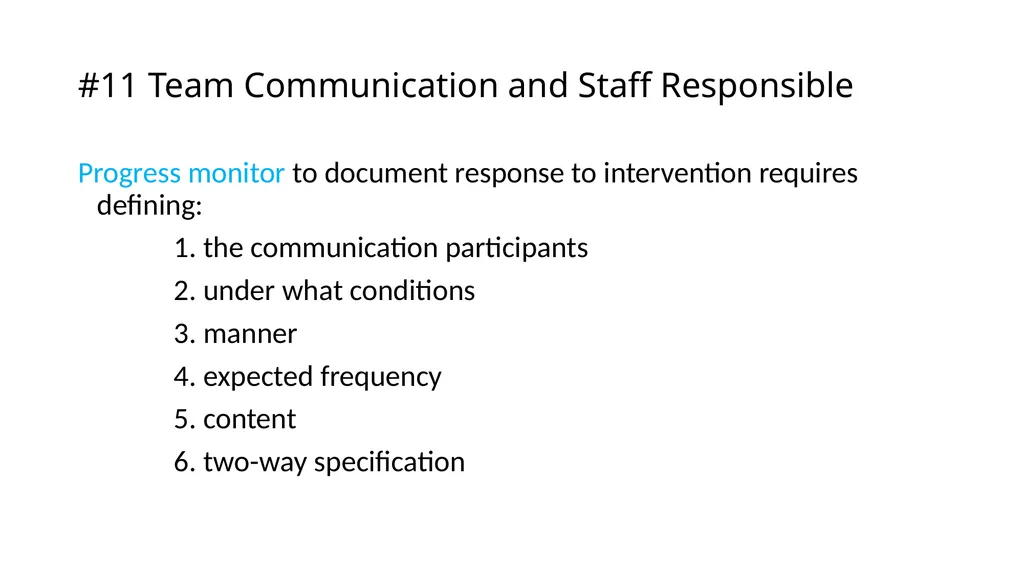
slide59. Progress monitor to document response to intervention requires defining:
1. the communication participants
2. under what conditions
3. manner
4. expected frequency
5. content
6. two-way specification #11 Team Communication and Staff Responsible<br>
slide60. Make sure the principal is in on this conversation
Get it in writing
Review it often The student will follow the standard District Discipline Policy/What adaptations will be made?<br>
slide61. 3-5 weeks
Be aware of extinction bursts
Make sure it is being implemented with fidelity
If teachers say it’s not working, find out why
Keep taking data!!
Be Consistent!
Same response every time
Consistency means: children can expect Kindness, Fairness, and Safety in the classroom How Long Should We Give it to Work?<br>
slide62. The replacement behavior is a positive alternative
The replacement behavior must be easily preformed
Deliver the reinforcer immediately after the desired behavior for young children and when starting a behavior plan
When discussing reactive strategies, make sure to include the steps the adults will take
Write steps to help staff prevent escalation
Make sure to set a date to revisit progress of the plan
The team will need to communicate and progress monitor to document response to interventions
It usually takes about 3-5 weeks to see significant change for behaviors that have been occurring for long periods of time
Make sure the plan is being implemented with fidelity!
Questions? BSP review<br>
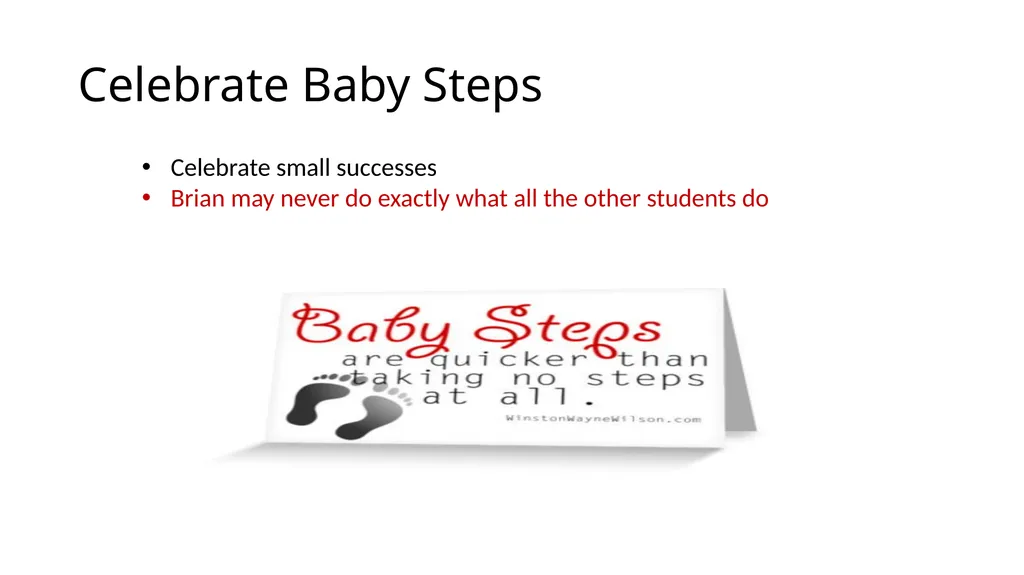
slide63. Celebrate Baby Steps Celebrate small successes
Brian may never do exactly what all the other students do<br>
slide64. things That Work Will Take:
Time
Patience
Energy
Caring
Commitment<br>
slide2. You need to know WHY
You can make a behavior worse
Need to know the function of the behavior
Gain something or avoid something? Before You Can Work on Changing a Behavior<br>
slide3. Think of it as a Doctor Visit Look at the symptoms
Diagnose
Find the right level of care
If symptoms persist, may need to re-diagnose<br>
slide4. Tools needed 1. Data Collection
2. Competing Behaviors Pathways
3. Behavior Support Plans (Don’t always need)<br>
slide5. Where Do You Start? Data Collection Gather information
Collect data on the problem behavior
Through observations
Through interviews
Past information
Look at what is happening before (antecedent)
Look at what happens after (reinforcing behavior)<br>
slide6. Data collection tools<br>
slide8. Consensus
Establishes buy-in
Visual of the real issues Why use the Pathways chart?<br>
slide9. Competing Pathways Upper: Get this—general positive behavior
Middle: Prevent this—reactive strategies to prevent problem behavior escalation
Lower: Accept this—FERB in lieu of problem behavior when general positive upper pathway fails<br>
slide10. Advanced Behavior Management Summary Statement
Order of Team Discussion What other students are doing What is currently going on What can we accept while working on
the behavior?<br>
slide11. Please read the next slide to yourself
On a piece of paper please write down
Main behavior
Antecedents
Consequences Meet Our Example Student Brian<br>
slide12. Brian is a kindergartener on IEP for speech
Has many features suggestive of autism
He is verbal, and uses 3-4 word sentences routinely to express needs and wants, but never to comment on something in the environment.
Brian likes routines, and becomes very upset if the bus is late, or if the bus driver is not the expected one. On those days, when Brian’s bus routine has changed, staff members say they “know he will have problems.”
Each school day Brian puts his coat away, and goes to circle time. After going to circle, on many days, Brian will run away, and kick and head butt if captured after running away, if the activity at circle time lasts more than five minutes.
Brian is more likely to leave circle by running away, on days when the bus routine has changed from the typical bus routine<br>
slide13. Look at the boxes one by one
*Very important to fill the boxes out in the order the are numbered*
Look at the information that should go there
Look at some examples
Decide what should go there for Brian The process:<br>
slide14. Advanced Behavior Management 6. Setting
Events
Not
continuous 4. Triggering
Antecedents 5. Maintaining
Consequences 1. Problem
Behavior 2. Desired
Alternative 3. Typical
Consequence Summary Statement
Order of Team Discussion 7. Acceptable
Alternative
(Replacement
Behavior)<br>
slide15. 1. Define Problem Behavior Measurable
Observable
Objective<br>
slide16. Off task:
Poor organization
and planning:
Tantrums:
Outbursts/Rage/
Explosive Reactions
“Naughty”
“Bullies others”
“Wastes time” crawls on the floor; plays with objects in desk; attempts play with others
rushes to complete assignment without planning each phase; waits until the final work period to begin a long term assignment
student throws materials; student crawls under the desk and screams with high volume.
Uses profane language
Shoves, pushes students, calls names
Fiddles with things in desk during independent work time Examples for define problem Behavior<br>
slide17. Advanced Behavior Management Gets up and
Runs into the
Hallway during
Circle time 6. Setting
Events
Not
continuous 4. Triggering
Antecedents 5. Maintaining
Consequences 1.Problem
Behavior 2. Desired
Alternative 3. Typical
Consequence Summary Statement
Order of Team Discussion 7. Acceptable
Alternative
(Replacement
Behavior)<br>
slide18. Advanced Behavior Management Gets up and
Runs into the
Hallway during
Circle time 6. Setting
Events
Not
continuous 4. Triggering
Antecedents 5. Maintaining
Consequences 1. Problem
Behavior 2. Desired
Alternative 3. Typical
Consequence Summary Statement
Order of Team Discussion 7. Acceptable
Alternative
(Replacement
Behavior)<br>
slide19. Supposed to do
Other students doing 2. Desired Alternative Behavior<br>
slide20. Sit at desk
Complete assignment during class time
Turn in neat completed homework on time
Use language that does not contain swear words while talking to peers and teachers
Keep hands and feet to self while in the lunch room Examples for desired alternative behavior<br>
slide21. Advanced Behavior Management Gets up and
Runs into the
Hallway during
Circle time 6. Setting
Events
Not
continuous
. 4. Triggering
Antecedents 5. Maintaining
Consequences 1. Problem
Behavior 2. Desired
Alternative 3. Typical
Consequence Summary Statement
Order of Team Discussion 7. Acceptable
Alternative
(Replacement
Behavior) Sit in circle time and listen to the lesson<br>
slide22. Advanced Behavior Management Gets up and
Runs into the
Hallway during
Circle time 6. Setting
Events
Not
continuous 4. Triggering
Antecedents 5. Maintaining
Consequences 1. Problem
Behavior 2. Desired
Alternative Typical
Consequence Summary Statement
Order of Team Discussion 7. Acceptable
Alternative
(Replacement
Behavior) Sit in circle time and listen to the lesson 3.<br>
slide23. What happens when the student or all the other students exhibit the desired behavior written in #2? #3 Typical Consequence for #2<br>
slide24. Students are allowed access to the computer
Students learn the material
Students are able to move on to the next lesson in the book
Students are able to stay in the classroom and participate in class
Students are able to play on the playground
Students are able to sit where they want at lunch Examples for typical consequences<br>
slide25. Advanced Behavior Management Gets up and
Runs into the
Hallway during
Circle time 6. Setting
Events
Not
continuous 4. Triggering
Antecedents 5. Maintaining
Consequences 1. Problem
Behavior 2. Desired
Alternative 3. Typical
Consequence Summary Statement
Order of Team Discussion 7. Acceptable
Alternative
(Replacement
Behavior) Sit in circle time and listen to the lesson Learn the information the teacher is sharing verbal praise<br>
slide26. Advanced Behavior Management 6. Setting
Events
Not
continuous 4. Triggering
Antecedents 5. Maintaining
Consequences 1. Problem
Behavior 2. Desired
Alternative 3. Typical
Consequence Summary Statement
Order of Team Discussion 7. Acceptable
Alternative
(Replacement
Behavior) Sit in circle time and listen to the lesson Learn the information the teacher is sharing verbal praise Gets up and
Runs into the
Hallway during
Circle time<br>
slide27. Situations
People
Time
Place
Object
Etc. #4 Triggering Antecedents<br>
slide28. Physical Setting
Social Setting
Instructional
Strategies
Scheduling
Factors Sensory under or over stimulation: noise, crowding, temperature, etc.; missing or present materials, configurations of furniture;
Interaction patterns in or around the student, people present or absent; substitute teacher
Mismatch between learner accommodation needs and instructional components. An accommodation plan may be necessary to increase student success.
Specific times within the schedule; with or without sequencing and transition supports; absence of a visual schedule; unanticipated changes in routine. Examples for triggering antecedents<br>
slide29. Advanced Behavior Management Gets up and
Runs into the
Hallway during
Circle time 6. Setting
Events
Not
continuous 4. Triggering
Antecedents 5. Maintaining
Consequences 1. Problem
Behavior 2. Desired
Alternative 3. Typical
Consequence Summary Statement
Order of Team Discussion 7. Acceptable
Alternative
(Replacement
Behavior) Sit in circle time and listen to the lesson Learn the information the teacher is sharing verbal praise Circle time lasts more than 5 minutes<br>
slide30. Advanced Behavior Management 6. Setting
Events
Not
continuous 4. Triggering
Antecedents 5. Maintaining
Consequences 1. Problem
Behavior 2. Desired
Alternative 3. Typical
Consequence Summary Statement
Order of Team Discussion 7. Acceptable
Alternative
(Replacement
Behavior) Learn the information the teacher is sharing verbal praise Circle time lasts more than 5 minutes Gets up and Runs into the Hallway during
Circle time Sit in circle time and listen to the lesson<br>
slide31. Why do they keep doing it?
Also know as function of the behavior
Gain- object, attention, stimulation, acceptance from peers/adults
Avoid- avoid a situation, escape a location, protest something, protest someone
It can be both
Keep it simple
Usually if the behavior stops being reinforcing it will eventually stop #5 Maintaining Consequences<br>
slide32. Getting Examples:
To gain adult attention
To gain sustained peer attention and positive comments (use instead of “power”)
To gain a desired item or activity
To get a choice in the pacing of activities (use instead of “control”)
Reject: (Escape/Protest/Avoid) Examples:
To escape or avoid a task student states is (a) too hard or (b) too long, or (c) not meaningful to the student or (d) to escape peer comments that the task is too easy
To avoid or protest a demand or request or reprimand
To escape an environment in which the student states negative comments from peers frequently occur
To escape or avoid specific people or activities Examples for Maintaining Consequences<br>
slide33. Advanced Behavior Management Does not
Have to
Participate
In circle time 6. Setting
Events
Not
continuous 4. Triggering
Antecedents 5. Maintaining
Consequences 1. Problem
Behavior 2. Desired
Alternative 3. Typical
Consequence Summary Statement
Order of Team Discussion 7. Acceptable
Alternative
(Replacement
Behavior) Sit in circle time and listen to the lesson Learn the information the teacher is sharing verbal praise Circle time lasts more than 5 minutes Gets up and
Runs into the
Hallway during
Circle time<br>
slide34. Advanced Behavior Management Gets up and
Runs into the
Hallway during
Circle time 5.
5. Maintaining
Consequences
Does not
Have to
Participate
In circle time 6. Setting Events
Must be
periodic,
Not continuous! 4. Triggering
Antecedents 1. Problem
Behavior 2. Desired
Alternative 3. Typical
Consequence Summary Statement
Order of Team Discussion 7. Acceptable
Alternative Sit in circle time and listen to the lesson Learn the information the teacher is sharing verbal praise Circle time lasts more than 5 minutes<br>
slide35. ADD TO the likelihood a behavior will occur
Does not occur all the time #6 Setting Events<br>
slide36. Child refused meds
Child broke up with girl/boyfriend
Child did not get enough sleep the night before
Why is the setting event important? Examples Setting Event<br>
slide37. If You Expect It, Pre-correct It! Don’t need a formal behavior plan<br>
slide38. Brian likes routines, and becomes very upset if the bus is late, or if the bus driver is not the expected one. On those days, when Brian’s bus routine has changed, staff members say they “know he will have problems.” Each school day Brian puts his coat away, and goes to circle time. After going to circle, on many days, Brian will run away, and kick and head butt if captured after running away, if the activity at circle time lasts more than five minutes. Brian is more likely to leave circle by running away, on days when the bus routine has changed from the typical bus routine.<br>
slide39. Advanced Behavior Management Does not
Have to
Participate
In circle time 6. Setting Events
Bus is late/not
The usual bus
driver 4. Triggering
Antecedents 5. Maintaining
Consequences 1. Problem
Behavior 2. Desired
Alternative 3. Typical
Consequence Summary Statement
Order of Team Discussion seventh 7. Acceptable
Alternative
(Replacement
Behavior) Sit in circle time and listen to the lesson Learn the information the teacher is sharing verbal praise Circle time lasts more than 5 minutes Gets up and
Runs into the
Hallway during
Circle time<br>
slide40. Advanced Behavior Management Does not
Have to
Participate
In circle time 6. Setting
Events
Not
continuous
Bus is late/not
The usual bus
driver 4. Triggering
Antecedents 5. Maintaining
Consequences 1. Problem
Behavior 2. Desired
Alternative 3. Typical
Consequence Summary Statement
Order of Team Discussion 7. Acceptable
Alternative
(Replacement
Behavior) Learn the information the teacher is sharing verbal praise Circle time lasts more than 5 minutes Gets up and
Runs into the
Hallway during
Circle time Sit in circle time and listen to the lesson<br>
slide41. What student should do instead of the problem behavior?
Positive alternative that allows the student to obtain the same outcome that the problem behavior provided.
Must be as easily performed as the problem behavior. #7 Replacement Behavior<br>
slide42. Swears at teacher: protesting a lack of attention- Replacement Behavior: Verbally state a desire for attention from the teacher.
Fights: protesting not getting his way during a recess game- – Replacement Behavior: Use protest language taught in verbal conflict resolution training.
Screams: protesting an unexpected activity- Replacement Behavior: Use the printed schedule to protest and then negotiate about an upcoming unexpected activity.
Runs from room-escaping hard work- Replacement Behavior: Go to time away/break center.
Gains sustained positive peer attention from gang members for assaultive behavior–Replacement Behavior: Gain sustained positive peer attention from an alternative group for prosocial behavior. Examples for Replacement Behavior<br>
slide43. Advanced Behavior Management Does not
Have to
Participate
In circle time 6. Setting
Events
Not
continuous
Bus is late/not
The usual bus
driver 4. Triggering
Antecedents 5. Maintaining
Consequences 1. Problem
Behavior 2. Desired
Alternative 3. Typical
Consequence Summary Statement
Order of Team Discussion 7. Acceptable
Alternative
(Replacement
Behavior)
Teacher will cue
Brian to go to
Designated spot in
The classroom. Sit in circle time and listen to the lesson Learn the information the teacher is sharing verbal praise Circle time lasts more than 5 minutes Gets up and
Runs into the
Hallway during
Circle time<br>
slide44. Need to know why the behavior is happening, or you could make the behavior worse
Need to know the function of the behavior
Is the student trying to gain something or avoid something
Before you can do the FBA you need to collect data
When defining the problem behavior, make sure the behavior is measurable, observable, and objective
Triggering antecedents can include situations, people, time, place, objects, etc.
The function of the behavior is also known as the maintaining consequence
Setting events add to the likelihood a behavior will occur
Does not occur all the time.
Why is the setting event important? If you expect it, pre-correct it!
Questions? FBA Review<br>
slide45. Does the student know your concern?
Does the student know the goal?
Have you systematically tried to build a positive relationship with the student?
Can simple changes be made? Before The Behavior Plan…<br>
slide47. Are there situations that make this behavior more likely to occur? Setting Event<br>
slide48. Consider the impact on students’ achievement.
Are there less academic or social skills learned by this student or others because of the problem behavior?
Does this behavior raise safety or welfare concerns?
Behavior Impedes Learning section of IEP #1 What is the problem behavior….why is it important to change<br>
slide49. Look at what has been done at home and school
If the intervention did not change behavior:
Look to see how long the intervention was implemented
Look to see who was implementing
Did parts of it work? #2. Previous Interventions<br>
slide50. Using the data, what does the team think is the main function of the behavior?
Gain
Avoid
Both #3. Hypothesis (What is the function of the behavior?)<br>
slide51. #4 Identify antecedents(triggers) Consider:
Time of day
Staff
Students
Task
Location<br>
slide52. Changes in time/space/materials/ interactions to remove likelihood of behavior #5 changes needed to the environment<br>
slide53. The replacement behavior is a positive alternative that allows the student to obtain the same outcome that the problem behavior provided.
It must be as easily performed as the problem behavior. #6Replacement Behavior (What student should do instead of the problem behavior?)<br>
slide54. List successive teaching steps for student to learn replacement behavior/s
Teaching of underlying pivotal skills that will increase the student’s ability to perform general positive behaviors #7 List teaching strategies/ curriculum/materials needed to teach replacement behaviors and staff responsible.<br>
slide55. A reinforcer is something proven to increase the behavior.
A reward is something we hope the student will strive to earn, but there is no current evidence supporting that conclusion. #8 Positive reinforcement strategies for displaying appropriate behavior and staff responsible<br>
slide56. Specificity: Be specific
Contingency: Contingently given following the desired behavior
Efficacy Evidence: Student must WANT the reinforcer
Frequency: The frequency of earning must match the students ability to delay gratification.
Immediacy: Delivered immediately after each desired behavior.
Young children
Just starting behavior plan
Choice-within-Variety: Offer more than one reinforcer and allow the student to select. Rules for Reinforcers<br>
slide57. What steps will the adults take to return the student to rule-following behavior?
How can staff best prevent escalation?
What words, items or actions work to calm this specific student? #9 Reactive Strategies and staff responsible (What to do when the problem behaviors occur, including Crisis Management Plan)<br>
slide58. What forms will be used
When will plan be revisited for progress
Set a date!
How long should you give the plan to work?
Write specific names of people #10 Collections (Methods and frequency of monitoring the progress of the plan)<br>
slide59. Progress monitor to document response to intervention requires defining:
1. the communication participants
2. under what conditions
3. manner
4. expected frequency
5. content
6. two-way specification #11 Team Communication and Staff Responsible<br>
slide60. Make sure the principal is in on this conversation
Get it in writing
Review it often The student will follow the standard District Discipline Policy/What adaptations will be made?<br>
slide61. 3-5 weeks
Be aware of extinction bursts
Make sure it is being implemented with fidelity
If teachers say it’s not working, find out why
Keep taking data!!
Be Consistent!
Same response every time
Consistency means: children can expect Kindness, Fairness, and Safety in the classroom How Long Should We Give it to Work?<br>
slide62. The replacement behavior is a positive alternative
The replacement behavior must be easily preformed
Deliver the reinforcer immediately after the desired behavior for young children and when starting a behavior plan
When discussing reactive strategies, make sure to include the steps the adults will take
Write steps to help staff prevent escalation
Make sure to set a date to revisit progress of the plan
The team will need to communicate and progress monitor to document response to interventions
It usually takes about 3-5 weeks to see significant change for behaviors that have been occurring for long periods of time
Make sure the plan is being implemented with fidelity!
Questions? BSP review<br>
slide63. Celebrate Baby Steps Celebrate small successes
Brian may never do exactly what all the other students do<br>
slide64. things That Work Will Take:
Time
Patience
Energy
Caring
Commitment<br>