
Customer Relationship Management E-Marketing/7E


Description: Customer Relationship Management E-Marketing7E Chapter 15 Chapter 15 Objectives After reading Chapter 15, you will be able to: Define customer relationship management (CRM) and identify the major benefits to e-marketers. Outline the three
Related Topics
Download Presentation
"Customer Relationship Management E-Marketing/7E" is the property of its rightful owner. Permission is granted to download and print the materials on this website for personal, non-commercial use only, and to display it on your personal computer provided you do not modify the materials and that you retain all copyright notices contained in the materials. By downloading content from our website, you accept the terms of this agreement.
Presentation Transcript
slide1. Customer Relationship Management E-Marketing/7E
Chapter 15<br>
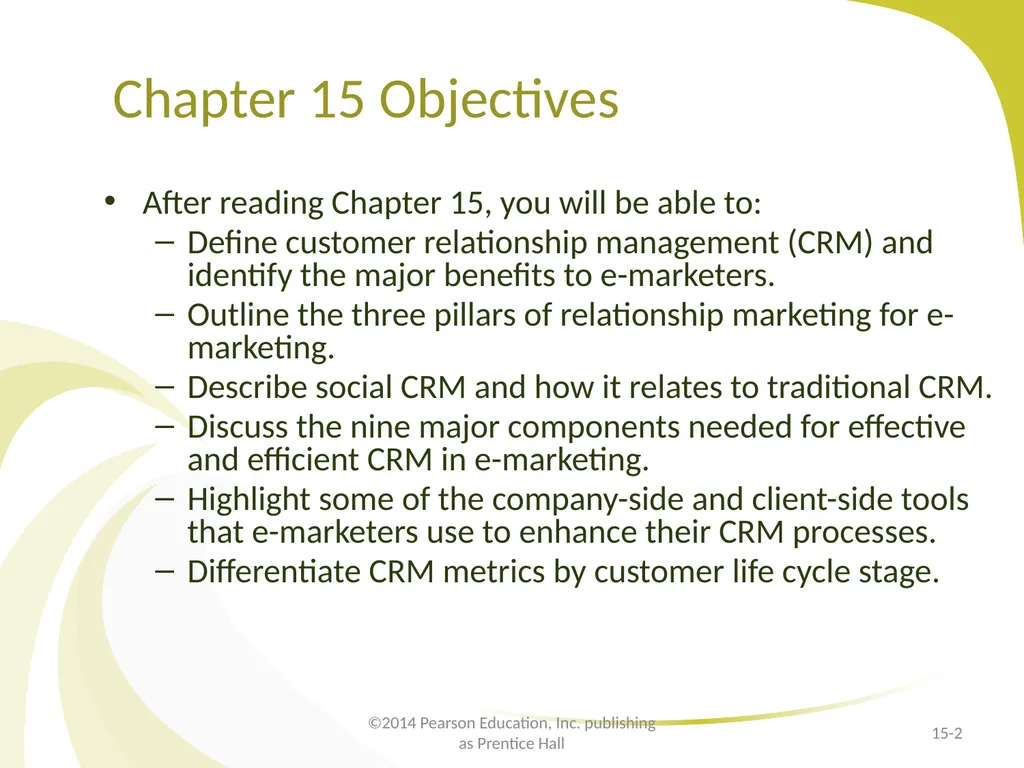
slide2. Chapter 15 Objectives After reading Chapter 15, you will be able to:
Define customer relationship management (CRM) and identify the major benefits to e-marketers.
Outline the three pillars of relationship marketing for e-marketing.
Describe social CRM and how it relates to traditional CRM.
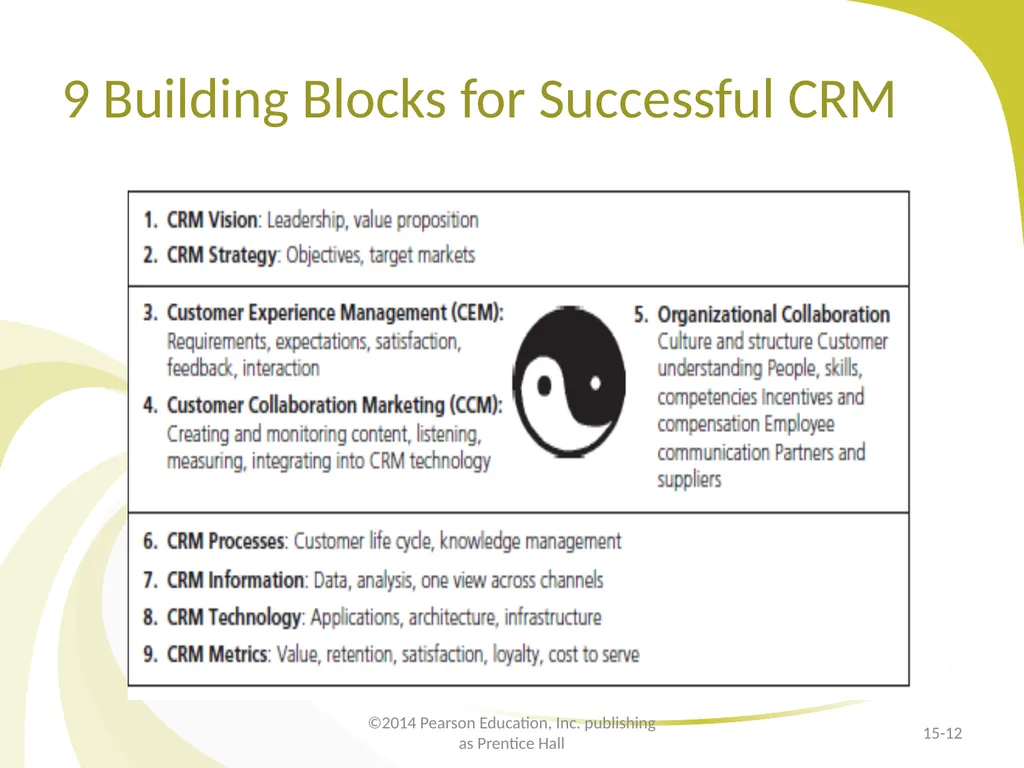
Discuss the nine major components needed for effective and efficient CRM in e-marketing.
Highlight some of the company-side and client-side tools that e-marketers use to enhance their CRM processes.
Differentiate CRM metrics by customer life cycle stage. 15-2 ©2014 Pearson Education, Inc. publishing as Prentice Hall<br>
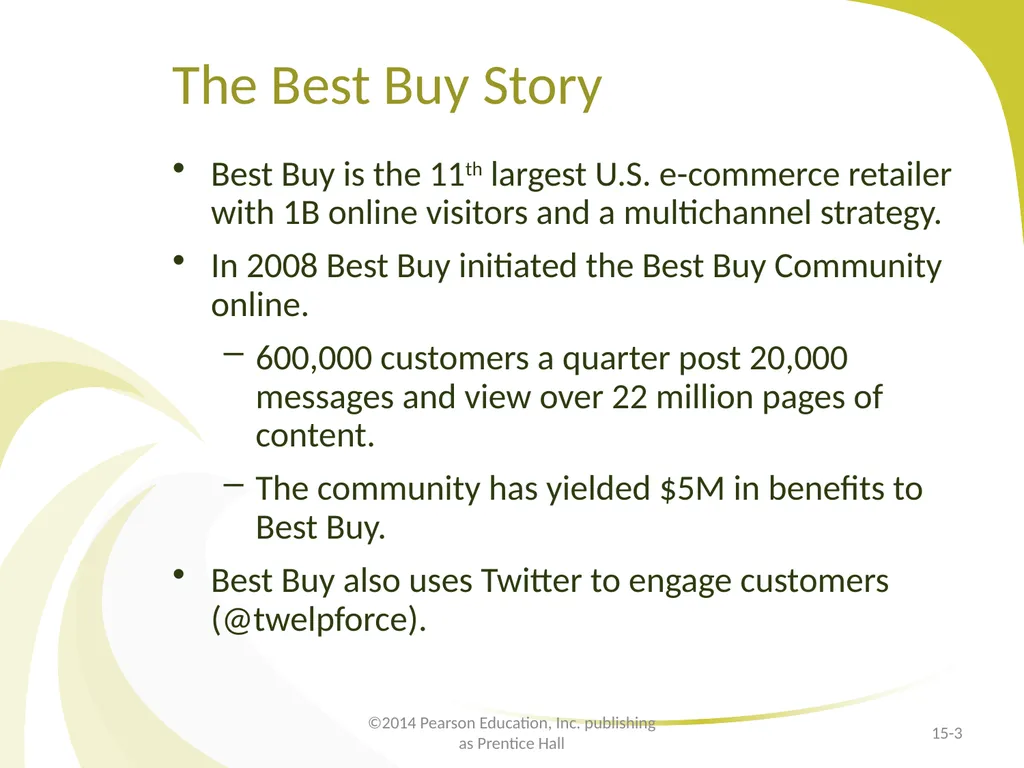
slide3. Best Buy is the 11th largest U.S. e-commerce retailer with 1B online visitors and a multichannel strategy.
In 2008 Best Buy initiated the Best Buy Community online.
600,000 customers a quarter post 20,000 messages and view over 22 million pages of content.
The community has yielded $5M in benefits to Best Buy.
Best Buy also uses Twitter to engage customers (@twelpforce). The Best Buy Story 15-3 ©2014 Pearson Education, Inc. publishing as Prentice Hall<br>
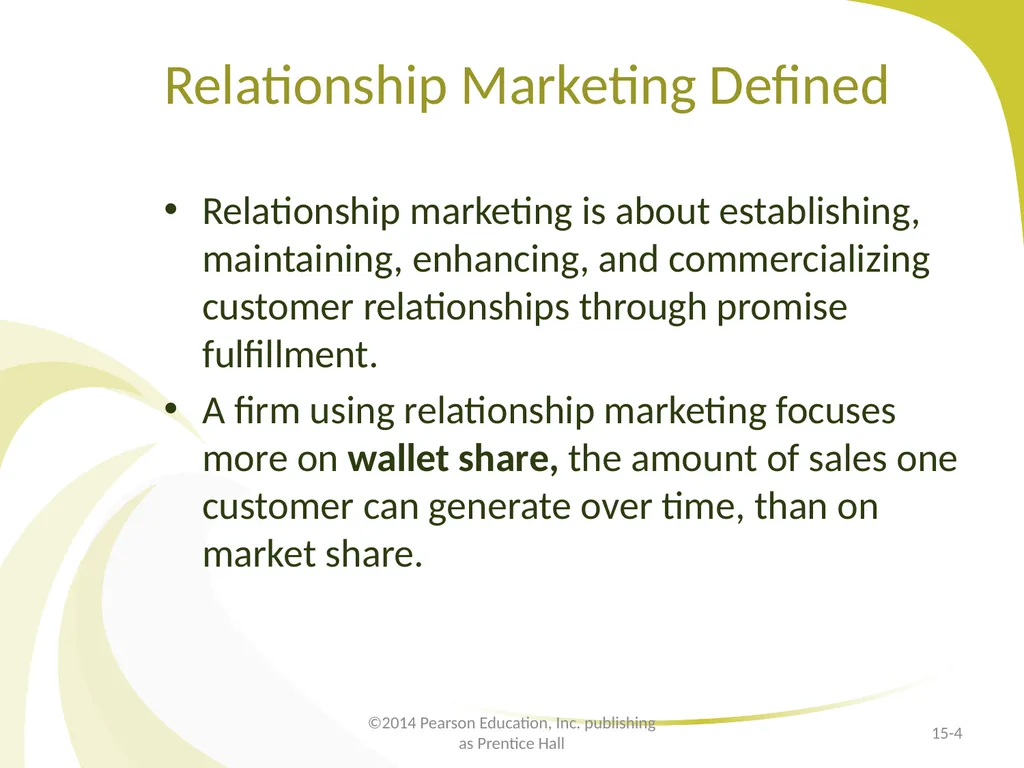
slide4. Relationship Marketing Defined Relationship marketing is about establishing, maintaining, enhancing, and commercializing customer relationships through promise fulfillment.
A firm using relationship marketing focuses more on wallet share, the amount of sales one customer can generate over time, than on market share. 15-4 ©2014 Pearson Education, Inc. publishing as Prentice Hall<br>
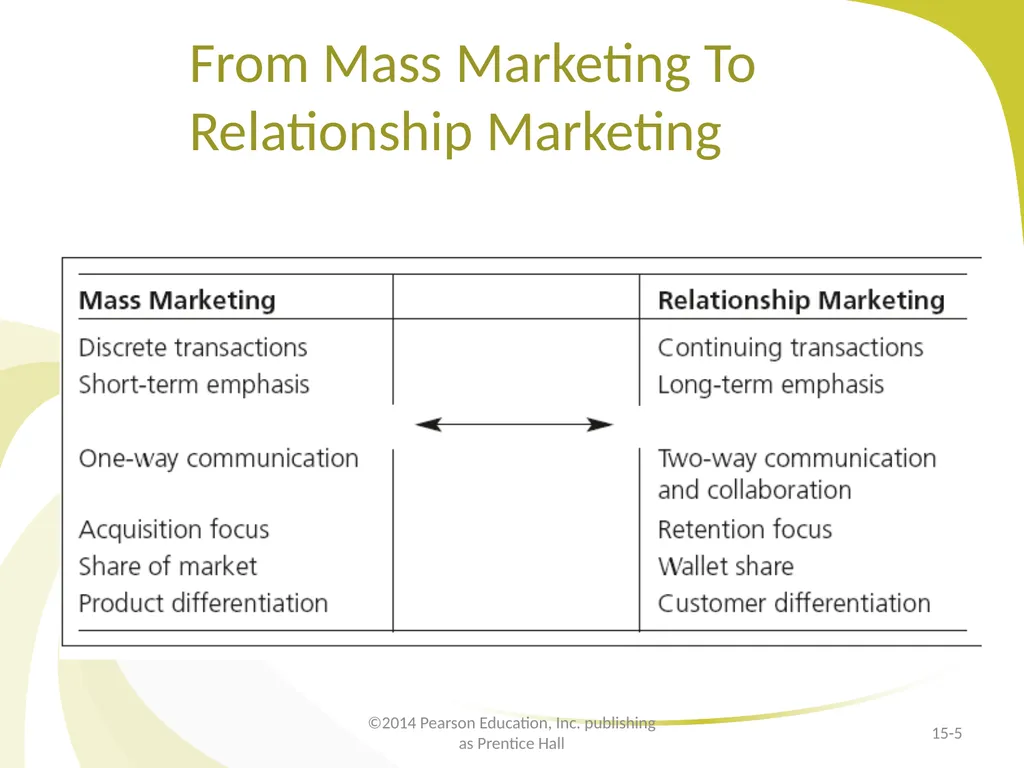
slide5. From Mass Marketing To Relationship Marketing 15-5 ©2014 Pearson Education, Inc. publishing as Prentice Hall<br>
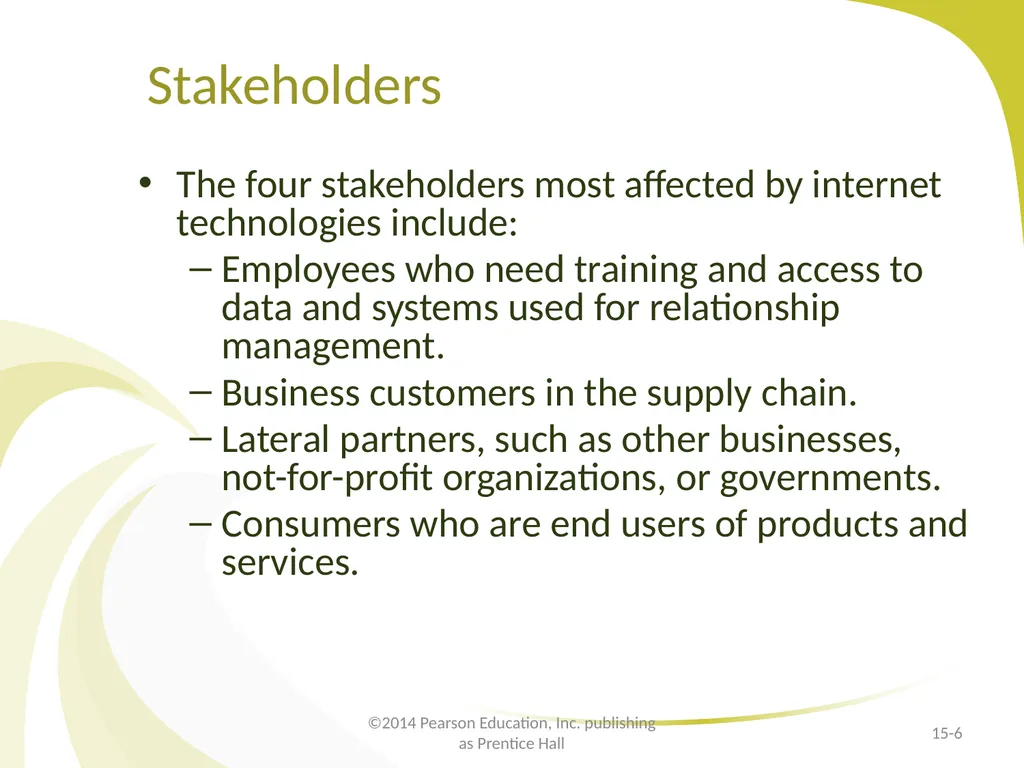
slide6. Stakeholders The four stakeholders most affected by internet technologies include:
Employees who need training and access to data and systems used for relationship management.
Business customers in the supply chain.
Lateral partners, such as other businesses, not-for-profit organizations, or governments.
Consumers who are end users of products and services. 15-6 ©2014 Pearson Education, Inc. publishing as Prentice Hall<br>
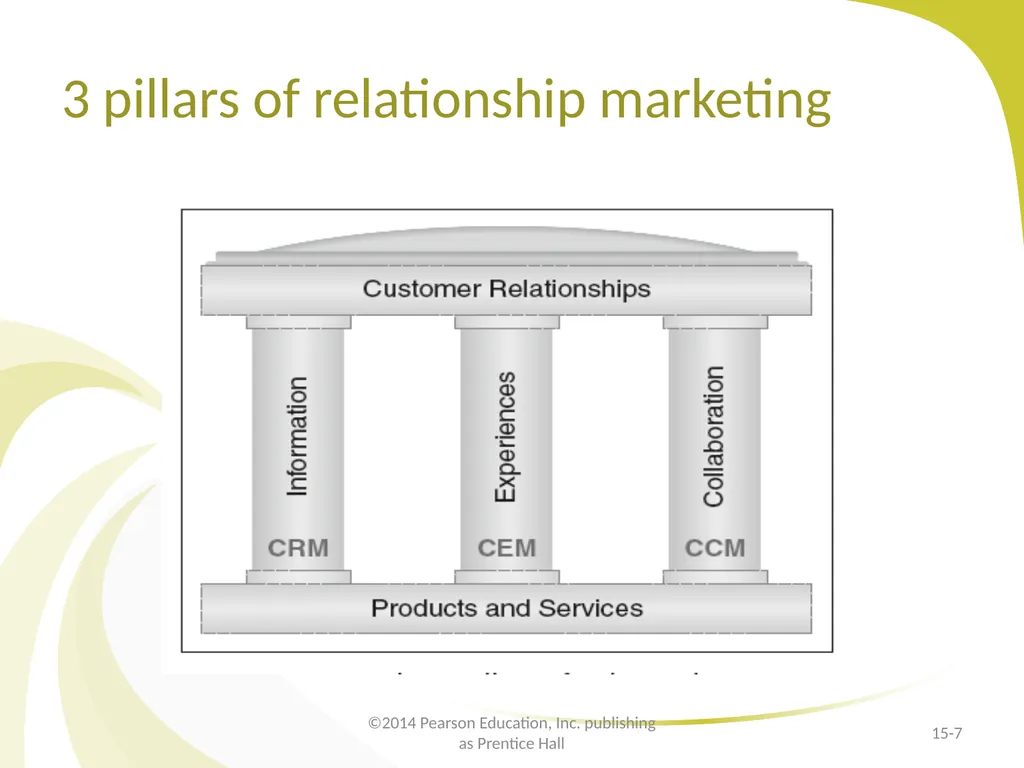
slide7. 3 pillars of relationship marketing 15-7 ©2014 Pearson Education, Inc. publishing as Prentice Hall<br>
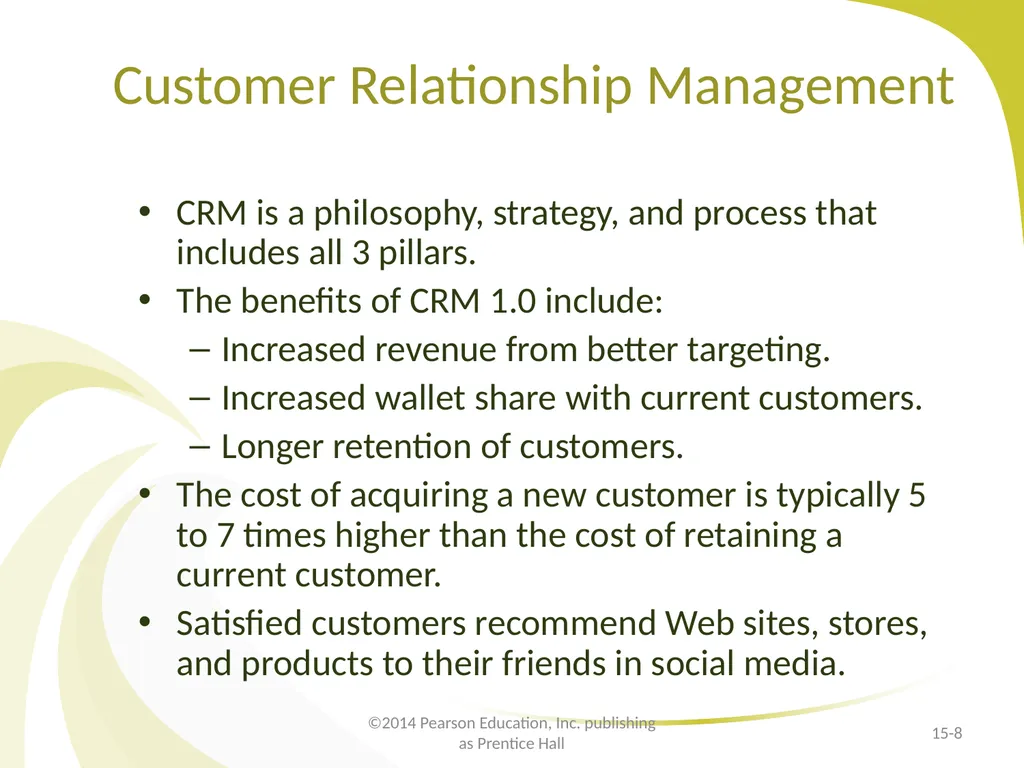
slide8. Customer Relationship Management CRM is a philosophy, strategy, and process that includes all 3 pillars.
The benefits of CRM 1.0 include:
Increased revenue from better targeting.
Increased wallet share with current customers.
Longer retention of customers.
The cost of acquiring a new customer is typically 5 to 7 times higher than the cost of retaining a current customer.
Satisfied customers recommend Web sites, stores, and products to their friends in social media. 15-8 ©2014 Pearson Education, Inc. publishing as Prentice Hall<br>
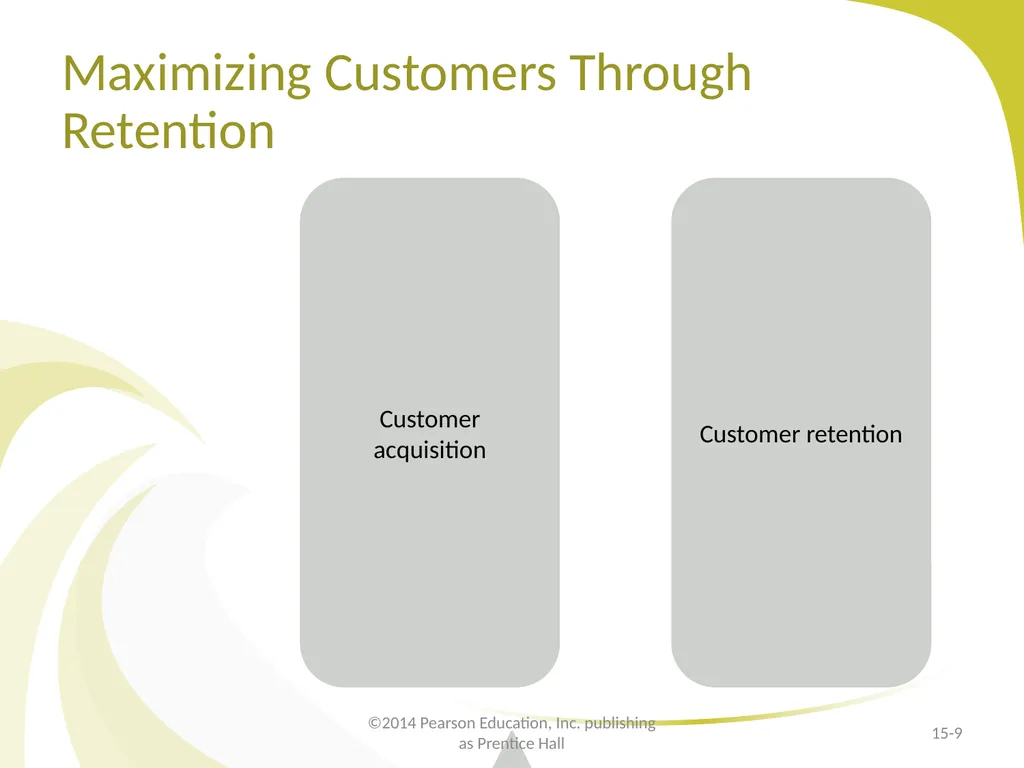
slide9. Maximizing Customers Through Retention 15-9 ©2014 Pearson Education, Inc. publishing as Prentice Hall<br>
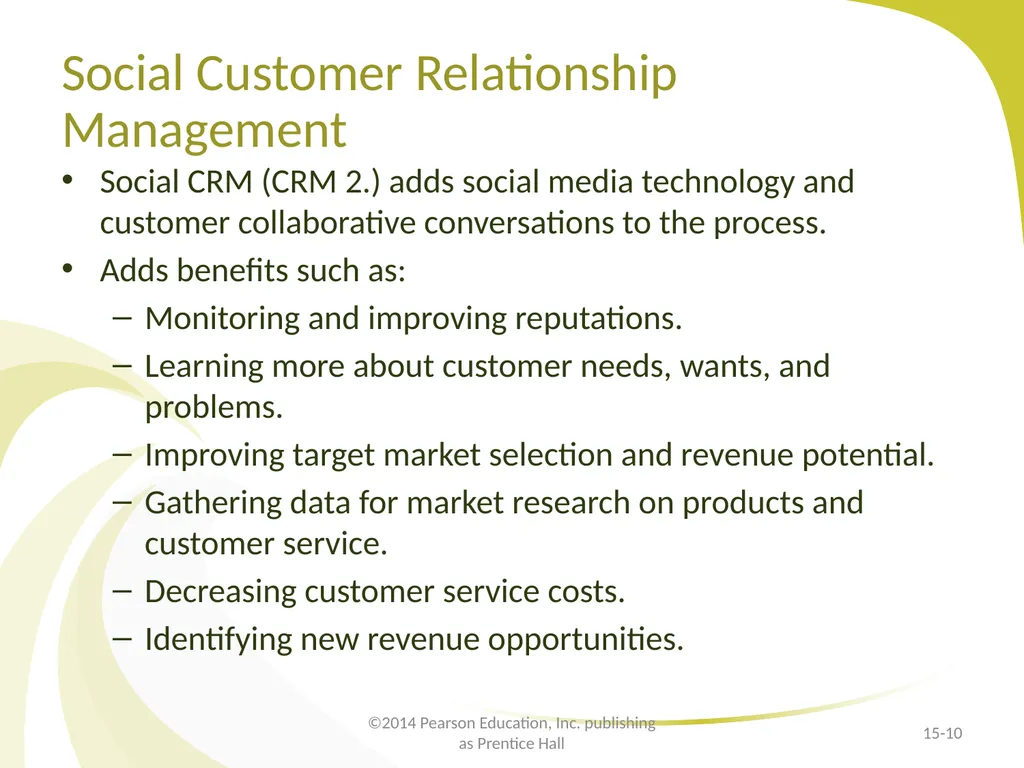
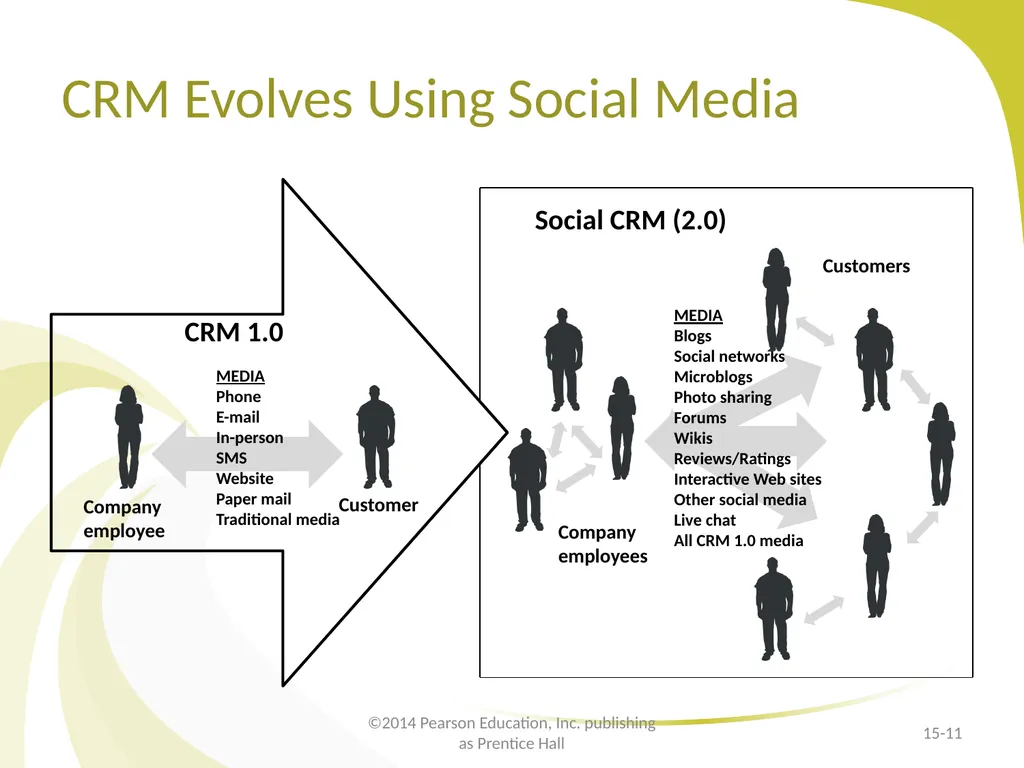
slide10. Social Customer Relationship Management Social CRM (CRM 2.) adds social media technology and customer collaborative conversations to the process.
Adds benefits such as:
Monitoring and improving reputations.
Learning more about customer needs, wants, and problems.
Improving target market selection and revenue potential.
Gathering data for market research on products and customer service.
Decreasing customer service costs.
Identifying new revenue opportunities. 15-10 ©2014 Pearson Education, Inc. publishing as Prentice Hall<br>
slide11. CRM Evolves Using Social Media 15-11 ©2014 Pearson Education, Inc. publishing as Prentice Hall<br>
slide12. 9 Building Blocks for Successful CRM 15-12 ©2014 Pearson Education, Inc. publishing as Prentice Hall<br>
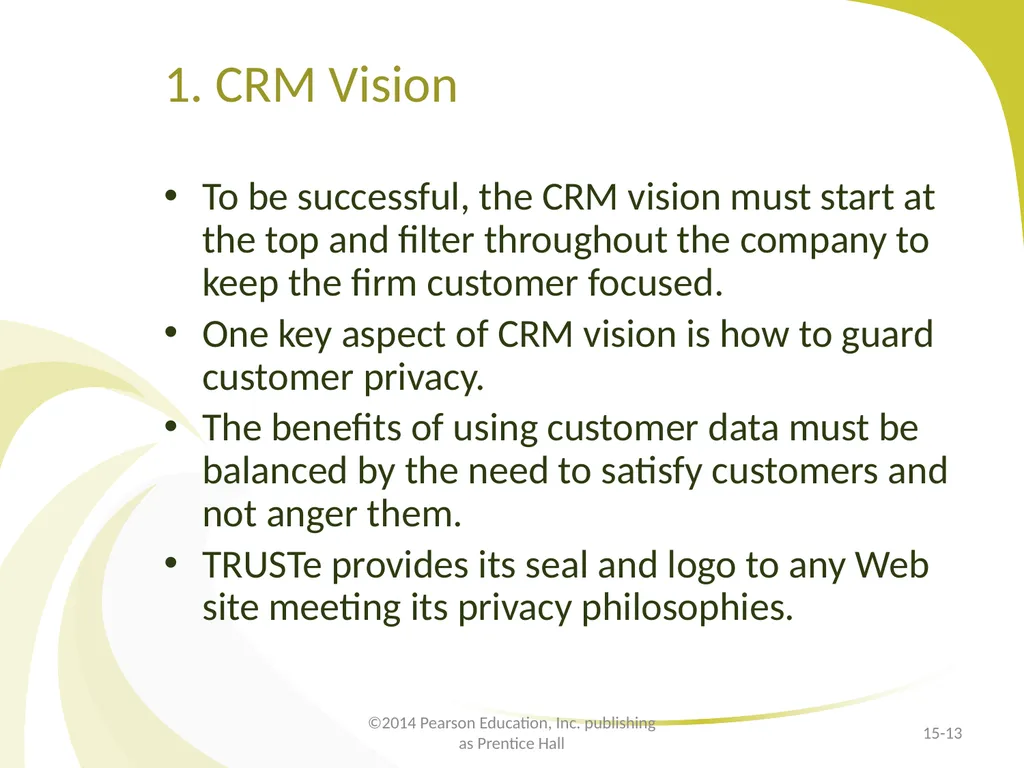
slide13. 1. CRM Vision To be successful, the CRM vision must start at the top and filter throughout the company to keep the firm customer focused.
One key aspect of CRM vision is how to guard customer privacy.
The benefits of using customer data must be balanced by the need to satisfy customers and not anger them.
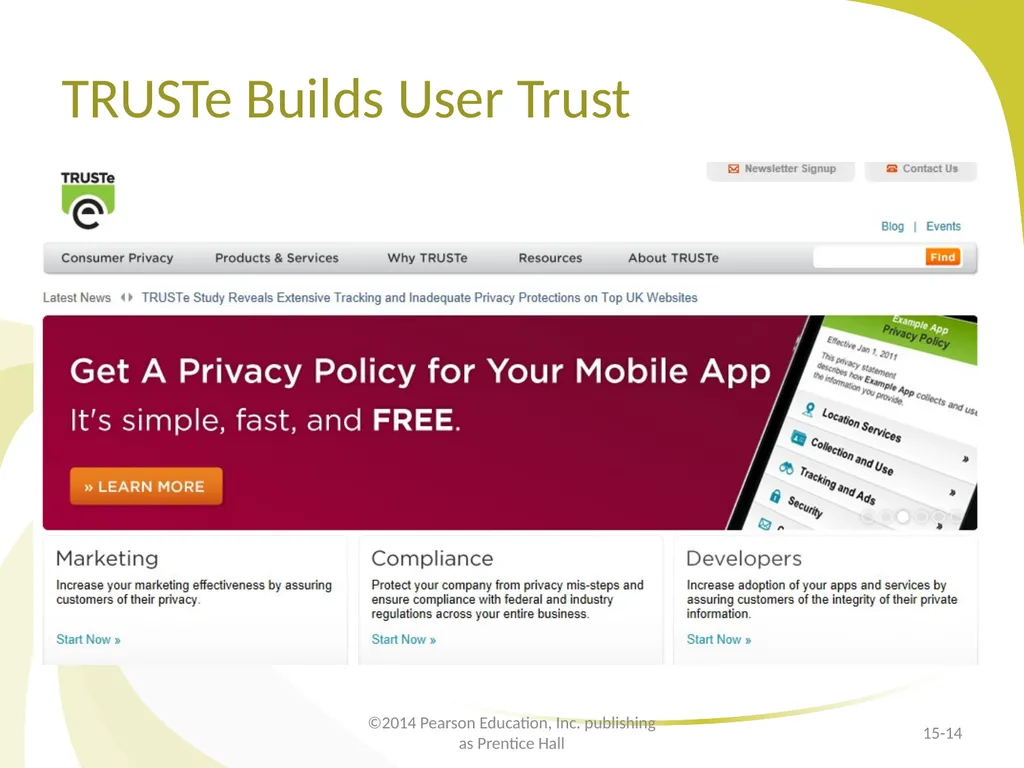
TRUSTe provides its seal and logo to any Web site meeting its privacy philosophies. 15-13 ©2014 Pearson Education, Inc. publishing as Prentice Hall<br>
slide14. TRUSTe Builds User Trust 15-14 ©2014 Pearson Education, Inc. publishing as Prentice Hall<br>
slide15. E-marketers must determine their objectives and strategies for initiating CRM programs and buying technology or setting up social media.
Many CRM goals refer to customer loyalty.
An important CRM strategy is to move customers up the relationship intensity pyramid to advocacy.
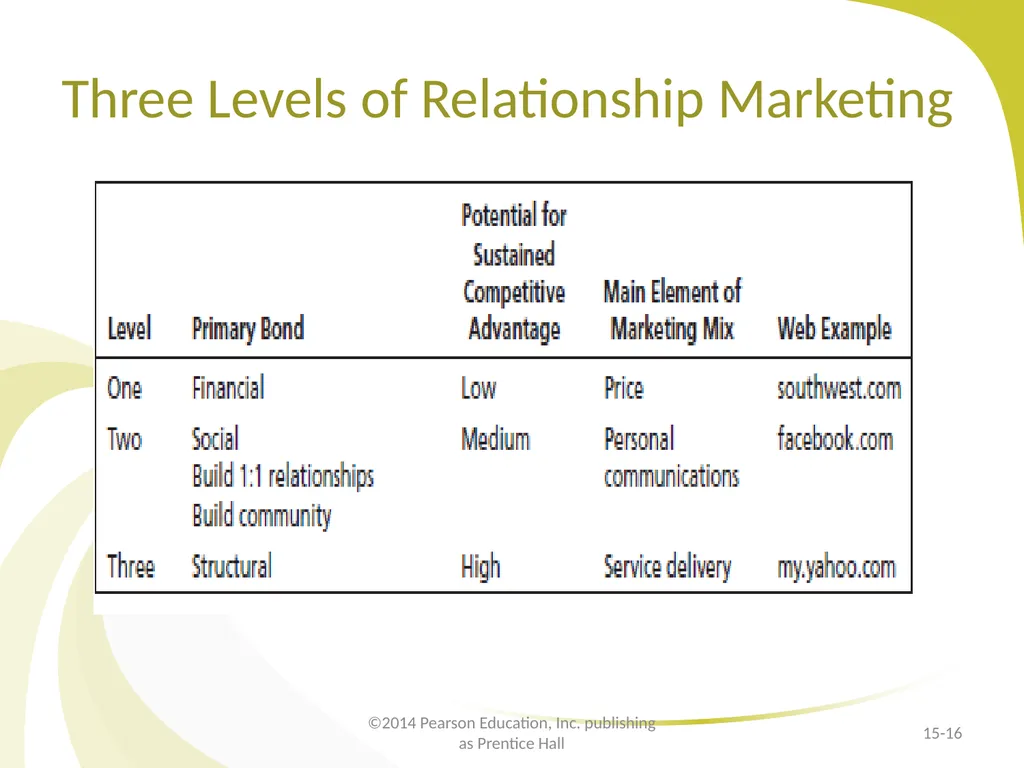
Another CRM goal involves building bonds with customers on 3 levels: financial, social and structural. 2. CRM Strategy 15-15 ©2014 Pearson Education, Inc. publishing as Prentice Hall<br>
slide16. Three Levels of Relationship Marketing 15-16 ©2014 Pearson Education, Inc. publishing as Prentice Hall<br>
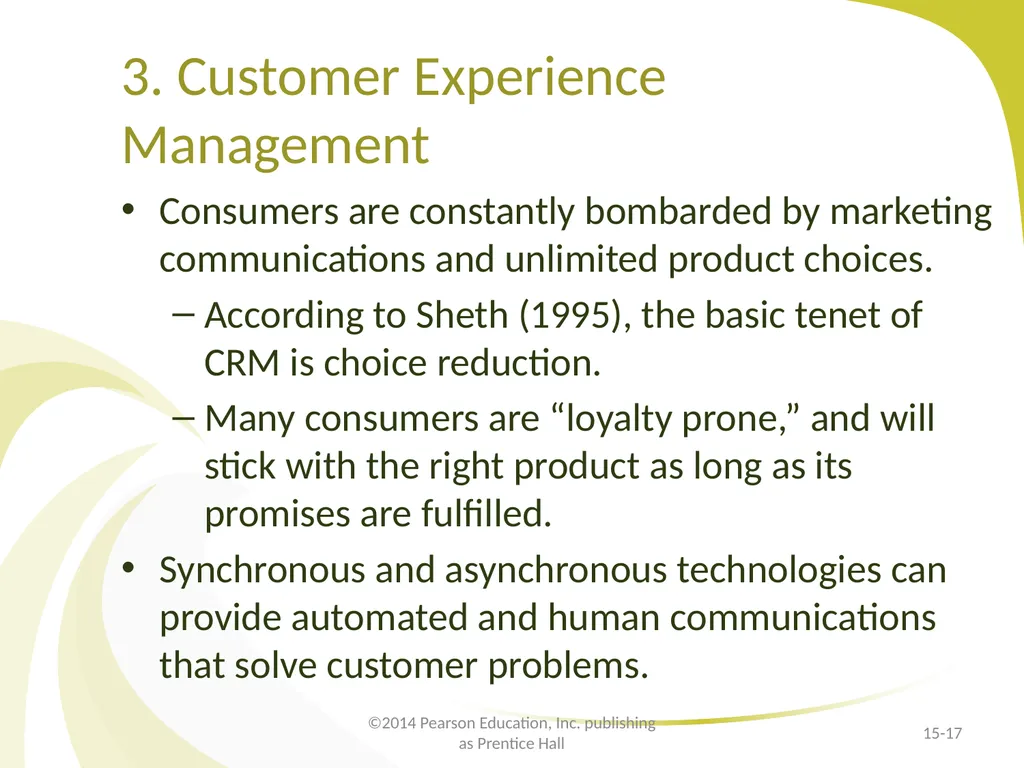
slide17. 3. Customer Experience Management Consumers are constantly bombarded by marketing communications and unlimited product choices.
According to Sheth (1995), the basic tenet of CRM is choice reduction.
Many consumers are “loyalty prone,” and will stick with the right product as long as its promises are fulfilled.
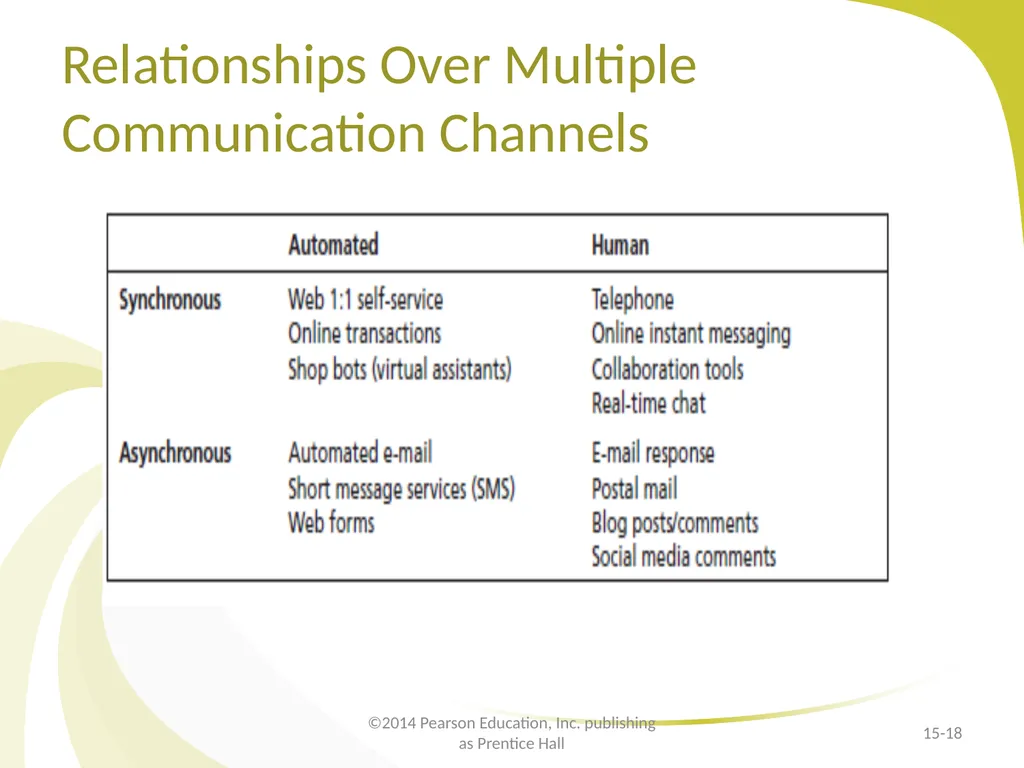
Synchronous and asynchronous technologies can provide automated and human communications that solve customer problems. 15-17 ©2014 Pearson Education, Inc. publishing as Prentice Hall<br>
slide18. Relationships Over Multiple Communication Channels 15-18 ©2014 Pearson Education, Inc. publishing as Prentice Hall<br>
slide19. CCM is content, people, and interaction driven, while traditional CRM is data-driven.
CCM is about managing customer relationships and experiences by creating and monitoring online content.
Listening the online chatter using technology such as Google Alerts and social media dashboards is more important than talking when a company is selling. 4. Customer Collaboration Management/Marketing (CCM) 15-19 ©2014 Pearson Education, Inc. publishing as Prentice Hall<br>
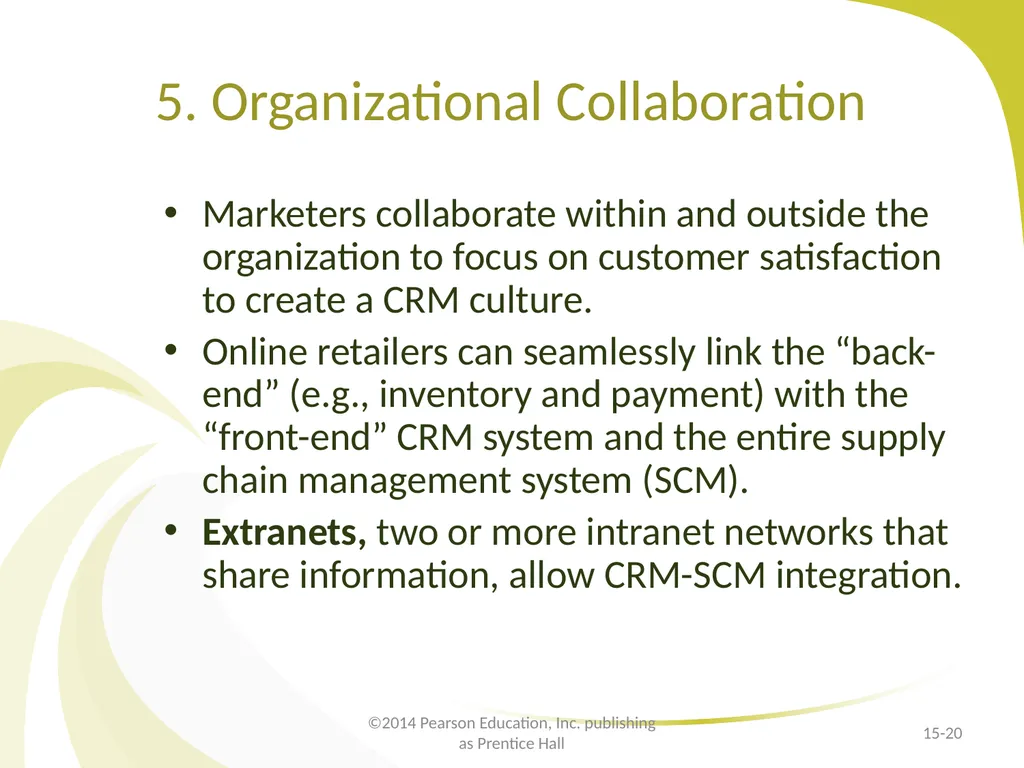
slide20. Marketers collaborate within and outside the organization to focus on customer satisfaction to create a CRM culture.
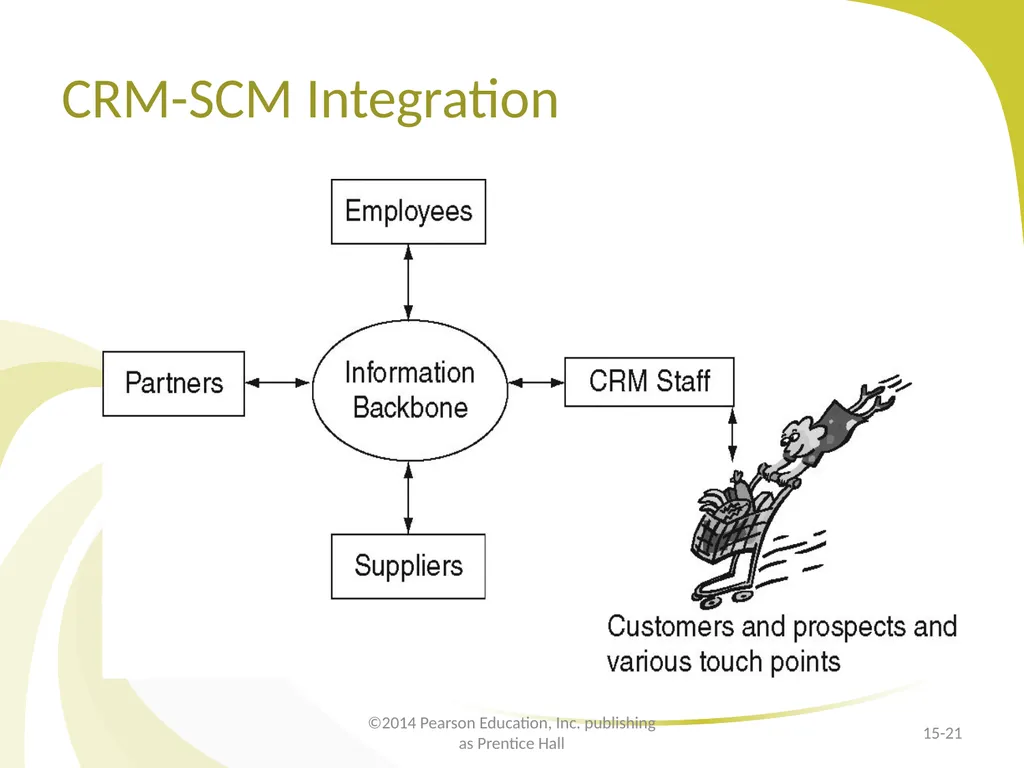
Online retailers can seamlessly link the “back-end” (e.g., inventory and payment) with the “front-end” CRM system and the entire supply chain management system (SCM).
Extranets, two or more intranet networks that share information, allow CRM-SCM integration. 5. Organizational Collaboration 15-20 ©2014 Pearson Education, Inc. publishing as Prentice Hall<br>
slide21. CRM-SCM Integration 15-21 ©2014 Pearson Education, Inc. publishing as Prentice Hall<br>
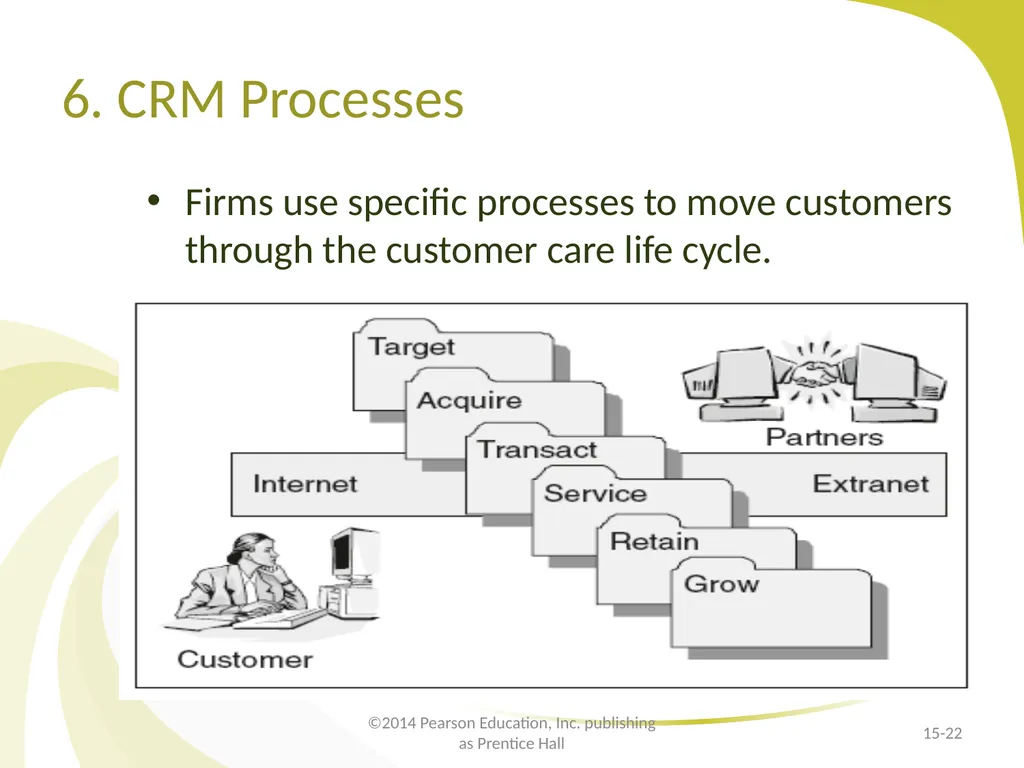
slide22. 6. CRM Processes Firms use specific processes to move customers through the customer care life cycle. 15-22 ©2014 Pearson Education, Inc. publishing as Prentice Hall<br>
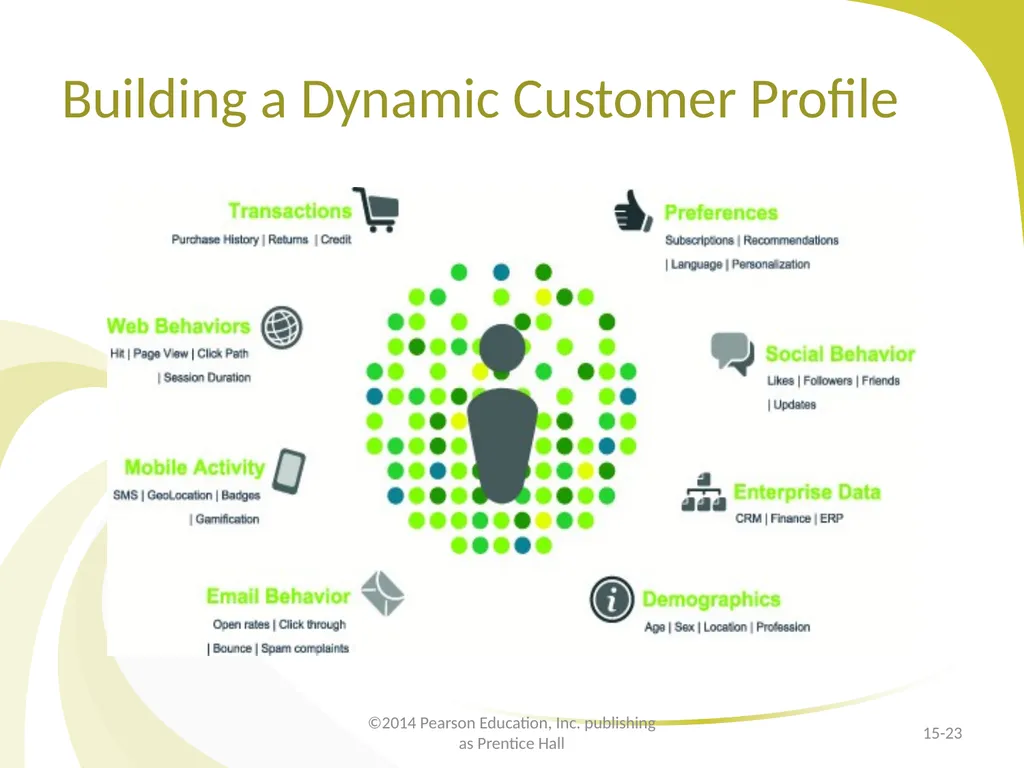
slide23. Building a Dynamic Customer Profile 15-23 ©2014 Pearson Education, Inc. publishing as Prentice Hall<br>
slide24. Sales Force Automation Sales force automation allows salespeople to build, maintain, and access customer records, manage leads, and manage their schedules.
Up-to-date customer and prospect records help build customer relationships.
Salesforce.com also has tools to monitor brand conversations in the social media. 15-24 ©2014 Pearson Education, Inc. publishing as Prentice Hall<br>
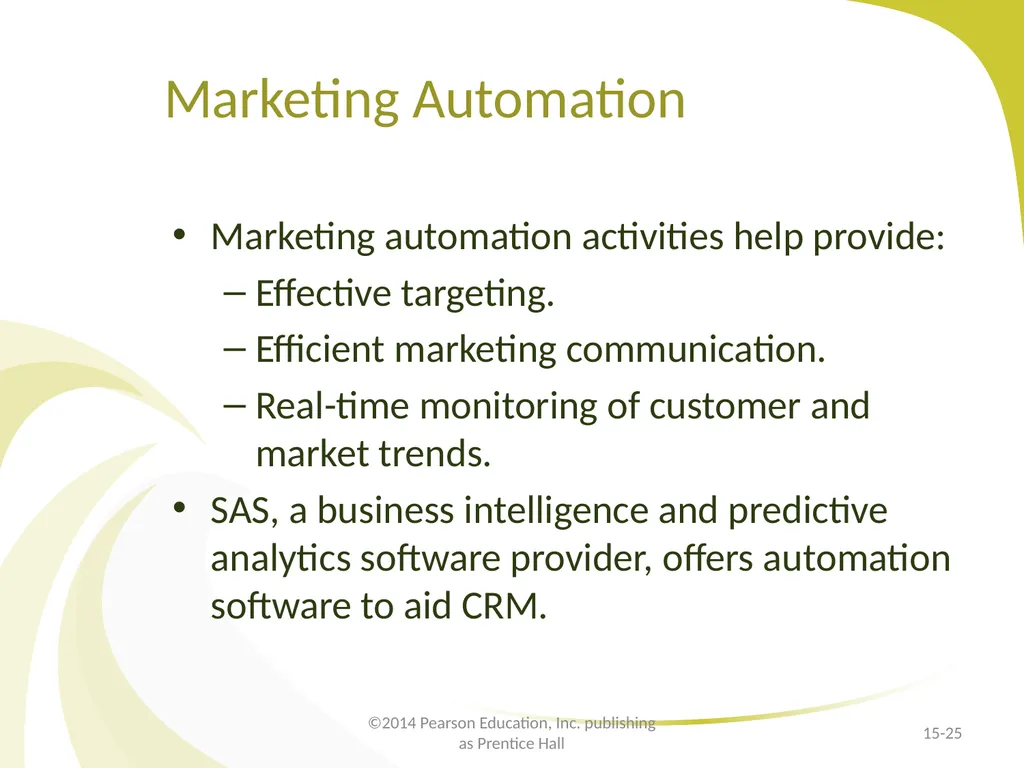
slide25. Marketing Automation Marketing automation activities help provide:
Effective targeting.
Efficient marketing communication.
Real-time monitoring of customer and market trends.
SAS, a business intelligence and predictive analytics software provider, offers automation software to aid CRM. 15-25 ©2014 Pearson Education, Inc. publishing as Prentice Hall<br>
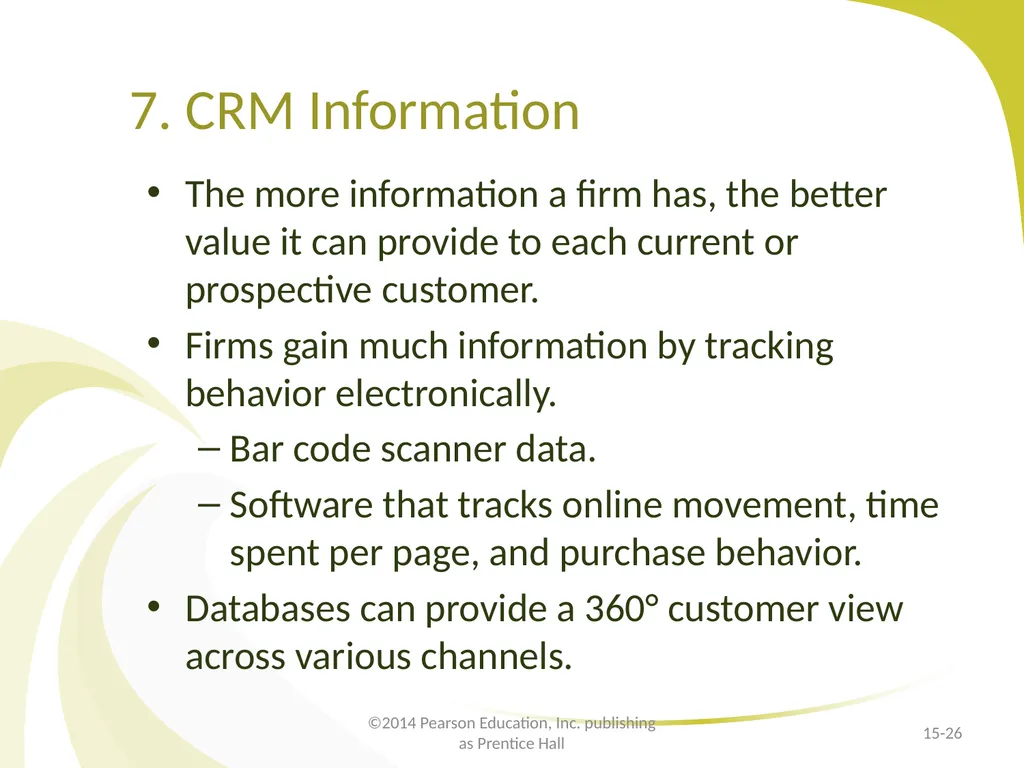
slide26. 7. CRM Information The more information a firm has, the better value it can provide to each current or prospective customer.
Firms gain much information by tracking behavior electronically.
Bar code scanner data.
Software that tracks online movement, time spent per page, and purchase behavior.
Databases can provide a 360° customer view across various channels. 15-26 ©2014 Pearson Education, Inc. publishing as Prentice Hall<br>
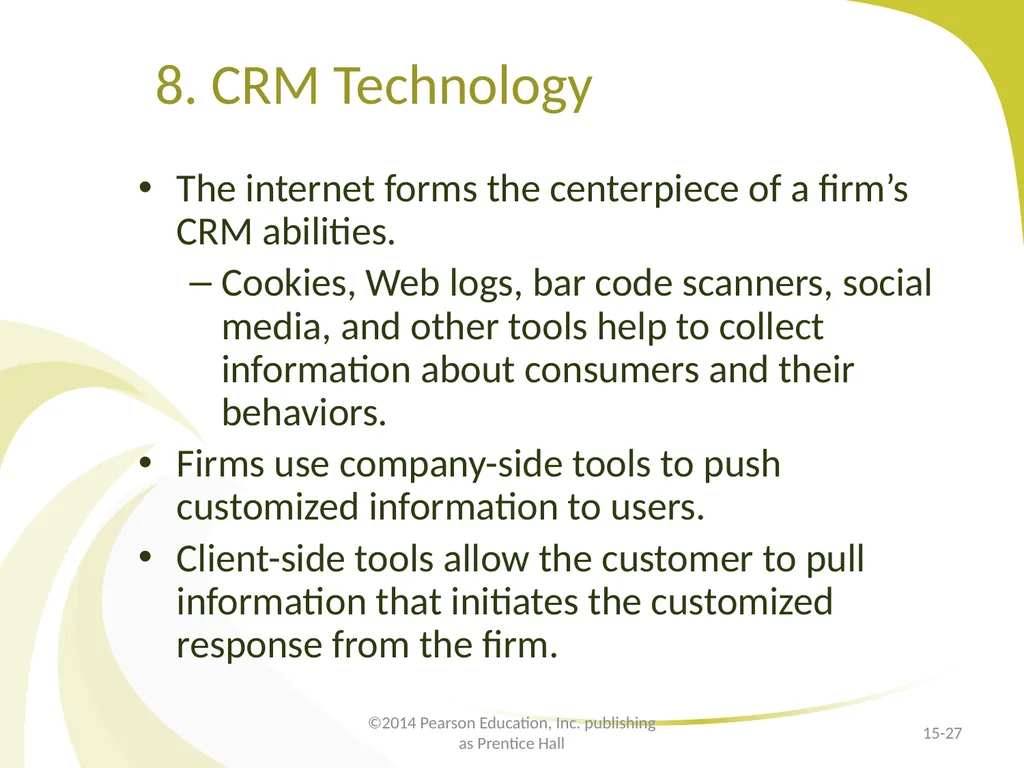
slide27. 8. CRM Technology The internet forms the centerpiece of a firm’s CRM abilities.
Cookies, Web logs, bar code scanners, social media, and other tools help to collect information about consumers and their behaviors.
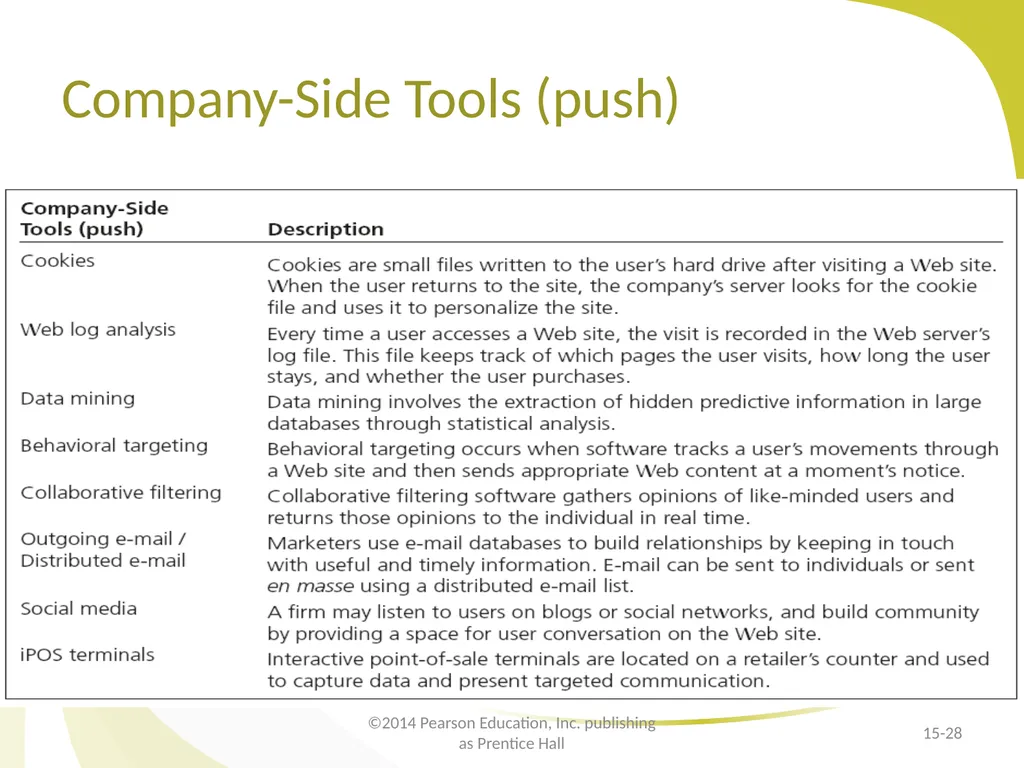
Firms use company-side tools to push customized information to users.
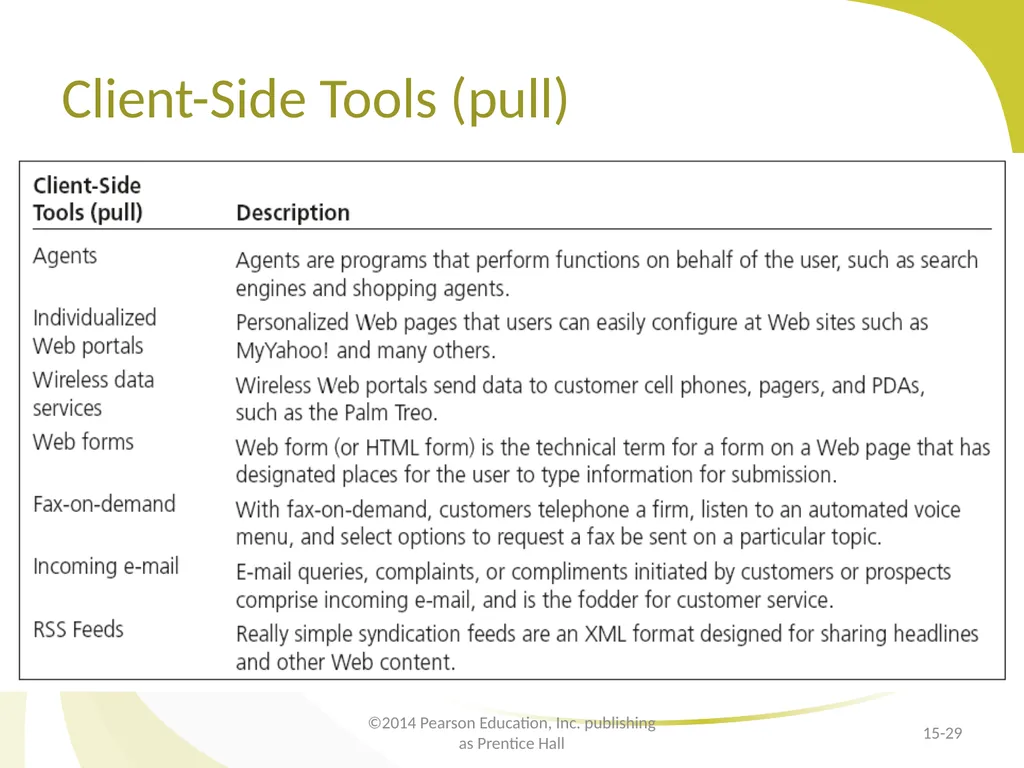
Client-side tools allow the customer to pull information that initiates the customized response from the firm. 15-27 ©2014 Pearson Education, Inc. publishing as Prentice Hall<br>
slide28. Company-Side Tools (push) 15-28 ©2014 Pearson Education, Inc. publishing as Prentice Hall<br>
slide29. Client-Side Tools (pull) 15-29 ©2014 Pearson Education, Inc. publishing as Prentice Hall<br>
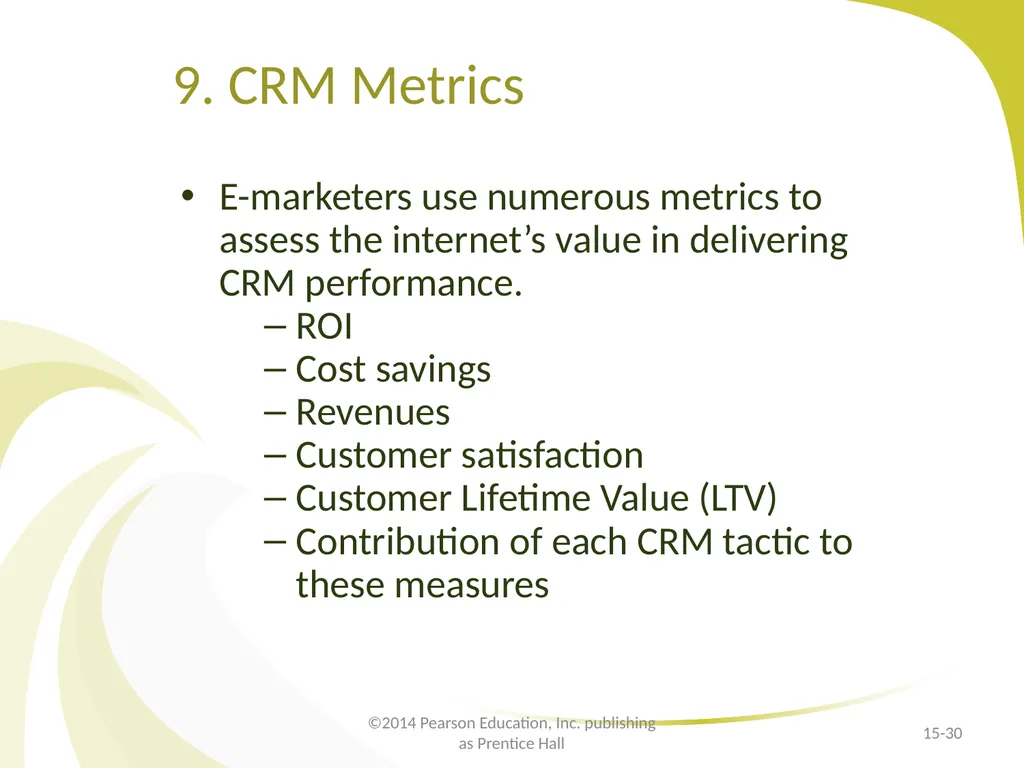
slide30. 9. CRM Metrics E-marketers use numerous metrics to assess the internet’s value in delivering CRM performance.
ROI
Cost savings
Revenues
Customer satisfaction
Customer Lifetime Value (LTV)
Contribution of each CRM tactic to these measures 15-30 ©2014 Pearson Education, Inc. publishing as Prentice Hall<br>
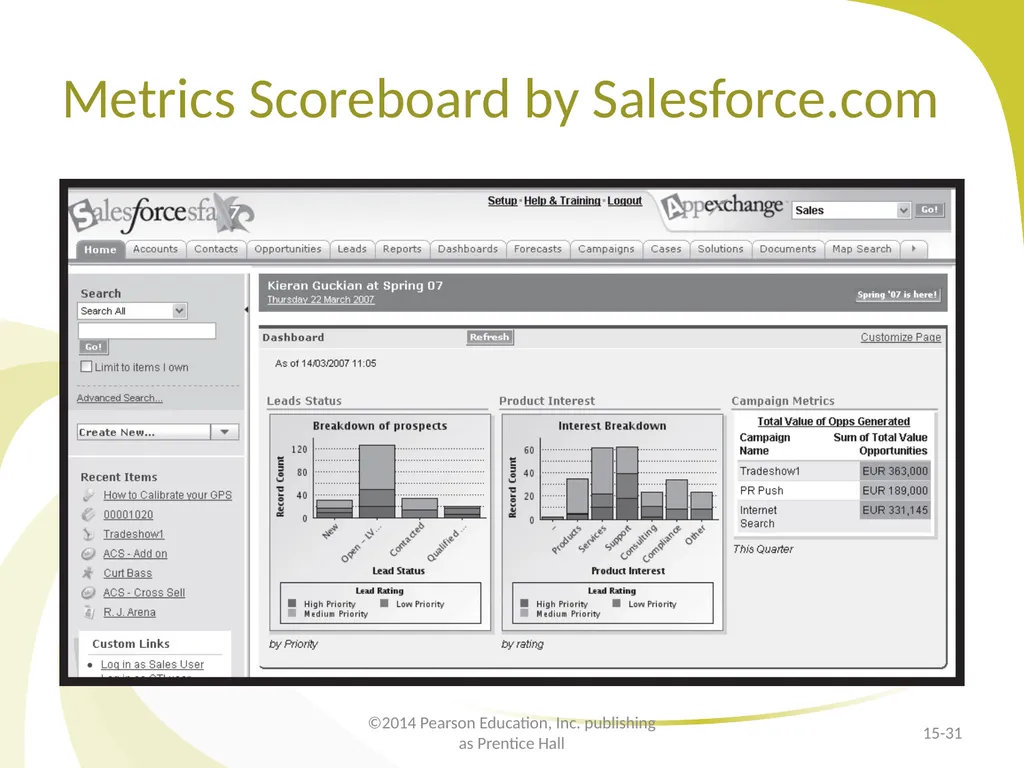
slide31. Metrics Scoreboard by Salesforce.com 15-31 ©2014 Pearson Education, Inc. publishing as Prentice Hall<br>
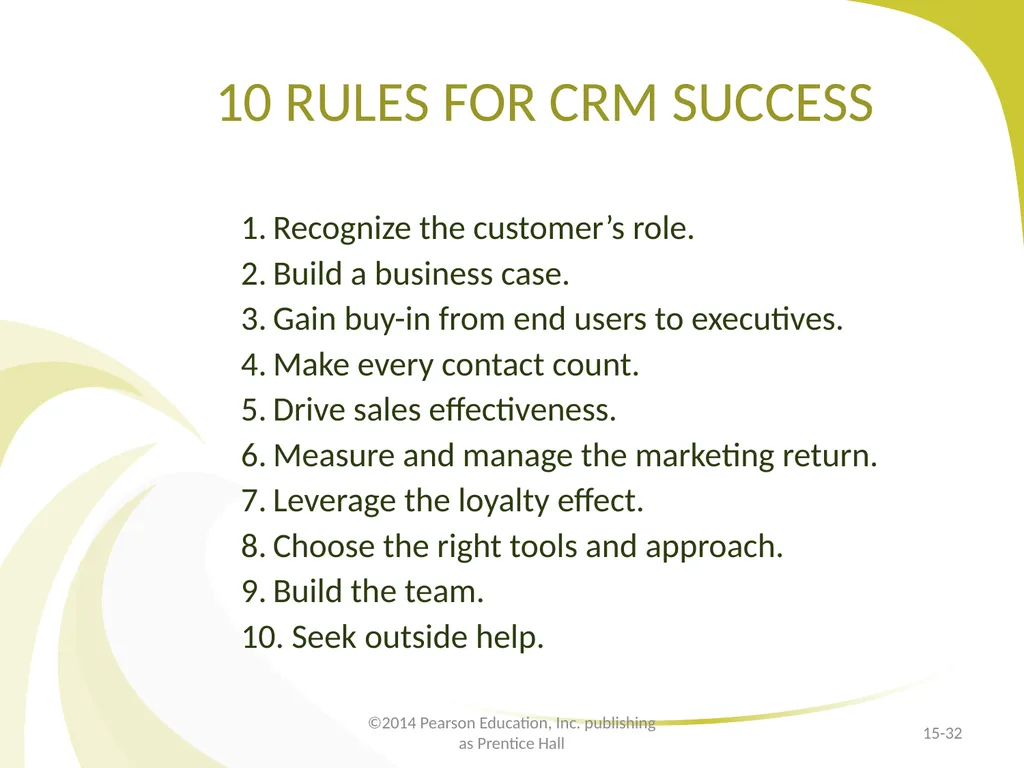
slide32. 10 RULES FOR CRM SUCCESS Recognize the customer’s role.
Build a business case.
Gain buy-in from end users to executives.
Make every contact count.
Drive sales effectiveness.
Measure and manage the marketing return.
Leverage the loyalty effect.
Choose the right tools and approach.
Build the team.
Seek outside help. 15-32 ©2014 Pearson Education, Inc. publishing as Prentice Hall<br>
slide33. All rights reserved. No part of this publication may be reproduced, stored in a retrieval system, or transmitted, in any form or by any means, electronic, mechanical, photocopying, recording, or otherwise, without the prior written permission of the publisher. Printed in the United States of America. Copyright © 2014 Pearson Education, Inc.
Publishing as Prentice Hall 15-33<br>
slide2. Chapter 15 Objectives After reading Chapter 15, you will be able to:
Define customer relationship management (CRM) and identify the major benefits to e-marketers.
Outline the three pillars of relationship marketing for e-marketing.
Describe social CRM and how it relates to traditional CRM.
Discuss the nine major components needed for effective and efficient CRM in e-marketing.
Highlight some of the company-side and client-side tools that e-marketers use to enhance their CRM processes.
Differentiate CRM metrics by customer life cycle stage. 15-2 ©2014 Pearson Education, Inc. publishing as Prentice Hall<br>
slide3. Best Buy is the 11th largest U.S. e-commerce retailer with 1B online visitors and a multichannel strategy.
In 2008 Best Buy initiated the Best Buy Community online.
600,000 customers a quarter post 20,000 messages and view over 22 million pages of content.
The community has yielded $5M in benefits to Best Buy.
Best Buy also uses Twitter to engage customers (@twelpforce). The Best Buy Story 15-3 ©2014 Pearson Education, Inc. publishing as Prentice Hall<br>
slide4. Relationship Marketing Defined Relationship marketing is about establishing, maintaining, enhancing, and commercializing customer relationships through promise fulfillment.
A firm using relationship marketing focuses more on wallet share, the amount of sales one customer can generate over time, than on market share. 15-4 ©2014 Pearson Education, Inc. publishing as Prentice Hall<br>
slide5. From Mass Marketing To Relationship Marketing 15-5 ©2014 Pearson Education, Inc. publishing as Prentice Hall<br>
slide6. Stakeholders The four stakeholders most affected by internet technologies include:
Employees who need training and access to data and systems used for relationship management.
Business customers in the supply chain.
Lateral partners, such as other businesses, not-for-profit organizations, or governments.
Consumers who are end users of products and services. 15-6 ©2014 Pearson Education, Inc. publishing as Prentice Hall<br>
slide7. 3 pillars of relationship marketing 15-7 ©2014 Pearson Education, Inc. publishing as Prentice Hall<br>
slide8. Customer Relationship Management CRM is a philosophy, strategy, and process that includes all 3 pillars.
The benefits of CRM 1.0 include:
Increased revenue from better targeting.
Increased wallet share with current customers.
Longer retention of customers.
The cost of acquiring a new customer is typically 5 to 7 times higher than the cost of retaining a current customer.
Satisfied customers recommend Web sites, stores, and products to their friends in social media. 15-8 ©2014 Pearson Education, Inc. publishing as Prentice Hall<br>
slide9. Maximizing Customers Through Retention 15-9 ©2014 Pearson Education, Inc. publishing as Prentice Hall<br>
slide10. Social Customer Relationship Management Social CRM (CRM 2.) adds social media technology and customer collaborative conversations to the process.
Adds benefits such as:
Monitoring and improving reputations.
Learning more about customer needs, wants, and problems.
Improving target market selection and revenue potential.
Gathering data for market research on products and customer service.
Decreasing customer service costs.
Identifying new revenue opportunities. 15-10 ©2014 Pearson Education, Inc. publishing as Prentice Hall<br>
slide11. CRM Evolves Using Social Media 15-11 ©2014 Pearson Education, Inc. publishing as Prentice Hall<br>
slide12. 9 Building Blocks for Successful CRM 15-12 ©2014 Pearson Education, Inc. publishing as Prentice Hall<br>
slide13. 1. CRM Vision To be successful, the CRM vision must start at the top and filter throughout the company to keep the firm customer focused.
One key aspect of CRM vision is how to guard customer privacy.
The benefits of using customer data must be balanced by the need to satisfy customers and not anger them.
TRUSTe provides its seal and logo to any Web site meeting its privacy philosophies. 15-13 ©2014 Pearson Education, Inc. publishing as Prentice Hall<br>
slide14. TRUSTe Builds User Trust 15-14 ©2014 Pearson Education, Inc. publishing as Prentice Hall<br>
slide15. E-marketers must determine their objectives and strategies for initiating CRM programs and buying technology or setting up social media.
Many CRM goals refer to customer loyalty.
An important CRM strategy is to move customers up the relationship intensity pyramid to advocacy.
Another CRM goal involves building bonds with customers on 3 levels: financial, social and structural. 2. CRM Strategy 15-15 ©2014 Pearson Education, Inc. publishing as Prentice Hall<br>
slide16. Three Levels of Relationship Marketing 15-16 ©2014 Pearson Education, Inc. publishing as Prentice Hall<br>
slide17. 3. Customer Experience Management Consumers are constantly bombarded by marketing communications and unlimited product choices.
According to Sheth (1995), the basic tenet of CRM is choice reduction.
Many consumers are “loyalty prone,” and will stick with the right product as long as its promises are fulfilled.
Synchronous and asynchronous technologies can provide automated and human communications that solve customer problems. 15-17 ©2014 Pearson Education, Inc. publishing as Prentice Hall<br>
slide18. Relationships Over Multiple Communication Channels 15-18 ©2014 Pearson Education, Inc. publishing as Prentice Hall<br>
slide19. CCM is content, people, and interaction driven, while traditional CRM is data-driven.
CCM is about managing customer relationships and experiences by creating and monitoring online content.
Listening the online chatter using technology such as Google Alerts and social media dashboards is more important than talking when a company is selling. 4. Customer Collaboration Management/Marketing (CCM) 15-19 ©2014 Pearson Education, Inc. publishing as Prentice Hall<br>
slide20. Marketers collaborate within and outside the organization to focus on customer satisfaction to create a CRM culture.
Online retailers can seamlessly link the “back-end” (e.g., inventory and payment) with the “front-end” CRM system and the entire supply chain management system (SCM).
Extranets, two or more intranet networks that share information, allow CRM-SCM integration. 5. Organizational Collaboration 15-20 ©2014 Pearson Education, Inc. publishing as Prentice Hall<br>
slide21. CRM-SCM Integration 15-21 ©2014 Pearson Education, Inc. publishing as Prentice Hall<br>
slide22. 6. CRM Processes Firms use specific processes to move customers through the customer care life cycle. 15-22 ©2014 Pearson Education, Inc. publishing as Prentice Hall<br>
slide23. Building a Dynamic Customer Profile 15-23 ©2014 Pearson Education, Inc. publishing as Prentice Hall<br>
slide24. Sales Force Automation Sales force automation allows salespeople to build, maintain, and access customer records, manage leads, and manage their schedules.
Up-to-date customer and prospect records help build customer relationships.
Salesforce.com also has tools to monitor brand conversations in the social media. 15-24 ©2014 Pearson Education, Inc. publishing as Prentice Hall<br>
slide25. Marketing Automation Marketing automation activities help provide:
Effective targeting.
Efficient marketing communication.
Real-time monitoring of customer and market trends.
SAS, a business intelligence and predictive analytics software provider, offers automation software to aid CRM. 15-25 ©2014 Pearson Education, Inc. publishing as Prentice Hall<br>
slide26. 7. CRM Information The more information a firm has, the better value it can provide to each current or prospective customer.
Firms gain much information by tracking behavior electronically.
Bar code scanner data.
Software that tracks online movement, time spent per page, and purchase behavior.
Databases can provide a 360° customer view across various channels. 15-26 ©2014 Pearson Education, Inc. publishing as Prentice Hall<br>
slide27. 8. CRM Technology The internet forms the centerpiece of a firm’s CRM abilities.
Cookies, Web logs, bar code scanners, social media, and other tools help to collect information about consumers and their behaviors.
Firms use company-side tools to push customized information to users.
Client-side tools allow the customer to pull information that initiates the customized response from the firm. 15-27 ©2014 Pearson Education, Inc. publishing as Prentice Hall<br>
slide28. Company-Side Tools (push) 15-28 ©2014 Pearson Education, Inc. publishing as Prentice Hall<br>
slide29. Client-Side Tools (pull) 15-29 ©2014 Pearson Education, Inc. publishing as Prentice Hall<br>
slide30. 9. CRM Metrics E-marketers use numerous metrics to assess the internet’s value in delivering CRM performance.
ROI
Cost savings
Revenues
Customer satisfaction
Customer Lifetime Value (LTV)
Contribution of each CRM tactic to these measures 15-30 ©2014 Pearson Education, Inc. publishing as Prentice Hall<br>
slide31. Metrics Scoreboard by Salesforce.com 15-31 ©2014 Pearson Education, Inc. publishing as Prentice Hall<br>
slide32. 10 RULES FOR CRM SUCCESS Recognize the customer’s role.
Build a business case.
Gain buy-in from end users to executives.
Make every contact count.
Drive sales effectiveness.
Measure and manage the marketing return.
Leverage the loyalty effect.
Choose the right tools and approach.
Build the team.
Seek outside help. 15-32 ©2014 Pearson Education, Inc. publishing as Prentice Hall<br>
slide33. All rights reserved. No part of this publication may be reproduced, stored in a retrieval system, or transmitted, in any form or by any means, electronic, mechanical, photocopying, recording, or otherwise, without the prior written permission of the publisher. Printed in the United States of America. Copyright © 2014 Pearson Education, Inc.
Publishing as Prentice Hall 15-33<br>