Customer Service Agenda: Understanding Your Current Situation Service Guidelines Definition Identify your customer Qualities Clarify expectations Benefits Ideas, Concepts and Tools for change 1 Current Service Situation What does
Related Topics
Share
Embed code
Download this presentation From Below
"Customer Service Agenda: Understanding Your" is the property of its rightful owner. Permission is granted to
download and print the materials on this website for personal, non-commercial use only, and to display it
on your personal computer provided you do not modify the materials and that you retain all copyright
notices contained in the materials. By downloading content from our website, you accept the terms of this
agreement.
Presentation Transcript
01
Customer Service Agenda:
Understanding Your Current Situation
Service Guidelines
* Definition * Identify your customer
* Qualities * Clarify expectations
* Benefits
Ideas, Concepts and Tools for change 1<br>
02
Current Service Situation What does ISU, as an employer, currently expect of you?
Compliance? Policy? Rules? Guidelines?
What does your customer expect of you?
Are you meeting these expectations?
Are you actively working to improve?
Are these expectations changing?
Are you adapting to these changes?
Companies with strong service standards have employee loyalty, low employee turnover, and low productivity costs. 2<br>
03
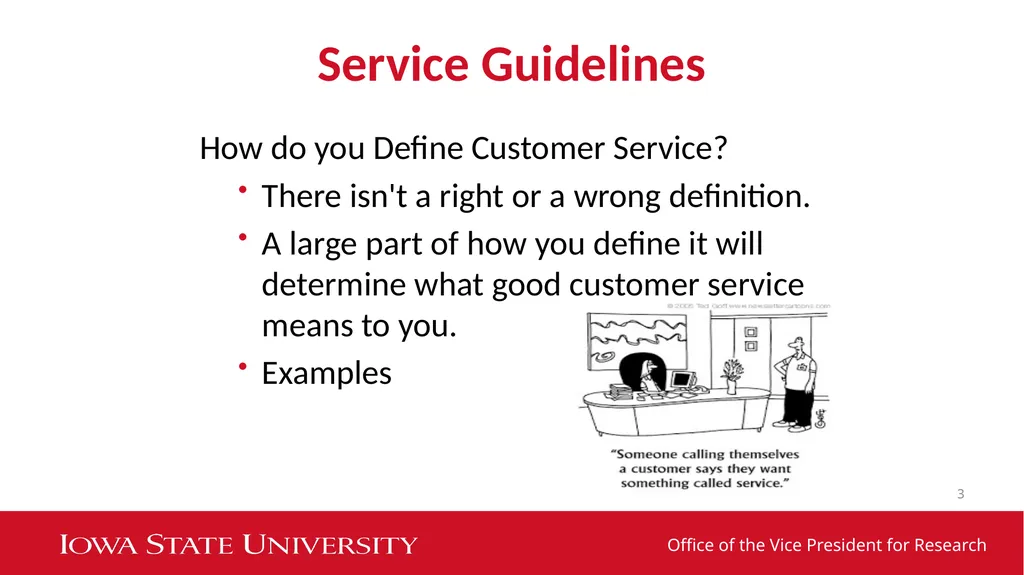
Service Guidelines How do you Define Customer Service?
There isn't a right or a wrong definition.
A large part of how you define it will determine what good customer service means to you.
Examples 3<br>
04
Service Definition Examples Customer service is the process of ensuring customer satisfaction with a product or service.
Service that treats customers with a friendly attitude and tries to resolve their problem or question as efficiently as possible.
Service is defined as meeting or exceeding the expectations of a customer.
Customer Service is performing to the highest standards and measures, especially with consideration to quality metrics. 4<br>
05
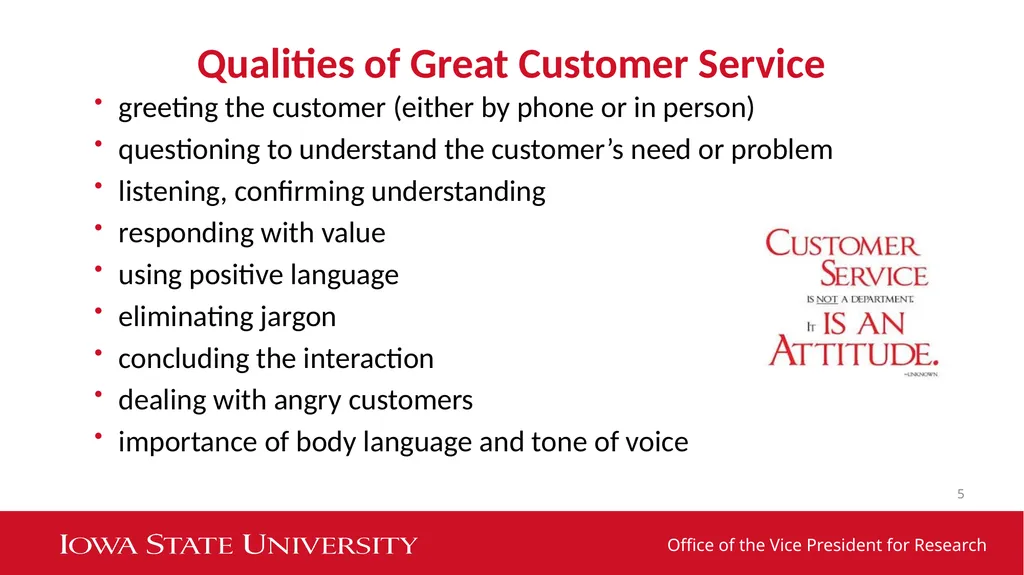
Qualities of Great Customer Service greeting the customer (either by phone or in person)
questioning to understand the customer’s need or problem
listening, confirming understanding
responding with value
using positive language
eliminating jargon
concluding the interaction
dealing with angry customers
importance of body language and tone of voice 5<br>
06
Some Benefits of Great Customer Service Good listening skills and questioning techniques can shorten the interaction time with customers. This allows an organization to serve more customers in less time. However, customers do not want to feel rushed, when they have questions. Be proactive and make sure every consumer feels they are being heard and not just "listened" to.
Being able to clearly explain the next step in a process and confirming that the customer is satisfied, will decrease the number of callbacks and return customers. Improving "first contact" resolution is one of the primary drivers of customer satisfaction. 6<br>
07
Some Benefits of Great Customer Service Training all employees using consistent customer service skills, allows them to have a common process and language when assisting customers. This allows the business to brand their interaction of excellent service to the customer, which adds value to the business.
Investing in employee training gives employees a feeling of value and improves morale. In addition, when employees feel valued, they value their customers. This could be a result of effective customer service skills training, which not only benefits the employee, but will enhance the relationships with the customers. These important factors can help to increase employee loyalty, reduce employee turnover, and lower productivity costs. 7<br>
08
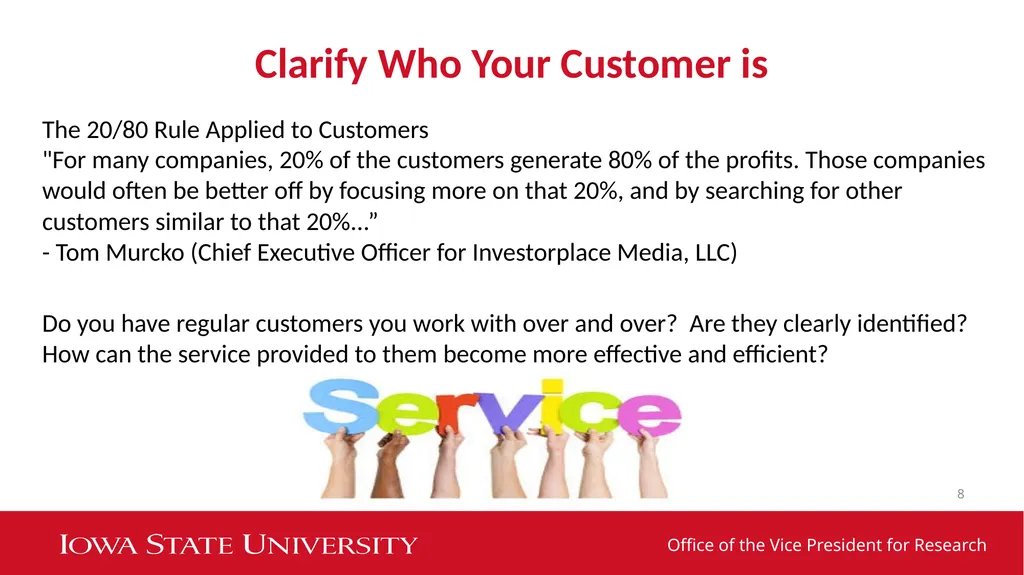
Clarify Who Your Customer is The 20/80 Rule Applied to Customers "For many companies, 20% of the customers generate 80% of the profits. Those companies would often be better off by focusing more on that 20%, and by searching for other customers similar to that 20%...” - Tom Murcko (Chief Executive Officer for Investorplace Media, LLC)
Do you have regular customers you work with over and over? Are they clearly identified? How can the service provided to them become more effective and efficient? 8<br>
09
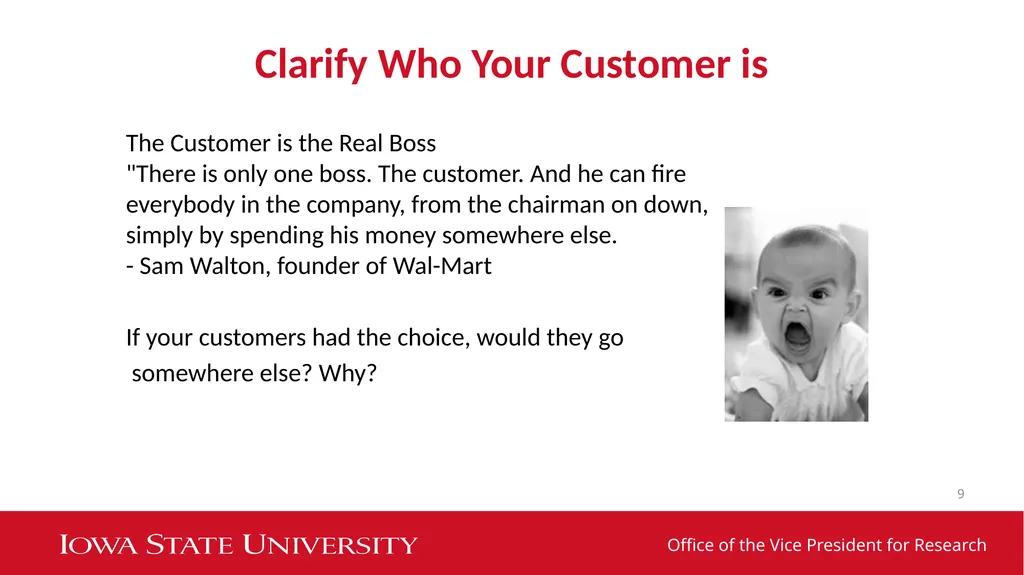
Clarify Who Your Customer is The Customer is the Real Boss "There is only one boss. The customer. And he can fire everybody in the company, from the chairman on down, simply by spending his money somewhere else. - Sam Walton, founder of Wal-Mart
If your customers had the choice, would they go
somewhere else? Why? 9<br>
10
What are your customer’s top service expectations? Speed? Knowledge? Accuracy? Courtesy?
Are there metrics that go along with these?
first response time?
average response time?
total handle time? 10<br>
11
Ideas, Concepts and Tools for Change Great Service starts with your attitude, pride and ownership
Start with idea of “yes” for the answer. If “no”, provide alternatives.
3E’s: Energy; Execution; Enthusiasm
4P’s: Promptness; Politeness; Professionalism; Personalization (use their name, etc.)
Make it obvious that you care about the customer 11<br>
12
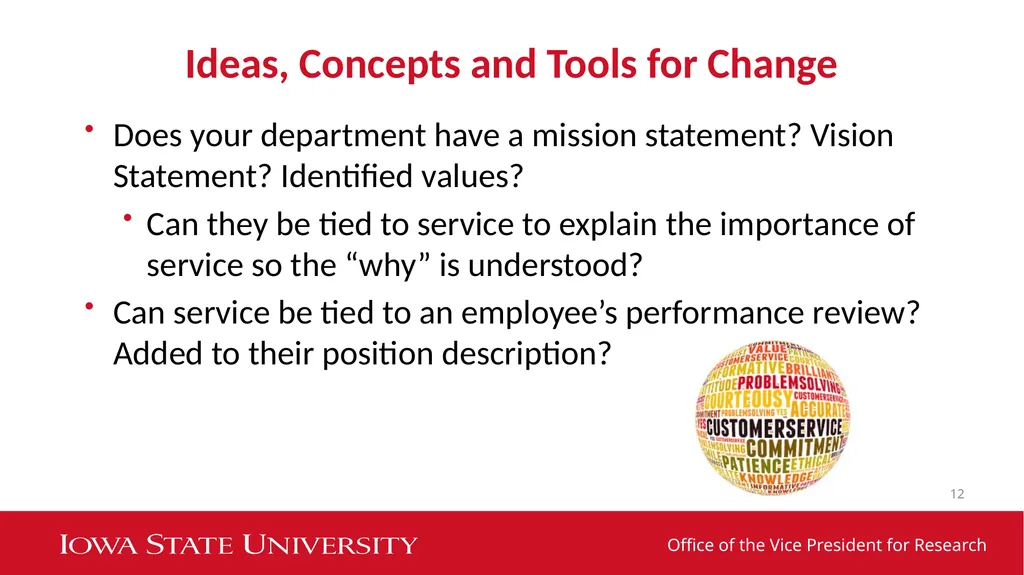
Ideas, Concepts and Tools for Change Does your department have a mission statement? Vision Statement? Identified values?
Can they be tied to service to explain the importance of service so the “why” is understood?
Can service be tied to an employee’s performance review? Added to their position description? 12<br>
13
Ideas, Concepts and Tools for Change What other departments/individuals do you need to have close partnerships with? What can be done to improve/define/share processes? Improve relationships? Create Standard Operating Procedures?
FPM?
UHR?
Another College? 13<br>
14
Customer Survey Do your customers know you care and are wanting to improve?
Appropriate questions; Effective questions
Do a survey of your customers to see what they need – develop questions from that feedback
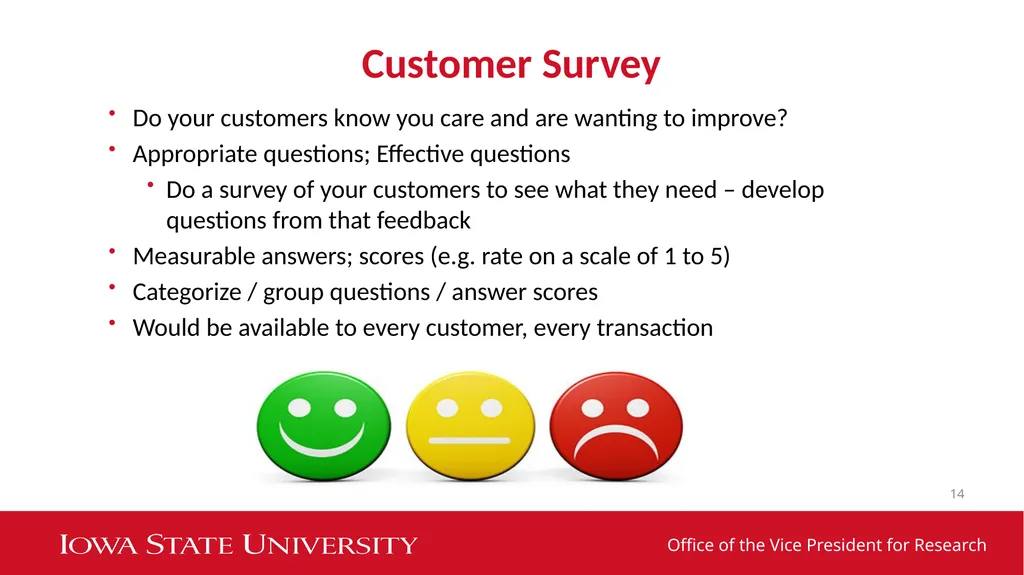
Measurable answers; scores (e.g. rate on a scale of 1 to 5)
Categorize / group questions / answer scores
Would be available to every customer, every transaction 14<br>
15
Customer Survey Post results for everyone to see
Bring them to meetings for discussion
Recruit positive surveys
“Please fill out a survey and let us know how happy you were with our services”
Create Action Plans to raise scores
Specific changes to make
Follow up on changes – make them habits
Celebrate milestones / provide recognition
Have contests, games, competitions, set team and individual goals 15<br>
16
Ideas, Concepts and Tools for Change Be creative about service
Think outside the box
Brainstorm ideas – make lists
No idea is off-limits! 16<br>