Differentiated Instruction Beginning Teacher Symposium WCU August 14, 2013 Kristin Menickelli kmenickellijcpsmail.org This is the value of the teacher, who looks at a face and says theres something behind that and I want to reach that
"Differentiated Instruction Beginning Teacher" is the property of its rightful owner. Permission is granted to
download and print the materials on this website for personal, non-commercial use only, and to display it
on your personal computer provided you do not modify the materials and that you retain all copyright
notices contained in the materials. By downloading content from our website, you accept the terms of this
agreement.
This is the value of the teacher, who looks at a face and says there's something behind that and I want to reach that person, I want to influence that person, I want to encourage that person, I want to enrich, I want to call out that person who is behind that face, behind that color, behind that language, behind that tradition, behind that culture. I believe you can do it. I know what was done for me. —Maya Angelou<br>
03
Objectives Participants will:
Gain a deeper understanding of why (as a philosophy) and how to differentiate (what to do) instruction.
Brainstorm ideas and plan using differentiation strategies.
Share suggestions for effectively implementing differentiation in the classroom.<br>
04
Qualities of Effective Teachers The following are some of the key qualities of effective teachers:
Have formal teacher preparation training.
Hold certification of some kind (standard, alternative, or provisional) and are certified within their fields.
Have taught for at least three years.
Are caring, fair, and respectful.
Hold high expectations for themselves and their students.
Dedicate extra time to instructional preparation and reflection.
Maximize instructional time via effective classroom management and organization.
Enhance instruction by varying instructional strategies, activities, and assignments.
Present content to students in a meaningful way that fosters understanding.
Monitor students' learning by utilizing pre- and post assessments, providing timely and informative feedback, and reteaching material to students who did not achieve mastery.
Demonstrate effectiveness with the full range of student abilities in their classrooms, regardless of the academic diversity of the students.
Linking Teacher Evaluation and Student Learning
by Pamela D. Tucker and James H. Stronge<br>
05
What Is Differentiation? A teacher’s response to learner needs
Responsive instruction
An approach to teaching that advocated active planning for student differences in classrooms.
The philosophy proposes that what we bring to school as learners matters in how we learn<br>
06
One Size Doesn’t Fit All “Students differ from one to another in size, shape, and social development. Students also learn differently. Teachers can no longer teach “The Lesson” and hope that everyone gets it.”
“Much has been researched and written about classroom climate and the need for a safe, nurturing environment with high challenge and low threat where all learners can thrive.”
Everyone needs feedback. Teachers and students need to exchange constant feedback to monitor progress and to adjust learning. It has been said that assessment drives the curriculum. Teachers need pre-assessment tools to plan for learning as well as ongoing assessment tools to use during and after the learning process.
After pre-assessment, teachers need to examine the data and adjust the learning based on students’ knowledge, skills, past experiences, preferences and needs. (adjusting, compacting, grouping)<br>
07
Discussion Question<br>
08
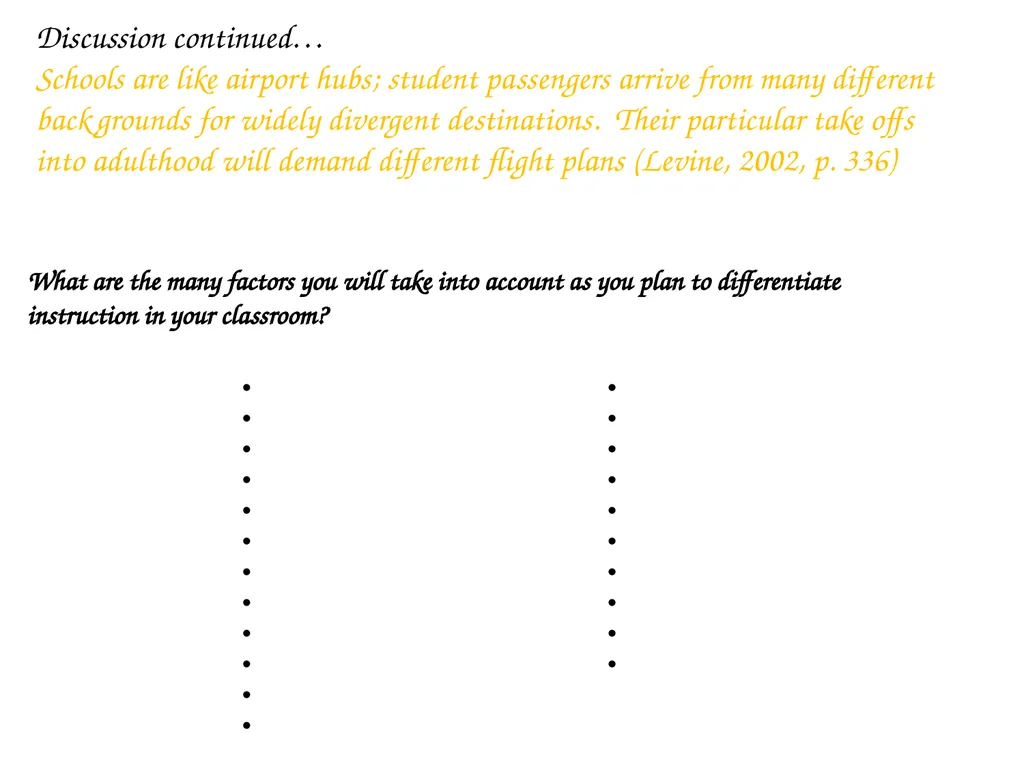
Discussion continued… Schools are like airport hubs; student passengers arrive from many different backgrounds for widely divergent destinations. Their particular take offs into adulthood will demand different flight plans (Levine, 2002, p. 336) What are the many factors you will take into account as you plan to differentiate instruction in your classroom?<br>
09
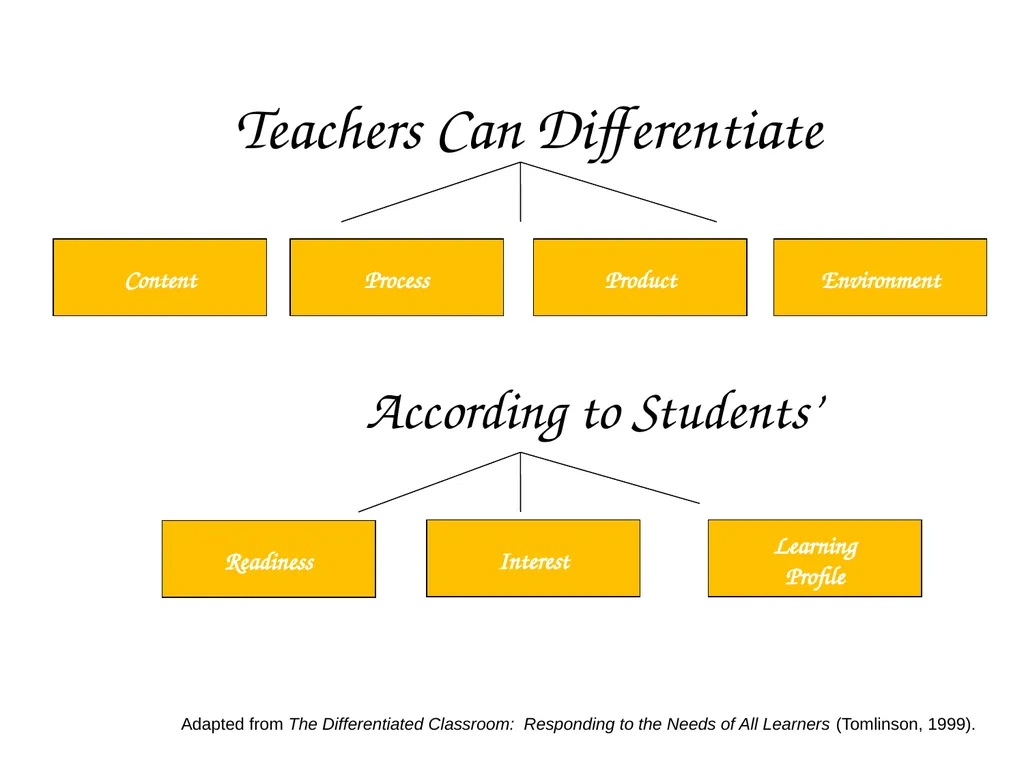
Content Product Environment According to Students’ Readiness Interest Learning
Profile Teachers Can Differentiate Adapted from The Differentiated Classroom: Responding to the Needs of All Learners (Tomlinson, 1999). Process<br>
10
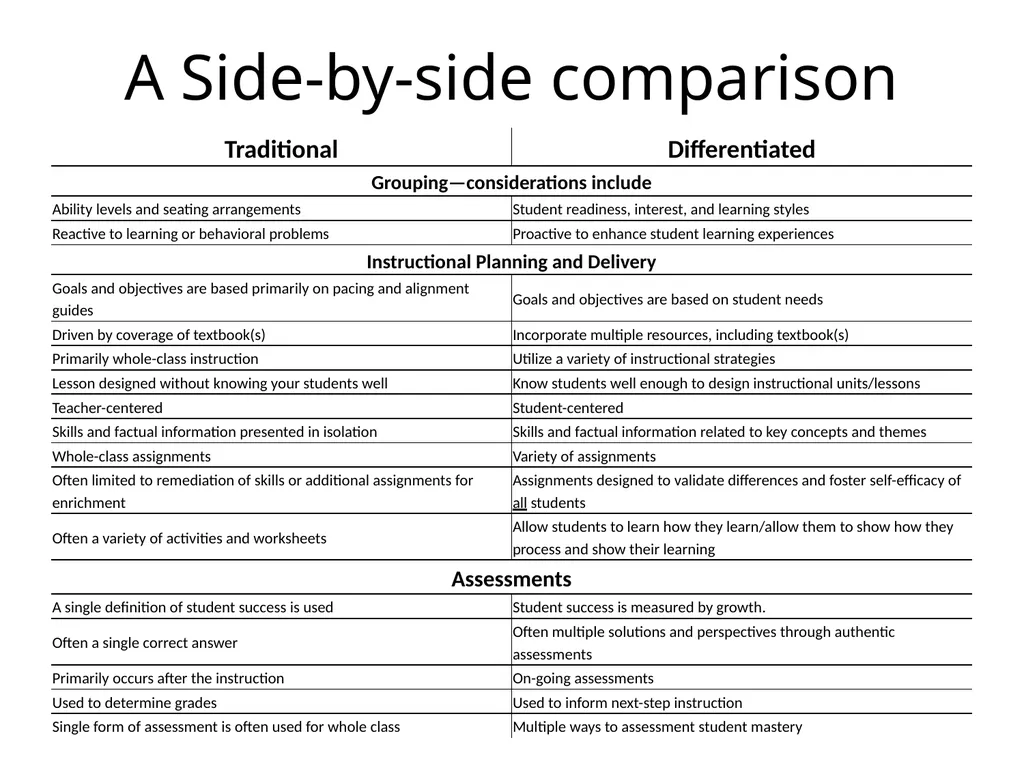
A Side-by-side comparison<br>
11
Academic Learning Time (ALT) Academic Learning Time refers to that portion of engaged time that students spend working on tasks at an appropriate level of difficulty for them and experiencing high levels of success (excludes time spent engaging in tasks which are too easy or too difficult). Evidence of success includes answering questions correctly in class and completing assignments with a high degree of accuracy. Academic learning time excludes the time that students make many mistakes or appear to be confused.
Review of the Literature on “Time and Learning”
The Core Academic Learning Time Group, March 2002<br>
12
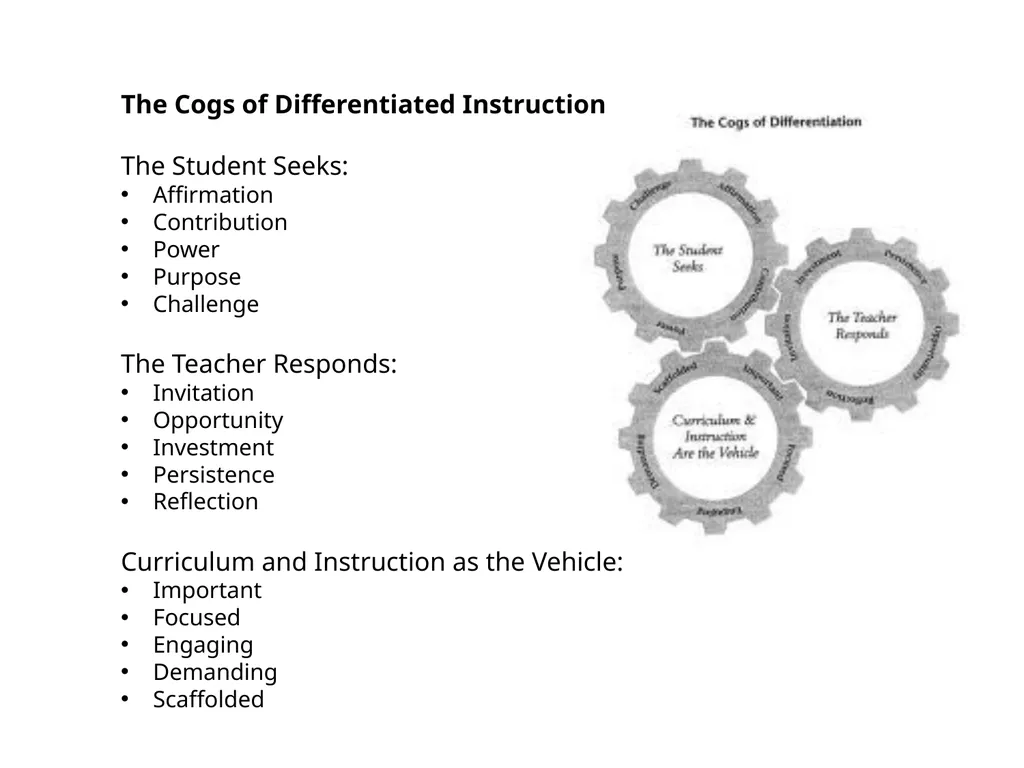
The Cogs of Differentiated Instruction
The Student Seeks:
Affirmation
Contribution
Power
Purpose
Challenge
The Teacher Responds:
Invitation
Opportunity
Investment
Persistence
Reflection
Curriculum and Instruction as the Vehicle:
Important
Focused
Engaging
Demanding
Scaffolded<br>
13
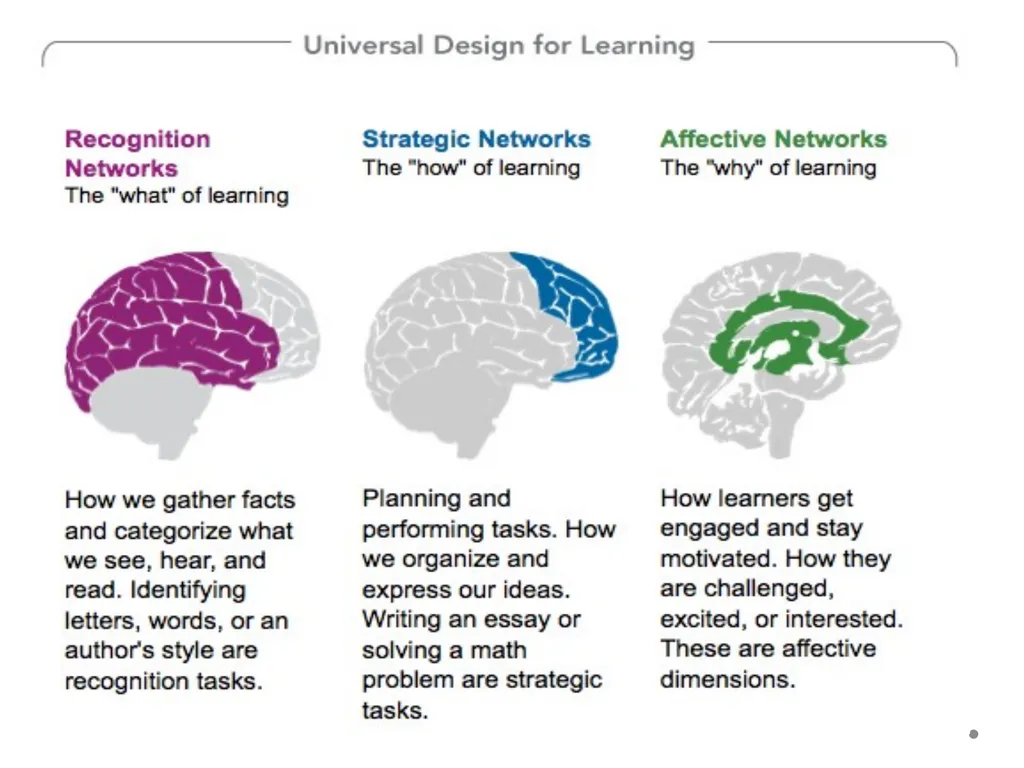
Because teachers want to know… How can I meet the needs of all my students? UDL! UNIVERSAL DESIGN FOR LEARNING
A set of principles for curriculum development that applies to the general education curriculum to promote learning environments that meet the needs of all learners<br>
14
Universal design for Learning UDL at a Glance UDL provides a blueprint for creating instructional goals, methods, materials, and assessments that work for everyone--not a single, one-size-fits-all solution but rather flexible approaches that can be customized and adjusted for individual needs.<br>
15
•<br>
16
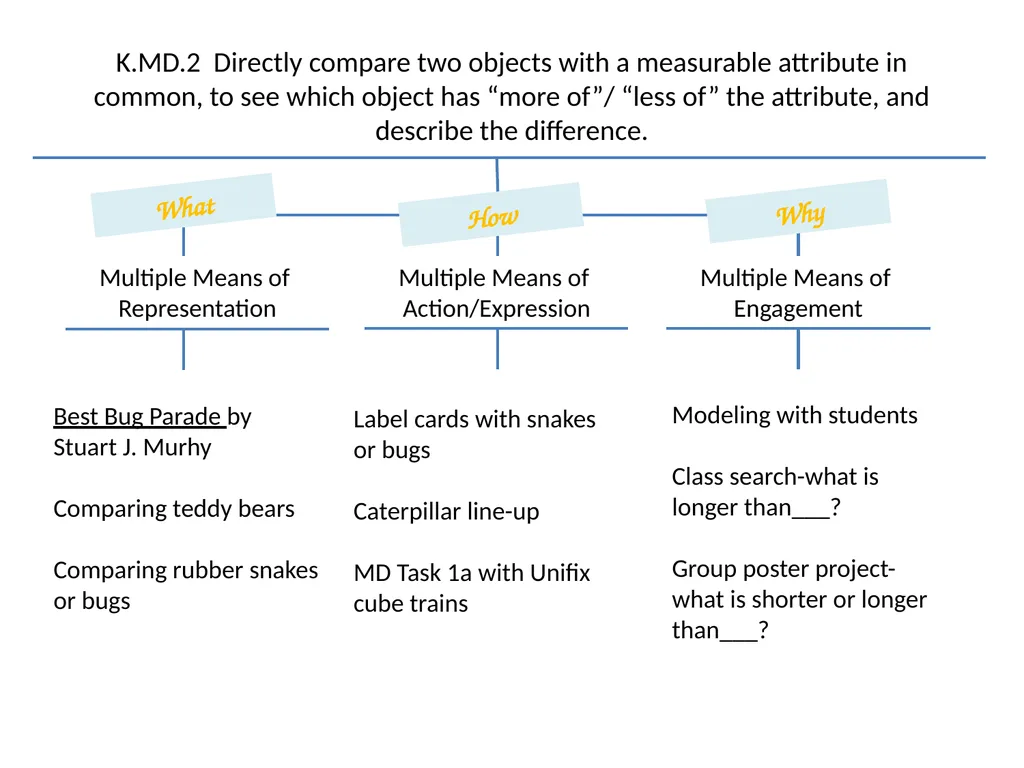
K.MD.2 Directly compare two objects with a measurable attribute in common, to see which object has “more of”/ “less of” the attribute, and describe the difference. Multiple Means of
Representation Multiple Means of
Action/Expression Multiple Means of
Engagement Best Bug Parade by Stuart J. Murhy
Comparing teddy bears
Comparing rubber snakes or bugs Label cards with snakes or bugs
Caterpillar line-up
MD Task 1a with Unifix cube trains Modeling with students
Class search-what is longer than___?
Group poster project-what is shorter or longer than___? What Why How<br>
17
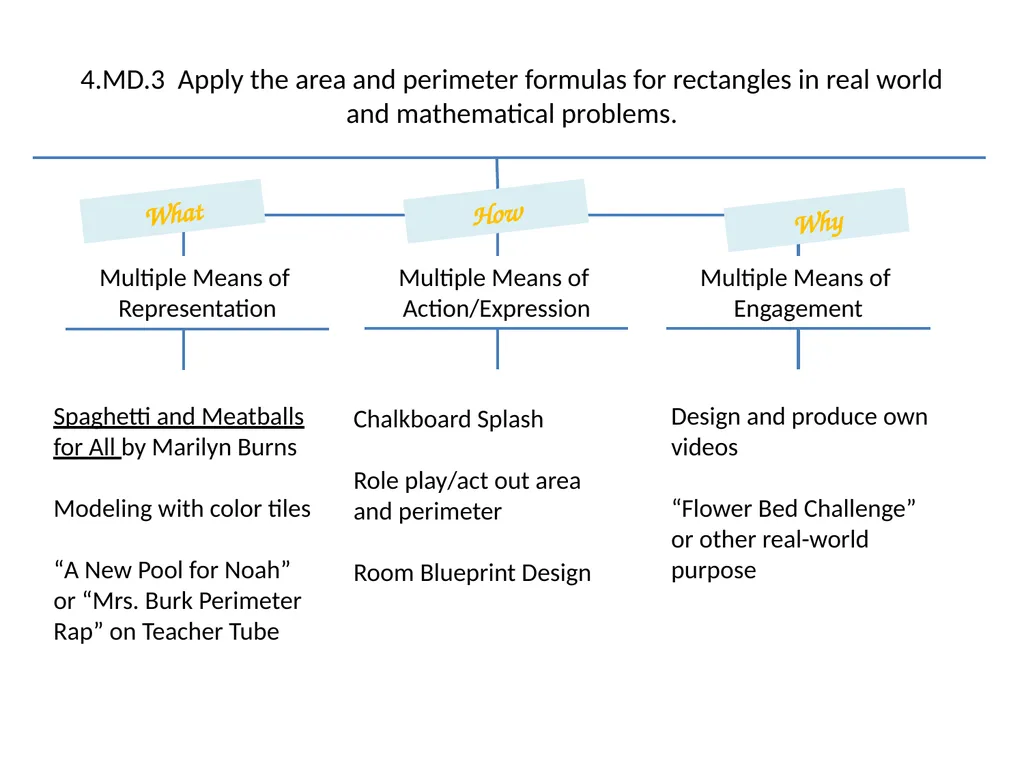
4.MD.3 Apply the area and perimeter formulas for rectangles in real world and mathematical problems. Multiple Means of
Representation Multiple Means of
Action/Expression Multiple Means of
Engagement Spaghetti and Meatballs for All by Marilyn Burns
Modeling with color tiles
“A New Pool for Noah” or “Mrs. Burk Perimeter Rap” on Teacher Tube Chalkboard Splash
Role play/act out area and perimeter
Room Blueprint Design Design and produce own videos
“Flower Bed Challenge” or other real-world purpose What Why How<br>
18
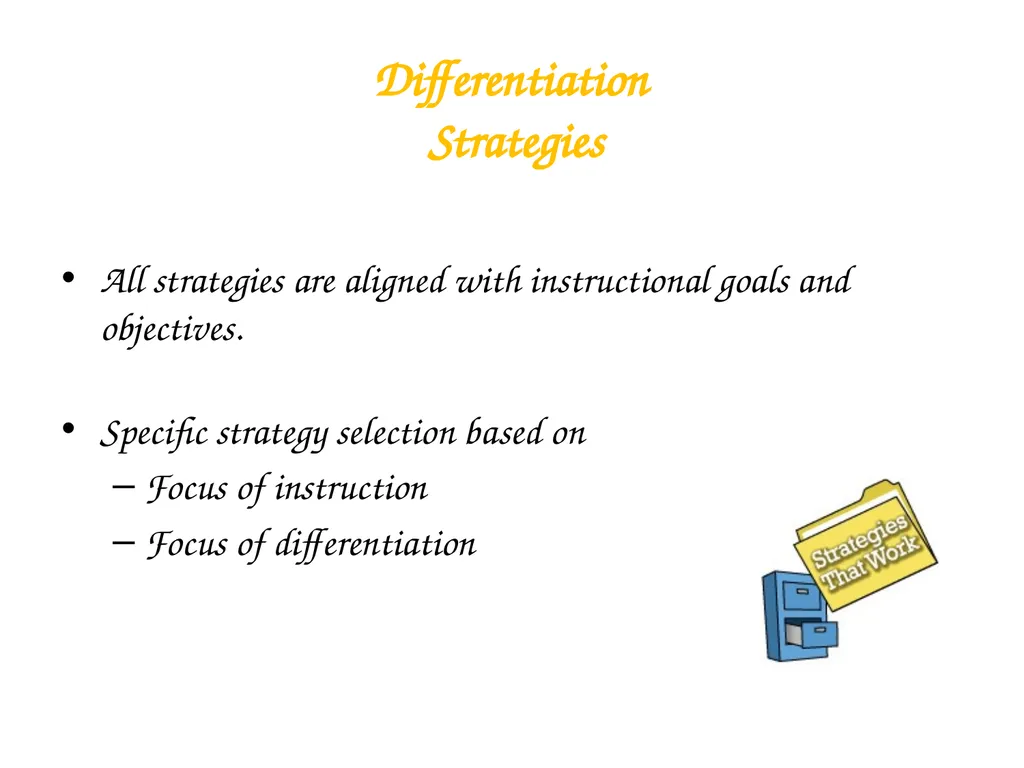
Differentiation Strategies All strategies are aligned with instructional goals and objectives.
Specific strategy selection based on
Focus of instruction
Focus of differentiation<br>
19
Assessment in the Differentiated Classroom Ongoing
Instruction-dependent
Student-dependent
Informative for continued instruction<br>
20
Tips for Implementing Differentiated Instruction: Your Classroom Get to know your students
Start slowly
One subject/one technique
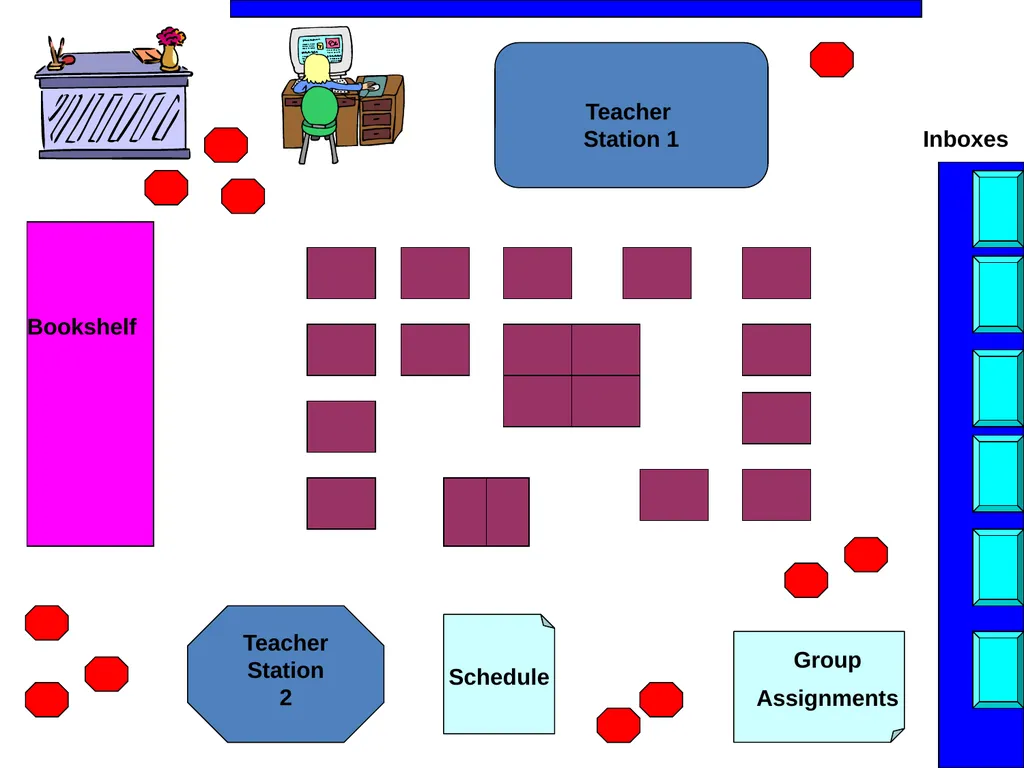
Organize your classroom space.<br>
21
Inboxes<br>
22
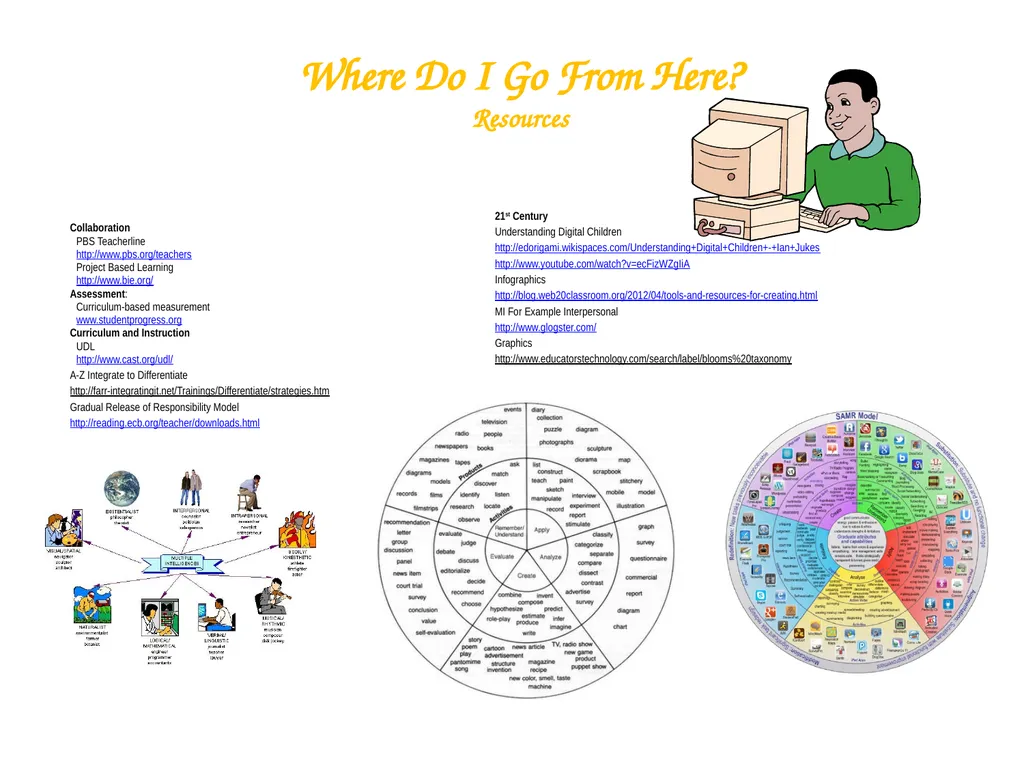
Where Do I Go From Here? Resources Collaboration
PBS Teacherline
http://www.pbs.org/teachers
Project Based Learning
http://www.bie.org/
Assessment:
Curriculum-based measurement
www.studentprogress.org
Curriculum and Instruction
UDL
http://www.cast.org/udl/
A-Z Integrate to Differentiate
http://farr-integratingit.net/Trainings/Differentiate/strategies.htm
Gradual Release of Responsibility Model
http://reading.ecb.org/teacher/downloads.html
21st Century
Understanding Digital Children
http://edorigami.wikispaces.com/Understanding+Digital+Children+-+Ian+Jukes
http://www.youtube.com/watch?v=ecFizWZgIiA
Infographics
http://blog.web20classroom.org/2012/04/tools-and-resources-for-creating.html
MI For Example Interpersonal
http://www.glogster.com/
Graphics
http://www.educatorstechnology.com/search/label/blooms%20taxonomy<br>
23
Next Steps! What differentiation strategies will you implement in your classrooms? Turn and talk to your table.<br>