
Disarming Microaggressions: Using
AM
Published · 45 slides · 0 views

1 / 1









Description
Disarming Microaggressions: Using Microintervention Strategies Presented to Virginia Polytechnic Institute State University Asian Engagement Cultural Center Cultural and Community Centers June 17, 2021 By Derald Wing Sue, Ph.D. Teachers
Related Topics
Share
Embed code
Download this presentation From Below
"Disarming Microaggressions: Using" is the property of its rightful owner. Permission is granted to download and print the materials on this website for personal, non-commercial use only, and to display it on your personal computer provided you do not modify the materials and that you retain all copyright notices contained in the materials. By downloading content from our website, you accept the terms of this agreement.
Presentation Transcript
01
Disarming Microaggressions: Using Microintervention Strategies
Presented to
Virginia Polytechnic Institute & State University
Asian Engagement Cultural Center
Cultural and Community Centers
June 17, 2021 By
Derald Wing Sue, Ph.D.
Teachers College, Columbia University<br>
Derald Wing Sue, Ph.D.
Teachers College, Columbia University<br>
02
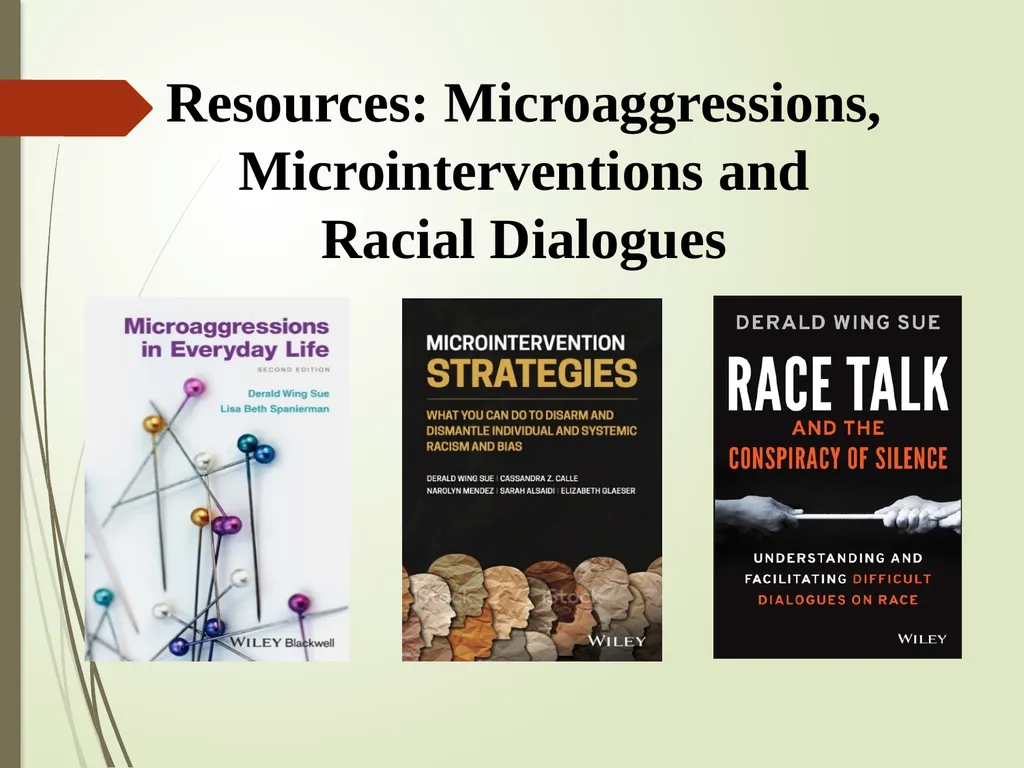
Resources: Microaggressions, Microinterventions and
Racial Dialogues<br>
03
Dedication Maya Angelou
1928-2014
Still I Rise
“You may write me down in history With your bitter, twisted lies, You may tread me in the very dirt But still, like dust, I'll rise.”
“You may shoot me with your words, You may cut me with your eyes, You may kill me with your hatefulness, But still, like air, I'll rise.”<br>
1928-2014
Still I Rise
“You may write me down in history With your bitter, twisted lies, You may tread me in the very dirt But still, like dust, I'll rise.”
“You may shoot me with your words, You may cut me with your eyes, You may kill me with your hatefulness, But still, like air, I'll rise.”<br>
04
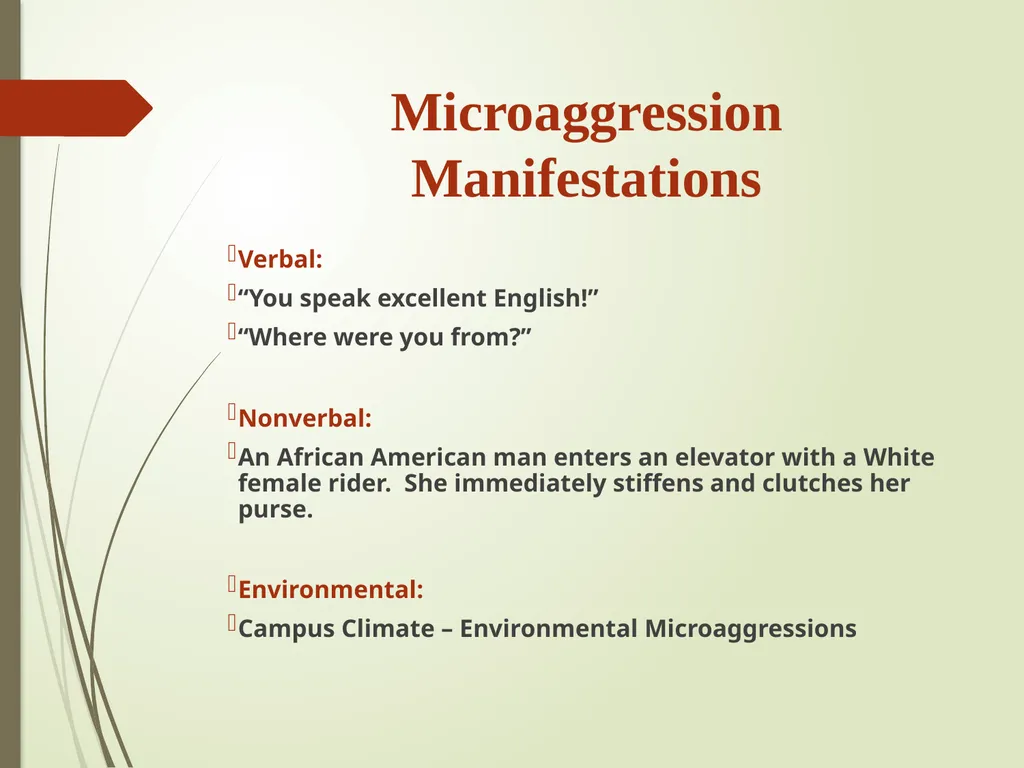
Microaggression Manifestations Verbal:
“You speak excellent English!”
“Where were you from?”
Nonverbal:
An African American man enters an elevator with a White female rider. She immediately stiffens and clutches her purse.
Environmental:
Campus Climate – Environmental Microaggressions<br>
“You speak excellent English!”
“Where were you from?”
Nonverbal:
An African American man enters an elevator with a White female rider. She immediately stiffens and clutches her purse.
Environmental:
Campus Climate – Environmental Microaggressions<br>
05
Racial Microaggression Impact “It gets so tiring, you know. It sucks you dry. People don’t trust you. From the moment I [African American male] wake up, I know stepping out the door, that it will be the same, day after day. The bus can be packed, but no one will sit next to you……I guess it may be a good thing because you always get more room, no one crowds you. You get served last…when they serve you, they have this phony smile and just want to get rid of you….you have to show more ID to cash a check, you turn on the TV and there you always see someone like you, being handcuffed and jailed. They look like you and sometimes you begin to think it is you! You are a plague! You try to hold it in, but sometimes you lose it. Explaining doesn’t help. They don’t want to hear. Even when they ask, ‘Why do you have a chip on your shoulder?’ Shit…I just walk away now. It doesn’t do any good explaining.” (Sue, 2010, p. 87).
Questions: Is life as hard as this Black man describes? Is he exaggerating or misreading the action of others? Is he oversensitive or paranoid? Is he right in concluding that others don’t want to listen to his explanations? Why is he so angry and resentful? Do you believe him or not? If not, what are your reasons?<br>
Questions: Is life as hard as this Black man describes? Is he exaggerating or misreading the action of others? Is he oversensitive or paranoid? Is he right in concluding that others don’t want to listen to his explanations? Why is he so angry and resentful? Do you believe him or not? If not, what are your reasons?<br>
06
Microaggressions Microaggressions can be defined as
brief and commonplace daily verbal, behavioral or environmental indignities,
whether intentional or unintentional,
which communicate hostile, derogatory, or negative slights, invalidations, and insults
to an individual or group because of their marginalized status in society.<br>
brief and commonplace daily verbal, behavioral or environmental indignities,
whether intentional or unintentional,
which communicate hostile, derogatory, or negative slights, invalidations, and insults
to an individual or group because of their marginalized status in society.<br>
07
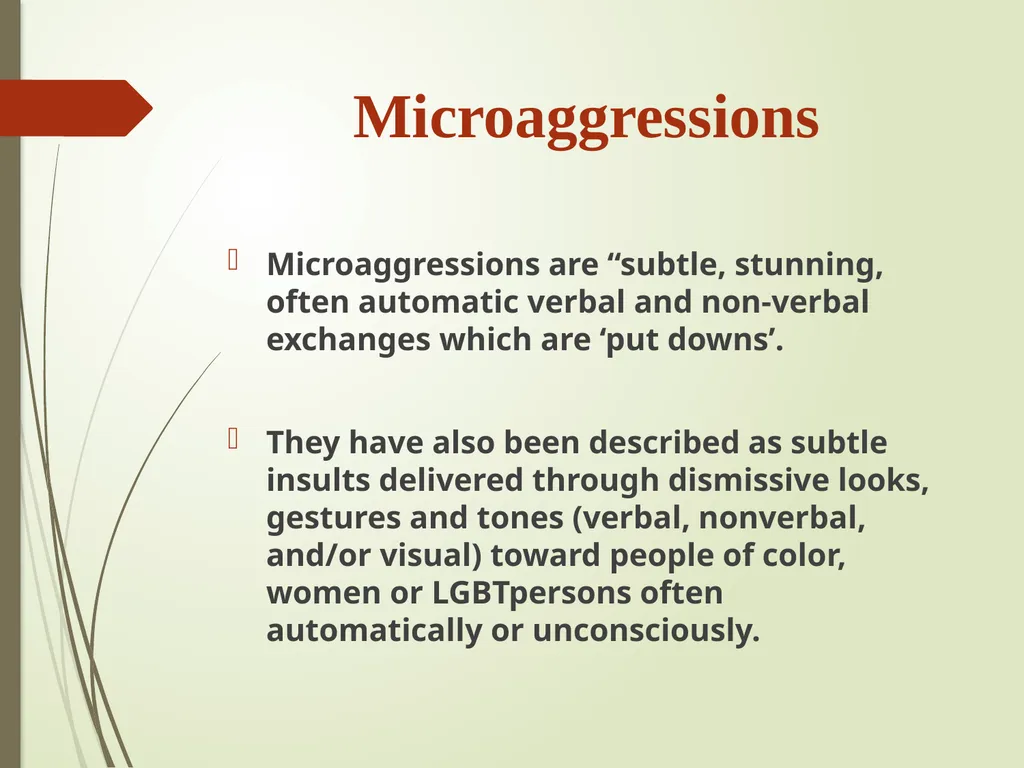
Microaggressions Microaggressions are “subtle, stunning, often automatic verbal and non-verbal exchanges which are ‘put downs’.
They have also been described as subtle insults delivered through dismissive looks, gestures and tones (verbal, nonverbal, and/or visual) toward people of color, women or LGBTpersons often automatically or unconsciously.<br>
They have also been described as subtle insults delivered through dismissive looks, gestures and tones (verbal, nonverbal, and/or visual) toward people of color, women or LGBTpersons often automatically or unconsciously.<br>
08
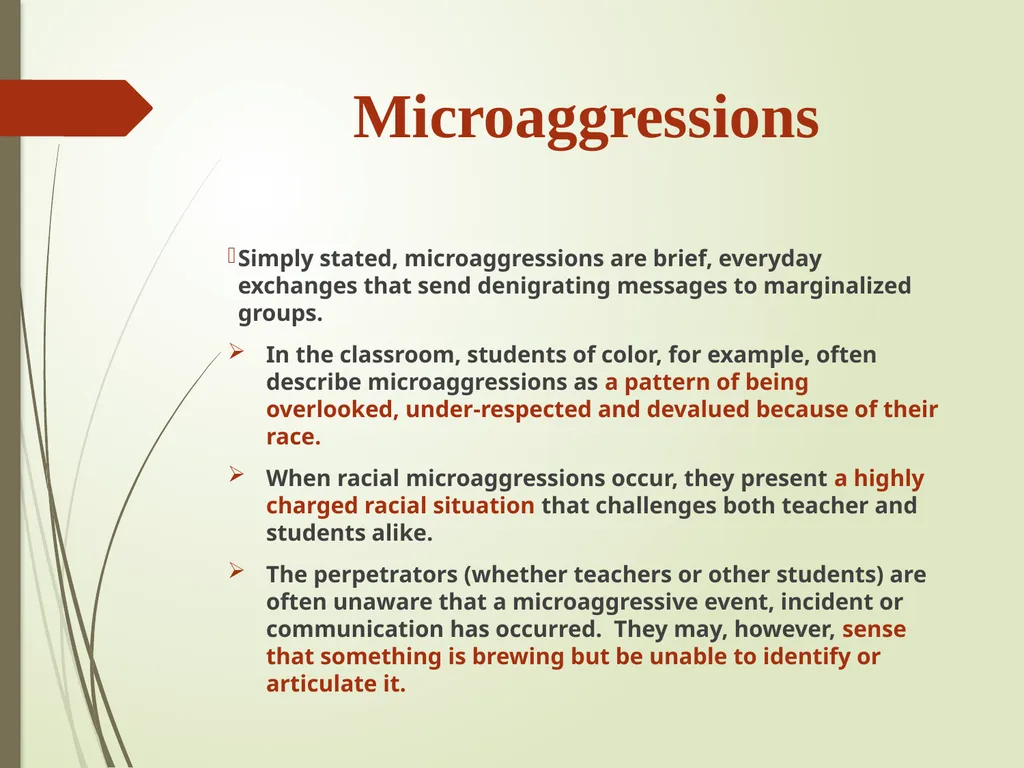
Microaggressions Simply stated, microaggressions are brief, everyday exchanges that send denigrating messages to marginalized groups.
In the classroom, students of color, for example, often describe microaggressions as a pattern of being overlooked, under-respected and devalued because of their race.
When racial microaggressions occur, they present a highly charged racial situation that challenges both teacher and students alike.
The perpetrators (whether teachers or other students) are often unaware that a microaggressive event, incident or communication has occurred. They may, however, sense that something is brewing but be unable to identify or articulate it.<br>
In the classroom, students of color, for example, often describe microaggressions as a pattern of being overlooked, under-respected and devalued because of their race.
When racial microaggressions occur, they present a highly charged racial situation that challenges both teacher and students alike.
The perpetrators (whether teachers or other students) are often unaware that a microaggressive event, incident or communication has occurred. They may, however, sense that something is brewing but be unable to identify or articulate it.<br>
09
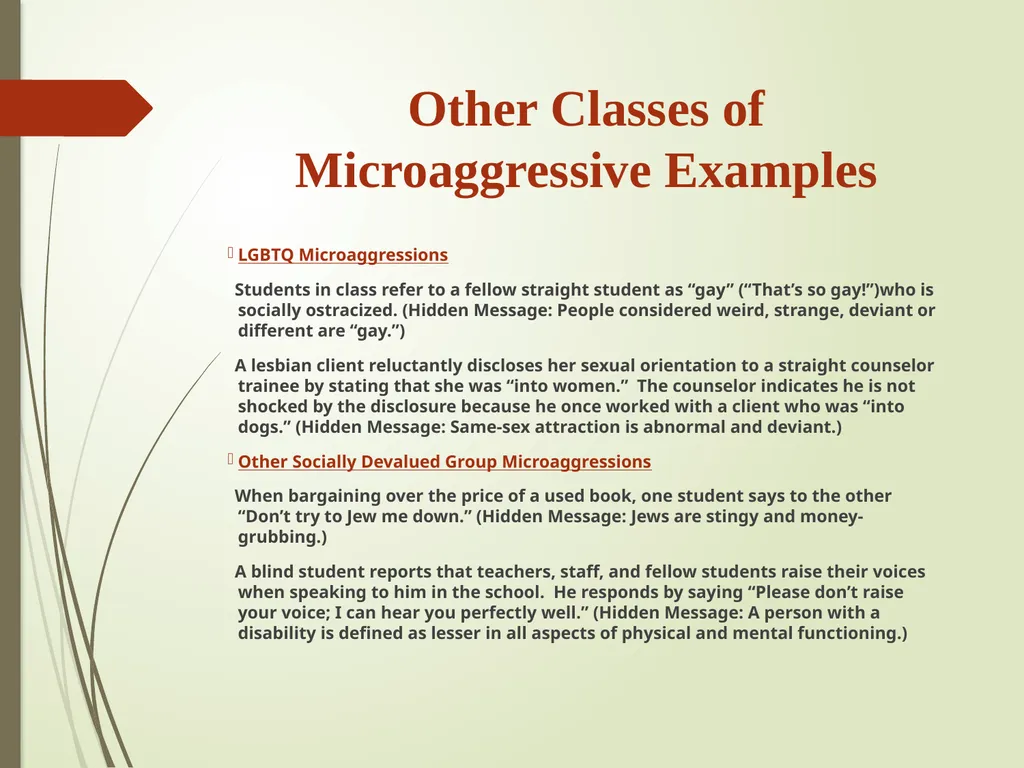
Other Classes of Microaggressive Examples LGBTQ Microaggressions
Students in class refer to a fellow straight student as “gay” (“That’s so gay!”)who is socially ostracized. (Hidden Message: People considered weird, strange, deviant or different are “gay.”)
A lesbian client reluctantly discloses her sexual orientation to a straight counselor trainee by stating that she was “into women.” The counselor indicates he is not shocked by the disclosure because he once worked with a client who was “into dogs.” (Hidden Message: Same-sex attraction is abnormal and deviant.)
Other Socially Devalued Group Microaggressions
When bargaining over the price of a used book, one student says to the other “Don’t try to Jew me down.” (Hidden Message: Jews are stingy and money-grubbing.)
A blind student reports that teachers, staff, and fellow students raise their voices when speaking to him in the school. He responds by saying “Please don’t raise your voice; I can hear you perfectly well.” (Hidden Message: A person with a disability is defined as lesser in all aspects of physical and mental functioning.)<br>
Students in class refer to a fellow straight student as “gay” (“That’s so gay!”)who is socially ostracized. (Hidden Message: People considered weird, strange, deviant or different are “gay.”)
A lesbian client reluctantly discloses her sexual orientation to a straight counselor trainee by stating that she was “into women.” The counselor indicates he is not shocked by the disclosure because he once worked with a client who was “into dogs.” (Hidden Message: Same-sex attraction is abnormal and deviant.)
Other Socially Devalued Group Microaggressions
When bargaining over the price of a used book, one student says to the other “Don’t try to Jew me down.” (Hidden Message: Jews are stingy and money-grubbing.)
A blind student reports that teachers, staff, and fellow students raise their voices when speaking to him in the school. He responds by saying “Please don’t raise your voice; I can hear you perfectly well.” (Hidden Message: A person with a disability is defined as lesser in all aspects of physical and mental functioning.)<br>
10
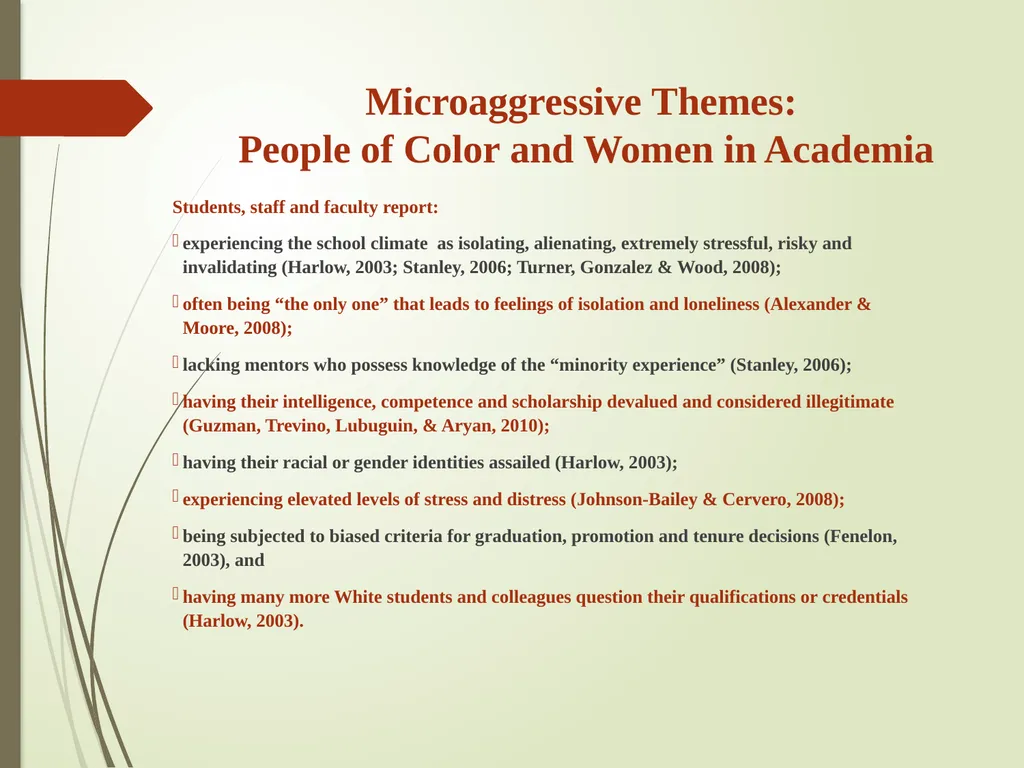
Microaggressive Themes:
People of Color and Women in Academia Students, staff and faculty report:
experiencing the school climate as isolating, alienating, extremely stressful, risky and invalidating (Harlow, 2003; Stanley, 2006; Turner, Gonzalez & Wood, 2008);
often being “the only one” that leads to feelings of isolation and loneliness (Alexander & Moore, 2008);
lacking mentors who possess knowledge of the “minority experience” (Stanley, 2006);
having their intelligence, competence and scholarship devalued and considered illegitimate (Guzman, Trevino, Lubuguin, & Aryan, 2010);
having their racial or gender identities assailed (Harlow, 2003);
experiencing elevated levels of stress and distress (Johnson-Bailey & Cervero, 2008);
being subjected to biased criteria for graduation, promotion and tenure decisions (Fenelon, 2003), and
having many more White students and colleagues question their qualifications or credentials (Harlow, 2003).<br>
experiencing the school climate as isolating, alienating, extremely stressful, risky and invalidating (Harlow, 2003; Stanley, 2006; Turner, Gonzalez & Wood, 2008);
often being “the only one” that leads to feelings of isolation and loneliness (Alexander & Moore, 2008);
lacking mentors who possess knowledge of the “minority experience” (Stanley, 2006);
having their intelligence, competence and scholarship devalued and considered illegitimate (Guzman, Trevino, Lubuguin, & Aryan, 2010);
having their racial or gender identities assailed (Harlow, 2003);
experiencing elevated levels of stress and distress (Johnson-Bailey & Cervero, 2008);
being subjected to biased criteria for graduation, promotion and tenure decisions (Fenelon, 2003), and
having many more White students and colleagues question their qualifications or credentials (Harlow, 2003).<br>
11
Harmful Impact Controversy Microaggressions are constant and continual without an end date (an everyday hassle may be time limited).
Microaggressions are cumulative and any one may represent the feather that breaks the camel's back
Microaggressions must be deciphered because they contain double messages (especially microinvalidations)
Microaggressions are constant reminders of a person's second class status in society
Microaggressions symbolize past historic injustices (enslavement of African Americans, incarceration of Japanese Americans and the taking away of land from Indigenous peoples.<br>
Microaggressions are cumulative and any one may represent the feather that breaks the camel's back
Microaggressions must be deciphered because they contain double messages (especially microinvalidations)
Microaggressions are constant reminders of a person's second class status in society
Microaggressions symbolize past historic injustices (enslavement of African Americans, incarceration of Japanese Americans and the taking away of land from Indigenous peoples.<br>
12
Harmful Impact Studies reveal, that microaggressions, while seemingly trivial in nature have major consequences for marginalized groups in our society because they:
(a) assail the mental health of recipients (Sue, Capodilupo, & Holder, 2008),
(b) create a hostile and invalidating campus climate (Solórzano, Ceja, & Yosso, 2000),
(c) perpetuate stereotype threat (Steele, Spencer, & Aronson, 2002),
(d) create physical health problems (Clark, Anderson, Clark, & Williams, 1999),
(e) saturate the broader society with cues that signal devaluation of social group identities (Purdie-Vaughns, Steele, Davies, & Ditlmann, 2008),<br>
(a) assail the mental health of recipients (Sue, Capodilupo, & Holder, 2008),
(b) create a hostile and invalidating campus climate (Solórzano, Ceja, & Yosso, 2000),
(c) perpetuate stereotype threat (Steele, Spencer, & Aronson, 2002),
(d) create physical health problems (Clark, Anderson, Clark, & Williams, 1999),
(e) saturate the broader society with cues that signal devaluation of social group identities (Purdie-Vaughns, Steele, Davies, & Ditlmann, 2008),<br>
13
Harmful Impact (f) lower work productivity and problem solving abilities (Dovidio, 2001; Salvatore & Shelton, 2007).
(g) may contribute to the “imposter phenomenon” (IP) or the belief that one is an intellectual fraud (Cokely, Smith, Bernard et al, 2017)
(h) and are responsible for creating inequities in education, employment and health care (Purdie-Vaughns, et al, 2008; Sue, 2010).
Far from being benign slights, microaggressions have major detrimental consequences for people of color, women and LGBTQ individuals.<br>
(g) may contribute to the “imposter phenomenon” (IP) or the belief that one is an intellectual fraud (Cokely, Smith, Bernard et al, 2017)
(h) and are responsible for creating inequities in education, employment and health care (Purdie-Vaughns, et al, 2008; Sue, 2010).
Far from being benign slights, microaggressions have major detrimental consequences for people of color, women and LGBTQ individuals.<br>
14
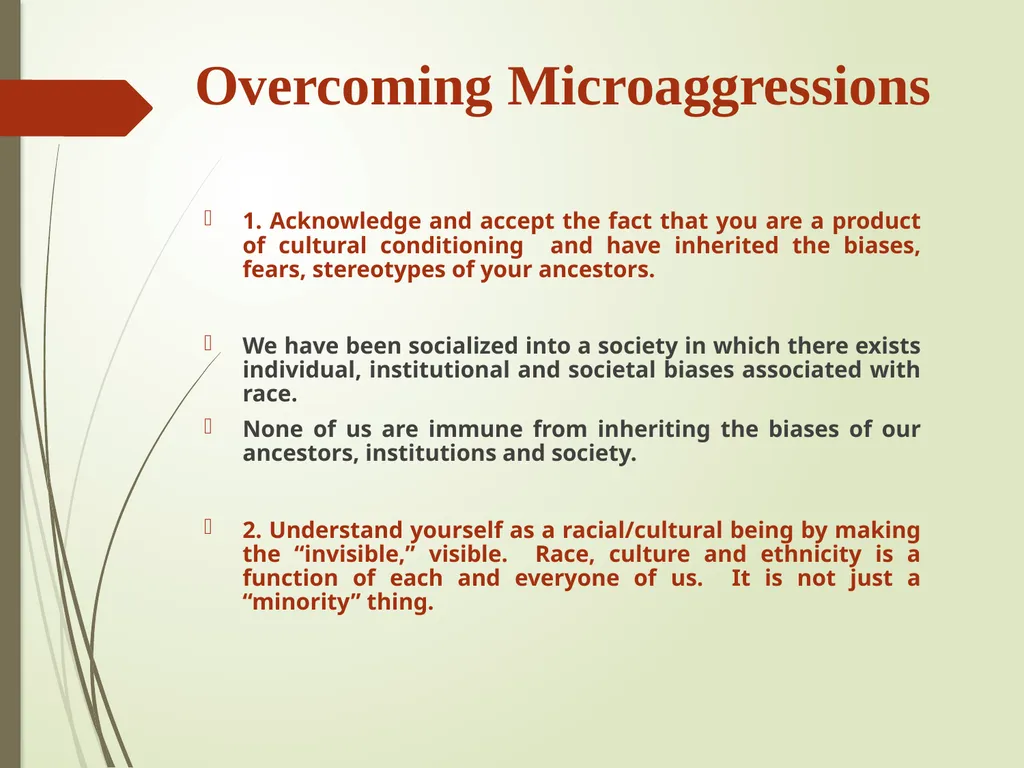
Overcoming Microaggressions 1. Acknowledge and accept the fact that you are a product of cultural conditioning and have inherited the biases, fears, stereotypes of your ancestors.
We have been socialized into a society in which there exists individual, institutional and societal biases associated with race.
None of us are immune from inheriting the biases of our ancestors, institutions and society.
2. Understand yourself as a racial/cultural being by making the “invisible,” visible. Race, culture and ethnicity is a function of each and everyone of us. It is not just a “minority” thing.<br>
We have been socialized into a society in which there exists individual, institutional and societal biases associated with race.
None of us are immune from inheriting the biases of our ancestors, institutions and society.
2. Understand yourself as a racial/cultural being by making the “invisible,” visible. Race, culture and ethnicity is a function of each and everyone of us. It is not just a “minority” thing.<br>
15
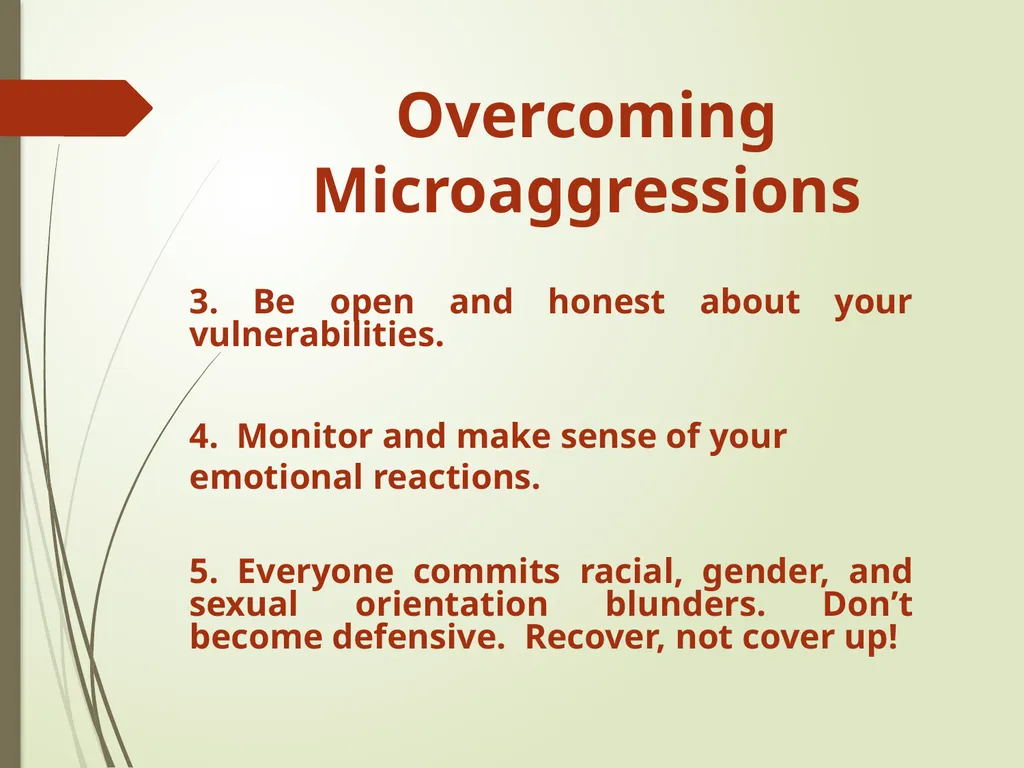
Overcoming Microaggressions 3. Be open and honest about your vulnerabilities.
4. Monitor and make sense of your emotional reactions.
5. Everyone commits racial, gender, and sexual orientation blunders. Don’t become defensive. Recover, not cover up!<br>
4. Monitor and make sense of your emotional reactions.
5. Everyone commits racial, gender, and sexual orientation blunders. Don’t become defensive. Recover, not cover up!<br>
16
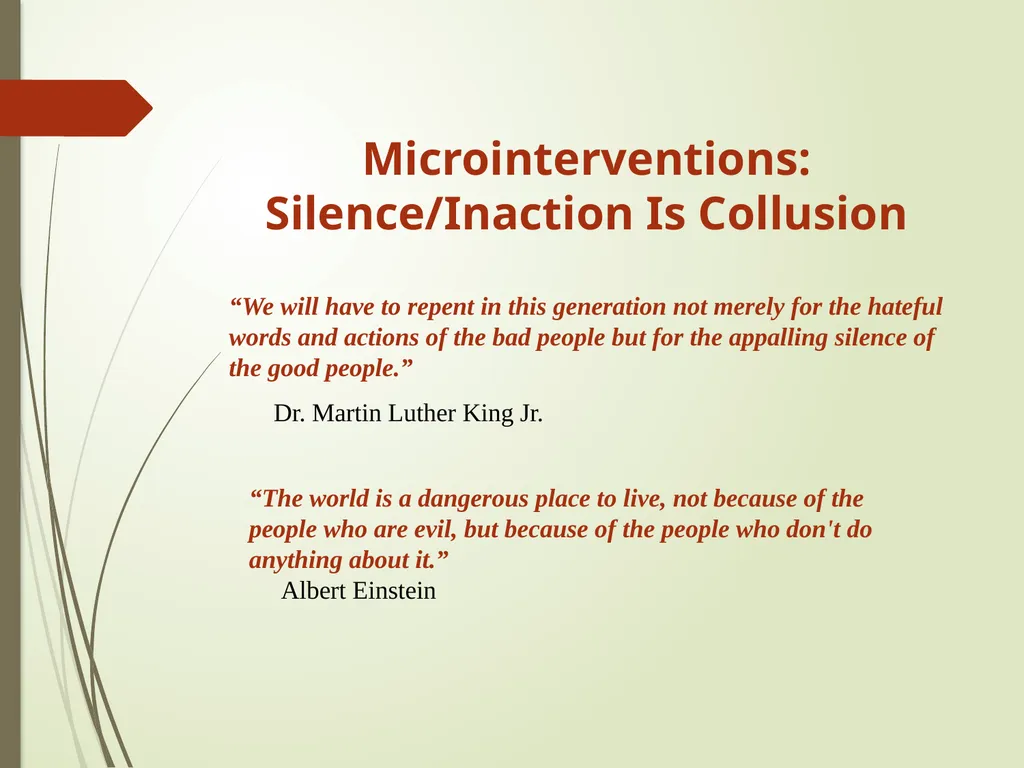
Microinterventions:
Silence/Inaction Is Collusion “We will have to repent in this generation not merely for the hateful words and actions of the bad people but for the appalling silence of the good people.”
Dr. Martin Luther King Jr. “The world is a dangerous place to live, not because of the people who are evil, but because of the people who don't do anything about it.”
Albert Einstein<br>
Dr. Martin Luther King Jr. “The world is a dangerous place to live, not because of the people who are evil, but because of the people who don't do anything about it.”
Albert Einstein<br>
17
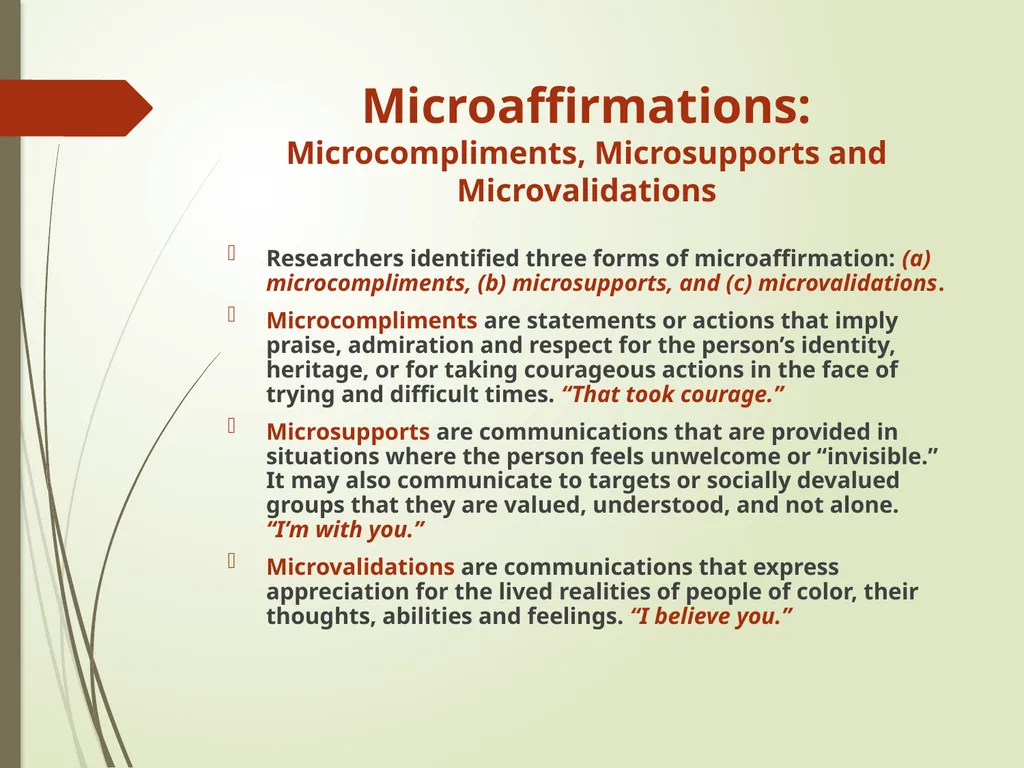
Microaffirmations:
Microcompliments, Microsupports and Microvalidations Researchers identified three forms of microaffirmation: (a) microcompliments, (b) microsupports, and (c) microvalidations.
Microcompliments are statements or actions that imply praise, admiration and respect for the person’s identity, heritage, or for taking courageous actions in the face of trying and difficult times. “That took courage.”
Microsupports are communications that are provided in situations where the person feels unwelcome or “invisible.” It may also communicate to targets or socially devalued groups that they are valued, understood, and not alone. “I’m with you.”
Microvalidations are communications that express appreciation for the lived realities of people of color, their thoughts, abilities and feelings. “I believe you.”<br>
Microcompliments are statements or actions that imply praise, admiration and respect for the person’s identity, heritage, or for taking courageous actions in the face of trying and difficult times. “That took courage.”
Microsupports are communications that are provided in situations where the person feels unwelcome or “invisible.” It may also communicate to targets or socially devalued groups that they are valued, understood, and not alone. “I’m with you.”
Microvalidations are communications that express appreciation for the lived realities of people of color, their thoughts, abilities and feelings. “I believe you.”<br>
18
Microaffirmation Examples:
Identity the microaggressions and microaffirmations. An African American student had just finished answering a challenging question posed by the White male professor. Surprised but impressed by the student’s analysis, the professor loudly exclaimed, “Jamal that was a most articulate and surprisingly insightful solution!” Although seemingly a compliment, Jamal felt uncomfortable as the professor continued his talk. While the professor and many White students seemed oblivious to the possible offensive statement (microaggression), all the students of color made immediate eye contact with Jamal (microaffirmation).
During a meeting conducted by the CEO, Patricia, a Latina manager, made several suggestions about dealing with a company crisis. The White male managers on the team seemed to ignore her comments, cut her off in midsentence, and consistently talked over her (microaggressions). One of her male colleagues, however, noticed the ready dismissal of Patricia’s ideas and made the following observation, “There are many good options here, but I’m interested in what Patricia is suggesting.” Could you expand upon your solution (microaffirmation)?” At that point, everyone turned to Patricia and listened to her ideas.<br>
During a meeting conducted by the CEO, Patricia, a Latina manager, made several suggestions about dealing with a company crisis. The White male managers on the team seemed to ignore her comments, cut her off in midsentence, and consistently talked over her (microaggressions). One of her male colleagues, however, noticed the ready dismissal of Patricia’s ideas and made the following observation, “There are many good options here, but I’m interested in what Patricia is suggesting.” Could you expand upon your solution (microaffirmation)?” At that point, everyone turned to Patricia and listened to her ideas.<br>
19
Microaffirmation Communications Note the nonverbal microaffirmation from students of color. When they all turned and made eye contact with Jamal, they were in essence telling him “That was a microaggression. Do not doubt yourself. You are not crazy. It did happen.” They were not only validating his experiential reality, but also providing him support. “You aren’t alone. We are all in the same boat.”
When Patricia’s suggestions were ignored and her attempts to make contributions were cut off in mid-sentence by male colleagues, the manager who interrupted the dialogue by expressing interest in her ideas was communicating: “You have good ideas that are worthy of consideration. I value you as a colleague. I view you as a competent member of this team, so do not give up. I support you. I see and hear you.”<br>
When Patricia’s suggestions were ignored and her attempts to make contributions were cut off in mid-sentence by male colleagues, the manager who interrupted the dialogue by expressing interest in her ideas was communicating: “You have good ideas that are worthy of consideration. I value you as a colleague. I view you as a competent member of this team, so do not give up. I support you. I see and hear you.”<br>
20
Microintervention
Other Beneficial Impacts Engaging in microinterventions can result in secondary benefits (perhaps primary) apart from ending microaggressions and bias.
First, they serve to enhance psychological well-being, and provide targets, allies and bystanders with a sense of control and self-efficacy.
Second, they provide a repertoire of responses that can be used to directly disarm or counteract the effects of micro and macroggressions by challenging perpetrators and systems of oppression.<br>
First, they serve to enhance psychological well-being, and provide targets, allies and bystanders with a sense of control and self-efficacy.
Second, they provide a repertoire of responses that can be used to directly disarm or counteract the effects of micro and macroggressions by challenging perpetrators and systems of oppression.<br>
21
Macro Impact of
Microinterventions Third, although some may perceive microinterventions to be small and insignificant actions that potentially trivialize the nature of racism, many scholars have suggested that the everyday interventions of allies and well-intentioned bystanders have a profound positive effect in
creating an inclusive and welcoming environment,
discouraging negative behavior,
challenging false consensus, and
reinforcing a norm that values respectful interactions.
In other words, microinterventions can have a macro-impact by creating a societal climate in public forums, employment settings, and educational institutions that encourage the positive and discourage the negative.<br>
creating an inclusive and welcoming environment,
discouraging negative behavior,
challenging false consensus, and
reinforcing a norm that values respectful interactions.
In other words, microinterventions can have a macro-impact by creating a societal climate in public forums, employment settings, and educational institutions that encourage the positive and discourage the negative.<br>
22
Microinterventions for
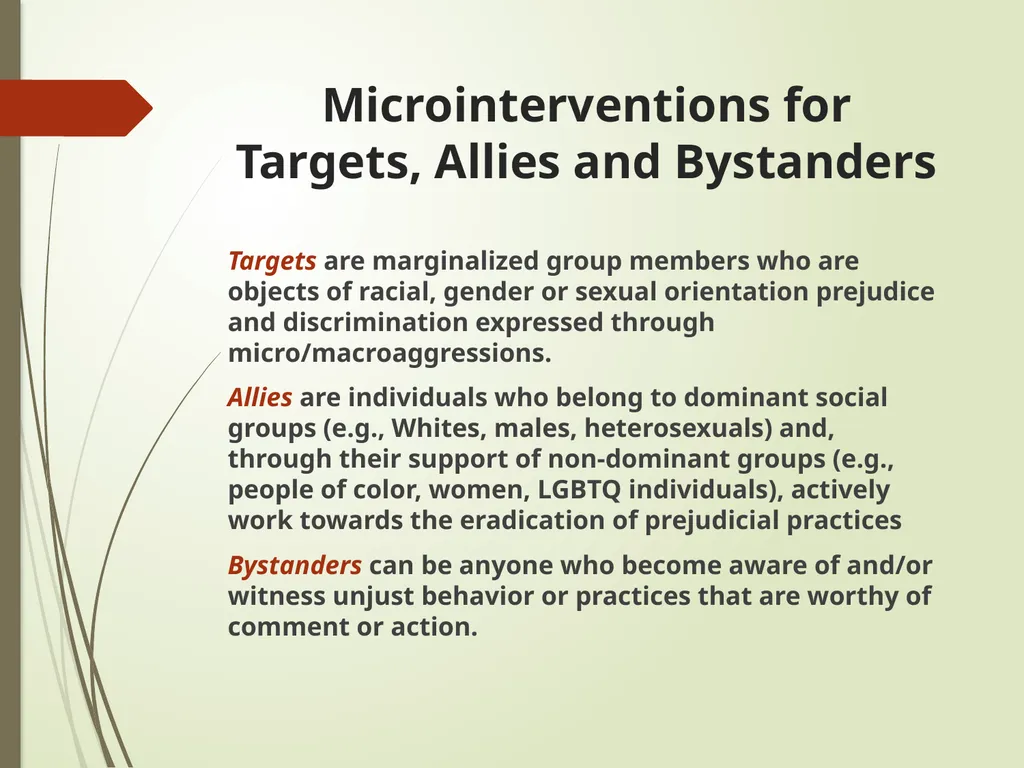
Targets, Allies and Bystanders Targets are marginalized group members who are objects of racial, gender or sexual orientation prejudice and discrimination expressed through micro/macroaggressions.
Allies are individuals who belong to dominant social groups (e.g., Whites, males, heterosexuals) and, through their support of non-dominant groups (e.g., people of color, women, LGBTQ individuals), actively work towards the eradication of prejudicial practices
Bystanders can be anyone who become aware of and/or witness unjust behavior or practices that are worthy of comment or action.<br>
Allies are individuals who belong to dominant social groups (e.g., Whites, males, heterosexuals) and, through their support of non-dominant groups (e.g., people of color, women, LGBTQ individuals), actively work towards the eradication of prejudicial practices
Bystanders can be anyone who become aware of and/or witness unjust behavior or practices that are worthy of comment or action.<br>
23
Microinterventions
Personal/Individual Level The strategic goals of microinterventions are fourfold:
(1) Make the “invisible” visible.
(2) Disarm the microaggression.
(3) Educate the offender about the meta-communications they send.
(4) Seek external support when needed.<br>
(1) Make the “invisible” visible.
(2) Disarm the microaggression.
(3) Educate the offender about the meta-communications they send.
(4) Seek external support when needed.<br>
24
Strategic Goal # 1: Make the “Invisible” Visible Objectives:
1. Bring the micro/macroaggression to the forefront of the person’s awareness.
2. Indicate to the perpetrator that they have behaved or said something offensive to you or others.
3. Force the perpetrator to consider the impact and meaning of what was said/done or, in the case of the bystander, what was not said/done.
Rationale:
1. Allows targets, allies and bystanders to verbally describe what is happening in a nonthreatening manner.
2. When allies and bystanders intervene, reassures targets that they are not “crazy” and that their experiences are valid.
3. When those with power and privilege respond, may have greater impact on perpetrator.<br>
1. Bring the micro/macroaggression to the forefront of the person’s awareness.
2. Indicate to the perpetrator that they have behaved or said something offensive to you or others.
3. Force the perpetrator to consider the impact and meaning of what was said/done or, in the case of the bystander, what was not said/done.
Rationale:
1. Allows targets, allies and bystanders to verbally describe what is happening in a nonthreatening manner.
2. When allies and bystanders intervene, reassures targets that they are not “crazy” and that their experiences are valid.
3. When those with power and privilege respond, may have greater impact on perpetrator.<br>
25
Strategic Goal # 1: Make the “Invisible” Visible 1. Disempower the innuendo by “naming” it.
Paulo Freire in Pedagogy of the Oppressed (1968) said the first step to liberation and empowerment is “naming” an oppressive event, condition or process so it no longer holds power over those that are marginalized.
It demystifies, deconstructs and makes the “invisible” visible.
Naming is (a) liberating and empowering because it provides a language for people of color to describe their experiences, and (b) reassures them that they are not “crazy.”
It forces those with power and privilege to consider the roles they play in the perpetuation of oppression.
“That’s a racist remark.”
“That’s a microaggression.”
“That’s a stereotype.”<br>
Paulo Freire in Pedagogy of the Oppressed (1968) said the first step to liberation and empowerment is “naming” an oppressive event, condition or process so it no longer holds power over those that are marginalized.
It demystifies, deconstructs and makes the “invisible” visible.
Naming is (a) liberating and empowering because it provides a language for people of color to describe their experiences, and (b) reassures them that they are not “crazy.”
It forces those with power and privilege to consider the roles they play in the perpetuation of oppression.
“That’s a racist remark.”
“That’s a microaggression.”
“That’s a stereotype.”<br>
26
Strategic Goal # 1: Make the “Invisible” Visible 2. Undermine the meta-communication.
White professor to 3rd generation Asian American student: “You speak excellent English!” (Microaggression = “You are a perpetual alien in your own country. You are not a true American.”
Asian American student to professor: “Thank you. I hope so. I was born here.” (Student acknowledges the conscious compliment, but undermines the unspoken assumption of being a foreigner.)<br>
White professor to 3rd generation Asian American student: “You speak excellent English!” (Microaggression = “You are a perpetual alien in your own country. You are not a true American.”
Asian American student to professor: “Thank you. I hope so. I was born here.” (Student acknowledges the conscious compliment, but undermines the unspoken assumption of being a foreigner.)<br>
27
Strategic Goal # 1: Make the “Invisible” Visible 3. Broaden the ascribed trait to a universal human behavior.
Rather than pointing out the inaccuracy of a stereotype, this tact makes the trait applicable to many or all groups.
“I think that applies to everyone.”
“I don’t think that’s a gender thing, men do it too.”
Statement: “Why are all the Black students seated together in the cafeteria? Why do they separate themselves from us?”
Counter: “I could ask the same question about Whites. Why are all the White people sitting together?”<br>
Rather than pointing out the inaccuracy of a stereotype, this tact makes the trait applicable to many or all groups.
“I think that applies to everyone.”
“I don’t think that’s a gender thing, men do it too.”
Statement: “Why are all the Black students seated together in the cafeteria? Why do they separate themselves from us?”
Counter: “I could ask the same question about Whites. Why are all the White people sitting together?”<br>
28
Strategic Goal # 1: Make the “Invisible” Visible 4. Ask for clarification of a statement or action.
GENERAL QUESTIONS
“Robert, what exactly do you mean?”
“Come again. Did I hear you correctly.”
“Do you realize what you just said?”
“I can’t believe you just said that. Tell me what you mean?”
SPECIFIC QUESTIONS
“Do you really believe all Latinos have a poor worth ethic?”
“What experiences do you have with African Americans that lead you to that conclusion?”
The intent of these questions is to (a) force the perpetrator to stop and consider what they just said or did, (b) communicate your disagreement or disapproval, and (c) encourage a further exploration of the belief or attitude of the person.<br>
GENERAL QUESTIONS
“Robert, what exactly do you mean?”
“Come again. Did I hear you correctly.”
“Do you realize what you just said?”
“I can’t believe you just said that. Tell me what you mean?”
SPECIFIC QUESTIONS
“Do you really believe all Latinos have a poor worth ethic?”
“What experiences do you have with African Americans that lead you to that conclusion?”
The intent of these questions is to (a) force the perpetrator to stop and consider what they just said or did, (b) communicate your disagreement or disapproval, and (c) encourage a further exploration of the belief or attitude of the person.<br>
29
Strategic Goal # 1: Make the “Invisible” Visible 5. Make the meta-communication explicit by restating/rephrasing the statement.
“You’re telling me that you’re not going to consider Jamal for the manager position because White co-workers aren’t ready for a Black boss.”
“In other words, you believe that women workers are less dependable than men because they will take time off to have children.”
“You mean that Black managers here wouldn’t have been promoted without some affirmative action program.”
“What you just said, make me believe you are prejudiced against Muslims.”
This method of confronting a microaggression or any form of biased statements is much more challenging than the previous strategies. It is meant, however, to make explicit the biased attitudes/beliefs of the person and allow them to face the meaning of their words and actions. It is meant to let the person “hear” what they may have said. It is likely to evoke defensiveness but is aimed at peeling away naiveté or innocence of perpetrators.<br>
“You’re telling me that you’re not going to consider Jamal for the manager position because White co-workers aren’t ready for a Black boss.”
“In other words, you believe that women workers are less dependable than men because they will take time off to have children.”
“You mean that Black managers here wouldn’t have been promoted without some affirmative action program.”
“What you just said, make me believe you are prejudiced against Muslims.”
This method of confronting a microaggression or any form of biased statements is much more challenging than the previous strategies. It is meant, however, to make explicit the biased attitudes/beliefs of the person and allow them to face the meaning of their words and actions. It is meant to let the person “hear” what they may have said. It is likely to evoke defensiveness but is aimed at peeling away naiveté or innocence of perpetrators.<br>
30
Strategic Goal # 1: Make the “Invisible” Visible 6. Reverse, redirect or mimic the statements or actions of the offender as if it was meant for the perpetrator.
This is a form of verbal or behavioral jujitsu that reverses the roles of perpetrator and target, and can be viewed as a form of humor or sarcasm.
The perpetrator now becomes the target of the remark or action, and its impact can become a learning opportunity for the offender.
White worker compliments an Asian American co-worker:
“You speak excellent English.”
The target responds:
“Thank you, John. You do too!”
White female to a Black female friend;
“You’re pretty for a dark girl.”
Black female to the White friend:
“Thank you. You’re pretty for a White girl.”
Reversal statements or actions are brief, succinct comebacks that have a powerful impact upon the offender.<br>
This is a form of verbal or behavioral jujitsu that reverses the roles of perpetrator and target, and can be viewed as a form of humor or sarcasm.
The perpetrator now becomes the target of the remark or action, and its impact can become a learning opportunity for the offender.
White worker compliments an Asian American co-worker:
“You speak excellent English.”
The target responds:
“Thank you, John. You do too!”
White female to a Black female friend;
“You’re pretty for a dark girl.”
Black female to the White friend:
“Thank you. You’re pretty for a White girl.”
Reversal statements or actions are brief, succinct comebacks that have a powerful impact upon the offender.<br>
31
Strategic Goal # 2: Disarm the Microaggression Objectives:
1. Instantly stop or deflect the micro/macroaggression.
2. Force the perpetrator to immediately consider what they have just said or done.
3. Communicate your disagreement or disapproval towards the perpetrator actions in the moment.
Rationale:
1. Provide targets, allies, and bystanders with a sense of control and self-efficacy to react to perpetrators in the here and now.
2. Preserves targets’ well being and prevents traumatization by or preoccupation with what transpired.
3. Allows perpetrator to think before they speak or behave in future encounters with similar individuals.<br>
1. Instantly stop or deflect the micro/macroaggression.
2. Force the perpetrator to immediately consider what they have just said or done.
3. Communicate your disagreement or disapproval towards the perpetrator actions in the moment.
Rationale:
1. Provide targets, allies, and bystanders with a sense of control and self-efficacy to react to perpetrators in the here and now.
2. Preserves targets’ well being and prevents traumatization by or preoccupation with what transpired.
3. Allows perpetrator to think before they speak or behave in future encounters with similar individuals.<br>
32
Strategic Goal # 2: Disarm the Microaggression 1. Interrupt the communication and redirect.
During the course of a conversation when a biased or misinformed statement is made, simply interrupt it by directly or indirectly stopping the monologue, and communicating your disagreement or displeasure. This is very effective when a racist or sexist joke is being told.
“Whoa, let’s not go there.”
“Danger, quick sand ahead.”
“I don’t want to hear the punchline, or that type of talk.” (Removing yourself from the conversation.)
Shaking your head and physically leaving the situation.<br>
During the course of a conversation when a biased or misinformed statement is made, simply interrupt it by directly or indirectly stopping the monologue, and communicating your disagreement or displeasure. This is very effective when a racist or sexist joke is being told.
“Whoa, let’s not go there.”
“Danger, quick sand ahead.”
“I don’t want to hear the punchline, or that type of talk.” (Removing yourself from the conversation.)
Shaking your head and physically leaving the situation.<br>
33
Strategic Goal # 2: Disarm the Microaggression 2. Express disagreement.
“That’s not how I view the situation.”
“I don’t agree with what you just said (or did).”
“That doesn’t sound right to me.”
“I don’t think that’s true at all.”
“I think you’re making an erroneous assumption.”<br>
“That’s not how I view the situation.”
“I don’t agree with what you just said (or did).”
“That doesn’t sound right to me.”
“I don’t think that’s true at all.”
“I think you’re making an erroneous assumption.”<br>
34
Strategic Goal # 2: Disarm the Microaggression 3. Describe what is happening.
“Every time I come over, I find myself becoming uncomfortable because you make statements I find offensive and hurtful.”
“What’s going on with you? You never seem to give due consideration to any of the ideas presented by the women on you work team.”<br>
“Every time I come over, I find myself becoming uncomfortable because you make statements I find offensive and hurtful.”
“What’s going on with you? You never seem to give due consideration to any of the ideas presented by the women on you work team.”<br>
35
Strategic Goal # 2: Disarm the Microaggression 4. Use an exclamatory short expression.
Say “Ouch” or something like “Aaah C’mon” Taken from Ouch! That Stereotype Hurts. Sunshower Learning (2007).
This is a very simple technique intended to (a) indicate to the perpetrator that they have said something offensive to you or others, (b) force the person to consider the impact and meaning of what they have said or done, and (c) facilitate a possible more enlightening conversation and exploration of his/her biases.
“Those people all look alike.” Ouch!
“He only got the job because he’s Black.” Aaah, C’mon!
“I’m putting you on the finance committee, because you people (Asian American) are good at that.” Ouch!<br>
Say “Ouch” or something like “Aaah C’mon” Taken from Ouch! That Stereotype Hurts. Sunshower Learning (2007).
This is a very simple technique intended to (a) indicate to the perpetrator that they have said something offensive to you or others, (b) force the person to consider the impact and meaning of what they have said or done, and (c) facilitate a possible more enlightening conversation and exploration of his/her biases.
“Those people all look alike.” Ouch!
“He only got the job because he’s Black.” Aaah, C’mon!
“I’m putting you on the finance committee, because you people (Asian American) are good at that.” Ouch!<br>
36
Strategic Goal # 3: Educate the
Offender Objectives:
1. Engage in a one-on-one dialogue with the perpetrator to indicate how and why their behavior is offensive to you and others.
2. Facilitate a possible more enlightening conversation and exploration of the perpetrator’s biases.
3. Encourage the perpetrator to explore the origins of their believes and attitudes toward targets.
Rationale:
1. Allows targets, allies and bystanders the opportunity to express their experiences while maintaining a relationship with the offender.
2. Lowers the defense of the perpetrator and helps them recognize the harmful impact.
3. Perpetrator becomes keen to microaggressions committed by those within their social circle and educates others.<br>
1. Engage in a one-on-one dialogue with the perpetrator to indicate how and why their behavior is offensive to you and others.
2. Facilitate a possible more enlightening conversation and exploration of the perpetrator’s biases.
3. Encourage the perpetrator to explore the origins of their believes and attitudes toward targets.
Rationale:
1. Allows targets, allies and bystanders the opportunity to express their experiences while maintaining a relationship with the offender.
2. Lowers the defense of the perpetrator and helps them recognize the harmful impact.
3. Perpetrator becomes keen to microaggressions committed by those within their social circle and educates others.<br>
37
Strategic Goal # 3: Educate the
Offender 1. Help microaggressors differentiate between good intent and harmful impact.
“I know you meant well, but that really hurts.”
“I know you meant it as a joke, but it really offended Aisha.”
“I know you want the women on this team to succeed, but always putting them on hospitality committees will only prevent them from developing leadership skills.”
“I know you kid around a lot, but think how your words affect others.”
“I know you meant it to be funny, but that stereotype is no joke.”<br>
“I know you meant well, but that really hurts.”
“I know you meant it as a joke, but it really offended Aisha.”
“I know you want the women on this team to succeed, but always putting them on hospitality committees will only prevent them from developing leadership skills.”
“I know you kid around a lot, but think how your words affect others.”
“I know you meant it to be funny, but that stereotype is no joke.”<br>
38
Strategic Goal # 3: Educate the
Offender 2. Contradict the group-based stereotype with opposing evidence by personalizing it to specific individuals.
Many stereotypes or negative statements are related to stereotyping an entire group; “every member shares the same trait.” Asking specifically who the person is talking about or providing information that contradicts the overgeneralization challenges the group stereotype.
“Are you talking about someone in particular?”
Statement: “Those Blacks just don’t have a good work ethic.”
Counter: “I think Eric and Juanita (both African American) work very hard and put in more time than most workers.”
Statement: “Those immigrants don’t even try to learn English.”
Counter: “Actually, I’ve met many immigrants who have learned to speak English well. It’s not easy. Have you ever tried to learn another language?”<br>
Many stereotypes or negative statements are related to stereotyping an entire group; “every member shares the same trait.” Asking specifically who the person is talking about or providing information that contradicts the overgeneralization challenges the group stereotype.
“Are you talking about someone in particular?”
Statement: “Those Blacks just don’t have a good work ethic.”
Counter: “I think Eric and Juanita (both African American) work very hard and put in more time than most workers.”
Statement: “Those immigrants don’t even try to learn English.”
Counter: “Actually, I’ve met many immigrants who have learned to speak English well. It’s not easy. Have you ever tried to learn another language?”<br>
39
3. Appeal to the offender’s values and principles.
“I know you really care about representing everyone on the task force and being a good leader, but acting in this way really undermines your intentions to be inclusive.” Strategic Goal # 3: Educate the Offender<br>
“I know you really care about representing everyone on the task force and being a good leader, but acting in this way really undermines your intentions to be inclusive.” Strategic Goal # 3: Educate the Offender<br>
40
4. Promote empathy.
“The majority of Latinos want the same things as you. Jesus works hard and wants to advance in his job and make enough to support his family. Do you know how he must feel to be described as being lazy and be deprived of a promotion opportunity? How would you feel if that happened to you? Can you place yourself in his shoes? Strategic Goal # 3: Educate the Offender<br>
“The majority of Latinos want the same things as you. Jesus works hard and wants to advance in his job and make enough to support his family. Do you know how he must feel to be described as being lazy and be deprived of a promotion opportunity? How would you feel if that happened to you? Can you place yourself in his shoes? Strategic Goal # 3: Educate the Offender<br>
41
Strategic Goal # 4: Seek External Reinforcement or Support Objectives:
1. Partake in regular self-care to maintain psychological and physical wellness.
2. Check in with self and others to ensure optimal levels of functioning.
3. Send a message to perpetrators at large that bigoted behavior will not be tolerated or accepted.
Rationale:
1. Mitigates impact of psychological and physiological harm associated with continual and cumulative exposure to microaggressions.
2. Reminds targets, allies, and bystanders that they are not alone in the battle.
3. Ensures situations of discrimination or bias do not go unnoticed.<br>
1. Partake in regular self-care to maintain psychological and physical wellness.
2. Check in with self and others to ensure optimal levels of functioning.
3. Send a message to perpetrators at large that bigoted behavior will not be tolerated or accepted.
Rationale:
1. Mitigates impact of psychological and physiological harm associated with continual and cumulative exposure to microaggressions.
2. Reminds targets, allies, and bystanders that they are not alone in the battle.
3. Ensures situations of discrimination or bias do not go unnoticed.<br>
42
Strategic Goal # 4: Seek External Reinforcement or Support Tactics or Best Practices:
1. Alert Leadership.
2. Report Incident.
3. Seek Therapy/Counseling.
4. Seek Spirituality/Religion/Community Support.
5. Establish a Buddy System.
6. Establish or Join a Support Group.<br>
1. Alert Leadership.
2. Report Incident.
3. Seek Therapy/Counseling.
4. Seek Spirituality/Religion/Community Support.
5. Establish a Buddy System.
6. Establish or Join a Support Group.<br>
43
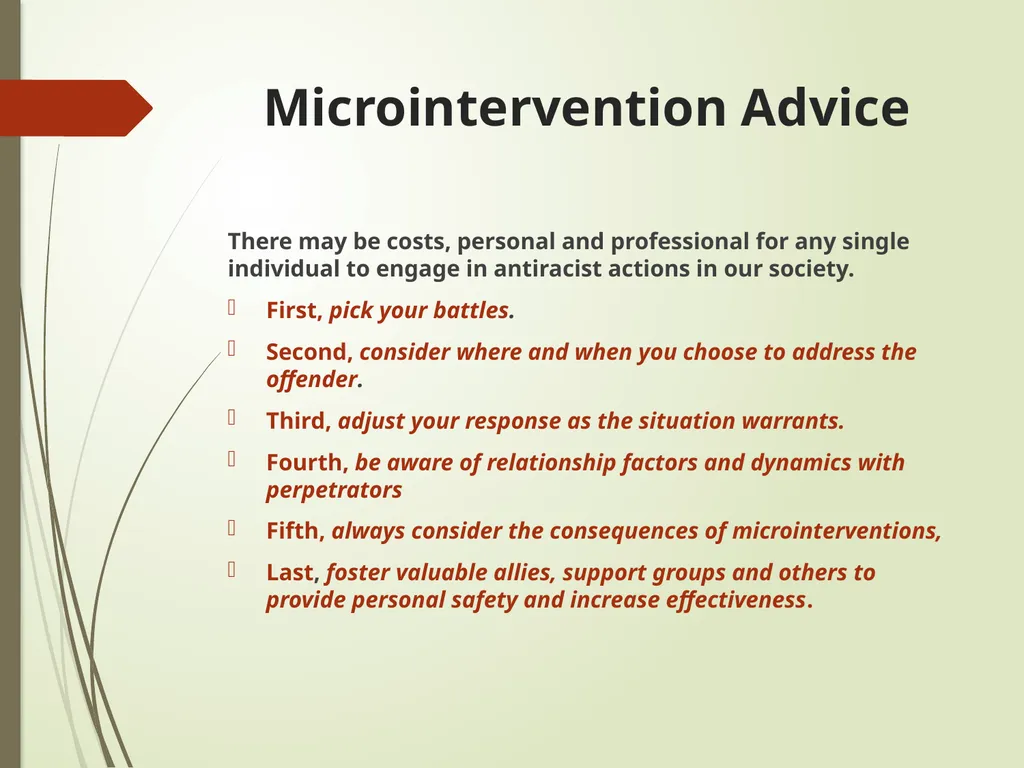
Microintervention Advice There may be costs, personal and professional for any single individual to engage in antiracist actions in our society.
First, pick your battles.
Second, consider where and when you choose to address the offender.
Third, adjust your response as the situation warrants.
Fourth, be aware of relationship factors and dynamics with perpetrators
Fifth, always consider the consequences of microinterventions,
Last, foster valuable allies, support groups and others to provide personal safety and increase effectiveness.<br>
First, pick your battles.
Second, consider where and when you choose to address the offender.
Third, adjust your response as the situation warrants.
Fourth, be aware of relationship factors and dynamics with perpetrators
Fifth, always consider the consequences of microinterventions,
Last, foster valuable allies, support groups and others to provide personal safety and increase effectiveness.<br>
44
FINIS Thank you all for your attention and patience.
Questions
Reactions
Comments<br>
Questions
Reactions
Comments<br>